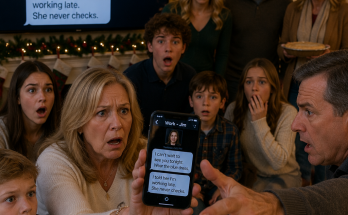
“Stop Pretending To Be Successful,” Sister Mocked At Her Reception. “Still In That Warehouse Job?” Mom Sneered. I Smiled Politely. Suddenly, Guests’ Phones Started Buzzing, “40 Under 40: Meet The Youngest Tech Billionaire…”
### Part 1
The chandeliers inside the Ashford Grand Ballroom scattered white light across five hundred guests, thousands of roses, and enough crystal glassware to stock a small hotel.
My sister Caroline had spent eighteen months designing the evening. Not planning it—designing it.
She had selected the exact shade of ivory for the tablecloths, rejected three orchestras before hiring a twelve-piece ensemble, and flown in a pastry chef to build a wedding cake taller than some children. Every place card had been handwritten. Every candle had been positioned according to a diagram.
Nothing about Caroline’s wedding was accidental.
That included where she had seated me.
Table twenty-nine stood near the service doors, where waiters pushed carts in and out beneath a drafty air vent. I was surrounded by distant cousins, two retired neighbors, and a dentist Caroline claimed she barely knew.
Honestly, I preferred it.
I had worn a plain navy dress, low heels, and the small silver earrings our grandmother left me. My goal was simple: congratulate Caroline, eat dinner, survive the family commentary, and leave before anyone became emotional from champagne.
For three years, that had been my strategy at family gatherings.
Blend in. Smile politely. Reveal nothing.
I was examining a centerpiece when my mother’s voice cut through the orchestra.
“Elena.”
There was a particular way Denise Brooks said my name when other people were listening. She stretched the first syllable and softened the second, making it sound affectionate while warning me that a performance was about to begin.
She approached with Aunt Linda beside her.
Linda’s eyebrows lifted as she looked me over. “There she is. Your mother was just telling me you’re still working at that warehouse.”
“It’s a distribution facility,” I said.
My mother gave Linda a knowing smile. “She likes to make it sound more sophisticated.”
The ballroom smelled of roses, expensive perfume, and the butter sauce being served with dinner. Somewhere behind me, silverware struck the floor.
Linda leaned closer. “How long has it been now? Four years?”
“Six,” my mother answered before I could. “Six years in the same industrial building.”
“I’ve changed positions.”
“That’s good,” Linda said with the careful encouragement adults use with a child showing them a drawing. “Are you supervising people now?”
“Sometimes.”
My mother sighed. “We keep hoping she’ll find something with a future.”
I looked toward the dance floor. Caroline and her new husband, Nathan, were posing beneath an arch of white flowers. Nathan was a respected surgeon, quiet and thoughtful, with the permanently tired eyes of someone who spent his life under hospital lights.
Caroline looked flawless beside him.
She had always known exactly how she wanted her life to appear.
“Elena says she’s happy,” my mother continued. “She lives in a studio near the old warehouse district and works strange hours. No husband. No boyfriend. No real social circle.”
“My apartment suits me.”
“A studio,” my mother repeated.
“It’s open-plan.”
Linda touched my wrist. “You were so bright in school, honey. That’s what makes it sad.”
Before I could respond, Caroline appeared beside us, trailing perfume and silk.
Her dress shimmered under the chandeliers. Her smile was perfect until she looked directly at me.
“You came,” she said.
“You invited me.”
“I wasn’t sure your demanding warehouse schedule would allow it.”
Nathan glanced at her, but Caroline had already turned toward him.
“This is my younger sister, Elena. She works in logistics.”
“Warehouse logistics,” my mother corrected.
Nathan offered his hand. “It’s nice to finally meet you.”
“You too. Congratulations.”
“Thank you.” He smiled. “Caroline mentioned you work nights.”
“Not anymore.”
Caroline laughed softly. “Listen to her. Mysterious as always.”
My uncle Gerald joined us carrying a martini. Then my cousin Owen and his wife, Rachel, wandered over. Within two minutes, I stood in the center of a familiar family circle.
Gerald asked whether I still moved boxes.
Owen offered to introduce me to a manager at his insurance company.
Rachel suggested community college.
Each comment arrived disguised as concern.
Each smile contained the same verdict.
Failure.
I kept my voice calm because arguing had never changed anyone’s mind. My family believed success announced itself through recognizable things: job titles, suburban houses, designer clothes, and spouses whose résumés sounded impressive over dinner.
They could not imagine that a woman might build something enormous without bringing it home for their approval.
Caroline accepted another glass of champagne from a passing server.
Then she examined my dress and smiled.
“Isn’t that the same thing you wore to Uncle Gerald’s retirement party?”
“Yes.”
She laughed loudly enough for the nearest tables to hear.
“Elena, honestly. Stop pretending you’re satisfied with so little.”
The conversations around us began to quiet.
I saw Nathan’s expression change.
And when Caroline turned fully toward me, I realized she had not approached merely to embarrass me.
She had been waiting all day to say something.
### Part 2
Caroline held her champagne glass by the stem and studied me as if I were a problem she had finally decided to solve.
“You always do this,” she said.
“Do what?”
“That calm little smile. That act where you pretend your life is exactly what you wanted.”
Owen shifted his weight. Rachel stared at the floor.
My mother said, “Caroline, this is your reception.”
“Exactly. It’s my reception, and I’m tired of pretending for Elena’s sake.”
The orchestra continued playing, but the musicians had softened, either because they sensed the tension or because half the room had stopped talking.
Nathan touched Caroline’s elbow. “Maybe this conversation can wait.”
“No. It has waited six years.”
She set her glass on a table so sharply that champagne spilled over the rim.
“You’re thirty-two years old,” she told me. “You work in a warehouse. You live alone in a run-down district. You wear the same three dresses to every family event, and you never bring anyone with you.”
“I wasn’t aware I was required to.”
“That attitude is exactly the problem.”
Her voice climbed. Guests at three nearby tables turned in their chairs.
“You think acting content makes you successful,” she continued. “It doesn’t. It makes you delusional.”
My mother did not stop her.
That hurt more than Caroline’s words.
Our father, Paul, was somewhere across the ballroom talking to Nathan’s relatives. My mother could have ended the conversation with a sentence. Instead, she pressed her lips together and watched as though Caroline were saying something unpleasant but necessary.
“I never claimed to be successful,” I said.
“You don’t have to claim it. You walk around acting like you’re above everyone’s advice.”
“I’ve thanked everyone for their advice.”
“And ignored it.”
“Yes.”
Someone nearby coughed to hide a laugh.
Caroline’s face flushed. “Do you know how many people asked me what you do?”
“I imagine you told them.”
“What was I supposed to say? That my sister moves inventory while everyone else in the family has built an actual career?”
Nathan stepped between us slightly. “Caroline, enough.”
She looked at him with disbelief. “You’re defending her?”
“I’m asking you not to humiliate your sister in front of our guests.”
“I’m trying to wake her up.”
“You’re being cruel.”
The word landed harder than anything I had said.
Caroline’s expression tightened. For a second, I thought she might stop. Then she looked around and saw the attention she had gathered.
My sister had always performed best before an audience.
“You don’t understand,” she told Nathan. “Elena was the smart one growing up. Teachers adored her. Everyone said she’d do extraordinary things. Then she graduated, disappeared into that warehouse, and decided mediocrity was some kind of moral virtue.”
“I took a job.”
“And never left.”
“That isn’t true.”
“Then explain it.”
The question produced a strange stillness inside me.
There were several ways I could have answered.
I could have told them about the first scheduling program I built on an old laptop during night shifts. I could have described sleeping beneath my desk during the winter our servers crashed every few hours. I could have mentioned negotiating contracts at dawn, signing payroll while eating vending-machine crackers, or watching our first overseas operations center open through a grainy video call.
Instead, I said, “I’m doing work that matters to me.”
Caroline laughed.
It was not a happy sound.
“Stop pretending to be successful, Elena.”
The sentence traveled farther than she intended.
The orchestra stopped.
The bow of the lead violinist hovered above the strings. Servers froze beside their carts. Hundreds of faces turned toward us beneath the chandeliers.
Caroline seemed energized by the silence.
“You are not successful,” she said. “You are the family embarrassment. I invited you because Mom said people would notice if you were missing. That’s the truth.”
My chest tightened, but I kept my arms loose at my sides.
“Thank you for being honest.”
She blinked, briefly thrown by my response.
Then she pointed at me.
“Look at her. She can’t even defend herself.”
My father pushed through the growing crowd. “What is going on?”
“Caroline is helping me understand my life,” I said.
“Don’t make jokes,” Caroline snapped. “You’ve wasted your potential, and everyone here knows it.”
Dad looked at Mom. Mom looked away.
That small movement told me everything.
They had discussed me before the wedding.
Perhaps they had even agreed Caroline should speak to me.
Caroline continued listing my failures: my apartment, my clothes, my lack of a husband, my supposedly entry-level salary. Every detail was sharpened and displayed for the room.
Then a phone buzzed.
Another followed.
Within seconds, a ripple of vibrations moved through the ballroom.
Guests began pulling phones from purses and suit jackets. Screens lit beneath the crystal chandeliers.
Owen glanced at his phone.
His face changed.
Rachel looked over his shoulder and covered her mouth.
“What?” Caroline demanded. “What is everyone staring at?”
My aunt Linda read something on her screen, then slowly lifted her eyes toward me.
“Oh my God,” she whispered.
At that moment, my own phone vibrated inside my purse.
The message was from my assistant.
The digital cover is live. Earlier than scheduled. We have a situation.
### Part 3
For three months, fewer than twenty people had known about the cover.
My executive team knew. Our legal counsel knew. The photographer knew. The magazine’s editorial staff knew.
My family did not.
I had agreed to the profile reluctantly after two years of refusing interviews. Meridian Route Systems had grown too large to remain faceless, and several competitors had begun inventing stories about who controlled it.
The magazine promised the digital edition would go live Monday morning.
It was Saturday night.
Caroline’s wedding night.
Owen turned his phone around.
The screen displayed a photograph of me in a charcoal suit, standing inside one of our automated distribution centers. Behind me, conveyor lines disappeared into blue-white light.
Across the top was the name Forbes.
Below my photograph was the headline:
Elena Brooks, 32: The Quiet Founder Who Rebuilt Global Logistics.
Caroline stared at the screen.
“What is that?”
No one answered.
She snatched Nathan’s phone from his hand and searched my name. Her fingers moved quickly at first, then slowed as the results appeared.
My mother stepped closer to Owen.
“That photograph looks like Elena.”
“It is Elena,” Rachel said.
“No.” Mom shook her head. “It can’t be.”
Uncle Gerald had begun reading the article aloud under his breath.
“Founder and chief executive… operations in twenty-three countries… fourteen thousand employees…”
He stopped and looked at me.
“You own Meridian Route Systems?”
“Yes.”
His martini tipped far enough to spill onto his cuff.
“The Meridian Route Systems?”
“As opposed to another one?”
Dad pulled out his phone. The blue light reflected across his glasses.
Caroline kept scrolling.
Her face had turned the color of her dress.
“This says the company is valued at nine-point-three billion dollars.”
“That estimate is high.”
A nervous laugh escaped someone in the crowd.
Caroline looked up sharply. “High?”
“Private-company valuations are imprecise.”
“This says your personal stake is worth more than four billion.”
“I don’t carry it in cash.”
No one laughed that time.
The ballroom doors opened behind us.
A silver-haired man entered carrying a flat black envelope, followed by a photographer and a younger woman from the magazine’s editorial team.
I recognized Julian Mercer, the editor who had spent months convincing me that public recognition could help us recruit engineers and expand our education foundation.
“Elena,” he said, approaching with a look that was both apologetic and amused. “I see you received the surprise.”
“You published early.”
“Our international team accidentally released the digital edition when scheduling the European launch. Once it started spreading, we couldn’t pull it back.”
“You could have warned me.”
“We tried. Your phone went directly to voicemail.”
I had turned it off during the ceremony.
Julian glanced around the silent ballroom. “I hope we haven’t disrupted anything.”
Caroline made a broken sound.
Julian seemed to notice her bridal gown for the first time.
“Oh,” he said. “This is the wedding.”
“The one I told you about.”
His expression became genuinely horrified. “I am so sorry.”
He held out the black envelope. Inside was the first printed copy of the issue.
The cover felt heavier than I expected. My own face looked unfamiliar—focused, polished, certain. It was the version of me my employees knew, not the woman who had spent family dinners quietly passing rolls while relatives suggested better jobs.
Julian turned to my parents.
“You must be proud.”
My mother opened her mouth.
Nothing came out.
Julian continued, unaware of the previous twenty minutes.
“What your daughter has accomplished is almost impossible to summarize. She transformed an overlooked scheduling tool into the backbone of one of the world’s most advanced supply networks.”
Caroline stared at me. “Scheduling tool?”
I looked at Julian. “You’ve started. You may as well finish.”
He nodded.
“Elena began while working night operations at the old Patterson distribution center. She noticed that trucks were spending hours idling because the existing software couldn’t adjust to real-time disruptions. She wrote an adaptive-routing program herself.”
My father frowned. “Elena doesn’t write software.”
“I taught myself.”
“When?”
“At night.”
Julian smiled. “Within six months, her program reduced delays at that facility by sixty-eight percent. The owner allowed her to test it at three additional warehouses. A year later, regional carriers were licensing it.”
Uncle Gerald whispered, “She told us she got promoted.”
“I did.”
“To what?” my mother asked.
“Director of systems.”
“You said supervisor.”
“You didn’t ask what I supervised.”
Julian continued.
“Elena acquired the original facility during a restructuring, merged with two transportation platforms, and expanded without surrendering control to outside investors. Meridian now coordinates critical shipments for hospitals, manufacturers, food distributors, and emergency-response networks.”
Nathan looked at me differently then—not with awe, but recognition.
“Our hospital system uses Meridian,” he said. “During last year’s shortages, your platform rerouted supplies to us.”
“I remember that project.”
“That prevented dozens of procedures from being canceled.”
Caroline’s hand tightened around his phone.
“You knew her company?”
“I knew the company,” Nathan said. “I didn’t know Elena founded it.”
Across the room, whispers swelled.
Guests searched articles, financial profiles, and interviews with my executives. Years of deliberate privacy unraveled in minutes.
My mother touched the printed cover.
“All this time,” she whispered, “you let us believe you moved boxes.”
I looked at the woman who had spent six years apologizing for me.
“No, Mom. All this time, you chose not to ask what I actually did.”
### Part 4
My mother pulled her hand away from the magazine as though the paper had burned her.
“We asked,” she said.
“You asked whether I was still at the warehouse.”
“And you always said yes.”
“I was.”
Caroline lifted her chin. Her tears had stopped, replaced by something sharper.
“This is insane. People do not secretly become billionaires.”
“I wasn’t keeping it secret from the world. I was keeping my personal life private.”
“You kept it secret from us.”
“Yes.”
The single word silenced her.
Around us, the wedding reception had transformed into a business conference. Guests who had ignored me during cocktail hour were now standing in clusters, reading about Meridian’s growth. Several appeared to be searching for connections through mutual acquaintances.
A man I had never met approached and introduced himself as a commercial developer.
“I would love ten minutes to discuss a distribution project.”
“Not tonight.”
A woman from Nathan’s extended family began explaining that her company used our forecasting software.
“Please contact our office on Monday.”
Within minutes, people were forming an informal line.
I stepped backward.
“This is Caroline’s wedding,” I said. “Please return to your tables.”
The guests moved reluctantly, though many kept glancing at me.
Caroline laughed under her breath.
“You think asking them to sit down fixes this?”
“I didn’t arrange the release.”
“But you agreed to the cover.”
“Yes.”
“And you knew it was coming.”
“Monday.”
“You could have warned me.”
“Why?”
“Because this is my wedding.”
“I did not expect it to publish tonight.”
“But if it had come out Monday, you would still have humiliated me.”
I stared at her.
“You spent twenty minutes calling me a failure in front of five hundred people.”
“Because I didn’t know.”
“That is not a defense.”
“It changes things.”
“No. It reveals things.”
Nathan lowered his gaze.
Caroline looked around at the people who had witnessed everything. The perfect bride who had entered the ballroom expecting admiration was now being observed with discomfort, curiosity, and quiet judgment.
She pointed at the magazine in my hand.
“You stood there and let me say all those things.”
“Yes.”
“Why?”
“Because I wanted to hear how far you would go.”
Her expression collapsed slightly.
“You were testing me?”
“No. A test is something someone knows they are taking. I was listening.”
Our father stepped forward. “Elena, that isn’t fair.”
“Which part?”
“We believed you were struggling.”
“You believed I was beneath you.”
“We were worried.”
“You were embarrassed.”
Mom’s eyes filled. “We offered you money.”
“You offered me money and reminded me of it at every holiday, even though I never accepted.”
“We were trying to help.”
“Last Christmas, you asked me not to discuss work with Nathan because you didn’t want Caroline to feel awkward.”
My mother’s lips parted.
Caroline looked toward her. “You said that?”
“She said a warehouse job would sound unimpressive beside your medical careers.”
“I was protecting everyone from an uncomfortable conversation,” Mom said.
“By erasing me.”
Dad rubbed the bridge of his nose. “We made assumptions. We were wrong.”
“You were wrong about my income. You were not confused about how you treated me.”
Julian Mercer remained nearby, looking as though he wanted to disappear into the carpet. He stepped closer and spoke quietly.
“I can have my team leave.”
“Please do.”
He nodded, then paused. “For what it’s worth, Elena, the article focuses on the work. Not the money.”
“That was the agreement.”
“It’s already the most-read business profile we’ve published this year.”
“I’ll deal with that tomorrow.”
He squeezed my shoulder briefly and departed with his staff.
My aunt Linda appeared at my side.
“Honey, I feel terrible.”
“Do you?”
“Of course. We had no idea.”
“An hour ago, you said it was sad that I had wasted my intelligence.”
“I misunderstood.”
“You believed a warehouse worker deserved pity. Now you know I own the warehouse, so suddenly I deserve respect.”
Linda flinched.
“That isn’t what I meant.”
“It is exactly what you meant.”
Owen approached next.
He looked genuinely ashamed. “I offered you an entry-level insurance job at Thanksgiving.”
“Three Thanksgivings.”
“Right.”
“You also asked whether my apartment accepted rent assistance.”
His ears turned red.
“I was being an arrogant idiot.”
“Yes.”
Rachel touched his arm. “At least he admits it.”
Caroline watched everyone apologize to me. With each apology, her expression grew more desperate.
Finally, she stepped close enough that only I could hear her.
“Tell them it was a misunderstanding.”
“It wasn’t.”
“Tell them I was emotional.”
“You were clear.”
“Tell them I didn’t mean it.”
I looked into her tear-streaked face.
“Did you mean it when you believed I had nothing?”
She did not answer.
That was an answer.
Nathan guided her toward the bridal table, but Caroline pulled away and grabbed my wrist.
“Please,” she whispered. “You cannot leave me alone in this.”
I slowly removed her hand.
“You made sure I was alone in it for six years.”
### Part 5
The orchestra started again, cautiously, as if music could persuade the room that nothing unusual had happened.
A slow song filled the ballroom.
No one danced.
Caroline sat at the bridal table with her hands clenched in her lap. Two bridesmaids hovered beside her, uncertain whether to comfort her or pretend not to have heard what she had said.
I wanted to leave.
That had been my plan even before the disaster: stay through dinner, congratulate the couple, go home. Now the exit seemed miles away, separated from me by hundreds of curious faces.
Nathan approached while Caroline’s parents-in-law spoke to her.
“Elena, may I talk to you?”
We stepped into a quieter hallway near the coatroom. The air smelled of coffee and lemon furniture polish. Through the closed ballroom doors, I could hear the muted pulse of the orchestra.
“I’m sorry,” Nathan said.
“You didn’t do anything.”
“I should have stopped her sooner.”
“You tried.”
“Not soon enough.”
He leaned against the wall and loosened his tie.
“I knew Caroline compared herself to people. I didn’t realize how much of her confidence depended on believing she was doing better than you.”
“She has always needed a scoreboard.”
“She loves you.”
I looked at him.
He winced. “That sounded weak.”
“It sounded familiar.”
Nathan glanced toward the ballroom. “She’s devastated.”
“I know.”
“She believes everyone will remember her wedding for this.”
“They probably will.”
He gave a humorless laugh. “You don’t soften things.”
“I spent years softening things. It didn’t help.”
He rubbed his jaw. “She wants to apologize.”
“She wants the consequences to disappear.”
“That may be true tonight. But she could still be sorry.”
“I hope she becomes sorry. For her sake, not mine.”
Nathan studied me carefully. “You’re done with her.”
“I’m done participating in a relationship where my value changes according to what people think I earn.”
“She’s your sister.”
“That explains why I gave her so many chances. It doesn’t obligate me to keep giving them.”
The ballroom doors opened.
My father stepped into the hallway.
“There you are.”
Nathan excused himself, leaving Dad and me beneath the bright wall sconces.
Dad looked older than he had during the ceremony. His shoulders sagged, and a deep line had appeared between his eyebrows.
“I’ve been reading about you,” he said.
“That must feel strange.”
“It does.”
He held up his phone.
“There are photographs of you with government officials, industry leaders, university presidents.”
“Work events.”
“You funded an engineering center.”
“Through the Meridian Foundation.”
“Two hundred million dollars.”
“Over several years.”
Dad lowered the phone. “Why would you tell strangers about your life and not us?”
“I didn’t tell strangers. The foundation files public reports.”
“You know what I mean.”
I folded my arms.
“The first year, I tried to tell you.”
He frowned.
“At your birthday dinner,” I continued. “I told you I was developing software that could reduce shipping delays.”
“You said you were working on a computer project.”
“Before I could explain, Caroline laughed and said I had watched too many startup documentaries.”
Dad looked down.
“You laughed too.”
“I don’t remember.”
“I do.”
A cart squeaked down the distant hallway. Someone opened the kitchen door, releasing a burst of warm air scented with roasted meat.
“The second year,” I said, “I told Mom we had signed our first national contract. She said it was nice that my employer trusted me with paperwork.”
Dad shut his eyes.
“The third year, I brought a business journal with an article about Meridian. Caroline placed her purse on top of it and spent dinner talking about her residency.”
“You could have insisted.”
“I could have begged you to be interested.”
His face tightened.
“That isn’t fair.”
“It is completely fair. You saw what you expected to see. Once I understood that, I stopped offering pieces of myself for you to dismiss.”
He was silent for several seconds.
Then he said, “We can fix this.”
“No.”
The firmness of my answer startled him.
“We can apologize. We can learn. We can be better.”
“You can become better. I hope you do.”
“But not with you?”
“Not closely.”
His eyes reddened.
“We’re your family.”
“You were my judges. Family was the word you used to justify access.”
He reached for my arm but stopped before touching me.
“We loved you.”
“I believe you loved the version of me that stayed quiet enough to make your cruelty comfortable.”
From the ballroom came the sharp sound of a microphone switching on.
Then Caroline’s voice trembled through the speakers.
“Elena, please come back inside.”
My father looked toward the doors.
So did I.
And when Caroline said she wanted to tell all five hundred guests “the truth about my sister,” I knew she was about to make the evening worse.
### Part 6
When I returned to the ballroom, Caroline stood alone on the dance floor holding a microphone.
Her veil had been removed. Her mascara had left gray shadows beneath her eyes. Nathan stood near the bridal table, his expression tense.
Every guest watched me walk through the doors.
Caroline extended one hand.
“Elena, please.”
I stopped several feet away.
She swallowed.
“I owe my sister an apology.”
A few guests shifted in their seats.
“I said terrible things tonight,” she continued. “I called her a failure. I mocked her job, her home, her clothes, and her personal life. I did it because I thought…”
Her voice broke.
She looked at me.
“I thought I was better than her.”
The microphone carried her confession to every corner of the room.
“I was wrong. Elena is the founder of one of the most successful technology companies in the country. She has accomplished more than I understood was possible.”
Several guests began to clap.
I raised one hand.
The applause stopped.
Caroline’s face tightened.
“You still don’t understand,” I said.
She lowered the microphone. “I’m apologizing.”
“You are replacing one ranking with another.”
“What?”
“You believed I was worthless because you thought I had a low-paying job. Now you believe I deserve an apology because you discovered I am wealthy.”
“That isn’t what I said.”
“It is what you said. You listed my financial achievements as evidence that your insults were wrong.”
She stared at me.
“If I truly were a warehouse worker,” I asked, “would I have deserved what happened tonight?”
“No.”
Her answer came too slowly.
I stepped closer.
“What if I lived in a small apartment because that was all I could afford? What if I wore this dress because buying another one would mean missing a bill? What if I had worked the same shift for six years because it provided health insurance and stability?”
Caroline gripped the microphone with both hands.
“I still shouldn’t have treated you that way.”
“No, you shouldn’t have.”
“I know that now.”
“You know people are judging you now.”
A murmur moved through the room.
Her cheeks flushed.
“You think this apology is about my reputation?”
“I think your reputation is the first consequence you have ever been unable to hand to someone else.”
Nathan looked down.
My mother stood near the front table with tears on her face. Dad remained by the doors.
Caroline’s voice dropped.
“What do you want from me?”
“Nothing.”
“That is not fair. I’m trying to make this right.”
“You cannot make six years right during a wedding speech.”
“Then tell me what to do.”
“Live with what you did.”
She recoiled.
I had not raised my voice. I had not insulted her. Still, the truth struck harder than anger would have.
Caroline placed the microphone on a nearby table.
“Do you hate me?”
“No.”
That seemed to surprise her more than yes.
“I don’t hate you,” I continued. “Hatred requires attention. I spent too much of my life caring what this family thought. I’m not spending more of it punishing you.”
Her mouth trembled.
“Then forgive me.”
“I may eventually forgive what happened for my own peace. That does not mean I will trust you again. It does not mean we return to Sunday dinners and holiday photographs. It does not mean you receive access to my life because you finally know its price.”
“My price?” she whispered.
“The number attached to me changed. Your behavior changed with it.”
“I’m still your sister.”
“And I was still your sister an hour ago.”
The room became completely silent.
Caroline looked around, perhaps searching for someone to defend her. No one did.
I turned toward Nathan.
“Your wedding ceremony was beautiful. I hope your marriage becomes kinder than this reception.”
He nodded, his face solemn.
Then I looked at my parents.
“I will have my assistant send you a number where you can leave messages. Do not come to my home or office without an invitation.”
Mom covered her mouth.
Dad whispered, “Elena.”
“I mean it.”
I walked toward the exit.
This time, no one tried to stop me.
Outside, rain had begun tapping against the ballroom’s glass awning. My driver, Caleb, pulled the car forward while camera flashes erupted beyond the property gates.
The story had already escaped the ballroom.
Reporters were shouting my name.
As Caleb opened the door, I saw another notification from my communications director.
The wedding video is online. Someone streamed the entire confrontation.
The Forbes cover had revealed my career.
Now the world was about to meet my family.
### Part 7
By sunrise, a twelve-minute video of Caroline humiliating me had been viewed more than eight million times.
I watched exactly forty seconds.
That was enough.
The clip began with Caroline saying, “Stop pretending to be successful,” and ended with Julian Mercer placing the Forbes issue in my hands. Someone had added captions and dramatic music. Comment sections were filled with strangers arguing about wealth, family, jealousy, and whether I had planned the reveal.
I had not.
By eight in the morning, three news vans were parked outside my building. Security guards blocked the lobby while photographers gathered across the street beneath umbrellas.
My quiet life was gone.
I stood barefoot in my kitchen, drinking coffee from a chipped ceramic mug while my communications director, Simone Price, spoke through the speakerphone.
“We have interview requests from every major network,” she said. “Several want you and Caroline together.”
“No.”
“I assumed.”
“No family interviews. No response to the wedding video. We discuss Meridian, our employees, and the foundation. Nothing personal.”
“That may be difficult. Your sister posted an apology.”
I closed my eyes.
“What did she say?”
“That she had been under emotional pressure, consumed too much champagne, and reacted to years of concern for your well-being.”
“So she blamed alcohol and concern.”
“She also said she is proud of you.”
“Of course she is.”
Simone paused. “There’s more. Your mother gave a comment to a reporter outside the hotel.”
I set down my mug.
“My mother spoke to the press?”
“She said the family always knew you were talented and had supported you during difficult years.”
A laugh escaped me.
It sounded unfamiliar in the empty apartment.
My home was technically an open-plan penthouse, though I had always called it a studio. The fourth floor of the converted warehouse contained my kitchen, office, bedroom platform, library, and a wall of windows overlooking the river.
My family had never visited.
They had assumed I was embarrassed by the neighborhood.
In reality, the building belonged to me, as did the three renovated blocks surrounding it. Downstairs, teams of engineers were developing the next version of our emergency-routing platform.
“Do we correct her?” Simone asked.
“No. We do not fight my family through the media.”
“Understood.”
“Release the statement about the education initiative.”
The announcement had been planned for Monday: a new scholarship program for students working full-time while studying engineering or supply-chain management.
People like the younger version of me.
People whose intelligence might be overlooked because they wore safety vests instead of suits.
After the call, I turned on my personal phone.
There were 214 messages.
Some came from relatives who had barely spoken to me in years.
Aunt Linda wanted to “reconnect.”
Uncle Gerald had a business proposal.
Owen wanted to apologize over lunch.
A second cousin asked whether Meridian offered internships.
My mother had called twenty-nine times.
Caroline had sent a long message at 4:17 a.m.
I know I destroyed everything. I know saying sorry isn’t enough, but please don’t erase me from your life. I was jealous of you long before I knew the truth. You never seemed to need anyone. I built my identity around being the accomplished daughter because I thought it was the only thing I had that you didn’t. When I saw you standing there calm and happy, I wanted to break that calm. I wanted you to feel smaller so I could feel safe. I am ashamed.
It was the first honest thing she had said.
I read it twice.
Then I archived the message without responding.
Honesty did not undo harm. Sometimes it merely identified it accurately.
Three days later, my parents arrived at Meridian headquarters without an appointment.
Security called from the lobby.
“They say they’re your mother and father.”
“They are.”
“Should I send them up?”
“No.”
Through the glass wall of my office, I could see the river reflecting the cold afternoon light. Employees moved between conference rooms carrying laptops and coffee.
Six years of work surrounded me.
“Ask them to leave,” I said.
Ten minutes later, my father sent a photograph.
He and my mother stood outside the building holding a cardboard box containing my childhood trophies, school photographs, and a framed certificate from a science fair.
Your mother thought you might want these. We want to remember who you were before all this.
I looked around my office.
Before all this, I had been exactly the same person.
They simply had not considered her worth knowing.
### Part 8
Six months after Caroline’s wedding, the noise finally began to fade.
The Forbes issue remained framed in Meridian’s lobby because my employees insisted on it. I refused to hang a copy in my home.
I appeared in one carefully controlled interview, but I spoke almost entirely about our work. I described the mechanics who had helped test my first routing model, the drivers who explained why elegant software often failed on real roads, and the night-shift employees who understood inefficiencies executives never saw.
When the interviewer asked about the wedding video, I said, “No profession determines a person’s dignity. That is the only part of the story worth repeating.”
Then I changed the subject.
Our scholarship program received more than forty thousand applications. We expanded it twice before the end of the year.
My family continued trying to reach me.
I met my parents once in a quiet restaurant near the river.
Mom arrived carrying a new handbag and wearing the careful expression she used when entering a room where she was unsure of her status. Dad looked exhausted.
For ninety minutes, they apologized.
Some of it was sincere.
They admitted that Caroline’s achievements had been easier to understand. Medical school, a white coat, a prestigious marriage—those things fit the story they knew how to tell.
My work did not.
“We should have been curious,” Dad said.
“Yes.”
“We should have respected you even if you truly worked on a loading dock.”
“Yes.”
Mom twisted her napkin. “Can we start over?”
“No.”
She began to cry.
I did not enjoy hurting her. That was the part they never understood. Distance was not revenge. It was maintenance.
“I’m not asking you to start over as if nothing happened,” she said. “I’m asking for a chance.”
“You had thousands of chances. Every phone call was a chance to ask about my life instead of correcting it. Every dinner was a chance to listen. Every holiday was a chance not to use me as the family warning story.”
“We can change.”
“I hope you do.”
“But you won’t be there to see it?”
“Not closely.”
We left without hugging.
I felt sad for several days afterward, but I did not regret the decision.
Caroline’s marriage survived, though not easily. Nathan contacted me once—not to pressure me, but to say they had begun counseling. He apologized again for the wedding and promised not to contact me unless I reached out first.
I appreciated that.
Caroline sent a handwritten letter on the anniversary of the wedding. She did not mention my wealth. She did not ask me for forgiveness. She wrote that she had changed hospitals, reduced her social commitments, and started volunteering at a clinic where many patients worked the kinds of jobs she once mocked.
I believed she was trying.
I also understood that her growth did not require my participation.
I placed the letter in a drawer.
Maybe one day I would answer.
Maybe I would not.
My life became fuller after I stopped spending energy preparing for family judgment. I traveled to our facilities, visited scholarship recipients, and began taking Saturday mornings off for the first time in years.
I also bought another navy dress.
It looked almost identical to the old one.
Simone laughed when she saw it.
“You’re a billionaire. You know you can purchase clothing in other colors.”
“I like navy.”
A year after the wedding, I attended a scholarship ceremony inside our original distribution center. The building had been renovated, but I could still identify the corner where I had placed my dented laptop between stacks of shipping manifests.
A young woman named Tessa approached after the ceremony. She worked nights at a grocery warehouse while completing a degree in computer science.
“My family thinks I’m wasting my life,” she said.
I knew the tightness in her voice. I knew the embarrassment of being measured by people who had never bothered to understand the work.
“Are you?”
“No.”
“Then keep going.”
She glanced toward the framed Forbes cover displayed near the entrance.
“Did you always know you would become that successful?”
“Not even slightly.”
“What did you know?”
I looked across the active warehouse. Conveyor belts hummed. Forklifts beeped in the distance. Sunlight poured through high industrial windows, illuminating dust in the air.
“I knew I had found a problem worth solving,” I said. “And I knew the people laughing at me had not looked closely enough to see it.”
That evening, I returned home and stood on my balcony overlooking the warehouse district.
The river reflected the orange edge of sunset. Trains moved along the far bank. Below me, the buildings I had purchased and restored glowed with office lights.
My phone buzzed.
It was a message from Caroline.
I saw your scholarship interview. You were right. You were always the same person. I’m sorry we needed a magazine cover to notice.
I read the words without anger.
Then I placed the phone on the table and went inside.
I did not respond.
Forgiveness, I had learned, did not always look like reunion. Sometimes it meant releasing the hope that people would become what you once needed them to be.
Caroline had told me to stop pretending to be successful.
The truth was, I had never pretended.
I had simply stopped performing my life for people committed to misunderstanding it.
The Forbes cover changed what the world knew about me.
It did not change who I was.
And it did not earn my family another chance to decide what I was worth.
THE END!