My daughter’s birthday had arrived, and her only wish was for a burger from her favorite spot. It was her ‘little dream, and I wanted to make it happen. However, upon our arrival, the waiter gave us a mocking reception. With a smirk, he said, ‘REALLY? THIS IS HER BIG BIRTHDAY WISH!?
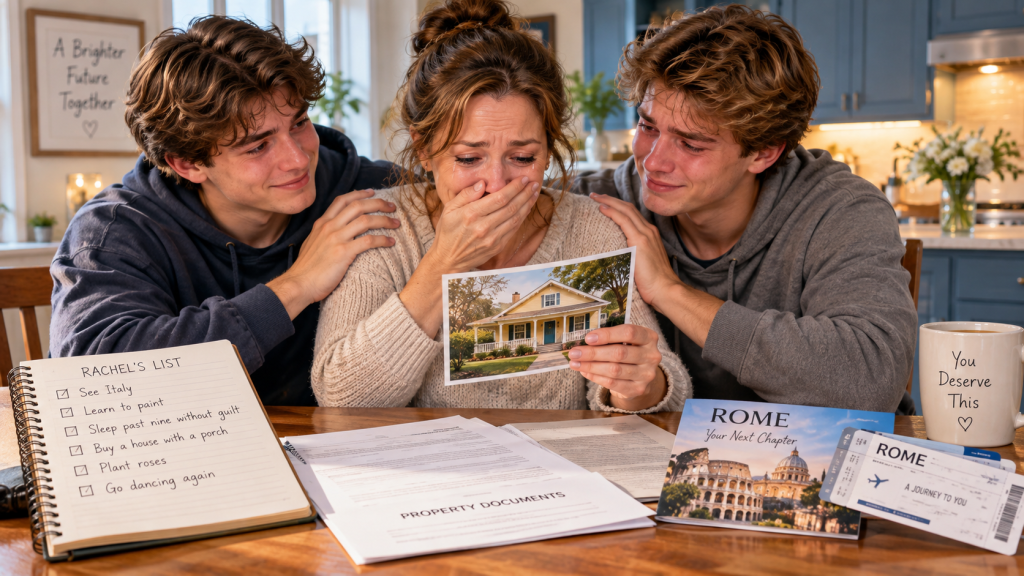
“That’s the part we’ve been terrified to tell you.” Noah’s voice trembled, and for a moment I forgot to breathe. I looked down at the photograph in my hand again. It was the little yellow house I had once dreamed of buying when I was twenty-four,

back when I still believed my life would unfold in ordinary ways. I had shown Daniel a picture of it years ago and joked that someday I wanted a kitchen with blue cabinets, a garden full of roses, and a porch wide enough to sit on during summer storms. After he died, that dream disappeared so completely that I had almost forgotten it belonged to me. “Why do you have a picture of this house?” I whispered. Mason leaned forward, his eyes bright with tears. “Because it’s yours.” I laughed automatically, certain I had misunderstood him. “What?” Noah slid the papers closer. “Not this exact house. It sold years ago. But one almost identical to it came on the market six months ago, twelve minutes from here.” My eyes dropped to the documents. There was an address, photographs, mortgage paperwork, and a bank statement showing a down payment so large that my stomach turned. “Where did this money come from?” I asked. The twins exchanged another glance. Mason opened the little black notebook. Inside were pages of dates, amounts, and handwritten calculations stretching back six years. “When we were twelve, we heard Aunt Melissa asking you why you never went to Italy.” My heart squeezed. Noah continued softly. “You told her you couldn’t afford it because braces were more important.” I remembered that conversation. I had laughed when I said it, as though it meant nothing. Apparently, two boys in the hallway had been listening. “That night,” Mason said, “we decided we were going to pay you back someday.” “Pay me back?” My throat tightened. “You don’t pay someone back for loving you.” “We know,” Noah said. “That’s why it stopped being about paying you back.” They told me everything. At twelve, they started putting aside birthday money instead of spending it. At thirteen, they washed cars and mowed lawns. At fourteen, Mason began repairing old computers for neighbors while Noah bought damaged bicycles, fixed them, and sold them online. By sixteen, the two of them had turned their tiny savings into a small online resale business. They sold refurbished electronics, old collectibles, and eventually handmade furniture Noah built in the garage. I remembered the late nights, the boxes arriving, the packages stacked near the door. I had assumed it was a hobby. I never knew they were saving almost every dollar. “We kept enough for expenses,” Mason said. “The rest went into an account.” “How much?” I asked. Noah pointed at the statement. My eyes found the number, and the room blurred. Ninety-four thousand dollars. I covered my mouth. “No.” “Aunt Rachel—” “Absolutely not.” I pushed the papers away. “That money is for your future. College. Cars. Apartments. Anything you need.” Mason smiled sadly. “College is covered.” “What do you mean?” “We both got scholarships.” I stared at them. They had told me about partial scholarships, never full ones. “We didn’t want you to know until tonight,” Noah said. “Mine covers tuition and housing. Mason’s covers almost everything, and his business income covers the rest.” My eyes filled so quickly I could barely see them. “You lied to me.” “Technically,” Mason said with a weak smile, “we strategically omitted several details.” I laughed through my tears, and suddenly we were all crying. Noah reached across the table and took my hand. “The down payment is already in escrow. We talked to a lawyer. The house is going only in your name. No loans in ours. No conditions.” “I can’t take this.” “Yes, you can,” Mason said. His voice broke. “Because we watched you spend thirteen years saying ‘I can’t’ whenever something was for you.” That sentence shattered me. I remembered all the small things I had dismissed without thought: the shoes I put back on shelves, the birthdays I barely celebrated, the dates I canceled, the vacations I never took. I had never considered myself unfortunate. I had simply built my life around them. “There’s more,” Noah whispered. He turned the notebook to the final page. Written across the top were the words RACHEL’S LIST. Beneath them were things I had mentioned casually over the years: See Italy. Learn to paint. Sleep past nine without guilt. Buy a house with a porch. Plant roses. Go dancing again. I touched the page with trembling fingers. “You remembered all this?” Mason laughed softly. “You remembered everything about us.” Then Noah reached beneath his chair and placed a smaller envelope on the table. Inside were two plane tickets to Rome, leaving six weeks later. This time, I couldn’t hold myself together. I bent forward and sobbed, not because of the money or the house or even Italy, but because the boys I had spent my life protecting had grown into men who had quietly been protecting pieces of me I didn’t realize I had lost. They came around the table and wrapped their arms around me, just as they had when they were five years old and terrified of sleeping alone. Only now they were taller, stronger, and somehow holding me up. “You gave us a childhood,” Mason whispered against my shoulder. “Let us give you something back.” Six months later, we moved the final box into my new yellow house. The kitchen had blue cabinets. The porch was wide enough for three chairs. Along the fence, Mason and Noah planted twelve rose bushes while arguing about which one would bloom first. That evening, we sat outside beneath a violet sky and watched the first summer storm roll across the horizon. I thought about Daniel and Laura, about the frightened children they had left behind, and about the life I once believed I had sacrificed. I finally understood that love had not stolen those thirteen years from me. Love had filled them. And as Noah handed me a cup of tea and Mason rested his feet on the porch railing, I realized something else: I had spent half my life believing I was the one who saved them. The truth was, in ways I would spend the rest of my life discovering, they had saved me too.
PART 2 — THE MONEY DANIEL LEFT SO I WOULDN’T DISAPPEAR
For the first three weeks after moving into the yellow house, I tried very hard not to turn happiness into another responsibility.
That was harder than it sounds.
I had spent thirteen years measuring my life in terms of what Noah and Mason needed.
School forms.
Dentist appointments.
Groceries.
Soccer cleats.
Broken laptops.
College applications.
Nightmares.
Fevers.
Driving lessons.
The emotional catastrophe of one disastrous middle-school haircut that Mason still insisted had been “misunderstood by society.”
There was always something.
Now both boys were eighteen.
Their scholarships were confirmed.
Their businesses were doing better than I had ever understood.
And somehow I was standing in the kitchen of a yellow house with blue cabinets because two children I had raised had quietly spent six years building me a down payment.
Every morning, I walked downstairs and still felt as though someone might knock on the door and explain there had been a clerical error.
No one did.
The house remained mine.
That fact took time to settle inside me.
I did not spend their entire ninety-four thousand dollars.
That had been my first condition once I stopped crying long enough to become irritating.
Their lawyer—because apparently my boys had lawyers now—helped structure the gift properly.
Enough went toward the down payment to make the monthly mortgage comfortable.
The rest remained theirs.
They complained.
I ignored them.
Parenting did not end because they had discovered spreadsheets.
“If the water heater explodes,” I told them, “I am not calling two college freshmen for emergency capital.”
Mason frowned.
“We could build a reserve.”
“No.”
“Diversified—”
“No.”
Noah leaned toward him.
“She’s becoming hostile to financial planning.”
“I raised you.”
I reminded them.
“I know exactly how to become hostile.”
That ended the discussion.
Temporarily.
The roses went in first.
Twelve bushes.
Noah planted them too deep.
Mason planted them too shallow.
They spent an hour arguing over whose technique would kill them faster.
I sat on the porch drinking tea and refused to intervene.
A woman should be allowed to enjoy the natural consequences of adult children ignoring gardening instructions.
That evening, rain moved over the fields.
We sat outside together.
Three chairs.
Exactly enough.
For the first time in years, I felt something inside me unclench.
Not heal completely.
Just loosen.
I thought maybe the hardest part of our story was over.
That was before the certified envelope arrived.
It came on a Tuesday.
Noah brought it inside.
“Mail for you.”
I was unpacking dishes.
“Put it on the counter.”
“It says signature required.”
“Then why are you holding it?”
“I signed.”
I stared.
“You cannot sign certified legal mail for me.”
“I live here.”
“You’re leaving for college in six weeks.”
“So technically I am a temporary mail-room employee.”
Mason walked in carrying a drill.
“Did we get promoted?”
“No.”
I held out my hand.
“Give me the envelope.”
The return address was unfamiliar.
MONROE & BECKETT ESTATE COUNSEL
Austin, Texas.
My stomach tightened.
I had developed an unfortunate reaction to legal stationery over the years.
Nothing good ever arrived in heavy cream paper.
I opened it.
Inside was a letter.
Dear Ms. Rachel Morgan,
There was my name.
Then:
Our firm is conducting a review relating to the Daniel and Laura Bennett Family Trust following the eighteenth birthdays of Noah Bennett and Mason Bennett. Certain retained estate materials require acknowledgment from the boys’ former guardian. We have been unable to verify that prior notices were delivered to you. Please contact our office at your earliest convenience.
I stopped reading.
Noah noticed.
“What?”
I looked at him.
“Did you know about a family trust?”
He shrugged.
“The college one?”
“What college one?”
Now he stopped smiling.
Within fifteen minutes, all three of us were sitting at the kitchen table.
The little black notebook lay between us.
The ninety-four-thousand-dollar miracle had apparently made my nephews believe they were mature financial adults.
I was beginning to suspect they had selectively omitted even more than scholarships.
“Mason.”
“Yes?”
“What trust?”
He looked at Noah.
Noah looked at him.
I pointed.
“That thing you two do with your eyes is starting to make me violent.”
Noah sighed.
“We knew there was an education account.”
“How?”
“Aunt Melissa mentioned it once.”
Melissa.
My older sister.
Of course.
“She said Uncle Daniel and Laura had life insurance.”
I knew about the insurance.
Sort of.
After the accident, I had been twenty-seven years old, grieving, terrified, and suddenly responsible for two five-year-old boys who woke screaming for their parents.
Paperwork existed somewhere around the edges of that disaster.
Daniel’s estate.
Laura’s estate.
Insurance.
A trust.
Funeral bills.
Mortgage.
I signed things.
Answered questions.
Then concentrated on getting two small boys to eat breakfast.
Laura’s older brother, Victor Hale, had handled most of the estate administration.
He was thirty-nine then.
A financial adviser.
Responsible.
Organized.
The sort of person who owned matching luggage.
At twenty-seven, I had considered that evidence of moral authority.
Victor told me there was money set aside for the twins’ education.
Not enough for everything.
But something.
I remembered the conversation.
We were standing in Daniel’s kitchen after the funeral.
The boys were asleep upstairs.
Victor had a calculator beside him.
He said:
“Daniel and Laura planned responsibly, but there are debts.”
I nodded.
“The boys?”
“There will be a trust.”
“For college?”
“Mostly.”
“Good.”
I remember saying that.
Good.
As though one four-letter word could absorb two deaths.
“What does Melissa know?”
I asked.
Mason shrugged.
“Not much.”
“Why didn’t either of you tell me?”
Noah looked embarrassed.
“Because we were planning the house.”
“What does that have to do with anything?”
“We didn’t want you to think we were spending trust money.”
My anger disappeared.
Immediately.
“The house came from you?”
“Our business.”
“Yes.”
“The trust money hasn’t been distributed yet.”
Noah leaned closer.
“We wanted the house to come from us.”
My throat tightened.
It did.
Whatever this letter meant, the yellow house remained theirs.
That mattered.
I folded the paper.
“I’m calling the attorney.”
Claire Monroe answered personally.
That surprised me.
Her voice was careful.
“Ms. Morgan?”
“Yes.”
“Thank you for calling.”
“Why is your firm writing me thirteen years after my brother died?”
Silence.
Then:
“That is partly what I’m trying to determine.”
I hated the sentence immediately.
“Can you explain?”
“I can explain what our archive shows.”
“That would be a wonderful beginning.”
Noah mouthed:
Be nice.
Traitor.
Claire’s firm had merged years earlier with the small law practice that prepared Daniel and Laura’s estate documents.
The original attorney had retired.
During a digital conversion of archived trust files, staff found a sealed instruction packet that should have been reviewed when both twins reached eighteen.
That happened three months earlier.
The packet had been misindexed under Daniel’s business records instead of the family trust.
An administrative error.
Embarrassing.
Not sinister.
Yet.
“What’s in it?”
“I would prefer to meet.”
“Why?”
“Because the documents reference you directly.”
My stomach tightened.
“What documents?”
“A guardian-support provision.”
I became still.
“I’m sorry?”
Claire paused.
“Ms. Morgan, were you ever paid a quarterly guardian stipend from Daniel and Laura’s trust?”
The kitchen disappeared.
“No.”
Not maybe.
Not I don’t remember.
“No.”
Another silence.
Claire’s voice changed.
“Then I think we need to meet very soon.”
The boys came with me.
I tried to stop them.
Failed.
Apparently once children buy you real estate, parental authority becomes negotiable.
Claire’s office overlooked downtown Austin.
Glass walls.
Quiet carpet.
Everything smelled expensive and calm.
I distrusted it.
She came into the conference room carrying two binders and a sealed envelope.
She was probably fifty.
Gray beginning at the temples.
No theatrical expression.
Good.
I had learned to fear people who arrived already looking shocked on my behalf.
Claire began with the estate plan.
Daniel and Laura had taken out several life-insurance policies.
I knew that.
The main proceeds paid debts, funeral expenses, and created education trusts for Noah and Mason.
Also true.
Then Claire opened another section.
“There was a separate reserve.”
“How much?”
“Originally one hundred forty-six thousand dollars.”
My stomach turned.
“For college?”
“No.”
She looked directly at me.
“For the guardian.”
I stopped breathing.
The Guardian Stability Reserve had one purpose.
If Daniel and Laura both died while the boys were minors, the person who took permanent custody could receive reimbursement for housing, childcare, healthcare costs, transportation, and a modest quarterly support payment.
Not luxury.
Not salary for loving children.
Support.
Daniel had apparently insisted on it.
Claire found the old drafting notes.
He told the attorney:
Rachel will take them if she has to, and she will ruin herself before admitting she needs help. Make sure the document does not let her do that.
I covered my mouth.
Mason looked at me.
Noah lowered his eyes.
My brother had known me.
Perfectly.
“How much was I supposed to receive?”
I asked.
Claire answered cautiously.
“It depended on actual expenses and trustee discretion.”
“Who was trustee?”
I already knew before she said it.
“Victor Hale.”
Laura’s brother.
My stomach tightened.
“And what do the records say happened?”
Claire opened the binder.
Quarterly statements.
Thirteen years of them.
At first, small expenses.
Preschool.
Medical copays.
Summer childcare.
A replacement car seat after an accident.
Those made sense.
Then entries began appearing under:
Guardian reimbursement — R. Morgan
$2,800.
$3,250.
$4,100.
Again.
Again.
Again.
I stared.
“I never received these.”
Claire did not answer.
Another:
Guardian housing stabilization payment — $12,500
No.
Another:
Annual guardian support — $8,000
No.
My hands started shaking.
“How much?”
Claire hesitated.
“How much do the records claim was paid to me?”
“Over the entire administration?”
“Yes.”
“Approximately one hundred eighty-three thousand dollars, including reimbursements and support categorized under your name.”
Noah swore.
I did not correct him.
Some words earn their moment.
“That’s more than the original reserve.”
I said.
“Investment gains and transfers from a permitted family support account increased the available amount over time.”
I stared at the pages.
“Where did the money go?”
“We don’t know yet.”
There.
Not:
Victor stole it.
Not yet.
Good.
Claire continued.
“The historic trust accounting lists disbursements.”
“It does not include complete bank images in our archive.”
“We have requested them.”
“Some payments may have gone directly toward expenses benefiting the boys.”
“Some may have been routed through accounts administered for guardianship.”
“We need records before drawing conclusions.”
I nodded.
My chest hurt.
Because even if every dollar had somehow benefited Noah and Mason, one fact remained.
I had never been told this support existed.
At thirty-one, I worked two jobs for eight months after Mason needed orthodontic work.
At thirty-three, I postponed replacing my car until the transmission actually failed in a grocery-store parking lot.
At thirty-five, Melissa asked why I never took vacations.
I made the Italy joke.
Braces are more important.
That was the sentence Noah and Mason overheard.
The sentence that inspired the notebook.
The lawn mowing.
Computer repairs.
Bicycles.
Packages.
Six years of two boys believing someday they had to give me back the parts of my life I had traded for theirs.
I stared at Daniel’s trust statements.
Maybe some of those trades had never been required.
That realization did not feel like relief.
It felt like grief arriving thirteen years late.
Mason stood.
“I’m going to kill Victor.”
“No.”
I said it immediately.
“He took your money.”
“We do not know that.”
“It literally says your name.”
“That proves how the trust categorized payments.”
“Not who received them.”
Noah stared at me.
“You’re defending him?”
“No.”
“I’m defending facts.”
My voice broke.
“Because if someone did something wrong, I want the truth strong enough that nobody can call it our anger.”
Both boys went quiet.
I had no idea when I became the person saying things like that.
Probably somewhere between braces and escrow.
Then Claire placed the sealed envelope in front of me.
“This is yours.”
My name was on it.
Daniel’s handwriting.
RACHEL — IF YOU TAKE THE BOYS
I stopped breathing.
“Has anyone opened it?”
“No.”
The original attorney’s note said it was to be delivered after the twins turned eighteen unless Daniel had given it to me earlier.
He never had the chance.
The accident happened four months after the estate plan was finalized.
I touched the envelope.
Thirteen years suddenly collapsed into paper.
Inside was a two-page letter.
The first line:
Rach, if you’re reading this, then either Laura and I are dead or lawyers have become dramatically more intrusive than expected.
I laughed.
Then cried immediately.
Daniel.
That was Daniel.
He had never allowed seriousness to enter a room without making fun of its shoes.
I kept reading.
If you have the boys, first: I’m sorry. Not for them. They’re excellent, although Mason eats glue and Noah lies about brushing his teeth. I’m sorry because if they are with you, something happened that none of us wanted.
Mason whispered:
“I did not eat glue.”
Noah looked at him.
“You absolutely ate glue.”
“Not relevant.”
I laughed through tears.
Then the letter changed.
Rachel, you will try to do everything yourself. Don’t.
My vision blurred.
There is money specifically for whoever raises Noah and Mason. If that person is you, use it. Rent a decent house. Hire a sitter. Replace the car before it catches fire. Take them on trips. Take yourself somewhere too.
I pressed my fingers against my lips.
You do not honor me by turning their childhood into a punishment for yourself.
I stopped.
The room vanished.
Thirteen years.
Every time I said:
I can’t afford it.
Every night I calculated bills after the twins were asleep.
Every birthday where I told people I did not need anything.
Every pair of shoes I put back.
Every vacation tab I closed.
My brother had anticipated it.
Then tried to stop me.
And somehow I never knew.
Noah was crying openly now.
Mason stared at the floor.
I kept reading.
I asked Victor to administer the reserve because he understands money better than either of us and because Laura trusts him. He is supposed to send you quarterly statements and make support available without making you beg. If he starts acting like a banker, remind him this is family money, not a loan.
My stomach tightened.
Claire noticed.
So did the boys.
Then:
The college accounts are separate. Do not save guardian money for tuition. That is not what it is for.
I laughed once.
Bitter.
Of course.
I had spent thirteen years protecting college.
Daniel had already protected college separately.
Then the last paragraph:
One more thing. You are not their replacement mother. You are Rachel. Give them what you have. Let them miss us. Let yourself get tired. Let yourself have a life that does not belong entirely to two little boys. If you ever think choosing something for yourself means choosing them less, you are being an idiot. I love you, but an idiot.
I folded over the letter.
Noah came around the table first.
Mason followed.
Same way they had in my yellow-house kitchen.
Only this time I was not crying because they had remembered my dreams.
I was crying because Daniel had remembered them before they disappeared.
For several minutes, nobody spoke.
Then Mason whispered:
“The house stays yours.”
I pulled back.
“What?”
He wiped his face.
“If Victor took money that should have helped you, I don’t want you deciding our house gift somehow doesn’t count anymore.”
My throat tightened.
“I wasn’t—”
“You were.”
He knew me too well.
Noah nodded.
“That money was ours.”
“We earned it.”
“We chose it.”
“What Uncle Daniel left is separate.”
The word hit me.
Separate.
Not replacement.
Not reimbursement for love.
The yellow house was still theirs.
Daniel’s reserve was something else.
A promise interrupted.
I nodded.
“Okay.”
Mason frowned.
“Okay like you actually understand?”
“Do not abuse moments of emotional weakness.”
“Understood.”
Claire contacted Victor through counsel.
Not us.
That was another rule.
No angry calls.
No surprise confrontation.
No Noah driving six hours with the expression he wore whenever he wanted to “just ask questions.”
Victor responded within four days.
He denied misappropriating anything.
His explanation sounded plausible enough to be frightening.
The guardian reserve had paid expenses for Noah and Mason over thirteen years.
School programs.
Summer camps.
Medical insurance.
Tutoring.
Technology.
Housing support.
Transportation.
He said some reimbursements were deposited into an account established for me as guardian.
I stared at that sentence.
“What account?”
Claire’s expression tightened.
“We’ve asked.”
Victor said I knew about it.
I did not.
He said I had verbally authorized him to administer the money broadly.
I did not remember that.
Could I have?
Thirteen years earlier, I was sleeping three hours a night and helping two five-year-olds understand why their parents were never coming home.
Maybe I signed things.
Maybe I nodded through explanations.
Memory built inside grief is not reliable enough to be arrogant.
So I did not immediately call him a liar.
We waited for records.
I hated waiting.
The first bank records arrived two weeks later.
An account had indeed existed.
RACHEL MORGAN, GUARDIAN FBO NOAH & MASON BENNETT
My name.
Their names.
Opened eleven days after the funeral.
I stared at the signature card.
The primary fiduciary signer:
Victor Hale, Trustee
Secondary authorized recipient:
Rachel Morgan
My signature appeared beneath it.
I looked at Claire.
“That looks like mine.”
“Do you remember signing?”
“No.”
It could have been genuine.
I needed that to remain possible.
Then we looked at transactions.
Money came in from the guardian reserve.
Some went directly to legitimate expenses.
School tuition for a specialized summer program.
Mason’s emergency-room bill after he broke his wrist.
A speech therapist Noah needed briefly.
Those were real.
I remembered them.
But I had paid some of those expenses myself.
“Did the trust reimburse me?”
I asked.
Claire looked at the dates.
“That is what we need to reconcile.”
The same medical bill appeared once as paid by me and later as a trust disbursement.
Where did the reimbursement land?
The guardian account.
Then, days later, it transferred elsewhere.
Not to my checking.
To another account.
Recipient:
Hale Family Advisory Services LLC.
Victor’s firm.
My stomach tightened.
“Why?”
Claire did not speculate.
The transaction memo said:
Administrative reimbursement / advance reconciliation.
Could be legitimate.
Could be fee payment.
Could be repayment for something Victor advanced.
We needed underlying invoices.
Again.
Evidence.
But the amount repeated too often.
$3,000.
$5,500.
$7,200.
Over years.
Hale Family Advisory had received substantial money from the guardian account.
Some clearly described as trustee or administrative fees.
Others less clear.
Then an independent forensic accountant joined us.
Priya Shah.
She spent three weeks destroying every exciting theory with spreadsheets.
I adored her.
She found something important.
Victor had done real work.
A lot of it.
Tax filings.
Trust administration.
Investment oversight.
Insurance paperwork.
School payments.
No imaginary company.
No entirely fake fees.
Good.
That mattered.
But the trust document capped trustee compensation unless additional fees were approved by an independent co-trustee.
There was no active co-trustee after the original attorney retired.
Yet Victor’s compensation increased anyway.
And some “guardian reimbursements” were routed to his firm without documentation showing why they belonged there.
The problem was not that every dollar vanished.
The problem was that money meant to support my household had been managed as though I were irrelevant to it.
Then Priya found annual acknowledgments.
Thirteen documents.
One per year.
Each said roughly the same thing:
Guardian acknowledges receipt or application of support expenditures for benefit of minors and approves annual accounting.
At the bottom:
My signature.
Rachel Morgan.
Again.
Again.
Again.
My skin went cold.
“I never signed these.”
Priya looked at me.
“All of them?”
“No.”
“Could any have been electronic?”
“I don’t remember ever seeing these.”
Claire leaned forward.
“Do not say impossible.”
I looked at her.
“I know.”
Good.
People were learning me.
The earliest signatures looked close to mine.
Later ones looked almost too consistent.
Same angle.
Same spacing.
Same shape in the R.
Priya did not call them forged.
She said:
“They merit examination.”
That phrase had become my new nightmare.
One acknowledgment was supposedly notarized in person.
Austin.
May 14, nine years earlier.
I stared at the date.
Something scratched at my memory.
Then Noah said:
“Wait.”
He pulled out his phone.
Opened old photographs.
Scrolled.
Scrolled again.
Then turned the screen toward us.
May 14.
Nine years earlier.
The three of us were in Denver.
Mason in a hospital bed.
His arm in a cast.
I remembered instantly.
He had fallen at Melissa’s house while we were visiting.
Complicated elbow fracture.
Surgery the next morning.
I spent three nights sleeping in a chair beside him.
The acknowledgment claimed I appeared before a Texas notary in Austin at 3:20 p.m.
At 3:20 p.m., according to hospital records we later obtained, I was signing Mason’s surgical consent in Colorado.
This time, memory had documentation.
The room became silent.
Claire looked at Priya.
Priya looked at the document.
Then at me.
“Okay.”
she said quietly.
“That one is a problem.”
My hands began shaking.
Mason went pale.
Noah whispered:
“He forged her name.”
Claire lifted one hand.
“We still need examination and the notary records.”
“But she wasn’t in Texas.”
“No.”
“She wasn’t.”
“That makes the notarization difficult to explain.”
Not impossible to investigate.
Difficult.
Good enough.
The notary was Celeste Harper.
She had worked for Hale Family Advisory at the time.
Her commission had expired years earlier.
Investigators were not involved yet.
This was still a civil trust review.
Claire contacted Celeste through counsel.
At first, she said she did not remember.
Reasonable.
Nine years.
Then she saw the acknowledgment.
Her response changed.
She said Victor sometimes brought documents already signed and asked her to notarize them based on previous identification on file.
Improper, potentially serious.
But again, one person’s memory after nine years needed support.
The old notary journal became crucial.
Celeste still had it.
The entry for May 14 listed:
R. Morgan — annual guardianship acknowledgment
Identification:
TX DL — copy on file
Personal appearance box:
blank.
My skin went cold.
Victor’s lawyer changed tone after that.
Not confession.
Negotiation.
He argued that the documents reflected administrative shortcuts, not theft.
That I had been overwhelmed.
That Victor paid expenses I never saw.
That everyone understood he was managing the boys’ money broadly.
He said the guardian reserve benefited the household even if funds did not pass directly through my hands.
Some of that might be true.
It also did not explain why anyone needed my signature on acknowledgments I never signed.
I wanted to call him.
Badly.
Claire said no.
Noah said:
“Let me.”
I said no even faster.
Mason suggested an email “that would technically remain professional.”
No.
The twins had inherited Daniel’s persistence and none of his caution.
Unfortunately, I had raised them.
Then Melissa called.
My sister had heard enough from the boys to know something was wrong.
She sounded guilty before she said hello.
“What?”
I asked.
“Rachel, I need to tell you something.”
My stomach tightened.
“Please stop opening conversations that way.”
She almost laughed.
Then:
“Victor used to complain about the trust.”
“When?”
“Years ago.”
“Why didn’t you tell me?”
“I thought it was normal estate stuff.”
“What did he say?”
“That you never submitted reimbursement paperwork properly.”
I stared.
“I didn’t know there was reimbursement paperwork.”
“I know that now.”
“What else?”
Melissa hesitated.
“He said Daniel had made the trust too generous.”
My skin prickled.
“Generous to whom?”
“You.”
Apparently Victor believed Daniel had overestimated what a guardian should receive.
He told Melissa:
“Rachel is living with the boys anyway. Why should the trust pay her housing?”
Melissa had shrugged it off.
Family opinion.
Nothing more.
Now it sounded different.
Not proof.
Motive perhaps.
A philosophy.
If Victor believed supporting me was unnecessary, he may have felt justified redirecting money toward what he considered more legitimate expenses.
People can violate documents while believing they are correcting them.
That possibility frightened me because it sounded human.
“Did Laura know about the guardian reserve?”
I asked Melissa.
“Yes.”
“How?”
“She talked about it before they died.”
My heart squeezed.
“What did she say?”
Melissa’s voice softened.
“She said if anything happened, she didn’t want you becoming one of those women who spends twenty years acting grateful for leftovers because everybody calls sacrifice beautiful.”
I started crying.
Laura.
Not just Daniel.
Both of them.
They had known.
They had tried to protect me from exactly what I did.
And somehow the protection disappeared into administration.
Then Claire found the second policy.
That was when the story changed again.
It was not part of the trust.
A separate life-insurance policy on Daniel.
Five hundred thousand dollars.
I stared at the number.
“No.”
Claire nodded slowly.
“The archive contains a copy.”
“Who was beneficiary?”
She looked at me.
“You.”
The room went completely still.
Not the boys.
Not the estate.
Me.
Daniel had written a note in the planning file:
Rachel will use every dollar of her own money on Noah and Mason if we die. This policy is for her. No restrictions. She will hate that. Do it anyway.
I laughed and cried at the same time.
Mason covered his face.
Noah whispered:
“He really knew you.”
Yes.
He did.
“But I never received five hundred thousand dollars.”
I said.
Claire nodded.
“I know.”
“What happened?”
“There was a beneficiary change.”
My stomach dropped.
“When?”
“Three weeks before Daniel and Laura died.”
The new beneficiary:
Victor Hale.
I stared at her.
No.
“Maybe Daniel changed his mind.”
It hurt to say.
Still necessary.
Claire nodded.
“That is possible.”
“Did the insurer pay Victor?”
“Yes.”
“How much?”
“Approximately five hundred thousand, less a small policy loan.”
My hands went numb.
“And nobody told me.”
“No.”
The beneficiary change form contained Daniel’s signature.
At first glance, it looked real.
Victor’s address appeared as beneficiary contact.
The witness was an employee of Hale Family Advisory.
No obvious impossibility.
No date after death.
No dramatic spelling mistake.
Just paper.
The kind that can change an entire life quietly.
I looked at Claire.
“Why are you suspicious?”
She did not answer.
Instead, she reached for Daniel’s sealed letter.
The one addressed to me.
“What?”
I asked.
“Look at the date.”
I had been too emotional to notice.
The letter was dated nine days before the accident.
My skin went cold.
That was two weeks after Daniel supposedly removed me as beneficiary.
Claire pointed toward the second page.
There was a sentence I had skimmed past because I was crying too hard.
The guardian reserve is for raising the boys. The separate insurance policy is for you. Victor has the details. Do not let him talk you into putting all of it into the boys’ accounts. Buy yourself a life too.
I stopped breathing.
Nine days before Daniel died, he believed the separate policy still named me.
Maybe he had forgotten changing it.
Possible.
Maybe he misunderstood.
Possible.
Or maybe he had never changed it.
Also possible.
No conclusions.
Not yet.
Claire requested the insurer’s original beneficiary-change file.
It arrived electronically four days later.
Application image.
Processing notes.
Fax cover sheet.
Identity verification.
The form had been faxed from Hale Family Advisory.
Not automatically wrong.
Victor handled estate planning.
Then Priya noticed the policy number had been handwritten in ink different from the rest of the form.
Again, not proof.
Then Claire noticed something more important.
The insurer had called Daniel for confirmation because the beneficiary was changing from his sister to his brother-in-law.
There was a contact note.
Outbound verification call completed. Policyholder confirmed change.
My heart sank.
“There.”
I whispered.
“He changed it.”
Maybe the entire mystery had a simple answer.
Daniel changed his mind.
Forgot.
Then wrote me a letter using outdated assumptions.
Painful.
Not criminal.
I almost preferred that.
Then Claire scrolled lower.
Verification telephone number:
Victor’s office.
I stared.
“That isn’t Daniel’s number.”
“No.”
“Maybe he was there.”
“Possible.”
Who answered?
The old insurer note did not say.
No recording was immediately available.
Thirteen years.
Retention periods exist.
Some evidence does not wait forever for people to become suspicious.
Then came the signature comparison.
Claire hired an independent forensic document examiner.
Weeks passed.
The opinion was cautious.
Several genuine Daniel signatures were used for comparison.
The beneficiary-change signature showed characteristics inconsistent with some known originals.
But Daniel’s signatures varied.
Especially when he signed quickly.
The examiner would not call it a definitive forgery from the scan alone.
I appreciated the restraint.
Hated the uncertainty.
Then Priya found a source document.
A refinancing agreement Daniel had signed four months before his death.
His signature on page fourteen had a distinctive flourish.
The beneficiary-change signature looked almost identical.
Not similar.
Identical.
Same tiny ink skip.
Same unusual upward hook.
A handwritten signature does not normally reproduce microscopic defects exactly.
The examiner’s opinion strengthened.
The insurance signature likely came from a copied image.
Not hand-signed naturally.
My stomach turned.
“Someone copied his signature.”
Noah whispered.
Claire held up a hand.
“Likely.”
“Who?”
“We do not know.”
Mason stared at the beneficiary line.
“Who benefited?”
Victor.
That was obvious.
Still not enough to say he did it himself.
Someone could forge a signature to benefit another person.
People sometimes do strange things.
We needed more.
Then Claire found the fax metadata.
The beneficiary form had been sent from Hale Family Advisory at 6:42 p.m.
A Thursday.
Office access records from an old security vendor still existed because Hale’s landlord had archived accounting data during a property dispute.
That felt absurd.
Thirteen-year-old truth preserved because two companies once argued over a maintenance bill.
The access report showed one card used inside the office after six.
VICTOR HALE.
My hands went cold.
Still not absolute proof he sent the fax.
But the circle was narrowing.
Victor’s lawyer requested a meeting.
Claire advised we attend.
Boys not included.
They objected with enough passion to power a small town.
Still no.
This was not their burden to carry before facts were complete.
I went with Claire and Priya.
Victor sat across from me for the first time in thirteen years.
He had aged.
We all had.
His hair was almost white.
He looked at me and whispered:
“Rachel.”
I did not answer.
For several seconds, nobody spoke.
Then Victor said:
“I never stole from the boys.”
I stared.
“That wasn’t my first question.”
His face tightened.
“The trust money went toward them.”
“Some of it did.”
“Yes.”
“Some went to your firm.”
“For administration.”
“Some payments were labeled as money to me.”
“You benefited indirectly.”
I laughed once.
“Do not say that.”
He stopped.
Good.
“Did you sign my name?”
“No.”
“Did your employee notarize documents I never signed?”
He looked toward his attorney.
Then:
“There were administrative shortcuts.”
I felt something inside me harden.
“Did you sign my name?”
“I said no.”
Claire touched my wrist lightly.
Facts.
Stay there.
Then I asked:
“Why didn’t you tell me about the guardian reserve?”
“I did.”
“No.”
“I explained the trust after the funeral.”
“You told me about college.”
“You were distraught.”
“Apparently so distraught that you decided remembering for me was optional.”
His eyes lowered.
“That isn’t fair.”
“No.”
I leaned forward.
“What wasn’t fair was working two jobs while a trust document said my brother had specifically set aside money so I wouldn’t have to.”
Victor looked away.
Then I placed Daniel’s letter on the table.
His face changed.
Slightly.
Enough.
“You’ve seen this?”
I asked.
“No.”
“You knew the letter existed?”
“No.”
Claire said nothing.
Neither did Priya.
Victor read the paragraph about the separate insurance policy.
His face drained.
That was the first moment I became genuinely afraid of the answer.
“Why did Daniel think I was still the beneficiary nine days before he died?”
Victor swallowed.
“He may have forgotten.”
“Maybe.”
“People change estate plans and forget old notes.”
“Maybe.”
“Why did the change form come from your office?”
“Because I handled his financial paperwork.”
“Why did the insurer call your office to confirm?”
“He was there often.”
“Why does the signature appear copied from another document?”
His lawyer interrupted.
“We’re not accepting that characterization.”
Good lawyer.
Correct.
I looked back at Victor.
He did not answer.
Then I asked the simplest question.
“What did you do with the insurance money?”
Silence.
Finally:
“I invested it.”
“For whom?”
“Myself.”
There.
Not necessarily proof the beneficiary change was fraudulent.
But the money had become his.
“What did you think Daniel wanted?”
Victor looked at me.
“I thought Daniel was reckless with money when it came to you.”
The sentence hit strangely.
“What?”
“He treated you like you were another child.”
“He was your brother.”
“Yes.”
“He loved me.”
“Too much.”
I almost laughed.
There are sentences so wrong they sound surreal.
Victor continued.
“He was leaving the boys secure.”
“Then another half million directly to you.”
“You had no children.”
“No mortgage then.”
“No reason—”
“Stop.”
I said it quietly.
He did.
“You do not get to explain why I did not deserve what my brother chose to leave me.”
His face changed.
That was the entire case in one sentence.
Maybe not legally.
Emotionally.
Absolutely.
Victor looked exhausted.
“I believed the money should stay connected to the boys.”
“But it didn’t.”
Silence.
“You said you invested it for yourself.”
His attorney leaned toward him.
Victor ignored the warning.
“I was going to make sure they were always covered.”
“Were they?”
“Yes.”
“Noah and Mason have education trusts.”
“Yes.”
“The guardian reserve existed.”
“Yes.”
“So what exactly were you protecting them from?”
He looked at me.
No answer.
Maybe from the idea that I might have something of my own.
The meeting ended without confession.
Good.
Real life rarely provides one when requested.
Victor’s attorney proposed producing additional records.
Claire accepted.
We left.
In the elevator, Priya said:
“He told us more than his lawyer wanted.”
Claire nodded.
I stared at the numbers descending.
“Do you think he forged Daniel’s signature?”
Claire looked at me.
“I think we now have enough to investigate that question seriously.”
It was the strongest answer she had given.
My hands shook anyway.
Two weeks later, additional Hale Family Advisory records arrived.
Old archived emails.
Invoices.
Internal account notes.
Most mundane.
Then Priya called me at 8:10 one evening.
“Rachel.”
“What?”
“I found something.”
I sat down.
“What?”
“An email from Victor to a staff member.”
“When?”
“The day the beneficiary form was sent.”
My heart began pounding.
“What does it say?”
Priya paused.
Then read:
Need Daniel policy change processed tonight. Use signature from refinance packet if necessary. He’s already approved the structure and I don’t want to bother him again.
The room went completely silent.
“Use signature from refinance packet.”
I whispered.
“Yes.”
My stomach turned.
Victor might argue Daniel had orally approved the change.
That he merely reused a signature for convenience.
Still serious.
Still potentially fraudulent.
But not yet proof Daniel never agreed.
Then Priya continued.
“There’s a reply.”
“What?”
The staff member wrote:
Are you sure? Beneficiary changes normally require fresh execution.
Victor answered:
I’m sure. Handle it.
My eyes closed.
There it was.
A copied signature.
Directed by Victor.
But Priya was not finished.
“There’s one more email.”
I almost told her to stop.
Instead:
“Read it.”
Two days later.
Victor to himself.
A forwarded draft.
Subject:
DANIEL — RACHEL
Body:
He keeps saying the policy is for Rachel and that she must not put it all toward the boys. Need to revisit after he cools down.
My heart stopped.
Date:
Two days after Victor supposedly filed a beneficiary change that Daniel had already approved.
I whispered:
“He hadn’t approved it.”
Priya said nothing.
She did not need to.
The email spoke loudly enough.
Then she told me about the attachment.
A draft memorandum.
Victor had written notes after a conversation with Daniel.
One line was highlighted by the search software:
D says Rachel stays direct beneficiary. Refuses trust structure.
The date was five days before the accident.
After the beneficiary change.
After Victor had already redirected the policy to himself.
My hands went numb.
Daniel had not forgotten.
Daniel still believed the policy named me.
Because, as far as he knew, it did.
I thought the story ended there.
It didn’t.
Claire called the following morning.
Her voice sounded different.
“Rachel.”
“What now?”
“The insurer found an archived claims image.”
My stomach tightened.
“What image?”
“When Victor claimed the policy after Daniel’s death, he submitted the beneficiary form and another document.”
“What document?”
“A beneficiary-confirmation affidavit.”
I closed my eyes.
“Signed by Daniel?”
“No.”
“Victor.”
My heartbeat quickened.
“What did he swear?”
Claire hesitated.
Then:
“That Daniel had personally informed him of the beneficiary change in the presence of a witness.”
“Who was the witness?”
Silence.
“Claire?”
She answered.
“Laura.”
I stopped breathing.
Laura.
Daniel’s wife.
Noah and Mason’s mother.
Dead in the same accident.
Unable to contradict him.
“Could that be true?”
I whispered.
“It could.”
“Do we have anything from Laura?”
“That’s why I’m calling.”
My skin went cold.
“What did you find?”
“The original estate archive contains a handwritten note from Laura.”
“When?”
“Three days before the accident.”
I stood.
“What does it say?”
Claire read slowly.
Victor is pushing Daniel again about changing Rachel’s policy. Daniel said no. I agree with Daniel. If Rachel ends up raising our boys, she needs something that belongs only to her. Victor means well, but he keeps confusing control with responsibility.
I could not speak.
Noah and Mason had grown up believing I sacrificed everything because loving them required it.
I had believed the same.
Daniel and Laura had tried to prevent exactly that.
And somewhere between their signatures, their deaths, and the administration of their estate, someone had decided he knew better.
Then Claire said:
“Rachel, there’s one more page.”
Of course there was.
“What?”
“It’s not about the insurance.”
My heart tightened.
“What is it about?”
“The boys.”
I sat down.
Claire’s voice softened.
“Daniel and Laura named a backup guardian in case you could not raise Noah and Mason.”
“I assume Victor.”
“No.”
That surprised me.
“Who?”
“A woman named Evelyn Price.”
I frowned.
“I don’t know anyone named Evelyn Price.”
“That’s the problem.”
“What problem?”
Claire paused.
“We ran the name because there was no contact information in the file.”
“And?”
Her next sentence turned the entire room cold.
“Evelyn Price is still alive.”
I gripped the phone.
“Who is she?”
Another pause.
Then Claire said:
“According to the original guardianship papers, she is Noah and Mason’s biological grandmother.”
I stopped breathing.
“That’s impossible.”
Laura’s mother had died before the twins were born.
Daniel’s mother—my mother—had been gone even longer.
Claire continued:
“Rachel, I don’t think Daniel and Laura were referring to either family you knew.”
My pulse hammered.
“What does that mean?”
Then came the sentence that opened an entirely new door beneath thirteen years of certainty.
“The file says Evelyn Price was the mother of the woman who gave birth to Noah and Mason.”
I could barely speak.
“Laura gave birth to them.”
Silence.
Then Claire answered quietly:
“According to the guardianship file…”
“No.”
“She didn’t.”
And suddenly the missing trust money was no longer the only secret Daniel and Laura had left behind.
PART 3 — THE FAMILY THEY CHOSE BEFORE THEY LEFT US
For several seconds after Claire said the name Evelyn Price, I could not understand what she was telling me.
Not because the words were complicated.
Because they collided with thirteen years of memory.
Laura pregnant.
Laura complaining about swollen ankles.
Laura sending me a photograph of two bassinets pushed against the wall in their bedroom.
Laura laughing because Daniel had assembled one crib backward.
Laura holding Noah and Mason in the hospital.
Laura crying the first time one of them smiled.
Laura.
Their mother.
That fact lived in me so deeply that anything appearing to challenge it felt offensive.
“Claire.”
My voice shook.
“Whatever document you found, Laura was their mother.”
“I agree.”
“Then don’t say biological grandmother as if that means—”
“It doesn’t.”
She interrupted gently.
“That is exactly why I want to explain this carefully.”
I pressed one hand against the kitchen table.
Across from me, Noah and Mason had gone completely still.
They had heard enough of my side of the call to know something was wrong.
Noah whispered:
“Mom?”
They had called me that only sometimes.
Usually Rachel.
Sometimes Mom when emotion moved faster than habit.
That word nearly broke me.
I held up one finger.
“Give me a minute.”
Then I listened.
The original guardianship file contained documents from a fertility clinic in Austin.
Daniel and Laura had tried for years to have children.
I knew some of that.
Not all.
There had been miscarriages.
Two failed IVF cycles.
One surgery Laura almost never discussed.
By the time they reached their mid-thirties, the doctors told them carrying another pregnancy would be medically risky for her.
They considered adoption.
Then another option emerged.
Laura’s closest childhood friend, Emily Price, offered to help.
I knew Emily.
Barely.
She had attended Daniel and Laura’s wedding.
Tall woman.
Dark hair.
Wonderful laugh.
Then she moved to Colorado.
I had not seen her in years.
According to the records, Emily became both the egg donor and gestational carrier.
Daniel was the genetic father.
Emily was the genetic mother.
But from the beginning, Laura was the intended parent.
The legal agreements had been prepared before embryo transfer.
After the twins were born, additional parentage and adoption orders ensured the family status was clear under the law that applied then.
Laura was not pretending to be their mother.
She was their mother.
Legally.
Emotionally.
By every daily measure that mattered.
Biology had simply followed another path into the room.
I sat slowly.
“Why didn’t I know?”
Claire answered:
“The file suggests Laura wanted privacy.”
“From me?”
“From almost everyone.”
My chest tightened.
“Why?”
“There are letters.”
Of course there were letters.
This family apparently believed paper should survive conversations.
Maybe they were right.
Claire emailed me a scanned copy.
Laura’s handwriting.
I recognized it immediately.
Round.
Slanted.
Always too large.
Rachel, if we ever have to tell you this because something happened to us, I need you to understand one thing first. I am their mother. Emily is also part of the truth of how they came here. Those statements do not compete.
My eyes filled.
Then:
I was scared people would look at me differently if they knew I could not carry them. I know that is irrational. I know motherhood is more than pregnancy. But grief makes pride stupid.
I laughed through tears.
That sounded like Laura.
Then:
Emily gave us something enormous. She did not want to parent the boys. She wanted them to know where they came from someday, if and when it could be explained without making them feel that anyone had lied about loving them.
I stopped.
Noah had come around the table.
Mason stood behind him.
They could see my face.
I could not make them wait.
I put the call on speaker.
Claire explained the rest.
Emily had not disappeared because of conflict.
She had died when the twins were three.
A cerebral aneurysm.
Sudden.
Evelyn Price, her mother, remained alive.
Daniel and Laura maintained occasional contact with her.
Birthday photographs.
Medical updates.
Holiday cards.
Nothing intense.
Evelyn never tried to claim a parental role.
She was simply someone connected by biology and love to how the boys came into the world.
When Daniel and Laura updated their estate documents, they named me first as guardian.
Victor was not named.
If I could not serve, Evelyn Price was the backup.
Not because biology automatically outranked everyone else.
Because she was someone both Daniel and Laura trusted.
That distinction mattered.
Mason sat.
“So Laura…”
He stopped.
I moved closer.
“Was your mother.”
He looked at me.
“Is.”
I corrected myself.
“Is your mother.”
His eyes filled.
“Even though—”
“Yes.”
I did not let the sentence finish.
“Yes.”
Noah looked down.
“And Emily?”
I took a breath.
“Was also part of making you.”
Claire spoke gently through the phone.
“She contributed the egg and carried the pregnancy.”
Noah stared.
“So Daniel was our biological father.”
“Yes.”
“And Emily was our biological mother.”
“In the genetic sense, yes.”
“And Laura was…”
He stopped.
I reached for his hand.
“Your mother.”
He nodded.
As if he needed someone to say the word without apology.
I did.
Again.
“Your mother.”
That night, nobody slept.
We sat at the kitchen table until almost two in the morning.
Not talking continuously.
There were long stretches where one of us simply stared at the documents.
The yellow house felt different.
Not unsafe.
Full.
As though thirteen years of family history had entered the room all at once and needed somewhere to sit.
Mason asked the hardest question first.
“Did they lie to us?”
I thought carefully.
“You were five when they died.”
“That’s not what I asked.”
No.
It wasn’t.
I looked at him.
“They had not told you yet.”
“Would they have?”
“Yes.”
“How do you know?”
I turned Laura’s letter around.
There was another paragraph.
We plan to tell the boys gradually when they are old enough to understand. Not as a confession. As family history. I don’t want them discovering at thirty that everyone else knew something about their bodies they did not.
Noah rubbed his eyes.
“So they were going to tell us.”
“Yes.”
Mason whispered:
“They never got the chance.”
There it was.
Not deception.
Interrupted parenting.
Another thing death had left unfinished.
The next morning, Claire contacted Evelyn Price.
Not me.
Not the boys.
First through her attorney.
Careful.
Respectful.
Evelyn was seventy-three.
Living outside Santa Fe.
Widowed.
Still teaching watercolor classes at a community center twice a week.
When she learned Noah and Mason finally knew, she cried before agreeing to speak with us.
We started with video.
No dramatic reunion.
No:
My grandbabies.
Thank God.
She appeared on the screen wearing a blue cardigan and looking terrified.
Mason looked just as terrified.
Noah said:
“Hi.”
Evelyn whispered:
“Hello.”
Then nobody knew what to do.
Beautifully awkward.
Human.
Eventually Evelyn held up a photograph.
Emily.
Twenty-eight.
Pregnant.
Standing beside Laura.
They were both laughing.
Daniel behind them holding a sign that read:
I HAVE NO IDEA WHAT I’M DOING.
Mason laughed.
The tension broke.
Evelyn smiled.
“That was accurate.”
Noah leaned toward the screen.
“Did Emily love us?”
Evelyn’s face changed.
“Yes.”
Then she added carefully:
“She also never believed she was your mother in the way Laura was.”
That mattered.
“She loved you as someone who helped bring you here.”
“She trusted Daniel and Laura to raise you.”
“She was proud of that.”
Mason’s eyes filled.
“Why didn’t you come get us after they died?”
Evelyn looked down.
“Because they chose Rachel.”
Silence.
“And because she was raising you.”
Her voice broke.
“I did not believe loving you gave me the right to interrupt the life they had chosen for you.”
My chest tightened.
For thirteen years, I had wondered whether I was enough for the boys.
Somewhere far away, a woman connected to them by blood had been respecting the fact that Daniel and Laura believed I was.
That realization humbled me.
We met Evelyn in person four months later.
Slowly.
The boys decided the pace.
Not me.
That was important.
They were eighteen.
Their history belonged to them now.
Evelyn came to the yellow house carrying a box of photographs and no expectations.
She stood on the porch and stared at the roses.
“Emily loved yellow roses.”
Mason immediately looked horrified.
“We planted red.”
Evelyn laughed.
“Good.”
“What?”
“She hated red roses.”
Noah looked at Mason.
“Excellent work.”
Small facts.
Meaningless.
Precious.
Inside the box were letters Emily had written during the pregnancy.
One for each twin.
Not meant to be opened until adulthood.
Noah took his upstairs.
Mason went to the porch.
I stayed in the kitchen with Evelyn.
She looked around at the blue cabinets.
“This is beautiful.”
I almost cried.
“It was on my list.”
“What list?”
“Long story.”
She smiled.
“I have time.”
So I told her.
The birthday money.
The computer repairs.
Bicycles.
The ninety-four thousand dollars.
The house.
Rome.
Evelyn cried before I reached the end.
Then said:
“Emily would have loved them.”
I looked toward the porch.
“Laura would too.”
“Yes.”
No competition.
Just yes.
The trip to Rome still happened.
That mattered to the boys more than anything.
When the insurance investigation deepened, I almost canceled.
Of course I did.
There were lawyers.
Accountings.
Calls.
Deadlines.
Reasons.
Always reasons.
Noah found me on the airline website.
“You are not canceling Italy.”
“I might need to.”
“No.”
“I have meetings.”
“Move them.”
“Mason and you start school soon.”
“Exactly.”
He crossed his arms.
“Rachel’s List says Italy.”
My own children had weaponized my dreams.
Disgusting.
We went.
Six weeks later.
Rome was hot.
Crowded.
Impossible.
I loved it.
I cried the first time I saw the Trevi Fountain.
Not because it was beautiful.
Because Daniel had once written:
Take yourself somewhere too.
Thirteen years late.
Still.
I was there.
Noah took a photograph while I wasn’t looking.
Mason later printed it and added it to the black notebook.
Beside:
See Italy
he drew a check mark.
I pretended not to cry.
Nobody believed me.
The insurance case moved while we were away.
Claire hired specialists.
The insurer reopened its old claim file.
Victor’s copied signature instruction became impossible to dismiss as a clerical misunderstanding.
The email showed he had directed an employee to reuse Daniel’s signature.
The later memo showed Daniel had not approved changing me as beneficiary.
Laura’s handwritten note showed she agreed I should remain the beneficiary.
The claim affidavit Victor submitted after their deaths claimed Laura had witnessed a decision she had apparently opposed.
That created a problem far larger than trust accounting.
Victor’s position changed.
First:
Daniel orally approved.
Then:
He intended to approve.
Then:
Victor believed he was carrying out what Daniel would eventually understand was best.
That last one was almost honest.
Claire read it aloud during a meeting.
I stared.
“He thought he knew better.”
“Yes.”
“Than the policy owner.”
“Yes.”
“Than Laura.”
“Yes.”
“Than me.”
“Yes.”
“Than the document.”
Claire almost smiled.
“Apparently.”
There it was.
The entire tragedy reduced to one personality flaw.
Control dressed as judgment.
The trust accounting settled first.
Independent review found that a substantial amount of guardian-reserve money had genuinely benefited Noah and Mason.
School.
Medical expenses.
Programs.
Insurance.
Necessary costs.
I was glad.
But tens of thousands had been miscategorized or routed to Hale Family Advisory without sufficient authorization.
Victor had charged fees above the trust cap.
Some reimbursements designated for me had been diverted to his firm.
And several annual acknowledgments bearing my name had not been signed by me.
Victor was removed from any remaining fiduciary role.
The trust was transferred to an independent corporate trustee.
He agreed to repay improperly taken fees and disputed amounts as part of a civil settlement.
No fantasy number.
No triple damages falling from the sky.
Records.
Accounting.
Repayment.
Enough.
The life-insurance issue was worse.
The insurer eventually rescinded its acceptance of the beneficiary change after reviewing the evidence.
Because the original payment had occurred thirteen years earlier, recovery involved litigation, tracing, defenses, interest calculations, and settlement negotiations.
Victor no longer possessed five hundred thousand dollars in a single account.
Of course not.
Money moves.
Some had been invested.
Some spent.
Some lost.
Some remained.
The parties eventually reached a substantial restitution and civil settlement.
Victor also faced a criminal investigation regarding the forged beneficiary change and false claim materials.
That process took longer.
He eventually entered a plea to offenses supported by the documentary evidence.
His sentence included a period of incarceration, financial restitution, and restrictions related to fiduciary work.
Not forever.
Not theatrical.
Real.
When people learned that, they expected me to feel victorious.
I didn’t.
Victor had been part of our family.
He attended birthdays.
Graduations.
Christmas.
He once taught Mason to fish.
He once drove Noah four hours home from summer camp because I had the flu.
That did not disappear because he had done something deeply wrong.
Good acts are not credits that erase bad ones.
Bad acts do not retroactively make every good memory counterfeit either.
Again.
Both.
I hated that word less by then.
Victor wrote me one letter before sentencing.
Claire asked whether I wanted it.
I said yes.
He did not begin well.
I believed I was protecting Daniel’s money from being wasted.
I nearly stopped.
Then kept reading.
He admitted that after Daniel died, he looked at me and saw someone he considered financially inexperienced.
Single.
Overwhelmed.
Emotionally attached to the boys.
He believed handing me unrestricted insurance money would lead me to “sacrifice it inefficiently.”
That sentence made me laugh with rage.
He had been so certain I would give everything to Noah and Mason that he decided the solution was to take the money intended to prevent exactly that.
Control creates extraordinary logic.
Then:
I thought because the boys were my sister’s sons, I had an equal right to decide what was best for them.
No.
But at least he finally named it.
I also resented Daniel for trusting you more than me.
There.
The deeper truth.
Not money.
Status.
Daniel named me guardian.
Not Victor.
Daniel left me the direct policy.
Not Victor.
Laura chose me.
Not Victor.
He had converted rejection into fiduciary philosophy.
Then the sentence that mattered most:
I told myself I was correcting Daniel’s mistake. I understand now that the mistake was believing his choice required my approval.
I put the letter down.
That was enough.
I did not answer.
Some apologies do not need correspondence.
The boys received control of their education trusts at the appropriate ages and under the trust terms.
The independent trustee confirmed what they had suspected.
Their scholarships meant most of the money remained.
They suddenly had futures even more financially secure than they thought.
I reacted with extreme maturity.
“You are not buying sports cars.”
Noah sighed.
“We don’t want sports cars.”
“Boats?”
“No.”
“Crypto?”
Mason stared.
“Who hurt you?”
“Life.”
Fair.
The recovered guardian money and insurance settlement created another problem.
Me.
I did not want it.
That sounds noble.
It was actually terror.
The boys had spent six years giving me permission to have something.
Daniel had tried to do the same.
Laura too.
Accepting the money meant admitting that some of my suffering had been avoidable.
That was hard.
If the money never existed, then every sacrifice had been necessary.
If it did…
Then what did I do with the years I had lost?
That question poisoned me for weeks.
My therapist finally said:
“Nothing.”
I stared.
“What?”
“You do nothing with the years.”
“That’s helpful.”
She continued.
“You cannot retroactively take Italy at thirty-four.”
“You cannot unwork the second job.”
“You cannot buy the shoes you put back in 2017 and make that moment disappear.”
“So what do I do?”
“Stop asking the future to reimburse the past perfectly.”
I cried.
Annoying woman.
Correct.
So I used some money.
Carefully.
Not on the boys.
That was the hardest part.
I repaid a remaining piece of my mortgage.
Replaced my aging car before it died.
Bought art supplies.
Terrible ones at first.
Rachel’s List:
Learn to paint.
I took a beginner watercolor class.
My first landscape looked like a swamp experiencing legal trouble.
Evelyn Price loved it.
She lied.
Beautifully.
I slept past nine one Sunday.
Then woke in panic.
For approximately three seconds, I thought I had forgotten school pickup.
The twins were nineteen.
One was at college.
The other was visiting friends.
Nobody needed breakfast.
Nobody needed a ride.
Nobody needed braces.
I lay there staring at the ceiling.
Then started laughing.
Sleep past nine without guilt.
Another check.
Not perfectly.
But close enough.
I went dancing again too.
Not romantically.
At first.
Melissa dragged me to a class.
I stepped on three strangers.
One man avoided me after fifteen minutes.
Reasonable.
Then I kept going.
Week after week.
Eventually I became mediocre.
A triumph.
The boys grew into their lives.
Noah studied mechanical engineering.
Mason studied information systems and continued expanding the repair business.
Neither became the magical rich child who existed to take care of me.
I refused that story.
They paid their own expenses where appropriate.
They made mistakes.
Noah lost money on a terrible startup investment and called me afterward.
“Do not say I told you so.”
“I wasn’t going to.”
“You paused.”
“I was breathing.”
“You were loading the sentence.”
Fair.
Mason got his heart broken at twenty-one.
He came home for a weekend and spent two days pretending he was fine.
Eventually I found him sitting on the porch at midnight.
“She said she doesn’t see a future with me.”
I sat beside him.
“That hurts.”
“That’s it?”
“What do you want?”
“I don’t know.”
I smiled.
“Then I’m not fixing it.”
He leaned against my shoulder.
For thirteen years, I had thought love meant solving.
The older they became, the more I learned that sometimes love means sitting beside a problem that belongs to someone else.
Daniel would have understood.
Maybe.
Evelyn became part of the family slowly.
Not grandmother in some instant ceremonial way.
At first, she was Evelyn.
Then Miss Evelyn as a joke.
Then Grandma Ev after Noah accidentally called her that during Christmas dinner and turned red.
She cried in the pantry.
I pretended not to notice.
Later, the boys chose the name themselves.
That mattered.
Family names should not be assigned like titles in estate documents.
They should grow through use.
We talked about Emily often enough that she became a person rather than a biological fact.
She loved thunderstorms.
Hated olives.
Painted badly.
Had a scar above her left knee from a bicycle accident.
She volunteered to carry the twins because she loved Laura.
Not because Laura begged.
Not because Daniel paid her secretly.
Not because there was some hidden romance.
The records were boringly clear.
That gave me peace.
Not every secret needs another betrayal inside it.
Sometimes privacy is simply privacy.
Noah once asked Evelyn:
“Do you wish Emily had raised us?”
Evelyn looked startled.
Then sad.
“No.”
He frowned.
“Really?”
“She did not want to.”
“She wanted the life she had.”
“She wanted you to have Laura and Daniel.”
Then:
“I wish she had lived long enough to know you.”
Different.
That answer stayed with me.
Love does not need to rewrite other people’s choices to prove itself.
We visited Emily’s grave eventually.
The boys wanted to.
I went too.
Laura’s photograph was in Noah’s pocket.
Daniel’s letter in Mason’s backpack.
Nothing was being replaced.
At the stone, Mason stood for a long time.
Then said:
“Thank you.”
Two words.
That was all.
Enough.
Daniel and Laura remained Mom and Dad.
Always.
The boys did not start calling Emily “real mother.”
I hated that phrase anyway.
Real according to what?
DNA?
Pregnancy?
Legal status?
School pickups?
Nightmares?
The person who held your hand at the dentist?
Families are built from more than one kind of truth.
The boys’ biology belonged to Emily and Daniel.
Their parenting belonged to Daniel and Laura.
Their second childhood belonged partly to me.
Their later adulthood included Evelyn.
No one needed to be reduced for another person to count.
That became one of the most healing things we learned.
Three years after the yellow house, Noah moved out permanently.
I stood in his bedroom after he left.
Empty shelves.
Indentation where the bed had been.
One forgotten sock behind the dresser.
I cried for an hour.
Then Mason found me.
“He’s twelve minutes away.”
“I know.”
“He has a key.”
“I know.”
“He was here yesterday.”
“I know.”
“You are being unreasonable.”
“I raised you.”
“Fair.”
He sat beside me anyway.
Mason left the following year.
That one was worse.
Because after he drove away, the yellow house became quiet in a way it had never been.
Three chairs on the porch.
One person.
For a few months, I hated it.
Then something strange happened.
I started liking some of the quiet.
At first, guilt came with it.
Then less.
I read on the porch.
Painted badly.
Planted more roses.
Took weekend trips.
Not because the boys had “given me my life back.”
They had never taken it.
That language mattered.
My life had included raising them.
Now it included something else.
Chapters are not refunds.
One spring evening, Noah and Mason came home for dinner.
Both now in their twenties.
Noah brought someone he was dating.
Mason brought dessert and forgot the ice cream.
We ate outside.
The roses had finally grown high enough to cover part of the fence.
Mason looked at the black notebook.
Still kept on the porch shelf.
“You still have that?”
“Of course.”
“Please tell me you are not adding tasks.”
“No.”
I opened it.
Rachel’s List.
Most items had check marks now.
Italy.
Painting.
Sleeping late.
House with porch.
Roses.
Dancing.
One remained.
Do something you want without explaining why.
Noah laughed.
“That’s impossible for her.”
Rude.
Possibly true.
The next month, I did it.
I booked a train trip through Canada.
Alone.
Did not ask anyone’s permission.
Did not give a speech.
Did not calculate whether the money should go to the boys instead.
I simply wanted to go.
So I went.
On the second day, somewhere between mountains and a lake so blue it looked artificial, I opened the notebook and drew the final check mark.
Then I cried.
Quietly.
Not because the list was complete.
Because I finally understood it had never been a debt ledger.
The boys had not written down what I was owed.
They had written down evidence that I existed outside what I gave them.
That was the gift.
Years later, I asked Noah why the first thing they saved for had been a house.
He shrugged.
“Because you always talked about the porch.”
“That’s all?”
“No.”
He looked embarrassed.
“We were scared you’d spend cash on us.”
Accurate.
“So we bought you something difficult to redirect.”
I laughed until I cried.
Apparently my nephews had understood asset protection before adulthood.
Daniel would have been proud.
The insurance money eventually became less emotionally charged.
Some went into retirement.
Some into the house.
Some funded travel.
I created a small education scholarship in Daniel and Laura’s names for guardians raising relatives’ children.
Not enormous.
No foundation empire.
Just enough each year to help someone pay for childcare, transportation, tutoring, or whatever people always assume loving relatives can magically afford.
The application had one sentence I insisted on:
Support for the guardian is support for the child.
Victor had spent years misunderstanding that.
I did not want someone else to.
Evelyn died when the boys were twenty-seven.
Peacefully.
Cancer.
Enough time to prepare.
Still unbearable.
At her funeral, Noah stood beside me.
Mason carried one of Emily’s paintings.
Terrible painting.
Runs in the family apparently.
The boys spoke about Evelyn as their grandmother.
No qualifications.
No explanation.
No genetic footnote.
Just grandmother.
Because by then, that was what she had become.
After the funeral, Claire handed me a final envelope.
I almost laughed.
“Absolutely not.”
She smiled.
“This one is safe.”
“Lawyers always say that.”
Inside was a photocopy of the original guardianship designation.
Daniel and Laura’s signatures.
My name first.
Evelyn second.
At the bottom, Laura had handwritten:
Rachel will say yes even if she is terrified. Evelyn will understand why she needs help. Make sure they know about each other.
I stared.
Thirteen years late again.
So many instructions arriving after the people who wrote them were gone.
Still.
We had found each other.
Eventually.
Maybe not according to schedule.
But enough.
I placed that paper beside Daniel’s letter.
Not in a vault.
In the desk drawer beneath the black notebook.
Family history no longer frightened me.
It had stopped feeling like a series of traps.
Some documents proved betrayal.
Others proved love.
Paper was not the enemy.
Secrecy was not even always the enemy.
The danger was when someone used silence to replace another person’s choice.
Victor had done that.
Daniel and Laura had tried not to.
That difference mattered.
The yellow house remained mine.
The boys asked once whether I planned to sell.
I looked around.
Blue kitchen cabinets.
Porch.
Roses.
The dent Noah put in the hallway wall moving a bookshelf.
Mason’s terrible attempt to repair it.
“No.”
I said.
“Not yet.”
Maybe someday.
Homes are allowed to finish too.
But not because someone else needs them more.
Not because my life is less serious.
Not because I am supposed to move whenever family points somewhere else.
If I leave, it will be because I choose the next place.
That is different.
One summer storm, almost fifteen years after Daniel and Laura died, Noah and Mason came home at the same time.
Rain hammered the porch roof.
We sat in those same three chairs.
Older now.
Different.
Mason had a wedding ring.
Noah was complaining about mortgage rates.
I almost enjoyed that too much.
At some point Noah looked toward the roses.
“Do you ever wish you hadn’t taken us?”
The question hit so softly it took a second to hurt.
I turned.
“What?”
“You know.”
“If someone else had raised us, maybe you would’ve had more…”
He stopped.
“More what?”
“Life.”
There it was.
The question beneath every sacrifice story.
I looked at both of them.
Then toward the storm.
“No.”
I said.
Not instantly.
Carefully.
“I wish I had known about the money.”
“I wish Daniel and Laura had lived.”
“I wish Victor had respected what they chose.”
“I wish I had taken Italy ten years earlier.”
“I wish I had bought better shoes sometimes.”
Mason smiled.
Then my voice broke.
“But I do not wish away you.”
Noah looked down.
“Those are different wishes.”
I continued.
“You were never the cost of my life.”
“You were part of my life.”
“The problem was that I started believing every other part of me had to disappear to prove I loved you.”
The rain softened.
“That was not your fault.”
“It was not love’s fault either.”
I swallowed.
“It was a story I learned.”
“Then everybody praised me for living it.”
Noah’s eyes filled.
Mason whispered:
“That’s why we made the list.”
“I know.”
“No.”
He shook his head.
“I mean really.”
“We were scared when we were kids.”
“You never bought yourself anything.”
“You never went anywhere.”
“You kept saying you were fine.”
He laughed weakly.
“And you are a terrible liar.”
Rude.
Again.
“So we wrote down every time you accidentally admitted wanting something.”
My throat tightened.
“We thought if we remembered it long enough, someday you would remember too.”
I started crying.
There are gifts too large to fit inside ninety-four thousand dollars.
That was one.
Noah reached across and squeezed my hand.
“You don’t owe us anything.”
“I know.”
“Do you?”
“Yes.”
This time, I meant it.
“I know.”
That was when the story finally became complete.
Not when Victor pleaded guilty.
Not when insurance money came back.
Not when we learned Emily’s name.
Not when Evelyn became Grandma Ev.
Not even when the boys bought the yellow house.
The story ended when all three of us stopped treating love like an account that had to balance.
Daniel did not leave money because he expected repayment.
Laura did not choose me because she wanted me to disappear into motherhood.
Emily did not carry two children because she wanted ownership over them.
Evelyn did not respect our family because she loved them less.
Noah and Mason did not buy me a house because childhood had been a debt.
And I did not raise them for thirteen years because I was waiting for something back.
Love had become distorted only when people tried to control what it was supposed to entitle them to.
Victor thought love for the boys gave him authority over Daniel’s choices.
It didn’t.
I once thought love for the boys required giving up everything for myself.
It didn’t.
The boys once thought gratitude required repaying me.
It didn’t.
Once we understood that, the numbers finally became only numbers.
The black notebook still sits in my kitchen.
Old now.
Corners bent.
Pages loose.
Across the final page, under Rachel’s List, Mason later added one more line.
I found it years afterward.
Keep wanting things.
No checkbox.
Smart boy.
Some tasks should never be completed.
I still paint.
Badly.
I still dance.
Better.
I have been to Italy three times.
The second trip was better because I stopped crying every time I ate pasta.
I sleep past nine more often.
Sometimes with guilt.
Sometimes without.
The roses bloom every June.
Red.
Emily would hate them.
Apparently.
I like that.
The house does not belong to her story.
Or Laura’s.
Or Daniel’s.
Or even the boys’.
It belongs to mine.
Built partly from their love.
Still mine.
There is no contradiction.
And when I look back at those thirteen years, I no longer say I lost them.
I also no longer say I sacrificed them.
That word became too simple.
I lived them.
I was tired.
Happy.
Afraid.
Needed.
Lonely.
Proud.
Resentful sometimes.
Grateful often.
I loved two boys fiercely.
I neglected parts of myself.
Both happened.
Love does not become false because it was difficult.
And difficulty does not become sacred merely because it happened in the name of love.
That is what I wish more people understood.
Daniel wrote:
You do not honor me by turning their childhood into a punishment for yourself.
For years, without knowing it, that was exactly what I had done.
Not deliberately.
I thought being a good guardian meant needing less.
Wanting less.
Taking up less space.
Then two twelve-year-old boys started listening from a hallway.
Saving birthday money.
Fixing bicycles.
Repairing computers.
Writing down every dream I accidentally admitted.
They did not rescue me.
I do not tell the story that way anymore.
They reminded me I was still there.
That is different.
More meaningful too.
The first summer after Evelyn died, another storm rolled over the yellow house.
I sat on the porch alone.
Three chairs.
Two empty.
Not sad empty.
Expected empty.
Noah was traveling.
Mason was with his wife.
Their lives had widened beyond me.
Exactly as they should.
I held a cup of tea and watched rain move across the roses.
For years, silence in a house meant someone needed something and I had forgotten what.
That night, silence meant everyone I loved had somewhere safe to be.
Including me.
I smiled.
Then opened the black notebook.
Most of the ink had faded slightly.
See Italy.
Check.
Learn to paint.
Check.
Sleep past nine without guilt.
Mostly check.
Buy a house with a porch.
I looked around.
Check.
Plant roses.
Twelve of them at first.
Many more now.
Check.
Go dancing again.
Check.
Then:
Keep wanting things.
No box.
I ran my finger beneath the words.
And finally understood why there never should be one.
A life is not finished when the list is completed.
A life is alive because the list keeps changing.
For thirteen years, I thought my greatest accomplishment was keeping Noah and Mason safe after Daniel and Laura died.
Food.
School.
Home.
Love.
Consistency.
All true.
But in the end, what made us a family was not that I saved them.
Not that they saved me.
It was that eventually, each of us learned to stop demanding salvation from the others.
We were allowed to love without owing.
Give without owning.
Receive without apologizing.
Leave without abandoning.
Return without becoming children again.
That became the inheritance no trust administrator could divert.
No forged signature could redirect.
No insurance policy could measure.
Daniel and Laura gave the boys a beginning.
Emily gave them another piece of that beginning.
Evelyn gave them history.
I gave them thirteen years.
They gave me a yellow house.
And time gave all of us something none of those people could have planned correctly in advance.
Enough distance to understand that family was never about deciding which love counted most.
It was about making room for all the true ones without asking one to disappear.
The rain ended.
Water dripped slowly from the porch roof.
I closed the notebook.
Set it beside my tea.
Then walked into the kitchen with the blue cabinets I once mentioned as a joke when I was twenty-four.
I had thought that woman was gone.
She wasn’t.
She had simply been busy.
Very busy.
Raising two little boys.
Surviving grief.
Learning how much a life can hold.
And waiting, without knowing it, for someone to remind her that she was still allowed to want a porch after the storm.
I have one now.
Wide enough for three chairs.
Wide enough for one.
Wide enough for anyone I choose to welcome.
And that, finally, was the dream.
Not the house.
The choice.
THE END STORIES! THANK YOU FOR READING GOOD LUCK !