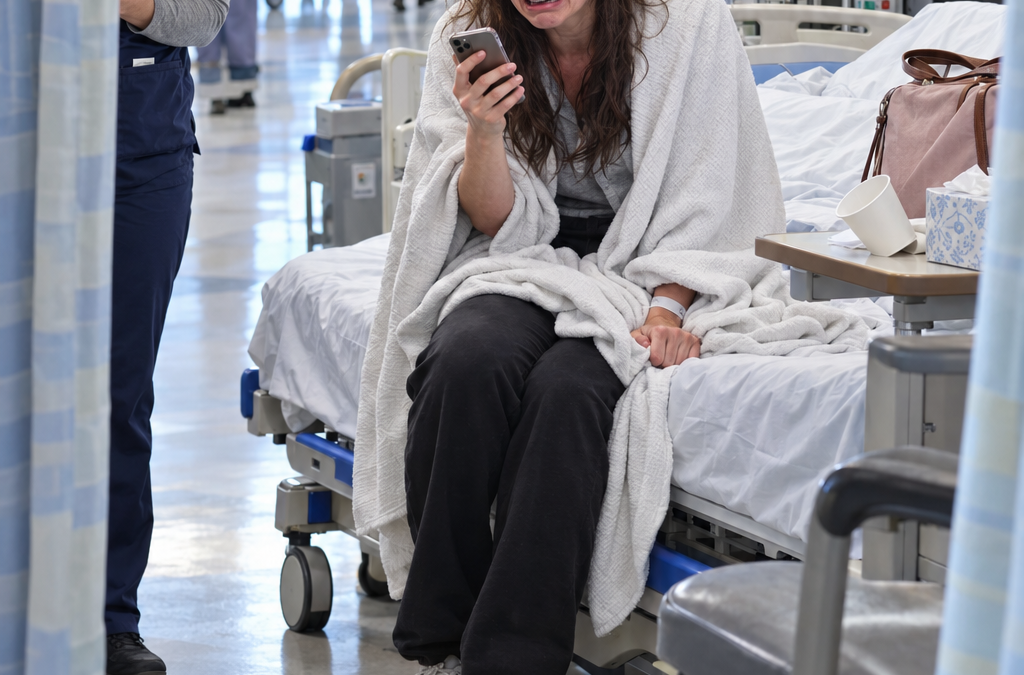
“I’m In The Emergency Room, Please Help Me…” I Texted. “Don’t Bother Us. Deal With It Yourself…” My Parents Shouted Before Hanging Up. Without Hesitation, I Called The House Manager, Hailey Warren. “Throw Everything Out And Kick Them Out…”
I was thirty-four when I finally learned how little my family valued me. I learned it beneath fluorescent emergency-room lights, with rain streaking the windows and my hands shaking too badly to hold my phone. I texted my parents, begging them to come. My mother replied that they were busy celebrating my brother and told me not to bother them. By sunrise, I had made one decision: if I wasn’t their daughter when I was hurt, I wouldn’t keep being their bank when they needed money.
### Part 1
My name is Hannah Warren, and until the night my car spun across a rain-soaked Savannah road, I thought I understood exactly what loneliness felt like. I was a systems engineer, which meant I had spent years surviving overnight deployments, impossible deadlines, conference rooms full of men who assumed I was there to take notes, and emergencies that began with one blinking red warning and ended twelve hours later with half a company functioning again. I knew exhaustion. I knew pressure. I knew what it felt like to walk into my apartment at two in the morning, kick off my shoes, and realize there was nobody waiting to ask whether I had eaten. What I did not know was how much worse loneliness could become when the people who were supposed to love you deliberately chose somewhere else.
The emergency room smelled like antiseptic, plastic tubing, and rainwater carried in on people’s coats. A monitor beside my bed kept chirping while a nurse adjusted something above my shoulder, and every few seconds pain rolled through my ribs hard enough to steal my breath. My phone lay on the sheet near my hip, its screen cracked from the accident, and when the nurse asked whether there was someone she could call, I almost laughed. “My parents,” I whispered. Even then, after everything, those were the first people I thought of.
I typed with one hand because the other was trembling too badly. “I’m in the emergency room. Please come.” Three dots appeared beneath my mother’s name almost immediately, and hope rose inside me so fast it embarrassed me. Then my phone rang. “Mom?” I said, and in the background I heard applause, silverware, voices, and someone laughing into a microphone. She didn’t ask whether I was hurt. She didn’t ask what hospital I was in. She sighed and said, “Hannah, tonight is Derek’s leadership award dinner. We can’t just leave. Don’t bother us with this right now.”
For several seconds, I thought I had misunderstood her. “I’m in the ER,” I repeated. “There was an accident.” Her answer came sharper this time. “Then you’re already where you need to be. The doctors can handle it. Your brother only gets a night like this once.” Before I could say anything else, she told me she had to go and ended the call.
I called my father next. Thomas Warren had never been cruel in the loud way my mother could be; his cruelty came from silence, from letting things happen and later pretending he had not noticed. He answered after four rings, and I could hear the same banquet noise behind him. “Dad, I need somebody here.” He exhaled as though I had called because my dishwasher was leaking. “Your mother explained the situation. We’ll check on you tomorrow. Derek is about to speak.” Then he hung up.
A physician named Dr. Carter caught my phone when it slipped from my fingers. He placed it on the tray and said, “Don’t worry about anything outside this room tonight. Your job is to stay still and let us take care of you.” I nodded because talking had become impossible. I wasn’t crying because of the accident anymore. Pain belonged to my body, but what my parents had done landed somewhere deeper, in the place where a thirty-four-year-old woman could suddenly become twelve again.
Growing up in our white-columned house outside Savannah, I had always known my brother Derek was the favorite. His trophies occupied an entire hallway while my certificates disappeared into drawers. When guests came over, Mom would guide them past his photographs like a museum docent. “Our Derek,” she’d say, glowing. If anyone asked about me, my father usually smiled and said, “Hannah’s our quiet one.”
When I was twelve, I carried home a math test with a grade so high my teacher had written a note saying I should consider an advanced program. I remember standing beside Mom’s chair while she flipped through a magazine, waiting for her face to change. She looked at the paper for maybe three seconds. “Very nice,” she said. “Derek was doing advanced math at your age too.” I went upstairs, closed my bedroom door, and tore the note into tiny pieces over the trash can.
Derek attended a private school with landscaped courtyards and glossy brochures because my parents said he “needed an environment equal to his potential.” I attended the public school across town where ceiling tiles stained brown when it rained. When I asked why, Mom told me money was tight and somebody had to be practical. I became practical so thoroughly that by sixteen I had stopped asking for anything that cost money.
I worked weekend shifts, joined robotics clubs, competed for scholarships, and eventually paid my own way through a local university. Derek went to business school in Atlanta with Mom and Dad helping with tuition, rent, and a used BMW that somehow became necessary because “first impressions matter in business.” I waited tables, assisted in a campus lab, and learned how to stretch groceries until Friday. Yet whenever my parents called, the conversation still began with Derek.
The strange part is that I never stopped loving them. That is what people misunderstand about families like mine. There is no single morning when you wake up and announce that you are being used. You simply grow accustomed to surviving on crumbs, then convince yourself those crumbs are a meal because admitting otherwise would mean accepting that the people you love know exactly what they are doing.
Years later, after I earned my first serious promotion, I called Mom from the parking garage because I wanted her to hear the news before anybody else. “That’s wonderful, honey,” she said. Then, without missing a beat, she added, “Derek is meeting with investors next week.” I sat behind the steering wheel listening to her describe his plans until my excitement disappeared completely. By the time we hung up, my promotion felt like something that had happened to somebody else.
The monitor beside my hospital bed beeped again, bringing me back to the present. Beyond the curtain, a television was broadcasting highlights from some local gala, and through the haze I heard Derek’s name. When I turned my head, there he was on the screen in a black suit, smiling beneath bright chandeliers while my parents applauded from a table near the stage.
That was when a thought came to me with frightening clarity.
They had chosen him when we were children. They had chosen him when we became adults. Now, with their daughter alone beneath emergency-room lights, they had chosen him again.
And for the first time in my life, I wondered what would happen if I finally chose myself.
### Part 2
By morning, the storm had weakened to a gray drizzle, but I barely noticed. I had slept in short, restless stretches, waking whenever someone entered the room or a machine changed rhythm. My parents never called back. Not at midnight, not at two, not after Derek’s banquet ended, and not at sunrise when any reasonable person would have remembered they had a daughter in the hospital. The only message I received from my mother arrived shortly after seven: “Let us know when you’re home.”
It was such a small sentence that it almost impressed me. No apology. No “Are you okay?” No question about what had happened. Just a request for information, as if I were a package they were tracking. I stared at it until Dr. Carter came in, glanced at my expression, and asked whether I needed him to call someone.
“No,” I said. “I think that’s the problem. I’ve spent years believing I did.”
During the hours that followed, while tests were reviewed and discharge plans discussed, my mind kept returning to money. Not because I was worried about my hospital bill, but because money had quietly become the architecture holding my entire family together. My parents’ house still belonged to them on paper, but for years I had covered a large part of the mortgage payment. Their car payments came from accounts I funded. I paid several household expenses, helped with insurance costs, covered repairs, and transferred money whenever some new “temporary emergency” appeared.
It had begun eight years earlier with one polite request. Mom called on a gray Tuesday afternoon and told me she and Dad wanted to refinance the house so they could help Derek launch a consulting business. “It’s an investment in the family,” she said. “We only need help for a few months while he gets established.” I had been twenty-six, newly employed, and desperate enough for their approval that the word family worked on me like a command. I sent the money that evening.
A few months became a year. The mortgage led to property taxes, repairs, and insurance. When a storm damaged part of the roof, Mom sent me photographs and wrote, “You’re our responsible one. Can you handle this?” I did. When Dad had unexpected bills, I covered them. When their car needed work, I paid. Whenever I hesitated, my mother reminded me how fortunate I was to have a stable career.
Meanwhile, Derek’s company seemed permanently trapped in the stage just before success. He leased office space with exposed brick walls, bought expensive suits, and posted photographs from networking events while telling everyone that image was essential for attracting clients. When I asked why he couldn’t help Mom and Dad with the mortgage, Mom laughed as though I had suggested something ridiculous. “He has to reinvest everything right now. You have a salary.”
My best friend Claire understood the arrangement long before I did. One evening she found a mortgage confirmation on my kitchen counter and stared at it. “You’re paying for their house now?” she asked. “Part of it,” I replied. “Only until Derek’s company becomes stable.” Claire folded her arms. “Hannah, his company has supposedly been six months away from becoming stable for four years.”
I defended them because that had become another habit. “They’re my parents. What am I supposed to do, let them lose the house?” Claire looked directly at me and said, “You are not making them safer. You’re making sure they never have to change.” I became angry with her, which was easier than admitting she was right.
The clearest warning came at a family dinner two years before my accident. Derek arrived wearing a new suit and distributing business cards for a rebranded version of his consulting company. I knew exactly how much the design had cost because my mother had asked me to cover “a small professional expense” the month before. After dessert, Mom stood with a wineglass raised and announced, “To Derek, who never stops chasing his dreams.”
Everyone clapped. I stood beside the kitchen doorway holding two dirty plates, and for one strange second I saw the entire family arrangement from the outside. Derek dreamed. My parents admired him. I paid.
Later, as I loaded the dishwasher, Mom touched my shoulder. “You’re such a dependable daughter.” She said it warmly enough that part of me softened. Then she added, “Derek is going to need a little extra runway this quarter. You don’t mind helping, do you?”
“I’ve been helping for years.”
“That’s what family does.”
I looked at her. “When was the last time family did something for me?”
Her smile vanished for half a second, then returned. “Don’t turn everything into a competition with your brother.”
That sentence stayed with me because I had spent my entire childhood being compared to Derek, yet the moment I compared how we were treated, suddenly comparison became inappropriate.
My aunt Lydia, Dad’s older sister, was the only person who ever challenged the system openly. She had never cared whether Mom thought she was rude. When she learned how much I was paying, she appeared at my apartment with coffee and said, “You understand the difference between helping someone and financing their refusal to grow up, right?”
“I can’t abandon them.”
“Why not? They’ve had no problem abandoning you whenever you’re inconvenient.”
At the time, I thought she was being harsh. Lying in the hospital years later, I finally understood that Lydia had not been harsh enough.
When I was discharged, Claire picked me up. She didn’t ask why my parents weren’t there until we were halfway to my apartment. Rain slid along the passenger window, and I watched Savannah pass in blurred green and gray. Finally she said, “They didn’t come, did they?”
I shook my head.
Her hands tightened on the steering wheel. “Hannah.”
“Please don’t say it.”
“I wasn’t going to.”
That somehow made me cry harder.
For the next week, I rested, answered work emails when I shouldn’t have, and avoided the family group chat. Mom posted photographs from Derek’s banquet. Dad shared a video of his speech. Derek wrote, “Couldn’t have done it without the family believing in me.” Nobody mentioned that while they were smiling beneath chandeliers, I had been alone in a trauma bay.
Then, one Tuesday morning, I opened my banking dashboard.
The screen showed transfer after transfer carrying my parents’ names. Mortgage support. Vehicle payment. Household expenses. A line of credit I had guaranteed years earlier. Small charges, large charges, recurring charges, emergencies that had somehow become permanent.
For the first time, the numbers didn’t look like love.
They looked like evidence.
I reached for a notebook, started writing down every obligation connected to me, and realized something that made my stomach tighten.
The next payment was scheduled for Friday.
And this time, I wasn’t going to send it.
### Part 3
I spent three days making sure anger didn’t make the decision for me. That mattered. I had spent most of my life being told that any resistance was emotional, dramatic, or selfish, so I wanted every step to be deliberate. I called the bank, spoke with an adviser, reviewed every automatic transfer and authorization, and separated what legally belonged to me from what belonged to my parents. I wasn’t taking their property or touching their accounts; I was simply ending my role as the person paying obligations they had chosen to carry.
The first transfer I canceled was the monthly amount toward their mortgage. My cursor hovered over the confirmation button while old memories crowded into my head: Mom kissing my forehead when I had a fever at six, Dad teaching me to ride a bicycle, Christmas mornings before Derek became the center of everything. Those memories were real. So were the hospital lights.
I clicked confirm.
The second payment was easier. Then the third. By the time I removed the last recurring transfer, my hands had stopped shaking. The page looked almost empty when I finished, and the sudden absence of their names gave me a feeling I didn’t recognize at first.
Space.
Friday came. Nothing happened.
Saturday passed quietly too. I began to wonder whether my parents had enough money in their own account to cover things and simply hadn’t noticed. That possibility should have relieved me. Instead, I realized some wounded part of me had expected a reaction because a reaction would prove how much they had depended on me.
The phone rang Monday at 8:17 in the morning.
Mom.
I watched it vibrate across the coffee table until the final ring. Thirty seconds later, she called again. Then Dad. Then Mom. On the fourth attempt, I answered.
“Hannah?” Mom sounded breathless. “The bank says the mortgage payment wasn’t made.”
“Okay.”
“Okay?” Her voice jumped. “What does that mean?”
“It means I didn’t make it.”
There was silence. I could hear a clock ticking somewhere on her end. “Why?”
I almost admired the question. Not “Can you still afford it?” Not “Are you recovering?” Not even “What happened?” She seemed genuinely unable to imagine a reason I might stop.
“Because I’m not paying it anymore.”
“Hannah, don’t be ridiculous. Your father and I depend on that arrangement.”
“Then you shouldn’t have left the person funding the arrangement alone in an emergency room.”
Her tone hardened immediately. “So that’s what this is about. You’re punishing us because we attended your brother’s dinner.”
“No. I’m ending a financial arrangement that should have ended years ago.”
“You told us you’d help.”
“I did help. For years.”
“Family doesn’t keep score.”
I looked around my apartment at the worn sofa I had delayed replacing, the old dining table I bought secondhand, and the small stack of receipts from repairs I had postponed while helping them. “You’re right,” I said. “Family shouldn’t have to.”
Mom inhaled sharply. “After everything we’ve done for you.”
The old sentence. The magic sentence. The one designed to turn every childhood meal, every ride to school, every birthday cake into a bill due in adulthood.
“What exactly have you done for me lately?” I asked.
“We raised you.”
“You raised two children, Mom. You just only celebrated one of them.”
She snapped, “This jealousy of Derek is getting embarrassing.”
I laughed, and the sound surprised both of us. “I was in an emergency room after a car accident, and you told me not to bother you. If you still think this is about jealousy, there is nothing left for us to discuss.”
I ended the call.
Five minutes later, Dad left a voicemail. “Your mother is upset. Whatever point you’re trying to make, you’ve made it. Call the bank and fix this before it becomes a serious problem.”
I deleted it.
Then Derek called.
My brother and I were only three years apart, but we had never been close. Growing up, he accepted being favored with the natural confidence of someone accepting sunlight. I don’t remember him asking our parents to treat me badly, but I also don’t remember him ever questioning why I had less. As adults, he usually contacted me when he needed technical help, business advice, or introductions.
“What are you doing?” he demanded.
“Good morning to you too.”
“Mom says you’re cutting them off over the banquet.”
“I’m no longer paying their expenses.”
“Same thing.”
“No, it isn’t.”
His voice lowered. “You realize their finances affect all of us.”
There it was. Not concern. Logistics.
“Why don’t you cover the payments?”
He actually laughed. “You know my cash flow situation.”
“I know you just received an award for business leadership.”
“Those things aren’t related.”
“Then maybe they should be.”
His voice became cold. “You’ve always been resentful.”
That word landed less painfully than it once would have. “And you’ve always been expensive.”
He hung up.
Claire came over that evening with soup and found me sitting at the kitchen table surrounded by financial statements. She looked at the papers, then at me. “You did it.”
“I did.”
“How do you feel?”
“Terrible.”
“Good.”
I stared at her.
She sat across from me. “If setting a boundary after years of being exploited felt wonderful immediately, I’d be worried about you. You’re grieving what you wanted them to be.”
That sentence stayed with me through the next several weeks.
My parents tried every method they knew. Mom sent photographs of the house with messages about how much family history it contained. Dad left stern voicemails about responsibility. Derek wrote that I was creating unnecessary instability at a critical moment for his company. Then the strategy changed. Mom became tender.
“I know you’re hurt,” she wrote. “Maybe we made mistakes. But you don’t destroy your family over one bad night.”
One bad night.
I read the sentence several times.
The hospital had not created the problem. It had simply turned on the lights.
The mortgage issue forced my parents to examine finances they had ignored for years. They had refinanced more than once, borrowed against the house, and committed to expenses based partly on the assumption that my monthly support would continue indefinitely. Derek had borrowed money too, some directly from them and some through arrangements I had never fully understood.
Then Aunt Lydia called.
“Hannah,” she said without greeting, “did you know your father’s name is attached to one of Derek’s business credit agreements?”
I sat straighter. “No.”
“Neither did I until your mother complained about it.”
“What kind of agreement?”
“I don’t know yet. But your brother is panicking more than a missed mortgage payment should explain.”
After we hung up, I remembered Derek’s strange comment: Their finances affect all of us.
For the first time, I wondered whether I had been supporting more than my parents’ lifestyle.
Maybe I had been keeping Derek’s company alive too.
And if that was true, stopping one payment had just pulled a thread none of them could put back.
### Part 4
A month after I ended the transfers, Mom asked me to come to the house. She described it as a conversation, but her message read more like a summons. “Your father and I think it’s time you sit down with us and resolve this before permanent damage is done.” She added that Derek would be there, which told me immediately that they weren’t planning a conversation. They were planning an intervention.
Claire told me not to go. Aunt Lydia said the same thing more colorfully. “They’ve had thirty-four years to listen to you. Why do you think they’ll suddenly start because their checking account is uncomfortable?” I understood their concern, but there was one reason I wanted to return: I needed to stand inside that house as the adult I had become and see whether it still had power over me.
Saturday afternoon was bright and humid, the kind of Georgia day when the air feels thick enough to hold. The magnolia tree in the front yard was blooming, and for a moment the house looked exactly as it had when I was sixteen. Then I noticed the weeds along the driveway, a broken gutter, and an unopened envelope wedged beneath the front doormat. Neglect had begun to show quickly once I stopped paying people to erase it.
Mom opened the door before I knocked. “Finally.”
No hug. No question about my recovery.
Dad sat in his recliner with both hands on the armrests. Derek paced near the fireplace, phone in hand. Papers covered the dining table.
Mom pointed toward a chair. “Sit.”
I remained standing. “You asked me to talk.”
Derek looked up. “Then let’s talk about why you decided to blow up everyone’s finances without warning.”
“I gave years of warning. Nobody listened because the warning kept arriving with money.”
Dad’s jaw tightened. “Watch your tone.”
I turned toward him. “That sentence worked better when I lived here.”
Mom stepped between us. “This hostility is exactly the problem. We are trying to save the house.”
“Then save it.”
“With what?” she demanded.
I looked at Derek. “Maybe your award-winning businessman can help.”
His expression changed instantly. “You don’t understand how business works.”
“I understand that you’ve been telling this family you’re months away from success for nearly a decade.”
He tossed his phone onto the table. “You think because you have a paycheck and some technical job that you’re better than everyone.”
There was a time when I would have spent ten minutes explaining what a systems engineer actually did. Instead I said, “No. I think adults should pay their own bills.”
Mom slapped her palm against the table. “Enough.”
The sound echoed through the dining room.
She began listing everything they had provided when I was a child: food, clothes, school supplies, birthday parties. She spoke faster as she went, apparently unaware that she was describing the basic responsibilities of raising a child. When she finished, she looked at me as though she had presented evidence in court.
“I didn’t ask to be born,” I said quietly. “You don’t get to invoice me for childhood.”
Dad stood.
I’d seen my father angry before, but this was different. Beneath the anger was fear. “Do you have any idea what people are saying?” he asked. “The bank has called twice. People at church know we’re having financial trouble. Derek’s partners are nervous.”
“Why would your mortgage make Derek’s partners nervous?”
Nobody answered.
That silence was more informative than anything they could have said.
I turned toward my brother. “What did you do?”
“Nothing.”
“Derek.”
He moved closer, lowering his voice. “Dad helped guarantee some things when the business expanded. That’s normal.”
“With what collateral?”
Mom said, “That isn’t your concern.”
I stared at her. “You asked me here because you want my money. That makes it my concern.”
Dad stepped forward. “The house was used as part of a business arrangement.”
The room became very still.
“How much?”
Derek rubbed his forehead. “It’s complicated.”
“How much?”
“Enough that we need stability right now.”
I almost laughed. All those years my mother had told me I was supporting them temporarily, some of my money had been indirectly protecting debt tied to Derek’s company. The beautiful family home, the place I had sacrificed vacations and savings to preserve, had become one more platform beneath my brother.
“Did you ever plan to tell me?” I asked.
Mom looked offended. “Why would we burden you with details?”
“You had no problem burdening me with payments.”
“This family invested in Derek because he has the potential to build something significant.”
The sentence struck me harder than I expected. There it was again, unchanged after decades: Derek had potential. I had utility.
I picked up my purse.
Mom’s voice sharpened. “Where are you going?”
“Home.”
“You can’t leave while we’re discussing this.”
“We’re not discussing anything. You’re explaining why I should keep sacrificing my future so Derek doesn’t have to face his.”
Derek stepped toward me. “If you walk out now, don’t expect everyone to forget it.”
I looked at him. “You all forgot I existed while I was in the hospital. I think I’ll survive.”
Outside, sunlight struck the windshield so brightly I had to squint. My pulse was pounding, but beneath the adrenaline I felt something solid forming. I had always imagined confronting them would end with either their apology or my collapse. Instead, nothing dramatic happened. I simply got into my car and drove away.
Three days later, Aunt Lydia called again.
“You need to turn on the local business news.”
I opened my laptop.
A short article reported that Derek’s consulting company had lost a major client after questions arose about inconsistencies in several invoices connected to a municipal contract. No charges had been announced. No conclusions had been reached. The article was cautious and dry.
But one line made my stomach tighten.
The client had requested an independent review of financial records.
I called Lydia back. “Does Mom know?”
“She knows.”
“What did she say?”
“She blamed you.”
I closed my eyes.
Of course she did.
Then Lydia added, “Hannah, there’s something else. Your father called me last night asking for money.”
That frightened me more than the article.
Dad never asked anyone for help.
If Thomas Warren was asking his estranged sister for money, the situation inside that white-columned house was far worse than they had admitted.
### Part 5
For the next two months, I tried not to watch my family’s problems unfold. I blocked Derek’s number after he left a voicemail accusing me of sabotaging his business, even though I had never spoken to his clients, employees, or partners. I muted my parents’ messages. I stopped searching his company online. Every time curiosity tempted me, Claire reminded me, “You left the burning building. You don’t have to stand outside counting flames.”
Still, news traveled.
Derek’s business review widened after accountants began examining records connected to several contracts. I knew better than to pretend I understood what investigators might eventually conclude, and I refused to join the gossip spreading through Savannah. What mattered to me was simpler: the company that had been described as a brilliant success appeared to have far less stability than my family had claimed.
The financial stress hit my parents immediately. Without my transfers and with Derek unable to help, they fell behind on several obligations. The house went from symbol to liability almost overnight. Mom sold jewelry she had once told me would someday belong to my daughter, apparently forgetting I had neither a husband nor children. Dad stopped attending certain social events because, according to Aunt Lydia, he was embarrassed by questions.
One afternoon, my mother appeared at my apartment.
I saw her through the peephole and nearly didn’t open the door. She stood in the hallway holding her handbag with both hands, dressed carefully despite the heat, looking smaller than I remembered. For one dangerous second, pity moved through me.
Then I opened the door.
“Hannah.”
“Mom.”
“Can I come in?”
“No.”
Her eyes widened. She had never imagined that my home might contain a boundary she couldn’t cross.
She glanced toward the hallway behind her, as though worried a neighbor might overhear. “Please. I don’t want to have this conversation standing outside.”
“Then we don’t have to have it.”
Her mouth tightened, but she controlled herself. “Your father and I are in trouble.”
“I know.”
“We may lose the house.”
“I know.”
“And you’re okay with that?”
The question was so perfectly designed that I almost admired it. Not “Will you help?” but “Are you okay with our suffering?” It transformed their financial decisions into a test of my morality.
“I’m not responsible for preventing every consequence in your life.”
Tears appeared in her eyes. Years earlier, those tears would have destroyed me. “I don’t understand what happened to you,” she whispered.
“The emergency room happened.”
“We made a mistake.”
“You made a choice.”
“Hannah, it was one evening.”
“No. It was my whole childhood compressed into one evening.”
She shook her head quickly. “That’s not fair. You always had everything you needed.”
“I had everything except the feeling that I mattered.”
Her face changed. For a moment I thought something had finally reached her, but then she said, “This is Claire putting ideas in your head, isn’t it?”
And there it was.
Even my own pain had to belong to somebody else before she could take it seriously.
“No,” I said. “This is me.”
She reached into her handbag and removed an envelope.
“I brought some numbers. If you could just help through the end of the year, we could restructure everything.”
I didn’t take it.
“Mom, why didn’t Derek come?”
Her eyes dropped.
“Because he can’t help you, can he?”
“He’s dealing with serious problems.”
“So was I when you told me not to bother you.”
She flinched.
I closed the door gently.
Not slammed. Not dramatic. Just closed.
That night I sat on my kitchen floor and cried harder than I had in the hospital.
Boundaries sound empowering when people describe them later. They rarely describe the part where you feel like a monster for refusing someone you still love. They don’t describe how your childhood trains your body to experience “no” as danger. I kept hearing Mom’s words: We may lose the house.
Claire sat beside me without trying to solve anything.
After a while I said, “What if I could stop it?”
“You probably could.”
“What if I regret not helping?”
“You might.”
I looked at her.
She continued, “The question isn’t whether helping would make the immediate pain go away. It would. The question is what happens the month after that.”
I knew the answer.
Another payment. Another emergency. Another year.
A week later, Dad called from a number I didn’t recognize. I answered before realizing who it was.
“Hannah.”
His voice sounded older.
“Dad.”
“I’m not calling to argue.”
I waited.
“We need to talk about your mother.”
“What about her?”
“She’s not sleeping. She’s scared.”
“So am I sometimes.”
He ignored that. “You could fix this.”
The sentence finally made something inside me go quiet.
Not “We could fix this.” Not “Derek could help.” Not “I made terrible financial decisions and need to face them.”
You could fix this.
“Dad, I’ve been fixing things since I was a teenager.”
“You’re the one who’s good at it.”
“I’m also your daughter.”
He said nothing.
I closed my eyes.
“Do you remember what hospital I was in?”
Silence.
“You didn’t even know, did you?”
“Hannah—”
“Mom never told you because neither of you asked.”
He tried to interrupt, but I kept going. “You keep calling me the responsible one like it’s a compliment. It isn’t. It’s the job you gave me because responsibility made me useful.”
He sighed. “What do you want from us?”
Years earlier, I might have said an apology. Recognition. Love.
Now I understood that asking for those things from people who treated affection like currency would only keep me tied to them.
“Nothing,” I said.
That answer shocked him into silence.
“I don’t want anything from you. And that’s why this is over.”
I ended the call.
Several weeks later, my physical therapist cleared me from the final restrictions related to the accident. Walking outside afterward, I stood beneath the bright afternoon sun and realized my body had healed while my family was still waiting for me to return to my old role.
Then my phone rang.
It was Dr. Carter.
He reminded me who he was, although there was no chance I had forgotten.
“The hospital is upgrading its emergency response infrastructure,” he said. “We need someone who understands systems and also understands what it’s like to be on the other side of them. Your name came up.”
I smiled for the first time that day.
“What exactly are you offering?”
“A conversation.”
For once, those words didn’t sound like a trap.
### Part 6
The hospital project changed my life more quietly than the accident had. There were no dramatic announcements, only meetings, diagrams, security reviews, and long afternoons studying how information moved during emergencies. I worked with nurses, physicians, dispatch coordinators, and technical teams to redesign parts of the system so critical messages were easier to track and failures were harder to ignore. It wasn’t glamorous, but every time we solved a problem, I felt something I had not felt while paying my family’s bills: useful without being used.
Dr. Carter became a colleague rather than the man who had seen me broken beneath fluorescent lights. He never asked intrusive questions about my family. Occasionally, when a meeting ran late, he would place a coffee beside my laptop and say, “Systems people forget they’re biological systems too.” Then he’d disappear before I could argue.
I moved temporarily into Aunt Lydia’s guest room while repairs were made to my apartment building. Her small house sat beyond the city traffic, surrounded by pine trees and cicadas. Lydia believed breakfast should involve strong coffee and no unnecessary conversation before eight, which made us extremely compatible. On weekend mornings, we walked down a narrow road while she taught me something nobody in my family ever had: silence could be peaceful.
One morning she asked, “Do you miss them?”
I knew who she meant.
“Yes.”
“Good.”
I laughed. “Why does everyone keep telling me painful things are good?”
“Because missing people means you’re not pretending they never mattered. It doesn’t mean you have to let them hurt you again.”
I thought about that for a long time.
By autumn, the family house entered formal foreclosure proceedings. I learned because a notice was forwarded to me by mistake, my name still appearing on an old contact record even though I had never owned the property. I sat at Lydia’s kitchen table holding the envelope while morning sunlight crossed the wood.
She looked at me. “You okay?”
“I think so.”
“You don’t sound sure.”
“I spent years believing that house was my responsibility.”
“Buildings are rarely the thing we think we’re saving.”
A few weeks later, the property was listed for sale under financial pressure. Mom sent me one final photograph of the front porch with a message: “Last chance to save the home you grew up in.”
I stared at it.
Then I typed, “A home is where people show up for you.”
I never sent it.
I simply deleted her message.
Derek’s professional problems continued separately. The review of his company produced enough concerns that several clients terminated their relationships, and the business eventually entered bankruptcy. I didn’t celebrate. His collapse wasn’t proof that I had won anything. Mostly, it confirmed something I should have recognized years earlier: I had been subsidizing an image that couldn’t survive without other people’s money.
One evening, Derek appeared outside Lydia’s house.
He looked different. No tailored jacket. No confident grin. His shirt was wrinkled, and exhaustion had hollowed his face. Lydia opened the door, saw him, and immediately said, “If you raise your voice, I’ll introduce you to my garden hose.”
Despite everything, I almost laughed.
Derek looked past her toward me. “Can we talk?”
We sat on the porch.
For a while neither of us spoke. Crickets filled the yard, and headlights occasionally passed beyond the trees.
Finally he said, “Mom thinks you hate us.”
“I don’t.”
“Could’ve fooled me.”
“I stopped paying your bills. That’s not the same as hate.”
“My bills?”
“You know what I mean.”
He rubbed both hands over his face. “You have no idea what things were like.”
“Then tell me.”
That seemed to surprise him.
He talked for almost twenty minutes. He described pressure from Dad to succeed, Mom introducing him everywhere as the future of the family, investors who expected growth he couldn’t deliver, and the terror of admitting the company wasn’t as strong as everyone believed. Some of it I understood. Golden children live inside cages too; theirs simply have nicer furniture.
Then he said, “You always had it easier because nobody expected anything from you.”
I stared at him.
He realized the mistake immediately.
“Derek, nobody expecting anything from me is not the childhood advantage you think it is.”
“I didn’t mean—”
“Yes, you did.”
He looked at the porch floor.
I could have attacked him. Instead I asked the question that had followed me since the accident.
“When Mom told you I was in the emergency room, what did you say?”
His eyes shifted toward the yard.
That was answer enough.
“You knew.”
“Hannah—”
“You knew I was there.”
“Mom said you were okay.”
“Did you call?”
He said nothing.
“Did you text?”
Nothing.
“Did you ask which hospital?”
He swallowed. “No.”
The hurt that moved through me was strangely calm.
He had spent his life benefiting from our parents’ choices, but that night he had made his own.
“I’m sorry,” he said.
I believed he meant it in that moment.
But an apology does not create an obligation.
“I accept that you’re sorry,” I said. “That doesn’t mean we’re going back to what we were.”
“What were we?”
I looked at him. “Exactly.”
He left a few minutes later.
Lydia stepped onto the porch carrying two glasses of iced tea. “How’d it go?”
“He apologized.”
“Did it help?”
“A little.”
“Are you giving him money?”
I laughed so suddenly tea nearly came out of my nose.
“No.”
“Then I’m proud of you.”
By winter, my parents had moved into a modest apartment across town. Dad resigned from several community positions after the financial problems became public enough that he no longer wanted the attention. Mom stopped posting photographs online. The family that had spent decades curating perfection suddenly disappeared from view.
I expected their fall to make me feel powerful.
Instead, it made me tired.
Then, two days before Christmas, an envelope arrived at Lydia’s house.
Inside was a handwritten letter from my father.
The first line read, “Hannah, your mother doesn’t know I’m writing this.”
For a long time, I couldn’t make myself read the rest.
### Part 7
Dad’s letter was four pages long. His handwriting, once neat and angular, wandered across the paper as though he had written without stopping to correct himself. He admitted that he had known Mom favored Derek, though he described it in gentler language. He wrote that he had convinced himself I needed less because I complained less, and that every year I became more independent, he took my independence as permission to invest more attention somewhere else.
Then he wrote something that stopped me.
“I was proud of you, but I was also ashamed that you had succeeded without needing me.”
I read that sentence three times.
For years I had assumed my achievements simply meant nothing to him. The truth was more complicated and, in some ways, uglier. My independence had confronted him with his own failure as a father, so instead of moving closer, he had retreated.
Near the end, he wrote, “I cannot defend what happened the night of your accident. I knew you were in the hospital. I told myself your mother had spoken to you and that you were safe. The truth is that leaving would have embarrassed Derek during an important moment, and I chose the easier path.”
There it was.
No excuse.
No claim that I had misunderstood.
A choice.
His final paragraph did not ask for money. It asked whether I would meet him for coffee.
I spent two weeks deciding.
Claire thought I should go only if I wanted something for myself. Lydia said, “Forgiveness isn’t a subpoena. You don’t have to appear.” Dr. Carter, who knew almost nothing about the details, said only, “People confuse closure with reconciliation. They aren’t the same.”
I eventually agreed.
Dad chose a small café near the river. When I arrived, he was already sitting in a corner with a cup he hadn’t touched. He looked older without the house, the church committees, and the comfortable certainty that everyone around him would protect his reputation.
“Thank you for coming,” he said.
I sat down.
For once, he did not lecture me. He apologized. Not perfectly, but specifically. He apologized for comparing me to Derek, for allowing Mom to make me responsible for expenses, for accepting money without asking what it cost me, and for staying at the banquet when I needed him.
I listened.
When he finished, he said, “I hope someday you can forgive me.”
“I probably will.”
Relief moved across his face too quickly.
I continued, “But forgiveness isn’t the same as trust.”
His expression fell.
“I can stop carrying anger and still decide you don’t get the same access to my life.”
He nodded slowly.
“Mom thinks if we apologize, things can go back.”
“They can’t.”
“I know.”
That answer surprised me.
Dad stared through the window toward the river. “Your mother is having a harder time accepting that.”
“She always had a harder time accepting things she couldn’t control.”
He almost smiled.
Before we left, he asked whether I wanted updates about Derek.
“No.”
He nodded.
Then he hesitated. “Is there anything I can do for you?”
It was the first time in my life I remembered him asking that question without expecting something afterward.
“Respect my distance.”
“I can do that.”
We left separately.
I did not feel healed when I walked to my car. There was no swelling music, no miraculous release. I simply felt lighter because one conversation had finally belonged to the truth instead of appearances.
Mom reacted differently.
She called three days later, furious that Dad had met me without telling her.
“So he’ll sneak around behind my back now?”
“This isn’t about you.”
“It has always been about me. I’m your mother.”
I almost smiled at the accidental honesty.
She moved quickly from anger to tears. “I’ve lost my home. I’ve lost my friends. Derek barely speaks to us. Your father blames himself for everything. How much more punishment do you need?”
“I’m not punishing you.”
“Then why won’t you come home?”
“You don’t have my home.”
Silence.
I continued carefully. “You want the old arrangement back. You want me available, helpful, quiet, and grateful for whatever affection is left after Derek gets what he needs. That person doesn’t exist anymore.”
“I said I was sorry.”
“No. You said you were sorry everything fell apart.”
“What’s the difference?”
That question told me we had reached the end.
“I hope you have a peaceful life, Mom.”
“Hannah, don’t you dare hang—”
I ended the call.
Then I blocked her number.
Not because I hated her.
Because loving someone does not require giving them unlimited access to you.
The hospital project entered its final testing stage that spring. I stood inside a conference room surrounded by screens showing emergency workflows my team had spent months rebuilding. When the final simulation completed successfully, people applauded.
The sound hit me unexpectedly.
Applause.
For one second I was back in the ER, hearing a television broadcast Derek’s banquet while my parents celebrated miles away.
Then Dr. Carter clapped me on the shoulder. Claire, invited for the demonstration, was grinning from the back of the room. Lydia stood beside her with both hands raised over her head like I had won the Super Bowl.
The memory changed shape.
Applause no longer belonged only to my brother.
Afterward, hospital leadership offered me a permanent position directing systems reliability for several facilities in the region. The salary was better than my old job. The work mattered more.
I accepted.
That evening I drove to the river, parked, and watched sunlight fade across the water.
My phone remained quiet.
Years earlier, silence from my family had made me feel invisible.
Now it felt like freedom.
I thought the story was finally over.
Then, six months later, a package arrived at my office with no return address.
Inside was my childhood math certificate—the one I had believed disappeared more than twenty years earlier.
And beneath it was a note in my mother’s handwriting.
### Part 8
For several minutes, I simply stared at the certificate.
The paper had yellowed around the edges, but I recognized my teacher’s handwriting immediately. Somewhere along the way, after I tore up the original note, another copy must have been mailed home or placed in my school records. Across the top was my twelve-year-old name and the score I had once been desperate to show my mother.
The note beneath it contained only three sentences.
“I found this while packing the last boxes from storage. I should have told you I was proud of you. I don’t expect an answer.”
I sat at my desk long after everyone else had gone home.
If she had sent that message one year earlier, I might have driven straight to her apartment. I would have interpreted three sentences as transformation. I would have filled every blank with the apology I wanted and ignored everything that wasn’t there.
Now I could see it for what it was.
A small truth.
Nothing more. Nothing less.
I placed the certificate inside my desk drawer and went home.
I never answered.
That choice surprised Claire when I told her.
“You’re not going to respond at all?”
“What would I say?”
“I don’t know. Maybe thank you?”
I shook my head. “She said she doesn’t expect an answer. I’m finally going to believe her.”
Claire smiled. “Look at you, taking people at their word. Terrifying.”
We ordered dinner and spent the evening talking about everything except my family.
That became the shape of my new life. Not dramatic revenge. Not constant triumph. Ordinary days that belonged to me.
I rented a brighter apartment overlooking a narrow stretch of marsh outside Savannah. I replaced the old sofa I had kept years longer than necessary because my money had always been going somewhere else. I traveled for the first time without calculating what emergency my parents might invent while I was gone. Lydia and I spent a long weekend in Charleston eating seafood, walking until our feet hurt, and laughing because neither of us knew how to take flattering photographs.
I built savings.
I bought good coffee without guilt.
I slept.
At work, our emergency systems project expanded to additional facilities. Every time a nurse told us that a new alert process saved minutes during a crisis, I remembered the woman I had been on that rain-soaked night. I could not change who had failed to come for me, but I could help build systems designed to show up when people needed them.
Dr. Carter and I became friends. Nothing dramatic happened between us, and I was grateful for that. For once, I didn’t need every meaningful relationship to turn into romance or rescue. Sometimes he joined Claire and me for dinner. Sometimes we talked about work. Sometimes months passed without seeing each other outside the hospital.
My life was full without needing somebody to complete it.
Dad respected the boundary he had promised to respect. He sent a birthday card once a year and never included guilt. Occasionally I replied with a brief message. We were not close, but we were no longer at war.
That was enough.
Derek eventually found work in Atlanta managing operations for another company. I heard through Lydia that he lived quietly and kept his name away from anything flashy. We exchanged one message after Aunt Lydia had a minor surgery. He wrote, “I’m glad she’s okay.” I replied, “Me too.”
That was the entire conversation.
We did not become the siblings we should have been.
Some relationships cannot be reconstructed simply because both people finally understand why the building collapsed.
As for Mom, I saw her once almost two years after the accident.
I was leaving a grocery store on a Saturday morning when I noticed her near the flower display. She looked older, her hair shorter, her clothes simpler than the carefully coordinated outfits she used to wear to church and community events. For a moment, neither of us moved.
Then she walked toward me.
“Hannah.”
“Mom.”
Her eyes filled immediately, but she did not reach for me.
“You look well.”
“I am.”
She nodded. “Your father says your hospital work is going well.”
“It is.”
“I saw an article about the new system.”
I waited.
She swallowed. “I’m proud of you.”
There was a time when those four words would have changed my entire week.
Now they simply landed where they belonged.
“Thank you.”
She looked disappointed, perhaps because she had expected me to collapse into her arms. Perhaps she finally understood there was no sentence powerful enough to restore years she had treated as expendable.
“Could we have coffee sometime?” she asked.
I studied her face.
I didn’t hate her. That had become important to me. Hatred is another form of attachment, another way of letting someone occupy space inside you.
But I also knew exactly what peace had cost me.
“I don’t think I’m ready for that.”
Her mouth trembled.
“Will you ever be?”
“I don’t know.”
For once, I refused to manufacture a hopeful answer just to make someone else comfortable.
She nodded.
“Okay.”
Then she walked away.
I stood beside the automatic doors while people pushed carts around me, feeling neither victorious nor devastated.
Just steady.
The anniversary of my accident arrived during another summer storm.
Rain hammered against my apartment windows almost exactly as it had that night. I sat on my balcony beneath the covered awning with tea warming my hands while lightning flickered beyond the marsh.
At 9:14 p.m., my phone displayed an old photograph from my cloud archive.
The family house.
White columns. Magnolia tree. Derek standing at the center. Mom beside him. Dad behind us.
And me on the edge of the frame.
For years, I had believed being pushed to the edge meant I was less important.
I knew better now.
Sometimes the edge is simply the nearest place to the exit.
I deleted the photograph.
Not angrily.
I just didn’t need it anymore.
Before bed, I opened my banking app out of old habit. The balances belonged to me. The savings accounts had grown. There were no emergency transfers to my parents, no recurring rescue payments, no quiet financial bleeding hidden beneath the word family.
I thought about the night everything changed.
“I’m in the emergency room. Please come.”
“Don’t bother us.”
Those words had once felt like the cruelest thing my mother could have said.
Years later, I understood they had also given me something.
Clarity.
They showed me that I could spend the rest of my life begging people to choose me, or I could stop waiting and choose myself.
I chose myself.
The house was gone. Derek’s old company was gone. My parents’ reputation was gone. None of that became the revenge I once imagined it might.
My real victory was much quieter.
I no longer measured my worth by who showed up.
I no longer confused being needed with being loved.
I no longer believed that sharing blood gave anyone ownership of my peace.
Some people say family should be forgiven no matter what. Maybe forgiveness matters to them, and maybe one day I will understand the word differently. I released most of my anger long ago, but I never returned to the role my parents created for me.
I didn’t rescue them.
I didn’t rebuild the old family.
I didn’t pretend late regret could erase years of choices.
I built something else instead.
A career that mattered to me.
Friendships that did not come with invoices.
A home where silence felt safe.
A life in which I could say no without explaining it.
And on stormy nights, when rain still tapped against the windows and reminded me of fluorescent lights, broken glass, and a phone trembling in my hand, I no longer heard my mother’s voice telling me not to bother them.
I heard my own.
Calm. Certain. Finally loud enough.
“You don’t have to earn your place in somebody else’s life.”
Then I turned off the light, put my phone facedown, and slept.
THE END!