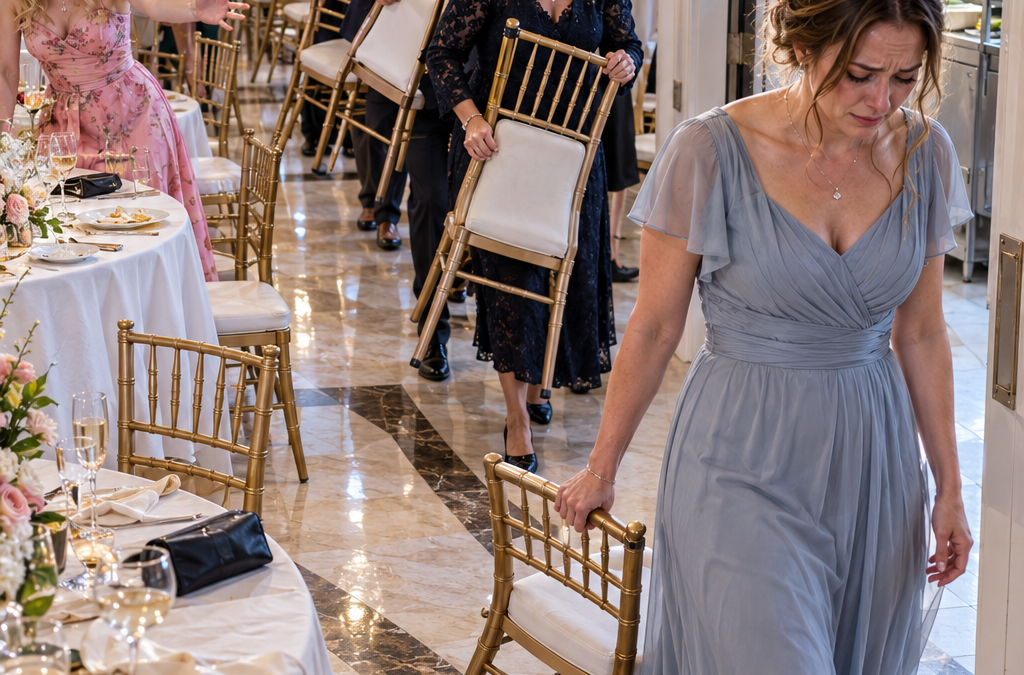
“The Ballroom Is For Real Family,” My Sister Smirked. “Your Seat Is In The Kitchen.” I Nodded And Walked Out. Then Chairs Scraped Behind Me. One By One, The Ballroom Emptied. My Sister Screamed, “Where Are You All Going?”
My younger sister thought seating me beside the kitchen doors at her wedding would remind me where I ranked in our family. What she did not know was that I had already uncovered suspicious charges inside the nonprofit I had spent twelve years building—and her wedding was sitting at the center of them. I walked out without shouting, threatening, or begging for a better seat. Then one guest stood up. Another followed. By the time the ballroom emptied, my sister’s humiliation was the least dangerous secret waiting to come out.
### Part 1
“The ballroom is for real family. Your seat is in the kitchen.” Lindsay smiled when she said it, and somehow that smile hurt more than the words. Orange blossoms filled the Glasshouse Conservatory with a sweetness so heavy it coated the back of my throat, but from the swinging metal doors behind my chair came the smell of hot butter, dishwater, and roasted meat. For several seconds, I could hear nothing except the low mechanical hum of the kitchen ventilation system and the faint clink of someone setting down a champagne flute.
My place card sat on a narrow overflow table covered with cheaper linen than the tables inside the ballroom. Avery Mercer had been written across it in elegant black calligraphy, the ink still glossy under the overhead lights, which told me someone had printed it recently. My mother, Diane, stepped close enough that her perfume mixed unpleasantly with the grease drifting through the service doors. “Just do this for your sister,” she whispered, tightening her fingers around my forearm. “Do not make a scene.”
I looked past her toward Lindsay, who stood in a fitted white gown beneath an arch of orange blossoms that had probably cost more than some of the emergency housing grants my organization issued in a month. Her new husband, Ethan Caldwell, tugged at his collar and stared at the floor as if the pattern in the marble might rescue him. “It’s only a seat,” he muttered. “Let’s keep everything calm tonight.” Lindsay nodded approvingly, because calm had always meant the same thing in my family: Avery absorbs the insult, Avery fixes the problem, Avery keeps smiling.
At thirty-eight, I was the founder and executive director of Harbor House Family Center, a nonprofit I had built from two borrowed offices and a donated refrigerator into a regional network serving families in crisis. I had slept in hospital chairs when Mom was ill, emptied my savings when Lindsay got sued over unpaid credit cards, and canceled opportunities because somebody in my family needed rescuing again. For years I had mistaken endurance for love. Standing beside that kitchen door, I suddenly understood how convenient that mistake had been for everyone except me.
I reached into my purse and pulled out my phone. Lindsay gave a theatrical little laugh. “Of course you need evidence,” she said loudly enough for several nearby guests to hear. “You can’t just be normal for one evening.” I photographed the place card, the service doors, and the seating chart posted near the ballroom entrance.
“Only when I expect someone to deny what happened later,” I said.
For the first time that evening, her smile twitched.
Lindsay recovered quickly. “You’re operations,” she said, waving vaguely toward the kitchen staff as though she were assigning me to my natural habitat. “Tonight is my launch moment. The donors are here for something bigger than spreadsheets and paperwork.” Several people turned toward us, and I saw my mother’s face tighten because Lindsay had said too much in public. I felt something inside me go strangely quiet.
“Thank you,” I said.
Lindsay blinked. “For what?”
“For finally saying it where other people could hear.”
I placed the card facedown, picked up my leather tote, and walked toward the exit. I did not ask for another chair. I did not accuse her of anything. Behind me, the string quartet launched into a frantic classical version of a pop song, the musicians playing too brightly and too quickly because everyone in the room understood that something had just cracked.
The hallway outside the conservatory felt ten degrees cooler. Evening light shone through the tall windows, blue and silver over the polished floor, and for the first time all day I could breathe without smelling flowers. Inside my tote were three things Lindsay knew nothing about: a sealed letter for Harbor House’s board, confirmation that independent auditors would arrive Monday morning, and the brass key to a townhouse I had bought six months earlier. My family still believed I lived in the cramped apartment I had rented while building Harbor House.
I was halfway toward the courtyard when a chair scraped violently across the ballroom floor.
The sound was so sharp I stopped walking. I expected someone to slip out quietly, embarrassed by the scene, but instead a woman’s voice carried through the partly open doors. “If Avery isn’t real family,” she said, “then neither am I.” I turned and saw Marisol Vega standing beside her table, one hand resting on the back of her chair.
Eight years earlier, Marisol had entered Harbor House with two toddlers, a grocery bag full of clothes, and thirty-seven dollars in cash. I had sat beside her in court, helped her apply for housing, and watched her rebuild her life one exhausting month at a time. Now she crossed the ballroom in a rented navy dress and walked straight toward me. Lindsay called her name, but Marisol never looked back.
The door opened, and Marisol wrapped both arms around me. “You don’t have to leave,” I whispered. “You found a babysitter. You deserve dinner and dancing.”
“I’m not leaving because you asked me to,” she said. “I’m leaving because she showed us who she is.”
Another chair scraped.
Then another.
Through the glass wall I watched the reaction spread unevenly across the room. Robert Hayes, who had run our food pantry for seven years, folded his napkin and stood with his husband. A family Harbor House had helped during a winter eviction gathered their coats. At first the wealthier donors looked confused, but confusion changed when they began asking why the founder of the organization they supported had been seated beside a service entrance while the bride told everyone she was merely an employee.
Lindsay moved from table to table with a bright, desperate smile. She laughed too loudly, touched people’s shoulders, and made sweeping gestures toward the kitchen as though a few exaggerated hand movements could turn humiliation into a harmless misunderstanding. One corporate donor listened for less than a minute before lifting his coat from the back of his chair. Ethan’s mother leaned across the sweetheart table, pointing sharply toward my abandoned place card while demanding an explanation.
Then Mara Patel stood.
Mara was Harbor House’s board president, a retired public accountant who treated silence like a professional tool. She placed her napkin beside her plate, smoothed the front of her dress, and looked directly at Lindsay. “This stopped being a family matter the moment Harbor House’s name was used to finance this event,” she said.
That sentence broke the room open.
People began moving toward the exits, some quietly, others asking questions Lindsay clearly did not want to answer. A few younger guests raised their phones, and I immediately asked them to stop filming because some Harbor House families had survived situations that required anonymity. The last thing I wanted was vulnerable people becoming scenery in a Mercer family scandal. Most lowered their phones at once.
The conservatory doors slammed open.
Lindsay stormed into the hallway, satin train dragging leaves from the courtyard behind her. “Get back inside,” she demanded. “Tell them this is a misunderstanding. Fix this.”
There it was. Not an apology. Not even embarrassment. An order.
“I’ve spent twelve years fixing what you break,” I said. “That ended tonight.”
Her face changed so completely that for a second she looked like a stranger. She turned toward the gathering guests, apparently expecting someone to comfort the abandoned bride, but no one stepped forward. Inside the ballroom, servers had stopped pouring wine, Ethan’s parents were pulling their son toward a private suite, and Lindsay’s college friends were disappearing through a side corridor.
Within minutes, the ballroom was almost empty.
Lindsay walked back through the doors and stood surrounded by untouched plates, flowers, and rows of abandoned chairs. “Where is everybody going?” she screamed. Her voice struck the glass ceiling and came back thinner and higher. Beside me, Mara looked down at her phone.
“Avery,” she said.
Something in her tone made the cold travel straight through my dress.
She tilted the screen toward me. Harbor House’s server had just blocked an attempt from Lindsay’s administrative account to permanently delete a directory protected by the legal hold we had activated ten days earlier.
I read the directory name twice.
Mercer Foundation Launch.
“That folder,” I whispered, “didn’t exist yesterday.”
And suddenly I knew the wedding was not collapsing because my sister had seated me in the kitchen.
It was collapsing because someone inside that ballroom had realized we were already looking.
### Part 2
The first crack had appeared six months earlier on a rainy Tuesday afternoon. Water streaked the windows of my Harbor House office while my mother’s name flashed across my phone, and the moment I answered, Diane began describing Lindsay’s expanding wedding budget as though she were reporting a natural disaster. The florist needed another deposit, the dress had become more expensive, and apparently some luxury transportation company required immediate payment. Mom never actually asked whether I would help; she simply told me how much money Lindsay needed.
“I stopped paying expenses that aren’t mine,” I said.
There was a long silence. Mom finally inhaled sharply and told me Lindsay was overwhelmed, fragile, and under tremendous pressure. She called my refusal selfish, then reminded me how difficult everything had been since my father died, although Dad had been gone for more than a decade and somehow his death was still being used as a credit line. I ended the call without arguing.
That night I drove east instead of returning to the apartment my family thought I rented. My real home was a modest brick townhouse on a quiet Columbus street lined with mature oaks, purchased after two years of aggressive saving. The living room held a gray sofa, an oak desk, and three unopened boxes because I had not yet decided where everything belonged. It was not impressive, but when I turned the key, nobody else could enter unless I invited them.
After dinner I opened my laptop and logged into Northline Community Systems, the small consulting business I had started quietly the previous year. I helped nonprofits design financial controls, privacy procedures, and data systems—the same “boring paperwork” Lindsay loved mocking. The income had paid most of my down payment and created an emergency fund my family knew nothing about. For the first time in my adult life, I had money that was not waiting to be sacrificed to someone else’s crisis.
That independence had not come naturally. I had grown up believing my usefulness was the price of belonging, especially after my father died and Mom began repeating that family had to “carry one another.” Somehow carrying one another meant I skipped a major nonprofit leadership program when Mom became ill, emptied savings to cover Lindsay’s overdue rent, and left a final interview eight years earlier because my sister needed help with a lawsuit. Lindsay never thanked me, but Mom always did on her behalf.
The night I closed on the townhouse, I wrote one sentence inside a new notebook.
Helping is a choice. Being used is not.
Three months before the wedding, that sentence became more than something I wanted to believe.
Jamie Chen, our operations coordinator, entered my office carrying an invoice. She placed it directly in front of me and tapped one line with her finger. The vendor was an upscale florist downtown, and the charge was $4,800 under an internal category labeled donor floral engagement. Three days earlier I had seen Lindsay posting pictures from the same florist while selecting wedding arrangements.
“Pull the original digital file,” I said. “Metadata, revisions, payment history. Everything.”
Jamie looked relieved that I had not immediately stormed toward Lindsay’s office. Accusations created noise; records created facts. Ten minutes later, the original document filled my monitor. The public file name said community outreach banquet, but buried in the author properties was a different project title: Lindsay and Ethan Wedding.
I stared at the screen until the words stopped looking like words.
Jamie returned carrying two more invoices from the same florist.
$4,650.
$4,925.
$4,700.
Every charge sat below Harbor House’s $5,000 threshold for mandatory dual approval.
“She learned the limit,” I said.
Jamie closed my office door.
For the next three hours, we covered the carpet with printed vendor records. Yellow highlighter marked videography. Blue marked gift packages. Green marked venue fees and décor. Multiple invoices had been divided into smaller pieces, each comfortably below the amount that would have required my signature or direct board review.
I felt sick, but I forced myself to separate facts from assumptions. We had suspicious billing patterns, not yet proof that every charge belonged to the wedding. Some commitments might have been legitimate donor expenses. Others might not have been paid yet.
I packed the records into a locked case and met Mara at a coffee shop several blocks from Harbor House. The place smelled like espresso and wet coats, and nobody around us seemed interested in the two women whispering over spreadsheets. Mara read silently, occasionally making a small notation in the margin. She did not look shocked.
“Do not confront Lindsay,” she said.
“I wasn’t planning to.”
“Do not search personal accounts either. We protect Harbor House first, and we do it cleanly.”
That afternoon Mara authorized a silent legal hold preserving internal files and communications connected to Lindsay’s administrative work. She also scheduled an independent audit to begin immediately after the wedding, when vendor accounts would be complete. Only four people knew: Mara, Jamie, our counsel, and me.
The next day I saw Olivia Grant, Lindsay’s wedding planner, hurrying through our lobby with a thick binder pressed against her chest. When I asked whether she needed help finding donor-event records, her eyes jumped toward the elevators. “Just checking logistics,” she said before disappearing down the corridor.
I did not follow her.
Instead, I returned to my office and documented the encounter.
Later that week, Lindsay walked into my office carrying a glossy folder. Mom followed holding tea and wearing the expression she used when she had already decided I was going to surrender. Lindsay dropped the folder on my keyboard. Across the cover was a polished logo for something called the Mercer Family Foundation.
Inside was a launch plan scheduled for her wedding reception.
There was also a document claiming Lindsay and I had founded Harbor House together.
I read it twice.
Mom squeezed my shoulder. “It’s ceremonial, sweetheart. Wealthy people like family stories. Let Lindsay share the credit.”
“I’m not signing something false.”
Lindsay laughed once. “You’re acting like I’m stealing your identity.”
“You’re rewriting twelve years of legal history.”
“Oh, please. We grew up in the same house.”
“That isn’t the same as founding the same organization.”
I circled the fabricated dates in red ink, handed the folder back, and sent an email documenting my refusal. In the same message, I transferred all large outreach approvals to Mara until the audit concluded. Lindsay’s face flattened.
“You’re going to regret embarrassing me in front of the Caldwell family,” she said.
The threat sounded childish until the following morning.
Jamie called me into the server room, where cold air pushed through the vents and machines hummed along the walls. A Harbor House tablet assigned to Lindsay had synchronized work notifications under the legal hold. One captured preview contained a message Lindsay had sent Mom.
If she won’t give me the title, she doesn’t get a place at the family table.
I stared at it until my eyes hurt.
Mom had responded with a heart.
Two days later, she texted me personally.
Wear something simple. Don’t make Lindsay’s day about you.
That same afternoon, another email arrived, this one from the Ohio Department of Family Services. They were offering me a regional leadership position after months of informal discussions. The salary was generous, the work meaningful, and the timing felt almost supernatural.
All I had to do was sign and walk away.
I printed the offer and placed it inside a manila envelope. Then I prepared a conditional resignation letter and a complete transaction timeline for Harbor House’s board. I put all three envelopes into my leather tote.
I told myself they were insurance, not weapons.
Then my mother found my townhouse.
Lindsay had searched property records after my refusal to sign the foundation documents. Mom stood on my porch staring at the brick façade as if I had hidden a second family from her. “You bought this?” she asked.
“Yes.”
“Without telling us?”
“I’m thirty-eight.”
Inside, she touched my sofa, looked around the half-furnished room, and accused me of becoming secretive. Within three minutes she was demanding that I sign Lindsay’s foundation documents to restore harmony. When I refused again, she left without saying goodbye.
The next morning, Olivia called.
“I just wanted to confirm your special seating request,” she said brightly. “Near the catering entrance.”
I tightened my hand around my coffee mug.
“I never made that request.”
The line went silent.
Instead of correcting anything verbally, I asked Olivia to email me the finalized seating chart and the revision history showing who requested the change.
When the email arrived, I downloaded three copies.
Because by then I understood the wedding was no longer just a wedding.
It was becoming evidence.
### Part 3
Friday evening’s rehearsal dinner confirmed my worst suspicion. I was standing near the back wall of a country club dining room while an audiovisual technician tested the projection system when photographs of Harbor House families suddenly filled a giant screen. Images of Marisol and her children appeared beneath the Mercer Family Foundation logo. My stomach tightened so hard I had to grip the back of a chair.
Those photographs had usage restrictions.
Some families had authorized limited donor presentations, but nobody had approved them for Lindsay’s private foundation branding. I walked directly to the technician and asked him to shut down the presentation until usage rights could be verified. He looked confused but immediately reached for the controls.
Lindsay crossed the room so quickly her heels snapped against the hardwood.
“What are you doing?”
“Protecting our clients.”
“This is my reception video.”
“That’s exactly the problem.”
She accused me of jealousy loudly enough for the wedding party to hear. Mom appeared behind her, whispering that I was embarrassing the family again. I kept my voice low and asked Lindsay to provide written authorization for every image in the presentation.
Her answer was simple.
“The video is running tomorrow whether you like it or not.”
After the rehearsal, Mara found me in the parking lot beneath a row of bright security lights. “Don’t go tomorrow,” she said. “We have enough to begin the audit. You don’t need to let them humiliate you.”
I considered it.
Then I thought about Marisol and the other Harbor House families who had been invited because they believed they were attending a legitimate community appreciation dinner. If I stayed home, Lindsay could use my absence as proof that her foundation had my blessing. She could stand beneath those stolen photographs, introduce herself as co-founder, and create a lie in front of donors before we had a chance to stop it.
“I’m going,” I said.
Mara sighed. “Then you go as executive director. Not as a sister trying to earn a chair.”
Saturday morning, Olivia sent the final seating chart.
My name did not appear anywhere on the main floor.
I searched twice before scrolling to a service appendix designed for catering staff. There it was.
Avery Mercer — kitchen access only. Do not relocate without bride approval.
I printed the page and slipped it into my tote.
By the time I arrived at the conservatory that afternoon, I was not surprised by the cheap table beside the swinging kitchen doors. What surprised me was Lindsay’s confidence. She genuinely believed the humiliation would work because it had always worked before.
She believed I would swallow it.
Then Marisol stood.
Then Robert.
Then a donor.
Then Mara.
And within twenty minutes, the performance Lindsay had spent months constructing was collapsing under the weight of people simply choosing not to participate.
After Mara showed me the blocked deletion attempt, we did not confront Lindsay publicly. We stepped into a small administrative office with Jamie, who had arrived for the reception as a staff guest. Jamie opened her laptop and connected through the secure network while music and shouting drifted faintly through the wall. The deleted directory attempt had come from Lindsay’s authenticated administrative account.
“The system blocked it automatically,” Jamie said. “Because of the legal hold.”
“Can you see what was inside?”
“Not without preserving the snapshot first.”
“Preserve it.”
She began the process while Mara called counsel.
I returned to the courtyard because dozens of people were still outside and nobody knew what to do next. Some guests wanted to leave. Others were furious and demanding explanations. I thanked them for supporting me but asked them not to turn the evening into entertainment.
“This involves real families,” I said. “Some of them trusted us with private parts of their lives. Please don’t post their faces.”
Marisol nodded immediately. Others followed.
Lindsay did not.
She marched out of the ballroom with her veil crooked and her face flushed. “You planned this,” she shouted.
I looked at her.
Around us, conversations stopped.
“You invited all these people and told them to walk out.”
“No.”
“You’ve always hated me.”
A few guests shifted uncomfortably. Ethan appeared several feet behind her, but he did not approach.
I could have told her everything.
The invoices.
The fake foundation.
The legal hold.
The audit.
Instead I said, “Go enjoy your wedding, Lindsay.”
That frightened her more than any accusation could have.
She stared at my tote.
For half a second, her eyes fixed on it with recognition—or fear.
Then Ethan’s mother called his name from the hallway.
His parents had discovered that several tables were filled with donors they believed were attending a Harbor House benefit, not a private foundation launch. They pulled their son into a bridal suite. The door closed.
Lindsay went after them.
Mara caught my arm. “Do not follow.”
We waited.
Ten minutes later, Ethan came out alone.
He looked at me differently than he had beside the kitchen doors. “Did Lindsay ask you for permission to use Harbor House at this wedding?”
“No.”
“To launch the Mercer Family Foundation?”
“No.”
“My parents received a sponsor packet.”
My pulse changed.
“What kind of sponsor packet?”
He rubbed both hands over his face. “I don’t know. They thought it was something you created together.”
I glanced at Mara.
Ethan saw the look.
“What is happening?”
“I don’t know enough yet to answer you safely.”
His laugh held no humor. “That is not reassuring.”
“No. It isn’t.”
That night I drove home after midnight. The townhouse was completely quiet, and I set my tote on the kitchen counter without opening it. For the first time, the emptiness of the house did not feel peaceful.
It felt exposed.
I checked the locks twice.
Sunday morning at exactly eight, the Harbor House board convened an emergency meeting over video. Nine squares appeared on my screen. Mara formally froze administrative spending, suspended Lindsay’s access, revoked her organization card, and ordered preservation of all client privacy records.
Then Lindsay joined.
Her mascara was smudged beneath her eyes, but her posture was controlled. She began crying before Mara finished speaking.
“Avery manipulated those people,” she said. “She planned a walkout because she couldn’t stand watching me be happy.”
I stayed silent.
Lindsay claimed I had used vulnerable clients to humiliate her in front of Ethan’s family. She demanded my removal as executive director and presented herself as the victim of an older sister who had spent years controlling her. Had this happened five years earlier, I might have started defending myself immediately.
Mara simply shared her screen.
Three recordings began playing.
In the first, I was clearly asking guests not to film Harbor House clients.
In the second, Marisol told someone she had decided to leave without any warning from me.
In the third, I was already outside when the first chairs began scraping back.
When the final recording ended, nobody spoke.
Lindsay wiped her face.
Then she held a document up to her camera.
It was the false co-founder verification letter.
Mom had signed it.
Diane Mercer appeared in another video square, staring down at her dining room table.
“Mom,” Mara said carefully, “did you verify the contents before signing that statement?”
Mom’s face hardened.
“Everybody knows Lindsay helped.”
“That wasn’t my question.”
“She’s Avery’s sister.”
“That wasn’t my question either.”
Lindsay interrupted, arguing that Harbor House had always been a family project. I uploaded the original incorporation records, board minutes, grant applications, and twelve years of filings. Her name appeared nowhere.
Then Jamie posted the metadata.
The supposed historical verification letter had been created ten days before the wedding.
Lindsay stopped crying.
For the first time, panic replaced performance.
Then the video-call waiting room chimed.
Olivia Grant had arrived with an attorney.
And the wedding planner was carrying records of her own.
### Part 4
Olivia looked exhausted when Mara admitted her into the emergency meeting. Her hair was pulled into a loose knot, and the polished woman who had managed every detail of Lindsay’s wedding now looked like someone who had not slept. An attorney sat beside her and immediately explained that Olivia wanted to cooperate because she believed she had been misled. Then he asked permission to share her screen.
An email thread appeared.
At the top was Lindsay’s name.
Split the invoices and bill anything guest-facing to outreach.
Below it was another sentence.
Avery won’t review the quarter until after the wedding.
I leaned back in my chair.
Nobody had to interpret the message.
Olivia explained that Lindsay had described the reception as a hybrid donor event connected to the official launch of an approved family foundation. She had been told that Harbor House’s executive office supported the arrangement. To prove it, she uploaded contracts, planning documents, and sponsor materials bearing a digital version of my signature.
I had never signed any of them.
“Do you have originals?” our counsel asked.
“Yes.”
“Unedited?”
“Yes.”
Olivia opened the venue contract.
The initial deposit alone was enough to keep several emergency apartments operating for weeks.
My stomach tightened because we had already identified eleven separate vendor commitments connected to the same project. The amount we had found so far was only the beginning.
Over the next six weeks, the audit consumed my life.
I voluntarily stepped away from expenditure approval so nobody could claim I was directing the investigation against my sister. Every morning, I went to Harbor House, worked with families, answered staff questions, and tried to keep the organization functioning while auditors occupied our conference room behind closed doors. Every evening, I returned to my townhouse and resisted the urge to call my mother.
The preliminary total eventually reached $48,600.
Some of the charges had already been paid.
Others were contractual commitments Harbor House would have been responsible for after the reception.
Lindsay had divided the expenses across eleven transactions under the dual-approval threshold. Florals, videography, guest packages, transportation, ballroom upgrades, promotional materials—each had been disguised as community outreach.
The pattern mattered more than the number.
One mistake could be careless.
Eleven carefully divided invoices were strategy.
Lindsay reacted by taking her case to social media. She filmed tearful videos claiming I was an older sister who had always resented her popularity and happiness. She described the wedding as an “innovative fundraising partnership” and suggested the audit existed because I had become emotionally unstable after years of putting work ahead of family.
I never answered her publicly.
Harbor House released one statement saying an independent investigation was underway and client privacy remained our priority.
Then the privacy problem became worse than the money.
Jamie and I reviewed every photograph shown during the wedding. Seven families had granted limited permission for images to appear in annual reports or private donor presentations. None had authorized use by the Mercer Family Foundation.
Several photographs of children had been redesigned into marketing graphics.
I sat with Marisol in a quiet corner of our community room and apologized.
“You don’t have to apologize for what your sister did,” she said.
“I have to apologize that our controls allowed it.”
Marisol studied me. “Then fix the controls. Don’t carry her shame for her.”
I wrote those words down later.
A week after that meeting, Renee Coleman appeared in my doorway.
She was one of our long-term housing participants, a mother whose daughter attended a nearby middle school. Renee held a printed screenshot from the wedding gallery. Her hands shook.
In the background of the image, a giant projection screen displayed her daughter’s photograph beneath the Mercer Family Foundation logo.
“That picture was never public,” she whispered.
I knew.
Renee had never signed a release of any kind.
The photo had come from our private case-management system.
Jamie launched an access trace immediately. I stood behind her chair while server logs loaded line by line. The photograph had been downloaded using Lindsay’s secure administrative credentials from a remote connection.
At first that seemed obvious.
Then Jamie frowned.
“What?”
She zoomed in on the time stamp.
The file had been retrieved on Wednesday evening during the wedding weekend.
I checked my calendar.
Lindsay had been at the country club terrace that evening, surrounded by bridesmaids and relatives during a rehearsal event I had attended myself. There were dozens of witnesses and photographs placing her there.
“She couldn’t have been on this laptop,” I said.
Jamie continued tracing the session.
The remote access originated from a staff-pool laptop registered to Harbor House.
A laptop checked out under Lindsay’s name.
I opened the physical checkout log.
She had taken the device for the entire wedding week.
That still did not explain who had used it.
Then Jamie found network location data showing the machine had connected through a residential internet address.
I recognized the street immediately.
My mother’s house.
The room went quiet.
I remembered seeing a Harbor House laptop sitting on Mom’s dining room table several days before the wedding. At the time, I assumed Lindsay had left it there accidentally.
Jamie searched preserved synchronized messages.
A deleted exchange appeared.
Lindsay: Laptop’s unlocked on Mom’s table.
A second message followed.
Go into the client story folder. Find Renee’s daughter. Send me the good photo.
Mom replied less than a minute later.
Found it.
I felt something inside me drop.
The betrayal from Lindsay was painful, but familiar.
This was different.
My mother had crossed into a system containing private information about families who trusted me.
Not accidentally.
Not because she misunderstood a seating chart.
She had opened a protected client directory and removed a child’s photograph because Lindsay asked her to.
I drove to Mom’s house that evening.
She let me inside with visible irritation, as though the investigation itself were a personal inconvenience.
“Did you access Harbor House’s client system?”
She crossed her arms.
“Lindsay needed a picture.”
“That isn’t an answer.”
“She said it was for the wedding presentation.”
“You accessed a private file.”
“Oh, Avery, stop talking like I broke into the Pentagon.”
My hands went cold.
“You took a child’s image from a protected system.”
“I was helping your sister.”
“You were helping her steal.”
Mom flinched at the word but recovered quickly.
“Harbor House belongs to this family.”
“No,” I said. “It doesn’t.”
Her expression changed.
For years, that belief had existed beneath everything.
Because I built Harbor House, Mom believed the organization was a family asset. My work belonged to all of us. My reputation belonged to all of us. My salary, access, relationships, and history could be redistributed whenever Lindsay wanted them.
“Harbor House belongs to the community it serves,” I said. “Not to the Mercer family.”
She looked away.
The forensic audit later found that the false co-founder document had also been created on Mom’s home computer. Diane admitted signing it because she wanted her daughters treated “equally.” She could not understand why giving Lindsay half the credit for work she had never done was any different from dividing dessert between two children.
Then we recovered another deleted message.
Mom had written: Put Avery somewhere out of sight. Tomorrow is supposed to be about Lindsay.
Lindsay answered: Kitchen access will remind her where she fits.
I stared at that exchange longer than I had stared at the invoices.
The wedding seat had never been an impulsive insult.
My mother had helped plan it.
The next major discovery came from Ethan’s parents.
They forwarded the sponsor packet Lindsay had sent them two days before the wedding. It advertised the Mercer Family Foundation as a continuation of Harbor House’s work and included my copied digital signature. A note instructed them not to discuss the project with Ethan because it was supposed to be a surprise.
They had been preparing to contribute a substantial amount.
Ethan called me that evening.
His voice sounded hollow.
“Did you authorize any of this?”
“No.”
“Did you ever tell Lindsay she could use your signature?”
“No.”
“Did you ever agree to make her co-founder?”
“No.”
He was silent for a long time.
Then he asked the question I think he had been avoiding since the wedding.
“What did I marry?”
I could not answer that for him.
But I knew the investigation had moved far beyond a family argument.
And when our lawyer called the next morning, he confirmed what I already suspected.
The state charity regulator wanted the complete file.
### Part 5
Once the state became involved, everything slowed down. People imagine investigations as dramatic raids and shouted accusations, but most of ours happened through secure document requests, conference calls, and long afternoons watching professionals compare records line by line. I kept working while lawyers argued over terminology I had never expected to hear attached to my sister’s name.
Ethan separated from Lindsay within days of receiving his parents’ sponsor packet.
He arrived at one formal interview with his own attorney and sat across from her at a conference table. I was present only because questions involved my authorization. Ethan asked Lindsay whether I had ever given her permission to represent my work to his family.
She never answered.
Instead, she said I had always controlled her.
Ethan repeated the question.
Lindsay accused him of siding with me because his parents cared more about money than marriage.
He asked a third time.
“Did Avery authorize you?”
Lindsay pushed her chair back.
“This is exactly what she wanted.”
Ethan stood.
“No. This is what I needed to know.”
He walked out.
I felt no satisfaction watching their marriage collapse. Ethan should have questioned more before the wedding, especially when he saw where Lindsay seated me, but his failures did not make her deception less real. He filed for divorce several weeks later.
Mom tried a different strategy.
She arrived at my townhouse one evening carrying a casserole.
I did not invite her inside.
“Avery, please,” she said. “The neighbors can see us.”
“Then we should keep this short.”
Her mouth tightened.
She asked me to describe the audit as an administrative misunderstanding. She insisted Lindsay could repay the money privately and that formal state action would permanently destroy her future. Mom even told me Dad would have wanted me to protect my sister.
That sentence almost worked.
For years, invoking my father had been enough to move me.
Then I remembered Renee standing in my office holding the stolen photograph of her daughter.
“No.”
Mom blinked.
“I’ll make sure you’re safe as you get older,” I told her. “I will not abandon you medically or let you become homeless. But I will not cover Lindsay’s debts, lie to regulators, or erase what you did.”
“You’re choosing strangers over family.”
“I’m choosing the truth over protecting people who hurt strangers.”
She stared at me with an expression I had seen since childhood—the one designed to make disappointment feel like moral judgment.
This time it did not work.
Three days later, our attorney called.
The state had requested Harbor House’s complete audit package. Lindsay’s lawyer immediately asked for private mediation before any referral to a prosecutor. The condition was that I attend personally.
Mara advised me that I did not have to.
I went anyway.
The mediation room was cold enough that I wished I had brought a sweater. Lindsay sat across the mahogany table wearing a gray suit and almost no makeup. She looked smaller than she had at the wedding, but I knew better than to confuse reduced power with remorse.
Her attorney slid a document toward me.
Lindsay would repay a portion of the disputed expenses immediately.
In return, Harbor House would describe the matter as internal administrative errors and withdraw certain complaints related to data handling.
I did not touch the paper.
“We can end this,” Lindsay whispered.
Her voice had the same trembling softness she used as a teenager whenever she wanted me to fix something before Mom found out.
“End what?”
“The scandal.”
“The investigation isn’t the scandal.”
Her eyes hardened.
“You know what this will do to Harbor House.”
“No. I know what you did to Harbor House.”
The softness vanished.
She leaned forward and accused me of sacrificing twelve years of work because I could not let go of a wedding insult. She said negative press would cost jobs, donations, and housing programs. Then she told me that if Harbor House collapsed, every displaced family would be my responsibility.
For a second, the old guilt moved.
Then our attorney placed a binder on the table.
He began with Olivia’s email thread.
Split the invoices.
Bill anything guest-facing to outreach.
Then came the contracts.
The copied signature.
The sponsor packet.
The access records.
The recovered messages directing Mom to retrieve Renee’s daughter’s photograph.
Lindsay interrupted constantly.
Olivia misunderstood.
Mom overstepped.
The vendors coded things incorrectly.
Ethan’s parents were confused.
I had manipulated the auditors.
Everyone, apparently, had independently conspired against her.
Our attorney eventually closed the binder.
“You are free to reject the findings,” he said. “The regulator will evaluate the evidence.”
Lindsay looked at me.
Not at Mara.
Not at the lawyers.
Me.
“You promised Dad.”
There it was.
I had been twenty-six when my father died unexpectedly. Lindsay had been twenty-two, sobbing beside his hospital bed, and I had told him I would look after Mom and my sister. For twelve years, that promise had expanded until it meant I could never say no without being accused of betrayal.
“I promised to look after you,” I said. “I didn’t promise to protect you from consequences.”
Her face went still.
“You’re destroying this family.”
“No. I’m refusing to lie for it.”
The mediation ended without agreement.
Outside, Mara and I stood near the elevators waiting for our attorneys. I felt exhausted rather than victorious. Ending an old family role did not feel like breaking chains; it felt like discovering how much of your body had grown around them.
My phone vibrated.
Jamie.
I answered.
“We found another folder,” she said.
My chest tightened.
“What kind?”
“A backup of Lindsay’s foundation materials.”
“That’s not new.”
“This one is.”
I heard keyboard clicks.
“Why?”
“Because it includes donor projections dated three months after the wedding.”
I stopped breathing for a second.
“What donor projections?”
Jamie hesitated.
“Avery, I don’t think the wedding was the end of the plan.”
She sent the file.
The spreadsheet listed future fundraising events under the Mercer Family Foundation banner.
Beside several donors were estimated gift amounts.
Beside Harbor House assets were proposed transfer values.
And on the final tab was a line labeled Executive Transition.
Under my name were two words.
Resignation expected.
I looked through the glass doors toward the street.
Lindsay had never planned to borrow my organization for one wedding.
She had planned to take it after I left.
### Part 6
The discovery changed the entire shape of the case. Until then, the defense could argue that Lindsay had misused Harbor House resources to subsidize a lavish wedding and inflate a vanity foundation. The new planning files suggested something broader: a long-term effort to position the Mercer Family Foundation as Harbor House’s successor while pushing me out.
The timeline began six months before the wedding.
That was the same period when Mom first pressured me to fund Lindsay’s expenses.
The documents included donor lists exported from Harbor House, branding drafts, and a proposed announcement describing Lindsay as the “next-generation executive voice” of our work. My supposed resignation appeared as a completed step even though I had never told anyone outside Mara about the conditional letter in my tote.
That terrified me.
“How did she know I might leave?” I asked Jamie.
“She may not have known,” Jamie said. “She may have been planning to make leaving attractive.”
I thought about the months of insults.
The fake co-founder letter.
The kitchen seat.
The repeated claims that I was only operations.
Perhaps Lindsay had not simply wanted to humiliate me.
Perhaps she wanted me angry enough to resign.
The state investigators requested the new files immediately.
I spent the next several weeks answering questions while Harbor House instituted emergency reforms. Nobody was allowed to move financial data without dual approval. Staff access was rebuilt from the ground up. We brought in an outside privacy specialist and notified every family potentially affected by the unauthorized image use.
Those were some of the hardest conversations of my career.
I could explain that we had discovered the breach and responded quickly.
I could not erase it.
Renee listened silently when I told her the investigation had confirmed who accessed her daughter’s image. Mom’s involvement embarrassed me in a way I struggled to describe. Renee finally said, “Your mother made her choice. What matters now is what your organization does next.”
That became the principle I used for everything.
Not what would make my family comfortable.
Not what would preserve our name.
What protects people next?
Lindsay’s attorney eventually negotiated with prosecutors and state charity regulators. The process stretched across winter. There were interviews, financial reviews, corrected filings, restitution discussions, and arguments over which actions could be proved beyond administrative misconduct.
Mom lost her honorary board affiliation almost immediately.
She protested that she had never received compensation, as though unpaid access made the breach harmless. The board required her to issue a written retraction of every statement claiming Lindsay had co-founded Harbor House. Diane complained that public correction would humiliate her daughter.
I told her false public claims required public correction.
She did not speak to me for six weeks.
Lindsay was terminated from Harbor House.
The fake Mercer Family Foundation never legally launched.
Its website disappeared.
The social media accounts stopped updating.
Several professional contacts who had praised Lindsay’s “vision” before the wedding quietly removed old posts once documentation became public.
I did not celebrate any of it.
I was too busy repairing what remained.
Ethan continued with his divorce.
Once, while collecting records from our attorney’s office, I passed him in the lobby. He looked tired.
“I should’ve said something when she put you by the kitchen,” he said.
“Yes.”
He seemed surprised by the answer.
I could have softened it.
I did not.
“I knew it was cruel,” he said. “I told myself it was between sisters.”
“That was easier.”
He nodded.
“Yes.”
We had nothing else to say.
By early spring, prosecutors accepted a negotiated resolution. Lindsay admitted responsibility for a core financial deception charge connected to misuse of charitable funds and false representations. She agreed to repay the full documented amount, cover audit-related costs through a structured restitution agreement, complete three hundred hours of community service, and accept three years of supervised probation.
She was also prohibited for an extended period from holding financial oversight authority in a charitable organization.
Some people told me she had gotten off lightly.
Others thought the consequences were severe.
I stopped thinking in those terms.
There was no sentence that could restore a stolen photograph to privacy or give back the months our staff spent repairing trust.
There was only accountability.
The final legal conference took place on a rainy Tuesday.
When I walked into the lobby afterward, Lindsay was waiting near the elevators.
She looked thinner.
Her expensive wardrobe had been replaced by a plain coat and black flats. For one dangerous second, I saw my little sister at sixteen, standing in our kitchen asking me to drive across town because she had missed the last bus.
Then she spoke.
“You took everything from me.”
The illusion disappeared.
“No,” I said. “I stopped standing between you and what you did.”
She stared at me.
“Caleb—”
“Ethan.”
Her mouth tightened because I had corrected the name of her own husband? No. I had corrected her attempt to make the conversation abstract, to bundle everyone she lost into something I had supposedly taken.
“Ethan left. Mom barely talks to me. My career is gone.”
“I know.”
“Are you happy?”
“No.”
She seemed genuinely confused.
I had spent years imagining that if Lindsay ever faced consequences, I would feel vindicated.
Instead, I felt free.
Those were not the same thing.
“Then help me,” she whispered.
I waited.
“Just until I get back on my feet.”
There it was.
The old mechanism.
Not remorse.
Rescue.
“Who is supposed to help me now?” she asked.
I looked toward the lobby doors, where pale spring sunlight reflected off wet pavement.
“The same person who should have learned years ago,” I said. “You.”
I walked outside.
My phone rang before I reached the corner.
The Ohio Department of Family Services.
The regional leadership offer I had declined months earlier had expired, but they were creating a part-time advisory role and wanted me to apply.
While I was listening to the voicemail, Mara called.
She wanted me to remain at Harbor House permanently and lead its restructuring.
Two futures arrived almost simultaneously.
For once, neither required saving Lindsay.
Neither required pleasing Mom.
I stood beneath the awning while rain tapped softly against the metal above me.
Then I realized I did not have to choose immediately.
I could ask what kind of life I wanted.
That question should have felt simple.
Instead, after thirty-eight years of letting other people answer it for me, it felt revolutionary.
### Part 7
I did not accept Mara’s offer right away.
Three days after the legal resolution, she sat across from me in my office with a legal pad on her knee. Harbor House was stable enough to survive, but stability was not the same as safety. If I stayed, I wanted to change the structure that had allowed family influence and personal loyalty to override professional controls.
“No automatic honorary board positions,” I said.
Mara wrote it down.
“No family member receives authority because of their relationship to me.”
She nodded.
“Dual authorization on major spending?”
“All spending above a modest operational threshold,” I corrected. “And automated review for split transactions.”
Mara almost smiled.
“Quarterly outside access audits,” I continued. “Mandatory privacy training. Documented consent for every public image.”
“Anything else?”
“Yes.”
I took a breath.
“Three permanent board seats chosen from current or former program participants.”
Mara stopped writing.
“That will make some donors nervous.”
“Then they can be nervous.”
For years, wealthy supporters had been invited into rooms where the people actually served by Harbor House had no voice. Lindsay had exploited that imbalance, treating families as emotional decoration for donor presentations. I wanted the people most affected by our decisions to have actual power over them.
The board approved every condition.
I stayed as executive director through restructuring, but I also accepted the state’s part-time advisory position. Northline Community Systems continued growing slowly, giving me income that did not depend entirely on Harbor House. For the first time, my professional identity had more than one foundation beneath it.
That mattered.
If Harbor House ever needed a leader other than me, I could leave without feeling as though my entire life had disappeared.
Mom moved into a managed senior apartment on the north side of Columbus later that spring. She did not require intensive care, but the community offered enough support that neither Lindsay nor I could be used as an emergency plan for every problem. I helped with the deposit and made sure her medical and housing needs were stable.
Then I created rules.
I visited every other Sunday.
One hour.
No surprise visits to my townhouse.
No financial discussions about Lindsay.
No rewriting the investigation.
Mom tested every boundary.
During one visit she sighed while stirring tea. “Families used to forgive each other.”
“We still can.”
Her eyes brightened.
“Forgiveness doesn’t restore access.”
The brightness disappeared.
Another Sunday she said Lindsay had “made some mistakes.”
I stood.
“Avery, don’t leave over one sentence.”
“I told you I won’t discuss revisions of what happened.”
“I’m your mother.”
“Yes.”
“You can’t treat me like a stranger.”
“I’m not. A stranger wouldn’t get a scheduled visit every other week.”
That sounded cold, but it was not intended as punishment.
Boundaries worked only if I stopped arguing them.
Lindsay began her community service in a municipal administrative program unrelated to Harbor House. I knew little about her daily life because I stopped asking. People occasionally sent me social media screenshots showing that she had moved into a small downtown studio.
I deleted them.
Her life was no longer my project.
One evening she texted me a photograph of an overdue utility notice.
Can you cover this one? I’ll repay you.
I stared at the message for thirty seconds.
Old Avery would have transferred the money before resentment had time to arrive.
I forwarded the message to my attorney because our legal boundaries were still active, then blocked the number.
My hands shook afterward.
Growth is rarely cinematic.
Sometimes it is standing alone in your kitchen while your phone screen goes dark and resisting the urge to undo the healthy decision you made ten seconds earlier.
The hardest part was not losing my sister.
It was accepting that the sister I missed had existed mostly in fragments.
There had been good memories.
Road trips.
Late-night ice cream.
The year she helped decorate my first apartment.
The time she slept beside my bed when I had the flu.
Those moments were real.
So was everything she did later.
I no longer needed to destroy the good memories to justify protecting myself from the bad reality.
Ethan’s divorce became final in early summer.
He sent one brief message through our attorney thanking Harbor House for providing documents promptly.
I wished him well through the same channel.
That chapter closed without romance, revenge, or dramatic reconciliation.
I preferred it that way.
The biggest change happened inside Harbor House.
Our new beneficiary board representatives challenged decisions in ways the old board never had. Renee pushed for stricter photo retention policies. Marisol demanded that donors receive privacy training before touring residential programs.
One board member complained that the restrictions would make fundraising harder.
Marisol looked directly at him.
“Then raise money without turning our worst days into entertainment.”
The proposal passed.
The first quarterly access audit found minor weaknesses.
We published the findings internally instead of hiding them.
The second found fewer.
By June, staff stopped speaking about the investigation in whispers.
Harbor House finally felt like an organization moving forward rather than a building waiting for another secret to surface.
Then Mara called me into the conference room.
A long envelope sat on the table.
My pulse jumped despite myself.
“What is that?”
“Open it.”
Inside was an invitation to our annual community dinner.
I laughed.
“We organize this.”
“Not this year.”
I looked at her.
“For twelve years,” Mara said, “you planned every table, every donor list, every speech. This year the participant board is planning it.”
I turned the card over.
No fancy conservatory.
No hotel ballroom.
The dinner would be held in Harbor House’s own main hall.
Potluck-style.
Families, staff, volunteers, donors.
No reserved head table.
No foundation branding.
I stared at the invitation longer than necessary.
Eight months earlier, my sister had sent me to the kitchen because she thought that was where invisible people belonged.
Now the organization we had almost lost was inviting everyone to the same room.
Then I noticed the final line.
Seating is open.
I smiled.
For the first time, that phrase did not sound like an oversight.
It sounded like freedom.
### Part 8
The June evening was warm enough that the front doors of Harbor House stayed open.
Inside, long mismatched tables filled the main hall. Nobody had rented designer chairs or ordered towering floral arrangements. The room smelled like baked macaroni, roasted vegetables, barbecue, fresh bread, and at least four competing desserts.
It was perfect.
Jamie moved through the crowd carrying extra plates. Mara stood near the drink station arguing cheerfully with Robert about whether sweet tea counted as a dessert. Marisol was laughing with Renee beside a display board explaining our new privacy and consent procedures.
Every photograph in the room had written authorization.
Every family represented had chosen how their story would be shared.
Nobody’s pain had been turned into a logo.
I had expected the evening to make me think constantly about Lindsay’s wedding.
Instead, for the first hour, I barely thought about her at all.
That surprised me more than anything.
For months I had measured progress by how strongly I could maintain a boundary.
Now I discovered another form of progress.
Indifference.
Not cruelty.
Not pretending nothing happened.
Simply reaching a point where another person’s chaos no longer controlled the emotional weather of my day.
Mom did not attend.
Lindsay was not invited.
I felt no guilt about either absence.
Near the end of dinner, I carried a platter down one side of the room and noticed an empty chair between Renee and Jamie. There was no name card.
No hierarchy.
No designated position of honor.
I sat.
Marisol leaned toward me.
“Can I ask you something?”
“Depends.”
She smiled.
“That night at the wedding—did you know people would follow you?”
I looked around the room.
Robert was helping clear plates.
A donor was stacking folding chairs beside a former Harbor House resident.
Two children were arguing about which cookie contained more chocolate chips.
“No,” I said.
Marisol raised an eyebrow.
“Really?”
“Really.”
“What would you have done if everyone stayed?”
The answer came easily.
“I would have walked out alone.”
For months, people had told the story of Lindsay’s wedding as though the guests leaving had been the moment I won.
It was not.
My real victory happened several seconds earlier.
It happened when I turned my back on the kitchen table before I knew whether anyone agreed with me.
If every chair inside that ballroom had remained occupied, I still would have driven home.
I still would have handed the audit files to Mara.
I still would have refused the false foundation documents.
I still would have protected Harbor House.
Understanding that changed the memory.
I no longer remembered myself as the woman everyone followed.
I remembered the woman who finally stopped waiting to be chosen.
Mara joined us carrying coffee.
“State office called,” she told me.
“I know.”
“They want to expand your advisory contract.”
“I know that too.”
Marisol laughed. “Does everyone know your business before you?”
“Apparently.”
Mara sat across from me.
“You going to accept?”
“Probably.”
“And stay here?”
“For now.”
“That sounds suspiciously healthy.”
I smiled.
The arrangement suited me.
I spent three days a week at Harbor House, one day advising statewide programs, and the rest consulting through Northline. My townhouse finally looked lived in.
I painted the living room blue.
I hung photographs.
I bought a dining table large enough for six people even though most evenings I ate alone.
Not because I expected some replacement family to magically appear.
Because having space no longer frightened me.
Several weeks earlier, Mom had asked whether Lindsay and I would ever be sisters again.
“We’ll always be sisters,” I said.
She thought that meant reconciliation.
It did not.
Relationships can retain names after they lose access.
Lindsay was my sister.
She was also someone I did not trust.
Both statements could be true.
I had stopped demanding emotional simplicity from complicated facts.
Mom and I were not repaired either.
We were contained.
Sometimes that was the healthiest version of a relationship available.
She had never given me the apology I once imagined needing. She still described her actions as “trying to keep the family together.”
I stopped correcting her.
Her version of events no longer determined mine.
The community dinner began winding down around nine. Families carried containers toward the parking lot. Volunteers wiped tables.
I started helping Jamie gather serving utensils.
“You know,” she said, “we have volunteers for that.”
“I have hands.”
“You’re the executive director.”
“Which apparently still comes with hands.”
She laughed.
As we worked, I looked through the open doorway toward the kitchen.
Eight months earlier, that word had represented humiliation.
Kitchen.
The place Lindsay believed belonged to workers instead of honored guests.
The place behind the ballroom.
The place out of sight.
Now our kitchen was full of people packing leftovers for families who could use them. Volunteers washed pans. Someone found extra bread and started dividing it into bags.
Nothing about the room felt lesser.
That was the final thing Lindsay had misunderstood.
She thought worth came from where other people seated you.
At the head table.
Near the donors.
Under the chandeliers.
Far away from the service doors.
But some of the strongest families I had ever known were built in kitchens.
They were built by people sharing food, washing dishes, making room, and asking who still needed something before the night ended.
Lindsay had seated me near the kitchen because she wanted me invisible.
Instead, she accidentally forced me to see clearly.
I saw my mother’s role.
I saw the financial manipulation.
I saw the organization’s vulnerabilities.
Most importantly, I saw myself.
Not as the family fixer.
Not as Lindsay’s emergency account.
Not as the daughter responsible for keeping everyone comfortable.
I was simply Avery Mercer.
A woman who could leave a room where she was being disrespected.
A woman who could love people without financing their destruction.
A woman who could refuse forgiveness when forgiveness was being demanded as permission to repeat the same behavior.
I carried the final platter into the kitchen.
When I returned, only a few people remained.
Marisol pointed toward my chair.
“You coming back?”
I looked at the empty seat.
“Yeah.”
I sat between her and Renee.
No one announced my arrival.
No one stood.
No one gave a speech.
And that was exactly how I wanted it.
We talked about ordinary things.
School schedules.
Renee’s new job.
Jamie’s terrible habit of buying plants she forgot to water.
For the first time in years, I was surrounded by people without wondering what they needed me to fix.
Outside, summer rain began tapping softly against the windows.
I thought about the woman I had been the night Lindsay told me the ballroom was for real family.
She had believed walking away meant losing her place.
She did not understand yet that some tables cost too much to sit at.
I understand now.
Sometimes protecting your peace means disappointing people who benefited from your lack of boundaries. Sometimes family members call your independence selfish because your dependence was useful to them. Sometimes the apology never comes, the relationship never returns to what it was, and the healthiest ending is not reconciliation.
It is distance.
It is clarity.
It is building a life so stable that another person’s crisis cannot automatically become your responsibility.
If nobody had followed me out of Lindsay’s wedding, I still would have left.
That is the part of the story I carry with me.
The crowd was never what made the choice right.
The choice was right because I finally understood that I did not need permission to stop participating in my own humiliation.
Lindsay gave me a seat beside the kitchen because she thought she was showing me where I belonged.
Eight months later, sitting at an ordinary table in a loud community hall surrounded by people who expected nothing from me except my presence, I finally knew the truth.
Nobody else gets to decide where I belong.
And for the first time in my life, neither did my family.
THE END!