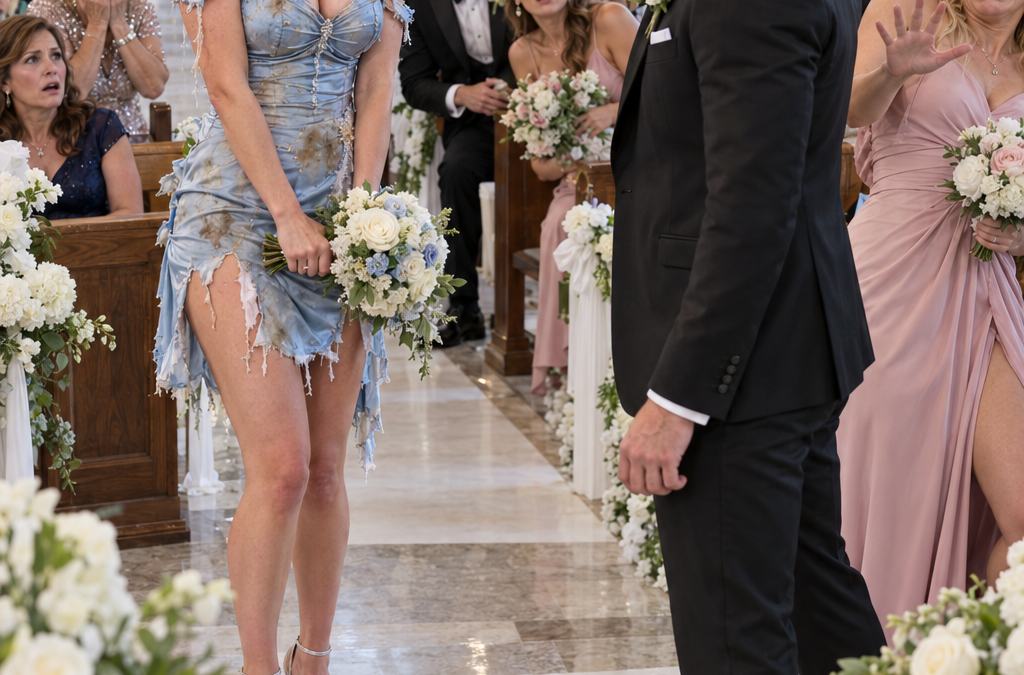
3 Hours Before My Wedding, My Sister Stole My Dress. She Left My Old High-School Prom Dress Instead—Ripped, Stained, And Two Sizes Too Small. The Note Said, “Wear What You’re Worth.” I Forced Myself Into It And Walked Down The Aisle. She Looked Thrilled. Until My Husband Held Up His Phone And Said, “Everyone Should See What She Sent Me Last Night.”
Three hours before my wedding, I unzipped the garment bag holding my $1,800 gown and found the pale blue prom dress my sister had destroyed thirteen years earlier. The bodice was still torn, the stain was still visible, and my old prom ticket had been pinned to the shoulder with four words written across the back: “Wear what you’re worth.” My family expected me to collapse. Instead, I put the dress on, walked toward my husband, and discovered he had been waiting for exactly that moment.
### Part 1
Eight days before my wedding, I took a 911 call from a woman who told me she was fine three times in less than thirty seconds. Her voice was smooth and almost cheerful, but a television was blasting behind her, and beneath the television I could hear a man repeating her name with the slow, irritated patience of someone who wanted her to hang up. “Ma’am,” I said, keeping my own voice level, “I need your address first. Then tell me what you can hear around you.”
I had worked as a dispatcher in Lexington, Kentucky, for eight years, and the job had taught me that people rarely called because of the thing they said first. You listened to breathing, background noise, pauses, changes in tone, the creak of a door, the sound of somebody standing too close. Officers reached that woman in six minutes, and before my shift ended, I learned she was safe.
I drove home that night thinking I had done one small thing correctly. What I did not think about was how strange it was that I could hear fear hidden inside a stranger’s sentence but had spent most of my life ignoring the warning sounds inside my own family.
My name is Claire Bennett, and I was thirty-one when I married Daniel Mercer. Daniel taught high school history, loved primary sources, corrected historical movies under his breath, and once spent forty minutes explaining why a trivia host had accepted the wrong answer about the Louisiana Purchase. That argument was how we met.
We were supposed to get married on a horse farm twenty-five minutes outside Lexington, in a restored barn with whitewashed beams, long windows, and a patio strung with warm lights. I had planned everything carefully because careful things had always made me feel safe. My family, unfortunately, had spent years teaching me that careful plans could still be rewritten by louder people.
The Friday before the wedding, Daniel’s mother, Elaine, hosted our rehearsal dinner at a steakhouse downtown. My father, Frank, sat at one end of the table in the gray suit he wore to every wedding and funeral, while my mother, Marlene, moved from conversation to conversation with the energy of a campaign manager. She had contributed five thousand dollars to the wedding, and although Daniel and I had paid for everything else, she managed to mention that contribution often enough that people probably thought she owned the barn.
My older sister, Natalie, sat across from me. She was thirty-four, beautiful in the effortless way that made strangers look twice, and she led worship at my parents’ church every Sunday. Her husband’s place at the table was empty.
“Evan had a work emergency in Denver,” Natalie explained when Daniel’s aunt Susan asked about him. “He’s devastated he had to miss this.”
She smiled while she said it, but she touched his empty place card with two fingers. I noticed because I noticed things for a living.
Later, while servers cleared salad plates, I heard my mother speaking to Elaine and Susan at the other end of the table. “Just be gentle with Claire this weekend,” she said. “She gets overwhelmed.”
She did not lower her voice enough.
Elaine nodded slowly, and something about that bothered me. It was not the first time my mother had described me as delicate, emotional, difficult, overwhelmed, sensitive, or “working through things.” Those words had followed me through adulthood like luggage I never packed.
I let it go because letting things go had been my specialty for thirteen years.
Near the end of dinner, the venue coordinator stopped by to confirm Saturday’s timeline. She tapped her clipboard, reviewed the florist arrival and music setup, then casually said, “And Natalie has the third key to the bridal cottage, like your mom requested.”
I looked up.
“There are three keys?” I asked.
“Mine, yours, and your sister’s.”
My mother waved a hand. “She needs access for the music.”
Natalie was singing during the processional, another arrangement suggested by my mother after I chose my best friend, Rachel, as maid of honor. “Natalie should have something special too,” Mom had said, and I had agreed because resisting her was usually more exhausting than surrendering.
Natalie left before the toasts ended. She said she had a migraine, hugged me tightly, and whispered, “Get some sleep. Tomorrow’s going to be a lot.”
At the time, I thought she sounded almost kind.
Saturday morning, Rachel and I sat in a downtown salon with rollers pinned into our hair and iced coffees sweating onto the counter. Rachel had been my best friend since college, and she was now a pediatric nurse who could discuss terrifying things in a calm voice and ridiculous things with total seriousness.
“Your groom texted me last night,” she said. “Wanted to know if you were okay.”
“Why?”
“He’s nervous. It’s adorable.”
My phone rang a few minutes later.
Daniel.
“Hey,” he said.
His voice was softer than usual.
“How are you doing?”
“Currently being sprayed with enough hair product to survive a tornado.”
He laughed, but only briefly. “Claire, is there anything you want to tell me before today?”
I smiled at my reflection. “Only that I’m probably going to cry before you do.”
There was a pause.
Too long.
“Okay,” he said. “I love you. I’ll see you at the end of the aisle.”
After we hung up, I held the phone for another second. Something about that pause bothered me, but Rachel started complaining about the curling iron temperature, and I forgot about it.
Then my photographer texted.
“Just confirming: your mom called Thursday and asked me to skip the gown-detail and getting-ready photos. Do you still want them?”
I read the message twice.
Thursday.
My mother had canceled photographs of a wedding dress that was still supposed to be hanging safely inside the bridal cottage.
“No,” I typed back. “Please keep everything as planned.”
Rachel read over my shoulder. “Why would your mother cancel dress pictures?”
“She thinks everything that isn’t her idea is a waste of money.”
I said it lightly, but the uneasiness returned.
We drove to the farm after lunch. Dogwoods were blooming along the fence line, the grass looked almost unnaturally green, and the barn stood exactly as it had in every photograph I had saved for a year. Behind it sat the little white bridal cottage where I had personally hung my gown the afternoon before.
The front door was locked.
I unlocked it.
The garment bag hung exactly where I had left it.
Same hanger.
Same white bag.
Same zipper.
Rachel set our coffees on a dresser while I reached up and pulled the zipper down.
It caught halfway.
Through the opening, I saw blue.
Not ivory.
Blue.
“Rachel,” I said.
Something in my voice made her turn immediately.
“That isn’t my dress.”
I pulled the zipper down.
The dress inside was pale blue satin. The bodice was split along one seam, and a faded reddish stain ran down the skirt. The fabric had the cheap shine of a department-store formal dress bought by an eighteen-year-old with frozen-yogurt-shop paychecks.
I knew it before my hands touched it.
My senior prom dress.
Pinned to the shoulder was a yellowed ticket.
Senior Prom, 2013.
I turned it over.
Four words had been printed carefully in block letters.
“Wear what you’re worth.”
I sat on the edge of the bed.
My hands went to my knees automatically.
In for four.
Hold for four.
Out for four.
I had taught hundreds of frightened strangers to breathe like that. Now I did it while staring at the dress that had changed my family’s story about me thirteen years earlier.
Rachel whispered, “Claire, where did that come from?”
There was only one place it could have come from.
My mother’s cedar closet.
The dress had been hanging there since 2013.
And only someone in my family would have known exactly what it meant.
### Part 2
I did what I always told callers to do when something inside their home felt wrong. I checked what could be checked before deciding what I believed.
The cottage windows were latched. The back door was deadbolted from the inside, the front lock showed no damage, and nothing else in the room appeared disturbed. When I called the coordinator, she crossed the gravel in less than two minutes and stopped dead when she saw the dress.
“Only three keys exist,” she said.
She pulled out her phone.
“Mine has been with me all morning. You have yours. Your mother asked Wednesday if Natalie could have the third one for the music setup.”
She showed me the message.
Could you give Natalie a key? She needs to set up early for the music. Thank you.
A little heart followed the sentence.
Rachel looked at me. “Call her.”
“No.”
“Claire.”
“I want to see who arrives first.”
It was Natalie.
She appeared less than ten minutes later wearing a sage-green dress, her dark hair arranged in flawless waves. She stepped into the bedroom, saw the blue dress spread across the bed, and stopped.
Then she looked at me.
Her expression became tender immediately.
“Claire,” she whispered. “Oh, honey.”
She crossed the room and placed one hand on my shoulder.
Exactly where the dress had been torn thirteen years earlier.
“Did you do this?”
I stared at her.
Not because the question shocked me.
Because it was the wrong question.
“Where is my wedding gown, Natalie?”
She tilted her head.
“Honey, you tell me.”
Rachel took one step forward. “She was fine this morning.”
Natalie never looked at her. “She’s usually fine right before.”
“Right before what?” Rachel asked.
Natalie ignored her.
“Do you remember senior year, Claire?”
That sentence opened a door inside me I had spent thirteen years holding shut.
Natalie asked whether I had slept. Whether I felt anxious. Whether I had been “feeling like myself.” She asked every possible question about my mental state.
She never asked where my wedding dress was.
My mother arrived next.
She came through the cottage door quickly, carrying her purse in one hand and wearing the expression she always wore when she believed a situation required management. One glance at the prom dress was enough.
She closed the door behind her.
“Okay,” she said. “Okay, sweetheart. Let’s not do this again.”
I stared at her.
“Do what?”
She sat beside me and reached for my hand.
Lavender perfume surrounded me.
My mother had kept lavender sachets in her cedar closet for as long as I could remember. Even after moving out, graduating college, building a career, and buying my own furniture, that scent still made some part of me feel eighteen and guilty.
“You should lie down,” she said. “We can delay things. I can tell people you’re having a difficult day.”
“What happened to my gown?”
“Nobody needs to know anything happened.”
“What happened to my gown, Mom?”
She squeezed my fingers. “Just not like last time.”
I pulled my hand free.
“Last time?”
She looked away.
That was when I asked about the cottage key.
Her face hardened.
“Please don’t start inventing things today.”
“The coordinator showed me the message.”
“You know how you get.”
There it was.
The sentence that had been treated like my medical history for half my life.
You know how you get.
Natalie moved toward the window. A set of keys jingled in her hand, and I recognized the worn leather tag attached to them.
My father’s truck keys.
“If it helps,” she said, “I brought a spare white dress.”
I looked at her.
“What?”
“It’s in Dad’s truck. Nothing fancy. But nobody would notice.”
“You brought a backup white dress to my wedding?”
Silence.
My mother turned toward Natalie.
For one second, something passed between them.
Natalie recovered first.
She smiled.
“Because I know you.”
Then she walked out.
My mother followed.
Rachel waited until we were alone, shut the bathroom door, and pointed at the prom dress draped over my arm.
“Tell me what happened in 2013.”
I leaned against the sink.
At eighteen, I had bought that dress with money from a frozen yogurt shop. It was the first expensive thing I had ever paid for myself, and I remember standing in the store fitting room thinking I looked older, prettier, more certain than I felt.
Natalie was twenty-one and home from college the night of my prom. She brought her boyfriend, Chase, to watch my mother take pictures in our living room.
When I came downstairs, Chase looked up.
“Wow,” he said. “Claire, you look completely different.”
One sentence.
Nothing flirtatious.
Nothing dramatic.
But Natalie heard it.
A few minutes later she told me one strap was twisted and pulled me upstairs to fix it.
Inside her bedroom, she grabbed the strap.
Then she yanked.
The seam tore all the way down my side.
Before I could understand what had happened, she picked up the red plastic cup she had carried upstairs and dumped punch down the front of my skirt.
Then she ran downstairs crying.
By the time I reached the landing in my ruined dress, my mother was holding Natalie while she sobbed that I had become jealous because Chase had been paying attention to her. Natalie claimed I had thrown a drink, destroyed my own dress, and accused her of ruining prom.
I screamed.
That became the only part anyone remembered.
A girl in a stained, torn dress screaming from the staircase.
My father stood near the bottom step. I remember him looking past me toward Natalie’s open bedroom door.
Then he walked away.
Later that night, I told my mother exactly what Natalie had done.
She listened.
Then she said, “Natalie has no reason to lie, Claire. You do.”
I missed prom.
That summer, my parents sent me to counseling for what my mother called anger problems. The counselor was kind, and I suspect she understood more than she said, but I was eighteen and exhausted and had already learned that telling the truth louder only made people describe me as unstable.
My mother had the dress cleaned but never repaired.
She hung it in her cedar closet with my prom ticket pinned to it.
“So you remember what losing control costs,” she told me.
From then on, every family story had two daughters.
Natalie was composed.
Claire was sensitive.
Natalie helped.
Claire reacted.
Natalie could be trusted.
Claire required handling.
Rachel turned off the bathroom faucet.
I had not realized I had turned it on.
“She isn’t trying to ruin your wedding,” Rachel said slowly.
“No.”
I stared at the blue dress.
“She’s recreating prom.”
The realization was worse than anger.
A ruined dress.
A public reaction.
A room full of witnesses already expecting me to fall apart.
I grabbed Rachel’s car keys and walked outside.
For several minutes, I sat behind the wheel with my phone open to Daniel’s messages.
Can we postpone? I’ll explain everything later.
My thumb hovered above Send.
Leaving felt safe.
No audience.
No humiliation.
No chance to become the screaming girl on the staircase again.
I started the engine and backed three feet out of the parking space.
Then someone tapped on my window.
Daniel’s aunt Susan stood outside holding a garment steamer and a stack of wedding programs.
I lowered the glass.
“Your mom asked me to bring this,” she said, lifting the steamer. Then she studied my face. “And she said we should all be gentle with you today.”
My fingers tightened around the steering wheel.
“When?”
“What?”
“When did she say that?”
Susan thought.
“Lunch. Maybe a little before.”
More than an hour before I opened the garment bag.
My mother had prepared people for my breakdown before I even knew there was something to break over.
Then Susan hesitated.
“There was something else.”
“What?”
“She told the women handing out programs that if you walked in wearing something unexpected, nobody should stare.”
I stopped breathing.
Not if I cried.
Not if I panicked.
If I wore something unexpected.
My mother knew.
The whole thing had been arranged before I ever unzipped that bag.
I turned off the engine.
And suddenly, leaving was no longer the safest choice.
It was exactly the ending they had prepared for me.
### Part 3
When I walked back into the cottage, Natalie’s white backup dress was spread across the bed.
The price tag was still attached.
I placed the old prom dress beside it.
“They built two doors,” I told Rachel.
She waited.
“If I leave, I’m unstable Claire who couldn’t handle her wedding. If I wear Natalie’s backup dress, she becomes the sister who rescued me.”
Rachel looked at the blue satin.
“So what’s door number three?”
I picked it up.
“I wear this.”
Her eyes widened.
“Claire, that dress is two sizes too small.”
“Then we make room.”
Rachel had closed wounds on screaming children. A cheap satin dress was not going to intimidate her.
The venue coordinator brought us an emergency sewing kit, safety pins, fashion tape, scissors, ribbon, and a seam ripper. Rachel opened the back seam farther, adjusted the sides, and threaded ivory ribbon through rows of reinforced pins like a corset.
At eighteen, I had been a size four.
At thirty-one, I was an eight.
The dress had been designed for the girl my family froze in time.
Every breath reminded me I was not her anymore.
Rachel offered to hide the stain with tulle.
“No.”
She looked up.
“Leave it.”
“Claire.”
“It has been there thirteen years. I’m done hiding what happened.”
When I finally faced the mirror, I saw the same pale blue fabric, the same neckline, the same ruined seam. But the face above it was different.
The eighteen-year-old girl had stood on that staircase waiting for someone older to decide whether she was telling the truth.
I had spent eight years deciding when strangers needed police, ambulances, firefighters, or simply someone who would stay on the line.
I did not need permission anymore.
The screen door creaked.
Natalie stepped into the bedroom and stopped.
For once, she had no prepared expression.
“You’re actually wearing that?”
“You chose it.”
She studied me, then smiled.
The expression returned slowly, as though she had recalculated the situation and decided it still benefited her.
“Oh.”
She picked up the backup dress.
“Well. It’s your day.”
She walked out.
At four forty-five, my father knocked.
Frank Bennett had spent thirty years repairing air conditioners and had never been a man who wasted words. He stood on the porch in his gray suit, ready to walk me to the barn.
He smiled when he saw my face.
Then he looked down.
The smile disappeared.
He stared at the blue dress for far longer than surprise required.
Then his eyes shifted past me toward his white pickup near the fence.
When I took his arm, it was trembling.
“You don’t have to do this,” he whispered.
“I know.”
I tightened my hand around his elbow.
“That’s why I’m doing it.”
The barn doors opened.
One hundred forty people turned.
The sound that moved through the room was not a gasp exactly. It was quieter and worse: fabric shifting, programs lowering, bodies leaning toward one another.
A woman near the aisle whispered, “Bless her heart.”
Another answered, “They warned us.”
At the front of the barn, Natalie began singing.
Her voice was beautiful.
It always had been.
She stood beside the string trio in her sage dress, hands folded perfectly, singing an old hymn while I walked toward the man I was supposed to marry.
She barely looked at Daniel.
She watched the dress.
Her eyes moved over the torn bodice, the old stain, the improvised ribbon.
Checking.
Confirming.
Enjoying.
My mother sat in the front row with a white handkerchief pressed to one eye. She leaned toward the woman behind her and whispered something.
I read her lips.
“I told you she might.”
Daniel’s mother, Elaine, watched me with pity.
Only Susan was not looking at me.
She was looking at my mother.
My father’s arm shook through all forty steps.
Halfway down the aisle he whispered, “Claire.”
Nothing followed.
He had spent most of his life letting silence finish sentences for him.
When we reached the altar, I finally looked directly at Daniel.
I had prepared for shock.
Concern.
Embarrassment.
Even pity.
Instead, he looked at my dress once and then met my eyes.
No flinch.
No confusion.
He looked almost as though something had just been confirmed.
My father placed my hand in his.
Daniel leaned close.
“Did you choose this?”
It was the first useful question anyone in my family had asked me all day.
“No.”
His fingers tightened around mine.
“Okay.”
There was no hesitation.
“Then marry me first.”
The officiant began.
While he spoke, I noticed Daniel touch the inside pocket of his jacket.
Once.
Then again.
Our vows came next.
Daniel unfolded the page he had practiced in our kitchen, and at first every sentence was familiar.
Then he reached the bottom.
One new line had been written in different ink.
“And I promise to believe you before I believe a story about you.”
My breath caught.
Across the barn, Natalie’s smile disappeared for half a second.
My mother glanced toward one of the women handing out programs and gave a tiny nod.
Daniel had said, Marry me first.
Now I understood.
Whatever he had inside his jacket, he did not want it to become the center of our wedding until we were already husband and wife.
I said my vows.
I talked about building a home where neither person had to shout to be heard. A home where the truth did not depend on who told it first.
My voice never shook.
The officiant pronounced us married.
Daniel kissed me.
Natalie started clapping before anyone else.
Too fast.
Too loudly.
Then the room joined her.
The string players lifted their bows for the recessional.
Daniel did not turn toward the aisle.
Instead, he faced our officiant.
“Can I borrow your microphone?”
My mother’s voice carried from the front row.
“What is he doing?”
Daniel took the microphone with one hand while still holding mine with the other.
“Thank you all for being here,” he said. “I know this has been an unusual afternoon.”
Nobody moved.
“I won’t keep you long. But before Claire and I walk out of here, there’s something everyone needs to hear.”
He reached into his jacket.
Natalie stopped clapping.
Daniel pulled out his phone.
The screen was already open.
“Last night,” he said, “someone sent me a message about my wife.”
Then he looked directly at my sister.
“And I think we should talk about why she knew what Claire would be wearing before Claire did.”
### Part 4
Daniel read the message without dramatizing it.
That made it worse.
“Claire has been struggling again, like she did in high school. She wants to wear her old prom dress tomorrow to see if you’ll love every version of her. Please don’t react. And please don’t tell her I warned you. She made me promise.”
Nobody made a sound.
Daniel lowered the phone slightly.
“This arrived at eleven fourteen last night.”
He looked around the barn.
“At eleven fourteen last night, Claire’s wedding gown was locked inside a cottage she had not entered since Friday afternoon.”
My sister still held her microphone.
For once, she was not singing.
“There was also a photo attached,” Daniel continued. “I’m not showing it because it belongs to Claire. It’s a picture of her at eighteen, crying in that blue dress.”
My stomach turned.
I had forgotten the photograph existed.
My mother had taken it after the screaming ended.
Not to comfort me.
To document what she called my episode.
Daniel looked at Natalie.
“Who took that picture?”
Natalie pressed a hand against her chest.
“Daniel, she made me promise.”
Her voice became soft and wounded.
“I was trying to protect her. And what you’re doing right now, in front of everyone on her wedding day, is exactly what I was afraid would happen.”
A few people shifted.
One woman from my parents’ church nodded.
I watched my sister regain control of the room.
It was astonishing how quickly she could do it.
Daniel waited.
Then he looked down at his phone again.
“I asked another question last night. I asked whether anyone else knew about Claire supposedly wanting to wear this dress.”
He paused.
“Natalie answered, ‘Just me and Mom. Mom’s handling the family side.’”
Every face near the front turned toward my mother.
Her handkerchief slipped from her fingers.
She stood.
“This is not the place.”
I released Daniel’s hand.
He passed me the microphone.
I had spent years speaking calmly while people screamed into telephones.
I knew something my family had never understood.
Volume was not authority.
“That dress,” I said, “has been hanging in my mother’s cedar closet for thirteen years.”
My voice carried easily.
“I have not been inside my parents’ house since Christmas.”
I removed the yellowed ticket from my bouquet.
“This ticket was pinned to it.”
I held it up.
“So if I planned this, someone should explain how I got a dress I couldn’t access.”
Natalie’s mouth opened.
“You asked me to bring it.”
“When?”
She froze.
“Yesterday.”
“I worked twelve hours yesterday.”
“You texted me.”
“Show everyone.”
Her eyes moved toward my mother.
It was tiny.
A reflex.
But a room full of people saw it.
Then Susan Mercer stood from the groom’s side.
She still held her program.
“Marlene told me around lunch to be gentle with Claire,” she said. “That was before Claire arrived at the cottage.”
Natalie’s expression hardened.
“Susan, with respect, you’ve known my sister for three years.”
Susan nodded.
“I’ve known your mother since noon.”
A few nervous breaths broke through the silence.
“That was long enough for her to tell me that if Claire walked in wearing something unexpected, nobody should stare.”
My mother gripped the back of the pew.
“I was preparing people.”
“For what?” I asked.
She did not answer.
Daniel took the microphone again.
“My wife was told all day that people were trying to protect her. So that’s what I’m doing now.”
He turned toward me.
“I’m believing her.”
Then my father stood.
He said nothing.
He walked toward the barn doors and disappeared outside.
My mother whispered his name.
He did not stop.
We waited.
Nobody knew whether the ceremony was over, whether the reception had begun, or whether someone should start the music.
For nearly two minutes, the only sounds were the slight creak of the musicians’ stands and a horse stamping somewhere beyond the windows.
Then the barn doors opened again.
My father came inside carrying my wedding gown.
Ivory silk hung over his arms.
The long train was gathered against his chest.
He walked slowly down the aisle and placed the gown across the front pew.
“She put it behind the seat in my truck this morning,” he said.
He looked at Natalie.
“She told me it was another dress she might wear tonight.”
Natalie’s face changed.
Not immediately.
First came disbelief.
Then calculation.
Then panic.
“Dad misunderstood.”
Nobody responded.
“It’s a misunderstanding.”
Still nothing.
She looked at the people around her.
“Claire does this. She twists things.”
Not one person nodded.
Natalie’s voice rose.
“Why are you looking at me like that?”
Her microphone was still on.
“Why is everyone looking at me?”
Then the real sentence escaped.
“Everyone was going to ask where Evan is!”
It echoed through the barn.
Natalie went still.
Her hand flew to her mouth.
My mother closed her eyes.
Suddenly I understood the empty place card at the rehearsal dinner. The kitchen renovation that had supposedly forced Natalie to move into my parents’ house. Her husband’s endless business trips.
Evan had not been in Denver.
Something had happened to Natalie’s marriage, and instead of allowing herself to become the family member people worried about, she had decided to put me back in the role I had occupied since eighteen.
I stared at her.
“You needed them to talk about me.”
“No.”
“You needed someone else to be the problem.”
She shook her head rapidly.
“That isn’t—”
“You can leave.”
My mother stepped toward me.
“Claire.”
“You too.”
Natalie lowered her microphone.
It slipped from her hand and landed softly on the straw-covered floor, still broadcasting the sound of her breathing.
Nobody applauded.
Nobody shouted.
She walked out.
My mother followed.
The coordinator, who deserved every dollar we had paid her, restarted the string trio and smoothly announced that cocktail hour would begin early outside.
Guests moved quickly.
Anything was better than standing inside that barn.
My immediate family was directed into a tack room beside the cottage.
The narrow space smelled of leather and saddle soap. Saddles hung along one wall, and one wooden stool sat beneath a small window.
Natalie stood near the center.
My mother faced her.
For the first time in my life, I heard fear in Marlene Bennett’s voice.
“Natalie.”
She swallowed.
“Tell me you didn’t do this.”
Natalie laughed once.
No humor.
No softness.
“You didn’t ask me that in 2013.”
My mother stared.
“What does that mean?”
“You never asked.”
Natalie’s perfect composure broke.
“You never even went upstairs. You believed me in one minute.”
My father closed his eyes.
Natalie pointed toward my torn blue bodice.
“I did it.”
The words landed almost gently.
“I ripped her dress.”
My mother sat down hard on the stool.
Natalie kept talking.
“I dumped the punch on her too. Chase said she looked pretty, and I couldn’t stand it.”
Thirteen years.
Six counseling sessions.
Hundreds of family jokes.
Thousands of careful explanations.
All of it collapsed in one ordinary sentence.
My mother slowly looked at me.
“Claire.”
Her lips trembled.
“Why didn’t you tell me?”
For the first time that day, I almost laughed.
“I did.”
She lowered her eyes.
“I was eighteen.”
### Part 5
Nobody spoke for several seconds.
The room was too small for the amount of truth inside it.
Daniel stood beside me. Rachel guarded the doorway with her arms folded, while my father remained near the wall with his head lowered.
Daniel finally looked at my mother.
“Why did my mom already believe Claire had emotional problems before today?”
Mom’s hands folded tightly in her lap.
“At the engagement party,” she said, “I told Elaine that Claire had struggled when she was younger.”
My chest went cold.
“You told my future mother-in-law?”
“I said you had done a lot of work on yourself.”
“Work on what?”
Silence.
Daniel’s jaw tightened.
My mother hurried on.
“I only wanted her prepared.”
That word again.
Prepared.
My entire life had been surrounded by people my mother prepared to misunderstand me.
“And this week?” Daniel asked.
Mom exhaled.
“Natalie asked for the cottage key Wednesday.”
“For music?” I said.
Mom looked down.
“She said she needed access.”
“And Thursday?”
My mother did not answer.
“You called my photographer Thursday,” I reminded her.
Natalie stared at the wall.
Mom’s face changed.
“I thought something might happen.”
“You thought what might happen?”
She rubbed her fingers together.
“Natalie said you were talking about the old dress.”
“When?”
“Friday.”
“No.”
The word came out sharper than anything I had said all day.
“You called my photographer Thursday.”
Mom went still.
Natalie’s eyes closed.
There it was.
The contradiction.
My mother had not learned about the plan Friday night.
She had known at least a day earlier.
“Mom?”
“I didn’t take your gown.”
“That isn’t what I asked.”
“I didn’t write that note.”
“That isn’t what I asked either.”
She looked at me then.
Really looked.
“I thought if I gave Natalie the key, she would handle whatever she was planning without making a scene.”
I almost admired the sentence.
Even after everything, she had found a way to describe Natalie’s sabotage as managing me.
“So you knew.”
“I knew she wanted to do something.”
“You canceled the photographs.”
“I didn’t want there to be pictures if things went badly.”
“You told guests not to stare.”
“I didn’t want you embarrassed.”
“You told Daniel’s family I had problems.”
“I wanted them to understand.”
“You never called me.”
That finally stopped her.
Not the gown.
Not the lie.
Not thirteen years.
That simple fact.
“You prepared everyone except me.”
Natalie suddenly spoke.
“It was supposed to be back before dinner.”
We all turned.
She stared at the floor.
“The real dress. I was going to put it back in the cottage after the ceremony.”
Rachel made a disbelieving sound.
Natalie’s words accelerated.
“Everyone would think Claire moved it herself. Mom would calm everybody down. Claire would change. People would remember the weird prom-dress thing for a while, then it would become one of those family stories.”
“One of those family stories,” I repeated.
“She would have been fine.”
Natalie looked at me.
“She always ends up fine.”
There it was.
The logic people use when they hurt someone competent.
You survive, therefore the damage does not count.
My mother pressed both hands to her face.
“You managed the story,” I told her. “You just never managed to ask whether it was true.”
Natalie pushed past Rachel.
Mom stood and followed.
My father remained.
For a moment, we faced each other.
I wanted something impossible from him.
A sentence from 2013 delivered thirteen years late.
Instead he said, “I’ll take them home.”
I nodded.
“I know you will.”
He left.
Through the tack-room window, I watched his truck cross the gravel, my mother in the passenger seat and Natalie in the back. The brake lights glowed once near the gate.
Then they disappeared.
Daniel found me a few minutes later sitting on the bridal-cottage porch.
My wedding gown was draped across his arm.
“You can change,” he said. “Rachel says ten minutes.”
I touched the ivory fabric.
I had chosen that dress almost a year earlier in a quiet shop with Rachel. When I saw myself in it for the first time, I had thought, There you are.
Now I looked down at the blue satin.
The torn seam.
The ribbon.
The stain.
“I already got married in this.”
Daniel waited.
“I’m staying in it.”
He smiled.
“Okay.”
That was one of the reasons I loved him.
He knew the difference between agreeing with me and allowing me.
The reception continued.
Almost everyone stayed.
The father-daughter dance disappeared from the schedule without anyone mentioning it. Daniel and I danced under the patio lights while the ribbon along my back moved with every turn.
At first, people watched the dress.
By the end, they watched us.
Rachel abandoned the three-page maid-of-honor speech she had written about college, Nashville, and the time I accidentally locked us out of a dorm room wearing towels.
She lifted her glass.
“I’m skipping what I wrote.”
A few people laughed nervously.
“I’ve known Claire for twelve years. I’ve seen her sick, exhausted, furious, heartbroken, and scared. I have never once seen her be the person her family described today.”
Rachel looked directly at me.
“To Claire. And to Daniel, who asked instead of assuming.”
People drank.
Nobody cheered.
That was better.
Later, Elaine approached me near the dance floor.
Her hands were cold when she took mine.
“Your mother told me things about you.”
I waited.
“She said you had temper problems when you were younger. She said you had worked hard to manage them.”
Elaine’s eyes filled.
“For more than a year, I kept waiting to see something that was never there.”
I remembered every dinner at her house.
Every careful question.
Every time she seemed to study my response after a disagreement.
Someone had given her a version of me before she had the chance to know the real one.
“I’m sorry,” she said.
I squeezed her hands.
She did not demand forgiveness.
She did not explain herself.
That made forgiving the mistake easier.
That night, Daniel and I finally discussed the message Natalie had sent him.
He told me he had read it three times while brushing his teeth.
“It didn’t sound like you,” he said. “But it was designed so I couldn’t safely challenge it.”
“What do you mean?”
“She said you were unstable, but she also said asking you about it might make things worse.”
I understood immediately.
Natalie had created a trap.
Believe her, or risk becoming the husband who triggered his fragile bride.
“So you texted Rachel.”
Daniel nodded.
“I asked whether you seemed okay. She said you were happy all week.”
“Then you called me.”
“And you laughed.”
He looked ashamed.
“I should have told you everything then.”
“Yes.”
He accepted it.
No defense.
No argument.
“Yes.”
“Next time, wake me.”
“Even at three in the morning?”
“Especially at three.”
We shook on it.
Then Daniel kissed my hand.
My phone buzzed against the table.
A message from my mother filled the lock screen.
“We need to talk about how this looked.”
I turned the phone face down.
For the first time in my life, I did not answer automatically.
And that silence felt nothing like weakness.
### Part 6
Daniel and I spent two nights in a small cabin near Red River Gorge.
It was not our real honeymoon. A teacher in April and a 911 dispatcher who had already traded half her schedule could not disappear for two weeks, so we planned to travel during summer break.
For forty-eight hours, we hiked, slept late, ate terrible convenience-store sandwiches, and kept our phones mostly turned off.
When I powered mine on Sunday evening, I had forty-seven messages.
My mother had been busy.
Some relatives had received one version in which Natalie had misunderstood my emotional state. Others had been told the entire incident was “a family misunderstanding blown out of proportion.” One cousin forwarded me a message where Mom wrote that weddings were stressful and “everyone made mistakes.”
There was no mention of a stolen gown.
No mention of thirteen years.
No mention of a backup dress purchased in advance.
No mention of warning 140 people how to interpret my behavior.
I did not correct her.
There had been 140 witnesses.
For once, I did not need to become the family historian.
By the following Sunday, the pastor at my parents’ church had asked Natalie to step back from leading worship temporarily. Nobody gave me details, and I did not ask.
Then the second story came out.
Evan had not been working in Denver.
He had moved out in January.
Natalie’s supposed kitchen renovation was fictional.
She had been living with my parents because her marriage had collapsed months earlier.
People at church had started asking questions. Natalie, who had built most of her identity around being the stable daughter with the beautiful marriage and respected church role, apparently could not tolerate becoming the subject of concern.
So she reached backward thirteen years.
She found the role that had always protected her.
If Claire became unstable again, nobody would ask what had happened to Natalie.
It was ugly.
But it made terrible sense.
In mid-May, Natalie moved into an apartment across town.
A few days later she texted me.
“I didn’t think you’d actually walk out there wearing it.”
I read the sentence twice.
No apology.
No admission.
No question about whether I was okay.
Only disbelief that I had refused the role she assigned me.
I archived the message.
Four days after our wedding, my father came to our apartment.
He arrived alone.
He sat at my kitchen table without removing his jacket and placed a small envelope between us.
I did not touch it.
“What is that?”
“Something I should have given you thirteen years ago.”
He opened it.
Inside was a scrap of pale blue satin.
The size of two fingers.
Loose threads still hung from one edge.
I looked at him.
He stared at the table.
“The morning after your prom, the window unit in Natalie’s room stopped working.”
His voice was flat.
“I moved her desk to get behind it.”
He pushed the fabric toward me.
“This was on the floor.”
I stopped breathing.
“I knew it matched your dress.”
He nodded.
“You saw the torn seam.”
“Yes.”
“You knew.”
His face collapsed.
“Yes.”
I stood.
For years, I had imagined what proving the prom story would feel like.
Vindication.
Relief.
Maybe rage.
Instead, I felt tired.
“You knew that night?”
“By the next morning.”
“And when Mom sent me to counseling?”
“I told myself the counselor might help everybody.”
“When she called me unstable?”
“I told myself arguing with her would make it worse.”
“When Natalie became the trustworthy daughter and I became the family warning label?”
His eyes filled.
“I told myself too much time had passed.”
I stared at the fabric.
Thirteen years of silence reduced to a scrap small enough to lose inside an envelope.
“Why keep it?”
“I don’t know.”
“Yes, you do.”
He closed his eyes.
“I was ashamed to throw it away.”
There it was.
My father had kept evidence because destroying it felt wrong.
But he had also hidden it because admitting it existed would require action.
“I saw you looking toward Natalie’s room that night,” I said.
His head lifted.
“At the bottom of the stairs.”
He nodded.
“I suspected.”
“And you still walked away.”
“Yes.”
I went into my purse and found the old prom ticket.
Wear what you’re worth.
I placed it inside the envelope with the fabric.
Then I wrote “2013” across the front and pushed it back toward him.
“You kept this all these years.”
He stared at it.
“You can keep it now.”
His mouth tightened.
“But this time, you tell people what it means.”
He looked up.
“I want to apologize.”
“I know.”
“I failed you.”
“Yes.”
His face changed because he had expected me to soften the word.
I did not.
“Claire, I don’t expect you to forgive—”
“Good.”
He nodded slowly.
I sat back down.
“I don’t hate you, Dad.”
He swallowed.
“That might be worse.”
“It isn’t punishment.”
I folded my hands.
“It’s distance.”
He looked at the envelope.
“What do I do?”
“For once?”
I stood.
“You decide without making me carry it for you.”
He left ten minutes later.
I did not hug him.
I did not slam the door.
I simply closed it.
A week later, Susan told me he had called relatives individually.
Not a family group message.
Not a vague statement.
Phone calls.
He told them Natalie had destroyed my prom dress in 2013. He told them he found evidence the next morning. He told them he had stayed silent while my mother treated me as though I had invented the incident.
He used the words, “I knew enough to stop it, and I didn’t.”
When Susan told me that, I felt something loosen.
Not forgiveness.
Not yet.
Maybe never in the form he wanted.
But truth finally had another witness.
I made quieter changes too.
At work, I opened my emergency contact form.
My mother’s name had been first for eight years.
I crossed it out.
Daniel became number one.
Rachel became number two.
Then came Mother’s Day.
My mother texted three times.
First: “Brunch Sunday at eleven.”
Then: “Your father hopes you’ll come.”
Finally: “Families don’t heal by avoiding each other.”
I typed one sentence.
“I won’t be there Sunday. Please don’t ask me to explain.”
She replied almost immediately.
“You’re punishing everyone.”
I stared at the screen.
Then I locked my phone.
My mother had spent years teaching me that every boundary was an attack on the person who wanted to cross it.
I was finally learning otherwise.
### Part 7
At the end of April, I took the blue prom dress to a dry cleaner.
The woman behind the counter held it up, examined the old stain, the new ribbon holes, and the damage along the bodice.
“This dress has been through something,” she said.
“So have I.”
She smiled politely, probably unsure whether I was joking.
They removed most of the old punch stain.
I was surprised by how sad that made me.
For thirteen years, that stain had been evidence. Then during my wedding, it had become a declaration.
Now it was only fabric again.
A seamstress rebuilt the side, let out the bodice, and replaced several safety-pin holes with proper loops. When she finished, the dress looked almost new without pretending nothing had happened to it.
I did not take it home.
Instead, I drove to Daniel’s high school.
One classroom near the counseling office housed a donated prom closet where students who could not afford formalwear could borrow dresses, shoes, jackets, and accessories for free.
No applications.
No public explanation.
No questions.
Daniel met me outside.
“You sure?”
I held the dress bag over my arm.
“No.”
He smiled.
“Good enough.”
Inside the room, racks of dresses crowded the walls in every imaginable color. Sequins flashed beneath fluorescent lights. Someone had organized shoes by size in plastic bins.
The teacher who ran the closet thanked me and reached for the hanger.
“Wait.”
I removed a small card from my purse.
For a minute, I did not know what to write.
My mother had once pinned a message to the dress.
Wear what you’re worth.
I had believed those words longer than I wanted to admit.
Eventually, I wrote something different.
“Be gentle with her.”
Not because the next girl would be fragile.
Because clothes carry people through moments they remember forever.
I pinned the card to the shoulder and handed the dress over.
On the second Saturday in May, someone borrowed it.
I did not know her name.
I did not ask.
That mattered.
For most of my childhood, my mother believed knowing people meant being entitled to manage them. Their choices, their emotions, their explanations.
I was learning that sometimes kindness meant allowing someone to remain unknown.
Meanwhile, Natalie made two attempts to contact me.
The first was a four-paragraph text that began, “I know everyone thinks I’m a monster.”
I stopped reading there.
The second came through my father.
“She wants to explain.”
I shook my head.
“She already did.”
“She says there’s more.”
“There is always more.”
My father looked older than he had a month earlier.
“Your mother thinks you should at least hear her out.”
“That’s because Mom still believes access to me is a family right.”
He said nothing.
I appreciated that.
He had started doing something unfamiliar.
Stopping.
My mother contacted me more often.
She sent childhood photographs.
Recipes.
A picture of a flowering dogwood tree in her yard.
Then finally, one message that was almost an apology.
“I should have listened to you in 2013.”
Almost.
The next sentence ruined it.
“But I was doing the best I could with what I understood at the time.”
I stared at those words for several minutes.
That had always been my mother’s gift.
She could transform accountability into tragedy about herself.
I did not respond.
Daniel asked once whether I thought I would ever speak to her again.
“Yes.”
That surprised him.
“Really?”
“I’ll probably speak to her.”
I looked across our kitchen.
“But speaking is not the same as restoring what she had.”
“What did she have?”
“Automatic access.”
That was the part I could finally name.
My mother had always known she could call, enter, advise, interpret, announce, explain, warn, correct, or override.
She could describe me to other people before I arrived.
She could decide what I felt.
She could prepare rooms for versions of me I had never agreed to become.
That was over.
On Memorial Day, Daniel and I attended a cookout at Susan’s house.
Elaine saved me a chair beside her.
Nothing about the afternoon was dramatic.
Hamburgers burned slightly on the grill. Someone forgot ice. Daniel’s cousin argued about baseball with a neighbor.
It felt wonderful.
Halfway through lunch, Daniel handed me an envelope.
“This came through school.”
Inside was a thank-you card from the teacher who managed the prom closet.
The student who had borrowed the blue dress had asked her to pass along one sentence.
“That dress made me feel like myself.”
I read it again.
And again.
Daniel sat quietly beside me.
For thirteen years, that dress had been used to prove I was not who I said I was.
Then Natalie used it to turn me into an old version of myself.
But somewhere across Lexington, a teenage girl had put it on and felt more like herself.
I laughed.
Then I cried.
Not the crying my mother had warned everyone about.
Not the crying Natalie had tried to trigger.
Just ordinary tears on an ordinary patio while Daniel handed me a napkin.
“You okay?”
“Yes.”
And this time, the word was true.
My father continued calling relatives.
He also started seeing a counselor.
He told me that himself during one of our occasional coffee meetings.
I did not congratulate him.
I did not punish him either.
That was his work.
I had mine.
My mother refused counseling at first because she said she “didn’t need a stranger explaining her family.” Later, I heard she changed her mind.
I never asked why.
Natalie stopped attending my parents’ church.
She and Evan eventually filed for divorce.
I heard through cousins that she blamed the wedding incident for “destroying her support system.”
Maybe she believed that.
Maybe in her version, I still stole something from her.
I no longer needed to correct it.
For most of my life, I had thought healing meant eventually proving the truth so thoroughly that everyone who hurt me would finally agree with it.
I was beginning to understand that freedom was quieter.
Sometimes people never agree.
Sometimes they keep the old story because losing it would cost them too much.
And sometimes you simply stop showing up for the role.
### Part 8
Six months after the wedding, my mother asked to meet me for coffee.
She did not ask through my father.
She did not send Natalie.
She sent one message.
“I would like to apologize without explaining myself. If you don’t want to meet, I understand.”
I stared at that sentence longer than I expected.
Then I agreed.
We met at a coffee shop halfway between our homes.
She arrived early.
Of course she did.
For once, she had nothing spread across the table. No photographs, no childhood keepsakes, no evidence of her good intentions.
Just coffee.
She looked smaller to me.
Not physically.
Simply less powerful.
“Thank you for coming,” she said.
I nodded.
She wrapped both hands around her cup.
“I believed Natalie because believing her was easier.”
I did not rescue her from the silence after that sentence.
“She was confident,” Mom continued. “You were angry. I mistook confidence for truth and emotion for guilt.”
I listened.
“Then I kept repeating the story because admitting I was wrong would mean admitting what I did to you afterward was wrong too.”
There it was.
No “but.”
No “I was trying.”
No “you have to understand.”
She looked directly at me.
“I sent you to counseling for telling the truth.”
My throat tightened.
“I made you doubt your own memory.”
“Yes.”
“I told other people you were unstable.”
“Yes.”
“I helped Natalie set up what happened at the wedding.”
“Yes.”
Her face crumpled.
“I am sorry.”
I believed she meant it.
That did not restore thirteen years.
People often confuse sincerity with entitlement.
A sincere apology deserves to be heard.
It does not automatically earn the relationship that existed before the harm was acknowledged.
“I believe you’re sorry.”
Hope flashed across her face.
I continued.
“But things are not going back.”
Her expression fell.
I hated seeing it.
That surprised me.
My mother had hurt me deeply, but I was not happy that consequences hurt her.
That did not mean the consequences were wrong.
“You won’t come to holidays?”
“Maybe some.”
“Sunday dinners?”
“No.”
“Can I call?”
“You can text first.”
She stared at her coffee.
“For how long?”
“I don’t know.”
“Claire, I’m your mother.”
“I know.”
The answer came easily.
“That’s why it hurt as much as it did.”
She cried quietly.
I did not move around the table to hold her.
I also did not leave.
We sat there for almost an hour.
When we parted, she asked if she could hug me.
I said no.
She nodded.
Then we walked to separate cars.
I did not feel triumphant.
I felt clean.
My father and I built something different.
Not the old relationship repaired.
Something smaller.
More honest.
He came to our apartment sometimes, but never unannounced. He no longer carried messages from my mother or sister.
The first time he started defending Natalie during a conversation, he stopped himself.
“I’m doing it again,” he said.
“Yes.”
He nodded.
That was progress.
Natalie never apologized in a way I could receive.
Almost a year after the wedding, she sent an email claiming she had been in “an impossible emotional situation” because of her marriage.
I believed that part.
Pain explains strange behavior.
It does not erase deliberate cruelty.
She wrote that seeing me happy while her own life collapsed had made her feel invisible.
I understood that too.
Then she asked whether we could “start fresh as sisters.”
I did not reply.
Starting fresh would have required pretending we had not already started many times.
I had spent thirteen years paying interest on a lie she invented because her boyfriend complimented my prom dress.
I was finished financing it.
Daniel and I finally took our honeymoon the following summer.
We drove up the coast of Maine, stayed in tiny inns, ate lobster rolls beside the water, and spent one rainy afternoon inside a used bookstore because neither of us wanted to drive.
On our anniversary, he handed me a small wrapped box.
Inside was the yellow prom ticket.
I stared at him.
“How did you get this?”
“Your dad had the envelope.”
I looked at the familiar card.
He had removed the message from the back.
Not erased it.
Covered it.
A thin piece of paper had been mounted over the old words.
On it Daniel had written one sentence.
“You decide what you’re worth.”
I laughed.
“That is unbearably sentimental.”
“I’m a history teacher. We preserve documents.”
I kissed him.
Then I placed the ticket inside my wallet.
Not because I needed a reminder of my sister.
Because I wanted a reminder of choice.
At work, nothing dramatic changed.
Phones kept ringing.
People kept calling on terrible nights.
I still listened for the things they did not say.
The television too loud.
The frightened pause.
The person in the background repeating a name.
But something about the job felt different after my wedding.
For years, I had believed strength meant staying calm enough to survive whatever happened.
Now I understood that sometimes strength meant ending the call.
Walking away.
Blocking the number.
Closing the door.
Refusing to explain yourself one more time.
A year after the wedding, Rachel sent me a photograph from Daniel’s school.
The prom closet had expanded into two classrooms.
Someone had donated racks, mirrors, and shoes.
Near the door hung a small sign created by the students.
“Take what makes you feel like yourself.”
My blue dress was not there.
It had been borrowed again.
Then again.
Eventually, the teacher told Daniel that a student loved it so much she asked whether she could keep it.
He called me from school.
“What do you think?”
I looked around our apartment.
At the framed wedding photograph on the wall.
In it, I wore pale blue satin, ivory ribbon running down my back, Daniel’s hand around mine.
The stain was faintly visible.
My real wedding gown was folded safely in storage.
I had never worn it.
Maybe I never would.
“Give it to her.”
“You sure?”
“Yes.”
That dress had spent enough years in closets.
Sometimes I still think about the moment those barn doors opened.
One hundred forty people turning.
My father trembling beside me.
Natalie singing while she watched to see whether I would break.
My mother sitting in the front row with a handkerchief ready for a disaster she had helped arrange.
And Daniel waiting at the end of the aisle.
He did not rescue me.
That matters.
I do not tell this story because a husband saved me from a cruel family.
He could not.
Rachel could not.
Susan could not.
Even my father carrying the gown back into the barn could not undo what he had failed to do thirteen years earlier.
What Daniel did was simpler.
He asked me what was true.
Then he believed my answer.
After thirty-one years, I finally did the same thing for myself.
My family still has versions of me.
Some relatives probably think I am unforgiving.
Natalie may always believe I humiliated her.
My mother may privately wish I would accept an apology and restore every Sunday dinner as proof that everything healed correctly.
They are allowed to want those things.
I am allowed to say no.
Forgiveness, when it exists, does not require access.
Understanding does not require reconciliation.
And love does not require volunteering for the same wound twice.
Eight years before my wedding, I became a 911 dispatcher because I wanted to be useful on the worst nights of other people’s lives.
For years, I told strangers the same things.
Stay where you are if it is safe.
Move if it is not.
Tell me what happened.
Keep breathing.
Help is coming.
It took me much longer to understand those instructions applied to me too.
I had spent most of my childhood staying inside a story someone else created because I thought leaving it meant proving them right.
It did not.
Sometimes leaving is the first true thing you do.
On my wedding day, my sister gave me the dress she believed represented the worst version of me.
My mother prepared a room full of people to pity me before I arrived.
My father walked beside me carrying thirteen years of silence.
And I still reached the altar.
Not because I proved I was stronger than them.
Not because I defeated anyone.
I reached it because somewhere between the cottage and the barn, I stopped asking my family which version of me I was allowed to be.
I was Claire Mercer.
Thirty-one years old.
A dispatcher.
A wife.
A friend.
A woman wearing a ruined blue prom dress because someone else had decided it should shame her.
And when I walked through those barn doors, I finally understood something nobody in my family had been qualified to decide.
What I was worth.
THE END!