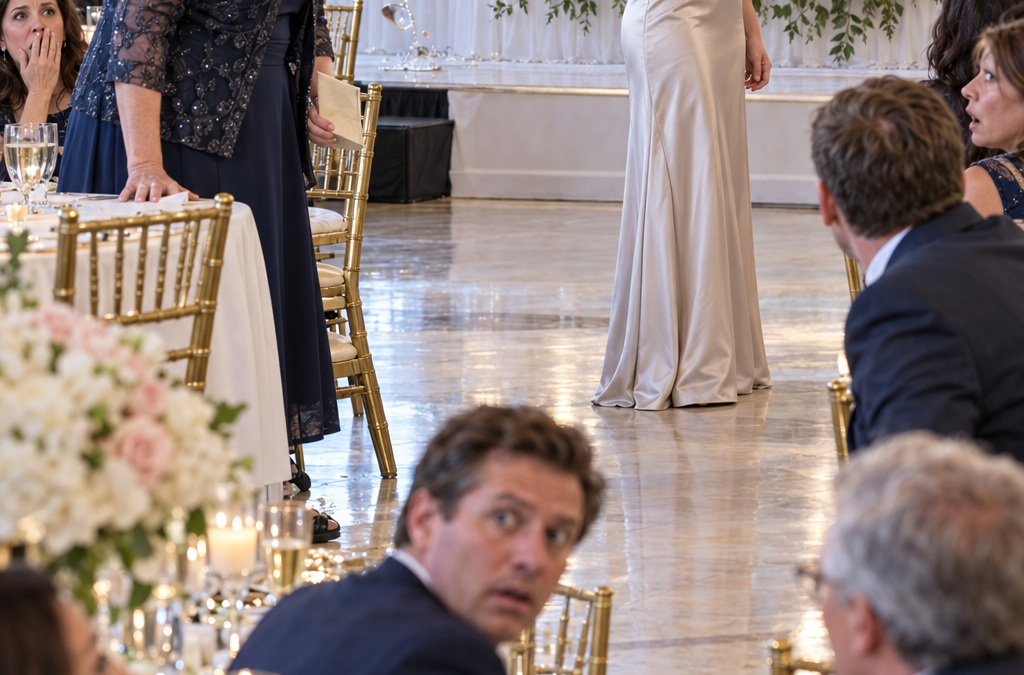
For 20 Years, My Parents Called Me “The Wrong Baby.” At Their Anniversary, Mom Joked Into The Mic, “Maybe The Hospital Will Finally Take Her Back!” Everyone Laughed. I Took The Mic. “Funny You Say That.” Then The Retired Nurse Who Delivered Me Stood Up At Table 9. Mom’s Glass Shattered.
My mother spent 20 years telling everyone I was the baby the hospital gave her by mistake. At her 35th anniversary party, she made 110 guests laugh about sending me back, while my 4-month-old daughter slept against my shoulder. My father laughed louder than anyone. I handed my daughter to my husband and walked toward the microphone. But the real shock came when a retired nurse stood up at the back of the room. My mother recognized her immediately—and dropped her champagne glass.
## Part 1
The first time I understood that my family’s favorite joke could hurt someone besides me, my daughter was 6 hours old. She was sleeping against my chest in a hospital room outside St. Louis, making tiny movements with her mouth as though she were dreaming about nursing. A white identification bracelet circled her ankle, and an identical one circled my wrist. Every time a nurse brought her back from an examination, a scanner made 2 soft beeps, confirming that she belonged with me.
I’d never considered how comforting those sounds might be until my mother walked into the room and turned them into a punch line. Marilyn Keene arrived carrying a bakery box, a vase of flowers, and the unmistakable confidence of a woman who believed every gathering improved when she took charge. My father, Patrick, followed with balloons that bumped against the doorframe, while my younger aunt, Beth Larkin, slipped in behind them holding a small knitted blanket. My husband, Nathan, stood up from the uncomfortable reclining chair where he’d spent most of the night sleeping in his jeans.
My mother kissed my forehead, inspected the flowers already arranged beside my bed, and immediately began rearranging them. She asked the nurse whether the hospital still provided complimentary photographs, criticized the temperature of the room, and announced that she’d brought pastries for the entire nursing station. My father barely listened because he was staring at his granddaughter with the softest expression I’d seen on his face in years. Then Marilyn noticed the bracelet around Willa’s ankle.
“Better check that one twice,” she announced, tapping the plastic band with a polished fingernail. “We wouldn’t want another wrong baby in this family.”
The nurse gave her a courteous smile and explained that the hospital checked identification every time an infant changed hands. My mother laughed and told her the story she’d been telling strangers since I was 5 years old. According to Marilyn, the hospital had accidentally sent her home with somebody else’s daughter, but she and Patrick were too kindhearted to demand an exchange. “Of course, by the time we realized our mistake, she’d already started calling us Mom and Dad,” she finished, gesturing toward me.
My father chuckled, Nathan looked uncomfortable, and Beth laughed a fraction of a second before everyone else. That was something she’d always done, an eager little laugh that appeared whenever Marilyn looked in her direction. I’d spent 20 years laughing along because there was never a graceful way to explain that being called unwanted hurt, especially when everyone insisted it was affectionate teasing. But as I watched my mother’s finger resting against my daughter’s ankle, I realized that Willa would eventually understand those words.
After my parents left, Beth remained beside the window, holding the little blanket against her stomach. She was 43, unmarried, and lived alone above a retired couple’s garage in a neighborhood near the old parish where our family had attended church. She’d been the aunt who remembered my science fairs, mailed birthday cards exactly on time, and somehow always bought the books I wanted without asking what I liked. Yet whenever Marilyn was present, Beth seemed to shrink into someone who needed permission to occupy a chair.
“Would you like to hold her?” I asked.
Beth stared at Willa for a moment before extending her arms. She held the baby carefully, studying her tiny nose and closed eyelids with an expression I couldn’t identify. After several minutes, she looked toward the clock above the doorway, and something in her face tightened. “I’d better give her back,” she whispered, although nobody had asked her to leave.
That night, when Nathan drove home to shower and feed our dog, I opened the baby memory book his mother had given us. The first pages invited parents to record their children’s birthdays, first visitors, and the stories surrounding their arrival. One page asked me to describe the day I was born, including the hospital, the time, and the first words anyone had spoken to me. I held my pencil above the paper and discovered that I knew almost nothing.
I knew I had been born in October, somewhere in St. Louis County, and that my parents had moved into their suburban house around the same time. I knew my mother disliked discussing pregnancy because she said it had been difficult, and I knew my father claimed he’d nearly missed my delivery after getting stuck in traffic. Beyond those fragments, every question about my birth had always led back to the same ridiculous hospital story. For the first time, I wondered why a woman who documented every birthday dinner and Christmas centerpiece had preserved so little about the day her only child arrived.
I wrote a reminder in the margin to ask Marilyn for the details. It seemed like an ordinary thing to do, a small administrative task I could finish once I recovered from childbirth. At 25, I worked as an insurance claims examiner, which meant I spent most of my days comparing statements, dates, photographs, and records until they formed a consistent account. I wasn’t suspicious of my parents yet, but I knew the difference between a missing detail and an explanation that didn’t quite fit.
A week later, Marilyn appeared in my kitchen with 3 casseroles and a schedule she’d already prepared for Willa’s christening. While she lined up the containers and explained which relatives would expect invitations, I opened the memory book beside her. “What hospital was I born in?” I asked. “And do you remember what time?”
She barely looked up. “Sometime before breakfast, I think. Why?”
“I’m filling out Willa’s book, and there’s a page about my birth. I thought it would be nice to have the details.”
“You know the story, sweetheart. They sent us the wrong baby, and we kept you anyway.”
I watched her slide a casserole into the refrigerator. “I’m asking seriously, Mom.”
Something changed in her expression, not anger exactly, but irritation that I was refusing the answer she’d selected. She told me the hospital had since been remodeled, the photographs were probably lost during our move, and nobody could reasonably expect her to remember an exact time after 25 years. When I asked about her pregnancy photographs, she laughed and said she’d been too swollen and miserable to allow anyone near her with a camera. Then she returned to discussing the christening as though our conversation had ended.
My father brought over several old photo albums that weekend after I mentioned wanting pictures for Willa’s book. Most contained the ordinary evidence of a middle-class American marriage: backyard cookouts, birthday cakes, baseball games, and holidays arranged around carefully decorated living rooms. There were photographs from the summer before I was born, including one of my parents standing beside their unfinished back deck during a Labor Day barbecue. My mother wore a fitted blue sundress, and her stomach appeared completely flat.
I turned the picture over and found the processing date stamped on the back. It was early September, approximately 6 weeks before my birthday. I knew photographs could be developed late, and I knew women’s pregnancies didn’t all look the same, but there was something else in the picture that held my attention. Near the edge of the frame, partly obscured by my father’s shoulder, stood Beth wearing an oversized sweatshirt despite the late-summer heat.
She was young enough that I almost didn’t recognize her. Her hair fell past her shoulders, and she appeared to be turning away from whoever was holding the camera. I studied the photograph until Nathan came into the kitchen carrying a load of clean towels. When I showed it to him, he looked at my mother’s stomach, then at Beth, and finally at my face.
“That doesn’t prove anything,” I said before he could speak.
“I didn’t say it did.”
“Maybe Mom was carrying small. Maybe the picture was taken earlier.”
He pulled out a chair and sat beside me. “Then ask her about the date.”
I wanted to tell him I’d already tried, but the words wouldn’t come. Instead, I slipped the photograph into the memory book and closed it. A strange possibility had begun forming in my mind, one I didn’t want to examine because it threatened the entire shape of my childhood.
Six weeks later, at Willa’s christening luncheon, I asked my great-aunt Frances whether she remembered visiting the hospital when I was born. She’d had 2 glasses of wine and was telling stories about the old parish, so the question seemed harmless. But her smile disappeared, and she glanced toward the other end of the table where Marilyn was talking to the priest.
“Oh, honey,” she murmured, squeezing my wrist. “That’s something you ought to ask Beth.”
Across the table, my mother’s fork stopped halfway to her mouth. She hadn’t been close enough to hear my question, or at least I didn’t think she had. Yet she looked directly at Frances and said, in a voice that carried through the surrounding conversation, “Let the past stay where it belongs.”
Frances released my wrist. I looked around the table for Beth, but her chair was empty and her purse was gone. For 20 years, I’d believed that my mother’s joke was about a hospital mistake. Now I was beginning to suspect that the mistake wasn’t the reason she kept telling it.
## Part 2
Beth lived in a narrow upstairs apartment above a brick garage, with windows overlooking a small courtyard where her landlords grew tomatoes in old wooden planters. I’d been there hundreds of times, usually to borrow a book or deliver Christmas cookies, and the stairwell had always smelled like damp concrete and laundry detergent. That Friday afternoon, I climbed the stairs without Willa because I didn’t want my daughter present for a conversation I couldn’t predict. Nathan had stayed home with her and promised he wouldn’t call unless something genuinely important happened.
Beth opened the door before I knocked. She wore jeans and a faded college sweatshirt, and she’d already set out 2 mugs beside a teapot. I noticed that she didn’t ask why I’d come, although my last message had said only that I needed to talk. She seemed to have been expecting this visit for longer than a few days.
I sat at her kitchen table and placed the Labor Day photograph between us. “That’s you, isn’t it?” I asked, pointing to the young woman at the edge of the frame. Beth looked at the picture, then turned toward the refrigerator as though she’d heard something in the next room. Every school photograph of mine, from kindergarten through high school graduation, hung there beneath an assortment of souvenir magnets.
“Yes,” she answered eventually.
“Why were you dressed like that in September?”
“It was comfortable.”
I leaned forward. “Beth, I don’t care about the sweatshirt. I want to know why my mother doesn’t have a single pregnancy picture from the months before I was born.”
Her hands tightened around the handle of the teapot. She stood without pouring anything, carried it to the counter, and stared through the window toward the courtyard. When she finally returned, she sat opposite me and folded her hands so tightly that her knuckles turned pale. I’d never seen her look so much like someone awaiting a verdict.
“Did you give birth to me?” I asked.
For several seconds, she said nothing. The refrigerator motor switched on behind me, and a truck rumbled past on the street below. Then she lowered her head and whispered, “Yes.”
I had prepared myself for almost every answer except one delivered so simply. I expected explanations, evasions, perhaps a denial so convincing that I’d feel ashamed for asking. Instead, the woman I’d known as Aunt Beth had just told me she was my biological mother. I looked at the kitchen curtains she’d sewn herself, the photographs on the refrigerator, and the small ceramic bowl where she kept my childhood drawings folded inside envelopes.
“How old were you?” I asked.
“18 when you were born.”
“And you let Marilyn raise me?”
Beth raised her eyes, and I saw something in them that made me regret the question immediately. “I signed papers,” she said. “Whether that means I understood everything I was agreeing to is a different question.”
She told me she’d been living with Marilyn and Patrick that year while trying to finish high school and save enough money for community college. Their marriage had appeared stable, and they owned a house with a yard, 2 cars, and the kind of life everyone in our extended family admired. Beth had none of those things, and her pregnancy had created a situation Marilyn insisted would ruin her future if anyone discovered the truth. Rather than explain how that pregnancy happened, Beth kept turning the handle of her mug between her palms.
“My sister told me I could either give you a respectable home or spend the rest of my life trying to explain why I couldn’t,” she said. “She made it sound like there wasn’t a third choice.”
I asked whether my mother had been unable to have children. Beth nodded and explained that Marilyn had experienced years of fertility problems, although she knew little about the medical details. Once Beth’s pregnancy became impossible to hide, Marilyn began introducing her to distant relatives as a young woman recovering from a difficult personal situation. The immediate family was told that Marilyn and Patrick had arranged a private adoption, and most people accepted that explanation without asking questions.
“Did you want to keep me?” I asked.
Beth looked toward the photographs on her refrigerator. “I wanted to be your mother,” she said. “I was also frightened, broke, and completely convinced that everyone older than me knew things I didn’t.”
She told me about the night I was born at St. Augustine’s Hospital. Labor had started shortly after midnight, and Marilyn had driven her there while Patrick supposedly waited at home for a phone call. According to Beth, Marilyn handled the forms, answered questions from staff members, and spoke so confidently about the planned adoption that nobody seemed interested in hearing much from the frightened teenager lying in the bed.
“When you were born, I asked if I could hold you,” Beth continued. “Marilyn said it wasn’t allowed because I’d already agreed to give you up.”
My stomach tightened as I remembered the nurse placing Willa against my chest before anyone had finished cleaning the room. Beth explained that a nurse named Joan had eventually brought me to her, closed the door, and allowed her to hold me privately. She remembered the quiet, the scratchy hospital blanket, and the way my fingers had opened against her skin. After approximately 10 minutes, Marilyn returned, and Beth surrendered me without arguing.
“I’ve been counting those 10 minutes my whole life,” she admitted.
I thought about the afternoon she’d held Willa and kept looking at the clock. She’d returned my daughter after almost exactly the same amount of time, even though nobody had imposed a limit. I reached across the table and covered Beth’s hand with mine. She began crying silently, without the dramatic release I might have expected from someone who’d carried a secret for 25 years.
I asked why she’d remained in our lives as my aunt instead of disappearing, and she gave a small, miserable smile. “Because disappearing meant never seeing you again,” she said. “Marilyn offered me Christmas mornings, birthdays, and a place at the dinner table, as long as I never confused you about who your mother was.”
As a child, I’d thought Beth’s constant presence proved we were an unusually close family. She’d attended every school play, helped me study for chemistry exams, and driven across town when I forgot my soccer uniform. Marilyn often joked that Beth had no life of her own, but everyone treated her devotion to me as harmless eccentricity. I understood now that she hadn’t been a lonely aunt borrowing somebody else’s family.
She’d been my mother, permitted to love me only from a carefully assigned distance.
“Who is my biological father?” I asked.
Beth’s expression changed immediately. She withdrew her hand, stood, and walked to the window as though checking whether anyone could see us. When she turned around, the softness had disappeared from her face. “Please don’t make me answer that today,” she said.
I wanted to demand the truth, but she was trembling, and I’d already learned enough to recognize what fear looked like in that apartment. Instead, I asked about the nurse who’d helped her hold me. Beth remembered the first name clearly: Joan, an older woman with gray-streaked hair who’d worked in labor and delivery for years.
Before I left, Beth brought me a small cardboard box from her bedroom closet. It contained birthday cards she’d bought but never sent, a blue ribbon from my elementary school science fair, and photocopies of several drawings I’d made for Marilyn. At the bottom was a newspaper clipping announcing my adoption, published in a local community newsletter. The photograph showed Marilyn holding me beside Patrick while Beth stood in the background, smiling with her mouth and not her eyes.
“They let me keep this,” Beth said.
I carried the box downstairs feeling as though the steps had shifted beneath me. When Nathan asked what happened, I told him everything while he sat with Willa sleeping against his shoulder. He listened without interrupting, then asked whether I wanted to confront my parents immediately. I shook my head because a confession was important, but it didn’t explain why so many people had worked to keep it hidden.
The following Monday, I submitted a request for my original birth record through Missouri’s adoption-records process and contacted a retired nurses’ association, asking them to forward a letter to Joan if they could identify her. I didn’t ask for confidential medical records or demand that anyone break hospital privacy rules. I simply wrote that I believed she had attended my birth and that I wanted to understand what happened. Eleven days later, my telephone rang while I was changing Willa’s diaper.
The caller introduced herself as Joan Ellis, formerly of St. Augustine’s labor and delivery department. Her voice was low and steady, the voice of someone who had spent decades explaining difficult things without frightening people unnecessarily. When I told her my name, she became quiet for several seconds.
“I remember you,” she said. “And I think there’s something you should know before you speak to your parents.”
## Part 3
Joan Ellis lived in a single-story brick house about 30 minutes south of the city, with a porch swing, carefully trimmed hedges, and a small American flag hanging beside the front door. She was 72, with short white hair and reading glasses suspended from a cord around her neck. When I arrived that Saturday, she opened the door before I reached the porch and examined my face with an expression that made me feel strangely exposed. Then she stepped aside and invited me into a living room that smelled of furniture polish and freshly brewed coffee.
She’d prepared a yellow legal pad and placed it between 2 armchairs. After offering me coffee, she explained that she’d retired 11 years earlier and had spent most of her career working with mothers and newborns at St. Augustine’s. She remembered countless families, she said, but only a handful of situations continued troubling her long after retirement. Mine was one of them.
“Before we start,” she said, “I want you to understand something. I’ll tell you what I personally witnessed, but I won’t pretend to remember details I don’t.”
I told her I appreciated that because I spent my working life distinguishing facts from assumptions. She smiled faintly and asked whether I had brought photographs of myself as a baby. I showed her the adoption announcement Beth had kept, and she studied it for several seconds before reaching toward a wooden cabinet beside her television. From its bottom drawer, she removed an old blue tin decorated with faded roses.
Inside were photographs, holiday cards, and handwritten notes from families she’d known throughout her nursing career. She sorted through them carefully until she found a square Polaroid with a yellowed border. It showed a young woman in a hospital bed, her hair damp against her forehead, holding a newborn wrapped in a striped blanket. The baby’s face was mostly hidden, but the woman’s expression was unmistakable.
It was Beth. She looked exhausted, frightened, and completely absorbed in the tiny person resting against her chest. I had seen that same expression on my own face in photographs Nathan took after Willa was born. Joan turned the picture over and showed me 2 handwritten words beneath the date.
“Ten minutes.”
I pressed my thumb against the edge of the photograph. “You took this?”
“Yes. Your aunt asked if someone could take a picture, but your adoptive mother had already made it clear that photographs weren’t necessary.”
Joan explained that Marilyn had presented herself as the person managing the adoption and had answered questions Beth should have been allowed to answer herself. She’d repeatedly referred to Beth as immature, emotionally unstable, and incapable of making responsible decisions. Whenever Joan tried speaking directly to the young mother, Marilyn interrupted with information about appointments, paperwork, or the supposedly wonderful home waiting for the baby. The other staff members appeared relieved that someone was handling the complicated situation so efficiently.
“Your mother was very persuasive,” Joan said. “She knew how to make controlling a situation look like taking responsibility for it.”
I asked whether the hospital had a policy preventing mothers who planned adoption from holding their newborns. Joan shook her head before I’d finished the question. The choice belonged to the mother, she explained, and adoption plans did not automatically remove a woman’s ability to make decisions about her baby. Joan had seen Beth hesitate when asking permission to hold me, and she’d understood that someone had discouraged her.
“She asked me whether it was against the rules,” Joan remembered. “I told her it wasn’t, and then I brought you to her.”
Beth had held me while Joan quietly watched the hallway. During those 10 minutes, she hadn’t asked about adoption paperwork or the people waiting to take me home. She’d looked at my fingers, counted my toes, and cried so quietly that Joan initially thought she was sleeping. Then she’d lowered her face toward mine and whispered something the nurse never forgot.
“There you are.”
I stared at the photograph until the colors blurred. Those were the first words spoken directly to me that anyone could remember, and they hadn’t come from the woman I’d spent my childhood trying to please. They’d come from Beth, who had been allowed to hold me for less time than it took my mother to deliver one of her familiar dinner-party speeches. I asked Joan whether I could have a copy of the photograph.
“You can have the original,” she said. “I should have given it to her years ago.”
She placed it in an envelope and pushed it across the table. Then she sat back, folded her hands, and told me that the photograph wasn’t the only reason she remembered my birth. A few hours after I arrived, she’d overheard Marilyn speaking on the hallway telephone. The conversation had been brief, but the words had stayed with her because of how calmly Marilyn had spoken them.
“She said, ‘No, you stay home. You don’t get to watch her hold your daughter. I’ll bring her home when everything’s settled.’”
My fingers tightened around the envelope. “Who was she talking to?”
“I don’t know. I only heard one side.”
“Did she actually say ‘your daughter’?”
Joan nodded. She explained that she had originally assumed Marilyn was speaking to Patrick about the baby he planned to adopt. But the words had struck her as possessive, particularly because Marilyn was discussing a child whose biological mother was still recovering in a nearby room. The longer Joan thought about that night, the less comfortable she became with the confident story Marilyn had presented.
I asked whether anyone from the hospital had questioned Beth privately about the adoption. Joan remembered a social worker visiting but couldn’t tell me exactly what had been discussed. She knew that the adoption hadn’t been finalized in the hospital and that Beth still had decisions to make afterward. When I asked whether my adoptive parents had completed the process legally, Joan told me she’d never seen the court records and wouldn’t speculate.
Then she told me about something that happened the following Monday. Beth had returned to the hospital with Marilyn, supposedly because she needed help obtaining some discharge paperwork. Joan encountered them near the nurses’ station and overheard Beth asking whether she could take her daughter home instead of proceeding with the adoption. Before Joan could respond, Marilyn told Beth the hospital had already made its decision.
“She said the hospital wouldn’t allow it,” Joan recalled. “I knew that wasn’t true. Whatever legal process eventually followed, it wasn’t the hospital’s decision to make for her.”
I waited while Joan removed her glasses and rubbed the bridge of her nose. She admitted that she’d been busy, that Marilyn seemed confident, and that she’d convinced herself the family would resolve the matter through the proper channels. She hadn’t challenged the statement, even though she recognized that the frightened young woman might believe it. That failure, Joan said, was the part she regretted most.
“Did Beth leave with her?” I asked.
“Yes. Your adoptive mother took her by the arm, and they walked out together.”
For several minutes, neither of us spoke. Joan’s wall clock ticked above the doorway, and somewhere outside a lawn mower started up. I imagined Beth walking into the hospital hoping someone would tell her she still had a choice, then hearing the woman everyone trusted announce that the choice had already disappeared. It made the joke I’d heard all my life sound different.
Marilyn hadn’t kept the wrong baby because she was generous. She’d spent 25 years reminding everyone that she could have returned me, while carefully hiding the fact that someone had actually wanted me back.
Before I left, Joan gave me her telephone number and said she’d be willing to speak with Beth if Beth wanted to contact her. She also agreed that I could share her account with an attorney, provided I made clear which details came from direct observation and which were recollections of conversations. I thanked her, although gratitude seemed inadequate for the photograph and unbearable for the information that came with it. At the front door, she touched my arm and asked me one final question.
“Does your father know you’re looking into this?”
“I haven’t told him.”
Joan nodded slowly. “Then you should be careful about assuming he was simply a man waiting at home.”
I drove away with the photograph in my bag, replaying Marilyn’s telephone conversation until I could hear nothing else. At home, Nathan found me sitting in the driveway with the engine off, staring at the house we’d built our little life inside. He took my hand and waited while I told him what Joan remembered. By the time I finished, Willa was crying inside, and I realized I’d been gone for almost 5 hours.
That evening, I placed the Polaroid beside the photograph from Labor Day. The young woman in the sweatshirt and the young mother in the hospital bed had the same frightened eyes. I called Beth and told her I’d found Joan, then asked whether she wanted to see the picture. She began crying before I finished describing it.
Three days later, an envelope from the Missouri Bureau of Vital Records arrived in our mailbox. It contained the original birth record I’d requested, along with a letter explaining the document’s historical status. I opened it standing at the kitchen counter while Nathan made coffee behind me. The first line gave the name I’d known my entire life, except for the surname.
Lena Marie Larkin.
The mother’s name was Elizabeth Anne Larkin, age 18. The place of birth was St. Augustine’s Hospital, and the time was 4:17 a.m. But when my eyes reached the space reserved for the father’s name, the line was completely blank.
I knew who Beth was. I knew who had raised me. What I didn’t know was why the man who’d spent 25 years calling himself my father had allowed his name to disappear from the first official record of my life.
## Part 4
Nathan read the birth record twice without speaking. Then he placed it on the kitchen table beside the photographs and sat down across from me. Willa slept in her bassinet near the window, her little fists resting beside her face, and I kept looking toward her because she was the only part of my life that still felt uncomplicated. I had been raised by people who treated family secrets as a form of protection, but I had no intention of bringing that habit into my marriage.
“Do you think Patrick is your biological father?” Nathan finally asked.
“I think somebody went to a lot of trouble to avoid writing down who he was.”
“Those aren’t necessarily the same thing.”
“I know.”
That distinction mattered to me. A blank space on a birth record didn’t prove anyone’s identity, and Joan’s recollection of a one-sided phone conversation couldn’t establish what happened between my father and Beth. I could construct a convincing explanation from the pieces I’d collected, but I spent my working days rejecting convincing explanations when they lacked evidence. I needed Beth to tell me the truth, even if hearing it destroyed the last comfortable version of my family.
I drove to her apartment that evening after Nathan returned from grocery shopping. Beth let me inside and immediately noticed the envelope in my hand. She’d already spoken with Joan by telephone, and the conversation had left her pale and exhausted. When I told her about the original record, she sat at the kitchen table and waited for me to ask the question she knew was coming.
“Is Patrick my biological father?”
Beth closed her eyes. For a moment, I thought she might refuse again, but then she nodded. “Yes,” she whispered.
The word seemed to take all the air out of the apartment. I gripped the back of a chair because the answer had been waiting inside me for days, yet hearing it made my knees feel unreliable. Patrick Keene, who had taught me to ride a bicycle, attended my college graduation, and held my newborn daughter with tears in his eyes, was not merely the man who’d adopted his wife’s sister’s child. He was the man whose involvement had made the adoption necessary for the family story everyone wanted to preserve.
Beth told me she had moved into Marilyn and Patrick’s house after her own mother became seriously ill and could no longer support her. She was finishing high school, working weekends at a grocery store, and trying to save enough money for an apartment. Patrick was 37, married, and widely admired for helping his young sister-in-law get established. Everyone praised him for being generous, and Beth had learned to believe that disagreeing with him would be ungrateful.
“The first time something happened between us, Marilyn was away visiting relatives,” Beth said. “I was frightened of upsetting him, and afterward he told me we’d both made a mistake.”
I asked whether he’d pressured her. Beth spent a long time choosing her answer, then explained that Patrick had been the adult who controlled her transportation, housing, and much of the money she depended on. He’d promised to help her move out after graduation, but whenever she mentioned those plans, he reminded her how much he and Marilyn had already done for her. Beth said she didn’t know how to describe what happened without making it sound simpler than it had been.
“I wasn’t in a position where saying no felt safe,” she told me. “And afterward, I was the one everyone expected to be ashamed.”
When Beth discovered she was pregnant, Patrick initially suggested that she leave town until the baby was born. He was afraid Marilyn would divorce him, and he warned Beth that exposing their relationship would devastate the entire family. Beth tried to arrange somewhere else to stay, but she had no savings and few relatives willing to become involved. Eventually, Patrick told Marilyn about the pregnancy, though Beth never learned exactly how he described what had happened.
Marilyn confronted Beth in the kitchen and accused her of trying to destroy the marriage that had sheltered her. Patrick stood nearby without contradicting his wife. Within days, Marilyn presented the adoption as the only arrangement that would keep everyone together, and Patrick began repeating her explanation whenever Beth questioned it. They would raise the baby, Beth would remain an aunt, and nobody outside the immediate family would need to know who the father was.
“Did you agree because you wanted me to have a better life?” I asked.
“Partly,” Beth answered. “But mostly because I didn’t know where else we could go.”
Her honesty hurt more than an easy explanation would have. She hadn’t been a heroic young mother making a peaceful sacrifice, nor was she a person who’d simply abandoned me. She’d been a frightened teenager surrounded by adults who controlled the practical details of her future. I thought about how different my own life had been at 18, when Patrick helped me choose a college and Marilyn filled my car with groceries before I moved into the dorm.
I asked whether Patrick had ever acknowledged being my biological father in private. Beth said he’d spoken to her about it twice, once before the adoption and once after my tenth birthday. Both conversations had centered on the danger of telling me the truth. He insisted that I had a happy childhood and that changing my understanding of the family would accomplish nothing except hurting Marilyn.
“He told me that being a good mother sometimes means knowing when to stay quiet,” Beth said.
I thought of all the years I’d watched her swallow conversations before they began. Marilyn had mocked Beth for being overly attached to me, while Patrick had occasionally defended her in a gentle voice that always sounded generous. I used to think those moments proved he understood her better than his wife did. Now I wondered whether his kindness had been another way of avoiding responsibility.
On my way home, I pulled into the parking lot of the supermarket where Beth used to take me on Saturday mornings. She’d let me choose one candy bar while she bought vegetables for Sunday dinner, and we’d sit in the car talking about books before returning to my parents’ house. I suddenly remembered asking her why she never had children. She’d smiled and said some people got enough happiness borrowing their nieces.
I’d believed her because children usually believe adults when the alternative is too complicated to imagine.
The next morning, I called Great-Aunt Frances. She confirmed that she’d known about the adoption from the beginning, although she’d believed Beth had become pregnant by an unidentified young man and that Marilyn had offered a respectable solution. Frances remembered being told that Beth had changed her mind several times and needed firm guidance. When I asked whether anyone had spoken to Beth without Marilyn present, Frances admitted she couldn’t remember doing so.
“I thought we were helping,” she said.
“Did you ever ask her what she wanted?”
The silence that followed lasted long enough for me to hear Frances’s television playing in the background. Finally, she said no. She’d accepted Marilyn’s account because Marilyn was organized, articulate, and always seemed to know the responsible thing to do. Frances told me she was beginning to understand that being comfortable with someone’s explanation was not the same as knowing it was true.
I didn’t reveal Patrick’s identity to her. Beth had entrusted me with that information, and I wasn’t going to repay her by turning her life into another family discussion she couldn’t control. Instead, I asked Frances whether she would be willing to listen if Beth eventually wanted to tell her story. She promised she would, and for the first time I could remember, she sounded more interested in hearing an answer than offering advice.
That afternoon, Nathan found me reviewing the adoption announcement and the original birth record side by side. He asked whether I wanted to consult an attorney, and I said yes, if only to understand which documents I was entitled to obtain and whether Beth had any unresolved legal concerns. We arranged a consultation with a family-law attorney who explained that an old adoption could not simply be assumed invalid because the circumstances sounded troubling. She recommended obtaining the court records available to the parties before making any claims about legality or consent.
I appreciated her caution. I wasn’t looking for someone to declare my entire childhood fraudulent, and I didn’t want to promise Beth a legal victory that might be impossible. What mattered immediately was ending the lie, protecting Beth from retaliation, and deciding what relationship, if any, I could maintain with the people who’d raised me. Nathan listened while I considered those problems, then asked the question that clarified everything.
“What do you want Willa to know about your family when she’s old enough to understand?”
I looked through the kitchen doorway, where our daughter was sleeping beneath a mobile of paper stars. I wanted her to know that family stories could be complicated without becoming cruel. I wanted her to trust that if she asked me something important, I would tell her the truth even when honesty was uncomfortable. Most of all, I wanted her never to confuse being loved with being expected to accept humiliation.
I called Beth and told her that I planned to speak privately with Marilyn before the anniversary party scheduled for August. Beth asked whether I would reveal Patrick’s identity, and I promised I wouldn’t without her permission unless circumstances left me unable to protect my own family otherwise. I also told her about the attorney’s advice and offered to help her obtain independent legal guidance if she wanted it. She listened carefully, then said she needed time to think.
That night, Marilyn called to discuss table assignments for the party. She’d invited 110 people, ordered a gold anniversary cake, and arranged for a slideshow of family photographs. Her voice was bright and ordinary, and for a few seconds I almost forgot that she’d built my entire childhood around something she knew wasn’t true. When she asked whether Willa would be attending, I told her yes, provided she stopped making jokes about babies being switched or unwanted.
Marilyn laughed. “Lena, don’t start making rules for everybody just because you’ve become a mother.”
“I need to talk to you about something else, too.”
She went quiet. Then she told me to come by the following Saturday while Patrick was outside working in the yard. She said we could discuss whatever was bothering me over coffee, as long as I didn’t turn it into one of my insurance investigations. Before hanging up, she added something that made me stare at the phone long after the call ended.
“And leave Beth out of it. She gets confused when people start asking questions about things she doesn’t understand.”
For the first time, I realized my mother didn’t merely expect me to accept her version of the past. She expected me to help keep Beth from ever correcting it.
## Part 5
The seating chart covered most of my parents’ dining room table when I arrived that Saturday. Marilyn had arranged numbered circles across a large sheet of poster board, with place cards grouped according to family, church friends, former coworkers, and neighbors. Beside her elbow stood a bowl of paper clips and a glass of iced tea with precisely 3 lemon slices. It was the kind of orderly arrangement she’d always loved, every person assigned a place before anyone entered the room.
She greeted me with a kiss and asked whether Willa was sleeping through the night. I answered briefly, then sat across from her and placed my handbag beside the chair. She continued writing names for another minute, apparently determined to establish that our conversation would happen when she was ready. Finally, she capped her pen and looked at me with the indulgent smile she used when she thought I was being unreasonable.
“What’s all this drama about your baby?” she asked.
“It isn’t about Willa,” I said. “It’s about the story you’ve told about me since I was little.”
Marilyn sighed and reached for her iced tea. She insisted everyone knew she was joking, that children needed to develop a sense of humor, and that she’d never intended to make me feel unwanted. I asked why she continued telling the story after I’d explained how it affected me. Instead of answering, she reminded me of the private schools, piano lessons, and vacations she’d paid for while raising me.
“I gave you a wonderful childhood,” she said. “You don’t get to erase that because you’re suddenly sensitive about an old joke.”
I took the original birth record from my bag and placed it on the table. “There was no hospital mix-up, Mom. I know Beth gave birth to me.”
Her eyes moved across the document without the surprise I’d expected. She didn’t ask where I’d found it, and she didn’t deny the names printed there. Instead, she sat very still, studying me with an expression that made me feel like a troublesome employee rather than her daughter. When she finally spoke, her voice was almost conversational.
“Your aunt has always had trouble understanding what people do for her.”
“Beth didn’t tell me about the record. I requested it myself.”
“Of course you did. You always have to make everything into an investigation.”
I told her I knew Beth had been 18, that the adoption had followed a frightening pregnancy, and that a nurse remembered Beth asking to take me home. Marilyn interrupted when I mentioned the hospital, insisting that memories became unreliable after so many years. She said Beth had agreed to the adoption because she wasn’t capable of raising a child, and Marilyn had sacrificed her own peace to prevent a family scandal. When I asked why she’d told everyone I was an unwanted baby, she looked genuinely offended.
“Because I was the one who kept this family together,” she said. “Sometimes people need reminding.”
The answer was so revealing that I forgot my prepared questions. Her joke hadn’t survived because she found it funny; it had survived because it established a hierarchy in which everyone owed her something. I was supposed to remember that she’d accepted me, while Beth was supposed to remember that she’d been allowed to remain nearby. Patrick’s laughter helped maintain the arrangement without requiring him to acknowledge his part in creating it.
“That story ends now,” I said. “Not just because it hurts me, but because you’re not going to teach my daughter that somebody has to earn a place in this family by accepting insults.”
Marilyn leaned forward. “Careful, Lena. Your aunt still rents that apartment through me, and she’s never been good at making arrangements for herself.”
I felt the heat rise into my face. Beth had told me Marilyn managed the rental property on behalf of its elderly owner, but I hadn’t understood how much influence she retained over the lease. My mother wasn’t simply threatening to embarrass Beth. She was reminding me that she could interfere with the little stability Beth had built.
“Don’t use her home to make a point,” I said.
“Then stop forcing me to make one.”
Marilyn turned back to the seating chart and began rearranging place cards. She moved Beth from a table near the family to table 9, beside the kitchen doors and several guests who barely knew her. Then she added an empty place card beside Beth’s name and wrote “Guest” across it. She suggested that Beth might finally bring someone interesting to the party instead of spending another evening following me around.
I watched her position that empty card with the satisfaction of someone completing a clever little punishment. For the first time, I understood how much of my childhood had been organized around gestures like that. She didn’t need to shout or forbid anyone from attending. She simply decided where people belonged, then relied on their desire for peace to keep them there.
Before leaving, I asked her once more to stop telling the joke. I offered to keep what I’d discovered private if she respected that boundary and agreed to let Beth speak for herself within the family. Marilyn refused to promise anything, saying she wouldn’t be controlled in her own house or at her own anniversary celebration. I put the birth record away and told her that if she repeated the story publicly, I would correct it publicly.
“You’re not brave enough to embarrass your family in front of 110 people,” she said.
Patrick was mowing the lawn when I stepped outside. He stopped the engine as I approached and climbed down, wiping his forehead with a towel. For several moments, he seemed more interested in the grass clippings stuck to his shoes than in looking at me. Then he asked whether I’d upset my mother.
“Are you my biological father?” I asked.
He closed his eyes, and his shoulders dropped. That tiny movement answered the question before he spoke. He admitted that he was, then said he hadn’t known what else to do when Beth became pregnant. Marilyn had taken charge, and he’d convinced himself that following her plan was the responsible choice.
I asked why he’d allowed Beth to shoulder the shame for something he had helped cause. He told me it had been a terrible mistake and that he’d spent 25 years trying to make up for it by being a good father. When I reminded him that Beth had been 18 and dependent on him, he looked away. He said he regretted everything about that period, but he still seemed unable to explain why regret had never led him to tell the truth.
“You could have stopped the jokes,” I said. “Every single time, you could have stopped them.”
Patrick folded the towel into a square. He admitted that laughing had been easier than facing Marilyn’s anger or acknowledging what the joke concealed. When I told him Willa would no longer be exposed to it, he asked me to give him until after the anniversary party to speak with his wife. I agreed to keep the matter private until then only if the joke wasn’t repeated, and he promised to talk to her.
The following morning, I returned to Beth’s apartment carrying a spare key to our house. Nathan and I had cleared the guest bedroom, and we wanted her to know she could stay with us if Marilyn interfered with her lease. Beth accepted the key reluctantly, explaining that she didn’t want to become another person I felt obligated to rescue. I told her she wasn’t a burden, and that the room was an option rather than a condition.
“Your sister doesn’t get to decide whether you have somewhere safe to go,” I said.
Beth turned the key over in her palm. Then she admitted she’d spent years accepting small humiliations because she believed any resistance might cost her access to me. The apartment had never been her greatest concern; she could have lived elsewhere. What terrified her was the possibility that Marilyn would stop inviting her to birthdays, holidays, and family dinners. Even after I became an adult, she’d been afraid to tell me the truth because losing my trust might hurt more than continuing the arrangement.
A week later, Joan invited Beth and me to her house. She brought out the Polaroid, poured coffee, and apologized directly for failing to challenge Marilyn’s claim that the hospital would not allow Beth to reclaim her baby. Beth listened without interrupting, then asked Joan whether she’d truly been allowed to change her mind before signing the adoption papers. Joan explained that the hospital couldn’t make that decision for her and that the later legal process was separate.
Beth pressed the photograph against her chest and cried. She wasn’t crying because someone had promised to return 25 lost years; nobody could do that. She was crying because the rule she’d organized her entire life around had never been a hospital rule at all. Joan stayed beside her until the tears slowed, then asked what Beth wanted to do now.
Beth looked at me before answering. She wanted the rest of our family to hear the truth, but she wanted to tell it in her own time. Joan agreed to attend the anniversary party as Beth’s guest, provided she wouldn’t be expected to make a scene. She said she would speak only if Marilyn repeated the hospital story, and only about what she’d personally witnessed.
Three days before the celebration, I called Marilyn with one final warning. I told her Beth would be attending, that I knew more than she’d admitted, and that I would correct the record if she made me the punch line again. She laughed softly and said she would give whatever toast she pleased. Then she hung up before I could answer.
I stared at the silent phone, thinking about all the opportunities I’d given her to choose differently. She’d rejected every one. On Saturday, the decision would belong entirely to her.
## Part 6
The banquet hall stood beside a landscaped shopping center on the edge of town, its glass entrance doors reflecting the bright afternoon sky. By the time Nathan and I arrived, the parking lot was crowded with cars bearing license plates from several neighboring states. Inside, servers arranged silverware while a florist adjusted enormous white arrangements beneath a banner celebrating 35 years of marriage. Everything looked exactly as Marilyn had planned.
Nathan carried the diaper bag while I lifted Willa from her car seat. She wore a pale green dress and soft white socks, and her dark hair had begun curling slightly behind her ears. The smell of coffee, perfume, and warming dinner rolls filled the entrance hall. I paused beside a tall decorative mirror, adjusted her blanket, and reminded myself that I wasn’t responsible for what my mother chose to say.
Joan arrived in an older Buick just as we reached the doors. Beth sat beside her wearing a navy dress I hadn’t seen before, with her hair pinned neatly at the back of her head. When she climbed out, she looked anxious but determined, gripping a small purse with both hands. Joan straightened the collar of Beth’s dress in the matter-of-fact way nurses sometimes care for people without making the gesture feel sentimental.
I walked over and hugged them both. Beth asked whether she should speak to Marilyn immediately, but I told her she didn’t owe anyone a confrontation. We had agreed on a simple arrangement: we’d attend as family, avoid discussing the past unless Marilyn raised it, and leave if things became ugly. Nathan had already loaded the stroller into the car in case we needed to make a quick departure.
Inside, Marilyn greeted guests near a display of framed wedding photographs. She wore a champagne-colored dress and a necklace Patrick had given her for their anniversary. She looked beautiful, composed, and delighted with herself, moving from group to group with the easy confidence of someone who considered a crowded room her natural environment. When she spotted us, she hurried over and kissed Willa’s forehead.
“There’s my beautiful granddaughter,” she said. “You’re going to steal the show tonight.”
I shifted Willa slightly away from her perfume and introduced Joan as Beth’s guest. Marilyn barely glanced at the older woman, already distracted by someone arriving behind us. She offered a quick smile and turned away before Joan could respond. I watched her move across the room, unaware that she’d just stood within arm’s reach of the woman who remembered my first minutes alive.
Beth found table 9 exactly where Marilyn had placed it, beside the swinging doors leading to the kitchen. A metal service cart rattled through the doorway every few minutes, and servers passed behind the chairs carrying trays and coffee pitchers. Joan sat beside Beth and surveyed the room with professional calm. I noticed that Marilyn visited every table except theirs during the hour before dinner.
Our seats were at table 1, directly beneath the projector screen. Patrick greeted Nathan warmly and asked about his job, then kissed Willa’s cheek and settled into the chair beside my mother. He avoided looking directly at me until Marilyn left to speak with the event coordinator. Then he leaned across the table and asked quietly whether I was doing all right.
“Did you talk to her?” I asked.
His expression tightened. He admitted he’d tried, but Marilyn had dismissed the subject and told him not to bring unpleasant family matters into their celebration. He suggested that we could discuss everything after the party, when she wasn’t under so much pressure. I stared at him, astonished that he still believed postponement was a solution.
“You promised me you’d make sure she understood,” I said.
“She understands. She just doesn’t like being told what to do.”
“Then she knows exactly what happens if she tells that story.”
Patrick glanced toward the room, where guests were beginning to sit down. He asked me not to embarrass Marilyn in front of everyone, reminding me that they’d spent months planning the celebration. I told him I didn’t intend to embarrass anyone, but I wouldn’t protect a lie at my daughter’s expense. He lowered his eyes and returned to arranging the napkin in his lap.
Dinner began with salads and warm bread, followed by chicken, roasted vegetables, and an anniversary cake displayed beneath the projector screen. Marilyn had arranged for photographs from her marriage to appear throughout the evening. The images moved through decades of holidays, vacations, graduations, and birthdays, presenting the familiar story of a devoted couple who had built a comfortable life together. Every few minutes, guests pointed toward the screen and laughed at someone’s old hairstyle or clothing.
Then the slideshow reached the year I was born. A photograph of my parents standing beside their new house appeared, followed immediately by a Christmas picture with a baby in Marilyn’s arms. The summer and early autumn between those moments had vanished from the presentation. I knew the missing months now, but I wondered how many people in the room had ever noticed the gap.
Frances sat beside me and followed my eyes toward the screen. She’d spoken to Beth earlier, she whispered, and apologized for not asking more questions when Beth was young. I told her that was a conversation she needed to have directly with Beth, not through me. Frances nodded, looking older and more tired than she had at the christening. When the next photograph appeared, she took my hand briefly beneath the table.
At the far end of the room, Beth sat quietly beside Joan. Several guests approached her during dinner, but most seemed surprised to find a stranger sitting with her. Joan introduced herself without mentioning her nursing career, and Beth managed a few genuine smiles. When I looked over after dessert, I saw them talking with their heads close together, as though they were finally getting to share a conversation that should have happened decades earlier.
The anniversary speeches began shortly after 8. Patrick approached the microphone with a folded sheet of paper, cleared his throat, and thanked everyone for coming. He talked about how much Marilyn had done for their family and how grateful he was to have spent 35 years beside her. His voice wavered when he described her as the person who always knew what was best.
I watched Beth lower her gaze. For years, those words had been used to justify nearly every choice Marilyn made, no matter who paid for it. Patrick finished by raising his glass and promising to love his wife for the rest of his life. The room applauded, and Marilyn approached him with a delighted smile.
Then she took the microphone.
She began with charming stories about their wedding, the terrible weather that morning, and the tiny apartment they’d shared during their first years together. Her timing was perfect, and guests laughed exactly where she expected them to laugh. She mentioned Patrick’s habit of losing his keys, her own tendency to overplan holidays, and the arguments they’d survived while raising a family. With every ordinary joke, I felt myself relax slightly.
Perhaps she’d decided not to tell the story. Perhaps even Marilyn could recognize that humiliating her adult daughter in front of 110 people wasn’t worth the satisfaction of winning an argument. Nathan rested his hand against my back, and Willa slept peacefully against my shoulder. I began wondering whether we could finish the evening without anything worse than an uncomfortable family dinner.
Then Marilyn looked directly at me.
“Of course, most of you know the funniest story from our years of parenting,” she said into the microphone.
My stomach dropped. Across the table, Patrick closed his eyes, and I knew he’d recognized the opening as quickly as I had. Beth placed both hands flat against the tablecloth at the back of the room. Joan turned in her chair to face the stage.
“Twenty-five years ago,” Marilyn continued, “the hospital apparently mixed up the babies and sent us home with the wrong little girl.”
The room filled with familiar laughter. Some guests had heard the story dozens of times, while others smiled expectantly as Marilyn prepared to deliver the ending. She looked at me with that same triumphant expression I’d seen across the seating chart. Then she gestured toward Willa.
“And now our wrong baby has had a baby of her own,” she announced. “I told her to check those hospital bracelets carefully, because this family can’t afford another mix-up.”
More laughter followed. Marilyn paused until it settled, clearly enjoying the anticipation. Then she leaned toward the microphone and delivered the line she’d used countless times.
“Maybe this time the hospital will finally take her back.”
The laughter erupted around me. A woman near the dance floor slapped the table, and several older relatives leaned back in their chairs, delighted by the familiar punch line. Patrick laughed too, loudly enough that I could hear him above everyone else. Nathan remained silent.
I kissed Willa’s forehead and handed her to my husband. Then I stood, walked toward the stage, and reached for the microphone. Marilyn moved aside with an amused expression, apparently expecting me to respond with one of the polite jokes I’d used throughout childhood.
“Funny you should mention the hospital,” I said.
The laughter began fading. I turned toward table 9, where Joan Ellis slowly rose from her chair. She didn’t speak or gesture; she simply faced the stage with her reading glasses hanging against her dress.
Marilyn followed my gaze. The moment she recognized Joan, her smile disappeared, and the champagne glass slipped from her hand. It shattered against the floor, sending pale liquid across her shoes.
For the first time in 20 years, the entire room fell silent.
## Part 7
I walked the length of the banquet hall with the microphone in my hand, past tables where people suddenly found their napkins and silverware fascinating. A server stood motionless beside the broken glass, holding a folded towel and waiting for someone to tell him what to do. Marilyn remained near the stage, staring at Joan as though she were trying to remember a nightmare she’d convinced herself had never happened. I reached table 9, handed Joan the microphone, and stepped aside.
“My name is Joan Ellis,” she began. “I spent 34 years working in labor and delivery at St. Augustine’s Hospital. I was present when Lena was born, and I remember that particular delivery very clearly.”
The room stayed silent. Joan explained that she had personally checked my identification bracelet against my biological mother’s records, exactly as hospital procedures required. There had been no mistaken identity, no confusion between newborns, and no family accidentally sent home with someone else’s child. She spoke slowly, carefully distinguishing the facts she’d witnessed from things she’d learned afterward.
“The woman who gave birth to Lena was not Mrs. Keene,” she said.
Someone near the front whispered a question, but nobody answered. Marilyn recovered enough to give a sharp little laugh and step toward the microphone. She suggested that Joan must be confusing one delivery with another and reminded everyone how difficult it was to remember events from 25 years earlier. Then she turned toward the room with a bright, desperate smile.
“Honestly, everyone, it’s just a family joke. I can’t believe my daughter has decided to turn our anniversary into some kind of investigation.”
Joan didn’t raise her voice. She explained that she remembered the young mother because she’d been unusually frightened, and because another family member had repeatedly answered questions on her behalf. She remembered putting the newborn into the girl’s arms after being told the mother wasn’t supposed to hold her. Most importantly, she remembered the young woman’s hesitation when she asked whether she was even allowed to touch her own baby.
“I took a photograph that morning,” Joan continued. “I kept it for years because I knew I should have done more. I’ve since given it to Lena, and I have spoken directly with the woman in that photograph.”
Beth stood beside her chair. Her face had gone pale, but when she spoke, her voice was steady enough to reach the surrounding tables without the microphone. “I was the woman in that bed. I gave birth to Lena.”
A woman from our old church covered her mouth. Frances closed her eyes and pressed her fingertips against her forehead. Several guests looked from Beth to Marilyn, trying to understand a family arrangement they’d accepted without question for decades. I recognized the expression because I’d worn it myself when the possibility first occurred to me.
Marilyn stepped forward. “Beth, sit down. You don’t know what you’re saying.”
“I know exactly what I’m saying,” Beth replied.
My mother began describing how difficult the situation had been, how young Beth was, and how much Marilyn had sacrificed to keep the baby within the family. She insisted that she had provided a home when nobody else was willing to take responsibility. But the more she talked, the clearer it became that she was still measuring everyone else’s life against the generosity she believed they owed her.
“She couldn’t raise a child,” Marilyn said, pointing toward Beth. “I did what was necessary.”
Beth swallowed hard. “You told me I wasn’t allowed to keep her.”
“Because you weren’t ready.”
“You told me the hospital wouldn’t let me change my mind.”
Joan lifted the microphone again. She explained that on the Monday following my birth, she’d heard Beth ask whether she could take her daughter home rather than proceed with the adoption. Marilyn had answered that the hospital wouldn’t permit it, and Joan had failed to correct her. The nurse acknowledged her own responsibility without trying to make herself sound heroic.
“I knew the hospital hadn’t made that decision,” Joan said. “I should have told her plainly that she needed independent information about her rights. I didn’t, and I’ve regretted it ever since.”
Marilyn looked toward Patrick. For 25 years, that had been his cue to smooth things over, laugh, and reassure everyone that his wife meant no harm. This time, however, he sat motionless, staring at his hands on the tablecloth. My mother waited for him to intervene, then became furious when he didn’t.
“You think I wanted any of this?” she demanded. “Ask Patrick why I had to raise that baby in the first place.”
The silence changed. People weren’t merely uncomfortable anymore; they were beginning to understand that something much worse than a concealed adoption lay beneath the family story. Patrick looked at Beth, then at me, and for the first time I could remember, he seemed unable to hide behind someone else’s explanation. He stood slowly, gripping the back of his chair.
“Beth was 18,” he said. “I was married to Marilyn. And I’m Lena’s biological father.”
The words settled over the room with a heaviness no amount of laughter could have disguised. Patrick admitted that he’d concealed the truth because he’d been afraid of losing his marriage and reputation. He said he’d let Beth endure the shame while he continued enjoying the privileges of being the respectable husband and father. His confession was awkward and incomplete, but at least he finally said what he’d avoided for most of my life.
Marilyn stared at him with undisguised hatred. “You promised me we’d never have to discuss this again.”
“I know,” Patrick answered.
I wasn’t interested in watching them argue over whose decision had caused more damage. Patrick had made choices that affected Beth before I was born, and Marilyn had spent the following decades reminding both of us that our security depended on her approval. Their marriage had survived by making silence seem like loyalty. I wanted no further part in keeping it intact.
I walked back to Nathan and took Willa into my arms. She stirred against my shoulder, opened her eyes briefly, and settled again when I kissed her cheek. Looking at her, I understood something that had eluded me through every difficult conversation of the previous months. Being a parent wasn’t a title earned by providing food, clothing, and a roof; it was the responsibility to protect a child’s dignity even when doing so cost you something.
At table 9, Beth remained standing beside Joan. I crossed the room and pulled out the empty chair beside them, the one Marilyn had assigned to an unnamed guest. Nathan followed with the diaper bag and sat close enough that our shoulders touched. Frances rose from table 1, picked up her handbag, and slowly joined us.
“Would you mind making room for me?” she asked Beth.
Beth moved her chair without speaking. Frances sat beside her and took her hand, an ordinary gesture that seemed to require more courage than anything she’d said in the previous 25 years. Around us, people began murmuring to one another, while a few approached the table to ask questions or offer awkward apologies. Joan reminded anyone asking about the adoption process that she could testify only to what she’d witnessed.
Marilyn left through a side door before the anniversary cake was served. Patrick remained at table 1 for several minutes, surrounded by abandoned glasses and half-finished desserts. Eventually, he stood and approached us, but Nathan quietly moved his chair into the aisle when he saw my expression. Patrick stopped a few feet away and asked whether we could speak privately.
“Not tonight,” I said.
He looked at Willa, then at Beth, and his face crumpled. I had seen him cry at funerals and weddings, but I’d never watched him confront a problem that couldn’t be fixed by waiting for Marilyn to become agreeable. He apologized to me, although he couldn’t seem to finish a sentence without mentioning how frightened he’d been of losing everything. I told him that his fear had never given him the right to make Beth pay for it.
By 9:30, the hall was nearly empty. The DJ hadn’t played a single song after the speeches, and servers were clearing untouched slices of anniversary cake into cardboard containers. Guests departed in uncomfortable pairs, speaking quietly as they passed our table. A few avoided eye contact, while others admitted they’d laughed at the joke for years without considering what it might mean.
Outside, the air was humid and smelled of wet asphalt from an earlier shower. Beth hugged Joan beside the Buick, thanking her for finally telling the truth. Joan hugged her back and said she wished she’d been brave enough to do it sooner. I watched them together, thinking of how different our lives might have been if someone had spoken clearly on that Monday morning.
When we got home, Beth came inside for tea before returning to her apartment. Willa was finally asleep, and Nathan was putting away the stroller when Beth’s telephone vibrated against the kitchen table. She read the message, and the small smile she’d been wearing disappeared. Then she turned the screen toward me.
It was from Marilyn. “Your arrangement is over. Clear out the apartment by the end of the month. Leave the keys with the owner.”
Beth stared at the message for a long time before placing the phone beside the spare house key I’d given her. Marilyn had chosen the only punishment she still believed would work. But this time, Beth already had somewhere else to go.
## Part 8
The next morning, Beth arrived at our house carrying 2 suitcases and a cardboard box filled with framed photographs. She hadn’t slept much, and her eyes were swollen, but she’d already made a list of the belongings she wanted to collect from the apartment. Nathan helped her carry everything upstairs to the guest bedroom, which we’d prepared with clean sheets, a reading lamp, and a small desk overlooking the backyard. When Beth saw the room, she stood in the doorway and began crying.
“I’m not staying forever,” she assured me.
“I didn’t ask you to.”
“I don’t want you thinking you have to take care of me.”
I put my arm around her shoulders. She’d spent so much of her life accepting affection with conditions attached that she didn’t know what to do when someone offered help without demanding anything in return. I told her she could stay as long as she needed while she found a place of her own. Then I handed her the spare key again and reminded her that she didn’t have to ask permission to come and go.
Nathan contacted the property owner, who confirmed that Marilyn managed rent collections but couldn’t simply remove a tenant by text message. Our attorney explained the proper notice requirements and offered to help Beth respond if Marilyn tried to force her out. Beth listened to the advice, then decided she wanted to move rather than spend another season arguing about the apartment. This time, though, she would leave on her own terms, after securing her belongings and arranging somewhere she could afford independently.
Over the next several weeks, Beth toured apartments, contacted landlords, and reviewed rental agreements with a care I’d never seen her exercise on her own behalf. She had worked for the county library system for nearly 20 years, and although her salary was modest, she’d saved enough money to afford a comfortable one-bedroom apartment. Marilyn had always described her as helpless, but I gradually realized how much competence Beth had learned to conceal. She’d managed budgets, organized community programs, and helped hundreds of people find information, yet somehow she’d been convinced that choosing her own home was beyond her abilities.
Three days after the party, Patrick called while I was feeding Willa. I let the telephone ring, then listened to his voicemail after my daughter fell asleep. He said Marilyn was devastated, that people from church had begun asking questions, and that he couldn’t bear the thought of losing his family. He asked whether I’d come to dinner so we could discuss how to move forward.
I didn’t return the call. Instead, I wrote him an email explaining what I would need before considering any future contact. He had to acknowledge publicly that he’d been my biological father all along, that Beth had been 18 when he became involved with her, and that he’d allowed her to carry the consequences alone. He needed to apologize directly to Beth without asking for secrecy, forgiveness, or reassurance.
Most importantly, he needed to understand that being honest now wouldn’t automatically restore his place in my life. I told him I wouldn’t allow him or Marilyn to spend time with Willa while they continued defending the lies that had shaped my childhood. My daughter would know her family history, but she would not be taught that love required pretending harmful behavior was harmless. I read the email twice before sending it, making sure every boundary was clear.
Patrick replied the next afternoon. He wrote that he understood, that he’d been selfish and cowardly, and that he’d finally accepted how much he’d hurt Beth. He also said he couldn’t imagine explaining the details to the entire church community. His message ended by asking whether an apology to me alone might be enough.
I closed the email without answering.
The following Sunday, Frances called to tell me Marilyn and Patrick had missed church for the second consecutive week. Several longtime friends had contacted them, asking why they’d allowed Beth to be mocked for so many years. Frances admitted that some relatives remained sympathetic to Marilyn, arguing that she’d raised me and deserved gratitude regardless of the circumstances. Others were disturbed by what Patrick had admitted and by Marilyn’s immediate attempt to threaten Beth’s housing.
I told Frances I wasn’t interested in counting which relatives supported which side. I’d spent enough of my life trying to understand where everyone stood in relation to my mother. People were free to decide whether they wanted to maintain friendships with her. I simply wasn’t going to participate in the arrangement anymore.
Marilyn sent a long letter 2 weeks later. She described the sacrifices she’d made while raising me, the opportunities she’d provided, and the pain of hearing strangers question her character. She accused Beth of allowing resentment to poison our relationship and insisted that Patrick’s mistake had placed her in an impossible position. Near the end, she wrote that she hoped becoming a mother would eventually help me understand why she’d done what was necessary.
There was no apology for the jokes. No acknowledgment that she’d threatened Beth’s housing, no recognition that she’d lied about the hospital, and no concern for how the revelations had affected me. The letter was written as though I were a witness being asked to reconsider an unfair judgment rather than a daughter describing harm. I placed it in a folder with the other documents and didn’t respond.
I didn’t hate Marilyn, which surprised me. There were moments when I remembered her staying awake beside my bed during childhood illnesses or driving across town to bring forgotten school supplies. Those memories were real, and I didn’t need to erase them to recognize the cruelty that existed alongside them. What I felt was a quieter kind of separation, the realization that I could appreciate what she’d given me without permitting her to keep hurting me.
Beth gradually settled into the rhythm of our household. She drank coffee with Nathan before he left for work, folded laundry while Willa napped, and sometimes sat beside me in the evenings while we watched television. At first, she asked permission before touching anything in the kitchen, even the mugs we’d placed on an open shelf. But after a few weeks, she began moving through the house like someone who understood that she was welcome.
One afternoon, I came downstairs to find her holding Willa beside the living room window. My daughter was awake and reaching toward the sunlight spilling across Beth’s shoulder. They’d apparently been standing there for some time, because Beth was telling her a long story about the birds visiting our backyard. She didn’t glance toward the clock or offer to hand the baby back when I entered.
I stood quietly in the doorway. For years, Beth had behaved as though every moment she spent near me belonged to somebody else. Now she was holding her granddaughter without counting the minutes. Willa made a happy squealing noise, and Beth laughed in a way I’d almost never heard before, completely unguarded and free from concern about anyone else’s reaction.
I retrieved the instant camera Nathan’s mother had included with Willa’s baby book. Beth looked surprised when I raised it, but she didn’t turn away. I took a photograph of her standing in the white afternoon light with Willa nestled against her shoulder. When the image developed, I placed it beside the old Polaroid Joan had kept.
The photographs showed the same woman, separated by 25 years. In the first, Beth looked frightened, holding her newborn as though someone might take her away at any moment. In the second, she was smiling down at her granddaughter, unaware that I was comparing the two images. I studied them for a long time before slipping the new photograph into Willa’s memory book.
There was still an unfinished page near the beginning, the one that had started everything. It asked about the day I was born, and I’d left most of the spaces blank since March. I took a pen from the kitchen drawer and filled them in carefully, using the original birth record and the details Joan had remembered.
Place of birth: St. Augustine’s Hospital, St. Louis County, Missouri. Time: 4:17 a.m. Biological mother: Elizabeth Anne Larkin. First words spoken directly to me that anyone remembered: “There you are.”
Beth came into the kitchen while I was finishing. She stood beside me and read the page, then touched the photograph of herself holding me in the hospital. For several seconds, she said nothing. When she finally spoke, her voice was barely above a whisper.
“I used to think that was all I was ever going to get,” she said. “Those 10 minutes.”
I closed the book and looked at her. “You should have had more.”
She nodded, tears gathering in her eyes. Then she reached for my hand and held it between both of hers. We couldn’t recover my childhood, and neither of us knew exactly how to begin building a relationship that should have existed from the beginning. But for the first time, we could make that choice without someone else deciding what we were allowed to call each other.
A month later, Beth signed a lease on a small apartment near the library where she worked. It had large windows, a balcony overlooking a courtyard, and enough space for the books she’d accumulated throughout her adult life. Nathan helped carry her furniture inside, and I brought over groceries while Willa slept in her stroller. Beth insisted on choosing her own curtains and buying a dining table large enough to seat 4 people.
She invited us to dinner the following Saturday. When I arrived, she opened the door wearing a flour-dusted apron and explained that she’d spent the afternoon attempting a recipe she’d always wanted to try. The apartment smelled of rosemary and roasted potatoes, and music played softly from a speaker near the kitchen window. Nothing about the evening was extraordinary, which made it feel more precious than any elaborate family celebration I’d attended growing up.
Halfway through dinner, Beth asked whether I’d mind if she introduced me to a coworker as her daughter. She said she understood if I needed more time, and she didn’t want to claim a role I wasn’t ready to give her. I looked at Willa sitting in her high chair beside Nathan and thought about how many ordinary moments Beth had sacrificed because she’d been afraid to ask for too much.
“You can tell people the truth,” I said. “You don’t have to ask me for permission.”
Her smile was small but unmistakable. She reached across the table and squeezed my hand, then continued passing the potatoes as though the conversation hadn’t changed anything important. But I knew that it had. For the first time in her adult life, she wouldn’t have to introduce herself as someone standing outside her own family.
Patrick eventually sent a message to several relatives acknowledging that Beth was my biological mother and that he was my father. He admitted that his actions had contributed to the adoption and apologized for allowing the family to believe a false story. It was shorter and less complete than the truth deserved, but it was the first time he’d accepted responsibility without asking Marilyn to speak for him. Beth read it and decided she wasn’t ready to answer.
I respected her decision. I also maintained my distance from Patrick, even when he sent birthday cards and asked for photographs of Willa. He’d begun doing something necessary, but necessary actions weren’t payments that purchased forgiveness. I had spent 25 years believing I owed people affection because they’d done what parents were supposed to do, and I wasn’t going to repeat that mistake.
As for Marilyn, I haven’t spoken to her since the anniversary party. I hear occasional news through relatives, but I don’t ask for updates, and I don’t participate in conversations about whether she’s suffering enough or whether I’ve punished her too harshly. She has her marriage, her friends, her comfortable house, and whatever explanations she chooses to give the people who still listen. What she doesn’t have anymore is permission to use me as proof of her generosity.
Willa will eventually learn how complicated her family history is. When she’s old enough, I’ll tell her about Marilyn and Patrick, about Beth, and about the nurse who remembered a frightened young mother asking to hold her daughter. I won’t pretend that every adult in the story behaved honorably, and I won’t turn their mistakes into a joke. I’ll explain that people can love us and still cause harm, and that love doesn’t excuse refusing to take responsibility.
Last Saturday, Beth came over for breakfast. Nathan was making pancakes, Willa was banging a wooden spoon against her high chair, and sunlight poured across the kitchen counter. Beth arrived carrying a bag of fresh strawberries and immediately went to kiss her granddaughter. She spent the next hour helping Willa feed herself, laughing when strawberry juice ended up on the baby’s forehead.
After breakfast, I found Beth sitting on the living room rug, watching Willa crawl toward a basket of toys. She looked up when I entered and asked whether I’d like another cup of coffee. I shook my head and sat beside her, and for a while we simply watched my daughter discover the world. Nobody mentioned the past, and nobody seemed worried about what came next.
Then Willa reached up toward Beth, demanding to be held. Beth lifted her without hesitation and settled her comfortably against her chest. I watched them together, and the word I’d been carrying quietly for weeks finally came out.
“Mom, could you hand me that blanket?”
Beth went completely still. She looked at me, her expression caught somewhere between surprise and disbelief, then reached for the blanket beside the couch. She placed it in my hands without making a speech, without asking whether I’d meant what I said. But her eyes filled with tears, and when she smiled, I knew she understood.
I had grown up believing that being the wrong baby meant nobody had truly wanted me. The truth was almost unbearably simple. Someone had wanted me from the very beginning, someone who had spent 25 years waiting for permission to say so.
I wasn’t a mistake, and I wasn’t a debt my family could collect whenever they needed to feel generous. I was a daughter, a wife, and now a mother who understood that love should never require a person to laugh at their own humiliation. The woman holding my daughter had loved me before I had a name, and she no longer needed anyone’s permission to call me hers.
For 20 years, my family had laughed about sending me back. Now I finally knew where I’d belonged all along.
THE END!