“Your $3,500 Monthly Pay Cut Was Just To Keep My Mistress Happy.” I Had Already Quit. Ten Minutes Later, My CEO Husband Stepped From The Elevator With Her Beside Him.
My husband leaned close outside the elevator and told me the $3,500 he had cut from my monthly pay was “just enough to keep Tessa happy,” as if financing his twenty-three-year-old assistant with his wife’s salary were a minor household adjustment. I didn’t cry or argue. I had already resigned ten minutes earlier. Three weeks later, while preparing for our divorce, my attorney found a deleted board document that suggested my humiliation had never really been about Tessa at all.
Part 1
The email arrived at 9:12 on a Tuesday morning, glowing on my monitor beneath the subject line NOTICE OF REASSIGNMENT AND COMPENSATION ADJUSTMENT. By 9:14, I had read it three times. Mara Ellison, Director of Apparel Design and Creative Concepts, was being removed from leadership after an unspecified “performance review,” transferred to fabric classification and sample inventory, dropped to a salary of $65,000, and stripped of every royalty and collection bonus attached to the work I had spent six years creating.
The number that stayed with me was $3,500. That was what I would lose every month before the vanished royalties were even counted, and for several seconds I heard nothing except the ventilation system above my desk and the faint metallic clatter of sample hangers from the workroom beyond the glass wall. Then I laughed once, quietly, because something inside me had gone past hurt and landed somewhere much colder.
I had spent six years at Vale & Mercer Fashion Media turning rough ideas into production-ready collections. I drew the first silhouettes, built CAD files, corrected patterns, tested fabric behavior, fought suppliers over dye consistency, and sat through midnight fittings while executives upstairs learned how to describe my work in language polished enough for press releases. For three of those six years, the man taking most of the credit had also been my husband.
Adrian Vale and I married privately when he was still vice president of brand partnerships. He had asked me to keep it quiet until his position “settled,” arguing that people might accuse him of favoritism if they knew he had married one of the company’s strongest designers. I believed him because I was in love, and because at home he made secrecy sound temporary, almost romantic. Three years later he was CEO, I was still Mara Ellison at the office, and somehow the right time to acknowledge me had never arrived.
I had begun packing the night before.
Nothing dramatic had happened then. No confession, no warning, just the accumulated instinct of a woman who had spent too long watching doors close half an inch at a time. I copied my personal work records onto an orange shock-resistant drive: original sketches, timestamped CAD files, tech packs, revision chains, fabric testing notes, supplier correspondence, and contracts showing which concepts had been developed by me before they ever reached an executive presentation.
I did not take payroll information, client databases, or anything I had not created or legitimately received through my work. I took the history of my own hands. Then I packed the three objects I still cared about—a pair of black German shears, a scarred leather sketchbook, and the red velvet pincushion my mother had given me when I was nineteen.
At 9:22, I walked into Human Resources with a cardboard sample box against my hip.
Elliot Grant, the forty-eight-year-old HR director, looked up and immediately removed his glasses. “Mara, please tell me you’re not about to do something impulsive.”
“I’m resigning.”
He stared at the single sheet of paper I placed on his desk. “Adrian authorized the reassignment himself, but that doesn’t mean it’s permanent. Give it a few days.”
“No.”
“Mara.”
“Please sign the acknowledgment.”
His face changed then. Not because he suddenly understood what I was doing, but because he realized I had already done it emotionally. After six years of watching employees bargain with humiliation because they needed health insurance, references, mortgages, and approval, Elliot knew the difference between anger and departure.
He signed at 9:28.
Ten minutes after reading my demotion notice, I no longer worked for Vale & Mercer.
I carried my cardboard box through the main design floor while people pretended not to stare. A junior patternmaker named Leah looked at me as if she wanted to speak, then looked quickly toward the executive corridor and lowered her eyes. Two assistants stopped talking when I passed. Someone near the printer whispered my name, and I kept walking because I had spent enough years giving other people permission to interpret my silence.
The elevator chimed.
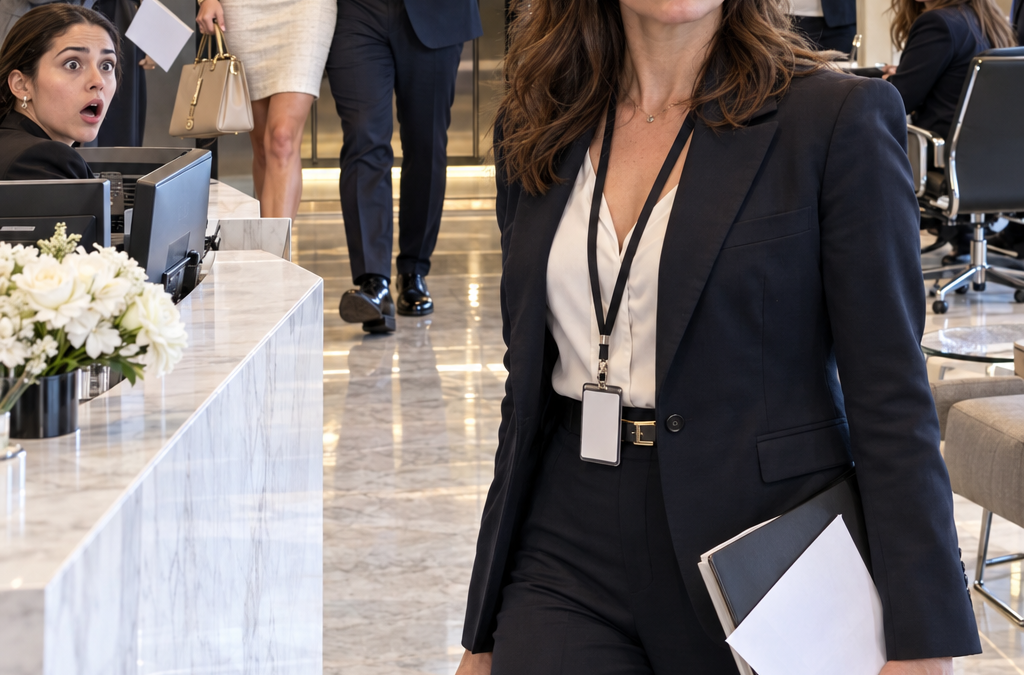
Adrian stood inside.
He was thirty-four, handsome in a way that photographed well, wearing a charcoal suit with a white shirt and silver tie. Beside him stood Tessa Wynn, his twenty-three-year-old executive assistant, whose official duties had somehow expanded over six months from scheduling meetings to attending private dinners, choosing his travel hotels, and wearing clothes that appeared on expense reports no junior employee could afford.
Tessa saw my box first. Her fingers moved lightly around Adrian’s forearm, not gripping him exactly, just resting there with the casual intimacy of someone who wanted the room to notice without appearing to want anything at all.
Adrian stepped out. “What is this?”
“I resigned.”
His expression barely moved. “Don’t be ridiculous.”
“I’m not.”
People were watching now. I could feel it without turning.
He lowered his voice and leaned close enough for me to smell the cedar-and-citrus cologne I had bought him the previous Christmas. “The salary adjustment was necessary. Tessa’s compensation package had to be increased, and I needed room in the departmental budget.”
I stared at him.
He continued, apparently mistaking my silence for confusion. “It’s thirty-five hundred a month, Mara. You’re my wife. Don’t keep score over something that small just because you’re jealous of a younger employee.”
There are sentences that destroy a marriage loudly, and there are sentences that simply reveal the marriage was already destroyed.
“So that’s what this is?” I asked. “You cut my pay to increase hers?”
His jaw tightened. “Don’t make a scene.”
I almost smiled.
“You’re safe with me,” he murmured. “Tessa isn’t. She needs support.”
The cardboard edge pressed against my palm. For three years, I had eaten alone at industry dinners while my husband worked the room as an eligible executive, waited in hotel suites while he attended events where acknowledging me would have been “complicated,” and watched my designs appear beneath his quotes in magazines. Now he was telling me my security was the reason I could be sacrificed.
“I understand,” I said.
He looked relieved.
That was the last expression I ever gave him for free.
I stepped around him and walked toward the glass doors at the end of the lobby. Behind me, Tessa asked softly, “Is she upset with me?” and Adrian replied in the tired voice of a man inconvenienced by someone else’s dignity.
Outside, Boston sunlight hit the pavement hard enough to make me squint. I put the box on a stone ledge, took out my phone, and called my best friend, June Adler, who answered on the fourth ring.
“I quit.”
A cup slammed onto a surface at her end. “You did what?”
“Ten minutes ago.”
“Where are you?”
“Outside the Pavilion.”
“Stay there.”
“I’m not staying anywhere near this building.”
Twenty-five minutes later, I was sitting across from June in a café near her photography studio. She listened without interrupting until I repeated Adrian’s sentence about Tessa needing support, then leaned back with both hands wrapped around her iced coffee as though keeping herself from throwing it through a window.
“He actually admitted it?”
“Almost proudly.”
“And you just walked out?”
“I had already resigned.”
June studied me. “Where are you sleeping tonight?”
That question should have frightened me more than it did.
I opened my wallet, removed a debit card from a different bank, and slid it across the table. “I have forty-seven thousand dollars Adrian doesn’t control. Some savings, some money from my mother’s estate. I need a safe apartment, furnished if possible.”
June stared at the card. “You kept an exit account?”
“I kept an account in my own name.”
“When?”
“Years ago.”
She shook her head slowly. “Part of you knew.”
Maybe I had.
My phone vibrated.
ADRIAN: Cards are suspended. Come home. We’ll talk when you’re ready to behave rationally.
June read my face. “What did he do?”
“He froze the cards.”
“Already?”
I locked my screen. “He thinks that means I have to go back.”
An hour later June found me a third-floor sublet in the South End belonging to a photographer leaving for Chicago. It had sloped ceilings, old hardwood floors, one bedroom, and a fire escape outside the kitchen window. It was smaller than the walk-in closet in Adrian’s Back Bay penthouse.
I signed for it before sunset.
That night I returned to the penthouse for my clothes.
Adrian came home while I was closing my second suitcase. He stood in the bedroom doorway, studying the empty hangers where my dresses had been.
“You’re actually leaving.”
“Yes.”
“This is because of the job?”
“No.”
He gave a short laugh. “Then what?”
I zipped the suitcase.
“You.”
His face hardened. “You’re angry.”
“I’m done.”
“Mara, don’t turn a business decision into a marital crisis.”
“You used our marriage to explain why I could afford to be humiliated.”
He stepped closer. “I can restore the salary.”
“I don’t want the salary.”
“What do you want?”
“A divorce.”
The room went completely still.
For the first time that day, Adrian looked genuinely shocked.
Then his expression changed into something almost amused. “You think you’re divorcing me because of thirty-five hundred dollars?”
“No,” I said. “I’m divorcing you because you still think this is about thirty-five hundred dollars.”
I pulled the suitcase past him.
As I reached the front door, he spoke again. “You’ll come back.”
I opened the door.
“You have no idea how difficult I can make things for you.”
That was the first threat.
Three weeks later, my attorney would show me a document proving that Adrian had begun making things difficult long before I ever resigned.
Part 2
My first morning in the South End apartment began with delivery trucks grinding down the street and sunlight cutting through cheap blinds in narrow gold stripes. There was no espresso machine built into the wall, no silent climate control, no marble island large enough to serve twelve people. I brewed coffee in a dented stovetop pot June had left me and sat at a little wooden table that wobbled whenever I rested my elbow on it.
I felt safer there than I had in the penthouse for years.
By ten, I was sitting across from Naomi Dacre, an intellectual-property attorney I had known in college. Naomi was forty-one, sharply dressed, precise without being cold, and experienced in the combination of employment, copyright, and marital disputes that made ordinary lawyers suddenly interested in referring clients elsewhere. She listened while I explained the secret marriage, the demotion, Adrian’s relationship with Tessa, the frozen cards, and my resignation.
“Relationship?” she asked.
“I don’t have proof they’re sleeping together.”
“But you believe they are.”
“I believe my husband cut my compensation to increase hers and told me not to be jealous.”
Naomi made one small notation. “For today, we deal with what can be proved.”
I liked her immediately.
I placed the orange drive on her desk and explained what it contained. She did not celebrate, widen her eyes, or tell me I had an “ace.” She asked where every file came from, whether I had access permissions, which documents I created personally, and whether company policy claimed ownership over work created within employment.
“Some rights belong to the company,” she said after nearly an hour. “That does not mean Adrian personally created the work. Those are different questions, and your husband may have spent years making them appear identical.”
She opened one of my original sketch files. “This timestamp predates the board presentation by eleven weeks.”
“Yes.”
“And these handwritten annotations?”
“Mine.”
“Can anyone verify that?”
“Pattern staff. Sample staff. Suppliers.”
Naomi nodded. “Good. We build facts before we build accusations.”
The divorce petition was filed that afternoon.
Adrian reacted within six hours.
First he withdrew the entire balance from our joint checking account. Then he suspended every supplementary card attached to accounts under his control. Finally, at 7:40 that evening, he called me.
“How long do you think this lasts?” he asked.
“What?”
“This performance.”
“I’m making pasta, Adrian.”
His silence sharpened. “You filed.”
“Yes.”
“You could have spoken to me first.”
“I did. I said divorce.”
“You were emotional.”
“I was extremely calm.”
“That’s not the same thing.”
I stirred tomato sauce while he explained my own life to me. He told me I had no job, that my professional reputation was tied to Vale & Mercer, that senior clients knew him rather than me, and that no reputable agency would hire a woman who walked out after a demotion and immediately sued her CEO husband.
“You haven’t even heard my legal position,” I said.
“You don’t have one.”
“Then why are you worried?”
He hung up.
Two days later, rumors appeared in the agency’s internal Slack channels.
June brought me screenshots. Anonymous accounts claimed I had been demoted after making a serious error on a major collection, become “unstable,” and stormed out before the company could complete a formal review. Another message suggested I had become obsessed with Tessa because Adrian valued “younger creative energy.”
I read them at my kitchen table while June paced.
“Say something,” she demanded.
“Not yet.”
“They’re destroying your name.”
“No. They’re trying to provoke me into helping them destroy it.”
June stopped pacing.
I forwarded everything to Naomi.
The next attack was more polished. A former client emailed to say they had “heard concerning things” but hoped I was well. Another stopped responding to my messages. An industry recruiter who had once approached me twice suddenly wrote that no suitable roles were available.
Then came the fabric.
I opened my apartment door one evening and found a torn swatch of couture silk pushed halfway through the mail slot. A note had been clipped to it.
STOP BEFORE NO ONE IN THIS INDUSTRY WILL TOUCH YOUR WORK AGAIN.
I did not touch it with bare hands.
That surprised me. The old version of me might have stood in the hallway shaking, wondering what Adrian wanted me to do. Instead, I photographed the fabric where it lay, used kitchen tongs to place it inside a clean plastic sleeve, and called Naomi.
“This changes the tone,” she said.
“I know.”
“Do you recognize the fabric?”
I looked closer.
It was ivory faille with a narrow silver woven edge.
My stomach tightened.
“Yes.”
“From where?”
“Vale & Mercer’s spring collection from four years ago.”
“The one Adrian received the design award for?”
“Yes.”
Naomi was quiet. “Keep the door locked. I’m sending someone from my office to collect it.”
The threat scared me less than the choice of fabric.
Only a limited number of people would have known what that swatch meant to me. The collection had been my breakthrough, although publicly it had become Adrian’s. I had worked eleven consecutive nights correcting the architecture of the garments after the original concept failed in sampling, and the silver-edged faille was a fabric I had found through a small mill outside Lyon.
It was the first time Adrian learned how much professional credit I was willing to surrender for him.
The next morning, he came to my apartment.
He knocked once, then again harder.
I opened the door but stood in the opening.
His eyes traveled over the sloped ceiling behind me. “You live here?”
“Yes.”
“On purpose?”
“Yes.”
“Mara, stop.”
“Stop what?”
He looked exhausted rather than angry, which made me more cautious. “How much?”
I stared at him.
“How much money do you want to withdraw the divorce?”
“I don’t want your money.”
“Everyone says that before a number is offered.”
“Then offer one.”
He frowned.
“I’m curious how much you think three years of hiding me costs.”
“This is childish.”
“No. Childish was believing you every time you said we would announce our marriage after the next promotion.”
His jaw worked once. “Come home.”
“No.”
“I’ll restore your title.”
“No.”
“Your royalties.”
“No.”
“The board can issue a statement.”
“Still no.”
He stepped forward. “What exactly do you expect to achieve?”
I thought about it.
“I want to stop living in a life where every good thing I receive can be removed whenever you need me obedient.”
Something flickered across his face.
Not guilt.
Recognition.
“I gave you everything,” he said.
I looked around my tiny apartment. “That is exactly what you believe.”
He left without another word.
A week later his attorneys accused me of taking proprietary design data.
The complaint claimed I possessed confidential fall-winter collection material, supplier contracts, and development files that could damage the company if disclosed. They demanded the return of all devices and threatened immediate injunctive relief.
Naomi read the filing twice.
“He’s forcing us into discovery,” she said.
“Is that bad?”
“It can be. It can also be incredibly stupid.”
She tapped one paragraph with her pen. “They claim Vale & Mercer maintains precise authorship and development records proving these works originated under executive creative direction.”
“So?”
“So if they make authorship central to the claim, we get to ask for those records.”
For the first time since the divorce began, I saw her smile.
“Adrian may have just opened the door we needed.”
That door led to the old server archives.
And somewhere inside them was the first proof that my pay cut had not begun with Tessa.
Part 3
Vale & Mercer’s legal team requested a private mediation before turning over internal records. Naomi told me that was normal. I told her Adrian never did anything simply because it was normal.
The meeting was held in a conference room overlooking Back Bay. Adrian sat opposite me beside two attorneys, wearing a dark gray suit and the composed expression he used during difficult board meetings. He did not look at my wedding ring finger, which had been bare since the night I left.
His lawyer began. “Mr. Vale would prefer to resolve this discreetly.”
“So would I,” I said.
Adrian’s eyes lifted. “Then stop escalating.”
“I resigned. I filed for divorce. Your side accused me of theft.”
“Because you took company files.”
“I preserved proof of my own work.”
“You don’t decide what belongs to you.”
Something in the sentence almost made me laugh.
Naomi slid a folder across the table. “Then we should proceed with forensic review of the development archive and determine authorship through metadata, revision histories, access logs, handwritten originals, supplier communications, and witness testimony.”
Adrian’s attorney stopped touching his pen.
Adrian did not.
“Fine,” he said.
Naomi turned toward him. “Including executive presentation drafts and original board-submission files.”
His gaze shifted by perhaps half an inch.
That was all.
But I saw it.
Afterward, Naomi and I walked two blocks without speaking. Once inside a café, she put her bag down and said, “He doesn’t want the board files reviewed.”
“You noticed.”
“I noticed his attorney noticed.”
“Why?”
“That’s what we’re going to find out.”
Discovery began slowly.
Vale & Mercer produced thousands of pages: policies, emails, file inventories, server logs, creative decks, supplier invoices, and archived revision histories. Most were ordinary enough to bore a person unconscious. Naomi’s team indexed everything, and I spent long evenings at my kitchen table helping identify projects, dates, and people.
One file stood out because it was missing.
My spring collection presentation—the one built around the silver-edged faille—showed an original creation date but no visible revision author before Adrian’s executive version.
“That’s impossible,” I told Naomi. “I revised that deck for eleven days.”
“Could the history have been migrated?”
“No. The other presentations from that year show revision data.”
She requested the server-level logs.
Vale & Mercer objected.
The mediator ordered production.
That was when Leah called me.
I remembered her lowering her eyes as I carried my box through the design floor. She was twenty-seven, careful, talented, and usually so soft-spoken people underestimated how much she observed.
“I don’t know if I’m supposed to contact you,” she whispered.
“Then don’t tell me anything confidential.”
“I need to tell somebody.”
I waited.
“After you left, they started changing file permissions.”
“Who?”
“IT said executive instruction.”
My pulse climbed.
“Leah, you should speak to my attorney, not me.”
“I will. But there’s something else. Before you were demoted, Mr. Vale had us audit your old project folders.”
“When?”
“Almost two months before.”
My hand tightened around the phone.
Two months.
Tessa had been at the firm for six months, but Adrian had told me the pay cut was necessary because of her new compensation package. If they had started examining my files eight weeks before the demotion, then the decision had been in motion much earlier.
“What were they looking for?”
“I don’t know. We were told to flag files where the executive summary didn’t match the listed creator.”
I stood very still.
“What does that mean?”
Leah swallowed audibly. “Your name kept coming up.”
Naomi interviewed her formally the next day.
Leah brought no stolen documents and made no dramatic accusations. She simply described instructions, dates, meetings, and changes she had personally witnessed. That was better than outrage; facts could survive cross-examination.
Then the server logs arrived.
My name was everywhere.
MARA_ELLISON had created, edited, revised, or uploaded foundational work behind seven of the company’s most profitable apparel campaigns. Later copies of those files showed the same work moved into executive presentation folders under Adrian’s user account.
Some transfers were legitimate. CEOs present work produced by teams all the time.
Others were not.
The troubling pattern involved documents sent outside the company. Award submissions described Adrian as “originating designer.” Licensing materials identified “Adrian Vale creative concepts.” Investor decks credited “CEO-originated design architecture” as evidence the company’s value was tied uniquely to his leadership.
He had not merely accepted praise.
He had used my work to inflate his personal value to the company.
Naomi sat beside me in her office, turning through the printed log summaries.
“This is bigger than marital betrayal.”
“I know.”
“Did you ever authorize him to describe himself as the originating designer?”
“No.”
“Did the board know you created this work?”
“They knew I ran design. I don’t know what he told them about specific projects.”
Naomi leaned back. “His company complaint against you may force disclosure of representations he made to investors. That is why he’s nervous.”
My chest tightened.
For years I had told myself it did not matter whose name appeared in interviews as long as I was doing work I loved. That had been the bargain I made inside the marriage: Adrian handled the politics, I handled the work, and someday when it was safe, we would stop pretending.
There had never been a “someday” in his plan.
My invisibility had been useful.
Tessa became almost secondary.
That realization hurt differently than the suspected affair. A mistress could be dismissed as weakness or vanity. What Adrian had done with my career required patience, planning, and repeated decisions made when he was completely sober and fully aware of the consequences.
He had needed me professionally invisible because his own image depended on it.
That evening I walked through Blackstone Square until my hands went numb from the October air. June joined me halfway around the path and listened while I explained.
“So the demotion wasn’t because Tessa wanted more money.”
“Not mainly.”
“Then why now?”
“We think someone at board level started questioning who actually created certain collections.”
June stopped.
“And Adrian moved you downstairs.”
“Where I wouldn’t attend creative meetings, speak to clients, or have access to current development conversations.”
“He was burying you.”
The phrase landed hard.
Not firing me.
Burying me.
If he had fired me, people might have asked why the company’s design director was suddenly gone. By demoting me after a vague performance review, he could rewrite my reputation first.
And Tessa?
She may have been convenient camouflage.
Two days later Naomi found the document referenced in my opening summary.
It was a draft prepared for a board compensation committee three weeks before my demotion. Most of it discussed Adrian’s upcoming contract renewal. One line was highlighted in an internal reviewer’s note:
PLEASE VERIFY CLAIM THAT MR. VALE PERSONALLY ORIGINATED SIGNATURE APPAREL CONCEPTS. MULTIPLE INTERNAL RECORDS IDENTIFY MARA ELLISON AS PRIMARY CREATOR.
Below it, another comment had been added.
WHO IS MARA ELLISON, AND WHY IS SHE ABSENT FROM EXECUTIVE CREATIVE PRESENTATIONS?
The final version submitted to the board contained neither comment.
Instead, it described me as a “mid-level implementation resource.”
I stared until the words blurred.
“Three weeks later,” Naomi said carefully, “you were removed from leadership.”
I looked at her.
“And a false performance review appeared.”
“Yes.”
“And Adrian told me it was because Tessa needed money.”
Naomi nodded once.
My husband had not sacrificed me to keep another woman happy.
He had used another woman to hide the reason he needed me discredited.
Part 4
Once I understood that, the emotional shape of the marriage changed.
Memories I had filed under disappointment rearranged themselves into evidence. The awards Adrian discouraged me from attending because “press teams hate confusing roles.” The client dinner where I was told to introduce myself as a technical consultant. The conference in Milan where he accepted praise for a modular eveningwear concept I had sketched on our kitchen table while he slept beside me.
I had mistaken erasure for compromise.
Naomi warned me not to race ahead emotionally. “We have evidence of misrepresentation, not yet proof of every motive. Let him explain himself through documents.”
I nodded.
Then Adrian made his next mistake.
He filed for a preliminary injunction seeking to freeze income from my freelance work, claiming my recent illustrations and pattern commissions were derived from Vale & Mercer intellectual property. The request threatened the small stream of money I had begun earning from independent clients.
At first I was furious.
Then Naomi called.
“He attached examples.”
“Of my freelance work?”
“And company work he says they resemble.”
“So?”
“So one of his examples is a silhouette you sketched four years before Vale & Mercer used anything remotely similar.”
I went silent.
“You still have the old sketchbook?”
I looked across my apartment at the worn leather book on my shelf.
“Yes.”
The sketch was there, dated in ink, along with a fabric receipt taped to the facing page from a shop in Northampton. My mother had still been alive then. I remembered drawing at her dining table while she made tea, months before I joined the project Adrian now claimed had originated inside his executive team.
Naomi sounded almost cheerful. “They just introduced your preexisting creative history into the dispute.”
Adrian’s attempt to starve me financially had produced evidence strengthening my authorship claim.
That pattern continued.
His lawyers demanded my devices. In response, Naomi requested reciprocal forensic inspection of relevant executive systems.
His lawyers accused me of taking supplier information. Naomi produced emails showing I had introduced the suppliers to Vale & Mercer.
His public-relations consultant quietly circulated the story that I was a disgruntled employee. A fashion editor who had worked with me for years called June and asked why the supposed incompetent employee possessed original sketches for collections publicly associated with Adrian.
People began asking questions.
Adrian hated questions he did not control.
He called one night at 11:18.
I answered because Naomi had asked me to preserve communications.
“What are you doing?” he demanded.
“Making tea.”
“Stop being cute.”
“I’m not.”
“You’re giving documents to people.”
“I’m giving documents to my attorney.”
“The same thing.”
“No, Adrian. It is literally not the same thing.”
He breathed hard through his nose. “Do you understand what happens if the company becomes unstable?”
“Yes.”
“Hundreds of people work there.”
“I know.”
“Then stop pushing.”
I sat at my little table with the phone beside my mug. “You sued me.”
“To protect the company.”
“You lied about my performance.”
Silence.
“You buried my name.”
“I protected us.”
“From what?”
His answer came too quickly. “Scandal.”
“What scandal?”
“Our marriage. My position. Your position.”
“That doesn’t explain why you called yourself the designer.”
“I was the executive creative lead.”
“You cannot draft a production pattern.”
“That’s not what CEOs do.”
“You cannot grade a bodice.”
“Mara—”
“You cannot explain why a bias-cut satin twists after laundering unless I’ve explained it to you first.”
“That doesn’t matter.”
There it was.
The entire marriage in three words.
It doesn’t matter.
My work did not matter if his name could sell it. My title did not matter if his promotion required my silence. My money did not matter if Tessa made him feel admired. My marriage did not matter unless I was threatening to end it.
“I’m going to bed,” I said.
His tone changed. “Wait.”
I nearly hung up.
“Mara.”
Something in his voice was different. Not remorse exactly, but fatigue stripped of arrogance.
“I did what I had to do.”
“For what?”
“To keep control.”
I closed my eyes.
“At least that part is true.”
The next morning Naomi instructed me not to discuss that call publicly. “He has finally said something useful, but it’s ambiguous. We don’t exaggerate it.”
That was Naomi’s strength. She never let me turn vindication into recklessness.
The second mediation occurred in November.
This time Adrian arrived with three attorneys and no Tessa. He looked thinner. I later learned Vale & Mercer’s board had formed a special committee to review authorship representations after receiving notice of our evidence dispute.
The mediator asked whether settlement remained possible.
“Yes,” Adrian’s lead attorney said. “If Ms. Ellison returns all materials, withdraws her claims, accepts a financial package, and signs comprehensive confidentiality.”
Naomi looked at me.
I shook my head.
“No.”
Adrian stared across the table. “How much more do you want?”
I felt almost sorry for him then.
He still thought everything translated into money.
“I want my name attached to my work.”
“We can give you a private acknowledgment.”
“Public claims were made publicly.”
His lawyer interjected. “We are not relitigating years of marketing language.”
“Then we’re not settling.”
Adrian leaned forward. “Do you understand what you’re doing to my company?”
I met his eyes.
“Your company accused me of theft for possessing evidence that I did the work your company says you created.”
His face reddened.
Naomi placed my leather sketchbook on the table.
Then she placed the orange drive beside it.
“We propose a technical authorship review,” she said. “Original paper sketches, digital metadata, revision logs, sourcing records, and witness testimony.”
Adrian’s attorney gave a dismissive shrug. “Fine.”
Naomi continued.
“If Mr. Vale maintains that he was the substantive originating designer behind the disputed collections, we will also request a supervised technical deposition.”
The room quieted.
“A what?” Adrian asked.
“He will be asked to explain the construction decisions identified in documents attributed to him.”
Adrian’s attorney stiffened. “That’s theatrics.”
“No,” Naomi said. “It’s authentication.”
She opened one file.
“Mr. Vale may explain why the shoulder pitch changed 1.8 centimeters between revisions four and five, why the silk faille required stabilization along the bias seam, what caused the original sleeve head to collapse during fitting, and why the supplier’s first finishing method was rejected.”
Adrian looked at the page.
I had written every answer.
Naomi closed the folder.
“Alternatively, Ms. Ellison can answer them.”
For the first time since I left the Pavilion, Adrian looked afraid in front of me.
Not because I had become wealthy.
Not because I had found someone more powerful.
Because his own accusation had created a test he could not pass.
Part 5
The board investigation changed everything without changing my daily life at all.
I still woke in the same attic apartment. I still bought groceries at the neighborhood market, worked freelance assignments at my kitchen table, and counted legal expenses before allowing myself anything unnecessary. Sometimes the strongest reminder that my life was rebuilding came from absurdly ordinary things, like choosing towels without wondering whether Adrian preferred the color.
Outside my apartment, however, the pressure around Vale & Mercer increased.
Board investigators interviewed former design employees. Two suppliers confirmed they had worked directly with me on technical development while Adrian attended only final presentation calls. A retired production manager produced old fitting schedules listing me as the person responsible for corrective decisions on three award-winning collections.
Then Tessa contacted Naomi.
I learned about it during a meeting.
“What does she want?” I asked.
“To speak through counsel.”
“Why?”
“She says Adrian misrepresented her compensation arrangement.”
I sat back.
According to Tessa, she had indeed been involved with Adrian personally. Their relationship had begun during a company trip to Los Angeles four months before my demotion. He had told her he was legally separated and that his marriage existed only “on paper for financial reasons.”
I should have felt rage.
Mostly I felt tired.
Tessa also said something more important.
She had never asked Adrian to cut my salary.
She had asked for a raise after being assigned executive travel work far beyond her job description. Adrian told her he would “restructure design overhead” to make it happen. Later, when she worried I would resent her, he said I was financially comfortable because I was “basically family.”
He had turned both women into explanations for choices he made himself.
Tessa was not innocent. She had suspected more than she admitted, enjoyed the access Adrian gave her, and had participated in a relationship with a married executive whose explanations should have raised obvious questions. But she had not designed my demotion.
That belonged to Adrian.
More importantly, Tessa had attended one meeting that mattered.
Three weeks before my reassignment, she had been asked to schedule Adrian, the CFO, and an outside compensation consultant for an urgent evening session. The subject line read EXECUTIVE ATTRIBUTION REVIEW.
After the meeting, Adrian dictated notes for her to send to Human Resources.
One instruction concerned me.
“Begin documenting performance concerns regarding M.E.”
Naomi asked whether Tessa still had the email.
She did.
Adrian’s attorneys called it incomplete context.
So we requested the context.
That produced another chain of messages.
The board compensation committee had questioned whether Adrian’s personal leadership bonus should be tied to collections increasingly shown to have been created by staff designers. One director had specifically asked why the company’s celebrated “founder-led creative identity” seemed to depend on an employee whose name rarely appeared outside internal production documents.
Adrian’s response was not to correct the record.
He began building a file suggesting my performance was declining.
My demotion, therefore, was not simply cruel.
It was defensive.
By moving me into inventory work and stripping my royalties, he could later argue that my contribution had been overstated and that stronger executive leadership had been necessary to compensate for my weaknesses.
He had tried to manufacture the past.
And he had used Tessa as the easiest explanation if I complained privately.
I went home after learning that and cried for the first time.
Not loudly.
I sat on the floor beside my bed with my back against the wall and let tears slide down my face while traffic moved beneath the window.
June found me there twenty minutes later because Naomi had called her.
“I thought knowing the truth would make me feel better,” I said.
June sat beside me.
“It doesn’t.”
“No.”
“I feel stupid.”
“You trusted your husband.”
“I helped him.”
“You loved him.”
“I kept giving him things he never even had to steal. Credit. Time. Excuses.”
June leaned her head against the wall. “Then maybe that’s the lesson.”
“What?”
“You don’t have to keep punishing yourself just because he benefited from the version of you that loved him.”
For several minutes we said nothing.
Eventually I got up, washed my face, and heated soup.
That was how recovery often worked for me—not through speeches, but through deciding to eat dinner.
Two days later Adrian appeared outside my building again.
This time I did not open the door.
“What do you want?” I asked through it.
“To talk without lawyers.”
“No.”
“Mara.”
“No.”
“Five minutes.”
I considered calling Naomi, then turned on my phone recorder and opened the door only after texting June that he was there. Adrian stood in the hall without a coat despite the cold.
“You spoke to Tessa.”
“My attorney did.”
“She’s lying.”
“About which part?”
His face tightened.
“The relationship?”
He looked away.
“The raise?”
Silence.
“The performance file you started building after the board questioned your design credits?”
His eyes snapped back to mine.
“So you do have it.”
The sentence escaped before he could stop it.
I felt my heartbeat in my throat.
“Have what?”
He recovered. “Whatever she gave you.”
I almost smiled.
He had just told me Tessa possessed something worth fearing.
“You need to leave.”
“Mara, listen to me. The board was looking for reasons to weaken my contract. They would have used you.”
“They were asking who created the work.”
“They were trying to divide us.”
“We were already divided. I just didn’t know it.”
“You think these people care about you? They’ll use you to remove me and forget your name in six months.”
“Maybe.”
He stared.
“But whether they care about me doesn’t change what you did.”
His shoulders dropped slightly.
“I built that company.”
“We built your image.”
“You benefited too.”
“I was your secret wife earning less than the value of the royalties you canceled.”
“You lived in my home.”
“Exactly.”
He took a step back as if I had struck him.
For years he had considered the penthouse evidence of generosity. He had never understood that living inside someone else’s wealth without independent standing can become another form of dependence.
“I can fix this,” he said.
“No.”
“I can tell the board you were involved.”
“Involved?”
His face changed.
He knew immediately.
That one word destroyed whatever remained of the conversation.
I closed the door.
A week later, Vale & Mercer’s board placed Adrian on temporary administrative leave pending completion of the attribution review.
The news spread through the industry before lunch.
My phone filled with messages from people who had ignored me for months.
I answered almost none.
That afternoon Leah sent one simple text.
I’m glad somebody finally asked who did the work.
I read it twice.
Then Naomi called.
“The company wants to negotiate separately from Adrian.”
“For what?”
“Your authorship, unpaid royalties, and the false performance record.”
“What about the divorce?”
“Still separate.”
I looked around my apartment, at the cheap table and the cracked window latch I had been meaning to repair.
For months Adrian had told me I could not survive outside the world he controlled.
Now his own company was asking to settle the consequences of believing him.
Part 6
I refused Vale & Mercer’s first offer.
It was substantial enough to make June whistle when I told her the number, but the money came with language stating the company admitted no wrongdoing and that all public credits would remain unchanged.
“No,” I told Naomi.
“You understand you may not get a better financial offer.”
“I understand.”
“What matters most?”
“My name.”
Naomi nodded. “Then that’s what we negotiate.”
The company’s second proposal acknowledged me as Lead Design Originator on four major collections and Principal Technical Designer on three more. It restored unpaid contractual royalties, erased the manufactured performance findings from my personnel record, and included a written statement confirming that my resignation followed a disputed reassignment rather than professional misconduct.
I asked for one additional provision.
The company had to correct internal records for the design staff who worked beneath me.
Adrian had not stolen only from me. My silence had helped create a culture where junior designers watched executives absorb credit because everyone assumed that was the price of staying employed.
The board agreed.
Adrian did not.
His personal attorneys fought every divorce term, challenged the valuation of marital assets, and claimed the penthouse predated our marriage. Naomi’s family-law partner handled most of that while she focused on the intellectual-property dispute.
Adrian’s strategy had changed.
He no longer threatened me directly.
He delayed.
Every bank statement took weeks. Every property record required follow-up. Every answer arrived on the last permissible day. The intention was obvious: exhaust me until peace became more valuable than fairness.
Some nights it nearly worked.
I would sit at the kitchen table after midnight staring at legal invoices, unfinished design work, and emails requiring decisions I no longer had the energy to make. I would imagine signing whatever Adrian wanted simply so I could wake the next morning without seeing his name.
Then I remembered what going back actually meant.
Not love.
Submission.
So I slept and answered the next day.
I began earning more freelance work as the rumors changed. Clients who had once backed away returned carefully, often pretending they had never doubted me. I accepted some assignments and declined others.
One small Boston label hired me to redesign the fit architecture of a struggling capsule collection. The owner, a fifty-two-year-old woman named Celia Marsh, sat beside me during the first fitting and asked questions about everything.
Why this seam?
Why that grain?
Why move the dart?
At the end she said, “I’ve hired creative directors for twenty years. Most of them talk until the room agrees with them. You explain until the garment makes sense.”
I nearly cried in the cab home.
Recognition felt different when I did not have to disappear to receive it.
Around Christmas, my mother’s old silver narcissus brooch became part of my work routine. I pinned it near my desk lamp, where I could see it while drawing. She had always told me to keep something of my own, and for years I had thought she meant money.
Now I understood she meant identity.
The board investigation concluded in January.
Adrian had not committed the cinematic fraud people online later tried to turn it into. There were no secret offshore accounts or forged signatures in dark rooms. Reality was more ordinary and more damning.
He had repeatedly exaggerated his creative authorship in executive materials, permitted inaccurate award submissions, directed staff to alter attribution practices, and initiated questionable performance documentation against me after directors raised concerns about those claims.
He had also approved company-funded expenses associated with Tessa that violated internal policy.
The board asked for his resignation.
He refused.
They terminated him.
June came to my apartment carrying champagne.
“I don’t want to celebrate him losing his job,” I said.
She looked offended. “I’m celebrating you keeping yours. The one you’re building.”
That I could accept.
We drank from mismatched coffee mugs because I owned no champagne glasses.
Adrian called at 10:30 that night.
I almost let it ring out.
Then I answered.
“Are you happy?” he asked.
“No.”
He sounded surprised.
“You got what you wanted.”
“No. I wanted a divorce and my work acknowledged. The board made its own decision.”
“You gave them the weapon.”
“You filed the lawsuit that forced discovery.”
Silence.
The sentence was cruel only because it was true.
If Adrian had allowed me to resign and leave quietly, the internal questions might have remained unresolved for years. Instead, his attempt to label me a thief required him to prove who created the disputed work.
His own retaliation had exposed him.
“I lost everything,” he said.
I looked around the apartment.
“No, Adrian.”
“You don’t get to tell me what I lost.”
“You still have money. Property. Connections. Your education. Your health. You lost a title.”
“And my wife.”
That hurt.
Not because I wanted him back, but because somewhere inside me lived the memory of the man I once believed he was.
“You lost your wife before you lost the title.”
He breathed slowly.
“Tessa left.”
I did not respond.
“She says I lied to her.”
“You did.”
“I was trying to keep everything from falling apart.”
“You were trying to keep everything arranged around you.”
“Mara.”
“I’m hanging up now.”
“Wait.”
I waited.
His voice dropped.
“Was any of it real?”
There are questions that arrive too late to deserve comforting answers.
“Yes,” I said. “For me.”
He said nothing.
“That’s why it hurt.”
I ended the call.
The final divorce negotiations began three weeks later.
Adrian no longer had company lawyers helping indirectly with the surrounding disputes. His bargaining position had weakened, but I did not use the moment to destroy him.
I wanted what was legally fair.
My share of marital assets.
Release of funds withdrawn from the joint account.
Mutual non-disparagement.
No claim over my future independent work.
No confidential clause preventing me from truthfully discussing my own professional history.
And a divorce.
His attorney resisted the last intellectual-property language for two full sessions.
Then Naomi placed the orange drive on the conference table.
Adrian looked at it.
For months that little object had represented everything he feared—timestamps, drafts, notes, corrections, years of invisible labor.
But by then I realized the drive itself was not powerful.
Truth was not powerful merely because it existed.
It became powerful because I had finally stopped volunteering to hide it.
Adrian signed the preliminary settlement terms at 4:17 on a freezing Thursday afternoon.
Before leaving, he looked at me across the table.
“I never thought you’d actually go.”
“I know.”
“I thought you needed me.”
“I did.”
He frowned.
“Once,” I added.
That was the difference he had never understood.
Needing someone in the past does not obligate you to need them forever.
Part 7
The divorce was not final immediately.
Legal endings move more slowly than emotional ones.
For another two months there were signatures, financial disclosures, revised language, title transfers, tax discussions, and administrative details boring enough to make everything that had happened feel strangely ordinary. The marriage that once controlled my daily existence was eventually reduced to folders, initials, notarized pages, and court dates.
My professional life expanded at the same time.
Celia referred me to two other independent labels. June began photographing some of my work for a small portfolio site. Leah left Vale & Mercer and joined a technical development studio across the river, where her name appeared properly on project credits.
We had coffee once.
“I should have said something sooner,” she told me.
“You had a job to protect.”
“So did you.”
I smiled. “That’s probably why none of us spoke.”
She looked down into her cup.
“Things are different there now.”
“Better?”
“Uncomfortable.”
“Sometimes that comes first.”
Vale & Mercer hired a new chief creative officer from outside the company and created a formal attribution policy requiring major presentations to list lead creative and technical contributors. I did not return.
Several people assumed I would.
One board member even called Naomi informally to ask whether I might consider consulting.
I declined.
The building itself had become too connected in my mind to waiting for permission.
Instead, I rented a small shared studio above a framing shop with north-facing windows and uneven floors. The rent made me nervous, which was one reason I knew the decision mattered.
I called the business Ellison Form Studio.
No invented luxury branding.
No surname borrowed from a husband.
Just mine.
My first official project under the studio name was not glamorous. A regional womenswear company needed help correcting fit problems across six basic garments that customers kept returning. The project required spreadsheets, test garments, pattern corrections, and hours of measuring quarter inches that nobody would ever photograph for a magazine.
I loved every minute.
The return rate dropped.
The client renewed.
I framed the first paid invoice.
June laughed when she saw it on the wall. “That is the least sexy piece of art I’ve ever photographed.”
“It’s mine.”
She stopped laughing.
“Fair.”
My divorce hearing took place on a rainy March morning.
Adrian arrived before me.
He looked healthy again, though different without the invisible armor of the CEO title. His suit was expensive, his hair precise, but no assistants followed him and nobody in the hallway adjusted their posture when he passed.
We sat on opposite sides of the courtroom.
There was no dramatic speech.
No judge denounced him.
No crowd gasped.
The court reviewed the settlement, confirmed our intentions, asked several questions, and dissolved the marriage.
That was all.
Years of hope ended in less than an hour.
Outside, rain darkened the courthouse steps.
Adrian caught up with me beneath the stone overhang.
“Mara.”
Naomi paused, but I told her it was fine.
Adrian stood several feet away.
“So that’s it.”
“Yes.”
“You really don’t hate me.”
It was not a question.
“No.”
His mouth tightened.
“I think that’s worse.”
“For who?”
He looked toward the rain.
“I keep replaying the elevator.”
I knew exactly which moment.
“If I hadn’t said that about Tessa…”
“I still would have learned eventually.”
“Would you?”
I thought about the woman I had been.
Maybe not immediately.
Maybe I would have accepted the demotion, gone home, listened to an apology, returned to work, and spent another year proving that I could endure more.
Adrian watched my face.
“That’s what I thought.”
I looked at him.
“You still don’t understand.”
“What?”
“The worst thing you did wasn’t saying it.”
He frowned.
“It was believing it.”
The rain filled the silence between us.
He nodded slowly.
“I am sorry.”
I had imagined those words many times.
In some versions I laughed in his face. In others I told him exactly how badly he had broken me.
When the apology finally came, I felt no urge to punish him and no desire to comfort him.
“I believe you’re sorry now,” I said.
He looked relieved too soon.
“That doesn’t change anything.”
The relief disappeared.
“I know.”
And this time I believed that too.
I stepped into the rain and walked toward Naomi’s car without looking back.
That afternoon I returned to my studio.
There were pattern pieces spread across the table, two unanswered client emails, and a half-eaten sandwich from the day before. Life had not arranged itself into a beautiful final scene just because my divorce was complete.
I was grateful for that.
Ordinary work saved me from turning survival into my entire identity.
Six months after leaving Vale & Mercer, Ellison Form Studio had four steady clients and enough revenue to cover rent, insurance, and my salary. Not a fortune. Not an empire.
A beginning.
I moved out of the attic apartment in early summer, but I did not return to a luxury tower. I rented a sunny two-bedroom apartment in Jamaica Plain with a small balcony and room for a proper dining table.
June helped me move.
As we carried boxes inside, she found the old cardboard sample box from the day I resigned.
“You kept this?”
“Apparently.”
Inside were the black shears, the red pincushion, and the leather sketchbook.
The orange drive was no longer there. Naomi kept the original evidence copy secured with the closed case files.
June ran one finger along the box edge.
“You walked out of there carrying basically nothing.”
I looked around my new apartment.
“That’s what I thought too.”
“What changed?”
“I stopped measuring what I had by what belonged to Adrian.”
June smiled.
That night, after she left, I sat alone on the balcony.
My phone buzzed.
For one second my body reacted the old way, tightening before I even looked.
Then I saw the sender.
An unknown email address.
The message contained a scanned page from an old Vale & Mercer design archive.
No greeting.
No explanation.
At the bottom was a handwritten note.
Mara—there are more women whose work disappeared the same way yours did. You weren’t the first.
I read it twice.
Then a third time.
My divorce was finished.
Apparently, the deeper story was not.
Part 8
I sent the email to Naomi the next morning.
She called before nine.
“Do not contact the sender.”
“I wasn’t planning to.”
“Good.”
“Is it real?”
“The document looks plausible. We verify before doing anything.”
The page came from a collection developed two years before I joined Vale & Mercer. The public campaign had credited a former executive creative director, but handwritten production notes showed another name repeatedly beside technical corrections: Simone Clarke.
I knew the name vaguely.
Simone had left the company before my second year. People described her as talented but “difficult,” the same word that began appearing around me after I stopped accepting Adrian’s decisions quietly.
Naomi found her.
Simone did not want money from me, publicity, revenge, or involvement in my divorce. She wanted to confirm something she had wondered about for nearly a decade.
“Yes,” she told us during a video call. “That was my work.”
“What happened?” I asked.
She laughed without humor.
“The usual. I was told executives were responsible for vision and I was responsible for execution. When I asked for credit, suddenly I was poor at collaboration.”
My stomach turned.
Adrian had not created the culture that erased us.
He had inherited it.
Then he had learned to profit from it.
That distinction mattered.
I had spent months viewing him as the center of the entire machine because he had been the center of my private life. In reality, Vale & Mercer had rewarded vague authorship, executive mythology, and quiet creative labor long before Adrian became CEO.
His deeper failure was not inventing the system.
It was seeing how unfair it was and choosing to climb it.
The board had already begun reviewing older attribution records because of my settlement. Simone agreed to speak with investigators on the condition that her current employer remain uninvolved. Two other former employees later came forward independently.
I stayed out of the public spectacle.
Reporters contacted me after word of the review leaked. I gave one carefully prepared statement confirming that my own authorship dispute had been resolved and that I supported accurate credit for creative workers.
Nothing more.
I did not want to build a career from being Adrian Vale’s former wife.
I wanted to build one from being Mara Ellison.
The industry story faded after a few news cycles, as stories do.
Vale & Mercer corrected additional credits and revised compensation structures. A former executive retired earlier than expected. Lawyers negotiated private settlements.
No empire collapsed.
People continued going to work.
That felt more believable than destruction, and strangely more satisfying. Real accountability is often administrative, expensive, embarrassing, and permanent enough to change how people behave even after the headlines disappear.
Adrian moved to New York.
I heard through mutual acquaintances that he joined a private brand consultancy in a nonexecutive role. He and Tessa did not stay together.
I never asked why.
One afternoon in September, almost a year after my resignation, a small package arrived at my studio.
Inside was my silver-edged faille swatch.
Not the torn threatening piece.
A clean archival sample.
There was also a note from the new creative officer at Vale & Mercer.
We found this in the original development box. Your sourcing notes were attached. It belongs with your records.
I held the fabric beneath the studio lights.
Four years earlier, that cloth represented the moment I first allowed Adrian to accept public credit for something I had created. When the torn version appeared at my apartment, it became a threat.
Now it was just fabric again.
That surprised me more than anything.
Objects lose power when the story around them changes.
I framed a small section beside my first Ellison Form invoice.
Not as a trophy.
As a reminder.
That evening June arrived with Thai food and two beers.
She stood in front of the framed swatch.
“You’re getting sentimental.”
“I’m becoming unbearable.”
“You were always unbearable. Adrian just had better furniture.”
I laughed so hard I nearly dropped the takeout.
We ate at the worktable while the last sun moved across the windows. My studio smelled like paper, cotton muslin, coffee, and the basil from our food.
At some point June asked, “Do you think you’ll marry again?”
I looked at her.
“What?”
“I’m not trying to set you up.”
“Good.”
“I’m asking.”
I thought about it.
“Maybe.”
She waited.
“But I’m not looking for someone to rescue me.”
“That sounds healthy.”
“I’m also not looking for someone to prove Adrian wrong.”
“Even healthier.”
“And if I never marry again, that’s fine too.”
June raised her beer.
“To extremely reasonable emotional development.”
I tapped my bottle against hers.
There was no new man waiting conveniently at the end of my divorce.
I was glad.
For once, my life did not need to become somebody else’s love story in order to feel complete.
On the anniversary of the day I resigned, I woke before my alarm.
I walked to the studio through cool morning air, bought coffee from the corner shop, and unlocked the door at 7:43.
The room was quiet.
On one wall hung current design boards. On another were technical charts from three active client projects. My mother’s silver narcissus brooch rested near the lamp, and the black German shears lay beside my cutting mat.
I opened the old leather sketchbook.
The first pages were full of drawings from my twenties—some awkward, some ambitious, some better than I remembered. Near the middle was the silhouette Adrian had once claimed belonged to company history.
I touched the date written beneath it.
For years I had thought the most important thing I possessed was the orange drive containing proof.
I was wrong.
The files mattered legally.
The evidence mattered professionally.
But the most important thing I had recovered could not be stored on a drive.
It was trust in my own memory.
I knew what I had made.
I knew what I had endured.
I knew where I had compromised and where I had finally stopped.
At 9:12, exactly one year after the demotion email arrived, my phone buzzed.
It was an automated calendar reminder I had forgotten to delete.
VALE & MERCER EXECUTIVE COLLECTION REVIEW.
I stared at the words.
Then I deleted the event.
A minute later my studio door opened and Celia walked in carrying two garment bags.
“Please tell me you have coffee,” she said.
“Always.”
“We have a fit disaster.”
“Good.”
She blinked.
I smiled.
“Fit disasters are fixable.”
We hung the garments on the rack and got to work.
That was how the anniversary passed.
Not with revenge.
Not with a courtroom.
Not with Adrian begging outside my door.
With work that carried my name.
Sometimes people ask whether I regret staying silent for so long.
Of course I do.
I regret the dinners I skipped, the credits I surrendered, the excuses I made, and the years I spent confusing patience with love. But regret is useful only if it teaches you where not to live again.
I also know I would not have left simply because someone told me to.
I left when the truth became impossible to keep translating into excuses.
Adrian thought my silence meant I would tolerate anything.
I had mistaken it for loyalty too.
We were both wrong.
The $3,500 pay cut was never the real loss. Neither was the penthouse, the title, the marriage, or the illusion of being protected by a powerful husband.
The real danger had been slowly surrendering authorship of my own life.
So I took it back.
Not in ten minutes.
The resignation took ten minutes.
Taking myself back took much longer.
But eventually, everything beyond that door became mine to design.
THE END!