“We’re Handing All $80 Billion To Gavin,” Dad Declared. “Now Leave. You’re Exiled.” I Gazed At Them In Shock. “So, You Sold The Company Without My Patents?” Mom Chuckled. “We Sold Our Business.” The Buyer Stood Up. “Actually…”
My father announced that my parents were giving the entire future of our $80 billion robotics company to my brother, then ordered me out of the boardroom as if I were an employee who had wandered into the wrong meeting. My mother said nothing. My brother straightened his cuff links and watched me leave. I didn’t argue. Six weeks later, however, a former finance director mailed me an internal memo marked PRE-CLOSING IP RISK, and the handwritten note beside my name made me realize my exile had been planned years before the sale.
Part 1
Eight years before anyone said the number eighty billion out loud, our company occupied the second floor of a beige office building in North Austin between a tax preparation service and a place that repaired commercial refrigerators. The air-conditioning rattled through ceiling vents, the break room smelled permanently of scorched coffee, and our first prototype worked only if nobody bumped the aluminum table it sat on. Back then, Asterion Robotics still felt like a family business because it actually was one: my father Martin handled investors and contracts, my mother Diane ran operations, my older brother Gavin chased clients, and I spent most nights in the lab trying to make machines adapt to the kinds of mistakes that happen in real factories. I was twenty-seven, tired all the time, and happier than I knew how to explain.
The first system that truly mattered looked unimpressive. It was a waist-high industrial arm attached to a camera array, a battered laptop, and three sensors I had bought with money from a consulting job I worked on weekends. What made it different was the software architecture behind it, a control method that allowed the machine to adjust when an object arrived crooked, late, damaged, or where it was not supposed to be. Most industrial systems at the time were excellent at repetition and terrible at surprise, and I was obsessed with the surprise part because real factories were made of surprises. At two in the morning on a Tuesday, I deliberately knocked a metal bracket out of position, watched the machine correct itself instead of freezing, and laughed so hard I scared the cleaning crew.
Gavin took the prototype to a manufacturing conference in Dallas the following week. He was five years older than I was and had the kind of confidence that made people forgive him for talking twice as much as anyone else in the room. When an investor asked how he had developed the adaptive system, Gavin glanced toward the back wall where I was standing beside a stack of brochures, and for one foolish second I expected him to call me forward. Instead, he smiled and said, “We spent years thinking about how machines behave when the world stops cooperating,” and the audience nodded as though he had personally spent those years soldering sensors at two in the morning.
Afterward, Mom found me near the loading doors and squeezed my forearm. “He’s good at translating what you do,” she said. “That matters, Rachel.” I told her I knew, because I did know; Gavin really was good at presenting, Dad really was good at negotiating, and Mom could turn a chaotic organization into something polished enough to impress a room full of bankers. The problem was not that their talents were imaginary. The problem was that, little by little, everyone began treating mine as something the family owned automatically.
Before Asterion sold a single commercial unit using my system, I met a patent attorney named Leonard Shaw through an engineering mentor from graduate school. Leonard was nearing retirement and had a habit of tapping contracts with the end of his glasses whenever he thought someone was about to do something stupid. I explained that the company was my family’s, that we trusted one another, and that I did not want to insult my parents by making ownership complicated. He stared at me for several seconds and said, “Trust is not an ownership structure.”
The earliest work had been done before Asterion employed me full-time, using equipment I owned and consulting income I had saved. Leonard helped me file the original patents in my own name and later negotiate a broad license that let Asterion develop, manufacture, sublicense for normal commercial use, and build future products on top of the technology. The company received almost everything it needed to operate, but a change in control required my written approval before the core license could pass to a new owner. Dad barely looked at the clause when we signed it. “Fine,” he said. “We’re not selling the company anyway.”
For years, that sentence seemed harmless. Asterion grew from thirty people to three hundred, then three thousand, and the beige office disappeared behind campuses, research buildings, test facilities, and carefully designed videos showing autonomous machines moving through warehouses with eerie precision. My title improved more slowly than our valuation; I became chief systems architect, then executive vice president of advanced automation, while Gavin moved from sales to chief commercial officer and finally president. Whenever a magazine profiled him as the charismatic face of American robotics, Mom bought framed copies for the family office.
I noticed the imbalance, but I also participated in it. I hated interviews, turned down conference panels, and let Gavin explain systems I had designed because it seemed efficient. When younger engineers asked why my name appeared on old patent filings but almost never in press releases, I joked that somebody had to stay home and make the machines work. It was easier to treat invisibility as a personality preference than admit my family had discovered invisibility was useful to them.
The first sign that something larger was happening came when my calendar changed. Weekly strategy meetings vanished. Finance presentations moved to private folders I could no longer open, and Gavin began bringing unfamiliar men and women through the engineering floors without introducing them to me. One afternoon I stepped out of a test bay and found him standing beside two executives in dark suits, describing our newest platform as “the foundation of Asterion’s next twenty years.”
“Who are your friends?” I asked.
Gavin smiled too quickly. “Potential partners.”
One of the executives extended her hand. “Rachel Bennett. I’ve wanted to meet you.”
The look Gavin gave her was small, almost invisible, but I saw it. He had not expected her to know who I was.
Two weeks later, Dad invited me to dinner at a steakhouse overlooking downtown Austin. He cut his meat into neat squares while Mom talked about renovating their lake house, and Gavin spent most of the meal checking messages under the table. Dessert had just arrived when Dad said, “We received a serious offer.”
“For what?”
“Asterion.”
The number was eighty billion dollars.
I laughed once because my brain rejected it before it understood it. Gavin watched me over the rim of his glass, pleased with himself, while Dad explained that the buyer was a multinational infrastructure and technology group called Northstar Dynamics. He described global manufacturing networks, autonomous freight, defense-adjacent logistics, and shareholder value, but I barely heard him after one detail: Northstar wanted full control.
“What happens to engineering leadership?” I asked.
Dad folded his napkin. “Nothing you need to worry about tonight.”
That answer bothered me more than the number. Three days later, a document arrived through Asterion’s internal legal portal with a message from Dad saying it was routine closing paperwork and needed my electronic signature by Friday. I opened it at my kitchen counter with cold coffee beside me and the old blue engineering notebook I had carried since my twenties lying under a pile of mail.
The document was more than seventy pages long. Most of it concerned warranties, licenses, transfers, and representations that sounded ordinary until I reached an attached consent naming my patents individually. Northstar was not merely asking Asterion to certify that it had rights to use the technology. It was asking me to approve transfer of those rights after a change in control.
I read the clause three times.
Then I noticed something stranger. In the main acquisition schedule, the same patents were listed under “Company-Owned Intellectual Property.”
The next morning, Dad appeared in my doorway holding a paper cup. “Legal says you haven’t signed.”
“I’m reading it.”
“There’s nothing to read.”
“My patents are listed as company property.”
His face barely changed. “Accounting language.”
“They aren’t company property.”
“Rachel.” He lowered his voice. “Do not turn a technicality into a family problem.”
He left before I answered. I sat there listening to the quiet hum of the lab and looked at the blue notebook on my desk, suddenly remembering Leonard Shaw tapping that old license with his glasses.
That night I pulled every agreement I still had from eight years earlier. On page fourteen of the original license, the language was exactly as I remembered it: no assignment upon change of control without written consent from the patent owner.
For the first time, I wondered whether my family had forgotten what I owned.
A more frightening possibility arrived a moment later.
Maybe they remembered perfectly.
Part 2
Dad returned the next morning at 7:20, early enough that the engineering floor was still mostly dark. He closed my office door behind him and sat without being invited, which was something he did only when he wanted the conversation to feel personal instead of official. “Northstar’s lawyers are being overly cautious,” he said. “The consent is procedural. You sign, everybody moves on.”
“Why are my patents listed as Asterion-owned assets?”
He rubbed his forehead. “Because nobody wants a two-hour lecture on intellectual property history every time we discuss valuation.”
“That is not an answer.”
His expression hardened in a way I recognized from childhood. Dad had never yelled much; he could make a room colder simply by deciding warmth was over. “Your mother and I built this company before you ever finished graduate school.”
“I know.”
“We paid employees when there was no revenue. We mortgaged the house. I spent twenty years carrying risk.”
“And I invented the platform you licensed.”
He leaned back. “There it is.”
I stared at him. “There what is?”
“The resentment.”
It was such a perfect reversal that I almost admired it. I had asked why a legal document misidentified my property, and within sixty seconds Dad had transformed the question into evidence that I was jealous of my own family. He stood and straightened his jacket. “Sign by Friday, Rachel. Do not make me explain to Northstar why my daughter is creating problems at the finish line.”
Mom called that night while I was folding towels. She chose tenderness instead of pressure, which was usually more effective. “Your father doesn’t understand how to talk to you when he’s stressed,” she said. “You know that.”
“I asked him a factual question.”
“I know, honey.”
“Then why won’t anyone answer it?”
There was a soft pause. “Because sometimes a family has to think beyond individual ownership.”
I stopped folding. “Individual ownership is the reason Asterion has the license.”
“Gavin has sacrificed too.”
I laughed quietly. “What does Gavin have to do with my patents?”
“This sale is his transition into leadership. Your father wants stability after closing.”
That was the first time anyone admitted there was a succession plan. I asked what my role would be, and Mom said, “You’ll be comfortable,” which was not remotely the same thing. Then she added, “Please don’t turn this into another fight about recognition.”
Another fight. As though we had been having arguments for years when, in reality, I had spent years avoiding them.
I called a man named Owen Price after midnight. Owen had been my closest friend since college and, for the last four years, my boyfriend in the quiet adult sense of the word: separate apartments, duplicate keys, shared holidays, no dramatic declarations. He worked in corporate finance and knew enough about acquisitions to understand what I was describing. When I finished, he said, “Do not sign anything until you have your own lawyer.”
“I already have company lawyers.”
“You have Asterion’s lawyers.”
“They’ve represented the family for years.”
“Exactly.”
The next day, I contacted Leonard Shaw. His assistant told me he had retired to New Mexico but agreed to speak with me after hearing my name. Leonard listened while I explained the proposed sale, then asked me to read the transfer clause aloud. When I finished, he said, “The language has not become less clear just because your family is richer.”
He referred me to Naomi Ellis, an Austin attorney who specialized in technology ownership disputes. Naomi had silver-streaked black hair, a corner office with almost no decoration, and the unnerving habit of staying silent after someone finished speaking. She reviewed the agreement, patent filings, development records, and the acquisition consent while I sat across from her trying not to bounce my knee.
Finally she turned the documents toward me. “Asterion can sell its shares, physical assets, customer contracts, brand, facilities, and anything else it owns. It cannot transfer these patent rights to Northstar without your consent.”
“What happens if I refuse?”
“Northstar either renegotiates directly with you, restructures the transaction around a limited license, reduces its valuation substantially, or walks away.”
I swallowed. “Eighty billion dollars?”
Naomi gave me a measured look. “The number is not your responsibility.”
I went home feeling both safer and more frightened. Until then, part of me had assumed Dad must know something I did not, some buried amendment or board action that made my concerns childish. Naomi’s certainty changed the nature of the problem. My family was not asking me to cooperate with something routine; they were asking me to transfer something enormously valuable while pretending it had never really belonged to me.
On Thursday afternoon, Owen texted that he would be working late and asked if we could cancel dinner. I left the office around seven and stopped at a restaurant near Republic Square because I had forgotten to eat. Through the front window, I saw Gavin at a corner table.
Owen was sitting across from him.
I stood on the sidewalk for several seconds watching them through the glass. There was a leather folder between them, and Gavin was laughing while Owen shook his head in the particular way he did when someone offered him something impressive. I walked inside before I could talk myself out of it.
Neither man saw me until I reached the table.
Owen went pale. Gavin leaned back. “Rachel.”
“What is this?”
“It’s not what you think,” Owen said, which was depressing because people only say that when something is very close to what you think.
Gavin touched the folder. “I asked Owen whether he’d consider joining us after the acquisition. Northstar will need finance people who understand Asterion.”
“You offered him a job?”
“A very good one,” Owen said quietly.
I looked at him. “Since when?”
He could not answer quickly enough.
Outside, he followed me halfway down the block. Cars hissed over wet pavement from an afternoon storm, and the smell of rain rose from the concrete. “Rachel, wait.”
“How long?”
“Three weeks.”
Three weeks meant he had known before I called him about the consent.
“You told me to get independent counsel.”
“Because you should.”
“While negotiating a job with Gavin.”
“I didn’t know how ugly this would get.”
I turned around. “You knew exactly how ugly it was. You just thought the deal would close before I understood where you were standing.”
His face tightened. “I was trying to protect my future.”
That sentence ended us more cleanly than cheating would have. He had not fallen in love with someone else or made one reckless mistake; he had simply calculated which side would be more profitable and assumed I would forgive him later.
Naomi listened to the story the next morning and asked one question. “Do you still want to sign?”
“No.”
“Then don’t.”
We sent a formal notice stating that I had not consented to transfer of the patents and would require complete disclosure before considering any assignment. I expected Dad to call within minutes.
Instead, nothing happened.
For four days, the company behaved as though my notice had disappeared.
Then my badge stopped opening the executive records floor.
IT restored it within an hour and called the problem accidental. Two senior meetings vanished from my calendar. A junior engineer named Maya Chen quietly forwarded me a slide deck Gavin had presented to Northstar showing “Asterion Proprietary Adaptive Control IP” with my patents listed beneath the heading.
And on the final page, in small print, was a line that made my stomach tighten.
“Ownership verification completed.”
Someone had verified something that was not true.
The question was no longer whether my family wanted me to sign.
It was how long they had been telling other people they did not need me.
Part 3
Naomi told me not to confront anyone until we knew how deep the representations went. That advice went against every instinct I had; I wanted to walk into Dad’s office, throw the presentation onto his desk, and demand names. Instead, I began quietly collecting documents I was entitled to access: board packets, intellectual property schedules, lender disclosures, insurance certifications, old financing materials, and archived versions of investor presentations. Once I knew what I was looking for, the pattern stopped being subtle.
Five years earlier, during a major debt refinancing, Asterion had described my core patents as “proprietary technology owned or exclusively controlled by the company.” Three years later, during a private equity round, the wording became “company-owned and controlled intellectual property.” The language had drifted slowly, one adjective at a time, until my license had somehow become ownership. My signature did not appear on any transfer because no transfer had ever occurred.
When I brought the documents to Naomi, she rested both hands on her desk. “This is larger than the acquisition.”
“Meaning?”
“Meaning your family may have made material representations to lenders and investors based on assets the company does not own.”
“Can they fix it?”
“With disclosure, negotiation, and probably money. But if they try to conceal it during an eighty-billion-dollar transaction, the consequences become much worse.”
I drove back to Asterion through afternoon traffic with my windows cracked because I needed air. The company’s main campus came into view behind rows of live oaks, all glass walls and polished concrete, and for the first time I saw the place without the comforting mythology of family history. Thousands of people had mortgages, children, health insurance, and retirement accounts tied to decisions my parents were making. If the deal collapsed badly, the damage would not stop at our dinner table.
Dad called me into his office that afternoon. A white envelope sat in front of him.
“What is that?”
“A solution.”
Inside was a resignation agreement. Asterion would pay me fifty thousand dollars in severance, continue certain benefits for several months, and provide a neutral reference. In exchange, I would resign immediately, waive future claims, sign all necessary intellectual property consents, and agree never to disclose internal disputes regarding ownership.
I read the number twice because I thought I had missed zeros.
“Fifty thousand?”
Dad’s mouth tightened. “It’s symbolic. You already hold substantial company equity.”
“You’re offering me fifty thousand dollars to transfer patents supporting an eighty-billion-dollar sale.”
“I am offering you a clean exit.”
“Why do I need an exit?”
“Because your behavior has become disruptive.”
I closed the agreement. “What behavior?”
“Lawyers. Notices. Accusations.”
“I asked you to correct false ownership statements.”
“You are acting like this company revolves around you.”
I looked at the framed photograph on his bookshelf of the four of us at Asterion’s first profitable-year celebration. Gavin had his arm around Dad, Mom was holding champagne, and I was standing slightly behind them wearing a blue dress and a smile I no longer recognized. “No,” I said. “I think part of this company revolves around technology you licensed from me, and I’m apparently the only person in the family willing to say so.”
I left the envelope on his desk.
The retaliation began quietly. Mom told directors I was “emotionally exhausted.” Gavin mentioned to engineering managers that I had become possessive about collaborative work. Human resources requested a wellness meeting I had never asked for, and two people I had worked with for nearly a decade began addressing routine technical questions to my deputy instead of me. Nobody called me unstable outright, but the message spread efficiently because vague concern is harder to fight than a direct accusation.
Maya noticed. She was thirty-one, brilliant, stubborn, and incapable of pretending not to see injustice. One evening she followed me into the lab and shut the door. “Did I do something wrong?”
“No.”
“Then why did Gavin tell me to route architecture approvals through him?”
I stared at her. “He did?”
“He said the transition requires centralized authority.”
“What transition?”
Her expression changed. “You really don’t know.”
She pulled out her phone and showed me an internal staffing chart for post-acquisition leadership. Gavin was listed as chief executive of Northstar’s global automation division. My role was blank.
Not reduced. Blank.
Mom called two days later and invited me to a celebration at my parents’ house. I nearly declined, but Naomi wanted me to observe how the family described the transaction in front of investors and employees. The estate was lit with white string lights, a jazz trio played near the terrace, and waiters moved through rooms carrying champagne while executives congratulated Gavin. On one wall hung photographs documenting Asterion’s history, including an image of the first prototype.
I had been cropped out of it.
That was almost funny.
Near the dining room, Gavin cornered Maya over presentation folders. “You used the wrong forecast graphics,” he said loudly enough for people nearby to hear.
“I used the version corporate communications sent me.”
“Then maybe engineering needs people who can check basic details.”
I stepped beside her. “The deck came through my group. If there is a problem, talk to me.”
His smile disappeared. “You really cannot stand one evening that isn’t about you.”
Several conversations around us went quiet.
“Leave her out of this, Gavin.”
He lifted his wine glass. “Relax.”
The glass tipped.
Red wine spilled across my cream blouse and dark jacket, cold at first and then sticky against my skin. Gavin widened his eyes with theatrical surprise. “Rachel, seriously, it slipped.”
I looked at Dad. He turned his attention to a man beside him as though he had not seen anything.
Mom stepped close enough that I could smell her perfume. “Please don’t make a scene.”
The sentence did more damage than the wine.
I went upstairs to the guest bathroom, locked the door, and stared at myself beneath lights too bright for anyone’s face. For eight years, I had treated every insult as a misunderstanding, every omission as efficiency, every stolen piece of credit as the price of family peace. The stains spreading across my jacket looked almost black in the mirror.
I called Naomi.
“I’m done protecting them.”
Her voice remained calm. “Then tomorrow we preserve everything.”
We did.
Emails, badge logs, access records, meeting invitations, financial disclosures, patent schedules, board materials, security footage, and versions of acquisition documents were placed under legal hold. Naomi notified Northstar’s counsel that my consent had not been given and that ownership representations required review. She also instructed me not to access anything outside my authorization, not to remove confidential files, and not to communicate with reporters.
For the first time, someone was helping me fight without asking me to become reckless.
Three days later, Maya called me from her car.
“Rachel, something weird happened.”
“What?”
“An outside security contractor was in the legacy source archive tonight.”
I sat up straight.
“Why?”
“I don’t know. They asked questions about who created the earliest architecture and whether employee accounts existed before the formal patent filings.”
My skin went cold.
The original systems predated my Asterion employment by months.
Someone was not merely trying to pressure me into transferring my patents anymore.
Someone was trying to manufacture a history in which I had never owned them.
Part 4
Naomi brought in a forensic technology attorney named Marcus Hale, who spoke slowly and never guessed. His team reviewed the limited records we legally possessed and sent formal preservation demands to Asterion regarding the outside contractor. Within forty-eight hours, the contractor stopped work and retained its own counsel. Nobody confessed to anything dramatic, but invoices, written instructions, and access logs established one uncomfortable fact: Gavin had authorized a project described as “legacy provenance reconciliation” after I refused to sign the transfer consent.
Dad called me six times that day. I did not answer until Naomi was beside me.
“What did you tell Northstar?” he demanded.
“The truth.”
“You are interfering with a transaction approved by the board.”
“I am correcting statements about my property.”
“You have no idea what is at stake.”
“Then explain it.”
Silence.
That was the moment I understood there was still something they had not told me.
The answer arrived from an unexpected direction. A former Asterion finance director named Thomas Reed contacted Naomi after receiving the preservation notice. Thomas had left the company eighteen months earlier, officially for personal reasons, though I remembered rumors of a disagreement with Dad. He offered to speak if his attorney attended.
We met in a conference room that smelled faintly of dry-erase marker. Thomas looked older than I remembered, with deep lines beside his mouth and a habit of rolling a pen between his fingers.
“Your father has been planning a sale longer than you think,” he said.
“How long?”
“At least four years.”
I felt stupid for being surprised.
Thomas slid a document across the table. It was a financing memorandum for a logistics subsidiary Gavin had created inside Asterion called Vector Freight Systems. I knew Vector existed, but I had always understood it to be an experimental business unit. In reality, Gavin had spent billions building autonomous distribution hubs, leasing property, ordering specialized equipment, and signing long-term contracts based on growth projections that never materialized.
“Vector is losing money?” I asked.
“Extraordinary amounts.”
“How much?”
Thomas glanced at Naomi before answering. “Enough that the Northstar sale went from attractive to necessary.”
That changed everything. Dad had not been pushing the acquisition simply because eighty billion dollars was irresistible. Asterion’s core robotics business remained profitable, but Gavin’s expansion had loaded the company with debt and obligations that investors did not fully understand. Worse, several credit agreements contained representations tying collateral value to Asterion’s intellectual property portfolio.
My patents were part of those representations.
“Did my father know the company didn’t own them?”
Thomas gave me a tired look. “Rachel, I raised it.”
“When?”
“Three years ago.”
The room seemed suddenly smaller.
He explained that internal finance staff had flagged the license during a refinancing review. Dad insisted the language was harmless because I was family and would “never obstruct a company transaction.” When Thomas pushed for the disclosures to be corrected, Mom argued that highlighting the distinction would weaken lenders’ confidence. Gavin reportedly said, “Rachel signs whatever Dad puts in front of her.”
I stared at the table.
Naomi asked, “Do you have evidence?”
Thomas slid over meeting notes, emails, and a draft risk memorandum he had kept through his attorney after his departure. Beside a paragraph warning that a future change of control could require my consent, someone had handwritten a comment.
R.B. manageable. Family issue.
Those were the words I had seen in the mysterious memo years later in my mind before I ever received it physically. In that moment, though, it was simply ink on paper proving my family had converted my loyalty into a risk assumption.
The final board meeting before closing was scheduled for Monday morning. Northstar’s acquisition team would attend, along with their chief strategy officer, Elias Mercer, and several attorneys. Dad’s assistant emailed me late Friday stating that my presence was “optional.”
Naomi replied that I would attend.
I wore a navy suit and carried my old blue notebook. Not because it was legally necessary; the patent office records and signed agreements mattered more than sentimental evidence. I carried it because every ugly sketch inside reminded me that the technology had existed before valuations, television interviews, private jets, and people who suddenly wanted to rewrite history.
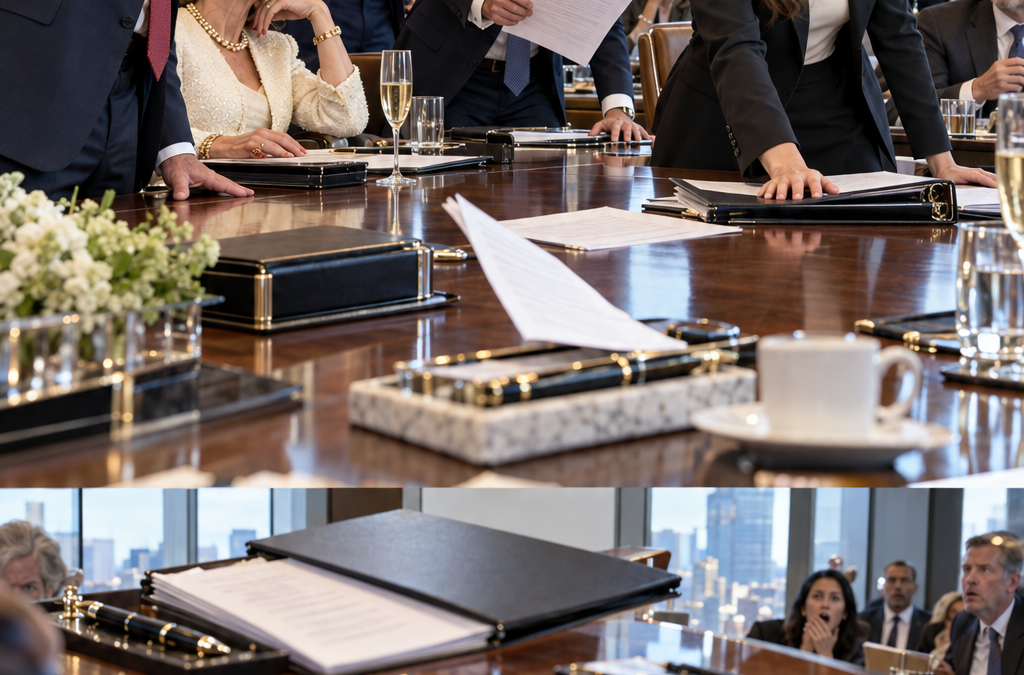
Dad was standing when we entered the boardroom. Mom sat beside him with a porcelain cup untouched in front of her, and Gavin leaned back in his chair wearing a charcoal suit and an expression designed to suggest he was already in charge. Across the table sat Elias Mercer and Northstar’s legal team.
Dad did not invite me to sit.
“We have resolved the family ownership structure,” he announced. “After closing, control of the Bennett family interests will pass entirely to Gavin.”
I looked at him. “Entirely?”
“That is correct.”
Mom watched me with a strange mixture of triumph and anxiety.
Dad continued, “You will receive whatever compensation is required under your employment agreement, but you will no longer have a role in Asterion. You have caused enough disruption.”
I glanced toward Elias. “Has Northstar agreed to this?”
Dad snapped, “Northstar is buying our company. This is a family decision.”
Then he said the sentence I would remember most clearly.
“Gavin gets the future. You leave today.”
The air vent hummed above us.
I set the blue notebook on the table.
“So you sold the company without my patents?”
Mom gave a small laugh. “Rachel, we sold our business.”
Across the table, Elias stopped writing.
He slowly closed the folder in front of him.
“Actually,” he said, “you haven’t sold anything.”
Dad turned toward him.
Elias stood. “The transaction has not closed, funds have not been released, and we have identified multiple unresolved representations concerning intellectual property ownership.”
Gavin’s foot dropped from his knee.
Dad looked at me. “What did you do?”
Naomi placed the license agreement on the table. “My client declined to transfer property she owns.”
Northstar’s attorney opened the marked section.
Dad began speaking quickly about family intent, historical understanding, and the practical meaning of control. Elias listened for less than a minute before raising one hand.
“We are not discussing family intent.”
Naomi placed the patent assignments beside the license, then the original development records, then the financing disclosures showing Asterion repeatedly describing the patents as company-owned. Finally, she placed the fifty-thousand-dollar severance agreement on the table.
Elias read the transfer condition.
His expression changed.
“You attempted to terminate the patent owner before closing and condition severance on assignment of the disputed technology?”
“That is not what happened,” Dad said.
“It is exactly what the document says,” I replied.
Gavin pushed back his chair. “She’s holding the entire deal hostage because she hates that I’m taking over.”
I looked at him. “I am not holding anything of yours.”
“This technology belongs to Asterion.”
“No. Asterion has a license.”
“You built it for the family.”
“I built it before I worked here.”
He slapped his palm against the table. “This is insane.”
Northstar’s lead counsel turned toward him. “Mr. Bennett, did you authorize an outside contractor to access legacy development systems after Ms. Bennett refused consent?”
The anger drained from Gavin’s face.
Dad stared at him.
“What contractor?”
For the first time that morning, Gavin had no prepared answer.
Part 5
Gavin recovered quickly enough to make things worse. He said the contractor had been hired to organize historical records, not manufacture evidence, and that any access to legacy systems was a normal part of due diligence. Northstar’s counsel asked whether Northstar had requested the work. Gavin said no.
“Then whose due diligence?” Elias asked.
Nobody answered.
Naomi produced the invoices. The contractor had been instructed to identify “employment-linked provenance indicators,” locate any records suggesting the earliest software architecture had been created using company resources, and map source-code timestamps against my employment date. The wording was careful, but the purpose was obvious. After I refused to sign, Gavin had gone searching for material that could undermine my ownership.
Dad looked genuinely shocked, which gave me no comfort. “You did this without telling me?”
Gavin’s face reddened. “I was protecting the transaction.”
“You were told not to touch the issue.”
“You told me to solve it.”
Mom whispered, “Gavin.”
He ignored her. “What was I supposed to do? Let Rachel destroy eighty billion dollars because she suddenly decided she needs applause?”
The room became very quiet.
Elias closed the invoice packet. “This meeting is suspended.”
Dad stood. “We can resolve this today.”
“No.”
“You have a signed merger agreement.”
“With closing conditions.”
“We met them.”
Northstar’s lead attorney spoke instead. “At minimum, we have an unresolved ownership defect, potentially inaccurate representations regarding intellectual property, undisclosed concerns involving lender statements, and a post-signing effort to investigate provenance outside the agreed diligence process. We are not releasing funds while those issues remain.”
Dad’s voice lowered. “What are you saying?”
“I’m saying,” Elias replied, “that eighty billion dollars does not move because a family says everything is fine.”
The meeting ended twenty minutes later without a transaction. Not canceled, not yet, but frozen. Northstar’s team left with boxes of documents, Asterion’s outside counsel stayed behind, and Dad stood at the end of the table staring through the windows at downtown Austin.
Gavin turned on me first.
“I hope you’re happy.”
“No.”
“You just put thousands of jobs at risk.”
“The ownership problem existed before I walked into this room.”
“You could have signed.”
“You could have disclosed the truth.”
His mouth opened, then closed.
Mom approached me. “Rachel, please. Whatever happened here, we can still handle it privately.”
I looked at her. “You spent years making false statements because you assumed I would stay quiet. There is no private version left.”
She flinched as if I had shouted.
Naomi touched my elbow, and we left.
For the next three weeks, I lived inside a strange silence. I did not go to the office because Asterion placed me on paid administrative leave, supposedly to protect the integrity of the investigation. Reporters camped outside the campus after financial outlets learned the acquisition had been delayed, but Naomi instructed me not to comment. I stayed in my house, cooked food I barely tasted, took long walks before sunrise, and answered questions from lawyers.
The board formed a special committee. Outside investigators interviewed current and former employees. Northstar expanded its review beyond the patent license into Vector Freight, lender disclosures, internal forecasts, and executive communications.
That was where the deeper problem surfaced.
Gavin’s expansion had not simply underperformed. For nearly two years, senior leadership had used optimistic internal assumptions when describing Vector’s progress to investors while circulating far more pessimistic figures privately. Some of that was normal forecasting uncertainty; some was not. Dad had repeatedly delayed impairment decisions because a lower valuation would make Asterion’s debt ratios look worse ahead of a sale.
Mom, though not an accountant, had been deeply involved in messaging. Emails showed her asking communications teams to remove references to “dependency on third-party-controlled foundational IP” from investor materials because the phrase sounded “needlessly alarming.” In another exchange, when an attorney suggested obtaining a fresh written confirmation from me before refinancing, Mom replied, “Rachel is not an external party. Treating her that way creates a problem where none exists.”
I read that sentence three times.
For years, they had treated my independence as imaginary whenever acknowledging it would cost them money.
Thomas Reed provided investigators with his risk memorandum. Other former employees followed. One by one, decisions I had experienced as isolated family slights became part of a corporate pattern: inconvenient information was softened, delayed, reframed, or buried if it interfered with the story Dad wanted investors to hear.
My patents had not created the crisis.
They had exposed it.
Northstar formally terminated the acquisition thirty-four days after the boardroom meeting. The public statement cited unfulfilled closing conditions and concerns identified during extended due diligence. It did not mention me by name.
Dad called within ten minutes.
I let it go to voicemail.
His message lasted eleven seconds.
“You got what you wanted.”
I deleted it.
Asterion’s stock in the private secondary market fell sharply. Lenders demanded additional information. A planned credit facility was withdrawn. Several large customers paused contract expansions until they understood whether the company still had stable rights to its core technology.
Asterion did still have a license. I had never revoked it.
That distinction mattered.
Naomi asked whether I wanted to terminate the existing rights based on alleged breaches. I thought about thousands of engineers, machinists, technicians, support staff, and warehouse workers who had nothing to do with my family’s choices.
“No,” I said. “As long as the company follows the current license, operations continue.”
“You understand that refusing to terminate may reduce your leverage.”
“I’m not trying to punish employees.”
For the first time in months, I slept through the night.
The board removed Gavin from operational authority pending investigation. Dad remained chief executive for another six weeks, but major investors began demanding his resignation. He fought them until a lender produced correspondence showing he had personally received Thomas Reed’s warning about the patent disclosure three years earlier.
After that, the story he had been telling—that he misunderstood a technical clause—could no longer survive.
He resigned on a Thursday morning.
Mom sent me a message that afternoon.
Your father gave his life to that company.
I stared at the words for a while before replying.
So did I.
She did not answer.
A week later, I met Maya for lunch at a taco place far from Asterion. She had resigned after the gala and was interviewing elsewhere.
“I keep thinking I should feel terrible,” she said. “Asterion was my dream job.”
“Mine too.”
She looked at me carefully. “What are you going to do?”
I had been asking myself the same question.
For eight years, every version of my future had included Asterion. Fighting to remain there suddenly felt like fighting to keep a room that had been burning around me for years.
“I think I’m going to build again,” I said.
Maya smiled for the first time that afternoon.
“With what team?”
“I don’t have one.”
“What office?”
“I don’t have that either.”
“Funding?”
“Not yet.”
She took another bite, thinking.
Then she said, “Good.”
I laughed. “Good?”
“The first time was too easy.”
I nearly choked.
That evening, I opened the blue notebook at my kitchen table. Between old diagrams, I found a page where twenty-seven-year-old me had written a question beside the first adaptive-control sketch.
What should the machine do when the environment stops behaving the way we expected?
I had answered it technically years ago.
Now I understood why the question had stayed with me.
Adaptation was never about pretending the obstacle was not there.
It was about recognizing reality fast enough to choose a new path.
Part 6
Starting over at thirty-five felt less romantic than people imagine. There was no triumphant montage, no instant investor line around the block, and no pleasure in going from executive laboratories to a rented industrial unit with unreliable air-conditioning. Maya joined me first, followed by two former Asterion engineers who had been planning to leave even before the acquisition collapsed. We named the new company Lattice Motion because every better name had already been taken.
I was careful about intellectual property from day one. Every engineer received plain-language ownership explanations. Every invention agreement separated personal work from company work. We created a review committee so no executive could quietly redefine who had made something years after the fact. Investors initially found my obsession excessive.
One venture capitalist glanced at our governance packet and said, “You know most founders don’t spend this much time planning for betrayal.”
“I’m not planning for betrayal,” I said. “I’m planning for clarity.”
He invested anyway.
We did not compete directly with Asterion at first. I had no interest in building a revenge company, and Naomi warned me to keep enormous distance from any trade secrets that belonged to my former employer. Lattice focused on flexible robotics for smaller manufacturers—businesses that could not afford entire automation departments but still needed machines capable of adapting to imperfect environments. The work was technically harder in some ways because inexpensive equipment had less tolerance for sophisticated solutions.
It made engineering fun again.
The family conflict continued without me. Investors filed claims regarding disclosure failures. Lenders renegotiated covenants. Several directors resigned. Gavin’s contractor project became part of a broader inquiry into whether company systems had been accessed for an improper legal purpose, though no dramatic criminal case ever materialized.
That disappointed some reporters.
Reality is often less theatrical than people want. Consequences arrive through depositions, insurance disputes, canceled bonuses, withdrawn offers, legal bills, damaged reputations, and phone calls that stop being returned.
Gavin lost his title and much of his board protection. People who had once laughed too loudly at his jokes began describing him as reckless. I did not celebrate that because I had spent too many years watching my mother manage narratives to trust any story that suddenly made one person entirely monstrous.
Gavin was reckless.
Dad enabled him.
Mom protected the image.
And I had remained silent far longer than I should have.
Understanding my own role did not mean accepting blame for theirs. It meant deciding I would never again confuse avoiding conflict with being kind.
Owen contacted me six months after the failed sale.
He asked to meet at a coffee shop near the university where we had studied together. I almost refused, then agreed because I wanted to know whether seeing him would still hurt. He arrived early and looked almost exactly the same except for the exhaustion around his eyes.
“I made the wrong choice,” he said after we sat down.
“Yes.”
He looked surprised by how quickly I agreed.
“I thought the acquisition was certain.”
“I know.”
“Gavin made it sound like your issue was emotional. He said the lawyers would sort it out.”
“You knew enough to tell me to hire my own lawyer.”
His fingers tightened around the paper cup. “I was afraid of getting left behind.”
I watched students cross the street outside carrying backpacks, laughing, rushing between classes. “So was I.”
“I want to make this right.”
“There is nothing to make right.”
“Rachel—”
“I don’t hate you, Owen.”
His shoulders loosened.
“But I don’t trust you.”
They tightened again.
He said people make mistakes when they are scared. I agreed. He said seven years of friendship should matter. I told him it did matter, which was why the betrayal had mattered too.
Then I left.
The old version of me would have stayed another hour to make sure he understood I was not cruel. I no longer needed him to understand.
A month later, Gavin emailed me through lawyers requesting a private meeting. Naomi advised against going alone, so we met in her conference room. He had lost weight. The expensive confidence that once seemed fused to his body had disappeared.
“Asterion needs certainty,” he said.
“It has certainty. The current license remains valid.”
“Customers are nervous because they think you could pull it.”
“I have said publicly through counsel that I will honor the agreement.”
“They want a longer term.”
“That can be negotiated.”
He studied me. “You’re enjoying this.”
“No.”
“Come on.”
“I spent years begging myself not to notice what all of you were doing. Why would this be enjoyable?”
For a moment, he looked almost like my brother again instead of an opposing party.
“Dad thinks you destroyed him.”
“Dad knew the disclosures were wrong.”
“He thought you’d sign.”
“That is not a defense.”
Gavin looked toward the windows. “You always hated that I was better at the business side.”
“I never hated that.”
“You hated the attention.”
“No, Gavin. I hated disappearing.”
His expression changed.
There it was, finally—not an apology, but recognition.
I continued. “You could have been the face of Asterion forever. I did not want your job. You decided my work needed to become yours for you to feel secure.”
He looked down at his hands.
The meeting ended with no reconciliation. Asterion eventually negotiated an amended license through its independent board, including stronger reporting requirements, clearer ownership language, and restrictions preventing future executives from representing the patents as company-owned. The payments were substantial but reasonable.
I could have demanded more.
I did not want my victory to depend on squeezing a wounded company until employees paid for my family’s mistakes.
Lattice used part of the licensing income to expand. We hired thirty people, then eighty. Maya became head of product systems and laughed the first time I tried to introduce her at a conference as “someone from my engineering team.”
“No,” she said, taking the microphone from my hand. “I have a name.”
The audience laughed.
So did I.
That evening, after the conference, I found a letter waiting at my hotel.
It was from Mom.
Your father is not well. Whatever you think of us, please remember we are still your family.
For years, that sentence would have pulled me home immediately.
This time I placed the letter on the desk and did not move.
Part 7
Dad’s health problems were real. Naomi confirmed that before I responded because I no longer trusted urgency simply because it came from my mother. He had developed a serious condition requiring frequent appointments and expensive ongoing care, and the collapse of Asterion’s deal had left my parents less liquid than anyone outside the family would have guessed. They were still far from poor, but much of their wealth was tied to damaged private equity interests, property, and obligations created during the years Dad assumed the sale would solve everything.
Mom asked for money.
Not directly at first.
She told me what appointments cost, mentioned insurance disputes, and described the stress of managing everything alone. Then she wrote, I never imagined that after everything your father did for you, we would have to ask our daughter for help.
I read that line on my phone in Lattice’s new office while someone tested a robotic gripper twenty feet away.
There was the old mechanism again.
Debt disguised as love.
I called Naomi. “Verify the bills.”
“All of them?”
“The essential medical ones.”
“And if they’re legitimate?”
“Pay providers directly.”
Naomi paused. “You do not have to do this.”
“I know.”
I did not send my parents cash. I did not visit the house. I did not let Mom convert assistance into restored access to my life.
She called when the first bill was paid.
“Rachel.”
I waited.
“Thank you.”
“You’re welcome.”
“Your father would like to see you.”
“No.”
A long silence followed.
“He may not have unlimited time.”
“None of us do.”
“That is a terrible thing to say.”
“It is not meant to be cruel.”
“Then what is it meant to be?”
“A boundary.”
Mom’s breathing changed. “Families forgive.”
“Sometimes.”
“I forgave you plenty over the years.”
That almost made me laugh, but I did not.
“For what?”
She struggled to answer.
Eventually she said, “For being difficult.”
I looked through the glass wall of my office at Maya arguing cheerfully with an engineer over a sensor mount. “Mom, I’m going to continue paying verified essential bills directly. That is what I am willing to do.”
“What about us?”
“I don’t know what you mean.”
“You know exactly what I mean.”
I did.
She wanted the old relationship restored because my continued distance made the consequences visible. If I returned for dinner, smiled in family photographs, sat beside Dad at appointments, and let Gavin text me on birthdays, everyone could tell themselves the acquisition disaster had been an unfortunate business disagreement.
I was not going to provide that comfort.
“No,” I said.
Mom hung up.
Lattice’s first major national contract arrived three weeks later. A network of regional manufacturers wanted our adaptive systems installed across twenty-seven facilities, and the contract was large enough to change the company permanently. The night we signed, our staff gathered in the unfinished kitchen area with pizza and canned drinks because we still had not furnished the event space.
Maya raised her drink. “Speech.”
“No.”
“You own the company.”
“That is exactly why I should know when not to speak.”
People laughed.
I stood anyway.
I told them the contract mattered, but not as much as the fact that our first employee had the same right to understand an agreement as our largest investor. I told them no invention would become “company property” through vague language, no person would disappear from a story because someone else was better in front of a camera, and no executive’s ego was worth corrupting the record of who had done the work.
I did not mention my family.
I did not need to.
A reporter later asked whether Lattice existed because I wanted revenge against Asterion. I told her no. “Revenge is a terrible business model. Eventually you run out of enemies.”
That quote traveled farther than anything technical I said during the interview.
A year after the failed acquisition, Thomas Reed sent Naomi the original copy of his old risk memorandum because the investigation had closed the portion requiring him to retain it. She called me into her office and placed the document on the table.
PRE-CLOSING IP RISK.
The words at the top were ordinary corporate language.
The handwritten comment beside my name was not.
R.B. manageable. Family issue.
Below it was another line I had never seen.
Need signature before public succession announcement. D says she’ll comply once parents present united front.
I stared at it.
“D?” I asked.
Naomi said nothing.
She did not need to.
Diane.
My mother had not merely defended Dad after the fact. She had been involved in planning the pressure campaign before the acquisition became public.
That explained the timing of everything: the missing meetings, the sudden concerns about my emotional state, the conversations about Gavin’s “moment,” the gala, the staffing chart, even the way Mom kept framing my ownership as an embarrassing family dispute.
They had expected me to resist.
They had simply believed they could isolate me until resistance became too painful.
For days, that discovery bothered me more than Dad’s threats or Gavin’s contractor scheme. Dad was aggressive when challenged. Gavin was impulsive when cornered.
Mom had always been the one I thought understood me.
Then another memory surfaced.
Five years earlier, after a magazine profile credited Gavin with leading development of our adaptive platform, I had complained to her in the kitchen.
“Should I correct them?” I had asked.
Mom had put down her glass and smiled.
“Why embarrass your brother over one article?”
One article became another.
One silence became a habit.
One habit became evidence.
I finally understood that my family’s betrayal had not started with the eighty-billion-dollar sale.
The sale was simply the first time their old assumptions became too expensive to hide.
Part 8
Two years after Northstar walked away, Asterion still existed. That fact surprised people who preferred cleaner endings. The company was smaller, more conservative, and run by executives with no connection to my family, but thousands of employees still went to work every morning designing machines, maintaining systems, answering customer calls, and solving ordinary problems.
Its valuation never returned to anything close to eighty billion dollars.
That number had depended on assumptions that could not survive daylight.
Vector Freight was sold off in pieces. Several overextended projects closed. Investors absorbed losses. Dad’s remaining influence disappeared, and Gavin spent most of the next two years fighting civil claims and trying unsuccessfully to rebuild a reputation in an industry where people remembered the provenance investigation.
He sent me birthday texts.
I never blocked him.
I simply did not answer.
Some people interpreted that as cruelty when they heard pieces of the story through relatives. An aunt told me life was too short for grudges. A cousin said Gavin had “learned his lesson.” Another relative reminded me that Dad was ill and Mom was aging.
I stopped defending myself.
The word grudge implies you are carrying something around.
I had put mine down.
Refusing to resume a relationship was not the same as waking up every morning angry.
Most mornings, I did not think about them at all.
Lattice grew slowly enough that I could still recognize everyone in the office, then quickly enough that I could not. We opened a second engineering facility outside Austin and established an employee invention review program that became surprisingly popular. Young engineers arrived at meetings expecting contracts full of language designed to trap them and looked confused when our lawyers actually explained what each clause meant.
I loved that confusion.
Maya became chief technology officer after arguing with me for three months that the title did not matter.
“It matters when investors need to know who has authority,” I told her.
She narrowed her eyes. “Was that growth?”
“Don’t ruin it.”
She laughed.
At our first major industry conference as a mature company, I stood backstage holding the old blue notebook. Its cover was frayed, the binding was loose, and several pages were stained with coffee from a decade I could barely remember living through. A young engineer named Luis noticed it.
“What’s in there?”
“Bad drawings.”
He smiled. “Worth anything?”
I looked at the notebook.
“Eventually.”
When my name was announced, I walked onto the stage alone.
Years earlier, Gavin had stood under similar lights explaining my technology while I watched from the back of a room. I used to replay that memory with anger, imagining the moment rewritten so he pointed toward me and gave me the credit I deserved.
I did not want that fantasy anymore.
I did not need him to point.
I talked about adaptive manufacturing, uncertainty, and the danger of designing systems around perfect conditions. Machines, I explained, fail when engineers assume the environment will behave. Organizations fail for the same reason.
Afterward, a reporter asked whether I believed my parents regretted what happened.
“I don’t know.”
“Do you want them to?”
“No.”
That surprised her.
I explained that regret is useful only when it changes behavior. Wanting an apology had once kept part of me tied to my family because I imagined there would be a perfect sentence capable of balancing eight years of silence.
There wasn’t.
Dad eventually asked to see me through Naomi.
Not Mom.
Not Gavin.
Him.
The request came with a handwritten note.
I was wrong about the patents. I was wrong about the sale. I was wrong to assume you would always say yes.
I sat with those three sentences for a long time.
Then I turned the page over.
On the back, he had added:
I hope someday you understand I was trying to protect what we built.
That was enough to tell me he still did not fully understand.
He remained focused on intention.
I had finally learned to judge patterns.
I declined the meeting.
I continued paying verified essential medical expenses directly until Dad’s coverage stabilized. I did not attach conditions. I did not demand gratitude.
Money was easier than access.
That distinction protected me.
Mom made one final attempt a few months later. She appeared at Lattice’s reception desk without an appointment.
I saw her through the glass doors.
She looked smaller than I remembered. Her hair was shorter, her coat was plain, and without the carefully controlled environments of galas and boardrooms, she seemed less like the architect of our family image and more like an ordinary woman in her sixties standing somewhere she had not been invited.
Maya came into my office. “Do you want security?”
“No.”
“Do you want me to send her up?”
I looked through the glass again.
“No.”
I walked to the lobby instead.
Mom stood when she saw me.
“Rachel.”
“Hi, Mom.”
Her eyes moved over the office behind me, the engineers walking between conference rooms, the prototype stations, the company name on the wall.
“You built all this.”
“Yes.”
She smiled faintly. “You always were talented.”
The compliment arrived years too late, but I did not feel the satisfaction I once imagined I would.
“Why are you here?”
She held her purse with both hands. “I wanted to see you.”
“You’re seeing me.”
Her face tightened.
“I don’t know how to fix this.”
“You can’t.”
Tears appeared in her eyes.
For a moment, the daughter in me wanted to make the moment easier. That instinct had survived everything.
I let it pass.
“I’m sorry,” she whispered.
“For what?”
She looked down.
That was the test she did not know she was taking.
After several seconds she said, “For letting the company come between us.”
I felt something close quietly inside me.
“The company didn’t come between us, Mom.”
She looked up.
“You, Dad, and Gavin made choices. For years. The sale just made those choices impossible to ignore.”
She wiped beneath one eye.
“Can we start over?”
“No.”
The word hurt her.
It did not hurt me to say it.
“I don’t want anything bad to happen to you,” I continued. “I’ll continue helping with essential care if it’s needed. But I’m not rebuilding the relationship we had.”
“We’re your family.”
“Yes.”
“Doesn’t that mean anything?”
“It means a lot. That’s why it took me so long to leave.”
Neither of us spoke for several seconds.
Then Mom nodded.
Not because she agreed.
Because there was nothing left to negotiate.
She walked toward the elevators and did not turn around.
I returned to the engineering floor.
No one applauded. No one knew what had happened except Maya, and even she did not ask. A motor whined from the prototype bay, someone laughed near the kitchen, and two engineers were arguing about a calibration problem as though my entire past had not just walked out of the building.
I loved them for that.
Years earlier, I thought my family had taken something from me every time Gavin accepted credit, Dad dismissed my ownership, or Mom asked me to stay quiet. In some ways, they had.
But the most important thing they took was time.
I could not recover that.
What I could do was stop giving them more.
The old blue notebook still sits in my office today. Not in a safe, not under glass, not displayed like a relic. It stays on a shelf beside current engineering manuals, marked-up contracts, and photographs of the Lattice team.
Sometimes young employees ask why I keep something so worn.
I tell them it reminds me of two things.
First, always write down your work.
Second, never let love substitute for clear agreements.
My parents once believed they could sell an eighty-billion-dollar company, hand the future to my brother, erase me from the story, and repair any hurt afterward because I had always been the daughter who eventually made peace.
They were wrong.
The deal disappeared because they misrepresented ownership, ignored warnings, hid deeper financial problems, and tried to solve a legal risk by pressuring the person who owned it. Their downfall was not caused by some secret fortune I revealed at the perfect moment.
It was caused by choices they had been making for years.
My patents simply forced those choices into the open.
People still ask whether I won.
I never know how to answer.
Gavin lost the future he thought had been guaranteed. Dad lost control of the company that defined him. Mom lost the ability to smooth every ugly fact into a family-friendly story. I lost the version of my family I had spent most of my life trying to preserve.
None of that feels like victory.
The victory came later, in quieter ways.
It was hearing Maya challenge me in a meeting without fear. It was watching a twenty-four-year-old engineer ask our lawyers exactly what an invention clause meant. It was signing contracts that did not require somebody weaker to stay confused. It was standing in my own office on an ordinary Tuesday and realizing no one there needed me to disappear so they could feel important.
For years, I thought loyalty meant absorbing damage without changing shape.
I know better now.
Loyalty without truth is obedience.
Love without boundaries is access.
And forgiveness, when it is demanded as the price of keeping a family comfortable, is not forgiveness at all.
Sometimes people hurt you and eventually become better.
Sometimes they apologize clearly enough that a new relationship becomes possible.
And sometimes the healthiest ending is far less dramatic.
You stop arguing.
You stop waiting.
You stop returning.
Then one morning, you realize the door you closed behind you has been quiet for so long that you no longer think of it as a door.
You think of it as a wall.
And on your side of that wall, you finally have room to build.
THE END!