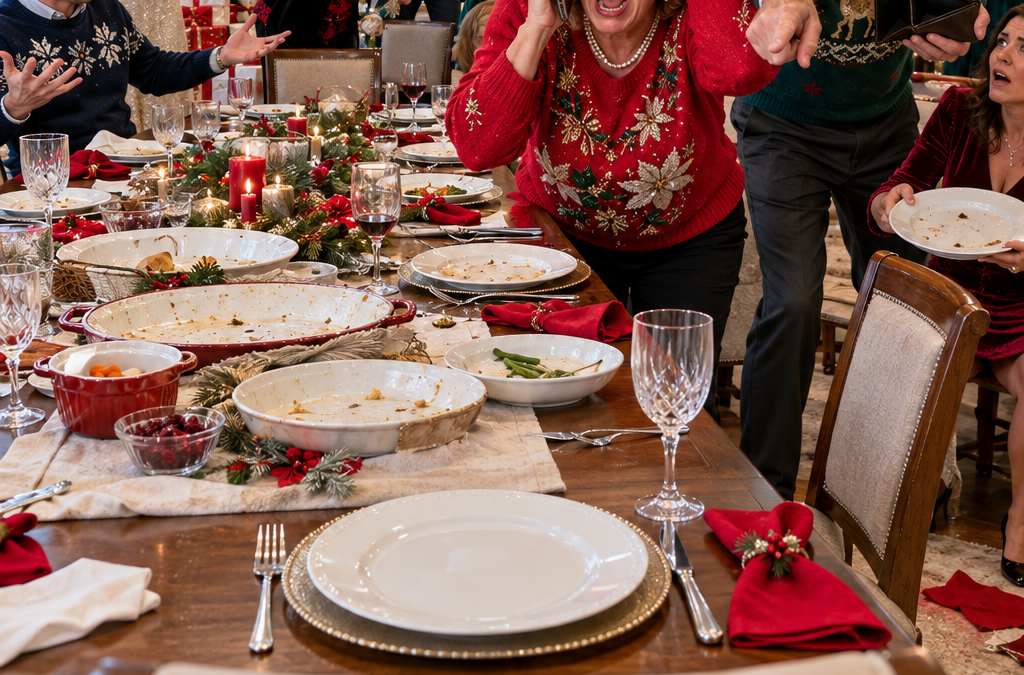
My Mom Blamed Me Every Year For “Ruining” Christmas For The Entire Family. This Year, I Didn’t Show Up… I Didn’t Pay For Anything Either. And At Exactly 7 P.M., My Phone Started Ringing Nonstop With Panicked Calls…
For nine years, I paid for the houses, the dinners, the gifts, and nearly every detail of my family’s Christmas, only to be blamed whenever one small thing went wrong. The year I finally said no, my mother ignored me, my brother ordered me to “fix it,” and the rest of them stood outside a beach house they thought I had paid for. I didn’t rescue them. Two weeks later, a property manager called and asked why my mother had tried to make a reservation using my name.
Part 1
At seven o’clock on Christmas night, my phone began vibrating hard enough to walk itself across the little pine table beside the wood stove. I was three hours west of Richmond in a one-bedroom cabin outside Lexington, wearing thick socks, holding a coffee mug with a chipped blue rim, and listening to rain tick against the windows. The first message was from my mother, Evelyn: “Where are you? Everyone is standing outside because of you.” My younger brother Caleb followed twenty seconds later with three words I had spent most of my adult life obeying: “Fix this now.”
Then my sister Nora sent a photograph.
Four suitcases sat on a dark wooden porch under a yellow security light. My aunt Diane stood wrapped in a camel-colored coat, her face pinched from the cold, while Caleb was near the driveway holding his phone against one ear. My mother stood closest to the front door with one hand raised toward someone outside the frame, probably the property manager she was already blaming. What caught my attention, though, was the brass plaque beside the door: Sandpiper House, the exact Virginia Beach rental my mother had been sending to our family group chat since October.
My shoulders tightened before I could stop them. For years, crisis had triggered the same physical response in me: heart faster, jaw clenched, brain already calculating the cheapest solution before anyone had formally asked me to solve the problem. I could have opened a travel site, found two hotel rooms, called the closest restaurant still serving dinner, and put down my credit card in less than ten minutes. Instead, I wrapped both hands around my coffee and reminded myself that in October I had written a sentence simple enough for a child to understand: “I’m not hosting Christmas this year. I’m not booking the house, and I’m not paying for it.”
The phone rang.
My mother didn’t say hello. “What is going on?”
I looked at the fire. “You’ll have to be more specific.”
“The manager says there is no reservation. He says somebody else has the property after tomorrow morning. We have luggage, groceries, gifts, everything. Diane is freezing.” Behind her, I could hear my brother arguing with someone and Nora saying she needed to get her charger from the car. My mother lowered her voice into the tone she used whenever she wanted her demand to sound like reason. “Mara, I know you were angry, but this has gone far enough.”
“I wasn’t angry when I told you I wasn’t booking anything.”
“You were upset.”
“No. I was clear.”
Only in my family could a statement stop counting because the people hearing it disliked the content.
The first Christmas I ever paid for had been nine years earlier, when I was twenty-five and still counting grocery purchases against payday. My father, Thomas Collins, had died that spring after a fast, ugly battle with pancreatic cancer, and my mother moved through the following months like silence itself had become dangerous. She kept the television running from breakfast until after midnight, left the kitchen light glowing when nobody was in the room, and refused to move Dad’s chair from the end of the dining table. When she called me one November evening and said, “I just want one Christmas that still feels like us,” I said yes before I thought to ask what it might cost.
I worked in logistics operations for a regional medical equipment company, which meant my days were spent preventing small problems from becoming expensive ones. I found a modest rental outside Richmond with four bedrooms, a fireplace that smoked unless you cracked the kitchen window, and an old dining table long enough for all of us. I paid the deposit, then groceries, then extra linens, then a catered ham because Mom said Dad always believed Christmas dinner should smell like cloves and brown sugar. For one night, I genuinely thought I had done something good.
Caleb watched football with his shoes on the coffee table. Nora, still in college then, took a hundred photographs beside the tree. Aunt Diane complained that her mattress dipped in the middle but stayed two nights anyway, and Mom smiled in our family picture with her hand resting on the back of Dad’s empty chair. Later, while I was washing serving dishes, she came into the kitchen, looked over her shoulder toward the others, and said quietly, “Next year you should find something bigger.”
I was holding a wet plate. “Bigger?”
“Your father would have wanted everybody comfortable.”
That sentence became the blueprint for almost a decade.
By the third Christmas, Mom had started sending rental listings before Halloween. Caleb sent links to gifts with messages like, “This would be perfect if anyone’s asking,” although everyone understood who “anyone” meant. Nora wanted coordinated sweaters and professional photographs, and Diane always asked about the best bedroom before asking how I had been doing. Nobody ever said, “Can you afford this?” They asked, “Did you book it?” and “Did you pay the balance?” and “Did you confirm dinner?”
The year everything finally broke, I was thirty-three and earning good money, but not the kind of money that made eleven thousand dollars disappear without consequence. I remember sitting in a grocery-store parking lot staring at the total on my phone: rental, groceries, catering, photographer, decorations, gifts, extra cleaning fees, two last-minute guest additions, and a larger car because Mom claimed Diane couldn’t ride comfortably in Nora’s SUV. I had spent eleven thousand dollars creating a Christmas nobody else had financially touched.
Then holiday traffic delayed dinner by forty-seven minutes.
Mom stood beside the front window with her arms crossed, watching the driveway as though I had personally closed Interstate 64. When the caterer finally arrived, I helped carry foil trays inside, found serving spoons, reheated potatoes, transferred food into the decorative dishes Mom preferred, and apologized to people who had done nothing all afternoon except wait. Halfway through dinner, Mom set down her fork and said, “Every year, Mara, you somehow find a way to ruin Christmas for this whole family.”
Nobody laughed.
Caleb leaned back in his chair. “You always cheap out on the part people actually remember.”
Nora barely looked up from her phone. “The pictures were rushed because dinner was late. Everything feels off now.”
Diane nodded solemnly. “If you insist on controlling everything, sweetheart, you have to take responsibility when it goes wrong.”
I looked at the plates, the candles, the rented house, the wrapped gifts beneath a nine-foot artificial tree I had paid someone to deliver, and suddenly understood something I should have seen years earlier. When Christmas went well, it was our family tradition. When anything went wrong, it belonged to me.
Driving home the next morning, an envelope full of receipts slid off the passenger seat and scattered across the floorboard at a red light. I picked one up and saw the rental charge at the top, then another for the photographer, another for the catering deposit. Eleven thousand dollars, and all my mother had needed was one sentence to make me feel as though I had failed them.
That October, when the family chat began filling with Christmas plans again, I finally stopped cooperating.
I just didn’t yet understand how much my mother had been depending on more than my cooperation.
Part 2
The first message came from Mom on October 7 at 8:14 in the morning. It was a link to Sandpiper House, a six-bedroom beach rental with pale blue siding, a wide deck, an enormous kitchen, and photographs carefully staged to make winter at the Atlantic look romantic instead of wet and windy. “This one looks perfect,” she wrote, followed by a red heart. Before I finished my coffee, Caleb had sent links to a leather jacket and noise-canceling headphones, Nora wanted to know if we could hire the same photographer as last year, and Diane claimed the upstairs ocean-facing bedroom because “my knees are worse now.”
I read every message during lunch, then typed the boundary I had been rehearsing privately for months. “I’m not hosting Christmas this year. I’m not booking the house, and I’m not paying for it. If you all want to go somewhere, you’ll need to arrange it yourselves.” My thumb hovered over Send long enough for the screen to dim once. Then I pressed it.
Nobody replied for three minutes.
Mom finally wrote, “You’re upset. We’ll talk later.”
Caleb sent a laughing emoji. Nora asked, “So are we still doing the beach?” Diane didn’t respond to me at all; she simply replied to Mom that she hoped the ocean bedroom had a walk-in shower. I stared at the thread and felt something inside me shift, not dramatically, but with the quiet finality of a lock turning. They hadn’t heard a boundary. They had heard a tantrum they expected to expire.
A week later, Mom reposted Sandpiper House. “Don’t forget this one.”
“I meant what I said,” I replied.
That became my entire argument. No eleven-thousand-dollar screenshot, no inventory of past humiliations, no reminder that I had once driven forty minutes on Christmas Eve because Diane wanted a specific brand of sparkling water. I had spent years explaining myself to people who treated explanations as invitations to negotiate, and I was finished presenting evidence for the right to use my own money.
November was strangely peaceful. The vendors I had used before sent their normal automated reminders—holiday catering availability, photographer booking deadlines, early-bird rental discounts—and I deleted them. When Nora texted, “Did you confirm dinner yet?” I answered, “You’ll need to check with whoever is organizing it.” When Caleb asked whether I had ordered the headphones, I responded with a thumbs-up emoji, which irritated him enough that he called twice and left no voicemail.
Meanwhile, I booked my cabin.
It cost less for four nights than I had spent the previous year on matching sweaters nobody wore after the photographs. The place had one bedroom, a tiny kitchen, a wood stove, two mismatched armchairs, and no television. The owner mentioned hiking trails, a creek, and unreliable cell service as though the last one were a disadvantage.
I paid in full.
The receipt made me laugh.
Then, in early December, I saw the message that explained why nobody seemed worried.
Mom had written to Caleb and Nora in the family chat rather than privately. “Don’t stress. Mara always gets dramatic before the holidays. She’ll handle it.”
Caleb replied with a thumbs-up.
Nora asked what time everyone should arrive.
I stared at the conversation longer than I should have. My first impulse was to type, “No, I won’t,” but I had already said it twice, and repeating myself would only help them pretend they had needed further clarification. So I put my phone down and finished packing Christmas gifts for three coworkers who had covered shifts for me during a difficult project.
Three days before Christmas, I drove west.
Rain streaked the windshield as Richmond disappeared behind me, and my phone lay facedown in the cup holder. I kept expecting guilt to arrive with distance, but what I mostly felt was fatigue. I had not realized until then how much of my December had always been spent anticipating someone else’s disappointment.
The cabin smelled faintly of cedar and old smoke. I unpacked groceries, put a bottle of wine in the refrigerator, stacked firewood beside the stove, and made pasta with mushrooms and garlic because nobody in my family liked mushrooms and I had spent years quietly removing them from recipes. The first night, I slept nine uninterrupted hours.
Christmas morning arrived gray and still.
I made pancakes, called my friend Tessa in Chicago, walked two miles along a muddy trail, and read half a mystery novel near the stove. Around noon, the family chat became active with photographs from the road. Caleb posted a picture from a gas station, Nora posted her kids holding paper cups of hot chocolate, and Mom sent, “Almost there!”
Nobody asked where I was.
At 4:18, Nora sent a picture of the ocean.
At 5:02, Diane complained about traffic.
At 6:41, the chat went silent.
At 7:00, my phone began vibrating.
After I answered Mom’s call and read my October message aloud, there was a silence so complete I could hear wind through their phone.
Then Mom said, “You knew what would happen.”
“I knew what I wasn’t doing.”
“You had two months to prevent this.”
“I gave you two months to book your own Christmas.”
Caleb took the phone from her. “You knew we were coming here.”
“Yes.”
“And you let us drive all this way?”
“I didn’t tell you to come.”
“You know what I mean.”
Actually, I did. He meant: Why didn’t you stop us from ignoring you?
Then Nora’s voice came through, smaller than the others. “Mom told us you had already handled it.”
I sat straighter. “What?”
There was a pause.
“She said you always do this. You get upset, then you take care of everything.”
Mom cut in quickly. “I said you wouldn’t let Christmas fall apart.”
“Did you tell them I had booked this house?”
Another silence.
That was when something about the scene stopped making sense.
A rental like Sandpiper House wasn’t a roadside motel. Someone had to communicate with the owner. There were deposits, electronic agreements, check-in instructions, door codes, identification. Four adults had driven several hours carrying food and wrapped gifts without any of them having received so much as a confirmation email.
“Mom,” I said, “who told you this house was available tonight?”
Her answer came too quickly.
“It was on the website.”
“That isn’t what I asked.”
Caleb swore under his breath.
Diane started complaining again.
Mom said, “This is not the time for one of your interrogations.”
And suddenly I knew there was something she wasn’t telling me.
Part 3
I ended the call ten minutes later, after Mom invoked my father’s name.
She had saved that weapon for last, the way she always did. “Your father would be ashamed to see you leave your family standing outside on Christmas,” she said, and for a moment I was twenty-five again, trying to preserve a dead man’s approval by keeping everyone around me comfortable. The old guilt rose automatically, but it no longer had the same authority. “Dad taught me to help people,” I said. “He never taught me to finance people who insult me for helping.”
Mom inhaled sharply.
Diane said something about disrespect.
Caleb grabbed the phone again. “So what are we supposed to do?”
“You’re four adults with cars and smartphones. Find a hotel.”
“On Christmas?”
“Yes.”
“So you’re seriously going to sit in your cabin and do nothing?”
I looked around my small room. One plate drying beside the sink, one coat hanging by the door, one mug cooling near my hand, and absolutely nothing in the house I would have to apologize for later. “Tonight I am.”
Then I ended the call.
For the first twenty minutes afterward, I couldn’t read. I kept hearing imaginary versions of their conversation, especially Mom telling everyone I had abandoned them. Eventually I put my phone in a kitchen drawer and added another log to the stove.
The next morning there were nineteen messages.
Caleb had found two hotel rooms near Norfolk for an outrageous holiday rate. Diane had apparently cried in the lobby because the rooms did not connect, which would have been funny if I hadn’t spent so many years treating her inconveniences like emergencies. Nora’s children had eaten vending-machine crackers while Caleb searched for somewhere serving dinner. Mom wrote six separate paragraphs describing the evening as “humiliating,” “heartless,” and “something your father never would have tolerated.”
I answered none of them.
Two days later, Nora emailed me.
Her message began with an account of how difficult the night had been and ended with a request that made me laugh out loud in my kitchen. Between the rooms, food, gas, and a last-minute breakfast, the holiday had cost them around twenty-three hundred dollars. “Would you at least consider covering half?” she asked.
I archived it.
Mom’s email arrived that afternoon.
“You caused this. Reimburse Caleb.”
I typed one word.
“No.”
For years, I had written careful paragraphs explaining budgets, overtime, weather delays, deposits, cancellation policies, why twelve people could not comfortably fit into an eight-person house, and why professional photography at sunset could not be rescheduled after sunset. That single word felt cleaner than all of them.
The strange part was what happened next.
Mom went mostly silent.
I expected furious calls, relatives recruited as messengers, maybe an accusation on Facebook. Instead, Diane texted that I should “be the bigger person,” Caleb called once from a number I didn’t recognize, and Mom disappeared from the group chat for almost a week. That should have relieved me, but the unanswered question from Christmas night stayed with me: how had they believed they had a reservation?
On January 8, at 10:37 in the morning, a man named Martin Keene called my office.
His first sentence was, “Ms. Collins, I’m trying to clear up a reservation issue involving Sandpiper House.”
I almost dropped my pen.
Martin managed the property for the owners. He explained that an inquiry had been submitted in early November under my name, using an email address belonging to my mother. The message referenced my previous bookings with another company and requested that the property be held until “the usual family organizer” completed payment. Martin said he had exchanged several emails with my mother because she claimed she was coordinating the details on my behalf.
“What exactly did she tell you?” I asked.
There was a short pause.
“That you were traveling for work and would settle the balance closer to Christmas, as you had done with previous holiday properties.”
My stomach tightened.
“I never contacted you.”
“That’s what I’m trying to establish.”
Martin explained that he had sent three payment reminders. My mother kept assuring him the money was coming, but no deposit was ever made. On December 15, he released the house to another customer beginning December 26, while leaving Christmas night unbooked because he assumed our family might still complete a one-night arrangement. When Mom arrived expecting access for the full week, he realized she had either misunderstood the arrangement or deliberately ignored his emails.
“Why would she drive there without a code?” I asked.
“That’s the part I couldn’t understand.”
Neither could I.
Then Martin said something that made my hand go still.
“She told me you had authorized her to use the payment method from your previous family rentals.”
“I didn’t.”
“I suspected that might be the case.”
He asked whether I wanted copies of the correspondence. I gave him my personal email address, thanked him, and sat at my desk staring at the wall after we disconnected.
The emails arrived five minutes later.
The first few were exactly what Martin had described. Mom was friendly, vague, and confident. She wrote that I was “handling finances as usual” and that the family preferred to keep things simple because “Mara gets overwhelmed when too many people contact her directly.”
Then I reached a message dated December 11.
Mom had written: “Please don’t release the booking. She always pays. She likes to make a point first.”
A point.
That was what my boundary had become in her version of reality.
I read further.
On December 14, Martin wrote that without payment he could not guarantee the dates. Mom responded, “Use the card connected to her old reservation profile if your system allows it. She has approved family Christmas expenses before.”
My mouth went dry.
Martin replied that his company did not have access to another agency’s payment records.
Mom’s final response was only one sentence.
“I’ll take care of it.”
She never did.
Instead, she drove everyone to Virginia Beach and waited for me to rescue them.
I thought that was the worst thing in the email chain until I noticed an attachment on the earliest message.
It was a screenshot from an old holiday rental account.
My old holiday rental account.
And my mother should never have had access to it.
Part 4
I changed every password before lunch.
The rental account dated back six years to a house we had used near Williamsburg. I barely remembered creating it, but the profile still contained my old billing address, phone number, past trips, and a list of previous bookings. No full credit card number was visible, but the last four digits of an expired card appeared beside several transactions.
What bothered me wasn’t the payment information.
It was the login history.
The account showed access from a device I didn’t recognize as recently as November.
I called the rental company and spent forty minutes moving through customer service until I reached someone in account security. They couldn’t identify a person, but they confirmed that password reset emails had been sent twice in the previous year. Both reset requests had been successfully completed.
I opened my old email account and searched.
There they were.
I had missed them because both occurred during work trips when my inbox was overflowing. Someone had reset the password, then deleted the notification from my inbox—but not from the trash folder, which I rarely emptied.
I felt ridiculous sitting alone in my office feeling frightened by something as ordinary as a password reset.
Then I remembered the year before, when Mom had called me during a client dinner and said the photographer required “a quick approval.” I told her I couldn’t deal with it and asked her to handle whatever logistics were necessary. The photographer’s final invoice ended up nearly seven hundred dollars higher than the estimate because of additional prints, a second location, and rush editing.
Mom had told me Nora requested the extras.
When I asked Nora about it that evening, she sounded confused.
“I thought Mom wanted them.”
That was the first memory that changed shape.
Then another followed.
Three Christmases earlier, Diane had thanked me for upgrading everyone’s rooms at a resort-style rental. I had no idea what she meant, but when I asked Mom, she waved it away as a booking adjustment. The final charge had been several hundred dollars higher than expected.
Another year, Caleb complained that I had insisted on expensive catered appetizers when “pizza would have been fine.” I remembered staring at him because I hadn’t chosen the appetizers at all.
Mom had.
I went home early and pulled a plastic file box from the back of my bedroom closet.
My father had believed in paper. Even after online statements became normal, he printed bank records, clipped receipts together, and wrote dates in the upper-right corner in blue ink. After he died, Mom gave me several boxes of financial documents because she said looking at them upset her. I had gone through the important estate records years earlier, then kept the rest because throwing away Dad’s handwriting felt strangely disloyal.
That night I opened everything.
At first, I didn’t know what I expected to find. Some explanation for Mom’s obsession with elaborate Christmases, maybe evidence that Dad had been the real spender and she was trying to recreate what he used to provide. Instead, I found the opposite.
Dad’s holiday spending had been modest.
Very modest.
Grocery receipts. Hardware-store purchases. A Christmas-tree farm. Small checks to churches and local charities. One year, he bought Mom a gold bracelet and wrote “don’t tell Ev” on the receipt envelope like a teenager hiding a surprise.
There were no luxury rentals.
No professional family photographs.
No catered dinners.
No expensive coordinated traditions.
I sat on the floor surrounded by paper and realized Mom’s favorite sentence—“Your father would have wanted this”—had never been about preserving Dad’s Christmas.
She had invented a new one after he died.
Near midnight, I found a spiral notebook.
Dad had used it during the last year of his life to track household expenses while Mom was helping with his appointments. Most pages were ordinary—insurance questions, medication schedules, names of nurses, utility payments—but near the back he had written several notes about Mom.
“Ev upset about Diane comparing houses again.”
“Remind her we don’t need to impress anybody.”
“Talked about Christmas. She wants beach place next year. Told her no debt for appearances.”
I read the last line three times.
No debt for appearances.
The following page contained a longer note.
“Evelyn thinks Mara will be the one in the family who can ‘make things nicer’ once she’s established. Told her not to put that on the kid. Mara already fixes too much for everybody.”
I stopped breathing for a second.
Dad had seen it.
Before the rentals, before the matching clothes, before my eleven-thousand-dollar Christmas, my father had noticed the role forming around me.
Mara already fixes too much for everybody.
I sat there until my legs went numb.
The next morning Nora called.
I almost let it go to voicemail, then answered.
Her first words were, “I owe you an apology.”
I didn’t say anything.
“I went back through the group chat,” she continued. “You told us. Clearly. Twice. Mom kept saying you would take care of it, and I believed her because… I don’t know. Because you always had.”
“That’s not the same thing as me agreeing.”
“I know.”
Her voice sounded tired rather than defensive, which made me listen.
Then she said, “There’s something else.”
I waited.
“Mom told Caleb and me you had access to Dad’s life-insurance money.”
I felt cold all over.
“What life-insurance money?”
Part 5
My father’s life insurance had not made me wealthy.
I knew that because I had helped Mom complete the claim after he died. The policy paid just over $180,000, most of which went toward the remaining mortgage, funeral expenses, medical bills, and giving Mom enough cash to stay in the house without panicking about money. I received nothing from the policy and expected nothing.
Nora, however, had been told a very different story.
“Mom said Dad left some separate account for you,” she explained. “Not millions or anything. Just enough that paying for Christmas wasn’t really a burden.”
I stood in my kitchen looking out at bare January trees. “When did she tell you that?”
“A long time ago. Maybe the second or third year you started renting houses.”
That explained more than I wanted it to.
Caleb’s casual demands. Diane’s assumption that I could always upgrade something. Nora’s lack of concern when prices climbed. They had not simply decided I earned more and therefore should pay.
My mother had given them a reason to believe the money came from Dad.
“Did she say why Dad supposedly left it to me?”
Nora hesitated. “She said because you were the responsible one.”
I laughed once, without humor.
Of course.
Even imaginary generosity from my father had been transformed into another job.
I told Nora the truth. There was no secret account. Dad had never left me a Christmas fund. Everything I spent came from my salary, bonuses, savings, and more credit-card balances than I cared to admit.
Nora went quiet.
“How much did you spend last year?”
“About eleven thousand.”
“Oh my God.”
“That was one year.”
She whispered something I couldn’t hear.
Then she said, “Mara, I thought maybe you spent two or three thousand.”
That hurt more than if she had argued.
For years, my family had enjoyed an expensive holiday without even knowing what it cost because nobody had bothered to ask.
I emailed Nora copies of Dad’s estate distribution documents, not because I owed her proof but because I wanted one person in the family to understand how completely fictional Mom’s story had been. Nora called back an hour later sounding shaken.
“She lied.”
“Yes.”
“Why?”
That became the question neither of us could answer.
A week later, the answer began to take shape when Diane called me.
She opened with, “Your mother says you’re going through old financial records like some kind of detective.”
I almost smiled. “Did she tell you why?”
“She said you’re trying to embarrass her.”
“I found out she tried to book Sandpiper House under my name.”
Silence.
“She what?”
I explained.
Diane stopped interrupting.
Then, almost reluctantly, she said, “Your mother has always been strange about money.”
That sentence from Aunt Diane was like hearing a cat admit it had noticed mice.
According to her, Mom had spent much of her marriage comparing our family to relatives, neighbors, and people from church. Dad hated it. He drove cars until they became unreliable, repaired appliances himself, and preferred backyard cookouts to formal restaurants. Mom interpreted his frugality as embarrassment.
“After Thomas died,” Diane said, “she became obsessed with showing everyone the family was still doing well.”
“By spending my money?”
Diane sighed. “I don’t think she thought of it that way.”
“Then how did she think of it?”
“As family money.”
That phrase sat heavily between us.
I began examining old invoices.
The pattern became obvious once I knew what to look for. Mom would suggest a rental, then call the property to request upgrades. She added additional guests, extended stays, booked extras, and told vendors to include costs on the final bill sent to me. She told relatives I had chosen the expensive options, which made them less likely to question her.
She got the status.
I got the invoice.
And when anything went wrong, I got the blame.
Her system was almost elegant.
Nobody needed to think of her as demanding because Mara had “handled it.” Nobody needed to feel guilty about the cost because Dad had supposedly left me money. Nobody needed to thank me because I was merely performing the role Dad had expected from me.
The only thing required to keep the entire structure standing was my continued cooperation.
That was why Christmas at Sandpiper House mattered.
My refusal hadn’t simply ruined a holiday plan.
It had interrupted the story Mom had built around herself.
In early February, she finally came to my house.
I saw her through the front window carrying one of Dad’s old document folders.
For a moment, hope rose in me despite everything.
Maybe she was ready to admit it.
I opened the door but didn’t invite her in.
Her eyes moved past me toward the hallway. “Are you going to make me stand outside?”
The irony was so obvious I almost admired it.
“What’s in the folder?”
Her mouth tightened.
“Your father’s papers.”
“I have Dad’s papers.”
“Not these.”
She held the folder against her coat.
“Mara, if you’re going to keep dragging the family through this, you should at least know the whole story.”
I stepped aside.
She walked into my living room, set the folder on the coffee table, and removed a document I had never seen before.
It was signed by my father six months before he died.
And my name was on it.
Part 6
The document was not a will.
It was a letter from my father to an estate attorney, written while he was reviewing his finances after his diagnosis. The first page dealt with ordinary questions about Mom’s mortgage protection and beneficiary designations. The second page contained a paragraph about me.
Dad had asked whether he could leave me a small separate amount—twenty-five thousand dollars—not because I needed it more than Caleb or Nora, but because, in his words, “Mara has spent her whole life becoming the emergency contact for people who should learn to solve their own problems.”
I looked up at Mom.
“What happened to this?”
She stared toward the window.
“Your father changed his mind.”
“Where’s the revised paperwork?”
“He was sick.”
“That isn’t what I asked.”
Mom pressed her lips together.
The letter itself created no inheritance. Dad had merely asked a question. But I understood immediately why Mom had brought it: she wanted me to see that there had, briefly, been an idea involving money for me.
“You told them he left me money,” I said.
“I told them he wanted you taken care of.”
“That isn’t the same thing.”
“I was trying to keep everyone from feeling guilty.”
“For spending my salary?”
Her voice sharpened. “You were doing well.”
“So were Caleb and Nora.”
“Not like you.”
There it was.
Not grief.
Not confusion.
A calculation.
I sat across from her. “Why did you tell everyone Dad would have wanted those Christmases?”
Her eyes filled with tears almost immediately, and years ago that would have ended the conversation. I would have moved beside her, apologized for upsetting her, changed the subject, and probably offered dinner. This time I waited.
“You don’t understand what it was like after he died,” she said.
“I was there.”
“No, you were working. You had your career. You had somewhere to go every morning. I was fifty-eight years old and suddenly the woman whose husband died.”
The sentence was so revealing that I stayed quiet.
Mom told me that after Dad’s funeral, people stopped calling. Invitations became less frequent. Couples who had been their friends for decades drifted away because she no longer fit naturally into dinners and weekend trips. She felt watched, pitied, diminished.
Then I rented that first Christmas house.
Everyone came.
Everyone posted photographs.
People commented online about how beautiful our family holiday looked.
Mom had felt visible again.
“So the next year you wanted bigger,” I said.
She wiped her cheek.
“Yes.”
“And the year after that?”
“I wanted everyone together.”
“That isn’t what I asked.”
Her shoulders sagged.
She finally admitted something I had never expected to hear directly.
She liked people thinking our family had become more successful after Dad died.
Not happier.
Successful.
The houses became larger because Diane compared photographs. The professional photographer started because another widow at church sent elaborate holiday cards. The waterfront locations began because Mom noticed more people commenting on Nora’s social-media posts when there was an ocean behind us.
“You could have paid for those things,” I said.
“I didn’t have your income.”
“So you spent mine.”
“It wasn’t like that.”
“It was exactly like that.”
She started crying harder.
“I thought you could handle it.”
That sentence ended whatever sympathy I had been trying to preserve.
My whole life, “Mara can handle it” had sounded like praise. At work, teachers, friends, relatives, even Dad had used versions of it. But sitting across from my mother, I finally understood how easily competence becomes a permission slip for other people’s irresponsibility.
“You knew I was struggling some years.”
“I knew you were tired.”
“I told you I carried balances on cards.”
“You always paid them off eventually.”
I stared at her.
“You knew.”
Mom looked down.
That was the emotional reversal I had not been prepared for. I had assumed she was careless, entitled, maybe delusional about money. What I discovered instead was worse because it was simpler.
She had known.
She had known the holidays cost me too much.
She had known I felt pressured.
She had known I was sometimes using bonuses or delaying my own plans to cover them.
She just believed I would keep doing it.
I pointed toward the letter from Dad.
“Did you ever tell him what Christmas became after he died?”
Her expression changed.
That was my answer.
Dad, the man whose name she had used to pressure me for nearly a decade, had explicitly warned her not to make me responsible for everyone.
“You used him against me,” I said quietly.
“Mara—”
“You said he would be ashamed of me.”
“I was upset.”
“You said he wanted everyone comfortable. You said he would have wanted bigger houses. You said the money wasn’t really a burden because he wanted me taken care of.”
She stood.
“I am still your mother.”
“And I am still your daughter. You just stopped treating me like one when I became useful.”
Mom flinched.
For once, I didn’t rush to repair the damage my words caused.
She gathered her purse and coat, but left Dad’s letter on the table.
At the door, she said, “You’re going to regret tearing this family apart.”
I looked at her.
“I didn’t tear it apart. I stopped paying to hold it together.”
She left without answering.
Three days later, Caleb called.
This time, I answered.
And what he told me made it clear Mom still hadn’t admitted everything.
Part 7
Caleb sounded different.
Usually, when my brother called, he began halfway into whatever problem he wanted solved. That evening he said hello, asked whether I had a minute, and waited for my answer.
“I talked to Mom,” he said.
“So did I.”
“She told me about Dad’s letter.”
I leaned against my kitchen counter. “Did she tell you there was never actually money left to me?”
“Yes.”
“Good.”
He was quiet.
Then he said, “She also told me something about last Christmas.”
I waited.
According to Caleb, Mom had not merely assumed I would eventually book Sandpiper House.
She had deliberately kept everyone else from booking it.
In November, Caleb had offered to put the deposit on his credit card after seeing that I wasn’t participating in the group chat. Mom told him not to waste his money because I had “already started the process.” When Nora suggested choosing a cheaper rental, Mom rejected it because “Mara had points and discounts” that would make Sandpiper House affordable.
Neither statement was true.
“She kept telling us you were handling it privately,” Caleb said. “I should have asked you.”
“Yes.”
He inhaled slowly. “I know.”
That was the closest my brother had ever come to accepting responsibility without immediately asking me to soften it.
Then he told me why Mom had been so certain.
The previous Christmas—the eleven-thousand-dollar one—she had called my rental agency after I booked the house and added two extra nights without asking me. She had told the company she was authorized to make changes because she was my mother and part of the reservation.
The agency charged the card on file.
I had noticed the higher total but assumed taxes and fees had changed.
“Caleb,” I said, “how do you know this?”
“Because she told me last week. She said she had done it before and you always paid.”
There was no dramatic crash inside me.
Just clarity.
Mom had built confidence from repetition.
Every time she made a decision with my money and I absorbed the cost, she learned that my protest had no practical consequence.
Every time relatives demanded more and I provided it, they learned that entitlement worked.
Every time someone blamed me and I came back the following December anyway, they learned there was no price for disrespect.
Until Sandpiper House.
Her own behavior caused the failure. She told Caleb not to pay. She discouraged Nora from choosing another property. She misrepresented herself to Martin. She refused to accept his payment deadlines because she believed I would appear at the last minute with a credit card.
When I didn’t, there was no reservation.
For the first time, Mom’s assumptions landed on Mom.
Caleb apologized.
Not perfectly.
He defended himself twice, saying he had been busy with work and believed what Mom told him. He mentioned that I had always “seemed okay” paying, which irritated me enough that I interrupted.
“I seemed okay because every time I said I wasn’t, you called me dramatic.”
He stopped.
“You’re right.”
That mattered more than a polished apology would have.
Nora apologized separately a few days later. She told me she had added up what she could remember asking for over the years and felt sick about it. I told her guilt wasn’t useful unless it changed her behavior.
“Then tell me what changes,” she said.
So I did.
I would attend family events when I wanted to. I would bring food or gifts if I chose. I would never again be the automatic planner, booker, driver, lender, purchaser, emergency contact, or person responsible for fixing someone else’s refusal to prepare.
“If Mom plans Christmas?” Nora asked.
“Then Mom pays for the parts she plans.”
“And if she can’t?”
“Then she plans something she can afford.”
It sounded obvious.
That was why it felt revolutionary.
Spring came.
I separated every shared account I could find. Streaming services, a family cell-phone add-on, a warehouse membership, even a cloud-photo plan Mom had been using for years. None of the amounts were enormous individually, but together they represented the same pattern: I paid because it was easier than having a conversation.
The conversations happened anyway.
Diane called me selfish when she lost access to the warehouse account.
I told her memberships could be purchased online.
Caleb paid me back for a concert ticket I had bought for him months earlier.
Nora began hosting Sunday dinners at her own house and asking everyone to bring something.
Mom withdrew.
For several months, she barely spoke to me except through short texts about practical matters. My guilt came in waves, but so did relief.
Then in June, while cleaning out my garage, I found Dad’s old toolbox.
Inside the lid, taped beneath a faded manufacturer’s label, was a small envelope with my name on it.
I knew his handwriting instantly.
The note inside was only four sentences.
“Mara, helping is good. Being made responsible for everyone is not. If I’m not around someday, don’t confuse keeping the peace with keeping the family. A family that only works when one person carries it is already in trouble.”
I sat on the concrete floor and cried for the first time since Christmas.
Not because Dad had given me permission to walk away.
Because he had seen the burden before I did.
Part 8
The next Christmas looked nothing like the ones before it.
By early November, the family group chat remained almost silent. No beachfront listings appeared. Nobody sent me gift links. Diane posted one photograph of a decorated hotel lobby with the comment, “Wouldn’t this be lovely,” and nobody responded.
Then Nora created a new message thread.
“Christmas dinner at our place. Potluck. No gifts over $30 unless you want to. Come if you can.”
I stared at it and smiled.
Caleb immediately claimed mashed potatoes.
Diane volunteered pie.
Mom wrote only, “I’ll think about it.”
Nobody asked me to organize anything.
I brought green beans, a bottle of wine, and two inexpensive board games.
Nora’s house was crowded and imperfect. Her youngest spilled juice on the tablecloth before dinner. Caleb’s potatoes were slightly lumpy. Diane complained that the dining chair hurt her back, then stopped when nobody offered to switch with her.
The turkey finished twenty minutes late.
Nothing collapsed.
That might have been the most important thing any of us learned.
Mom arrived after everyone else.
She brought a small bakery cake and wore the pearl earrings Dad had given her on their thirtieth anniversary. She hugged Nora, kissed the children, said hello to Caleb, then stopped in front of me.
“Merry Christmas, Mara.”
“Merry Christmas, Mom.”
We did not hug.
I had imagined that moment many times over the year. In some versions she apologized. In others she attacked me and I delivered a perfect speech that left the room silent.
Real life gave me neither.
She sat at the table.
We ate.
After dinner, while the others played a card game, Mom found me in the kitchen rinsing serving dishes.
For nine years, some version of our worst moments had happened near a sink.
She leaned against the counter.
“I’m sorry about last year.”
I turned off the water.
“For which part?”
Her face tightened, but she didn’t retreat.
“For telling everyone you would pay when you said you wouldn’t.”
I waited.
“And for using your accounts without asking.”
I said nothing.
“And for what I said about your father.”
That was the apology I needed to hear, even though hearing it did not repair what came before.
Mom looked at the floor.
“I was angry at him for dying,” she said. “That sounds horrible, but it’s true. He got sick, and suddenly every plan we had became mine alone. Then people stopped looking at me the same way. I think I started using Christmas to prove I hadn’t lost everything.”
“You used me to prove it.”
“Yes.”
The word was barely audible.
I appreciated the honesty.
I did not mistake it for restoration.
“I forgive the apology,” I said. “That doesn’t mean we go back to how things were.”
She looked at me. “I know.”
And surprisingly, I believed her.
My relationship with my mother did not become warm again. We did not begin having weekly lunches or taking mother-daughter trips. I stopped expecting her to transform into the woman I wished she had been, and she slowly stopped expecting me to resume the role I had abandoned.
We became polite.
Then, occasionally, kind.
That was enough.
Caleb changed more than I expected. Once he understood how often he had treated my competence as free labor, he became almost aggressively determined not to ask for favors without offering something in return. When he moved apartments that summer, he invited me to help, then added, “Pizza, beer, and you are absolutely allowed to say no.”
I said yes.
Not because he needed me.
Because he had finally learned to ask.
Nora and I became closer. She admitted that for years she had resented me because Mom described every expensive family decision as something I wanted. Nora thought I was controlling the holidays; I thought Nora was demanding them.
Mom had been translating each of us to the other.
That realization was painful, but useful.
We stopped letting her.
As for Sandpiper House, I never saw it in person.
Martin sent me one last email after closing his records, apologizing for the confusion and confirming my name had been removed from the inquiry. I thanked him and kept the email in a folder with Dad’s note, not because I wanted to preserve the anger but because I had spent too many years doubting my own memory whenever the family insisted something had happened differently.
Facts mattered.
So did receipts.
So did screenshots.
But the biggest change in my life was quieter than any of those things.
I stopped equating being needed with being loved.
At work, that distinction made me better at my job. I delegated instead of rescuing coworkers who repeatedly ignored deadlines. I took actual vacations instead of checking email every hour.
At home, I let my phone ring.
I let people solve problems.
I let adults experience consequences that belonged to them.
Sometimes helping was still the right thing to do. I drove Nora to outpatient surgery one spring and stayed with her children overnight. I loaned Caleb my truck when his broke down. I took Mom groceries when she had the flu.
The difference was that I chose those things.
Choice changed everything.
A year after the Sandpiper disaster, I returned to the same cabin outside Lexington for three nights.
The owner had replaced the chipped blue mug, which disappointed me more than it should have. The wood stove still clicked as it heated, rain still whispered through the trees after dark, and cell service was still unreliable.
On Christmas morning, I made coffee and sat near the window.
My phone remained faceup this time.
At 9:12, Nora sent a photograph of her kids wearing pajamas.
Caleb texted, “Merry Christmas. Potatoes are better this year.”
Mom sent, “Hope the mountains are peaceful.”
No demands.
No emergency.
No accusation waiting behind a holiday greeting.
I answered all three when I felt like it.
Then I put the phone down and watched steam curl from my coffee.
For years, I had believed peace would arrive dramatically, like a slammed door or a final confrontation or the moment somebody admitted I had been right.
It didn’t.
Peace was much less impressive.
It was eating food while it was still hot.
It was knowing what Christmas cost before agreeing to it.
It was helping because I wanted to, not because refusal would make somebody angry.
It was loving people without financing their expectations.
Most of all, it was understanding the lesson my father had tried to leave me long before I was ready to hear it.
A family should not require one person to carry everyone else while apologizing for the weight.
That Christmas, nobody needed me to save the day.
For the first time, that didn’t make me feel unnecessary.
It made me free.
THE END!