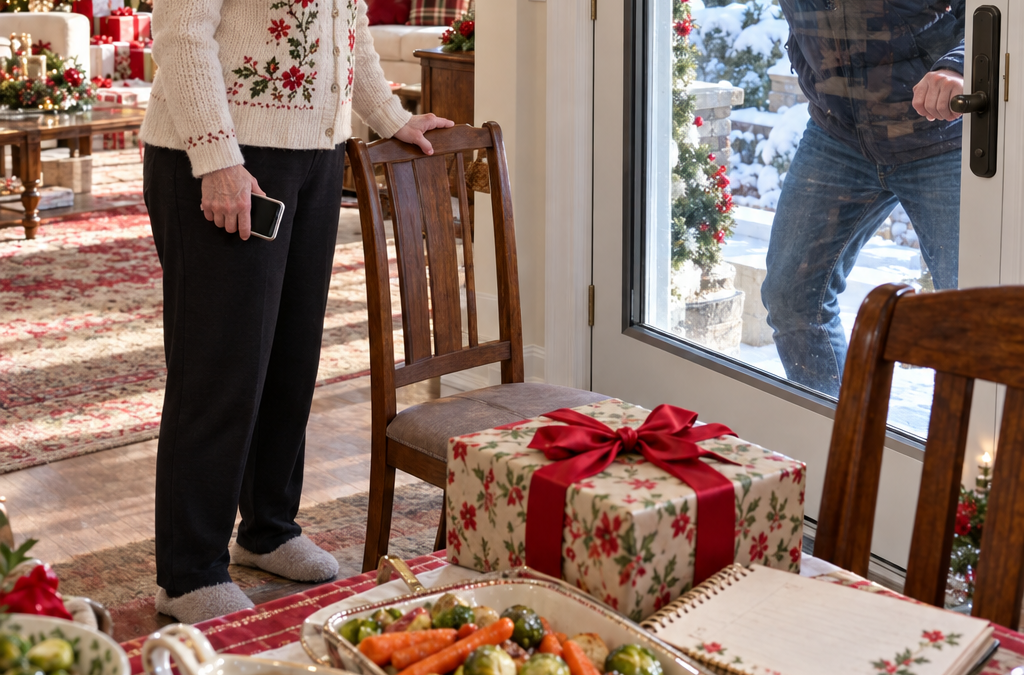
I Called My Son While Planning For Christmas. “Should I Make Ham Or Roast?” His Wife, Brooke, Answered, “You Don’t Need To Come. We’re Spending It With My Family.” I Replied, “All Right.” The Next Morning, He Pounded On My Door.
Four days before Christmas, my daughter-in-law answered my son’s phone and told me not to come. I didn’t argue. I went home, looked at the $26,400 left from selling my late husband’s beloved woodworking collection, and finally stopped pretending my family loved me for reasons that had nothing to do with what I paid for. The next morning, my son pounded on my door demanding “his” money back. Three months later, a mortgage-company voicemail revealed they had promised a lender something I had never agreed to give.
Part 1
I was standing in the frozen-food aisle of a Kroger outside Columbus, Ohio, trying to decide whether a bone-in spiral ham was worth the trouble when I called my son, Nathan, to ask what he wanted for Christmas dinner. My cart was already half full: russet potatoes, cranberry sauce with whole berries because Nathan hated the jelly kind, stuffing mix that took forty minutes instead of five, and two bottles of sparkling cider because my ten-year-old grandson, Owen, liked drinking it from one of my old champagne flutes and pretending he was at a fancy restaurant. It was December 20, five days before the first Christmas since my husband Thomas died that I had been determined to make feel normal. Nathan’s phone rang twice before his wife answered. “Hi, Claire,” I said. “Is Nathan around? I just need to know—ham or tenderloin?” There was a pause long enough for me to hear what sounded like cabinet doors closing behind her. Then she said, “Actually, Evelyn, we’re spending Christmas with my parents this year. You really don’t need to make the trip.”
I remember staring at a freezer door where my reflection floated over bags of frozen peas. Claire’s parents lived in Arizona and had come east twice since Thomas’s funeral. I knew they had wanted Christmas with their daughter and grandchildren eventually. What I had not known was that Christmas had already been reassigned without anyone mentioning it to me. “All right,” I said. Claire sounded almost suspicious. “All right?” “Yes.” Another pause followed. She had apparently prepared herself for a fight and didn’t know what to do with the absence of one. “We just think it’ll be easier this way,” she added. “Of course.” I ended the call, moved my cart so another woman could reach the peas, and continued shopping because sometimes dignity looks very much like placing butter in a cart while your chest feels hollow.
I paid for everything. I loaded the groceries into my Subaru. I drove home through dirty December snow with the heater blowing too warm against my face, and I did not cry until I was standing in my kitchen putting Owen’s sparkling cider in the refrigerator. I had been widowed fourteen months, and Thomas had taught me a trick for moments when panic started climbing your throat: run cold water over your wrists and count backward from twenty. I did that now. By the time I reached eleven, the sadness had changed shape. It wasn’t gone, but beneath it was something harder and more useful. Recognition.
For twenty-two years, I had made myself indispensable to Nathan. I paid the difference when he and Claire couldn’t quite cover the security deposit on their first apartment. I paid for Nathan’s transmission because he casually mentioned the repair estimate over Sunday dinner and looked tired. When Claire returned to her marketing job after Owen was born, I rearranged the retirement schedule I had imagined for myself and babysat three days a week. I did it again when Lily was born. When their furnace failed during a January cold snap, I wrote a check before they finished explaining what had happened. When they bought their current house, I covered the portion of the down payment that their savings didn’t reach. Not once did I call any of it a loan. I told myself that helping was simply what mothers did.
The problem was not that I had helped. The problem was that I had quietly trained all of us to think help would always arrive before consequences did.
On the edge of my kitchen counter sat a cream-colored folder from Halloran & Pierce Auctions. Two months earlier they had sold most of Thomas’s antique woodworking collection. My husband had spent forty-one years gathering old hand planes, chisels, marking gauges, braces, saws and strange iron tools whose names I still confused. Some were worth hundreds of dollars. A few were worth thousands. After fees, the sale deposited $26,417 into a savings account I had not touched.
Nathan and Claire knew about it.
Neither had ever directly asked for the money. They were more sophisticated than that. Claire had mentioned that houses in the Westbridge school district were “impossible unless you had enough cash to cover an appraisal gap.” Nathan had told me over Thanksgiving that sellers were choosing offers from buyers with “strong family backing.” Two weeks later, Claire showed me photographs of a brick colonial with a finished basement and a large fenced yard. “The kids would grow up there,” she had said.
At the time I had smiled.
Standing in my kitchen after being dismissed from Christmas, I understood that those conversations had not been conversations. They had been architecture. They were building a bridge toward my bank account and waiting for me to walk across it voluntarily.
I opened the auction folder and ran my finger over Thomas’s name.
Every Saturday for eleven years, Thomas had volunteered at Harbor Light Community Church, where a small woodworking shop served men coming out of the county re-entry program. He taught them how to sharpen blades, square boards and build simple furniture. He never described it as charity. “A man who knows how to make something useful has somewhere to start,” he used to say. After Thomas died, the program struggled. Their old dust collection system failed. Two machines needed replacing. The volunteer who had handled most instruction moved away.
I picked up my phone and called Reverend Malcolm Cole.
He answered on the second ring. “Evelyn? I was thinking about you last week.”
“I have some money from Thomas’s tools,” I said. “I want the shop running again.”
He went quiet.
“All of it?” he finally asked.
“All of it.”
“Evelyn, that’s more than twenty-six thousand dollars.”
“I know what numbers mean, Malcolm.”
That made him laugh softly. Then his voice broke.
We talked for almost forty minutes. New equipment, safety upgrades, a stipend for a retired tradesman to teach twice a week, replacement benches, materials. When Reverend Cole asked whether I wanted the donation anonymous, I surprised myself.
“No,” I said. “Use Thomas’s name. And mine.”
“You’re sure?”
“Thomas spent his whole life avoiding attention. He’s dead now, so he has lost his vote.”
The next morning I drove to Harbor Light and handed over the check.
When I walked outside, snow was beginning to fall in small dry flakes. For the first time since Thomas’s funeral, I felt as if I had made a decision that belonged entirely to me.
At 7:43 the following morning, pounding shook my front door hard enough to make the wreath jump against the glass.
I came downstairs in my robe and looked through the peephole.
Nathan stood on my porch without a coat, holding his phone in one hand.
I opened the door with the chain still fastened.
He shoved the phone toward the gap.
On the screen was Harbor Light’s Facebook post announcing the reopening of the Thomas Mercer Woodworking Workshop, funded through a $26,417 gift from Evelyn Mercer.
Nathan’s face looked unlike anything I had seen since he was a teenager.
“You gave it away,” he said.
I looked at him through the narrow opening.
“Gave what away?”
“Our money.”
And in that moment, I realized Christmas had never been the real argument.
Part 2
I left the chain fastened until Nathan lowered his voice. He kept glancing toward the street as if one of my neighbors might be hiding behind a snowbank recording us, though at that hour the only movement outside came from a municipal plow grinding past the corner. “Mom, seriously, it’s freezing,” he said. “Then stop shouting.” He pressed his lips together, stepped backward, and I closed the door long enough to remove the chain. When I opened it again, he came inside without waiting to be invited, kicking snow from his shoes onto the mat Thomas had bought at a craft fair because it said WELCOME in letters crooked enough to amuse him.
Nathan went directly into the living room and stood beside the fireplace. My Christmas tree was lit behind him, decorated mostly with ornaments collected during his childhood—salt-dough stars, wooden trains, an angel Owen had made from a clothespin when he was six. For one strange second I saw every age of my son at once. Then he held up his phone again. “We made an offer on the Westbridge house.” “When?” He hesitated. “Twelve days ago.” “Twelve days.” I sat in the armchair beside the window. “And you were planning to tell me when?” “We were waiting until everything was solid.”
“Apparently it was solid enough to sign a contract.”
His jaw tightened. “The appraisal came in low. We knew that might happen. The seller won’t reduce the price, so we have to make up the gap.”
“With whose money?”
He stared at me.
I waited.
Finally he said, “We thought Dad’s tool money would cover most of it.”
The sentence landed with such clarity that I almost admired it.
“You made an offer on a house using money sitting in my savings account.”
“You knew we wanted the house.”
“I knew you wanted a house.”
“You knew what we meant.”
“No, Nathan. I knew what you hoped.”
He dragged both hands through his hair. “Mom, you’ve always helped us.”
“Yes.”
“So how were we supposed to know you’d suddenly decide to give twenty-six thousand dollars to strangers?”
I looked past him toward the framed photograph of Thomas on the mantel. He was standing in the woodworking shop wearing an old denim apron, smiling beside a young man holding a badly built birdhouse. “They weren’t strangers to your father.”
Nathan turned away.
That was when I said, “Three days ago, Claire answered your phone and told me not to come for Christmas.”
His shoulders shifted slightly.
“You knew she was going to do that.”
“We talked about it.”
“So you were sitting there?”
“No. I mean, we talked about her parents wanting this year.”
“But you let her make the call.”
He didn’t answer.
I felt something in me settle.
“What did you tell Owen and Lily?”
Nathan looked at the rug.
The silence was enough.
“Nathan.”
“We told them you had plans.”
“What plans?”
He rubbed the back of his neck. “Mom, don’t make this into something bigger.”
I reached for my phone.
He moved toward me. “What are you doing?”
“Calling Owen.”
“Mom.”
I held up one hand.
My grandson answered on the fourth ring.
“Grandma?”
His voice had a cautious edge I recognized because Nathan had sounded the same way when he was ten and thought adults were angry.
“Hi, sweetheart. How are you?”
“Okay.”
A pause.
Then Owen asked, “Are you still mad?”
Nathan stopped breathing.
“Mad at whom?”
“At us.”
My fingers tightened around the phone.
“Why would I be mad at you?”
“Dad said you needed a break because Lily and me get too loud when we come over. He said you wanted quiet this Christmas.”
I looked directly at Nathan.
His face had gone pale.
“Owen, listen to me. I am not angry with you or Lily. Not even a little. Adults got mixed up about Christmas plans, but you did nothing wrong. Do you understand?”
“Yeah.”
His voice changed instantly, lightening.
“Can I still call you Christmas morning?”
“You better.”
He laughed.
After we said goodbye, I placed the phone face down.
Nathan lowered himself onto the sofa.
“You made your ten-year-old son believe I didn’t want him around.”
“I panicked.”
“You lied.”
“I know.”
“You lied because telling him Grandma had been excluded would make you uncomfortable.”
He leaned forward with his elbows on his knees. “Claire was sure you’d guilt us about Phoenix. She said if we told you directly you’d make everyone miserable.”
“And you agreed?”
“I thought it would avoid drama.”
I almost laughed.
Instead I said, “How much money do you need?”
Nathan looked up quickly.
Hope appeared so fast on his face that it hurt more than anger would have.
“Eighteen thousand would cover the gap and closing costs. Twelve might save the contract if we moved a few things around.”
“No.”
His expression froze.
“Mom.”
“No.”
“You just asked how much.”
“I wanted to know the size of the decision you made for me.”
He stood. “We can lose five thousand dollars in earnest money.”
“Then I hope five thousand dollars buys you a useful lesson.”
His face hardened. “Dad would never do this.”
“Do not use your father against me.”
“I’m just saying—”
“No.” My voice remained quiet. “I was married to Thomas for thirty-eight years. He worried about you because every time your life became difficult, I rushed in before you had to solve anything. He told me more than once that I was making generosity too easy to confuse with rescue.”
Nathan stared at me.
That surprised him because it was true.
Before he could answer, a car door slammed outside.
Thirty seconds later my front door opened.
Claire walked in without knocking.
She had done that for years. I had always permitted it because objecting seemed petty. She wore black workout pants, white sneakers and a long quilted coat. Her dark hair was tied into a tight ponytail, and her face had the controlled expression she used when she considered everyone else emotional.
She looked at Nathan first.
Then at me.
“Tell me it can be reversed.”
“No.”
Claire exhaled.
“Evelyn, we have a binding contract.”
“I’m aware.”
“We made decisions based on information you gave us.”
“What information?”
“That the auction money existed.”
I actually blinked.
Claire continued. “You knew why we were showing you houses.”
“I thought you were showing me houses because people sometimes show their mother-in-law things happening in their lives.”
Nathan muttered, “Claire.”
She ignored him. “You’ve helped before.”
“Yes. That was part of the problem.”
Her eyes narrowed.
I stood.
“I am not your emergency fund. I am not the invisible third income in your marriage. And I am not someone you remove from Christmas on Monday and ask for twelve thousand dollars on Thursday.”
Claire folded her arms.
“So this is punishment.”
“No. The donation happened before Nathan came here. The only consequence you’re experiencing is that you spent money you did not own.”
She looked toward Nathan.
“Did you tell her about the kids?”
He looked down.
Claire’s expression changed.
Only for half a second.
But I noticed.
“What about the kids?” she asked.
And suddenly I understood that Nathan had lied to more than one person.
Part 3
Nathan explained in three ugly sentences. He had told Owen and Lily that I wanted a quiet Christmas because he thought the truth—that Claire had asked me not to come—would make the children upset with their mother. Claire listened without interrupting, but by the end the muscles around her mouth had tightened. “You told them Evelyn didn’t want them there?” “I was trying to keep them out of it.” “By blaming her?” Claire asked. Nathan looked from her to me as if searching for the version of this conversation in which he was still the reasonable person.
I should have enjoyed watching Claire turn on him. Instead, I felt tired. “Whatever problems exist between the two of you are not mine to manage.” Claire looked back at me. “We still need twelve thousand dollars.” The speed with which she returned to the money was almost impressive. “No.” “You could pull it from your IRA.” “I know what an IRA is.” “You’re over the penalty age.” “I also know how old I am.” Nathan muttered her name again. Claire’s face flushed. “We stand to lose the house.” “Then you lose the house.”
Her composure finally cracked.
“You’re really going to let your grandchildren lose a better school district because you’re upset about one Christmas?”
There it was: not their house, not their contract, not their assumption. My grandchildren.
I walked to the front door and opened it.
“I think both of you should go.”
Claire stared at me.
Nathan seemed smaller somehow.
Neither moved.
So I said, “I am not discussing my money again.”
Claire grabbed her keys from her pocket. “Fine.”
She passed me without another word.
Nathan paused by the door. There was anger in his face, but something else lived beneath it. Fear, perhaps. Not fear of losing a house. Fear of living without the version of me who always fixed things.
They left.
At eleven that morning I called a locksmith.
By two, my front and back doors had new cylinders.
The locksmith, a cheerful man named Daryl who smelled faintly of peppermint gum, asked if I had lost my keys.
“No,” I said. “I found my judgment.”
He glanced at me, decided not to investigate, and continued working.
That afternoon I reviewed every automatic payment attached to my bank account. I discovered I was paying for Nathan and Claire’s cell-phone lines, a streaming service they used more than I did, roadside assistance on Nathan’s truck, and an annual family membership at the children’s science museum. None of those expenses ruined me. That was not the point. I removed everything except the museum membership, which I changed so Owen and Lily remained covered when they visited with any adult.
Then I sat at the kitchen table and made another list.
Things I did because I loved them.
Things I did because I was afraid they would stop needing me.
The second list was longer.
Christmas Eve, I went to Harbor Light.
The church hosted dinner for families connected with the re-entry program. I spent four hours in the kitchen stirring potato soup, carrying trays and slicing rolls. Reverend Cole kept trying to stop me from lifting things until I told him widowhood had not turned me into porcelain. Near the end of the evening, he took me downstairs to the woodworking shop.
The room smelled of fresh lumber and machine oil.
Against one wall sat two new workbenches.
A contractor had already upgraded the electrical service. New equipment was scheduled for January.
Above the door hung a temporary paper sign:
THOMAS MERCER WORKSHOP — REOPENING SOON.
I touched Thomas’s name.
Reverend Cole stood beside me quietly.
“He’d complain about the sign,” I said.
“He absolutely would.”
Then Malcolm added, “And he’d be proud of you.”
That nearly broke me.
Christmas morning I called my sister, Diane, in Boise. We had not spoken properly in months because I had spent so much time helping Nathan’s family that every relationship not requiring rescue had drifted toward the edges of my life. Diane told me about a ridiculous rescue dog named Walter who was afraid of cardboard boxes and a trip she was planning to Portugal in April.
“Come with me,” she said.
“I’ll think about it.”
“You always say that.”
“Then yes.”
There was silence.
“Who are you,” Diane asked, “and what have you done with my sister?”
I laughed harder than the joke deserved.
Nathan texted on December 27.
We lost the house. Seller wouldn’t extend. Lost earnest money too. Hope you’re satisfied.
I read it twice.
Then I returned to the thousand-piece lighthouse puzzle spread across my table.
I did not answer.
January was quieter.
A few of Thomas’s sisters called after hearing Nathan’s version of the story. I told each of them the same thing: Nathan and Claire signed a real-estate contract based on money they had never asked me to give them. I had donated my money to Thomas’s program before I knew about their contract. Christmas and the house were two separate examples of the same problem.
One sister said, “Family should help family.”
“I did,” I replied. “For twenty years.”
She did not call again.
The hardest part was Owen and Lily.
I refused to compete with their parents or use the children as a route around them. I mailed birthday cards. I answered when Owen called. I never spoke badly about his parents.
But I stopped purchasing access.
In February, I booked Portugal.
In March, Harbor Light reopened the workshop.
I started volunteering one afternoon a week, mostly doing paperwork and making coffee.
Then, on a Tuesday morning, my phone rang from a number I didn’t recognize.
I let it go to voicemail.
A woman introduced herself as Rebecca Shaw from Fairmont Residential Lending.
“Mrs. Mercer,” she said, “I’m following up regarding the family gift contribution listed on Nathan and Claire Mercer’s mortgage file. We still have an unsigned donor certification bearing your information, and our compliance department needs clarification about whether the pledged funds were ever authorized.”
I replayed the message.
Then I replayed it again.
Pledged funds.
Donor certification.
Bearing my information.
I had never spoken to Fairmont Residential Lending in my life.
Part 4
I did not call Nathan first. That old reflex rose immediately—protect him, warn him, let him explain before anyone else did—but I recognized it now. Instead, I called the number from the voicemail and asked for Rebecca Shaw. She sounded relieved when I reached her. “Mrs. Mercer, thank you. I want to be careful because I can’t discuss another applicant’s complete file without authorization, but your name appears as the source of a proposed family gift.” “How much?” I asked. There was a pause. “Thirty thousand dollars.”
I sat down.
The auction had produced $26,417.
Thirty thousand meant they had not merely counted the auction money. They had rounded me upward.
“I never promised thirty thousand dollars.”
“I understand.”
“I never signed anything.”
“That is why the file was flagged.”
She explained, cautiously, that during the preapproval process applicants sometimes listed expected gift funds before final donor documentation was received. That itself was not necessarily improper. Problems arose only if someone represented an anticipated gift as definite when it was not. A donor letter had later been drafted using my name and address, but no valid signature had been received. After the offer collapsed, the application went inactive. A routine compliance review had brought it back up.
“Who drafted the letter?”
“I can’t characterize who created it,” Rebecca said. “But it was submitted through the borrower portal.”
I thanked her.
Then I asked her to note clearly that I had never authorized any gift, promised any amount or consented to have my assets represented as available for their purchase.
“I can absolutely record that.”
After the call, I sat in Thomas’s old office for almost twenty minutes.
My anger was different now.
Christmas had hurt.
The house money had shocked me.
But this was something colder: Nathan and Claire had moved from assumption into documentation.
They had placed my name inside a financial transaction before I ever said yes.
I called Nathan.
He answered on the second ring.
“Mom?”
“I received a call from Fairmont Residential Lending.”
Silence.
Not confusion.
Recognition.
That told me almost everything.
“Nathan.”
“I can explain.”
“Good.”
He exhaled slowly. “The loan officer told us we could list expected gift funds during preapproval. It wasn’t final.”
“Expected by whom?”
“We thought you were going to help.”
“You thought.”
“Yes.”
“So you put thirty thousand dollars beside my name.”
“Claire estimated what we’d need.”
Of course she did.
“And the donor letter?”
“Just paperwork they generated.”
“Using my address.”
“We would have talked to you before closing.”
I closed my eyes.
“Before closing.”
“Yes.”
“Not before making the offer.”
He said nothing.
“Not before committing earnest money.”
Nothing.
“Not before telling a lender that your mother would provide thirty thousand dollars.”
“Mom, we honestly believed—”
“That is the problem.”
His voice sharpened. “What do you want me to say?”
“The truth would be a refreshing start.”
That silenced him.
Finally he said, “We were sure you’d do it.”
“Why?”
Another silence.
I waited.
“Because you always did.”
There it was.
Not manipulation.
Not even greed in the simple sense.
A family system I had helped create.
“I need you to understand something,” I said. “If your father were alive and you did this with his money, he would be furious.”
“I know.”
“No, Nathan. I don’t think you do.”
“I said I know.”
His voice cracked.
That stopped me.
For several seconds neither of us spoke.
Then he said, “Claire and I are having problems.”
I did not rescue him from that either.
“I’m sorry.”
“She blames me for losing the house.”
“You both signed the contract.”
“I know.”
“She says if I had handled you differently—”
“Stop.”
He went quiet.
“Do not make me the third person in your marriage.”
He whispered, “Okay.”
“I love you. But I am stepping out of the financial role I have occupied in your life. Completely. No rent. No cars. No deposits. No emergency checks. If Owen or Lily has an actual medical or safety emergency, we can discuss it. Otherwise, your household belongs to you.”
He gave a short, bitter laugh.
“That’s convenient after twenty years.”
“It isn’t convenient at all. It is late.”
He hung up.
I expected to feel guilty.
Instead, I felt grief.
Those are different things.
At Harbor Light the next week, I mentioned the mortgage call to Reverend Cole without giving him every detail. He listened while sanding the edge of a replacement cabinet door.
“You know what Thomas used to say about warped boards?” he asked.
“I’m sure you’re about to tell me.”
“He said you don’t straighten one by pretending it isn’t bent.”
“That sounds annoyingly like him.”
Malcolm smiled.
By April, a retired carpenter named Gil Navarro had become the workshop’s paid instructor. He had spent thirty-five years building custom cabinetry and possessed the rare ability to correct someone without humiliating them. The men trusted him.
One Tuesday, I arrived with coffee and found Nathan standing at a workbench.
He wore an old canvas jacket and safety glasses.
For a moment I thought I had imagined him.
“What are you doing here?”
He removed the glasses.
“Reverend Cole said volunteers could come Tuesdays.”
“How long?”
“Three weeks.”
I looked toward Malcolm.
He became suddenly fascinated by a clipboard.
Nathan picked up a piece of walnut.
“I didn’t come because of you.”
“Good.”
“I mean—I didn’t know you’d be here today.”
“Also good.”
His mouth moved slightly, almost a smile.
We worked in the same room for forty minutes without speaking.
Then Nathan came to me holding a small wooden box with one corner badly fitted.
“Owen asked me last month why you didn’t come for Christmas,” he said.
I waited.
“I told him the truth.”
“All of it?”
“As much as a ten-year-old needs.”
“And?”
“He cried.”
My chest tightened.
“So did I.”
Nathan looked at the box in his hands.
“I’m sorry, Mom.”
There was no request behind it.
No amount.
No emergency.
No “but.”
Just the sentence.
“I lied to you. I lied to my kids. I used Dad’s memory to pressure you. And Claire and I put you on that mortgage application because we treated your money like something already assigned to us.”
He swallowed.
“I’m ashamed of it.”
For twelve weeks, I had imagined what I might say if this moment ever came.
None of my prepared speeches survived it.
“I accept your apology.”
His eyes lifted.
“But I don’t trust you yet.”
He nodded.
“That’s fair.”
“What happens now?”
I looked toward Gil, who was demonstrating how to use one of Thomas’s old hand planes.
“Come back Tuesday.”
Nathan glanced over.
“And do what?”
“Learn how to square that terrible box.”
For the first time in months, my son laughed.
Part 5
Nathan kept coming on Tuesdays. At first I assumed it was guilt dressed as service, and perhaps part of it was, but guilt is not always useless if a person stays around long enough for it to turn into responsibility. He learned to sharpen chisels, clean glue from clamps, replace worn sandpaper and listen when men younger than him described rebuilding their lives from almost nothing. Gil treated him exactly like everyone else. When Nathan rushed a measurement, Gil made him redo it. When he complained that an old plane was pulling to one side, Gil handed it back and said, “Tools usually reveal the operator before they reveal themselves.”
Thomas would have adored him.
Nathan and I did not immediately return to Sunday dinners. He did not receive a key to my house. I did not add his phone line back to my account. Repairing trust, I discovered, was less like mending a torn dress than rebuilding an old staircase. Every step had to hold weight before I trusted the next one.
In May, Owen called and asked whether I would attend his school music program.
“I would love to.”
“Dad said it was okay.”
The fact that he said that broke my heart a little, but I went.
Nathan sat on one side of me. Claire sat on the other.
We exchanged polite hellos.
Nothing more.
Owen played six notes on a recorder with the seriousness of a concert soloist. Lily waved at us from three rows away even though she was supposed to be sitting with her preschool class.
Afterward, Claire approached while Nathan took the children to get cookies.
“Thank you for coming.”
“Thank you for inviting me.”
She nodded.
Her face looked thinner.
“I heard the lender contacted you.”
“Yes.”
She shut her eyes briefly.
“That was me.”
“I assumed.”
“I uploaded the estimated gift amount.”
“And the letter?”
“The loan officer generated the template from information I entered.”
She met my eyes.
“I never signed your name.”
“I know.”
“But I submitted it as anticipated family funds before asking you.”
“Yes.”
“I’m sorry.”
Unlike Nathan’s apology, hers still sounded like a statement she had rehearsed in a parked car.
I appreciated the effort without pretending it fixed anything.
“Thank you for saying that.”
She seemed surprised I offered nothing more.
Then Lily came running toward us holding two cookies and the moment ended.
Portugal happened in June because Diane’s spring schedule changed. For ten days I walked streets that had existed before my country did. I ate grilled sardines in Lisbon despite being certain I would hate them. I took a train to Porto. Diane and I drank wine beside the Douro River and laughed about things that had nothing to do with our children.
One evening she asked, “Do you regret the donation?”
I didn’t even have to think.
“No.”
“Do you regret helping Nathan all those years?”
That answer took longer.
“No. I regret helping in ways that removed his responsibility.”
Diane nodded.
“There’s a difference.”
“Yes.”
When I returned, Harbor Light had become busy enough that the workshop scheduled three weekly sessions. Two participants had found entry-level construction jobs. Another man named Marcus began selling small cedar planters at a local market. The $26,417 was no longer a number missing from my bank account. It had become machines humming, boards being cut, paychecks earned, people arriving on time because someone expected them.
That mattered.
In July, Nathan invited me to lunch.
Not dinner at his house.
Not a family event.
Just lunch.
He paid.
It sounds ridiculous to mention that, but I noticed.
We sat in a small diner where Thomas used to order meatloaf every Thursday.
Nathan stirred ice in his tea.
“Claire and I almost separated.”
I set down my fork.
“I’m sorry.”
“We started counseling instead.”
“That’s good.”
“She says we built our whole marriage around avoiding discomfort.”
I waited.
Nathan smiled without humor.
“Apparently I married someone exactly like me.”
“Life is efficient that way.”
He laughed.
Then he grew serious.
“I blamed her for Christmas because she made the call. She blamed me for the kids because I lied to them. We blamed you for the house because that was easier than admitting we couldn’t afford it.”
He looked through the window.
“The mortgage thing scared me.”
“It should.”
“I kept telling myself we hadn’t done anything because your signature wasn’t there. But we had already told ourselves the money was ours. The paperwork just made it visible.”
That was the first moment I believed he understood.
Not because he apologized.
Because he named the real problem.
In August, Claire texted.
Could we meet for coffee? Just us.
We chose a café downtown.
She arrived early.
Her hands stayed wrapped around a cup of herbal tea though it was eighty degrees outside.
“I’ve been seeing a therapist since February,” she said.
I nodded.
“She asked me to make a list of relationships I treated transactionally.”
I waited.
“You were first.”
That hurt more gently than I expected.
Claire looked embarrassed but did not look away.
“I resented how involved you were in our lives,” she continued. “I thought you used money to make yourself necessary.”
There was enough truth in that to make me uncomfortable.
“Sometimes I did.”
She seemed surprised.
“I didn’t do it intentionally,” I said. “But being needed made me feel secure.”
Claire nodded slowly.
“And I took advantage of it.”
“Yes.”
She accepted that without defense.
“I wanted one Christmas with my parents. That part was legitimate.”
“I agree.”
“I handled it cruelly.”
“Yes.”
She smiled weakly.
“You aren’t making this easy.”
“I’m trying very hard not to make it easy.”
That earned the smallest laugh.
Then she said, “I also need to tell you why that particular house mattered so much to me.”
I studied her.
She looked down at her tea.
“My parents were planning to move back from Arizona.”
I frowned.
“The Westbridge house had a finished basement with a bedroom and full bathroom.”
I remembered the photographs.
Claire continued.
“We were going to have them stay several months each year.”
Something cold shifted in my stomach.
“Did Nathan know?”
“Yes.”
“Were you planning to tell me?”
“Eventually.”
I leaned back.
The better school district had been true.
The bigger yard had been true.
But there had been another reason they needed my money.
My money was going to help buy a house partly designed to make room for Claire’s parents after she had removed me from Christmas to make room for them.
And for the first time since December, I had to decide whether rebuilding a relationship meant accepting an apology—or pretending I had not just learned something that changed the shape of the betrayal all over again.
Part 6
I did not raise my voice. That surprised Claire more than anger would have. “Let me understand,” I said. “You wanted twenty-six thousand dollars from Thomas’s tools to help buy a house where your parents could stay for months at a time.” Claire nodded slowly. “Possibly. They’re aging. My dad’s knees are bad. Phoenix summers are getting harder for them.” “And while planning that, you called me and told me not to come for Christmas.” “Yes.” “Did it occur to you how that would look?” Her eyes filled immediately, but she did not cry. “Not until later.”
I believed her.
That was almost worse.
Cruelty requires attention.
Entitlement often does not.
Claire had not constructed some grand plot to replace me. She had simply organized the family according to her priorities and assumed my money would remain available even when I was not. In her mind, those facts had lived in separate compartments.
“I need you to know something,” she said. “My parents didn’t know we were counting on your money.”
“That helps.”
“They thought we had saved more than we had.”
“That does not.”
She nodded.
“I know.”
The therapist, she explained, had forced her to examine how much of her adult life revolved around controlling situations before they could disappoint her. Her own mother was loving but intrusive. Her father avoided conflict. Claire had grown up believing boundaries were things you created through distance rather than conversation. When she wanted Christmas with her parents, she treated me as an obstacle to manage. When she wanted the Westbridge house, she treated my history of financial help as an asset to manage.
“I turned people into logistics,” she said.
It was an unusually precise confession.
I respected it.
But respect was not absolution.
“I forgive the apology,” I said carefully. “I am not erasing what happened.”
“I’m not asking you to.”
“Good.”
She took a breath.
“I would like to start over.”
“We cannot start over.”
Her face fell slightly.
“We can start from here.”
That mattered.
Starting over pretends history disappeared.
Starting from here means history comes with you.
We discussed boundaries for nearly an hour. I would stop arriving unannounced, something I had occasionally done under the excuse of dropping off groceries. I would not reorganize Claire’s kitchen, offer advice about the children unless safety was involved, or volunteer money when no one asked.
In return, they would never represent my finances as available. They would never ask the children to carry adult messages. Major holidays involving my grandchildren would be discussed directly, not delivered through a gatekeeping phone call.
“And,” I said, “I will never again finance your household.”
Claire nodded.
“Understood.”
“No exceptions because a car breaks.”
“Understood.”
“No exceptions because interest rates change.”
A faint smile.
“Understood.”
“No appraisal gaps.”
That made both of us laugh.
It was the first genuine laugh we had shared.
The deeper test came two weeks later.
Nathan’s truck needed a transmission.
For years, that sentence would have been followed by my checkbook opening.
Instead he called and said, “I just want you to know I might be late to the workshop because I’m taking the bus.”
I waited for the request.
It never came.
“What are you going to do about the truck?”
“Repair shop offered financing. It’s ugly, but I can pay it off in four months if we cut some things.”
“Good.”
Then I heard Thomas’s voice in my head and added, “Did you get a second estimate?”
Nathan laughed.
“Yes, Mom.”
“Then I’ll stop.”
He rode the bus for three weeks.
Claire picked up extra freelance work.
They paid the repair themselves.
Nothing catastrophic happened.
That sounds obvious, but it was revolutionary for all of us.
In September, Owen spent a Saturday with me.
We made pancakes badly. He showed me a model airplane kit he had been saving for.
“Dad says I should wait until I have enough money for the good one.”
“Your dad is probably right.”
He looked suspicious.
“You usually buy stuff.”
“I used to.”
“Why not now?”
Children have an irritating talent for walking through emotional doors adults spend months circling.
“Because sometimes waiting for something helps you understand how much you really want it.”
Owen thought about that.
“Did Dad have to wait for something?”
“Yes.”
“What?”
“To grow up.”
Owen laughed so hard milk came out of his nose.
By October, Nathan had built six small walnut boxes at Harbor Light. The first had uneven joints. The sixth could have been sold in a store.
He handed it to me after one session.
Inside, resting on dark felt, was Thomas’s favorite brass marking gauge.
I stared at it.
“I found it in one of Dad’s old tool bags,” Nathan said. “Gil helped me clean it.”
“You keep it.”
He shook his head.
“I want it here.”
I ran my thumb over the worn brass.
Thomas’s fingerprints had probably touched the same place thousands of times.
Nathan stood beside me.
“I spent a lot of years thinking Dad respected me because I had a house and a family and a decent job.”
“He did respect you.”
“I know. But I think I confused looking successful with being responsible.”
I looked at him.
“That is a very expensive distinction.”
“Five thousand dollars in earnest money, apparently.”
I smiled.
He did too.
That November, Claire called about Thanksgiving.
Not to announce plans.
To discuss them.
Her parents were flying in.
Would I be comfortable joining everyone at their house?
I said yes.
Then she added, “And just so it’s clear, nobody is asking you to bring anything except yourself.”
I almost answered automatically that I would bring dessert.
Instead I said, “Thank you.”
An hour later she texted again.
Actually, please bring your pecan pie. My father has talked about it for two years.
That request, oddly enough, felt entirely different.
Part 7
Thanksgiving was awkward for approximately eleven minutes. Claire’s mother, Susan, hugged me too long. Her father, Richard, shook my hand with the solemn expression of a man who had clearly been briefed on family history and did not know which topics were explosive. Nathan opened wine. Owen dropped a spoon. Lily announced to everyone that her preschool teacher had a boyfriend named “Mr. Jason probably,” though nobody had asked. Ordinary chaos saved us.
Susan approached me while Claire basted the turkey.
“I want you to know,” she said quietly, “we didn’t know anything about the house money.”
“Claire told me.”
“We knew they were looking. We knew the basement might work for visits. Richard and I offered to contribute if that became serious.”
I looked at her.
“How much?”
“Ten thousand.”
Interesting.
“They told you no?”
Susan nodded.
“Claire said they had it handled.”
Of course they did.
That detail might once have infuriated me. Instead it completed the picture. Nathan and Claire had not targeted me because I was the only possible source of money. They had targeted me because my money came with the longest history of being available without difficult conversations.
I was the path of least resistance.
That realization did something strange.
It made the betrayal feel less personal and more structural.
Still wrong.
But understandable in a way that allowed me to stop measuring my worth against Claire’s parents.
During dinner, Richard raised his glass.
“To Thomas,” he said. “Claire showed us the article about the workshop.”
Everyone looked toward me.
I felt my throat tighten.
“To Thomas,” I repeated.
Nathan drank with his eyes lowered.
After dessert, Owen dragged both grandfathers’ tool stories out of us until he learned enough to become unbearable. Richard had once rebuilt an old motorcycle engine. Thomas had built our dining table. Owen announced that he planned to become “an engineer-carpenter-pilot.”
“Excellent,” I said. “Three unstable careers at once.”
Nathan nearly choked on coffee.
That night, driving home, I realized I had enjoyed myself.
Not because everything was healed.
Because nobody had needed me to purchase the evening.
December approached without dread.
I decorated my house more simply than before. I stopped trying to reproduce every tradition Thomas had loved. Some belonged to the life we had together. I could honor them without embalming them.
Harbor Light held an open house on December 12.
Former participants displayed furniture, boxes and cutting boards. One man named Marcus had been hired full-time by a cabinet shop. Another, Dwayne, had enrolled in a community-college construction program.
Reverend Cole asked Nathan to speak.
Nathan refused twice.
Then he did it anyway.
He stood beside the workbench where Thomas used to teach.
“My father believed a person should know how to make something useful,” he said. “I thought he meant wood.”
A few people smiled.
“I understand now he was talking about lives, too.”
He glanced at me.
“I’m one of the people who needed this shop more than I knew.”
That was all.
No dramatic confession.
No public family story.
He stepped down.
I was grateful.
Afterward, Gil pulled me aside.
“Your boy’s not bad with a hand plane.”
“He’s forty-two.”
“He’s still your boy.”
“That is unfortunately true.”
Gil grinned.
On December 18, Claire called.
“Christmas Eve dinner here?”
“Yes.”
“My parents are leaving on the twenty-third, so it’ll just be us.”
“All right.”
“And Evelyn?”
“Yes?”
“I want to ask something without making it weird.”
“That introduction has never improved a question.”
She laughed.
“Would you like to sleep over so you don’t have to drive home late?”
There was a time I would have interpreted that invitation as proof everything had returned to normal.
Now I knew better than to demand symbolism from ordinary kindness.
“Thank you,” I said. “But I’ll drive home.”
“Okay.”
No guilt.
No pressure.
That was progress.
Christmas Eve, I arrived carrying one pecan pie.
No envelopes of money.
No surprise gifts beyond the toys I had bought the children within a budget I set weeks earlier.
Nathan opened the door.
For a moment neither of us said anything.
Then he smiled.
Not the careful smile.
The old one.
“Hey, Mom.”
“Hey.”
Owen appeared behind him and ran at me hard enough to nearly knock the pie sideways.
“You came!”
“Apparently.”
Lily followed more slowly with both arms already extended for me to pick her up.
“You’re back,” she declared.
I lifted her.
“I’m back.”
In the kitchen, Claire was fighting a knot of string lights.
“Need help?”
“I’ve almost got it.”
She pulled.
The knot tightened.
“Actually, yes.”
I held one end while she worked the other.
It was such a small thing.
Two women standing beneath bright kitchen lights untangling a wire.
No apology.
No money.
No negotiations.
Just cooperation.
Later, after the children were asleep, Nathan fell asleep on the sofa during the last twenty minutes of an old Christmas movie. Claire and I sat at the kitchen table with wine and the remaining pie.
“He’s different,” she said.
“Nathan?”
“Since the workshop.”
I looked toward the living room.
“He’s becoming more himself.”
Claire turned her glass between her palms.
“We’re saving again.”
“For a house?”
“Eventually.”
“Good.”
“We’re looking at places we can afford.”
“Even better.”
She smiled.
Then she said something I never expected.
“I’m glad you donated the money.”
I studied her.
“That must have hurt.”
“A little.”
She laughed.
“If you hadn’t, we might have bought that house.”
“And?”
“And nothing would have changed.”
That was true.
The lost house had felt like disaster in December.
A year later it looked more like interruption.
Sometimes the thing that ruins your plan is the only thing capable of revealing that the plan itself was rotten.
Part 8
I left Nathan and Claire’s house around eleven-thirty that Christmas Eve. My empty pie plate rode on the passenger seat while an old Nat King Cole song played softly through the speakers. Snow had begun falling, not heavily, just enough to catch the streetlights and make everything outside seem briefly cleaner than it really was. I thought about Thomas, as I always did when driving alone on Christmas Eve. I thought about the first year we were married, when we had forty-eight dollars left after rent and he built me a jewelry box from scrap cherry because we could not afford gifts. I still had that box.
At home, I set the pie plate beside the sink and turned on the tree.
There was no loneliness waiting for me.
Only quiet.
I had confused those things for years.
Three days later, Nathan called to tell me he had been offered a small paid role at Harbor Light coordinating Saturday volunteers. “It’s not much money,” he said. “That isn’t the point.” “I know.” He hesitated. “Dad would’ve liked it.” “Yes.” Another pause. “Do you think he’d be proud of me?” I looked toward Thomas’s photograph on my mantel. “I think your father was proud of you before you deserved it sometimes. That’s what fathers do.” Nathan laughed quietly. “And now?” “Now I think you’re giving him better material.”
By spring, Nathan and Claire had saved enough for a modest emergency fund.
Nobody informed me of the balance.
Nobody needed to.
Claire’s parents rented a small furnished apartment for their extended summer visits rather than planning their lives around Nathan and Claire’s future basement. Susan told me over the phone, “Turns out independence is contagious.”
I liked her more every time we spoke.
Owen eventually saved enough for the model airplane he wanted. Nathan made him wait an additional month because the child had spent twenty dollars of his savings on candy at a school fundraiser.
Owen called me expecting sympathy.
I told him his father was right.
“This family has changed,” he complained.
“You have no idea.”
Lily remained four years old and therefore financially irresponsible.
In June, I traveled with Diane again, this time to Nova Scotia. We rented a small cottage near Lunenburg where the fog came in so thick some mornings we could not see the harbor. I spent one afternoon sitting on a deck reading a novel while Diane painted badly with watercolors.
At sixty-four, I finally had hours that belonged entirely to me.
That was the strangest inheritance Thomas left.
Not money.
Permission.
I had spent decades believing love was measured by how much of myself I could make available. My time. My kitchen. My retirement. My savings. My weekends. My plans.
Thomas had loved differently.
He gave people skills.
Then he stepped back and expected them to use them.
The realization embarrassed me because I had watched him do it for thirty-eight years without understanding.
That autumn, Harbor Light added a second instructor.
The original donation account had nearly been exhausted, exactly as intended. Equipment had been purchased. Safety improvements completed. Instructor wages funded during the crucial first year. The workshop no longer needed me to rescue it either. Local businesses had begun donating materials, and a regional construction company agreed to sponsor the program.
Reverend Cole showed me the annual report.
“You started something sustainable,” he said.
“Thomas did.”
“You funded the restart.”
I looked through the workshop window.
Nathan was helping Marcus repair a cabinet door.
“No,” I said. “I stopped funding the wrong thing.”
Malcolm did not ask what I meant.
He knew.
A year after the mortgage-company voicemail, I received another call from an unfamiliar number.
For one ridiculous second my stomach tightened.
Then a woman introduced herself as the director of a county workforce program. She wanted permission to use Thomas’s workshop model in two neighboring counties.
I laughed after hanging up.
The original $26,417 had become larger without increasing by a cent.
That was the strange arithmetic of useful giving.
Money handed to prevent consequences disappears into the next emergency.
Money used to build capacity can keep moving after you stop touching it.
Nathan and Claire eventually bought another house.
It happened nearly three years after the Christmas fight.
A smaller place than Westbridge.
Older.
No finished basement.
The elementary school was good but not famous.
They saved the down payment themselves.
Nathan called after the offer was accepted.
“We got it.”
“I’m happy for you.”
“We close next month.”
“Wonderful.”
Then he added, carefully, “I’m not calling for money.”
“I know.”
“How do you know?”
“Because if you were, I would hang up.”
He laughed.
I attended the housewarming with a ceramic planter and a bottle of sparkling cider for Owen, who was now thirteen and deeply embarrassed by the fact that I remembered his childhood champagne-flute tradition.
Claire showed me the kitchen.
She did not ask my opinion about cabinet colors.
I did not offer one.
Growth often looks disappointingly ordinary.
That Christmas, all of us gathered at my house.
Not because I demanded tradition back.
Because we discussed it in October and everyone wanted to come.
Nathan brought the ham.
Claire made potatoes.
Susan brought rolls.
Owen set the table.
Lily, now seven, broke one of my wineglasses and immediately burst into tears.
I swept up the pieces while she apologized.
“It was an accident.”
“Are you mad?”
“No.”
She studied my face.
“Really?”
“Really.”
Something about the question brought me back to Owen’s voice on the phone years earlier.
Are you still mad?
I looked toward Nathan.
He had heard it too.
Our eyes met across the kitchen.
Neither of us said anything.
We didn’t need to.
After dinner, Nathan found me alone by the sink.
“I still think about that Christmas,” he said.
“So do I.”
“I hated you for a while.”
“I know.”
“I thought you cared more about Dad’s program than about us.”
“I know.”
He leaned against the counter.
“Now I think you were the first person who finally cared enough to stop helping.”
That sentence stayed with me.
Later, after everyone left, I walked through my quiet house switching off lights.
The same house.
The same kitchen.
The same woman, mostly.
But not entirely.
I had once believed being indispensable meant being loved. If people needed my money, my labor, my time, my ability to repair whatever they broke, then surely they would never leave me out.
But dependence is not devotion.
A person can need what you provide and still forget to see you.
I no longer paid Nathan’s bills.
I no longer solved Claire’s emergencies.
I no longer bought my place at family tables.
And strangely, once the money disappeared from between us, we finally had to discover whether anything else remained.
It did.
Not the old relationship.
Something better.
Something with limits.
Something that could survive the word no.
Before bed, I opened the small walnut box Nathan had made and touched Thomas’s brass marking gauge.
I could almost hear my husband teasing me.
Took you long enough, Evie.
“Yes,” I whispered to the empty room. “It did.”
Then I closed the box, turned off the Christmas tree, and went upstairs knowing the difference at last.
Love helps people build their own lives.
Fear keeps paying to make sure they still need yours.
THE END!