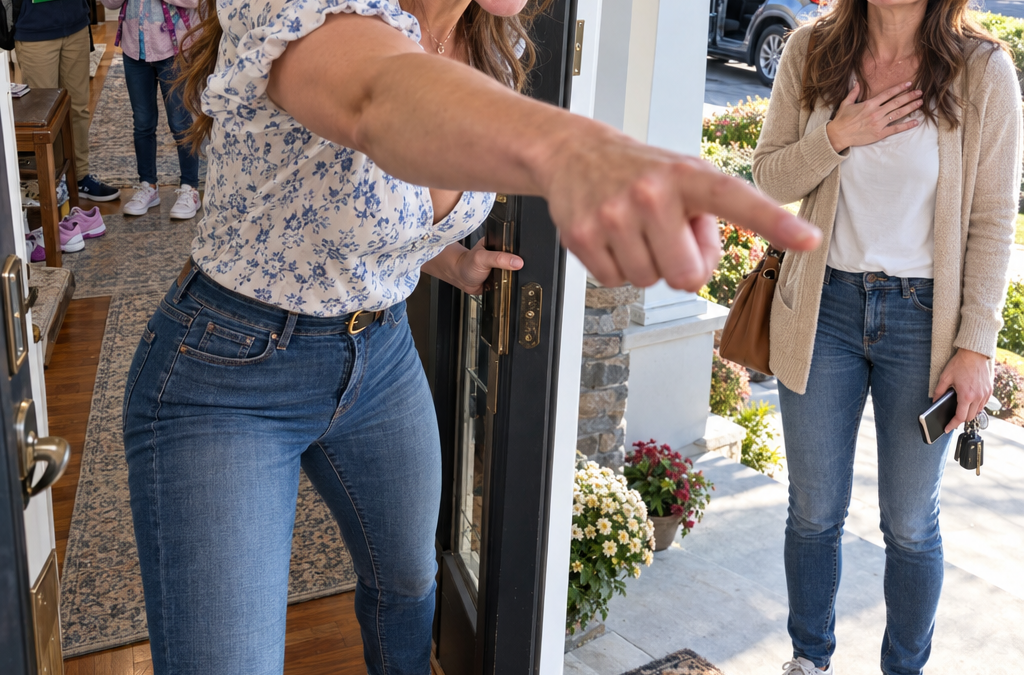
For 4 Years, I Picked Up My Sister’s Kids From School For Free. One Day, I Was 37 Minutes Late, And She Screamed At Me In Front Of Them, “Not With My Children!” Then She Shoved Me Out Of Her House. I Stopped Picking Them Up. 11 Days Later, The School Called Me. Then My Sister Called 6 Times. I Turned My Phone Face Down.
For four years, I rearranged my job around my sister’s children because she said family was supposed to show up. Then one afternoon she humiliated me outside their school, ordered me never to touch her kids again, and our mother quietly told me to accept it because “mothers are under pressure.” I did exactly what they asked and stepped away. Eleven days later, the school called me anyway. A week after that, a court envelope arrived with my name beside a monthly payment I had never received—and five strange bank transfers suddenly stopped looking accidental.
Part 1
My sister Lauren told me I was “the free help” in front of half the pickup line at 3:42 on a Wednesday afternoon.
She did not lower her voice when she said it. She stood beside the curb at Maple Ridge Elementary in Livonia, Michigan, one hand wrapped around my niece Ellie’s wrist and the other stabbing the air toward me while parents loaded backpacks into SUVs around us. “Thirty-seven minutes, Mara. They sat here for thirty-seven minutes because you couldn’t manage one thing. You’re not their mother. You’re the free help, and apparently you can’t even do that right.”
Ellie was seven and had been crying hard enough that her eyelashes were stuck together. Her brother Owen, nine, stood beside the assistant principal holding both straps of his backpack like handles on a parachute, his face carrying the particular embarrassment children wear when adults make a private problem public. I apologized first to the school staff, then crouched in front of them and apologized again, because I had been late and being humiliated did not change that.
What Lauren did not mention was that the school had shifted dismissal earlier that week because of teacher conferences. The notice had gone home in the children’s folders and through the parent portal, both of which went directly to her. I worked before dawn at a wholesale flower warehouse so I could finish early enough to be at that curb every afternoon, but nobody had told me Wednesday dismissal was at 2:25 instead of 3:05.
Another mother, Tara Whitcomb, had called Lauren when she realized Ellie and Owen were still waiting. Tara leaned against a pearl-white SUV ten yards away, pretending to study her phone while listening to every word. Two mothers near her exchanged the quick, satisfied look people give each other when somebody else’s family disaster confirms their own life is going well.
Ellie shoved her backpack at me and wrapped both arms around my neck. I had barely touched her shoulder when Lauren pulled her away.
“Don’t,” she snapped.
Ellie’s emergency allergy injector was in the front pocket of that backpack, so when Lauren drove them home, I followed in my own car out of habit. For four years, I had hung the backpack on a hook inside her mudroom every afternoon because the emergency medication was supposed to stay there instead of being forgotten in a car overnight.
I stepped one foot into the entryway.
Lauren turned so fast her purse swung into the wall.
“You do not come into my house.”
I stopped.
“You don’t touch my kids. You don’t pick them up. Take the booster seats out of your car tonight. I mean it.”
Behind her, Ellie sat halfway up the staircase with both palms pressed over her ears. Owen stood against the wall staring at his sneakers. I could have reminded Lauren about the thousands of afternoons she had called me a lifesaver, the orthodontist appointments, the fever pickups, the soccer practices, the nights I had fed them dinner because she was stranded on Interstate 96 after a sales call, but there are arguments you can win only by making children remember them forever.
So I backed onto the porch.
My phone buzzed before I reached the driveway.
Mom.
Lauren had already called her.
“Your sister is a mother,” my mother said when I answered. “You don’t understand the kind of fear she felt seeing those kids sitting there.”
“I understand she was scared.”
“Then let her calm down. Don’t turn this into something bigger.”
That was my family’s oldest rule. Lauren could create the explosion; my job was to reduce the damage.
I stood beside my car and typed a message instead of calling her.
Understood. I will not pick up Ellie or Owen beginning tomorrow. Please confirm you have other arrangements.
Her response appeared nine seconds later.
Do not come near my kids again.
I stared at it, then took a screenshot.
The two booster seats came out of my back seat that evening. Owen’s was black, with a cup holder he had cracked by standing on it when he was six. Ellie’s was purple, and a fox sticker she had chosen at a gas station curled away from the plastic at one corner.
I placed both seats on Lauren’s porch and drove home.
The strange thing was how steady my hands were.
The next morning I clocked in at 4:30, trimmed three hundred rose stems, packed hydrangeas for a hotel order, and did not leave at 2:15.
Nobody called.
The second day, nobody called.
By the fifth afternoon, my body still expected to turn toward the school when I passed the freeway exit. I had built four years around a three-o’clock obligation so completely that having my afternoons back felt less like freedom than forgetting an appointment.
On the eleventh school day after Lauren’s order, my phone rang at 3:19.
Maple Ridge Elementary.
The office secretary, Mrs. Alvarez, had known me since Owen started kindergarten.
“Mara,” she said carefully, “I know there’s been a change in arrangements.”
My stomach tightened.
“Are the kids okay?”
“They’re fine. Nobody has come for them. We cannot reach their mother.”
“What about their father?”
“His number is after yours. We left him a message.”
Lauren’s ex-husband, Adam, worked commercial roofing and often kept his phone in his truck while he was on a site.
I drove to the school.
I did not put Ellie and Owen into my car.
I sat on the wooden bench outside the front office with one child on each side of me, in full view of Mrs. Alvarez and every teacher walking past. Ellie eventually leaned against my arm. Owen opened a book and stayed on the same page for twenty minutes.
Lauren arrived at 4:31 carrying a thick manila folder against her chest.
She looked at the children.
Then at me.
Then deliberately past me.
“Come on,” she said. “Your aunt has somewhere better to be.”
Mrs. Alvarez wrote the pickup time on a clipboard.
“Third late pickup this semester,” she said without looking up.
Lauren’s shoulders stiffened.
That was the first time I understood other people had been keeping records too.
That night Lauren called six times.
I did not answer.
I sat at my kitchen table with a purple hair tie around my wrist, even though nobody needed me to fix her ponytail anymore, and looked at the long white envelope a process server had handed me three days earlier.
The first page said SUBPOENA.
The second page had my name beside a number.
After-school childcare provider: Mara Bennett, sister.
$950 per month.
Paid continuously since August 2022.
I read it again.
Then I looked at my phone as Lauren’s sixth voicemail appeared.
Her message was only one sentence.
“Mara, tell me you haven’t read page two.”
Part 2
I had never received nine hundred fifty dollars for watching Lauren’s children.
I had never received nine dollars.
When Lauren’s divorce was finalized in 2022, Owen was about to start kindergarten and she had just taken a territory-sales job for a medical equipment company. She cried on the phone one July evening and told me she could not possibly be at a school gate every afternoon while covering hospitals from Detroit to Ann Arbor.
“Just until I figure something out,” she had said.
At the time, I worked the day crew at Great Lakes Floral Supply. My supervisor, Denise, had recently started letting me design larger event orders, and that summer she offered me the lead position on our weddings and corporate installations team. It meant more money, my own crew, and finally doing the work I actually loved instead of spending most mornings stripping leaves and sorting boxes in a refrigerated warehouse.
The problem was that event work happened in the afternoon.
I turned it down.
Instead, I volunteered for the 4:30 a.m. processing shift so I could leave early enough to collect Owen.
Denise looked at me over her glasses when I told her.
“You know I can’t hold the position forever.”
“I know.”
I bought Owen’s first booster seat with my own card that weekend.
Two years later Ellie started kindergarten, and I bought the purple one.
By then my glove compartment held a binder containing the garage code to Lauren’s house, school pickup numbers, pediatrician information, Owen’s soccer schedule, Ellie’s severe peanut allergy plan, library days, dentist appointments, emergency contacts, and a list of snacks neither child would declare “disgusting” without trying first. I carried spare tissues, juice boxes, crayons, Band-Aids, and purple hair ties because Ellie lost hers almost every day before lunch.
Family work grows invisibly. Nobody announces that you have become infrastructure.
You simply notice one afternoon that six people have built their schedules assuming you will remain exactly where they left you.
Lauren occasionally bought me coffee. Sometimes she called me her lifesaver. At family dinners she also joked that I was lucky to have the flexibility because I “didn’t have kids or anything tying me down.”
Mom laughed.
I usually did too.
Standing in my doorway with the subpoena in my hand, I started calculating because numbers are easier than betrayal.
According to Lauren’s sworn financial filing, she had paid me $650 per month when Owen first started school. The amount had increased to $950 when Ellie enrolled.
For nearly four years, I had shifted jobs, bought gasoline, waited through appointments, handled sick days, and built my life around two children because I loved them.
Somewhere in a legal file, Lauren had transformed all of that into a business expense.
Then I remembered the transfers.
Five of them.
Starting that spring, Lauren had accidentally sent money into my account several times. Each transfer had been exactly $950.
Each time she had texted almost immediately.
Wrong person. Can you send that back?
Or:
I swear this banking app hates me.
I had laughed and returned the money.
The transfers had never stayed in my account longer than a few hours.
Until that subpoena, I had never considered them connected.
The next afternoon I drove straight from work to my credit union in Plymouth. I still smelled like eucalyptus and wet cardboard when I sat across from a patient banker named Leonard and asked for every transaction between Lauren and me since 2022.
He scrolled.
“There isn’t much until this year.”
Then he turned his screen toward me.
April 1. Incoming: $950.
Two hours later. Outgoing: $950.
May 1. Same pattern.
June.
July.
August.
Five transfers in.
Five transfers back.
I opened my text thread with Lauren and found every explanation.
April: Sent that to you instead of dance. Send back please.
May: Wrong contact again. I’m an idiot.
June: This app hates me.
July: Don’t say it.
August: Last time, I promise.
Leonard looked from my phone to the screen.
“Do you need certified copies?”
“Yes.”
He printed the full account history, stamped it, and gave me two sets.
“In my experience,” he said, “people who ask for one copy eventually wish they had two.”
I sat in my car afterward with both envelopes on my lap.
If Adam’s attorney had only Lauren’s bank statement, it looked perfect.
A regular monthly childcare payment.
Five months in a row.
My sister had not paid me.
She had used my account to manufacture receipts.
I went home and read the subpoena again.
The hearing concerned Adam’s request to modify parenting time and recalculate support. Lauren claimed she had substantial childcare costs and that the children depended on an established after-school routine with me.
The routine she had ordered me to abandon.
I called the attorney’s office listed on the subpoena. A paralegal explained that I was a witness, not a defendant, and that I should bring any records showing childcare payments. She added one sentence that made my neck tighten.
“If anyone pressures you about your testimony, please document it.”
Lauren had already called six times.
Three days later she texted.
Sunday. Mom’s house. Five o’clock. Kids will be there. We need to discuss this like adults.
Then another message.
Bring the binder from your glove box.
I knew immediately what the binder meant.
She needed to replace me.
I replied with one word.
Okay.
Sunday dinner smelled like pot roast, which was what Mom cooked whenever she wanted everyone trapped at the table long enough to solve something.
Lauren sat across from me with the same manila folder I had seen at the school.
“I’m not angry anymore,” she began.
“That’s good.”
“Adam is trying to take Wednesdays overnight.”
I waited.
“He’s using that school incident to say I don’t have reliable childcare.”
“You told me never to see the kids again.”
“I was upset. Obviously I didn’t mean permanently.”
“You confirmed it in writing.”
Her mouth tightened.
Then she opened the folder.
“When you go to the hearing, you need to tell them the truth.”
“I plan to.”
“The truth is that I’ve paid you for childcare since Owen started kindergarten.”
I looked at her.
“You’ve never paid me.”
“I have paid you in a hundred ways.”
Mom stared at her plate.
Lauren leaned toward me.
“Coffee. Meals. Vacations with the kids. Being included in their lives. Do you know how many women would give anything for what you had with them?”
“Then why does your court paperwork say cash?”
For the first time, she hesitated.
Only for a second.
“Because courts want numbers, Mara. There isn’t a box labeled sister who helps because she loves her family.”
She pushed a typed page across the table.
Cash payment: $950. First of each month. Envelope left on kitchen counter beside fruit bowl.
“That’s all you have to say.”
I picked it up.
Mom finally reached across the table and touched my wrist.
“I wrote a letter too,” she said.
I turned toward her.
“You wrote what?”
“That I’ve seen envelopes on Lauren’s counter.”
“What kind?”
Mom blinked.
“What?”
“What color were the envelopes?”
“White.”
Lauren’s eyes snapped toward her.
Mom corrected herself.
“I mean, sometimes brown.”
I looked back down at the typed page.
Lauren had not merely lied about paying me.
She was teaching everyone around her how to remember the lie.
And suddenly the subpoena did not feel like a family dispute I had accidentally been dragged into.
It felt like the first loose thread in something Lauren had been weaving for years.
Part 3
Lauren told me I owed her.
Not money.
Loyalty.
“If Adam gets Wednesdays because of one mistake you made,” she said, “you will know for the rest of your life that you helped take time away from their mother.”
“You filed paperwork saying you paid me.”
“Because childcare costs money.”
“Not when I did it.”
Her expression hardened.
“You’re getting hung up on technical language.”
Mom squeezed my wrist harder.
“Honey, nobody is trying to hurt you.”
That sentence bothered me more than Lauren’s anger.
Nobody in my family ever had to be trying to hurt me for me to end up hurt.
I folded Lauren’s typed instructions twice and slipped them into my jacket pocket.
“I’ll think about it.”
Mom visibly relaxed.
Lauren did too.
That was when I understood something humiliating: both of them believed my resistance was temporary because it always had been.
I had spent thirty years proving that if everyone waited long enough, I would eventually make things easier.
Before I left, Owen caught me near the coat rack.
“Are you coming to my game Saturday?”
“I’m not sure.”
“Dad will be there.”
Adam.
For four years he had been a man I waved to across soccer fields or exchanged polite sentences with during birthdays. Lauren had described him as unreliable, selfish with his time, obsessed with work, the kind of father who wanted praise for basic parenting.
“Dad asked if you were coming,” Owen whispered.
That surprised me.
Saturday afternoon I drove to his soccer game and stood on the far side of the field near the parking lot.
Adam saw me before halftime.
He walked over in his work jacket, hands shoved into the pockets, and stopped several feet away as though he was not sure whether I wanted him closer.
“I’m glad you came,” he said. “Owen’s been asking.”
“He looks good.”
“He does.”
We watched him chase the ball for a moment.
Then Adam cleared his throat.
“I’m sorry about the subpoena.”
“You didn’t serve it personally.”
“My attorney said you probably hated getting dragged into this.”
“I mostly don’t understand it.”
He nodded.
“And I’ve been meaning to thank you for years.”
I looked at him.
“For what?”
“The after-school care. I know I only pay my share, but still. You’ve been worth every cent.”
For a second, the sound of the soccer field seemed to move farther away.
“What share?”
Adam frowned.
“The childcare.”
“How much?”
“Five-seventy a month now. It was three-ninety before Ellie started school.”
I stared at him.
He stared back.
Neither of us spoke.
Around us, parents clapped because somebody else’s child had scored.
“How long have you been paying that?”
“Since Owen started kindergarten.”
Nearly four years.
I calculated roughly in my head.
More than twenty thousand dollars.
Lauren had not simply invented an expense to strengthen her current case. She had been collecting reimbursement for a service I provided for free.
Adam had spent years paying his share of an imaginary bill.
“Did Lauren ever tell you that you could pick them up yourself?”
He looked confused.
“I asked.”
“When?”
“Three times.”
He explained that he had changed his work crew so he could finish early on Wednesdays. Each time, Lauren’s attorney responded that the children already had a stable routine with their aunt and that removing them from that routine would be disruptive.
“So I backed off,” he said. “I thought you wanted the time with them.”
My throat tightened.
Lauren had told me Adam never offered.
She had told him I was the reason his offer could not work.
She had made both of us useful to the same story.
During halftime, Owen ran over.
“Dad, are we doing Wednesdays now?”
Adam looked down.
“Maybe, buddy.”
“Mom says you’re too busy. She says you always choose work.”
Adam’s face did not change.
That was how I knew the sentence hurt him.
“Go get water,” he said gently.
When Owen ran away, Adam stared at the grass.
“She tells them that?”
I could have shown him everything.
The bank records were in my car.
Lauren’s typed script was in my pocket.
But I did not.
Not yet.
“Your attorney asked Lauren for proof she pays me?”
“Yes.”
“What did she send?”
“Screenshots of transfers. Five payments for nine-fifty.”
Exactly what I expected.
“Keep your hearing date.”
Adam turned toward me.
“What does that mean?”
“It means do not withdraw anything.”
He studied my face.
Then nodded.
On the way back to my car, I passed Tara Whitcomb.
She smiled brightly.
“Oh, Mara! Good to see you. I was going to ask—Thursday is supposed to rain. Any chance you can grab Mason too when you get the kids?”
Then she remembered.
Her smile changed.
“Oh. Right.”
“No.”
The word came out softer than I expected.
I kept walking.
That evening Lauren texted.
Owen says you talked to Adam for twenty minutes. What did you tell him?
I answered:
His footwork is improving.
She did not respond.
Two nights later, Ellie FaceTimed me from an old tablet.
Her face filled the screen beneath a blanket.
“Are you still mad at us?”
“I was never mad at you.”
“Mom says you stopped getting us because she can’t pay you anymore.”
I went very still.
“What?”
“She said Dad’s lawyer made the money stop.”
There are moments when anger arrives hot.
This was not one of them.
This anger was cold enough to clarify things.
Ellie whispered, “How much do you cost?”
I could have told her everything.
Instead I said, “That is grown-up stuff. None of it is because of you.”
Something clinked beneath the blanket.
Coins.
Then the blanket jerked away and Lauren’s face appeared.
“Stop calling my daughter.”
“She called me.”
The screen went black.
I went downstairs and sat in my parked car.
The back seat still showed two faint rectangular impressions where the booster seats had been.
A goldfish cracker was wedged into the buckle on Ellie’s side.
How much do you cost?
My sister had taken four years of love and converted them into a number for court.
Now she had given the number to a seven-year-old.
I sat there until the interior light switched itself off.
Then I went upstairs, took out a yellow legal pad, and wrote the hearing date at the top.
October 22.
Underneath it I wrote one sentence.
Stop protecting people from the consequences of their own paperwork.
Part 4
I called Lauren from the loading dock at work two days later.
It was 1:14 in the afternoon. I sat on an upside-down flower bucket in my apron while trucks beeped behind me and asked her to explain exactly what she wanted me to say.
She picked up on the first ring.
“Are you calling to yell at me?”
“No.”
Silence.
“I’ve been thinking about the hearing.”
Her voice changed instantly.
Warmer.
Relieved.
“I knew you would.”
I closed my eyes.
“I don’t want to get the numbers wrong. Text me exactly what I’m supposed to remember.”
Lauren laughed.
“You are terrible at lying.”
“I know.”
“Fine.”
The messages arrived before I stood up.
Cash every month since August 2022.
$650 until Ellie started kindergarten.
$950 after.
First of every month.
Brown envelope on kitchen counter beside fruit bowl.
The app transfers were payments when cash wasn’t available.
Nothing was returned.
If asked about messages, say we were joking.
Then she sent me a PDF prepared by her attorney’s office.
Match this, she wrote.
I opened it.
It was a draft sworn statement.
Near the bottom, one sentence caught my attention.
Defendant has continued to pay Ms. Bennett for after-school care through the present month.
Present month.
October.
I typed:
What about September? I stopped pickup September 9.
The typing dots appeared.
Disappeared.
Reappeared.
Say I paid September too. You were still technically on call.
I scrolled up twenty-eight days.
There was Lauren’s earlier message.
Do not come near my kids again.
I saved everything in three places.
Two days later, she forwarded a screenshot.
Filed.
Mom’s letter too.
We’re good.
I stared at the words for a long time.
Lauren had signed her name under oath to a version of September in which I had simultaneously been forbidden from seeing her children and paid to care for them.
Monday morning an investigator from the county Friend of the Court office called.
Her name was Marisol Grant.
I had taken the day off and arranged every document across my kitchen table: certified bank records, transfer timestamps, screenshots, Lauren’s typed coaching sheet, the PDF, the school message, and the text banning me from contact.
Ms. Grant spoke calmly.
“How long did you provide regular after-school care?”
“Since August 2022.”
“Were you paid?”
“No.”
“Never?”
“Never.”
She asked the question again fifteen minutes later using different words.
Then she asked about the five transfers.
I explained each one.
I read Lauren’s messages.
I sent the stamped records proving each $950 payment had been returned the same day.
Then I sent the September message.
Finally, I sent the instructions Lauren had given me for what to say.
Ms. Grant was quiet.
“Did you tell your sister you would give false testimony?”
“No.”
“What did you tell her?”
“I said, ‘Okay.’”
Another silence.
“Why?”
“Because for thirty years, ‘okay’ has been the fastest way to make my sister keep talking.”
That afternoon I sent the full packet to her secure email.
Then I texted Lauren.
Done.
Her response came almost immediately.
A heart.
Knew you’d come around.
The strange thing was that I felt no triumph.
Mostly I felt tired.
Lauren had spent so many years being certain that I would absorb the damage that she had lost the ability to imagine me stepping aside.
At our mother’s birthday party the next weekend, she acted generous.
She allowed Ellie to run into my arms.
She let Owen sit beside me during cake.
Then after everyone had eaten, Lauren tapped a fork against her glass.
“It’s been a hard month for our family,” she announced.
People looked toward me.
“But the important thing is that family comes back.”
Mom smiled through tears.
Tara Whitcomb murmured, “That’s beautiful.”
Lauren raised her glass.
“To Mara, who finally remembered what family means.”
People applauded.
I lifted my glass slightly and put it down.
Afterward Lauren handed me a laminated piece of paper.
A schedule.
Monday through Friday pickup.
Early dismissal reminders.
Friday-night babysitting as needed.
At the bottom:
Compensation: Love, obviously.
“Starting Monday after the hearing,” she said.
My aunt Joyce laughed.
“Friday nights too? Lauren, you’re a dictator.”
“She doesn’t mind,” Lauren said. “Mara never has anything going on.”
I studied the laminated sheet.
Then smiled.
“Monday after the hearing?”
“Exactly.”
“Okay.”
Nobody else at the table knew why that date mattered.
Four days later, Ms. Grant’s report went to both attorneys.
At 4:17 that afternoon, my phone began ringing.
Lauren.
Again.
Again.
Again.
At 4:30 Adam texted.
My attorney just called me.
Then:
Mara. What did you send them?
At 9:06 somebody started pounding on my apartment door.
I knew Lauren’s knock before she spoke.
“Open the door!”
I stood four feet from it in my socks.
“You lied to me,” she shouted. “You set me up.”
I said nothing.
“They’re accusing me of filing false information. My lawyer won’t return my calls. You gave them bank statements?”
“Yes.”
“You said you’d help me.”
“I said okay.”
“You knew what I meant.”
“Yes.”
The hallway went quiet.
Then her voice broke.
“Do you understand what you’ve done?”
I put my palm against the wall.
“Talk to your lawyer, Lauren.”
She began crying.
I had heard my sister furious, delighted, drunk, exhausted, smug, frightened, and once in labor over speakerphone.
I had almost never heard her cry.
I did not open the door.
The next morning Mom called at 6:10.
“Lauren’s attorney withdrew.”
I sat up.
“She has six days before the hearing.”
“I know.”
“Mara, what did you do?”
“I answered questions.”
“You should have come to us first.”
I looked across my bedroom at the chair where the old pickup binder sat waiting.
“I did come to you first, Mom.”
She was silent.
“You served pot roast.”
Part 5
For two days, my mother treated the situation as though I had discovered a trapdoor beneath the family and chosen to open it.
Lauren, according to her, had made “a mistake in paperwork.”
Adam’s attorney was “taking advantage.”
The court investigator was “making everything sound worse.”
I asked one question.
“Did Lauren lie?”
Mom always answered a different question.
“She was trying to protect the kids.”
Protect was another family word that could be stretched until it covered almost anything.
Lauren left me a four-minute voicemail explaining that every dollar Adam had paid ultimately benefited Ellie and Owen. Braces cost money, dance classes cost money, winter coats cost money, and child support existed for children anyway.
“I didn’t steal from anybody,” she said in her smooth sales voice. “I used the support for the kids. I only put your name on one category because courts require categories.”
I listened in my car during lunch.
Then texted:
If the money went where you say, the receipts will show that.
She never answered.
Three days before the hearing, my mother called me from her driveway.
“I fell.”
Her voice sounded so small that every argument disappeared.
I left work immediately.
Mom had been covering several of Lauren’s school pickups since I stopped. She was sixty-eight and had a bad right knee. Somehow everyone had shifted the burden from me to her without ever saying out loud that this was what had happened.
She was sitting on the driveway beside her Buick, purse in her lap, unable to stand.
“The kids get out in eighteen minutes,” she said.
“Forget the school.”
“Lauren isn’t answering.”
I called Adam.
There was wind and the hammering sound of a roofing crew behind him.
“Your kids need pickup. Mom fell.”
“I’m coming down.”
No complaint.
No speech.
I heard a ladder rattle before he hung up.
I drove Mom to urgent care.
While we waited for X-rays, she stared at a fish tank in the corner.
“The investigator called me,” she said eventually.
I waited.
“She asked about my letter.”
“And?”
“She asked me to describe the envelopes.”
I looked at her.
“I said white.”
“Lauren said brown.”
Mom nodded.
“She asked whether I had ever actually seen Lauren hand you one.”
The television above us showed a cooking program with the sound off.
Mom twisted the strap of her purse.
“I hadn’t.”
“No.”
“I’ve seen envelopes in Lauren’s kitchen.”
“Everybody has envelopes.”
“I know.”
She swallowed.
“I signed the letter because she said it was true.”
For a moment, I saw not my mother but the mechanism that had shaped our family. Lauren demanded certainty. Mom supplied it. I supplied labor.
All three of us had called that love.
“Can you fix it?” Mom whispered. “Tell them I was confused?”
“No.”
She flinched.
“I’ll drive you downtown tomorrow if you want to correct it. I’ll wait outside. But you have to tell them yourself.”
Mom stared at the fish tank.
Then nodded.
The next morning she walked into the county office using a borrowed cane.
I held the door.
I did not go to the counter with her.
She spoke to a clerk for fifteen minutes, filled out a form, and signed it.
On the drive home, Lauren texted her.
Mom showed me the screen.
My lawyer is gone. Adam is coming after me. Now my own mother turns on me too. You’re both dead to me.
Mom put the phone facedown.
“She used to be such a sweet baby.”
I kept my eyes on the road.
I did not tell her that sweet babies become adults who make choices.
The hearing was on Thursday morning.
The room looked nothing like television.
No judge’s bench.
No jury.
Just a long table in a beige office high above downtown Detroit and a domestic-relations referee named Ms. Harmon at one end with a stack of files.
Adam sat beside his attorney, Kendra Lowe.
Lauren sat alone.
She had requested a delay after losing counsel, but the request was denied because the date had been scheduled for months.
She wore a navy blazer.
The same one she used for hospital sales presentations.
When I entered, she looked at the wall above my head.
I was sworn in.
Kendra began with simple questions.
“How long did you provide regular pickup for the children?”
“Four school years.”
“Were you compensated?”
“No.”
“Did you receive monthly cash envelopes?”
“No.”
“Did Lauren transfer money to you electronically?”
“Yes.”
“What happened to those transfers?”
“I returned every one at her request.”
Kendra slid the certified transaction history forward.
She read the timestamps.
Then she read Lauren’s texts.
Wrong person.
Send back.
App hates me.
Don’t say it.
Lauren’s jaw tightened.
When it was her turn, she stood even though nobody had told her to.
“Isn’t it true,” she asked me, “that you left my daughter, who has a severe allergy, waiting at school for thirty-seven minutes?”
“Yes.”
She blinked.
“I was late. I apologized to the children and the school. I would apologize again.”
She had expected denial.
She changed direction.
“And isn’t it true you resent me because I have children and you—”
“Ms. Bennett,” the referee interrupted. “Questions concerning the claimed childcare expense.”
Lauren sat down.
The referee placed two documents beside each other.
“Ms. Bennett, on September 9, did you send your sister a message saying, ‘Do not come near my children again’?”
Lauren shifted.
“I was emotional.”
“And on October 9, did you sign a sworn statement claiming you continued paying her for childcare through October?”
“I believed she remained available.”
“Was she providing childcare?”
Lauren looked at me.
“No.”
“Were you paying her?”
Silence.
“I considered the support she gave part of our family arrangement.”
“That is not the question.”
The air-conditioning hummed.
Lauren’s face flushed.
Then she reached into her folder.
“The routine is continuing anyway. Mara agreed to return after the hearing.”
She pulled out the laminated schedule.
I almost admired the confidence.
Almost.
The referee looked at me.
“Ms. Bennett?”
I opened my bag.
“I have a statement.”
I had typed it the night before.
My hands did not shake.
“I am removing myself as a scheduled childcare provider for either parent. I have asked Maple Ridge Elementary to remove me from routine pickup authorization. I will remain an emergency contact because Ellie and Owen should not suffer because adults disagree. I love them. I am their aunt. I am not their childcare arrangement.”
I handed it over.
The referee read it.
Then placed it directly on top of Lauren’s laminated schedule.
Lauren finally looked at me.
For the first time in my life, I saw my sister realize that “okay” and “yes” were not the same word.
Part 6
Referee Harmon did not give a dramatic speech.
Real consequences rarely arrive with music.
She read her findings into the record in a voice so ordinary that each sentence seemed heavier for not being emphasized.
The claimed after-school childcare expense was removed from the support calculation.
Adam would receive Wednesday overnight parenting time on a temporary basis, beginning the following week.
The amount he had paid toward the nonexistent childcare expense would be credited back over time.
The total identified by the court was more than twenty-four thousand dollars.
Lauren was ordered to contribute to Adam’s legal fees associated with investigating the false expense.
Her sworn October statement would be referred to the assigned judge for separate review.
Lauren sat completely still.
Adam covered his mouth with one hand.
Then the referee looked at me.
“For the record, Ms. Bennett appears to have provided several years of uncompensated childcare to these children.”
I stared down at the table.
“The office appreciates that service and regrets that it was represented otherwise.”
Uncompensated.
Such a dry word.
Yet hearing it spoken aloud in an official room did something to me.
For years everybody had called what I did easy because no invoice existed.
The absence of a price had somehow become evidence of the absence of cost.
I looked at a ceiling tile until my eyes stopped burning.
In the elevator afterward, Adam said nothing for eleven floors.
When the doors opened, he cleared his throat.
“Next Wednesday is my first overnight.”
“Okay.”
“I don’t know what they eat on Wednesdays.”
I laughed before I could stop myself.
“Tacos.”
He nodded seriously.
“Of course.”
“Ellie pulls the filling out and eats it with a spoon. Owen puts too much hot sauce on everything because he thinks suffering proves maturity.”
Adam smiled.
“The binder?”
“In my car.”
He hesitated.
“Would you really give it to me?”
“It belongs with whoever is actually doing the job.”
We transferred the binder in the parking garage.
Gate codes.
Doctors.
Snack lists.
Teacher names.
Everything I had accumulated without realizing it represented labor.
The following Sunday, Mom returned the booster seats to me. I drove them to Adam’s apartment along with the binder and a bag of Goldfish crackers.
The first Wednesday, I expected nothing.
At 4:15 Adam texted.
Can we stop by for two minutes? Ellie says emergency.
They arrived ten minutes later.
Ellie climbed out holding a mason jar.
Around the glass she had taped a piece of white paper.
In purple marker, she had written:
AUNT MARA’S PAY.
Coins filled the bottom.
A few folded bills were tucked among them.
“It’s twenty-four dollars and ten cents,” she announced. “Owen counted.”
“Three times,” Owen said.
I crouched.
“What is this?”
Ellie pushed the jar toward me.
“For pickup.”
My heart stopped.
“Sweetheart—”
“Mom said you quit because Dad’s lawyer made her stop paying you. So I saved mine.”
I heard the same small clinking sound from the FaceTime call beneath the blanket.
She had been counting money that night.
Trying to figure out whether she could afford me.
I wrapped my hands over hers around the cold glass.
“Ellie, listen carefully. Nobody ever paid me.”
She frowned.
“Then why did you do it?”
Because I loved you seemed too simple.
But it was the answer.
“Because being with you and Owen was one of my favorite parts of the day.”
She studied my face.
“So you did it for free?”
“Yes.”
Owen looked toward his father.
“I told her.”
His voice cracked.
“I told her you weren’t doing it for money.”
Adam turned away, rubbing his eyes.
Ellie looked down at the jar.
“Can you still come?”
“Sometimes.”
“For free?”
“As your aunt.”
That distinction mattered.
I kept the jar.
She kept the money.
That night Adam let her buy the taco shells.
The jar went on my kitchen windowsill.
Three weeks later, the school called again.
Lauren was stuck behind a freeway accident.
Adam was on a roof.
I went.
Emergency contact.
Not scheduled caregiver.
I sat on the same bench with Ellie on one side and Owen on the other.
This time Owen actually read his library book.
Ellie spent twenty minutes describing a classmate who claimed he could burp the alphabet.
Lauren arrived nearly an hour after dismissal.
Her hair was falling out of its clip.
She stopped when she saw us.
I watched her prepare for judgment.
Before she spoke, Ellie slid off the bench and took her hand.
“It’s okay, Mommy.”
Lauren looked down.
“Being late isn’t a crime,” Ellie said. “Aunt Mara told me.”
The hallway became very quiet.
Mrs. Alvarez studied her computer.
A teacher rearranged papers on a bulletin board.
Lauren’s face changed.
She knelt in front of Ellie and rested her forehead against her daughter’s shoulder.
Ellie patted her hair.
Exactly the way I had done for years.
When Lauren stood, she looked at me.
“Thank you for staying with them.”
“Anytime it’s an emergency.”
She heard the boundary.
Her eyes lowered.
“Okay.”
For once, the word belonged to her.
The court recommendation became final after the objection period expired.
Wednesday overnights became part of the parenting order.
The nonexistent childcare expense disappeared.
Adam began receiving a monthly support credit.
But the deeper consequence was harder to calculate.
Lauren now had to be at the school gate herself on her parenting days.
She changed jobs within her company, giving up part of her sales territory for an inside position with lower commission.
Mom stopped covering regular pickups after her knee injury.
And I discovered something embarrassing.
The world did not collapse when I stopped rescuing everyone.
It simply rearranged itself around the space where I had been standing.
Part 7
December brought the separate hearing concerning Lauren’s sworn statement.
I was not required to attend.
Adam later told me the judge questioned her at length about signing documents she knew contained false information. She received a financial sanction, was ordered to pay additional legal costs, and was warned that the finding would remain in the case file.
The most painful consequence was probably not the money.
It was permanence.
Lauren had always survived family arguments by rewriting them afterward.
She remembered her own tone differently.
She remembered promises differently.
She remembered who started things differently.
A court file did not care what she remembered.
It kept the version with timestamps.
She never apologized to me directly.
For several months our communication was almost clinical.
Ellie’s cough is better.
Owen has a game Saturday.
Dance recital starts at six.
I answered just as briefly.
Glad she’s better.
I’ll try to come.
Thanks.
At first Mom repeatedly tried to push us toward reconciliation.
“Life is short.”
“You’re sisters.”
“The kids need both of you.”
One afternoon I asked her, “What exactly would reconciliation mean?”
She looked surprised.
“Being normal again.”
“Normal was me doing whatever Lauren needed so nobody got upset.”
Mom had no answer.
In December she came to my apartment with an apple pie.
Her knee brace was gone, though she still carried a cane on bad days.
She stood in the hallway until I invited her inside.
We ate pie at my kitchen table beneath the mason jar on the windowsill.
“I’m sorry,” she said eventually.
I looked up.
“I should have asked what happened before I told you to forgive it.”
It was the first apology I could remember receiving from her without asking for one.
I did not say it was okay.
I said, “Thank you.”
We ate another slice.
That was enough for one day.
Tara Whitcomb deleted the social-media post she had made after the original school incident.
I knew because she texted me.
I might have judged too quickly. No hard feelings?
Then, ten minutes later:
Unrelated question—our after-school program fell through. Any chance you could grab Mason two days a week? Happy to pay.
I laughed alone in my kitchen.
Not because it was funny.
Because life occasionally has a sense of timing too obvious for fiction.
I declined.
Later I learned Tara joined a neighborhood carpool that charged fifteen dollars per ride.
For curiosity, I calculated what four years of my pickups would have cost at that rate.
Then I deleted the number.
I had never wanted Lauren to pay me.
That was never the injury.
The injury was that she had considered my time valuable enough to charge Adam for it and worthless enough not to tell me.
At work, Denise called me into her office in January.
A folder waited on her desk.
“Events lead,” she said.
I stared at it.
“We need someone who understands installations and doesn’t panic when brides change everything three hours before delivery.”
“I turned this down.”
“Four years ago.”
“You said you couldn’t hold it.”
“I didn’t.”
She pushed the folder toward me.
“This is a new opening.”
I knew she was lying about that part.
I also knew kindness does not always need to be interrogated.
I took the job.
My schedule changed.
No more 4:30 a.m. shift.
My afternoons became weddings, galas, corporate dinners, hotel lobbies, and charity events.
The hours I had once surrendered returned to me in a different shape.
At first I felt guilty staying late.
Then I realized nobody was waiting at a school gate because I had planned for everyone except myself.
Adam’s Wednesdays settled into a rhythm.
Tacos became tradition.
Sometimes he invited me.
Sometimes I went.
I arrived with dessert and left before eight.
I did not check homework.
I did not pack lunches.
I did not reorganize their backpacks.
If Ellie asked for help tying her hair, I helped because I wanted to.
The purple hair tie remained on my wrist.
Choice changes the weight of almost everything.
One evening in March, Lauren sent me a video.
Ellie stood onstage at a dance recital wearing a glittering bumblebee costume.
She bowed far too long.
The audience laughed affectionately.
Lauren’s message said:
She asked if you were watching. I told her I would send this.
I watched the clip nine times.
Then wrote:
Tell her the bow was perfect.
Three dots appeared.
They stayed for a while.
Then disappeared.
No apology arrived.
No explanation.
I did not chase either one.
By then I understood that forgiveness and access were separate things.
I could stop wishing Lauren harm without inviting her back into the part of my life where she had once placed her schedule over mine.
The children adjusted faster than the adults.
Owen stopped asking who was “winning Wednesdays.”
Ellie stopped asking whether I cost money.
Adam learned the school portal password, the pediatrician’s number, and exactly how much hot sauce Owen could tolerate before regretting his decisions.
Lauren learned too.
She learned that pickup time existed whether her meeting ran late or not.
She learned after-school programs charged real money.
She learned Mom’s bad knee was not a renewable resource.
And slowly, painfully, she learned that being surrounded by people willing to help did not mean their lives belonged to her.
By spring, we could stand beside the same soccer field without a scene.
Sometimes that was all reconciliation needed to be.
Not reunion.
Not forgetting.
Just the absence of a new wound.
Part 8
The following April, I was standing in the ballroom of a hotel in Ann Arbor looking at twelve enormous arrangements of yellow tulips when I realized I had finally stopped measuring time by school dismissal.
The room smelled like cut stems, fresh linen, and coffee from the catering station.
My crew had finished early.
My name was printed at the top of the installation order.
Four years earlier, I had walked into Denise’s office and surrendered this job because Lauren needed someone at a curb by three.
I had believed sacrifice became noble automatically if nobody paid you for it.
I knew better now.
Sacrifice is only noble when it is chosen freely.
Otherwise it becomes expectation wearing a prettier name.
The monthly financial consequences from Lauren’s court case continued.
Adam’s support payment was reduced by a fixed amount while the improper childcare charges were credited back.
Lauren complained about it once in front of Mom.
Mom did not ask me to fix anything.
That mattered.
Lauren stayed in inside sales.
She earned less commission but attended school events she used to miss.
She was still late sometimes.
Mrs. Alvarez still wrote it down.
The world had developed an inconvenient habit of keeping records around her.
Oddly, I think that made Lauren more careful.
Not kinder overnight.
Not transformed into a different person.
Just more aware that other people possessed memories too.
One Saturday after Owen’s soccer game, she approached me while Adam packed chairs into his truck.
“Can I ask you something?”
“Yes.”
“Do you hate me?”
The question sounded younger than she did.
“No.”
She looked skeptical.
“You could.”
“I could.”
“But you don’t.”
“No.”
She waited.
I knew what she wanted.
She wanted the second half.
The part where I said everything was forgiven and we could start again.
Instead I told the truth.
“I don’t trust you the way I used to.”
Her jaw tightened.
“I figured.”
“I don’t know whether that comes back.”
“What am I supposed to do with that?”
“Nothing.”
She looked almost offended.
“Nothing?”
“You asked how I feel. You don’t have to fix my answer.”
For a moment I thought she might argue.
Then she nodded.
“Okay.”
There was that word again.
This time it did not mean submission.
It meant the conversation could end without somebody winning.
A few weeks later, Mom invited both of us for dinner.
Lauren brought salad.
I brought bread.
Nobody cooked pot roast.
That felt intentional.
The children raced through the house while Mom complained that Owen was growing too fast and Ellie needed to stop leaving crayons under the couch.
Lauren and I spoke about ordinary things.
Work.
A pothole on Five Mile Road.
Whether Mom needed a new refrigerator.
Nothing was solved.
Nothing exploded.
When I left, Lauren followed me to the porch.
“Ellie’s school has a grandparents-and-family breakfast Friday.”
“I saw the email.”
“She wants you there.”
“What time?”
“Seven-thirty.”
I smiled.
“I can make that.”
Lauren hesitated.
“Thank you.”
This time she did not add for everything.
She did not turn the gratitude into a transaction.
She simply let it stand.
Friday morning, Ellie spotted me from across the cafeteria and waved both arms so hard she nearly knocked over her juice.
Owen was already old enough to pretend he was not excited, which meant he only smiled instead of running toward me.
I sat between them at a folding table covered with paper placemats.
Nobody asked who had paid me to be there.
Nobody needed to.
The mason jar still sits on my windowsill.
The label Ellie made has faded from sunlight.
Aunt Mara’s Pay.
I keep flowers in it now.
Usually leftovers from work.
Tulips in spring.
Small roses in summer.
Once, in January, just bare eucalyptus branches because I liked the smell.
I could peel the label off.
I never have.
It reminds me of the difference between value and price.
Lauren knew my time had value.
That was why she had attached a price to it in court.
What she had forgotten was that value belonged to me first.
I was allowed to decide where my hours went.
I was allowed to love Ellie and Owen without becoming their transportation system.
I was allowed to help during emergencies without agreeing to Tuesdays, Wednesdays, Friday nights, orthodontist appointments, soccer practices, forgotten backpacks, and every crisis somebody else failed to plan for.
I was allowed to have a career even though my work involved flowers instead of hospital contracts.
I was allowed to be tired.
I was allowed to say no before I became furious enough to justify it.
Most importantly, I learned that boundaries do not always arrive as slammed doors.
Sometimes a boundary is sitting quietly on a school bench and refusing to put children into your car because their mother told you not to.
Sometimes it is a screenshot.
Sometimes it is a bank statement.
Sometimes it is allowing your mother to correct her own letter.
Sometimes it is telling a judge, “I am their aunt. I am not their arrangement.”
And sometimes it is accepting that people you love may never give you the apology that would make the story feel neat.
Lauren never gave me a speech.
She never sat across from me and confessed that she had taken advantage of me for years.
She never admitted that the transfers were calculated from the beginning, although no other explanation ever made sense.
She never said she was jealous of my freedom, afraid Adam would get more parenting time, terrified of losing control, or convinced my life mattered less because I did not have children.
Maybe all of those things were true.
Maybe none of them were.
Eventually, I stopped needing the answer.
Her motives belonged to her.
Her actions were enough for me.
One Wednesday near the end of the school year, Adam invited me for tacos.
I arrived with chocolate cupcakes.
Ellie opened the door with half her hair falling out of a ponytail.
“Aunt Mara!”
She turned around automatically.
“Fix it.”
I pulled the purple hair tie from my wrist.
Then stopped.
“You know what? Your dad can fix it.”
Adam looked horrified from the kitchen.
“I absolutely cannot.”
Ellie laughed.
I fixed it anyway.
Not because anybody expected me to.
Not because a schedule said so.
Not because family love had been turned into an invoice or because a court had finally acknowledged four years of unpaid work.
I fixed her ponytail because I was standing in a kitchen I could leave whenever I wanted, surrounded by people who now understood the difference between asking and assuming.
Later, while Adam burned the first batch of taco shells, Owen poured far too much hot sauce onto his plate.
Lauren called to ask whether she could speak to the kids.
Adam handed them the phone.
No tension.
No whispered accusations.
Just two parents learning, imperfectly, to live inside rules they had not invented for themselves.
At eight, I gathered my purse.
Ellie frowned.
“You’re leaving?”
“Yes.”
“Why?”
“Because I have work tomorrow.”
She accepted that immediately.
Children often understand boundaries faster than adults.
Outside, the air was cool enough that I could smell somebody’s wood smoke from three houses away.
My car waited at the curb.
No booster seats.
No forgotten backpacks.
No school binder in the glove box.
I sat behind the wheel for a moment before starting the engine.
Four years earlier, I thought being needed was proof that I mattered.
Then my sister put a dollar amount beside my name and accidentally showed me the danger of confusing those two things.
Being needed can make you useful.
Being loved should leave you free.
I drove home through the dark with both hands relaxed on the wheel, knowing Ellie and Owen would always have me when something truly mattered.
But my afternoons were mine again.
And this time, I knew exactly what they were worth.
THE END!