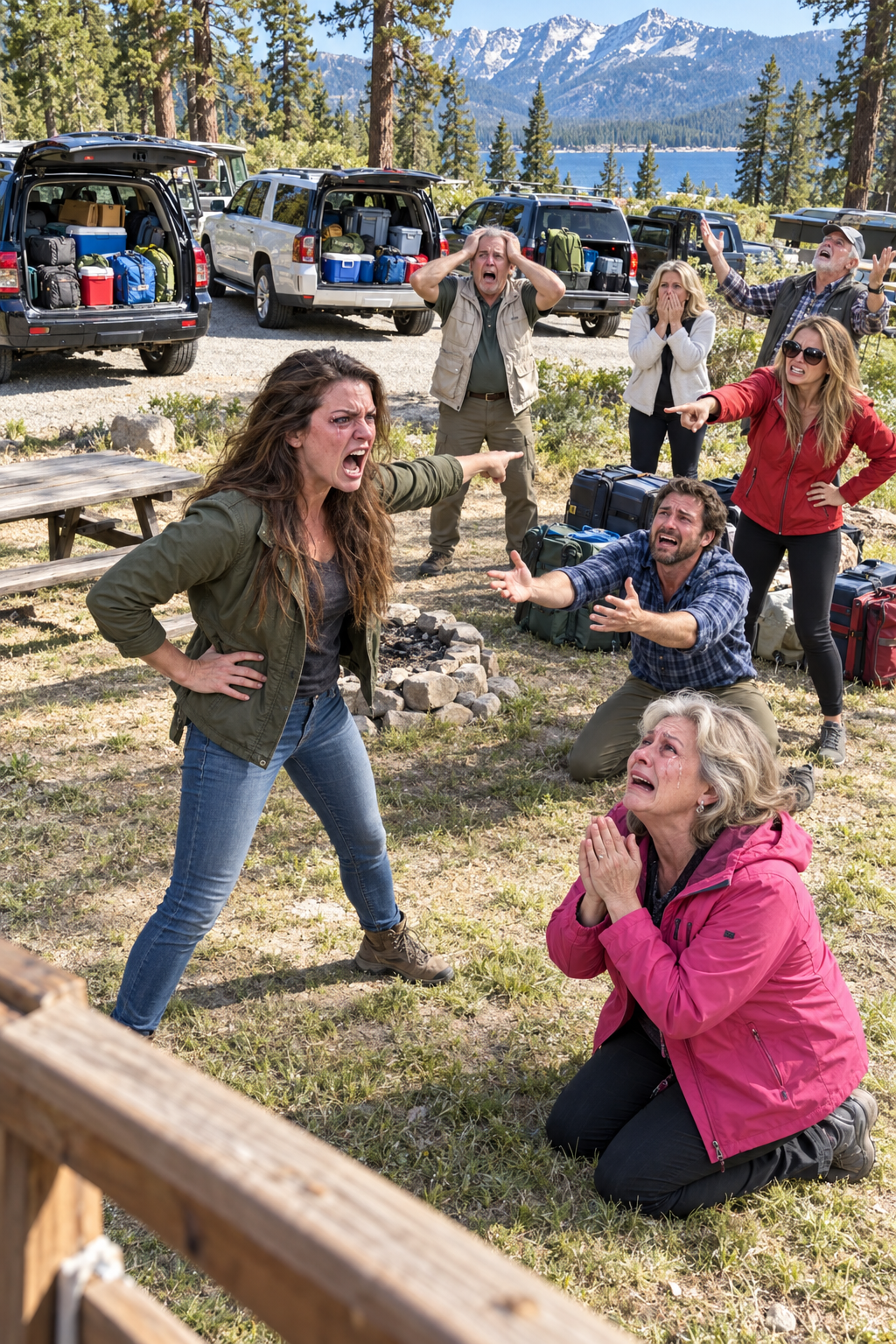
My Whole Family Vanished In The Night, Took Every Car, Every Tent And Every Scrap Of Food, Left Me And My 10-Year-Old Daughter Alone In The Wilderness, And 10 Days Later, They Begged For Mercy.
I woke in the mountains with my ten-year-old daughter asleep across my lap and discovered my entire family had vanished with every car, tent, phone, cooler, and scrap of food. They left one note telling me to trust them. Ten days later, after I carried my sick child toward a fire tower and somehow came out alive, I learned my family had already mourned us in public—and my mother was hiding a letter my dead husband had written before anyone knew we would disappear.
Part 1
The first thing I noticed was the silence. My neck hurt from sleeping crooked in a camp chair, Lily’s cheek was pressed against my ribs, and the fire in front of us had collapsed into gray ash beneath a thin skin of morning frost. I looked toward the clearing where four tents had stood the night before and saw nothing but flattened grass.
For several seconds my brain refused to arrange what my eyes were showing me. My parents’ black SUV was gone, my brother Nolan’s Tahoe was gone, the folding tables were gone, the coolers were gone, and even the wool blanket my mother had tucked around Lily and me sometime after midnight was missing. Two sets of tire tracks crossed the damp gravel and disappeared around the bend as neatly as lines drawn with a ruler.
“Nolan?” I called. “Dad?”
Only wind moved through the fir trees.
Lily stirred against me. “Mom, where is everybody?”
“I don’t know yet, honey.”
A sheet of white paper sat on the picnic table beneath a stone. The handwriting belonged to Nolan, the same hard slant I had seen on birthday cards, loan requests, and Christmas gift tags for thirty-eight years: THIS IS A NECESSARY RESET. TRUST US. I folded the note once, slid it into my jacket pocket, and checked for my phone even though I already knew it wasn’t there.
The previous night, Nolan’s wife Brooke had collected everyone’s devices in a black plastic case because this weekend was supposed to be a “real digital detox.” That case had vanished with everything else, but Lily’s purple backpack remained beside my chair, half hidden beneath pine needles. Inside were two bottles of water, three granola bars, a cheap yellow lighter, a rain poncho, Mr. Buttons—her stuffed rabbit—and nothing else.
“Did Uncle Nolan go get breakfast?” Lily asked.
I forced my mouth into something that probably looked like a smile. “Maybe. Right now we’re going to make a plan.”
Eight weeks earlier, I had buried my husband.
Ethan Mercer was forty-one years old when cancer took him on a June morning in Tacoma. Our daughter slept in a recliner beside his hospice bed with her sneakers still on, and I held Ethan’s hand until the hand was all that remained of the person who had built half my adult life with me. Five days later, nearly three hundred people stood beneath dripping umbrellas at his funeral while Lily held my fingers so tightly my knuckles hurt.
Ethan and I had started Cedar & Steam Coffee in 2013 with our savings, a secondhand espresso machine, and more confidence than money. By the time he died, we had twenty-six locations across Washington, Oregon, and Idaho, hundreds of employees, and enough revenue that newspapers occasionally called us a regional success story. What those articles never mentioned was the winter Ethan and I slept on flattened cardboard in our first shop because we could afford rent or heat, but not both.
I returned to work nine days after his funeral because spreadsheets did not pity me. Employees needed paychecks, leases still existed, vendors still expected answers, and grief was easier when I could reduce something to numbers. My family called that unhealthy, although nobody objected when those same numbers paid for things they needed.
My father, Robert, was a retired insurance claims manager who believed every relationship could be improved by paperwork. My mother, Elaine, volunteered at church, remembered every birthday, and could silence a room by saying, “I’m disappointed,” in a soft voice. Nolan was three years older than me, charming enough that strangers trusted him within ten minutes, and practiced enough at being forgiven that apologies had become another kind of currency.
When I was eleven, Nolan arranged for both cars to leave me behind after a family hike by telling Dad I was riding with Grandma June and telling Grandma June I was riding with Dad. A ranger found me four hours later in a nearly empty trailhead lot with wet socks and a juice box. Nolan called it a misunderstanding, and years later he turned it into a Christmas story so funny that even I learned to laugh.
At twenty-two, I loaned him most of my graduate-school savings for a sporting-goods business that failed within months. At thirty, Ethan hired him at Cedar & Steam because Nolan had a wife, a little boy, and what Ethan called “one last chance to become dependable.” When Nolan left the company suddenly five years later, Ethan told me only that they had disagreed about procurement practices, and I never asked the questions I should have asked.
That was my talent in the Mercer family. I let things go.
Three days after Ethan’s funeral, I walked into headquarters and found Nolan sitting behind Ethan’s desk. A framed picture of his son Mason was already beside the computer, and a box containing some of Ethan’s personal things rested on the floor.
“What are you doing?” I asked.
“Helping you,” Nolan said. “The managers are scared. Suppliers are calling. You shouldn’t have to run this place while you’re barely sleeping.”
“Two weeks,” I told him. “Temporary access. Then we review everything.”
He came around the desk and hugged me. “Whatever you need, Claire.”
Two weeks later, our operations director, Julian Reyes, found that Nolan had quietly raised his own vendor-approval authority from five thousand dollars to twenty-five thousand. I revoked his access that afternoon. Nolan did not argue with me; he simply went home and called our mother.
At Sunday lunch, all four of them told me I had authorized the change.
“You don’t remember,” Mom said gently while cutting lasagna. “You told Nolan to take over until you were stable.”
“I told him two weeks.”
Brooke reached across the table. “Grief changes memory, Claire.”
Nolan gave me the patient expression adults use with frightened children. “Nobody is trying to take anything from you.”
That night, I bought a twenty-dollar voice recorder and a spiral notebook.
I felt ridiculous hiding them in my purse.
Two weeks later, my father asked me to lunch and slid a valuation report across the table. Years earlier he had invested forty thousand dollars in Cedar & Steam for a small ownership stake, and the company’s growth had made that investment valuable. I offered to buy him out at an independently assessed price.
He pushed the papers back.
“I don’t want money,” he said. “I want a board seat. And Nolan should be chief operating officer.”
“No.”
His expression barely changed. “Ethan would’ve wanted family around you.”
“Ethan wanted competent people around me.”
That evening my mother called crying, asking whether I intended to push away the only people Lily had left. Three days later, an investigator from child protective services appeared at my front door because someone had anonymously reported that I was too unstable with grief to care for my daughter.
The investigator closed the case almost immediately.
But when Nolan came to my house carrying pastries and asking whether I truly believed he could do such a thing, I saw his phone illuminate on the porch railing behind him.
A message from Brooke.
Did she believe us?
The screen went dark before Nolan noticed I had seen it.
And for the first time in my life, I stopped wondering whether my family was worried about me and started wondering what, exactly, they needed me to believe.
Part 2
The camping trip was my mother’s idea, although Nolan had clearly planned every detail. One Sunday in August, she served lasagna, waited until Lily and Mason were coloring at the far end of the table, and said everyone thought I needed one weekend away from contracts, attorneys, and “all the suspicion.” Dad called it a reset, Brooke called it an intervention, and Nolan said there was a secluded campground in the Olympic Mountains where nobody would bother us.
I said no twice. Then Lily looked up from her crayons and reminded me that Ethan had promised to take her somewhere dark enough to see the Milky Way. Nolan watched my face change and said softly, “Do it for her, Claire.”
That sentence got me into the car.
Nolan insisted my Subaru remain at home because there was no reason to take three vehicles. Lily and I rode with my parents, while Nolan, Brooke, and Mason followed in the Tahoe. We drove beyond the last gas station, beyond the last occupied house, then another hour along forest roads until Nolan stopped at a locked steel gate and opened it with a key.
“Friend of a friend,” he said when I asked where he’d gotten it.
The road beyond the gate was rough but beautiful. Sunlight flashed gold through the trees, Lily sang badly to songs only she seemed to know, and for one dangerous hour I allowed myself to believe my family really had brought me there because they loved me. I remember thinking Ethan would have liked the place.
By evening we had tents around a fire ring and steaks cooking over a portable grill. Mason and Lily hunted for interesting rocks while Dad drank coffee, Mom wrapped herself in a fleece jacket, and Nolan behaved like the brother I remembered from the good years. After dinner, Brooke held out a black case and announced, “Phones go in here until Sunday.”
I hesitated.
Nolan laughed. “You bought a voice recorder because of us. You can survive thirty-six hours without email.”
Everybody smiled.
I put my phone in.
Later Brooke brought mugs of herbal tea around the fire. Mine tasted unusually sweet, and within twenty minutes my arms became heavy enough that lifting them felt like moving through water. I assumed exhaustion had finally caught up with me.
Lily climbed into my lap and whispered, “Wake me when the stars come out.”
“I promise.”
The last clear thing I remember is my mother standing over us. She tucked the blanket beneath Lily’s shoulder, brushed hair away from my forehead, and leaned close enough that I smelled her hand lotion.
“I’m sorry, sweetheart,” she whispered.
I thought she meant Ethan.
When I woke, everybody was gone.
For ten minutes I stood beside that empty campsite while a calmness I did not trust settled over me. I did not scream because Lily was watching. I did not cry because once she started crying, I wasn’t sure either of us would stop.
We followed the gravel road first. After roughly two miles we reached a bridge where a fast creek crossed beneath us, while the road curved uphill toward the locked gate and miles of deserted forest beyond it. I pictured Lily’s short legs, our three granola bars, and the possibility that nobody even knew where Nolan had taken us.
Then I heard my grandmother’s voice.
Grandma June had taken me camping the summer after Nolan abandoned me at the trailhead. She had been furious that nobody had taught me what to do if I was alone outside, so she spent a week teaching me simple things: stay dry, don’t wander without purpose, watch the terrain, and when you have no map, water is usually a better guide than pride.
“Water goes downhill,” she’d said. “And eventually, downhill tends to meet roads, farms, bridges, towns, or people.”
I took Lily’s hand and climbed carefully from the bridge toward the creek.
“Are we lost?” she asked.
“We know where the water goes.”
“Where?”
“Down.”
She considered that. “That’s not really an answer.”
Despite everything, I laughed. “Your father would agree.”
The first day we covered perhaps six miles. We split one granola bar, and I lied that I’d eaten before she woke so she would take the larger portion. Lily looked at me with Ethan’s suspicious eyes but said nothing.
That night we slept beneath the shelter of a huge cedar where fallen branches created a dry pocket against the trunk. I used the lighter only long enough to make a tiny fire, then extinguished it once our damp socks had warmed. The temperature dropped sharply after sunset, and Lily curled against me with Mr. Buttons under her chin.
“Is Uncle Nolan coming back?”
“I don’t know.”
“Did we make them mad?”
My chest tightened. “You did absolutely nothing wrong.”
“What about you?”
The honest answer would have required explaining thirty-eight years of my family. Instead I said, “I don’t know yet.”
On the second morning, I emptied Lily’s backpack and examined everything again. Water, wrappers, poncho, lighter, rabbit. Nolan had taken our phones and transportation, removed every obvious shelter and food source, driven away while I was unconscious, yet somehow the one bag containing exactly enough equipment to prevent the situation from looking immediately murderous had remained beside my chair.
That detail became impossible to ignore.
An accident is messy. People forget random things.
What my family had left us was curated.
I folded the poncho, repacked the bag, and felt something inside me change. Until then I had been hoping Nolan would come back embarrassed, explaining that some cruel intervention had gone too far.
Now I understood we needed to get ourselves out.
Because whoever had planned that campsite had remembered to leave evidence that we could survive.
They simply had not left enough for us actually to do it.
Part 3
By the third day, hunger had stopped feeling dramatic. It was simply there, a dull hollow sensation that made every smell sharper and every hill steeper. We found berries I recognized from childhood, and I checked them twice before letting Lily touch them.
Her lips turned purple.
She smiled at me. “Dad would say I look like an alien.”
“He’d take a picture first.”
“And then he’d show everybody.”
“Immediately.”
For thirty seconds we were a mother and daughter eating berries beside a creek instead of two missing people trying to survive.
That mattered more than the food.
Rain arrived on the fourth day. I stretched the poncho between branches beside a fallen tree and reinforced it with ferns until we had a miserable little shelter that leaked mainly around the edges. Lily developed a cough that evening, and I told myself cold children coughed.
By morning she was burning with fever.
I carried her whenever I could and made her walk when I could not. Near an abandoned logging site, we found the remains of a roofed equipment shed, rusted metal scattered among weeds, and enough dry wood beneath collapsed boards to make a safe fire. I cleaned an old metal container as thoroughly as possible, boiled creek water, cooled it, and spent hours getting Lily to take small sips while I pressed damp cloth against her forehead.
“Mom, I’m cold,” she whispered.
“I know.”
“Can we call somebody now?”
My throat closed. “Not yet.”
“Okay.”
That “okay” nearly destroyed me.
Children assume adults are holding back solutions. They do not understand the specific terror of realizing no more capable person is coming. I kept waiting to hear an engine, a helicopter, a shout from search volunteers—anything that would prove somebody had noticed we were gone.
Nothing came.
On the sixth day Lily’s breathing became faster. She drifted in and out of sleep while I sat with her in that broken shed listening to rain tap against corrugated metal. Several times she murmured Ethan’s name.
Once she asked for Nolan.
That hurt more.
She loved him. Nolan had taken her to baseball games, bought her a bicycle, taught her card tricks, and once driven across Tacoma during a snowstorm because she had left Mr. Buttons at his house. Whatever he had done to us did not erase who he had been to her, and I realized cruelty becomes much harder to understand when it comes from someone whose love was occasionally genuine.
“Mom?”
“I’m here.”
“Do you think Dad knows where we are?”
I looked toward the doorway where rain silvered the trees. “If there’s any way he can, yes.”
“Tell him I’m mad.”
“I think he already knows.”
“Tell him he should’ve stayed.”
That broke something open in me.
I bent over Lily and cried without sound, my face against her damp hair. For months I had been careful around her grief because I thought being a good mother meant presenting death as something we could carry elegantly. Out there, elegance became useless.
“I’m mad too,” I said.
Lily opened her eyes.
“I’m furious at him for getting sick. I’m furious at the doctors because they couldn’t fix it. I’m furious at every person who gets to complain about their husband leaving socks on the floor.”
A tiny smile moved across her mouth.
“Dad did that.”
“Constantly.”
“He said the floor was temporary storage.”
“He was wrong.”
She closed her eyes again. “Tell me another bad thing.”
So I did.
I told her Ethan snored when he slept on his back, burned grilled cheese whenever he answered email while cooking, refused to replace coffee mugs even after their handles cracked, and sang the wrong lyrics with absolute confidence. Lily listened until sleep took her.
The next morning her fever eased.
I touched her forehead twice because I didn’t trust my hand. Then Lily opened her eyes and said, “You’re staring at me weird.”
I laughed so suddenly it sounded like a bark.
“What?”
“Nothing.”
“You look terrible.”
“So do you.”
“Good.”
I put my face against the sleeve of my jacket and cried until my ribs hurt.
We rested for most of the seventh day. Lily ate berries slowly, drank boiled water, and picked pine needles from Mr. Buttons’ fur. By afternoon she could sit without leaning against me.
“Mom?”
“Yeah?”
“Why did they leave?”
I had rehearsed answers.
None survived her face.
“I don’t know everything yet.”
“But you know something.”
I looked at her.
Sometimes ten-year-olds deserve more truth than adults want to give them.
“I think someone wanted people to believe we chose to disappear.”
“Why?”
“That’s what we’re going to find out.”
She was quiet for a minute. “Does Grandma know?”
My mother’s whisper returned so clearly that I heard it again: I’m sorry, sweetheart.
“I don’t know.”
That evening the birds stopped making noise.
The air became thick and strangely yellow, and clouds gathered behind the ridgeline with a speed that made the back of my neck tighten. I had spent enough childhood summers outdoors to recognize a serious storm.
We were beside a creek.
Exactly where we should not be.
“Lily, shoes on.”
She looked at the sky. “Again?”
“We’re going uphill.”
Thunder cracked before we had climbed fifty yards.
The storm hit so hard the trees seemed to bend together, and I dragged Lily beneath the exposed root system of a toppled spruce as rain erased the world around us. She buried her face against my chest and asked me to tell her about Ethan again.
So while lightning turned the forest white, I told her the story of the day her father bought our first espresso machine for nine hundred dollars.
I did not tell her I was starting to believe somebody had deliberately chosen a place where no one would hear us scream.
Part 4
The thunder lasted for hours. Whenever Lily trembled, I kept talking about Ethan: our first shop, our first employee, the winter pipes froze, the morning our espresso machine flooded the floor ten minutes before opening. By midnight I had reached stories I hadn’t remembered in years.
Somewhere during those hours, fear changed.
It did not disappear. It became useful.
Until then, I had been surviving because Lily needed me. Beneath that uprooted spruce, listening to trees crack in the darkness, I decided surviving was no longer enough.
I wanted answers.
By morning the storm had moved east. Across the valley, a thin column of smoke climbed from a distant ridge where lightning had likely struck a tree. Smoke meant fire, and fire in national forest land meant somebody might eventually come to inspect it.
We started climbing.
An old logging road appeared beneath layers of fern on the ninth day. My shoes were splitting at the soles, Lily had lost enough weight that her face looked wrong to me, and our progress became a ritual of fifty steps followed by twenty slow breaths. She never complained.
Late that night I woke because her breathing sounded rough again.
I lay awake until dawn.
On the tenth afternoon, Lily stopped walking.
She did not collapse dramatically. She simply stood in the ruts of the old road, looked at me, and said, “Mom, I can’t anymore.”
Then she sat down.
I crouched beside her and followed the ridge with my eyes.
Above the trees, perhaps a quarter mile away, something square rose into the pale sky.
A fire lookout tower.
It looked abandoned, but its height was enough. Even if there was no radio, there might be a road, emergency supplies, a view, or some way to make ourselves visible.
“Climb on my back.”
“You’re too tired.”
“Probably.”
“Mom.”
“Do you trust me?”
Her arms wrapped around my neck. “Always.”
I remember that word more clearly than I remember the climb.
I carried her until my legs failed, then moved on my knees. At the base of the lookout tower, I discovered rusted stairs climbing toward a weathered cabin. I got Lily up them one section at a time, resting her against railings while I fought nausea and dizziness.
From the top I could see mountains in every direction.
And nothing else.
No occupied buildings. No moving vehicles. No trail crew.
But I could also see the smoke from the lightning strike.
I climbed down, collected dead branches, then arranged them in a wide clearing beside the tower. I made the largest signal I could think of and built a smoky fire near it, using green branches once the dry material caught.
For twenty minutes nothing happened.
Then Lily whispered, “Do you hear that?”
At first I thought it was wind.
Then came the unmistakable thudding rhythm of rotor blades.
An orange-and-white helicopter crossed the valley below us.
I screamed.
The aircraft continued east.
I grabbed my jacket and waved it above my head until my shoulders failed. Lily stood against the railing doing the same with the bright purple backpack.
The helicopter became smaller.
“No,” I said.
I dropped to my knees.
Then the sound changed.
Lily shouted, “Mom!”
The helicopter banked.
It came back.
A crew member leaned from the open side door and pointed directly at us.
Everything after that exists in pieces: wind flattening the grass, a woman in a helmet kneeling in front of Lily, somebody asking my name, me trying to explain that we’d been out there for ten days. When I said, “Claire Mercer,” the crew member nearest me looked sharply at the pilot.
At the hospital in Port Angeles, Lily was treated for pneumonia, dehydration, and exhaustion. Nurses put fluids into her arm, wrapped her in warmed blankets, and asked questions she was too tired to answer. I refused to leave her room until a doctor finally examined me in the bed beside hers.
He returned later with a woman wearing hospital identification and closed the door.
“Mrs. Mercer, your blood work showed evidence of a strong sedative.”
I stared at him.
“I didn’t take a sedative.”
“Then we need to document that.”
“The tea,” I said.
The woman exchanged a glance with him.
An hour later, a man named Special Agent Victor Hale entered with a federal badge.
He appeared exhausted. “Mrs. Mercer, I need to ask whether you wrote a note at your campsite.”
He showed me a photograph.
THIS IS A NECESSARY RESET. TRUST US.
“Nolan wrote it.”
“You recognize the handwriting?”
“He’s my brother.”
Hale pulled a chair beside the bed.
“Your brother says you wrote it.”
I looked at him.
“He reported you missing two days after you vanished. He told local authorities you had become unstable following your husband’s death and had intentionally taken your daughter into the wilderness.”
“No.”
“He provided the note as evidence.”
“No.”
“Search teams worked from the information he gave them. The location he identified was several miles from the actual campsite.”
My entire body went cold.
Hale continued carefully. “Your family then petitioned for emergency authority over portions of your affairs, arguing you were likely deceased.”
“We’ve been gone ten days.”
“Your father spent his career around claims procedures. He knew which forms to file and which facts created urgency.”
I looked at Lily sleeping beneath hospital blankets.
“What else?”
Hale hesitated.
“Tell me.”
“Your father had a life insurance policy on you.”
I stopped breathing.
“One point five million dollars. A claim was prepared this week. There was also a will submitted through an attorney that supposedly transfers control of your business interests to your father and brother if both you and your daughter die.”
“I never signed that.”
“We don’t believe you did knowingly.”
Then he told me about the memorial.
My family had held one the previous Saturday at my parents’ church. Flowers, photographs, nearly eighty people. Nolan had stood at a lectern and spoken about his little sister and beloved niece while Lily and I were sleeping beside a creek.
“They had a funeral for us?”
“A memorial.”
“While nobody had found bodies.”
“Yes.”
I looked at the photograph of the note.
The abandoned campsite suddenly became brutally simple.
The phones were not taken because my family wanted quiet.
The cars were not removed because they wanted to frighten me.
The backpack was not forgotten.
Agent Hale leaned forward.
“Mrs. Mercer, based on what we know right now, I don’t believe your family abandoned you.”
I already knew what he was going to say.
“I think they expected you not to come back.”
Part 5
The next morning I hired Martin Shaw, a Seattle attorney Julian recommended with the warning, “He scares other lawyers.” Martin was sixty-two, gray-haired, quiet, and unimpressed by drama. He arrived at the hospital carrying an old leather briefcase and read every page Agent Hale gave him before speaking to me.
“What do you want?” he asked.
“My daughter safe.”
“That’s first.”
“I want the company protected.”
“Second.”
“And after that I want the truth recorded somewhere they can’t rewrite it.”
He nodded. “That’s the useful answer.”
Martin told me not to contact my family. Federal investigators were already preserving records, the questionable insurance claim had been flagged, and the probate documents could be challenged without announcing how much authorities knew. For several days, Nolan and my parents apparently believed bureaucratic delays were the only thing between them and the future they had planned.
The first break came from the notary.
His name was Curtis Vale, a former bank employee who had certified several documents containing my signature. Investigators located him in a Nevada motel four days after my rescue.
He cooperated immediately.
Nolan had approached him during Ethan’s final weeks. The signatures were already present on loose pages, Vale said, and Nolan claimed his grieving sister had signed paperwork but had been too overwhelmed to complete the formalities. In exchange for money, Vale placed his seal on a power of attorney, a will, and amendments I had never knowingly seen.
The signatures came from the hospice clipboard.
The memory returned so violently I felt sick.
Nolan walking down the hallway holding papers.
“Visitor authorizations,” he’d said.
Mom behind him with coffee.
“Sign here, Claire. Initial there.”
Ethan watching from his bed through the open door.
I had signed without reading because my husband was dying thirty feet away and my brother had said, “I’ve got you.”
He had indeed had me.
Investigators searched Nolan’s house, my parents’ home, two vehicles, and several storage devices. On my father’s computer they found a folder labeled C. MERCER containing insurance projections, company valuations, notes about my grief, and a timeline beginning before Ethan died. On Nolan’s devices they found research about closed forest roads, missing-person investigations, legal presumptions, business succession, and survivability in remote terrain.
Then they found the debt.
Nolan owed more than six hundred thousand dollars to private lenders. Worse, a forensic audit showed he had diverted over four hundred thousand dollars from Cedar & Steam during his final year working there using fake vendors and inflated procurement invoices.
I read the audit twice.
“Ethan knew,” I said.
Julian sat across from me in Martin’s conference room.
His eyes dropped.
“You knew too.”
“Not everything.”
“Don’t do that.”
He rubbed both hands over his face. “Ethan found the vendor accounts. He made Nolan repay part of it and resign. Nolan threatened to tell your parents Ethan was destroying the family.”
“Why didn’t anybody tell me?”
“Ethan asked me not to.”
I stood so quickly the chair struck the wall.
“Everyone keeps protecting me by lying to me.”
Julian flinched.
I immediately hated myself because he wasn’t the person who had left us in the forest.
“I’m sorry,” he said. “Ethan thought you were already carrying your parents, your brother, the company, Lily, and then his diagnosis. He said if he could contain Nolan without breaking your family, he wanted to try.”
“That worked well.”
“No.”
The word sat between us.
Martin entered ten minutes later carrying another document.
“Ethan did one thing right.”
In April, before his illness became severe, my husband had moved most of his Cedar & Steam shares into a trust for Lily. I was trustee, but any major transfer required the signature of a co-trustee.
That co-trustee was Julian.
The forged will could not give Nolan control of the company.
Neither could the power of attorney.
My family had spent months arranging a takeover that Ethan had unknowingly made nearly impossible.
“So they did all of this for an insurance policy?” I asked.
Martin shook his head.
“Money was part of it. Control was part of it. But there’s another issue.”
My father had quietly covered some of Nolan’s theft after Ethan discovered it. Bank records showed transfers from Robert to shell vendors associated with the missing company funds. If Cedar & Steam conducted a complete forensic review, my father could be exposed as helping conceal Nolan’s misconduct.
My refusal to give Dad a board seat and Nolan an executive position had not merely offended them.
It threatened to put both men’s history under professional scrutiny.
The child-services report suddenly made sense.
The claims that grief had damaged my judgment.
The effort to establish Nolan as acting management.
The pressure for a family intervention.
They had been building a story about me before they ever took me camping.
A grieving widow.
Unstable.
Forgetful.
Neglectful.
Unfit.
If I could be discredited, controlled, declared incompetent, or eventually declared dead, every earlier accusation against Nolan could be rewritten as one more symptom of my collapse.
My phone remained in evidence, but Martin had retrieved the spiral notebook and voice recorder from my house.
Recorded on one file was my mother’s voice saying, “You told Nolan he could take over.”
Then mine.
“I did not.”
My father: “You aren’t remembering clearly.”
My brother: “We’re trying to protect you.”
Martin stopped the audio.
“This matters.”
“I sound exhausted.”
“You sound consistent. They don’t.”
That evening Agent Hale came to see me.
He placed a clear evidence sleeve on the table.
Inside was a sealed envelope investigators had photographed in my mother’s dresser before leaving the original where they found it.
My name was written across the front.
Claire.
I recognized the handwriting before Hale said anything.
Ethan.
“What is that?”
“We don’t know.”
“Open it.”
“We can’t. Not without authority, unless the person possessing it voluntarily gives it to you.”
I stared at my dead husband’s handwriting.
“When was it dated?”
“The outside isn’t.”
For the first time since the helicopter, I felt genuinely afraid of an answer.
Because Ethan had known Nolan was stealing.
Ethan had seen the clipboard.
And sometime before he died, he had written something to me and entrusted it to the same mother who later stood over my unconscious daughter in the mountains and whispered that she was sorry.
Part 6
The meeting took place three weeks after my rescue in a courthouse conference room overlooking Port Townsend Bay. My family had been told there would be a formal conference concerning disputed estate documents, insurance claims, and ownership issues. They knew by then that some filings had been frozen, but Martin and Agent Hale had carefully avoided revealing exactly why.
I waited outside while they settled around the table.
Through the door I heard my mother’s voice.
Normal.
That hurt more than I expected.
When the prosecutor opened the door, I walked inside wearing the gray suit I’d worn to Ethan’s funeral.
Nolan looked up.
For a second his expression showed nothing because his brain had not caught up with his eyes.
Then the color left his face.
Brooke made a sound like she’d swallowed air.
Dad gripped both sides of his chair.
Mom’s purse dropped from her lap.
“Hello, Nolan,” I said. “Sorry I missed the memorial.”
My mother’s lips moved.
“Claire?”
“Yes.”
She stood.
“We thought you were dead.”
“No, Mom. You needed everybody else to think I was.”
Nolan recovered first.
He pushed his chair back and gave a broken laugh. “Oh my God. Claire, thank God. We thought—Jesus. Where were you?”
“You know where I was.”
“No, we searched.”
“Forty-eight hours later.”
“We panicked.”
“You reported the wrong location.”
His eyes moved toward his lawyer.
Brooke began crying.
“I told him we should go back,” she said.
Nolan turned on her. “Shut up.”
And just like that, the family performance cracked.
Martin placed documents across the table one by one: the notary’s statement, bank transfers, forensic audit results, insurance paperwork, screenshots from Nolan’s devices, and copies of my father’s notes. Dad watched with the expression of a man calculating which sentence could still be challenged.
“We were protecting the business,” he said.
I looked at him. “From me?”
“From uncertainty.”
“My daughter nearly died.”
“We didn’t know Lily would stay with you.”
The room became perfectly still.
I leaned forward.
“What?”
Dad realized too late what he’d said.
Nolan spoke quickly. “He means we thought the kids would sleep in the tent with Mason.”
“But Lily fell asleep in my lap.”
Nobody answered.
“You all saw her there.”
Mom covered her mouth.
“You removed the tents,” I said. “You removed the cars. You removed the food. And you left her anyway.”
“We left supplies,” Nolan snapped.
“Three granola bars.”
“You had water.”
“We had two bottles.”
“There was a creek.”
Agent Hale shifted beside the wall.
I watched Nolan.
“How did you know exactly where the creek was?”
He blinked.
“I’d been there.”
“You told us it was a campground a friend recommended.”
“Same thing.”
“No.”
His lawyer put one hand on his sleeve.
Nolan pulled away.
“You don’t understand what was happening,” he said. “I was drowning. Dad was exposed because of what Ethan did. The lenders were calling. You had more money than you knew what to do with.”
“I paid your mortgage.”
“Once.”
“I paid for Mason’s preschool.”
“Do you want a medal?”
“I loaned you my savings when I was twenty-two.”
“Eight thousand dollars, Claire. You built a forty-million-dollar company.”
“Not for you.”
His face changed.
There it was.
Not grief.
Not concern.
The old resentment beneath everything.
“You always had someone,” he said. “Grandma protected you. Then Ethan protected you. Then all these employees worshipped you. Every time I made one mistake, you got to stand there being responsible.”
“Four hundred thousand dollars in fake invoices isn’t one mistake.”
“You could have fixed it!”
His voice struck the walls.
Everyone stopped moving.
Nolan pointed at me, breathing hard.
“You could’ve written a check and nobody would’ve known. Instead you cut my access, you threatened Dad’s position, and you forced us into a corner.”
“We?”
His mouth stayed open.
The prosecutor spoke from the end of the table.
“Mr. Mercer, I strongly suggest you follow your attorney’s advice and stop.”
Then my mother began crying.
Not her controlled telephone tears.
Real ones.
Her shoulders shook as she reached into her purse and removed a creased envelope.
“I need her to read this.”
I stared at it.
Ethan’s handwriting.
Mom placed it in front of me.
“He gave it to me the morning after Nolan brought you that clipboard.”
“Why?”
“He told me to give it to you if Nolan crossed the line.”
I looked at her.
“When exactly did you decide abandoning my daughter in the wilderness wasn’t the line?”
She lowered her eyes.
I opened the envelope.
Ethan’s letter was two pages.
Claire,
If Elaine is giving you this, then something went wrong, and I’m sorry I couldn’t stay long enough to stand beside you when it did.
I know what Nolan took from the company. I found the accounts before I got sick. Your father helped cover part of the shortage because he believed protecting Nolan meant protecting the family. I disagreed. I made Nolan resign and promise repayment.
Yesterday I watched him bring you papers in the hospice hallway.
I don’t know what they were.
I know your brother.
So I changed what I could while I still had the strength.
My shares are in trust for Lily. You and Julian control them together. No paper Nolan puts in front of you can transfer them. No will can transfer them. Cedar & Steam is safe.
Your mother asked me what she should do. I told her one thing: when Nolan makes you choose between peace and truth, choose truth, because peace built on your silence has cost you enough already.
You were never weak, Claire.
You were generous with people who learned to treat generosity as permission.
Take Lily somewhere dark enough to see the stars.
I left the map in my blue notebook.
All my love,
Ethan
I read it twice.
Then I looked at my mother.
“You had this the whole time.”
“I didn’t know what Nolan planned.”
“But you knew about the theft.”
She nodded weakly.
“You knew Dad covered it.”
Another nod.
“You knew Ethan was afraid of that clipboard.”
“Yes.”
“You knew they were lying about my memory.”
Her face collapsed.
“Yes.”
I placed the letter flat on the table.
Mom reached toward me.
“I thought we could keep everyone together.”
And there it was.
Not a secret plan.
Something worse because it was so ordinary.
My mother had not needed to want me dead.
She had only needed to keep choosing the comfort of the family over the safety of the daughter who always forgave them.
Part 7
My mother kept saying she had never agreed to kill anyone. Brooke said the same thing. Dad insisted the trip had only been intended to create enough evidence of instability to shift temporary control of my affairs, and Nolan claimed everyone had misunderstood everyone else until the situation “went too far.”
None of those explanations changed what happened after Lily fell asleep in my lap.
They had a child in front of them.
They still drove away.
I stood at the end of the conference table and looked at four people I had loved for most of my life.
“I used to think forgiveness was what kept a family alive,” I said. “Every time Nolan hurt me, Mom asked me to let it go. Every time Dad wanted something, I gave enough that nobody had to be uncomfortable.”
Dad started, “Claire—”
“No.”
He stopped.
“I let go of being abandoned at eleven. I let go of eight thousand dollars. I let go of mortgage payments, school tuition, the roof on your house, Nolan walking into Ethan’s office, all of you telling me I couldn’t remember my own conversations.”
My voice shook once.
Then it steadied.
“I thought swallowing pain was proof I loved you.”
Mom whispered my name.
“I was wrong.”
Agents entered the room.
Brooke began begging immediately. Dad demanded to see warrants. Nolan blamed his lenders, then Brooke, then our father, then Ethan.
Mom came around the table and caught my sleeve.
“Please. Mercy.”
The word stopped me.
My entire childhood lived inside that word.
Be nice.
Be reasonable.
He’s your brother.
We’re your parents.
Family takes care of family.
I gently removed her hand.
“Lily asked me on day seven whether you knew why we were there.”
Mom’s face crumpled.
“I told her I didn’t know.”
She sobbed.
“I can answer her now.”
I walked out.
The criminal cases took months.
Brooke cooperated first. She admitted helping collect the phones and participating in the plan to leave me isolated long enough to support claims that I had disappeared voluntarily. She claimed Nolan had concealed how dangerous the situation would become, but messages showed she had repeatedly asked whether authorities would search the real road.
Her plea agreement still included prison.
My father went to trial.
His own meticulous records hurt him more than any witness could. Decades as a claims professional had trained him to document everything, and prosecutors showed the jury timelines, insurance calculations, notes about my grief, and transfers used to cover portions of Nolan’s theft.
He had spent his life believing paperwork protected him.
This time it described him.
Nolan held out longest.
The breakthrough came from one of his lenders, who produced recordings of Nolan boasting weeks before the camping trip that his “family problem” would soon resolve itself. Faced with those recordings, the financial records, digital searches, the false filings, and Brooke’s testimony, he eventually pleaded guilty to multiple serious charges, including attempted murder and fraud.
I did not attend every hearing.
I attended sentencing.
Nolan turned around before the judge entered and looked at me across the courtroom.
He seemed older.
Smaller.
For most of my life that face had possessed a strange power over me because I remembered every version of it at once: fourteen-year-old Nolan laughing at the trailhead, twenty-five-year-old Nolan dancing badly at my wedding, Uncle Nolan carrying newborn Lily through our kitchen like she was made of glass.
He mouthed, “I’m sorry.”
I looked away.
My father received a sentence long enough that he will be an old man if he ever leaves prison. Brooke received less because of her cooperation. My mother, whose involvement was harder to prove at the same level, pleaded guilty to lesser charges and served a shorter term followed by restrictions that prohibited contact with Lily.
That last part mattered most.
Several relatives said I was cruel.
My father’s brother wrote that I had destroyed an elderly couple over “one terrible mistake.” Two cousins stopped speaking to me after I refused to pay for Nolan’s legal defense.
Other people surprised me.
My cousin Rebecca flew from Arizona and slept on our couch for a week. Julian ran Cedar & Steam while I attended therapy appointments with Lily and refused a raise until I threatened to give him one anyway.
The child-services investigator who had visited my house called after the arrests.
“I’m sorry,” she said.
“You were doing your job.”
“I believed the report might be coming from someone concerned.”
“So did I.”
“I should’ve seen more.”
“How?”
She had no answer.
Neither did I.
The last truly bad moment came months later when my mother appeared outside Lily’s school carrying a lemon cake.
I saw her before Lily did.
Mom stood near the edge of the playground in her church coat, holding the cake beneath a plastic cover. She looked ten years older.
Then Lily came outside.
She stopped.
“Mom?”
“Go back inside, sweetheart.”
“Grandma looks sad.”
“I know.”
Lily watched her for another second.
Then she went inside.
I crossed the parking lot.
My mother’s hands shook.
“I only wanted to give her this.”
“You can’t be here.”
“I’m her grandmother.”
“You were.”
The words hurt me too.
She lowered the cake.
“Claire, I didn’t know Nolan was going to leave you that long.”
“You had Ethan’s letter.”
“I was scared.”
“So was Lily.”
Her face folded.
“I loved you.”
“I believe you.”
That surprised her.
I believed it myself.
That was the tragedy.
My mother had loved me.
She had simply loved avoiding conflict more.
“You can write to me,” I said. “I may read the letters. I won’t promise to answer. You do not contact Lily unless she chooses it when she’s older.”
“Please.”
“No.”
I walked back to my car.
That night I threw away the lemon cake.
Then I sat on my kitchen floor and cried for the woman who made school lunches, sewed Halloween costumes, remembered birthdays, and later stood beside a sleeping child while someone packed the food that child would need to survive.
Hating a monster would have been easier.
Losing my mother required admitting she had never been one.
She was simply a person who made terrible choices repeatedly enough that love could no longer excuse them.
Part 8
Cedar & Steam lost three locations during the scandal. Reporters camped outside headquarters, online strangers invented theories about Ethan, and one television crew waited near Lily’s school until Martin threatened legal action. For several months I hated seeing our company name because it felt attached to everything Nolan had done.
Then ordinary life began returning.
Employees needed schedules.
Coffee machines broke.
Rent increased.
Customers complained when we changed the blueberry muffin supplier.
Ordinary problems became gifts.
Julian and I reorganized the company, tightened every financial control, and created a hardship fund that employees could access without begging a manager for help. I discovered that rebuilding trust was less dramatic than losing it; mostly it consisted of boring systems, repeated behavior, and people doing what they said they would do.
Lily recovered physically faster than I did.
She gained back the weight she’d lost and returned to school, though storms bothered her for a while. She kept Mr. Buttons beside her pillow and began checking whether doors were locked twice before bed.
We both went to therapy.
There were no miraculous speeches.
Some nights she wanted to talk about the mountains for an hour.
Other nights she wanted macaroni and cheese and a television show about baking.
I learned to follow her.
Mason went to live with Brooke’s sister in Spokane. He had lost his parents without understanding what they had done, and I refused to punish him for being their son. I opened a college account for him and arranged for him and Lily to see each other several times a year.
The first time they met after everything, Mason asked Lily what happened in the forest.
She shrugged.
“We found a helicopter.”
It was enough truth for a child.
My mother wrote every month.
I read some letters immediately and left others unopened for weeks. She apologized in different forms, explained herself, stopped explaining herself, asked about Lily, stopped asking when I told her that questions about Lily were not hers to ask.
I never wrote back.
People sometimes assume that means I spent those years burning with anger.
I didn’t.
Eventually I stopped thinking about her every day.
That was more final than hatred.
Nolan wrote once from prison.
Six pages.
He apologized, then explained the debt, then apologized again, then described his fear, then reminded me of everything we had been through as children. Near the end he wrote, I know there’s still a part of you that remembers I’m your brother.
There is.
I remember teaching him how to make pancakes after he moved into his first apartment.
I remember him sitting beside me at Ethan’s funeral.
I remember him holding Lily when she was born.
I also remember waking beside an empty campsite.
Memory does not require reconciliation.
I did not answer.
A year after our rescue, I found Ethan’s blue notebook while clearing the last boxes from his side of our bedroom closet. It contained coffee-roasting notes, equipment serial numbers, three terrible sketches of our dog, and a folded restaurant napkin.
On the napkin was a hand-drawn map.
At the bottom Ethan had drawn a crooked star and written, For Lily—so she can see what Tacoma is hiding.
I sat on the floor holding it for a long time.
The following August, I packed my Subaru with more food than two people could reasonably eat in a week.
Lily noticed.
“Are we expecting twelve guests?”
“No.”
“Bear convention?”
“Possible.”
She studied the tent, sleeping bags, first-aid kit, satellite communicator, water filters, emergency blankets, paper maps, and two different ways to make a fire.
“You’ve become weird.”
“I’ve earned weird.”
She accepted that.
We drove toward the Olympic Peninsula.
I did not tell her exactly where until we passed the last gas station.
She went quiet.
“Is this that place?”
“No.”
“Are you sure?”
“Completely.”
We entered a developed campground with numbered sites, bathrooms, other families, a ranger station, and a tiny store selling postcards and overpriced fudge.
Lily looked around.
“This is aggressively safe.”
“That’s the theme.”
She laughed.
That laugh hit me in the chest because I remembered its thinner version beside the creek.
We pitched our tent together. Lily complained about one crooked pole, I burned two hot dogs, and after sunset we carried sleeping bags to a small meadow above the campground.
I unfolded Ethan’s napkin.
Lily recognized the handwriting immediately.
“Dad?”
“Yeah.”
I handed it to her.
She traced the badly drawn star with one finger.
“He planned this?”
“Before he died.”
“Did Grandma know about this too?”
The question came softly.
I could have dodged it.
I didn’t.
“Probably not.”
Lily looked at the dark ridge.
“Do you forgive her?”
I had been asked that question by journalists, therapists, cousins, employees, and strangers who somehow thought forgiveness was the final stage of every painful story.
For the first time, I knew my answer.
“I don’t think forgiveness is the important part.”
“What is?”
“Knowing what happened. Keeping ourselves safe. Not becoming cruel because somebody was cruel to us.”
She thought about that.
“So you still don’t want to see her.”
“No.”
“Can both things be true?”
“What things?”
“That you don’t hate somebody and you don’t want them back.”
I looked at my daughter.
“Yes.”
She nodded like she’d solved something.
The sky darkened slowly.
Then the stars appeared.
Not ten or twenty.
Thousands.
They spread above us until the black seemed almost crowded with light, the Milky Way stretched faintly across the center, and for several minutes Lily said nothing at all.
Finally she whispered, “Dad was right.”
“About what?”
“The sky really is different up here.”
I swallowed.
“He was right about a lot of things.”
Lily found my hand inside the sleeping bag.
A year earlier, that same hand had held hers while we walked through a forest believing help might never come.
Now there were campers laughing below us.
A ranger’s truck rolled slowly along the campground road.
Someone opened a cooler.
Someone’s radio played softly.
Ordinary sounds.
Safe sounds.
I still keep the old spiral notebook in my bedside drawer.
The yellow lighter sits beside it.
I know I don’t need either one anymore, but I have stopped trying to decide whether keeping them means I am afraid or simply unwilling to forget.
My whole family vanished in the night and left my daughter and me in the wilderness.
For most of my life, I would have searched for the reason that made what they did forgivable.
I would have listened to Nolan’s debt, Dad’s fear, Brooke’s panic, Mom’s excuses, and found some small corner where I could place the blame so the family could remain intact.
I don’t do that anymore.
Their fear was real.
Their desperation was real.
Some of their love was probably real too.
So was the empty campsite.
So were Lily’s fever and the missing phones and the false report and the memorial held while we were alive.
Love does not erase choices.
And being family does not give anyone permission to make you pay forever for refusing to carry the consequences of theirs.
That night under the stars, Lily eventually fell asleep with her head against my shoulder.
I remained awake for a while.
Not because I was afraid someone would take the tents.
Not because I was listening for tires on gravel.
I stayed awake because Ethan had wanted our daughter to see that sky, and after everything it had taken to reach it, I wasn’t ready to close my eyes.
For once, neither of us had been left behind.
We had simply gone somewhere without them.
THE END!

