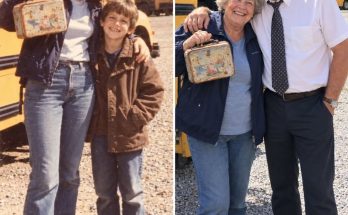
Two years after my husband asked me for a quiet divorce, we slow-danced at our granddaughter’s wedding. That night he stayed. By morning he was gone, and his old wristwatch was lying on my nightstand. Two weeks later, a woman I’d never heard of called me.
“He put you down as his wife,” she said. “You’d better come.”
Harlis and I had been married thirty-eight years. Every winter, he went out before me and warmed up my car. He’d set my coffee on the dash in the old Kroger mug with the chip in its handle. I sold insurance for twenty-nine years. I never once climbed into a cold car.
Then, two falls before the wedding, he slid papers across our kitchen table.
“Let’s just do it quiet, Deenie,” he said.
Nobody on this earth called me Deenie but him. The names at the top of the papers were Harlis D. Harbison and Nadeen R. Harbison, set down like we were strangers who had agreed to meet.
I held my reading glasses. I didn’t even get up.
“Is there somebody else?”
“No,” he said. “I’m just tired.”
“Tired of what?”
He looked at the papers. “I don’t want a fight, Deenie.”
“Tired of me, then.”
He didn’t say yes. He didn’t say no. I took that silence for an answer because I couldn’t find another one that hurt less.
We signed at a little office above the bank. There was no yelling, no scene.
He gave me the house and took his truck and tackle box. At the door, he turned around.
“Keep the porch light on anyhow.”
I remember thinking that was an odd thing to say to somebody he was leaving. I didn’t ask what he meant. He moved into his sister Orene’s spare room out in the county, and I went back to my life without him in it.
For two years, I got one Christmas card from him each year, signed with just an H. At the beauty shop, the girls asked where he was.
“Got tired of me, I guess,” I said.
It was a tidy answer. It kept people from asking the next thing, and after a while I believed it myself.
The year before the divorce, Harlis had become quiet. He dropped two coffee cups. He couldn’t get the lid off a pickle jar, then threw the jar in the trash instead of asking me for help. I thought he was drinking. He had never been a drinker, which should have told me how little I understood. I didn’t know what else to think, and he didn’t tell me.
This June, our son’s oldest girl, Kenley, got married at the fairgrounds hall. Harlis came in a brown suit that hung on him like a coat on a hook. He’d lost thirty pounds, maybe more.
“You look real nice, Deenie,” he said.
“You look like you forgot to eat for a year.”
He laughed. For one second, he was the man I married. Then the DJ played our song, the one from our own wedding in 1984. Harlis crossed the dance floor and held out his hand.
I looked at it before I looked at him.
“You sure?” I asked.
“I’d like to.”
His hand on my back was so light, as if he couldn’t quite hold on. We danced through the whole song.
“Sorry I’m so slow,” he said into my hair.
“You always were.”
He laughed against my ear. Kenley cried. So did I.
When the song ended, he walked me to my car. He followed me home afterward. I won’t say more about that night than this: he stayed, and for a few hours it was 1984 again.
When I woke up, his side of the bed was cold. His truck was gone. There was no note on the counter. His old Timex was on my nightstand, the one I gave him the morning we married. The band had cracked years ago, and he had never let me replace it.
Around noon, a text came: “Be happy, Deenie. I mean it.”
I called him four times. Each time, it went straight to voicemail. Orene wouldn’t pick up either. I drove out to her place twice that week, and her car was gone both times.
I put the watch in the kitchen junk drawer with my Medicare card, rubber bands and dead batteries. I told myself I was an old fool who’d been used for one night. Then I made myself a little supper for one, same as every night.
Two weeks later, while I was washing the supper dishes, my phone rang.
“Is this Nadeen Harbison?” a woman asked.
“It is.”
“My name is Tamsin. I’m a nurse at the hospice house over in Vincennes.”
I had to hold on to the counter.
“Harlis put you down as his wife and his emergency contact,” she said. “You’d better come.”
Hospice. I didn’t sleep one minute that night. At two in the morning, I thought of the girls at the beauty shop and what they’d say if I came running back the minute he got sick. Then a worse voice, my own, said it plainer: He didn’t want you two years ago, Nadeen, and he doesn’t want you now.
At five, I got up, took the watch from the drawer and drove to Vincennes.
The hospice house sat at the end of a long gravel drive, all windows and bird feeders. Tamsin met me at the front desk. She was young, with a long braid and kind, tired eyes.
“You came,” she said. “He said you might not.”
“How long has he been here?”
“He came in the day after the wedding. He went downhill fast.”
She glanced at her clipboard before she spoke again.
“But the ALS goes back a lot further than that. It was in his chart before your divorce.”
Before the papers. Before “Let’s just do it quiet.” Before I decided he’d gotten tired of me.
“Why didn’t anybody tell me?”
My voice came out too loud for that quiet hallway.
Tamsin went behind the desk and came back with a yellow legal-pad page folded in four and taped shut. On the outside, in Harlis’s crooked printing, was one word: Deenie.
“He gave us this the day he came in,” she said. “He said if you came, you ought to read it before you see him.”
I could have handed it back. I could have driven home and put it in the junk drawer with his watch. Instead, I buckled the watch onto my own wrist, cracked band and all. Then I sat in a plastic chair by the window and pulled off the tape.
At the top, in the corner, was a date two months before he slid the papers across our kitchen table.
The first line said: “Deenie, I have ALS, and I am leaving because I think you deserve not to spend the rest of your life taking care of me.”
I read it twice. The words did not change.
The letter was short. Harlis wrote that he had been diagnosed before the divorce, and that he had kept the diagnosis from me. He had watched me make a life around him, he said, and could not bear the thought of my life shrinking down to his needs. He thought ending the marriage would give me a clean choice, though he had never told me what I was being asked to choose.
Then he wrote that he was sorry he had called it tiredness.
I folded the page along its old creases. Tamsin waited without asking what it said.
“He told you not to tell me?” I asked.
“He said to give it to you if you came.”
“Did he say anything else?”
“He said you might be angry.”
“I am.”
Tamsin nodded. “You can take a minute.”
“I’ve had two years.”
That wasn’t quite fair to her. I knew it, and she didn’t argue. She pointed me toward Harlis’s room.
He was in bed, looking smaller than he had at the wedding. His face turned toward the door when I came in. The old familiar relief I expected to feel never arrived. I was too busy trying to place the man in front of me beside the one who had handed me divorce papers and let me think I was the reason.
“You came,” he said.
“Tamsin said you thought I might not.”
“I thought you had a right not to.”
“You gave me that right after you’d made the choice for me.”
He shut his eyes for a moment. “I know.”
I pulled the chair close enough to sit, but I didn’t take his hand.
“Why didn’t you tell me?”
“I thought I was doing the kind thing.”
“That’s what the letter says.”
“I was trying to spare you.”
“You didn’t spare me. You left me to make up my own reason.”
His mouth tightened. He looked down toward the blanket. “I didn’t know how to tell you I was getting worse.”
“You could’ve started with the truth.”
“I should have.”
I had expected anger to come out cleaner than it did. Instead, I kept hearing myself say small things. The jar. The cups. The years of guessing. I wanted to ask why he didn’t trust me. I wanted him to say he did. I didn’t ask, because there was no answer that could give those two years back.
Harlis touched the edge of the blanket with one finger. “I didn’t want you to have to watch me disappear.”
“You decided that for me.”
“Yes.”
The answer was quiet and plain. It didn’t make me forgive him. It did make it harder to pretend he had left because I was nothing to him.
I set the letter on the table beside his bed.
“I thought you were tired of me.”
“I wasn’t.”
“You said you were.”
“I know.”
“You let me believe that.”
He didn’t look away. “I’m sorry, Deenie.”
I had heard him apologize for small things before: a missed call, a broken cup, a forgotten errand. This was not small, and he didn’t try to make it sound that way.
I asked him about the wedding. He said he had wanted to see Kenley married. He had also wanted to dance with me once more, if I would let him. Then he stopped, as if he’d said too much.
“You could’ve asked me,” I said.
“I was afraid you’d say no.”
“So you didn’t ask.”
“No.”
There it was again: his fear, and his decision made in place of mine.
I looked down at the watch on my wrist. “You left this.”
“I wanted you to have it.”
“You could have told me that.”
“Yes.”
I didn’t let him turn the watch into a message that fixed anything. It was only the watch I had given him when we married. It had sat in my drawer for two weeks while I told myself what the night meant.
“I’m going to call our son,” I said. “He should know what you wrote.”
Harlis’s face changed. “You don’t have to bring everybody into it.”
“I’m not bringing them into the letter. I’m telling them why you divorced me.”
“Deenie, ”
“They’ve heard me say you got tired of me. That was your story, and I helped carry it.”
He swallowed. “I didn’t want them to think, ”
“I know what you didn’t want.”
I called our son from the hall and told him I was at the hospice house. I said his father had ALS before the divorce, and I had just read a letter explaining why Harlis left. I asked him to come, if he could. I didn’t tell him what to think. I had done enough of that for both of us.
Orene arrived before our son. She came in with her coat still on and stopped when she saw me.
“I tried to reach you,” I said.
“I know.” She looked at Harlis, then at the folded letter. “I’m sorry.”
“Did you know?”
She hesitated. “I knew he was sick. I didn’t know what he’d put in that letter.”
It wasn’t a full answer to everything I could have asked, but it was what she had to give me then. She sat on the other side of the bed.
Harlis looked between us. “I didn’t want this turning into a family meeting.”
“It already became one when you told everybody I was your wife,” I said.
“I put you down because you’re who I wanted called.”
“Then say that. Don’t pretend the divorce didn’t happen.”
Orene glanced at him. “She’s here, Harlis.”
“I can see that.”
“You told me not to call her,” she said. “You said she had her own life.”
“I didn’t want her pulled into this.”
“Still deciding for her,” I said.
He closed his eyes. Orene reached toward him, then stopped before touching his arm. Nobody in the room had a clean thing to say. The letter sat on the table, folded where Harlis had folded it before he taped it shut.
When our son arrived, he listened while I told him what the page said. I read the first line aloud, then the part where Harlis admitted he had called his fear tiredness. I didn’t dramatize it. The words were enough.
Our son looked at his father. “You never told her?”
“No.”
“You let her think it was because of her.”
“I did.”
“Why?”
Harlis took a breath. “I thought if she knew, she’d stay because she felt she had to.”
“And you thought leaving without telling her was better?”
“No,” Harlis said. “I thought it would hurt less. I was wrong.”
Our son looked down at the letter. “She spent two years saying you were tired of her.”
“I know.”
“You could have called.”
“I know.”
There was no speech from me about how a family should behave. Our son had heard the answer in his father’s voice. Orene had heard it too. Harlis had not been forced into the truth by a document or a stranger. He had written it down himself and finally said it aloud.
I expected somebody to tell me I should forgive him because he was ill. Nobody did. Orene didn’t defend him. Our son didn’t ask me to make the room easier. That mattered more than any apology could have.
When they left us alone, Harlis said, “I wanted the years we had to be good years.”
“They were good years,” I said. “That doesn’t make the last two all right.”
“I know.”
“You keep saying that.”
“I don’t have a better answer.”
“No,” I said. “You don’t.”
I was still angry. I was also glad I had come. Both things were true, and neither one cancelled the other.
He asked whether I would stay awhile. I looked at him, not at the letter or the watch.
“I’ll stay today,” I said. “I’m not promising you anything else.”
“That’s fair.”
“And if I come back, it’ll be because I choose to. Not because you put my name down as your wife.”
He nodded. “All right.”
I went back to the desk and spoke to Tamsin. “I’m divorced from him,” I said. “But I’m the person he chose to call. If he wants me there, please call me.”
“I will,” she said.
“I’ll decide each time.”
“Of course.”
I returned to the room. The letter stayed on the table where all of us had read it. Harlis didn’t ask me to put it away or tell him what I thought of him now. He just looked at the watch on my wrist.
I sat beside him. I did not tell him everything was forgiven. I did not call him my husband. I stayed because I wanted to be there.
When I left, I knew what the divorce had been about. Harlis had loved me and had still taken my choice away. He had apologized, and I had heard him. The next visit would be my decision too.