My brother was the golden boy of the NYPD.
Everyone watched. No one helped.
But I smiled—because I’d already made the call.
It was supposed to be a celebration. My older brother, Mark, had just been promoted to detective after nearly eight years on the force. My father, Charles, retired NYPD himself, was beaming with pride.
Sixty-eight guests packed into our backyard in upstate New York—family, cops, family friends.
I stood quietly in the corner, sipping a watered-down soda, invisible as usual.
Then came the toast.
My father raised his glass and gave a long-winded, testosterone-laced speech about legacy and honor. Mark ate it up. I clapped along with everyone else, despite the burning inside me.
No one knew what I knew.
After the clapping died down, I said it. Just loud enough for those near me to hear, but the ripple was immediate.
“Legacy built on silence and bruises, huh?”
Conversations stopped. The air thickened. My father’s jaw clenched. My brother’s eyes narrowed.
“You say something, Ella?” Charles’s voice carried across the yard like a whip crack.
I didn’t back down. “Just admiring how well everyone plays pretend.”
In seconds, he was in front of me.
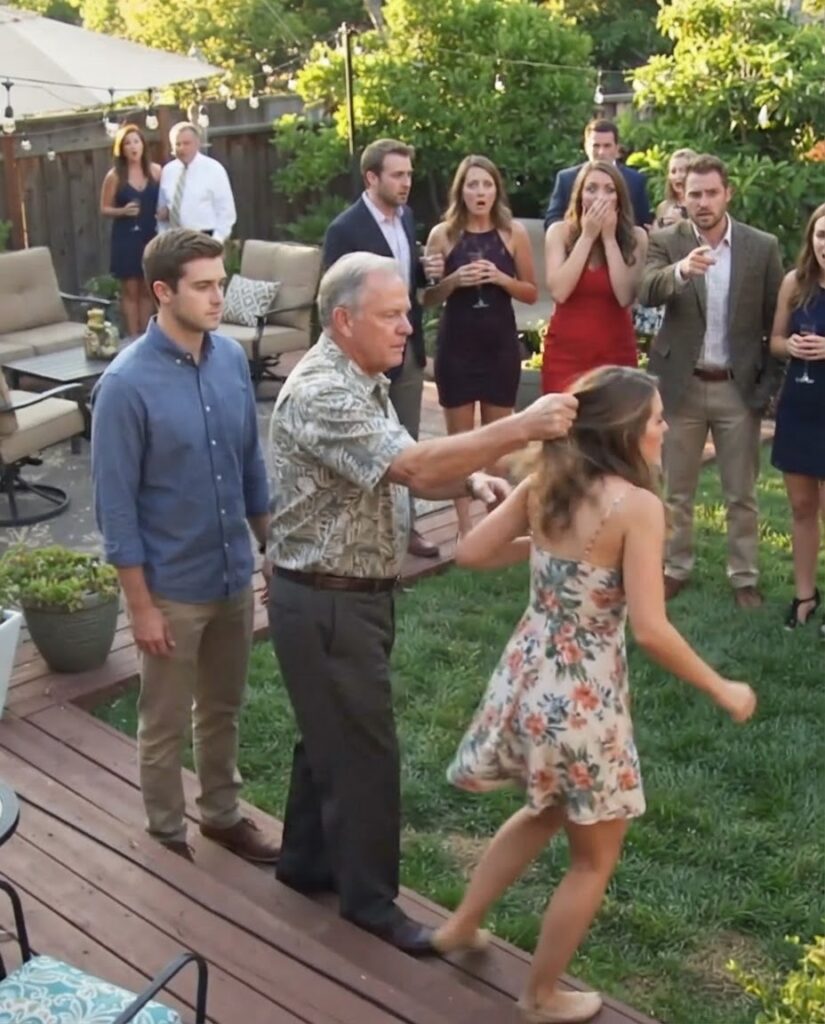
The slap came hard and fast—open palm, full force across my face. Gasps. Drinks spilled. I stumbled back, vision blurry, ears ringing.
He grabbed a fistful of my hair and yanked. I screamed as he dragged me across the patio, past the barbecue grill, past wide-eyed guests who did nothing.
Not even my mother.
Mark followed. “You had it coming,” he said as I was flung down the front steps. “You don’t ruin my day.”
Laughter from a few cops. The door slammed shut behind them.
I sat on the curb, nose bleeding, cheek on fire, heart pounding—but not from fear.
From focus.
They didn’t know what I’d done.
While they were clinking glasses, I’d gone upstairs to use the bathroom. I made a call. Just one.
By morning, everything they built would collapse….
Part 2: The Ashes of the Golden Boy
I sat on the cold concrete curb for twenty minutes, listening to the muffled bass of music through the closed front doors and the occasional roar of male laughter drifting from the backyard. Blood dripped steadily from my left nostril, staining the collar of my pale yellow dress. My cheek felt like a hot iron had been pressed against it, and a lump was already forming at the base of my skull where Charles had yanked my hair.
I didn’t wipe the blood away. I wanted it to dry. I wanted the cold night air to bake the physical evidence of their cruelty onto my skin, a stark visual record of what the “honorable” NYPD legacy looked like behind closed doors.
Around 9:30 PM, the party began to wind down. Off-duty officers stumbled out the front door, shouting sloppy goodbyes, keys jingling in their hands despite having consumed alcohol for five straight hours. None of them looked at me as they walked down the driveway. To them, I was just a discarded piece of trash on the curb, a temporary inconvenience swiftly managed by the head of the house.
Inside, Charles and Mark were likely pouring two fingers of top-shelf bourbon to celebrate a job well done—both the promotion and the suppression of the family black sheep.
They didn’t know about Internal Affairs.
They didn’t know about the flash drive I’d plugged into Mark’s laptop twenty minutes before the speech. They didn’t know about the five years of body-cam footage he’d illegally edited out, the confiscated cash that never made it into the evidence locker, or the quiet side deals Charles had brokered during his final years on the force to secure Mark’s fast-track promotion to detective.
Most of all, they didn’t know about the FBI’s public corruption task force, who had been building a Rico case against Charles’s old precinct for eight months—and had only been waiting for a witness with primary credentials to unlock the encrypted network files.
I had given them the master key.
At 6:15 AM the following morning, the sun barely crested the horizon over our quiet suburb. The neighborhood was dead silent, save for the early morning chirp of birds.
I was sitting in the backseat of a unmarked black SUV parked two blocks down, wrapped in a blanket provided by Special Agent Vance. My face was swollen, purple and yellow bruised along the jawline, but my mind was razor-sharp.
“Are you sure you want to be here for this, Ella?” Agent Vance asked softly from the driver’s seat, looking at me through the rearview mirror. “It’s going to get chaotic.”
“I stayed for the slap,” I replied, my voice raspy from the cold. “I’m staying for the curtain call.”
At 6:30 AM sharp, three heavy armored federal vans and four state police cruisers rolled down the quiet residential street without sirens, their tires gliding smoothly over the asphalt. They pulled right up onto our pristine, manicured lawn.
Within seconds, tactical officers in full gear poured out, rifles raised, surrounding the house.
“Federal search warrant! FBI! Open the door!”
The battering ram hit the front door with a sound like thunder. The reinforced oak frame shattered on the second strike.
Through the open SUV window, I heard the immediate chaos inside. Shouting, stomping boots, the sharp barks of commands.
“Get down! Hands where I can see them! On the ground now!”
A moment later, Charles’s booming voice echoed out into the morning air, dripping with rage and unearned authority. “Do you know who the hell I am?! I’m Charles Miller! Retired Senior Detective! Call Precinct 41 right now! Get your hands off me!”
“Shut up and get down!” a federal agent barked back.
Ten minutes later, they brought them out in handcuffs.
Mark came first. The golden boy of the NYPD was wearing sweatpants and a stained undershirt, his wrists bound tightly behind his back in steel cuffs. His face was pale, his eyes wide with unadulterated panic, completely stripped of the arrogant smugness he’d displayed on the patio twelve hours ago.
Charles followed right behind him. He was fighting every step of the way, his face flushed red, roaring threats about lawsuits, political connections, and badges. But the federal agents paid him no mind, forcing his head down as they shoved him into the back of a van.
My mother emerged last, trembling, weeping hysterically in her bathrobe, clutching a mug of cold coffee as if it were a lifeline.
As the agents led Mark toward the transport vehicle, his eyes scanned the street and landed on the unmarked SUV parked near the curb. The rear window rolled down slowly.
I leaned forward, letting the morning sunlight hit my face—highlighting the deep purple bruise across my cheek, the dried blood on my lip, and the absolute calm in my eyes.
Mark froze. The color drained completely from his face as realization hit him like a physical blow.
“You…” he whispered, his voice cracking. “Ella… what did you do?”
I didn’t answer. I just offered him the same faint, ice-cold smile I had given him when he told me I had it coming.
The agent shoved him into the van, and the heavy doors slammed shut.
Part 3: The Price of Silence
Six months later.
The Southern District Court of New York was packed to capacity. The trial had dominated local news for weeks—a explosive scandal exposing systemic corruption, evidence tampering, and racketeering within one of the state’s most decorated police dynasties.
The defense had tried everything. They tried to paint me as a disgruntled, mentally unstable daughter seeking revenge for a family dispute. They tried to suppress the digital evidence. But the paper trail was absolute, and the audio files I provided—recordings I had spent three years collecting at family dinners—were damning beyond repair.
I sat on the witness stand, dressed in a sharp charcoal suit. Across the room sat Charles and Mark at the defense table, wearing orange jumpsuits, their hair graying, their posture broken. There were no golden badges left to shield them.
The prosecutor, a formidable woman named Ms. Reyes, stood up for her closing arguments.
“Members of the jury,” Ms. Reyes began, pacing slowly in front of the box. “The defense wants you to believe this is a tragedy of a family torn apart by a rebellious daughter. But the evidence shows us the truth: this family was built on a foundation of terror, silence, and institutional abuse.”
She pointed toward the defense table. “For decades, Charles Miller used his badge as a shield to commit crimes, and he passed that legacy down to his son, Mark. They believed they were untouchable because they wore a uniform. They believed that inside their home, and on the streets, no one would ever dare to speak up.”
Ms. Reyes turned her gaze toward me. “They relied on silence. They relied on bruises to enforce that silence. But they forgot one simple truth: immunity ends when light is shed upon the dark.”
The jury deliberated for less than three hours.
When the foreperson stood to read the verdict, the courtroom was so quiet you could hear the ticking of the wall clock.
“On count one, racketeering conspiracy… we find the defendant, Charles Miller, guilty.”
“On count two, tampering with physical evidence… guilty.”
“On count three, deprivation of rights under color of law… guilty.”
Count after count. Sentence after sentence.
Charles received twenty-four years in federal prison without the possibility of early parole—a virtual life sentence for a man his age. Mark was sentenced to fourteen years, his law enforcement career erased, his name forever blacklisted.
As the marshals stepped forward to lead them away in chains, Charles finally turned his head to look at me. The fiery rage that had defined his existence for sixty years was gone. In its place was only a hollow, terrifying emptiness. He opened his mouth, as if wanting to say something, to curse me or beg for mercy, but no sound came out.
He had lost his power. The whip crack in his voice was broken forever.
After the courtroom cleared, I walked out down the grand stone steps of the federal courthouse into the cool afternoon air. Reporters swarmed the base of the stairs, cameras flashing, microphones thrusting toward my face.
“Ella! How do you feel about the verdict?”
“Do you have any regrets about turning in your own family?”
“Ella, look over here!”
I stopped at the top of the stairs, pulled my coat tightly around myself, and looked down at the sea of press. I thought back to that night in the backyard—the slap, the dragged hair, the cold curb, and the thirty-eight guests who turned their heads and pretended not to see.
I leaned toward the nearest microphone.
“For years, I was told that family legacy means protecting each other’s sins,” I said, my voice steady, clear, and resonant. “I was taught that silence was the price of survival. But real honor isn’t staying quiet to protect criminals who happen to share your blood.”
I paused, looking straight into the camera lenses.
“They built their legacy on silence and bruises,” I concluded quietly. “I rebuilt mine on the truth.”
I walked down the steps, past the cameras, and into the bustling New York crowd—finally free, finally heard, and never again invisible.
At his promotion party, my father slapped me so hard I saw stars, then dragged me out by my hair. My brother clapped and said, “That’s what happens when you talk too much.”