I Watched MIL Secretly Seal The Cellar Vent And Turn On The Propane. I Played Dumb And Sent My Husband Down For Wine. Boom! Police Report: “The Deceased Were A Partially Undressed Man And Woman.” MIL Went Mad When She Saw The Bodies!
I watched my mother-in-law turn my underground wine cellar into a death trap while my husband slept beside me upstairs. I said nothing. The next morning, when he casually asked me to retrieve a rare bottle for an important “client,” I smiled, handed him the access card, and told him he could get it himself. Hours later, my house was burning, my husband was dead beside another woman, and his mother was screaming that I was supposed to be inside. Then investigators found a document with my forged signature.
Part 1
The first thing that frightened me about Evelyn Hart was how calm she looked while she was trying to kill me. On the security feed, my sixty-eight-year-old mother-in-law stood on a small ladder in the reserve cellar beneath my Napa Valley home, sealing off part of the ventilation system with materials she had no reason to own and no reason to understand. The cellar lights washed her face in a pale gray that made her look nothing like the woman who brought casseroles to church fundraisers and told strangers she prayed for my marriage. I sat frozen behind my desk, one hand still resting on the inventory report I had been reviewing, watching her turn the room I had built bottle by bottle into something dangerous.
The cellar was more than a hobby. I had spent fifteen years turning my family’s modest vineyard operation into a serious California label, and the reserve cave held bottles that represented almost every important year of my adult life. It was designed with redundant safety systems because old underground structures could be temperamental, and one of those systems had begun showing irregular readings on my tablet. That was the only reason I had opened the camera application that night. I expected to find a contractor’s cart blocking a sensor; instead, I watched Evelyn finish tampering with the ventilation and move toward an old emergency fuel line near the service wall.
I did not go downstairs. That decision probably saved my life, although for several minutes I hated myself for making it because staying still felt like cowardice. I started a screen recording, saved a copy to an off-site account, and quietly called the private monitoring company that handled our environmental alarms. I told them I suspected a leak and asked them to place the cellar in maintenance lockout until a technician could inspect it in the morning. Then I sat in the dark listening to my own pulse while Evelyn left the cellar, wiped her hands on her cardigan, and disappeared from the camera.
Ten minutes later, my husband walked into my study carrying warm milk. Daniel had the kind of face people trusted immediately: neat brown hair, wire-framed glasses, an easy smile, and the slightly tired expression of a man who wanted everyone to know how hard he worked. When we met seven years earlier, he had been a regional sales manager with an embarrassing amount of charm and very little money. I had introduced him to distributors, given him increasing responsibility in my company, and eventually made him director of business development because I believed marriage meant building something together. He set the milk beside my laptop and kissed the top of my head as if we were still the couple I thought we were.
“You’re still working?” he asked. “Claire, there will always be another spreadsheet.”
“I know.”
He draped a cashmere cardigan around my shoulders and started rubbing the muscles near my neck. I might have leaned into him on any other night, but something white near the cuff of his pajama pants caught my eye. It looked like dried construction residue, the same pale material I had just watched Evelyn smear around the cellar equipment. My stomach tightened so suddenly that I had to press my palm against the desk.
Daniel followed my eyes and casually brushed at his leg. “You okay?”
“Dinner didn’t agree with me.”
I pushed the milk away and stood. For the first time in seven years, I looked at my husband and wondered whether every kindness he offered contained a calculation I had simply failed to notice. He asked if my old stomach problem was bothering me, told me he had already adjusted the water heater for my shower, and then added, almost as an afterthought, “Don’t go downstairs tomorrow. Take a day off from the cellar. You look exhausted.” His voice was affectionate. The timing was not.
I turned on the shower and left it running while I opened the wall safe in our dressing room. A year earlier, after I had spent nearly two weeks hospitalized with pneumonia, Daniel had pressured me to increase my life insurance, saying it was responsible planning for a couple with significant assets. The original policy divided the payout between him and my parents. The copy in the safe now contained an additional beneficiary form I had never seen before.
One hundred percent went to Daniel.
My signature was at the bottom.
It was almost perfect.
Almost.
I had signed thousands of contracts in my career, and I knew the tiny upward hook I made at the end of my last name. The signature on that form curved downward. Daniel had either forged it himself or paid someone to do it, and suddenly Evelyn’s behavior downstairs stopped looking like the work of one angry old woman. It looked organized.
I returned the papers exactly where I found them and went to bed. Daniel was reading beside me, calm enough to make me feel temporarily insane. After he switched off the lamp, he waited a few minutes before mentioning that an important buyer was supposedly visiting the next evening and that he wanted one of my rare Bordeaux bottles from the deepest reserve section.
“I’d appreciate it if you pulled it in the morning,” he said.
I stared into the darkness.
Then I understood why the cellar had been prepared tonight.
“Actually,” I said quietly, “I have a spa appointment tomorrow.”
Daniel shifted beside me.
“I’ll leave the access card for you. You can get the bottle yourself.”
For several seconds, he said absolutely nothing.
Then his hand found mine beneath the blanket.
“That works too,” he whispered.
Part 2
I barely slept. By six-thirty the next morning, I had already contacted the environmental monitoring company again, confirmed that the cellar remained flagged for maintenance, and arranged for a county-certified technician to inspect the property. The electronic system should have rejected ordinary access until the inspection was complete, which gave me a small measure of confidence. What I did not know was whether Daniel had another way inside, and that question became the most important one of my life.
Breakfast was theater. Evelyn sat across from me at the long dining table pretending to be interested in the chef’s seafood bisque while watching every movement of my hands. When I said I was skipping the cellar and driving to Calistoga for the day, relief passed across her face so quickly that she could not hide it. “Good,” she said. “Those underground rooms aren’t healthy anyway.” Daniel entered halfway through the conversation in a navy suit, kissed my cheek, and asked what we were discussing.
“The cellar,” I said.
His fork stopped for half a second.
I reached into my purse and removed the titanium access card I normally carried. It would identify whoever attempted entry, but because of the safety lockout, it should not have opened the reserve door. I pushed it across the polished table toward Daniel. “You wanted the Bordeaux. Since I’m gone all day, you can pick it up yourself.”
Evelyn went very still.
Daniel looked at the card and then at me. “You trust me around your precious collection?”
“You’ve been telling me for years that I should.”
He laughed, but it was the wrong laugh. He slipped the card into his pocket almost immediately, faster than a man accepting an inconvenient errand. I watched him do it and felt something inside me shut down with surprising quiet. If he knew nothing about the sabotage, he would simply discover the door was locked, call me, complain, and wait for maintenance. If he knew exactly what had happened, he would reveal that too.
I left the estate at eight-thirty and drove toward town before turning onto an overlook above the valley. From there I could see the upper roofs of the property between rows of vines, but more importantly, I could access the exterior cameras and electronic access logs from my phone. At nine-fifteen, I received a message from the technician saying he had been delayed by an emergency service call and would reach my property closer to noon. I considered calling the sheriff immediately and telling them everything, but I had only a video of Evelyn tampering with equipment and a suspicious insurance document. So I called the fire department’s non-emergency number instead, reported a suspected fuel leak in an underground structure, and gave them the address.
At 10:47, a red Porsche entered my gate.
Daniel was driving.
A woman stepped out of the passenger side wearing a cream coat over a short black dress. I recognized her before the camera zoom finished adjusting. Her name was Brooke Mercer, a twenty-nine-year-old marketing consultant Daniel had repeatedly described as “just a vendor.” I had met her twice at company events. Both times she had smiled at me with an intensity I had mistaken for nervousness.
Daniel walked around the car, put both hands around Brooke’s waist, and kissed her in my driveway.
For a moment, everything else disappeared. The insurance form, the cellar, Evelyn, the fire department—all of it became background noise behind the humiliating simplicity of that kiss. He had brought his mistress into my home less than twelve hours after his mother had sabotaged the room he expected me to enter. I felt no urge to cry. I felt as though someone had removed the floor beneath me and forgotten to let my body fall.
My phone chimed.
CELLAR ACCESS ATTEMPT: DENIED.
I stared at the log.
Thirty seconds later another message appeared.
MAINTENANCE OVERRIDE ACCEPTED.
I had never given Daniel the maintenance override code.
My hand tightened around the phone. That single notification did more than confirm he knew about the cellar. It told me he had anticipated safety restrictions. The override had been created for licensed service personnel and stored in an administrative file Daniel was never supposed to access.
I called 911.
“My name is Claire Hart,” I said. “I own Hart Ridge Estate. I reported a possible fuel leak earlier. Two people have just entered the underground cellar despite a maintenance lockout. Please send someone immediately.”
The dispatcher told me units were on their way. I remained on the line while watching the blank exterior feed, because there were no cameras in the private residential hallway leading to the cellar entrance. Three minutes passed. Then five. At eight minutes, I could hear sirens somewhere far down the highway.
At 11:03, the world below me jumped.
The sound reached the overlook a fraction after I saw the smoke. A dull concussion rolled across the valley, followed by a dark column rising from the center of my property. Birds scattered from the trees. My windshield trembled. I stopped breathing.
“No,” I whispered.
The 911 dispatcher was still speaking through my phone.
I had wanted Daniel caught. I had wanted the firefighters to arrive before he could do anything. I had wanted answers, handcuffs, divorce papers, and a courtroom where he would have to look at me while every lie was read aloud.
I had not wanted this.
I drove back toward the estate behind two fire engines. By the time I reached the entrance, deputies had blocked the private road and smoke was pouring across the vineyard. The main house still stood, but part of the lower structure had collapsed inward, and broken windows glittered across the lawn. I ran toward the tape shouting Daniel’s name until a deputy stopped me.
Then Evelyn came pushing through the crowd.
She saw me.
Her face changed.
Not grief.
Not relief.
Terror.
“Claire?” she gasped. “You’re alive?”
The deputy beside me slowly turned his head toward her.
I looked at Evelyn and felt the entire morning narrow into one terrible sentence.
“What do you mean, I’m alive?”
Part 3
Evelyn tried to recover, but panic had already stripped the disguise from her face. She stammered that she had assumed everyone at the house must have been caught in the explosion, which might have sounded reasonable if she had not known I was supposedly spending the day in Calistoga. I reminded her of that in front of the deputy without raising my voice. “You asked me about the spa at breakfast,” I said. “You knew I wasn’t home.” She stared at me as if I had betrayed her by surviving.
A detective named Elena Ruiz separated us within minutes. She was compact, silver-streaked, and patient in a way that made lying around her seem exhausting. I gave her my phone, the security recording of Evelyn in the cellar, screenshots of the access logs, the details of my earlier calls, and photographs of the insurance form I had taken before replacing it in the safe. I told her about the residue on Daniel’s pajamas and his request for the bottle. I left out nothing, including the fact that I had handed him the access card because I expected the maintenance lockout to stop him.
“You understood there might be danger down there?” Ruiz asked.
“Yes.”
“Then why give him the card?”
“Because it shouldn’t have worked. I wanted to know whether he would try.”
She held my gaze for several seconds. “And he used an override code?”
“Yes.”
“That’s important.”
It was the first moment all morning when I felt my lungs fully open.
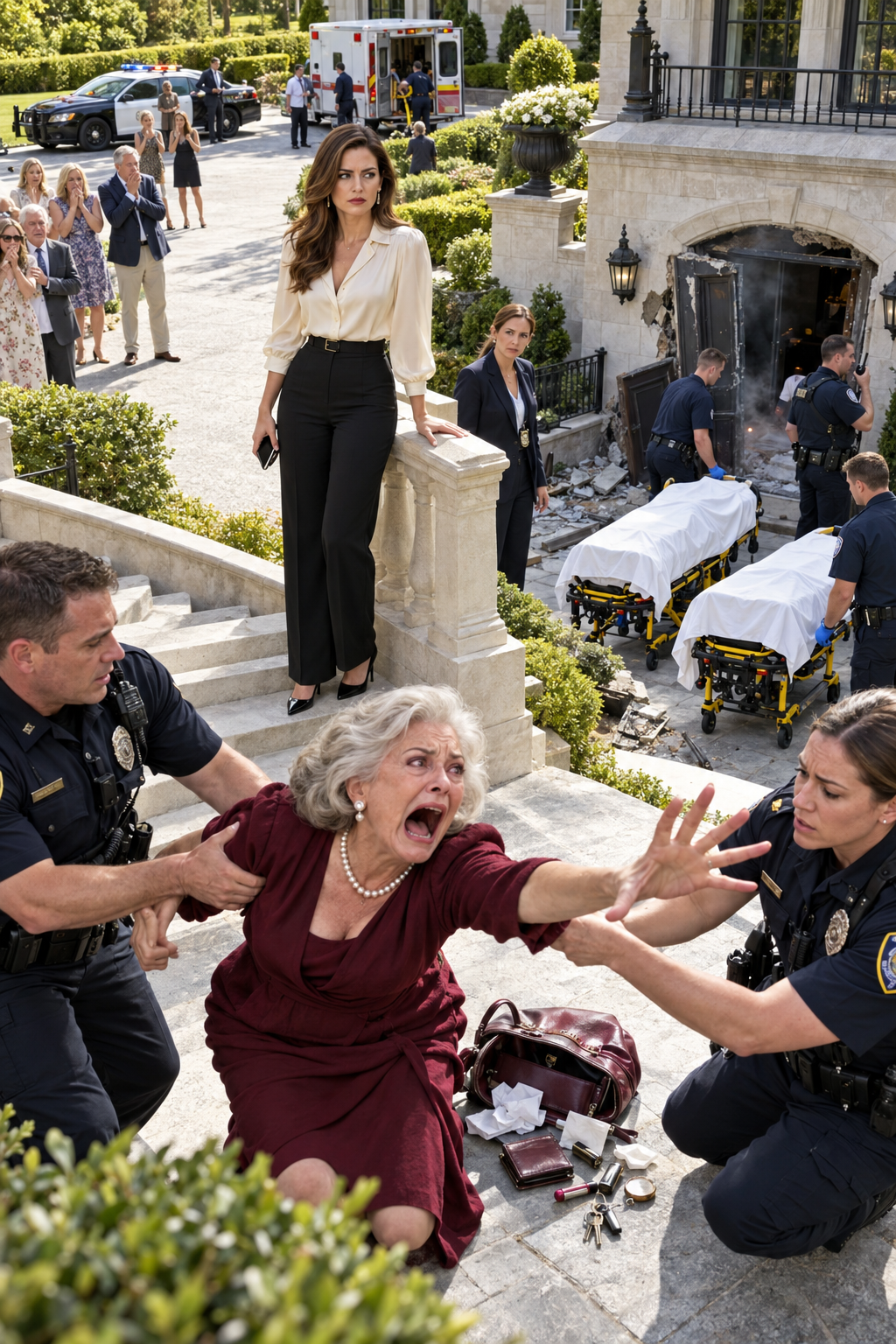
Firefighters recovered two bodies from the deepest section of the cellar several hours later. Personal effects identified Daniel almost immediately. The second victim was eventually confirmed as Brooke Mercer. When Detective Ruiz told us, Evelyn made a strangled sound and grabbed the hood of a patrol car for balance.
“Brooke?” she said.
Ruiz’s eyes sharpened. “You know her?”
Evelyn realized too late that she had answered the wrong question.
She shook her head violently. “No. I mean—I heard Daniel mention a Brooke.”
I had never told Evelyn the woman’s first name. Neither had the detective.
Evelyn backed away from us, repeating Daniel’s name as if saying it enough times could reverse the morning. Then she collapsed. Paramedics took her to the hospital, where doctors later determined that she had suffered a major stroke. She survived, but for weeks she could barely speak and had limited movement on one side of her body.
The investigators treated the explosion as a crime scene almost immediately. The cellar’s ventilation had been deliberately obstructed, and a portion of the system had been altered long before Evelyn appeared on my security footage. The maintenance override Daniel used came from an administrator credential that had been accessed from his company laptop several months earlier. Evidence recovered from the ruins suggested he and Brooke had introduced an ignition source after entering the compromised room, but the exact sequence mattered less to me than the growing proof that the danger had been created intentionally.
Three days later, Detective Ruiz asked me to meet her at the temporary office the sheriff’s department had set up near the property. She placed a plastic evidence sleeve on the table. Inside was a partially damaged notebook recovered from Daniel’s home-office safe.
Most of the pages were unreadable.
One was not.
My life insurance policy number appeared at the top. Beneath it were several dates, initials, and a short phrase written in Daniel’s hand: E handles final seal.
Evelyn.
I sat there until the letters blurred.
Ruiz folded her hands. “Mrs. Hart, I need to ask whether your husband had financial problems.”
“Not that I knew about.”
“Debts?”
“He managed several company accounts.”
“Affairs besides Ms. Mercer?”
“I didn’t know about her until the morning he died.”
Ruiz nodded. “Then we’re going to start with money.”
That sentence followed me to the hotel in San Francisco where I moved after the fire department declared the house uninhabitable. Daniel’s office safe had survived badly scorched but intact, and among the items returned to me was one encrypted laptop. I might never have opened it without Nate Rivera, my head of security, who called me privately the next evening.
Nate had worked for my family for almost a decade. He was former military, reserved to the point of seeming unfriendly, and the only employee who had ever told Daniel “no” without changing his tone. “There’s something you should have,” he said when he arrived at the hotel. He handed me a small external drive.
“What is it?”
“Backups.”
Months earlier, Daniel had repeatedly asked Nate to wipe and reinstall his office computer because of supposed software problems. Nate’s policy was to preserve encrypted images before erasing company equipment in case business records were lost. “I kept them because his requests started feeling strange,” he said. “I was going to tell you. Then everything happened.”
We gave the drive to Detective Ruiz and a forensic accountant before I touched anything myself.
Two days later, the accountant called.
“Claire,” she said, “you need to sit down.”
Daniel had been stealing from my company for nearly three years.
Fake suppliers. Inflated invoices. Shell businesses. Payments routed through consulting accounts and eventually into accounts controlled by Brooke. The preliminary number was $2.7 million, and the deeper they looked, the worse it became.
Then the accountant found the messages.
One from Daniel to Brooke read: Once the last piece is done, she won’t be around to audit anything.
Another said: Mom thinks she’s helping me fix the family.
And Brooke had answered: Then hurry.
I read those words once.
I did not read them again.
My husband’s death had ended the murder plot.
It had not ended what he had done.
Part 4
Grief became complicated once the financial records surfaced. I was mourning the person I thought Daniel had been while attorneys were showing me spreadsheets proving that person may never have existed. The man who had made coffee for me every morning had also approved fake invoices while I was sleeping upstairs. The man who brought flowers to my mother had discussed my death with his mistress in the same message thread where they compared kitchen finishes for a San Francisco penthouse.
My attorney, Julian Price, moved quickly. He obtained emergency orders freezing two properties Daniel had purchased in Brooke’s name and several accounts tied to the fraud. I did not ask for revenge. I asked for my company’s money back. That distinction mattered to me because Daniel’s theft had affected eighty-four employees, distributors who trusted our contracts, growers waiting to be paid, and families whose paychecks depended on decisions he had treated like chips at a casino.
Brooke’s family did not see it that way.
Her mother, Denise Mercer, called my attorney’s office repeatedly claiming everything Daniel gave Brooke had been a gift. Brooke’s older brother, Travis, was less diplomatic. He left a message accusing me of stealing from a dead woman and promising that I would regret it if I touched the penthouses. Julian saved the recording and forwarded it to law enforcement.
The first court conference was ugly. Denise cried loudly and insisted her daughter had been manipulated by a wealthy married man. Travis interrupted everyone, called me names, and had to be warned twice by courthouse security. I sat across from them listening to people defend money that had come from my company while pretending they had no interest in how Brooke obtained it.
Julian opened a binder containing three years of financial tracing.
“This is not a dispute over gifts,” he said. “These funds originated in fraudulent vendor payments from Hart Ridge Wine Group. We have invoices, bank records, messages, and corresponding transfers.”
Denise stopped crying.
Travis leaned forward. “Those places are in my sister’s name.”
“So are accounts receiving stolen funds,” Julian said. “A name on a deed does not erase the source of the money.”
The judge continued the asset freeze.
A week later, a court-appointed receiver entered the larger penthouse to inventory property purchased with disputed funds. I attended because several pieces of art and wine listed in Daniel’s records appeared to have come from my personal collection. What we found inside looked less like a luxury apartment than a house after a reckless party that had gone on for months.
Brooke’s relatives had already moved in.
Clothes covered the furniture. Food containers were stacked beside designer shopping bags. Denise argued with the receiver about jewelry while two cousins hurriedly carried boxes toward a bedroom until deputies ordered them to stop. Travis was not there, which made me more uneasy than if he had been screaming in my face.
Then I heard a baby cry.
It was faint enough that I thought I had imagined it.
The receiver heard it too.
We followed the sound to a small back room where a portable crib stood near the wall. Inside was an infant boy wrapped in a blanket that clearly had not been changed recently. He was awake but lethargic, his cheeks hollow, his breathing fast.
I turned around.
“Whose baby is this?”
No one answered.
Denise finally muttered, “Brooke’s.”
I stared at her. “You left him back here alone?”
“He’s been difficult since she died.”
The casualness of the answer made my skin crawl.
I called 911 before she finished speaking.
At the hospital, doctors told child welfare investigators the infant was dehydrated and underweight but likely to recover. His name was Owen Mercer. He was four months old. Brooke had apparently given birth quietly and kept the child mostly hidden from her social circle.
Then a social worker asked me a question I had not prepared for.
“Mrs. Hart, is it possible your husband was the father?”
I looked through the glass at the tiny child sleeping beneath a warming blanket.
“I don’t know.”
Daniel’s messages answered that question within days. There were references to “our son,” money set aside for childcare, and arguments about when Daniel planned to leave me publicly. A later DNA comparison confirmed paternity.
Owen was Daniel’s child.
I felt nothing resembling instant maternal love. I also felt no hatred toward him. He was a baby whose father had tried to kill me and whose mother had helped spend money stolen from my company, but none of that belonged to him.
I told the social worker I would not seek custody.
“I can’t be his mother,” I said. “That wouldn’t be healthy for either of us.”
Then I paid his outstanding hospital costs through a trust administered by my attorney and asked that my name not be used in future placement decisions.
I was leaving the hospital that evening when my phone vibrated.
Unknown number.
The message contained a photograph of my winery gates taken from the road.
Beneath it were six words.
You took everything. Now I take yours.
Part 5
The sheriff’s department traced the message to a disposable number, which meant almost nothing legally, but I did not need Detective Ruiz to tell me who had probably sent it. Travis Mercer had threatened me in court, his family’s access to Brooke’s property had just been cut off, and now someone was photographing my workplace from outside the perimeter. I forwarded everything to Ruiz and drove directly to Hart Ridge.
Nate was waiting near the production building when I arrived. “Someone’s been watching the south fence,” he said. “Male, medium build, hood up. He stayed outside the property line and left when my team approached.”
“Did you get a face?”
“No.”
“Plate?”
“He parked farther down the road.”
We increased security that night. Not because I wanted a confrontation, but because I had finally learned the cost of assuming people would behave rationally simply because their behavior made no sense to me. Daniel had counted on my trust. Evelyn had counted on my reluctance to imagine family members capable of real malice. I was done giving dangerous people the benefit of disbelief.
The harassment continued in small, ugly ways. Someone spray-painted THIEF on an exterior wall. One morning an employee found two tires punctured in the staff parking area. Another anonymous message arrived at three in the morning telling me to release the frozen accounts. Every incident went into a police report.
Meanwhile, Detective Ruiz kept pulling threads from Daniel’s records.
One thread led six months backward.
A maintenance invoice showed that Daniel had hired an outside contractor to work on the reserve cellar during a weekend when I was in Oregon negotiating a distribution agreement. The contractor was not on our approved vendor list. Nate remembered Daniel giving the regular maintenance crew those days off.
Ruiz located the foreman, Ronald Kessler, and interviewed him with an investigator from the district attorney’s office. I was not present, but she later told me what he admitted. Daniel had paid cash for unauthorized alterations to part of the cellar ventilation, claiming he wanted to reduce airflow in a reserve section for an experimental aging project. Kessler had thought the request was stupid but not criminal.
“He says the system would appear to run while moving far less air than designed,” Ruiz told me.
“And Evelyn finished the job the night before the explosion.”
“That’s what it looks like.”
Six months.
Daniel had been planning my death for six months.
That fact affected me more than the affair.
An affair could grow from cowardice, boredom, narcissism, or opportunity. Six months of engineering circumstances around another person’s death required waking up beside that person day after day and continuing the plan. Daniel had sat across from me on my birthday while waiting for the cellar to become dangerous enough. He had held my father’s hand during a medical procedure. He had discussed summer vacation dates with me while quietly changing the conditions of my life insurance.
Ruiz also uncovered emails between Daniel and Evelyn. He never wrote, “Kill Claire.” He was too careful for that. Instead, he told his mother I was planning to sell the family property, cut her off financially, and possibly leave him with nothing. None of it was true.
Evelyn hated me enough to believe him.
One message from her read: Tell me what needs fixing and I’ll fix it.
Daniel answered: I’ll show you when the time comes.
I sat in Ruiz’s office with the printout in front of me.
“So he manipulated her,” I said.
“Yes.”
“She still chose to do it.”
“Yes.”
That answer mattered.
Evelyn’s stroke had improved enough that she could answer simple questions. Prosecutors were waiting for a competency evaluation before deciding how to proceed. Julian warned me that her age and medical condition might affect what punishment was realistic.
“I don’t care whether she dies in prison,” I said. “I care that the truth becomes official.”
It was the first time I understood the difference between justice and spectacle.
Three nights later, a Pacific storm rolled over Napa. Rain hammered the winery roof and wind pushed hard against the loading doors. I was working late because an insurance auditor needed records that had survived the estate explosion, but Nate had ordered me to keep the building’s emergency alert pendant on my desk.
At 11:38 p.m., the power failed.
Backup lights came on for less than a second.
Then those died too.
My phone lost connection to the exterior camera network.
I stood.
A crash echoed from the tasting room below.
Glass.
Another crash followed.
Then a man’s voice rose through the building.
“Claire!”
I recognized it immediately.
Travis.
I reached for the emergency pendant.
Before I pressed it, he shouted again.
“I know you’re here.”
Something heavy struck the staircase railing.
“You’re signing those papers tonight.”
I pressed the button once.
Silent alarm transmitted.
Then I stepped away from my office door and entered the secure service corridor behind the records room.
This time, the person hunting me was not hiding behind someone else.
Part 6
The service corridor had been built for staff movement between the administrative level and production areas, and in normal conditions it was painfully ordinary: concrete walls, emergency signage, utility doors. In darkness, with Travis shouting somewhere behind me, it became the only part of the building that felt safe because I knew where it led. I moved without running, keeping one hand against the wall so I would not lose orientation.
Travis kicked open my office door less than a minute later.
I heard furniture overturn.
“Where are you?”
His voice was slurred, furious, and much closer than I wanted.
I did not answer.
Nate’s security team was stationed at two separate points on the property that night, and the silent alarm should have reached them even with the main network disabled because it used an independent system. The sheriff’s department was also automatically notified. My job was not to fight Travis. My job was to stay alive until professionals reached me.
That became more difficult when he found the corridor.
A flashlight beam cut across the far wall behind me.
“There you are.”
I saw his outline at the opposite end and something long in his right hand. Later, police would identify it as a large hunting knife. At that moment I only knew I could not let him get within arm’s reach.
I moved through a fire door into the lower production level and pulled it closed behind me. Travis slammed against it almost immediately. The door slowed him but did not lock automatically, and seconds later I heard it crash open.
“Stop running!”
I continued toward the reserve aging area, where three reinforced rooms were used for climate-sensitive storage. One had an exterior-controlled security door because it contained limited-production inventory. It was not dangerous inside. It was simply difficult to exit without the release panel mounted in the corridor.
I had no elegant plan.
I had a door.
That was enough.
I entered the room, crossed behind two storage racks, and waited where Travis could see me once he reached the entrance. My heart was beating hard enough to hurt. Every instinct told me to keep moving, but if I continued deeper into the building, I would eventually run out of secure barriers.
Travis appeared in the doorway.
His clothes were soaked from the storm. Blood ran from a cut near his eyebrow, probably from the broken tasting-room glass. He held the knife low at his side and stared at me with the unstable focus of someone who had spent too long convincing himself another person’s property belonged to him.
“You ruined my family,” he said.
“Your sister helped steal from mine.”
“Shut up.”
“The accounts are frozen because they’re evidence.”
“They’re ours.”
“No.”
That single word enraged him more than any insult could have.
He stepped fully into the room.
I moved farther behind the racks.
Travis followed.
“You’re going to call your lawyer,” he said. “You’re going to tell him to release everything.”
“That isn’t how court orders work.”
“I said shut up.”
He advanced another few feet.
A siren sounded faintly outside the building.
His head turned toward the noise.
I ran.
Not toward the back of the room.
Toward the entrance.
He lunged after me, but the racks forced him around the longer side. I reached the corridor first, grabbed the door, and pulled it closed.
Travis hit the other side hard enough to shake the frame.
The electronic latch engaged.
He began screaming.
I backed away from the door, hands trembling so badly I almost dropped my phone when I called Nate.
“Lower reserve,” I said. “He’s contained. He has a knife.”
“We’re thirty seconds out.”
I slid down the wall and sat on the concrete floor.
The banging continued.
“You can’t keep me in here!”
I said nothing.
“You stole from Brooke!”
Nothing.
“She deserved that money!”
Nothing.
Then he shouted something that made me look up.
“Daniel promised her!”
I stood.
“What?”
There was silence on the other side.
I walked closer but stayed beyond the door.
“What did Daniel promise Brooke?”
Travis laughed bitterly. “Everything. The winery, the house, all of it once you were gone.”
My phone was recording.
He kept talking because angry people often mistake confession for victory.
“He said you wouldn’t be a problem by Christmas. Brooke told us. She said his mom was helping. She said they had it handled.”
Boots thundered through the corridor.
Nate arrived first with two security officers, followed seconds later by deputies. They ordered me back while they opened the door under controlled conditions and arrested Travis. He dropped the knife only after facing several armed officers.
I remained against the wall, suddenly cold.
Detective Ruiz arrived forty minutes later.
I handed her my phone.
“He talked through the door.”
She listened to the recording once and looked at me.
“This is useful.”
“Good.”
She studied my face. “Are you hurt?”
“No.”
“That wasn’t what I asked.”
I almost laughed.
Instead, I looked through the corridor window at Travis being placed in a patrol car.
“No,” I said again. “But I think I’m finally angry.”
The next morning, Ruiz called before sunrise.
Police had obtained an emergency warrant for Travis’s phone.
Inside a cloud backup, they found messages Brooke had sent her family months before her death.
One included a photograph of Daniel and Evelyn standing together beside the cellar service entrance.
Underneath it, Brooke had written:
His mother finally agreed. Now we just need Claire to walk into the room.
Part 7
The criminal case stopped being theoretical after that. Evelyn’s lawyers could argue that Daniel manipulated her, that grief had clouded her judgment, or that her medical condition made prosecution cruel, but they could no longer claim she had wandered into my cellar and made innocent repairs. Brooke’s messages, Daniel’s emails, the security video, the altered ventilation system, the insurance form, and the maintenance records all pointed in the same direction.
Evelyn eventually became well enough for a recorded interview.
Detective Ruiz asked whether I wanted to watch from another room.
I said no.
I had spent too much of my life looking at Evelyn’s face while wondering what she meant. I no longer needed to see it.
She confessed after nearly four hours.
Not completely, and not nobly.
She blamed Daniel for almost everything. He told her I was going to abandon him. He said I intended to sell the vineyard and put Evelyn in a cheap nursing home. He convinced her that I had humiliated him for years and that my death would merely “move along” an accident that might happen someday anyway. She admitted entering the cellar and interfering with the safety systems because Daniel assured her no one would ever prove it.
Then she cried for her son.
Not for me.
Not for Brooke.
Not for the employees who could have been in the house.
Daniel.
Her golden boy had died in the trap he built for his wife, and that was the only part she seemed unable to accept.
Prosecutors ultimately charged Evelyn with attempted murder, conspiracy, and related offenses. Her health complicated everything, but the court found her competent with medical accommodations. She accepted a plea that guaranteed years in a secure correctional medical facility rather than gamble on a trial.
Julian asked whether I wanted to submit a victim impact statement.
I wrote one page.
I did not describe how frightened I had been or how much money I lost. I described trust.
I wrote about handing someone a key to your home because you believe they are family. I wrote about the strange damage done when ordinary memories become evidence. A vacation photograph becomes proof someone was lying about where they were. A loving text message becomes camouflage. A breakfast conversation becomes part of a murder timeline.
I ended with one sentence.
I do not forgive Evelyn Hart, and I do not need hatred to maintain that decision.
Travis pleaded guilty to aggravated burglary, criminal threats, property damage, and weapons charges after prosecutors played the recording from the reserve room and presented the photographs from my gates. His family blamed me publicly until Julian threatened legal action over several false accusations. After that, they disappeared from my life almost as quickly as they had entered it.
The civil recovery took longer.
The penthouses were sold. Brooke’s accounts were liquidated under court supervision. Several shell-company transfers were reversed. Insurance covered part of the business losses after investigators confirmed that Daniel had acted without company authorization.
We did not recover everything.
We recovered enough.
More importantly, the forensic audit exposed the weaknesses Daniel had exploited. He had not stolen millions because he was a financial genius. He had stolen millions because I trusted my husband more than I trusted internal controls.
That was difficult to admit.
So I changed them.
No executive at Hart Ridge could approve and pay the same vendor. Outside audits became quarterly rather than annual. Family relationships meant nothing in financial authorization. My new chief operating officer had worked for me for years and still needed a second signature for major transfers.
Some people called those changes cold.
I called them adult.
Owen recovered and entered foster placement while social services reviewed possible long-term guardians. Brooke’s parents attempted to seek custody and were denied after the conditions in the penthouse became part of the child welfare record. A foster couple eventually applied to adopt him.
The social worker asked whether I wanted updates.
“Occasional ones,” I said.
“Do you want contact when he’s older?”
“I don’t know.”
That was the truth.
I created an education trust for him through an independent foundation with instructions that the source remain private until adulthood. It was not an inheritance from Daniel. Daniel had no moral claim on my money after trying to take my life.
It was simply something I could do for a child who had done nothing.
Months after the explosion, I visited the remains of my old house for the final time. Most of the structure had already been demolished. The cellar entrance was gone, replaced by a fenced excavation full of broken stone and dark soil.
Nate stood several yards away while I walked through what had once been my garden.
Near the edge of the construction area, I found a small piece of blue tile from the kitchen Daniel and I had renovated together.
I picked it up.
For one second, I remembered us choosing that tile, arguing about the shade, laughing in the store because neither of us could tell the difference between “ocean” and “coastal slate.”
The memory hurt.
That did not make it false.
Daniel had betrayed me.
It did not mean every moment had been imaginary.
That realization was harder than simply deciding he had always been a monster.
I dropped the tile into the debris container.
Then I left.
Part 8
A year after Daniel died, Hart Ridge opened a new reserve building on the opposite side of the vineyard. I refused to recreate the old cellar. The new structure was above ground, full of natural light, straightforward emergency exits, independent environmental monitoring, and more windows than any winemaker would normally want.
People assumed the design was psychological.
They were right.
At the opening, distributors, employees, growers, and local restaurant owners crowded the terrace while late-afternoon sunlight spread across the vines. I gave a short speech thanking the staff for keeping the company alive through what I called “an exceptionally difficult year.” I did not mention Daniel. Everyone already knew.
Afterward, I walked through the production floor alone.
The building smelled like oak, stone, fermenting fruit, and stainless steel warmed by the day’s sun. For years, those smells had meant work. Then Daniel turned one of them into fear. I had spent months wondering whether I would ever enter a cellar again without remembering the security footage.
That afternoon, I realized I had stopped thinking about it.
Not forgotten.
Stopped organizing my life around it.
There was a difference.
Evelyn sent me three letters from the medical correctional facility. I returned the first two unopened. The third came through her attorney with a note saying her health was deteriorating and she wanted closure.
I read it.
Most of the letter was about Daniel.
How much she loved him. How convincing he had been. How frightened she was of losing him. How she had believed I was going to destroy his future.
Near the end, she wrote, I know I made mistakes, but I hope someday you can understand that a mother will do anything for her child.
I folded the letter.
Then I mailed one response.
Evelyn,
You did not protect your son. You helped him become the kind of man who believed another person’s life was an obstacle he could remove.
I understand what you did.
Understanding is not forgiveness.
Do not contact me again.
Claire
I never heard from her after that.
Owen was adopted shortly before his second birthday. The social worker sent one photograph with his new parents’ permission. He was sitting in a backyard covered in cake, wearing a paper birthday hat sideways and laughing at something outside the frame.
I kept the photograph.
Not on my desk.
Not framed.
In a drawer with important documents.
That was the right distance.
Julian once asked whether I worried Owen might someday come looking for me when he learned who his biological father had been. I told him I hoped that if the day came, I would be able to answer whatever questions belonged to him without giving him burdens that did not.
Daniel’s sins were Daniel’s.
I had learned too much about inherited resentment from Evelyn to pass any of it forward.
The company stabilized. We hired back staff displaced during the reconstruction and eventually exceeded the revenue level we had reached before the fraud was discovered. I sold the ruined residential estate rather than rebuild a mansion on top of it and bought a smaller house fifteen minutes from the winery.
It had three bedrooms.
I used one.
The second became an office.
The third remained empty.
For the first time in years, empty space did not make me feel lonely.
People occasionally asked whether I was dating again. The answer was no, and I stopped offering explanations. I did not need a new relationship to prove Daniel had failed to ruin my capacity for happiness. Maybe I would love someone again. Maybe I would not.
What mattered was that the choice belonged to me.
The strangest part of surviving betrayal is that eventually the dramatic pieces become administrative. The destroyed house became an insurance file. The attempted murder became a case number. My marriage became probate documents, court exhibits, financial corrections, and one box of photographs stored in a closet.
Life becomes ordinary again whether you are ready or not.
One autumn morning, almost two years after the explosion, I arrived at the winery before sunrise. Harvest crews were already moving between the rows with headlamps, calling to one another in the dark. Someone had left coffee on my desk.
For one irrational second, I thought of Daniel.
He used to bring me coffee.
The memory passed.
I took the cup outside.
The sky over the hills was turning pale pink, and the vineyard smelled of cold earth and crushed grapes. Nate drove past in a utility cart and raised one hand. Workers laughed somewhere near the loading dock.
Nothing exploded.
No one was waiting behind me.
No one needed anything from me except the ordinary decisions of an ordinary workday.
I had spent months believing the ending of my story would be the moment Daniel’s plan collapsed onto him. Then I thought it would be Evelyn’s conviction, or the recovered money, or Travis in handcuffs.
It wasn’t any of those things.
Their consequences belonged to them.
My ending belonged to me.
Daniel wanted my death because it was easier than facing what he had stolen. Evelyn helped him because believing her son was a victim was easier than admitting what he had become. Brooke helped spend the money because she believed another woman’s life was a price someone else would pay. Travis nearly destroyed his own future because he mistook stolen wealth for an inheritance.
None of them were defeated because I became more powerful than they expected.
They were defeated by the choices they kept making after every opportunity to stop.
I simply survived long enough to let those choices become visible.
I took a sip of coffee and watched sunlight touch the first row of vines.
Then I went back inside to work.
THE END!