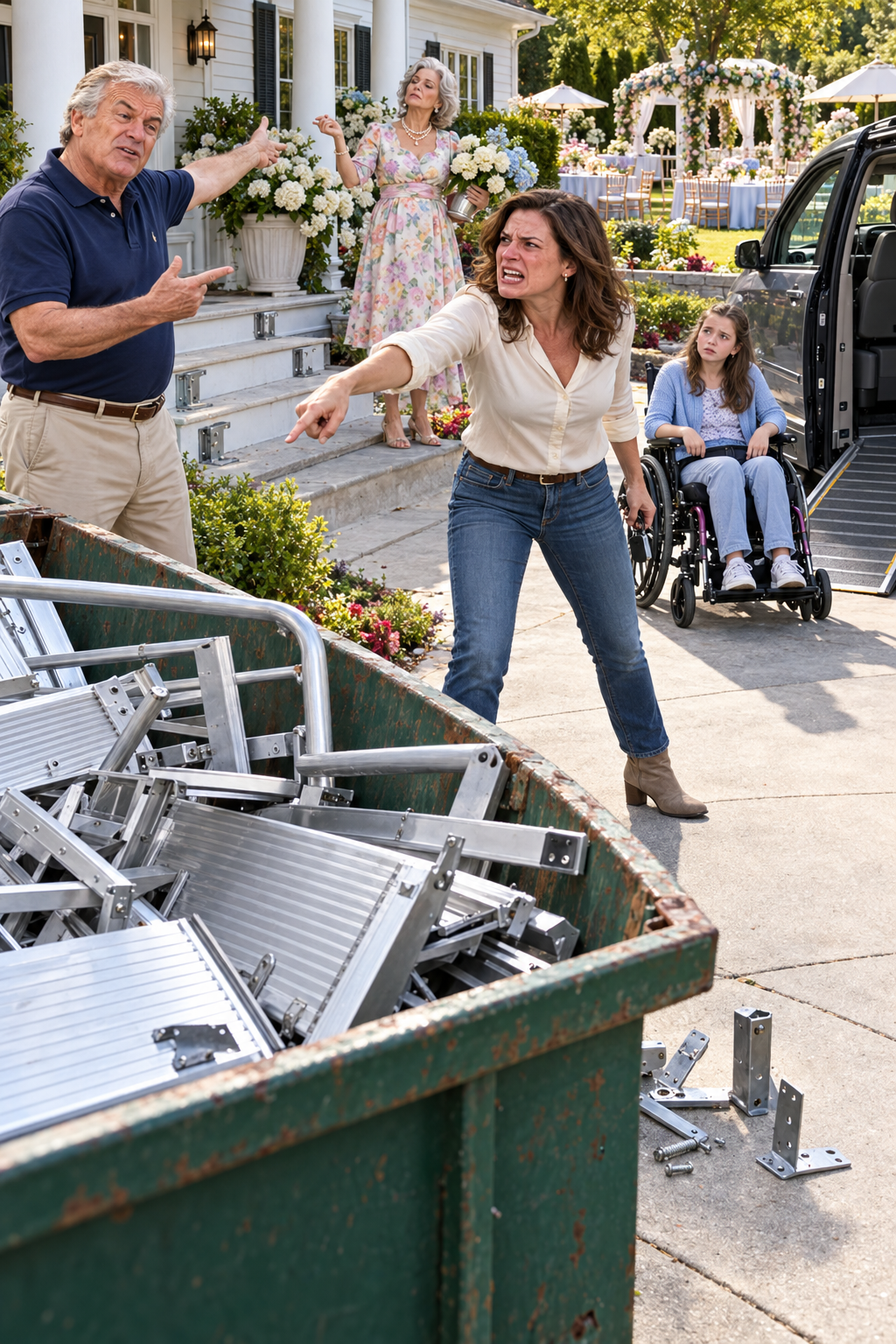
I Came Home With My Disabled Daughter And Found Her $4,800 Wheelchair Ramp Broken In A Dumpster! Dad Said, “Your Mom’s Garden Party Is Saturday—It Looked Ugly!” Furious, I Said A Few Words And Left With My Daughter… Six Weeks Later, Mom Came Crying…
The day my parents destroyed the $4,800 wheelchair ramp I bought for my nine-year-old daughter, my father told me to carry her up the steps while my mother arranged flowers for her guests. My daughter asked if she’d done something wrong. I took photographs, said we were leaving, and drove away without raising my voice. Four days later, I discovered a real estate listing for my parents’ house. The photographs included my daughter’s bedroom, and the description said our apartment was already vacant.
## Part 1: The Afternoon My Daughter Lost Her Way Home
The first thing I noticed was the smell of freshly cut grass. My father had always been particular about his lawn, but that Thursday afternoon, the entire front yard looked as though somebody had prepared it for a magazine photographer. The hedges were trimmed into neat rectangles, white flowers lined the walkway, and two enormous ceramic planters stood beside the front steps. What wasn’t there was the aluminum wheelchair ramp my daughter had used every day for almost three years.
I sat behind the steering wheel for several seconds, trying to make sense of the empty space beside the porch. My nine-year-old daughter, Rosie, was in the back seat, still wearing the purple sweatshirt she’d put on for her appointment at the children’s rehabilitation clinic that morning. She had spina bifida, and although she had strong arms and an impressive ability to maneuver her wheelchair, stairs remained stairs. There were four concrete steps between the driveway and the entrance to the apartment we rented from my parents.
“Mom, why are we stopping?” she asked.
I looked toward the garage and saw something silver sticking out of a large green dumpster. A length of aluminum railing lay across the top, bent sharply in the middle, and a familiar strip of yellow nonslip tape dangled from its edge. I’d applied that tape myself after Rosie complained that the original surface became slippery during Ohio winters. Suddenly, I understood what I was looking at.
“Stay here for a minute, sweetheart,” I said.
My father, Gordon Rowe, stood beside a landscaping truck, discussing something with a man holding a clipboard. Dad wore his usual khaki shorts and a spotless golf shirt, the uniform he adopted whenever he wanted strangers to believe he spent his days managing investments rather than worrying about bills. He saw me approaching and gave me the same distracted expression he’d worn when I interrupted him during football games as a child. I stopped beside the dumpster and asked why Rosie’s ramp was inside it.
“We had it taken down,” he said. “Your mother’s garden party is Saturday, and it was making the whole entrance look like a loading dock.”
I stared at him, waiting for the second half of the explanation. There had to be a temporary ramp somewhere, perhaps behind the house, or some arrangement I hadn’t been told about. Instead, he nodded toward the empty flower bed and told the landscaper to make sure the replacement shrubs arrived before noon Friday.
“Dad, Rosie can’t climb those steps.”
“Then help her.”
“How?”
He sighed as though I were asking him to solve an unnecessarily complicated problem. “Jenna, you’re her mother. Pick her up and carry her inside.”
My mother appeared in the doorway before I could answer. Vivian Rowe was sixty-one, carefully dressed in white linen pants and a pale blue blouse, with her hair styled in a smooth blond bob that required an appointment every six weeks. She held a glass vase filled with hydrangeas and seemed more concerned about getting water on her sleeves than about the dismantled ramp. When I asked whether she’d agreed to the removal, she looked mildly offended.
“Of course I knew,” she said. “We’ve been discussing the entrance for months. People notice these things, Jenna.”
“People also notice when a child can’t get into her own home.”
Mom glanced toward my car. “Please don’t turn this into one of your speeches about accessibility. We know Rosie needs extra help, but the entire property shouldn’t have to look like a hospital.”
Behind us, the landscaper had stopped writing. His expression changed when he saw Rosie through the window, and I noticed him looking from her wheelchair to the broken pieces in the dumpster. My father followed his gaze and lowered his voice, suddenly conscious of having an audience. “This is family business,” he told the man.
Rosie called my name again. I walked back to the car, opened the rear door, and helped her transfer into her chair, a process we’d practiced hundreds of times until she could do most of it without assistance. She looked toward the front steps and then at the dumpster, where part of the handrail still carried a small sunflower sticker she’d attached the previous summer. Her face changed in a way I will never forget.
“That’s mine,” she whispered.
I crouched beside her. “I know.”
“Did it break?”
“No, honey.”
She turned toward my parents. “Grandpa, where’s my ramp?”
Dad put his hands on his hips. “We needed to make the yard presentable, Rosie. Your mom will figure something out.”
Rosie looked at the steps for a long moment. “But how am I supposed to get inside?”
Nobody answered her.
My mother eventually said, “Don’t look so upset, sweetheart. It’s only four steps.”
I wanted to ask her to sit in Rosie’s wheelchair and demonstrate how insignificant those four steps were. I wanted to remind my father that he’d signed the installation agreement himself, and that I’d paid $4,800 for a professionally installed ramp because Rosie deserved to enter her home without being carried like luggage. Instead, I noticed my daughter’s fingers tightening around the rubber grips of her wheels.
“Rosie,” I said, “we’re not going inside today.”
She looked frightened. “Where are we going?”
“Somewhere you can get through the front door.”
My father stepped closer. “Don’t make a spectacle of this.”
I took out my phone and photographed the steps, the exposed concrete where the ramp supports had been anchored, the broken aluminum sections, and the company name on the dumpster. I photographed the landscaper’s truck as well, although I made sure not to include his face. Then I took a short video, walking from the driveway toward the entrance so nobody could later claim there had been another accessible route.
Mom’s voice sharpened. “Are you seriously documenting your own parents?”
“Yes.”
“Jenna, put that thing away. You’re embarrassing yourself.”
I lowered the phone and looked at both of them. “You removed my daughter’s way into her home. We’re leaving.”
That was all I said.
I helped Rosie into the car and folded her wheelchair into the cargo area of my aging SUV. As I fastened her seat belt, she looked past my shoulder toward the house she’d called home since she was six. My father had already turned back to the landscaper, and my mother was rearranging her flowers as if the conversation had been an inconvenient interruption.
We were halfway down the street when Rosie spoke again.
“Mommy, did Grandma take it away because she doesn’t want me there anymore?”
I kept my eyes on the road because I was afraid she’d see what was happening to my face.
“No, sweetheart. You didn’t do anything wrong.”
“That’s not what I asked.”
She was right, and that hurt more than anything my parents had said. I couldn’t tell her that her grandparents loved her exactly as she was, because I’d just watched them destroy something essential to her independence for the sake of appearances. I also couldn’t let their cruelty become the way she understood herself.
“I don’t know what Grandma was thinking,” I told her. “But I know you’re not the problem, and I promise you won’t have to beg anybody to let you into your own home.”
At the next red light, I called my friend Marcy Bell, who lived about twenty minutes away in a ranch-style house with a level entrance. She answered on the third ring, listened to my explanation without interrupting, and said she’d put fresh sheets on the guest bed. Then she asked whether Rosie wanted pepperoni or cheese pizza.
“Both,” Rosie called from the back seat.
Marcy laughed, and for the first time that afternoon, my daughter smiled.
I thought we were leaving behind one unforgivably selfish decision. I didn’t yet understand that the missing ramp was only the first visible piece of something my parents had been arranging for weeks.
## Part 2: The Money I Gave Them Never Bought Us Respect
By the time we reached Marcy’s house, the anger I’d been holding together with both hands had turned into exhaustion. Marcy opened her door before I rang the bell, stepped aside so Rosie could roll through, and carried our overnight bags down the hallway. She’d known me since our first year at Columbus State, back when our biggest problems were overdue assignments and unreliable boyfriends. Now she was a divorced middle-school librarian with a small house, two cats, and the extraordinary habit of making room for other people’s emergencies without asking whether they were convenient.
Rosie immediately noticed a ceramic pumpkin on the living room shelf, even though it was April. Marcy explained that she’d forgotten to pack away her Halloween decorations, which Rosie found hilarious. Within twenty minutes, my daughter was at the kitchen table eating pizza and criticizing the anatomical accuracy of a cartoon dragon she’d drawn on a napkin. Watching her behave like an ordinary nine-year-old almost made me believe the afternoon hadn’t happened.
My name is Jenna Walsh. I was thirty-six that spring, and I worked as a medical billing specialist for an outpatient clinic on the north side of Columbus. My job involved insurance codes, denied claims, payment records, and an endless supply of people who insisted a computer error was somebody else’s responsibility. I was good at it, partly because I’d learned to recognize when explanations didn’t match the paperwork. Unfortunately, I hadn’t applied that same skill to my own family.
My marriage to Rosie’s father, Ethan, had ended three years earlier. He wasn’t a monster, and he wasn’t especially interested in being a hero either; he had moved to Pennsylvania for work and gradually become the kind of father who remembered birthdays but needed reminding about appointments. His child support arrived regularly enough that I didn’t have to pursue him, but the daily responsibilities were mine. Finding a rental we could afford, in a good school district, with truly accessible entrances and a usable bathroom had seemed almost impossible.
That’s when my parents offered us their ground-floor suite.
The suite occupied a renovated section of their large suburban home, with a bedroom, a smaller room for Rosie, a kitchenette, and a bathroom that needed some adjustments. Dad called it a temporary solution until I got back on my feet. Mom said she was thrilled to have her granddaughter nearby, although she’d added that we should maintain separate routines so nobody felt crowded. I signed a rental agreement, paid a security deposit, and set up recurring transfers of $1,150 for rent and $280 for utilities.
It wasn’t charity, and I never treated it as charity.
The first major improvement was Rosie’s ramp. A local accessibility contractor measured the entrance, calculated the proper slope, and installed an aluminum system with sturdy railings and a landing large enough for Rosie to turn safely. My father approved the work in writing because the modifications required attaching supports near the porch. I paid the $4,800 invoice from money I’d saved while working extra shifts.
I remembered Rosie’s first trip up that ramp more clearly than I remembered most of my own birthdays. She’d insisted I stand back while she moved her wheelchair up the incline, stopping once to reposition her hands. When she reached the landing, she turned toward me with a grin so wide it made her cheeks bunch beneath her eyes. “I can come home by myself,” she announced.
For a while, I believed my parents understood what that meant.
The changes began with small things. Mom asked me to keep Rosie’s spare wheelchair cushion out of sight when her bridge friends visited. Dad complained that the ramp interfered with the flowers beside his porch, even though the contractor had specifically designed it to preserve most of the landscaping. At Thanksgiving, Mom positioned Rosie at the far end of the dining table because she said the wheelchair made it difficult for people to move between the chairs.
Each incident seemed too small to justify moving out, particularly when I was trying to save money. I defended them to Marcy, telling her they were older and uncomfortable with change. I told myself they were learning, even as Rosie quietly learned to ask whether her wheelchair was allowed in certain rooms.
Then there was the money.
Two years before the ramp was destroyed, a severe storm sent water into my parents’ basement. Dad called while I was processing claims at work, describing soaked drywall, ruined carpeting, and contractors demanding deposits. He said they needed $7,500 immediately and promised they’d return it once an insurance payment arrived. I transferred the money from my emergency fund before my lunch break ended.
The repayment never came. When I asked, Mom said insurance had covered less than expected and wondered why I was suddenly being so businesslike with my own parents. I dropped the subject because I couldn’t bear another conversation in which helping them was considered my obligation and asking questions was treated as an insult.
Their retirement plans became another source of financial pressure. They wanted a smaller property near Buckeye Lake, with a screened sunroom, a bright kitchen, and enough space for Dad to keep a fishing boat. Mom showed me photographs of white cabinets and wide lakefront windows, sometimes while Rosie sat beside us sketching birds. The house was always described as their reward for a lifetime of hard work, and I genuinely wanted them to have it.
I’d spent years putting money aside. I drove a twelve-year-old SUV, packed lunches instead of buying them, and accepted extra billing shifts whenever the clinic was short-staffed. I’d also postponed replacing our car with a more accessible vehicle because Rosie could still transfer independently, though the process was becoming more tiring as she grew. When my parents mentioned needing additional money for their retirement purchase and renovations, I offered to contribute up to $32,000 after reviewing the final costs.
Mom hugged me so tightly I could smell her expensive gardenia perfume. “You’re making our dream possible,” she said.
I’d meant the offer as a gift, not a contract. No money had been transferred, and I hadn’t signed anything committing me to a mortgage or purchase. Still, over the following weeks, my parents began talking about my savings as though the money already belonged to them. Mom would mention that my contribution was buying the sunroom, while Dad started discussing materials for a kitchen renovation he hadn’t even priced.
That Thursday night, after Rosie fell asleep in Marcy’s guest room, I sat at the kitchen table with my banking app open. My savings account showed a little more than $35,000, including the amount I’d planned to give my parents. I stared at the balance and thought about all the things Rosie and I had gone without so I could be useful to people who considered a wheelchair ramp an embarrassment.
“I’m not giving them the thirty-two thousand,” I told Marcy.
She set down her mug. “Were you planning to tell them tonight?”
“No. Tonight I need to figure out where we’re going to live.”
Marcy nodded and opened her laptop. She found several accessible rentals, though most were too expensive or too far from Rosie’s school. We made a list of properties to call, and I sent myself the photographs I’d taken so I’d have copies outside my phone.
Monday evening, four days after we’d left, Marcy called while I was helping Rosie with her homework. She sounded uncomfortable and asked whether my parents had mentioned putting their house on the market.
“They’re supposed to be buying a place near the lake,” I said. “Why?”
“Because I found their house online.”
She sent me a link.
The listing showed my parents’ carefully landscaped front entrance without the ramp. It described the property as a spacious home with a flexible ground-floor living area and “vacant possession available at closing.” When I reached the interior photographs, my stomach tightened.
One photograph showed Rosie’s bedroom, including the paper stars she’d taped above her desk.
Another showed her wheelchair parked against the wall beside the bed.
My parents had allowed strangers to photograph the rooms we were paying to occupy, and they’d told potential buyers those rooms would be empty.
There was something else beneath the listing photographs: a small notation showing that the property had gone under contract the previous Wednesday.
The day before my parents destroyed Rosie’s ramp.
## Part 3: The House Was Already Sold Before We Were Told
I read the listing three times before I understood the significance of the date. My parents hadn’t decided to sell their house after I withdrew my offer of financial help, and they certainly hadn’t made a sudden decision because of our argument. They had accepted an offer before Thursday afternoon, before the ramp went into the dumpster, and before Rosie sat in my car wondering whether her grandparents still wanted her around. Whatever else was happening, the removal had been planned while we were still paying rent.
I enlarged the photograph of Rosie’s bedroom. Her collection of colored pencils sat on the desk, her favorite stuffed fox was tucked against her pillow, and a drawing of a blue horse remained taped beside the window. Somebody had moved her wheelchair against the far wall, where she never left it because she couldn’t reach the bed from there. The photograph hadn’t been taken by someone standing casually in the doorway; the angle showed that the photographer had entered the room and positioned a camera beside the closet.
“When were these taken?” Marcy asked over the phone.
“I don’t know. That sweater on the chair is the one she wore Monday.”
“Did your parents say anyone was coming into the apartment?”
“No.”
“Then this wasn’t an accident.”
After hanging up, I checked my messages from the previous two weeks. Mom had asked about our medical appointments several times, including the exact time we’d leave on Thursday and whether Rosie would be back before dinner. At the time, I’d assumed she was thinking about household schedules. Reading those messages now, I noticed that she’d also asked whether I would be working late Monday and Wednesday.
I didn’t sleep much that night. Every time I closed my eyes, I pictured my mother opening Rosie’s bedroom door and inviting strangers inside while we were away. I remembered how carefully Rosie arranged her stuffed animals each morning, leaving just enough room beside the bed to maneuver her chair. The idea that somebody had rearranged her belongings to make the room look more appealing to buyers made me angrier than the photograph itself.
Tuesday morning, I called an attorney named Elena Torres. Marcy had used her firm during a dispute with a former landlord, and Elena agreed to speak with me that afternoon. I arrived carrying a folder containing our rental agreement, ramp installation paperwork, payment records, screenshots of the listing, and photographs of the dumpster. I’d organized everything chronologically, which was how I handled confusing problems at work when people were determined to confuse them further.
Elena was in her early forties, with short dark hair and a habit of listening without filling silences. She read the agreement first, paying particular attention to the provision allowing approved accessibility modifications and the section requiring reasonable notice before entry. Then she reviewed my father’s written approval of the ramp installation. When she reached the photographs, she leaned back and asked whether my parents had ever provided a replacement means of access.
“No.”
“Did they offer to reinstall the ramp?”
“No.”
“Did they give you advance notice?”
I shook my head.
She placed the photographs beside the rental agreement. “Ownership of the property doesn’t automatically allow a landlord to destroy a tenant’s belongings or ignore the lease. There may also be fair housing protections relevant to the accessibility modifications, depending on the property and circumstances. We need to examine the details before deciding which claims apply.”
I told her about the listing, and she asked whether I had consented to photographs being taken inside the suite. When I said no, she wrote something on her legal pad and requested the original screenshots with the web addresses visible. She explained that the false description of the apartment as vacant might matter significantly if my parents had entered into a sales contract requiring them to deliver the property without occupants. She also warned me not to interpret a suspicious listing as proof of every motive until we had more evidence.
“What I can tell you,” she said, “is that you have a legitimate reason to protect your daughter’s access, your property, and your tenancy. The best thing you can do is remain careful and factual.”
I told her about the $32,000. Elena asked whether I’d already transferred it, and I said the money was still in my savings account. She looked relieved. “Don’t move that money for their benefit while this is unresolved, and don’t sign documents they send without reviewing them.”
For the first time since Thursday, I felt something other than fear and anger. I felt organized.
That evening, my father called. I let it go to voicemail, and the message came through while Rosie was practicing multiplication at Marcy’s kitchen table. He sounded annoyed rather than concerned.
“Jenna, your mother tells me you’ve been looking for a lawyer. This is getting ridiculous. We can put a portable ramp there if that’s what you want, but you’re going to have to stop acting like we committed some terrible offense. Call me.”
I didn’t respond. A portable ramp might have been an appropriate temporary solution if they’d arranged it before removing the permanent one, but offering it five days later didn’t erase what had happened. More importantly, the message contained no apology to Rosie and no explanation for entering our rooms.
The following morning, I received a call from Beth Palmer, the real estate agent whose name appeared on the listing. I’d sent her a brief email the previous evening, explaining that I was the lawful tenant of the ground-floor suite and asking when the photographs had been taken. Beth sounded cautious, as though she understood that an ordinary house sale had suddenly become complicated.
“Your parents described the apartment as an informal family arrangement,” she said. “I wasn’t aware you had a written lease.”
“Did they tell you we were moving?”
“They indicated the space would be available to the purchasers at closing.”
“That’s not what I asked.”
She paused. “My understanding was that you’d agreed to relocate.”
I looked at the calendar beside my desk. My parents hadn’t even told me they were selling, let alone asked me to move. Beth explained that the accepted offer was contingent on inspections and financing and that the buyers wanted to occupy the entire property. The preliminary closing date was near the beginning of summer.
“Was my daughter’s ramp a problem for the buyers?” I asked.
“I can’t speak for their preferences.”
“Did my parents ask you to photograph the house without it?”
Another pause. “I think your attorney should communicate with the sellers’ attorney.”
Before ending the call, Beth confirmed that the bedroom photographs had been taken Monday afternoon. My mother had arranged access while Rosie was at school and I was at work. There was no misunderstanding to hide behind; she’d deliberately chosen a time when we couldn’t object.
Elena prepared a letter demanding that my parents preserve relevant records, explain the removal, and communicate through counsel about access to our belongings. She also began examining the tenancy and the available remedies. Meanwhile, Marcy contacted a housing advocate through the local disability resource center and obtained recommendations for accessible rentals, including one small house that hadn’t appeared on the main listing websites.
On Thursday, exactly one week after the ramp disappeared, a new email arrived from the landscaping company. I’d contacted them with a factual request for information about the dismantled equipment, including whether any usable components had been stored. The owner, Luis Navarro, said he wanted to speak with me because he’d learned the ramp belonged to a child who lived at the property.
We talked during my lunch break. Luis explained that his crew had initially assumed the ramp was being replaced, and he’d questioned why the owners wanted a functional accessibility structure destroyed. He said my father had insisted the pieces be cut down and disposed of rather than stored.
“That’s unusual for equipment in that condition,” Luis told me. “I asked him twice if he wanted to keep it.”
“Why didn’t he?”
Luis hesitated. “I can send you the written work order.”
A few minutes later, I received a photograph of the signed instruction sheet. The removal had been ordered almost three weeks before our appointment, and my father’s signature appeared beneath a paragraph specifying that the ramp materials were not to remain on the property.
There was also a handwritten note beside the scheduled completion date.
“Must be gone before buyer walkthrough. Occupant has been advised.”
My father had arranged to destroy Rosie’s ramp before he’d ever mentioned a garden party.
And he’d told the contractor that I knew.
## Part 4: The New House Offered Something My Parents Never Did
The small rental house was on a quiet street in Worthington, twenty minutes from Marcy’s place and close enough to Rosie’s school that we wouldn’t have to transfer her. It had a red front door, a narrow backyard, and a kitchen that looked as though it hadn’t been renovated since the early 1990s. The cabinets were ordinary honey-colored wood, the countertops were laminate, and the refrigerator made an alarming rattling sound whenever its motor started. I loved it almost immediately.
The front entrance had a level concrete walkway, with a threshold low enough for Rosie to cross independently. The bathroom had a widened doorway, grab bars, and enough turning space for her wheelchair, and the landlord had installed a roll-in shower for a previous tenant. There were a few details we’d need to adjust, but nothing resembled the expensive structural work I’d feared. When the property manager, a woman named Dana, showed us around, she talked directly to Rosie rather than asking me questions about her as if she weren’t present.
“Do you want to see the backyard?” Dana asked.
Rosie glanced at me. “Is there a step?”
“Nope. French doors with a little threshold strip.”
Rosie rolled toward the doors and examined the opening herself. She crossed it, turned around on the small patio, and looked up at me with a smile I hadn’t seen since the Thursday everything changed. “Mom, I could have a garden here.”
“One that doesn’t mind wheelchairs,” I said.
She laughed. Dana showed her a patch of soil beside the fence where the previous tenant had grown tomatoes, then asked whether she preferred flowers or vegetables. Rosie said she wanted strawberries because growing tomatoes sounded like homework. I realized I’d been holding my breath for most of the visit, waiting for someone to explain why something she needed would be inconvenient.
The rent was $1,625 a month, higher than what I’d been paying my parents after accounting for utilities. It would require some careful budgeting, but stopping the retirement contribution and avoiding the endless extra expenses at my parents’ house made the numbers possible. Marcy helped me calculate moving costs, deposits, and the money we’d need for minor accessibility adjustments. I decided to keep most of my savings untouched until we were settled.
Dana accepted my application after checking my employment and rental history. She did mention that my parents’ phone number appeared as my previous landlord contact and asked whether there was someone else who could verify regular rent payments. I provided three years of bank transfers instead, along with a copy of the lease. She glanced through the records and said the documentation was more useful than a vague recommendation anyway.
I nearly cried in her office.
The same afternoon, my mother sent me a photograph of the kitchen cabinets she’d selected for the lake house. They were white with brushed brass handles, and the message beneath them read, “These won’t stay reserved forever. Can we please put this silly argument behind us?”
I stared at the message until my screen dimmed.
She hadn’t asked where Rosie was sleeping. She hadn’t asked whether we’d found an accessible place, whether I’d missed work, or whether my daughter was frightened. Instead, she’d sent me cabinet photographs as though the ramp were an unfortunate disagreement about household decorating.
I replied with a short email explaining that Rosie and I were moving, that Elena would handle communication about the destroyed ramp and our tenancy, and that I would no longer be contributing to their retirement purchase or renovations. I reminded them that the money had never been transferred or legally committed. Then I sent the message and returned to packing the things Marcy had helped us retrieve from storage.
My father called eleven minutes later.
“What do you mean you’re not giving us the money?”
“I mean I’m not giving you thirty-two thousand dollars.”
“Jenna, we have contracts. We’ve made decisions based on your promise.”
“Then you made those decisions before you had the money.”
He swore under his breath. In the background, I heard my mother asking whether he was telling me about the kitchen, and something in his voice changed when he answered her. He sounded nervous, a tone I rarely heard from a man who’d spent my entire childhood insisting that financial problems were caused by other people’s carelessness.
“We’re already committed to the lake property,” he said.
“Then you’ll have to find another way to pay for it.”
“You’re going to ruin our retirement because of a ramp?”
“No, Dad. I’m choosing to spend my savings on a safe home for my daughter.”
He hung up.
For the next several days, I divided my time between work, school transportation, rental paperwork, and conversations with Elena. My parents allowed me to collect essential belongings through a prearranged appointment, but I insisted that Marcy accompany me. Rosie stayed at Marcy’s house with a neighbor she trusted, and I went back to the suite for the first time since the ramp had been removed.
The interior looked subtly different. My mother had taken down the family photographs I’d hung near the kitchenette, and somebody had placed a scented candle on the counter. Rosie’s bedspread had been smoothed with the precision of a hotel room, and her stuffed animals were lined against the pillows. The bedroom looked less like a child’s private space than a room prepared for inspection.
Mom stood near the doorway, watching us pack.
“I don’t understand why you’re making this so permanent,” she said. “We could have worked something out.”
“You could have talked to me before tearing down the ramp.”
She looked toward the window. “Your father thought you’d eventually realize that living here wasn’t practical forever.”
“Then he could have said that.”
“Jenna, sometimes parents have to make difficult decisions.”
I put Rosie’s art supplies into a cardboard box and sealed it without answering. Mom waited for an argument, but I had no interest in defending my daughter’s right to use a front door for the hundredth time. When she finally walked away, Marcy looked at me and quietly asked if I was all right.
“I’m starting to understand how often I’ve confused being useful with being loved,” I told her.
We carried two loads to the car before my father appeared. He examined the boxes with open disapproval and asked whether I intended to take the small microwave I’d bought for the kitchenette. When I said yes, he told me it had become part of the apartment. I showed him the original purchase receipt, and he waved his hand as though I were being petty.
That evening, Elena called with an update. The landscaping company had confirmed the equipment was dismantled at my parents’ direction, and the photographs supported a claim for the loss of the ramp and other possible damages. She was also preparing a formal request for information about unauthorized entry and the handling of our tenancy during the sale. I thanked her and started checking my work email before making dinner.
An unfamiliar number appeared on my phone a few minutes later. The caller introduced herself as a loan processor with a regional mortgage lender and asked whether I was Jenna Walsh. She explained that she was reviewing documentation for a transaction involving Gordon and Vivian Rowe and needed to verify a family contribution toward their purchase.
“I haven’t contributed any money,” I said.
There was a silence.
“Our file includes a gift letter for thirty-two thousand dollars,” the woman replied. “It identifies you as the donor.”
“I didn’t sign any gift letter.”
The woman stopped speaking for several seconds. Then she asked me to confirm my email address and said the document could be sent through the lender’s secure system for verification.
I opened it twenty minutes later.
At the bottom of the page, beneath a statement promising an unconditional financial gift, was my full name.
And beside it was a signature that looked remarkably like mine.
## Part 5: My Mother Had Put My Name on Something I Never Signed
The signature was close enough to mine that somebody glancing at the document might have accepted it without question. The first letter of my name had the same exaggerated loop I’d developed in high school, and the last few letters were joined together in the hurried way I signed routine forms at work. But the final stroke angled upward, while mine always turned down, and the date beside it was a day I’d spent in the clinic dealing with a billing system outage. I hadn’t been anywhere near my parents or their mortgage paperwork.
The letter identified me as an adult daughter providing an unconditional gift of $32,000 toward my parents’ purchase of a retirement property near Buckeye Lake. It said the money wouldn’t need to be repaid and included a statement that the funds were available from my personal savings. My parents’ names appeared in the borrower section, and my mother’s email address was listed among the contacts. Someone had taken the offer I’d made during a conversation in her kitchen and turned it into an official-looking financial commitment.
I forwarded the document to Elena immediately.
She called me less than an hour later and asked whether I’d ever authorized my mother or father to sign anything on my behalf. I told her I hadn’t, and that I’d never even seen the form until the loan processor contacted me. Elena asked me to preserve the email, the original attachment, and the information identifying the sender. Then she said something that made the room feel unusually quiet.
“This is no longer just about the ramp.”
I sat down at Marcy’s kitchen table. “Could they actually take my money?”
“Not simply because your name is on this form. The money is still in your account, and we’re going to make sure the lender understands that you haven’t authorized a gift. But presenting a document with another person’s signature raises serious questions, and you need to protect yourself from any misunderstanding about your involvement.”
She advised me to provide a clear written statement directly to the lender, explaining that I hadn’t signed or approved the letter and had not transferred the funds. We prepared the statement together, without accusations I couldn’t substantiate, and asked the lender to preserve the document and related records. I also contacted my bank to review account security and make sure nobody else had access to my savings.
The next morning, I called my mother.
It was the first time I’d initiated contact since the ramp was removed. She answered cheerfully, apparently interpreting my name on the screen as evidence that I was ready to reconcile. I could hear dishes clinking and the faint sound of a television in the background.
“Jenna, sweetheart. I’ve been thinking about calling you. Your father says the lender has been asking for some additional paperwork, and we really need to get that settled.”
“Mom, did you sign my name on a gift letter?”
The dishes stopped clinking.
“What letter?”
“The letter saying I’m giving you thirty-two thousand dollars for your new house.”
She exhaled sharply. “Oh, for heaven’s sake. You told us you were giving us that money.”
“I asked whether you signed my name.”
“Your father was trying to keep everything moving. We had a deadline.”
“Mom.”
There was another silence, followed by the soft scrape of a chair.
“I completed the form,” she said. “You were supposed to come over and sign it, but then you started this business about the ramp.”
I pressed my fingers against my forehead. “Did you sign my name?”
“I put your name where it belonged. I wasn’t stealing anything from you.”
“Those are two different things.”
She became defensive almost immediately. She reminded me that she’d helped with Rosie when I worked late, that my father had given us somewhere to live after the divorce, and that families were supposed to keep their promises. She said the lender needed to see that the contribution was genuine, and because I’d already offered the money, she considered the form an administrative detail.
“An administrative detail doesn’t require you to imitate my signature,” I said.
“Oh, don’t be dramatic. You’ve been making everything sound so sinister.”
I looked at the statement Elena had helped me prepare. “I’ve told the lender the signature isn’t mine.”
My mother inhaled so sharply I heard it through the phone.
“You did what?”
“I told them the truth.”
“Jenna, you have no idea what you’ve just done.”
For a moment, I expected her to ask whether I was frightened or angry. Instead, she began explaining that they had a contract on the retirement property, that the sellers were expecting them to close, and that Dad had already paid for several inspections and preliminary expenses. She said their existing house would provide much of the purchase money once sold, but the additional contribution helped make the financing work. Without it, she warned, the lender might require changes they couldn’t afford.
“Then you shouldn’t have submitted a document I didn’t sign,” I said.
She began crying. I had heard that particular kind of crying throughout my childhood, usually when I’d refused something she expected of me. It was loud enough to communicate distress but somehow controlled enough for her to keep explaining what I needed to do.
“Your father has worked his whole life for this,” she said. “Can’t you think about somebody besides yourself for once?”
I thought about Rosie asking whether she was allowed to use the dining room when my mother’s friends visited. I thought about the winter afternoon when she’d slipped while transferring into her chair and apologized for the noise before asking if I could help her. I thought about how often I’d told her not to take up less space just because somebody else seemed uncomfortable.
“I’m thinking about Rosie,” I said. “You should try it.”
Mom hung up.
That afternoon, I took Rosie to a park near the new rental house. It was an unusually warm day, and the playground had an accessible swing and smooth pathways that looped around a pond. Rosie brought her sketchbook and settled beside me on a bench while ducks wandered through the grass looking for food. She drew one with an enormous beak and announced that it looked exactly like Grandpa when he was angry.
I laughed before I could stop myself. Rosie laughed too, then became quiet.
“Are we ever going back to Grandma’s house?”
“Only to collect the rest of our things.”
“Will Grandma be mad forever?”
“I don’t know.”
She traced a line on her drawing with a blue pencil. “I don’t want them to be sad because of me.”
I turned toward her. “Rosie, grown-ups are responsible for their own decisions. Grandma and Grandpa decided to remove your ramp, and I decided we needed somewhere safer to live. You didn’t cause any of that.”
“But what if they lose their new house?”
The question startled me because I hadn’t discussed the mortgage paperwork with her. She explained that Grandma had called her tablet the previous evening while I was showering. Mom had told her that our family was going through a difficult time and that everybody needed to help make things right. She’d also asked Rosie whether she missed her grandparents.
My daughter had said yes.
Then my mother had told her to remind me how much our family meant to her.
I felt my chest tighten. Rosie wasn’t only losing the home she’d known for three years; she was being recruited into an argument she was too young to understand. I took her tablet home that afternoon, adjusted the contact settings, and explained that adults weren’t allowed to ask her to solve their money problems. If Grandma wanted to speak with her, she would have to speak with me first.
That evening, my father sent a text demanding to know why I’d embarrassed my mother in front of the lender. He wrote that a decent daughter would have called him before involving outsiders. I forwarded the message to Elena and didn’t reply.
Twenty minutes later, another message arrived.
This one contained no anger, only a short sentence.
“The buyers have found a problem with the house. Your mother says you need to fix what you started.”
I stared at the screen, trying to understand how their property sale had become my responsibility.
The following morning, Elena received a letter from the attorney representing the buyers. It contained photographs taken during the home inspection, including several of the doorway where Rosie’s ramp had stood.
The wood beneath the entrance was dark with moisture damage, and sections of the exterior framing appeared badly deteriorated.
The buyers wanted proof that the old flooding problems had been properly repaired.
My parents had told me those repairs were why they needed my $7,500 two years earlier.
## Part 6: The Ramp They Destroyed Exposed What They Had Hidden
When I first saw the inspection photographs, I didn’t recognize the entrance. Without the ramp covering part of the lower wall, the area beneath the door looked damaged and unfinished. Sections of trim had been removed, revealing darkened wood, crumbling sealant, and a narrow gap where water could apparently enter during heavy rain. One photograph showed a moisture meter pressed against the framing, its display indicating elevated moisture.
Elena explained that the buyers’ inspector had identified concerns requiring further evaluation, including drainage near the former basement entrance and possible deterioration around the ground-floor suite. She was careful not to claim that the entire house was unsafe or that my parents had committed fraud. What mattered was that the inspector had found evidence inconsistent with the fully repaired condition my parents apparently represented to the buyers, and those issues could affect the sale.
I remembered the basement flood two years earlier. Dad had called me at work, claiming a contractor wouldn’t begin until he paid a substantial deposit. After I transferred $7,500, he’d thanked me and said the insurance money would eventually make everything right. A few weeks later, the basement smelled faintly of fresh paint, and Mom proudly showed me a newly installed carpet that looked almost identical to the old one.
I’d never seen an invoice for the actual repairs.
Now I asked Elena whether the buyers’ questions were related to that incident. She said they might be, but we needed documents rather than assumptions. The inspection report alone couldn’t establish when the damage occurred or what work had been done. She suggested that I search my records for anything showing the scope of the original repairs, particularly if my parents had used my loan to explain their financial situation.
That evening, I went through two years of old emails. I found my father’s original message asking for money, followed by a photograph of a contractor’s estimate he’d sent to justify the amount. The estimate included replacing drywall, treating moisture-damaged areas, improving drainage, and repairing a deteriorated exterior door frame. The total was just over $7,000, which explained why Dad had requested $7,500.
What I couldn’t find was proof that the work had been completed.
I remembered asking my father about the drainage once, after a heavy rain left a puddle beside the ramp. He’d told me the contractor had handled everything and that I needed to stop worrying about his property. I’d believed him because he’d always presented himself as someone who understood construction better than I did. Sitting at Marcy’s table with the old estimate beside the inspection photographs, I realized I’d mistaken his confidence for competence.
Meanwhile, the move was approaching. The new rental house was ready, and the furniture movers were scheduled for Saturday morning. Elena arranged a final written access agreement with my parents so we could collect our belongings without another confrontation. The agreement included a clear inventory process, and I planned to photograph the rooms before leaving.
The night before moving day, Rosie asked whether she could help label the boxes. We sat on Marcy’s living room floor while she decorated cardboard cartons with drawings of their contents: a giant sock for clothes, a book with teeth for school supplies, and a crooked television that looked more like a toaster. When she reached the box containing her stuffed animals, she stopped drawing and asked whether they would still smell like her old bedroom.
“Probably for a while,” I said.
“Good. I liked my room.”
“I know you did.”
She pressed a sticker onto the box. “I just didn’t like feeling like I was in the way.”
I looked at her for a long moment. She returned to drawing, apparently unaware she’d said anything extraordinary. That was when I understood how much of her childhood had already been shaped by people who treated her independence as an inconvenience. I couldn’t go back and change every uncomfortable dinner or whispered remark, but I could make sure she stopped learning that lesson at home.
Saturday morning arrived with low clouds and the smell of rain. Two movers pulled their truck into my parents’ driveway at eight, and Marcy followed in her car. My father stood on the porch holding a cup of coffee, watching us with the expression of a man waiting for someone to recognize his authority. He didn’t offer to help.
“You’re really doing this,” he said as I unlocked the suite.
“Yes.”
“Your mother barely slept last night.”
“I’m sorry she’s upset.”
“Apparently not sorry enough to stop.”
I continued inside. The movers loaded furniture while Marcy checked boxes against our inventory, and I packed the last things from Rosie’s room. My mother appeared around ten, dressed in a gray cardigan and carrying a small framed photograph of Rosie from kindergarten. She offered it to me with trembling hands.
“You forgot this.”
“Thank you.”
Her eyes moved toward the empty bedroom. “It wasn’t supposed to happen like this.”
I waited.
“Your father thought you’d understand eventually,” she continued. “We were trying to make a clean start. A smaller house, less maintenance, fewer complications.”
“Was Rosie one of the complications?”
Mom looked offended. “Don’t twist my words.”
“Then tell me what you meant.”
She glanced toward the movers. “Not here.”
That had always been her answer when a conversation threatened to expose something unpleasant in front of other people. We could discuss it later, quietly, where she could question my tone or remind me how much she’d sacrificed as a mother. This time, I didn’t follow her into the kitchen.
Before leaving, I photographed the empty rooms, the appliances I’d purchased, and the doorway where the ramp had stood. I recorded the condition of the suite, returned the keys through the agreed process, and took a final look at the small window beside Rosie’s old bed. I’d spent three years believing that room represented security, and it hurt to realize how easily my parents had turned it into leverage.
Dad followed me to the driveway.
“Once you calm down, you’ll understand what this has cost us,” he said.
I turned toward him. “I understand what it cost Rosie.”
“You’re throwing away your family.”
“No, Dad. I’m taking care of mine.”
He looked as though he wanted to say more, but the movers were standing nearby, waiting for instructions. I got into my car and drove away.
At our new house, Rosie was waiting with Marcy’s neighbor, who’d brought her over after the movers arrived. She’d positioned herself on the front walkway and insisted on carrying a small box in her lap. When I parked, she called out that she’d already tested the front door three times and could open it without assistance.
I watched her roll into the living room, carefully avoiding a stack of boxes. The floorboards creaked beneath her wheels, and sunlight fell across the faded kitchen cabinets. Nothing about the place was impressive by my mother’s standards, but it was the first home in years where I didn’t have to consider whether my daughter’s presence would offend the person who owned it.
Three days later, my father called again. This time, he didn’t shout.
“The buyers are threatening to walk,” he said.
I sat down on an unpacked dining chair. “Why?”
“The inspection. The repairs. All that nonsense about the apartment being occupied.”
“Those aren’t things I invented.”
He breathed heavily into the phone. “They want documentation we don’t have.”
“Then get it from the contractor.”
A long silence followed.
Finally, he said, “We didn’t have the contractor do all the work.”
I looked toward the kitchen, where Rosie was arranging cereal boxes on a shelf she could reach. My father continued speaking, his voice much quieter now.
He explained that after the flood, they’d replaced the most visible damaged materials but postponed several expensive repairs. The contractor’s original estimate had been higher than expected, and Dad had convinced himself that the remaining problems could wait until they sold the house. He admitted that some of the money I’d sent hadn’t gone toward the repairs at all.
“Where did it go?” I asked.
He hesitated.
“We needed to keep the home-equity payments current.”
I closed my eyes.
For two years, my parents had allowed me to believe I’d saved their house from water damage. In reality, they’d used part of my money to cover financial obligations they hadn’t told me about, while the underlying problems continued.
And now the repairs they’d postponed were threatening the sale they needed to finance their retirement.
## Part 7: Their Retirement Fell Apart Because of Their Own Decisions
Six weeks after Rosie and I moved out, I received a letter from Elena outlining the financial consequences of what my parents had done. She had gathered the rental records, photographs, landscaping documents, and communications concerning the unauthorized removal of the ramp. She’d also requested reimbursement for the destroyed equipment, the security deposit, and documented losses connected to our forced relocation. My parents’ attorney had responded with a proposal for negotiations rather than immediately contesting everything.
I read the letter twice while sitting at my kitchen table. Outside, Rosie was helping Marcy plant strawberries in a wooden garden bed we’d purchased from a hardware store. The girls had already named the plants, and one unfortunate seedling had been christened Sir Strawberry the Third. It was an ordinary Saturday afternoon, which made the letter feel like news from a life I was finally beginning to leave behind.
Elena called shortly afterward. She explained that my parents were under significant financial pressure, partly because their home sale had collapsed after the buyers raised unresolved concerns about the property’s condition and the accuracy of information provided during the transaction. Their buyers had withdrawn under the applicable contingencies, and the listing had been taken off the market while my parents considered repairs. The sellers of the retirement property had also refused another extension after my parents couldn’t demonstrate that their financing would be ready.
The retirement house was gone.
My parents hadn’t lost it because I reported a forged signature or because I refused to hand over my savings. They’d lost the financing they expected from me, failed to complete the sale of their existing house, and discovered that years of postponed repairs couldn’t be hidden behind fresh paint and landscaping. The removal of Rosie’s ramp had exposed part of the damaged entrance, prompted closer scrutiny, and created a documented dispute concerning a tenant they’d already promised would be gone.
Their problems were connected because their decisions were connected.
Elena told me that the lender had documented my objection to the gift letter and was no longer treating my proposed contribution as available funds. She couldn’t tell me whether the matter would lead to any further investigation, and she advised me not to speculate. My responsibility was simply to maintain accurate records and refuse to validate something I hadn’t authorized.
For a while, I sat quietly with the phone resting against my ear.
I’d spent my childhood watching Dad talk his way through financial trouble. When the car broke down, he blamed dishonest mechanics; when property taxes increased, he blamed politicians; when Mom overspent, he blamed stores for making ordinary purchases too tempting. He always seemed capable of turning a practical problem into a story in which someone else had disappointed him. Hearing that he couldn’t talk his way out of this one brought me less satisfaction than I’d expected.
Mostly, I felt tired.
That evening, Rosie asked if we could make homemade pizza. She stood beside the counter in her wheelchair, spreading sauce across uneven circles of dough while I chopped vegetables. We’d lowered the height of one small worktable, and she’d begun treating it like her personal restaurant. She insisted that every pizza needed a menu name, which was how our pepperoni dinner became the Supreme Volcano Disaster.
Halfway through cooking, she asked whether Grandma knew we’d moved all our things.
“Yes, sweetheart.”
“Does she know we have strawberries?”
“Probably not.”
Rosie considered that. “I think she’d like our garden.”
“She probably would.”
“Can we show her someday?”
I turned off the faucet and dried my hands. “Maybe we can send her a picture when we’re ready. But right now, Grandma and Grandpa need to understand some important things about how they treated us.”
Rosie nodded, although she didn’t look entirely satisfied. Children don’t stop loving people just because adults have behaved badly. She still remembered Grandma reading stories to her when she was little and Grandpa teaching her how to identify birds from their songs. Those memories were real, and I had no intention of pretending otherwise.
But I also wasn’t going to let those memories excuse what happened.
The following Wednesday, just after six in the evening, my parents appeared outside our new house.
I was folding laundry when the doorbell rang. Through the front window, I saw Dad standing beside my mother, both dressed more casually than I’d ever seen them during a visit. His face looked thinner, and the lines around his mouth had deepened. Mom clutched a purse against her stomach, her shoulders hunched beneath a beige sweater.
I stepped outside and closed the door behind me. Rosie was in her bedroom talking to Marcy on a video call, and I didn’t want her pulled into another confrontation.
“How did you find this address?” I asked.
Mom looked wounded. “Jenna, we’re your parents.”
“That’s not an answer.”
“Your father found it on some paperwork,” she said. “We didn’t come here to fight.”
Dad glanced toward the front entrance. His eyes moved over the level walkway and the wide doorway, but he made no comment about how easily Rosie could enter. He rubbed his hands together and said they’d been trying to reach an agreement with Elena, but the legal expenses were becoming difficult. He wanted to explain their financial situation before I made any final decisions.
“The lake house is gone,” he said.
“I heard.”
“The sellers wouldn’t wait any longer. We can’t qualify on the terms we expected, and the buyers backed out of our current place.”
“I’m sorry the purchase didn’t work out.”
Mom began crying almost immediately. “It wasn’t just a purchase, Jenna. It was everything we’d been working toward. Your father wanted to spend his retirement fishing. I wanted a sunroom where I could have coffee and watch the water.”
I thought about the sunroom photographs she’d shown me while Rosie sat quietly beside us. There had been room in those plans for a boat, expensive cabinets, and a view of the lake. Somehow, there hadn’t been room for a child to use a ramp.
Dad took a folded piece of paper from his pocket. It was a handwritten summary of their expenses, including their remaining home-equity balance, estimated property repairs, and the costs they’d incurred attempting to purchase the other house. He held it out as if a list of numbers would somehow make the situation more reasonable.
“If you could help us with even part of what you promised,” he said, “we might be able to get another property.”
I didn’t take the paper.
“Have either of you come here to ask how Rosie is doing?”
They looked at each other.
“Of course we care about Rosie,” Mom said.
“Then tell me how she is.”
Mom opened her mouth and closed it.
Dad looked toward the front door. “She’s fine. You said yourself the new place works.”
“You haven’t asked about her school, her appointments, or whether she’s still afraid somebody will take away her way into the house. You haven’t asked whether she understands why we left.”
“Jenna,” he said, “you’re making this into something it doesn’t need to be.”
I looked at him for several seconds. “Then help me understand something. Why did you remove the ramp before telling us you were selling?”
He shifted his weight. Mom stared at the driveway.
“The buyers wanted the property available,” Dad said.
“That’s a reason to discuss our lease, not destroy something Rosie depended on.”
Mom wiped her eyes. “We knew you’d resist moving. You always get so emotional whenever something involves Rosie’s needs.”
“So you removed the ramp to make us leave?”
Neither answered.
“Mom, I’m asking you directly.”
She looked at me, and for the first time that evening, the familiar injured expression disappeared. She looked annoyed, exhausted, and strangely impatient.
“We thought that once the entrance was changed, you’d understand that staying wasn’t going to work anymore,” she said. “We assumed you’d make other arrangements.”
I felt the full weight of the words settle between us.
They hadn’t misunderstood Rosie’s disability. They hadn’t forgotten that she needed the ramp. They’d known exactly what would happen when they removed it, and they’d counted on my ability to solve the problem for them.
“And the thirty-two thousand?” I asked. “You still expected me to give you that?”
Dad frowned. “We assumed you’d honor your promise.”
I looked from one parent to the other. “You expected me to move my daughter out because she’d become inconvenient, and then help pay for the house you were moving into?”
“That’s an ugly way to describe it,” Mom said.
“It’s what you just told me.”
She began crying again, but I no longer felt any pressure to make her stop.
I told them I wouldn’t be contributing to another property, withdrawing my statement to the lender, or abandoning my claim for the destroyed ramp. I said any further discussions about money or the tenancy would go through Elena. When Dad asked whether I understood what this would mean for our family, I told him I did.
Then I asked them to leave.
Mom reached toward my arm. “Jenna, please. We made a mistake.”
I stepped back.
“A mistake would have been forgetting to tell me the landscaper was coming. You made plans around removing something your granddaughter needed, and you expected me to pay for the consequences.”
Dad stared at the ground.
“Your retirement was never Rosie’s responsibility,” I said.
I went inside and locked the door.
Rosie was in the hallway, holding a drawing of a strawberry plant. She asked who’d been outside, and I told her Grandma and Grandpa had come to talk about grown-up matters.
“Are they still mad?” she asked.
“Probably.”
She thought for a moment. “Are you?”
I looked down at her. “A little. But I’m not scared of them being mad anymore.”
Rosie considered that answer, then handed me the drawing and asked whether we could hang it in the kitchen.
We did.
That night, I received one final email from my mother. It said she’d only been trying to give everybody a better future, and that one day I would understand how much pressure my father had been under.
There was no apology to Rosie.
There was no acknowledgment that they had deliberately made our home inaccessible.
I forwarded the email to Elena, closed my laptop, and went to bed.
For the first time, I wasn’t waiting for my parents to become the people I’d spent my life hoping they were.
## Part 8: The Front Door My Daughter Would Never Have to Fear Again
By September, our house looked as though we’d lived there for years. Rosie’s artwork covered the refrigerator, the strawberry plants had grown into a tangled patch of green, and the living room contained more library books than any sensible person should borrow at once. The refrigerator still rattled, the kitchen cabinets were still outdated, and the backyard fence leaned slightly toward the neighbor’s property. None of it bothered me.
I had stopped measuring the quality of our life against the things my mother considered impressive.
The legal dispute with my parents took several months to resolve. Elena negotiated a written settlement that included reimbursement for the destroyed ramp, return of my security deposit, and a contribution toward documented relocation expenses. My parents didn’t have enough available cash to pay everything immediately, so the settlement established a payment schedule and consequences if they failed to comply. It wasn’t a dramatic courtroom victory, and there were no reporters or public confrontations.
It was simply a documented acknowledgment that their actions had caused losses they were responsible for addressing.
That distinction mattered to me more than I’d expected.
For years, my parents had asked for financial help through telephone calls, emotional conversations, and vague promises. Every arrangement had depended on my willingness to accept their version of events, even when the details changed afterward. Now there was a written agreement with dates, amounts, and responsibilities that didn’t disappear because somebody was offended.
Elena also helped me formally conclude the dispute over the tenancy and confirm that I had no obligation connected to my parents’ attempted retirement purchase. My statement about the unauthorized gift letter remained part of the lender’s records, and I kept copies of the relevant correspondence. I didn’t need to know every conversation between my parents and their lender to understand the most important thing: I hadn’t signed away my savings, and I wasn’t going to.
My parents’ old house remained theirs. They’d taken it off the market temporarily while obtaining estimates for the drainage and structural repairs, and Dad had begun talking about finding a less expensive retirement option someday. I heard these details through my aunt Celia, who called occasionally to check on Rosie. She had always been the relative who avoided family arguments, but after seeing the photographs of the demolished ramp, she’d quietly admitted that she should have questioned the way my parents spoke about Rosie’s disability years earlier.
“I thought your mother was just being particular about her house,” Celia told me. “I should have understood what those comments meant.”
I appreciated that she didn’t ask me to forgive anyone. She offered to take Rosie to an accessible art program at the community center one Saturday, and when I said I’d think about it, she accepted the answer without trying to negotiate. Eventually, Rosie went, came home with a clay turtle, and informed me that Aunt Celia was excellent company because she didn’t offer unsolicited advice about painting.
My own life began changing in smaller, less visible ways.
I stopped accepting extra shifts every time someone at work needed coverage. I’d spent so much of my adult life trying to build a financial cushion against emergencies that I’d forgotten emergencies weren’t always inevitable. Some were created by people who expected me to rescue them. I still worked hard, but I started protecting evenings and weekends for Rosie.
We went to a minor-league baseball game, visited a science museum with accessible exhibits, and spent a Saturday at a farmers market where Rosie insisted on buying a jar of blueberry jam that cost more than lunch. I replaced the folding wheelchair storage setup in my SUV with equipment that made loading easier, and I began researching adaptive vehicle options for the future. The money I’d intended to give my parents became something far more useful than a sunroom.
It became a measure of security for my daughter and me.
In October, Rosie had her annual school art exhibition. She’d submitted a drawing of our new house, complete with the red front door, the narrow garden bed, and an enormous strawberry growing beside the walkway. The strawberry was nearly as tall as the house, which her teacher apparently considered a creative interpretation of perspective. Rosie disagreed and explained that it was simply a very important strawberry.
We arrived early, and she rolled into the school gymnasium ahead of me. The room smelled of construction paper, washable paint, and popcorn from a fundraiser table. Parents wandered between displays while children proudly explained projects that ranged from surprisingly sophisticated to wonderfully incomprehensible. Rosie spotted her drawing hanging near the front and called for me to come look.
I stood beside her and read the little description she’d written beneath it.
“My house is my favorite place because I can go in and out whenever I want.”
The words were so simple that I almost missed how much they meant.
I thought about the afternoon at my parents’ house, the missing ramp, the dumpster, and the way Rosie had looked toward those four concrete steps. She hadn’t been asking for anything extraordinary. She wanted to go home, get her school things, eat pizza, and watch a movie after a tiring medical appointment.
She wanted what most children never have to think about.
“Do you like it?” Rosie asked.
I crouched beside her. “I love it.”
“Even the giant strawberry?”
“Especially the giant strawberry.”
She smiled, then noticed that my eyes were wet. “Mom, it’s just a drawing.”
“I know, sweetheart.”
I bought the drawing when the school offered to frame student artwork for a small donation. Rosie argued that I could have framed it myself for less money, which was exactly the sort of sensible observation that made me wonder whether she’d inherited more of my personality than was fair. I told her some things were worth paying for, and she accepted that explanation once I promised we could get ice cream afterward.
A few days later, a birthday card arrived from my mother.
It was addressed to Rosie, with flowers printed around the edges and a twenty-dollar bill tucked inside. The message said Grandma and Grandpa missed her, hoped she was happy, and wished they could see her again. At the bottom, my mother had written that families shouldn’t stay separated over misunderstandings.
I read the card before giving it to Rosie, as we’d agreed after the tablet incident. The money was a gift with no condition attached, but the message was familiar. Even months later, my mother was describing what happened as a misunderstanding rather than a deliberate decision.
I asked Rosie whether she wanted the card.
She nodded.
She read it slowly, tracing one finger beneath the words. Then she looked up and asked whether Grandma had finally put the ramp back.
“I don’t think so.”
“Does somebody else live there now?”
“No. Grandma and Grandpa are still there.”
Rosie thought about that. “If they put the ramp back, would we move home?”
I shook my head gently. “No, sweetheart. This is our home now.”
She looked around our kitchen, at the crooked magnet holding her school calendar, the jar of pencils on her worktable, and the little strawberry plant we’d brought inside before the first frost.
“Good,” she said.
I hadn’t expected her answer to be so immediate.
She folded the card and put it in the drawer where she kept birthday letters and photographs. She asked whether she could use the twenty dollars to buy new markers, and I said she could. Then she went to her room to finish a drawing while I stood alone in the kitchen, trying to identify the feeling moving through me.
It wasn’t triumph.
It was relief.
My parents continued making payments under the settlement, although one arrived late and required a reminder from Elena. My mother sent two more messages suggesting that we should meet for the holidays, and Dad left a voicemail saying life was too short for family disagreements. Neither offered a genuine acknowledgment of what they’d done, and neither asked what Rosie needed to feel safe around them.
I didn’t respond to the invitations. I wasn’t interested in staging a reconciliation for the sake of a holiday photograph or pretending that returning money could repair a child’s sense of belonging. I could acknowledge the pleasant parts of my childhood without returning to the relationship that had made me responsible for my parents’ comfort at my daughter’s expense.
Eventually, I sent one final message through Elena. It explained that I would maintain the necessary legal communication but didn’t want personal contact. It also stated that Rosie would not be used as a messenger or asked to mediate adult problems. My parents were free to disagree with those boundaries, but I was no longer asking their permission to establish them.
I never received the apology I’d once imagined.
For a while, that bothered me. I’d pictured my father admitting he’d been wrong and my mother sitting across from Rosie, explaining that the ramp had never been ugly because it allowed her granddaughter to be independent. I wanted them to understand that accessibility wasn’t a decoration they could remove when company arrived. Most of all, I wanted them to recognize what their actions had taught a child who was still learning whether the world had room for her.
But wanting an apology and needing one were different things.
As the weather grew colder, Rosie and I developed a Friday evening routine. We made dinner together, chose a movie, and spread blankets across the couch. Sometimes Marcy joined us, bringing snacks and complaining about the ridiculous plot twists in whatever Rosie selected. Other times, it was just the two of us, laughing at jokes nobody else would understand.
One Friday in November, the doorbell rang while we were preparing dinner. A delivery driver stood outside holding a package of art supplies I’d ordered for Rosie’s birthday, and I asked her to answer the door because my hands were covered in flour. She rolled down the hallway, unlocked the door, and accepted the package with a cheerful “Thank you.”
There was nothing remarkable about the exchange.
The driver didn’t have to lift her wheelchair. I didn’t have to rush over and help her navigate a step. Nobody sighed about the appearance of our entrance or suggested that her needs were making the house less attractive.
Rosie closed the door and carried the package into the kitchen.
“Is this for me?” she asked.
“You’re not supposed to see the label.”
She grinned. “Then you shouldn’t have asked me to get it.”
I laughed and held out my flour-covered hands. She rolled backward just in time to avoid having white fingerprints pressed onto her sweatshirt. For several minutes, we chased each other around the kitchen island, me walking and her steering with practiced speed, until I surrendered and promised not to investigate the mysterious package.
Later that night, after the movie ended and Rosie had gone to bed, I sat beside the front window and looked out at our small driveway.
My parents’ house had once seemed like the answer to everything I feared after my divorce. I’d believed that staying close to family would protect Rosie from instability and loneliness. I hadn’t understood that being physically close to people could still leave you emotionally alone, or that a home could have every comfort except the certainty that you were welcome.
I remembered the $4,800 ramp, the $7,500 I’d lent for repairs that weren’t completed, and the $32,000 I’d nearly given away for a retirement home I would have been expected to celebrate. For years, I’d treated those amounts as the price of keeping our family together. It had taken one afternoon in a driveway to show me that I was paying for something my daughter wasn’t receiving.
Respect.
The settlement couldn’t give Rosie back the afternoon she’d spent believing her grandparents didn’t want her. It couldn’t erase my mother’s words or make my father understand why carrying a nine-year-old child up four steps wasn’t a reasonable substitute for letting her move independently. It couldn’t turn the people who’d raised me into the grandparents Rosie deserved.
But the life we were building didn’t depend on any of those things.
The next morning, I woke to the sound of Rosie’s wheelchair moving down the hallway. She was already dressed, with her hair sticking up on one side and her sketchbook balanced on her lap. She opened the front door to check the weather, then turned toward me with the serious expression she used when planning important activities.
“Mom, can we go get more strawberries in the spring?”
“Of course.”
“Maybe we should plant a whole row.”
“We can do that.”
She looked outside again, where pale sunlight was spreading across the walkway. Then she rolled down the path toward the mailbox, perfectly comfortable navigating the gentle slope on her own.
I stood in the doorway and watched her go.
For nine years, I’d wanted to give my daughter a world where she didn’t have to apologize for taking up space. I’d made mistakes, trusted the wrong people, and spent money I should have kept for us. But standing there that morning, I knew I’d finally made one decision I would never regret.
I’d chosen a home where Rosie could come and go without asking anyone to carry her.
My parents had lost the retirement house they wanted because of the decisions they’d made. They’d lost my financial support because they’d mistaken my love for an unlimited obligation. And they’d lost the privilege of being part of Rosie’s everyday life because they refused to recognize her dignity when it mattered.
I didn’t forgive them. I didn’t wish them suffering, either. I simply stopped making their problems more important than my daughter’s safety and happiness.
Rosie reached the mailbox, retrieved a colorful envelope, and turned her wheelchair back toward the house. She waved the letter in the air, smiling as though she’d discovered something wonderful.
“Mom! It’s for me!”
“Then come tell me about it!”
She rolled up the walkway, crossed the threshold, and came inside without slowing down.
I stepped aside to give her room.
And this time, nobody had to ask whether she belonged.
THE END!