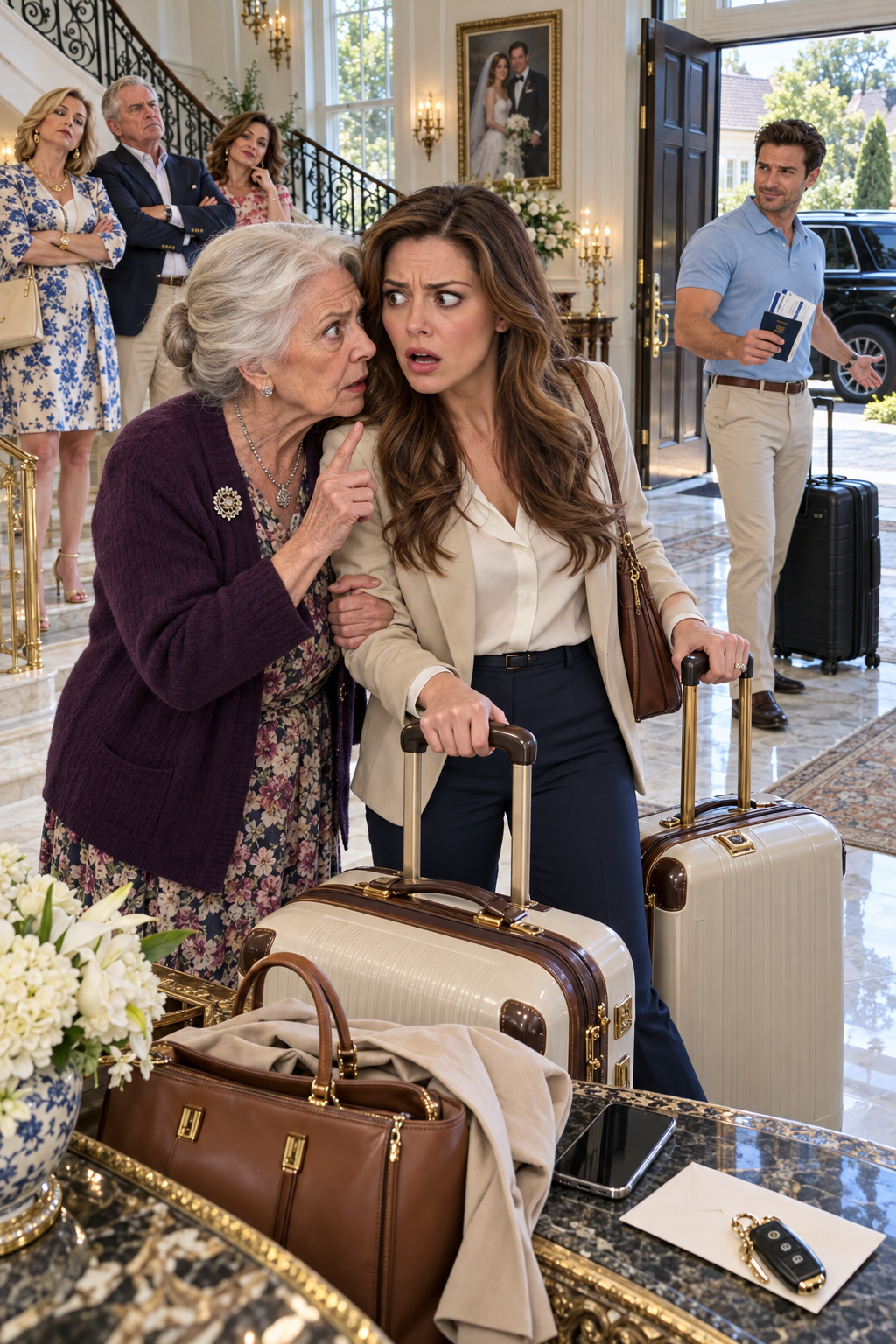
Everyone Called My Grandmother A “Witch.” Right Before My Husband And I Left For Our Vacation, She Whispered In My Ear, “Do Not Go With Him… You Will Not Return Alive.” Then She Added, “Before Canceling The Trip, Do Exactly One Thing…”
My grandmother grabbed my wrists the night before my anniversary trip and begged me not to leave with my husband. My mother called her crazy, my sister laughed, and my husband smiled as though the whole thing were harmless family nonsense. I didn’t argue with any of them. I went home, waited until my husband fell asleep, and checked the reservation myself. Six hours later, I discovered that the person registered to share our secluded mountain cabin wasn’t my husband. It was a woman I’d never met.
## Part 1: The Warning Nobody Wanted Me to Believe
The first time my grandmother told me my husband was dangerous, we were eating pot roast in my mother’s dining room, and I was worrying about whether I’d remembered to turn off the space heater at work. Nothing about the evening suggested that my marriage was about to come apart. My mother had set out her good china, my younger sister was showing everyone photographs of her new kitchen, and my husband, Graham, was explaining why a piece of commercial property outside Asheville would probably double in value within five years. Then my grandmother put down her fork, looked directly at me, and said, “Claire, you cannot go to those mountains with him.”
Every conversation at the table stopped except for the television murmuring in the next room. My mother, Diane, closed her eyes with the exhausted expression she reserved for my grandmother’s more dramatic announcements, while my sister, Brooke, actually laughed. Graham reached beneath the table and squeezed my knee, the way he did whenever somebody said something embarrassing and he wanted me to know we were on the same side. “Rose,” he said pleasantly, “I promise I know how to drive in the mountains.”
My grandmother didn’t smile. At eighty-one, Rose Whitaker was a small woman with silver hair she still curled every morning, sturdy brown shoes, and the kind of watch that needed winding. People in our family called her a witch because she had spent decades making predictions nobody could properly explain, from warning my uncle away from a failing business partnership to insisting a cousin check the brakes on a car that later failed inspection. Sometimes she was wrong, although my relatives rarely remembered those occasions when retelling her stories. But when she looked at me that night, I recognized something I hadn’t seen since my grandfather died: genuine fear.
“Please,” she said. “Not this trip.”
“Mother, enough,” Diane interrupted. “Claire has been working herself to death. Graham arranged something beautiful for their anniversary, and you’re frightening her for no reason.” Brooke added that Grandma probably saw a black cat crossing the interstate in a dream, which made Graham laugh and my father stare harder at his mashed potatoes. I tried to smooth things over by saying I would be careful, but Grandma kept watching me, her hands folded so tightly that the knuckles had turned white.
I was thirty-four, and Graham Mercer and I had been married for five years. He worked in commercial real estate, wore expensive watches without appearing to care about them, and remembered the names of waiters at restaurants we’d visited only once. I was an occupational therapist at a rehabilitation clinic, where most days involved helping people regain ordinary abilities after injuries or illnesses, and Graham often told friends that my patience was what had saved him from becoming an unbearable workaholic. My parents adored him, and until that evening, I would have said our marriage was steady, affectionate, and occasionally dull in the comforting way grown-up marriages were supposed to be.
The anniversary vacation had been his idea. Four nights at Blackwater Pines, a private mountain lodge about three hours from Charlotte, with a stone fireplace, an outdoor hot tub, and supposedly no reliable cellphone service. Graham had announced the surprise two weeks earlier by setting a tiny wooden cabin ornament beside my morning coffee. “No spreadsheets, no patients, no developers calling me at dinner,” he’d said, kissing the back of my neck. “Just you and me, where nobody can interrupt us.”
I had been delighted, although there were small things I’d noticed and then dismissed. Graham insisted on packing our bags himself, claiming the destination had specific weather conditions, and he wouldn’t forward the reservation because he wanted every detail to remain a surprise. When I asked whether I should bring hiking boots, he told me he’d already bought a new pair in my size. He had also asked twice where I kept our marriage certificate and the folder containing my insurance documents, explaining that his accountant was helping us organize our household records.
At the time, none of it seemed particularly sinister. We had recently talked about updating our wills, and Graham had a habit of taking over arrangements whenever he felt I was overloaded. He wasn’t a perfect husband; he could become impatient when plans changed and had recently started checking his phone during dinner. But I considered those irritating habits, not warning signs, and I’d defended him whenever Grandma hinted that his charm concealed something less pleasant.
After dessert, I found Grandma standing by the hallway window, watching Graham help my father carry folding chairs into the garage. She touched my elbow and asked me to walk upstairs with her, claiming she had something to give me for the trip. Her bedroom smelled of lavender powder and furniture polish, and the bedspread was the same faded blue quilt she’d made when I was a teenager. As soon as I entered, she closed the door, turned the lock, and took both my wrists in her hands.
“Do not get on that mountain with him,” she whispered. “I’m asking you to trust me just this once.”
I tried to laugh, but her fingers were trembling. “Grandma, what’s happened? Did Graham say something to you?” She glanced toward the door before answering, and for a moment I thought she was going to tell me she had dreamed about a terrible accident. Instead, she said, “Has he shown you the reservation, sweetheart? Not the pictures of the cabin. The actual booking, with the names.”
I admitted that he hadn’t. Grandma reached into the pocket of her cardigan and withdrew a folded square of yellow notepaper, pressing it into my palm as though somebody might be watching us. “Before you cancel, before you confront him, look at this. And whatever you find, don’t let him know you’ve looked until you’re somewhere safe.” When I asked what she meant, her eyes filled with tears. “I’m afraid that if you leave with him tomorrow, you won’t come home.”
My mother called from downstairs before I could press her further. Grandma released my wrists and unlocked the door, suddenly looking exhausted, and I walked back into the cheerful noise of my family’s conversation with her note concealed in my fist. Graham was waiting by the front door, holding my coat, and he watched my face a little longer than usual. “What did the fortune-teller have to say?” he asked, smiling as he helped me into it.
“She told me to dress warmly,” I replied.
On the drive home, Graham complained about Grandma for nearly twenty minutes. He said she was becoming paranoid, that my mother ought to consider having her evaluated, and that it was unfair for an elderly woman’s superstitions to interfere with something he’d worked hard to arrange. I stared at the headlights sliding across the pavement and remembered the way Grandma’s hands had shaken. When Graham finally asked why I was so quiet, I told him I had a headache.
He went to bed shortly after ten, saying he needed to be rested for the drive. I stayed downstairs pretending to finish laundry until I heard him moving around in the bathroom, followed by the familiar click of the bedroom light. Then I unfolded Grandma’s note beneath the kitchen lamp and read the three words she’d written in her careful, slanted handwriting: “Check second name.”
Graham’s laptop was sitting on his desk in the small office beside our kitchen. We sometimes used each other’s computers to pay bills or print documents, and I knew the password, although I had never thought to search his private messages before. I opened the email account he used for household reservations and found a confirmation from Blackwater Pines dated eleven days earlier. There were photographs of the cabin, an invoice for four nights, a security deposit, and an attached guest itinerary.
The first page looked exactly as I expected. Arrival was scheduled for Thursday afternoon, departure for Monday morning, and the cabin was listed as a two-person booking with a prepaid mountain excursion. My name appeared under Primary Guest, followed by our home address and a contact number I recognized as Graham’s. Then I scrolled down to the second guest field.
Guest Two: Tessa Vale.
I read the name three times, waiting for it to become familiar. Graham’s name appeared elsewhere as the person who had paid for the reservation, but he wasn’t registered as someone staying in the cabin. Beneath Tessa’s name was a special instruction requesting that the second guest be allowed to arrive separately after check-in. I had never heard of Tessa Vale, and the longer I stared at the reservation, the less I understood why my husband had arranged for her to share our anniversary accommodation.
I was still looking at the screen when a floorboard creaked in the hallway behind me.
## Part 2: The Stranger on My Reservation Was No Stranger to My Husband
I closed the reservation window so quickly that the laptop nearly slid off the desk. Graham stood in the office doorway wearing the gray T-shirt he slept in, his hair flattened on one side, and for a frightening second I was sure he’d seen everything. He looked from me to the computer and frowned. “What are you doing up? I thought you were coming to bed.”
“I couldn’t sleep,” I said. “I was checking whether my supervisor sent the new schedule.” He glanced at the laptop again, then at my phone lying beside it, and asked whether I was still upset about Grandma. I told him I wasn’t, which was the first deliberate lie I’d told my husband in years. After a moment, he stepped forward, kissed my forehead, and said, “Don’t let her ruin this for us, Claire.”
I followed him upstairs and lay beside him in the dark, listening to the ceiling fan tick each time it completed a rotation. Graham fell asleep within minutes, one hand resting on his stomach, looking so familiar that I briefly wondered whether I had misunderstood the reservation entirely. Perhaps Tessa was an employee at the lodge, or the booking system had carried over another customer’s details. But I couldn’t explain why Grandma had known there was a second name, and I couldn’t forget Graham watching me from the office doorway.
At twelve thirty, I slipped downstairs again. This time I photographed the reservation before doing anything else, making sure the confirmation number, guest names, dates, and special instructions were visible. Then I searched Graham’s email for Tessa Vale. Forty-three results appeared, dating back almost eight months.
Some were harmless-looking messages about paperwork and scheduled calls, but several had subject lines that sounded more like private arrangements than ordinary business correspondence. One thread discussed “the final version” of documents Tessa had prepared. Another contained a short reply from Graham saying, “She still thinks it’s just the anniversary package, so don’t change anything without telling me.” A week later, Tessa had written, “We need the originals handled before Friday. If those dates move again, I can’t guarantee the same arrangement.”
I read that last sentence repeatedly. It could have meant any number of things, and I understood enough about professional communication to know people often used vague language when discussing confidential transactions. Still, these weren’t messages Graham had ever mentioned, and they concerned the exact dates of our vacation. I searched for attachments and found a scanned checklist with several items blacked out, including one labeled “insured authorization.”
That was when I remembered the blue folder in our bedroom closet.
Graham had asked about it earlier that month, supposedly because we were updating our wills. Inside were copies of our marriage certificate, identification documents, mortgage papers, and my life insurance policy through work. I carried a $350,000 term policy and had a separate employer-provided benefit, with Graham listed as the beneficiary, arrangements we’d made years earlier when we purchased our house. I had never considered changing them because I had never seriously imagined not being married to him.
The folder was still on the shelf, but its contents were no longer arranged the way I kept them. A copy of my insurance certificate had been moved to the front, and the small envelope containing our backup identification documents was open. I sat on the closet floor in my pajamas, surrounded by shoes I hadn’t put away, and tried to recall the last time I’d personally removed anything from that folder. I couldn’t remember.
Back at the laptop, I searched for the insurance company’s name. Several emails appeared involving Graham, Tessa, and a third person whose address belonged to a small consulting company called Northline Administrative Services. The messages contained questions about policy beneficiaries, accidental death coverage, and what paperwork would be required if an insured person died away from home. One email from Graham specifically asked how quickly a spouse could begin the claim process following an incident in another state.
My hands started shaking so badly I had to set my phone down.
I wasn’t foolish enough to believe that an insurance question proved someone intended to kill me. Graham handled property investments and discussed policies constantly, and I knew there might be a legitimate explanation for individual messages. But the combination of a remote vacation, an unknown woman on our booking, paperwork I hadn’t authorized, and questions about what would happen if I died had transformed my bedroom into a place I no longer felt safe sleeping. I copied what I could without altering or deleting anything and forwarded the photographs to a separate email account Graham didn’t know about.
Then I searched Tessa’s name online. She was thirty-eight, lived in Greenville, South Carolina, and had previously worked in benefits administration for a regional insurance services company. Her public profile described her as an independent documentation consultant, although her professional page hadn’t been updated in almost a year. There were photographs of charity events, business luncheons, and weekend trips, most of them ordinary enough that I began to wonder whether I had frightened myself unnecessarily.
One photograph changed that.
Tessa was seated across from Graham at a restaurant in Charlotte, smiling while he leaned toward her with his hand resting on the back of her chair. I recognized the dark wood paneling and copper light fixtures immediately because Graham had taken me there for my birthday the previous year. The photograph was dated May 14, a Tuesday when he’d told me he was having dinner with a difficult prospective investor. Tessa’s caption read, “Some partnerships are worth the risk.”
I enlarged the picture until their faces blurred. They weren’t kissing or holding hands, and I couldn’t tell whether they were romantically involved, but there was something intimate about the way Graham watched her. I remembered him coming home that evening smelling of expensive cologne and complaining about the investor’s endless questions. He had kissed me, asked about my day, and gone upstairs to shower.
For the first time, I began to wonder which parts of our marriage had been real.
At 2:17 a.m., I opened an email thread about the lodge itself. Tessa had asked whether the cabin’s emergency contact information would be visible to anyone other than the person who made the booking, and Graham had replied that he’d taken care of it. Farther down, there was a message about the second guest registration and a sentence that made my skin go cold. “Once we’re there, she won’t have any reason to question what happened,” Tessa had written.
I didn’t know what “what happened” referred to. It might have concerned a financial transaction, a confrontation, or something far worse, but I could no longer persuade myself that I was looking at a misunderstanding. I photographed the conversation, checked that the copies had arrived in my separate email account, and carefully closed the laptop. Then I went into our downstairs bathroom, locked the door, and called Grandma.
She answered on the second ring, sounding completely awake. “Claire?”
“Who is Tessa Vale?” I whispered.
There was a long silence. Finally, Grandma said, “Did you see her name on the booking?” I told her yes and described the emails, the insurance questions, and the photograph. She listened without interrupting, except once when I mentioned the documents and heard her draw a sharp breath.
“Get your purse and your keys,” she said. “Take what you need for two days and come here. Don’t wake him to explain.”
“Grandma, how did you know?”
“I’ll tell you when you’re sitting in my kitchen.”
I packed a small overnight bag with clothes, medication, my wallet, and my work identification. I took photographs of the blue folder exactly as I’d found it, returned everything to the closet, and left a brief message on Graham’s phone saying I wasn’t feeling well and had gone to Grandma’s house. I didn’t accuse him of anything, because I didn’t know what he’d done and because I’d never been so afraid of discovering the answer.
At 3:06 a.m., Grandma opened her front door before I had reached the porch. She was wearing her pink robe over a flannel nightgown, and the smell of fresh coffee drifted from behind her. She took one look at my face, pulled me inside, and locked the deadbolt. When I asked again how she knew about Tessa, she sat down at the kitchen table and reached for a manila envelope I’d never seen before.
“Because she isn’t the first woman whose name I’ve found connected to your husband,” Grandma said.
## Part 3: The Evidence My Grandmother Had Been Hiding for Months
Grandma pushed the envelope across the kitchen table, but she kept one hand resting on it while I reached for my coffee. “Before you look, I need you to understand something,” she said. “I didn’t know about that trip until your mother mentioned it last week, and I don’t know what Graham intended to do up there. But I’ve been trying to find the courage to tell you something about him for months.”
Inside the envelope were copies of emails, a handwritten letter, and a photograph of a woman standing in front of a modest brick house. Her name was Elaine Porter, a sixty-nine-year-old widow who had attended the same church as Grandma for nearly twenty years. Elaine had invested seventy-four thousand dollars in a proposed retirement development outside Hendersonville after Graham approached her through a mutual acquaintance. The development never materialized as promised, and when she requested her money back, she received confusing explanations about construction delays, restructuring, and contractual limitations.
“She came to me because she knew he was your husband,” Grandma explained. “She thought I might be able to persuade him to speak to her.” Grandma had initially assumed it was a legitimate business disagreement and had called Graham privately. He assured her that Elaine was an unreasonable investor who had misunderstood the risks, then warned her not to involve herself in matters she didn’t understand. Afterward, Elaine showed Grandma additional correspondence, including a document bearing the name of the woman who’d handled Graham’s administrative arrangements: Tessa Vale.
I spread the papers across Grandma’s table. There was nothing proving that Graham had deliberately stolen Elaine’s money, but her attorney’s letter raised serious questions about where certain payments had gone. A portion of the money had been transferred to a consulting company with the same name I’d seen in Graham’s emails the night before. Another page showed that Graham had given Elaine financial projections that apparently differed from the information supplied to other investors.
“Why didn’t you tell me?” I asked.
“I tried, Claire.” Grandma’s voice cracked, and she reminded me of a telephone conversation we’d had in July, when she’d questioned whether Graham’s real estate business was doing as well as he claimed. I remembered becoming defensive and telling her that she couldn’t keep treating every successful businessman like a criminal. “Your mother called afterward and said I was upsetting you,” Grandma continued. “She told me I would lose my granddaughter if I didn’t stop interfering.”
I looked down at the papers, ashamed because I remembered that argument too. Grandma had spent the next few months collecting whatever Elaine was willing to share, partly because she believed the woman deserved answers and partly because Graham’s hostility had frightened her. She had recently spoken with Elaine’s attorney, who suggested there might be more going on than a failed investment, although he couldn’t discuss confidential matters freely. Then, three days earlier, Graham had dropped off groceries for Grandma and left a folded travel itinerary on her hallway table while he carried in the bags.
“I didn’t search his things,” she said. “The paper was open, and I saw Tessa’s name beside yours. He came back, picked it up, and told me it was nothing important.” Grandma folded her hands in her lap. “When I asked whether he was taking you to Blackwater Pines, he looked at me in a way I’ve never forgotten.”
I wanted to ask what she meant, but she shook her head before I could. “I don’t have a vision to explain, sweetheart. I have a man who lied about knowing Elaine, a woman whose money is missing, and a reservation that places you somewhere isolated with someone you don’t know.” Her voice grew steadier. “Maybe there’s an innocent explanation for some of it. But I wasn’t going to let you disappear into those mountains without asking you to look.”
By seven that morning, I had stopped shaking enough to make decisions. I called the rehabilitation clinic and requested emergency personal leave, then contacted a local attorney recommended by one of Grandma’s friends. Her name was Maya Patel, and after hearing a short description of the situation, she agreed to speak with me before noon. She told me not to contact Graham about what I’d discovered and urged me to preserve the original messages rather than attempt to investigate further on my own.
Maya also advised me to make a police report about the threatening circumstances surrounding the trip. Grandma drove with me to the county sheriff’s office, where we met Detective Lena Ortiz, a practical-looking woman in her forties who listened without making promises. I showed her the photographs of the reservation, Tessa’s correspondence, and the questions about my life insurance policy. She took notes, asked about Graham’s history of threatening behavior, and wanted to know whether he had ever physically hurt me.
“He hasn’t,” I admitted. “He’s sometimes controlling about schedules, but he’s never hit me or threatened to kill me.”
“That doesn’t mean you should ignore what you’ve found,” Ortiz replied. “It does mean we need to distinguish what we know from what we suspect.” She explained that troubling emails weren’t automatically evidence of a criminal conspiracy, and she couldn’t promise an immediate arrest simply because I feared my husband. But she agreed the circumstances warranted documentation and further review, particularly the possibility that someone had accessed or altered financial information without my permission.
When I left the sheriff’s office, my phone displayed eleven missed calls from Graham. The most recent voicemail sounded almost normal, except for an unusual sharpness beneath his affectionate words. “Claire, honey, your car isn’t here, and your suitcase is missing. We’re supposed to leave this afternoon. Call me before I start worrying.”
I was sitting in Maya’s waiting room when he called again. I put the phone on speaker after checking with my attorney, who was seated beside me, and answered as evenly as I could. “I’m at Grandma’s,” I said. “I’m not going on the trip.”
Graham went silent. Then he laughed once, without amusement, and asked whether Grandma had finally convinced me the mountains were cursed. I told him I needed space and wouldn’t discuss it until I’d had time to think. His breathing changed, and when he spoke again, the friendly tone had disappeared. “Claire, tell me something. Were you on my computer last night?”
I looked at Maya. She shook her head slightly, warning me not to get drawn into an argument.
“I’m not discussing that with you,” I replied.
“That’s interesting,” Graham said. “Because there’s something you don’t understand about those documents, and you’re making a very serious mistake.”
He disconnected before I could answer.
Ten minutes later, a message appeared from him: “Please don’t do anything stupid with Tessa’s name. You have no idea what you’re involving yourself in.”
My fear hardened into something colder. I hadn’t mentioned Tessa during our call, and Graham had no reason to believe Grandma had told me her name unless he suspected I’d discovered the reservation. I showed Maya the message, and she photographed it for our records. Then she asked me to contact my insurance company while she was present, because there was one question that mattered more urgently than whether my husband had been having an affair.
Had anybody recently attempted to change my policy information?
## Part 4: The Marriage I Trusted Was Built Around a Debt I Never Knew Existed
The representative at my insurance company couldn’t provide every detail over the telephone because one of the accounts required verification through my employer’s benefits office. She could confirm, however, that an online request to update contact information had been initiated nine days earlier and that a beneficiary-related form had been uploaded for review. The form wasn’t complete, and no beneficiary change had been approved. When she read the email address associated with the request, I felt the blood drain from my face.
It wasn’t my email address. It was a variation of my name registered through a private domain I’d never seen, and the representative explained that the submitted form had been flagged because its verification information didn’t match their records. I requested copies through the company’s fraud review process and asked them to place additional security controls on my account. Maya documented everything, then helped me begin checking our shared financial accounts and requesting credit information through the appropriate channels.
By late afternoon, we had discovered that Graham’s business finances were in far worse condition than he’d admitted. Two credit cards associated with our household had balances I hadn’t expected, and there had been repeated transfers from our joint checking account to a business account I didn’t recognize. Graham had always handled the mortgage payment and most of our larger expenses, while I paid utilities, groceries, and insurance from my salary. We’d agreed to that arrangement because he earned more than I did, but I now understood how little I’d actually known about the money moving through our marriage.
I remembered conversations that should have troubled me earlier. In August, Graham had suggested that I temporarily reduce my retirement contributions because we were “holding extra cash for investment opportunities.” In September, he’d become irritated when I spent eight hundred dollars replacing our failing dishwasher without consulting him first. Around the same time, he had started criticizing the cost of my professional training courses while continuing to come home in a luxury SUV that he claimed his company leased.
“Does he have any business partners?” Maya asked.
I gave her the names of two men I remembered from holiday parties, but she explained that the structure of Graham’s companies would require a more careful review. We could look at publicly available records and our own accounts, but we couldn’t simply demand access to every private business document he possessed. She recommended an accountant experienced in divorce-related financial investigations and told me that any suspected unauthorized borrowing needed to be reported to the relevant institutions.
That evening, I learned something worse than the missing money.
My mother called while Grandma and I were eating canned tomato soup at her kitchen table. Diane sounded irritated rather than concerned and immediately demanded to know why I’d abandoned Graham before an expensive vacation. She said he’d called her crying, that he was confused by my behavior, and that I should be ashamed of allowing Grandma’s “morbid imagination” to destroy a happy marriage.
“Mom, Graham has been communicating with another woman about my insurance policy,” I said. “And there’s paperwork submitted in my name that I didn’t authorize.”
“Well, maybe he was trying to take care of something,” Diane answered. “That man does everything for you, Claire. Have you considered how humiliating this is for him?”
I stared at the kitchen wall, where Grandma kept photographs of her grandchildren in mismatched wooden frames. My mother had managed to hear that someone might have interfered with my personal financial information and still make my husband’s embarrassment the central issue. I asked whether Graham had ever discussed our insurance documents with her, and the pause that followed was just long enough to make me sit upright.
“Your husband asked me for an old copy of your marriage certificate,” she admitted. “I had one from when you were married. He said you needed it for paperwork.”
“When?”
“A few weeks ago. Why?”
I asked exactly what she’d given him. Diane insisted it was only a copy of the certificate, then admitted she had also sent a photograph of a folder label that showed where my father kept some old family records. She became defensive when I asked why she hadn’t checked with me first. “Because I didn’t imagine my own son-in-law would need his wife’s permission to organize the family paperwork,” she snapped.
“He needed my permission to act as me,” I answered. “There’s a difference.”
Grandma had been listening quietly from across the table. When I ended the call, she pushed her untouched soup aside and said something I’d never heard her say about my mother. “Diane has always confused being agreeable with being kind.” I wanted to defend her, but I couldn’t find the words, because the same woman who had taught me to lock my doors and never share personal information with strangers had handed sensitive records to Graham without telling me.
The next morning, I spoke with Elaine Porter by telephone. Her voice was soft and slightly breathless, and she apologized several times for bringing trouble into my family. Elaine explained that she’d met Graham through a retirement planning luncheon and had believed she was investing in a carefully managed residential development. Over the following year, the promised reports became less detailed, deadlines slipped, and requests for repayment produced increasingly hostile responses.
“Tessa was the person who sent the paperwork,” Elaine said. “I never met her in person, but she knew everything about the accounts. Every time I asked Graham a question, he told me Tessa would send an explanation.” Then Elaine mentioned something that made me stop taking notes. “Your husband said he’d soon have a personal financial event that would let him settle the outstanding obligations. He told my attorney there was no reason to begin formal proceedings before the end of October.”
Our anniversary trip was scheduled for October 22 through October 26.
I asked Elaine whether she still had that statement in writing. She said her attorney did, along with copies of messages and investment records that were already being examined. I didn’t tell her my worst suspicions because I didn’t want to frighten her or accuse Graham of a crime I couldn’t prove. But when we ended the call, I sat at Grandma’s table staring at the calendar, wondering why a businessman facing repayment demands would be so confident about a sudden change in his personal finances.
That afternoon, Graham left a voicemail that sounded nothing like the man I’d married. He accused me of stealing confidential business information, threatened to expose my “emotional instability” to my employer, and said my grandmother was going to regret interfering with his marriage. An hour later, he sent flowers to Grandma’s house with a card that read, “Come home, Claire. We can fix this.”
I put the flowers in the outside trash can and kept the card.
Detective Ortiz called shortly before dinner. She said she had spoken with a representative of Blackwater Pines and confirmed that the resort had received unusual instructions concerning our reservation. She couldn’t share everything immediately, but she wanted to know whether Graham had ever told me we would be meeting another couple or spending part of our trip apart. When I said no, she asked whether I could come to the station the following morning.
“There’s something about the guest arrangements that doesn’t match the story your husband has been telling people,” she said. “And I think you need to hear it from the person who handled the booking.”
## Part 5: The Resort Employee Who Refused to Keep Quiet
The woman who handled our reservation was named Marissa Cole, and she looked uncomfortable before anyone had even asked her a question. She joined Detective Ortiz and me through a video call from a small office at Blackwater Pines, with a landscape photograph hanging behind her and the distant sound of somebody speaking into a radio. Marissa explained that Graham had originally booked the cabin for two adults, but the guest names had been amended four days after the initial reservation. My name remained first, while Graham’s had been replaced by Tessa Vale.
“Did he explain why?” I asked.
Marissa glanced toward Detective Ortiz. “He said there had been a misunderstanding with the original booking and that he would be staying nearby under a separate business arrangement.” She checked her notes and added that Graham had made several unusual requests about privacy, staff visits, and activities beyond the lodge’s maintained grounds. She couldn’t remember every conversation from memory, but the booking system contained notes because another employee had been uncomfortable with the requests.
The resort was secluded, but not entirely isolated. Its cabins were spread across wooded mountain property, with a staffed main building and marked hiking paths leading toward scenic overlooks. Graham had apparently asked whether guests could explore areas outside the regular trails and whether staff routinely checked on visitors who didn’t appear for scheduled activities. Marissa said employees had explained their safety policies, and Graham had seemed irritated by the idea that the resort might contact guests who missed an appointment.
“He kept saying they wanted complete privacy,” she told us. “I finally explained that privacy didn’t mean we ignored guest safety. That’s the last conversation I personally had with him.”
Detective Ortiz asked whether the original booking notes had been preserved. Marissa confirmed that the system retained a history of changes, including an inquiry from Tessa about arriving after the main guest had checked in. I asked why Tessa would need access to a cabin intended for my anniversary, and Marissa said she couldn’t answer that. But there was a detail she wanted to clarify before we ended the call: the request to remove Graham’s name had come from Tessa’s email account, with Graham copied on the message.
I sat there thinking about the wooden cabin ornament beside my coffee, the new hiking boots Graham had bought, and how pleased he’d seemed when I agreed to the trip. The same man who’d spent weeks describing four romantic nights together had quietly arranged a reservation that didn’t list him as a guest. It was possible he had intended to stay elsewhere, or that some part of the arrangement had a legitimate business explanation, but he’d never given me any reason to expect another woman. He had asked me to trust a surprise while concealing its most important details.
After the interview, Ortiz asked whether I wanted someone from victim services to speak with me. I said yes, partly because I was embarrassed to admit how little I was sleeping and partly because I’d started jumping whenever a car slowed outside Grandma’s house. She explained that investigators were continuing to review the documents and financial issues I’d reported, but they couldn’t tell me exactly what crime, if any, Graham had contemplated at the lodge. I appreciated that she didn’t pretend certainty was the same thing as taking my fear seriously.
Maya had meanwhile arranged for a financial specialist to review the accounts I was legally entitled to examine. His preliminary findings suggested that Graham had moved money repeatedly among several small companies, including accounts associated with Northline Administrative Services. Some transfers appeared to be ordinary consulting payments, but others lacked clear supporting invoices. The accountant cautioned that irregular bookkeeping wasn’t proof of fraud, particularly in a complicated property business, although the missing explanations would matter in the divorce and any broader investigation.
I had decided by then that divorce was inevitable. Whether Graham had intended to frighten me, deceive me, or physically harm me, he’d concealed another woman, interfered with sensitive financial information, and responded to my concerns with threats. Maya began preparing the separation paperwork and advised me to protect my income, document my expenses, and avoid making sudden decisions about our jointly owned house. I opened an individual checking account for my future wages and changed passwords on accounts that belonged to me.
When Brooke came to Grandma’s house that evening, I assumed she’d been sent to persuade me to return home. She stood awkwardly on the porch holding a bakery bag, and I noticed she’d been crying. “Mom says you’re accusing Graham of trying to kill you,” she began. “I told her that couldn’t possibly be right, but then Dad said something about a loan, and I didn’t know what to think.”
I asked what loan she meant. Brooke looked at the paper bag in her hands and explained that Graham had borrowed twenty thousand dollars from our parents earlier that year. He had told them a commercial purchase was temporarily delayed and promised to repay everything within ninety days. When the deadline passed, he’d offered my father an interest in a future development instead of cash.
“Why didn’t anybody tell me?” I asked.
“Because Graham said you’d worry,” Brooke replied. She admitted that he’d also borrowed six thousand dollars from her, claiming he needed to cover a professional expense while waiting for a payment. She’d kept quiet because she didn’t want her husband to know she’d used part of their emergency savings without discussing it first. I stood in the doorway realizing that nearly everyone in my family had been protecting a different piece of Graham’s story, and together their silence had allowed him to keep lying to all of us.
Brooke started crying again when I told her about the insurance paperwork. She said she didn’t know anything about that and asked whether I honestly believed Graham wanted me dead. I answered that I didn’t know what he’d intended, but I knew enough to refuse to spend another night alone with him. “I can’t give you the answer you want,” I told her. “I can only tell you what I’ve found.”
She left the bakery bag on Grandma’s table. It contained two cinnamon rolls from the shop we visited as children, and under different circumstances I might have considered it a peace offering. That evening, however, it reminded me how quickly my family reached for familiar comforts when something ugly needed to be confronted. I wrapped one roll in foil for Grandma and put the other in the freezer.
The following morning, I received confirmation that the suspicious insurance document had been preserved for review. The submission contained an electronic signature represented as mine, along with contact details I had never authorized. The company had stopped the request before making changes, and its fraud department was gathering information about the submission. For the first time, I had evidence of a concrete act committed in my name without my permission, something investigators could examine independently of my fear.
I forwarded the notice to Maya and Detective Ortiz. Less than an hour later, I received an unexpected text from an unknown number asking whether I would speak privately about Graham before the police became more involved. It was signed Tessa.
I didn’t reply. I took a screenshot and sent it to Ortiz, who advised me not to arrange a private meeting. Then another message arrived, this one containing a photograph of a single sheet of paper.
It was a statement describing an accident at Blackwater Pines, written as though the accident had already happened.
At the top of the page was my full name.
## Part 6: The Woman Who Helped My Husband Finally Told the Truth
The document in Tessa’s photograph began with a sentence that was almost impossible to read without feeling sick: “Claire Mercer insisted on continuing alone despite being warned about the conditions.” Beneath it was a description of a late-evening outing, followed by a paragraph explaining that Graham had become separated from me and immediately sought help when he realized something was wrong. The statement was written in the past tense, as if someone were recounting an event that had already occurred. It contained no date or signature, but my name appeared three times.
I enlarged the image until the words became grainy. A person could write a hypothetical statement for many reasons, and I wasn’t qualified to say exactly what the document proved, but I couldn’t imagine a legitimate reason for my husband to prepare an account of my mountain accident before we’d even left home. I remembered him examining the new boots he’d purchased for me and telling me how much I would love a certain overlook. Suddenly those ordinary conversations felt contaminated by intentions I couldn’t see.
Detective Ortiz asked me to forward the messages without replying to Tessa. She explained that investigators would attempt to obtain the underlying document and determine who created it, rather than treating a photograph as conclusive proof of authorship. She also asked me not to share the image publicly, since doing so could interfere with the investigation and expose me to additional conflict. I agreed, although every part of me wanted to send it to my mother with one sentence asking whether she still believed Graham deserved an apology.
I stayed at Grandma’s house that weekend. The trip we’d been supposed to take came and went without me, and the anniversary passed while I sat on the living room rug sorting through medical bills and old photographs. On Saturday evening, Grandma found me holding a picture from our wedding, the one where Graham had dipped me backward beneath a canopy of flowers while everybody laughed. I stared at my own face in the photograph and tried to recognize the woman who had believed she knew him.
“Do you think he ever loved me?” I asked.
Grandma sat beside me with some difficulty, her knees stiff from arthritis. “I think people can feel affection and still choose to do terrible things,” she said. “But I wouldn’t spend your life trying to measure what he felt. Pay attention to what he did.” I wanted to argue because that sounded too simple for a marriage containing five years of birthdays, vacations, illnesses, inside jokes, and ordinary mornings. But she was right about the one thing that mattered now: whatever Graham called love had not kept me safe.
On Monday, Detective Ortiz contacted me to say Tessa had agreed to provide information through an attorney. I wasn’t invited to the interview, and Ortiz warned me that she wouldn’t be able to disclose everything investigators learned. She did confirm that the accident statement was relevant to their inquiry and that they were examining whether it had been prepared before our scheduled trip. I spent the rest of the day cleaning Grandma’s kitchen cabinets because sitting still made the waiting unbearable.
Three days later, Maya called me into her office. She had received copies of several insurance-related documents through the review process, and one of them contained information I had not seen before. Alongside the unauthorized contact update was a request concerning the beneficiary and coverage records, submitted using personal details that belonged to me but through an account I hadn’t created. The submission hadn’t been accepted, yet somebody had gone far enough to impersonate me in a formal financial process.
The account records also contained an unexpected clue. A phone number supplied in the attempted update matched a business contact number associated with Northline Administrative Services, although the paperwork itself presented it as my personal contact information. Maya said the insurance company’s investigation would determine whether its systems had been misused and who was responsible. I had never heard a lawyer sound so careful while discussing something that made me feel so violated.
That afternoon, Graham appeared outside the clinic where I worked. I’d returned on a reduced schedule because I needed my paycheck and missed the normal structure of helping patients, but the receptionist stopped him before he reached the treatment rooms. He stood in the lobby carrying a paper cup of coffee and a small bag from my favorite sandwich shop, looking exhausted enough that one of my coworkers asked whether he’d been sick. When I stepped into the corridor, he raised both hands as though he were approaching a frightened animal.
“Claire, please,” he said. “Can we talk for five minutes?”
I stayed near the staff doorway and told him to leave. He looked around, embarrassed by the people watching, and lowered his voice. “Tessa has been filling your head with things because she’s angry with me. She’s trying to save herself. You know me better than this.” When I asked why Tessa had been registered as my cabin companion, his expression changed almost imperceptibly.
“She was handling some business paperwork,” he said. “The resort messed up the names.”
“Then why did you remove yours?”
“I didn’t remove anything.”
I told him the lodge had records showing the change came from Tessa’s account with him copied on the message. Graham stared at me, and for the first time I saw him searching for a response rather than producing one effortlessly. He finally said the arrangements were more complicated than I understood and reached toward my arm. I stepped back, and my coworker called for security.
He left without another argument, but before going through the doors, he turned and said, “There are people who are going to get hurt because you won’t let this go.”
The incident was documented by the clinic, and Maya helped me pursue appropriate protective measures while the investigation continued. I felt humiliated that patients and coworkers had witnessed part of my private life, but my supervisor took me into her office and assured me I didn’t owe anyone an explanation. She arranged for staff to handle unexpected visitors and suggested I speak with an employee assistance counselor. I accepted, because I’d begun to understand that practical help was more useful than pretending I could manage everything alone.
Near the end of the week, Detective Ortiz called with an update she was authorized to share. Investigators had obtained additional records indicating that the accident statement had existed before the trip, and Tessa was cooperating in their inquiries about Graham’s communications and the financial paperwork. Ortiz emphasized that the evidence still needed to be evaluated and that she couldn’t guarantee a particular charge or outcome. Then she asked if I was sitting somewhere private.
I was alone in Grandma’s sunroom, with rain striking the windows and the smell of damp leaves coming through an old frame. Ortiz explained that Tessa had acknowledged an intimate relationship with Graham and admitted assisting with administrative work involving documents she knew I hadn’t reviewed. Tessa claimed Graham had repeatedly assured her that the marriage would soon be over, but that his language became increasingly disturbing when she asked how he expected to handle my objections to his financial plans.
According to Ortiz, Tessa had retained a message in which she asked Graham whether he expected me to sign the remaining paperwork after the anniversary trip. His reply was brief: “There won’t be a divorce to negotiate when this is over.”
I closed my eyes. For months I’d been asking myself whether Graham had planned an affair, a financial trick, or something more frightening, and now there was a written answer that seemed to point toward the worst possibility. It still didn’t describe exactly what he intended to do, and I knew investigators would have to establish what the messages meant in context. But I no longer needed a confession to understand why Grandma had been terrified.
Before ending the call, Ortiz told me that investigators were pursuing the suspected identity and financial offenses as separate matters, because those could be examined through records rather than assumptions about a hypothetical tragedy. Graham’s involvement in the unauthorized submissions and the transfers connected to Northline was being scrutinized. Other potential offenses remained under review, and Ortiz promised only that I would be informed about developments relevant to my safety.
That evening, I sat beside Grandma while she knitted a scarf for a church clothing drive. I told her about Tessa’s account and the message concerning our marriage, leaving out some details because I couldn’t bear to repeat them. Grandma stopped knitting for a moment and looked at the rain beyond the porch.
“Claire,” she said quietly, “I think it’s time you know why I was so afraid of losing you.”
## Part 7: The Family That Protected My Husband Finally Faced the Truth
Grandma put her knitting aside and asked me to bring down a small wooden box from the top shelf of her hallway closet. Inside were photographs, old letters, and a newspaper clipping so faded that I had to hold it beneath the lamp to read the date. The photograph on top showed Grandma as a young woman beside someone who looked remarkably like her, except that the other woman had dark hair and a nervous smile. Her name was Marion, and she was Grandma’s younger sister.
I knew Marion had died long before I was born, but my family rarely discussed her. Grandma explained that Marion had married a man who seemed generous and respectable to everyone outside their home. He volunteered at church, helped neighbors repair their cars, and never forgot a birthday. Privately, however, he controlled Marion’s money, isolated her from relatives, and convinced her that questioning his decisions was evidence she was unstable.
“When Marion finally told me she was frightened, I said she was probably exhausted,” Grandma admitted. “I told her every marriage had difficult seasons and that she should speak to her husband before making accusations.” Her fingers moved over the photograph. “She tried to leave him later that year, and he hurt her badly enough that she spent weeks in the hospital.”
Marion survived, but she moved across the country afterward and never regained a close relationship with the family that had dismissed her concerns. She died of cancer when Grandma was fifty-two, and her final letters spoke of how lonely she’d felt when nobody believed her. Grandma had kept those letters for nearly thirty years, partly as a reminder of Marion and partly, I suspected, as a punishment for her own failure to listen.
“That’s why you didn’t want me to go,” I said.
“That’s part of it,” she answered. “I’ve spent half my life being called a witch because I notice things people don’t want to see. Your grandfather’s brother had debts before his business collapsed. Your cousin’s car made a grinding noise before those brakes failed inspection. People remember that I warned them, but they forget I usually had a reason.”
She told me that Graham’s behavior had troubled her from the beginning, not because she possessed supernatural knowledge, but because she’d recognized the way he steered conversations away from questions he disliked. When Elaine Porter approached her, those concerns gained substance. The travel itinerary had frightened her because she already knew that Tessa’s name was associated with disputed paperwork, and Graham’s reaction when she questioned him reminded her of Marion’s husband.
“I wasn’t certain you’d die,” Grandma said. “I was certain there were things being hidden from you, and I was afraid you wouldn’t get another chance to find them.” She reached across the table and took my hand. “Maybe I should have told you everything sooner. I was so afraid you’d defend him and stop speaking to me that I nearly made the same mistake all over again.”
I held her hand and realized that both of us had been trying to preserve a relationship by avoiding an uncomfortable truth. She had feared losing me if she accused Graham openly, and I had feared damaging my marriage by acknowledging how much his secrecy troubled me. Neither fear excused what Graham had done, but both had helped him keep the truth hidden. For the first time, I understood that courage sometimes meant risking someone’s anger before you had the perfect words to explain why.
The months that followed were neither quick nor satisfying. Graham retained an attorney and disputed many of the allegations, claiming that Tessa had misunderstood instructions and acted beyond her authority. Investigators examined financial records, insurance submissions, and communications connected to Northline, while Maya pursued the divorce and arrangements to protect me from additional financial exposure. I spent hours gathering bank statements, answering questions, and documenting decisions I had made years earlier without knowing they would someday matter.
By January, investigators had assembled evidence supporting charges involving unauthorized use of my identifying information and financial transactions connected to Graham’s business dealings. The district attorney’s office announced charges involving identity-related fraud and obtaining money through false representations, while other aspects of the investigation remained unresolved. Graham was arrested, later released under conditions set by the court, and ordered to address the allegations through the legal process. I learned about those developments through the appropriate channels rather than the dramatic confrontation I’d once imagined.
The information that frightened me most concerned the accident statement. Investigators had traced the document’s preparation to communications between Graham and Tessa before our vacation, and Tessa had acknowledged that it was intended to support a version of events involving my supposed disappearance or injury. According to the records discussed with me, Graham had wanted his absence from the resort’s official guest list to be consistent with whatever explanation he eventually provided. Investigators considered that evidence troubling, but proving a specific plan to harm me was a different legal question from proving the documented financial offenses.
I accepted that distinction even though it left me with questions. The criminal process could establish responsibility for certain acts without resolving every possibility that haunted me at night. I no longer needed to know precisely what Graham had expected to happen on that mountain to recognize that he’d planned to deceive me and others about the circumstances of our trip. The man I’d married had prepared an explanation for a disaster that hadn’t occurred, and I had escaped the situation before he could discover whether his preparations would matter.
The financial investigation also revealed how deeply Graham had relied on other people’s trust. Elaine wasn’t the only investor who’d been given optimistic information that conflicted with internal business records, and several of his companies had serious outstanding obligations. My parents eventually admitted that Graham had repeatedly assured them repayment was imminent, even while urging them not to tell me about the loans. Brooke’s six thousand dollars had gone toward business expenses that Graham couldn’t adequately explain to her.
None of them had wanted to believe he was in trouble. Graham had supplied a different reassuring story to each person, and each had kept quiet for reasons that seemed reasonable in isolation. My parents didn’t want to burden me, Brooke didn’t want to confess an argument-worthy mistake to her husband, and I didn’t want to question the man who claimed to be protecting our future. The combined result was a silence Graham could exploit.
My mother came to Grandma’s house one Sunday in February. She stood in the kitchen where I’d hidden after escaping my marriage and began crying before she removed her coat. “I never thought he would do something like this,” she said. “I thought I was helping keep your marriage together.”
“You weren’t keeping it together,” I answered. “You were helping him keep information from me.”
Diane said she’d been embarrassed about the money she and Dad had lent Graham. She admitted she’d encouraged him to keep his financial troubles quiet because she believed I would overreact and possibly leave him during a difficult business period. When she realized how that sounded, she covered her face. “I didn’t know about the other woman or the insurance forms,” she whispered.
“I believe you didn’t know everything,” I said. “But you knew enough to ask questions, and you decided not to ask me.”
She apologized, then asked whether I could eventually forgive her for choosing Graham’s explanation over mine. I told her I couldn’t make that promise, and that I needed her to stop asking Grandma to repair something Diane had broken herself. My mother left without the embrace she’d clearly hoped for. I felt guilty afterward, but not guilty enough to call her back.
In March, Maya called to say that the ongoing financial disclosures had uncovered another discrepancy involving household funds and a business obligation. The discovery meant our separation arrangements would require further review, and it eliminated Graham’s remaining argument that I had been unaware of nothing more serious than ordinary business fluctuations. It also gave Maya additional grounds to challenge his account of our finances.
I put down the phone and walked onto Grandma’s porch, where the first spring flowers were pushing through the damp soil. My marriage was ending, my finances were complicated, and the family I’d relied on was no longer the family I’d believed I had. Yet I realized something that afternoon: for the first time in months, I wasn’t wondering whether Graham would approve of what I did next.
I was beginning to make decisions that belonged entirely to me.
## Part 8: The Last Secret Was Not Worth the Life I Almost Lost
One year after Grandma warned me about the anniversary trip, I woke in a small rented house on the outskirts of Charlotte with sunlight spreading across the bedroom floor. The curtains were inexpensive, the kitchen cabinets needed repainting, and one of the windows stuck whenever the weather turned humid. But the lease was in my name, the keys belonged to me, and nobody else knew the passwords to my accounts. I made coffee without wondering whether my husband was annoyed that I’d gotten out of bed before him.
The divorce had become final that summer. Reaching a financial settlement required months of negotiations, careful examination of records, and decisions about property I’d once assumed would belong to us for the rest of our lives. Our house was sold, and the distribution of the proceeds reflected the financial issues documented during the proceedings. I didn’t emerge wealthy or suddenly free of practical concerns, but I was able to move forward with my own salary and a manageable budget.
The criminal proceedings continued separately. Graham ultimately entered guilty pleas to financial offenses connected to fraudulent representations and unauthorized use of identifying information, resolving several of the charges without a lengthy trial. The court imposed a sentence involving incarceration and restitution obligations, although recovering money for everyone harmed was a separate and uncertain process. The investigation into the circumstances surrounding our planned trip did not produce a conviction for an intended act of violence.
That distinction mattered to me. I never told people that a court had proved Graham planned to murder me, because no court had made such a finding. What had been documented was already disturbing enough: unauthorized financial paperwork, concealed business problems, a relationship with Tessa, unusual resort arrangements, and a prepared account of an accident that never happened. I didn’t need to exaggerate any of those facts to explain why leaving had been the safest decision of my life.
Tessa also faced consequences for her role in the paperwork. Her cooperation with investigators didn’t erase her participation, and she resolved charges involving document-related misconduct through a separate legal process. I learned that she’d spent months accepting Graham’s explanations because their relationship promised her personal and financial advantages. When he began discussing the lodge arrangements in ways that frightened her, she had continued helping him rather than warning me.
She eventually sent a letter through her attorney. In it, she apologized for becoming involved with my husband and acknowledged that she’d chosen to overlook things she knew were wrong. She wrote that she hadn’t understood how serious Graham’s intentions might be until the investigation began, although I found that difficult to reconcile with the document she’d helped prepare. I read the letter once, gave it to Maya for my records, and declined to respond.
I didn’t want to spend another year weighing the sincerity of people who’d already demonstrated what they were willing to do when their interests conflicted with mine.
My parents had a harder time accepting that the old family routines were gone. Diane called several times to ask whether I would attend holiday dinners, explaining that everybody wanted a chance to begin again. She said Brooke was ashamed of laughing at Grandma and that my father had been deeply affected by learning how Graham had manipulated him. I believed their regret was genuine, but I also understood that regret didn’t restore the safety I’d once felt around them.
I agreed to meet my father for coffee once, in a busy restaurant near his office. He looked older than I remembered, with deep lines beside his mouth and a tiredness that made me think he’d spent more nights awake than he admitted. He told me he’d always considered himself a good judge of character and that Graham had appealed to his pride by treating him like a respected business adviser. “I should have told you about the loan,” he said. “And I should have listened when you said something was wrong.”
“Yes,” I answered. “You should have.”
He nodded, accepting the words without defending himself. We talked about my work and Grandma’s health for another twenty minutes before he left. I didn’t promise to see him again, but I didn’t feel the need to punish him with silence either. I simply allowed the relationship to remain smaller than it had been, because that was all I was comfortable offering.
With my mother, I needed more distance. She still occasionally described the whole experience as a tragedy that had happened to our family, which made Graham’s choices sound like a natural disaster nobody could have prevented. I reminded her that people had made decisions, concealed information, and ignored warnings. When she finally stopped asking me to forgive everyone so we could “move past it,” our conversations became less frequent but more honest.
Brooke eventually apologized to Grandma in person. She brought flowers and admitted that she’d mocked her warnings because she’d never imagined anything truly dangerous could happen in our family. Grandma accepted the apology without pretending that an afternoon of tears could erase months of ridicule. I was grateful Brooke had taken responsibility, although I no longer confided in her about my private life. Trust, I’d learned, wasn’t something another person could demand simply because time had passed.
The greatest change came in the way I thought about my own judgment. For years, I’d confused being a supportive wife with avoiding questions that might upset my husband. If Graham seemed irritated by a request for details, I assumed I was creating unnecessary tension. If he said an issue was too complicated to explain, I accepted that perhaps I didn’t understand his work well enough. I had been competent and decisive with patients, colleagues, and difficult medical situations, yet I’d gradually surrendered those same qualities at home.
Counseling helped me examine that contradiction without turning every memory into an accusation against myself. I began recognizing how Graham had rewarded my trust and discouraged my questions, often so subtly that individual incidents seemed harmless. A joke about my inability to understand investments, a compliment when I agreed not to worry about money, or a disappointed expression when I asked to see paperwork had all influenced how I behaved. None of it made me responsible for his choices, but understanding the pattern helped me recover my own confidence.
I continued working at the rehabilitation clinic and eventually accepted a supervisory role I’d previously declined because Graham complained that my schedule was already inconvenient. The position meant more responsibility and occasional late evenings, but I enjoyed training younger therapists and helping families navigate complicated recoveries. I also started taking weekend pottery classes, something I’d wanted to try since college. My first bowls were lopsided, and the glaze on one looked like muddy water, but I kept them on my kitchen shelf because I’d made them for no purpose other than my own enjoyment.
Grandma visited often, usually carrying something I hadn’t requested. Sometimes it was a bag of peaches from a roadside stand, sometimes an old recipe she’d found, and occasionally another of her peculiar warnings. One afternoon she told me not to buy a used car I’d been considering because the salesman kept answering questions I hadn’t asked while avoiding the ones I had. I took the vehicle to an independent mechanic anyway, and the inspection uncovered repairs the dealership hadn’t mentioned.
“You really should open a detective agency,” I told her afterward.
She laughed so hard she had to set down her tea. “At my age? I’d spend half the day looking for my glasses.” Then she became serious and reminded me that noticing warning signs didn’t mean assuming everyone was dishonest. “There are good people in the world, Claire. Don’t let Graham make you afraid to know them.”
I thought about that advice when a coworker asked whether I’d like to have dinner with her brother, a recently divorced school principal she’d described as patient and funny. A year earlier, I might have accepted simply because I worried people would think I was bitter if I stayed single. This time I thanked her and said I wasn’t interested in dating yet. The answer surprised me with how comfortable it felt.
I wasn’t waiting for a better man to prove that my life could be happy again.
In October, almost exactly one year after the canceled trip, Grandma and I took a short vacation to the North Carolina coast. We rented a modest cottage near a quiet beach, packed groceries instead of making restaurant reservations, and spent three days walking beside the water. Grandma insisted on collecting shells despite having three boxes of them at home, and I complained that she was going to make me carry them all back to Charlotte. She told me that complaining was one of my least attractive habits, then handed me another shell.
On our second evening, we sat on the cottage porch watching the sky turn pink over the dunes. Grandma was wrapped in a blanket, drinking tea from a mug with a chipped handle, and I was looking through photographs on my phone when she asked whether I still had the note she’d given me. I told her it was tucked into the drawer beside my bed. She smiled faintly and asked whether I ever wished she’d simply told me everything she knew.
“Sometimes,” I admitted. “But I don’t think I would have believed you without seeing the reservation myself.”
“I wish I’d found a better way,” she said.
I looked at her hands resting around the mug and remembered how tightly she’d held my wrists that night. She hadn’t possessed enough evidence to explain every danger, and she’d been frightened that a direct accusation would only send me deeper into Graham’s influence. Her decision hadn’t been perfect, but it had given me one concrete question I could answer for myself. In a family where so many people had preferred comfortable assumptions, that small act of questioning had changed my future.
“Grandma,” I said, “were you really sure I wouldn’t come back from that trip?”
She watched a gull circle above the beach before answering. “No, sweetheart. I was scared you might not. That’s different from knowing.” She turned toward me. “I couldn’t tell you what would happen, Claire. I could only tell you there was a reason to stop and look.”
For a while, neither of us spoke. Waves broke against the shore beyond the dunes, and the porch light flickered on as evening settled around us. I thought about the mountain cabin I’d never seen, the anniversary dinner I’d never eaten, and the version of my future Graham had promised me. Somewhere in the space between those abandoned plans and this quiet little porch, I had stopped mourning the life I thought I was supposed to have.
I still occasionally wondered what would have happened if I’d ignored Grandma. Maybe the trip would have ended in an argument, or a staged financial confrontation, or something far worse. There was no way to reconstruct an event that never occurred, and I refused to let my imagination turn uncertainty into a permanent prison. The truth I possessed was sufficient: I had recognized serious warning signs, protected the evidence, and reached safety before confronting a person whose behavior had become frightening.
When we returned home, I put a photograph from the beach beside my bed. Grandma was standing at the water’s edge holding her shoes, laughing because a wave had soaked the bottom of her pants. Next to the photograph, I placed her folded yellow note beneath a small piece of sea glass we’d found together. The paper had softened along its creases, but the handwriting was still perfectly legible.
A month later, I booked another weekend away, this time by myself. When the reservation form asked for the primary guest’s name, I typed Claire Mercer, the name I still used professionally while arranging to return to my maiden name. Beneath that field was a second box labeled Additional Guest. I looked at it for a moment, remembering the night an unfamiliar name had changed everything.
Then I left it blank.
For five years, I’d believed a happy future required Graham to be standing beside me. After everything that happened, I finally understood that the future didn’t need anyone else’s name on the reservation.
I confirmed the booking, closed my laptop, and went to bed without fear.
THE END!