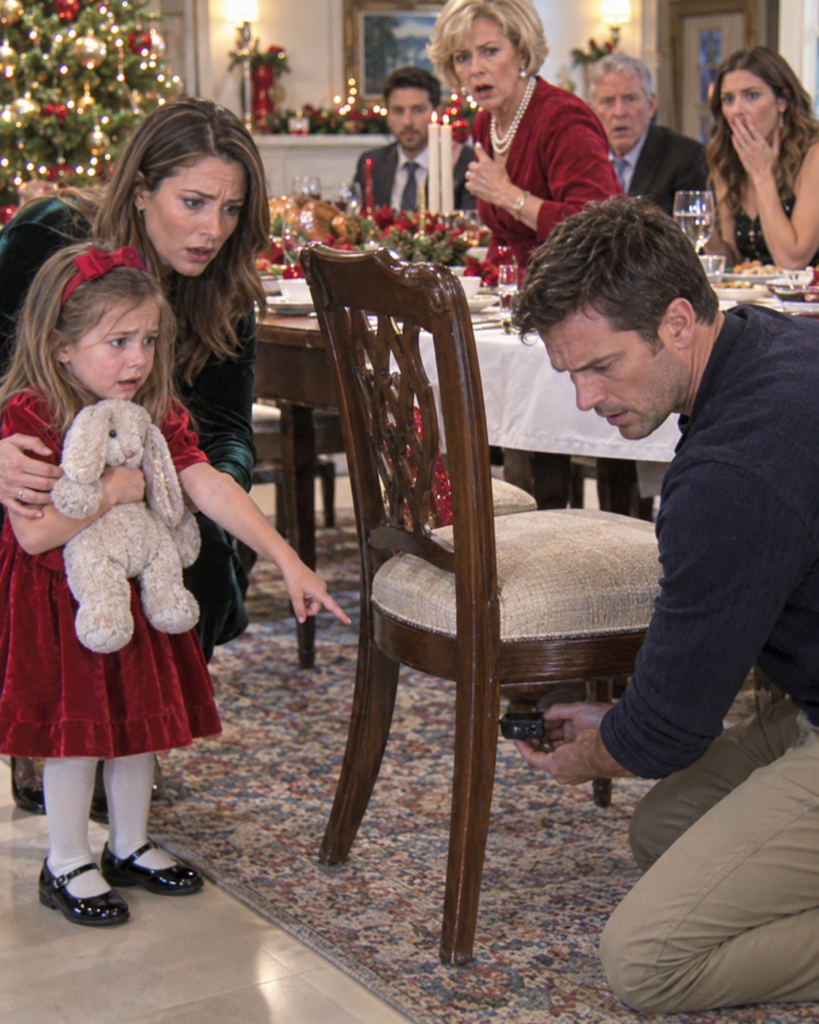
THE CHAIR HURT MY FIVE-YEAR-OLD NIECE—AND WHAT I FOUND HIDDEN UNDERNEATH IT EXPOSED A FAMILY SECRET THAT WOULD CHANGE EVERYTHING
Part 1: “Aunt Claire, the Chair Hurts”
The first time my five-year-old niece told me that the chair hurt, I almost missed the words.
The television was too loud. My brother Daniel was laughing at something on his phone. His wife, Elisa, was in the kitchen, complaining that the roast chicken was drying out.
And little Sophie was standing beside the dining-room table, holding the hem of her pink sweater between two tiny fingers.
She looked at me with the kind of seriousness that didn’t belong on a child’s face.
“Aunt Claire?”
I turned toward her.
“Yes, sweetheart?”
“The chair hurts.”
I glanced at the wooden dining chair behind her.
It was an ordinary chair. Dark oak. High back. A faded cushion tied to the seat with four little ribbons. It had belonged to Daniel and Elisa since before Sophie was born.
“What do you mean, honey?”
Sophie glanced toward the kitchen.
Then toward her father.
Then back at me.
“The chair hurts when I sit on it.”
Daniel laughed without looking up from his phone.
“She’s been saying strange things all week,” he said. “Don’t encourage her.”
I smiled automatically, the way adults often do when a child says something that doesn’t fit into the conversation.
But Sophie didn’t smile back.
She took one small step closer to me.
“Can I show you?”
Something in her voice made me put down my glass.
“Of course.”
She didn’t lead me toward the chair.
Instead, she took my hand and guided me around the table, toward the narrow space between the wall and the sideboard.
Then she pointed underneath the chair.
“Under there.”
I crouched.
At first, all I saw were four wooden legs, a cushion, and a little dust gathered along the floorboards.
Then I noticed that the fabric underneath the seat had been cut and stitched back together.
The stitching was uneven. Newer than the rest of the upholstery.
One corner had come loose.
And something pale was tucked between the fabric and the wooden frame.
I leaned closer.
“What is that, Sophie?”
She swallowed.
“That’s why it hurts.”
Before I could reach for it, Elisa appeared in the doorway.
“What are you two doing?”
Her voice was sharp enough to make Sophie flinch.
“Nothing,” I answered, still crouching. “Sophie wanted to show me something under the chair.”
Elisa’s expression changed.
Only for a second.
But I saw it.
Her eyes darted toward the underside of the seat, then back to my face.
“Claire, please don’t start.”
“Start what?”
“This.” She waved her hand between us. “She makes up stories, and you always turn them into something important.”
Sophie stepped behind my shoulder.
“I didn’t make it up.”
Elisa let out an impatient breath.
“Go wash your hands, Sophie.”
“But Aunt Claire hasn’t—”
“Now.”
My niece lowered her head and walked away.
I stood up slowly.
“What’s under the chair?”
“Old upholstery,” Elisa replied.
“Then why is Sophie afraid of it?”
“She isn’t afraid. She’s looking for attention because Daniel and I have been busy.”
From the living room, Daniel called out, “Can we please have one family dinner without making everything a crisis?”
I looked at my brother.
He was still holding his phone.
He hadn’t even noticed that his daughter was trembling.
And suddenly, I wasn’t thinking about the chair anymore.
I was thinking about the way Sophie had looked at her mother before speaking.
Children look at adults for many reasons. They look for permission, reassurance, approval.
But Sophie had looked at Elisa the way someone looks at a locked door when they are afraid of what might be on the other side.
I knew that look.
I had seen it before.
Not in Sophie.
In my own childhood.
And I had promised myself that if I ever saw it on another child’s face, I would never pretend not to understand it.
“I’m going to check the chair,” I said.
Elisa stepped directly in front of me.
“No, you’re not.”
For a moment, neither of us moved.
Then she lowered her voice.
“Claire, you are a guest in my house. You don’t get to come here and question how I raise my daughter.”
“I haven’t questioned anything.”
“You’re about to.”
Her smile returned, but it was the kind of smile people wear when they want everyone else to believe a conversation is perfectly normal.
“Sit down. Dinner is ready.”
I looked past her.
At the end of the hallway, Sophie had stopped beside the stairs.
She was watching us.
Her small hands were pressed against her chest.
And her lips formed three silent words.
Please don’t leave.
I didn’t know what I would find beneath that chair.
I didn’t know that within two hours, a doctor would be examining evidence that would bring a police officer to my brother’s front door.
And I certainly didn’t know that the most devastating secret in the house had nothing to do with the object hidden beneath the seat.
It had to do with the people who had known about it.
For months.
Perhaps longer.
I only knew one thing.
I wasn’t leaving without finding out why my niece was afraid.
Part 2: The Warning from the Hallway
Dinner lasted eleven minutes before I stopped pretending everything was normal.
Elisa had made roast chicken, mashed potatoes, and green beans. Sophie sat between her parents, her feet dangling above the floor.
Every time she shifted in her chair, her face tightened.
At first, I thought she was uncomfortable because of the cushion.
Then I noticed something else.
She never leaned against the backrest.
Not once.
She sat rigidly upright, keeping her body away from the wooden frame, as though she were trying to avoid touching a particular part of the chair.
“Sweetheart,” I said gently, “would you like to sit with me on the sofa after dinner?”
Sophie looked up.
For one hopeful second, her eyes brightened.
Then she glanced at Elisa.
“I have to finish my food,” she whispered.
“You can finish it beside me.”
Elisa put down her fork.
“Claire, she’s perfectly capable of eating at the table.”
“I was only offering.”
“And I’m telling you that we have routines.”
Daniel rubbed his forehead.
“Can we not do this?”
I stared at him.
“Do what?”
“Act like every little thing is a warning sign.”
“I’m asking your daughter if she’d like to sit beside me.”
“And you’re making her think something is wrong.”
That was when Sophie dropped her fork.
The little metal clatter against the plate made everyone jump.
“Sorry,” she whispered.
Elisa’s expression hardened.
“Pick it up.”
Sophie slid out of her chair, retrieved the fork, and returned to her seat.
Then Elisa leaned toward her daughter and spoke quietly enough that she probably believed I couldn’t hear.
“Do you remember what happens when you tell stories?”
Sophie’s eyes filled with tears.
“Yes, Mommy.”
“Then eat your dinner.”
I felt a cold sensation move through my chest.
I had grown up with a mother who could turn any disagreement into a lesson about gratitude. My father had been gentler, but he had spent much of my childhood working away from home. By the time I understood how much fear could hide behind a perfectly ordinary family dinner, I had already learned to stay quiet.
I had promised myself I would never become the adult who heard a child pleading for help and answered by protecting the family’s reputation.
So I did something that irritated everyone at the table.
I stopped eating.
“Sophie,” I asked, “has the chair always hurt?”
Daniel slammed his fork down.
“Claire!”
Sophie stared at her plate.
Elisa stood so quickly that her chair scraped across the floor.
“That is enough.”
“I’m asking a question.”
“And I’m telling you to stop frightening her.”
“I’m not frightening her.”
“You are filling her head with nonsense.”
Elisa took Sophie’s plate and carried it into the kitchen.
“Dinner is over. Go upstairs.”
Sophie slipped from her chair.
As she passed me, she brushed my hand with her fingers.
Something small and folded touched my palm.
She kept walking.
I waited until her footsteps disappeared upstairs before opening it beneath the table.
It was a scrap of paper torn from a child’s drawing pad.
There were only four words written in shaky pencil.
HE PUT IT BACK.
Underneath the sentence was a drawing of a chair.
A large red X covered the seat.
I read it twice.
Then I looked toward the hallway.
A few seconds later, Elisa’s voice drifted down from upstairs.
“If you repeat those lies about your father again, someone is going to come take you away to a place where you’ll never see us again.”
The words were followed by silence.
I couldn’t hear Sophie’s response.
I didn’t need to.
My hand had begun to shake.
Daniel was standing behind me.
“What did she give you?”
I folded the paper.
“Nothing.”
“Claire.”
I looked at him.
For the first time that evening, my brother wasn’t annoyed.
He was frightened.
And that frightened me more than anything else.
“Tell me what you know about the chair,” I said.
He glanced toward the stairs.
Then he looked at the front door.
“I don’t know what you’re talking about.”
It was the first lie he told me that night.
It wouldn’t be the last.
Part 3: The Thing Hidden Beneath the Seat
I waited until Elisa went upstairs to prepare Sophie for bed.
Then I returned to the dining room.
The house had grown strangely quiet. The television was off, the kitchen lights were dimmed, and Daniel had disappeared into his office.
I pulled the dining chair away from the table and turned it carefully onto its side.
The underside looked even stranger up close.
Someone had removed a section of the upholstery fabric and attached it again with staples. The work was clumsy, as if it had been done in a hurry.
I didn’t want to damage anything.
I also didn’t want to leave without understanding why a five-year-old had slipped me a note.
So I took several photographs.
Then I used my phone’s flashlight to examine the loose corner.
There was an envelope inside.
It was old, yellowed around the edges, and held in place by a strip of adhesive tape.
Beside it was a small black rectangular object that looked like an electronic recording device.
I didn’t touch either item.
I photographed their positions and called my friend Natalie Brooks, a pediatrician who had known me since college.
She answered on the fourth ring.
“Claire? Everything okay?”
“I need your advice.”
My voice sounded strange even to me.
I explained what Sophie had said, the note, the threat I’d overheard, and what I’d discovered beneath the chair.
Natalie didn’t interrupt.
When I finished, she asked one question.
“Is Sophie safe right now?”
“I think so. She’s upstairs with her mother.”
“Do you believe she’s in immediate danger?”
“I don’t know.”
“Then don’t confront anyone alone, and don’t interrogate Sophie for details. If you believe she may be at risk, contact the appropriate child-protection professionals or emergency services. Let trained people assess the situation.”
“What about the things under the chair?”
“Leave them where they are if it’s safe to do so. Document what you’ve seen, but don’t try to investigate the contents yourself.”
I swallowed.
“Could a chair actually hurt a child?”
“Of course, Claire. A broken component, a protruding fastener, damaged upholstery—there are several possibilities. But the important question is why she’s frightened and why someone appears to have hidden something there.”
Natalie paused.
“Claire, children sometimes communicate distress indirectly because they don’t have the words to explain what’s happening. Take what she said seriously without deciding in advance what it means.”
That last sentence stayed with me.
Take her seriously.
Don’t decide in advance.
I thanked Natalie and ended the call.
Then I heard footsteps behind me.
Daniel stood in the doorway.
His face had gone pale.
“What are you doing?”
I slowly lowered my phone.
“I found something.”
His eyes moved toward the chair.
For a moment, he looked as though he might faint.
Then he crossed the room and pushed the chair upright.
“You shouldn’t have touched that.”
“I didn’t remove anything.”
“You had no right to go through our furniture.”
“Your daughter told me it hurt.”
“She’s five!”
“And you’re her father.”
He looked away.
I had expected anger. What I saw instead was something more complicated: guilt, confusion, and a terrible kind of recognition.
“Daniel,” I said carefully, “what’s in that envelope?”
He shook his head.
“I don’t know.”
“Then why are you afraid of it?”
He looked at me.
And in a voice so quiet I almost didn’t hear him, he said:
“Because I thought it was gone.”
Before I could ask what he meant, footsteps sounded on the stairs.
Elisa appeared in the hallway.
She took one look at us and the chair.
Then she screamed.
“YOU OPENED IT?”
The sound was so sudden that I stepped backward.
Daniel closed his eyes.
Elisa hurried toward us, grabbed the chair, and dragged it toward the wall.
“You had no right!” she shouted at me. “You have no idea what you’ve done!”
I stared at her.
“Then explain it.”
She opened her mouth.
Nothing came out.
And that was when I understood that the envelope wasn’t merely something someone had forgotten beneath a chair.
It was something someone had gone to considerable trouble to hide.
Part 4: The Doctor Who Recognized the Pattern
I didn’t leave that night.
Not because I wanted to fight with my brother and his wife, but because I couldn’t shake the image of Sophie standing beside the chair, looking at me as though I were her last chance to be believed.
Elisa insisted that she was tired and wanted everyone to go home.
Daniel insisted that we were all overreacting.
I insisted that Sophie needed to be seen by a qualified professional if she was uncomfortable or in pain.
After a tense argument, Daniel agreed to let me accompany Sophie to a medical appointment the following morning. Natalie had already helped me understand the importance of professional assessment, and I made it clear that I would not question Sophie about what had happened.
But the situation changed before morning.
At 8:14 p.m., while Elisa was upstairs and Daniel was in his office, Sophie came down holding her favorite stuffed rabbit.
She stopped beside me.
“Aunt Claire?”
I knelt.
“I’m here, sweetheart.”
“Can I tell you something without Mommy getting mad?”
My heart hurt.
“You can tell me how you feel. You haven’t done anything wrong by asking for help.”
She looked at the staircase.
“Daddy said I have to be brave.”
I kept my voice gentle.
“You don’t have to be brave every second. It’s okay to be scared.”
She pressed the rabbit against her chest.
“Sometimes I hear the chair when nobody is sitting on it.”
I wasn’t sure what she meant.
“What do you hear?”
“A little click.”
She made the sound with her tongue.
“Click. Click.”
Then she pointed toward the dining room.
“And when I move it, Daddy gets mad.”
I didn’t ask her to explain further.
Instead, I told her that I was glad she had spoken to me, and that grown-ups were responsible for keeping children safe.
When Elisa returned, Sophie immediately fell silent.
I saw the change happen in her face.
It was like watching a light switch off.
That night, I slept on the sofa.
At 6:30 the following morning, Natalie arrived at the house. She had arranged for us to speak with a pediatric clinician who could assess Sophie appropriately. Natalie would not be making assumptions about what had happened; she simply wanted to ensure that the child received the right care.
Elisa was furious.
“She doesn’t need a doctor!”
Natalie remained calm.
“An examination can help determine whether there is a physical problem. If Sophie is distressed, the clinician can also advise on appropriate support.”
“She is perfectly healthy.”
“Then an assessment should help clarify that.”
Daniel stood by the front door, looking exhausted.
For a moment, I thought he would tell us to leave.
Instead, he moved aside.
The appointment took place at a nearby medical center.
Sophie held my hand as we entered.
The clinician, Dr. Patel, spoke to her in a quiet room with child-friendly decorations. She explained each step before doing anything and gave Sophie opportunities to pause or decline.
I waited outside for part of the appointment.
When Dr. Patel eventually invited me into a consultation room, her expression was serious but measured.
“I don’t want you to jump to conclusions,” she said. “We need to distinguish between a physical complaint, emotional distress, and anything else that might require further assessment.”
I nodded.
“Did you find something?”
“We identified an area of irritation that deserves follow-up. It isn’t enough, by itself, to tell us how it happened.”
My stomach tightened.
“What should I do?”
“Keep Sophie away from the chair until it has been safely examined. Don’t pressure her to provide details. Given the concerning statements you’ve described, I’m also recommending a consultation with the appropriate child-safeguarding team.”
I agreed immediately.
Then Dr. Patel showed me a photograph taken of the chair’s exposed underside, which I had sent to her before the appointment.
She pointed to a narrow metal component near the edge of the seat.
“This appears to be an altered section of the chair. We cannot establish its purpose from a photograph. A qualified investigator may need to examine it.”
I remembered the black object hidden beside the envelope.
The tiny click Sophie had described.
The way Daniel had said, I thought it was gone.
And suddenly, my mind was racing.
Could the object have been a recording device?
Had someone placed it there?
If so, who had been listening?
I asked Dr. Patel whether we should contact the authorities.
“Given the threat you overheard and the hidden object, I believe seeking guidance from child-protection professionals is appropriate,” she said. “If you believe Sophie is in immediate danger, contact emergency services. Please don’t attempt to investigate this on your own.”
I thanked her.
Then I went into the hallway and called the local child-protection service to report my concerns.
I gave them the facts without adding guesses.
Sophie’s words.
The threat.
The altered chair.
The hidden envelope.
The recording device.
The clinician’s recommendation.
They asked questions, explained the next steps, and arranged for a trained professional to speak with us.
Two hours after Sophie first told me the chair hurt, a child-safeguarding investigator arrived at the house.
And the moment he saw the photographs, his expression changed.
He looked at me.
“Who else knows this object was found?”
“My brother and his wife.”
“Did either of them explain what it is?”
“No.”
He paused.
“Then I think we need to speak with them separately.”
That was when Elisa began to cry.
Not the quiet, embarrassed kind of crying that comes when someone realizes they’ve made a mistake.
She cried as though the house itself were collapsing around her.
Because she knew something I didn’t.
And I was about to discover that the secret beneath the chair had been sitting in the middle of our family for much longer than anyone had admitted.
Part 5: The Envelope Had My Mother’s Handwriting
The investigator introduced himself as Mr. Reeves.
He spoke softly, carried a notebook, and never once treated Sophie as though she had done something wrong.
That alone made me feel as if I could finally breathe.
He asked Daniel and Elisa to speak with him separately. He also arranged for the chair and its contents to be handled appropriately rather than allowing anyone in the family to examine them further.
I stayed with Sophie in the living room.
She sat curled on the sofa, holding her stuffed rabbit while a children’s cartoon played quietly on the television.
Every few minutes, she looked toward the front door.
“Are they going to take me away?” she asked.
I turned off the television.
“Who told you that might happen?”
“Mommy.”
I took a breath.
“Sweetheart, I can’t promise you exactly what the grown-ups will decide today. But asking for help doesn’t mean you’ve done anything wrong. The people who are here want to understand what’s happening and help keep you safe.”
She considered that.
“Can I still see Daddy?”
“I don’t know what arrangements they’ll make, but you can tell the people helping you what you want and what makes you feel safe.”
She leaned against my arm.
“Okay.”
I wanted to promise her everything.
That she would sleep in her own bed that night.
That nobody would yell at her again.
That the people who were supposed to protect her would suddenly become the people she needed.
But promises made to frightened children should be promises you can keep.
So I held her hand and stayed beside her.
Across the hall, I heard Elisa speaking rapidly.
Then I heard Daniel say something I couldn’t make out.
A door closed.
Several minutes later, Mr. Reeves returned carrying a clear evidence bag containing the envelope.
“Claire,” he said, “I need to ask you about this handwriting.”
He showed me the front of the envelope.
There was no address.
No stamp.
Just two words, written in blue ink.
FOR CLAIRE.
My knees nearly gave way.
The handwriting belonged to my mother.
I hadn’t seen it in years, but I recognized the shape of the capital C, the unusual way she crossed her t’s, and the small curl at the end of her name.
My mother, Margaret Bennett, had died six years earlier.
She had been the one person in our family who always encouraged me to ask questions. When Daniel and I were children, she would tell us that the truth could be uncomfortable, but a lie eventually became a room you couldn’t escape.
She had also been the only adult who ever stood between me and my father’s temper.
My father, Robert Bennett, had died when I was twenty-seven. His death had brought an end to the family arguments that had defined much of my adolescence.
At least, I thought it had.
“Where did you find this?” I asked, though I knew the answer.
“Inside the chair.”
I looked at the words again.
“For Claire.”
Not for Daniel.
Not for Elisa.
Not for Sophie.
For me.
“May I read it?”
“Not until the evidence has been properly documented,” Mr. Reeves said. “Because of the circumstances, we need to preserve the contents and establish how they relate to the other item.”
I nodded, trying to control my breathing.
Then I looked at the chair in the evidence photographs.
The cushion.
The uneven stitching.
The envelope that had been hidden beneath it.
My mother had never owned that chair.
Daniel and Elisa had purchased it secondhand from a furniture shop several years after my mother’s death.
Which meant the envelope might have been placed there by someone who knew exactly what was inside it.
Someone who had known my mother’s handwriting.
Someone who wanted me to find it.
Or someone who wanted me to believe I was supposed to find it.
I looked toward the hallway.
Daniel was standing there, his face drained of color.
“Did you know the envelope had my name on it?” I asked.
He didn’t answer.
“Daniel?”
He swallowed.
“Yes.”
The room seemed to tilt.
“How long have you known?”
He looked at Sophie.
Then he looked away.
“Since last winter.”
I couldn’t speak.
“You’ve known about a letter addressed to me for almost a year, and you said nothing?”
“I didn’t know what it meant.”
“You could have told me.”
“I was trying to protect you.”
“From what?”
He opened his mouth.
Then Elisa appeared behind him.
“Don’t listen to him,” she said.
Daniel turned.
“Elisa, stop.”
“No. You don’t get to pretend this was all my idea.”
Mr. Reeves stepped between them.
“I’m going to ask both of you to remain calm. We will speak to each of you separately.”
But Elisa wasn’t looking at him.
She was looking at me.
Her eyes were wet, and her hands were trembling.
“You don’t understand,” she whispered. “Your mother made a promise.”
“What promise?”
Elisa pressed her lips together.
Then she said the words that changed everything.
“She promised she would never tell you what your father did.”
Part 6: The Father I Thought I Knew
My father had been dead for nine years.
For most of my adult life, I had remembered him as a complicated man who loved his children but often struggled to show it.
He could be generous. He could be funny. He could fix almost anything with his hands.
He could also become frighteningly angry.
When Daniel and I were small, I sometimes heard my parents arguing late at night. My mother would lower her voice when she realized we were awake, but there were nights when the words traveled through the walls.
I remembered one argument in particular.
I was twelve.
Daniel was nine.
My father had accused my mother of hiding money from him. She told him she was setting something aside for the children.
He called it betrayal.
She called it protection.
The next morning, she made pancakes, packed our lunches, and sent us to school as if nothing had happened.
For years, I believed the argument had been about household expenses.
Now I wasn’t sure.
“What did my father do?” I asked Elisa.
She shook her head.
“I can’t tell you.”
“You just told me there was a promise.”
“I shouldn’t have said anything.”
“Then tell me why my mother put an envelope with my name on it inside a chair.”
“I don’t know.”
“You knew about the envelope.”
“I knew it existed. That doesn’t mean I understood it.”
“Did you read it?”
Elisa looked at Daniel.
He lowered his head.
And I realized the truth was worse than either of them admitting ignorance.
They had both read it.
Perhaps not the entire letter.
Perhaps only enough to frighten them.
But they knew something about my father’s past that they had deliberately kept from me.
I wanted to shout.
Instead, I remembered Sophie.
She was still sitting on the sofa, listening to every word.
I walked over and crouched in front of her.
“Sweetheart, would you like to go outside with me for a little while?”
She nodded.
I asked Mr. Reeves whether that would be appropriate. Once he confirmed that another responsible adult could accompany us while the interviews continued, we stepped into the small garden behind the house.
The afternoon air was cool.
Sophie sat on the garden bench, holding her rabbit by its long ears.
“Aunt Claire?”
“Yes?”
“Is Grandpa Robert a bad man?”
The question struck harder than anything Elisa had said.
I sat beside her.
“Why do you ask that?”
“Mommy says I shouldn’t talk about him.”
I waited.
“Daddy says Grandpa loved everybody.”
She looked down at her shoes.
“But sometimes Mommy says grown-ups can love you and still do bad things.”
I considered my answer carefully.
“People can do good things and bad things, sweetheart. Sometimes they make mistakes, and sometimes they make choices that hurt others. What matters is that we tell the truth about what happened and make sure people are safe.”
“Was Grandpa bad?”
“I don’t know everything about what happened when he was alive.”
“Will you find out?”
I looked at my niece.
“Yes,” I said. “I will.”
She leaned her head against my shoulder.
After a while, she whispered, “I miss Grandma Margaret.”
“So do I.”
“Grandma said secrets get heavy.”
My entire body went still.
“What else did Grandma say?”
Sophie thought for a moment.
“She said if a secret makes you scared, you should tell someone who helps.”
I closed my eyes.
My mother had been dead for six years when Sophie was born.
How could Sophie know those words?
Then I remembered something Elisa had said at Christmas the previous year. She had mentioned that Sophie liked looking through an old box of family photographs and letters.
Perhaps she had seen something.
Perhaps she had heard someone reading aloud.
Perhaps my mother had left behind more than one message.
I didn’t ask Sophie to explain further.
I simply held her hand.
And for the first time since the dinner began, I felt certain about something.
Whatever the envelope contained, it was not my niece’s responsibility to carry it.
It belonged to the adults.
And the adults were finally going to have to face it.
Part 7: The Recording Nobody Was Supposed to Hear
The investigation took longer than I expected.
There were no dramatic announcements. No instant confession. No one emerged from a room and explained every mystery in a single speech.
Instead, there were interviews, photographs, written statements, and questions that sometimes led to more questions.
The chair was examined by qualified personnel.
The electronic object was identified as a small recording device, though its precise history and purpose still needed to be established. Investigators preserved it and arranged for its contents to be reviewed appropriately.
I was told not to speculate about what it had recorded or who might have placed it there.
That was difficult advice to follow.
My imagination kept returning to the same questions.
Who had hidden it?
Who had known it was there?
And why had Sophie been so frightened of the chair?
The answer to the last question emerged during a carefully conducted conversation with a trained child specialist.
I was not present for the entire discussion, and I was not given every detail. The professionals wanted to avoid having multiple family members ask Sophie the same questions or influence what she said.
I respected that.
What I did learn was enough to understand why the situation was being treated seriously.
Sophie had described repeated arguments about the chair. She had also said that adults sometimes became angry when she mentioned something she had seen or heard.
The specialist recommended that the adults stop discussing the investigation around her and avoid making threats about where she might live.
That recommendation alone told me how much damage our family’s silence had already done.
The recording was reviewed by investigators.
Later that evening, Mr. Reeves asked to speak with me privately.
“I need you to understand that the recording is one piece of evidence,” he said. “We still have to establish when it was made, who made it, and whether the voices can be reliably identified.”
“Did you hear something concerning?”
“Yes.”
He paused.
“I can’t disclose every detail while the investigation is ongoing. But the recording contains a conversation that appears relevant to the threats you reported.”
My stomach tightened.
“Was Sophie involved?”
“We’re not going to discuss the contents with her. Our priority is to protect her from further pressure while we determine what happened.”
I nodded.
Then he asked whether I knew why my mother might have written a letter addressed to me.
I told him about my childhood.
The arguments.
The money.
The way my mother had quietly encouraged Daniel and me to keep important documents in safe places.
I told him that my father had been a complicated man, but that I had never imagined the family had been hiding something so serious.
Mr. Reeves listened.
When I finished, he asked, “Did your mother ever mention a person named Thomas Hale?”
I shook my head.
“No.”
He wrote the name down.
“Who is he?”
“We’re still establishing his connection to the events. I wanted to know whether you’d heard it before.”
I hadn’t.
But the name sounded familiar.
That night, I called my oldest friend, Rachel, who had known my family since childhood.
“Thomas Hale,” I repeated. “Does that name mean anything to you?”
There was a long silence.
Then Rachel said, “Claire, I think you should speak to your father’s former business partner.”
“Why?”
“Because Thomas wasn’t just a friend of your father.”
“What was he?”
Rachel took a breath.
“He was the person your mother blamed for the worst argument I ever heard between your parents.”
I sat very still.
“What argument?”
“The one that happened the summer before your father died.”
I remembered that summer.
My father had spent several weeks away from home. My mother had been anxious, distracted, and unusually protective of the mail.
When he returned, he and my mother argued for hours.
A few days later, my father apologized to both of us for being distant.
He took Daniel fishing.
He took me to buy a book I’d wanted for months.
Then he went back to work.
I had believed the family had healed.
Now I understood that I might have seen only the peaceful surface of something that had never truly been resolved.
“Rachel,” I whispered, “what did my mother say about Thomas?”
She answered quietly.
“She said he knew what your father had done.”
I looked toward the living room.
Sophie was asleep beneath a blanket, her stuffed rabbit tucked under her chin.
I had thought the secret was hidden beneath a chair.
I was beginning to understand that the chair was only where the secret had finally become impossible to ignore.
Part 8: My Brother Finally Told the Truth
Daniel called me at 11:42 p.m.
I nearly let it go to voicemail.
For most of our lives, my brother had been the person I defended, the person I made excuses for, the person I believed would tell me the truth when it mattered.
That belief had begun to crumble.
Still, I answered.
“Is Sophie okay?” he asked.
“She is resting. The professionals are making sure she has the support she needs.”
“Can I talk to her?”
“That’s something you’ll need to arrange through the people responsible for her care right now.”
He exhaled.
“Claire, I need to tell you something.”
I waited.
“I didn’t put the device under the chair.”
“Did you know it was there?”
“Yes.”
“How long?”
“Since November.”
My grip tightened around the phone.
“Why didn’t you tell anyone?”
“Because I thought it was connected to something else.”
“What does that mean?”
He was silent for so long that I thought the call had dropped.
Then he said, “Last year, Elisa found an old storage box in the garage. It belonged to Dad. There were papers inside, and she recognized Mom’s handwriting on one of the envelopes.”
“What papers?”
“I don’t know exactly. Financial records, I think. Some letters. A photograph of Dad standing outside a building with a man I didn’t recognize.”
“Thomas Hale?”
Daniel inhaled sharply.
“You’ve heard that name?”
“An investigator asked me about him.”
“Then they know more than I thought.”
I closed my eyes.
“Daniel, please stop speaking in riddles. What happened?”
He told me that Elisa had become obsessed with the old papers after finding them.
At first, she believed they might contain information about money my father had hidden. My parents had owned a small construction business, and after my father’s death, there had been years of confusion over debts, insurance, and the sale of company equipment.
My mother had handled most of the paperwork.
Elisa believed my mother had concealed something.
She had confronted Daniel, who had refused to help her search through the records.
Their arguments grew increasingly bitter.
Then, one day, Elisa claimed she had found a recording device among the papers.
Daniel had not seen it himself.
He said Elisa told him it contained a conversation that could ruin the family if anyone heard it.
“Why would she put it in the chair?” I asked.
“I don’t know. She said she was keeping it somewhere nobody would think to look.”
“And Sophie found it.”
“Yes.”
“How?”
Daniel’s voice broke.
“She was playing under the table. The fabric had started to come loose, and she noticed something inside. She told Elisa, and Elisa told her it was an old piece of junk.”
“Then why did she threaten Sophie?”
“I don’t know, Claire.”
I almost laughed at the absurdity of the answer.
“You don’t know? Your wife told your five-year-old daughter that someone would take her away if she talked about her father.”
“I know.”
“Do you?”
“Yes!”
His sudden shout startled me.
Then he began to cry.
“I know what she said. I heard it. I should have stopped her.”
I didn’t answer.
“I kept telling myself that if I could calm Elisa down, everything would settle. I thought Sophie would forget about the chair. I thought the device was harmless.”
“You thought silence would fix it.”
“Yes.”
“And did it?”
He sobbed once.
“No.”
For several seconds, neither of us spoke.
Then he said something that made my anger give way to grief.
“Dad used to tell me that being the man of the house meant protecting everybody. I thought that meant keeping the family together no matter what.”
I stared at the dark window beside me.
“Daniel, keeping a family together isn’t the same as keeping everyone quiet.”
“I know that now.”
“Your daughter needed you to protect her, not the family secret.”
“I know.”
“Then you need to show her that.”
He didn’t argue.
Before we ended the call, he told me that Elisa had recently begun receiving messages from an unknown number. He had seen the notifications but hadn’t read them.
He believed she was afraid of whoever was contacting her.
I wrote down what he said and passed the information to Mr. Reeves the following morning.
I didn’t know whether those messages were connected to the chair, my father, or the recording.
But I had finally learned that my brother’s silence was not the only silence in the family.
And every new detail seemed to lead back to a man who had been dead for nine years.
My father.
Part 9: Thomas Hale
Thomas Hale lived in a small house on the edge of town.
He was sixty-eight, recently retired, and had spent most of his career managing accounts for local businesses.
When I knocked on his door, he looked at me for several seconds without speaking.
Then he stepped backward.
“Claire Bennett.”
He said my name as though he’d been expecting me.
“You knew my father,” I said.
“Yes.”
“Did you know my mother?”
“Very well.”
“Did you know why she left a letter for me?”
His face changed.
He glanced toward the street.
Then he opened the door wider.
“Come inside.”
The house smelled of coffee and old books. Photographs covered one wall, including a picture of my father standing beside a younger Thomas in front of a building with a faded sign.
I recognized my father’s smile.
It was the smile he wore when he believed everything was going according to plan.
Thomas noticed me looking at the photograph.
“That was taken before things went wrong,” he said.
“What things?”
He sat down slowly.
“Your father and I started a small construction company together. He was good with people. I was good with numbers. For a while, we made a decent living.”
“What happened?”
“Your father began taking on jobs he couldn’t afford to lose. He borrowed money to keep the business going, and he made promises he couldn’t keep.”
I listened.
Thomas explained that my father had eventually discovered discrepancies in the company’s accounts. Some were ordinary mistakes. Others appeared to involve payments that had been recorded incorrectly or approved without proper documentation.
Neither man could agree on what had happened.
My father accused Thomas of hiding information.
Thomas accused my father of trying to shift responsibility.
The business collapsed.
My parents spent years trying to recover financially.
“Did your father steal money?” I asked.
Thomas shook his head.
“I never proved that. I never claimed he did. What I know is that records were missing, and your father was afraid of what the remaining documents might reveal.”
“Why would my mother hide them?”
“Because she believed the truth would destroy her children.”
I looked at him.
“Did it?”
He lowered his eyes.
“Not in the way she feared.”
I felt tears prick behind my eyelids.
“What was in the recording?”
Thomas sat quietly for a long time.
“I haven’t heard it in years. I don’t know whether the device under the chair contains the same recording. But your mother once played a copy for me.”
“What did it say?”
He rubbed his forehead.
“It was a conversation between your parents. Your father was asking your mother to sign some paperwork. She refused. They argued about the business, the debts, and a document he wanted her to destroy.”
“Did she destroy it?”
“No.”
“Where is it now?”
“I don’t know.”
I thought about the envelope.
The letter with my name.
The device hidden in the chair.
“What did my father do?”
Thomas met my eyes.
“He made a terrible mistake. Then he spent years trying to make sure nobody found out exactly how terrible it was.”
My throat tightened.
“Was someone hurt?”
“Not physically, as far as I know. But people lost money. People lost jobs. And your mother was forced to make choices she should never have had to make.”
He paused.
“Claire, I need you to understand something. Your father wasn’t a monster. He wasn’t a saint, either. He was a frightened man who made a series of bad decisions and then convinced himself he could fix everything if he controlled the story.”
The words landed heavily.
Because suddenly, I recognized the pattern.
My father had tried to control the story.
My mother had hidden the evidence.
Daniel had stayed silent.
Elisa had threatened a child.
And now Sophie had become the person everyone was trying to silence.
I stood.
“Did my mother leave that envelope for me?”
Thomas looked toward the photograph.
“Yes.”
“Why?”
He took a slow breath.
“Because she knew the truth might reach you eventually. And she wanted you to hear it from her before someone else twisted it into something it wasn’t.”
I stared at him.
“What truth?”
He looked at me with tired, deeply saddened eyes.
“Your mother didn’t hide the evidence to protect your father.”
He paused.
“She hid it because she believed someone else was using your father’s mistakes to threaten your family.”
Part 10: The Woman in the Photograph
Thomas went to a locked cabinet in the study.
He returned with a small folder containing photocopies of documents, old photographs, and a handwritten note.
He did not hand them to me immediately.
“Some of this material may be relevant to an investigation,” he said. “I won’t ask you to take anything that should be preserved. But you can look at the photographs.”
He placed three pictures on the table.
The first showed my father and Thomas outside the construction office.
The second showed my mother standing beside a woman I didn’t recognize.
The third showed the same woman outside a courthouse.
On the back of the second photograph, my mother had written a name.
Eleanor Price.
“Who is she?” I asked.
Thomas leaned forward.
“Eleanor worked for your father’s company. She handled invoices and correspondence.”
“Was she involved in the missing records?”
“We don’t know. She claimed she discovered the discrepancies before anyone else did. Your father said she had misunderstood the accounts.”
“Did my mother believe her?”
“Yes.”
I looked again at the photograph.
Eleanor appeared to be in her early thirties. She had short dark hair and a serious expression.
“Where is she now?”
“I haven’t seen her in years.”
“Did she have children?”
Thomas hesitated.
“Yes.”
“How many?”
“One daughter.”
He told me that Eleanor had left town after the business collapsed. Her daughter had been very young at the time.
“Do you know her name?”
“Not with certainty. I remember Eleanor mentioning a little girl named Emma.”
The room went quiet.
Emma.
My niece’s middle name was Emma.
Sophie Emma Bennett.
I stared at Thomas.
“That’s just a coincidence.”
“Perhaps.”
But neither of us sounded convinced.
I thought about the envelope addressed to me.
The chair.
The recording device.
The unknown messages Elisa had received.
And now a woman who had worked for my father, a missing set of records, and a child named Emma.
I asked Thomas whether he would share what he knew with the investigator.
He agreed.
Before I left, he gave me one more piece of information.
“Your mother came to see me about three months before she died,” he said. “She was frightened. She told me she had made arrangements for something important to be delivered to you if certain documents ever resurfaced.”
“Did she say what it was?”
“No. Only that she didn’t want your father’s mistakes to become your burden.”
I thanked him and left.
Outside, I sat in my car and called Mr. Reeves.
I told him about Thomas, Eleanor, and the possibility that the documents might be connected to the old business dispute.
He asked me not to contact Eleanor or search for additional records myself.
“If there is a connection, we’ll establish it through the proper channels,” he said. “Please don’t put yourself or Sophie in the middle of an investigation.”
I agreed.
Then I looked at the photograph of my mother and Eleanor that I had been allowed to examine.
Two women.
One secret.
A child who had been too young to understand any of it.
And a letter that had waited six years for me to find it.
I had started the week believing my family had one problem: a little girl was afraid of a chair.
Now I understood that the chair had become a hiding place for a history nobody had known how to face.
But there was still one question I couldn’t answer.
Why had Sophie been the one to discover it?
And why had Elisa been so desperate to make sure she never spoke about it?
Part 11: The First Safe Night
Sophie didn’t come home that evening.
The child-protection team arranged a temporary safety plan while they assessed the concerns surrounding her home environment. She stayed with me under the arrangements approved by the professionals involved, and Daniel was given instructions about how and when he could contact her.
Elisa was asked not to pressure Sophie about her statements or the investigation.
For the first time in weeks, Sophie slept through the night.
I know because I woke up every hour to check on her.
At two in the morning, I found her curled on her side, one hand resting on her stuffed rabbit.
At three, I tucked the blanket around her shoulders.
At four, I stood in the doorway and listened to the soft rhythm of her breathing.
I was afraid to admit how relieved I felt.
Not because I believed everything was solved.
It wasn’t.
But because a child who had spent days worrying about what might happen if she spoke had finally been allowed to sleep without hearing adults argue about her.
The next morning, Sophie helped me make pancakes.
She insisted on pouring the flour herself, which resulted in a white cloud across the kitchen counter.
Then she giggled.
It was such a small sound.
Yet it felt enormous.
I smiled at her.
“There you are.”
She looked confused.
“Where?”
“That laugh. I’ve missed it.”
Her expression softened.
“Can we make heart pancakes?”
“We can certainly try.”
Our first heart looked like a potato.
The second looked like a map.
The third was almost recognizable.
Sophie decorated them with strawberries and declared herself the official pancake artist.
For twenty minutes, we didn’t talk about chairs, letters, recordings, or secrets.
We talked about cartoons.
We talked about the neighbor’s cat.
We talked about whether the moon followed our car when we drove at night.
Ordinary conversations.
The kind of conversations a five-year-old should be allowed to have.
Later that morning, Mr. Reeves called.
He told me that the investigation was continuing and that I should preserve any communications I received from family members.
Then he asked whether I had received a message from an unknown number.
I checked my phone.
There was one.
It had arrived shortly after midnight.
The message read:
YOU SHOULD HAVE LEFT THE PAST ALONE.
My hands went cold.
I sent a screenshot to the investigator and did not reply.
Ten minutes later, another message arrived.
YOUR MOTHER TRIED TO PROTECT YOU. DON’T MAKE THE SAME MISTAKE SHE DID.
I stared at the screen.
Someone knew about the envelope.
Someone knew about the investigation.
And someone was trying to frighten me into silence.
I immediately reported the second message as well.
I did not know who had sent them, and I refused to guess.
But I finally understood why my mother might have hidden a letter beneath a piece of furniture that would eventually be moved into my brother’s home.
Perhaps she had wanted it discovered.
Perhaps she had wanted it kept safe.
Perhaps she had been unable to decide which choice would protect us.
I sat at the kitchen table after Sophie went to play.
For the first time since the investigation began, I allowed myself to cry.
Not because I was afraid of the messages.
Because I was angry with my mother for leaving us a mystery instead of an explanation.
And because I missed her so much that I would have given anything to hear her tell me the truth herself.
Part 12: My Mother’s Letter
Three days later, the investigator confirmed that the envelope had been documented and its contents could be reviewed as part of the ongoing inquiry.
The letter was handwritten on three pages of ordinary stationery.
I sat in a quiet room with Mr. Reeves and a family-support professional while I read it.
The first line made my eyes fill immediately.
My dearest Claire,
If you are reading this, then something I hoped would never happen has finally happened. The past has found its way into your present.
I stopped.
For a moment, I could hear my mother’s voice so clearly that it felt as though she were sitting across the table.
I continued.
I have spent years telling myself that silence was the kindest thing I could leave you. I told myself that you had a right to grow up remembering your father as a man who loved you, not as a man who sometimes let fear make his decisions.
But I have come to understand that protecting a memory is not the same as protecting a person.
I wiped my eyes.
The next paragraph explained that my father had made serious financial decisions without telling my mother everything. He had concealed debts and signed agreements he later struggled to honor.
When the business collapsed, he asked her to sign documents that she did not fully understand.
She refused.
Their marriage suffered.
Their finances suffered.
And my mother spent years trying to ensure that Daniel and I would not be held responsible for decisions we had never made.
She did not claim my father had committed every wrongdoing people accused him of.
She did not claim that Thomas was entirely innocent.
Instead, she described a painful dispute in which accusations had multiplied faster than the evidence could resolve them.
Then I reached the passage that made me put down the pages.
Claire, the most important truth is not whether your father was good or bad. He was a human being, and he made choices that hurt people. I loved him. I also refused to sign away my judgment simply because I loved him.
If someone tells you that love requires silence, ask yourself who benefits from your silence.
I pressed my hand against my mouth.
My mother had written those words years before Sophie was born.
Yet they described exactly what was happening now.
I continued reading.
There are documents that belong to people who never received a proper explanation. I have asked Thomas to preserve what he knows, and I have kept copies of the records I could obtain. If they are ever examined again, I hope the truth will be established fairly.
Do not assume every accusation is true. Do not assume every denial is honest. Ask for evidence. Let people speak. And do not allow anyone to make you responsible for carrying a burden that belongs to them.
The final page was shorter.
I am sorry I did not tell you everything while I was alive. I thought I was sparing you pain. Perhaps I was also sparing myself the pain of admitting that I could not fix everything.
If you ever have a child in your care, Claire, remember this: a child should never have to choose between telling the truth and being loved.
Believe their fear enough to help them. Investigate their words carefully. And never punish them for asking a question.
All my love,
Mom.
I couldn’t move for several minutes.
The family-support professional quietly offered me a glass of water.
Mr. Reeves waited until I was ready before asking whether I recognized the references to the business records.
I told him what I knew.
He explained that the letter was important context, but it did not prove who had placed the recording device beneath the chair or why.
That distinction mattered.
My mother had offered me a way to understand her choices.
She had not handed me a complete answer.
And I was beginning to realize that the truth would require more than finding one letter or listening to one recording.
It would require people to stop protecting their preferred versions of the past.
Even when the evidence made those versions uncomfortable.
Especially then.
Part 13: The Confession That Wasn’t a Confession
Elisa requested to speak with me.
At first, I refused.
I wasn’t ready to sit across from someone who had threatened a five-year-old for talking about her own experiences.
But the family-support professional suggested that, if I chose to meet her, we could do so in a supervised setting with clear boundaries.
I agreed.
Not to forgive her.
Not to hear excuses.
To understand what had happened and make it clear that Sophie would not be pressured again.
Elisa arrived carrying a folder.
She looked exhausted.
Her hair was tied back, and she wore the same gray coat she’d worn the night the investigator came to the house.
She sat opposite me.
For a while, she said nothing.
Then she pushed the folder across the table.
“These are the messages I received,” she said.
I didn’t open it.
“Have you given them to the investigator?”
“Yes.”
“Then they should remain with the investigator.”
She nodded.
“I was scared.”
“So was Sophie.”
Elisa looked down.
“I know.”
“No,” I said quietly. “I don’t think you do.”
Her eyes filled.
She began explaining that, after finding the old documents, she had become convinced my mother had hidden something valuable. She believed the recording would reveal the truth about the business and that the missing records might prove someone had taken money.
Then she received anonymous messages warning her to stop looking.
She became obsessed with discovering who was behind them.
She said she had hidden the recording device beneath the chair because she didn’t want Daniel to find it.
But Sophie discovered it.
And when Sophie began talking about the chair, Elisa panicked.
She feared that the investigation would expose the messages, the hidden device, and her own role in concealing it.
So she tried to frighten Sophie into silence.
She said she hadn’t meant the threat literally.
I looked at her.
“You told a five-year-old that someone would take her away to a place where she’d never see her family again.”
“I was frightened.”
“You were the adult.”
“I know.”
“You could have asked for help.”
“I know.”
“You could have told the truth.”
Elisa covered her face.
“I know.”
For a long time, I watched her cry.
I wanted to believe that her tears meant she understood the harm she had caused.
But tears alone don’t establish accountability.
“Why did you tell Sophie her father was the subject of the lies?” I asked.
Elisa lowered her hands.
“Because the recording mentioned him.”
“Did you hear it?”
“Yes.”
“What did it say?”
She hesitated.
“It was an argument. Daniel’s father-in-law—your father—was speaking with someone. I couldn’t identify the other voice at first.”
“Was it Thomas?”
“I don’t know.”
“Then why did you decide Sophie was lying?”
“Because she kept saying she heard her father talking about the chair. I thought she was mixing things together.”
I stared at her.
“Did you ever ask what she meant?”
Elisa shook her head.
“I was too busy trying to make everything go away.”
That was the closest thing to an honest answer I’d heard from her.
Not a full confession.
Not proof that she had done everything people feared she had done.
Just an admission that her own fear had become more important to her than her child’s.
Before the meeting ended, I told her what needed to happen next.
She was to follow the safety plan, cooperate with the professionals, stop discussing the investigation in front of Sophie, and never again threaten the child for speaking honestly about her feelings.
Elisa agreed.
I did not tell her everything would be forgiven.
Because it wouldn’t.
Trust is not restored by one tearful conversation.
And a child’s sense of safety is not something an adult can demand back.
It has to be earned.
Part 14: The Detail Hidden in the Recording
The most important discovery came nearly two weeks after Sophie first told me the chair hurt.
Investigators had obtained a clearer copy of the recording through the appropriate technical process.
They were able to establish that the audio was older than the chair itself.
That meant someone had transferred the recording device from its original location before hiding it beneath the seat.
The discovery complicated the timeline.
It also weakened one of Elisa’s assumptions.
She had believed the device was connected to the recent anonymous messages.
The evidence did not establish that connection.
Instead, the recording appeared to contain an argument between my father and another adult about a document associated with the old construction business.
A phrase repeated several times.
“She’s not going to sign it.”
Another voice replied:
“She doesn’t have a choice.”
My father’s voice followed.
“That’s not how this works.”
Then the recording ended abruptly.
The audio did not establish the full context of the argument or what document they were discussing.
But it raised a question that had troubled my mother for years.
Who had been pressuring her to sign something?
Thomas agreed to provide investigators with the documents he had preserved.
A review of the records eventually revealed that several people had misunderstood what happened during the business’s final months.
Some financial decisions had been properly documented. Others were poorly recorded. A disputed payment had been attributed to the wrong account, and one of the missing documents turned out to be a duplicate agreement rather than the original.
There were still unanswered questions.
But the evidence did not support the most dramatic accusations circulating in the family.
My father had made serious mistakes.
He had also tried, at least at some point, to prevent someone from forcing my mother into an agreement she did not understand.
Both things could be true.
That was the uncomfortable complexity my mother had tried to explain.
The past was neither as innocent as I remembered nor as monstrous as Elisa had feared.
Then the investigator called with another development.
The anonymous messages had been traced to a phone number connected to an account used by a person who had previously worked with the construction company.
The identity was not immediately disclosed to me, and the investigators warned against drawing conclusions until the evidence was fully reviewed.
But the connection was enough to establish that Elisa’s fear had not come entirely from her imagination.
Someone had been contacting her.
Someone had known about the documents.
And someone had tried to discourage her from looking further.
I thought about the messages sent to me.
YOU SHOULD HAVE LEFT THE PAST ALONE.
I had assumed the sender was someone inside my family.
Now I wasn’t sure.
That uncertainty was difficult, but it was also a relief.
I no longer had to force every piece of evidence into a single explanation.
The truth could be complicated.
The investigation could take time.
And Sophie could still be protected while the adults worked through the unanswered questions.
For the first time, those three things felt compatible.
Then Mr. Reeves told me something that changed my understanding of the entire case.
“The person who hid the recording may not have been the person who made it,” he said.
I stared at him.
“What does that mean?”
“It means we’re examining several possibilities. We haven’t established who placed it under the chair or why.”
I remembered the envelope.
My mother’s handwriting.
The words FOR CLAIRE.
And suddenly, I wondered whether my mother had ever intended the recording to be found at all.
Perhaps she had hidden the letter to protect me.
Perhaps someone else had discovered it.
Perhaps the person who placed the device beneath the chair had wanted to use my mother’s words for a different purpose.
The chair had not revealed one clean, terrible secret.
It had revealed a chain of decisions, fears, and half-truths that had been passed from one adult to another.
And Sophie had been the first person brave enough to say that something was wrong.
Part 15: The Secret Sophie Had Been Trying to Tell Us
By the third week, Sophie had begun asking when she could go home.
Not because she wanted to return to the arguments.
Because she missed her room.
She missed the little yellow lamp beside her bed and the stuffed animals lined along her windowsill. She missed the tiny garden where she had planted sunflower seeds with her father.
She even missed the cat next door.
“I want my purple blanket,” she told me one morning.
“We’ll see what we can arrange.”
“And my books.”
“We’ll ask about those, too.”
She looked at me.
“Will Mommy be mad if I go home?”
I set down the cup I was holding.
“Sweetheart, the grown-ups are working out what will be safest for you. You don’t have to manage Mommy’s feelings. That’s not your job.”
She thought about that for a long time.
Then she asked, “Can I love Mommy and still tell the truth?”
My eyes burned.
“Yes,” I said. “You can love someone and tell the truth about something that frightened you. Those two things can exist together.”
She nodded slowly.
That afternoon, the child specialist called me.
She explained that Sophie had recently mentioned something relevant during a conversation that was not prompted by questions about the investigation.
The specialist was careful not to offer details beyond what was necessary, but she wanted me to understand that Sophie had described hearing adults argue about a photograph.
A photograph of a little girl.
The description matched an image found among my mother’s old documents.
I remembered the woman Thomas had identified as Eleanor Price.
I remembered the little girl named Emma.
I also remembered Sophie’s full name.
Sophie Emma Bennett.
I called Daniel.
“Why did you choose Emma as Sophie’s middle name?”
He sounded confused.
“What?”
“Her middle name. Why Emma?”
“Elisa liked it. Why?”
“Did either of you know someone named Emma Price?”
Silence.
Then Daniel said, “Claire, what have you found?”
“I’m asking a question.”
“Elisa mentioned that name once. She said it appeared in the old papers.”
My stomach tightened.
“Why didn’t you tell me?”
“Because I didn’t know whether it mattered.”
“Everything seems to matter when people are hiding it.”
He exhaled.
“Elisa thought Emma Price might have been connected to the company. She believed the little girl in the photograph was her daughter.”
“Did you ever meet her?”
“No.”
“Did you know where she lived?”
“No.”
I ended the call and reported the information to the investigator.
A few days later, Mr. Reeves arranged a meeting with a woman named Eleanor Price.
She was in her late fifties now.
Her hair was silver at the temples, and she carried a small leather handbag that looked as though she had owned it for decades.
When she saw me, she appeared startled.
“You’re Margaret’s daughter,” she said.
“Yes.”
She sat down.
For a moment, neither of us spoke.
Then she asked, “How is the little girl?”
I felt my heart skip.
“Which little girl?”
Eleanor looked toward the investigator.
He nodded, indicating that she could continue.
“Your niece,” she said. “Sophie.”
I stared at her.
“How do you know Sophie?”
“I don’t know her personally.”
“Then why are you asking about her?”
Eleanor folded her hands.
“Because I believe the chair may have been intended for me.”
I couldn’t breathe for a moment.
She explained that, many years earlier, my mother had asked her to keep a set of documents safe. The documents included correspondence about the construction business and a letter intended for me.
Eleanor had agreed.
But after my mother’s death, she lost contact with the family.
Years later, she learned that someone had purchased an old chair from a secondhand furniture shop. The chair had originally belonged to a storage property associated with the business.
She believed the documents might have been transferred with the furniture.
“How did you know which chair?” I asked.
“I didn’t,” she said. “Not until I heard that someone had found an envelope.”
I looked at the investigator.
He asked Eleanor to explain how she had learned about the discovery.
She said she had received a message from someone claiming that the old records had resurfaced. The message included a photograph of the chair.
She had recognized the upholstery.
But she had not known that a recording device was hidden inside it.
That detail surprised her.
The investigators documented her account and began checking it against the existing evidence.
Then Eleanor told me something I had not expected.
“My daughter is named Emma,” she said.
I swallowed.
“Is she the girl in the photograph?”
“Yes.”
“Where is she now?”
“She lives several states away. She’s an adult, and she has her own family.”
I looked down at my hands.
For three weeks, the name Emma had followed me through every new discovery.
Now I finally understood where it came from.
But I still didn’t know why Sophie had been named after her.
Eleanor couldn’t explain that either.
Then she asked to see the letter.
When the investigator showed her a photograph of the envelope, she began to cry.
“That is Margaret’s handwriting,” she whispered.
“Why was it addressed to me?” I asked.
Eleanor looked at me.
“Because your mother wanted you to know that your father wasn’t the only person who had made a promise.”
She paused.
“And she wanted you to know that the promise had been broken.”
Part 16: The Bigger Secret
The final twist began with a document that had been overlooked because everyone assumed it was connected to the financial dispute.
It was a simple family letter.
No legal language.
No official seal.
Just a page folded into thirds and tucked between two copies of an old business agreement.
The letter had been written by my mother shortly before she died.
It was addressed to Eleanor.
If the records ever return to the family, please tell Claire that the girl in the photograph was not involved in what happened. She was only a child.
I read that sentence several times.
The girl in the photograph.
Emma.
Eleanor’s daughter.
A child who had been dragged into an adult dispute without understanding it.
I continued reading.
Robert believed he was protecting us by keeping the truth from everyone. Eleanor believed she was protecting Emma by staying silent. I believed I was protecting Claire and Daniel by taking the documents away.
We were all so busy protecting the children that we forgot the children would eventually grow up and ask what we had hidden.
I put the letter down.
There was more.
My mother explained that, during the construction company’s collapse, my father had discovered that an employee’s daughter had accidentally carried an envelope containing sensitive business papers home from the office.
The girl had not understood what the papers were.
She had not stolen them.
She had simply picked up an envelope among other documents while helping her mother tidy an office.
When the papers later appeared in a dispute, adults began accusing one another of deliberate misconduct.
Eleanor feared that her daughter would be blamed.
My mother feared that the dispute would destroy two families.
My father, caught between financial pressure and his own pride, made decisions that made the situation worse.
The recording captured only a fragment of one argument.
It was never a complete explanation.
And the letter revealed something else.
My mother had chosen Emma as a middle name for the child she hoped I might one day have.
Not because she expected me to use it.
Not because she wanted to tie my future to an old dispute.
Because Emma Price had been a child who was blamed for something she didn’t understand, and my mother wanted to remember her as innocent.
But I had never known about that wish.
I had never even been pregnant.
The name Sophie Emma had been chosen by Daniel and Elisa years later, without knowing the story.
The coincidence had made the old papers seem more mysterious than they were.
For a moment, I almost laughed.
Then I cried.
Because my mother had spent years trying to keep two families from inheriting the mistakes of their parents.
And despite everything, the same mistakes had returned.
Adults were hiding things.
Adults were blaming one another.
And a little girl was afraid that telling the truth would cost her the people she loved.
The recording device had become the center of the investigation, but it was never the whole story.
The bigger secret was not that my father had been perfect or that he had been secretly evil.
It was that several adults had convinced themselves that silence was the same as protection.
My mother had hidden the truth because she feared it would hurt us.
Thomas had kept records because he feared being blamed.
Eleanor had remained silent because she wanted to protect her daughter.
Daniel had avoided questions because he wanted his marriage to survive.
Elisa had threatened Sophie because she wanted the investigation to stop.
Each person had a reason.
Some reasons were understandable.
Some choices were indefensible.
But all of them had left Sophie carrying fear that should never have belonged to her.
I thought about the first night.
The dining room.
The chair.
Sophie’s trembling hands.
The chair hurts.
She hadn’t known anything about the construction business.
She hadn’t known about my father’s debts or my mother’s letters.
She hadn’t known the name Eleanor Price.
She had only known that something frightened her and that the adults around her didn’t want her to talk about it.
And that was the truth that mattered most.
Not the most dramatic detail in the recording.
Not the most embarrassing page in the financial records.
Not the identity of the person who had hidden the device.
A child had asked for help.
And the adults had made her afraid to ask again.
I folded my mother’s letter carefully.
Then I made a decision.
I would not turn Sophie’s experience into another family secret.
I would not tell her that she had destroyed the family.
I would not ask her to forgive anyone to make the adults feel better.
And I would never again confuse keeping the peace with doing what was right.
Part 17: The Family Meeting Nobody Wanted
The family meeting took place six weeks after Sophie first showed me the chair.
It was held in a neutral room with a family counselor present. The purpose was not to force reconciliation or decide who was the worst person in the family.
It was to establish boundaries, discuss what had happened, and make sure Sophie would not be placed in the middle of the adults’ conflict again.
Daniel arrived first.
He looked older than he had at the beginning of the summer.
When I asked whether he had spoken to Sophie, he nodded.
“Only when the counselor said it was appropriate.”
“How is she?”
“She’s drawing again.”
I smiled sadly.
“She always loved drawing.”
“She drew a picture of you yesterday.”
“What did it look like?”
He almost smiled.
“Apparently, you have very long arms.”
I laughed despite myself.
Then his face grew serious.
“Claire, I need to apologize.”
I waited.
“I knew Sophie was afraid. I knew Elisa was upset about the chair. I knew there was something hidden beneath it, and I kept telling myself that staying quiet was the safest thing to do.”
He rubbed his hands together.
“I was afraid of losing my marriage. I was afraid of what the investigation would uncover. I was afraid that Dad’s mistakes would become the only thing anyone remembered about him.”
He looked up.
“And while I was worrying about all of that, my daughter was asking me for help.”
I didn’t interrupt.
“I don’t expect you to forgive me,” he continued. “I don’t even know whether Sophie will forgive me. But I’m going to stop making my fear her problem.”
For the first time since the investigation began, I believed he understood at least part of what he had done.
That didn’t erase his choices.
But it gave him a place to begin.
Elisa arrived fifteen minutes later.
She sat beside the counselor, keeping her hands folded in her lap.
She had agreed to follow the safety plan and participate in counseling. She had also acknowledged that her threat to Sophie was unacceptable.
When the counselor asked her what she wanted Sophie to understand, Elisa began to cry.
“I want her to know that she didn’t do anything wrong.”
The room remained silent.
“I want her to know that I was scared, and I handled that fear in a terrible way. I made her think that telling the truth could cost her family.”
She wiped her face.
“And I want her to know that my fear was never her responsibility.”
I watched her carefully.
It was the first time I had heard her describe the situation without blaming Sophie, the investigation, or my mother.
But I still wasn’t ready to trust her.
The counselor explained that rebuilding trust would require consistent behavior over time, not a single apology.
Elisa nodded.
Then she looked at me.
“I know you think I don’t deserve another chance.”
I answered honestly.
“I think Sophie deserves a chance to feel safe. What happens between you and her has to be guided by what is best for her, not by what you or I want.”
Elisa lowered her head.
For once, she didn’t argue.
The meeting ended with a practical plan.
Sophie would continue receiving appropriate support. Daniel would follow the agreed arrangements for contact. Elisa would continue working with the professionals involved, and everyone would stop discussing the investigation in Sophie’s presence.
No one demanded that I forgive anyone.
No one asked Sophie to make the family feel better.
And for the first time, the adults had been given a clear instruction that mattered more than their pride.
Protect the child.
The rest would have to wait.
Part 18: The Apology I Never Expected from My Father
Three months later, the investigation into the hidden device and the old business records reached a point where the authorities could explain several important findings.
The evidence did not establish that every person we had suspected was involved in wrongdoing.
The anonymous messages were connected to a former business associate who had wanted certain documents kept out of circulation. The person had been interviewed, and the relevant conduct was addressed through the appropriate process.
The investigators also confirmed that the recording device had been moved from its original location before it was hidden beneath the chair.
But they could not establish with certainty who had placed it there.
That question remained unresolved.
For a while, I found that frustrating.
I wanted every loose end tied neatly.
I wanted one person to explain the entire story.
I wanted a final revelation that would make every decision understandable.
Life didn’t offer me that.
What it offered was something quieter.
A clearer record of what had happened.
A better understanding of what remained uncertain.
And a family that could no longer pretend the past had never existed.
Thomas gave a statement about the old business dispute. Eleanor provided the correspondence she had preserved. The records were reviewed, and the people involved were able to correct several misunderstandings about the company’s collapse.
Some damage could not be undone.
Some relationships could not return to the way they had been.
But the evidence no longer needed to be hidden inside furniture.
I visited my father’s grave on a rainy Saturday.
I brought no flowers.
I brought the copy of my mother’s letter.
For a long time, I sat on the bench beside the headstone.
“I wish you had told me,” I said aloud.
The wind moved through the trees.
“I wish you had trusted me enough to let me understand who you were.”
I thought about the father who had taken me to buy books.
The father who taught Daniel to ride a bicycle.
The father whose temper sometimes made our home feel smaller than it was.
The father who had made mistakes and apparently spent years trying to control what people knew about them.
I had spent much of my adult life trying to decide whether I was allowed to love him without approving of everything he had done.
Now I understood that the question had never required a simple answer.
I could love the good memories.
I could grieve the things he had done wrong.
I could acknowledge the people his choices had hurt.
And I could refuse to repeat his mistakes.
I opened my mother’s letter one last time.
If you ever have a child in your care, Claire, remember this: a child should never have to choose between telling the truth and being loved.
I folded the pages and put them away.
Then I spoke the words I wished I could have said to my father while he was alive.
“I won’t make Sophie carry this.”
The rain grew heavier.
I stood and walked toward my car.
For the first time, I didn’t feel that I was betraying my father by telling the truth.
I felt that I was finally doing something my mother had wanted me to do.
Ending the silence.
Part 19: The Chair Was Gone
The old dining chair was never returned to the house.
After the investigation and examination were completed, the family agreed that it should not be kept as a piece of furniture. Its presence had become associated with too much fear, and nobody wanted Sophie to feel she had to sit near it again.
A few weeks later, Daniel and I took Sophie to choose a new chair for her little art table.
She examined every option as if she were a professional furniture designer.
“This one has soft corners,” she announced.
“Very important,” I agreed.
“And this one is purple.”
“Also important.”
She chose a small white chair with rounded edges and a cushion covered in tiny yellow flowers.
Daniel carried it to the car.
Sophie held my hand.
“Can I ask you something?”
“Anything, sweetheart.”
“Will there be secrets in this chair?”
I knelt beside her.
“I can’t promise that nobody will ever keep a secret. Some surprises are harmless, and some things are private. But if something frightens you, hurts you, or makes you feel unsafe, you can always tell a trusted adult.”
“What if they get mad?”
“Then you can tell another trusted adult. And another, if you need to. You don’t have to keep asking the same person if they aren’t listening.”
She thought about that.
“Even if it’s family?”
“Especially if it’s family.”
She wrapped her arms around my neck.
I held her for a long time.
I knew that a new chair couldn’t erase what had happened.
Neither could an apology, a family meeting, or a carefully written safety plan.
Sophie would need time.
Daniel would need to show, through his actions, that he could put her safety first.
Elisa would need to accept that being her mother did not give her the right to control what her daughter said.
And I would need to remember that helping Sophie did not mean I could control every part of her future.
But the chair was gone.
The threats had stopped.
The adults were finally getting help with the problems they had spent years trying to hide.
And Sophie was drawing again.
Sometimes, that was enough for one day.
Part 20: The Last Page of My Mother’s Letter
Nearly a year after the night I found the envelope, I received a package from Thomas.
Inside was a small box of family photographs and one additional page of my mother’s handwriting.
He had discovered it among papers that had been stored separately from the business records.
He believed it belonged with the letter addressed to me.
I sat at my kitchen table before opening it.
The page began with a date from the year before my mother died.
Claire,
I have been thinking about the difference between keeping a secret and keeping a promise.
When I was young, I believed those things were almost the same. If you loved someone, you protected them. If you promised to protect them, you kept their secrets.
But life taught me that a promise can become a mistake when it asks you to hurt someone innocent.
I paused to wipe my eyes.
The letter continued.
I kept too many things from you because I believed the truth would make you unhappy. I was wrong about some of those things. I was right about others. I wish I had trusted you enough to explain the difference.
Your father was not the only person who made mistakes in our family. I made mistakes, too.
I allowed fear to make decisions for me. I told myself that if I could keep everyone calm, I could keep everyone safe.
But calm is not always peace. Sometimes it is simply what happens when everyone is afraid to speak.
I looked toward the living room.
Sophie was visiting that afternoon. She was building a tower from colorful blocks and narrating an elaborate story about a princess who wanted to become an engineer.
Daniel sat on the floor beside her, helping her find pieces that fit together.
For a moment, the ordinary scene seemed more precious than anything I had seen in months.
I returned to the letter.
If you remember nothing else, remember this.
You are allowed to love people without agreeing with them.
You are allowed to forgive someone without pretending the harm never happened.
You are allowed to leave a room where you are being asked to betray yourself.
And you are allowed to tell the truth, even when the people you love would rather hear a lie.
The final paragraph was written in smaller handwriting.
I hope you have a child in your life who asks difficult questions. When that day comes, I hope you listen.
Not because children are always right about every detail.
Not because every fear means the worst thing has happened.
But because the moment a child stops believing that an adult will listen is the moment the adult has the most important work to do.
Love,
Mom.
I folded the letter.
For years, I had thought my mother’s greatest legacy was the way she made people feel loved.
Now I understood that it was also the way she taught us to question the things that frightened us.
I had spent months trying to discover what had been hidden beneath a chair.
But the most important thing my mother left behind wasn’t the letter, the photograph, or the evidence.
It was a lesson I could pass to Sophie.
The truth can be complicated.
People can be loving and still make terrible choices.
Families can survive painful discoveries, but only if they stop asking the most vulnerable person to carry the weight of everyone else’s fear.
And children should never have to earn the right to be heard.
I placed my mother’s letter in a folder with the rest of her papers.
Then Sophie called from the living room.
“Aunt Claire! Come look!”
I walked over.
Her block tower was taller than she was.
At the very top sat a tiny plastic figure wearing a purple dress.
“What’s her name?” I asked.
Sophie smiled.
“She’s the brave one.”
I knelt beside her.
“What makes her brave?”
Sophie thought about it.
Then she said, “She tells people when something is wrong.”
I felt tears gather in my eyes.
“That is brave.”
She leaned against me.
“Are you proud of her?”
I kissed the top of her head.
“Very proud.”
And as I watched her return to her tower, I understood that the ending I had been searching for wasn’t a confession that explained everything.
It wasn’t a dramatic punishment.
It wasn’t a perfect family reunited around a dinner table.
It was this.
A child who no longer believed that speaking up would make her unlovable.
A father who had begun learning how to listen.
An aunt who had refused to look away.
And a family that had finally begun to understand that the truth might hurt, but silence could hurt even more.
Epilogue: “The Chair Doesn’t Hurt Anymore”
Two years later, Sophie turned seven.
She celebrated with a purple birthday cake, yellow balloons, and a party in my backyard.
Daniel arrived early to help set up the tables. He had spent the previous two years working consistently to rebuild his relationship with his daughter. He attended counseling, followed the family agreements, and learned to apologize without expecting immediate forgiveness.
Elisa’s relationship with Sophie took longer to repair.
There were still boundaries. There were still difficult conversations. And there were times when Sophie needed reassurance that she could say no, express discomfort, or ask for help without being punished.
But the adults were no longer pretending those needs didn’t exist.
Elisa had continued working with a counselor. She had acknowledged that her threats were wrong, and she had stopped asking Sophie to keep secrets about the investigation.
Forgiveness wasn’t a deadline.
It was something Sophie would be allowed to decide for herself as she grew older.
That afternoon, after the guests had gone home, Sophie and I sat together at her art table.
Her white chair had yellow flowers on the cushion.
She was drawing a picture of our family.
There was Daniel.
There was me.
There was Elisa.
There was a little purple cat, even though none of us owned a purple cat.
And in the center, Sophie had drawn herself holding a bright yellow star.
“What’s that?” I asked.
“That’s my brave star.”
“Why do you have one?”
She shrugged.
“Because I told you about the chair.”
I felt my throat tighten.
“You were very brave.”
She continued coloring.
“Mommy says she was wrong to scare me.”
I put down my pencil.
“What do you think about that?”
Sophie considered the question with the seriousness only a child can bring to something important.
“I think she should listen next time.”
“I think that’s a very good idea.”
She added a yellow line around her star.
Then she looked at me.
“Aunt Claire?”
“Yes, sweetheart?”
“The chair doesn’t hurt anymore.”
For a moment, I couldn’t answer.
I looked at the little girl who had once stood in a dining room, clutching the hem of her pink sweater, frightened that speaking would make her lose everyone she loved.
She had been five years old.
She hadn’t known about business disputes, hidden documents, anonymous messages, or the complicated mistakes of adults.
She had only known that something was wrong.
And when the people closest to her refused to listen, she had kept trying.
I reached across the table and held her hand.
“I’m glad, sweetheart.”
She smiled.
Then she returned to her drawing.
I watched her for a while before looking toward the window.
Outside, Daniel was carrying the last of the birthday decorations to his car. Elisa stood by the gate, waiting for the agreed time to say goodbye to Sophie.
They weren’t the family we had been before.
Perhaps we never would be.
But we were learning that a family could change without pretending the past had never happened.
We were learning that love did not give anyone permission to frighten a child into silence.
And we were learning that protecting a family meant protecting the people in it—not the secrets that threatened to destroy them.
I thought about my mother.
I wished she had lived long enough to meet Sophie.
I wished she could have watched her granddaughter grow into a child who understood that her voice mattered.
Most of all, I wished my mother could have seen that the lesson she had written in a letter years earlier had finally reached the person who needed it most.
A child should never have to choose between telling the truth and being loved.
Sophie finished her picture and held it up proudly.
“Do you like it?”
I smiled through my tears.
“I love it.”
She placed it on the table beside us.
At the bottom, in uneven purple letters, she had written a sentence she had practiced at school.
MY FAMILY LISTENS TO ME.
I looked at those five words for a long time.
Because that was the real ending.
Not the discovery beneath the chair.
Not the recording.
Not the secrets of the past.
The ending was a little girl who no longer had to whisper.
A little girl who could tell an adult that something hurt and trust that someone would take her seriously.
A little girl who could love her family without being forced to protect its secrets.
And an aunt who had learned that sometimes the most important thing you can do for a child is not to solve every mystery immediately.
It is to listen.
To stay.
And to make sure the child knows that telling the truth will never make them undeserving of love.
Because the chair was never the only thing that hurt Sophie.
The silence hurt her, too.
And the day we finally broke that silence was the day our family had a chance to become something better.