My Grandmother Hands Out Envelopes Every Christmas. This Year, She Watched Me Open Mine, Frowned, And Said, “That’s Not What I Put In There.” Then She Looked At My Mother.
My grandmother handed me my Christmas envelope, then froze when I pulled out five hundred dollars instead of her usual handwritten letter. “That’s not what I put in there,” she whispered, staring at my mother. Mom laughed, called her confused, and hurried her out of the room while everyone pretended nothing had happened. I quietly kept the envelope and began asking questions. Nine days later, I found a missing-child photograph online. The little girl in that picture was me, and someone had been searching for her for twenty-five years.
Part 1
The first sign that something was wrong was the way my grandmother stopped smiling. It was Christmas afternoon in Syracuse, New York, and I was perched on the arm of her faded green couch, holding an envelope with my name written across the front in her familiar, slanting handwriting. Five crisp hundred-dollar bills rested against a Christmas card decorated with a red cardinal, an amount so unlike my grandmother that I almost laughed. Then I looked up and saw her staring at the money as though someone had placed a dead animal in my hands.
“Grandma, are you sure this is for me?” I asked, turning the bills over with my thumb. “Five hundred dollars? You know you don’t have to do that.”
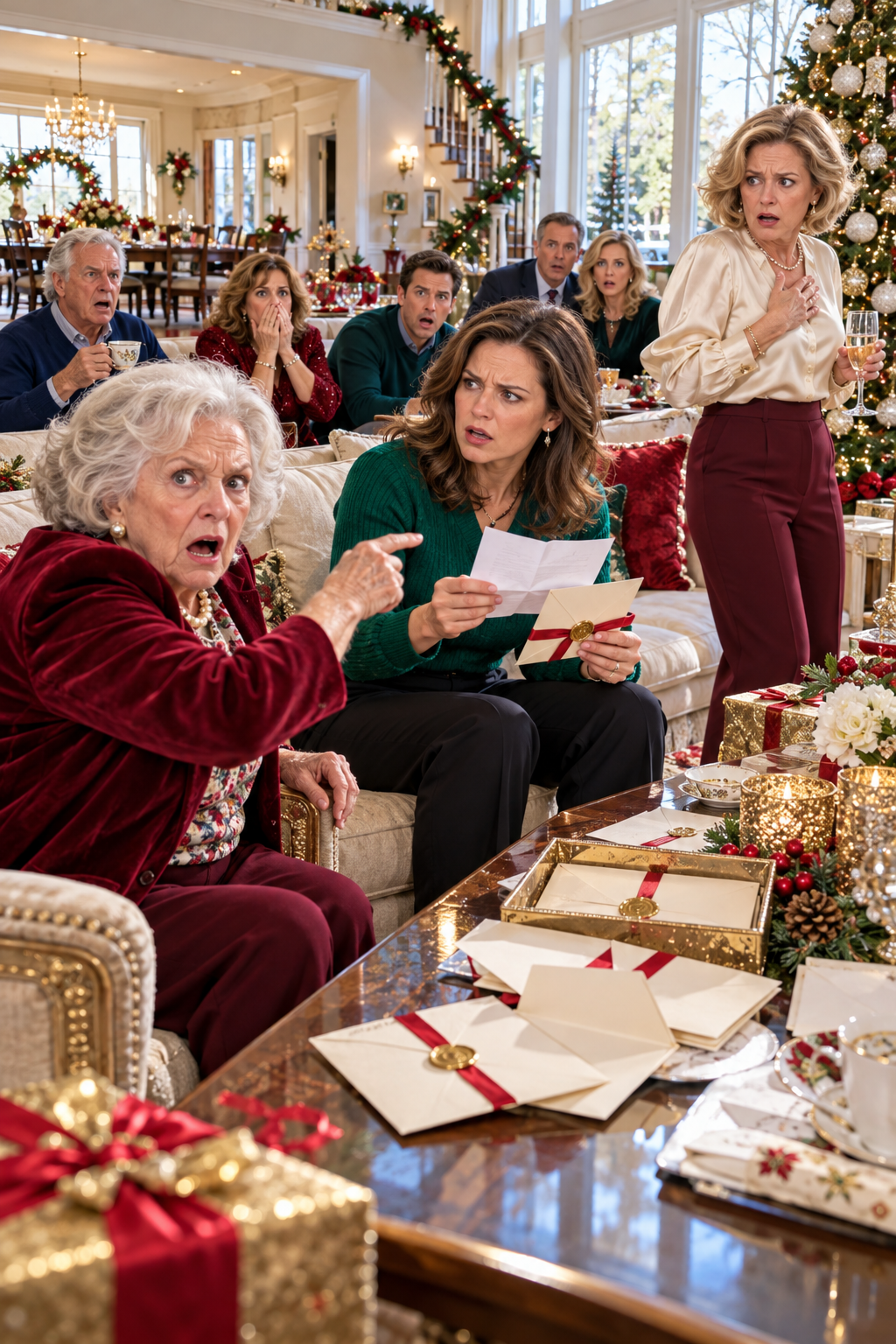
She didn’t answer immediately. Her eyes moved from the money to the empty envelope, then across the living room toward my mother, who was arranging a plate of sugar cookies beside the Christmas tree. “That’s not what I put in there,” Grandma said, so quietly that I almost missed it.
My mother, Elaine Mercer, stopped moving for perhaps half a second. Then she smiled with the bright, practiced expression she used whenever a conversation threatened to become uncomfortable. “Mom, you remember Tuesday, don’t you? We put money in everybody’s cards, and you said you wanted to do something extra special this year.”
Grandma’s name was Ruth Walsh, and at eighty-one she was small, stubborn, sharp-eyed, and capable of remembering precisely which neighbor had borrowed her roasting pan seventeen years earlier. She had lived alone since Grandpa died, handled her own bills, attended Mass every Sunday, and completed the crossword puzzle in the newspaper before breakfast. Her hands trembled when she poured coffee, but her memory had never frightened me. So when she looked directly at my mother and said, “No, Elaine, that is not what I put in Nola’s envelope,” I knew she wasn’t talking about a simple mistake.
My mother crossed the room and settled a hand on Grandma’s shoulder. “You’re exhausted, and you’ve barely eaten anything,” she said, her voice suddenly too gentle. “Come into the kitchen with me and have some water.”
Before I could object, she was guiding Grandma toward the hallway. My stepfather, Frank, looked up from the instruction booklet for the coffee maker I’d bought him and gave an uncomfortable chuckle. “She’s eighty-one, sweetheart,” he said. “Everybody gets a little mixed up eventually.”
I wanted to believe him. I wanted the afternoon to return to the ordinary comfort of Christmas, with Bing Crosby singing from Grandma’s old stereo, wet boots lined up by the radiator, and the smell of glazed ham drifting through the house. But the envelope was wrong in a way that money couldn’t explain. For twenty-four consecutive Christmases, my grandmother had given me twenty dollars and a handwritten letter, and this was the first year there was no letter.
When I was little, her letters contained things like how proud she’d been when I learned to ride my bicycle without training wheels or how she’d noticed me sharing my lunch with a lonely girl at school. As I grew older, she wrote about my first job, my struggles in high school, and the day I finished my apprenticeship as a union pipefitter. She never pretended to know everything about me, but she always noticed something, even when my own parents were too busy to ask. I kept every letter in a shoebox in my bedroom closet because, unlike most things people said, her words never seemed to change with the weather.
I was twenty-nine that Christmas, and most of my life had been ordinary enough. I worked on steam lines and industrial boilers in hospitals, schools, and university buildings, usually coming home with aching shoulders and black grime underneath my fingernails. I rented a small apartment on the east side of Syracuse, drove a ten-year-old pickup, and spent Sunday evenings having dinner with my parents. Nothing about my life suggested that an envelope could undo everything I believed about my family.
My name, or at least the name everybody used, was Nola Mercer. Frank Mercer had married my mother when I was five, and he had raised me with the quiet steadiness of a man who believed that showing up mattered more than saying the right thing. He taught me how to change a tire, came to every softball game I played, and spent an entire Saturday helping me prepare for my first welding certification. I called him Dad, and he had never given me a reason to regret it.
There was one odd detail about my identity, though I’d never thought of it as odd until that winter. My driver’s license and birth certificate said Nola Claire Keating, a surname my mother explained belonged to my biological father, who had supposedly died in a motorcycle accident when I was three. She told me he had been a troubled man, that his family wanted nothing to do with us, and that she had destroyed his photographs because remembering him was too painful. Whenever I asked questions, her face closed in a way that made me feel cruel for bringing him up.
I stopped asking before I was old enough to understand what I was giving up.
My mother and grandmother stayed in the kitchen for nearly twenty minutes that Christmas. When they returned, Grandma looked smaller somehow, her shoulders rounded and her rosary wound tightly around one hand. Mom remained beside her, bringing her coffee, adjusting her blanket, and answering questions before Grandma had a chance to speak. The entire afternoon became an exhausting performance of normality, and I was the only person who seemed to recognize that it was a performance.
When I bent down to kiss Grandma goodbye, she caught my wrist with surprising strength. “Come see me alone, sweetheart,” she whispered into my ear. Before I could answer, my mother appeared beside us and reminded me that the roads were icy.
The next afternoon I drove to Grandma’s house, only to find my mother’s sedan parked outside. Mom answered the door before I’d finished knocking and said Grandma was sleeping after a difficult night. Three days later, I returned after work and found Mom there again, this time explaining that Grandma needed help organizing her medical appointments. When I finally got inside, Grandma barely managed to ask about my job before my mother interrupted with a story about the neighbor’s frozen pipes.
On New Year’s Day, I called Grandma’s landline. My mother answered on the second ring and explained that she was staying over because Grandma had become forgetful. “You saw how confused she was at Christmas,” she reminded me. “I’m worried about her, Nola, and I need you to trust me.”
I said Grandma hadn’t seemed confused when she looked at the envelope. There was a silence long enough for me to hear a television playing in the background. Then Mom said, “She’s my mother, honey. I know when something’s wrong with her.”
That Saturday night, January 3, I sat alone in my apartment with the cardinal card on my coffee table. I examined the envelope again, searching for something that might explain Grandma’s reaction, but there was nothing except the familiar handwriting on the front and a faint indentation where another folded paper might once have rested. I thought about her request to see me alone and my mother’s determination to prevent it. For the first time, I wondered whether Grandma had intended to give me something that my mother didn’t want me to receive.
I opened my laptop and searched for my biological father.
I didn’t know his first name, only the surname Keating and the story of a motorcycle accident somewhere near Scranton, Pennsylvania, in the late 1990s. After an hour of searching death notices and newspaper archives without finding anything remotely convincing, I typed my own legal name into the search bar. The first result was a missing-child bulletin from a national database.
The photograph showed a little girl with crooked bangs, enormous ears, and a green dinosaur shirt. She was smiling with a gap between her front teeth, and there was something painfully familiar about the way she tilted her head. Beneath the picture were the words “Nola Claire Keating,” followed by a disappearance date: May 12, 2000.
I clicked the page, and my stomach tightened as I read the description. The child had disappeared from Scranton at age four in a suspected parental abduction, and the investigating agency was the Pennsylvania State Police. My mother’s name appeared under the circumstances of the disappearance. She had allegedly taken her daughter across state lines in violation of a custody order.
At the bottom of the page were two age-progressed images showing what the missing girl might look like as a teenager and a young adult. The older image wasn’t perfect, but the shape of the eyes, the jaw, and the ears were unmistakable. I touched the screen with one trembling finger, then scrolled back to the original photograph.
My mother hadn’t buried my father.
She had buried me.
Part 2
I spent the rest of that night trying to find a reasonable explanation for what I’d seen. Perhaps another woman named Elaine Keating had taken a little girl who happened to share my name, birthday, and face, although even thinking that sentence made me feel ridiculous. Perhaps the custody dispute had been misunderstood, the authorities had made a mistake, and my mother had eventually been cleared without anybody updating the website. But every explanation collapsed when I remembered the one fact no mistake could erase: my mother had told me that my father was dead.
At three in the morning, I walked into my bathroom and threw up. Afterward, I sat on the cold tile with my back against the bathtub, staring at the bathroom door until the steam from my earlier shower disappeared from the mirror. I thought about the years I’d spent feeling vaguely guilty for not grieving a father I couldn’t remember. Somewhere in Pennsylvania, a man might have spent those same years wondering whether I was alive.
By dawn, I’d found a public social media profile belonging to Gabriel Keating, a heating and air-conditioning technician who lived outside Scranton. His profile photograph showed a stocky man with a gray beard standing on a fishing dock beside a red-haired woman and a teenage girl holding a softball trophy. I could see my own ears in his face, a peculiar resemblance that brought tears to my eyes more quickly than anything else. I kept enlarging the photograph until the pixels blurred.
There were only a handful of public posts, most about fishing, work, and family celebrations. One post, dated May 12, 2016, contained no photograph, only a sentence: “Sixteen years today. Wherever you are, I’m still here.” I read it again and again, imagining how many times he had typed words like those without knowing whether anybody who mattered would ever see them. For twenty-five years, I’d been living three hours away from a man who apparently refused to stop looking for me.
The woman in his pictures was named Diane, and the girl was Paige. From a graduation photograph, I gathered that Paige was nineteen now and attending college in New Jersey. It took several minutes before I could bring myself to say it out loud in my empty apartment. “I have a sister.”
I almost contacted Gabriel immediately, but fear stopped me. What if the photograph wasn’t enough, what if the story was more complicated, or what if my appearance in his life destroyed a family he’d spent years rebuilding? Most of all, I didn’t want my first words to him to be questions I was still too frightened to ask. I needed someone who knew what had actually happened.
On Monday morning, I called the Pennsylvania State Police using the number listed on the bulletin. I gave the dispatcher the case number, my legal name, and my date of birth, and waited through a silence so long that I checked twice to make sure the call hadn’t disconnected. Eventually a woman with a steady voice introduced herself as Detective Celia Navarro, assigned to unresolved missing-person cases. She asked whether I was somewhere private, then began asking questions that made my hands shake.
She wanted to know my mother’s maiden name, where I’d attended kindergarten, and what identifying marks I remembered having since childhood. When I mentioned a brown birthmark shaped like a kidney bean behind my right knee, I heard papers move on her desk. “Ms. Keating,” she said after a pause, “I can’t confirm your identity on the telephone, but I have a very strong reason to believe you’re the person in this file.”
I was sitting in my truck outside a hospital construction site, wearing work boots and a sweatshirt underneath my winter jacket. Across the parking lot, a coworker was scraping ice from his windshield while another complained about the coffee machine in the trailer. The world looked exactly as it had an hour earlier, and I couldn’t understand how everyone could keep doing ordinary things. I pressed the phone against my ear and asked whether my father was alive.
“Yes,” Detective Navarro said. “He is.”
I covered my mouth with my free hand. She gave me a moment, then explained that my disappearance had never been resolved and that an outstanding legal case remained connected to it. In 1999, a court in Lackawanna County had awarded my parents joint custody, with restrictions against moving me out of Pennsylvania without authorization. My mother had left the state with me in May 2000, and my father had reported me missing the following morning.
“The state issued an arrest warrant in connection with interference with custody,” she explained. “We will need the prosecutor to review the status of the old charges and the available evidence, but locating you changes this investigation significantly.”
I asked whether my mother would be arrested. Detective Navarro didn’t pretend to know exactly what would happen, but she told me that once authorities verified my identity and location, they couldn’t simply ignore an unresolved case. She asked whether I was in immediate danger and whether my mother knew I’d found the bulletin. When I said no to both questions, she suggested we meet privately before anybody confronted my family.
That Friday, Detective Navarro drove to Syracuse and met me at a coffee shop near the university. She was in her forties, with close-cropped dark hair and the patient expression of someone accustomed to hearing difficult truths from people who weren’t ready to tell them. She carried a thick accordion file, a tablet, and a small envelope containing copies of photographs. When I handed her my birth certificate and identification, she compared them carefully before asking to see the birthmark behind my knee.
I took her into the coffee shop’s single-occupancy restroom rather than expose my leg in front of strangers. She examined the mark, then showed me an old photograph of a laughing little girl standing in a backyard sprinkler, the same brown shape visible behind her knee. The girl had one hand raised as if she were trying to catch the water. I stared at her face and felt a strange rush of grief for a child I’d never been allowed to remember.
Detective Navarro explained that additional documentation and biological confirmation would be arranged. Then she showed me selected pages from the old case file, including a custody order and the report my father had made after finding my childhood apartment nearly empty. He had arrived for his scheduled visitation and discovered that my clothes, toys, and mother were gone. The report listed a stuffed dog left on my bed and a neighbor who remembered hearing a car engine late the previous night.
One page carried my grandmother’s name.
A trooper had interviewed Ruth Walsh in June 2000, asking whether she knew where her daughter and granddaughter had gone. Grandma had claimed she had no idea, that she was frightened for us, and that she hadn’t received any communication from my mother. I recognized the address listed on the report as the old house in Scranton where Grandma had lived before moving to Syracuse. She had relocated north after Grandpa died, when I was ten.
I asked Detective Navarro whether my father had ever been accused of hurting us. She said the file included allegations raised during the custody dispute, but she wasn’t going to reduce a complicated family history to a single sentence. She confirmed that no finding of abuse had supported removing my father’s custody rights, while also explaining that a court’s decision wasn’t the same as knowing everything that happened inside a marriage. It was a careful answer, and I appreciated that she wasn’t trying to replace one unquestioned story with another.
For the next week, I moved through my ordinary schedule as if I were borrowing someone else’s life. I welded pipe in a hospital basement, ate sandwiches with coworkers, and went home to an apartment that felt increasingly unfamiliar. My mother called twice to ask why I hadn’t visited, and I told her work was busy. Every time she said she loved me, I wondered how many other things she’d said with the same easy confidence.
I went to Sunday dinner at my parents’ house on January 11 because staying away would have raised questions. Mom served pot roast and mashed potatoes, Frank complained about the Buffalo Bills, and I watched the woman who had packed my school lunches and checked my fever when I was sick. She asked whether I’d heard from Grandma lately, and when I said I hadn’t, she told me Grandma was becoming more confused. I managed to finish dinner without revealing that I’d spoken to a detective.
Driving home, I remembered something from fifth grade that I’d spent almost twenty years refusing to think about. Our class had planned a trip to the railroad museum in Scranton, and I’d begged my mother to sign the permission slip because I loved the old steam engines. She had snatched the paper from my hand, torn it down the middle, and screamed that I was never going to Pennsylvania. Later, she’d apologized and explained that the place held too many painful memories.
I had believed her.
Now I remembered sitting at home on the day of that field trip, watching cartoons while my classmates visited a city where my father was still looking for me. I remembered how ashamed I’d felt when my teacher asked why I couldn’t go. And I remembered my grandmother quietly bringing me a miniature toy locomotive the following Christmas, saying she thought I deserved one.
That memory changed something inside me. My mother wasn’t the only person who had known where I came from, and the envelope on Christmas morning suddenly looked less like a mistake than an attempted confession. I needed to speak to Grandma before somebody persuaded her that telling the truth would cost her everything.
On January 17, my mother called to say she had caught a terrible cold and couldn’t drive Grandma to Sunday Mass. She asked whether I could take her instead, reminding me to bring her straight home afterward because she tired easily. I promised I would.
For the first time since Christmas, my mother had opened a door without realizing what was on the other side.
Part 3
Grandma knew something the moment she climbed into my truck. She settled her purse against her knees, smoothed the front of her navy winter coat, and studied my face without saying good morning. I had inherited her gray-green eyes, and looking at her that morning felt like facing a version of myself that had lived long enough to understand regret. Finally, she reached across the console and squeezed my hand.
“I’ve been praying you would come,” she whispered.
I didn’t ask what she meant until after Mass. During the service, she held her rosary so tightly that I worried the chain would break, and twice I caught her watching me instead of the priest. When everyone else went downstairs for coffee and doughnuts, I guided her to a table in the corner of the parish hall. She sat facing the wall, away from the women who knew her, while I brought her coffee with three packets of sugar.
“Grandma,” I said, placing my phone between us, “I found the missing-child bulletin.”
Her eyes closed. She didn’t ask which bulletin, or why I had been looking, or whether I might have misunderstood. She simply put both hands around her paper cup and waited. I told her about Detective Navarro, the custody order, the photographs, and the man named Gabriel Keating whose face appeared in my own whenever I looked in the mirror.
When I finished, Grandma’s coffee had gone cold. “I knew your mother took you,” she said. “I knew the morning after she did it.”
Those were the first words of the confession that changed my understanding of every Christmas we’d spent together. Grandma told me that my parents had met in Scranton in 1994, married quickly, and had me before either of them understood what a difficult marriage could become. Gabriel was young, hot-tempered, and irresponsible with money, and he drank too much during the worst years of their relationship. My mother wasn’t happy, but the marriage had deteriorated long before she decided to leave.
By 1999, they were separated and fighting over custody. Mom had accused Gabriel of frightening and threatening her, and she sought a protection order and sole custody. The court heard both sides, did not grant the protection order, and eventually established a shared custody arrangement that neither parent could unilaterally disregard. Grandma said she had seen them argue bitterly, but she had never witnessed him strike or threaten my mother, and the grandmother I’d trusted all my life was careful not to claim she knew what happened behind closed doors.
“Your father had plenty to answer for as a husband,” she said. “But he wanted to be your father, Nola, and your mother couldn’t accept that he had a right to remain one.”
That winter, Mom had met Frank Mercer at a wedding in Syracuse. He had a steady job at a bearing factory, owned a modest house, and offered the kind of peaceful future Mom had wanted for years. She wanted to marry him and bring me north, but Gabriel refused to consent to a move that would put several hours between us. According to Grandma, he offered to discuss different visitation arrangements if Mom stayed nearby, but she had already decided what she wanted.
On May 12, 2000, Mom packed two suitcases, a garbage bag of my favorite toys, and enough clothes to make it appear that we were taking a short trip. She strapped me into my car seat after dark and drove north on Interstate 81. I asked where we were going, and she told me we were going somewhere Daddy couldn’t make us sad anymore. The next morning, she called Grandma from a pay phone outside Syracuse.
“She told me she was safe, and she said I couldn’t tell anybody,” Grandma remembered. “She said if Gabriel found her, he’d drag her back into court and take you away, and then she’d have nothing.”
When the police came to Grandma’s house, she lied. She told them she hadn’t heard from her daughter, even though she knew which city we were in and that Frank was helping us settle there. At first, she believed she was giving Mom time to work things out, perhaps to negotiate a custody agreement once the anger faded. But weeks became months, Mom married Frank, and eventually the lie grew too large for Grandma to imagine reversing.
“Why didn’t you tell me?” I asked.
Grandma wiped her face with a paper napkin. “Because each year I waited made the next year harder, and because I was afraid of losing both of you.”
She told me she had kept an old missing-child flyer folded inside her Bible, tucked between the pages of Psalms. Every May 12, she took it out and prayed over the photograph of the little girl in the green dinosaur shirt. She had watched me grow into a teenager, a young woman, and then an independent adult, all while knowing that someone else was missing those years. Her Christmas letters, she admitted, had become a way to say she loved me without finding the courage to tell me what love required.
Then she reached into her purse and took out a small photograph. It showed an older man sitting at a diner table, his eyes red, holding a phone with my picture on its screen. I recognized Gabriel immediately.
“He found me,” Grandma said. “Not you. Me.”
In the summer of 2024, Gabriel had located her name in an online church directory and written her a letter. He said he wasn’t asking her to violate anyone’s privacy or make a promise she couldn’t keep; he only wanted to know whether his daughter was alive and safe. Grandma had driven to Binghamton to meet him at a diner on Front Street, choosing a place halfway between their homes where nobody was likely to recognize them. She told him I was alive, that I worked as a pipefitter, and that I had grown into a good woman.
“He cried when I showed him your picture,” she said. “He kept asking whether you looked happy.”
I had spent most of my adult life wondering whether my biological father would have wanted to know me. All that time, he had been sitting in diners with strangers and asking whether I was happy.
Grandma met him again a few months later. He had remarried, had another daughter, and worked for a heating company, but he still kept copies of my missing-child flyer in a drawer beside his bed. She asked him not to contact me until she could explain everything herself. He was reluctant, especially after so many years, but eventually agreed to let me decide when and whether we met.
Last fall, Grandma had experienced a frightening episode of chest pain. The doctors assured her that she could manage her health with regular follow-up care, but the hospital visit changed how she thought about the time she had left. She couldn’t bear the possibility of dying with her secret, and she knew her voice might fail if she tried to tell me face-to-face. So she wrote me a letter.
It was four pages long, front and back, and she described everything she had told me in the parish hall. She enclosed the original missing-child flyer, Gabriel’s name and telephone number, and a photograph of him waiting at the diner. She placed everything inside my Christmas card, then handed the envelopes to my mother to fold, fill, and seal, just as they had done for years. She believed she was finally giving me the truth without forcing me to hear it in front of the family.
“Then I saw the money,” she said. “I knew what Elaine had done.”
I asked whether she had confronted Mom in the kitchen that Christmas. Grandma nodded, looking suddenly frightened, and told me that Mom had denied the letter existed. When Grandma insisted, Mom warned that people were already noticing her forgetfulness and that it wouldn’t take much to convince everyone she needed supervised care. Worst of all, Mom threatened to stop me from visiting if Grandma continued bringing up the past.
The cruelty of that threat struck me harder than anything else I’d heard. My mother had raised me to respect my grandmother, bring her groceries, shovel her walkway, and never let her spend a holiday alone. Now she was using the bond between us as leverage, counting on an elderly woman’s fear of isolation to protect a twenty-five-year-old deception. I reached across the table and held Grandma’s trembling hands.
“I won’t let her keep me from you,” I said. “And I won’t pretend this didn’t happen.”
Grandma began crying then, apologizing not just for the letter but for the entire life I’d been denied. I didn’t tell her everything was forgiven, because it wasn’t, and I didn’t know whether it ever would be. Instead, I told her that telling me the truth had to mean telling the police as well. She nodded, but her expression made it clear how frightening that responsibility seemed.
Before we left the parish hall, she wrote Gabriel’s telephone number on the back of a church bulletin. She also told me something I’d never known about Frank. He had wanted to adopt me when I was seven, but my mother refused to discuss it after learning that my biological father might have to be notified. Grandma had accepted Mom’s explanation that the paperwork would only reopen painful memories.
Driving home, I remembered something my mother used to tell me whenever I asked why Frank hadn’t adopted me. “Some things are better left exactly as they are,” she would say. At the time, I’d thought she meant my birth certificate was a treasured connection to a dead man. Now I understood that changing the paperwork could have required somebody to prove he was dead.
I walked Grandma to her front door and waited until she had locked it behind her. Then I sat in my truck, looking at the telephone number on the church bulletin while a light snow fell against my windshield. I had spent twenty-five years believing my father was gone, and my mother had spent those same years making sure I never discovered how close he had always been.
I wasn’t going to call Gabriel yet.
First, I needed to look my mother in the eyes and give her one opportunity to tell the truth without hiding behind anyone else.
Part 4
The following Saturday, I drove to my parents’ house without warning. It was late morning, and the neighborhood looked much as it had throughout my childhood, with snow piled along the curb and a plastic snowman still standing in the neighbor’s yard. Mom was at the kitchen table working on a crossword puzzle when I walked in, and she smiled until she saw the expression on my face. I asked where Frank was, and she said he was repairing a cabinet hinge in the garage.
“Could you ask him to come inside?” I said.
She set down her pen. “What is this about, Nola?”
“I need both of you here.”
When Frank entered, rubbing his hands on a shop towel, I placed my phone on the table with the missing-child bulletin open. Mom looked at the photograph, and the color drained from her face so completely that I thought she might faint. Frank leaned over the screen, read the name and date, and turned toward her with a confused frown. I waited until he sat down.
“Grandma told me what happened,” I said. “I’ve spoken to the Pennsylvania State Police, and they have an open case involving my disappearance.”
For several seconds, the only sound was the refrigerator humming behind us. Frank asked Mom what I was talking about, but she kept staring at the phone. When I mentioned the custody order and the warrant issued after she fled Pennsylvania, Frank recoiled as though I’d struck him. He asked her whether she had known about any of it.
“I had to leave,” she whispered. “You know what Gabriel was like.”
Frank looked at me, then back at her. “Elaine, you told me he was threatening you, and that you were afraid he’d hurt Nola. You never said a judge had ordered you to keep her in Pennsylvania.”
That was how I discovered Frank hadn’t known the complete truth. He knew Gabriel had been alive when Mom brought me to Syracuse, and he had agreed to help her establish a new life because he believed she was escaping a dangerous marriage. He believed the story about my father’s death was a painful but necessary fiction intended to prevent a little girl from becoming frightened or obsessed with an abusive parent. What he hadn’t known was that my father had legal custody rights, that my disappearance had been reported, or that an unresolved criminal case had followed Mom for decades.
“I was terrified,” Mom insisted. “Gabriel drank, he shouted, and he made every disagreement into a fight. You think a judge could understand what living like that was?”
I told her I wasn’t there to dismiss how frightening her marriage might have been. If she’d experienced abuse, she had deserved safety, help, and a lawful way to protect herself and her child. But she had taken away my ability to know the truth, and she had continued lying long after I was old enough to make decisions for myself. I asked why she had never told me Gabriel was alive once I became an adult.
“Because you would have gone looking for him,” she said.
There it was. Not a story about a motorcycle accident or an impossible choice made in the middle of the night, but a simple admission that she had spent my childhood controlling what I was allowed to know. She looked down at the crossword puzzle and began tracing one finger along the edge of the page. Frank lowered himself into the chair across from her.
“You told me his family had him cremated,” I reminded her. “You told me there were no photographs because you burned them. You let me grow up believing my other grandparents had rejected me.”
“I wanted you to be happy,” she said.
“And you were the only person who got to decide what happiness meant.”
She began crying, but I felt strangely calm. I had spent a week imagining that I would scream at her, demand explanations, or collapse under the weight of what she’d done. Instead, I heard myself asking the question that had brought me to her kitchen. “Where is Grandma’s Christmas letter?”
Mom covered her mouth. Frank watched her, his face slowly hardening, and I could tell he was learning something new again. At last she whispered that she had burned it in the fireplace after Grandma gave her the envelopes. The missing-child flyer and photograph had gone into the flames with it.
“She trusted you to help her,” I said. “You took something she wrote for me and destroyed it.”
Mom reached for my hand, but I pulled back. She said Grandma had been emotional about her heart problems and that the letter would have created confusion and unnecessary pain. She kept insisting that she had only wanted to protect me, even as every sentence revealed another person she had manipulated. When she mentioned that Grandma might be getting senile, Frank told her to stop.
It was the first time I’d ever heard him use that tone with her. He said he’d spoken to Ruth after Christmas and hadn’t noticed any confusion, only fear and sadness. He asked Mom whether she had threatened to send Grandma into a care facility, and she looked away without answering. The silence settled between them like something heavy enough to damage the kitchen floor.
I stood up. “I’m not asking either of you to choose between me and the other person,” I said. “But I’m going to find my father, and I’m going to cooperate with the investigation. You don’t get to decide what I know anymore.”
Frank followed me into the driveway. He was wearing his old flannel shirt without a coat, and his hands were shaking slightly from the cold. He apologized for believing the story Mom had told him, then said he had never intended to keep me from somebody who loved me. I believed him, even though believing him didn’t make the years he’d helped sustain the lie any easier to understand.
“You’re still my daughter,” he said. “Nothing about this changes that for me.”
I started crying then, for the first time since entering the house. Frank wrapped his arms around me, the same way he had when I was seven and broke my wrist falling off my bicycle. I told him I loved him, but I couldn’t make promises about what would happen to our family. He said he understood.
Before I could get into my truck, he asked me to wait. He disappeared into the garage and returned carrying a worn manila envelope secured with a red string. Inside were legal documents dated 2003, including a petition for stepparent adoption with Frank’s name filled in beside mine. The final pages were unsigned.
“I wanted to adopt you officially,” he explained. “I went to a lawyer, filled everything out, and told your mother it would make us a family in the eyes of the law.”
The attorney had explained that adopting me could require notifying my biological father or presenting evidence that his parental rights were no longer legally intact. Mom had refused immediately, claiming she couldn’t bear to erase the last connection between me and the man who had died. Frank thought her refusal came from grief, so he put the papers away and never mentioned them again. Now he held the envelope as though it contained the answer to a question he should have asked decades earlier.
“I thought I was respecting her feelings,” he said. “I never realized I was helping her keep you hidden.”
I took the papers home and spread them across my kitchen table. They didn’t prove Frank had deliberately deceived me, but they showed how carefully my mother had protected her story whenever someone came close to examining it. She had allowed me to use Frank’s surname at school and work, but she had kept my legal identity unchanged because changing it might have exposed her. The surname I’d once considered a sentimental tribute to my deceased father had actually helped preserve the connection that could undo her lie.
Two days later, Mom left a voicemail begging me not to contact Gabriel. She said he would poison me against her, that he would tell me only the worst things about their marriage, and that I would regret destroying our relationship over something that happened before I could remember it. I listened once, saved the recording, and didn’t call back. The next morning, I told Detective Navarro what my mother had admitted and arranged to give a formal statement.
That Wednesday evening, I drove to a grocery store parking lot and parked beneath a bright white security light. I wanted somewhere anonymous, a place where nobody would know if I sat crying in my truck afterward. I unfolded the church bulletin Grandma had given me, entered the telephone number into my phone, and stared at the screen. Then I pressed Call.
A man answered after the second ring. “Hello?”
I opened my mouth, but nothing came out. There was a television playing somewhere in the background and a dog barking once, followed by footsteps. The man waited patiently, then asked if anybody was there.
“It’s Nola,” I managed to say. “Nola Keating.”
The sounds in the background seemed to disappear. For several seconds I heard only his breathing, and then he made a small, broken sound that I couldn’t understand. When he finally spoke, his voice trembled.
“Hi, sweetheart,” he said. “I’ve been hoping you’d call.”
We talked for less than ten minutes because neither of us could manage much more. He asked whether I was safe, whether I had people who cared for me, and whether I wanted to meet. He didn’t ask me to call him Dad or insist that I explain why it had taken so long. Instead, he said he would follow whatever pace I needed because he knew that learning the truth didn’t automatically make us strangers who could suddenly behave like family.
We agreed to meet at the diner in Binghamton where he’d seen Grandma. He said there was a booth near the back window and that the rice pudding was worth the drive. I laughed unexpectedly, not because anything was funny, but because the man I’d spent my childhood imagining as either a ghost or a monster was telling me where to get dessert. We chose Saturday, February 7, at noon.
After we hung up, I sat in the truck until the store lights began reflecting off a fine layer of fresh snow. I had turned thirty three days earlier, and my mother hadn’t called on my birthday. Frank had sent a text telling me he was proud of me, and Grandma had mailed a card containing a short letter apologizing for her silence. But the man I’d never met had wished me a happy birthday over the telephone and said something I couldn’t stop thinking about.
“I have something for you,” he had told me. “Actually, I’ve been keeping it for a very long time.”
Part 5
I arrived at the diner twenty minutes early and chose a booth with a clear view of the entrance. The place smelled of bacon grease, burnt coffee, and the lemon-scented cleaner someone had used on the tables, and an old jukebox stood beside the restrooms. I ordered coffee and immediately regretted it because my stomach was already twisting with nerves. Every time the door opened, I looked up.
At 11:58, a man wearing a brown work jacket and a Penn State baseball cap stepped inside carrying a cardboard shoebox. He stopped just beyond the entrance and looked across the room, his gaze passing over the counter, the windows, and the booths. When he saw me, he stood completely still. A waitress carrying two plates had to move around him before he seemed to remember where he was.
He walked toward my table slowly, as if approaching too quickly might frighten me away. Up close, Gabriel Keating looked older than his photographs, with deep lines around his eyes and a small scar near his chin. He removed his hat, held it awkwardly against his chest, and asked whether he could sit down. I nodded, unable to trust my voice.
“Hello, Nola,” he said.
“Hello, Gabriel.”
I saw the effort it took for him not to react to hearing his first name. He placed the shoebox beside him, ordered coffee, and asked whether the drive had been difficult. I told him the highway had been clear, although I’d nearly missed my exit because I’d been gripping the steering wheel so tightly. He smiled, and for the first time I noticed that his smile looked like mine.
He didn’t immediately talk about the disappearance. Instead, he asked about my work and listened as I explained the difference between residential plumbing and the industrial pipe systems I handled. When I mentioned replacing a failing steam line in a hospital basement, his eyes lit up, and he began talking about an old boiler he’d worked on the previous week. For nearly fifteen minutes, we discussed pressure gauges, difficult contractors, and the peculiar satisfaction of repairing equipment nobody noticed until it stopped working.
Then he looked at my hands. “Your grandmother told me you worked with your hands,” he said. “I kept thinking about how much I’d have loved to teach you things when you were little.”
I stared at the faint welding burns on my knuckles. “Frank taught me quite a bit.”
Gabriel nodded. “I’m glad somebody did.”
There was no bitterness in his voice, and that made me feel more comfortable than I had expected. He asked whether Frank had been good to me, and when I said yes, he looked relieved. I told him Frank was still my dad in every practical sense, and Gabriel said he wasn’t there to compete with someone who had spent twenty-five years caring for me. He only hoped there might eventually be room for him too.
When our food arrived, neither of us ate much. Gabriel told me that the morning after I disappeared, he’d gone to the apartment where Mom and I lived to pick me up for his scheduled weekend. The furniture remained, but my clothes were gone, and the little bedroom where I’d slept was nearly empty. He found a stuffed dog abandoned beneath my bed and sat on the floor holding it until the police arrived.
“I remember that dog,” I said unexpectedly.
Gabriel looked up sharply. I could picture its floppy brown ears and the blue ribbon someone had tied around its neck, although I couldn’t remember where I’d seen it last. He told me I’d named it Captain because he wore a ribbon like a sailor. My mother had always said I was too young to remember anything about my first home.
Gabriel admitted that the first few months after my disappearance had been ugly. He’d been drinking heavily before the custody battle, and afterward he nearly lost his job because he couldn’t concentrate and kept leaving work to chase possible sightings. His attorney had told him to get help long before I disappeared, and eventually he did. He stopped drinking, started counseling, and began rebuilding his life while the police continued searching.
“I’m not going to tell you I was a wonderful husband,” he said. “I wasn’t, and I won’t ask you to pretend I was. But I loved you, and whatever happened between your mother and me, I never agreed to disappear from your life.”
I appreciated the distinction. I’d spent my childhood hearing that Gabriel had been a terrible man and my mother had been a loving woman who saved me from him. Now I was beginning to understand that people could be flawed without deserving to lose their children, and that someone could love me fiercely while still doing something unforgivable. Neither truth canceled the other.
Gabriel had hired private investigators twice, using savings he’d intended to put toward a house. He’d traveled to neighboring states after false sightings, mailed photographs to police departments, and checked with the state police every anniversary of my disappearance. When my grandmother contacted him in 2024, he felt hope for the first time in years, but he also feared frightening me by arriving without warning. He agreed to wait for Grandma’s letter because he wanted my first contact with him to be a choice.
“I couldn’t make the decision for you,” he said. “Too many people had already done that.”
Finally, he lifted the shoebox onto the table. It was an ordinary boot box with a rubber band around the lid, the corners softened from years of handling. Inside were envelopes standing upright like index cards, each addressed in blue ink to Nola Keating, wherever you are. Some were covered with cartoon animals, while others were plain white or decorated with balloons and flowers.
“One for every birthday after you disappeared,” he said.
There were twenty-five sealed cards, dated from my fifth birthday in 2001 through my twenty-ninth in 2025. Gabriel explained that he’d bought them every February, written whatever he wished he could tell me, and stored them in the box because he had nowhere to send them. He didn’t know whether I’d ever read them, but writing them made him feel as if he hadn’t completely surrendered the responsibility of being my father. Then he took one final blue envelope from his jacket.
“This one’s for your thirtieth,” he said. “I didn’t seal it. I thought maybe this year I could actually give it to you.”
I opened the first card, dated February 2, 2001. It showed a cartoon puppy wearing a party hat, and inside he had written that he hoped I received the bicycle with purple streamers I’d wanted before I disappeared. He said he hoped someone remembered that I hated chocolate frosting and wanted strawberries on my cake. A two-dollar bill was tucked inside because I’d once called them the special kind of money.
I hadn’t known any of those things about myself.
The card from my sixteenth birthday contained advice about learning to drive and a promise that he would teach me to change a tire if we ever met. The card from my twenty-first birthday said he hoped I’d found people who made me feel safe and that he was proud of the woman I might have become. He admitted he didn’t know what I looked like anymore but wanted me to know he had never stopped looking. I pressed the paper against my face and began crying in a crowded diner.
Gabriel reached across the table and rested his hand beside mine, giving me room to decide whether I wanted to take it. After a moment, I slipped my fingers around his. We sat that way while people ordered lunch, the waitress refilled coffee cups, and someone fed quarters into the jukebox. I couldn’t recover the years we’d lost, but for the first time I could see what those years had looked like from the other side.
We stayed until the lunch rush had disappeared. Before we left, Gabriel asked whether I’d be comfortable meeting Diane and Paige eventually, and I told him I wanted to, although I wasn’t ready for another emotional introduction that day. He showed me photographs of his family, including a picture of Paige wearing a softball uniform and laughing with a dog. I noticed a childhood photograph of myself taped to the refrigerator behind her.
“Is that me?” I asked.
Gabriel looked at the picture and smiled sadly. “You’ve always been part of our home.”
He insisted that I take the shoebox, and I carried it to my truck with both arms wrapped around it. Before we parted, he hugged me briefly, holding on only after I returned the embrace. He smelled of coffee and winter air and the familiar metallic scent of somebody who worked around machinery. I drove home with the box buckled into the passenger seat.
The following Monday, my phone buzzed during lunch at work. A message had arrived from Paige Keating, whose name I’d seen on Gabriel’s photographs. She wrote that she’d known about me since she was old enough to understand what a missing person was, and that my childhood picture had been on the refrigerator for her entire life. Then she asked whether I might visit for Easter because she had something she’d wanted to give her older sister for years.
I sat on an overturned bucket in the break room, holding my sandwich in one hand and my phone in the other. My mother had spent decades convincing me that my father’s family wanted nothing to do with me. Now a sister I’d never met was asking me to come home for a holiday.
Part 6
The shoebox stayed on my kitchen table for three weeks. I couldn’t bear to put it away, but I couldn’t bring myself to open every card at once, either. Each envelope represented a birthday I’d already lived, a moment that should have been ordinary and somehow had become evidence of a different life. I began reading one every few evenings, usually after work, when the apartment was quiet and I could give myself time to cry without needing to explain it to anyone.
The sixth birthday card contained a photograph of Gabriel standing beside the little bicycle he had bought me before my disappearance. The tenth included a newspaper clipping about a girls’ softball tournament, with a note wondering whether I still liked playing sports. On my eighteenth birthday, he had written about the strange pride and helplessness of knowing his daughter was legally an adult somewhere in the world. He hoped I had people who would celebrate me and help me choose what came next.
I began keeping a notebook of questions. What had my first bedroom looked like, and why had I named my stuffed dog Captain? Had Gabriel’s parents known me, and were they alive when I vanished? What did I call him when I was little, and what was the last thing he remembered hearing me say? I called him once a week, sometimes with a list in front of me, sometimes because I wanted to hear his voice while I made dinner.
Those conversations were awkward in a way I hadn’t expected. We shared a blood relationship and the same distinctive ears, but we didn’t know each other’s habits, jokes, or silences. I could tell when he was trying too hard not to offend me, and I sometimes resented how careful we both had to be. Still, when he described taking me fishing at a pond outside Scranton, I remembered the smell of muddy water and the strange excitement of holding a wriggling bluegill, and that tiny shared memory felt like a gift.
I also met with Detective Navarro again. A laboratory comparison and additional records had confirmed my identity, and the investigation was moving from locating a missing child to documenting how and why my disappearance had remained concealed. I gave a formal statement describing Christmas, my mother’s admission about burning the letter, and the conversation at her kitchen table. I also supplied a copy of Frank’s unsigned adoption petition and the voicemail in which Mom had begged me not to contact Gabriel.
Grandma gave her statement the following week. I accompanied her to the interview and waited outside while she explained what she’d known since May 2000 and why she’d lied to investigators. When she emerged, she looked exhausted but oddly lighter, like someone who had finally put down a suitcase she’d carried too long. In the car, she asked whether I thought the police would prosecute her.
“I don’t know,” I said. “But I think you did the right thing today.”
Grandma nodded, looking down at the rosary resting against her coat. “It’s a shame it took me twenty-six years to figure out what the right thing was.”
As the investigation continued, Mom became increasingly frantic. She called from different numbers when I stopped answering, left messages accusing Gabriel of manipulating me, and sent photographs from my childhood as proof that she’d been a devoted mother. One afternoon, she mailed a padded envelope containing my kindergarten drawings, report cards, and a photograph of us decorating a Christmas tree when I was six. There was a letter inside describing everything she had sacrificed for me.
I read it at my kitchen counter. She wrote about working two jobs before marrying Frank, staying up when I had pneumonia, and paying for my softball equipment when money was tight. Those memories were real, and I didn’t dismiss them simply because I was angry. But the letter never mentioned Gabriel, the custody order, or the twenty-five years she’d spent preventing me from learning who I was.
At the bottom she had written, “Please don’t let one mistake erase the mother who loved you.”
I called Frank that evening. He was repairing the kitchen cupboards when he answered, and I could hear tools rattling in the background. He told me Mom had been seeing a counselor and talking to an attorney, but that she still seemed convinced the entire situation was something happening to her rather than the result of her decisions. He said he had begun asking questions of his own, and every answer made him wonder how much of their marriage had been built around things he was never allowed to know.
“Do you regret raising me?” I asked.
Frank sounded almost offended. “Not for a single second.”
I told him I needed him to understand the difference between loving me and excusing what Mom had done. He was quiet, then said he’d spent most of his life thinking protecting his family meant keeping everyone together, and he was beginning to understand how damaging that instinct could be. He promised not to pressure me into reconciling with her. It was the first promise anyone in that house had made without asking me for something in return.
By late March, the district attorney’s office was reviewing the case. Detective Navarro explained that the age of the evidence and the passage of time complicated the legal process, but my mother’s location, her statements, and Grandma’s account had given prosecutors a clearer basis for proceeding. Attorneys were discussing a voluntary surrender rather than having officers arrive at my mother’s home. No one could promise what charges would ultimately be pursued or what punishment might follow.
Gabriel called me after learning about the developments. He said he would cooperate with prosecutors but wasn’t asking for revenge or a prison sentence simply to prove that he’d suffered. He wanted an official record of what had happened and an opportunity for me to decide what relationship, if any, I wanted with my mother. I told him I appreciated that he wasn’t trying to turn my life into a competition between parents. He said he had enough regrets about the past and didn’t intend to add another one.
In April, Mom drove to Scranton with her attorney and surrendered to the authorities. Frank took the day off work and drove her, although they had barely spoken during the three-hour trip. He called me from the courthouse hallway while I was working in a university boiler room. I stepped away from the noise of the equipment and listened as he told me she’d been fingerprinted and was waiting for the next stage of the court process.
“She asked if you’d forgive her,” Frank said.
I closed my eyes. “What did you tell her?”
“I told her that forgiveness isn’t something she gets to schedule.”
He paused before adding that it was the first time he’d ever visited Scranton. During their marriage, Mom had always refused to return, claiming the city held too many painful memories. He’d respected that without asking what those memories were, even when his company sent workers there or someone suggested attending a baseball game. He had spent twenty-five years married to a woman who treated an entire city like something she was afraid might speak.
After the call, I returned to work, climbed a ladder, and began checking a line of newly installed pipe. My hands knew what to do even while my mind replayed Frank’s words. I thought about the Sunday dinners, the birthday parties, the camping trips, and the ordinary love that had existed in our home alongside a secret no one was allowed to question. I wondered how many people could build a comfortable life on top of something terrible if they never looked beneath the floorboards.
That evening, Detective Navarro forwarded information about the next court date and the opportunity to submit a written statement. I sat at my kitchen table beside Gabriel’s birthday cards and Grandma’s old Christmas letters, and I began writing. For the first time, I wasn’t trying to explain my mother to anyone. I was trying to explain what it meant to discover that an entire part of my life had been deliberately taken from me.
I wanted the court to understand that I had been loved, and that I had also been harmed.
Both things were true, and neither one excused the other.
Part 7
I drove to Scranton on Easter Sunday with a bakery box balanced on the passenger seat and Gabriel’s birthday cards stored safely at home. Paige had called three times that morning to make sure I was still coming, and Diane had texted to ask whether I preferred ham or roast chicken. I had never been invited to a holiday dinner where the people waiting for me were technically strangers but already knew my name. By the time I reached Gabriel’s neighborhood, my hands were sweating against the steering wheel.
His house was a modest two-story home with pale siding, flower beds that hadn’t yet recovered from winter, and a basketball hoop attached to the garage. I parked behind Paige’s car and sat for a moment, looking at the front door. Then it opened, and a young woman with curly red hair hurried down the steps. She stopped a few feet from my truck, suddenly appearing as nervous as I felt.
“You’re really here,” she said when I climbed out.
“I’m really here.”
Paige studied my face with an expression that shifted between fascination and disbelief. “You have Dad’s ears,” she said, then laughed at herself. “Sorry. I’ve been wanting to say that since I saw your picture.”
Before I could respond, she threw her arms around me. I held her carefully at first, then tightened my embrace when I felt her shoulders begin to shake. It was strange to be somebody’s older sister without knowing the first thing about how to be one. But when she stepped back and wiped her eyes, she looked at me with such uncomplicated happiness that I found myself smiling.
Inside, Diane greeted me with a hug and immediately showed me where to put my coat. She was warm without being overwhelming, and she had the good sense not to ask how I was coping while everyone stood awkwardly in the foyer. Gabriel was in the kitchen carving the ham, and when he saw me, he put down the knife and came around the counter. He embraced me briefly, then returned to his work as if my presence in his kitchen were the most natural thing in the world.
I was grateful for that small kindness. I didn’t want every minute to become a ceremony about my return, and I didn’t want to feel responsible for everyone else’s happiness. I wanted to learn ordinary things about these people, like who took too much salt on their potatoes and who complained about the television being too loud. For the first time, those details seemed more important than the grand reunion I’d imagined.
During dinner, Paige told me about college, her softball team, and the dreadful roommate who kept borrowing her clothes. Diane laughed when Gabriel began complaining about a neighbor who insisted on repairing his own furnace despite having no idea what he was doing. I told them about a plumbing emergency at the university that had left six workers standing ankle-deep in freezing water. Everyone laughed, and for a few minutes I forgot to be nervous.
Then Paige asked whether I’d ever seen the old railroad museum downtown.
I set down my fork. “No,” I said. “My fifth-grade class went, but my mother wouldn’t let me.”
Gabriel’s expression changed. He understood without needing the rest of the story, and I could see him working to keep his anger from entering the room. He didn’t criticize Mom or make a speech about everything we’d missed. Instead, he asked whether I’d like to visit the museum with him sometime. I said yes, and the simplicity of that answer felt almost unbearable.
After dinner, Paige took me into the family room and showed me the refrigerator photograph I’d noticed in Gabriel’s pictures. It was held in place by a faded magnet shaped like a strawberry, its edges curling slightly from years of being touched. Beneath it were childhood drawings Paige had made, old softball schedules, and a photograph of Gabriel holding her when she was a newborn. My picture had occupied the same corner of that refrigerator since before Paige was born.
“I used to ask Dad why he never took it down,” she admitted. “He said it was because nobody should have to disappear twice.”
She told me she’d grown up knowing she had an older sister somewhere, although she hadn’t always understood the circumstances. When she was little, she’d sometimes imagine that I would knock on the door unexpectedly and ask to join the family for dinner. When she got older, she helped Gabriel search online and occasionally checked databases herself. She’d even written me letters when she was eleven, though she’d been too embarrassed to show anyone.
She disappeared upstairs and returned with a small paper bag. Inside was a bracelet made of blue and white glass beads, slightly uneven, with a little silver star attached to the clasp. She’d made it when she was thirteen, intending to give it to me if we ever met. I put it on immediately, and Paige started crying again.
That afternoon, I understood something I’d been struggling to explain since finding the missing-child bulletin. My mother’s actions hadn’t only deprived me of a father; they had shaped the lives of people I’d never known existed. Paige had grown up beside a photograph of an absent sister, Gabriel had organized his life around the possibility of finding me, and Diane had married a man whose grief occupied a permanent place in their home. One person’s decision had created decades of consequences that stretched far beyond the people who made it.
In June, I returned to Scranton for my mother’s court hearing. Before the proceedings, I submitted a letter describing my childhood and the impact of learning the truth. I wrote that Mom had never starved me, abandoned me, or treated me with everyday cruelty, and that I had many memories of her being loving and attentive. I also wrote that she had denied me the chance to know my father, misled my stepfather, manipulated my grandmother, and continued deceiving me long after the original custody dispute was over.
I didn’t ask the judge to send her to prison. I didn’t ask him to excuse her, either. I asked for the facts to be acknowledged and for the court to consider the harm that doesn’t leave bruises or medical records. I wanted an official record that separated what happened to me from the version of events my mother had repeated for twenty-five years.
After negotiations between her attorney and the prosecution, Mom pleaded guilty to a reduced interference-with-custody charge. The judge imposed three years of probation, community service, and restitution toward documented expenses Gabriel had incurred during parts of his search. He also required her to comply with counseling-related conditions. The sentence wasn’t dramatic, and there was no sudden confession from the witness stand, but hearing her formally accept responsibility mattered more to me than I’d expected.
Frank sat behind Mom, his hands clasped tightly together. Gabriel sat across the aisle beside Diane, wearing a dark jacket and looking older than he had at Easter. When the judge invited statements, Gabriel stood and spoke briefly about the birthdays, the unanswered questions, and the years spent searching. He said he was grateful his daughter was alive and that he hoped the case would finally allow everyone involved to stop living inside the disappearance.
Mom looked at me only once during the hearing. Her hair had more gray in it than I’d noticed before, and she seemed almost lost in the unfamiliar courtroom. For years, she’d controlled the stories told about our family, deciding which photographs existed, which questions were acceptable, and which memories were too painful to discuss. Now documents, testimony, and a public record had replaced her ability to determine what everyone believed.
When the hearing ended, she approached me in the courthouse hallway. Frank stayed several steps behind her, allowing us privacy without pretending he wasn’t worried. Mom’s eyes were swollen from crying, and she held a tissue so tightly that it had become a small wet ball in her hand. She looked at me and asked whether we could talk.
“I’m sorry,” she said. “I know I can’t change what happened.”
I waited. For once, she didn’t immediately explain what Gabriel had done or insist that everything she’d chosen was necessary. She told me she had been frightened of losing the new life she wanted with Frank and had convinced herself that if enough time passed, the past would no longer matter. She said lying about Gabriel’s death had seemed easier than explaining why I couldn’t see him, and eventually she had become afraid that telling me would cost her my love.
“You didn’t trust me to decide that for myself,” I said.
“No,” she whispered. “I didn’t.”
I looked at the woman who had raised me, remembering her standing beside my bed when I was sick and cheering at my softball games. Those memories didn’t vanish, but neither did the image of a father sitting alone with a shoebox of birthday cards. I understood that Mom’s regret might be genuine. I also understood that genuine regret didn’t entitle her to another opportunity to direct my life.
“I accept that you’re sorry,” I told her. “But I don’t forgive what you did, and I don’t want a relationship with you right now.”
She began crying again, and Frank stepped forward to support her. I didn’t stay to comfort her, because for most of my life I’d been taught that my mother’s distress was a problem I was responsible for solving. I walked outside, where Gabriel and Diane were waiting beside their car. Paige had sent me a message asking how the hearing went, and I told her I would call later.
That evening, after I drove home, Frank called to say Mom had asked him to give me a box of old family photographs she’d kept locked away for years. He said she wasn’t asking for anything in return. I agreed to take the pictures, but I made it clear that receiving them wasn’t the beginning of a reconciliation.
For the first time in my life, I was going to decide what place my mother occupied in my future.
Part 8
The box arrived at my apartment two weeks after the hearing. Frank brought it himself, along with a small toolbox because he had noticed my kitchen cabinet hanging crookedly during his last visit. We spent the afternoon sorting photographs while he repaired the cabinet, and neither of us mentioned my mother until we had nearly finished. It felt good to work beside him again, even if we were both still learning how to live with the truth.
Most of the photographs were ordinary pictures of my childhood in Syracuse. There were birthdays, school concerts, Christmas mornings, and summer afternoons at the lake, with Frank smiling behind a grill or carrying me on his shoulders. But at the bottom of the box were several faded photographs from Pennsylvania, including one of me sitting on Gabriel’s lap beside a birthday cake. Someone had written “Nola turns three” on the back.
I studied that photograph for a long time. Gabriel looked impossibly young, with dark hair and a nervous smile, and I was holding up three fingers while leaning against his chest. I sent him a picture of it, and he called almost immediately. He remembered the cake, the crowded kitchen, and the way I’d insisted on blowing out the candles twice because I liked watching everyone clap.
When Frank finished repairing the cabinet, he sat down across from me. He said Mom was attending her required appointments and trying to make sense of everything that had happened. He hadn’t left her, although he admitted their marriage was no longer the same. For years he’d believed that loyalty meant standing beside someone without asking difficult questions, and now he was learning that loyalty without honesty could become another kind of betrayal.
“I still love her,” he said. “But I’m not going to ask you to make this easier for us.”
I reached across the table and squeezed his hand. “Thank you, Dad.”
His eyes filled with tears, and he nodded without answering. I knew he was grieving too, not because his relationship with me had ended, but because the family history he believed he’d lived was suddenly different. He had raised me with genuine love, yet he had also accepted explanations that prevented me from knowing another parent. We couldn’t undo that contradiction, but we could stop pretending it didn’t exist.
Through the summer, Gabriel and I found ways to build something that resembled an ordinary father-daughter relationship. We went fishing once, although I caught nothing and spent most of the morning complaining about mosquitoes. He visited Syracuse and met me for lunch near a construction site, where he immediately began examining the building’s outdated heating equipment. We went to the railroad museum in Scranton, and when I stood beside the enormous steam locomotive I’d once been forbidden to see, he didn’t say a word about the years we’d missed.
Paige became part of my life with the uncomplicated persistence of a younger sister who didn’t understand the concept of giving someone too much space. She sent me pictures of her terrible cafeteria meals, asked for advice about buying a used car, and complained about how Gabriel worried whenever she drove in heavy rain. I helped her move into her college apartment in August, hauling furniture up three flights of stairs while she organized her books. When someone asked whether we were sisters, Paige answered before I could.
“Yes,” she said. “She’s my big sister.”
There were still moments when the lost years caught me unexpectedly. I sometimes felt jealous of Paige for having grown up with the father I didn’t know, and then felt ashamed because she had done nothing wrong. Other times, I found myself angry with Gabriel for accepting Grandma’s request to wait, even though I understood his reasons. I eventually told him how I felt, and he listened without defending himself.
“I thought I was giving you a choice,” he said. “Maybe I should have made a different one.”
I told him I couldn’t answer that question either. There was no way to know how things might have unfolded if he’d contacted the police in 2024 or if Grandma had told me the truth when I turned eighteen. Every alternative life existed only in my imagination. The life I actually had was the one I needed to begin living honestly.
Grandma recovered some of her confidence after the investigation ended. She stopped asking my mother to manage her correspondence, found a neighbor to drive her to Mass when I was working, and spoke to an attorney about updating her personal arrangements. Her doctor found no reason to believe the Christmas incident indicated dementia, though Grandma still had ordinary moments of forgetfulness that she joked about freely. She said being old was difficult enough without somebody using it as evidence that you couldn’t trust your own mind.
I visited every Sunday when I wasn’t working overtime. Sometimes we cooked together, and sometimes I sat in her living room while she told me stories about the neighborhood where she’d grown up. She also told me things she’d never mentioned about my childhood in Pennsylvania, including how Gabriel used to bring me to her house for breakfast and let me pour far too much syrup on my pancakes. Those stories hurt, but I wanted every one of them.
One afternoon, Grandma asked whether I had forgiven her.
I considered the question before answering. I told her I wasn’t sure forgiveness was a single moment when the past suddenly stopped hurting. I was grateful she had finally told the truth, and I wanted her in my life, but some days I still wondered how she could have watched me grow up without ever speaking. She said she understood and wouldn’t ask me to pretend otherwise.
“I spent so much time believing silence was kindness,” she said. “I don’t want you to have to be kind to me that way.”
By September, I’d opened all twenty-six birthday cards Gabriel had given me. The final card, written for my thirtieth birthday, was shorter than many of the others. He said he didn’t know whether he’d ever get to hand it to me, but he was beginning to believe that possibility might no longer be impossible. He promised he wouldn’t ask me to become the little girl he’d lost, because he wanted to know the woman I’d grown into.
I put the card back into the shoebox and cried for a while. Then I moved the box to the top shelf of my closet beside Grandma’s old Christmas letters. One contained the words of someone who had loved me while hiding the truth, and the other contained messages from someone who had loved me without knowing where I was. Neither collection was a complete picture of the people who wrote it, but together they gave me a history I’d never possessed before.
My mother continued trying to contact me through the summer. At first, the messages were full of apologies, then explanations, then long stretches of silence. She sent a birthday photograph, a recipe card, and a small package containing a scarf she’d knitted years earlier. I acknowledged receiving the photographs through Frank but didn’t respond to the other messages.
Eventually, she left one final voicemail. She said she was beginning to understand that she couldn’t make me speak to her, and that she would stop calling unless I asked her to. She told me she loved me and hoped I would someday believe that her love had been real. I saved the message, but I didn’t return the call.
I did believe she loved me. That was part of what made everything so painful. Loving someone didn’t give her the right to decide whom they could know, what history they were allowed to remember, or how much truth they could bear. My mother had confused possession with protection, and I wouldn’t let her make that mistake with me again.
That fall, I completed my certification to supervise larger industrial pipe installations. Frank came to the small celebration my coworkers organized, and Gabriel drove up from Scranton with Diane and Paige. Watching my two fathers shake hands was one of the strangest experiences of my life. They talked about their work, made a few awkward jokes about stubborn machinery, and eventually found something they could both agree on: I had inherited neither man’s patience when dealing with incompetent contractors.
There was no competition between them that evening. Frank had raised me, and Gabriel had searched for me, and I had reached a point where I no longer felt obligated to diminish either relationship to make the other acceptable. When a coworker asked who the men were, I introduced them both as my fathers. Neither corrected me.
In early December, Grandma called to ask whether I would come help decorate her Christmas tree. She said she had already purchased her cards and was planning to continue her tradition of giving envelopes to the family. For the first time in years, she’d written every letter herself without handing them to my mother for folding or sealing. She sounded pleased with the accomplishment.
“Are you sure you don’t need help?” I asked.
“I’ve got a little arthritis, not a missing brain,” she replied.
I laughed so hard that she had to repeat what she’d said.
Christmas Day arrived with heavy snow and the quiet hum of Grandma’s old heating system. She had invited Frank, and I brought Gabriel, Diane, and Paige for a small afternoon gathering after we spent Christmas morning in Scranton. It was an unusual arrangement, and I knew some relatives would have considered it awkward, but nobody argued about whose family was supposed to be whose anymore. Mom wasn’t there; I’d told Frank clearly that I wasn’t ready to share a holiday with her, and he respected my decision.
Grandma served ham, Paige burned the first batch of dinner rolls, and Gabriel spent twenty minutes discussing the furnace with Frank before Grandma ordered both men to leave it alone. Diane helped wash dishes while I carried plates into the kitchen. At one point, I looked into the living room and saw Grandma sitting between my two fathers, telling a story about how I’d once hidden an entire bag of marshmallows inside a winter boot. Everyone was laughing, and I realized I wasn’t thinking about the life I’d missed.
After dinner, Grandma brought out her stack of white envelopes. Each person’s name was written across the front in her familiar handwriting, although the letters tilted a little more than they once had. She handed them around the room, smiling as people opened cards containing small amounts of money and personal notes. Then she gave me mine.
I looked at the envelope for a long moment. It was sealed, and my name was written carefully across the center: Nola Claire Keating. Beneath it, in smaller letters, she had added Mercer in parentheses. I ran my thumb over the handwriting, remembering the Christmas before and how a single missing letter had changed my life.
“Go ahead, sweetheart,” Grandma said.
Inside was a cardinal Christmas card, a twenty-dollar bill, and four pages of handwriting. I felt my eyes sting before I’d read a word. Grandma watched silently while I unfolded the pages.
She wrote about the first Christmas she remembered spending with me, when I was still small enough to fall asleep in her lap. She described the years after my disappearance, her fear of losing my mother, and the terrible mistake of believing that protecting one person justified harming another. She told me about the courage she’d finally found and the shame she would always carry for finding it so late. Most importantly, she wrote that she hoped I would never again feel responsible for keeping the adults in my life comfortable with the truth.
At the end, she had written, “I cannot give you back the years I helped take from you. All I can do is tell you the truth for whatever years we have left, and love you without asking you to pretend.”
I folded the letter and placed it carefully back inside its envelope. Grandma was watching me with wet eyes, her hands clasped together in her lap. I crossed the room, knelt beside her chair, and hugged her. She held me tightly, and neither of us said anything for a long time.
Later that evening, after everyone had gone home, I stood alone in my apartment and put Grandma’s new letter into the shoebox with the others. Next to it sat the box of birthday cards from Gabriel, the purple ribbon Paige had tied around my Christmas present, and a photograph taken that afternoon of all of us standing beside Grandma’s tree. I studied the picture and thought about how different my understanding of family had become.
For most of my life, I’d believed that being loved meant being protected from whatever might hurt me. My mother had used that idea to justify a lie that grew more damaging every year, while the people around her had either trusted her or remained silent. Now I understood that real love required something more difficult than protection. It required honesty, respect, and the willingness to let someone make decisions you might not like.
I didn’t forgive my mother, and I didn’t know whether I ever would. I wasn’t waiting for an apology to become better or for enough time to pass that the past no longer mattered. I had a career I loved, two fathers whose relationships with me were different but genuine, a younger sister who called whenever she needed advice, and a grandmother who had finally learned to tell me the truth. My life wasn’t perfect, but it belonged to me.
Before going to bed, I took the old cardinal card from the previous Christmas out of my desk drawer. The five hundred dollars was long gone, spent on groceries, truck repairs, and the ordinary expenses of a life that had kept moving even when I felt stuck. The card itself still contained no message, only a printed holiday greeting and my grandmother’s signature. I held it beside the new envelope, the one Grandma had sealed with her own hands.
One envelope had contained money intended to keep me from asking questions. The other contained words that finally allowed me to stop questioning whether I’d deserved the truth.
I put the empty card away, turned off the light, and went to bed knowing that the next chapter of my life would be written by me.
THE END!