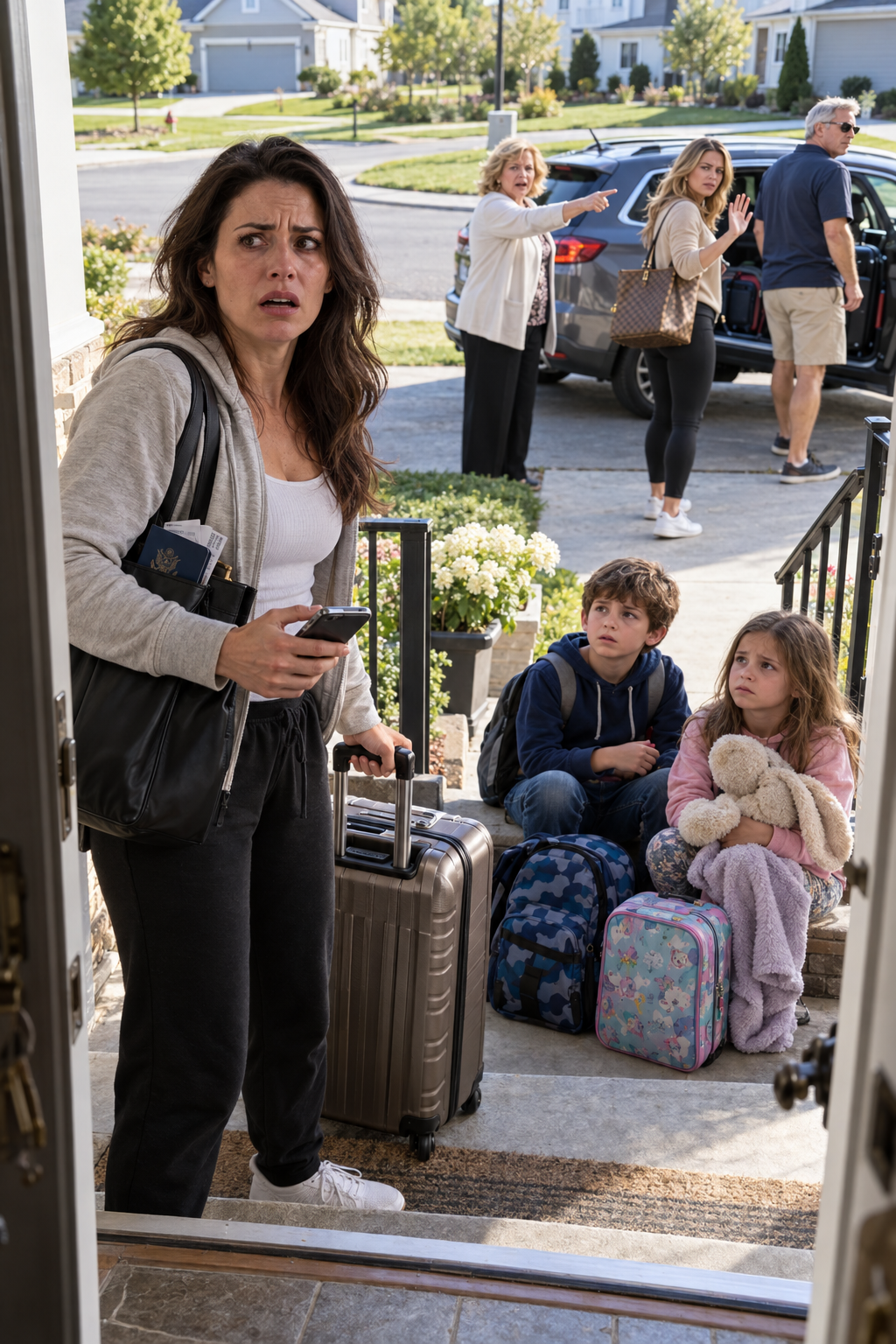
I Saved 3 Years For This Trip. The Night Before Our Flight, My Mom Called And Said, “You Have To Watch Your Sister’s Kids.” Dad Said, “Family Comes First.” I Said No. I Got On The Plane Anyway. When We Landed, I Had 38 Missed Calls, And My Sister’s Last Text Said: “They’re At Your Door.”
At three in the morning, my mother demanded that I cancel the Italian vacation my husband and I had spent three years saving for so I could babysit my sister’s three children. My father threatened to disown me while my sister remained completely silent. I boarded the plane anyway. By the time we reached Rome, police had visited my house and my family was calling me heartless. Eleven days later, a county employee showed me a document bearing my signature. I had never seen it before.
Part 1
The first thing I remember about that morning is the smell of burnt coffee drifting through the nearly deserted airport terminal. It was 3:07 a.m., and my husband, Daniel, was sleeping in an uncomfortable plastic chair with his jacket folded beneath his head. Our carry-on bags stood between us, each bearing a bright yellow ribbon I had tied around the handle so we could recognize them on a crowded luggage carousel. In a few hours, we would begin the journey to Italy, the country we had spent three years dreaming about while living a life that rarely left room for anything beyond work, bills, and family obligations.
My name is Katherine Lawson, although everyone calls me Kate, and I was thirty-two years old when I learned that the people who claimed to love me had mistaken my reliability for ownership. Daniel and I lived in a modest three-bedroom house outside Raleigh, North Carolina, where I worked as a medical billing specialist and he repaired commercial heating systems. Neither of us came from money, and neither had the kind of career that allowed expensive vacations without careful planning. What we did have was a shared determination to celebrate our tenth wedding anniversary somewhere extraordinary, even if that meant spending years making thoroughly ordinary sacrifices.
We started saving after a particularly miserable Christmas three years earlier, when Daniel had worked sixteen consecutive days repairing heating systems during a winter cold snap. On Christmas night, we sat at our kitchen table eating reheated ham while he showed me a photograph of a little restaurant overlooking the water in Positano. He said he wanted to take me there someday, and I laughed because the closest we had ever come to Europe was watching a travel documentary on our secondhand television. But the following January, we opened a savings account labeled ITALY, and every Friday we deposited whatever we could afford, even when that amount was only twenty dollars.
Our friends bought boats, renovated kitchens, and spent long weekends at beach resorts while we packed lunches and drove a car with a broken air-conditioning vent. I took extra billing shifts whenever someone called out, and Daniel spent Saturdays repairing equipment for a local contractor. We learned which grocery stores marked down meat on Wednesday evenings and how to stretch one roast chicken into three dinners. Whenever one of us became discouraged, the other would open our travel notebook, where we had collected photographs of Roman streets, Tuscan vineyards, and the blue water along the Amalfi Coast.
There was one expense that never appeared in that notebook, although it affected our savings more than I cared to admit. My older sister, Rachel, was thirty-six, divorced, and the mother of three children: Sophie, nine; Ben, seven; and little Leo, four. I adored those children, and I had spent countless afternoons helping with school projects, making grilled cheese sandwiches, and listening to Sophie explain whatever new book she had borrowed from the library. Unfortunately, loving them had gradually become indistinguishable from being expected to raise them whenever Rachel found something more interesting to do.
Rachel operated under a personal definition of emergency that included hair appointments, inconvenient work schedules, bad dates, and occasionally simply feeling tired of being a mother. My parents, Marilyn and Frank Whitmore, treated every request from Rachel as a family crisis requiring immediate cooperation. When I objected, Mom reminded me how difficult single motherhood was, while Dad pointed out that Daniel and I had no children and therefore enjoyed more freedom than we deserved. Apparently, our decision not to become parents yet had created an invisible obligation to compensate for every decision Rachel made.
Two months before our departure, I had begun telling everyone that we would be completely unavailable during our trip. I wrote our dates on Mom’s kitchen calendar, reminded Rachel during Sophie’s birthday party, and declined to cover a weekend when Rachel wanted to attend a music festival. Her reaction bothered me more than I admitted to Daniel, because instead of asking who would watch the children, she looked genuinely offended that I had made plans without consulting her. Mom later suggested that I leave our spare house key with Rachel in case somebody needed access while we were gone, but I refused because our neighbor, Luis Rivera, had already agreed to water the plants and collect the mail.
The evening before we left, Rachel called while I was carefully folding a navy-blue dress into my suitcase. She asked what time our flight departed and whether our tickets could be changed, claiming she was merely curious about our itinerary. I told her about the early flight from Raleigh to New York and our onward connection to Rome, then heard someone laughing in the background before she abruptly said she had to go. Daniel, who was kneeling beside his suitcase trying to decide which shoes to pack, looked up and asked why my sister suddenly cared about airline schedules.
“She probably wants something,” I said, attempting to sound amused, although a familiar knot had already formed beneath my ribs. Daniel stood, crossed the room, and gently took the dress from my hands before I could fold it for the fourth time. “Kate, we have paid for everything, our bags are packed, and we are going,” he said. “Whatever Rachel needs, she can ask another adult for help.”
I believed him until my phone started vibrating against the metal armrest in the departure lounge. Mom’s name flashed across the screen, and for a few seconds I considered letting the call go to voicemail, but the hour frightened me enough that I answered. She began speaking before I could say hello, telling me that Rachel was having an emergency and that I needed to come home immediately. When I asked whether someone was hurt, she said Rachel’s childcare arrangement had fallen through and the children needed somewhere to stay.
“What arrangement?” I asked, sitting upright as Daniel stirred beside me. Mom explained that Rachel had planned a five-day getaway to the mountains with a man she had recently started dating, but the woman who had agreed to watch the children had canceled at the last minute. Rachel was supposedly distraught, the reservations were nonrefundable, and my parents were much too busy to manage three young children for nearly a week. According to Mom, the simplest solution was for me to return home, collect Rachel’s house key, and look after Sophie, Ben, and Leo until their mother came back.
For several seconds I could hear only the distant rumble of a floor-cleaning machine moving across the terminal. “Mom, we’re at the airport,” I said, slowly enough that there could be no misunderstanding. “We’re leaving the country, our hotels and trains are booked, and Daniel has already arranged time off work that he cannot change.” She replied that vacations could be postponed, whereas children needed immediate care, and added that Rachel had been counting on me because I was always the dependable one.
That sentence changed something inside me, because it told me Rachel hadn’t simply encountered an unfortunate problem. She had made a decision involving my life without asking permission, and my mother had called to inform me of the consequences as though I were an employee who had missed a scheduled shift. I told Mom that I loved the children but would not cancel our trip, and she became so angry that her words started tumbling over one another. She accused me of valuing sightseeing more than family, then demanded to speak with Daniel because she apparently believed he could order me to behave.
Daniel shook his head when I extended the phone toward him, and I understood that he was refusing to participate in the familiar ritual of explaining my decisions to my parents. Before I could speak again, Dad took the phone and told me in a low, controlled voice that I was embarrassing the family by refusing to help my sister. “If you get on that airplane, Katherine, don’t expect to come crawling back when you need us,” he said. “You make this choice, and you’re choosing to be on your own.”
I looked at my husband, who was watching me with an expression I had seen only once before, when we stood in a hospital corridor waiting to learn whether his father would survive a stroke. He wasn’t angry or impatient; he simply wanted to know whether I was going to let fear decide another important moment in my life. When the boarding announcement sounded, I told Dad that Rachel was responsible for arranging care for her children and that I was getting on the flight. Then I ended the call, turned off my phone, and stood with Daniel in the line of passengers moving toward the gate.
As the attendant scanned my boarding pass, I felt a terrible urge to apologize to someone, although I couldn’t have explained what I had done wrong. Daniel reached for my hand, and together we walked down the narrow jet bridge toward the plane that would carry us away from everything familiar. I didn’t know that Rachel had already loaded three small suitcases into her minivan, or that my parents had given her instructions they would later deny. Most of all, I didn’t know that within hours, my sister would do something so reckless that a stranger would have to intervene to protect her children.
Part 2
We reached New York that morning and spent several hours waiting for the flight that would take us across the Atlantic. I kept my phone switched off, partly because I wanted to honor the promise I had made to Daniel and partly because I was terrified of discovering what my family had said about me. During the long flight to Rome, I slept badly, waking whenever someone moved down the aisle or a flight attendant adjusted the overhead lights. By the time we landed in Italy the following morning, exhaustion had blurred my thoughts, but I still felt a small rush of happiness when I saw the airport signs written in Italian.
That happiness lasted until I switched on my phone near baggage claim. Thirty-eight missed calls appeared on the screen, along with sixteen text messages and a collection of voicemails from my parents and sister. I stood beside a luggage cart while Daniel retrieved our bags, scrolling through notifications that grew increasingly hostile as the timestamps advanced. The earliest messages ordered me to call immediately, the next accused me of abandoning my responsibilities, and the final one from Rachel contained six words that made my hands go numb: “Hope you’re happy. They’re at your door.”
I opened the security camera application connected to our front porch, expecting to find Rachel leaving luggage or some spiteful note intended to frighten me. Instead, the recording showed her gray minivan pulling into our driveway at 6:18 that morning, North Carolina time, while we were still traveling. Rachel stepped out wearing jeans and a light jacket, opened the sliding door, and began unloading the children’s overnight bags onto our porch. Sophie climbed down first, holding Leo’s stuffed dinosaur, while Ben followed carrying a plastic grocery bag filled with snacks.
I watched my sister guide all three children toward our front door and press the doorbell several times. She appeared to say something to Sophie, then returned to the minivan while the little boy began crying and reaching toward her. The audio picked up his voice clearly enough that I could hear him asking why they couldn’t come inside. Rachel pointed toward our front door, climbed into the driver’s seat, and backed out of the driveway, leaving her children standing beside three suitcases and a welcome mat that read HOME SWEET HOME.
The recording continued, showing Sophie attempting to open the locked door while Ben pressed the doorbell repeatedly. Leo sat on his suitcase and cried, pulling the dinosaur against his chest, and I felt physically sick when Sophie crouched beside him and tried to explain something that neither of her brothers seemed to understand. She then looked directly into the security camera and said, “Aunt Kate, please open the door. Mom said you would be here.” I had been on my way to Italy when those words were spoken, and my sister knew it.
Daniel found me sitting on a bench near the baggage carousel with tears running down my face. I handed him the phone without explanation, and his expression changed as he watched the children waiting outside our empty house. The next recording showed our neighbor Luis stepping onto his porch in slippers and a faded Carolina Panthers sweatshirt, looking toward the driveway after hearing the children crying. He approached them cautiously, spoke with Sophie for several seconds, then took out his phone and made a call while his wife, Tessa, hurried across the street carrying a blanket.
Luis had worked as a high school maintenance supervisor for nearly twenty years, and he was the kind of neighbor who returned borrowed tools cleaner than he received them. His wife was a pediatric nurse, which meant she understood how quickly a frightened four-year-old could become an emergency when no responsible adult was present. According to the messages he later sent me, they brought the children inside, contacted the police, and gave the responding officer every phone number they had for Rachel and my parents. Because no one could immediately reach Rachel, an officer began documenting what had happened rather than treating the situation as a harmless family misunderstanding.
The police were still at Luis’s house when my parents finally arrived after driving nearly two hours from their home outside Winston-Salem. Dad emerged from his truck furious, while Mom rushed inside to collect the children and their belongings. The security camera recorded Dad walking onto our porch and looking directly at the lens before declaring that his daughter had disgraced the family. He then attempted our front door with a key, discovered it would not open, and struck the wooden railing hard enough that one of the flowerpots tipped sideways.
I watched that particular moment twice because I couldn’t understand why my father had a key to a house we had never invited him to enter while we were away. Years earlier, Daniel and I had given my parents an emergency spare after a plumbing disaster, but Mom had assured me that the key was returned. The camera showed Dad trying the lock again before walking away, and I remembered Mom’s suggestion that Rachel should have access to our house during our vacation. Suddenly the request felt less like an innocent offer of help and more like preparation for something I had refused to understand.
My phone rang before I could examine the remaining recordings, and Mom’s name appeared on the screen. I answered because I needed to confirm that the children were safe, but she launched into a furious account of the inconvenience she and Dad had suffered that morning. She described the long drive, the embarrassment of speaking to police officers, and how upset Rachel had become after learning that I wasn’t home. Only after I interrupted her twice did she finally confirm that Sophie, Ben, and Leo were with my parents, unharmed but frightened.
“Rachel left a four-year-old outside a locked house,” I said, gripping the phone so tightly that my fingers hurt. “She knew we were flying to Italy, and she abandoned those children anyway.” Mom insisted that Rachel had believed I would reconsider because I had never refused to help her before, then accused me of deliberately humiliating the family by allowing the police to become involved. When I pointed out that I hadn’t called anyone because I had been thousands of miles away, she said that my absence was exactly what had caused the problem.
I asked why Rachel hadn’t taken the children to their father, Adam Mercer, who lived less than half an hour from her house. Mom fell silent for the first time since answering the phone, then said Adam couldn’t be trusted and that I knew perfectly well how much Rachel had suffered during their divorce. I did know that Rachel had spent years describing Adam as selfish, unreliable, and uninterested in the children, although I had never personally witnessed the behavior she accused him of. Whenever I offered to contact him during one of her childcare emergencies, Rachel became defensive and insisted she would rather manage everything alone.
Daniel sat beside me while Mom continued speaking, and eventually he took the phone from my hand. He told her that we had confirmation the children were safe, that we would cooperate with any reasonable questions from the responding authorities, and that we would not be returning from Italy to repair Rachel’s decisions. Mom started shouting that family loyalty meant making sacrifices, but Daniel ended the conversation without raising his voice. We collected our suitcases, found our airport transfer, and drove toward Rome beneath a pale morning sky that looked nothing like the bright beginning I had imagined.
At the hotel, I contacted Luis to thank him and asked whether he could send me the full security recordings in case the police needed them. He replied that he had already saved copies and that the officer had taken a report after Rachel finally admitted she had left the children without confirming someone would be there. Then he added something that made me sit up in bed, where I had been trying unsuccessfully to sleep. Before leaving with my parents, Sophie had told Tessa that her mother wasn’t worried about me being in Italy because “Aunt Kate already promised to take care of us.”
I read that message several times, remembering the strange conversation Rachel had initiated the night before our flight. I had never promised to watch the children, not for five days, not for one night, and certainly not while traveling overseas with my husband. Yet Sophie had seemed entirely convinced that an arrangement existed, and Luis said she had become upset when Tessa questioned it. I couldn’t stop wondering what Rachel had told those children before leaving them at our door, or why my parents seemed more concerned about keeping me away from the police than about explaining what had happened.
Part 3
Our hotel stood on a narrow street near the historic center of Rome, where delivery scooters rattled over uneven pavement and the smell of fresh bread drifted from a bakery downstairs. On our first afternoon, Daniel persuaded me to leave the room and walk to a little café where we ordered sandwiches and sparkling water. I tried to appreciate the buildings, the unfamiliar language, and the sunlight falling across the old stone walls, but my mind kept returning to Sophie’s frightened voice outside our house. Every time I pictured her trying to protect her younger brothers, I wondered whether refusing my family had somehow made me responsible for what Rachel had done.
Daniel listened until I finished explaining that fear, then reminded me that there were two separate problems. The children needed responsible adults looking after them, and Rachel needed to answer for leaving them unattended, but neither problem required us to abandon our vacation. He pointed out that we could cooperate with the police, check on the children through reliable people, and still spend time together in Italy. It was the first time anyone had suggested that caring about my family didn’t require surrendering control of my own life.
The following morning, I received a call from my father’s older sister, Louise, who lived in Asheville and had always been less impressed by the Whitmore family’s reputation for loyalty than my parents were. Aunt Louise was sixty-eight, a retired elementary school principal, and the only person in our extended family who could interrupt Dad without provoking a shouting match. She had heard from Mom that I had abandoned three children so I could drink wine in Europe, but unlike everyone else, she had decided to ask me what actually happened. I sent her a careful account of the incident, including the fact that Rachel had been told repeatedly that Daniel and I would be out of the country.
Louise listened without interrupting, although I heard her exhale sharply when I described Leo crying on the porch. Then she asked whether my father had really tried to open our front door with a key, and I confirmed that the security recording showed him doing exactly that. She went quiet before saying that Mom had recently mentioned my willingness to help Rachel with “an important family arrangement,” which Louise had assumed involved ordinary school pickups. When I explained that I had agreed to no such arrangement, my aunt said she wanted to make several phone calls before drawing conclusions.
A few hours later, the first consequences of Rachel’s behavior became clear. Her new boyfriend, Caleb Morrison, sent me a message through Facebook, apologizing for contacting me unexpectedly and asking whether the children were safe. He said Rachel had told him I had agreed to watch them during their mountain getaway, and that when they arrived at our house, he initially assumed she was simply dropping them off with a relative who was asleep. According to Caleb, he had watched through the passenger window as Rachel repeatedly rang the bell and then ordered the children to remain on the porch even after nobody answered.
Caleb told me he had protested when Rachel started the engine, but she insisted I would come home once I realized the children were there. She claimed my parents had everything under control and that the entire situation was a harmless lesson intended to teach me not to be selfish. Caleb made her turn around after they reached the main road, but by the time they returned, the police were already at Luis’s house. He said the argument that followed ended their relationship before they ever left North Carolina, and he had spent the next two days wondering whether he should contact the authorities himself.
I thanked him for being honest and asked whether he would be willing to give the responding officer the same account. He agreed immediately, saying that he wanted nothing more to do with Rachel but didn’t want the children to suffer because he had stayed silent. I didn’t celebrate the end of their relationship, despite knowing how devastated Rachel must have been to lose the man she had rearranged everyone’s life to impress. What disturbed me was the realization that a man who had known her for six weeks had recognized the danger in her behavior more quickly than the parents who had raised us.
That evening, Louise called again after speaking with my parents. Mom had told her that I was exaggerating what appeared on the recording and that Rachel had simply made an unfortunate assumption about our availability. Dad, meanwhile, had described the incident as a private family disagreement and complained that Luis should have contacted him instead of involving law enforcement. Louise said she reminded them that a frightened child standing outside an empty house was not a private disagreement, particularly when the child’s mother knew nobody had agreed to be responsible for her.
Their conversation had become ugly when Louise asked why Adam, Rachel’s former husband, hadn’t been contacted. Mom claimed that Adam worked irregular hours and couldn’t manage the children safely, although she admitted that no one had actually called him that morning. Dad interrupted to say that Adam had lost the right to interfere with Rachel’s decisions when their marriage ended. Louise found that statement troubling because, as she reminded him, divorce did not end a father’s responsibilities or automatically eliminate his right to care for his children.
I began remembering incidents I had dismissed over the years because they seemed too small to challenge individually. There had been the Thursday when Rachel asked me to collect Ben from school and forgot to mention that she wouldn’t be home until midnight. Another time, she left Leo with Daniel and me for an entire weekend after saying she needed only a few hours to run errands. Mom had defended both incidents by describing Rachel as exhausted, while Dad insisted that I shouldn’t keep score of favors performed for family.
Those memories looked different when I considered how rarely Rachel had asked whether I was available before announcing what she needed. I had become so accustomed to accommodating her that I sometimes felt guilty for making appointments without first checking her schedule. Even our trip to Italy had required a family announcement months in advance, something none of my friends had needed to do before taking vacations. The realization embarrassed me, not because I had loved my sister’s children, but because I had accepted the idea that loving them meant allowing their mother to control my time.
On our third day in Rome, Daniel and I toured the Colosseum with a small group of American travelers. Our guide described the layers of history beneath the ancient structure, pointing out repairs made centuries apart, and for nearly an hour I became absorbed in something beyond my own family’s problems. We ate dinner afterward at a restaurant with tables so close together that we could hear the couple beside us discussing a lost piece of luggage. Daniel caught me smiling and reached across the table to squeeze my hand, and I realized we had managed to enjoy an entire afternoon without arguing about Rachel.
That fragile peace disappeared when Dad left a voicemail demanding that I call the police and explain the children had been left at our house with my permission. His voice was calmer than it had been at the airport, which somehow made the message more disturbing, because he sounded like a man discussing an ordinary administrative inconvenience. He said the officer’s report was causing unnecessary problems and that Rachel had received questions from a county child welfare employee. If I truly loved my niece and nephews, he argued, I would prevent a misunderstanding from damaging their mother’s reputation.
I called him back from the hotel and asked whether he understood that he was requesting a statement that wasn’t true. Dad replied that technical details mattered less than protecting family members, then suggested that perhaps I had forgotten a conversation in which I agreed to help Rachel. When I told him I remembered every discussion about our vacation perfectly, he said Mom had records proving otherwise. He ended the call before I could ask what kind of records he meant.
I stood beside our hotel window watching pedestrians hurry beneath umbrellas as a light rain began falling over the street. My father had spent my entire childhood insisting that dishonest people eventually had to live with the consequences of their decisions. Yet now he expected me to make a false statement to protect Rachel from something she had deliberately done. I wondered what records my mother could possibly possess that would make her confident enough to challenge my memory of my own decisions.
Part 4
The following morning, we boarded a high-speed train to Florence, and I spent the first hour watching fields and small towns slide past the window. Daniel had reserved our seats months earlier, choosing a table where we could spread out the guidebooks we had purchased at a used bookstore in Raleigh. He opened our notebook and pointed to the restaurants and museums we had highlighted, trying to draw my attention back to the trip. I wanted to give him that ordinary pleasure, but Dad’s reference to Mom’s records kept returning whenever the train grew quiet.
Near Florence, my phone displayed an unfamiliar North Carolina number, and I answered because the caller identified herself as Danielle Beck, a county child protective services worker. She explained that an inquiry had been opened after the police documented the children’s unattended drop-off, and she wanted to clarify my relationship with the family. Her tone was professional rather than accusatory, but she asked questions that made me increasingly uncomfortable. She wanted to know how frequently the children stayed overnight at my house, whether I routinely collected them from school, and whether I had recently agreed to provide extended childcare.
I answered truthfully, explaining that I had occasionally looked after the children but had never accepted responsibility for an ongoing schedule. When she asked whether my husband and I had offered to provide childcare for several months while Rachel resolved her work situation, I nearly dropped the phone. I told her we had been preparing for our anniversary vacation and that no one had discussed such an arrangement with us. Danielle paused before asking whether someone else might have made a commitment on my behalf.
“I don’t know,” I admitted, looking at Daniel across the table as the train slowed through the outskirts of Florence. “My mother says she has records proving I agreed to help, but nobody has shown me anything.” Danielle couldn’t discuss every statement made by other people involved in the inquiry, and she carefully explained those limitations before continuing. What she could tell me was that the children’s family had described me as a dependable, regular caregiver who had agreed to take on substantially more responsibility than ordinary occasional babysitting.
After the call ended, I felt as though someone had quietly moved the floor beneath my feet. Rachel had always exaggerated how much I helped her, particularly when speaking with our parents, but this seemed different from claiming I occasionally watched the children for an extra afternoon. Somebody had described a specific long-term arrangement that had never existed, and that description had apparently been offered to a government employee as fact. I called Louise immediately, told her what Danielle had asked, and begged her to find out what my family had been saying while I was away.
Louise listened, then told me something she had withheld earlier because she didn’t want to alarm me without evidence. Rachel and Adam had been involved in a custody dispute for several months after he requested more time with the children. According to Louise, Adam had recently obtained a position with consistent daytime hours and wanted a parenting schedule that allowed him to collect the children from school and care for them during the week. Rachel had resisted the changes, claiming that her existing childcare arrangements were stable and that the children would suffer if their routines were disrupted.
The news surprised me because Rachel had repeatedly described Adam as uninterested in the children. She told us he frequently canceled visits, complained about expenses, and preferred spending time with friends to fulfilling his responsibilities as a father. Although I had met Adam many times during their marriage, our relationship had become distant after the divorce, and I hadn’t spoken with him directly in nearly two years. I had accepted Rachel’s account because it was easier than imagining that my sister might misrepresent something involving her own children.
Louise admitted that she knew only fragments of the custody dispute, but she remembered Dad complaining about Adam’s attempt to change the parenting schedule. At the time, my father had said Rachel needed reliable family support to demonstrate that her children were properly cared for while she worked. Louise had interpreted that as a request for help with school pickups and sick days, the ordinary sort of support families often provided one another. Now she wondered whether my parents had been describing my availability to Rachel’s attorney without ever speaking to me.
We reached our hotel in Florence shortly before noon, and I spent twenty minutes standing beneath the shower, trying to settle the sick feeling in my stomach. When I emerged, Daniel had spread our itinerary across the bed beside a small map of the city, but he wasn’t pretending that the situation could be ignored. He asked me what I needed, and I said I wanted someone outside my family to examine whatever Rachel had submitted about me. Daniel opened his laptop and began looking for an attorney in North Carolina who handled family law disputes and questions involving written statements.
By late afternoon, we had arranged a preliminary consultation with Monica Vaughn, a lawyer recommended by Louise’s longtime friend. Monica told us that if my name had appeared in legal proceedings without my knowledge, we needed to obtain the relevant documents before deciding how to respond. She warned us not to accuse anyone of falsifying a signature or filing misleading information until we had seen exactly what had been submitted. She also advised me to preserve every message, voicemail, and original security recording, including those that seemed insignificant.
Daniel spent part of the evening transferring our security camera footage to a separate storage drive while I organized a timeline of events. I included the dates when I had informed Rachel of our trip, the messages arranging Luis’s help with our plants, and the time of Mom’s airport call. I found an old text from Rachel, sent three weeks before our departure, asking whether I would be interested in helping more often after school once we returned from Italy. My response had been clear: I couldn’t commit to a regular schedule because of work, but I was happy to visit the children when we arranged something in advance.
I showed that exchange to Daniel, and he immediately noticed something I had overlooked. Rachel had answered my refusal with a cheerful message saying that we would discuss it later, even though I had already made my decision. At the time, I assumed she was disappointed and didn’t want to argue, but now I wondered whether she had simply decided my agreement wasn’t necessary. I forwarded the conversation to Monica, along with the other messages that showed our plans had been public knowledge within the family.
That evening, Daniel persuaded me to walk with him across the Ponte Vecchio before dinner. The late sunlight turned the buildings along the Arno River a warm shade of gold, and street musicians played for tourists who stopped to take photographs. We leaned against the railing and watched the water moving below, and I apologized for letting my family intrude on the trip we had worked so hard to enjoy. Daniel told me I had nothing to apologize for, then admitted he had spent years wishing I could recognize how much emotional energy my parents demanded from me.
He reminded me of the time Rachel called during his father’s recovery from surgery and expected me to leave the hospital to collect Sophie from a birthday party. I had gone because Mom insisted there was nobody else, and Daniel had stayed alone with his father for nearly six hours. He said he never blamed me for loving my family, but he had worried that every significant event in our marriage would eventually become secondary to Rachel’s convenience. Looking at the river, I finally understood why he had sounded so certain at the airport when he told me we were getting on the plane.
Just before midnight, an email arrived from Monica saying she had spoken with an attorney representing Adam, who had agreed to provide a copy of a document previously submitted in the custody proceedings. The attachment was titled Family Support and Care Plan, and Monica suggested that Daniel and I read it carefully before discussing the contents with anyone. I opened the file and saw Rachel’s name, the children’s information, and several paragraphs describing an extensive childcare arrangement. Then I reached the final page, where my full name appeared beneath a signature that looked almost exactly like mine.
The document was dated seven weeks before our flight, on an afternoon when I had been working in my office in Raleigh. According to its contents, I had agreed to provide regular after-school care, overnight supervision when needed, and extended assistance during Rachel’s future travel or work obligations. It also listed Daniel as a secondary caregiver, even though he had never discussed any arrangement with Rachel. At the bottom was a declaration stating that I understood the responsibilities described above and had voluntarily agreed to undertake them.
I examined the signature until the letters blurred together, then looked at Daniel and asked him whether he recognized the handwriting. He leaned over my shoulder, studied it carefully, and said the shape of the final letter looked familiar but something about the signature wasn’t right. Neither of us had signed the document, and neither of us had authorized Rachel to make those promises. But someone had submitted a convincing imitation of my signature to support her custody case, and my mother apparently knew enough about it to threaten me with proof that I had agreed.
Part 5
I barely slept after discovering the document. Daniel eventually persuaded me to close the laptop and lie down, but every time I shut my eyes, I saw my name printed beneath promises I had never made. At sunrise, I sat beside our hotel window with a cup of coffee and read the entire statement again, looking for language that might explain how an ordinary childcare request had become a commitment to provide months of support. The document wasn’t a casual note between relatives; it was a written declaration intended to reassure the court that Rachel had a reliable network of caregivers available whenever her work or personal circumstances prevented her from looking after the children.
The proposed arrangement described me as someone who regularly worked from home and could adjust my schedule to collect the children from school. That wasn’t true, because although I occasionally worked remotely on Fridays, most of my job required me to be physically present at the medical billing office. It also claimed Daniel could provide transportation and emergency supervision because his work schedule was flexible. Anyone who knew how commercial heating repair worked would have laughed at that description, particularly during summer when breakdowns frequently kept him away from home until late evening.
I sent Monica a detailed explanation of the inaccuracies and asked whether the document could be removed from the custody case. She explained that our immediate priority was to formally dispute the statements attributed to me, preserve evidence showing I had not agreed, and determine who had created and submitted the document. The custody court would ultimately decide what weight, if any, it deserved, while any separate investigation into the authenticity of the signature would require appropriate evidence. Her careful language frustrated me at first, but I appreciated that she wasn’t promising dramatic consequences before anyone had established the facts.
Later that morning, Monica forwarded a copy of a statement signed by Mom that Rachel had provided in support of the childcare plan. In it, my mother described me as a willing and enthusiastic participant in the children’s daily lives, someone who had repeatedly offered to take on additional responsibility. She claimed our family had discussed the proposed arrangement together and that Rachel could depend on my assistance whenever necessary. Reading those words hurt more than discovering the questionable signature, because Mom hadn’t merely remained silent while Rachel misrepresented me; she had actively reinforced the story.
I called Mom from our hotel room, and she answered with an exhausted sigh, as though I were interrupting her during an already difficult week. When I asked about the statement, she said Rachel needed strong family support because Adam was trying to change the custody arrangement. Mom believed Adam’s request was motivated by money, although she offered no evidence beyond Rachel’s repeated complaints about financial pressure. She said my willingness to help was obvious from everything I had done for the children over the years, so putting that willingness into writing hadn’t seemed especially important.
“Did you know Rachel submitted a document with my signature on it?” I asked, trying to keep my voice steady. Mom hesitated before replying that she wasn’t responsible for every piece of paperwork Rachel completed. She insisted that families were supposed to support one another during difficult times and that I had always been happy to spend time with the children. When I reminded her that there was a difference between occasionally babysitting and promising to rearrange my entire life, she said I was becoming unnecessarily legalistic about something that should have been settled privately.
I ended the call when Mom suggested that the easiest solution would be to confirm the arrangement had existed and then quietly withdraw from it later. Her proposal made the situation painfully clear: she wasn’t trying to understand whether Rachel had done something wrong, but how quickly I could help make the consequences disappear. Daniel overheard the conversation from the bathroom doorway and asked whether my mother had expressed concern about the children being left alone. I thought back over everything she had said and realized that once again, the children’s actual experience had barely entered the discussion.
That afternoon, while Daniel explored a small museum he had wanted to visit, I found an older email from Rachel containing a school field-trip permission form for Sophie. Two years earlier, when Rachel was working a temporary evening job, she had asked me to sign as an emergency contact in case Sophie needed to be collected from school. I opened the scanned form and compared the signature with the one attached to the childcare declaration. Both contained an unusual break in the first loop of the letter K, a tiny gap caused by a pen that had briefly stopped writing.
I enlarged the two images on my laptop, placing them side by side until even Daniel could see the matching details. The signatures appeared remarkably similar, including the angle of the final flourish and the spacing between my first and last names. Monica cautioned that visual similarities alone couldn’t establish precisely how the signature had been produced, but she agreed that the older document deserved to be preserved and examined. I sent her both files, along with the original email proving when Rachel had received the older form.
For the first time, I began to understand why Rachel had reacted so aggressively to our Italian vacation. She had built part of her custody argument around my supposed availability, even though I had already told her I couldn’t provide the support she wanted. Our trip was no longer merely an inconvenience to her romantic plans; it exposed how little control she actually had over the childcare arrangements she claimed were dependable. By forcing me to cancel at the last minute, she might have hoped to turn a fictional commitment into a real one before anyone questioned the paperwork.
A message from Adam’s attorney arrived through Monica that evening, providing additional context I hadn’t known. Adam had spent months seeking more consistent time with Sophie, Ben, and Leo after changing jobs, and he had questioned whether Rachel’s childcare arrangements were adequate during her unpredictable work hours. When the disputed family support plan was submitted, his attorney had asked for clarification about my actual availability, but Rachel had indicated that I preferred not to become personally involved in the custody proceedings. I was stunned to learn that someone had effectively spoken for me to prevent the very conversation that would have exposed the problem.
Adam had made mistakes during the early years of his divorce, including missing several school events when his previous employer repeatedly changed his shifts. But the documents Monica described showed that he had recently maintained a stable residence, consistently exercised his scheduled parenting time, and requested additional weekdays rather than abandoning his responsibilities. I realized I had accepted Rachel’s description of him without questioning why she refused to involve him even when she desperately needed help. That didn’t make Adam perfect, but it meant my sister’s account was far less complete than she had led us to believe.
Near midnight, Rachel finally called me directly. She didn’t apologize for leaving the children outside our house, and she didn’t ask whether Daniel and I were enjoying our anniversary trip. Instead, she accused me of conspiring with Adam to take her children away, then demanded to know why I had contacted a lawyer. I told her I wanted to know who had signed my name to a document promising childcare I had never agreed to provide.
Rachel responded that I was being dramatic, claiming that the statement merely described what I had always done for the children. When I asked why she had told Caleb that I agreed to keep them for five days, she became defensive and said he was a stranger who had no right to interfere in family matters. Then she started crying and told me she couldn’t afford to lose the amount of child support she depended on if Adam received substantially more parenting time. For several minutes, she described her mortgage, car payment, and credit card bills while I listened in disbelief that she still hadn’t mentioned what Sophie and her brothers had endured.
“Rachel, those children aren’t a financial arrangement,” I said when she finally stopped talking. She replied that it was easy for me to judge because I had a husband, steady employment, and nobody depending on me for meals or school clothes. I reminded her that Adam was offering to help raise his own children, but she insisted that accepting his help would mean letting him win. Before hanging up, she warned me that if I disputed the paperwork, everyone would know I had chosen to destroy her family.
I sat quietly after the call, thinking about Sophie’s small face in the security recording and how hard she had tried to comfort Leo. Rachel was frightened of losing control over her circumstances, but instead of addressing that fear honestly, she had built a version of reality in which other people were required to make her decisions work. My parents had helped maintain that version for years, and now a document carrying my name threatened to make me part of it permanently. I understood that staying on the plane had done more than protect our vacation; it had prevented my family from turning their assumptions about me into an arrangement I might never have been allowed to leave.
Part 6
The next morning, Daniel and I rented a small car and drove into the Tuscan countryside, passing vineyards, olive groves, and stone farmhouses surrounded by low green hills. We had planned the excursion months earlier, choosing a family-run guesthouse where breakfast was served beneath a covered terrace overlooking the valley. I wanted desperately to enjoy the beauty around us, but my phone remained close enough that I could feel it vibrate against my pocket whenever another message arrived. Daniel eventually suggested that we check it together at two agreed times each day, leaving everything else to Monica unless an actual emergency arose.
The arrangement helped more than I expected, particularly because Monica had begun dealing directly with questions about the disputed paperwork. She prepared a written declaration for me to review, stating that neither Daniel nor I had agreed to the proposed caregiving schedule and that the signature attributed to me required verification. I also provided the text messages showing Rachel knew about our travel plans, along with the security recordings and copies of Caleb’s account of the abandoned drop-off. Monica explained that separating documented facts from family accusations would make our position stronger than arguing over motives we couldn’t conclusively establish.
Meanwhile, Louise had begun challenging the story my parents were spreading among our relatives. Mom had called several cousins and described me as a selfish daughter who had forced elderly parents to travel across the state to rescue their grandchildren. When Louise discovered that the family group chat contained a lengthy message accusing Daniel of turning me against everyone, she responded with a calm explanation of the actual sequence of events. She stated that Rachel had knowingly left her children at a locked house, that I had already departed for Italy, and that the police became involved because responsible neighbors recognized the children needed protection.
Louise deliberately avoided sharing sensitive court documents or videos of the children, but she refused to allow my parents to invent an agreement that never existed. My cousin Melissa replied that she had previously been pressured to babysit for Rachel and understood exactly how quickly a small favor could become an obligation. Another relative recalled being told that Rachel’s children had nowhere else to go despite knowing Adam still lived nearby. For the first time, the family conversation shifted away from whether I should have sacrificed my vacation and toward why Rachel had decided she could make that demand.
Mom reacted badly to losing control of the story. She sent Louise a message accusing her of dividing the family, then called me repeatedly to demand that I stop discussing private matters with outsiders. I didn’t answer, but I saved the messages because they demonstrated how urgently she wanted the situation handled without independent scrutiny. Later, Dad sent a shorter text saying that family problems should be settled inside the family, followed by a warning that lawyers would make everyone suffer. I read it twice and remembered how confidently he had told me, as a teenager, that people who told the truth never needed to fear questions.
The children’s situation was changing too. Danielle informed me that the county inquiry was continuing and that she had been in contact with the adults responsible for the children’s care, including Adam. My parents had kept the children with them after the incident, but the arrangement was becoming difficult because Dad still worked part-time and Mom struggled to manage Leo’s preschool routine alongside the older children’s schedules. Adam had offered practical help, including transportation and additional overnight care, and his attorney was asking the family court to review the parenting arrangement promptly.
Louise visited my parents and reported that Sophie seemed quieter than usual. She had always been an expressive child who loved telling elaborate stories, but now she stayed close to her brothers and repeatedly checked whether the adults around her knew where their mother was. When Louise asked what had happened at our house, Sophie said Rachel had explained that I was upset with the family but would come back once I realized the children needed me. Sophie had apparently believed that if she rang the doorbell long enough, I would eventually appear and everything would be fine.
Hearing that broke something in me that anger alone hadn’t touched. I could understand, even if I couldn’t excuse, Rachel’s attempt to inconvenience me, but using her daughter to deliver that punishment was cruel in a way I struggled to comprehend. Sophie had been given responsibility for protecting two younger children while being told that the success of the plan depended on persuading an absent adult to open a door. I asked Louise to tell Sophie, in an age-appropriate way, that I loved all three children and that nothing they had done caused the situation.
Louise promised she would, then asked whether I wanted her to explain why I hadn’t returned from Italy. I said Sophie deserved the truth, but not the burden of adult accusations, so we agreed Louise would simply tell her that I had been traveling and had never been told to expect them. I didn’t want the children drawn into a campaign against their mother, however angry I felt about what she had done. They already had enough confusing messages from adults who should have been protecting their sense of safety.
For the first time since the airport confrontation, I was able to put my phone away and enjoy several uninterrupted hours with Daniel. We visited a small vineyard where an elderly woman explained how her family had harvested grapes from the same hillside for generations. Later, we ate fresh pasta at a restaurant with mismatched chairs and a sleepy dog curled beneath the neighboring table. Daniel talked about repairing our backyard deck when we returned home, and I realized how much I had missed conversations that didn’t revolve around Rachel’s needs.
That evening, while the sun disappeared behind the hills, I told Daniel I felt ashamed of how often I had allowed my parents to interrupt our marriage. I remembered birthdays cut short, dinners abandoned, and weekends rearranged because Rachel had suddenly decided she needed help. Daniel said he had never doubted that I cared about him, but he admitted that he sometimes felt our plans existed only until someone in my family demanded something else. We sat together for a long time afterward, watching lights appear in the distant farmhouses, and I promised myself that if we emerged from this situation with our marriage intact, I would never again treat our shared life as something that could be casually canceled.
Two days later, Monica called with news that the family court had scheduled a hearing shortly after our return. Adam’s attorney had requested a temporary modification of the parenting schedule, citing the porch incident and questions about Rachel’s claimed support system. The court would consider the available evidence, including the circumstances surrounding the children’s unattended drop-off and the accuracy of information submitted about caregivers. Monica wanted me to attend because my direct explanation would be more useful than allowing other people to continue speaking about my supposed commitments.
I agreed immediately, despite feeling sick at the thought of standing in a courtroom opposite my parents and sister. Monica explained that the hearing wouldn’t necessarily resolve every question about the disputed signature, but it could affect where the children stayed while the broader custody issues were reviewed. She reminded me that the court’s focus would be the children’s welfare, not the family’s desire to avoid embarrassment. That distinction was important because Rachel and my parents seemed to view every consequence as an attack against them rather than a response to what had happened.
On our final night along the Amalfi Coast, Daniel and I sat on a terrace overlooking the water and shared the dinner we had imagined for three years. The restaurant was smaller than the photograph that started our dream, and a nearby table was occupied by a loud American family arguing affectionately over dessert. I thought about our own relatives thousands of miles away and wondered whether they would ever understand how much damage they had caused by refusing to respect a simple answer. When Daniel asked whether I regretted boarding the plane, I told him I regretted not learning to say no years earlier.
Before we went to bed, Monica forwarded a message from Rachel’s attorney proposing that the disputed childcare statement be treated as a misunderstanding rather than challenged at the hearing. The proposal included an acknowledgment that I had helped with the children in the past, but it also asked me not to contradict Rachel’s account of the family’s previous discussions. Monica had already advised against signing anything that blurred the difference between actual favors and commitments I never made. I understood then that my family still believed this could be solved by persuading me to accept their version of events, even though doing so might affect the children for years.
Part 7
When Daniel and I arrived home after two weeks in Italy, the first thing I noticed was how peaceful our street looked. The lawns were neatly trimmed, a delivery truck was parked near the corner, and somewhere behind our house a dog was barking at nothing in particular. Luis came outside as we carried our suitcases up the driveway, and I hugged him so tightly that he laughed and reminded me he was only the neighbor. Then I thanked him for protecting the children when their own mother had walked away, and his expression became serious as he said he had only done what any responsible adult should have done.
Inside, our house smelled faintly of furniture polish and the lemon cleaning solution Daniel had used before we left. Everything was exactly where we had left it, except for the flowerpot Dad had knocked over, which Luis had carefully repaired and returned to its place. I stood in the entryway remembering how often my family had treated this house as an extension of their own, somewhere they could arrive without warning and expect immediate accommodation. Before unpacking, I called a locksmith and arranged to have every exterior lock changed, including the deadbolt we had replaced the previous year, which explained why Dad’s old emergency key hadn’t worked.
The locksmith arrived that afternoon, and Daniel watched him install new cylinders while I sorted the mail and gathered documents for our meeting with Monica. We updated our garage access codes, reviewed who could enter our security system, and confirmed that only Luis had permission to visit the property while we were away. These precautions might have seemed excessive to someone unfamiliar with my family, but after watching Dad attempt to enter our house while we were overseas, I no longer considered unwanted access a hypothetical problem. For the first time, I wanted our home to feel like a place where decisions made by other adults couldn’t simply arrive on our doorstep.
Two days later, Daniel and I met Monica at her office, where she had arranged our materials into carefully labeled folders. She reviewed the original security footage, my travel reservations, the text messages refusing Rachel’s requests, and the older school form carrying my genuine signature. She also showed us the official copy of the disputed childcare declaration that had been obtained for the court proceedings, complete with its submission information and supporting statements. The signature was no less disturbing on official paper than it had been on my laptop screen, and I felt a renewed sense of betrayal when I saw Mom’s written confirmation attached to it.
Monica had prepared a statement explaining that I had never agreed to the proposed caregiving arrangement and had not signed or authorized anyone else to sign the document. Daniel provided his own statement because his availability had also been misrepresented, and our employer records supported the fact that neither of us could provide the schedule described. Monica cautioned that determining exactly who placed the signature on the document was a separate matter requiring additional review. What mattered immediately was preventing the court from relying on a childcare plan that did not exist.
On the morning of the hearing, I woke before sunrise and dressed in navy pants, a cream blouse, and the simple pearl earrings Daniel had given me for our anniversary. He made coffee while I reviewed my notes at the kitchen table, then drove us to the courthouse without turning on the radio. I expected to feel terrified when we entered the building, but instead I felt an unfamiliar steadiness, as though weeks of uncertainty had finally narrowed into a situation where the facts could be examined. My parents were standing near the security checkpoint when we arrived, and Mom immediately moved toward me with her arms extended.
I stepped away before she could embrace me, and her expression hardened so quickly that I almost laughed at how familiar the transformation felt. Dad told me there was still time to end the embarrassment if I simply acknowledged that Rachel had misunderstood our arrangements. I said the disputed statement wasn’t a misunderstanding because it described promises I had never made, and Dad warned that my refusal would have consequences for the entire family. Daniel stood beside me without speaking, and for once I didn’t feel compelled to soften my answer to prevent a confrontation.
Rachel arrived with her attorney a few minutes later, looking exhausted and considerably less confident than she had sounded during our telephone arguments. She glanced at me but turned away when she saw Monica standing nearby, then sat beside Mom and began speaking in urgent whispers. Adam entered through another door, carrying a folder and accompanied by his own attorney, and I noticed how carefully he avoided looking toward Rachel. He seemed older than I remembered, with tired eyes and a seriousness that suggested the custody dispute had taken a greater toll than I had understood.
The hearing itself was quieter than I expected, without the dramatic speeches or sudden revelations people imagine when they think about courtrooms. Adam’s attorney outlined the circumstances of the unattended drop-off, described the ongoing concerns about childcare, and explained why his client was requesting more parenting time while those concerns were reviewed. The court considered the security footage, written reports, and information regarding Adam’s current ability to provide care. Rachel’s attorney argued that her actions had been an isolated mistake made during a stressful family disagreement, but even that explanation required acknowledging that she had deliberately left the children at a house where no adult had agreed to receive them.
When the disputed childcare statement came up, Monica explained my position and presented the messages showing I had declined any ongoing arrangement. She made clear that I loved the children and had voluntarily cared for them in the past, but that these facts did not establish consent to the extensive commitments described in the document. The judge did not attempt to determine who had produced the signature during that hearing, although she acknowledged the serious dispute over its authenticity and declined to treat the statement as reliable proof of my future availability. Rachel stared at the table while Monica summarized the difference between actual help I had provided and obligations someone else had assigned to me.
The children’s own experiences mattered as well, although they were not required to stand in open court and face their parents. The court had information from the professionals who spoke with them after the incident, including accounts of their confusion and distress when they were left waiting outside our home. Sophie’s belief that I would appear if she kept ringing the doorbell demonstrated how completely she had trusted the arrangement her mother described. Hearing that account summarized by an attorney was painful enough that I had to concentrate on keeping my hands still in my lap.
Adam’s attorney explained that his client had maintained a suitable home, continued exercising his parenting time, and was willing to provide the school transportation and daily supervision the children required. The court also considered the temporary arrangements with my parents and the practical difficulties that had followed Rachel’s decision to leave the children at my house. After reviewing the evidence, the judge granted Adam temporary primary residential care while further evaluations and proceedings continued. Rachel would retain scheduled contact subject to safeguards established in the temporary order, and both parents were directed to cooperate with the professionals involved in reviewing the children’s needs.
The decision didn’t permanently resolve custody, and it didn’t automatically determine what other consequences Rachel might face. But it meant that Adam would provide the children’s primary home for the immediate future, instead of depending on arrangements Rachel had described without obtaining the caregivers’ consent. The disputed statement would not be treated as evidence that I was available to raise the children, and questions about its creation could be pursued through the appropriate process. For the first time, someone with authority had looked beyond my sister’s confident explanations and examined what the children actually needed.
Rachel began crying before we left the courtroom, and Mom put her arm around her while Dad glared at me from across the aisle. In the hallway, Rachel finally approached, her face flushed and her voice trembling as she said I had helped take her children away. I told her that the court had considered what happened when she left them outside my house, along with the stability of the care available to them. She accused me of enjoying her suffering, but I said there was nothing enjoyable about seeing three children frightened because their mother wanted to win an argument.
Dad stepped between us and demanded that I apologize to Rachel, insisting I had carried a family disagreement into a courtroom instead of allowing everyone to resolve it privately. I reminded him that the police became involved because Rachel abandoned her children and that Adam sought the custody review because he had concerns about their care. Mom said I would regret destroying my relationship with the people who had raised me, and I realized she still expected that warning to frighten me into submission. I looked at both of them and said, “I didn’t end this relationship today. You ended it when you decided my life and my name belonged to you.”
We walked away before either parent could respond, and Daniel guided me toward the courthouse exit as sunlight poured through the glass doors. I had imagined feeling triumphant if the court rejected my family’s version of events, but what I felt was quieter and considerably more complicated. I was relieved the children had a stable arrangement and that the false promises attributed to me had been challenged, yet I also understood that my parents would rather lose their relationship with me than admit the harm they had helped cause. Outside, Daniel asked whether I wanted to go home, and for the first time in weeks, the answer felt simple.
Part 8
The months that followed were less dramatic than the courtroom hearing, but they changed our lives more completely. Rachel continued participating in the custody proceedings, and Adam gradually established a routine that gave Sophie, Ben, and Leo the stability they had been missing. He collected them from school, attended parent-teacher conferences, and arranged reliable care for the occasional days when his work required longer hours. The children were still adjusting to living primarily with their father, but reports from Louise suggested they were sleeping better, settling into familiar routines, and beginning to understand that the adults responsible for them would actually be where they promised to be.
Rachel struggled with the changes, particularly because they affected both her daily schedule and her finances. The custody review required closer examination of the children’s actual care arrangements, and the question of financial support had to be addressed according to the parenting schedule rather than the assumptions Rachel preferred. She was also expected to participate in recommended parenting services and demonstrate that future childcare arrangements would be dependable. I didn’t follow every development because I had deliberately stopped treating my sister’s problems as matters requiring my constant attention.
The questions surrounding the written childcare statement continued separately from the immediate custody decisions. Monica helped ensure that our denial of the document’s authenticity was formally recorded and that the older signature sample was preserved with the other evidence. Rachel’s attorney eventually withdrew reliance on the disputed statement, although that did not settle every question about how it had been created. I refused to speculate publicly about criminal consequences or punishments that hadn’t been determined, because I had learned how important it was to distinguish what I knew from what other people wanted me to believe.
Mom contacted me repeatedly during those months, usually beginning with a message about how much she missed me before shifting to complaints about the stress our family was experiencing. She never asked how Daniel and I felt about the document, and she never acknowledged that her own written statement had helped misrepresent my availability. Instead, she described herself as a mother caught between two daughters and insisted she shouldn’t be punished for trying to protect everyone. I eventually stopped responding because every conversation seemed designed to return us to the same arrangement: Rachel would make the decisions, my parents would defend them, and I would accept whatever responsibilities remained.
Dad was even less interested in repairing the relationship. He sent two emails describing my behavior as unforgivable, followed by a message suggesting I had become arrogant because I now believed professional advice mattered more than family loyalty. When I didn’t answer, he informed Louise that I had been influenced by Daniel and would eventually realize how badly I had behaved. Louise told him that adults were allowed to make decisions he disliked and that threatening them wasn’t the same as guiding them. After that exchange, Dad stopped contacting her about me, although he continued telling relatives that I had abandoned the family.
For years, I might have interpreted their silence as something I needed to repair. I would have called Mom, apologized for upsetting Dad, and offered to help Rachel with something practical in hopes of restoring peace. This time, I allowed the silence to remain, and gradually I discovered how much time had been consumed by arguments that never actually solved anything. Daniel and I began eating dinner together without checking our phones, spent Saturdays working in the garden, and started saying yes to invitations from friends we had neglected.
One afternoon, Adam contacted me through Monica to ask whether Daniel and I would be comfortable meeting the children at a park. He explained that Sophie had been asking about us and that he wanted her to understand we still loved her, even though the adults’ relationships had changed. I agreed after confirming the visit fit the children’s current arrangements, and we met on a sunny Saturday at a park near his neighborhood. Sophie ran toward me as soon as she spotted our car, while Ben followed carrying a soccer ball and Leo hurried behind him clutching the same stuffed dinosaur he had held outside our house.
We spent two hours playing, eating sandwiches, and listening to the children describe their new routines. Ben proudly explained that his father had helped him build a model airplane, while Leo wanted Daniel to push him higher on the swings. Sophie was quieter, lingering beside me as her brothers chased each other across the grass, and eventually she asked whether I had been angry with her on the morning they came to our house. I told her I had never been angry with any of them and explained that I wasn’t home because Daniel and I were traveling, not because the children had done anything wrong.
Sophie studied the grass between her shoes for several seconds before admitting that she thought she had failed to follow her mother’s instructions. Rachel had told her to keep ringing the bell until someone answered, and Sophie had believed that being patient and obedient would somehow make the adults’ plan work. I told her that finding safe care for children was always an adult’s responsibility and that she should never have been expected to solve that problem herself. Then I reminded her how brave she had been when she helped her brothers while Luis and Tessa were coming to assist them.
She looked relieved, but I resisted the temptation to make a speech about her mother. Sophie didn’t need another adult demanding that she choose sides, and I wanted our relationship to be a place where she could talk about books, friends, and ordinary childhood worries. Before we left, she showed me a drawing she had made of our house, complete with the yellow flowers growing beside the porch steps. In the picture, all three children stood in the front yard beneath a bright blue sky, and I was beside them holding Leo’s hand.
I kept that drawing on our refrigerator, not as a reminder of the morning Rachel abandoned the children, but as proof that our relationship could survive without recreating the arrangement that had harmed us. When Sophie visited in the future, those visits would be planned with the adults legally responsible for her care and would happen because Daniel and I genuinely wanted to spend time together. I would never again allow my love for the children to become leverage someone else used to make decisions for me. The distinction was simple, but it had taken me most of my adult life to learn it.
About six months after our trip, Mom appeared at our house on a Sunday afternoon while Daniel and I were preparing dinner. I saw her through the kitchen window standing near the front door with a paper grocery bag and the strained expression she wore whenever she wanted to appear wounded. She rang the bell twice, then waited beneath the security camera until I answered through the intercom. When I asked what she wanted, she said she had brought homemade banana bread and hoped we could finally put the unpleasantness behind us.
I told her that bringing food wasn’t the same as acknowledging what she had done, and she replied that everyone had made mistakes. I asked whether she was prepared to admit that she had supported a childcare arrangement I never agreed to and had pressured me to make an untrue statement after Rachel left the children outside. Mom avoided answering directly, saying that the family had suffered enough and that life was too short to keep reopening old wounds. Then she asked whether I really intended to let a vacation destroy our relationship forever.
I looked through the camera at the woman who had raised me, remembering birthday cakes, school performances, and the ordinary kindnesses that had once made me believe her love was unconditional. Those memories were real, but so were the years of pressure, the disregard for my marriage, and the willingness to use my name without permission when Rachel needed something. I told Mom that I wasn’t interested in continuing a relationship built on denying those facts. She stood quietly for several seconds before collecting her bag and walking back to her car.
I didn’t cry when she left, although I had expected I might. Instead, I returned to the kitchen, where Daniel was chopping vegetables and a pot of tomato sauce simmered on the stove. He looked at me carefully, asked whether I was all right, and waited without pressing for an explanation. I told him I was sad about the mother I wished I had, but I no longer wanted to spend my life trying to persuade the mother I actually had to respect me.
That conversation didn’t lead to reconciliation, and I stopped expecting one. Dad never apologized, Mom occasionally sent holiday cards I chose not to answer, and Rachel continued telling anyone willing to listen that I had caused her problems. Their opinions still hurt sometimes, especially around birthdays and Christmas, but they no longer determined my decisions. I maintained my relationship with the children through appropriate arrangements with Adam, kept in touch with Louise, and accepted that being related to someone didn’t guarantee that a close relationship was healthy or possible.
The following spring, Daniel suggested we take a short weekend trip to the North Carolina mountains, somewhere with hiking trails, a fireplace, and no complicated itinerary. We booked a small cabin near Boone and spent three days walking through forests that smelled of damp earth and pine needles. There were no spectacular monuments, expensive restaurants, or foreign languages, but I enjoyed those days almost as much as Italy. We woke whenever we wanted, made pancakes in the little kitchen, and watched the sunset from a porch overlooking the mountains.
One evening, Daniel found our old travel notebook tucked inside a drawer where I had put it after unpacking from Rome. He brought it outside and sat beside me, turning through pages filled with ticket stubs, photographs, and handwritten notes from the trip we had almost lost. Between a restaurant receipt from Florence and a photograph of the Amalfi Coast, I found a note I had written on our final night in Italy. It said that the best part of our anniversary wasn’t where we had traveled, but realizing that our marriage deserved the same loyalty I had always given everyone else.
I read those words again while Daniel rested his arm across the back of my chair. Three years of saving had taken us to Italy, but the decision to board that plane had changed something far more important than our vacation plans. Rachel had expected me to rescue her from the consequences of her choices, and my parents had expected me to surrender because I always had before. When I refused, their actions exposed a pattern that could no longer be hidden behind affectionate claims about family responsibility.
The children were receiving more dependable care, my marriage had become stronger, and my home was finally somewhere I could live without expecting another person to make demands on my time. None of those changes required my sister to apologize or my parents to admit they had been wrong. I would have welcomed genuine accountability, but I no longer needed it in order to move forward. Their choices belonged to them, and the responsibility for living with the consequences did too.
As darkness settled over the mountains, Daniel asked where I wanted to travel next, and I laughed because I hadn’t imagined another adventure so soon. He opened our notebook to a blank page and handed me a pen, inviting me to write down whatever destination came to mind. I thought for a moment, then wrote “Wherever we want” across the top, leaving the rest of the page empty for plans we hadn’t made yet. For once, that uncertainty felt wonderful, because the future belonged to us, and nobody else had the right to decide how we spent it.
THE END!