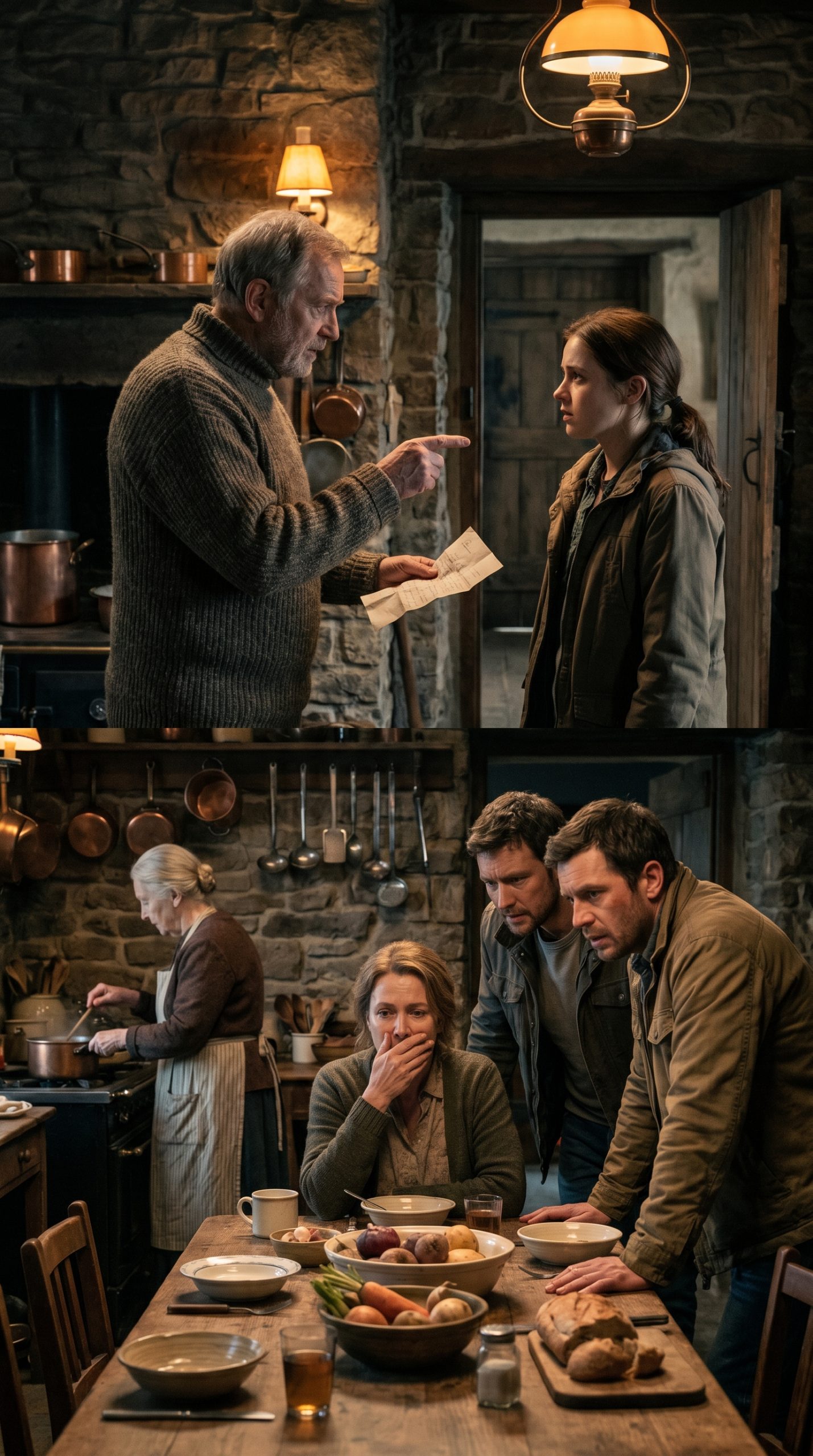
Not at the head of the table.
Not in the chair everyone saved for the person who mattered.
I belonged in the kitchen doorway with a towel over my shoulder, waiting to see who needed coffee. I belonged at the laundry room counter, folding my brother’s shirts while my mother told relatives how proud she was of his future. I belonged behind the dining chairs at Thanksgiving, holding a serving spoon, smiling just enough so nobody could accuse me of being ungrateful.
My name is Evelyn Hart. I am thirty-one years old, and for most of my life, my parents treated me less like a daughter than a convenient pair of hands.
My younger brother, Ryan, was the miracle. That was the word my mother used for him before he could even walk.
“Our miracle boy.”
My father called him “the future of this family.”
I was never called a miracle. I was dependable. Helpful. Mature. Such a good girl. The kind of daughter a mother could count on. Those words sound sweet when you say them gently, but in our house, they were not compliments. They were assignments.
By the time I was eight, I knew how Ryan liked his toast cut. By ten, I was packing his backpack when my mother was running late. By twelve, I was folding his baseball uniforms and wiping down his muddy cleats because, according to my father, “Ryan needs to focus.”
Ryan always needed to focus.
I needed to help.
That was the natural order of things in our house, and for years, everyone acted as if it had been written somewhere official.
Ryan had practices, tournaments, sleepovers, a bigger room, new sneakers, and “potential.” I had chores, expectations, hand-me-down reasons, and the sort of tiredness adults praised because it benefited them.
If Ryan left a plate on the coffee table, my mother would sigh and say, “Boys just don’t notice those things.”
If I left a glass in the sink after working a six-hour shift at the pharmacy, she would stand in the kitchen with her arms folded and say, “Evelyn, no man is going to want a lazy wife.”
I was sixteen the first time I realized my mother was not warning me about my future.
She was defending my present.
People like my parents use words like character when what they really mean is labor. They use words like family when what they really mean is obedience. And if you are useful enough for long enough, they stop seeing the person. They only see the service.
The strange part is, nothing about our family looked cruel from the outside.
We lived in a neat two-story house in a quiet Carolina neighborhood where every mailbox matched and the lawns looked trimmed even in February. My father, Thomas Hart, worked in insurance and wore pressed shirts to the office every morning. My mother, Shirley, volunteered at church luncheons and knew exactly how to lower her voice when she wanted people to think she was kind.
There were framed photos in the hallway, casserole dishes with our last name taped underneath, Christmas cards with matching sweaters, and neighbors who said things like, “You Harts are such a lovely family.”
Lovely families can hide entire lives in plain sight.
In our photos, Ryan was always seated or standing beside my parents. My father’s hand on his shoulder. My mother leaning toward him, her smile soft and proud.
I was there too, technically.
Sometimes at the edge. Sometimes behind a chair. Sometimes coming in from the kitchen with a plate in my hands just as the camera went off. There is a particular loneliness in being visible but not included. It teaches you not to ask for space. It teaches you to fit yourself into whatever corner is left.
My grandmother was the first person who noticed.
Her name was Eleanor Hart, though everyone called her Eleanor except me. To me, she was Grandma, and she was the only adult in our family who could make the room rearrange itself without raising her voice.
She was not soft in the way people expect grandmothers to be soft. She baked pound cake, yes, and kept peppermints in her purse, but she also had eyes like a courthouse clock and a memory nobody could charm their way around. She noticed details other people walked past.
Who had a full plate.
Who ate standing up.
Who was asked to bring another chair but never offered one.
At Thanksgiving when I was fourteen, I carried mashed potatoes, green beans, rolls, cranberry sauce, and a bowl of gravy hot enough to burn my fingers. Ryan sat at the table texting under the tablecloth while my mother whispered, “Evelyn, don’t make a face. Guests are watching.”
Grandma watched too.
Not loudly. Not with some dramatic speech.
She just looked at me, then looked at Ryan, then looked at my parents.
That was how she gathered truth.
Slowly. Quietly. Like a woman folding laundry and counting every missing sock.
The first time she challenged my parents directly, I was sixteen.
Ryan had knocked over a bowl of chili in the den. It hit the beige carpet with a wet, awful sound, spreading red across the fibers while Ryan jumped back and laughed.
My mother came in from the kitchen, saw the mess, and turned automatically toward me.
“Evelyn, clean that up before it stains.”
I was already standing.
That is what I hate most when I remember it. Not that she asked. That I moved before I thought. My body had been trained better than my heart.
Grandma was sitting in the recliner by the lamp, her reading glasses low on her nose.
“Why?” she asked.
My mother blinked. “What?”
Grandma pointed one finger toward Ryan. “His hand broken?”
The room went still.
Ryan gave a little laugh, the kind people use when they are not sure whether they are being corrected or entertained.
My father looked up from the news and said, “Come on, Mom. Don’t start.”
Grandma did not look at him first. She looked at my mother.
“Shirley, that boy spilled it. That boy can clean it.”
My mother’s face tightened. “Evelyn doesn’t mind helping.”
Grandma set her magazine down.
“That’s a funny word for it.”
My father folded the newspaper in half with more force than necessary. “Mom.”
“No, Thomas,” she said. “I have watched this house long enough. Ryan has two arms. You have two arms. Shirley has two arms. Funny how the only person trained to move is the girl.”
Nobody spoke.
That sentence sat in the den like smoke from a match.
Ryan eventually cleaned the chili, badly. My mother hovered, making little sounds of disapproval. My father muttered that Grandma was making a production out of nothing.
But it was not nothing.
It was the first time anyone had said out loud that my usefulness was not natural. It had been taught.
After that day, my parents became more careful when Grandma was around.
Not kinder. Careful.
There is a difference.
My mother stopped calling me from across the room to refill Ryan’s soda if Grandma was sitting right there. My father stopped saying “Evelyn can do it” quite so casually. Ryan learned to roll his eyes only when Grandma’s back was turned.
But nothing truly changed.
Families built on unfairness do not collapse the first time someone names the structure. They simply decorate it better.
Grandma knew that.
So she began making space for me in smaller ways.
She invited me to lunch after church at the diner with the blue vinyl booths where she always ordered chicken salad on rye and coffee so hot she said it could “take the paint off a mailbox.” She slipped me twenty-dollar bills folded twice and pressed them into my palm.
“For yourself,” she would say.
I always tried to refuse.
She would close my fingers around the money and say, “Not for the house. Not for your mother. Not for Ryan’s nonsense. For yourself.”
Sometimes she asked me questions nobody else did.
“Are you tired?”
“Do you want to go to college out of state?”
“What would you do on a Saturday if nobody needed you?”
I never knew how to answer that last one.
Girls like me do not dream in full sentences. We learn to want small things that fit around other people’s needs. A quiet hour. A new paperback. A drive with no errands attached. A meal we did not cook.
When Grandma asked if I was tired, I always said, “I’m fine.”
She never argued.
She would just look at me with that steady expression of hers and say, “Fine is a place people hide when they don’t think they’re allowed to be honest.”
I carried that sentence for years without knowing what to do with it.
By the time I graduated high school, Ryan’s life had become the family project. Baseball camps. Private lessons. Travel tournaments. Special equipment. Hotel rooms my parents could somehow afford when they could not afford my application fees unless I “really thought it was necessary.”
I had planned to go to college two hours away.
Nothing fancy. A state school with brick buildings, an old library, and a nursing program I had circled in a brochure until the paper wore thin. Grandma had helped me dream about it. She told me she had started a little savings account for me years earlier.
“Not enough for everything,” she said, “but enough to give you a beginning.”
A beginning.
I held that word like a match in winter.
Then, the spring before graduation, my mother sat me down at the kitchen table. There was a stack of bills beside her, a grocery list, and one of Ryan’s tournament schedules stuck to the refrigerator with a magnet shaped like a peach.
“Evelyn,” she said softly, “we need to talk about being realistic.”
That was how my family always began taking something from me. They called it realism.
My father stood by the counter, arms crossed.
“We’re stretched thin,” he said. “Your brother’s baseball expenses are temporary, but important. You know how much opportunity this could open for him.”
I knew before they said the rest.
I felt it in my stomach.
The college money Grandma had saved for me was gone.
Not lost. Not delayed. Gone.
My mother explained that they had needed to “borrow” from it for family expenses. My father said it had gone toward things that benefited everyone. Later, I learned that “everyone” meant Ryan’s housing deposit for a baseball academy summer program, two tournament fees, and several months of groceries after my father mishandled some money he never fully explained.
I called Grandma that night from the back porch.
I did not cry until she answered.
When I told her, there was a long silence.
Then she said, “Did they ask you?”
“No.”
“Did they tell you before?”
“No.”
“Did they call it family?”
I closed my eyes.
“Yes.”
She exhaled slowly.
“I see.”
That was all.
I thought she meant she understood.
I did not know she meant she was keeping record.
I stayed home after graduation. I worked at the pharmacy, took community college classes when I could, and kept doing what I had always done. Cooking. Cleaning. Laundry. Errands. Doctor visits. Church setup. Ryan’s appointments. Ryan’s meals. Ryan’s laundry even when he was old enough to drive himself to parties and call me dramatic if I asked him to rinse a bowl.
The years did not pass dramatically. They wore me down in ordinary ways.
I missed birthdays because Ryan needed rides. I missed a friend’s wedding shower because my mother volunteered me to help an aunt recover from surgery. I missed a promotion opportunity because my father said the family needed me around that month.
Whenever I resisted, my mother looked hurt.
“I don’t know why you act like helping your family is such a burden.”
That was the trap.
If I said it was a burden, I was selfish.
If I said nothing, it continued.
So I became quiet. Not peaceful. Quiet.
There is a kind of silence that is not consent. It is survival with good manners.
Grandma understood that too.
As she got older, I became the person who took her to appointments. At first, I told myself it was just another responsibility my family had dropped into my lap. But Grandma never treated me like help. She treated my presence as company.
We stopped for coffee after doctor visits. We talked in parking lots. She told me stories about my father as a boy, about the first job she ever had, about how she almost moved to Chicago at twenty-two but stayed because her own mother fell ill.
“Don’t let other people’s needs eat your whole life,” she told me once while we sat in her car outside the county records office, rain tapping the windshield. “They will call it love because love sounds nicer than appetite.”
I laughed because I did not know what else to do.
She did not laugh.
“I mean it, Evelyn.”
Last winter, Grandma got sick for real.
It began quietly. She stopped finishing meals. She napped in her chair with the television on low. She misplaced her church bulletin twice and joked about it, but I saw the worry in her eyes. Then came the hospital stay. Then another. Then the long, pale afternoons where the fluorescent lights made everyone look like a photograph left in the sun.
My parents visited when there were relatives to be seen by.
My mother knew how to sit beside a hospital bed with one hand on the blanket and make sorrow look graceful. My father asked nurses questions in his insurance-office voice, nodding like he was supervising the entire medical system. Ryan came twice. The first time, he brought a smoothie for himself and complained about parking. The second time, he stayed twelve minutes.
I stayed.
Not because I was noble. Not because I had some endless well of patience. I stayed because Grandma was the only person in my family who had ever looked at me and seen a human being before a task.
I rubbed lotion into her hands when they became dry. I adjusted her blanket. I learned which nurse was gentle with the IV and which one rushed. I brought her tea she barely drank. I read aloud from a mystery novel she said had too many widows and not enough sense.
Sometimes she slept while I sat beside her listening to the machines.
Sometimes she woke and stared at me with terrifying clarity.
Three days before she died, she squeezed my wrist.
Her hand was thin, but her grip was still Grandma.
“When they start arranging things after I’m gone,” she whispered, “don’t let them put you in the hallway.”
I thought she meant emotionally.
I thought she was telling me not to retreat, not to let my parents turn her death into another event where I served coffee and disappeared.
I promised her.
“I won’t.”
She looked at me for a long time.
“No,” she said. “You listen to me. Not in the hallway.”
I nodded, confused and frightened by the force in her voice.
“Okay.”
She closed her eyes.
That was the last full conversation we ever had.
Six days later, I stood halfway inside Mr. Bellamy’s conference room while my mother told me to wait outside.
“Just for the formal part,” she said.
Her voice was soft. Almost tender. She had dressed carefully that morning in a navy dress and low pearls, her church-lunch face arranged into grief. My father was already seated at the long table, legs crossed, wearing the expression he used when he expected the room to recognize his importance. Ryan sat near the window, scrolling through his phone, one knee bouncing like the will reading was a dental cleaning he had been forced to attend.
I had followed them in because nobody had told me not to.
That was my mistake. Assuming grief might make me family.
My mother turned at the door and placed one hand lightly on my forearm.
“Evelyn, honey, why don’t you wait outside?”
I stared at her.
“What?”
“This is family business.”
There it was.
Family business.
That phrase had followed me my whole life like a locked door.
I was family enough to scrub pans, steam dress shirts, sit with sick relatives, pick up prescriptions, bring casseroles to grieving neighbors, and sleep on hospital chairs.
I was not family enough to sit down for the formal part.
My face went hot, but my body did what it had been trained to do.
I stepped back.
One foot in the hallway. One foot in the room.
Exactly where my mother had placed me.
Then Mr. Bellamy looked up from the stack of folders in front of him.
“No,” he said. “She stays.”
The room went quiet.
Not a gasp. Not a dramatic silence.
Worse.
The kind of silence that happens when everyone realizes the old script has just been interrupted and nobody knows the next line.
My mother’s hand tightened on her purse strap.
My father straightened.
Ryan finally looked up.
Mr. Bellamy was a narrow man in his sixties with silver hair, a careful tie, and the calm expression of someone who had spent decades watching families become honest only when money forced them to. He removed his glasses and looked directly at my mother.
“Mrs. Hart, your mother gave very clear instructions. Evelyn remains in the room for the entire reading.”
My mother blinked. “I’m sure she didn’t mean—”
“She did.”
Two words.
Flat. Polite. Unmovable.
I felt something small and dangerous uncurl inside me.
Because Grandma had been dead for six days, and she was still the only person in my family who knew exactly where I belonged.
My mother stepped away from the door.
I walked in.
For a moment, I did not know where to sit. That sounds ridiculous, but people who have always been placed at the edge do not automatically recognize an available chair as theirs.
Mr. Bellamy noticed.
He gestured to the seat across from him.
“Here, Miss Hart.”
My mother sat down stiffly. My father leaned back as if this entire situation was beneath him. Ryan slipped his phone face down on the table but kept one hand on it.
Mr. Bellamy opened a folder.
Before he touched the will, he reached into an inside pocket and removed a sealed envelope.
My name was written across the front in Grandma’s handwriting.
Evelyn.
Just my name. No explanation. No title. No apology.
My throat tightened so quickly I had to look down at my hands.
Mr. Bellamy did not give me the envelope. He broke the seal himself. I understood later why that mattered. The moment he opened it, the letter stopped being something my family could intercept, soften, dismiss, or explain away in private.
He unfolded cream-colored paper and began to read.
“If Shirley has tried to put Evelyn in the hallway, then I was right about more than I wanted to be.”
My mother went perfectly still.
My father made a soft sound through his nose, the one he used whenever a woman had become inconvenient in writing.
Ryan stared at the table.
Mr. Bellamy continued, his voice professional and even.
“Read this in front of everyone because if my family has done one thing consistently, it is ask Evelyn to do the work in private and swallow the insult in silence. I would like, just once, for the room to hear it whole.”
Nobody moved.
The heating vent hummed softly under the window. Somewhere outside the conference room, a copier beeped. Ordinary sounds, continuing like the world had not just tilted.
“I have watched that girl clear plates while her brother stayed seated. I have watched her miss dances to care for relatives who barely remembered her name. I have watched her wash shirts for a boy old enough to own his own hands and stand two steps behind family photographs like staff someone forgot to dismiss.”
My mother made a small noise.
“Oh, for heaven’s sake.”
Mr. Bellamy paused and looked at her over his glasses.
“Do you want me to stop?”
She looked at my father.
That was answer enough.
He read on.
“When a family decides one child is the future, they almost always decide another child is the labor. In this house, Ryan was praised for existing. Evelyn was thanked only when she was useful.”
The sentence landed so hard it felt physical.
Not because it was new.
Because it had never been said out loud in front of them before.
There is a special kind of pain in hearing the truth spoken plainly after years of surviving it unnamed. Part of you wants to weep with relief. Another part wants to ask why it took so long for words to arrive.
Mr. Bellamy turned the page.
“I do not write this because I pity Evelyn. I write it because she has been trained to mistake endurance for character, and the rest of you have been happy to let her.”
Ryan let out a short laugh.
Nervous. Dismissive. The way men raised like kings laugh when the room suddenly describes the kingdom accurately.
Mr. Bellamy did not even look at him before reading the next line.
“If my grandson laughs while this is read, tell him that being adored is not the same thing as being worthy.”
Ryan’s laugh died in his throat.
My father shifted. “This is absurd.”
Mr. Bellamy ignored him.
“I remember the chili on the carpet. I remember the school mornings. I remember Shirley handing Evelyn tasks like little tests of devotion and Thomas calling it good preparation. Preparation for what? For becoming unpaid help to people who share her blood?”
I looked at my mother then.
Not because I expected guilt. I had stopped waiting for guilt to arrive on time in my family years before.
I wanted to see if she recognized herself.
She did.
That was the worst part.
Her lips pressed together. Her eyes fixed on the table. She looked less like a woman hearing lies than a woman furious that a private truth had walked into public wearing shoes.
Mr. Bellamy continued.
“When I asked Evelyn at sixteen whether she was ever tired, she lied and told me she was fine. That is what girls like her do when they have already learned that naming the burden only gets it shifted back onto them.”
I remembered then.
Grandma’s porch. A sweating glass of tea. Summer air. The sound of cicadas screaming from the trees. Me saying, “I’m fine,” with that dead little smile I used when I was trying not to be assigned something else.
Ryan leaned back.
“So what?” he said. “Grandma writes one bitter letter and now we’re all villains?”
Mr. Bellamy folded one corner of the paper with his thumb.
“No,” he said. “The years did that. Your grandmother only took notes.”
Ryan’s face flushed.
My father leaned forward. “I don’t appreciate the tone.”
Mr. Bellamy looked at him for one quiet second.
“Your mother anticipated that as well.”
Then he continued reading.
“If Evelyn is in that office today, then I failed to protect her fully in life, which means I must be precise in death. Before any division of property, sentiment, furniture, jewelry, or claims of family fairness are discussed, instruct Mr. Bellamy to retrieve the black ledger from the false bottom of my pantry flour bin and place it in Evelyn’s hands.”
My mother’s head snapped up.
My father went white first.
Then red.
That was the first reaction all morning that interested me.
Not to the letter.
To the ledger.
Mr. Bellamy lowered the paper and looked directly at my father.
“Do you know what she is referring to?”
“No,” my father said too quickly.
My mother said nothing.
That told me more than his denial.
My mother had many talents, but surprise was not one she wore well. What crossed her face was not confusion. It was dread.
Mr. Bellamy refolded the letter carefully and set it beside his file.
“We will pause the reading.”
“For what?” my father demanded.
“To retrieve the ledger your mother considered relevant.”
Ryan scoffed. “This is insane. It’s probably some old grocery notebook.”
Mr. Bellamy looked at him the way emergency room doctors look at confident people who diagnose themselves from the waiting room.
“That will be easy enough to confirm.”
Then he turned to me.
“Miss Hart, I suggest you come with me.”
My mother stood so fast her chair scraped the carpet.
“That won’t be necessary.”
Mr. Bellamy’s expression did not change.
“On the contrary. Your mother was very clear. Evelyn stays.”
My father stood too.
“You are not going into my mother’s house digging through her pantry like grave robbers.”
Mr. Bellamy slipped Grandma’s letter back into the folder.
“Then you should have hoped she left less specific instructions.”
That was the moment my mother made her mistake.
Not a large one. Not dramatic.
Just one sentence too fast.
“It won’t be there.”
The room turned toward her.
My father looked at her.
Ryan looked at her.
Mr. Bellamy, who had spent the last half hour sounding like patience in a tie, let a little steel into his voice.
“That is a very interesting thing to know with such certainty, Mrs. Hart.”
My mother opened her mouth. Closed it. Then tried the old family trick of turning speed into innocence.
“I only mean my mother moved things constantly toward the end.”
No one believed her.
Not fully.
Not cleanly.
Because there is a difference between confusion and foreknowledge, and my mother had just stepped over it in low heels.
Mr. Bellamy called his assistant and requested a witness from the office. A young paralegal named Mara joined us, carrying a clipboard and wearing the careful expression of someone trained not to react to family ugliness during business hours.
We drove to Grandma’s house in separate cars.
I rode with Mr. Bellamy and Mara. My parents followed in my father’s sedan. Ryan drove himself and complained by text in the family group chat until my father finally told him to stop.
Grandma’s house sat on Maple Ridge Road, a white brick ranch with black shutters, a porch swing, and hydrangeas that looked asleep for the winter. I had been there so often that stepping inside felt like muscle memory. Key under the ceramic frog. Front door that stuck if you did not lift while turning. Lemon oil. Old books. Peppermint. A faint trace of the lavender soap Grandma kept in the hall bathroom.
But the house felt wrong without her in it.
Not haunted.
Silenced.
The kind of silence that settles when the only person who regularly told the truth has been removed from the room.
Her cardigan still hung over the back of the breakfast chair. The ceramic cookie jar sat near the stove. A church bulletin lay on the counter beside a grocery list written in her slanted hand.
Eggs. Coffee. Flour. Stamps.
I stood there staring at the word flour and felt my breath catch.
Mr. Bellamy went straight to the pantry.
Not because he knew Grandma’s kitchen well, but because she had written directions like a woman who trusted memory less than ink.
Top shelf. Blue tin. False bottom.
My mother hovered three feet away, pretending outrage.
“This is degrading,” my father said.
Mr. Bellamy pulled open the pantry door.
“You’ve said that.”
“You are making assumptions from an old woman’s moods.”
“Your mother made legal instructions.”
Ryan leaned in the kitchen doorway with his arms crossed, already bored now that nobody was actively accusing him. That was Ryan’s gift. If the pain was not centered on him, he treated it as background noise.
Mr. Bellamy took down the blue flour tin.
It was heavier than it looked.
He placed it on the counter, opened the lid, and used Grandma’s metal scoop to transfer flour into a mixing bowl. White dust drifted into the air.
Nobody spoke.
He emptied half the tin, then tapped the bottom with his knuckle.
Hollow.
My mother sat down.
Not slowly.
Not gracefully.
She simply dropped into the breakfast chair as if her knees had forgotten their job.
That was how I knew she had seen it before.
Maybe not read it. Maybe not understood all of it.
But she knew enough to be afraid.
Mr. Bellamy slid a butter knife beneath the inner rim and lifted.
The false bottom came up clean.
Inside was a black ledger.
The cover was worn at the corners. Grandma’s handwriting was on the front.
Household Record. Private.
Mr. Bellamy carried it to the kitchen table.
For one wild second, I wanted him not to open it.
That surprised me.
After all those years of wanting somebody to know, some part of me still wanted the truth to stay folded up. Because once a thing is proven, you can no longer soften it for yourself. You can no longer tell yourself you were sensitive, or dramatic, or tired, or remembering unfairly.
Proof is not comfort.
Proof rearranges your spine.
Mr. Bellamy opened the ledger.
The first pages were ordinary. Grocery totals. Utility bills. Furnace repair dates. Notes about a plumbing estimate from 2012. Grandma’s handwriting neat, slanted, practical.
Then he turned to a page marked with a red ribbon.
At the top were four words.
What Evelyn Has Carried.
No one moved.
Mr. Bellamy read silently for several seconds. His jaw tightened once. Then he turned the ledger toward me.
“I believe your grandmother intended you to see this first.”
My hands trembled when I touched the page.
There were dates. Years of them.
Not every day. Not every task. But enough.
Evelyn made Ryan’s breakfast before school. Shirley said boys need protein.
Evelyn missed spring dance to sit with Aunt Carol after surgery. Ryan had batting practice.
Evelyn cleaned upstairs bath after Ryan and friends used it. Thomas said not to embarrass him in front of guests.
Evelyn’s paycheck from pharmacy used for grocery shortfall. Ryan’s tournament fee paid same week.
Evelyn drove Grandma to appointment. Shirley said she was too busy. Thomas golf luncheon.
Page after page.
Tasks I had forgotten.
Humiliations I had swallowed so completely they had become part of the walls.
The summer I was seventeen, Grandma had made entries for almost every day of Ryan’s baseball camp.
Breakfast made.
Uniform washed.
Lunch packed.
Cleats found.
Room cleaned.
Ride arranged.
Beside three of those entries, she had written in the margin:
Shirley called this nothing.
Another section was worse.
Money.
My graduation gift from Aunt Denise, “borrowed” for household expenses.
My part-time paycheck taken for bills while Ryan’s equipment was paid in full.
The small savings account Grandma had started for me when I was ten.
Closed.
Transferred.
Used.
The air left my body.
I stared at the page until the ink blurred.
My father spoke first.
“That doesn’t prove anything. Your grandmother wrote down her interpretation.”
Mr. Bellamy reached across the table, flipped ahead several pages, and turned the ledger toward him.
“Perhaps this part will help.”
Taped across two pages were copies of checks and bank receipts.
One check from Grandma to my parents, memo line: For Evelyn. Education only.
One withdrawal receipt three weeks later.
One payment confirmation for Carolina Elite Baseball Academy.
Ryan’s housing deposit.
My father went gray around the mouth.
My mother began to cry.
Not loudly. Not dramatically. Quiet tears, controlled enough to be respectable. She was still trying to manage the room, even then.
Ryan stepped closer and frowned.
“What does that even have to do with me?”
He sounded genuinely confused.
Somehow that made me angrier than if he had laughed.
Mr. Bellamy looked down and read the line Grandma had written beneath the receipt.
“He benefits, so he will claim innocence. That is how golden sons are built.”
The kitchen went completely still.
Ryan’s face flushed. “I didn’t take her money.”
I looked at him.
“No,” I said. “You just slept in the room it paid for.”
His mouth opened, then closed.
My father pushed back from the table.
“I’m not listening to another minute of this.”
Mr. Bellamy turned one final page.
A smaller sealed note was taped inside the back cover.
On the outside, in Grandma’s handwriting, were the words:
If the ledger is found, read this only after they deny everything.
My father froze.
Mr. Bellamy rested one hand on the note.
“You may be done,” he said, “but your mother wasn’t.”
For the first time that afternoon, nobody tried to stop him when he broke the seal.
The paper inside was thinner than the first letter. The handwriting was sharper, less affectionate, more final. The kind of writing people do when they are no longer trying to persuade anyone. Only to leave a record.
Mr. Bellamy read aloud.
“If they are hearing this, then they have already lied in my kitchen.”
My mother made a sound like air leaving a punctured tire.
My father stayed standing, one hand on the back of the chair.
Mr. Bellamy continued.
“Thomas will say Ryan knew nothing. Shirley will say Evelyn was loved in her own way. Ryan will look confused because confusion has always been the cleanest shirt laid out for him.”
Ryan snapped, “That’s ridiculous.”
Mr. Bellamy read through him.
“I am tired of the family story that Evelyn was merely helpful. Helpful is bringing a casserole. Helpful is driving someone to an appointment. Twenty-three years of unpaid service inside your own childhood is not help. It is extraction dressed as virtue.”
No one moved.
The refrigerator hummed. The clock over the stove ticked once.
I could smell flour in the air, dry and faintly sweet.
Mr. Bellamy turned the page.
“I watched Shirley let that girl eat last for years. I watched Thomas praise his son for breathing and his daughter for scrubbing pans. I watched college money disappear into baseball, groceries become lessons, and every protest recast as disrespect. If you are standing in this kitchen pretending you do not remember, then age has not made me cruel. Only accurate.”
My mother cried harder.
Not because the words were unfair.
Because they were exact.
That distinction matters.
Mr. Bellamy lowered the paper and looked at my father.
“Do you want me to stop?”
My father’s jaw tightened.
“No.”
“Interesting,” Mr. Bellamy said softly.
Maybe my father thought endurance could save face. Maybe he wanted to hear the worst of it so he could later call it exaggeration. Men like my father often believe surviving the reading is the same as winning the argument.
He had no idea what was coming.
Mr. Bellamy resumed.
“Three years ago, after the education money was gone and Ryan still took clean shirts from the laundry room without shame, I changed my will.”
There it was.
Not the house.
Not the ledger.
The will.
My father went utterly still.
My mother lifted both hands to her mouth.
Ryan said, “Changed it how?”
Mr. Bellamy did not answer him. He kept reading Grandma’s words.
“I told Mr. Bellamy to stop thinking of my estate as family comfort and start thinking of it as a final correction.”
Correction.
The word landed like something metallic against tile.
I looked at Mr. Bellamy and realized he had known all morning where the letter was leading. He had not been surprised by the ledger or the note. He had simply followed Grandma’s sequence, letting my family walk through each door in the order she intended.
“If Shirley cries, let her. Tears do not return what was taken. If Thomas speaks of fairness, ask him whether fairness ever once required Ryan to wash his own plate. If Ryan says he never asked for any of it, remind him that comfort accepted for twenty-three years is also a choice.”
Ryan exploded.
“I was a kid.”
I turned toward him before Mr. Bellamy could answer.
“You were twenty-two when I was still doing your laundry.”
That shut him up.
Because the worst lies in families are not always factual. They are proportional.
Ryan wanted childhood to cover everything.
It did not.
Not even close.
Mr. Bellamy continued.
“There is a photograph in the oak frame on my living room shelf from Easter fifteen years ago. Everyone smiles. Evelyn is three steps behind the chairs holding a serving bowl. If anyone in that kitchen still doubts what I mean, tell them to look at the picture and ask themselves why the only daughter who made the meal was not allowed to sit in it.”
I closed my eyes.
I knew the photograph.
Pink cardigan. Ham glaze on my wrist. My mother calling me from the stove just before the camera flashed. Ryan seated between my parents. My father laughing. My mother’s hand on Ryan’s shoulder. Me behind them, holding a serving bowl, smiling like a person trying not to be noticed wanting something.
I had forgotten the ham glaze until Grandma put it back into my body with one sentence.
My father looked away first.
That mattered.
Not because shame had arrived fully.
Because memory had.
Mr. Bellamy reached the final paragraph.
“Do not comfort them before the reading finishes. They have mistaken Evelyn’s softness for consent too many times already. Put them back in their chairs, take them to the office, and finish exactly as written.”
The note ended there.
No sentimental closing.
No plea for peace.
Just her signature in steady dark ink.
Eleanor Hart.
The kitchen stayed quiet after Mr. Bellamy folded the page.
My mother was crying openly now, but it did not change the air. I had spent too many years watching her tears turn rooms in her favor. This time, they simply fell.
My father looked like someone who had realized too late that the house, the ledger, the letter, and the will were not separate events.
Grandma had not left chaos.
She had left sequence.
Ryan spoke first, softer now.
“What does she mean, finish exactly as written?”
Mr. Bellamy placed the note back in the ledger and closed it.
“It means we return to the office.”
My father stepped toward the table.
“No. We can discuss this here.”
Mr. Bellamy looked almost bored.
“No,” he said. “You can hear it where your mother wanted Evelyn excluded.”
That sentence hit my mother hardest.
I saw it in the way her face crumpled.
Because suddenly the whole day had shape.
The hallway.
The conference room.
The first letter.
The ledger.
The second note.
Grandma had built every step not to punish them first, but to force the family pattern into the open before money could distract from it.
She knew my parents would call the will unfair.
So she made them sit inside the record of what fairness had looked like in our family for twenty-three years.
When we returned to Mr. Bellamy’s office, nobody tried to put me in the hallway.
That was the first correction.
Small. Temporary. But real.
My mother sat down without speaking. My father looked older than he had that morning. Ryan kept glancing at the black ledger as if it might transform into something less damaging if he stopped looking directly at it.
It did not.
Mr. Bellamy waited until we were all seated.
Then he opened the will.
There was no long speech. No performance. No dramatic throat clearing. Just legal language shaped around Grandma’s final choices.
She left small cash gifts to the church library and the women’s shelter where she had volunteered for years. Her wedding ring went to Aunt Denise, with a note saying, “Because you were the only one who asked about the marriage and not just the diamond.” The antique clock went to her younger brother. A few pieces of jewelry, furniture, and keepsakes were named carefully.
Then Mr. Bellamy came to the house.
“The residence on Maple Ridge Road, together with all furnishings not otherwise designated, shall pass in full to my granddaughter, Evelyn Hart.”
My mother shut her eyes.
My father did not move at first. That was how he handled impact, by going still and hoping control might return if he looked disciplined enough.
Ryan said, “What?”
Mr. Bellamy kept reading.
“The investment account listed in Schedule B, the bond portfolio listed in Schedule C, and the cash reserve held at First Carolina Bank shall also pass in full to Evelyn Hart.”
That was the real blow.
Not the house.
The absence of compromise.
There was no shared pool. No family trust for my father to supervise. No “equal division” my mother could emotionally negotiate in the parking lot. No graceful little arrangement where Ryan still benefited and I was expected to call it peace.
Just my name.
Again.
And again.
My father finally found his voice.
“That makes no sense.”
Mr. Bellamy looked at him.
“It made perfect sense to your mother.”
Ryan laughed once, sharp and disbelieving.
“So she gave everything to Evelyn because she washed dishes?”
I turned toward him.
“No,” I said. “She gave it to me because everybody else in this family treated me like I was part of the kitchen.”
The room went silent.
It landed harder than I expected.
Maybe because it was the first thing I had said all day that was simple enough not to hide behind.
Mr. Bellamy turned another page.
“There is one final instruction regarding any challenge to this will.”
Of course there was.
Grandma had never set a table in her life without planning the cleanup.
“If any beneficiary contests this will, attempts to pressure Evelyn Hart into private redistribution outside counsel, or uses intimidation, guilt, religious language, family reputation, or claims of fairness to extract assets from her, that individual’s remaining share shall be revoked and redirected to the Eleanor Hart Fund for Girls in Transitional Housing.”
Ryan’s head snapped up.
“Remaining share?”
Mr. Bellamy nodded.
“Your grandmother did leave you something.”
He reached into the file and withdrew a smaller envelope.
Ryan’s name was written on the front.
My brother took it like it might bite him.
Inside was a cashier’s check and a handwritten note.
Five thousand dollars.
Ryan stared at the amount as if it were an insult printed in bank ink.
Mr. Bellamy read the note when Ryan did not.
“Ryan, this is enough for a deposit, a mattress, and your first month of learning where your plates go when no woman is following behind you. Love, Grandma.”
For the first time all day, I almost laughed.
Not because it was funny, exactly.
Because it sounded so much like her.
My mother made a scandalized sound.
My father stood halfway up.
“This is humiliating.”
Mr. Bellamy folded the note.
“No,” he said. “What was humiliating was making your daughter carry your house and calling it character.”
No one spoke after that.
For twenty-three years, silence in my family had been something I was expected to fill. With apology. With service. With a cheerful change of subject. With the sound of dishes being cleared.
That day, I let it sit.
It was not mine to clean up anymore.
The fallout began in the parking lot.
My mother followed me outside, wiping under her eyes with a tissue that had started to shred at the edges.
“Evelyn,” she said.
I stopped beside my car.
Not because I owed her the pause. Because I wanted to see what she would do with it.
She clasped her purse with both hands.
“I never meant for things to become so uneven.”
Uneven.
That was the word she chose.
As if my life had been a tablecloth slightly crooked.
As if the whole family had not eaten from a table I was never allowed to sit at.
I looked at her for a long moment.
“Mom,” I said, “you didn’t trip and fall into this. You arranged it.”
Her face folded.
“I loved you in my own way.”
“I know,” I said.
That surprised her.
It surprised me too.
But it was true.
My mother had loved me in the way a person loves a reliable appliance. With gratitude when it worked. Irritation when it made noise. Panic when it stopped.
I got into my car before she could say anything else.
My father tried the next week.
He asked to meet “as a family,” which meant he wanted me alone somewhere he could use his voice without witnesses. Mr. Bellamy advised me not to do that.
“Never meet a desperate man alone when inheritance is on the table,” he said.
So I chose a diner two towns over, the kind of place with laminated menus, old men drinking coffee at the counter, and a pie case near the register. Public enough for restraint. Ordinary enough that nobody could accuse me of staging anything.
My father arrived in a charcoal jacket and disappointment.
He did not hug me. He did not apologize. He sat across from me, ordered black coffee, and spent fourteen minutes talking without once saying the words “I was wrong.”
He said Grandma had been emotional near the end.
He said old people sometimes rewrote history when they were lonely.
He said the ledger was “one-sided.”
He said I needed to think about the family as a whole.
He said Ryan was humiliated.
He said my mother was not sleeping.
He said people at church were already asking questions.
Then he leaned back and said the sentence that told me everything.
“You were never the kind of person who needed all that money anyway.”
I stared at him.
Even after the letters.
Even after the ledger.
Even after my grandmother turned the family history into evidence.
He still thought my strength made me easier to strip.
I put cash on the table for my coffee.
“That,” I said, standing, “is why she gave it to me.”
He called my name as I walked out.
Not loudly.
My father did not like scenes.
Neither did I.
The difference was that I had finally stopped preventing his.
Ryan took longer.
For the first few days, he sent angry texts.
Then sarcastic ones.
Then wounded ones.
So I blocked him.
He showed up at Grandma’s house once while I was there with a locksmith. His hair was messy, his face pale, and for once he looked less like the prince of the family and more like a man who had discovered the castle had been built on someone else’s back.
“You’re really keeping it all?” he asked.
I stood on Grandma’s porch with a new key in my hand.
“Yes.”
“You don’t think that’s selfish?”
The old Evelyn would have explained.
She would have reminded him of the checks. The laundry. The missed years. The letter. She would have tried to make him understand so she would not have to feel cruel.
But I was tired of presenting evidence to people who had lived inside the crime.
“I think it’s final,” I said.
His face tightened.
“Grandma turned you against us.”
“No,” I said. “Grandma stopped helping you pretend.”
He looked past me into the house.
“I didn’t ask you to do all that stuff.”
“No,” I said. “You just never stopped me.”
For a moment, he looked genuinely young.
Not innocent. Young.
There is a difference.
He had been raised in a house where clean clothes appeared, meals arrived, messes disappeared, and women absorbed inconvenience as if it were weather. In a way, my parents had harmed him too. Not the way they harmed me, but enough to leave him unskilled at ordinary decency.
Still, I would not make that my burden.
He left without another word.
Within a month, Ryan moved into an apartment on the edge of town. I heard from Aunt Denise that the five thousand dollars covered exactly what Grandma said it would: a deposit, a mattress, and the first month of learning where his plates went.
Apparently, adulthood was less convenient without a sister trailing behind him like a silent hotel staff.
My mother kept writing.
At first, the letters were careful.
Dear Evelyn, I hope you are eating. Your father and I are still processing everything. I know emotions were high.
I threw that one away.
Then:
I wish your grandmother had spoken to me directly instead of embarrassing the family.
I threw that one away too.
Then:
I don’t think you understand how hard it was raising two children with different needs.
That one I kept for three days out of anger, then tore in half.
But months later, a thinner envelope arrived. No return address in the corner, but I knew her handwriting.
I almost threw it away unopened.
Instead, I stood at Grandma’s kitchen counter and read it beside the ceramic cookie jar.
Evelyn,
I have written several letters that were more about defending myself than speaking to you. I am trying not to do that this time.
I think I confused your reliability with your role. I let the house depend on you because it was easier than asking the men in it to change. I called you mature when I should have noticed you were tired. I called you helpful when I should have protected you from being used.
I do not know how to repair twenty-three years. I am ashamed that my mother had to do in death what I should have done while you were still a girl.
You do not owe me comfort. I am writing only to say that I remember more than I admitted, and I am sorry.
Mom
I sat down after reading that.
Not because it fixed anything.
It did not.
An apology is not a time machine. It cannot return prom nights, college money, childhood Saturdays, or all the meals I ate standing over the sink because everyone else had already sat down.
But it was the first thing my mother had ever given me that did not come with a task attached.
So I kept it.
Not on display.
In a drawer.
Some truths do not need frames.
I kept Grandma’s house.
People assumed I would sell it. My father certainly thought I should. My mother asked once, gently, whether it might be “too emotional” for me to live there.
It was emotional.
That was the point.
For the first time in my life, I wanted to live somewhere I had not earned by serving the people inside it.
I repainted the kitchen a soft blue Grandma would have pretended to dislike before admitting it brightened the room. I replaced the heavy curtains in the living room. I moved the dining table so no chair sat naturally at the head. I bought mismatched mugs from a flea market and put them on an open shelf because I liked them, not because they matched anything.
The first night I slept there, I woke at 2:00 a.m. convinced I had forgotten to do something.
Laundry.
Dishes.
A packed lunch.
A prescription refill.
Some invisible bell rang inside me, and I sat up in the dark with my heart pounding before I remembered.
There was nothing to do.
Nobody needed me.
At first, freedom felt less like joy than withdrawal.
I did not know what to do with evenings that belonged entirely to me. I cooked too much food. I cleaned already-clean counters. I stood up whenever someone visited and reached for plates before they were finished.
Training does not evaporate just because a lawyer reads the truth out loud.
One Sunday, Aunt Denise came over with grocery-store flowers and a lemon cake. We sat in Grandma’s kitchen, drinking coffee from two of the mismatched mugs, and when she finished her slice, I stood automatically to take her plate.
She put her hand over mine.
“Sit,” she said.
I froze.
She smiled sadly.
“Just sit, Evelyn.”
So I did.
The world did not end.
That became my practice.
Sitting.
It sounds small unless you have spent your whole life standing in case someone needed something.
When guests came, I let them carry their own cups to the sink.
When Ryan texted from a new number asking how to get grease out of a pan, I sent him a link and nothing else.
When my father mailed me a list of “family heirlooms” he believed should be redistributed for fairness, I forwarded it to Mr. Bellamy without replying.
When church ladies hinted that forgiveness was important, I said, “So is honesty,” and watched them blink.
I also framed the Easter photograph.
The one Grandma mentioned in her note.
It took me weeks to do it.
I found it in the oak frame on her living room shelf, exactly where she said it would be. At first, I could barely look at it. There we all were, dressed in pastels, seated in Grandma’s dining room. My parents smiling. Ryan grinning. Aunts and cousins leaning toward the center.
And me.
Three steps behind the chairs, pink cardigan sleeves pushed up, serving bowl in hand, ham glaze on my wrist.
For years, I had hated that photo without understanding why. I thought I looked awkward. Plain. Out of place.
Now I understood.
I was not out of place by accident.
I had been placed there.
I hung the photograph in the hallway, not because I wanted to remember humiliation, but because I wanted proof that someone had seen it clearly long before I did.
Beside it, I hung a small note in Grandma’s handwriting from the ledger.
The only daughter who made the meal was not allowed to sit in it.
Some people would find that bitter.
I found it clarifying.
The house changed slowly after that.
Not just the paint and furniture.
The air.
I hosted Thanksgiving the next year.
Not for my parents. Not for Ryan.
For Aunt Denise, two cousins I actually liked, Grandma’s old neighbor Mrs. Alvarez, and a friend from work who had nowhere else to go. I cooked turkey, but not because I had to. People brought dishes. People helped. People laughed in the kitchen without treating me like the kitchen belonged to my hands alone.
When dinner was ready, I carried the platter to the table.
Then I sat down first.
No one commented.
That almost made me cry.
Halfway through the meal, Mrs. Alvarez lifted her glass and said, “To Eleanor. She always did know how to make a point.”
Everyone laughed softly.
I looked at the empty chair near the window, where Grandma would have sat with her coffee and sharp eyes, pretending not to be sentimental.
“To Grandma,” I said.
And for once, I did not stand up to refill anyone’s glass.
My parents did not come.
My mother called the day before and asked if we could “start fresh” soon. I told her fresh starts require clean hands.
She was quiet for a while.
Then she said, “I’m trying.”
“I know,” I said. “So am I.”
That was all I could offer.
My father did not call.
I heard he was angry for months. Then quieter. Then mostly embarrassed. Men like my father are not built to apologize when reputation is still available as a hiding place.
But one afternoon, almost a year after the will reading, he left a voicemail.
His voice sounded older.
“I found a box of your school things,” he said. “Some certificates. A few photos. I didn’t realize you had won that writing award in eleventh grade.”
I remembered that award.
I had not been able to attend the ceremony because Ryan had an away game and my mother said the family could not split up that weekend.
In the voicemail, my father cleared his throat.
“I suppose there are things I missed.”
I listened to it twice.
Then I deleted it.
Not every small confession deserves a doorway back in.
Sometimes it is enough that they finally see the room they built.
As for Ryan, he changed in uneven, imperfect ways.
Aunt Denise told me he started doing his own laundry after ruining two shirts. He learned to cook eggs, then chicken, then chili so bland Grandma would have risen from the grave to add salt. He dated a woman named Mallory for a while, and according to family gossip, she once told him, “I’m not your sister,” after he left dishes in her sink.
I hope he learned from that.
I do not need to know.
That has been one of the hardest lessons: not every person who harmed me needs to become a finished story in my hands. Ryan’s growth, if it happens, belongs to him. My peace belongs to me.
The inheritance changed my life, but not in the way people assume.
Yes, the house mattered. The accounts mattered. The money gave me choices I had once been denied. I paid off debt. I finished the degree I had started in pieces. I reduced my hours at the pharmacy and took a job with a nonprofit that helped women rebuild after leaving unstable homes.
But money was not the deepest gift Grandma left me.
The deepest gift was documentation.
She gave me proof that my memory was not exaggeration. She gave language to the ache I had carried quietly for years. She made the room hear what I had been trained to swallow.
Most of all, she gave me permission.
Permission to stop performing usefulness in exchange for belonging.
Permission to sit.
Permission to let silence be uncomfortable for someone else.
There are still days I catch myself moving too quickly.
Someone coughs after dinner, and my hand reaches for the dishes. A guest mentions being cold, and my body turns toward the thermostat before my mind catches up. My mother’s voice still lives somewhere in me, warning that good women anticipate needs before they are spoken.
But Grandma’s voice is there too.
Sit.
Not in the hallway.
So I sit.
I sit at my own table, in my own house, with my own name on the deed and my own coffee going cold beside me because I am busy reading instead of serving. I sit in the blue kitchen under morning light, watching dust drift through the air, thinking of Grandma hiding that ledger beneath flour because she knew truth sometimes has to wait in ordinary places until the right moment.
I used to believe inheritance meant receiving what someone left behind.
Now I know it can also mean receiving what someone finally gives back.
A chair.
A voice.
A record.
A life that is no longer measured by how quickly you rise when someone else calls your name.