Every Mother’s Day I dine alone at a restaurant I secretly own, tucked in a corner, enjoying the staff’s quiet care. This year my son said he was busy with his wife’s relatives. I did not know their celebration was happening two rooms away, on my account, supported by a letter bearing my signature. I looked at the forged page, smiled, and told the manager one gentle sentence.
PART 1 — PART 1: THE CORNER TABLE
Every year, on the second Sunday in May, I eat dinner alone.
I do not tell this to people with a sad face. I tell it with relish. My late husband Frank used to say that a woman who has raised a child, built a company and buried a spouse has earned the right to one perfectly quiet meal a year, in a room where nobody needs her for anything.
My name is Margaret Whitmore. I am sixty-six years old. I was born in a working-class neighborhood of Cleveland, the daughter of a baker and a seamstress, and I opened my first restaurant at twenty-nine with a ten-thousand-dollar loan and a stove that would not hold its temperature. That restaurant, a tiny eight-table place called Margherita’s, became the foundation of what is now Whitmore Hospitality Group: eleven restaurants across Ohio and Pennsylvania, a catering company and a small chain of bakeries.
I am proud of it. I am also quiet about it. Most people who dine in my restaurants have no idea who owns them. The company is held through a family trust. My name appears on the incorporation papers and nowhere else. I like it that way. When I walk through the doors of Bellavista, our flagship Italian restaurant, I am simply a gray-haired woman in a navy dress, asking for a table by the window.
I have been a regular for thirty years. They know me as Mrs. W. They do not know the rest.
Frank passed away six years ago, of heart disease. We had one child, our son Adam, born when I was thirty-four and had given up hoping. He was a golden baby, curly-haired and bright, and I spoiled him as only a late-blessed mother can. Private school. Summer camps. A used sports car at seventeen. I told myself I was giving him the childhood I never had.
Adam is thirty-two now. He is handsome, charming, with Frank’s easy laugh and, I am sorry to say, none of Frank’s patience. He married a young woman named Courtney four years ago, the daughter of a prominent family in Shaker Heights. The Prescotts. Real estate people. Very polished. Very social.
I never minded them. I minded only that, in the four years since the wedding, my son had grown ever more distant.
He called on holidays. He asked for help with bills. He had become, in a word, a man who visited his mother when he needed something.
On the Wednesday before Mother’s Day, he called.
PART 2 — PART 2: THE PHONE CALL
“Mom! Hey. Got a second?”
I was in the garden, kneeling in the dirt with a trowel, setting out the tomato seedlings. I rested the phone against my shoulder. “Of course, sweetheart.”
“I wanted to talk about Sunday. Mother’s Day. I’m sorry, it’s just, we’ve got a thing.”
“A thing?”
“Courtney’s parents are celebrating their anniversary. Thirty-five years. It’s a big family gathering. Her dad wants everyone there, aunts, uncles, cousins. We’re driving up to Chagrin Falls.” His voice was smooth, rehearsed. “I feel terrible. I know you like to do your annual quiet thing. But we can do lunch next week, how about that?”
I looked at a seedling in my palm. “Of course. I understand. Family comes first.”
“You’re the best, Mom.” I could hear the relief. “Love you.”
“I love you too.”
He hung up. I sat back on my heels and brushed the soil from my gloves. A small voice inside me, the one that has kept me solvent for forty years, murmured: He did not ask what you were doing on Sunday.
He did not ask. He never did.
I put it aside. I told myself I was being foolish. It was a perfectly natural thing for a young man to choose his in-laws’ anniversary party over his mother’s solitary dinner. I made a mental note to send a gift. Perhaps a case of good wine from our cellar.
That Sunday dawned golden and warm. I dressed in my navy silk, put on Frank’s pearl earrings, and drove to Bellavista at six-thirty. The restaurant was already full, a happy hum of conversation and clinking glasses. Candles flickered on every table. Through the front windows I could see families gathered around long tables, grandmothers being toasted, babies being passed.
The maître d’, a silver-haired man named Luca, met me at the door with his usual quiet bow. “Mrs. W. Your table is ready.”
“Thank you, Luca.”
He led me past the dining room toward the corner by the window, the one with the best light. As we walked, I noticed that he was holding himself slightly strangely. Stiffly, as though carrying a tray of fine glass.
I noticed, too, that the doors to the private banquet room were closed. And that someone inside was laughing very loudly.
PART 3 — PART 3: THE BANQUET ROOM
I settled at my table. The waiter brought my usual, a glass of Barolo, a plate of burrata and a basket of warm bread. I broke off a piece and buttered it and watched the evening sun slant across the white tablecloth.
It was perhaps twenty minutes later that Luca appeared at my elbow.
“Mrs. W,” he said, very low. “Forgive me. May I speak with you privately?”
I looked at him. In thirty years, I had never seen Luca Ferrante appear nervous. He was a man who had once served a fire-extinguisher demonstration during a dinner service without dropping a plate.
“Of course,” I said.
He led me through the kitchen, past the clattering pans and the sweating chefs, and into the small office behind the walk-in cooler. He closed the door and drew a long breath.
“I owe you an explanation,” he said. “And, I think, an apology. I’m not sure I did the right thing. Your son booked the private room.”
I stared at him. “My son.”
“For tonight. A reception for sixty guests, with a full tasting menu, wine pairing, dessert table and a live string trio.” He swallowed. “He called Friday morning. He said it was a surprise anniversary party for his in-laws. He said it was a gift, from you.”
My hand tightened on the back of a chair.
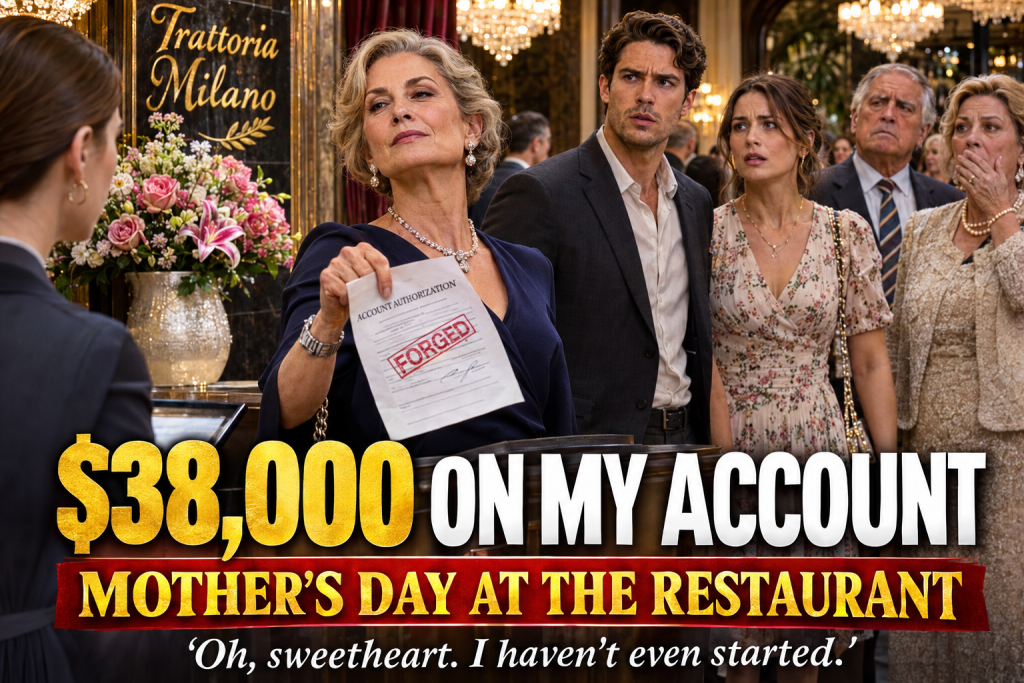
“He explained that you wanted it kept confidential,” Luca went on miserably. “He brought a letter. He said you were traveling and had asked him to handle the arrangements. The letter was typed. It was on your personal stationery. It authorized the charge to your membership account, number 000147.”
I looked at him. Number 000147 was the code that my husband and I had assigned, decades ago, to the Whitmore family account at Bellavista. It was a courtesy account. We had never actually used it. It sat dormant, a quiet relic, for the one purpose of allowing our family to dine without a bill.
“May I see the letter?” I asked.
Luca opened a drawer and drew out a single sheet. He handed it to me with two fingers, as one might hand over a dead bird.
It was my stationery. My phrasing. My signature, Margaret A. Whitmore, in blue ink, with the little loop at the end of the W.
I stared at it for a very long time.
PART 4 — PART 4: THE SIGNATURE
I want to tell you about the signature, because it matters.
I have signed my name some half a million times. I signed it on the first lease for Margherita’s. I signed it on loan applications, hiring contracts, birth certificates and a death certificate. It has a peculiar slant, a result of the arthritis in my right hand, and a distinctive flourish that I invented when I was nineteen, in a high school study hall.
The signature on the page was perfect.
Not close. Perfect. The slant, the flourish, the tiny hesitation at the apex of the M that comes from a lifetime of stopping to breathe. It was good enough to fool a bank officer. It was good enough to fool me, for the first three seconds.
And I knew, with the cold clarity of recognition, who had taught himself to do it.
Adam had begun practicing my signature at the age of twelve. I remembered it now. A school permission slip. I had laughed and scolded him gently. At fifteen, he had forged a late note for the principal. At nineteen, he had signed a credit application, and I had paid the balance without a word. Each time, he had grown more skilled. And each time, I had said, “Don’t do it again,” and let it pass.
I had trained him. Not deliberately. But I had let him learn that the consequence of a forgery was my forgiveness.
“Mrs. W,” Luca whispered. “I did not know whether to call you. He said you’d be unreachable. And the guests were already arriving. And then you walked in, and I thought, I should tell you.”
“You did exactly the right thing,” I said.
“What would you like me to do?”
I looked down at the page. I read the amount, typed in the final line.
“The estimated total?”
“Thirty-eight thousand dollars,” said Luca. “With gratuity.”
I folded the letter once and slid it into my handbag.
Then, to Luca’s immense astonishment, I smiled.
“Oh, Luca,” I said. “Let the party go on.”
He stared at me. “But, Mrs. W—”
“There are sixty people in that room who have done nothing wrong. A couple celebrating thirty-five years of marriage. I will not spoil it for them. Serve everything. Pour the best wine. Make it magnificent.”
“And your son?”
“I’ll deal with my son,” I said, “in the morning.”
PART 5 — PART 5: THE VISIT TO THE BANQUET ROOM
I did not go home. I could not have eaten. I returned to my corner table, and I sat very straight in my navy silk, sipping Barolo, and I listened to the muffled sounds from the private room. The strings played Vivaldi. A toast was offered, and applause followed. A long, joyful murmur rose and fell through the walls.
At eight o’clock, the double doors opened and a crowd of guests spilled into the corridor, laughing, to take photographs on the terrace. I saw, among them, a silver-haired man in a tuxedo with a beaming wife on his arm. The Prescotts. They looked perfectly happy.
And behind them, with a champagne flute in one hand, flushed and radiant, came my son.
Adam looked spectacular. He wore a charcoal suit and a silk tie I recognized as one I had given him last Christmas. His curly hair was combed back. He was laughing at something a cousin had said, one arm slung around his wife’s shoulders.
I watched him cross the terrace. And then, as if sensing my gaze, he turned his head and looked through the window.
Our eyes met.
I saw the laughter die on his face. I saw the color drain from his skin. His champagne flute tilted, and a few drops of golden wine slid down his cuff.
I did not stand. I did not wave. I lifted my glass, very slightly, in a small salute.
He set down his flute. He said something to Courtney. He moved toward the restaurant’s side door with the stiff, careful walk of a man crossing thin ice.
He came to my table. He did not sit. He stood beside it, tense as a wire, his smile frozen.
“Mom,” he said. “What a surprise. I thought you were, I thought you’d be home.”
“It’s Mother’s Day, darling. I always dine here.”
“Right. Of course.” He glanced around, desperate. “Look, I can explain.”
“I’m sure you can.”
“It’s not what it looks like.”
“Isn’t it?” I said gently. “Because it looks like you’ve spent thirty-eight thousand dollars of my money, using my signature, on an anniversary party for your in-laws, after telling me you couldn’t make time for your own mother.”
He swallowed. His face was shining with sweat.
“Mom,” he whispered. “Please. Not here.”
“I agree,” I said. “Come to the house tomorrow at nine. Bring your wife. And bring a lawyer, if you like.”
PART 6 — PART 6: THE MORNING AFTER
I did not sleep that night. I sat at my kitchen table, in my robe, with a cup of chamomile and the forged letter in front of me. I thought about Frank. I thought about the little boy with curls who had signed my name to a permission slip. I thought about the endless, easy love that had taught him that mothers were a kind of bank.
By dawn, I had a plan. It was not a plan of revenge. I want to be very clear about that. I am sixty-six years old, and I have long since lost any taste for punishing the people I love. But I am also a woman who has built an empire on the principle that actions have consequences, and I had spent thirty years failing to apply that principle in my own home.
At nine o’clock, my son and his wife arrived. They were alone. Adam had dark circles under his eyes. Courtney, a slender, anxious young woman with a pretty, tired face, carried a small covered dish.
“Muffins,” she said, her voice trembling. “I didn’t know what else to bring.”
I took the dish. “Thank you, dear. Sit down.”
They sat on the sofa in the living room. I took the armchair opposite. On the coffee table lay the forged letter, two folded bank statements and a cup of coffee, untouched.
“I’ll begin,” I said, “by telling you what I know.”
I laid out the facts, calmly, one at a time. The booking on Friday. The letter. The signature. The membership number. The thirty-eight thousand dollars. I did not raise my voice. I watched Courtney’s face, and I saw her shock. It was genuine. She had not known.
“Adam,” she whispered. “You told me your mother offered.”
He did not answer.
“You told me this was a gift.”
“Courtney—”
“You told my parents it was a gift!” Her voice cracked. “I thanked her! I wrote a card!”
He put his face in his hands. “I know. I’m sorry. I’m so sorry.”
I let the silence stretch. Then I said, quietly, “Adam. I’d like you to tell me why.”
He lifted his head. His eyes were red. And in that moment, he looked about nine years old.
“Because I’m in trouble, Mom,” he said. “I’ve been in trouble for a long time.”
PART 7 — PART 7: WHAT HE HAD HIDDEN
It came out in a rush, the way water comes out of a cracked dam.
Two years earlier, Adam had left the stable job I had helped him find at a bank, and launched a “business opportunity” with a friend: a boutique fitness franchise that had promised enormous returns. It had failed within eight months. He had lost one hundred and sixty thousand dollars, most of it borrowed. He had not told Courtney. He had not told me.
He had taken out a line of credit against their house. He had opened two credit cards under his wife’s name, with her consent for a “joint project” that she had not fully understood. He had been paying the minimums and nothing more.
“I couldn’t tell anyone,” he said, his voice raw. “Everyone thinks I’m doing so well. The Prescotts think I’m a success. They’ve been so proud of me. They told everyone at the club.”
“And the anniversary party?” I asked.
“Courtney’s father was going to host it himself. At a banquet hall in Chagrin Falls. But he’d mentioned that he wasn’t sure he could afford the full thing this year, because of a downturn in his real estate.” He wiped his face on his sleeve. “And I thought, if I could just pay for it, if I could give them something spectacular, they’d never find out how bad it was. They’d think I was rich. They’d keep respecting me.”
“You were going to charge it to my account.”
“I thought I’d pay it back. I had a plan, I was going to sell some stock, and I’d, I’d slip the money into the account before the end of the quarter. You’d never have noticed.”
Courtney had slid away from him on the sofa. She was staring at the floor, tears dripping off her chin.
“I would have noticed,” I said softly. “I notice everything. It’s how I built a company.”
“I know,” he whispered.
I looked at him for a long time. And then I said the thing I had been holding in my chest for thirty-two years.
“Adam, I am not angry about the money. The money is only money. What breaks my heart is that you believed you could not come to me. That you thought I would love you less if you failed. And that I let you believe it, because I spent your whole life making sure you never had to.”
His mouth trembled.
“I raised a son who thinks that love is something you pay for with a perfect signature,” I said. “That’s my failure, not yours alone.”
PART 8 — PART 8: THE TERMS
I had been thinking, all night, about what to do.
Forgery is a crime. I do not say this lightly. A document signed with my name, used to authorize a charge of thirty-eight thousand dollars, is the sort of thing that sends a young man to prison. I had a lawyer on my speed dial and a letter that would stand up in any court. I could have ended his life as he knew it with a single phone call.
I did not want to. Not because I loved him too much to hurt him, although I do. But because I had come, in the night, to a clearer understanding. A mother’s job is not to protect her child from every consequence. It is to make sure the consequences teach him something.
“Here is what will happen,” I said. “I am going to lay out three conditions. You will accept them, or I will call my attorney.”
They both looked up.
“First. You will tell the Prescotts the truth. All of it. Not tonight, but within the week, and in person, with Courtney at your side. You will tell them that the party was paid for with a forged letter, that you are deeply ashamed and that you will be repaying every cent.”
Adam closed his eyes. “Mom.”
“Second. You will repay the thirty-eight thousand dollars, with no interest, over three years. Not from my pocket, and not by borrowing. You will earn it. I’m offering you a position at Bellavista, starting Monday, as a line cook’s assistant. The wage is fair. The hours are long. You will report to Chef Marcello.”
He stared at me. “A dishwasher?”
“A kitchen assistant. You will learn how a restaurant works from the ground up, which is how I did. And you will see what thirty-eight thousand dollars looks like when it’s earned in nine-dollar increments.”
Courtney let out a small, helpless laugh through her tears.
“Third.” I turned to her. “Courtney, I want you to know that you are not responsible for any of this. If you wish, I will arrange for you to speak with my attorney independently, about your accounts and your credit. You owe my son nothing, and you owe me less. But I hope, with all my heart, that you’ll stay and help him.”
She nodded, sobbing.
Then I turned back to my son, and I said the last of it.
“And Adam. Whatever else happens, I am your mother. I will love you the day you finish paying, and I will love you the day you don’t. But I will no longer rescue you.”
PART 9 — PART 9: THE KITCHEN
He started on a Monday.
I confess I did not expect him to show up. I thought he might sulk, or run, or call me in tears, or have his father-in-law call me in rage. I was prepared for all of it.
At five-fifty that morning, Chef Marcello phoned me. He is a big, laconic man with arms like hams and a voice like gravel. “Mrs. Whitmore,” he said. “Your boy’s here.”
“Is he?”
“Early. Apron on. Asked me where the mop was.” There was a pause. “He looks terrible. But he’s here.”
I closed my eyes. “Be firm with him, Marcello. And kind.”
“I’m always firm,” he said. “And I’m kind when it counts.”
For the first three weeks, Adam was a disaster. He dropped trays. He burned his fingers. He could not tell a shallot from an onion. The cooks, who knew who he was within an hour, treated him with careful politeness that bordered on cruelty. He scrubbed the floors with a bucket and a brush. He peeled forty pounds of potatoes in a single afternoon. By Friday, his hands were raw.
I did not intervene. I watched from a distance, through Luca’s quiet reports. He said that Adam had not once complained. He said Adam had asked every cook to teach him something. He said that on the third Sunday, after the dinner rush, Adam had stayed late, alone, polishing every copper pot in the kitchen until it gleamed.
“Why?” Luca had asked him.
“Because my mother polished them,” Adam said. “When she started. Chef told me.”
The Prescotts took it hard. Courtney’s father, a stern, white-haired man named Walter, called me personally. He was furious. He was also, I discovered, deeply embarrassed. Adam’s confession, in the Prescott family living room, had been an agony. But Walter had listened to the whole thing. And at the end, he had said quietly, “Son, I wasn’t going to be able to afford the party either. I should have said so.”
“We were both afraid to look poor,” Adam told me later. “Can you imagine? Two grown men, terrified of the truth.”
It was, I think, the first honest conversation either of them had had in years.
PART 10 — PART 10: NEXT MOTHER’S DAY
It has been a year.
Adam has repaid twelve thousand dollars so far, on schedule. He works six days a week, and he has been promoted twice, first to line cook, then to assistant sous chef. Chef Marcello says he has a surprising palate. He cooks lunch every Sunday for the staff, and last month he invented a lemon risotto that has become a special.
Courtney has gone back to school part-time, studying accounting. She is the one who handles their finances now, with an iron hand and a tidy spreadsheet. The line of credit has been closed. The credit cards have been paid down by a third. They live in a smaller apartment, and they walk to the grocery store. They look, to my eyes, happier than they have ever been.
Walter Prescott and I have become, improbably, friends. We have lunch on the first Thursday of the month, at a diner, where we split a piece of pie and complain about our children.
The Sunday before last, the second in May again, I received an unexpected call.
“Mom,” said Adam. “What are you doing tonight?”
“The usual. Dinner at Bellavista.”
“Would you mind,” he said, hesitating, “if I made reservations somewhere else?”
I paused. “Where?”
“My place. Courtney and I are cooking. It’s a small apartment, and the table wobbles, and I have no idea whether the lasagna will work. But, would you come?”
My throat tightened.
I arrived at six o’clock, carrying a bottle of Barolo. The apartment was tiny, warm and smelled of garlic. A card on the table said, in his handwriting, Reserved: Mrs. W. I sat at the wobbly table and he served me a plate of lasagna that was slightly overcooked and magnificent.
At the end of the meal, he slid a small envelope across to me.
Inside was a check. Twelve thousand dollars, exactly. Drawn on his own account, with his own signature, in his own ordinary handwriting.
“It’s not the whole amount,” he said. “But it’s the first real thing I’ve ever paid you back.”
I held it a moment, thinking of my son at twelve, practicing my name.
“Adam,” I said, “this is the best Mother’s Day gift I have ever received.”
And I did not tell him that his signature, plain and uneven and entirely his own, looked more beautiful to me than any I had ever seen.