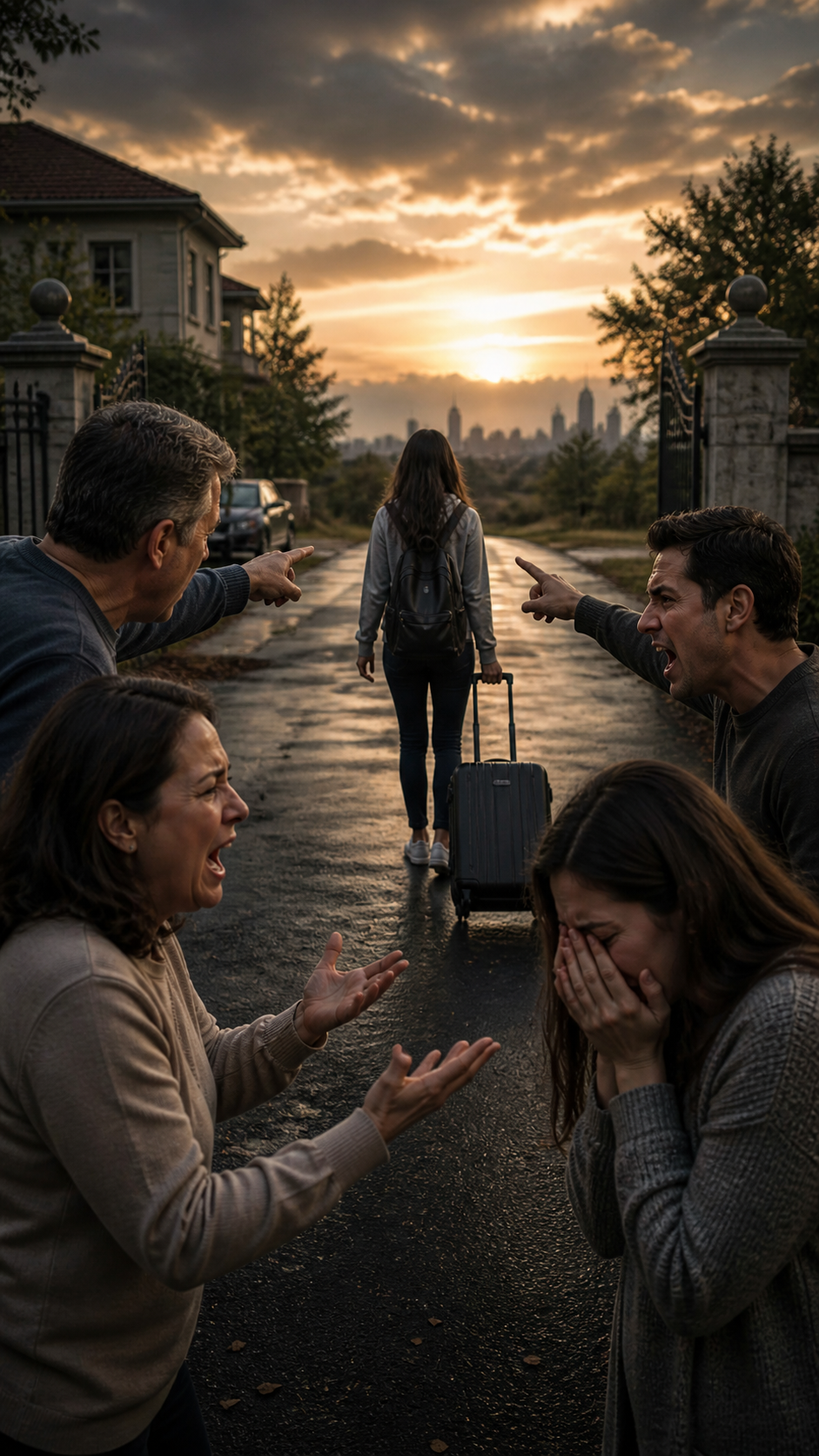
“I wish you were never born.”
My mother said it so calmly that, for a second, I thought I had misheard her.
Not because she was incapable of cruelty.
I had grown up around her kind of cruelty.
The quiet kind.
The polished kind.
The kind that wore a cardigan, brought casseroles to church families, and told everyone she loved both her sons equally.
But this was different.
This was not a sideways remark at Thanksgiving.
It was not a sigh when I said I could not help Tyler again.
It was not one of those little cuts she pretended were jokes.
It was a full sentence.
Clear.
Steady.
Final.
“I wish you were never born.”
I stood in my kitchen with my phone against my ear and stared at the faded floral wallpaper I kept meaning to tear down.
A tiny brown stain sat near the light switch, shaped almost like a fingerprint.
My eyes locked on it because if I focused on anything else, I was afraid the room might crack open.
My mother breathed on the other end of the line like she had just relieved herself of something heavy.
The fight had started over money.
It always did, eventually.
Tyler, my older brother, was getting married.
More accurately, Tyler was getting the wedding experience our parents believed he deserved, which meant every ordinary event had to become a production.
The engagement party alone had turned into a rented venue, a private caterer, custom cocktails, and a photographer because, according to Mom, “these memories only happen once.”
They happened once for Tyler.
For me, memories had always been something I was expected to make without help.
Mom had called while I was cooking dinner.
Lily was still at school grading essays, and I was stirring pasta sauce when my phone lit up with my mother’s name.
I almost did not answer.
That tiny hesitation should have warned me.
“Your father and I talked,” she said after three seconds of fake warmth, “and we think two thousand from you would be fair.”
I turned the burner down.
“Two thousand for what?”
“For Tyler and Amanda’s engagement party.
Don’t make this difficult, Jake.”
She said my name like it was already a disappointment.
I leaned against the counter and closed my eyes.
“Mom, I’m not paying two thousand dollars for Tyler’s party.”
The silence that followed was not empty.
It was loaded.
“Excuse me?”
“I said I’m not paying for it.
I have rent.
Bills.
A car repair I’m still paying off.
Tyler has a job.
Amanda has a job.
If they want a party that expensive, they can cover it.”
My mother gave a short laugh with no humor in it.
“You always do this.”
“Do what?”
“Make everything about you.”
I looked at the pot of sauce, slowly bubbling like nothing in the world had changed.
Everything about me.
My sixteenth birthday had been moved to a weeknight dinner because Tyler had a baseball tournament.
My high school graduation dinner had ended early because Tyler got into an argument with his girlfriend and needed comforting.
When I was accepted into a state college, Dad said, “Good, that’s practical.” When Tyler dropped out of community college, they called it “finding his path.”
Tyler needed.
Tyler deserved.
Tyler struggled.
Tyler shined.
I managed.
That was my role.
“I’m not doing this,” I said quietly.
My mother’s voice tightened.
“Your brother has always been more sensitive than you.
He needs to know his family is behind him.”
“I’m his family, not his ATM.”
That did it.
She inhaled sharply, and the version of her that performed patience vanished.
“You have been jealous of him since the day he was born,” she snapped.
“He was born before me.”
“You know what I mean.”
No, I did not.
Or maybe I did, and that was worse.
I set the spoon down.
“I’m done paying to stay in this family.”
Her voice dropped.
“You ungrateful little—”
Then she stopped herself.
Not because she was ashamed.
Because she was choosing something sharper.
“I wish you were never born.”
The pasta sauce popped once on the stove.
That was the only sound in the room.
I waited for her to take it back.
She did not.
I waited for her to gasp, to cry, to say she had not meant it.
Nothing.
Something inside me that had been bent for thirty-two years finally snapped straight.
“Okay,” I said.
She scoffed.
“Okay?”
“Consider your wish granted.”
“Jake, don’t be dramatic.”
My voice came out calm.
Too calm.
“From this moment forward, act like I was never born.
Don’t call me.
Don’t text me.
Don’t come to my apartment.
Don’t send Dad.
Don’t send Tyler.
Don’t send relatives to explain why I’m wrong.
You wanted me gone.
I’m gone.”
For the first time in the call, she sounded uncertain.
“Jake.”
I hung up.
The click was small, but it felt like a lock turning.
I stood there with the phone in my hand.
My body should have been shaking.
My chest should have been heaving.
But my hands were steady as I opened her contact and blocked her number.
Then I blocked Dad.
Then Tyler.
Then Aunt Rachel, who always told me privately that she understood but publicly acted like my parents were saints.
Then Uncle Mark, who once said Tyler was “the special one” and I needed to accept my place in the family.
Then cousins who only remembered my number when my mother needed extra pressure.
Seventeen people in one night.
Seventeen doors I had left open because I believed family access was automatic.
Block.
Block.
Block.
By the time I finished, the kitchen felt different.
The apartment felt larger, somehow.
Like oxygen had returned to the walls.
I dumped the overcooked pasta into a bowl and sat at the table without eating.
When Lily came home, she stopped halfway through the door.
She was still wearing her school badge.
Her hair had fallen loose from its ponytail, and her canvas teacher bag sagged from her shoulder, heavy with essays.
She looked exhausted until she saw my face.
Then all of that exhaustion sharpened into concern.
“What happened?” she asked.
I tried to answer, but my mouth opened and nothing came out.
She set her bag down and crossed the room.
“Jake.”
“I cut them off,” I said.
She sat beside me, coat still on, hand already reaching for mine.
“Tell me.”
So I did.
I told her about the money.
Tyler’s engagement party.
Mom’s tone.
The way she turned no into betrayal.
Then I
told her the sentence.
Lily’s face changed slowly.
At first, pain moved across it.
Then disbelief.
Then anger so clean and bright that it almost made me look away.
“She said that?”
“Yes.”
“And then what?”
“I told her to consider her wish granted.”
Lily held my hand with both of hers.
“Good.”
I blinked.
She leaned closer.
“I mean it.
Good.”
No one had ever said that to me after I defended myself.
Usually, defending myself started the second trial.
Had I been too harsh? Had I considered how Mom felt? Did I know how much stress Tyler was under? Could I be the bigger person?
Lily did not ask any of that.
She said, “I’m proud of you.”
Those four words hit harder than my mother’s sentence in a different way.
For a week, there was silence.
At first, the silence scared me.
I kept checking my phone as if anger could break through a block.
I expected emails.
A letter.
A knock.
Some new route of invasion.
Nothing came.
The quiet settled slowly.
On Monday, I woke up before my alarm and realized I had slept through the night.
On Tuesday, Lily and I made tacos and argued about whether cilantro tasted fresh or soapy.
On Wednesday, I walked home from work and did not feel the old drop in my stomach when my phone buzzed, because it was only Lily asking if we needed milk.
By Friday, I understood something that made me both sad and furious.
Peace had been possible all along.
It just required their absence.
The first knock came Saturday morning.
Three hits.
A pause.
Three more.
Lily and I were drinking coffee in the living room.
She looked at me over her mug.
I already knew.
I checked the peephole.
Aunt Rachel stood in the hallway, wrapped in a beige coat, eyes wet, clutching her purse like she had been sent into battle with nothing but lipstick and guilt.
“Jake,” she called softly.
“Honey, I know you’re in there.”
Lily came up beside me and whispered, “Do you want me to say something?”
“No.”
Aunt Rachel knocked again.
“Please don’t do this to your mother.”
There it was.
Not “please don’t let your mother do this to you.”
Not “I heard what she said, and it was unforgivable.”
Please don’t do this to your mother.
I stepped back from the door.
Aunt Rachel kept talking.
“She hasn’t slept.
She’s crying constantly.
You know she says things when she’s upset.”
Lily’s jaw tightened.
“She didn’t say it because she was upset,” I murmured.
“She said it because I said no.”
Aunt Rachel stayed for twenty-three minutes.
Lily timed it because she said, “One day you’ll need a record of how long they think they’re entitled to stand outside your door.”
I loved her for that.
Two days later, Tyler arrived.
I heard him before I saw him.
A fist slammed against the door so hard the frame rattled.
“Open up, Jake!”
Lily was grading papers at the table.
Her red pen froze mid-sentence.
Tyler hit the door again.
“I know you’re in there! Stop being a coward!”
I looked through the peephole.
My brother stood too close to the door, face flushed, hair perfect, expensive watch flashing each time he raised his fist.
He had always known how to look successful from a distance.
“You’re embarrassing Mom,” he shouted.
“All because you’re jealous I’m getting married?”
Lily quietly lifted her phone and started recording.
Tyler paced in the hallway.
“You think cutting everyone off makes you strong? It makes you pathetic.
You’ve been waiting for a reason to play victim your whole life.”
My hand moved toward the deadbolt.
Lily touched my wrist.
“No,” she whispered.
One word.
Enough.
I let go.
Tyler leaned toward the door.
His voice dropped just enough that the neighbors might not hear all of it.
“You don’t want to make Dad handle this.”
Then he stepped back, straightened his jacket, and left like he had delivered something important.
That night, I barely slept.
Not because I regretted cutting them off.
Because Tyler’s last sentence had carried a familiar weight.
Dad had always been the closer.
Mom wounded.
Tyler demanded.
Dad arrived last, calm and disappointed, to explain what would happen if I did not cooperate.
He never yelled much.
He did not have to.
His anger lived in the quiet space between words.
The next day, they went after Lily.
She called me from school during my lunch break.
I was in the break room with a half-eaten sandwich when her name lit up my phone.
“Hey,” I said.
For a second, she did not answer.
Then she said, “Your mother came to my school.”
The sandwich turned to stone in my throat.
“What?”
“She showed up at the front office and said there was a family emergency.
They almost pulled me out of class, but I was between periods, so I met her near the office.”
I stood so quickly my chair scraped the floor.
“What did she say?”
Lily exhaled, but her voice stayed controlled.
That was how I knew she was furious.
“She said you’ve been lying to me.
She said you have a history of cutting people off when they don’t give you money.
She said your family has been worried about your temper.”
“My temper?”
“She told me I should be careful.”
The break room faded around me.
My mother had not called to apologize.
She had not written a letter.
She had not asked herself whether telling her child she wished he had never been born might have consequences.
She had gone to my girlfriend’s workplace and tried to make me look dangerous.
“What did you do?” I asked.
“I told her she needed to leave.”
“And?”
“She started crying.”
Of course she did.
“And I told her,” Lily continued, “that crying in a school office would not make me forget what she came there to do.”
A breath left me that was almost a laugh.
“She didn’t like that.”
“I’m guessing no.”
“I told her if she contacted me at work again, I’d file a report with administration and document it as harassment.”
I pressed my hand over my eyes.
“I’m sorry.”
“Don’t.” Her voice softened.
“You did not send her here.”
“I know, but—”
“Jake.
Listen to me.
You did not send her here.”
I stood in that break room, surrounded by humming vending machines and stale coffee, and felt something inside me loosen.
For years, my family’s behavior had somehow always become my responsibility.
If Mom cried, I
had caused it.
If Tyler shouted, I had provoked him.
If Dad went silent, I had disappointed him.
Lily refused to hand me the blame.
The next morning, Dad came to my office.
I worked for a mid-sized logistics company in a building with glass doors, badge access, and a front desk staffed by a security guard named Warren who usually noticed everything.
Somehow, my father got past him.
Later, Warren told me Dad had walked in carrying a sealed envelope and said he was dropping off documents for a vendor dispute.
He knew the right tone.
Respectable.
Slightly impatient.
The kind of older man people trusted because he looked like someone’s accountant.
I did not see him.
That was what made it worse.
At 2:17 p.m., my boss sent a message.
Can you come to my office?
Martin was a fair man, which is not the same as a warm one.
He ran the department with spreadsheets, clean shirts, and controlled expressions.
I had worked under him for five years and had never seen him look rattled.
When I stepped into his office, he was standing behind his desk.
“Close the door, please,” he said.
My stomach dropped.
I closed it.
There was a folder on his desk.
Plain manila.
My name written across the tab in my father’s blocky handwriting.
“Your father came by today,” Martin said.
I looked at the folder.
“I didn’t know.”
“I figured.” Martin sat slowly.
“He told the front desk he had documents relevant to your employment.”
My mouth went dry.
Martin opened the folder.
“He said you have a history of instability.
He said your family has been covering for you for years.
He claimed you’ve borrowed money from relatives under false pretenses, threatened family members, and recently had what he called a severe breakdown.”
I felt the room narrow.
“That’s not true.”
“I need you to let me finish.”
His tone was not accusatory, but it was careful.
HR careful.
He pulled out the top sheet.
There were typed paragraphs.
My father must have prepared them before he came.
At the bottom were photocopies of old text messages.
Some were mine, but cut apart, stripped of context.
One said, “I can’t keep doing this.” Another said, “Do not contact me again.” Another, from years earlier, said, “I’m done.”
My words, turned into evidence against me.
Then Martin lifted another page.
“This is why I wanted to speak with you privately,” he said.
I saw it before he explained.
An old incident report.
From when I was seventeen.
My chest locked.
I had not seen that paper in fifteen years.
When I was seventeen, Tyler crashed Dad’s car into a mailbox after drinking at a party.
He had no license at the time because his had been suspended for speeding.
I was home that night, studying for a chemistry exam.
Dad woke me up at 1:30 in the morning and told me to get dressed.
At the scene, Tyler was crying.
Mom was shaking.
Dad looked at me and said, “You were driving.”
I said no.
Dad stepped close enough that I could smell coffee on his breath.
“If Tyler gets charged again, it ruins his future,” he said.
“You’re a minor.
It’ll go away.”
I still remembered the cold air.
The
broken mailbox.
Tyler’s eyes refusing to meet mine.
I took the blame.
For years, that report had been the family’s hidden leash.
Any time I pushed back, Mom reminded me that they had “protected me” after my “reckless phase.” Dad said I should be grateful they never held it over me publicly.
Now he had brought it to my employer.
Martin slid the photocopy toward me.
“Your father said this was proof of a long-standing pattern.”
I stared at it.
My seventeen-year-old signature sat at the bottom, shaky and terrified.
Something cold moved through me.
Not fear this time.
Clarity.
I looked up.
“Martin, I need HR in here.”
His eyebrows lifted.
“And I need to make a formal statement.”
Within twenty minutes, I was sitting in a conference room with Martin and Denise from HR.
My hands were folded on the table.
My voice shook at first, but only at first.
I told them everything.
The money demand.
My mother’s words.
The blocking.
Aunt Rachel.
Tyler at my apartment.
My mother at Lily’s school.
My father entering the building under false pretenses.
Then I told them about the crash.
I told them I had been home.
I told them Tyler had been driving.
I told them my father pressured me to take responsibility because I was a minor and Tyler had more to lose.
I told them my parents had used that lie to control me for fifteen years.
Denise took notes without interrupting.
When I finished, Martin leaned back in his chair and rubbed his jaw.
“Do you have any documentation?” Denise asked.
I laughed once, bitterly.
“No.
That was the point.
They controlled the story.”
Then my phone buzzed.
It was Lily.
I had forgotten she still had a folder on her laptop where she saved anything strange my family sent, because she once told me, “People like this count on everyone else being too embarrassed to keep records.”
Her text read: Check your email.
Now.
I opened it.
There were attachments.
Screenshots from years of messages I had forwarded her during fights.
Voicemails transcribed by an app.
A video clip from Tyler pounding on our door.
A written statement from Lily about my mother showing up at the school.
And one audio file.
The subject line made my skin prickle.
Your mom’s call.
I had forgotten my phone automatically recorded calls through an app I used for work vendor conversations.
Most of the time, I deleted them.
That day, I had been too stunned to do anything.
Lily had found the backup.
Denise watched my face.
“What is it?”
“My mother,” I said.
I connected my phone to the conference room speaker with hands that were no longer steady.
The recording began with ordinary words.
My mother’s voice asking about Tyler’s party.
My refusal.
Her anger rising.
Then the sentence filled the room.
“I wish you were never born.”
No one moved.
The recording continued.
My own voice, calm and flat: “Consider your wish granted.”
Then the rest.
My boundary.
Her accusation.
The hang-up.
When it ended, the silence in that conference room felt different from the silence in my kitchen.
This silence had witnesses.
Denise closed her notebook.
“Your father is not permitted in this building again,” she said.
“I’ll notify security today.”
Martin looked
at me.
His face had lost that careful HR distance.
“I’m sorry,” he said.
“For what it’s worth, I did not believe walking in here with a family folder was normal.”
I swallowed hard.
“Thank you.”
But the story did not end in that office.
Because once my father realized he had failed, he made one more mistake.
He emailed Martin.
In writing.
The message came two days later.
Martin forwarded it to HR, then to me at my request.
My father claimed the company was putting itself at risk by employing me.
He wrote that I was “vindictive,” “financially manipulative,” and “mentally unstable.”
Then he added one sentence that finally broke open the thing he had buried.
“We have spent years protecting him from the consequences of the incident he agreed to take responsibility for when Tyler was young and vulnerable.”
Agreed.
Not caused.
Not committed.
Agreed.
My father, so used to controlling every room, had accidentally told the truth because he assumed no one would read carefully.
I forwarded the email to a lawyer.
I did not plan to sue my parents into dust.
I did not want a war.
But I wanted the leash cut.
Officially.
Permanently.
The lawyer sent a cease-and-desist letter covering harassment, defamation, contact at my workplace, contact through my partner, and any further distribution of false claims related to my employment or character.
She also requested written confirmation that my father would stop sharing the old incident report as proof of misconduct, given his own written admission that I had merely “agreed to take responsibility.”
For three days, there was nothing.
Then Tyler called Lily from a blocked number.
She put him on speaker and started recording before she said hello.
His voice sounded smaller than I expected.
“Is Jake there?”
Lily looked at me.
I shook my head.
“No,” she said.
Tyler exhaled.
“Tell him Dad’s losing it.”
Lily said nothing.
“He got that letter,” Tyler continued.
“Mom’s crying.
Amanda’s asking questions.
This is getting out of hand.”
Lily’s eyes stayed on mine.
Then Tyler said, “Look, I know the crash thing wasn’t exactly fair, but we were kids.”
My heart stopped.
Lily’s voice remained perfectly calm.
“What crash thing?”
A pause.
Tyler realized too late.
“The car,” he muttered.
“You mean the crash Jake took responsibility for?”
Another pause.
Tyler whispered, “Dad said it would disappear.”
There it was.
Not an apology.
Not yet.
But the truth, breathing in the room.
I took the phone from Lily.
“Say it again,” I said.
Tyler went silent.
“Say it again,” I repeated, “or never contact either of us again.”
His voice cracked with anger, shame, or both.
“I was driving.”
The sentence landed like a key turning in a lock I had carried in my chest since I was seventeen.
“I was driving,” Tyler said again, quieter.
“You were home.
Dad made you take it because he said I couldn’t have another charge.
Mom knew.
Everyone knew enough.”
My hands shook then.
Finally.
Not from weakness.
From the force of fifteen years leaving my body.
“Thank you,” I said.
Tyler gave a bitter laugh.
“That’s it?”
“That’s it.”
“What am I supposed to tell Mom?”
I looked around my apartment.
Lily beside me.
The kitchen wallpaper still ugly.
The phone warm in my
hand.
My life, imperfect and mine.
“Tell her she got what she asked for.”
I hung up.
The aftermath was not dramatic in the way my family would have wanted.
No screaming confrontation in a driveway.
No tearful dinner where everyone apologized and hugged over cold mashed potatoes.
No speech from my father about how he had done his best.
Just documents.
Recordings.
Boundaries.
Consequences.
My workplace banned my father from the building.
Lily’s school documented my mother’s visit.
The lawyer sent a second letter after Tyler’s recorded admission, and after that, the contact stopped.
Not because they suddenly understood me.
Because they understood evidence.
Months later, Tyler’s wedding happened without me.
A cousin I forgot to block emailed one photo before I deleted it.
Tyler stood in a navy suit beside Amanda, smiling like a man who had never let anyone else carry his wreckage.
I felt less than I expected.
That was its own kind of freedom.
On my thirty-third birthday, Lily surprised me with dinner at home.
Nothing fancy.
Just pasta, garlic bread, a chocolate cake from the grocery store because she said those were better than expensive bakery cakes and she was right.
She put one candle in the center.
“Make a wish,” she said.
I stared at the small flame.
For years, I had wished for my mother to love me correctly.
For my father to admit the truth.
For Tyler to see what his comfort had cost me.
That night, I wished for none of them.
I blew out the candle and reached for Lily’s hand.
The strangest thing about being wished out of existence by your own mother is that, if you survive the sentence, you get to decide who you become afterward.
My family thought being cut off was my punishment to them.
They never understood it was the first kindness I ever gave myself.
And maybe that is the part people will argue about most.
Whether I should have forgiven them because they were family, or whether the real red flag was that it took my mother saying the unforgivable for me to finally believe what their actions had been saying my whole life.