Part 1
“If you wanted to see me cry in front of everyone, congratulations—you picked the perfect day to bury me alive.”
That was the first thing I said when I saw the cake my children set in front of me on my seventieth birthday.
My name is Margaret Sullivan. I live in an old house in Savannah, Georgia, and until that afternoon, I still believed a mother could forgive anything.
I had set the dining room early that day, even though my children had insisted for weeks that I lift not a finger.
“Mom, we’re going to spoil you this year,” my oldest son, Daniel, told me over the phone.
My daughter, Claire, added in that sweet voice she only used when she wanted something, “You just relax, Mom. We’ve got everything handled.”
And my youngest, Tyler, laughed before hanging up. “It’s gonna be unforgettable.”
He was right.
They arrived at seven with their spouses, my grandchildren, and grocery bags filled with store-bought food. No one hugged me properly. No one asked how I was feeling.
Since my husband, Robert, passed away, their visits had changed. They no longer came out of love—they came out of interest.
They asked about the house. My accounts. The paperwork. The jewelry Robert had given me over the years.
But never about my aching knees. My sleepless nights. Or the kind of silence that weighs more than illness.
Still, I smiled.
Because mothers learn to swallow their sadness to keep the peace.
After dinner, Daniel dimmed the lights.
“And now,” he said with a smirk, “the queen’s cake.”
Claire walked in carrying a tray. Tyler already had his phone out, recording.
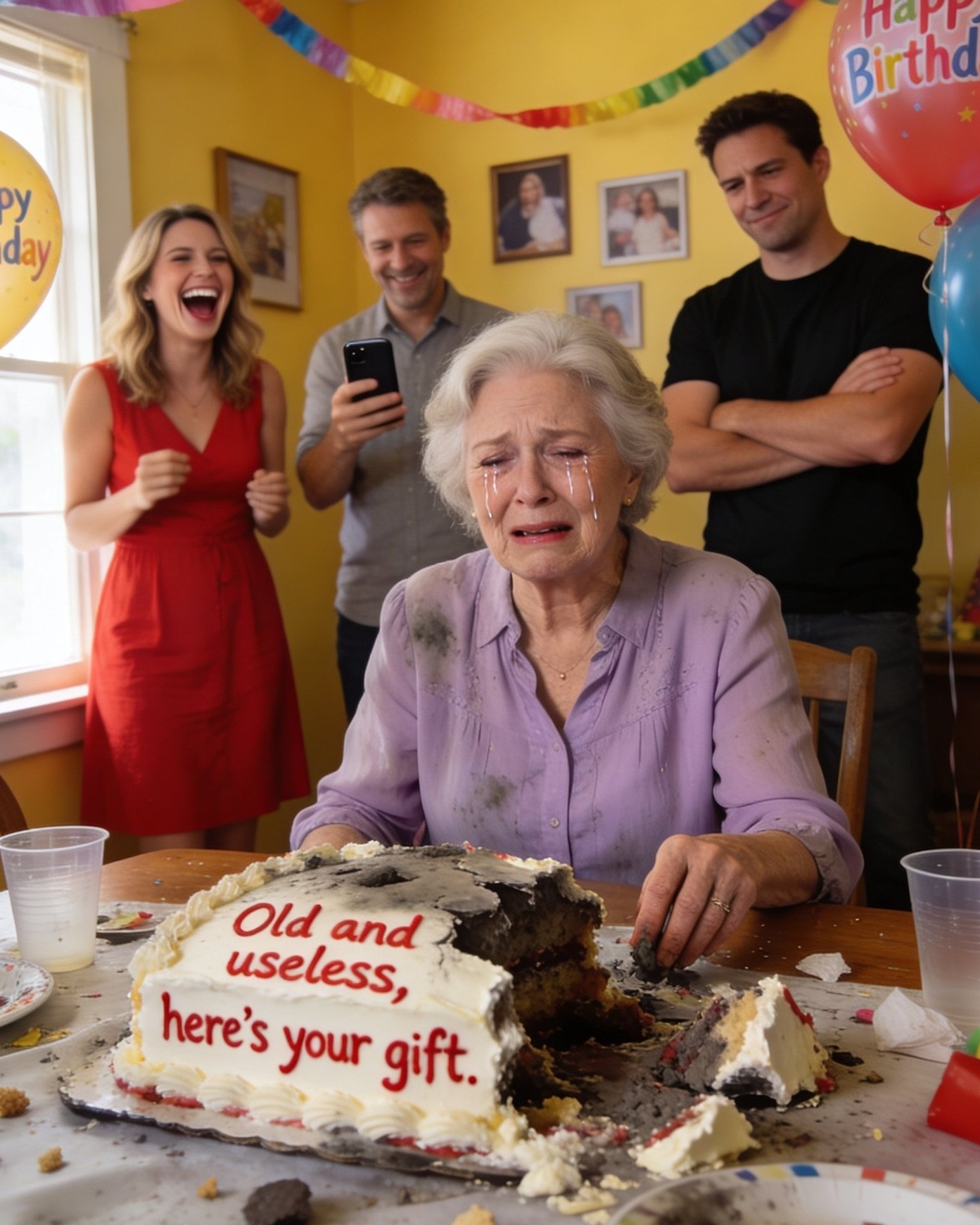
The cake… wasn’t a cake.
It was a collapsed, soggy mess made from stale dinner rolls, hardened bread, leftover frosting, and something that smelled sour. Everything was glued together with a grayish icing.
And on top, written in uneven letters with jam, were the words:
“For the useless old woman who only takes up space.”
My grandchildren fell silent.
My children didn’t.
They laughed.
Tyler pushed his phone closer to my face.
“Come on, Mom, don’t be upset. It’s content—it’s gonna blow up online.”
Claire crossed her arms. “You always say not to waste food, remember?”
Daniel added, “At your age, you probably can’t even tell the difference between fresh and stale anyway.”
Something inside me cracked.
But I didn’t cry.
I looked at each of them—these same children I had raised on double shifts, cleaning offices, skipping my own medication so they could go to good schools.
I took a breath.
“Thank you,” I said quietly. “Today, I finally understand what I’m worth to you.”
They left later that night, dishes in the sink, glasses scattered, and that rotten excuse for a cake still sitting on my table.
When the house fell silent, I picked up the phone and called my attorney.
“Mr. Bennett,” I said, “I want to change my will tomorrow.”
And as I stared at that disgusting thing they had called a cake, I knew—
What came next, they would never see coming.
Part 2
The next morning, I walked into Arthur Bennett’s office with a blue folder tucked under my arm and a heart colder than I’d ever felt before.
Arthur had been my husband’s friend for over thirty years. He knew everything—how Robert and I started with nothing, selling lemonade at roadside stands, saving every dollar until we could buy the house my children now circled like vultures.
“Margaret,” he said gently, “are you sure about this?”
I placed the documents in front of him—deeds, account statements, insurance policies, and my existing will.
“I’ve never been more certain.”
The old will divided everything equally between Daniel, Claire, and Tyler. The house. My savings. A small rental property. Robert’s jewelry.
Arthur read in silence, then looked up.
“What happened?”
I told him everything.
The cake. The laughter. The video. The words.
I didn’t cry.
I had cried enough over the years without anyone noticing.
When I finished, he pressed his lips together.
“That wasn’t a joke, Margaret. That was cruelty.”
“And cruelty doesn’t deserve to be rewarded,” I replied.
We drafted a new will.
Each of my children would receive one dollar. Not out of generosity—but to make it clear they had not been forgotten. They had been judged.
The rest would go elsewhere.
To a community kitchen downtown where I had quietly volunteered every Tuesday for months.
To support elderly people abandoned by their families.
To help widowed women struggling to pay rent.
The rental property would be donated to a nonprofit offering low-cost medical care.
Robert’s jewelry would be auctioned—except for his wedding ring. That, I wanted buried with me.
Arthur handed me the pen.
“Are you going to tell them?”
“Not yet.”
In the weeks that followed, my children acted as if nothing had happened.
Daniel texted me about “organizing paperwork.”
Claire showed up one Sunday, claiming she wanted to “help sort memories” while eyeing my display cabinets.
Tyler asked if he could use my house to film a video about “nostalgia and grandmothers.”
I closed the door in his face.
But the real turning point came a month later.
A neighbor showed me the video.
Tyler had posted it online.
It had thousands of reactions.
Not because it was funny.
Because it was horrifying.
People were tearing them apart in the comments.
And suddenly, my phone started ringing.
Not with apologies.
With panic.
They weren’t coming for forgiveness.
They were coming because the world now saw them exactly as they were.
Part 3
Daniel arrived first, sweating despite the cool morning air. Claire followed, sunglasses hiding her eyes. Tyler trailed behind, glued to his phone like he could somehow undo what he’d done.
They walked in without knocking.
“Mom, we need to talk,” Daniel said.
I sat calmly in the living room, holding a cup of coffee, Robert’s wedding ring hanging from a chain around my neck.
“I figured you would,” I replied.
Claire pulled off her sunglasses, her eyes red—not from sadness, but anger.
“You’re embarrassing us.”
I let out a small laugh.
“No, dear. You embarrassed yourselves.”
Tyler raised his hands. “Mom, I already took the video down. It’s over. People just overreact.”
“People?” I asked. “Or did someone finally say what I never dared to?”
Daniel slammed his hand on the table.
“If this is about that stupid cake, get over it. We’re your children.”
I looked at him for a long moment.
“My children were the ones I held through fevers at night. The ones I worked myself to exhaustion for. The ones I paid tuition for, helped with down payments, bailed out of debt and divorce.”
I paused.
“But the people who sat at my table and called me a useless old woman… I don’t know who they are.”
Claire’s voice trembled. “What do you want? An apology on our knees?”
“I want you to understand that even a mother gets tired.”
Then I told them.
“I changed my will. Each of you will receive one dollar. Everything else is going to people who know how to be grateful.”
Silence fell like a hammer.
Tyler went pale.
“You can’t do that.”
“I already did.”
Daniel stood, furious. “That house is ours too.”
“No,” I said calmly. “It’s mine. Your father and I built it long before you ever thought to claim it.”
Claire whispered, “Dad wouldn’t have wanted this.”
That one hurt.
But I didn’t lower my gaze.
“Your father died asking for you. None of you made it in time—you were too busy. Don’t use his name to cover your shame.”
Daniel stormed out. Claire followed, crying. Tyler lingered.
“Mom… are you really leaving us with nothing?”
I stood slowly.
“No, Tyler. I’m leaving you exactly what you gave me that day—a lesson.”
Months later, the community kitchen served its first full dinner for fifty elderly people.
On the wall hung a simple plaque:
“In honor of Margaret and Robert Sullivan—because family is also where respect lives.”
That night, I sat surrounded by people who didn’t share my blood—but looked at me with warmth.
And I understood something many mothers are too afraid to admit:
Forgiveness doesn’t mean allowing yourself to be destroyed.
Sometimes, the greatest act of self-love…
is closing the door—
even when your own children are standing on the other side.