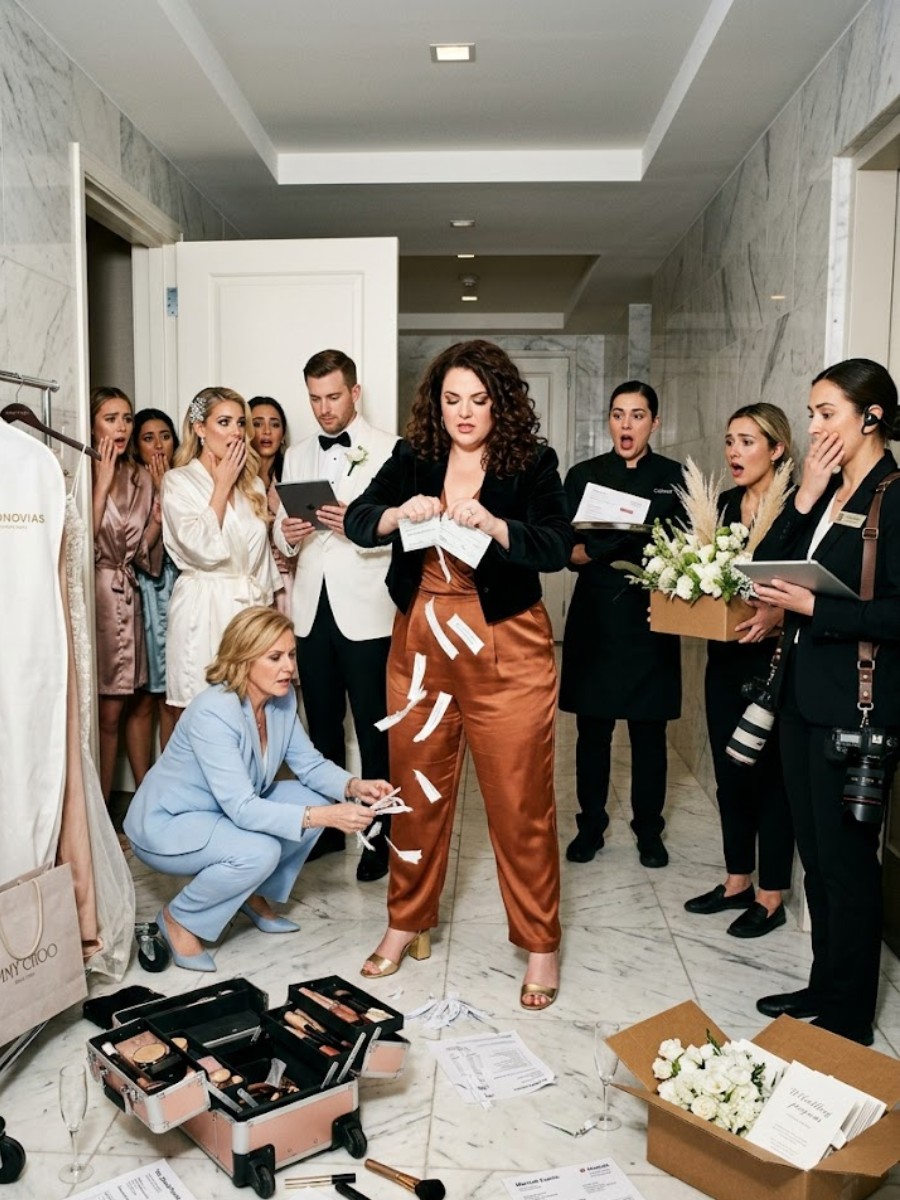
My Sister Blocked Me From Her Bridal Suite and Said “No Fat People in My Wedding Photos,” Forgetting I Had Paid for the Venue, Caterer, Florist, Photographer, and Final $20,000 Check; So I Tore the Check Into Shreds, Froze Every Vendor Charge in My Name
The hallway outside the bridal suite smelled of hairspray, expensive perfume, and lilies so fresh they still carried the damp, green scent of the florist’s cooler. Somewhere beyond the French doors, violins were warming up in the courtyard. Guests were arriving, heels clicking over stone, laughter floating up through the open windows in little bursts of champagne-bright sound. Everything looked like a wedding magazine had been unfolded and built into real life: ivory draping, gold-rimmed mirrors, white roses, candles waiting to be lit.
And there was Vivian, standing in front of the door like a gatekeeper to a life she had decided I was too embarrassing to enter.
She wore a white silk robe embroidered with Bride in pale gold thread. Her hair was still in rollers, her makeup already flawless, her skin glowing with the kind of careful radiance that came from two facials, a spray tan, a private makeup artist, and the steady belief that the world owed her beauty. One manicured hand pressed against the doorframe. Her diamond engagement ring flashed every time she moved, sharp and cold as a warning.
Her smile was worse than a frown. A frown would have been honest. Vivian’s smile had always been a polished little blade.
“There are no fat people in my wedding photos,” she said.
For one strange second, I thought I had misheard her. Not because the words were unlike her, exactly. Vivian had spent her whole life saying cruel things softly enough that other people could pretend they were jokes. But there, in the bright hallway, on a day I had helped build dollar by dollar, the words seemed too ugly to exist inside all that silk and roses.
The bridesmaids behind her froze. One of them, a tall blonde named Kelsey, had a champagne flute halfway to her lips. Another, Vivian’s college friend Simone, blinked too quickly and stared down at her phone as if a sudden message had saved her from witnessing anything. My mother, standing near the makeup chair in her pale lavender dress, lowered her eyes to the pearls around her neck. My father, who had been leaning against the wall with his reading glasses perched on the end of his nose, lifted his phone and began scrolling through nothing.
That was my family’s oldest magic trick: if they refused to see the wound, they never had to name the knife.
I looked at my sister. “Excuse me?”
Vivian laughed lightly, as if I were being silly. As if she had asked me to move a centerpiece, not erase myself from her family.
“Don’t do that, Claire.”
“Do what?”
“Make everything dramatic.” She tilted her head and gave me that patient, poisonous expression she used whenever she wanted others to believe I was unreasonable. “It’s my wedding. I have a vision. The photographer is doing this really elegant editorial style, almost like Vogue. It’s very clean. Very cohesive.”
“Cohesive,” I repeated.
Her eyes moved over me, slowly enough to be cruel and quickly enough to deny it. My dress was navy, just as she had requested. Long-sleeved, floor-length, tailored to skim rather than cling. I had chosen it carefully after three appointments, two fittings, and one humiliating afternoon in a boutique where Vivian had sighed outside the dressing room and said, “I just don’t want you looking matronly.” She had approved the dress herself. She had texted a heart emoji. She had even written, See? You can look polished when you try.
Now she examined that same dress as if it were a stain.
“You can still come,” she said, lowering her voice. That was another thing Vivian did. She lowered her voice right before the cruelest part, so anyone who heard it would feel they had intruded. “I’m not saying you have to leave. Just don’t stand near the altar. And maybe skip the family portraits. The photographer knows how to angle groups, but there’s only so much editing can do.”
Someone behind her made a tiny sound. A gasp swallowed too late.
I stood still, my clutch held in both hands. I could feel Mark beside me before he touched me. He had a way of going quiet when he was angry, not cold exactly, but steady, like a door being closed against the wind. His fingers brushed my elbow.
Vivian’s gaze flicked to him and hardened. She had never liked Mark. Not because he had done anything wrong. In fact, that was probably the problem. He was decent in a way that made indecency more visible. He remembered birthdays. He carried groceries. He listened. He had never laughed along when Vivian made one of her little jokes at my expense, and after the first time he had looked at her and asked, “Why would you say that?” she had never forgiven him.
“No,” I said.
Vivian blinked. “No?”
“No,” I repeated. “I’m not skipping the family portraits.”
Her smile thinned. “Claire, please don’t embarrass yourself.”
“I’m not the one embarrassing myself.”
Her eyes flashed. For a moment, her face showed what lived beneath the bridal glow: irritation, entitlement, panic. But she recovered quickly because recovery had always been her greatest talent.
“It is not personal,” she said. “It’s aesthetics.”
I almost laughed. Aesthetics. That was the word she had chosen for excluding her sister after asking that same sister to pay for half the wedding.
“No,” I said again. “It’s personal.”
My mother lifted her head. “Claire, honey…”
The honey did more damage than shouting would have. She used it when she wanted to soften me up. When I was eight and Vivian had cut the hair off my favorite doll because I wouldn’t let her take it to school, my mother had said, “Claire, honey, she’s little.” When I was sixteen and Vivian told everyone at a pool party that I had stretch marks like “old bread dough,” my mother had said, “Claire, honey, she’s insecure.” When I was twenty-five and Vivian borrowed two thousand dollars for rent and posted a weekend trip to Miami three days later, my mother had said, “Claire, honey, family helps family.”
Now she clasped her hands in front of her lavender dress and looked at me with an expression she probably thought was pleading but felt like an order.
“Please,” she said. “Don’t ruin your sister’s day.”
Something inside me went very still.
It was not rage, not yet. Rage is hot, messy, alive. This was different. This was a sudden clearing. A room I had lived inside for years, filled with smoke, finally had a window thrown open. I could see everything.
Vivian had not acted alone all my life. She had been cruel, yes, but she had been trained by silence. Fed by excuses. Protected by people who loved peace more than justice and called that love.
“My day?” I asked quietly.
My mother’s lips parted.
I turned back to Vivian. “You told me last month that you wanted me to stand beside you.”
Vivian rolled her eyes. “Things changed.”
“What changed?”
Her gaze slid downward again, deliberately. “Claire.”
The bridesmaids were statues now. Even the hair stylist had stopped pretending to sort pins. My father kept his eyes locked on his screen, thumb moving without rhythm.
Mark stepped forward half a pace. “We can go,” he said to me, calm but firm.
Vivian’s chin lifted. “This is family business.”
“So was asking her for money,” he replied.
The words landed harder than anything I had said.
Vivian’s face tightened. “I don’t need commentary from you.”
“Then stop giving everyone material.”
For a second, I loved him so fiercely I almost forgot to be hurt.
Vivian inhaled sharply and looked past him to me. “Are you seriously going to let him talk to me like that at my wedding?”
“You talked to me like that at your wedding.”
“It’s not the same.”
“No,” I said. “It isn’t. Because I paid for the wedding you’re using to humiliate me.”
Her smile faltered.
There it was. The truth. Not hidden exactly, but never spoken in front of everyone. It sat between us now, ugly and solid.
Twenty thousand dollars.
That was what Vivian had asked for in the end, though it had not started as twenty thousand. It had started as six. Six thousand for the venue deposit because she and Daniel were temporarily strapped. Then three for the florist because the “seasonal blooms package” looked cheap. Then four for the caterer because Daniel’s parents were “traditional” and Vivian didn’t want them thinking our family couldn’t host properly. Then the photographer deposit because Vivian had found someone with a magazine portfolio and “this is the only thing I truly care about, Claire, please.” Then the DJ. Then the planner. Then a final payment due the morning of the wedding, because she had made a spreadsheet and apparently my name had become a column labeled inevitable.
Every time she asked, she cried. Every time, she swore it was the last thing. Every time, my mother called afterward to say how much it meant that I was being “the bigger person.” The bigger person. Another phrase people used when what they really meant was the easier victim.
I had paid because I could. Because I had savings. Because I had spent a decade building a quiet, stable life while Vivian chased shine and Daniel chased investments he could not explain. I had paid because, foolishly, I thought generosity might make me visible as something other than the reliable older sister with the full figure and the emergency fund.
Vivian had hugged me in my kitchen two months earlier, sobbing mascara into my sweatshirt. She had called me her angel. Her lifesaver. Her best friend.
Now she would not let me through a door.
My hand moved before I thought about it. I opened my clutch.
The small sound of the zipper made Vivian’s expression change. It happened so fast that anyone else might have missed it, but I had been watching my sister’s face my whole life. Her eyes brightened. Her lips softened. Greed disguised itself as hope.
She thought I was reaching for the check.
She was right.
The final payment was folded in the inner pocket of my clutch, the one she had begged me to bring because “it’ll be easier if everything clears before the reception.” Twenty thousand dollars, written in my careful handwriting, made payable to Beaumont House Events. The ink had dried last night while I sat at my dining table and Mark leaned in the kitchen doorway, watching me with concern he tried not to turn into pressure.
“You know you don’t have to do this,” he had said.
“I know.”
“Do you?”
I had looked down at the check. “She’s my sister.”
He had nodded slowly, not agreeing, just acknowledging the sentence I had used all my life as both shield and chain.
Now, in the hallway, I took out the check and unfolded it.
Vivian’s eyes fixed on it. “Claire.”
My mother took one step forward. “Honey, let’s all calm down.”
My father finally stopped scrolling.
I held the check between both hands.
Vivian’s voice sharpened. “Don’t be stupid.”
That word did it.
Not the fat comment. Not the exclusion. Not even the humiliation in front of the bridal party. Somehow stupid, said with the old rhythm, snapped through the last thread.
Because I had been stupid. Not unintelligent, never that. But stupid in the specific way wounded people can be when they keep offering the knife back handle-first, hoping the person who cut them will decide not to use it again.
I tore the check once.
The sound was small, almost delicate. Paper fiber splitting. A tiny violence.
Vivian’s mouth opened.
I tore it again.
“No,” she whispered.
Again.
The bridesmaids stared. My mother covered her mouth. My father stepped away from the wall, his screen finally dark.
Again.
Little white pieces fluttered down onto the polished floor. One landed beside Vivian’s bare foot. Another clung to the hem of her silk robe. The check that was supposed to save her perfect day became scraps of paper, scattered like dead confetti.
I let the last pieces fall from my fingers.
Then I smiled. Not because I was happy. Because I was done.
“Good luck paying the suppliers,” I said. “Because the venue contract is in my name.”
Vivian went pale so quickly her spray tan looked painted on.
For one breath, she looked like a child caught stealing. Then the adult mask returned, furious and brittle.
“You’re lying.”
I bent, picked up a torn corner of the check, and pressed it into her trembling hand. “Call them.”
The hallway erupted all at once. Not loudly at first, but in overlapping whispers, shocked breaths, shoes shifting, silk rustling. Vivian stared at the scrap in her hand as if it might reassemble itself out of fear. My mother said my name twice, the first time pleading, the second time warning. My father muttered something I did not catch. Behind Vivian, the makeup artist began quietly packing brushes into a case with the careful speed of someone who wanted no part of family collapse.
“Claire, stop this,” my mother said.
I turned to her. “You watched her humiliate me.”
“She is under a lot of stress.”
“She is cruel.”
My mother flinched as if I had slapped her.
Good, I thought, and then hated myself for feeling it. But only for a moment.
Vivian’s fingers curled around the torn scrap until her knuckles went white. “You are not doing this to me.”
“I’m not doing anything to you.”
“You just destroyed my payment.”
“I destroyed my payment.”
Her nostrils flared. “It was for my wedding.”
“It was from my account.”
“You promised.”
“And you promised I was your sister.”
That hit something. I saw it in her eyes, a flicker of recognition quickly buried under resentment.
Then Daniel appeared at the far end of the hallway.
He came in with the energy of a man who believed every room owed him a spotlight. His tuxedo was expensive and slightly too tight across the shoulders. His boutonniere had been pinned crookedly, probably by one of his groomsmen after too many mimosas. His hair was carefully styled in the way men style their hair when they want it to look effortless but have spent twenty minutes making sure it does.
“What’s happening?” he demanded.
Vivian spun toward him, and tears appeared instantly. I had seen her do it so many times I wondered if she had a hidden switch behind her eyes.
“Claire is sabotaging us,” she cried. “She’s jealous. She’s trying to ruin everything because she can’t stand that today isn’t about her.”
Daniel’s gaze slid to me. Lazy contempt. Familiar enough that it no longer surprised me.
Daniel had always treated me as if I were furniture with a credit limit. Useful, unattractive, and not worth thanking unless someone was watching. The first time I met him, he had talked for forty minutes about a startup idea involving “luxury wellness logistics,” then asked if I knew any investors. The second time, he borrowed my parking spot and returned my car key with valet scratches he insisted were already there. By month six, he was calling me “big sis” with a grin that made my skin crawl.
For two years, I had watched him wear fake watches and real arrogance. He called himself an entrepreneur, which, as far as I could tell, meant three failed apps, a leased sports car, and an ability to say “cash flow” whenever the word debt would have been more accurate.
He looked now at the scraps of paper on the floor. “What did you do?”
Vivian clutched his arm. “She ripped up the final check.”
Daniel’s face changed. Not with concern for Vivian. With calculation. His eyes moved from the floor to me, then to Mark, then to my parents, measuring leverage.
“Pay the bill, Claire,” he said. “Don’t make this ugly.”
I almost laughed. “Ugly?”
“You heard me.”
“This became ugly when your bride told me I was too fat for the photos I paid for.”
Daniel smirked. “Maybe she has standards.”
The hallway went quiet again.
It was astonishing, really, how fast a person could reveal the truth of themselves when money was threatened. Daniel did not even bother pretending he had not heard the cruelty. He agreed with it. Worse, he thought agreement made him powerful.
Mark’s hand moved around mine. Not gripping. Just there.
I looked at Daniel, and something inside my mind made a small, clean click.
Not loud. Not dramatic. Just final.
I took out my phone.
Vivian saw it and lunged toward me. “No.”
Mark stepped between us without touching her. He was taller than Daniel, broader too, though he had none of Daniel’s performative swagger. He did not raise his voice. He did not have to.
“Step back,” Mark said.
Vivian recoiled as if he had shoved her. “He threatened me!”
“No,” Kelsey said quietly from behind her.
Everyone looked at her. Her face turned pink, but she lifted her chin a little. “He didn’t.”
Vivian shot her a look that could have curdled cream. Kelsey looked away, but the damage was done. The room had witnessed too much for the old script to work smoothly.
I scrolled through my contacts and called Marisol.
The venue manager answered on the second ring. “Claire, hello. Everything okay?”
Marisol Medina had the calmest voice of any person I had ever met. She had guided me through contract details, vendor timelines, insurance riders, payment schedules, rain plans, backup rain plans, candle restrictions, and Vivian’s endless last-minute changes with the serenity of a woman who had seen every form of human breakdown and kept extra pens for all of them.
“Not exactly,” I said. My voice sounded strange in my own ears. Too calm. “Please pause all services connected to the Beaumont wedding until I arrive at your office.”
Vivian shrieked, “You can’t do that!”
Marisol was silent for one beat. Then her voice shifted from warm to professional. “Claire, are you confirming you wish to pause services under your authority as the contracting party?”
“Yes.”
Daniel stepped closer. “Give me that phone.”
Mark looked at him. Daniel stopped.
Marisol continued, “Understood. I’ll notify operations immediately. Please come to the administrative office. I’ll meet you there.”
Vivian grabbed Daniel’s sleeve. “Tell her she can’t.”
Daniel’s jaw tightened. “The wedding is in Vivian’s name.”
“No,” I said. “The wedding is for Vivian. The contract is in mine.”
His eyes snapped to her.
That was the first real crack.
“You told me your parents handled the venue,” Daniel said.
Vivian blinked too fast. “They did. I mean, mostly. It’s complicated.”
My father made a low sound and looked toward the wall.
I laughed once, softly. “She told everyone something different.”
Vivian rounded on me. “Shut up.”
“No.”
“You think you’re powerful now? Because you have a contract?” Her tears vanished as quickly as they had come. “You’re still the same sad older sister buying attention because no one chooses you.”
The sentence struck old bruises. I felt each word because she knew exactly where to place them. Same sad older sister. Buying attention. No one chooses you.
For years, that had been the fear beneath all my usefulness. That love was not something I could receive naturally. That I had to earn it through favors, money, patience, silence. That if I stopped being convenient, people would leave.
Mark’s thumb stroked the back of my hand once. Not to save me. Not to speak over me. Just a reminder: I am here, and I see you.
I inhaled. “Careful.”
Vivian laughed. “Or what?”
I unlocked my phone, opened the folder labeled Wedding, and turned the screen toward her.
There were screenshots. Text messages. Voice notes. Vendor invoices. A forwarded email chain. Photos of receipts. Copies of the contract and addendums. I had not gathered them for revenge, not at first. I had gathered them because something about Daniel made my accountant’s instincts itch. I worked as a financial compliance auditor for a medical technology company; suspicion was not paranoia in my field. It was a muscle. And after Daniel had once joked that “credit cards are just imaginary money with deadlines,” I began saving everything.
Vivian stared at the folder.
Daniel’s expression hardened. “What is that?”
“Insurance,” I said.
I opened one screenshot. Vivian’s name at the top. A message to Daniel.
Claire wore that navy dress today. It’s better than expected but still, ugh. We’ll put her at the end and crop if needed.
Another.
The whale bankroll came through. I swear she gets emotional when I call her important.
My mother inhaled sharply.
I opened another. Daniel to Vivian.
Can we charge the premium bar to Claire’s card day-of? Once everyone is drinking she won’t notice until later.
Vivian’s lips went white.
Another message, this one from Daniel to the caterer, accidentally sent from Vivian’s laptop under her email login.
Bill Claire’s card for the upgrades. She never checks statements.
Daniel moved so fast Mark angled his body in front of me again.
“Delete that,” Daniel said, low.
“No.”
“You had no right digging through private messages.”
I looked at Vivian. “You gave me your laptop login to print the seating chart. Remember? You said I was good for boring useful things.”
Her mouth opened, then closed.
“You saved the password in the browser,” I continued. “Your vendor email was open. Then invoices started appearing with my name on charges I had not approved. That made it my business.”
My father rubbed both hands over his face. “Claire, this is going too far.”
I turned to him.
Of all the betrayals of that morning, his weariness nearly hurt the most. Not anger. Not horror. Weariness. As if my refusal to be robbed and humiliated were an inconvenience. As if I had dragged him into something unseemly by failing to swallow it.
“When I was sixteen,” I said, “Vivian told half the school I looked like a refrigerator in my homecoming dress. You told me to be understanding because she was insecure.”
He stared at me.
“When I was twenty-two, she drained the savings account Grandma left us both because she said she needed tuition money, and then she spent spring break in Cabo. You told me to let it go because she was young.”
“Claire,” he said softly.
“When I was twenty-five, she borrowed money for rent and never paid it back. You told me not to keep score with family. Today she told me I was too fat to be in her wedding photos, and you still asked me to stay quiet.”
He said nothing.
The silence was answer enough.
Vivian wiped carefully beneath one eye to protect her makeup. The movement was delicate, practiced, almost absurd. She looked around and realized the hallway was no longer fully hers. The bridesmaids were watching her differently. Daniel was watching her differently. My parents were trapped between fear of scandal and fear of me.
So Vivian did what she had always done when cruelty failed. She bargained.
“Fine,” she said. Her voice trembled just enough to suggest humility and not enough to actually contain it. “You made your point. I shouldn’t have said it like that.”
Mark gave a humorless laugh.
Vivian ignored him. “Give Marisol the money. Please. And you can be in one photo.”
I stared at her.
“A small one,” she added quickly. “With just immediate family. We’ll tell the photographer to take it from a good angle.”
The hallway went so still I could hear the faint hiss of the air-conditioning.
Kelsey closed her eyes.
My mother whispered, “Vivian.”
But Vivian was looking only at me, genuinely believing she had offered a solution.
That was when pity disappeared.
Not because I was heartless. Because pity needs some shared reality to survive. Vivian did not understand that she had injured me. She understood only that I had become inconvenient. She thought if she gave me a crumb, I would return the bakery.
“You still think this is a negotiation,” I said.
Her face hardened again.
Before she could answer, footsteps approached from the end of the corridor. Marisol appeared with a tablet tucked against her side and two security staff behind her. She wore a black suit, her dark hair twisted into a precise knot, her expression calm in the way only truly competent people can be calm during disaster.
“Claire,” she said. “We’re ready in the office.”
Vivian spun toward her. “You cannot stop my wedding.”
Marisol looked at her with professional sympathy and legal certainty. “Mrs. Beaumont-to-be, services have been paused pending authorization from the contracting client.”
“I am the bride.”
“Yes,” Marisol said. “And Claire is the client.”
The distinction landed like a gavel.
Daniel swore under his breath. Vivian looked as though someone had rearranged gravity.
My parents followed us because they had no choice. Vivian followed because panic had finally outrun pride. Daniel followed because money was disappearing. The bridesmaids remained behind in the suite, whispering as the door eased shut between them and the wreckage.
We walked through the venue toward the administrative office, and every step felt unreal.
Beaumont House had been Vivian’s dream venue. She had found it in a bridal magazine and talked about it for months before Daniel proposed, though she claimed she had “stumbled across it casually.” It was an old estate converted into an event space, all limestone walls and arched windows, with gardens that sloped down toward a narrow silver lake. Wisteria climbed one side of the courtyard. The ceremony lawn had rows of white chairs lined up beneath a pergola woven with roses. At the far end, the altar stood beneath gauze draping that moved gently in the breeze.
Guests were already arriving.
I saw Daniel’s parents near the fountain, stiff and elegant, his mother wearing emerald satin and the expression of a woman who evaluated everything by resale value. I saw cousins I had not spoken to in years. My aunt Lydia, who had once told me I had “such a pretty face” and thought it was a compliment, waved uncertainly before noticing the tension and lowering her hand. Servers hovered near trays of sparkling water, glancing toward Marisol for direction.
The violinist played a few uncertain notes and stopped.
Vivian walked behind me barefoot, robe whispering over her knees, her veil half-pinned and trailing from one side of her head like a flag of surrender she refused to raise. She kept saying my name under her breath, first sharply, then pleadingly, then sharply again. I did not turn.
The venue office was tucked behind the main reception hall, past a corridor lined with framed black-and-white photographs of weddings that had apparently gone better than this one. Inside, the room smelled of roses, printer ink, and panic. There was a polished desk, two visitor chairs, a wall calendar, a small safe, and a tray of neatly arranged mints no one would touch.
Marisol closed the door after everyone entered. The two security staff remained outside.
Vivian dropped into one of the chairs as if her bones had lost structure. Daniel paced behind her, already on his phone. My mother stood near the window. My father hovered by the door, arms folded.
Mark stood beside me.
Marisol set her tablet down and opened a folder. Paper still had power in moments like that. Digital signatures, email confirmations, payment portals—none of them felt as final as a printed contract placed on a desk between people who had been lying to one another.
“Let’s be clear,” Marisol said. “The Beaumont wedding event is scheduled under contract number BHE-7416. The contracting party is Claire Beaumont.”
“Former Beaumont,” Vivian muttered.
I looked at her. She looked away.
Marisol continued as if she had not heard. “The event was booked with a deposit paid by Claire Beaumont. Subsequent partial payments were also made by Claire Beaumont. The final payment is due before ceremony services commence. Under the terms agreed to, no ceremony, catering, bar, or reception services may proceed without full settlement.”
Vivian slammed her hand on the desk. “It is my wedding.”
Marisol did not blink. “It is your wedding. It is Claire’s contract.”
Daniel covered the mouthpiece of his phone. “We’ll pay after the ceremony.”
“No,” Marisol said.
“People are already here.”
“I understand.”
“You’re really going to shut down a wedding with guests outside?”
Marisol’s gaze moved to him. “I am going to follow the contract. That is what protects all parties.”
Daniel laughed harshly. “This is ridiculous. Put it on the bride’s card.”
I said, “Yes. Put it on the bride’s card.”
Vivian’s head snapped toward me.
Daniel stopped pacing.
My mother whispered, “Claire…”
“What?” I said lightly. “It’s her wedding.”
Vivian’s throat moved. “My card limit is temporarily—”
“Maxed,” I finished. “Yes, I know.”
Her eyes narrowed. “How would you know that?”
“Because your florist called me when your card declined for the additional orchids and you told her to use mine.”
“I was going to tell you.”
“No, Vivian. You were going to let me find out.”
Daniel pointed at me. “You had no right digging into our finances.”
“You attempted to charge my card without authorization,” I said. “That gave me every right to protect myself.”
Marisol’s face shifted slightly. Not surprise, exactly, but attention sharpening. “Unauthorized charges?”
I unlocked my phone again, opened the folder, and placed it on the desk facing her. “These messages show attempted unauthorized billing, attempted contract reassignment, and planned fraudulent charges to my card. I want written confirmation that no further payments under my name or card will be processed without my direct signed approval.”
Marisol picked up the phone carefully, scrolling only after I nodded. Her expression became very still.
Vivian began to cry again, but this time the tears seemed less obedient. “Claire, please. Guests are arriving.”
Through the office window, blurred figures moved across the courtyard in bright dresses and dark suits. The wedding planner, Elise, stood near the pergola with a headset pressed to one ear, her smile stretched too tightly as she tried to keep guests from noticing that the ceremony timeline had begun to buckle.
Music floated faintly. Then stopped again.
I looked at my sister.
In childhood, Vivian had been beautiful in a way adults rewarded before she understood what beauty was. Curls, dimples, huge blue eyes, a laugh that made strangers turn. I had been the sturdy one. The responsible one. The one teachers trusted to carry attendance sheets and parents trusted to watch younger cousins. I learned early that Vivian’s beauty made people forgive her quickly, and my competence made them assume I did not need comfort.
When she broke something, I cleaned it. When she cried, I explained. When she lied, I softened the truth. When she failed, I lent. When she insulted me, I absorbed. Every year, the pattern grew more expensive.
There is a particular kind of exhaustion that comes from being useful to people who do not like you enough to be kind. I had lived with it for so long I mistook it for maturity.
But sitting in that office, watching Vivian cry not because she had hurt me but because her vendors wanted payment, I felt the exhaustion lift. Beneath it was grief. Beneath grief, something harder.
Self-respect, maybe. I barely recognized it.
“You can still have your wedding,” I said. “Pay for it.”
Daniel barked out a laugh. “With what?”
“That sounds like a groom problem.”
His face darkened.
Vivian leaned forward, both hands clasped now. “You would destroy me over one comment?”
“No,” I said. “I am ending a pattern over one final comment.”
My mother made a soft sobbing sound.
I wanted to look at her. I wanted to be softened by it. That was the old reflex: someone else showed distress, and I abandoned myself to manage it. But I kept my eyes on Vivian.
“You asked me for help,” I said. “I helped. You asked for more. I gave more. You said I mattered to you. You said you wanted me beside you. But the second the check was written, I became an inconvenience again.”
“That’s not true.”
“You called me the whale bankroll.”
Her face crumpled, then twisted. “That was private.”
The words stunned me more than a denial would have. Private. Not wrong. Not cruel. Private.
Marisol looked down at the contract, giving us the mercy of not reacting.
Daniel shoved his phone into his pocket. “My father can wire something.”
Vivian turned so fast the half-pinned veil slipped lower. “Daniel—”
“What?” he snapped. “Do you have a better idea?”
“You said your parents were covering the honeymoon.”
He stared at her. “You said Claire was covering the wedding.”
“I said my family was helping.”
“You said your parents had it handled.”
“You said your app sale was closing.”
“It is closing.”
“You said that eight months ago.”
Their voices rose, and with each sentence the beautiful myth of their relationship peeled away. It had always been there beneath the curated photos and matching captions: two people performing wealth at each other, borrowing confidence from unpaid invoices. Vivian had wanted a groom who looked like success. Daniel had wanted a bride who looked like access. Neither had asked what would happen when appearance stopped taking credit cards.
My father stepped between them, though weakly. “Enough. This isn’t helping.”
Daniel turned on him. “Did you know she put the contract in Claire’s name?”
My father’s jaw worked. “Vivian said Claire volunteered.”
“I did,” I said. “For the venue deposit. Not to be used as an open wallet.”
My mother pressed her fingers to her temples. “We can fix this. We can all just calm down and fix this.”
I almost pitied her. My mother believed every problem could be fixed if the injured person agreed to call the injury a misunderstanding. It had worked for decades. It had built our entire family.
Not today.
I opened my email. My thumb hovered over the draft I had written in the hallway while Marisol walked toward us. It was not emotional. It was not messy. It was precise, because precision was the language people respected when they refused to respect pain.
To Beaumont House Events, Rose & Stem Florals, Larkspur Catering, Finch Photography, EverAfter Planning, and BlueLine Music:
Effective immediately, I withdraw authorization for any unpaid charges under my name, bank account, credit card, or contract for the Beaumont-Anders wedding event scheduled today. Any charges not personally approved by me in writing from this moment forward are unauthorized.
Attached, please find documentation indicating attempted unauthorized billing instructions and attempted changes to contract responsibility.
Please confirm receipt and pause all unpaid services pending direct payment by the bride, groom, or another authorized party.
Regards,
Claire Beaumont
The attachments were already there.
Screenshots. Contract pages. Invoices. The attempted reassignment email. Daniel’s message about my card.
I pressed send.
For a moment, nothing happened.
That was the strange thing about consequences. People imagine them as thunder, but often they begin with silence. A message leaves your phone. A server receives it. Someone somewhere hears a chime. A life changes one notification at a time.
Daniel’s phone buzzed first.
Then Vivian’s.
Then Marisol’s tablet.
Daniel pulled out his phone, glanced down, and swore. “The caterer says they won’t unload without certified payment.”
Vivian stood. “What?”
His phone buzzed again. “Florist is holding the remaining arrangements.”
Another buzz.
“The photographer paused coverage.” His voice rose. “Are you kidding me?”
Vivian grabbed her phone. “Elise says the DJ wants settlement confirmation.”
Marisol read from her tablet. “I can confirm receipt. Beaumont House will not process further charges under your name, Claire. I’ll send formal documentation after this meeting.”
“Thank you,” I said.
Vivian stared at me as if I had become a stranger. In truth, I suppose I had. The sister she knew would have cried, maybe argued, then paid. The sister she knew would have accepted one small photo from a good angle and spent the reception pretending not to hurt. The sister she knew would have gone home, eaten leftover cake from a paper plate, and told Mark it was fine.
That sister was gone.
“You monster,” Vivian whispered.
The word should have hurt. Instead, it clarified things.
“No,” I said. “I am just not your wallet anymore.”
Daniel strode to the door and yanked it open. The security staff looked at him. He stopped, adjusted his cuffs, and walked out with as much dignity as a man could manage while his wedding collapsed in his pocket.
Vivian ran after him barefoot, veil sliding, her robe flaring behind her. “Daniel! Don’t you dare walk away from me right now.”
My parents followed, because scandal had gravity.
I stayed seated for one moment longer.
Marisol’s expression softened slightly. “Claire, would you like a private room?”
The kindness nearly undid me.
“No,” I said, though my throat had tightened. “Thank you.”
Mark leaned down. “We can leave through the garden.”
I nodded.
Outside the office, chaos had begun arranging itself in clusters.
The wedding planner stood with two assistants near the entrance to the reception hall, speaking rapidly into her headset. Daniel’s groomsmen gathered by the bar, confused and irritated, one of them still laughing because he had not yet understood that the open bar was no longer inevitable. Vivian’s bridesmaids emerged from the suite in their matching champagne dresses, holding bouquets that suddenly looked like props from a play whose final act had been rewritten.
Guests whispered.
That sound—whispering—followed us as we crossed the side corridor toward the garden exit. I heard my name once. Then Vivian’s. Then the word money. Someone said contract. Someone else said fraud in a tone of delighted horror.
Through the open doors to the courtyard, I saw Daniel’s parents intercept him near the fountain. His mother’s emerald satin glinted in the sun. His father, a tall man with silver hair and a golfer’s tan, took Daniel by the arm and pulled him aside. Their voices carried just enough.
“What do you mean unpaid?”
“Not now, Dad.”
“You told us the Beaumonts covered the venue.”
“They did.”
“Apparently Claire did.”
“That’s still Beaumont money.”
“Is it?”
Vivian reached them, breathless. “This is Claire’s fault. She’s always hated me.”
Daniel’s mother looked Vivian up and down. There was no warmth in it. Only assessment. “Did you attempt to bill your sister’s card without approval?”
Vivian’s face froze.
Daniel said, “Mom—”
His father cut in. “Did you?”
The answer was written in the pause.
Vivian began crying again. “Everyone is attacking me on my wedding day.”
Daniel’s mother turned to her husband. “We are not wiring anything until we see every invoice.”
Vivian looked as if she had been slapped.
Mark’s hand touched the small of my back. “This way.”
We slipped through the side garden, past hedges trimmed into careful shapes and urns overflowing with white hydrangeas. The lake beyond the lawn glittered in the late afternoon sun. It was offensively beautiful, the kind of day people pray for when planning outdoor weddings. A breeze lifted the hem of my navy dress. For the first time that day, I breathed deeply.
Then my mother called my name.
I closed my eyes.
“Claire, please.”
Mark looked at me. “You don’t have to.”
“I know.”
But I turned.
My mother hurried down the path in her lavender heels, one hand pressed to her chest, lipstick trembling at the edges. Behind her, the venue hummed with contained disaster. She stopped a few feet away, breathing hard.
“She is your sister,” she said.
I almost smiled because, of course, that was where she began. Not I’m sorry. Not Are you okay? Not She should never have said that. Just the old spell. She is your sister.
“She was my sister when she mocked my body,” I said. “You were my mother when you stayed silent.”
Her eyes filled. “That isn’t fair.”
“No,” I said. “It isn’t.”
“I have always tried to keep this family together.”
“You kept Vivian comfortable. That is not the same thing.”
Her face crumpled. For a moment, she looked older than I had ever seen her. Not because of wrinkles or makeup, but because denial had weight, and hers was finally pressing down.
“Claire, I don’t know what you want me to say.”
That sentence was almost worse than silence.
“I wanted you to say something when it mattered,” I said. “Not now.”
“I can’t undo it.”
“No. You can’t.”
She reached toward me, then stopped. Maybe because I stepped back. Maybe because for once she understood that I was not available to comfort her for hurting me.
“She’s going to lose everything,” my mother whispered.
I looked past her toward the courtyard where Vivian stood surrounded by people who were no longer admiring her, only watching.
“No,” I said. “She is going to lose what she tried to make other people pay for.”
My mother’s tears spilled over. “What happens now?”
“For me?” I asked. “I go home.”
“And us?”
I looked at her for a long moment. There were a thousand answers. You apologize. You examine your life. You stop calling cruelty stress. You stop using me as a solution for the problems you refuse to confront. But I knew she could not hear all that yet, and maybe she never would.
“That is up to you,” I said.
Then I turned and walked away with Mark.
The parking lot sat behind a row of cypress trees, quiet except for the crunch of gravel beneath our shoes. My car was parked near the back, a practical gray sedan Vivian had once called “aggressively responsible.” Mark opened the passenger door for me. I gathered my dress and sat down, suddenly aware of my body in a way Vivian had wanted me to be: too much, too visible, too present. But then Mark crouched beside the open door and looked at me.
“Are you okay?”
The question was simple. That was why it broke me.
I put one hand over my mouth. The first sob came like something pulled from deep water.
Mark did not tell me not to cry. He did not say I was strong. He did not say I had done the right thing, though later he would. He simply stayed crouched there in his wedding suit, one hand resting on my knee, while I cried in the passenger seat of a gray sedan behind the most beautiful venue my sister would never fully pay for.
“I feel awful,” I said when I could speak.
“I know.”
“I also feel relieved.”
“I know that too.”
“Does that make me terrible?”
“No.” His voice was steady. “It makes you someone who finally stopped holding a burning rope.”
I laughed through tears because it was such a Mark thing to say. Gentle and strange and accurate.
We drove away before the ceremony time. In the rearview mirror, Beaumont House grew smaller, all limestone and roses and unraveling illusions. I watched until the cypress trees swallowed it.
At home, I removed the navy dress carefully and hung it on the back of the closet door. For a while, I stood looking at it. It was beautiful. It had always been beautiful. The fact that Vivian had tried to turn it into evidence against me did not change the cut of the fabric, the richness of the color, the way I had felt when I first saw myself in the mirror before her voice got inside the room.
Mark made tea. I sat at the kitchen table, still wearing my earrings, phone face down before me like an animal that might bite.
It buzzed.
Then again.
Then again.
I did not touch it.
Mark glanced over. “Want me to turn it off?”
“Please.”
He powered it down and placed it on the counter.
For the next hour, we said very little. The silence did not feel empty. It felt like recovery. He ordered Thai food from the little place down the street where the owner always sent extra dumplings because Mark had fixed their online ordering system for free. We ate on the couch, still half-dressed for a wedding that no longer existed in the shape we had expected. At one point, I got chili sauce on my sleeve and started laughing so hard I cried again.
Around seven, Mark’s phone rang. He looked at the screen.
“My mom,” he said. “She probably saw something.”
“Something?”
He gave me a careful look. “Vivian’s cousin posted a vague status. Then deleted it. My sister sent me screenshots.”
I groaned. “Already?”
“It’s the internet. Disaster wears running shoes.”
Despite everything, I smiled.
He answered on speaker only after I nodded. His mother, Elaine, did not ask for gossip. She asked if I was safe. Then she asked if I had eaten. Then she said, “Whatever happened, sweetheart, you can tell us when you want. Or never. But you are loved here.”
Loved here.
Two words. No invoice attached.
I cried again, quietly that time, into a napkin that smelled faintly of basil.
By nine, my phone had become a bomb I could no longer ignore. Mark powered it on and set it beside me. Notifications filled the screen.
Vivian: Answer me.
Vivian: You are insane.
Vivian: Everyone is staring.
Vivian: Daniel’s parents think I lied.
Vivian: Fix this.
Vivian: If you ever loved me, fix this.
Vivian: You ruined my life.
Vivian: I hope you’re happy.
Vivian: Mom is crying.
Vivian: Dad says you need to call him.
Vivian: Claire.
Vivian: CLAIRE.
Vivian: Please.
Vivian: They won’t release the flowers.
Vivian: The photographer left.
Vivian: We’re doing it at the house.
Vivian: I hate you.
My mother had called seventeen times. My father six. Aunt Lydia sent a question mark and then, twenty minutes later, I don’t want to get involved, but are you all right? Kelsey, the bridesmaid who had spoken up, sent one message.
I’m sorry. What she said was disgusting. I should have said more.
I stared at that one for a long time.
Then I wrote back: Thank you for saying something at all.
She replied almost immediately. I hope you know everyone heard. Nobody believes her version except the people trying very hard to.
That helped more than it should have.
I did not answer Vivian. I did not answer my parents. Instead, I emailed Marisol thanking her for her professionalism and requesting copies of all payment records. Then I forwarded everything to an attorney I had used once for a property dispute, a brisk woman named Helen Price who had the warm bedside manner of a locked filing cabinet and the beautiful habit of scaring people who deserved it.
By midnight, I knew the wedding had happened, sort of.
A cousin posted a photo in a private family group. Someone sent it to Mark’s sister, who sent it to him, who debated for fifteen minutes before showing me because he knew I would want the truth more than comfort.
The photo was blurry, taken from the back of someone’s yard. Not Beaumont House. My parents’ backyard. Folding chairs from the garage. A grocery-store floral arch that leaned slightly to one side. Vivian wore her gown, still stunning, because beauty had never been the problem. Daniel stood beside her looking furious. The lighting was harsh. There was no professional photographer visible. Half the guests were missing. The caption read, Love wins despite jealous hearts.
I looked at it until the words stopped hurting.
Then I went to bed.
For the next week, my life divided into before and after.
Before, I answered family messages quickly, even when they hurt. After, I let them sit.
Before, I explained myself until my throat went raw. After, I allowed silence to do work my explanations never had.
Before, I believed any boundary had to come with a convincing legal brief. After, I learned that “no” was a complete sentence, even when people disliked its grammar.
Vivian’s public story changed hourly. At first, I had a “mental breakdown” because I was jealous. Then I had refused to pay money I had promised. Then I had maliciously put the venue in my name to control her. Then Daniel’s vendors were scammers. Then the venue had discriminated against her. Then my parents had misunderstood the contract. Each version contradicted the last, but truth had never been Vivian’s primary medium. She painted in emotion. She knew if she could make people feel sorry for her fast enough, facts would arrive too late.
But this time, facts had timestamps.
Helen Price called me three days after the wedding.
“I reviewed the documents,” she said without hello. “You need to cancel the card used for prior vendor payments if you haven’t already. Also freeze any standing authorizations. I’m sending letters to the venue and vendors confirming withdrawal of authorization. The attempted billing instructions from the groom are concerning.”
“Concerning legally?”
“Concerning in a way that makes vendors nervous about being unpaid and implicated.”
I sat straighter. “What happens to them?”
“To the vendors? They protect themselves. To your sister and her husband? That depends on whether anyone files a complaint.”
“Should I?”
Helen paused. “Do you want damages beyond preventing further charges?”
“I don’t know.”
“That means not yet. We secure your position first. Decide about punishment later.”
Punishment. The word sat uneasily with me.
I did not want to punish Vivian. Not in the way she would understand punishment. I did not want her crying in a ruined dress or Daniel humiliated by his parents or my mother fielding whispers from relatives who had spent years pretending we were a close family. I wanted, absurdly, for Vivian to wake up different. To call me and say she had seen herself clearly. To say she had confused admiration with love and money with care and my silence with consent. I wanted an apology that did not arrive wearing the costume of need.
Instead, I received a voicemail from my father.
His voice sounded tired. “Claire, this has gone far enough. Your sister is devastated. Your mother can barely sleep. I know Vivian said something hurtful, and she should apologize, but you have to understand the pressure she was under. Weddings bring out emotions. You made a public scene, and now there may be legal consequences. I need you to think about whether being right is worth losing your family.”
I listened once.
Then again.
Then I saved it. Not because I wanted to keep hurting myself. Because I wanted proof for later, when nostalgia tried to edit him kinder.
Mark found me at the kitchen counter, staring at the phone.
“What did he say?”
I played it for him.
Mark’s face changed slowly. He did not swear often, but he did then, softly and with precision.
“What should I do?” I asked.
“What do you want to do?”
The question startled me. Not what would keep peace. Not what would make my parents calm. Not what would avoid drama. What did I want?
“I want to stop being the family shock absorber,” I said.
“Then stop.”
“What if there’s no family left after that?”
He came around the counter and stood in front of me. “Then maybe what’s left wasn’t family. Maybe it was a system, and you were the part absorbing all the impact so everyone else could pretend it worked.”
That became the sentence I carried through the next month.
A system, not a family.
Once I saw it that way, everything rearranged.
My mother sent long messages that began with I love you both and ended with requests that benefited Vivian. Could I please call the florist and explain? Could I please tell the photographer not to be vindictive? Could I please release the remaining deposit because Vivian and Daniel were “starting marriage under terrible strain”? Could I please not involve attorneys because “people make mistakes”?
I answered only once.
I love you. I am not discussing Vivian’s wedding costs. Please do not ask me again.
She did, of course.
So I stopped answering.
Vivian escalated. She sent photos of herself crying. She sent a screenshot of a vendor balance with You did this typed beneath it. She sent a voice note I deleted without listening after the first five seconds contained the words “after everything I’ve been through.” She posted quotes online about betrayal, envy, and “women who tear down other women because they hate themselves.” Several relatives liked them. Several others quietly unfollowed her.
Then Kelsey sent me another message.
I thought you should know Vivian is telling people you hacked her email. Daniel is telling people you stole vendor funds. I don’t think everyone believes them, but be careful.
I forwarded it to Helen.
Helen replied: Excellent. Defamation is often committed by panicked amateurs.
I liked Helen more every day.
Two weeks after the wedding, Daniel called me from an unknown number. I answered because I was expecting a delivery driver.
“You need to call off your lawyer,” he said.
I almost hung up, but something in his voice stopped me. The arrogance had thinned. Underneath was fear.
“Do not call me again,” I said.
“You think you’re untouchable because you have screenshots? You accessed private accounts. That’s illegal.”
“You gave me written authorization to print wedding documents from that laptop.”
“That’s not—”
“And your message to the caterer instructing them to bill my card is in their possession, not just mine.”
Silence.
I heard traffic behind him.
“You don’t understand how bad this could get,” he said.
“For you?”
“For everyone.”
“No,” I said. “I think I understand.”
His voice dropped. “Vivian is falling apart.”
For a moment, I saw her at seven, sitting on our porch steps with a scraped knee after falling off her bicycle, reaching for me before our mother. I had carried her inside. She had cried into my shoulder and said I was her favorite person. I wondered when that changed, or whether it changed at all. Maybe children love before they learn what love can buy.
“I’m sorry to hear that,” I said.
“She needs her sister.”
“No,” I said. “She needs accountability.”
He laughed bitterly. “You sound like a corporate HR poster.”
“And you sound like someone being recorded.”
He hung up.
I was not actually recording. But I wrote down everything he said and sent it to Helen, who responded with a single sentence: Do not answer unknown numbers for a while.
So I did not.
Life, annoyingly and mercifully, continued.
I went to work. I audited expense reports. I sat in meetings where people said things like “process improvement” and “risk mitigation,” and for the first time, those phrases felt personal. I had been a risk with no mitigation. A resource with no controls. A person everyone assumed would approve charges indefinitely.
At lunch, I began walking around the small park near my office instead of eating at my desk. It was spring, and the trees were in that brief tender stage where every leaf looked newly invented. I bought coffee from a cart run by a man named Rafael who called everyone boss. I started leaving my phone in my bag for entire hours.
Mark and I talked more honestly than we ever had. Not because we had been dishonest before, but because family pain had a way of taking up rooms even when unnamed. Now that it had burst through the wall, we could finally walk around inside it and point at things.
One evening, while chopping vegetables, he asked, “Did you ever want a big wedding?”
I laughed too quickly. “God, no.”
He smiled. “That was fast.”
“I mean, maybe once. When I was younger. Before Vivian turned weddings into competitive theater.”
“What do you want now?”
I set the knife down. Outside, the sky had turned a deep blue, the kind that made windows reflective. I could see myself in the glass: hair twisted messily, cheeks flushed from cooking, body solid and real and mine.
“I want to marry you somewhere nobody is performing,” I said. “I want food that tastes good. I want people who are happy we’re there. I want to not think about angles.”
He came behind me and wrapped his arms around my waist. “I can work with that.”
A month after the wedding, my parents asked to meet.
They did not call. They emailed, which meant Helen’s letters had taught them something about documentation. My father wrote that they wanted to “talk calmly as a family.” Vivian would not be there. Daniel would not be there. Just them and me.
I almost said no.
Then I said yes, but not at my house. Not at theirs either, where every room had memory traps. We met at a quiet café halfway between, on a Saturday morning when rain glazed the windows and the espresso machine hissed like a warning.
Mark offered to come. I told him I needed to go alone. He nodded, though I could see how much he disliked it, and kissed my forehead before I left.
My parents were already seated when I arrived. My mother looked smaller without the lavender dress and wedding makeup, wrapped in a beige cardigan, both hands around a cup of tea. My father had aged five years in five weeks. Or maybe I was finally seeing the age that had been there.
I ordered coffee and sat across from them.
For a while, no one spoke.
Then my mother began crying.
The old reflex stirred: reach across, comfort, say it’s okay. I folded my hands in my lap and waited.
“I’m sorry,” she said.
The words sounded rusty, as if she had not used them properly in years.
I said nothing.
She wiped her cheek. “What Vivian said was cruel. I should have stopped her. I should have said something immediately.”
My father stared into his coffee. “We both should have.”
I breathed carefully. Hope is dangerous when you are trying to heal. It can make you run back into burning houses because you see one window open.
“Yes,” I said. “You should have.”
My mother flinched, but she nodded. “I keep replaying it.”
“So do I.”
“I know.”
“No,” I said gently. “You don’t. You replay that day. I replay my whole life.”
My father looked up then.
I did not raise my voice. I did not need to.
“I replay every time Vivian hurt me and you explained it. I replay every time I was told to forgive before she was asked to apologize. I replay all the times money moved from my account to her life and everyone called that love.”
My mother pressed a napkin to her mouth.
My father said, “We thought you were stronger.”
There it was. The family myth dressed as a compliment.
“I was a child,” I said.
His face tightened.
“You thought I was stronger because it was convenient to think so. You thought Vivian was fragile because she made fragility everyone else’s problem. I learned not to ask for help because no one came when I did.”
My father’s eyes shone. He looked away.
My mother whispered, “I don’t know how to fix this.”
“You may not be able to.”
She looked stricken.
I continued anyway. “I’m not saying that to punish you. I’m saying it because I need us to stop pretending words can erase patterns. I am willing to have a relationship with you if it changes. I am not willing to go back.”
“What does change mean?” my father asked.
It was the first useful question he had asked in years.
“It means you don’t ask me to pay Vivian’s debts. Ever. You don’t carry her messages to me. You don’t tell me to be the bigger person when what you mean is quieter. You don’t minimize what she says about me. And you don’t get access to my life if you use it to protect her from consequences.”
My mother nodded quickly. Too quickly, perhaps, but I accepted it as a beginning.
My father was slower. “She is in a bad place.”
“I believe that.”
“She says you won’t speak to her.”
“That’s true.”
“How long will that last?”
“I don’t know.”
“She’s your sister.”
I stood.
My father’s face changed. “Claire—”
“No,” I said. “That sentence does not work anymore.”
People nearby glanced over. I lowered my voice but did not sit.
“She is my sister. That is why it hurt. That is why I helped for so long. That is why I stayed. You don’t get to use the word sister as a leash and call it love.”
My father’s mouth closed.
My mother reached toward me, then seemed to remember. Her hand fell back to the table.
“I’m sorry,” she said again.
This time, I believed she meant it. I also knew meaning it was not enough.
“I hope so,” I said.
I left before they could ask for anything else.
Outside, rain had softened to mist. I stood beneath the café awning and let the cool air touch my face. My hands were shaking. Not from fear. From the force of not abandoning myself.
When I got home, Mark was sitting on the living room floor assembling a bookshelf we did not need because he had needed something to do with his hands. Pieces of wood and screws surrounded him. The instructions were upside down.
“How did it go?” he asked.
“I think they apologized.”
“You think?”
“They used the words.”
“That’s something.”
“It is.”
“Is it enough?”
I sat beside him on the floor. “Not yet.”
He handed me a wooden peg. “Then not yet is the answer.”
We assembled the bookshelf badly. It leaned a little to the left no matter what we did. Mark called it character. I called it structural foreshadowing. We kept it anyway.
The legal fallout unfolded with less drama than Vivian’s social media implied and more seriousness than my parents had hoped.
The caterer filed a formal complaint regarding attempted unauthorized billing instructions. The photographer did too, partly because Daniel had threatened to “destroy her reputation” if she did not release images from the partial getting-ready coverage without payment. The venue retained the deposit allowed under the contract but refunded a portion of unused services to me after deducting administrative and cancellation fees. Marisol sent a letter so clear and thorough that Helen said, “I may invite this woman to my next deposition for moral support.”
The florist eventually returned some unused arrangements to her cooler and billed Vivian for custom materials. The DJ kept his retainer. The planner resigned from any remaining coordination and, according to Kelsey, told Vivian in writing that abuse of vendors was not covered under her package.
Daniel’s parents did not wire money that day. They did pay one vendor later, not out of generosity but to keep their family name out of small claims court. In exchange, they apparently demanded access to Daniel and Vivian’s finances.
That caused its own earthquake.
Kelsey, who somehow became the quiet channel through which reality reached me, sent careful updates only when they mattered. Daniel’s app sale did not exist. His sports car was not leased in his name but through a friend who wanted it back. Vivian had opened two store credit cards for wedding accessories. The honeymoon had been booked on points Daniel did not have. My parents took out a loan to settle part of the vendor mess after Vivian called them crying every night for two weeks. Then, when she demanded they cover a replacement honeymoon “because Claire stole the first one emotionally,” my father finally told her no.
I read that message three times.
Then I set my phone down and went outside to sit on the porch.
The evening was warm. A neighbor’s dog barked. Somewhere down the street, children rode bicycles, their laughter rising and fading. I thought about the old longing I had carried for years: to be chosen by my family, defended without begging, loved without being useful. It was still there, but smaller now. Or maybe I had grown around it.
I did not celebrate Vivian’s pain. That surprised some people, I think. They expected triumph, revenge, a social media post with pointed song lyrics. But the truth was quieter.
I grieved.
I grieved the sister I had wanted. The parents I had needed. The years I spent trying to purchase tenderness from people who kept raising the price. I grieved the version of myself who believed endurance was proof of goodness. She had tried so hard. I could not hate her for that.
Two months after the wedding, Vivian came to my office.
She did not make it past reception. My company’s front desk called up, saying, “There’s a Vivian Anders here to see you?” The question mark told me everything.
My stomach dropped. Anders. She had taken Daniel’s name, then.
I told reception I was unavailable.
Ten seconds later, my phone buzzed.
Vivian: I’m downstairs. Don’t be childish.
Then:
Vivian: I just want to talk.
Then:
Vivian: You owe me at least that.
I closed my eyes.
My manager, Priya, looked over from her desk. “Everything okay?”
I had told her only the basics. Family issue. Wedding disaster. Possible legal matter. Priya was the kind of boss who could dismantle a budget presentation and a bully with the same calm eyebrow raise.
“My sister is downstairs,” I said. “I don’t want to see her.”
Priya stood. “Then you won’t.”
She walked to reception herself.
I do not know exactly what she said, but Vivian left within five minutes. Later, Priya returned, placed a peppermint on my desk, and said, “Your sister has the energy of an unpaid invoice.”
I laughed so loudly the analyst beside me jumped.
That evening, Vivian sent one long email.
At first, I did not open it. Then I did, with Mark sitting beside me and Helen’s advice in my head: document, do not engage.
Claire,
I hope you are proud of yourself. I came to see you today because despite everything I still believe family matters, but you hid behind your receptionist like a coward. You have no idea what you did to me. My wedding day, the day I dreamed of my entire life, was turned into a nightmare because you couldn’t handle one comment. Yes, maybe I said it badly. Maybe I was stressed. But you know I care about appearances and you know how important the photos were to me. You could have talked to me privately instead of blowing everything up.
Daniel and I are trying to start our life and all you’ve done is make it harder. Vendors are harassing us. Mom and Dad are stressed. Everyone is judging me. I hope someday you understand that being technically right doesn’t mean you are a good person.
I’m willing to forgive you if you apologize and help clean up the mess you caused.
Vivian
I read it twice.
Mark said, “That is not an apology.”
“No.”
“What are you going to do?”
I forwarded it to Helen. Then I archived it.
Nothing. I was going to do nothing.
At first, doing nothing felt like standing in front of a speeding train. Every instinct screamed at me to respond, explain, correct, defend. Vivian’s accusations hooked into old training. Coward. Family. Technically right. Good person. She knew the language of my guilt because she had helped teach it.
But I did not answer.
The world did not end.
That became addictive, in a healthy way. The discovery that I could refuse an invitation to chaos and still wake up the next morning. That people could misunderstand me without my immediate labor. That my goodness did not require unlimited access.
Three months after the wedding, a thick envelope arrived from Helen’s office.
Inside were copies of vendor settlements, confirmation that no additional charges would be processed under my name, and a formal notice that two vendors had documented Daniel’s attempted payment fraud. There was also a check from Beaumont House Events: the refunded portion of my deposit, smaller than the original amount but still substantial.
I held the check in my hands for a long time.
This one, I did not tear.
Mark found me at the dining table staring at it.
“Good news?” he asked.
“I got some of the venue money back.”
“That is good news.”
“Is it strange that I don’t know what to feel?”
“No.”
I turned the check over. “This money was supposed to pay for Vivian’s perfect day.”
“It can still pay for something better.”
“Like what?”
He shrugged, but his eyes were warm. “Something that doesn’t require you to disappear.”
That was how our engagement party began.
We had been engaged for six months by then, though Vivian’s wedding had swallowed every family conversation so completely that our own plans had become a footnote. Mark had proposed in our kitchen on a rainy Tuesday with a ring tucked inside a mug because he knew I hated public spectacles and loved coffee. I had said yes before he finished asking. We had not set a date. Every time I tried to imagine a wedding, I saw seating charts like battlefield maps and Vivian’s voice saying cohesive.
But an engagement party felt possible. Not a performance. A reclamation.
We chose a small lakeside restaurant forty minutes outside the city, the kind with wooden decks, string lights, and a menu printed on one page because everything on it was good. The owner, Niko, showed us the private room overlooking the water and said, “We do birthdays, retirements, second weddings, first weddings, divorces once, though that was more of a champagne situation. Engagement is easy.”
I liked him immediately.
We invited thirty people. Mark’s parents. His sister and her wife. A few close friends. Priya. Rafael from the coffee cart, because when Mark heard I had invited my boss he said, “What about the man who calls you boss and gives you extra biscotti?” So Rafael came too, wearing a suit jacket over a T-shirt that said Espresso Yourself.
I invited my parents after thinking about it for a week.
Not Vivian.
My mother accepted with careful gratitude. My father wrote, We would be honored to come.
Honored. Not expected. That mattered.
The day of the party, I wore the navy dress.
Not because I had something to prove to Vivian. She would not be there. Not because I wanted a dramatic symbol, though maybe part of me did. I wore it because it was beautiful, because it fit me, because my body had not been the problem in that hallway and I refused to let the dress become a relic of humiliation.
When I stepped out of the bedroom, Mark turned from the mirror where he was attempting to fix his tie.
He stopped.
“What?” I asked, suddenly nervous.
“You look incredible.”
I laughed. “You have to say that.”
“I absolutely do not. I could say many things. For example, I could say this tie is trying to kill me.”
I walked over and fixed it for him. His hands settled at my waist.
“Navy is your color,” he said.
“It was almost my crime scene.”
He smiled sadly. “Not anymore.”
The restaurant glowed when we arrived. The lake beyond the windows reflected the evening sky in rose and gold. String lights looped across the deck. Small vases of wildflowers sat on the tables—nothing imported, nothing sculptural, just color and life. There were no seating charts beyond Niko saying, “Sit where the conversation is good.” There was no photographer, only Mark’s sister taking candid pictures with a camera and asking permission before posting any.
People smiled when I entered.
That should not have felt revolutionary. It did.
Elaine hugged me first, warm and lavender-scented. “There she is.”
Not “You look thin.” Not “That dress is flattering.” Just there she is, as if my arrival itself was welcome.
Priya handed me a small gift bag. “For your structurally questionable bookshelf,” she said. Inside was a tiny level and a note that read: Boundaries: now available in hardware form.
Rafael bowed dramatically and said, “Boss, congratulations on the merger.”
I laughed so hard I forgot to scan the room for danger.
My parents arrived ten minutes late. My mother wore blue, not lavender. My father carried a bottle of wine. They paused at the entrance, uncertain. For a moment, I saw them seeing me—really seeing me—in the navy dress they knew from Vivian’s wedding. My mother’s eyes filled, but she did not make the moment about her tears. She came forward and hugged me gently.
“You look beautiful,” she said.
I waited for the rest. The qualifier. The comparison. The careful suggestion.
Nothing came.
“Thank you,” I said.
My father hugged me too. He held on for a second longer than usual. “Thank you for inviting us.”
I nodded. “Thank you for coming.”
It was not fixed. But it was different.
Dinner was easy in the way I had forgotten gatherings could be easy. People talked about books, travel mishaps, Elaine’s war with a neighborhood squirrel, Priya’s terrifying yoga instructor, Rafael’s plan to create a coffee blend called Compliance Roast in my honor. Mark’s sister, Jenna, told a story about Mark as a teenager accidentally dyeing the family dog blue with Easter egg coloring. Mark protested that the dog “wanted to participate in spring.” Elaine said the dog had looked festive and emotionally betrayed.
I looked around the table and felt something loosen.
No one asked me to mediate. No one made a joke about my plate. No one turned affection into currency. No one needed me smaller.
After dessert, Niko dimmed the overhead lights, leaving only the strings of warm bulbs reflected in the windows. Mark stood, tapping his glass with a fork. The room quieted.
I looked up at him, wary because Mark did not usually make speeches. He preferred actions, small and steady: warming the car before I left early, bookmarking articles he thought I would like, replacing the cracked handle on my favorite mug instead of throwing it away.
He looked nervous now. That made me love him more.
“I am not going to talk long,” he said.
Jenna coughed, “Liar.”
He pointed at her. “Security.”
Everyone laughed.
He turned back to the room. “I just want to say thank you for being here. Claire and I wanted tonight to feel simple. Good food, good people, no performance. And looking around, I think we got exactly that.”
His gaze found mine.
“There are people who make love feel like an audition,” he said. “Like you have to keep earning your place, keep proving you are useful enough, quiet enough, generous enough, acceptable enough. And then there are people who make love feel like coming inside from the cold.”
The room went still.
“Claire,” he said, voice softer, “you are the warmest person I know. You have spent so much of your life making sure other people were okay. I am very proud to stand beside you while you learn that you deserve to be okay too.”
Tears blurred the lights.
He lifted his glass. “To Claire. Who finally chose herself. And who, for reasons I remain grateful for every day, also chose me.”
The applause was not thunderous. It was better than that. It was soft, genuine, and whole. Glasses lifted. Faces smiled. My mother cried quietly, but this time she did not ask me to tend to it. My father looked down at his hands, then up at me, and there was something like remorse in his eyes. Not enough to rewrite the past. Enough, maybe, to begin a different sentence.
I stood because sitting still felt impossible. Mark looked startled, then smiled as I raised my glass.
“I wasn’t planning to speak,” I said.
“Best speeches start that way,” Rafael declared.
I laughed, and the room laughed with me.
I looked at the faces around me. At Mark’s parents, who had made space for me without demanding gratitude. At friends who had shown up with jokes and flowers and no hidden invoices. At my parents, trying imperfectly. At Mark, who had never once asked me to shrink so he could feel larger.
“I used to think being loved meant being needed,” I said. “I thought if I could be useful enough, patient enough, forgiving enough, then eventually I would feel safe. But usefulness is not the same as love. Sometimes it is just a job nobody pays you for.”
Priya lifted her glass slightly at that.
“I’m learning late,” I continued, “but I’m learning. Love does not require you to disappear from the picture. Love does not ask you to stand at the edge so everything looks more cohesive. Love does not keep a ledger of your sacrifices and call the balance family.”
My mother closed her eyes.
I took a breath.
“Thank you for being people who make room. Thank you for seeing me. And Mark…” I turned to him. “Thank you for standing beside me without ever making me feel like I needed rescuing.”
His eyes shone.
“To us,” I said.
“To us,” everyone echoed.
Later, after plates were cleared and people drifted onto the deck, I stood alone for a moment by the railing. The lake was dark now, carrying broken reflections of the string lights. Music played quietly from inside, something jazzy and warm. Behind me, laughter rose and fell.
My phone buzzed in my clutch.
For the first time all evening, I checked it.
A message from Vivian.
No greeting.
I saw the pictures. Must be nice spending my wedding refund on yourself.
I stared at the words. They did not surprise me. They did not even hurt the way they once would have. They arrived like weather reported from a country I no longer lived in.
A second message appeared.
You looked ridiculous in that dress.
I looked down at the navy fabric moving gently in the breeze. I thought of the hallway, the scraps of check on the floor, Vivian’s smile, my mother’s silence, the office, the contract, the drive home. I thought of all the years I had let Vivian’s voice become a mirror.
Then I turned off my phone.
Not blocked. Not answered. Just off.
Mark came out a moment later carrying two glasses of sparkling water. “Everything okay?”
I took one. “Yes.”
He studied me, not prying. “Really?”
I looked through the window at the people inside. Elaine dancing badly with Rafael. Jenna taking a picture of Priya pretending to inspect the dessert table for compliance violations. My parents sitting side by side, speaking quietly, not looking perfectly healed, but present. The leaning bookshelf of my life, perhaps, still standing despite poor assembly.
“Really,” I said.
Mark leaned beside me on the railing. “Want to go back in?”
“In a minute.”
We stood there together.
The night air touched my arms. The lake moved in small dark ripples. Inside, someone called my name—not urgently, not demandingly, just happily. Claire, come here, you have to hear this.
For once, no one was asking me to fix anything.
For once, no one needed me in the background.
I walked back into the warm light in my navy dress, not cropped, not hidden, not tolerated for what I could provide. I walked in whole. And when Mark took my hand, and our friends made space for us in the center of the room, I finally understood that belonging did not feel like squeezing yourself into someone else’s frame.
It felt like standing exactly where you were and realizing no one wanted you edited out.