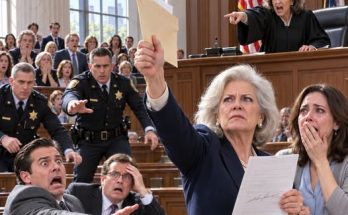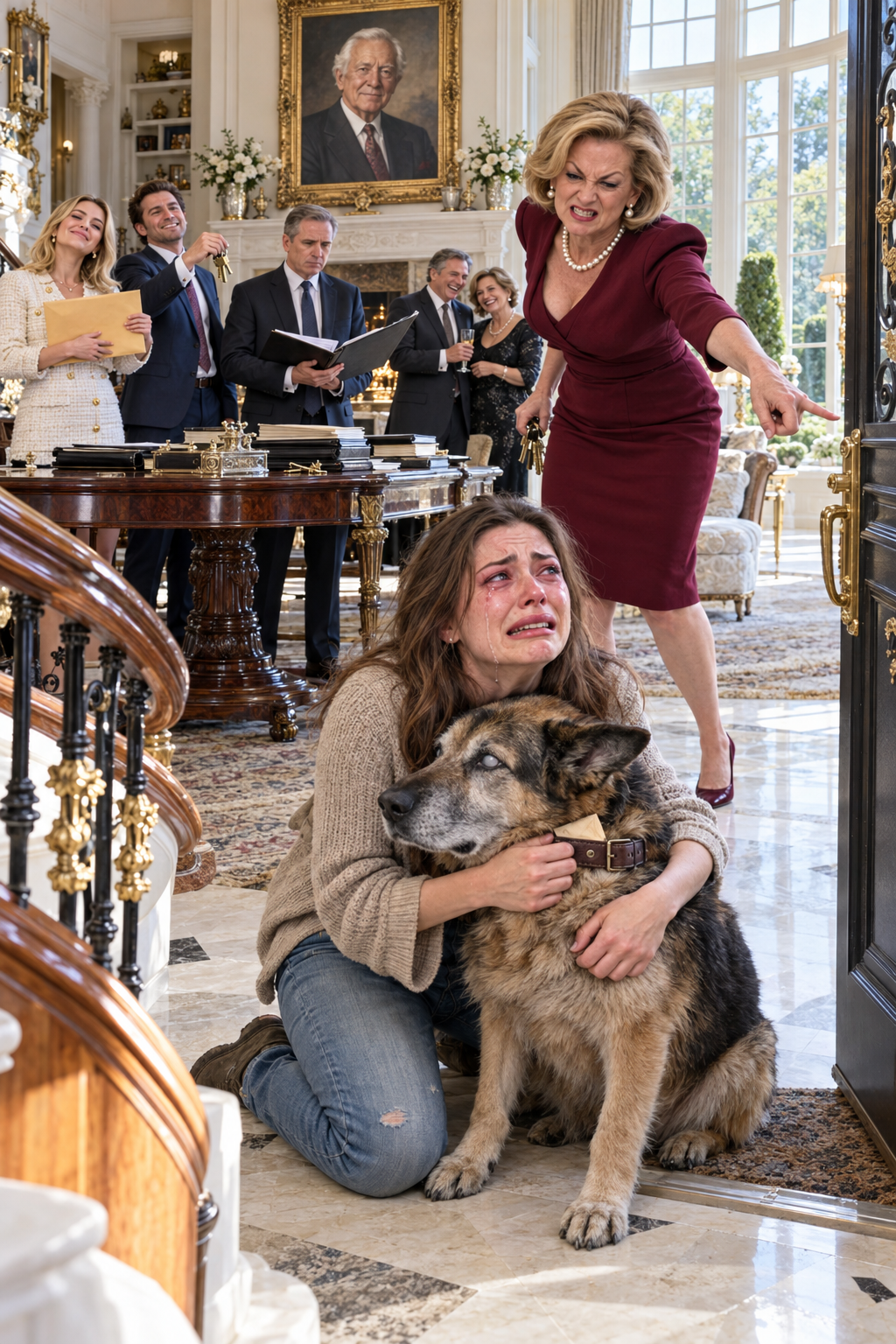
Grandpa Died. At His Will Reading, My Family Took His House And Money, Leaving Me His Old Blind German Shepherd. Aunt Sneered, “A Mutt Suits A Caregiver!” And Kicked Us Out. That Night, I Found A Note In His Collar: “Ellie, This Was A Test…”
Nine days after we buried my grandfather, my aunt dragged my suitcase into the rain while my uncle announced that his new house was no place for an old, blind German Shepherd. I had spent three years caring for Grandpa, and all he had supposedly left me was the dog nobody wanted. I took Scout and walked away without arguing. Near midnight, as I dried his cracked leather collar inside my car, my thumb caught on fresh stitching, and I discovered something my grandfather had hidden there.
Part 1
The first thing I noticed at my grandfather’s will reading was that nobody had bothered to move his coffee mug.
It sat at the far end of the kitchen table, beside the wooden chair where he had eaten breakfast every morning for nearly fifty years. A faint brown ring stained the bottom, and his reading glasses rested beside it, one arm held together with a tiny piece of electrical tape. I had washed that mug on the morning he died, then put it back in its usual place because I couldn’t bear to see the table without it.
My uncle Grant sat in Grandpa’s chair now, tapping the screen of his phone with one hand while adjusting the cuffs of an expensive navy blazer with the other. My aunt Cynthia occupied the seat beside him, wearing a cream-colored sweater and a diamond bracelet I had never seen before. Her son, Trevor, leaned against the kitchen counter, chewing gum and studying pictures of pickup trucks on his phone.
Nobody looked particularly heartbroken.
I sat closest to the back door, wearing the same black cardigan I had worn to the funeral nine days earlier. Scout, Grandpa’s thirteen-year-old German Shepherd, lay across my feet with his gray muzzle resting against my shoe. His eyes had turned cloudy over the previous year, and although he could still distinguish shadows when the light was bright, the veterinarian had warned us that his remaining vision wouldn’t last much longer.
Since Grandpa’s death, Scout had barely eaten. Every time somebody opened the front door, his ears lifted hopefully, only to droop again when the familiar footsteps never came.
Margaret Bell, the estate attorney, placed a leather folder on the table. She was a composed woman in her early sixties who had handled Grandpa’s paperwork for more than twenty years, and I noticed that she avoided looking directly at me as she arranged her documents.
“Thank you for coming,” she said. “I know this is difficult for everyone.”
“Of course,” Cynthia replied, although she had spent the previous ten minutes explaining how much the property might bring if they listed it before Thanksgiving.
Margaret adjusted her glasses and began reading Grandpa’s will.
His name was Jonah Bennett. He had lived in Pine Hollow, Pennsylvania, almost his entire life, spending forty-six years making saddles, leather harnesses, and custom riding equipment in the workshop behind his house. He had survived his wife, two strokes, and the loss of his youngest son, who happened to be my father.
Then Margaret reached the paragraph everybody had been waiting for.
“I leave my residential property, including the dwelling and associated land at 18 Willow Creek Road, to my son, Grant Bennett.”
Grant finally put down his phone.
Cynthia shifted forward so quickly that her bracelet struck the edge of the table.
“To my daughter, Cynthia Bennett Doyle, and my grandson, Trevor Doyle, I leave the funds remaining in my personal bank accounts, to be divided equally.”
Trevor grinned. Cynthia released a long breath, almost a sigh of relief, while Grant began asking about transferring the property’s utilities into his name.
Margaret raised one hand.
“There is one additional bequest.”
Everybody turned toward her.
“To my granddaughter, Mara Bennett, I leave my German Shepherd, Scout, together with his collar, leash, and personal belongings.”
For a moment, nobody spoke.
Then Cynthia laughed.
It began as a sharp little sound, but she couldn’t seem to stop. She covered her mouth, looked at Trevor, and laughed harder until tears gathered in the corners of her eyes.
“Oh, Dad,” she managed. “You really did have a sense of humor.”
Trevor barked out a laugh. “Three years playing nurse, and she gets the dog.”
Grant stared at his hands, but the corners of his mouth had lifted.
I kept my hand on Scout’s shoulder, feeling the slow rise and fall of his breathing.
“That’s enough,” I said.
Cynthia turned toward me, her laughter fading into something sharper. “Don’t be so sensitive, Mara. Dad obviously knew how much you loved that animal.”
“Then there’s nothing funny about it.”
“Oh, for heaven’s sake. You’ve been living here rent-free for three years, eating his groceries and using his electricity. You should be grateful he let you stay.”
I looked at the woman who had visited her father four times during the previous year. Two of those visits had lasted less than an hour, and one had ended when she became angry because Grandpa couldn’t remember where her mother’s jewelry had been stored.
“I took care of him,” I said.
“And we’re grateful,” Grant interrupted, sounding impatient rather than sincere. “But we need to be realistic about the property.”
Cynthia pointed toward Scout.
“That dog isn’t staying. He smells, he’s practically blind, and he probably won’t live another year.”
Scout lifted his head at the sound of her voice.
Trevor glanced at him and shrugged. “Just take him to a shelter. They’ll know what to do.”
“He isn’t going to a shelter.”
“Then that’s your problem.”
Margaret closed her folder. “I suggest everybody take some time before making decisions about the house. The estate administration hasn’t been completed.”
Grant barely acknowledged her.
Once she had left, Cynthia walked into the living room and started opening cupboards. Trevor began photographing Grandpa’s antique furniture, sending pictures to someone with the caption, “Finally getting paid.”
Grant followed me into the hallway while I gathered Scout’s medication and food.
“Mara, I’m going to need you to make arrangements.”
“What arrangements?”
“Somewhere else to live. The house needs repairs before we list it.”
I looked past him toward the living room, where Cynthia was already holding Grandma’s silver serving tray against the light.
“Grandpa hasn’t even been gone two weeks.”
“I know, but waiting won’t change anything.”
“You could give me a little time.”
Grant sighed. “Cynthia thinks you should leave today. I’m willing to give you until the weekend.”
Cynthia appeared behind him.
“Absolutely not. She’ll start claiming she has tenant rights, and then we’ll never get her out.”
“I’ve lived here for three years,” I said quietly.
“Exactly. Long enough.”
She opened the coat closet and threw my rain jacket toward me.
“Pack what you need. We’ll sort out the rest later.”
I could have argued. There were legal questions about forcing somebody out of a home where they had lived for years, and Margaret had specifically warned against rushing decisions. But I had just spent three years watching my grandfather struggle to breathe, speak, and walk, and I had no strength left for another fight that afternoon.
I packed one duffel bag, Scout’s veterinary records, his food bowl, and a photograph of Grandpa teaching me to fish when I was eight.
When I reached for his old green flannel jacket, Cynthia snatched it away.
“That belongs to the estate.”
“It’s just a jacket.”
“Then you won’t miss it.”
She shoved it back into the closet.
By six o’clock, Scout and I were standing outside beneath a cold October rain. Behind the living room curtains, I could see Grant opening a bottle of bourbon while Cynthia examined Grandpa’s collection of crystal glasses.
They were celebrating before the ground above his coffin had even settled.
My first stop was the boardinghouse where I had rented a room before moving in with Grandpa. The owner, Mrs. Whitcomb, opened her door, saw Scout, and shook her head.
“I’m sorry, honey. I can’t have a big dog here, especially one that old.”
I called two friends, a former coworker, and a motel. Nobody could accommodate both of us that night.
At eleven thirty, I parked behind a twenty-four-hour gas station, bought a bottle of water and a small bag of dog food, and climbed into my aging Subaru.
Scout refused the food.
I sat with him in the back seat, rubbing his ears while the rain drummed against the roof. His old leather collar had soaked through, and I could see a red mark where the wet leather rubbed against his neck.
“Come here, sweetheart,” I whispered. “Let’s get this off.”
I unbuckled the collar and placed it beneath the dashboard heater.
That was when I noticed the stitching.
Grandpa had made the collar himself nearly ten years earlier. I knew every scratch in its surface, every brass rivet, and the small crack near the buckle. But along its inner lining ran a row of fresh, pale thread, sewn in the precise saddle stitch Grandpa had taught me to recognize when I was a child.
My stomach tightened.
I found a pair of tiny scissors in the glove compartment and carefully cut through the stitches.
Between two layers of leather lay a narrow packet wrapped in clear plastic.
Inside was a folded piece of notebook paper.
I recognized Grandpa’s shaky left-handed handwriting before I even opened it.
The first sentence made me stop breathing.
“Mara, if you’re reading this, it means they gave you Scout, and you refused to abandon him. This was a test.”
Part 2
I read those words six times before I could bring myself to unfold the rest of the letter.
Scout had climbed halfway into the front seat, his front paws braced against the center console. He nudged my elbow with his nose, searching for the hand that usually scratched the soft place behind his ears. Outside, a delivery truck rolled past the gas station, its headlights washing across Grandpa’s handwriting.
I turned on the dome light.
“My sweet girl,” the letter continued, “I owe you an explanation, and maybe an apology. I have been watching this family for a long time. Three years in that chair gave me plenty of time to see what people wanted from me, and what they were willing to give.”
My throat tightened.
Three years earlier, Grandpa had suffered a stroke while feeding Scout behind the workshop. Scout barked until our neighbor, Walter Haines, came running from across the road and found Grandpa lying beside the garden fence.
The doctors warned us that Grandpa might never walk independently again. His right hand barely moved, his speech was badly affected, and he needed somebody nearby throughout the day.
Grant said his construction business couldn’t survive without him.
Cynthia said her anxiety made her incapable of handling medical emergencies.
Trevor, who was twenty-seven at the time, simply stopped answering his grandfather’s calls.
I was twenty-six, working at an independent bookstore in Harrisburg and engaged to a man named Adam. We had plans to move to Chicago after the wedding, and I had already started looking at publishing jobs there.
I told myself I would help Grandpa for a few months.
Then a few months became a year.
Adam lasted eight weeks before telling me he wasn’t prepared to spend his future waiting for somebody else’s life to end.
I cried when he left. Grandpa found me sitting on the kitchen floor afterward and struggled for nearly two minutes to say, “Don’t stay because of me.”
But staying had never felt like a punishment.
After my father died in a highway accident when I was eleven, Grandpa was the person who attended my school concerts and taught me to drive. He packed lunches when my mother moved away with her second husband, and he waited outside the emergency room when I broke my wrist falling off a horse.
When I had nowhere else to belong, he made room for me.
Now it was my turn.
I learned how to help him dress, how to read his expressions when words wouldn’t come, and how to encourage him without making him feel helpless. We celebrated the first morning he managed to butter his own toast. We celebrated again when he walked from the kitchen to the mailbox with only his cane.
Scout remained beside him through everything.
If Grandpa lost his balance, Scout pressed his shoulder against his leg. If Grandpa slept too long in his chair, Scout rested his muzzle on his knee until he woke. On difficult nights, when Grandpa became frustrated with his own body, Scout lay at his feet while I read aloud from the newspaper.
The rest of the family appeared whenever money or possessions entered the conversation.
Grant wanted to know whether Grandpa had updated his will.
Cynthia asked about the silver, the china cabinet, and Grandma’s jewelry.
Trevor once spent an entire visit measuring the driveway because he thought the property would be worth more with a three-car garage.
Grandpa heard all of it.
He couldn’t always respond, but his mind remained sharp, and his memory for dates and numbers was better than mine.
I looked down at the letter again.
“I knew what they were waiting for,” Grandpa had written. “What I didn’t know was whether any of them would choose kindness when kindness stopped being convenient. Scout was the only thing I could leave in plain sight that had no price tag attached.”
A tear landed on the paper.
“Now, listen carefully. The will Margaret read is real, but it cannot give Grant something I no longer owned. On March fourteenth, Walter took me to the county courthouse. I signed and recorded a deed transferring the house and land to you. It was a gift, made while I was alive and capable of making my own decisions.”
I stared at the sentence.
The house.
The house where I had grown up spending summers. The house Grandpa had built with Grandma before their first child was born. The house Grant was planning to sell.
Mine?
I read further.
“I kept this from you because I knew you would argue that my children deserved another chance. I also knew they would pressure you the moment they learned about it. Margaret has the old will, but the recorded deed controls ownership. The original papers are in the workshop storage cabinet, inside a box labeled dog biscuits. Walter knows where.”
The letter continued in crooked lines.
“The bank money is gone, too. Nobody stole it. I decided where it belonged while I was still alive. Walter can show you. Don’t mistake that decision for a hidden fortune. I wanted what I had earned to do some good.”
At the bottom, the handwriting became even shakier.
“I’m sorry I let you sit through that reading without knowing the truth. Maybe I was stubborn. Maybe I wanted to see whether my children would finally surprise me. But I never doubted you. Take care of Scout, and remember that a home belongs to the people who take care of it. Love, Grandpa.”
For a long time, I listened to the heater clicking beneath the dashboard.
I should have been happy.
Instead, I felt a confusing mixture of relief, anger, and grief.
Grandpa had known how Cynthia spoke to me. He had known Grant cared more about the value of the land than the memories inside the house. Why had he let me believe I was leaving with nothing but an old dog?
I looked at Scout, who was finally eating a few pieces of kibble from my palm.
“You didn’t know about any of this, did you?”
His tail brushed against the seat.
I remembered the day in March.
Grandpa had asked me to drive him downtown for what he described as an appointment. Walter came along, and the two men disappeared for nearly an hour while I waited in the car with Scout.
When they returned, Grandpa looked unusually pleased with himself.
“What were you doing?” I had asked.
“Business,” he said with tremendous effort.
Walter laughed, and Grandpa smiled like a little boy who had gotten away with something.
I had assumed they were buying fishing equipment.
At four in the morning, I used the gas station’s wireless connection to search the county’s online property records. The website took several attempts to load, and I had to pay a small fee for an official document image.
When the file finally opened, I read the property description twice.
Grantor: Jonah Bennett.
Grantee: Mara Bennett.
Recorded: March 14.
The deed carried Grandpa’s signature and a notary’s certification. A second page listed the recording information and the parcel number for 18 Willow Creek Road.
I pressed my palm over my mouth.
The house was legally recorded in my name.
Grandpa hadn’t made an empty promise in a secret letter. He had completed the transfer months before his death.
At seven, I drove to Walter’s house.
He opened the door wearing slippers and an ancient Army sweatshirt. Scout recognized his voice immediately and pushed past me into the kitchen.
Walter looked at my swollen eyes, the duffel bag in the back seat, and the plastic-wrapped note in my hand.
“They threw you out,” he said.
It wasn’t a question.
I nodded.
He stepped aside.
“Come in, sweetheart. I’ve got coffee, and there are things your grandfather wanted you to see.”
Part 3
Walter Haines had lived next door to my grandfather for forty-three years, which meant he knew more about our family than most of our relatives did.
He was seventy-nine, broad-shouldered despite his age, with a thick white mustache and hands permanently roughened by decades of working as a mechanic. His wife had died four years earlier, and since then he had maintained a stubborn routine of feeding birds, repairing lawn equipment, and arguing with the morning news.
He set a plate of toast in front of me while Scout stretched out beside the radiator.
“Jonah figured Cynthia would make a scene,” Walter said. “He didn’t think Grant would turn you out that same afternoon.”
“Why didn’t anybody tell me?”
“Your grandfather made me promise to keep quiet until he was gone. I wasn’t happy about it.”
“He could have told me himself.”
Walter nodded slowly. “He should have. Being sick didn’t stop that man from being stubborn.”
It was the first thing anybody had said since the funeral that acknowledged Grandpa hadn’t handled everything perfectly.
I showed Walter the deed on my phone.
He took his time examining it, then retrieved a manila envelope from a kitchen drawer. Inside were copies of Grandpa’s identification, a receipt from the recorder’s office, and a letter from a physician confirming that Grandpa understood his financial and legal decisions despite his physical disabilities.
“He wanted a record nobody could easily question,” Walter explained. “Your aunt has been calling him confused for years whenever he told her something she didn’t want to hear.”
I remembered Cynthia telling visitors that Grandpa could hardly understand a conversation. She usually said it while standing in front of him, as though losing the ability to speak clearly had also taken away his ability to hear.
Walter pointed toward the backyard.
“There’s something else. Jonah left the original papers in his storage cabinet, but the workshop isn’t safe anymore.”
I looked up.
“What do you mean?”
“Your cousin rented a dumpster yesterday. They’re clearing everything out before putting the place on the market.”
My toast turned to cardboard in my mouth.
“His tools?”
Walter’s expression darkened.
“Everything.”
I hurried to the kitchen window.
Through the narrow gap between Walter’s garage and the wooden fence, I could see Grandpa’s workshop. The doors stood open, and a large metal dumpster occupied most of the driveway.
Trevor and two hired workers were carrying boxes outside.
One of the workers emerged holding Grandpa’s old wooden tool chest.
I knew that chest.
He had built it from walnut and fitted every drawer by hand. Inside were leather punches, awls, burnishing tools, and knives that had been sharpened so many times their blades had grown narrow.
Trevor pointed toward the dumpster.
The worker dropped it over the side.
I stood so abruptly that the chair scraped against the floor.
“I’m going over there.”
Walter caught my sleeve.
“Not alone. You need the documents, and you need somebody who can keep Cynthia from turning this into a shouting match.”
“Those are his things.”
“I know.”
I watched another box tumble into the dumpster.
Grandpa’s entire working life seemed to be disappearing one armload at a time.
Walter picked up his phone and called Margaret Bell’s office.
She wasn’t available until the afternoon, but her assistant agreed to pass along an urgent message about the recorded deed. Walter then helped me request another certified copy from the county, because I wanted more than an image on my phone when I confronted the family.
By lunchtime, Trevor had posted an advertisement on social media.
“Family estate coming soon. Beautiful half-acre property. Serious buyers only.”
The asking price was $435,000.
He included pictures of the kitchen, the fireplace, and the apple trees Grandpa had planted along the back fence.
In one photograph, my childhood bicycle was still leaning against the shed.
I stared at the advertisement while Walter stood behind me.
“They’re selling my house.”
“Trying to,” he corrected.
His phone rang before I could answer.
It was Mrs. Larsen, a neighbor who had watched Trevor directing the workers all morning. She said Grant planned to have the dumpster collected early the following day.
The original documents were still inside that workshop somewhere.
I decided to retrieve them that evening, preferably with the family’s knowledge. But when I called Grant and asked to collect Grandpa’s remaining belongings, he refused.
“Cynthia says you’ve taken enough,” he told me.
“I need to get into the workshop.”
“That’s not your decision anymore.”
“It might be more my decision than you realize.”
He became quiet.
“What does that mean?”
“It means you shouldn’t be selling anything yet.”
He laughed once.
“Mara, grieving doesn’t make you an owner. Find somewhere to stay and stop causing trouble.”
He ended the call.
By dusk, the workers had left and the house lights were on. Walter and I walked to the front gate, where we could hear Cynthia and Trevor arguing about whether to replace the kitchen cabinets.
Walter rang the bell.
Cynthia appeared holding one of Grandma’s crystal glasses.
“What do you want?”
“We need to retrieve something from Jonah’s workshop,” Walter said.
“Everything out there is being disposed of.”
“It belongs to the owner,” I said.
She rolled her eyes.
“And who’s that supposed to be?”
I almost answered, but Walter gently touched my elbow.
“Tomorrow you’ll hear from Margaret,” he told her. “Until then, I’d recommend you stop throwing things away.”
Cynthia slammed the door.
Walter and I returned home, but I couldn’t sleep knowing the dumpster would be collected in the morning. Around eleven, he called the waste company and learned that the collection had been delayed until noon.
We went back to the driveway, where the dumpster stood accessible beside the public road. Walter brought a flashlight, gloves, and a small stepladder, and I climbed inside to search through what my family had discarded.
The smell of damp cardboard and old motor oil rose around me.
I found Grandpa’s toolbox near the bottom, its lid cracked but its contents mostly intact. Beneath a broken chair lay his flannel jacket, the one Cynthia had refused to let me take.
I tucked it under my arm.
Then I spotted a cardboard box with a faded picture of a dog on the side.
The label read, “BISCUITS.”
Underneath several empty tins sat a sealed waterproof document pouch.
My hands shook as I lifted it.
Inside were the certified deed, the county receipt, Grandpa’s medical documentation, and a second envelope bearing a simple instruction.
“For the family. Open when everybody is present.”
I was still examining the handwriting when a flashlight beam swept across the dumpster.
“Hey! Who’s out there?”
Trevor stood near the gate.
I crouched automatically.
He approached, swinging the flashlight from side to side.
Then a low growl sounded behind him.
Scout had slipped through Walter’s open gate and followed our voices.
He stood between the driveway and the road, his gray fur rising along his shoulders.
Trevor stumbled backward.
“Get that crazy dog away from me!”
Scout didn’t move forward. He simply stood there, his old body trembling with effort.
Walter stepped between them and clipped on Scout’s leash.
“Nobody’s hurting you, Trevor. Go back inside.”
Trevor retreated toward the porch, muttering threats about calling animal control.
Walter helped me out of the dumpster.
As we carried the documents home, he glanced at the sealed envelope in my hands.
“Your grandfather was very particular about that one.”
“Do you know what it says?”
“No. But there’s something you ought to understand before you open it.”
I stopped walking.
Walter looked toward Grandpa’s house.
“Your uncle has been making plans for that property since before Jonah died, and I don’t think he intends to wait for probate.”
Part 4
By morning, I understood what Walter meant.
Grant had already contacted a real estate agent and arranged private showings for the weekend. He had also hired a contractor to remove Grandpa’s workshop and clear the backyard, claiming he wanted to make the property more attractive to buyers.
I learned all of this from a stack of estimates Walter had photographed when Grant carelessly left them on the porch.
One sheet described the work as “site preparation authorized by property owner.”
Under the printed words “Owner’s Signature” was Grant’s name.
He hadn’t inherited a house.
He was signing contracts as though it already belonged to him.
Margaret finally called me shortly after nine.
When I explained the recorded deed, she became unusually quiet. She asked me to email the document, then remained on the line while she reviewed it.
“Mara, this is a valid recorded conveyance on its face,” she said. “I need to examine the full file and confirm the circumstances, but your grandfather transferred the property before his death. A will cannot dispose of property he no longer owned.”
“Did you know he planned to do this?”
“Not the completed transfer. He asked me hypothetical questions about changing his estate plan, but he never instructed me to prepare that deed.”
She paused.
“I wish he had told you. And I am very sorry about what happened at the reading.”
I stared through Walter’s window toward the house.
“Can Grant sell it?”
“Not with clear title. A proper title search should uncover the problem long before a sale closes. But he can still make trouble if he takes money from someone under false pretenses.”
She advised me to preserve every document, avoid direct confrontation, and put Grant and the real estate agent on formal notice immediately. Her office could send notices regarding the deed, and she recommended that I consult an independent real estate attorney to represent my interests as the property owner.
I followed her advice.
By noon, a lawyer named Claire Donnelly had agreed to review the documents. She told me to photograph everything happening on the property and not to rely on Grandpa’s letter as a substitute for legal records.
“The deed is what matters,” she said. “Your grandfather’s words explain his intentions, but they don’t replace the law.”
For the first time since the funeral, I felt as though somebody had handed me solid ground beneath my feet.
Then the chainsaws started.
I ran to Walter’s back window.
Two workers were standing beside the apple trees, wearing hard hats and bright orange safety vests. A third was dragging branches toward a trailer.
One of Grandpa’s trees already lay across the lawn.
It was the tree he had planted when I was born.
Every September, he used to put the ripest apples from that tree into a brown paper bag and leave them on the kitchen counter with my name written across the top.
I grabbed my coat and hurried outside.
Walter followed me across the yard.
By the time we reached the gate, the second tree was coming down.
“Stop!” I shouted.
The chainsaw operator lifted the blade and turned toward me.
Grant emerged from the porch, irritated.
“Mara, what are you doing here?”
“Those trees belong to me. You need to stop.”
Cynthia appeared behind him.
“Oh, she’s starting that again.”
I ignored her and showed the contractor the property record on my phone.
“My name is Mara Bennett. This parcel was transferred to me in March. I’m the recorded owner, and I haven’t authorized this work.”
The foreman examined the screen, then looked toward Grant.
“Sir, you told us you owned the place.”
“I inherited it.”
“That isn’t what the record says,” I replied.
The man took off his hard hat.
“We’re stopping until this is sorted out.”
Grant’s face darkened.
“You can’t just believe everything she shows you.”
“I’m not taking that chance,” the foreman said.
The workers shut off their equipment.
I looked at the fallen tree.
Its broken branches spread across the grass, dozens of green and red apples scattered among the leaves. The stump was pale and wet where the blade had passed through it.
I had come to stop more damage, and I had succeeded.
That didn’t make the tree stand up again.
Grant stepped closer.
“You had better explain yourself.”
“My attorney will.”
I walked away before he could answer.
Back at Walter’s house, I sat at the kitchen table with dirt on my shoes and sawdust stuck to my sleeve.
Walter placed a cup of coffee beside me.
“You saved the rest of them.”
“Grandpa planted those trees himself.”
“I know.”
“I should have come sooner.”
“You came as soon as you understood what was happening.”
He waited until I stopped staring at the cup.
“There’s something else Jonah wanted you to see.”
Walter fetched his truck keys and Scout’s leash.
We drove nearly forty minutes out of Pine Hollow, following a narrow road through farmland and wooded hills. Scout sat in the back seat, occasionally lifting his nose toward the cracked window.
When we turned onto a gravel driveway, he became restless.
His tail began thumping against the seat.
Ahead stood a long white building surrounded by fenced exercise yards and several rows of heated kennels. A wooden sign above the entrance read, “Second Chance Senior Animal Sanctuary.”
A woman in rubber boots stepped outside.
The moment she saw Scout, her face brightened.
“Well, hello, handsome!”
Scout pulled toward her voice.
She knelt and wrapped both arms around his neck.
“Where’s Jonah?” she asked, looking past us toward the truck.
Walter removed his cap.
The woman’s expression changed.
“Oh,” she whispered. “I didn’t know.”
Her name was June Alvarez, and she had managed the sanctuary for eleven years. She led us through a clean, warm building where elderly dogs slept on thick mats and smaller animals wandered freely between the kennels.
A three-legged terrier limped toward my shoes.
An old beagle lifted his head from a blanket.
At the far end stood a row of newly constructed kennels with insulated walls and heated floors.
June stopped beside a brass plaque.
“In gratitude to Jonah Bennett, who believed no animal should be abandoned because it had grown old.”
I read the inscription twice.
June stood beside me.
“Your grandfather donated eighty-six thousand dollars last spring. It paid for this building, the heating system, and medical equipment we couldn’t afford.”
I couldn’t speak.
That amount represented nearly everything Grandpa had saved from a lifetime of leatherwork.
“He told me he had family who expected an inheritance,” June continued. “But he said he’d spent enough years watching people decide what was valuable.”
I looked through the kennel window at a white-faced Labrador sleeping beneath a blanket.
“Did he tell you about me?”
June smiled sadly.
“He told me you were taking care of him. He was proud of you, Mara. More than you know.”
Then she reached into her desk and handed me a photograph.
Grandpa stood beside the new kennel building, leaning on his cane, with Scout pressed against his leg. He was smiling broadly, wearing the green flannel jacket I had just rescued from the dumpster.
On the back, in his difficult handwriting, were five words.
“For Mara, when she understands.”
Part 5
I kept the photograph beside my bed that night, although calling Walter’s spare room a bedroom felt generous.
It had once been his wife’s sewing room. There was a narrow bed, a dresser, and a window overlooking Grandpa’s property, where the remains of the apple tree still lay in the wet grass.
Scout slept on a folded quilt beside me.
For the first time since the funeral, he finished an entire bowl of food.
I thought that knowing the truth about the house would make everything easier. Instead, it made the smallest things more complicated.
I wanted to return home, but Grant and Cynthia were still there.
I wanted to protect Grandpa’s belongings, but half his workshop had already been emptied.
And I wanted to be angry at Grandpa for keeping me uninformed, but every time I looked at his handwriting, I missed him so badly that anger seemed impossible to hold.
The following morning, two county animal control officers arrived at Walter’s gate.
One carried a clipboard. The other held a leash and an animal handling pole.
“Are you Mara Bennett?”
“Yes.”
“We received a complaint about an aggressive German Shepherd running loose and threatening a resident.”
I knew immediately who had called.
Scout stood beside me, leaning against my knee.
“He’s old, nearly blind, and he hasn’t bitten anybody,” I said.
The officers asked to see his vaccination records and registration. I had brought them from Grandpa’s house, and I handed over the folder without argument.
The senior officer examined the paperwork.
“Everything appears current. We’ll document the complaint and what we’ve observed.”
She crouched a few feet from Scout.
“May I?”
I nodded.
She let Scout sniff her hand before gently scratching his chest.
“He’s a sweet old fellow.”
From behind the fence, Cynthia’s voice rose.
“That’s not what my son says.”
The officer turned.
“Ma’am, if you have evidence of an attack, you’re welcome to provide it. But we won’t remove a properly cared-for dog based solely on an allegation.”
Cynthia disappeared into the house.
After the officers left, Walter laughed so hard that he had to sit down on his porch steps.
I couldn’t laugh.
The complaint had made something painfully clear: my relatives were prepared to use any weakness they could find, even an elderly dog, to frighten me into leaving.
That afternoon, Trevor found me at the general store.
I was buying milk, bread, and a package of chicken treats for Scout when he approached with two friends behind him.
“Well, look who it is.”
I kept placing groceries on the counter.
“Hello, Trevor.”
He leaned against the display of candy bars.
“Mom says you’re telling everybody Grandpa gave you the house.”
“I’m not discussing that here.”
“Good, because it’s ridiculous. You think you can show some fake paperwork and steal four hundred grand?”
The cashier, Mrs. Larsen, looked up sharply.
“Trevor, that’s enough.”
He ignored her.
“Grandpa wasn’t right in the head. Everybody knows it.”
My hands went cold.
“You didn’t visit him enough to know anything about his mind.”
His face changed.
For a second, I thought he might grab my arm.
Instead, he stepped close enough that I could smell stale beer on his breath.
“Mom’s talking to a lawyer. If that deed isn’t real, you’re going to have a serious problem.”
I paid for my groceries.
“Then she should let her lawyer handle it.”
Outside, I found Scout lying quietly near Walter’s truck, where I had secured his leash in the shade.
Trevor followed me.
“One more thing,” he said. “Stay away from the house Saturday. We’ve got buyers coming, and nobody wants your drama.”
I turned toward him.
“Buyers?”
He smiled.
“Real buyers. Not somebody pretending she owns something.”
I returned to Walter’s house and called Claire.
She had already confirmed the ownership record and sent formal notices to Grant, Cynthia, and the listing agent. But the agent hadn’t yet responded.
When I mentioned Saturday, Claire asked me to forward everything I knew.
An hour later, she called back.
“Mara, we have a problem.”
Grant had accepted a twelve-thousand-dollar deposit from a young couple named Hannah and Daniel Price.
He had taken the money directly, outside an escrow account, signing a handwritten receipt that described it as a refundable good-faith deposit toward the purchase of the house.
Their real estate attorney was scheduled to attend a meeting at the property Saturday morning.
I felt sick.
“They have no idea?”
“Apparently not. The agent says Grant represented himself as the inheriting owner and told them probate was a formality.”
“But he got our notice.”
“He did. His attorney has now been informed, too.”
I pictured a young couple handing over their savings because they believed they were buying a home.
“Can we reach them?”
“I’m working on that. Meanwhile, don’t confront Grant alone. If he knows the transfer is valid and continues representing the property as his own, the consequences may be serious.”
That evening, my phone rang from an unfamiliar number.
A woman’s voice answered when I picked up.
“My name is Hannah Price. Your attorney gave our attorney permission to share your number. I hope this is okay.”
“Of course.”
She hesitated.
“I’m thirty-one weeks pregnant, and my husband and I have been trying to buy our first house for almost two years. Mr. Bennett told us the place belonged to his father and was being passed down to him.”
I closed my eyes.
“I’m sorry.”
“He says you’re a disgruntled relative who is trying to interfere with the sale.”
“He’s wrong.”
“Do you have proof?”
“Yes.”
Hannah was quiet for several seconds.
“Then I think you need to come Saturday.”
I looked toward Grandpa’s house, where lights glowed behind the curtains.
“I will.”
After we ended the call, Walter stood in the doorway holding an old photograph of himself and Grandpa.
“Saturday, then?”
I nodded.
He glanced at the sealed envelope on my dresser.
“Jonah asked for everybody to hear his final letter. Looks like he’ll get his wish.”
I picked up the envelope and turned it over in my hands.
For the first time, I wondered whether Grandpa’s message was meant to reveal who deserved his property, or whether he had wanted his family to hear a truth he had never been able to say aloud.
Part 6
Saturday arrived clear and cold, with frost silvering the grass and a thin layer of mist hanging above the creek.
I woke before sunrise and walked Scout around Walter’s backyard. He moved slowly, following the familiar route along the fence, occasionally stopping to sniff the damp leaves.
Across the road, Grandpa’s house stood exactly where it always had.
The same porch.
The same stone chimney.
The same kitchen window where I had watched him make pancakes every Sunday when I was little.
But the backyard looked wounded.
The fallen apple tree had been cut into logs, and the workshop doors stood open, exposing shelves that had once been crowded with leather and tools.
I knelt beside Scout.
“I don’t know what happens today, buddy.”
He pressed his head against my shoulder.
At ten fifteen, Claire arrived carrying a document case. Margaret Bell came a few minutes later, followed by Walter, who insisted on wearing his best jacket despite my suggestion that we weren’t attending a ceremony.
“Your grandfather would expect me to look respectable,” he said.
We walked across the road together.
Two cars were parked in the driveway when we arrived. Hannah and Daniel stood beside a silver sedan, speaking quietly with their attorney.
Hannah wore a thick blue coat stretched over her pregnant belly.
Grant stood on the porch holding a folder.
Cynthia was beside him, her hair freshly styled and her mouth painted a deep red.
Trevor leaned against a black pickup truck he had borrowed from a friend.
He spotted me first.
“Oh, this should be good.”
Cynthia looked down from the porch.
“Mara, I told you not to come here.”
I didn’t answer her.
Instead, I approached Hannah and Daniel.
“I’m sorry you got dragged into this,” I said.
Hannah took a breath.
“We just want to know what belongs to whom.”
“That’s exactly what we’re here to establish,” Claire replied.
Grant came down the steps.
“What’s going on?”
Claire introduced herself and handed him a copy of the recorded deed.
“Mr. Bennett, my client is the recorded owner of this property. You were notified in writing. You have no authority to offer it for sale.”
Grant barely glanced at the pages.
“My father left it to me.”
“The will contains that clause,” Margaret said. “But your father transferred the property before his death. It was not part of his estate when he died.”
Cynthia laughed sharply.
“That’s absurd. He could barely hold a spoon.”
Walter stepped forward.
“He held the pen just fine when he signed that deed. I was there.”
“You would say anything for her!”
“I’d tell the truth for Jonah. That’s what he asked of me.”
Daniel’s attorney opened his laptop and checked the county record independently. He verified the parcel number, the filing date, and the recorded owner.
Then he looked toward Grant.
“You accepted twelve thousand dollars from my clients while representing yourself as authorized to sell this property.”
Grant flushed.
“I expected to inherit it. There was no intention to mislead anybody.”
“But your attorney received notice before today’s meeting,” Claire said.
Cynthia pointed at me.
“She manipulated him. Everybody knows she lived here and controlled everything he did.”
I felt the old instinct to apologize, to explain myself, to make the room peaceful even when I wasn’t responsible for the conflict.
Instead, I stood still.
“My grandfather had a stroke,” I said. “He didn’t lose his right to make decisions. He knew what he was signing, and he had independent witnesses.”
Margaret opened another folder.
“The medical documentation supports his ability to make this decision. If you wish to contest the deed, you can pursue the appropriate legal process. Until then, the recorded transfer cannot simply be ignored.”
Hannah began crying quietly.
Daniel put his arm around her.
“We need our money back,” he told Grant.
Grant looked toward Cynthia, then Trevor.
The silence between them was revealing.
“Some of it has already been used,” he admitted.
Daniel stared at him.
“Used for what?”
“Expenses. Preparation for the sale.”
Their attorney closed his laptop.
“Then we’ll be discussing restitution immediately.”
Claire had arranged for a local deputy to be available for a civil standby because of Trevor’s earlier threats and the family’s escalating hostility. Deputy Elena Brooks arrived shortly afterward, listened to the attorneys, and made it clear that any allegations of fraud would need to be properly investigated.
She didn’t arrest anybody.
She didn’t have to.
Watching Grant struggle to explain where the deposit had gone was more devastating than any dramatic confrontation I could have imagined.
Cynthia turned on her brother.
“You told me everything was settled!”
“I thought it was!”
“You told me Dad had left us plenty!”
“The bank accounts are almost empty, Cynthia! I found that out yesterday!”
Trevor straightened.
“What do you mean, empty?”
Grant rubbed his forehead.
“There’s less than fifty dollars.”
Trevor looked at his mother.
“But you said Grandpa had almost ninety thousand.”
“He did!”
“Not when he died,” I said.
Every face turned toward me.
I reached into my coat and removed the envelope Grandpa had left in the workshop.
“He wanted all of you to hear this together.”
Cynthia folded her arms.
“Another one of your tricks?”
“No. His handwriting. His words.”
I opened the envelope.
Inside were two folded sheets and a smaller envelope marked with Trevor’s name.
My voice trembled as I began reading.
“Grant, Cynthia, and Trevor. If Mara is reading this, then she has learned what I chose to do with my property. I hope she has also learned something I should have taught her sooner: she does not owe anybody the rest of her life simply because they share her last name.”
Nobody interrupted.
“For three years, I listened to my children speak about my house while my granddaughter helped me learn to speak again. Grant talked about land values. Cynthia talked about jewelry. Trevor talked about what he would buy when I was gone.”
I swallowed.
“Every one of you knew Scout was getting old. Not one of you asked what would happen to him after I died. You knew Mara was tired. None of you asked whether she needed help.”
Cynthia looked away.
“Perhaps I failed you as a father. Perhaps I taught you that money matters more than the people who earn it. I cannot change that now. But I can decide what happens to the things I still control.”
I turned the page.
“The house was mine to give, and I gave it to Mara while I was alive. My savings were mine to spend, and I used them to build warm kennels for old dogs nobody else wanted. I don’t expect everyone to understand that choice. I only ask that you stop pretending you were robbed of something you had already decided belonged to you.”
Walter removed his glasses.
I reached the final paragraph.
“I am not asking Mara to punish you. Your own decisions will carry their own consequences. I am asking you to leave her alone and allow her to live the life she put aside while caring for me.”
The porch was silent.
I folded the pages.
Then I handed Trevor the smaller envelope.
He opened it quickly, perhaps expecting money.
Inside was a single photograph.
It showed Grandpa in his wheelchair, smiling as Scout rested his head in his lap.
On the back, Grandpa had written, “You can tell a great deal about a person by how they treat someone who has nothing left to give them.”
Trevor stared at it.
Then he crumpled the photograph in his fist.
“This is unbelievable.”
I looked at him.
“That’s how I felt when you suggested putting Scout down because he was inconvenient.”
He opened his mouth but said nothing.
Cynthia began crying.
Not the quiet, exhausted crying I had done in the car after the funeral. She was angry, and her tears came with accusations about unfairness, manipulation, and how much she had supposedly sacrificed as a daughter.
Grant stared at the ground.
For a moment, I wondered whether he might apologize.
Instead, he said, “Dad should have told us.”
I nodded.
“Yes. He should have.”
Then I looked him in the eye.
“And you should have asked what he needed while he was still here.”
Part 7
The confrontation ended without anyone throwing a punch or being dragged away in handcuffs.
For that, I was grateful.
Real life rarely arranges itself into a single satisfying moment where every wrong is corrected and every guilty person admits the truth. Grant still believed he had been treated unfairly, Cynthia still insisted Grandpa had been manipulated, and Trevor continued telling anybody who would listen that I had somehow stolen his future.
But the deed was recorded, the title was clear, and the house was mine.
Claire gave Grant formal written notice that he had no right to occupy or control the property. Because he and Cynthia had been staying there only to prepare the anticipated sale, and because neither wanted the expense of a prolonged legal dispute, they agreed through their attorneys to leave voluntarily within several days.
I stayed at Walter’s house until they were gone.
I wasn’t willing to walk into another confrontation just to prove I could.
Hannah and Daniel’s deposit was the first major consequence Grant had to face.
He had spent part of the money on cleanup work, advertising expenses, and personal bills he expected to repay after the sale. When the transaction collapsed, he couldn’t immediately refund it.
Their attorney demanded repayment and warned that they would consider civil action and a criminal complaint if the circumstances justified it.
Grant eventually sold a work truck and arranged to pay back the full amount.
It took several months.
Hannah told me later that getting the money back had been exhausting, but she and Daniel eventually purchased a smaller home across town.
Their baby arrived in March.
She sent me a photograph of a pink-cheeked little girl sleeping in a yellow blanket, along with a note thanking me for preventing them from going further into a sale that could never have closed.
I kept the photograph on my refrigerator.
The next complication came from Cynthia.
She hired an attorney and challenged the deed, alleging that Grandpa had lacked the mental capacity to transfer the property and that I had exercised undue influence over him.
I expected the accusation, but seeing it written in legal documents still hurt.
For three years, I had helped Grandpa make appointments, prepare meals, and manage the ordinary difficulties of living with a disability. Cynthia wanted those same acts of care presented as evidence that I had controlled him.
The case required records, testimony, and more patience than I thought I possessed.
Walter described accompanying Grandpa to the courthouse. The notary confirmed witnessing his signature and assessing his willingness to complete the transaction. His physician’s records showed that he understood who his family members were, what he owned, and what the transfer meant.
Margaret explained the difference between impaired speech and impaired judgment.
I testified about the mornings Grandpa solved crossword puzzles, discussed property taxes, and corrected Trevor’s arithmetic when he overestimated the acreage.
Cynthia’s claim eventually failed.
The judge found insufficient evidence to invalidate the transfer.
I should have felt triumphant when Claire called with the decision.
Instead, I stood in Grandpa’s kitchen, looking at the framed picture of him beside the fireplace, and wished he had lived long enough to tell his children himself.
The damage to the property became a separate legal matter.
The contractor had stopped work after I intervened, but the workshop had been partially dismantled, tools had disappeared, and two apple trees had been destroyed. Claire helped me document the damage and pursue compensation from the people responsible for authorizing it.
Grant and Cynthia argued about who had ordered which work.
The contractor produced a signed agreement bearing Grant’s name, while emails showed Cynthia had specifically requested the removal of the trees.
Eventually, we reached a settlement.
It didn’t restore the workshop or bring the trees back.
But it paid for replacement materials and part of the restoration, and I refused to let the family frame those costs as another gift I owed them.
Trevor’s troubles were less complicated.
He had financed an expensive pickup truck after hearing about the expected inheritance. When his mother’s share of Grandpa’s bank accounts turned out to be negligible, he struggled to keep up with the payments.
The lender repossessed it the following spring.
Mrs. Larsen told me he blamed Grandpa, the bank, and me, though apparently not the decision to borrow money he couldn’t afford to repay.
I didn’t celebrate.
I simply stopped answering his messages.
One afternoon, several months after the court case ended, Cynthia called from an unfamiliar number.
I almost let it ring.
Then I answered.
“Mara, it’s Aunt Cynthia.”
“I know.”
She hesitated.
“Your uncle and I aren’t speaking anymore.”
“I’m sorry to hear that.”
“He ruined everything.”
I leaned against the kitchen counter.
“Cynthia, I didn’t ask you to call.”
“I just thought you should know I’ve been having a very difficult time.”
There was a pause.
Then she said, “Your grandfather wouldn’t want us divided like this.”
I looked at Scout, asleep beneath the table.
“Grandpa spent three years asking you to visit,” I replied. “You didn’t have time for him then.”
“That’s not fair.”
“Neither was throwing me and Scout into the rain.”
“I was upset.”
“So was I.”
Her breathing became uneven.
“Are you really going to hold one bad day against your family forever?”
I thought about the years of remarks, the empty visits, the threats, the lies, and the way she had tried to turn my care for Grandpa into evidence of wrongdoing.
“It wasn’t one day,” I said.
She didn’t answer.
“I don’t hate you, Cynthia. But I don’t trust you, and I don’t want you in my life.”
I ended the call.
My hands were trembling.
Not because I regretted what I had said, but because it was the first time I had drawn a boundary without apologizing for it afterward.
That night, I sat beside the woodstove wearing Grandpa’s rescued flannel jacket.
Scout rested his head on my knee while I rubbed his ears.
When I slipped my hand into the jacket pocket, my fingers brushed against a folded scrap of paper.
My breath caught.
It was another note, much shorter than the first.
“Mara, burn birch in the stove when it gets really cold. Feed Scout at seven. He likes the blue blanket best.”
I smiled through sudden tears.
At the bottom was one final sentence.
“You gave me three good years when I thought I had none left. I hope you give yourself the rest of your life.”
Part 8
The first winter after Grandpa died was the quietest season I could remember.
Without medical appointments, therapy schedules, or relatives calling to complain, the days seemed strangely large. I woke at six anyway, made coffee, and found myself reaching for the notebook where I used to record Grandpa’s medications and exercises.
Sometimes I caught myself listening for his cane tapping against the hallway floor.
The sound never came.
Scout noticed the empty spaces, too.
He still waited outside Grandpa’s bedroom when the house grew quiet. At seven every evening, he stood beside his food bowl, but afterward he sometimes wandered into the living room and sniffed the old armchair before settling down.
The veterinarian said his remaining sight was almost gone.
His hips had become stiff, and he needed more rest than he once had. But he still loved slow walks, warm blankets, and the soft chicken treats I bought whenever I went into town.
I couldn’t give him more years.
I could make the years he had comfortable.
Walter came over nearly every afternoon.
Some days he helped me repair the house. Other days we sat on the porch drinking coffee and arguing about whether Grandpa’s old radio could be restored.
In February, we began rebuilding the workshop.
We started by sorting the tools I had rescued from the dumpster. Some were damaged beyond repair, but others cleaned up beautifully after a little oil and patience.
I found Grandpa’s leatherworking notebooks in a chest upstairs.
They contained measurements, sketches, customer names, and careful instructions written over decades. In the margins were tiny reminders in his handwriting.
“Don’t rush the stitching.”
“Good leather deserves good care.”
“Measure twice. Cut once.”
I remembered sitting on a stool beside him when I was nine, watching him make a saddle strap while the workshop smelled of warm leather, beeswax, and sawdust.
He had placed an awl in my hand and shown me how to punch evenly spaced holes.
“Anybody can cut a piece of leather,” he told me. “Making something that lasts is different.”
I had forgotten how much I loved working with my hands.
By early spring, Walter and I had rebuilt the workbench and repaired the roof.
I began making simple leather collars.
The first one was crooked, and the second had stitching so uneven that I took it apart and started over. The third was sturdy enough for Scout, although I kept Grandpa’s original collar hanging beside the workbench rather than letting its old leather deteriorate any further.
I posted photographs of my work online.
To my surprise, people began asking whether I could make collars for their dogs.
I started accepting a few orders.
Then a few more.
By summer, I had a small business making custom collars, leads, and leather tags. I named it Bennett Leatherworks, using the same initials Grandpa had stamped into every saddle he made.
For every collar I sold, I set aside money to make another one for Second Chance Senior Animal Sanctuary.
June cried when I delivered the first box.
“Your grandfather would have loved these.”
I looked at the elderly dogs sleeping in the warm kennels.
“He would have complained about the stitching.”
June laughed.
“Probably.”
I began volunteering there every Saturday.
I cleaned kennels, washed bedding, walked dogs that couldn’t manage long distances, and sat beside animals who were too frightened or too old to enjoy the noisy exercise yard.
One afternoon, June introduced me to a small, scruffy terrier mix with reddish fur and only three legs.
He had been found wandering near a highway, severely underweight and frightened of people.
Nobody knew his history.
He was around two years old, with one ear that stood upright and another that folded sideways.
When I sat on the floor beside his kennel, he approached carefully and placed one paw on my shoe.
I thought of Scout pressing himself against Grandpa’s leg all those years ago.
“What’s his name?”
“We’ve been calling him Rusty.”
I looked down at his hopeful face.
“Would you like to come home with me, Rusty?”
He wagged his tail.
Scout was not immediately impressed by the newcomer.
For the first several days, he grumbled whenever Rusty approached his blanket. Rusty respected the warning and slept on the opposite side of the room, occasionally inching closer when Scout appeared to be asleep.
By the end of the second week, I found them curled together beside the woodstove.
Scout’s gray muzzle rested across Rusty’s back.
I took a photograph and placed it beside Grandpa’s picture on the mantel.
The apple trees were harder to replace.
I waited until the soil softened in April, then bought five young saplings from a local nursery. Two replaced the trees that had been cut down, and the others went into the places where Grandpa’s older trees had begun to fail.
Walter helped me dig the holes.
“Five again?” he asked.
“Five.”
“Even after everything?”
I brushed dirt from my hands.
“Grandpa planted them for his grandchildren. I don’t have to like what everybody became to remember what he hoped we’d be.”
Walter considered that for a moment.
“That sounds like Jonah.”
“Maybe.”
I watered the saplings and stood looking at the small branches moving in the wind.
Planting those trees didn’t mean I had forgiven Cynthia, Grant, or Trevor.
It meant I wasn’t going to let their actions decide which memories I was allowed to keep.
As the months passed, I heard less about them.
Grant moved to another county after downsizing his business. Cynthia found work at a local insurance office and stopped sending messages once she understood I wasn’t going to respond.
Trevor occasionally posted angry comments about family betrayal, but I blocked him and stopped asking anybody what he was doing.
Their lives continued somewhere beyond my front gate.
So did mine.
On the anniversary of Grandpa’s death, I visited the cemetery with Walter.
We brought fresh flowers and a thermos of hot tea.
I poured some into Grandpa’s favorite glass mug, the one I had kept on the kitchen table, and placed it beside his headstone while we sat on the nearby bench.
For a long time, neither of us spoke.
Then Walter cleared his throat.
“You know, Jonah was afraid you wouldn’t stay in that house.”
I turned toward him.
“What?”
“Not because you didn’t love it. He was afraid you’d feel obligated to give it away when everybody started fighting.”
I looked down at the mug.
“He should have trusted me enough to tell me the truth.”
Walter nodded.
“He should have. I told him that myself.”
“He hurt me, Walter. I know he loved me, but he still hurt me.”
“I know.”
The wind moved gently through the cemetery trees.
After a while, Walter said, “He wasn’t a perfect man. He was just a man who loved you very much and was running out of time to show it.”
I sat with those words.
For months, I had struggled to decide whether Grandpa’s secret inheritance was a beautiful gift or an unfair test. Eventually, I realized it could be both.
He had protected my future, but he had also underestimated how much pain his silence would cause.
I didn’t need to pretend otherwise to love him.
“I wish I’d gotten to tell him,” I whispered.
“Tell him what?”
“That he didn’t have to buy my loyalty with a house. I would have taken Scout even if that really was all he’d left me.”
Walter wiped his eyes with the back of his hand.
“He knew, Mara.”
That evening, I returned home as the sun slipped behind the hills.
Rusty ran ahead of me through the yard, his three legs carrying him surprisingly fast across the grass. Scout followed more carefully, guided by the sound of my voice and the familiar path beneath his paws.
Inside, I lit the woodstove and prepared their dinner.
Seven o’clock.
Exactly the way Grandpa liked it.
Scout ate slowly, then made his way to the rug near Grandpa’s old chair. Rusty curled beside him, and within minutes both dogs were asleep.
I sat in the chair, listening to the fire settle.
The house was no longer filled with medical equipment or relatives arguing about money. There were unfinished leather collars on my workbench, muddy boots near the back door, and fresh photographs on the mantel.
It wasn’t the life I had planned when I was twenty-six.
It was a life I had chosen.
Sometimes people ask whether I ever felt guilty for keeping the house while Grandpa’s children received almost nothing.
I don’t.
Grant had signed contracts for property he didn’t own. Cynthia had destroyed things she believed would soon belong to somebody else. Trevor had spent money he hadn’t inherited and threatened an animal simply because it stood between him and what he wanted.
Their losses didn’t come from my revenge.
They came from the choices they made while they believed nobody could stop them.
And as for forgiveness, I hope they eventually become better people. I hope they learn to treat others with kindness, even when there’s nothing to gain.
But they can do that without me.
Near midnight, I stepped onto the porch with a blanket around my shoulders.
The air smelled of damp leaves and woodsmoke. Across the yard, the rebuilt workshop glowed beneath a small yellow light, and the young apple trees stood in their protective wire cages.
Scout came to the doorway behind me.
He was almost completely blind now, and I could hear his nails clicking carefully across the wooden boards.
I knelt and opened my arms.
He found me without hesitation.
I held his old gray face between my hands and kissed the top of his head.
“Good boy,” I whispered. “We’re home.”
His tail tapped softly against the porch.
I used to think Grandpa’s greatest gift was the house he had secretly placed in my name.
Now I know better.
The house gave me security. The workshop gave me a future. His final letters gave me answers I had been searching for all my life.
But Scout gave me something none of those things could.
On the worst night of my life, when the people who should have loved me had turned their backs, an elderly dog with failing eyesight had trusted me enough to follow me into the rain.
And when I chose not to abandon him, I discovered I was capable of choosing myself, too.
I had spent years believing that loving my family meant accepting whatever they were willing to give me.
Grandpa’s last secret taught me that love wasn’t measured by who stood closest to an inheritance.
It was measured by who stayed when there was nothing left to collect.
And every evening, when Scout found his way across the living room and laid his gray muzzle in my lap, I knew exactly which part of Grandpa’s legacy mattered most.
THE END!