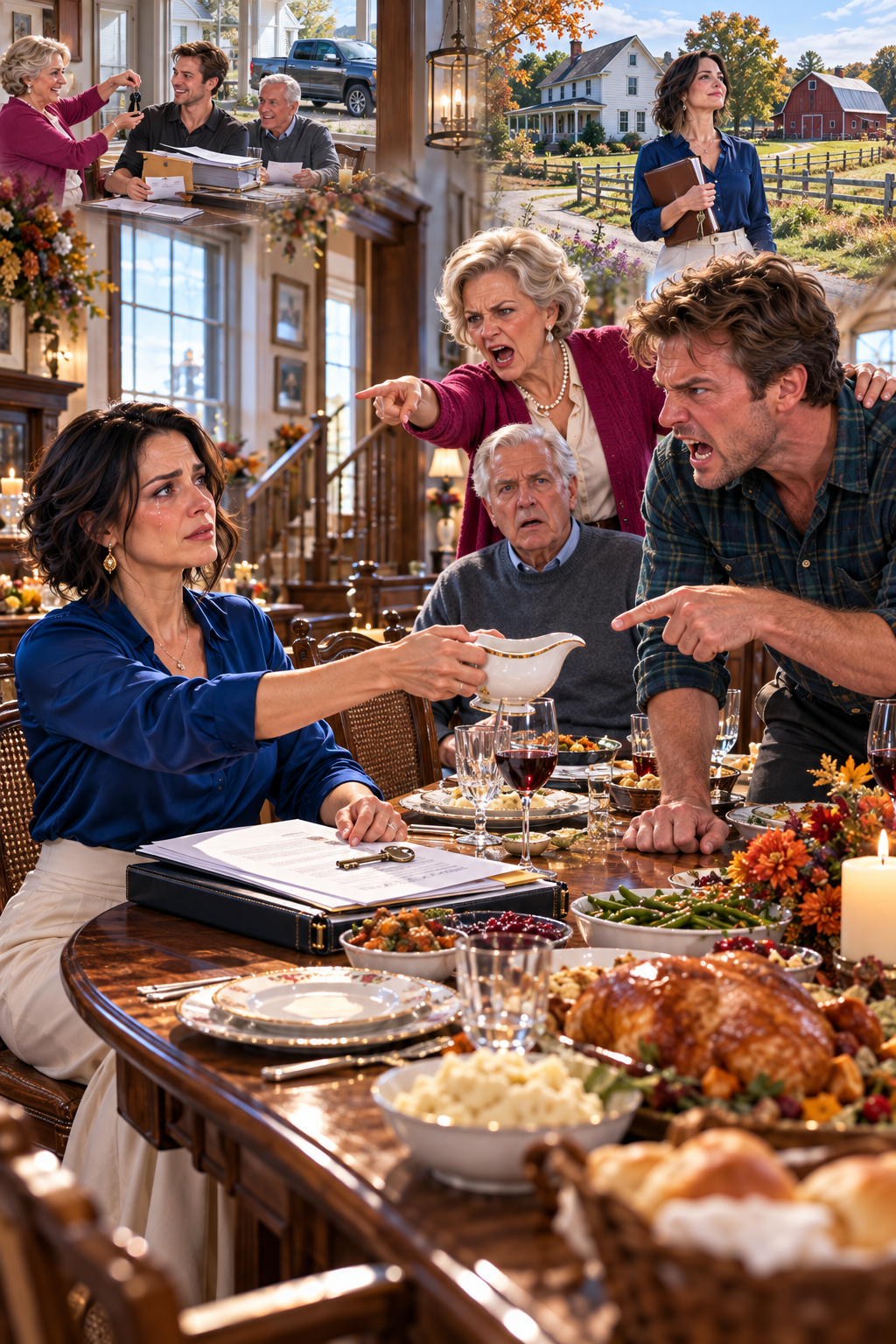
My Parents Paid My Brother’s Rent For 6 Years, Made His Truck Payments And Even Cleared His Credit Cards. At Thanksgiving He Found Out I’d Quietly Bought Back Grandpa’s Farm On My Own. He Slammed His Fist On The Table And Demanded Half While Mom Yelled “That Was His.” I Passed The Gravy And Said, “Not One Acre.” 2 Weeks Later…
My sister-in-law exposed my secret halfway through Thanksgiving dinner: I owned the eighty-acre farm my brother had spent seven years calling his inheritance. My mother accused me of stealing it, my father wouldn’t look at me, and my brother demanded half. I refused and walked out without raising my voice. Two weeks later, three hundred families arrived at my gate for his Christmas celebration. He had already spent their ticket money, but an old letter in my filing cabinet revealed something even worse about my family’s plans.
Part 1
The trouble started with a question nobody wanted answered. “So, Maren, when were you planning to tell everybody you own Grandpa’s farm?” My sister-in-law, Tessa, stood beside the Thanksgiving table with a glass of Chardonnay in her hand, looking pleased with herself in the way people do when they mistake humiliation for entertainment. My mother stopped pouring gravy, my father lowered his eyes, and my older brother, Callum, stared at me as if I’d just confessed to something criminal. The only sound came from the refrigerator humming behind us and the football game nobody was watching.
“What are you talking about?” Callum asked, although something in his expression suggested he already knew enough to be frightened. Tessa explained that an updated property abstract had crossed her desk at the title company on Tuesday, and Cedar Hollow Holdings, the company that owned our grandfather’s eighty acres, listed me as its sole member in the supporting documents. She gave a small, unsteady laugh and said, “Seven years, and you never mentioned owning the entire place?” Callum set his fork down, leaned across the table, and said, “Grandpa always intended that farm for both of us, and you know it.” Then he struck the tabletop hard enough to make the cranberry sauce tremble and added, “I want my half.”
My mother, Lorraine Whitcomb, stood so abruptly that her chair scraped backward across the kitchen tile. “That farm was supposed to be Callum’s,” she said, still holding the gravy boat, and there was something more painful than anger in her expression: genuine disbelief that I had dared to possess something she had already assigned to him. I reached across the table, gently took the gravy boat from her hands, and passed it to my father. “I bought that property at a public auction,” I said. “I paid for it, I maintain it, and I make the mortgage payments, so there isn’t a half to give away.”
My name is Maren Whitcomb, and I was thirty-one years old that Thanksgiving. I owned a small agricultural contracting business in southern Iowa, operated two tractors that were older than some of my customers, and had spent most of my adult life calculating how much rain a hayfield needed before it became worth cutting. My brother, thirty-four, managed sales at a recreational vehicle dealership and had an impressive talent for making acquaintances believe he was considerably more successful than he actually was. At family gatherings, I generally listened, complimented the food, and washed the dishes while Callum described his latest business opportunity. Keeping quiet had been my role since childhood, but that evening I was finished playing it.
Callum looked at Tessa, then back at me, and an uncomfortable realization spread across his face. “Cedar Hollow,” he said slowly. “That’s the company I pay for the Christmas barn.” I nodded, and he asked whether Boone Mercer, the neighboring farmer who handled the arrangements, had known the whole time. “Boone knows who signs his leases,” I answered. “You never asked him who owned the property, and you never bothered reading the paperwork you signed.” Tessa lowered her glass, suddenly understanding that her husband had spent seven Christmas seasons paying rent to the younger sister he routinely described as somebody who merely cut hay for a living.
My father, Wesley, cleared his throat and suggested that everyone calm down, a sentence he had used for decades whenever Callum wanted something unreasonable. Callum insisted that Grandpa would have divided the land equally, while my mother accused me of purchasing it behind my brother’s back. “You didn’t have the money to buy a farm,” she said, sounding almost offended by the possibility that I might have succeeded without her supervision. I looked at her carefully and explained that I had secured financing, sold equipment, and spent seven years meeting obligations nobody else in the family had helped me carry. She responded by asking why I couldn’t be generous now that I was doing so well.
“Because this is the same farm Dad sold to pay Callum’s debts,” I told her, and the room fell quiet enough for me to hear the heating system click on. Seven years earlier, my brother had accumulated more than forty thousand dollars in credit card balances and fallen four payments behind on a truck that cost almost as much as my first house. My parents had inherited the property after Grandpa died, then auctioned it to rescue Callum from the consequences of his spending. “You already used Grandpa’s farm to give him a fresh start,” I said. “I’m not going to finance another one.”
Callum pushed his chair away and accused me of exaggerating, but he couldn’t dispute the amount because our father had personally negotiated the settlements. I asked him what crop was growing on the northern field, where the underground drainage line crossed the creek bottom, or why the barn’s western foundation required repairs every spring. He couldn’t answer any of it, although he had been advertising the property as his family’s working farm for years. “I keep Grandpa’s Christmas tradition alive,” he finally said, as though that settled the matter. “You charge families thirty-five dollars for wagon rides Grandpa gave away,” I replied. “And you sell cocoa my grandmother used to make for free.”
Then Callum said something that made even Tessa go still. “Grandpa only let you hang around that place because nobody wanted you at home,” he said, his voice taking on the sharp certainty of somebody who knows exactly where an old injury lies. My father murmured his name, but my mother looked down at her plate instead of correcting him. I didn’t cry or argue, although I felt the familiar pressure behind my eyes. I folded my napkin, thanked my mother for dinner, and retrieved my winter coat from the hook beside the back door.
“December’s rent is due on the first,” I told Callum before leaving. “And don’t advertise my property as yours again.” He called after me that this wasn’t finished, but I stepped into the cold and pulled the door shut before he could say anything else. The drive south toward Corydon took forty minutes, with frozen fields on either side of the highway and my truck’s heater making its usual rattling noise. My hands were trembling by the time I reached the gravel road leading to the farm, not because Callum had insulted me, but because my mother had sounded so certain that I had taken something belonging to him.
The farmhouse appeared beyond the bare cottonwoods, white siding glowing beneath the porch light, and I parked beside the machine shed Grandpa had built before I was born. Grandpa Hollis had been my favorite person, although he would have been embarrassed to hear me say it, because he believed affection was something you demonstrated by showing up when work needed doing. My grandmother, Evelyn, died when I was six, leaving him alone with eighty acres, twenty-three cows, and a kitchen where he never learned to cook anything more complicated than eggs. My father visited occasionally, usually when he wanted advice or needed to borrow equipment, but I spent nearly every school vacation there. The place had never felt like somewhere I was sent because I wasn’t wanted; it felt like the one place where somebody was genuinely glad I’d arrived.
Grandpa taught me to operate a tractor before I could reach the pedals without stretching, and he made me learn how to repair equipment rather than immediately buying replacements. At fourteen, I jammed a hay baler so badly that I was convinced I’d ruined it, but he sat on an overturned bucket and handed me the correct wrench without a lecture. He taught me to watch the weather, respect a good neighbor, and keep promises even when nobody would discover if I broke them. Every December, he decorated an old wooden hay wagon with Christmas lights and gave free rides to children from the Methodist church. I rode beside him every year, while Callum usually stayed home complaining about the cold.
Grandpa died when I was twenty-four, and the morning Boone Mercer called to tell me remains clearer in my memory than almost anything that happened afterward. Boone had found him collapsed beside a feed gate, and I drove to the farm with my phone pressed against my ear while he stayed on the line without trying to fill the silence. Grandpa’s will left everything to his only child, my father, which meant the land was legally his to keep or sell. For one brief week, I believed he would preserve it, perhaps renting me the acreage I had already been helping Grandpa maintain. Then Callum’s creditors started calling my parents’ house, and my mother said a sentence that changed everything: “Well, at least we still have your father’s farm.”
I went to Dad and offered to buy the property through a private installment agreement at its appraised value, but he dismissed the idea before I finished explaining my plan. “Your brother needs the money immediately,” he said, looking past me toward the television, and when I asked why my future mattered less, he told me not to make a difficult situation worse. That evening, I sat alone on Grandpa’s sagging porch until Boone came over carrying two cups of coffee. When I told him the farm was going to auction, he listened without interrupting and finally asked, “Do you still want it badly enough to pay what somebody else will pay?” I told him yes, even though I had no idea how I could possibly manage it.
Boone studied the dark fields for a moment before saying, “Then we need to make sure nobody in your family knows you’re bidding.”
Part 2
Boone Mercer had farmed the land east of Grandpa’s property for almost forty years, and he knew the Whitcomb family better than most of our relatives did. He understood that if my father discovered I intended to bid, he would call Callum before the auctioneer finished his opening remarks. My brother would turn an ordinary purchase into an argument about fairness, my mother would accuse me of taking advantage of the family, and somebody would find a reason to interfere. Boone therefore suggested that I approach the sale exactly like any unrelated buyer. “You don’t need permission to buy land that’s being sold to the public,” he told me, “but you do need a plan that can survive after everybody gets angry.”
I spent the following week visiting the Farm Service Agency, speaking with a local agricultural lender, and assembling every financial record I had. By then, I’d operated my own hay business for several years, servicing horse properties, small cattle farms, and an orchard that paid me partly in apples. My equipment was aging, but my income was documented, my customers were reliable, and the business generated enough cash flow to support a carefully structured loan alongside crop rent. The agricultural loan officer didn’t care that I was a woman in a business where customers still occasionally asked whether my husband owned the tractors. She cared about acreage, production history, debt ratios, and whether I could explain how I’d make the payments during a bad season.
The down payment nearly finished me before I got started. I sold a round baler I had rebuilt myself, emptied my savings, canceled plans to replace my leaking pickup, and accepted extra mowing contracts that kept me working until the headlights came on. A lawyer named Petra Keene helped establish Cedar Hollow Holdings, an LLC that would purchase the property and hold the title. She explained that she could act as the company’s registered agent, but she also warned that ownership records might eventually become accessible through other legitimate documents. “Privacy isn’t the same as hiding something illegal,” she said, “and you need to be comfortable explaining this purchase if anyone asks.” I was comfortable with buying the farm; I simply wasn’t prepared to let Callum turn it into his next family emergency.
The auction took place on a humid Saturday in August, inside a sale barn that smelled of dust, old lumber, and burnt coffee. My parents sat near the front, my father wearing his best button-down shirt, while Callum was spending the weekend in Branson with friends. I waited in my truck outside, listening to the auctioneer through a speaker mounted above the entrance, while Boone stood at the back of the crowd and bid on behalf of my company. Two other buyers stayed in until the price crossed four thousand dollars an acre, and the final bidder fought Boone through three more increments. When the hammer fell at forty-six hundred an acre, Boone owned the winning bid for Cedar Hollow Holdings, and I bent forward until my forehead rested against the steering wheel.
The total was three hundred sixty-eight thousand dollars for eighty acres, the house, the barn, and several outbuildings. At closing, my father signed the deed without asking who owned the purchasing company, even though he was selling property that had belonged to his father for decades. He wanted to know when the funds would clear because Callum’s truck lender had started discussing repossession. By Friday, the money had arrived, my brother’s outstanding balances were settled, and my parents were celebrating his latest promise to become responsible. I was signing loan documents, arranging insurance, and calculating how much hay I’d need to sell before winter.
The first year nearly broke me, although I didn’t tell anyone in my family. The farmhouse needed electrical work, a section of pasture fencing had collapsed, and the old well pump failed during a week when the temperature never climbed above freezing. Boone leased the crop ground from my company, providing a predictable payment that covered much of the farm loan, while I handled hay production and worked additional acreage for customers. I learned to sleep through storms without worrying about every dollar a thunderclap might cost, although that ability took several years to develop. Whenever I considered telling my parents I’d saved the farm, I remembered how quickly they’d dismissed my offer to purchase it.
Four months after the auction, Boone called one evening with an unexpected request. Somebody wanted to rent the barn, parking area, and access lane for a Christmas celebration honoring Grandpa Hollis, and Boone asked whether my company would consider a seasonal agreement. I assumed it was the Methodist church until he told me the applicant was Callum. My brother had approached Boone after hearing he was working for the new owner, and he had outlined an ambitious holiday attraction with lights, tractor rides, photographs, refreshments, and an appearance by Santa Claus. For a few minutes, I let myself believe Callum had finally developed an attachment to the place beyond what it might give him.
He offered eighteen hundred dollars for the season, which would help with taxes and maintenance, and the agreement expressly limited his use to the barn, yard, and designated lane from December through early January. Petra prepared a straightforward lease, Boone handled the signing, and I assumed my brother would respect the property because it had once belonged to our grandfather. The first time I drove past the entrance that December, a freshly painted sign announced Hollis’s Christmas Barn, followed by a claim that it had been family-owned since 1951. Beneath the name was a ticket price of thirty-five dollars per vehicle. I sat in my truck watching a family hand over money for something Grandpa had always considered too important to charge for.
Every December afterward, Callum rented the property again, and his attraction gradually became one of the county’s busiest holiday events. My mother served cocoa in the barn, often telling visitors how proud Grandpa would have been of her son, while Callum hired somebody else to operate the tractor because he barely knew how to use its controls. He installed temporary light displays, ordered printed tickets, and promoted the event online with photographs of buildings I had paid to repair. When people congratulated him on keeping the family farm, he rarely corrected them, and sometimes he added stories about childhood summers spent helping Grandpa that I knew hadn’t happened. Meanwhile, I continued working in the background, mowing lanes, repairing fences, clearing snow, and depositing his rent checks into the same account that paid the mortgage.
Two years before that Thanksgiving, something changed in Callum’s advertisements. He began describing himself not merely as Grandpa’s grandson but as the person responsible for preserving the Whitcomb agricultural legacy, and his Christmas attraction expanded to include private group reservations and corporate events. That spring, a real estate agent stopped by Boone’s place with an inquiry about purchasing the eighty acres privately. Boone forwarded the envelope to me, and I recognized the prospective buyer’s name before I finished reading the first page. The financial documents attached to the offer disturbed me more than the price, but I asked Petra to reject it without revealing my identity. I locked the papers in my filing cabinet and told myself there was no reason to reopen another family argument.
The following two years passed with me repairing the farm and Callum behaving as though it already belonged to him. Then I borrowed a modest amount to build a proper hay storage shed, and the lender ordered an updated title abstract as part of the financing. Tessa worked at the company handling that paperwork, giving her legitimate access to a record that connected my name with Cedar Hollow Holdings. She was supposed to use it for the transaction, not discuss it over Thanksgiving dinner, but she apparently spent two days wondering how to confront me. By the time she finished her fourth glass of wine, professional discretion had lost to the pleasure of revealing a family secret.
When I returned home from Thanksgiving, my phone contained seventeen messages and a growing collection of accusations in the family group chat. My mother wrote that she was ashamed of me, Callum claimed I’d secretly purchased the farm out from under everyone, and relatives who hadn’t visited Grandpa in years were suddenly demanding an explanation for my behavior. My father sent one message saying my mother was very upset, without acknowledging anything that had happened at dinner. I turned off the notifications and checked the weather forecast because Boone needed me to feed his cattle the next morning. I also checked the calendar and noticed something Callum apparently hadn’t considered: his new Christmas season was supposed to begin in less than two weeks, and he had not secured a new lease.
That detail became important on Saturday afternoon when he finally called me himself. He spoke in the smooth, friendly voice he used when selling expensive recreational vehicles, telling me we had both said unfortunate things and should approach the situation like reasonable adults. Then he proposed that I transfer the southern forty acres, including the barn, to him and accept payments whenever his Christmas business became profitable enough. I asked what he could offer as a down payment, and he admitted he wasn’t prepared to provide one immediately. “We’re family, Maren,” he said, as though the previous Thursday had never happened, and I told him family was precisely why he should understand my answer.
“No,” I said, and hung up before he could begin negotiating with property he didn’t own.
Part 3
By Monday morning, I’d received messages from three relatives suggesting I should simply give Callum the barn to preserve family harmony. One aunt reminded me that he had a wife and responsibilities, although she didn’t explain why those responsibilities entitled him to property purchased with my money. My mother left a voicemail saying Grandpa would be heartbroken to see his grandchildren fighting over land, then ended by asking me to consider what losing the Christmas attraction would do to Callum’s reputation. I listened to it while replacing a broken hydraulic hose on my tractor. The irony was difficult to miss: everybody wanted me to sacrifice the farm to protect the brother whose debts had caused our grandfather’s land to be sold in the first place.
I called Petra that afternoon and explained that I would not authorize another seasonal lease. She reviewed the previous agreement, confirmed that it had expired in January, and asked whether Callum had advertised this year’s event or accepted reservations. I opened his ticketing website and showed her the opening-night announcement, which listed nearly three hundred family bookings along with a church group and a senior center visit. The tickets had been available since October, before he knew whether he would have permission to use the property. “He sold access he hadn’t secured,” Petra said, sounding more disappointed than surprised.
She advised me to document everything, send formal written notice, and avoid any confrontation that might endanger visitors. The letter went out by certified mail, explaining that Cedar Hollow Holdings would not enter into a new lease and that neither Callum nor his business was authorized to occupy the property. Petra included a request that he immediately notify customers and arrange refunds or an alternative venue. She also recommended additional event insurance if I intended to invite the public onto the farm myself. When she asked what I planned to do about the families who had already paid, I told her the one thing I had known from the beginning: children would not lose their Christmas outing because their parents trusted my brother.
Callum signed for the letter on Wednesday and telephoned me before dinner. “You’ve lost your mind,” he said, abandoning the friendly tone he’d used on Saturday, and then reminded me that three hundred families had purchased tickets. He listed the Methodist church, the senior center, the local newspaper, and several businesses that had reserved group outings, as though the number of people involved changed who owned the land. I asked why he had accepted payments before signing a lease, and he accused me of trying to destroy a seven-year tradition. “You can’t turn away all those children,” he said, and I answered, “I’m not turning anybody away.”
He became quiet, then asked whether that meant he could proceed with his event. “It means every family that comes to this farm will have somewhere to go,” I told him, carefully choosing my words. He interpreted that as surrender and promised to get Boone the usual rent check, even though I repeated that his business had no permission to operate there. Before I could explain further, he hung up and sent a triumphant message to the family group chat saying we had resolved our disagreement. I saved a screenshot, forwarded it to Petra, and went back to planning something my brother couldn’t cancel.
My first call was to Boone, who was seventy-two and had spent most of his life solving problems with a tractor and a willingness to show up early. He listened to my idea for free Christmas wagon rides, then asked how many vehicles might arrive and whether the frozen ground could support overflow parking. We walked the yard together the following morning, marking a separate entrance for arriving cars and identifying areas that needed gravel or temporary barriers. His wife, Ruth, volunteered to organize hot cocoa, while a retired school bus driver offered to help with parking. I contacted the senior center and church through Petra’s approved notice, explaining that the advertised commercial event had no authorization but that the farm itself would host a free community evening.
The senior center director, Edie Bell, sounded confused until I explained that I was Grandpa Hollis’s granddaughter and the property’s actual owner. She remembered Grandpa giving rides long before Callum established his business, and she became noticeably warmer when I promised to accommodate residents who needed assistance boarding the wagon. The church pastor, Reverend Stowe, asked whether there was an admission charge or donation requirement. “Neither,” I said. “If somebody wants cocoa, we’ll have cocoa, and nobody needs to pay for it.”
Still, I couldn’t ignore how much responsibility I was taking on. Three hundred families meant hundreds of cars, unpredictable weather, unfamiliar children, older visitors, and potential injuries around agricultural equipment. I contacted my insurance agent, checked the equipment, arranged portable lighting, and recruited enough volunteers to prevent the evening from becoming chaotic. Part of me wondered whether I was making an expensive emotional decision simply to prove that I could. Then I remembered Grandpa spending his own money on fuel and cocoa every Christmas because he believed a child should be able to enjoy something without watching a parent calculate the cost.
On Saturday, my father drove down to the farm alone, something he hadn’t done since the auction. He found me stacking hay in the new shed, stood in the doorway for several minutes, and finally asked whether the entire place really belonged to me. I showed him the deed and the current mortgage statement, then watched him read the signature at the bottom of the original conveyance. It was his signature, written seven years earlier beside the date that had allowed Callum’s creditors to be paid. “I never asked who bought it,” he murmured, and I replied, “You were more concerned about when the money would arrive.”
He folded the papers carefully and admitted that Callum had already spent much of the ticket revenue. Some had gone toward vehicle payments, some toward ordinary household bills, and another portion toward advertising expenses that couldn’t be recovered. My father said Callum was frightened about refunds, although he had been telling my mother everything was under control. “I’m asking you to help him through one more Christmas,” Dad said, and I could hear how tired he was of making the same request in different forms. I told him I’d spent seven years helping my brother without his knowledge, and that continuing to rescue him would accomplish nothing except make the next disaster larger.
Dad wandered toward the barn, where loose red paint hung from weathered boards, and stood looking at the building his own father had maintained for most of his life. He told me Boone had once offered him several boxes of Grandpa’s tools after the auction because the new owner had given permission for the family to collect personal belongings. “That was you, wasn’t it?” he asked, and I nodded. For a moment, I thought he might apologize for the auction or for the Thanksgiving dinner. Instead, he said my mother would find all of this terribly difficult and drove away.
That evening, while searching my filing cabinet for the insurance documents, I came across the real estate offer I’d received two years earlier. I had avoided looking at it since Petra rejected the purchase, partly because it contained another example of Callum presenting himself as someone he wasn’t. I spread the pages across my kitchen table beneath the yellow light and read them more carefully than I had the first time. Attached to the offer was a bank letter, a financing proposal, and a handwritten statement from Callum about his grandfather’s supposed wishes. The document that disturbed me most wasn’t the amount my brother had offered; it was the source of his proposed down payment.
My parents had been willing to put their own paid-off house at risk to help him obtain the farm, and both had signed the paperwork.
Part 4
The offer had been made two Octobers earlier, when Callum was still publicly describing himself as the future owner of Grandpa’s property. He had proposed purchasing all eighty acres and the buildings for five hundred twenty thousand dollars, considerably more than I had paid at auction. The attached financing materials described a home-equity credit arrangement secured by my parents’ house, which they had finally paid off after thirty years of monthly installments. My mother’s signature appeared on the paperwork above my father’s, confirming that she had participated in the plan rather than merely hearing about it afterward. That changed how I understood her reaction at Thanksgiving.
For years, I’d believed Mom resented my ownership because she thought Callum deserved everything Grandpa left behind. Now I understood she had actually committed herself to helping him obtain the farm, even if doing so meant risking the house where she intended to retire. The credit proposal didn’t establish that they had drawn the money, but the willingness to use their home as collateral told me how far they were prepared to go. They had never offered to support my original purchase, never asked how I kept the mortgage current, and never shown interest in the work required to preserve the place. Yet they were ready to make another substantial financial sacrifice when Callum decided he wanted it.
His handwritten letter was worse because it attempted to turn ordinary family history into a claim of moral ownership. He described summers spent learning agriculture beside Grandpa, his personal responsibility for maintaining the family tradition, and repeated promises that the farm would someday belong to him. I knew those stories were inventions because Callum had spent most summers traveling with friends or playing baseball while I worked beside Grandpa in the fields. He even claimed to have repaired the Christmas wagon with Grandpa during his final winter, when I remembered replacing its damaged boards myself. The letter wasn’t simply an exaggeration designed to impress a stranger; it was an attempt to purchase the farm using a version of our childhood in which I barely existed.
I called Petra and asked whether she still had copies of the correspondence surrounding the offer. She confirmed that the inquiry had been legitimate, that the proposed financing was preliminary, and that her response had never identified me as the owner. She also reminded me that my parents’ participation didn’t give Callum any legal claim against the property. “You can be disappointed in what they tried to do,” she said, “without turning this into another argument you have to win.” I understood her point, but I wanted my brother to know I had seen the story he told strangers when he believed I wasn’t listening.
On Tuesday evening, Callum called again, speaking more slowly than usual and accusing me of taking Grandpa’s legacy away from the family. I let him talk until he repeated the claim that Grandpa had promised him the farm, then opened the handwritten letter on my kitchen table. “You wrote something almost identical to a prospective seller two years ago,” I said, and I began reading the first paragraph aloud. He interrupted to ask where I’d obtained it, but I continued through the descriptions of his childhood summers and the claim that he had personally maintained the Christmas wagon. When I reached the financing information involving our parents’ home, his breathing became audible through the phone.
“How do you have those documents?” he asked, sounding nothing like the confident man who’d demanded half my land at Thanksgiving. I explained that the purchase offer had been delivered to Cedar Hollow Holdings, and that I had been the owner who rejected it. For several seconds he said nothing, then accused me of deliberately humiliating him by staying anonymous. “I didn’t ask you to write that letter, Callum,” I replied. “I didn’t ask you to involve Mom and Dad’s house, either.” He insisted that I was twisting the situation, but when I asked whether he’d told our parents he planned to operate the Christmas attraction without a lease, he hung up.
The next morning, Dad sent me a short message saying he’d learned about the proposed financing documents and was reviewing their household finances. It was the closest he’d come to admitting that the family had been organizing itself around Callum’s problems for years. Mom didn’t call, although Tessa left a voicemail apologizing for revealing the property information at dinner and saying her employer had opened a disciplinary review. I didn’t respond immediately because I wasn’t ready to discuss forgiveness with somebody who’d used confidential information to embarrass me. Instead, I spent the afternoon checking parking signs, organizing volunteers, and repairing a broken railing on the old barn steps.
Boone arrived shortly before dusk with a surprising addition to our preparations. Behind his tractor was Grandpa’s original Christmas wagon, freshly washed but unmistakable beneath its new straw bedding. Boone explained that he’d purchased it separately at the estate auction for sixty dollars and stored it in his machine shed because he couldn’t bear the thought of somebody hauling it away for scrap. I climbed onto the wooden platform and recognized the patched corner board I’d repaired with Grandpa one December afternoon. For the first time since Thanksgiving, I cried openly, sitting on that wagon while Boone pretended to inspect the tractor hitch.
On Thursday, December tenth, the morning sky was pale and the forecast promised cold but manageable weather. Ruth had arranged thermoses, volunteers, and enough cocoa ingredients to serve several hundred people, while I brought out an additional hay rack to prevent the waiting line from stretching too far. The temporary lights illuminated the barnyard, and Grandpa’s wagon stood near the entrance with fresh straw and heavy blankets neatly folded beneath the seats. I mounted a simple plywood sign beside the gate announcing free Christmas wagon rides in memory of Hollis Whitcomb. Beneath it, in smaller lettering, I identified Cedar Hollow Holdings as the host so visitors wouldn’t mistake my event for the business that had sold their tickets.
Just after five, Callum’s pickup appeared on the gravel road, pulling a trailer loaded with folding tables, decorations, and the familiar red sign advertising his Christmas attraction. Mom sat beside him wearing the expensive wool coat she usually reserved for church events. When they reached the closed service entrance, Callum climbed out and stared across the yard at Grandpa’s wagon, the volunteers, and the new sign. “What exactly are you doing?” he demanded, and I explained that I was hosting a free holiday celebration on my property. He pointed toward his trailer and said he’d already paid for the supplies and couldn’t afford to lose the ticket revenue.
I reminded him that Petra had sent formal notice and that he had been asked to contact his customers. He argued that we’d agreed to let the event continue, but I showed him the messages confirming that I had promised only to welcome the families, not to authorize his business. Mom stepped forward, looked at the old wagon, and briefly covered her mouth as she recognized it. “Maren, please don’t embarrass your brother in front of everyone,” she whispered, and I felt the familiar pressure to make myself smaller so he could remain comfortable. “I offered him a way to handle this privately,” I answered. “He chose to keep selling something he couldn’t provide.”
Callum reached toward the gate latch, but I stood beside it and explained that the volunteers had instructions to use the separate public entrance. Deputy Lydia Phelps, who purchased hay from me and had agreed to assist with traffic while off duty, was already walking over from the parking area. Callum noticed her and withdrew his hand, muttering that I’d planned the entire thing to make him look foolish. I told him he could stay and explain the ticket situation to customers, but his trailer and commercial equipment would have to remain outside. He went back to his pickup without answering.
At 5:20, headlights began sweeping across the gravel road, and the first families rolled down their windows with tickets displayed on their phones. A white senior center bus appeared behind them, followed by the church van and a line of vehicles stretching back toward the highway. I stepped into the cold with my clipboard while Callum watched from beside his truck, and I gave every driver the same explanation: the purchased event wasn’t operating, but the landowner was offering free rides and refreshments. Some people were confused, some were angry, and several immediately wanted to know how they could recover their money. Then the bus door opened, and Edie Bell called my name while an elderly passenger behind her asked whether Hollis Whitcomb’s old wagon was still there.
Part 5
I told Edie that the wagon was waiting beside the barn, and her passenger, a silver-haired man named Vernon, gripped the railing as though the answer had brought back something important. He explained that he’d ridden with Grandpa Hollis as a boy and hadn’t returned since the winter before his wife died. Two volunteers helped him down from the bus and toward the boarding area, where Ruth offered him cocoa and a seat while the first group prepared to leave. I glanced toward Callum, who was standing beside his truck with his phone pressed against his ear. For once, the attention he wanted was everywhere around him, but none of it was the kind he could use.
The first hour was difficult because families had purchased tickets expecting an organized attraction, and several understandably wanted immediate refunds. I explained that Callum’s business had accepted their payments and was responsible for resolving the charges, while our volunteers distributed written information about contacting the seller or payment provider. A few parents argued with me, and I listened because their frustration was reasonable even though I hadn’t collected their money. Meanwhile, the children were watching Grandpa’s illuminated wagon circle the barn, and most became impatient to climb aboard. Once the rides began, the complaints gradually gave way to laughter, photographs, and conversations about Christmases people remembered from decades earlier.
Reverend Stowe arrived with twenty-two children and approached my mother before joining the line. I couldn’t hear their conversation, but Mom’s expression changed when he showed her the church’s payment receipt and asked about the refund Callum had promised. Edie also spoke briefly with her, explaining that the senior center had issued a check for its reservation and expected the money to be returned. Neither woman shouted or caused a scene. They simply asked the questions my mother had spent years protecting Callum from having to answer.
By seven, people who recognized Callum were approaching his pickup directly, and his explanations were becoming increasingly strained. He told one family there had been a misunderstanding with the property owner, told another that the attraction had been unexpectedly canceled, and eventually stopped answering questions altogether. Tessa arrived separately after hearing what had happened and stood with him for several minutes before walking over to me. She looked exhausted, with dark shadows beneath her eyes, and asked whether I needed help directing cars. I handed her a reflective vest and a flashlight because there were still families waiting, and that evening I cared more about keeping everybody safe than assigning another person a permanent place in my life.
Callum left shortly afterward, towing the trailer of decorations he hadn’t been allowed to unload. Mom remained beside the road until the last group from the senior center boarded Grandpa’s wagon, then climbed into her car without speaking to me. I watched their taillights disappear and felt an unexpected absence of triumph. I had imagined that seeing them leave might finally make me feel victorious, but instead I felt tired, cold, and relieved that nobody had been hurt. Boone climbed onto the tractor, asked whether I was ready for another trip, and reminded me that we still had a long line of people who’d come to celebrate Christmas.
We continued until after ten, with volunteers rotating through parking duty while Ruth refilled thermoses and handed out cookies donated by a local bakery. The children sang carols badly, the older passengers sang them beautifully, and Vernon told me that Grandpa used to keep candy canes in his coat pocket for anyone who looked cold or disappointed. A third-grade teacher named Elodie Marsh helped children climb down from the wagon and stayed afterward to wash cups, explaining that she remembered Grandpa’s Christmas rides from her own childhood. She asked whether I planned to continue the tradition next year. I told her we’d do it on the second Saturday of December, and she promised to bring the candy canes.
The financial consequences began appearing within days. Customers disputed charges for the advertised commercial event that hadn’t taken place, and Callum’s payment processor began reversing transactions after reviewing the complaints. The tickets had brought in approximately ten thousand five hundred dollars, and the additional dispute fees pushed the amount he owed considerably higher. Because he had already spent much of the revenue, he couldn’t cover the reversals, and the processor restricted his account while seeking repayment. The business he’d described as his most successful seasonal operation suddenly had more obligations than cash, not because I had taken its earnings, but because he had sold reservations without securing the property.
The church and senior center had paid by check, which required separate requests for refunds, and Mom eventually covered those amounts herself. She also repaid several people who contacted her directly, including a widow who’d purchased a ticket for herself and her great-granddaughter. Combined with the money she provided Callum to address the payment problems, the expense approached fifteen thousand dollars. I learned those details from Tessa, who stopped me at a gas station in Chariton shortly after New Year’s. She told me the title company had reprimanded her for disclosing information obtained through her work, and that she had begun looking for another position because she no longer trusted herself to remain at the office without being reminded of what she’d done.
Tessa also described a conversation that took place at my parents’ kitchen table on New Year’s Day. Mom had kept a spiral notebook listing every payment, refund, phone call, and expense associated with Callum’s Christmas business. She laid it in front of him, explained how much his decisions had cost her, and announced that she would no longer make his truck payments or cover his rent. According to Tessa, Callum initially accused everyone of abandoning him, then promised to reorganize his finances, but Mom refused to discuss another payment. “I’ve never heard her tell him no like that,” Tessa said, and I wondered whether it would last longer than the other promises of change I’d witnessed over the years.
I didn’t ask Tessa to keep me informed, and I declined when she suggested we meet for coffee to repair our relationship. She apologized for Thanksgiving, acknowledged that my property records were none of her business, and admitted that she’d enjoyed the attention her revelation brought until she saw what it did to the family. I accepted that she regretted her actions, but regret didn’t restore the trust she’d damaged. “I hope things settle down for you,” I told her, and meant it without feeling obligated to resume our old conversations. She nodded, returned to her car, and left me standing beside the gas pump with the smell of diesel drifting through the winter air.
I heard from Dad occasionally afterward, usually through short messages about storms, crop prices, or whether I’d finished putting up hay. He never asked me to surrender the farm again, although he also never offered the apology I once thought I needed. Mom remained silent, and when relatives suggested I should call her because she was getting older, I told them she knew my number and had already made her position clear. I didn’t return to my parents’ house for birthdays, Easter, or the following Thanksgiving. It wasn’t a punishment I needed them to understand; it was simply the boundary that allowed me to live without waiting for another family gathering to turn into a negotiation over my property.
Callum eventually took a second job, sold his expensive truck, and closed the Christmas attraction’s website. Some customers posted reviews describing how they’d purchased tickets from a man who didn’t own the barn, then received free rides from the person who actually did. Others complained that refunds had been unnecessarily difficult, and I didn’t blame them for refusing to overlook what happened. One review stayed with me because it mentioned Grandpa’s wagon and said the evening reminded the writer of Christmas celebrations before everything became something families were expected to purchase. That mattered more to me than any public vindication Callum’s embarrassment might have provided.
The following December, we held the free wagon rides again, this time with a better parking arrangement, more volunteers, and a proper covered boarding platform I built during the summer. The Methodist church helped organize transportation, the senior center returned with another bus, and Ruth insisted on preparing the cocoa even though I’d offered to hire someone. Elodie arrived carrying a large tin of individually wrapped candy canes, and together we handed them to children as they stepped down from the wagon. I enjoyed her company, but neither of us rushed to turn a friendship into something else, and for once I felt no pressure to make my future fit somebody else’s expectations.
Near the end of the evening, Vernon returned with his granddaughter and asked whether he could sit in the front beside me for one last ride. I drove slowly along the gravel lane while the lights from the farmhouse shone across the frozen fields, and he told me stories about Grandpa’s younger days that I’d never heard before. He remembered how Hollis had once repaired a neighbor’s tractor without charging for the work, then refused a cash payment because the neighbor’s family had recently lost their home in a fire. “Your grandpa always said a place is worth what you put into it,” Vernon recalled, his voice nearly lost beneath the engine. “He would have liked seeing what you’ve done here.”
When the last visitors left, I helped Elodie carry the empty thermoses into the farmhouse and put away the remaining blankets. Boone had already driven the wagon into the shed, where the faded wooden boards looked just as they had when Grandpa taught me to climb aboard without catching my coat on the crooked corner. I stood there for several minutes, listening to the building settle in the winter cold, and thought about the years I’d spent wondering why my family couldn’t see what I’d accomplished. The answer was no longer important because I had stopped measuring the value of my life by their willingness to recognize it.
That night, I filed away the old purchase offer, the Thanksgiving messages, and the deed bearing my father’s signature. I wasn’t keeping them to reopen the argument someday, but because they belonged to the history of a place I had worked hard to preserve. The farmhouse still needed repairs, the mortgage wasn’t completely paid off, and the equipment would undoubtedly find expensive new ways to break down, but those were problems I knew how to solve. For the first time, I understood that I didn’t need my parents to admit they had treated me unfairly before I could build something worthwhile without them.
Before going to bed, I looked through the kitchen window toward Grandpa’s barn, where a single string of Christmas lights still glowed beneath the roof. My brother had spent seven years trying to convince everyone the farm belonged to him, and my parents had nearly risked their home to make that story come true. I had simply bought the land, paid the bills, repaired what was broken, and restored the tradition Grandpa loved. They could keep believing I had taken something from Callum, but I no longer needed to argue with them about it.
The farm had belonged to Grandpa Hollis, and now it belonged to me. I intended to keep it that way.
THE END!