
By then, my life no longer felt like my own. Every day blurred into the next — feeding the baby, changing diapers, washing bottles, rocking Maisie back to sleep, then starting over again before I could even catch my breath.
Our daughter was beautiful, but she was also a newborn, which meant sleepless nights, endless crying, and exhaustion so deep it felt physical. I kept waiting for things to get easier. Instead, I felt myself disappearing.
And while I struggled to survive on broken sleep and cold coffee, my husband, Gerald, slowly became someone I no longer recognized.
He worked from home, which had sounded perfect while I was pregnant. I imagined shared responsibilities, quick breaks to help with the baby, maybe even lunches together.
Reality looked very different.
Gerald spent most of his time locked inside his office while I moved through the house exhausted and alone.
Everything annoyed him.
The baby crying distracted him.
The dishes were too loud.
My footsteps in the hallway were “heavy.”
He rarely yelled, which somehow made it worse. His coldness was calm, controlled, and constant.

Then came his obsession with saving money.
Every expense became a discussion. Diapers. Laundry detergent. The electric bill. One afternoon, during a brutal heatwave, he walked over to the thermostat and switched the air conditioning off.
“Ten minutes is enough,” he said casually. “We don’t need it running all day.”
“It’s ninety degrees outside,” I replied, stunned.
He shrugged. “Then open a window.”
So I adapted.
I stopped ordering takeout.
I reused freezer bags.
I line-dried clothes.
I bought cheaper groceries and skipped anything unnecessary.
Every time I thought, This is insane, I swallowed the thought and kept going.
Then the shower comments started.
“How long are you going to be in there?”
“Maisie’s crying.”
“You act like the bathroom is a spa.”
The truth was, I already showered quickly. Most days I barely washed my hair. I just wanted five quiet minutes to scrub spit-up off my neck and feel human again.
One morning, while I was rinsing conditioner from my hair, Gerald knocked sharply on the door.
“You need to hurry up,” he said. “I can’t listen to the baby cry.”
I pulled the curtain back slightly. “She’s your daughter too.”
His face hardened immediately.
“I have a low tolerance for constant noise.”
“She’s six weeks old, Gerald.”
“And she starts crying every time you disappear, so stop taking forever.”
I remember standing there with shampoo sliding down my back and realizing something terrible:
My exhaustion meant absolutely nothing to the person who was supposed to love me most.
The next morning, I walked into the bathroom and froze.
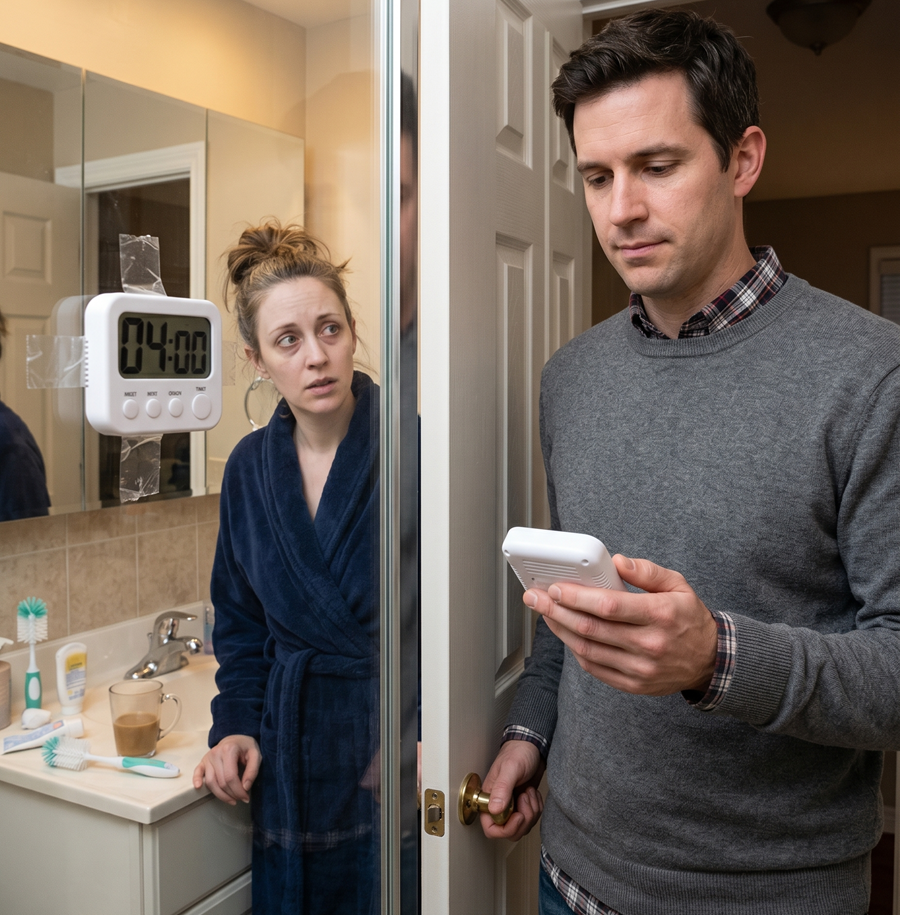
A digital timer had been taped directly onto the shower door.
Four minutes.
Gerald stood nearby holding another timer in his hand.
“I’ve got one out here too,” he explained calmly. “If the alarm goes off and you’re still inside, I’m shutting off the water.”
I stared at him, waiting for the punchline.
“Gerald… that’s not funny.”
“I’m not joking.”
“You can’t be serious.”
“I am.”
Part of me still believed he wouldn’t actually do it.
I was wrong.
The first time it happened, the alarm started blaring while I still had soap on my arm and shampoo in my hair.
A second later, the water stopped completely.
The pipes groaned inside the walls.
“Time’s up!” Gerald shouted through the door.
I stood there in shock before wrapping myself in a towel, filling a plastic pitcher from the sink, and rinsing my hair with freezing water while my daughter cried in the other room.
When I confronted him afterward, he barely looked away from his laptop.
“See?” he said. “You managed.”
The second time was even worse because I knew it was coming.
I rushed through the shower, skipped shaving, barely washed properly, and watched the timer count down with anxiety twisting inside my chest.
The moment the alarm sounded, the water vanished again.
I crouched beside the tub afterward, rinsing shampoo from my hair with a bucket while Gerald walked past and said:
“You need to learn better time management.”
What scared me most wasn’t his cruelty.
It was the fact that I was starting to adapt to it.
That morning had already been awful.
Maisie had cried most of the night. I had formula stains on my shirt, spit-up in my hair, and maybe three broken hours of sleep total.
Meanwhile, Gerald had spent half the night in his office wearing headphones while I handled everything alone.
By midmorning, I felt disgusting enough to cry.
I fed Maisie, changed her diaper, laid her down half asleep, and slipped into the bathroom as quickly as I could.
The timer was already waiting for me.
I scrubbed shampoo into my scalp desperately while Maisie started fussing outside.
Then she began crying harder.
“Jennie!” Gerald called.
“I’m almost done!”
“The timer says otherwise.”
Beep. Beep. Beep.
The water shut off instantly.
For one horrible second, standing there covered in soap, my first thought was:
I should apologize.
That’s how warped everything had become.
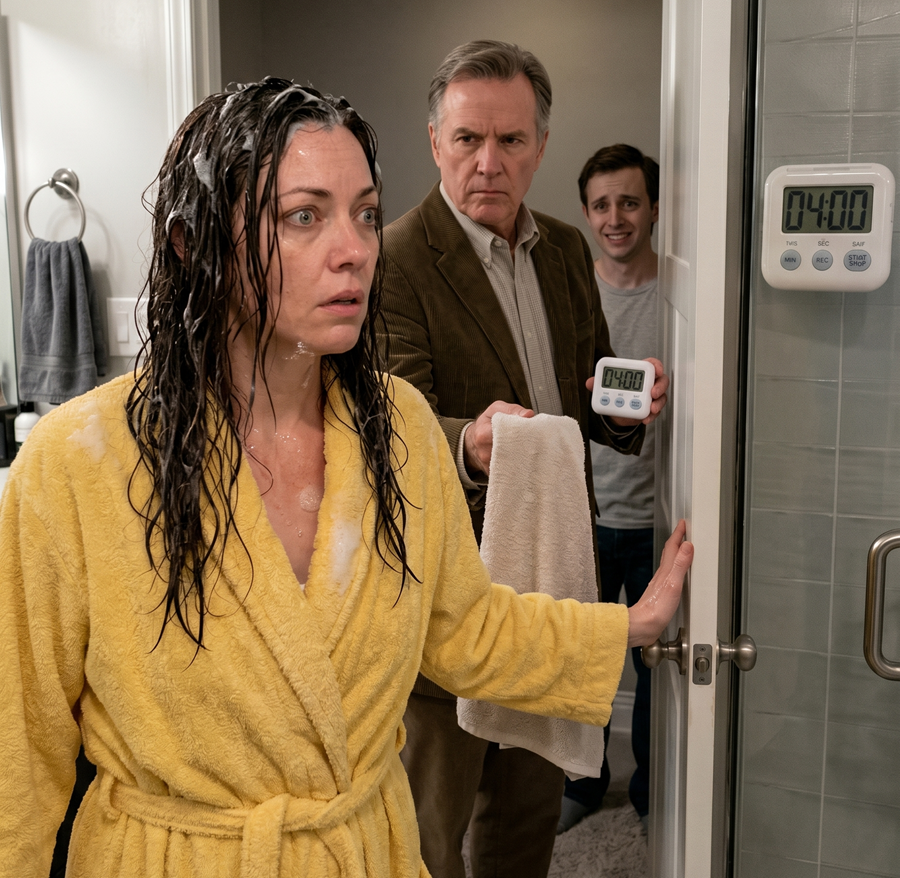
But when I pushed open the bathroom door wrapped in my robe, it wasn’t Gerald standing outside.
It was Robert, my father-in-law.
He held the second timer in his hand.
Gerald stood several feet away looking pale.
Robert handed me a towel quietly, then turned toward his son.
“Explain this.”
Gerald laughed nervously.
“Dad, it’s not what it looks like—”
“I watched you run to the water valve three mornings in a row,” Robert interrupted. “Today I followed you.”
Gerald swallowed hard.
“We’re trying to keep the baby on schedule.”
Robert slowly lifted the timer.
“You taped this to the shower door?”
“Jennie takes forever, Dad. The baby cries, I have work—”
“So your solution,” Robert cut in coldly, “was to treat your recovering wife like a hotel guest using too much hot water?”
Gerald fell silent.
“It’s been happening for days,” I whispered.
Robert looked at me then, and for the first time in weeks, someone saw how exhausted I really was.
“Go use the guest bathroom,” he said gently. “Take as long as you need.”
When I came back downstairs later, papers covered the kitchen table.
Robert had created a full schedule of my daily routine.
Every feeding.
Every diaper change.
Every bottle.
Every night waking.
Minute by minute.
“I’ve been watching,” Robert said quietly. “You’re awake at two in the morning and again before sunrise. Meanwhile, my son somehow still has time for naps and video games.”
Gerald looked offended.
“Dad, this is ridiculous.”
“No,” Robert replied firmly. “What’s ridiculous is timing your wife’s showers while she recovers from childbirth.”
Then he slid the papers toward Gerald.
“For the next seven days, you’re doing everything.”
Gerald blinked. “What?”
“Feedings. Laundry. Bottles. Night shifts. Diapers. Baths. All of it.”
“I have meetings.”
Robert nodded once. “Welcome to parenthood. Life doesn’t pause because you’re uncomfortable.”
“You can’t control my house.”
Robert folded his arms calmly.
“I helped buy this house. Watch me.”
For the first time since Maisie was born, someone stood up for me without asking me to justify my exhaustion first.
Robert handed the baby to Gerald.
“You wanted control,” he said. “Start there.”
That first night destroyed him.
By morning, Gerald looked exhausted. His shirt was inside out, the diaper station was a disaster, and he stared at the coffee machine like he’d never seen it before.
“How do you do this every day?” he finally asked me quietly.
I didn’t answer.
By the second night, he stopped complaining.
By the third, he stopped talking about money altogether.
And on the fourth night, I woke up hearing Maisie cry through the baby monitor.
Instinctively, I started to get up.
Then I heard Gerald’s footsteps crossing the nursery floor.
“Hey, sweetheart,” he whispered softly as he picked her up. “I’ve got you.”
A pause.
Then, almost too quietly to hear:
“I’m sorry. I didn’t understand.”
Tears slid into my hairline as I lay there listening.
Maybe he was talking to Maisie.
Maybe he was talking to me.
The next morning, the timer sat on the kitchen counter with the tape peeled off.
“I threw it away,” Gerald said quietly. “And I called someone to repair the valve. I shouldn’t have touched it.”
I believed he meant it.
But healing takes longer than apologies.
Before Robert left two days later, he pulled Gerald aside and made him repeat the baby’s schedule out loud like a student preparing for an exam.
At the front door, he squeezed my shoulder gently.
“If this nonsense starts again,” he told me, “you call me.”
The following morning, I stepped into the shower and simply stood there beneath the hot water.
No timer.
No shouting.
No footsteps outside the door.
Just steam filling the room and warm water easing weeks of tension from my body.
I washed my hair slowly.
I let the conditioner sit.
I stayed there long enough to remember that I was still a person, not just a machine keeping everyone else alive.
When I finally walked out, Gerald sat in the nursery holding Maisie asleep against his chest.
He looked up at me softly.
“Take as long as you need.”
That sentence alone didn’t fix everything.
But it was a beginning.
Gerald started helping without being asked.
He woke up during the night.
He stopped criticizing and started listening.
And I stopped apologizing for needing rest, food, silence, or basic kindness in my own home.
Because love should never come with a stopwatch.
And any home that forces you to rush your humanity is a home that needs to change.