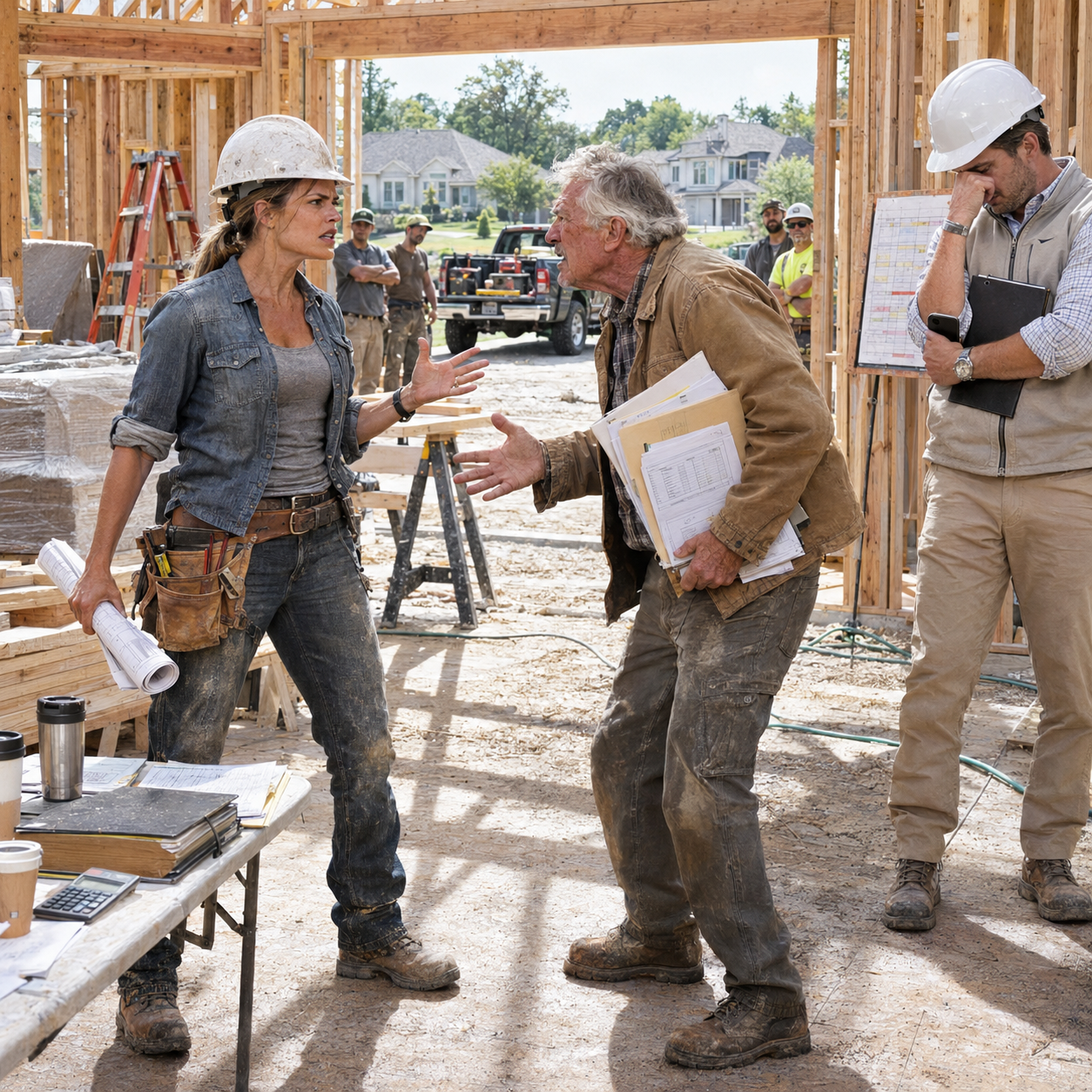
I Framed Houses For Dad’s Company For 19 Years. I Ran His Best Crew, Did His Bids, And Covered $14,000 Of His Payroll. At Sunday Supper, He Stood Up And Made My Sister’s Husband His Partner. Then He Smiled At Me: “You’ll Still Have A Job.” I Said, “I Don’t Need A Job, Dad. I’ve Got A Trade.” 1 Year Later, Dad Asked Me To Finish His Biggest House At Cost…
One year after my father handed half our family construction company to my brother-in-law and told me I could keep my job, he appeared outside my workshop before sunrise, asking me to rescue the biggest house his company had ever built. His workers had quit, his contractor was furious, and he wanted my crew to finish everything at cost, under his name. I calmly agreed to drive him to the property. What he didn’t know was that my crew was already there, and I had discovered why his business had really collapsed.
Part 1
My name is Audra Vale. I was thirty-five years old when my father finally discovered that being my father didn’t give him ownership of everything I built. That realization came on a freezing Saturday morning in October, on a hillside overlooking the Walla Walla Valley in southeastern Washington. By then, the house he wanted me to save had been sitting exposed to the weather for weeks, and the mistakes buried inside its walls were more serious than anyone had admitted. To understand why I refused his request, you have to understand that I had spent nearly twenty years helping him build a company I believed would someday be mine.
My father, Russell Vale, founded Vale Framing in 1994 with a borrowed pickup, two pneumatic nailers, and an extraordinary ability to understand buildings. He could study architectural drawings for ten minutes and recognize a problem that might take another carpenter half a day to discover. His work appeared throughout Dayton, Waitsburg, Walla Walla, and the growing neighborhoods farther west. On Sunday drives, whenever we passed a house his crews had framed, he tapped his horn twice. “That’s one of ours,” he would announce, smiling at the windshield. When I was little, I thought he owned half of Washington. I didn’t realize how carefully he distinguished between what belonged to him and what belonged to the people working beside him.
My grandfather, Bennett Vale, was a carpenter before my father ever touched a nail gun. He built porch steps, repaired barns, and restored old houses that everybody else considered hopeless. When I was nine, my grandmother Mabel suffered a terrible accident on their front porch. She had settled onto the wooden swing with a glass of iced tea when one of the concealed supports split apart. The swing dropped, throwing her against the floorboards and breaking her wrist. Grandpa spent the following weekend opening the porch ceiling, replacing the damaged framing, and installing reinforced blocking between the joists. I held his flashlight while he worked. Before allowing Grandma back onto the swing, he sat on it himself and rocked hard enough to make the chains creak.
“Anything that holds somebody you love,” Grandpa told me, “ought to be built strong enough for two grandmothers.” I never forgot that sentence. Neither did I forget how frightened he looked when Grandma fell, or how carefully he checked every bolt afterward. At fifteen, I began spending summers on Dad’s construction sites. I swept sawdust, carried lumber, and learned why crooked walls become expensive problems after the drywall goes up. By twenty-one, I was supervising a crew on custom homes. Some builders initially assumed I was there to deliver paperwork. After watching me lay out an entire complicated roof, they usually stopped asking where my supervisor was.
I developed a habit nobody assigned me. Whenever we framed a covered porch that could safely accommodate a swing, I installed properly reinforced blocking at the likely hanging points, consistent with the structure’s requirements. I recorded its location and eventually marked the finished ceiling with two tiny brass tacks. When the homeowners moved in, I gave them a paper bag containing suitable mounting hardware and a note explaining where the supports were located and that the swing installation still needed to be checked for its intended load. “There’s a place for a swing up there,” I would tell them. “You just can’t see it yet.” Over the years, photographs of families enjoying those porches collected on my phone.
Dad considered the extra work unnecessary. “We build what the customer pays for,” he said. I told him that sometimes customers didn’t know what they might need later. We disagreed, but those arguments were gentle compared with what came afterward. When I was seventeen, I saved nearly seven hundred dollars for my first professional nailer. Dad had access to the savings account my parents established when I was twelve. The week before I intended to buy the tool, I discovered nearly all my money was gone. My younger sister, Kendra, had needed expensive dental work, and Dad had decided my savings should cover it. He hadn’t asked permission.
“A tool can wait,” he told me. “Your sister can’t walk around with a broken front tooth.” I loved Kendra, and I didn’t begrudge her the treatment. What hurt was realizing Dad considered my earnings available whenever another family member needed them. Seven years later, he promised my five-person crew a nine-thousand-dollar bonus for finishing a subdivision ahead of schedule. We worked weekends, beat the deadline, and watched the builder deliver the payment. Dad used every dollar as a down payment on a used telehandler. When I asked about the bonus, he pointed toward the machine and said, “That equipment will belong to you when you take over this company.”
I asked him to put that promise in writing. He laughed, genuinely surprised. “You don’t need paperwork between family.” That afternoon I paid my workers what I could from my personal savings. Then I opened an independent bank account, bought a waterproof field notebook, and began documenting every job, every expense, and every promise involving money. I also kept receipts for every tool I purchased myself. Dad never knew how carefully I was recording things. At the time, I wasn’t preparing for a fight. I was simply trying to make sure that, when he finally retired, we could agree on what twenty years of work had meant.
Then my sister married Pierce Harlan, and the meaning of everything began to change. Pierce sold windows and construction supplies in Kennewick. He possessed a construction management degree, an immaculate white hard hat, and an impressive talent for making familiar ideas sound revolutionary. He could describe a computer-generated material estimate as though he’d personally invented mathematics. Dad adored him. Within months, Pierce was attending meetings with builders, questioning our labor costs, and referring to experienced carpenters as “the labor.” I remember my foreman, Mateo Salcedo, hearing that phrase at a family barbecue and quietly putting down his plate. Dad merely smiled. For the first time in my life, the man who had taught me how to build a straight wall seemed more impressed by somebody who had never built one.
Part 2
My mother, Joan, believed almost any family disagreement could be settled by feeding everybody together. She had worked at the elementary school office for twenty-five years, memorizing birthdays, allergies, and which children needed an extra sandwich. When tension developed at home, she made another casserole or invited someone for Sunday supper. Kendra inherited her talent for avoiding confrontation. My sister was two years younger, raising her son Colin while working at a dental practice in Walla Walla. She had struggled financially before marrying Pierce, and I understood why a confident husband with ambitious business plans appealed to her. I wanted her to be happy, even when his comments made me furious.
The first serious warning arrived in 2021, before Pierce joined the family. Lumber prices had climbed, building schedules were collapsing, and one of Dad’s largest customers hadn’t paid an overdue invoice. He came to my house on a Thursday evening and admitted he couldn’t cover Friday payroll. Fourteen workers depended on those checks. My husband, Nate, and I had fourteen thousand dollars saved for a larger vehicle because we were planning to have a baby. Nate worked as a paramedic and understood what it meant when other families depended on a decision. We agreed to lend Dad the money, but Nate insisted on written terms.
I prepared a simple promissory agreement at our kitchen table. Dad borrowed fourteen thousand dollars, with repayment required within twelve months. He signed it while Mom witnessed his signature. For once, he didn’t make a joke about paperwork. He repaid three thousand dollars that autumn, then stopped. Whenever I asked about the balance, he explained that business was tight and things would improve after the next contract. By the time our son Silas was born, I had stopped asking regularly. Eleven thousand dollars remained outstanding. I told myself the money would eventually become irrelevant when I inherited the company. That belief was easier than admitting my father might never intend to keep his promises.
On October 19, 2025, we gathered at my parents’ house for Sunday supper. Mom served pot roast, potatoes, and glazed carrots, which three-year-old Silas immediately pushed to the edge of his plate. Pierce spent dinner discussing growth projections and regional expansion. Dad listened with an expression I remembered from childhood, back when he’d watched a new piece of equipment operating for the first time. Halfway through the meal, Mom went into the kitchen and returned with an additional place setting, although everyone invited was already seated. She put it beside Pierce. I noticed her hands trembling slightly as she adjusted the silverware.
Dad stood and tapped his water glass. “I’ve been thinking about what happens to the company when I’m ready to slow down,” he began. My chest tightened with anticipation. I had spent nineteen years working toward precisely this conversation. Instead, he announced that Pierce would become an equal partner in Vale Framing on November first. Pierce would handle finances, negotiations, contracts, and future expansion. Dad described his education, his business instincts, and the opportunities he could supposedly bring. Kendra applauded. Pierce stood to shake Dad’s hand. My mother stared at her untouched potatoes. Nobody looked at me until Dad turned with a reassuring smile.
“Don’t worry, Audra. You’ll still have a job. Same crew, same pay. Pierce will take care of the business side.” Pierce leaned back in his chair and added, “We still need somebody experienced supervising the labor.” I heard Silas drop a fork onto the floor. That small metallic sound seemed louder than anything else in the room. I looked at Dad, waiting for him to acknowledge the years I’d managed projects, prepared estimates, trained workers, and dealt directly with customers. Instead, he took a drink of water. I realized he wasn’t announcing a decision he expected me to discuss. He was presenting an arrangement I was expected to accept gratefully.
“I don’t need you to guarantee me a job,” I said. “I have a trade.” Dad frowned, as though I’d misunderstood a generous offer. I explained that I wouldn’t remain under Pierce’s management, especially after being excluded from a decision involving the future I’d spent most of my adult life building. Dad said I was being emotional. Pierce suggested we revisit the discussion once I’d calmed down. Nate stood without saying anything, lifted Silas from his chair, and collected our coats. I kissed Mom goodbye and told Kendra that our disagreement wasn’t with her. As we crossed Grandpa’s old porch, Dad followed us outside and demanded to know where I thought I could possibly go.
I didn’t have an answer yet. Early Monday morning, I drove to the company yard and loaded my personal tools into my truck. Two framing nailers, a circular saw, my compressor, several levels, and nearly twenty years of equipment purchases. Every major tool had a receipt in the envelope beneath my driver’s seat. Mateo arrived carrying a travel mug and watched me work. He was fifty-three, with scarred hands, a bad knee, and the patient manner of someone who had corrected thousands of mistakes without embarrassing anybody. “I heard about Sunday,” he said. When I nodded, he asked whether I planned to start my own business. I told him I had no customers, no shop, and barely enough savings to purchase insurance.
Mateo considered that for a moment. “You’ve got customers,” he said. “They just don’t know where to call you yet.” He offered to join me, and another carpenter, Gus Renner, followed two days later. Both understood I couldn’t promise what Dad’s company had once provided. They had families and mortgages of their own, which made their confidence in me more frightening than reassuring. On Friday evening, Nate spread our household bills across the kitchen table. We had enough to survive a few difficult months, but not enough to make foolish decisions. As I calculated equipment costs, an old woman called about a porch repair. Her name was Edith Pike, and that phone call would give my new company its first home.
Part 3
Edith Pike lived on a small farm outside Dayton, where her late husband had raised wheat for nearly fifty years. I had repaired her porch swing several years earlier after one mounting point failed. The swing had been his wedding gift to her, and she considered it the most important piece of furniture she owned. When I finished that repair, she insisted on paying me. I refused, so she began delivering lemon bars to my house every few Sundays. Now she had heard through a neighbor that I’d left Vale Framing, and she wanted to know whether I was planning to disappear from the construction business entirely.
I drove out to see her that Saturday. Edith listened while I explained the partnership announcement, my resignation, and the difficulty of finding affordable workshop space. Then she pointed toward a steel machine shed behind her farmhouse. Her husband had stored tractors there, but it had been empty for years. The building had electricity, a concrete floor, and enough room to assemble wall panels during winter. She offered it for one hundred dollars a month, provided I continued driving her to medical appointments in Walla Walla. I told her the arrangement was much too generous. She replied, “I don’t recall asking you to negotiate against yourself.”
We named the new company Bluebend Framing, after a bend in the Touchet River near the property where Grandpa had taught me to fish. Nate helped complete the business registration, and Mateo found a used equipment trailer through a friend. After insurance, supplies, and the trailer purchase, I had barely six thousand dollars available. Our first contract came from a builder in Waitsburg who had requested my crew for years. He wanted a two-story farmhouse framed before Christmas. I gave him an honest price and a realistic schedule. He agreed without bargaining. Two weeks later, we started work with three trucks, borrowed scaffolding, and enough determination to make our lack of equipment almost irrelevant.
Dad’s first message accused me of taking company property. I answered with photographs of the purchase receipts and invited him to identify anything that belonged to Vale Framing. He didn’t respond. Pierce contacted me in November to say there were no hard feelings and that I could return whenever I wanted. He ended by mentioning that the company would probably need dependable labor in spring. I deleted his message. Before Christmas, Mom called and asked whether we could attend the family gathering. When I asked if Dad had acknowledged doing anything wrong, she said, “He’s still your father.” I told her that was exactly why his decision had hurt so much.
Winter was difficult but productive. We built wall sections inside Edith’s shed whenever snow made outdoor work impossible, then hauled them to jobs when conditions improved. Mateo trained Gus to handle estimates, and Nate helped me create a payroll system that kept every deduction and expense documented. In January, our Waitsburg builder recommended us for an addition in Walla Walla. That customer referred us to someone building a detached workshop near Prescott. By March, I had five employees. I sometimes woke before four in the morning calculating whether the next invoice would arrive before payroll, but every worker received a correct paycheck on Friday. Nobody had to ask twice.
One afternoon, a homeowner sent me a picture of a cedar porch swing beneath a newly finished roof. Her elderly mother was sitting on it with a sleeping terrier beside her. The woman thanked me for suggesting the reinforcement before the ceiling was finished. I showed Mateo the photograph. He studied it, smiled, and started cutting blocking for the next porch without being asked. Soon he was repeating Grandpa’s rule to new workers, although his version involved two grandmothers, a visiting aunt, and an enormous dog. Watching that habit spread through the crew meant more to me than seeing our business name painted on the trailer.
In March 2026, a custom-home builder named Hollis Brennan called. He had worked with Dad for almost twenty years and had specifically requested my crew on several difficult houses. His next project was a sprawling residence above Mill Creek, with more than seven thousand square feet under roof, complicated rooflines, large open spaces, and a wraparound porch. The owners, Cora and Paul Whitcomb, were retiring from Seattle. Hollis wanted careful workmanship because the house stood on an exposed ridge where strong winds could create serious structural demands. He invited Bluebend Framing to submit a competitive bid.
I spent four evenings reviewing the drawings at my kitchen table. The house required engineered beams, carefully detailed shear walls, extensive roof framing, and enough temporary bracing to protect the structure during construction. My price was $258,000, with work beginning in August. Hollis said the number looked reasonable, but Vale Framing was bidding too. Two weeks later, he called to explain that Dad’s company had offered $196,000 and could begin in July. I congratulated Hollis and wished him well. After hanging up, I studied my estimates again, looking for sixty-two thousand dollars I might have misunderstood. I couldn’t find them. That evening, Pierce texted me, telling me to stay away from Rasmussen-style legacy customers who belonged to the family business. Two days later, Kendra appeared at my workshop with an envelope she had been afraid to show me.
Part 4
Kendra arrived with Colin, who was fifteen and had recently decided that construction equipment was more interesting than anything taught in school. Mateo allowed him to watch from a safe distance while Gus demonstrated how we measured and assembled wall sections. My sister sat beside me on a stack of bundled lumber, turning a sealed envelope over in her hands. She looked exhausted. Her marriage had seemed comfortable from the outside, with a newer house, two reliable vehicles, and regular vacations. But I noticed that she wasn’t wearing her wedding ring. When I asked whether everything was all right, she said, “I need to tell you why Dad gave Pierce half the company.”
The trouble had started with a speculative house Pierce convinced Dad to build in College Place. Pierce believed they could purchase a lot, complete construction quickly, and sell the finished property for a substantial profit. Dad trusted his projections. Pierce’s parents loaned eighty-eight thousand dollars toward the project, expecting repayment after the sale. Unfortunately, Pierce repeatedly changed the design, upgraded finishes, and rejected potential buyers because he believed better offers were coming. By the time the house sold, construction expenses, carrying costs, and price reductions had consumed their expected profit. Instead of making money, Vale Framing faced a loss of more than seventy thousand dollars.
Dad didn’t have the cash to repay Pierce’s parents. He had also borrowed against the company property to cover bills related to the project. Pierce’s family demanded a resolution, and the solution was to transfer half of Vale Framing to Pierce in satisfaction of their outstanding loan. Kendra unfolded the documents she had brought, including a copy of the agreement bearing Dad’s signature. It was dated weeks before our October supper. The partnership announcement hadn’t been an opportunity Dad had suddenly recognized. It had been the public explanation for a financial arrangement already completed. My future had been exchanged to settle a debt created by someone else’s business decisions.
“Why didn’t he tell me?” I asked. Kendra stared toward the workshop doors. She admitted that Dad had considered asking me to contribute savings or take responsibility for part of the company’s debt. Pierce argued that I would resist the new management structure and should be kept out of the negotiations. Dad eventually agreed. Kendra hadn’t objected because she feared what the argument would do to her marriage. “I knew it wasn’t fair,” she whispered. “I just kept thinking there would be a better time to explain.” I wanted to be furious with her, but the sight of her sitting there, ashamed and frightened, made the situation feel much larger than one Sunday dinner.
I asked why she was telling me now. She looked toward Colin, who was listening intently as Gus explained why a wall opening needed the correct header. “Because he wants to learn construction,” she said. “And I don’t want him learning that the person who does the work is the person everybody else can use.” I offered Colin a paid Saturday apprenticeship once summer vacation began, provided he followed our safety rules and stayed under direct supervision. Kendra started crying. I hugged her, although I wasn’t ready to forgive everything she’d concealed. After she left, I placed the partnership documents beside my old job book and noticed something painful: Dad had documented Pierce’s ownership more carefully than he’d ever documented mine.
Summer arrived with more contracts than I could comfortably accept. Bluebend grew to seven workers, and I refused additional projects rather than promise schedules we couldn’t meet. Colin spent Saturdays learning measurements, material identification, and basic shop organization. He made mistakes, but he admitted them quickly and never pretended he understood something he didn’t. Meanwhile, word reached me that Vale Framing had begun work on the ridge house with fewer experienced carpenters than the project required. Several longtime employees had resigned, and Pierce had hired replacements to keep costs down. I wondered whether Dad understood how much knowledge had walked away with the people he called replaceable.
In August, Dad sent a message asking to borrow two of my workers for a week. He offered to pay their regular rates, but our schedules were already committed. When I explained that, he accused me of letting personal resentment interfere with the family business. I answered that my employees had agreed to work for Bluebend, not Vale Framing, and that I wouldn’t break promises to my customers. He replied, “You used to understand loyalty.” I read that sentence repeatedly. Then I opened the notebook containing the unpaid eleven-thousand-dollar loan, the missing bonus, and the dates of our old conversations. I realized my father and I had been using the same word to describe two entirely different obligations.
By September, the problems on the ridge were no longer rumors. An electrician I trusted told me the county inspector had rejected the exterior shear-wall installation. The drawings required closely spaced fasteners, but portions of the sheathing had been attached with gaps twice as large. Attempts to correct the problem had left many fasteners driven too deeply into the panels. In another section, plumbing work had damaged engineered floor joists. These weren’t cosmetic mistakes. They affected the building’s ability to resist forces safely. I didn’t celebrate hearing any of it. Somewhere on that hillside was a house people expected to live in for the rest of their lives, and beneath the mistakes was my father’s name.
Part 5
At the beginning of October, I received a call from a carpenter named Warren Bell, who had worked with Dad for almost twelve years. He sounded embarrassed. He explained that their paychecks had been late twice, then several payments had been returned because the company’s account lacked sufficient funds. Pierce kept promising that the next construction draw would fix everything, but the bank wouldn’t release additional money until the failed inspections were resolved. Warren had two children and a mortgage. He couldn’t keep driving forty miles each morning without knowing whether he’d be paid. He wasn’t asking me for a job. He wanted to know whether leaving made him disloyal.
I told him he had every right to expect the wages he’d earned. Warren said something that bothered me more than the money. Workers had warned Pierce about missing bracing and incorrect material orders, but he repeatedly instructed them to continue because delays were costing too much. Dad had been spending less time at the project, dealing with creditors and trying to keep smaller jobs moving. “He doesn’t know half of what’s happening up there,” Warren said. “And when somebody tells him, he says Pierce has it handled.” I thought about how Dad used to inspect every complicated connection himself. Delegating responsibility wasn’t necessarily wrong. Refusing to verify the work was another matter.
On October second, the remaining crew stopped working at noon and left the ridge. Nobody returned the following Monday. Hollis attempted to reach Pierce about unfinished corrections, unpaid suppliers, and the exposed structure. After receiving no workable recovery plan, he consulted his attorney and formally terminated Vale Framing’s contract on October eighth. I learned most of this afterward. At the time, I knew only that a contractor was struggling with an unfinished home and that my father had stopped answering calls from several people he’d worked with for decades. Mom called twice that weekend, asking whether I’d heard anything. When I offered to speak to Dad directly, she said he wasn’t ready.
The following Monday, Hollis called me. “Audra, is your April estimate still available?” I asked what had happened on the ridge, although I already suspected. He explained that he had to find a replacement framing contractor immediately. Autumn storms were approaching, and Cora Whitcomb was frightened that her retirement home might suffer permanent damage before the roof was completed. Hollis had already arranged for an independent structural engineer to assess the defects. He understood that remediation would cost extra. He wasn’t asking me to pretend the existing work was acceptable. “I need someone who will tell me what we’re actually facing,” he said. “Even if I don’t like the answer.”
I brought Mateo to the property the next afternoon. From the driveway, the house looked impressive, with enormous window openings facing the valley and walls rising against a cloudless sky. Up close, the problems became obvious. We found poorly fastened sheathing, inadequate temporary bracing, damaged floor joists, and a kitchen opening framed with ordinary lumber where the approved plans specified an engineered beam. Mateo placed his level against one great-room wall and showed me how far it leaned. I photographed every issue and compared it with the plans, making sure the engineer could verify the required corrections. The most troubling thing wasn’t that mistakes had occurred. It was how many had been left uncorrected.
Hollis joined us beside the north wall. He looked exhausted, with a folded inspection report protruding from his jacket pocket. I asked whether the homeowners had been informed about the full extent of the problem. He said they had, and that Cora wanted to meet whoever would take responsibility for finishing the project. She arrived shortly afterward carrying a folder of house sketches, including a drawing of the wraparound porch with two rocking chairs. “My husband has a bad knee,” she explained, “and we’ve planned this house around having somewhere peaceful to sit.” She wasn’t demanding a miracle. She wanted to know whether the structure could be made safe and whether anyone would tell her the truth.
I told Cora that the engineer needed to approve the repair methods before we concealed any damaged work. Parts of the existing framing would have to be removed, and the schedule would change. She listened carefully, then asked if I would personally oversee the repairs. I said yes, provided we reached a fair contract and the engineer’s instructions governed the corrections. On the drive home, Mateo finally broke the silence. “Your dad would never have let a wall stand like that ten years ago.” I agreed. We both knew the problem extended beyond Pierce’s bad estimate. Dad had begun trusting promises more than workmanship, and everyone around him was paying for it.
Part 6
On Wednesday, October fourteenth, I signed a contract with Brennan Custom Homes. The agreement identified Bluebend Framing as the replacement contractor and established clear payment terms, the remaining framing scope, and a separate allowance for corrective work approved by the engineer. Hollis arranged for damaged components to be evaluated and replaced or repaired according to the engineer’s written instructions. We also established a schedule for inspections before any affected areas could be covered. I didn’t ask Hollis to punish Dad by withholding legitimate payments, and I didn’t claim ownership of work performed before our arrival. I simply refused to make somebody else’s mistakes invisible.
When I returned to the shed, I gathered everyone around our worktable. We reviewed the drawings, delivery schedule, fall-protection requirements, and the repairs that had to be completed before the second-floor framing could progress. Warren had accepted a position with another contractor, and I was glad he had found steady work. The men I already employed would handle the new contract. I told them the ridge house carried unusual responsibilities because of the earlier failures. Nobody was to improvise a structural correction or conceal an uncertain connection. Mateo nodded and wrote the engineer’s contact information on the whiteboard. Gus requested additional bracing material before we moved anything else.
We started Thursday morning at seven. Our first task was carefully removing defective sheathing from the north shear wall while preserving evidence of its condition for the contractor’s records. The engineer reviewed the damaged floor areas and specified how they would be addressed. Hollis brought fresh supplies, and the lumberyard confirmed that our deliveries would be billed separately from Vale Framing’s unpaid account. By Friday afternoon, the site looked less impressive from the road because sections of sheathing had been removed and temporary supports were visible everywhere. That didn’t bother me. I preferred a building that looked unfinished to one that appeared complete while hiding dangerous weaknesses.
Cora visited Friday with coffee and homemade muffins. She walked beneath the unfinished porch and asked whether there would be room for a swing. I studied the framing and explained that we could incorporate suitable supports with the approved installation details. She smiled and said her husband had wanted a swing since they first met, but he’d never admitted it until retirement. I remembered Grandpa and Grandma sitting together on their porch after the accident, their feet moving across the boards in perfect rhythm. I asked Hollis to include the necessary details in the porch work. Before leaving, Cora touched one of the temporary braces and said she was beginning to feel hopeful again.
Saturday was supposed to be our longest workday. A cold front was moving toward the valley, and Mateo wanted the crew on site before sunrise to prepare more of the second-floor deck for inspection and installation. I planned to meet them after collecting revised plans and a few supplies from the shop. At five fifty that morning, headlights swept across Edith’s gravel driveway. A silver Chevrolet pickup stopped outside the shed, its windshield still rimmed with frost. Dad stepped out wearing an old brown canvas jacket. Pierce remained in the passenger seat, looking at his phone. I hadn’t been alone with my father since the partnership announcement almost a year earlier.
He didn’t ask how I was doing. “I need you on the ridge house,” he said. His voice was tired, and his face looked thinner than I remembered. He explained that the project was in trouble, that Hollis was unhappy, and that completing it was the only way to preserve the company’s reputation. He wanted my workers there Monday morning, finishing the framing at cost under Vale Framing’s name. Once another contract came through, he promised to repay the difference. I waited until he finished. Then I asked whether he knew Hollis had terminated his agreement. Dad said Pierce was handling the paperwork and that things could still be worked out.
From the truck, Pierce called, “We’re prepared to put the arrangement in writing this time.” I looked at my father, remembering how he’d laughed when I’d requested paperwork years earlier. “Come with me to the ridge,” I said. “You need to see something before we discuss money.” His shoulders relaxed. He apparently believed I’d agreed to help. We drove south through Waitsburg and Walla Walla, then followed Mill Creek Road toward the hills. I watched his headlights in my mirror and wondered when he had last visited the house himself. At the final gravel switchback, the first thing visible above the property was our equipment trailer, with BLUEBEND FRAMING painted across its side.
Part 7
Five trucks stood beside the unfinished house when we reached the ridge. Mateo was already on the second floor directing the placement of temporary bracing, and Gus was checking material deliveries near the porch. My trailer sat beside a stack of new sheathing, its blue lettering clearly visible from the driveway. Dad stopped behind my truck and stared through the windshield. Pierce climbed out first, carrying his spotless white hard hat. Hollis appeared from around the house with two cups of coffee. He stopped when he recognized them. “Morning, Russell,” he said. “Your sawhorses are beside the dumpster. I figured you’d want them back.”
Dad looked from Hollis to my trailer, then up toward Mateo. “How long have you been here?” he asked. I explained that we’d started Thursday, after signing a new contract on Wednesday. His jaw tightened. Pierce immediately stepped toward Hollis and demanded an explanation. He insisted that Vale Framing still had contractual rights and threatened to file a construction lien that would delay the entire project. Hollis remained remarkably calm. He reminded Pierce that the termination notice had been delivered by certified mail on October eighth and that Pierce had signed for it. Any legitimate payment disputes, he said, would be addressed through their attorneys. Threats wouldn’t change who was responsible for the work now.
Hollis also explained that he’d paid more than thirty thousand dollars directly to the lumber supplier after learning that unpaid materials could jeopardize the project. Those payments were being reconciled against the original agreement. Pierce began arguing about accounting procedures, but Dad interrupted him. “Enough.” Then he turned toward me. “I taught you everything you know, Audra. I built relationships with these contractors for thirty years, and you came up here behind my back.” I felt that familiar pressure to apologize simply because he sounded disappointed. Instead, I reminded him that Hollis had invited both companies to bid in April and had selected Pierce’s cheaper offer. I hadn’t taken the project from him. His company had lost it.
I led him to the north shear wall, where part of the original sheathing remained exposed for documentation. Dad examined the fastening pattern without speaking. He ran his thumb over several deeply driven nail heads, then measured the spacing with his fingers. I watched his expression change as he recognized what the failed inspection had identified. He asked who had authorized the corrective work, and Pierce claimed the crew had simply misunderstood instructions. I showed Dad the inspection reports and explained the additional structural problems. He walked to the damaged joists, crouched beside the opening, and studied the engineer’s repair notes. For the first time that morning, he looked like the careful carpenter who had raised me.
“What was your bid?” he asked quietly. “Two hundred fifty-eight thousand,” I answered. Dad turned toward Pierce. “You told me we could do it for a hundred ninety-six.” Pierce started explaining that the software had calculated competitive labor rates and that experienced workers were too expensive. Dad interrupted again. “You left out the people who knew how to build it.” The words hung between them. I didn’t feel victorious. I was looking at a sixty-three-year-old man realizing that the company he’d spent his life creating had become something he no longer understood. Yet that realization didn’t erase the choices he’d made, or the people who’d suffered because he’d refused to question them sooner.
Cora arrived while we were still standing near the wall. Hollis introduced us, and she recognized Dad’s name immediately. She thanked him for coming but explained that she needed the house repaired correctly, whatever disagreements existed between the contractors. Then she pointed toward the porch, where our newly installed blocking was visible between the joists. “Audra made sure we’d have a place for our swing,” she said. “We hadn’t even included one in the original plans.” Dad looked upward for several seconds. “My father used to do that,” he said. “He taught her.” I nodded. “He did teach me. And I kept doing it because I believed it mattered.”
Dad looked at the blocking again. Then, almost too quietly to hear, he repeated his request. “Just this once, Audra. Finish the house at cost. Let us put our name on it, and I’ll make things right afterward.” I thought about every Friday I’d spent worrying over payroll, every promise he’d postponed, and the workers whose families had depended on money his company hadn’t paid. “You had my work at cost for years,” I told him. “I’m not offering it that way anymore. My employees deserve their wages, and this family deserves a safe house.” He didn’t argue. He walked toward the dumpster and carried his old wooden sawhorses to his truck, one at a time. Pierce watched without helping.
Before Dad drove away, I approached his window. I told him Nate and I hosted supper every other Sunday and that he and Mom were welcome to come, provided he called first. I made it clear that Pierce wasn’t included in the invitation. Dad studied my face as though trying to determine whether I was offering reconciliation or setting another condition. Perhaps I was doing both. Finally, he nodded. As his truck disappeared down the gravel road, Hollis handed me a cup of coffee that had gone lukewarm. I climbed back toward the house, where Mateo was waiting with the next set of measurements. There was still an enormous amount of work to do, and every part of it belonged to us now.
Part 8
We finished the critical framing repairs and got the ridge house under roof the Tuesday before Thanksgiving. The county inspections passed after the engineer’s required corrections were completed, and Hollis received detailed documentation of every structural change. Cora visited with Paul when the building was finally protected from the weather. They stood beneath the porch roof, looking toward the valley, and Paul asked where the swing would hang. I showed him the reinforced locations and explained the hardware requirements. Cora put her hand through his arm. She told me she’d stopped imagining their retirement there during the worst weeks of construction. Now she could picture morning coffee on the porch again.
Finishing that house didn’t solve every problem, and I didn’t want it to. Vale Framing still owed money to suppliers, employees, and lenders. Dad sold the telehandler that had once swallowed my crew’s bonus. A few months later, he sold the commercial property where he’d operated the company for decades, using the proceeds to settle much of his remaining debt. Pierce returned to selling windows after his partnership with Dad collapsed. Kendra moved into a smaller rental with Colin while she and Pierce worked through their separation. She never asked me to take sides. I helped her move some furniture, and when she apologized again for keeping the partnership agreement secret, I told her we could rebuild our relationship without pretending the damage had never happened.
Dad continued taking small carpentry jobs with one helper. He repaired decks, replaced damaged framing, and occasionally built garages. The work was less demanding than managing a growing business, and he seemed content to spend his days actually holding tools again. In December, a plain envelope arrived in my mailbox. Inside was a two-hundred-dollar money order with “Audra loan” written across the memo line in Dad’s familiar block lettering. Another arrived in January, then February. There was no note or explanation. I recorded every payment in my old field notebook against the eleven-thousand-dollar balance. I didn’t forgive the debt, because I wanted both of us to recognize that promises deserved to be completed.
Our first family supper happened in November. Dad arrived with Mom, carrying a small grocery-store bag of rolls. He seemed uncomfortable sitting in my dining room without being the person making announcements. Nate served dinner, Silas demanded that Grandpa help assemble a wooden train afterward, and Mom talked about ordinary things happening around town. Nobody mentioned Pierce or the ridge house. As they were leaving, Dad stopped beside my front door and said, “I should’ve told you about the debt before that supper.” I waited. He looked down at his boots. “And I should’ve asked what you wanted instead of deciding it for you.” It wasn’t a complete apology, but it was the first time he’d spoken as though my wishes mattered independently of his own.
By the following summer, Colin had become a dependable Saturday apprentice. He still attended school and worked only under appropriate supervision, but he understood measurements, basic framing principles, and the importance of asking questions before making irreversible cuts. Mateo had taken him under his wing, patiently explaining why a structure needed more than the minimum appearance of strength. On a small house outside Waitsburg, Colin helped prepare the blocking for a future porch swing. He checked his measurements three times before calling Mateo to inspect them. When the homeowners received their installation information, Colin proudly explained the purpose of the supports. I watched him and thought about Grandpa standing on that stepladder, determined to make sure Grandma would never fall again.
Edith still rented us her machine shed for the same hundred dollars a month. Every attempt to increase the rent produced an argument I couldn’t win. I continued driving her to medical appointments, and she continued appearing on Friday afternoons with lemon bars for the crew. Bluebend Framing had enough work scheduled to keep our seven employees busy without taking unreasonable risks. We had better equipment, a reliable accounting system, and a growing list of builders who trusted our estimates. Some weeks were still difficult. Materials arrived late, equipment broke, and weather ruined carefully arranged schedules. But when something went wrong, I told the people affected and worked out a solution instead of making another promise I couldn’t support.
Late one summer afternoon, Dad stayed after supper while Silas played in the yard. He wandered onto our front porch and settled into the swing I’d installed when Nate and I built the house. Silas climbed beside him, clutching a toy truck. For a while, they rocked together, watching sunlight move across the wheat fields beyond our neighborhood. I stepped outside with two glasses of iced tea. Dad looked upward, following the chains to the small brass tacks marking the hidden supports. “What have you got holding this thing?” he asked. “Reinforced blocking between the joists,” I answered. “Bolted connections. Checked for the load.” He nodded slowly and smiled at Silas.
“Built for two grandmothers,” Dad said. I sat beside them, feeling the swing settle under our combined weight. For years, I’d wanted him to admit that the company should have belonged to me. Sitting there, I realized I no longer needed him to hand me something that had always existed only as a promise. I had built something with my own tools, honest contracts, loyal people, and lessons worth passing on. Dad still had obligations to meet, and our relationship would require more than a few peaceful dinners to repair. But that afternoon, when Silas asked Grandpa how houses stayed standing, Dad pointed toward me. “Ask your mother,” he said. “She’s the one who knows how to build them right.”
A week later, Cora sent me a photograph of herself and Paul sitting on their new cedar swing, the entire Walla Walla Valley stretching green and gold beyond the porch. I saved it with all the others. Dad had once promised I’d always have a job, and in the end, he was right. I had one I loved, seven people whose paychecks cleared every Friday, and a business that carried my grandfather’s most important lesson forward. Whenever we finish a house with a reinforced porch, I still tell the owners there’s a place for a swing they can’t see yet. Because the strongest things we build aren’t always the things that have our names on them.
THE END!