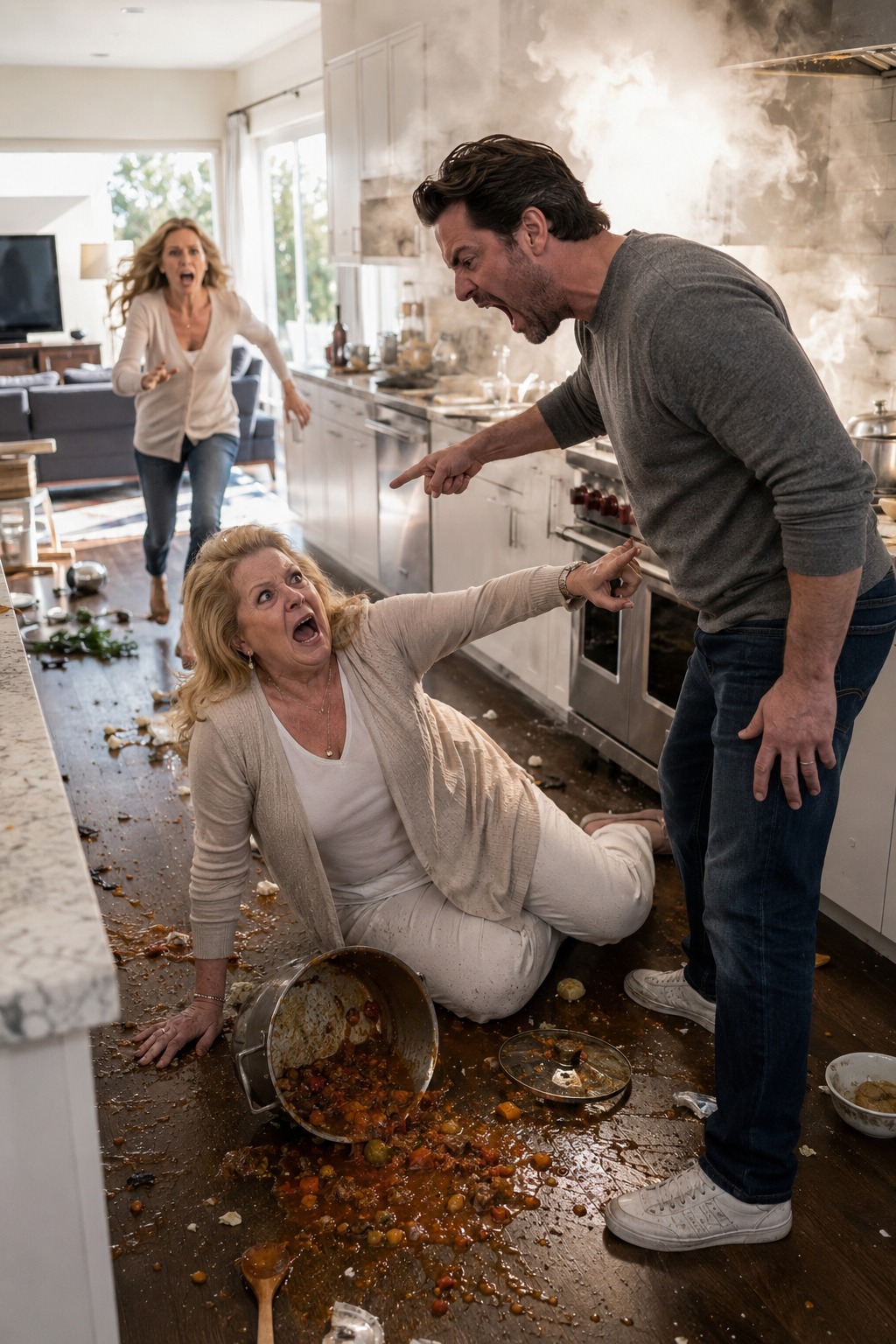
I Was Preparing A Stew In My Daughter’s Home In Los Angeles When My Son-In-Law Shoved Me To The Floor. “You Can’t Even Cook, Old Woman!” He Screamed. My Daughter Just Turned Up The TV, Pretending Nothing Happened. Five Minutes Later, A Thunderous Blast Shook The Kitchen. She Ran In – And Went Pale At What She Saw.
Part 1
The risotto was supposed to calm the house down.
That was what I told myself as I stood at my daughter’s stove, stirring Arborio rice through a pool of butter, onions, and saffron until the kitchen filled with that warm, golden smell Arthur used to call “Sunday light.” Outside the tall windows, Boston Harbor looked hard and silver under a January sky. Inside, everything was white, polished, and cold enough to make a person feel guilty for breathing too loudly.
I had been careful all afternoon. Careful with the cutting board so Mark would not complain about knife marks. Careful with the stainless-steel pans so no water spots dried on them. Careful with my own body, still thinner than it should have been after pneumonia had taken me down for two weeks and left me moving like a woman twenty years older than seventy.
The wooden spoon scraped the bottom of the pot in slow circles. Broth hissed when I added another ladle. The rice gave off steam that dampened my cheeks and fogged my glasses.
Behind me, Mark’s office door slammed.
I heard his expensive shoes hit the floor with fast, angry steps. He had been on calls all day, his voice rising and falling through the walls, sometimes smooth as a salesman’s handshake, sometimes sharp enough to peel paint. My daughter Clara sat in the living room with the television on too loud, pretending to watch a home renovation show where cheerful people knocked down walls and called destruction a fresh start.
Mark came into the kitchen and stopped beside me.
“What is that?” he asked.
I did not look at him right away. “Dinner.”
“That’s not dinner. That’s cement.”
I took a breath through my nose. Parmesan, saffron, chicken stock, onion. Familiar smells. Safe smells. “It’s risotto.”
He leaned over the pot and made a face as if I had served him dishwater. “No, Eleanor. Risotto has texture. This is mush.”
I kept stirring. “It needs two more minutes.”
He grabbed the spoon out of my hand.
It happened so quickly that for one second my hand stayed curved in the air, still holding the shape of something no longer there. He stirred hard, splashing broth onto the stove.
“You’re doing it wrong,” he snapped.
“I have made this dish since before you were born.”
That was the sentence that did it.
His head turned slowly. His face went red in blotches from his neck to his forehead. For a moment I noticed a tiny detail, absurdly clear: one of his cuff buttons was loose, hanging by a thread. Then his hand closed around my upper arm.
“You’re wrong,” he shouted. “Useless!”
He shoved me.
Not pushed, not guided, not startled me by accident. Shoved.
My hip folded under me. The kitchen tilted. The spoon clattered somewhere. I hit the tile first with my knee, then my shoulder slammed against the base of the refrigerator. Pain flashed white through my arm. My breath left me in a sound so small his rage swallowed it whole.
For a second I lay there with my cheek near the floor, smelling lemon cleaner and burned starch. The refrigerator hummed against my ear. My fingers twitched, uselessly searching for balance.
In the living room doorway, Clara stood frozen.
She had one hand on the wall. Her face was pale, her mouth open just enough to show she had seen everything. The television behind her kept playing; some young couple was laughing about backsplash tile.
“Mark,” she whispered.
“She fell,” he said without looking at her. “She’s clumsy. And now she’s ruined dinner.”
Clara’s eyes met mine.
I had carried that child inside my body. I had held her through ear infections, heartbreak, her father’s funeral. I knew every version of her face. I knew the look she wore when she was afraid, when she was guilty, when she had already decided to do the easier wrong thing instead of the harder right one.
Her eyes slid away.
That hurt worse than the tile.
I pushed myself up using the refrigerator handle. My shoulder screamed. Mark went back to the stove, muttering about incompetence, stirring the risotto like he was punishing it. Clara backed into the living room and sat down on the beige sofa, stiff as a mannequin.
Neither of them noticed the cream-colored envelope that had slipped halfway out of my apron pocket when I fell.
I noticed.
And when I saw the name printed in the corner, a bank I had never heard of, my pain changed shape inside me. It became something colder, sharper, and strangely awake.
### Part 2
I did not cry in the kitchen.
At seventy years old, you learn there are places where tears only feed the wrong person. So I stood, brushed imaginary crumbs from my apron, and walked past my daughter without asking for help. My knee trembled once. I forced it steady.
Their hallway smelled faintly of Mark’s cologne, cedar and something bitter. The walls were lined with black-and-white photographs of Boston bridges, all of them expensive, none of them personal. No family pictures. No drawing Clara had made as a child. No photo of Arthur in his work boots standing beside the apple tree he planted the year she turned six.
In the guest room, I locked the door and leaned against it until my breath came back.
The room was small but perfect in the way hotel rooms are perfect: gray blanket, white lamp, no clutter, no memory. My suitcase sat in the closet half-unpacked because I had kept telling myself I would return to Vermont soon. Every week I told myself that. Every week Clara found a new reason I should stay.
“Just until the ice melts.”
“Just until your follow-up appointment.”
“Just until Mark’s big closing is over. He’s under pressure, Mom.”
Pressure. That was the word she used for cruelty when she did not want to call it by its true name.
I sat on the edge of the bed and touched my shoulder. A bruise was already forming under my blouse, hot and tender. My hip throbbed. I stared at my hands in my lap. They were old hands, yes, but capable ones. Hands that had planted beans in rocky Vermont soil. Hands that had canned peaches, patched roofs, held a feverish child at three in the morning. Hands that had signed checks, buried a husband, driven through snowstorms, and fixed a broken furnace with a manual and stubbornness.
I had not come to Boston helpless.
But pneumonia had scared me. That was the truth I hated admitting. It had come fast, like weather over the mountains. One Monday I was coughing beside the woodstove; by Thursday I was in a hospital bed with oxygen tubes in my nose and a nurse telling me not to be brave. When the doctor said I should not live alone for a couple months, Clara had sounded almost desperate on the phone.
“Come here, Mom. Please. I can take care of you.”
Those words had cracked me open.
A daughter wanting her mother. A mother wanting to be wanted. It is embarrassing how easily love can dress itself up as wisdom when you are lonely.
At first, Mark behaved beautifully. He carried my suitcase. He brought herbal tea in a mug that cost more than my first winter coat. He called me “Eleanor” in a warm voice that never reached his eyes. Clara fluffed pillows and hovered so much I told myself I had misjudged everything.
Then I began getting stronger.
That was when kindness turned into usefulness.
Could I wipe the counters since I was already standing there? Could I fold towels while Clara worked? Could I make dinner because Mark had had a terrible day? Could I iron one shirt, just one, because he had a client breakfast?
Soon my physical therapy exercises were squeezed between cleaning glass shower doors and rubbing fingerprints off appliances. Mark stopped saying please. Clara stopped looking embarrassed. The apartment became a place where I was thanked less than the dishwasher.
And now he had put his hands on me.
I pulled the envelope from my apron pocket.
It was thick, cream-colored, expensive paper. My name was typed across the front:
Mrs. Eleanor Vance.
Below that was Clara and Mark’s address, Unit 12B, Harborview Tower.
The return address read: Consolidated Trust Bank, Boston, Massachusetts.
I turned it over. The flap had not been sealed properly, as if someone had opened it and pressed it closed again.
For a moment, the pain in my shoulder faded under a more dangerous feeling.
Someone had read my mail before I did.
### Part 3
I did not open the envelope right away.
That may sound foolish, but fear has strange manners. It can make you fold a letter neatly and set it on your pillow as if politeness might keep your life from changing. I washed my face instead. Cold water, ivory soap, towel pressed to my eyes until sparks floated behind my lids.
From the kitchen came the scrape of Mark cleaning the pot too hard. Clara’s voice rose once, soft and pleading. His answered like a slammed drawer. Then silence.
I sat on the bed and stared at the envelope.
Consolidated Trust Bank.
Arthur had never mentioned such a bank. My husband had been a quiet man, not secretive exactly, but private in the way old Vermont men can be. He kept receipts in coffee cans and sharpened pencils with a pocketknife. He believed in paying bills the day they arrived. When he died twenty years earlier from an aneurysm that took him between one breath and the next, I had found exactly what I expected: a modest pension, the farmhouse, a checking account, and a life insurance policy that covered funeral expenses and some repairs to the barn.
Nothing mysterious. Nothing grand.
Certainly nothing that would send a formal letter to a Boston condo where I did not live.
A noise in the hallway made me freeze.
Footsteps stopped outside my door. Mark’s shadow cut the strip of light beneath it.
“Eleanor,” he said.
I put the envelope under my pillow.
His voice changed through the door, softer now, almost oily. “Clara says you’re upset. I think we both got a little heated.”
I said nothing.
“You have to understand, I’m under enormous stress. I can’t come home to chaos. You’re staying here rent-free, eating our food. The least you can do is follow instructions.”
My fingers curled around the bedspread.
“I’ll expect an apology in the morning,” he added. “And don’t make Clara choose sides. That would be cruel.”
His footsteps moved away.
I waited until I heard his office door close. Then I opened the envelope.
Inside was a letter on heavy paper, two legal forms, a business card, and a smaller sealed envelope with my name written by hand.
My name, in Arthur’s handwriting.
The room seemed to draw backward from me. The walls, the lamp, the white bed, the gray blanket—all of it became distant.
I touched the ink.
Arthur had written my name with the slight rightward lean he always had, the capital E shaped like a small looped ribbon. I had not seen that handwriting in twenty years except on recipe cards and the old note he had left taped to the kitchen window one snowy morning: Gone for feed. Back by noon. Don’t lift the flour sack.
My throat tightened.
I read the formal letter first because the smaller envelope frightened me more.
Dear Mrs. Vance,
We have made several attempts to locate you regarding the private trust established by your late husband, Arthur James Vance…
I stopped. Read the sentence again.
Private trust.
My late husband.
The words did not belong together.
The letter explained that Consolidated Trust Bank had administered certain assets on behalf of a trust Arthur created before his death. Due to outdated contact information and a change in property forwarding records, their earlier notices had failed to reach me. A senior trust officer, Mr. Daniel Harrison, requested an urgent meeting to update beneficiary control and transfer direct authority.
I understood each word alone. Together, they formed a locked door.
I scanned lower.
There were references to investment accounts, holding companies, real estate assets, tax documents. My pulse beat in my bruised shoulder.
Then I saw a phrase halfway down the second page:
Beacon Hill Properties LLC.
I knew that name.
I had seen it printed on the rent notices Mark tossed in the kitchen trash. Once, weeks earlier, I had picked one up after coffee spilled across the floor. Mark had snatched it from my hand so quickly the paper tore.
“That’s private,” he had said.
At the time, I thought he was embarrassed about money.
Now I wondered what else he was hiding.
When I unfolded the last page, a single line made the room turn cold.
Primary real estate asset: Harborview Tower, Unit 12B.
I looked toward the locked door.
This apartment was listed in a letter addressed to me, connected to my dead husband, connected to a company Mark guarded like a secret.
And for the first time since I arrived in Boston, I felt sure of one thing: I had not been brought here only because Clara was worried about my health.
### Part 4
That night, I slept in pieces.
Every sound in the apartment came to me sharpened. The elevator chime through the wall. A pipe ticking behind the bathroom. Mark opening a cabinet sometime after midnight. Clara crying once, very quietly, then stopping as if she had pressed a hand over her own mouth.
I kept Arthur’s handwritten envelope under my pillow.
I did not open it until dawn.
The sky beyond the guest room blinds had the pale blue color of skim milk. My shoulder had stiffened overnight. When I lifted my arm, pain ran down to my wrist. In the mirror, I saw the first deep purple bloom beneath my collarbone.
Good, I thought.
Not because I wanted pain, but because proof matters. The world believes bruises more readily than women.
I sat by the window, broke the seal, and opened Arthur’s letter.
My dearest Eleanor,
If you are reading this, then I am gone longer than I ever wished to be, and something in your life has made you need protection.
I had to stop there.
Arthur had never been a flowery man. His love had lived in action: firewood stacked before a storm, coffee warmed without being asked, my side of the bed heated with a stone wrapped in flannel on nights when the wind came off the ridge. Seeing his love in words felt like hearing his voice through a wall.
I read on.
I did not tell you everything, and for that I ask your understanding, not your forgiveness. I made investments quietly because I wanted your life to remain yours. Money changes how people stand near you. It changes their voices. It invites hands into your pockets and opinions into your kitchen.
A sound escaped me, half laugh, half sob.
Arthur knew. Somehow, twenty years gone, he still knew.
The letter explained enough to make my hands shake. In the early 1990s, Arthur had invested in small technology companies through a college friend who worked in finance. What began as cautious purchases had grown. When Arthur became ill—though I had never known he suspected anything—he placed the assets in a blind trust with instructions that I not be contacted unless certain conditions were met: a financial threat, medical vulnerability, or evidence that our daughter might be dependent on people who did not have her best interests at heart.
I looked up at that.
Evidence.
What evidence had triggered the bank now?
I returned to the formal letter. There it was in smaller type near the bottom: attempted beneficiary inquiry submitted by third party. Property tax forwarding address updated. Contact re-established.
Third party.
I pressed my thumb against the paper until it bent.
At seven thirty, Clara knocked softly.
“Mom?”
I slid the papers into my suitcase beneath my folded sweaters. “Yes?”
“Mark has an early meeting. He wants breakfast.”
“He wants,” I repeated.
Silence.
Then, in a smaller voice, “Please don’t start today.”
Something inside me settled.
I opened the door. Clara stood in leggings and a soft blue sweater, her hair pulled back badly, as if she had done it with trembling fingers. There was a faint mark on her forearm, yellowing at the edges. Not fresh. Not accidental, either.
Our eyes both went to it.
She tugged her sleeve down.
“Did he do that?” I asked.
She looked past me into the guest room. “Mom, I can’t do this right now.”
“Can’t or won’t?”
Her lips parted. For a second I saw my Clara—the stubborn girl who once punched a boy for drowning ants with a garden hose. Then the apartment seemed to remember Mark for her. Her shoulders folded inward.
“He’s not always like this,” she whispered.
No sentence has ever carried more ghosts.
From the kitchen, Mark barked, “Clara!”
She flinched.
I wanted to grab her hand and drag her into the hallway, down the elevator, out into the cold morning. But a trapped person will sometimes bite the hand opening the cage. I knew that from neighbors back home, from women at church, from my own mother’s sister who stayed with a man until he finally left her for someone younger and easier to scare.
So I said only, “I’ll make breakfast.”
Mark sat at the island in a white shirt, scrolling his phone. He did not apologize. He did not look at my shoulder. He smiled when I set down his coffee.
“See?” he said. “Fresh start.”
I watched him lift the cup with the same hand that had shoved me.
In my apron pocket was Arthur’s letter. In my suitcase was the bank’s phone number. And under Mark’s laptop, half-hidden by a folder, I saw a printed document with my name on it.
The top line read: Petition for temporary guardianship.
### Part 5
I burned the toast on purpose.
Not badly. Just enough for Mark to smell it and swear under his breath, enough to make him stomp to the trash and scrape the blackened edges off with a knife. While he was busy performing outrage for an audience of two frightened women, I looked again at the document under his laptop.
Petition for temporary guardianship of Eleanor Vance.
Below that, my date of birth.
My address in Vermont.
A paragraph beginning: Due to cognitive decline and recent severe illness…
Cognitive decline.
I almost laughed.
The man who could not tell the difference between patience and weakness thought I was confused enough to sign myself away.
Mark turned too quickly for me to read more. “What are you staring at?”
“The toast,” I said.
“You ruined it.”
“So you mentioned.”
His eyes narrowed. He was not used to that tone from me. For two months I had answered him softly, hoping softness would keep peace. I had mistaken peacekeeping for kindness. In truth, it was only another form of hiding.
Clara stood near the sink, twisting a dish towel. Her eyes flicked to the document, then to me.
She knew.
Maybe not everything, but enough.
That knowledge landed in my chest like a stone.
After breakfast, Mark left for his meeting, taking the folder with him. Clara retreated to the bedroom, claiming a migraine. I cleaned the kitchen because old habits do not vanish in one morning, but I did it slowly, memorizing details: the building name on the mail stack, the property management number printed on an old envelope, the brand of camera mounted near the front door.
Then I dressed in my best wool suit.
It was dark green and twenty years old, but good fabric keeps its dignity. I pinned my silver hair back, put Arthur’s letter in my handbag, and wrapped a scarf over my bruised shoulder. When Clara saw me at the door, fear flashed across her face.
“Where are you going?”
“Out.”
“You can’t just leave.”
The words came too quickly. Mark’s words in her mouth.
I looked at my daughter until she dropped her eyes. “Watch me.”
The elevator ride down twelve floors felt like descending through layers of another person’s life. At the lobby desk, the doorman looked up from a tablet.
“Good morning, Mrs. Vance.”
It was the first time anyone in that building had called me by my name without sounding inconvenienced.
Outside, cold air hit my lungs. It smelled of salt, exhaust, and coffee from a cart on the corner. I wanted to cough but refused. I stood under the awning and called the number on Mr. Harrison’s card.
A woman answered on the second ring.
When I said my name, her voice changed immediately. Not warmer, exactly. More alert.
“Mrs. Vance, Mr. Harrison has been hoping to hear from you. Are you safe to speak?”
The question nearly undid me.
Safe.
I looked up at the twelfth floor. Somewhere behind those windows, my daughter was pretending not to know that her husband wanted me declared incompetent.
“I am safe enough,” I said. “For now.”
They sent a car.
Not a taxi, not a rideshare. A black sedan with a driver who stepped out and opened the door as if I were someone important. I sat in the back with my handbag clutched in my lap and watched Boston slide by—brick churches, glass towers, college students with knit hats, delivery trucks breathing steam into the morning.
Consolidated Trust Bank occupied a building that looked too old and too quiet for the city around it. Marble floors. Brass elevators. A lobby clock that ticked with the confidence of money that had never been late.
Mr. Harrison met me himself.
He was tall, silver-haired, and careful in the way doctors are careful when they already know the diagnosis. His office smelled faintly of leather and rain. He shook my hand with both of his.
“Mrs. Vance,” he said, “your husband was a remarkable man.”
I sat across from him and placed Arthur’s letter on the desk.
“Then tell me,” I said, “what remarkable thing he did.”
For two hours, Mr. Harrison showed me numbers I could barely believe, documents I forced myself to understand, and signatures that proved Arthur had built a hidden shield around me. Investments. Accounts. Properties. A holding company called Beacon Hill Properties. The trust value was over eight million dollars.
Eight million.
The number made no sound in my head at first. It was too large to be money. It felt like weather, like ocean, like something that could drown people or carry them depending on who held the map.
Then Mr. Harrison opened a folder marked Real Estate Assets.
“Your husband purchased several properties through the holding company,” he said. “One is currently occupied under a legacy lease.”
He turned the page.
Harborview Tower, Unit 12B.
I looked at the address where I had slept, scrubbed, cooked, and been shoved onto tile.
“Who signed that lease?” I asked, though my mouth had gone dry.
Mr. Harrison hesitated.
“Clara Vance Jennings and Mark Daniel Jennings.”
My daughter and her husband were not hosting me.
They were living in my property.
### Part 6
Power does not always arrive like thunder.
Sometimes it comes in a quiet office with a glass of water you forgot to drink, while a patient man explains that your signature now controls the roof over the head of someone who thought you were beneath him.
I looked down at the lease. Mark and Clara were paying a fraction of what that apartment was worth. A “family accommodation,” Mr. Harrison called it carefully, arranged years earlier through the trust. Arthur had intended the apartment to be available if Clara ever needed help. He had not intended it to become a palace for her husband.
“Did they know?” I asked.
“Know what, Mrs. Vance?”
“That I owned it.”
Mr. Harrison folded his hands. “The lease names Beacon Hill Properties as landlord. Your personal ownership was not disclosed. However, six months ago Mr. Jennings contacted the property manager requesting information about purchasing the unit. He was told the owner was not interested.”
Six months ago.
Before my pneumonia.
Before Clara called begging me to come to Boston.
A thread tightened.
“Did he ask about me?”
Mr. Harrison’s expression changed just enough. “A third-party inquiry was made regarding whether you were legally competent to manage inherited assets. It did not come through this bank directly, but it triggered a review. That is why we made renewed efforts to locate you.”
I thought of the guardianship petition. My name under Mark’s laptop. Clara’s sleeve pulled over the bruise on her arm.
The room was warm, but my hands felt cold.
“What happens now?” I asked.
“That depends entirely on you.”
No one had said that to me in months.
Not “Mark wants.” Not “Clara needs.” Not “don’t make things difficult.”
Entirely on you.
I straightened in the chair. “I want full authority transferred to me immediately. I want all accounts secured so no outside party can access information. I want the property management company instructed to deal only with me and my attorney.”
Mr. Harrison nodded, taking notes.
“And I want a lawyer.”
“We can recommend several.”
“I want someone who scares men who think women over sixty are furniture.”
For the first time, his mouth twitched. “I know exactly the person.”
By midafternoon, I had signed more documents than I had signed in the past decade. My hand cramped. My shoulder ached. My mind sharpened. The woman who entered that bank bruised and frightened did not leave the same way.
I did not go back to Harborview Tower.
Instead, I checked into the Fairmont Copley Plaza with only my handbag and the clothes I wore. The lobby glowed gold. A woman at the front desk called me Mrs. Vance and did not ask who was paying. My suite overlooked the square, where bare tree branches trembled in the wind and taxis slid through slush.
I stood in the bathroom under lights kind enough to lie and looked at my bruise.
Then I photographed it.
Front, side, close-up. My upper arm where Mark’s fingers had left marks. My shoulder. My knee. I emailed the photos to the lawyer Mr. Harrison recommended, a woman named Rachel Kim who called me fifteen minutes later.
“Do not return to that apartment alone,” Rachel said.
“I had no intention of returning as a guest.”
“Good. We’ll start with documentation. Assault, potential elder abuse, attempted guardianship abuse, landlord-tenant action if needed. You have options.”
Options.
Another word I had forgotten tasted so good.
I ordered room service that evening: steak, mashed potatoes, asparagus, and a glass of red wine. I ate slowly at a table by the window while my phone rang again and again.
Clara.
Then Mark.
Then Clara.
Then a text from Mark: Where the hell are you?
I did not answer.
At nine o’clock, Rachel sent me a draft notice. The lease would not be renewed at the old rate. Effective the first of the next month, rent for Unit 12B would be adjusted to full market value. If unpaid, legal proceedings would follow.
The increase was enormous.
Fair. Lawful. Devastating.
I approved it.
The next morning, the notice was delivered to their door at 9:03.
At 9:05, my phone rang, and Mark’s name lit the screen like a match over dry grass.
### Part 7
I let Mark’s call go to voicemail.
Then I made coffee in the hotel room machine, badly, because hotel coffee always tastes faintly of cardboard and regret. I drank it anyway while Boston woke outside my window. Horns. Brakes. A dog barking in the square. The ordinary world continuing, rude and beautiful.
The voicemail came through.
I played it once.
“Eleanor, call me immediately. There’s been some insane mistake with the apartment. Clara says you left yesterday and didn’t come back. This is unacceptable. You are staying in our home, and—”
He stopped there, perhaps remembering the notice in his hand.
“Our landlord is trying to extort us. If you know anything about this, you need to tell me now.”
I saved the voicemail.
At ten, Clara called.
I answered.
“Mom?” Her voice cracked on that one word.
“Yes.”
“Where are you?”
“Safe.”
A pause. I heard a door close on her end, then the small echo of a bathroom. Running water began. Cover noise.
“Mark is losing his mind,” she whispered. “The rent notice—it says we have to pay almost three times what we pay now. We can’t do that. Nobody can do that.”
“People pay market rent in Boston every day.”
“Mom, please don’t sound like that.”
“Like what?”
“Like you don’t care.”
I looked at the bruise on my arm. It had darkened overnight, yellow at the edges, purple in the center.
“I learned from your kitchen, Clara.”
She started crying, but quietly, as if even grief needed permission. “I’m sorry about yesterday.”
“No,” I said. “You’re sorry today.”
The running water hissed between us.
“He told me you fell.”
“You saw him shove me.”
Silence.
There are silences that mean confusion. There are silences that mean shame. Clara’s was both, braided with fear.
“Mom,” she said finally, “you don’t understand what it’s like.”
That sentence might have made me furious if I had not heard it from other women before. Women with makeup over bruises. Women at church who said their husbands were just tired. Women in grocery aisles flinching at phone calls.
“You’re right,” I said. “I don’t understand your marriage from the inside. But I understand what I saw.”
“He’s not always—”
“Do not finish that sentence.”
Her breath caught.
I softened my voice without softening my meaning. “Has he hit you?”
“No.”
“Has he grabbed you?”
Another silence.
“Has he threatened you?”
“Not exactly.”
“Has he made you afraid to answer simple questions?”
The water kept running.
Finally, she whispered, “He says I make him like this.”
I closed my eyes.
There it was. The old poison in a modern glass.
“Clara, listen carefully. You can leave.”
“I can’t. The apartment, the bills, his clients, our life—”
“Those are nouns, not chains.”
“You don’t know him.”
“I know enough.”
“No, you don’t.” Her voice dropped lower. “He has papers.”
“What papers?”
“I don’t know. Legal things. About you. About Dad’s estate, maybe. He said you were confused after pneumonia. He said we had to protect the family before you gave everything away or got scammed.”
The guardianship petition.
My stomach tightened, but my voice stayed even. “Did you sign anything?”
“I signed something at the hospital. Just for medical permission. He said it was standard because you were staying with us.”
“Clara.”
“I didn’t read all of it.”
The disappointment was so heavy I had to sit down.
My daughter had watched him shove me. My daughter had signed papers about me without reading them. My daughter had let fear make her dangerous.
“I’m scared,” she said.
“I know.”
“Can you fix it?”
There it was again. The child reaching for the mother after helping lock the door.
“I can help you get safe,” I said. “I cannot fix what you chose.”
She began to sob then, not the soft crying of guilt, but the raw sound of someone seeing a wall where she expected a bridge.
A fist pounded on her bathroom door.
“Clara!” Mark shouted through the phone. “Who are you talking to?”
She gasped.
The line rustled.
“Leave your phone on,” I said quickly. “Put it down. Do not hang up.”
But the call went dead.
For three minutes, I stood completely still with the phone in my hand.
Then a text arrived from an unknown number.
Mom. He took my phone. He has your red folder. I think he knows.
### Part 8
The red folder was in my suitcase.
Or it should have been.
I crossed the hotel room in three steps and opened the closet. My suitcase sat on the luggage rack, brown leather cracked along the edges, Vermont mud still caught in one wheel. I unzipped it and lifted sweaters, underclothes, a flannel nightgown, the small pouch where I kept my prescriptions.
The red folder was gone.
I had used it for years to hold important papers: my birth certificate copy, Arthur’s death certificate, insurance information, the deed to the Vermont farmhouse, Clara’s old school records I could never bring myself to throw away. I had not needed it in Boston, but I packed it because illness makes you think of paperwork.
Mark had been in my room.
Maybe before the shove. Maybe after. Maybe while Clara stood guard without admitting to herself that guard was what she had become.
I called Rachel.
She listened without interrupting.
“First,” she said, “you’re going to write down everything you remember about that folder. Second, I’m filing a notice with the court that any guardianship petition involving you is contested and potentially fraudulent. Third, we should consider a police report for the assault and missing documents.”
“I don’t want Clara trapped with him because I act too quickly.”
“Eleanor, respectfully, he is already trapping her. Acting carefully is not the same as waiting.”
I liked Rachel.
By noon, she had sent a courier to the hotel for copies of my bruise photos and bank documents. By two, she had contacted the property manager. By four, she had discovered that Mark had indeed scheduled a consultation with an attorney about “elder care planning” and “asset preservation.”
Asset preservation.
I laughed when she said it, but there was no humor in me. Men like Mark have a way of making theft sound like stewardship.
That evening, I moved from the hotel to a furnished apartment in Beacon Hill arranged by the bank. It was on a quiet street lined with brick row houses and black iron railings. The rooms had soft lamps, old rugs, bookshelves, and windows that looked over bare trees. It felt lived in by people who understood silence did not have to be sterile.
I slept little.
At 6:12 the next morning, Clara called from another unknown number.
“Mom?”
I sat up so fast my shoulder protested. “Where are you?”
“In the stairwell. I borrowed Mrs. Patel’s phone from eleven. I told her I locked myself out.”
Her voice was breathless. I could hear concrete echo and a distant door slamming.
“Is he with you?”
“No. He’s asleep. He drank last night.”
“Are you hurt?”
A pause.
“Clara.”
“He grabbed my wrist. It’s fine.”
“No, it is not.”
She gave a tiny broken laugh. “You sound like yourself.”
“I am myself. That has been the problem for everyone lately.”
She sniffed. “He says the rent notice is your fault. He keeps saying you found some lawyer, that you’re trying to turn me against him. He went through your suitcase. He found the red folder, but I don’t think he found the bank letter. Did you take it?”
“Yes.”
“Good.”
That one word opened a small window in me.
She was afraid, but she was thinking.
“Listen to me,” I said. “Can you leave today?”
“I don’t know.”
“That is not an answer.”
“He watches the door camera. He took my phone. He has my wallet in his office because he says I spend when I’m anxious. I have my passport hidden in a coat pocket.”
I stood and began dressing while holding the phone between shoulder and ear. “At ten thirty, a black car will stop outside the building. The driver’s name will be Samuel. He will say Arthur sent him. You take your passport, any medication, and nothing else. Do you understand?”
“What about clothes?”
“Clothes can be bought.”
“What about my sketchbooks?”
I closed my eyes.
Clara’s sketchbooks had been her life once. Before Mark. Before the art history degree she abandoned. Before she became a woman who matched throw pillows and apologized to furniture.
“If you can grab one safely, grab one. If not, leave it.”
Her breath shook. “Will you forgive me if I come?”
I looked out the window at a sparrow landing on the railing, small claws gripping iron.
“No,” I said.
The silence that followed was sharp.
“I will help you,” I continued. “I will protect you if you choose to leave. I will love you because I am your mother. But forgiveness is not the price of rescue.”
She began crying again.
“Ten thirty,” I said. “Do not be late.”
At ten twenty-nine, I stood inside the Beacon Hill apartment with my coat on, staring at my phone.
At ten forty-one, Samuel called.
“Mrs. Vance,” he said, voice tight, “your daughter has not come out.”
Then, in the background, I heard a woman scream.
### Part 9
I do not remember hanging up.
One moment Samuel’s voice was in my ear; the next I was halfway down the stairs with my coat unbuttoned, calling Rachel, then the police, then Samuel back. My hands shook so badly I hit the wrong number twice.
“Stay where you are,” Rachel said. “Do not enter that building alone.”
“I am not staying anywhere while my daughter screams.”
“Eleanor.”
There are tones lawyers use for unreasonable clients. Rachel tried that tone. It bounced off me.
By the time my car reached Harborview Tower, two police cruisers were already at the curb. Samuel stood near the entrance, a tall man in a dark coat, his face grim. The doorman looked terrified in the way employees look when private ugliness spills into public marble.
“She came out of the elevator,” Samuel said. “No purse. Just a coat. He came after her before she reached the doors. Grabbed her arm. She screamed. Then they went back toward the elevators. I called 911.”
“Did she go willingly?”
“No, ma’am.”
The lobby smelled of floor wax and panic.
A police officer asked me who I was. I told him I was Clara’s mother, the property owner, and the victim of an assault by the same man two days earlier. That sentence changed his posture. Rachel arrived ten minutes later, hair damp from rushing, carrying a leather bag and a look that could cut wire.
The officers went up first.
I was told to wait.
Waiting is its own violence.
I stood beside the lobby fireplace, which burned gas flames behind glass and produced no heat. My mind filled the silence with every terrible possibility. Clara at five with jam on her chin. Clara at twelve screaming that I ruined her life because I would not buy her platform shoes. Clara at twenty-two calling from college to say she had changed her major because art made more sense than economics. Clara at forty-five behind a locked door with a man who had learned her fear like a language.
The elevator opened.
Clara stepped out between two officers.
Her hair had fallen from its clip. One cheek was red. Her coat was buttoned wrong. In her arms she clutched a single black sketchbook to her chest.
I moved toward her, then stopped.
I wanted to hold her. I also wanted to shake her. Both truths lived in me.
She came to me first.
“I tried,” she said, and then she collapsed against my coat.
That was enough for the moment.
Mark came down separately, not handcuffed, which angered me until Rachel explained quietly that Clara had refused to press charges beyond making a report. His face was composed now, salesman-smooth, except for a small muscle jumping in his jaw.
When he saw me, he smiled.
Not warmly. Not kindly. A smile like a knife pulled an inch from its sheath.
“Eleanor,” he said. “This is a misunderstanding. Clara had a panic episode.”
Clara flinched.
Rachel stepped between us. “Mr. Jennings, you will not address my client.”
“Your client?” He laughed once. “Of course. She has a lawyer now. Perfect.”
I looked at him over Rachel’s shoulder.
“Where is my red folder?”
His expression did not change, which told me more than a confession.
“I have no idea what you’re talking about.”
“Then you will not mind when the police search for stolen personal documents.”
His eyes flickered.
There it was.
Clara’s fingers tightened around my sleeve. “Mom, please. Let’s go.”
I let her guide me out, but not because Mark had won that moment. Because a battlefield is not the same as a home, and I needed Clara somewhere he could not reach her before she lost her nerve again.
Back at Beacon Hill, she sat on the sofa with a cup of tea untouched in her hands. Her wrist was swollen. There was a red mark on her cheek that would darken by morning.
For a while, neither of us spoke.
Then she said, “I knew he was wrong about you.”
I waited.
“I knew he was cruel. Not at first, or maybe I did and I called it confidence. But later, I knew.” She looked at the tea. “When he told me to sign the hospital forms, I didn’t want to. He said if I didn’t, and something happened to you, it would be my fault. He said Dad would be ashamed of how I handled things.”
Arthur’s name in Mark’s mouth made my skin crawl.
“Your father would have thrown him out by his collar,” I said.
She gave a sobbing laugh.
Then I told her everything.
Not gently. Not cruelly. Clearly.
Arthur’s trust. The investments. Beacon Hill Properties. The apartment. The rent increase. The guardianship petition. The fact that Mark had been trying to get near money he did not even understand.
Clara listened without interrupting. Her face moved through disbelief, horror, shame, and something like grief.
When I finished, she whispered, “So you own the apartment.”
“Yes.”
“And the rent notice…”
“Yes.”
She set the tea down with both hands. “You used it to force him.”
“I used it to show you.”
Her eyes filled. “And what did you see?”
I looked at my daughter—bruised, frightened, alive, sitting in a room he did not control.
“I saw that you could still walk out,” I said. “But Clara, I also saw what you were willing to let happen to me before you did.”
She closed her eyes as if I had slapped her.
I did not take it back.
That night, she slept in the guest room. I stood in the hallway long after her light went out, listening to her breathe through the door the way I had when she was a baby.
At midnight, Rachel called.
“The court clerk just found something,” she said. “Mark filed an emergency petition this morning.”
“For guardianship?”
“Yes. But not just over you.”
My hand tightened around the phone.
“He is claiming Clara is mentally unstable and financially incompetent too.”
### Part 10
Mark had made one mistake.
He thought control was the same thing as intelligence.
Rachel emailed the petition before sunrise. I read it at the kitchen table while Clara slept. The apartment was quiet except for the old radiator clicking in the corner. Outside, Beacon Hill wore a thin coat of snow, softening steps, railings, window boxes, the whole city briefly pretending it had no sharp edges.
The petition was ugly in clean language.
Mark claimed Clara suffered from anxiety, poor judgment, financial impulsivity, and “undue influence from an elderly parent whose own cognitive condition remains uncertain.” He requested temporary authority over marital assets, medical decisions, and residential arrangements. He described himself as “the sole stable party.”
Stable.
The man who shoved me over risotto.
The man who chased his wife through a lobby.
The man who stole my documents and called theft protection.
I read every line once, then again. Anger is useful only after it becomes organized.
When Clara woke, she found me making eggs.
She hovered at the edge of the kitchen in borrowed pajamas. “Did something happen?”
“Yes.”
Her face emptied.
I slid the petition across the counter.
She read standing up. Halfway through, she gripped the edge of the marble. By the end, she had gone very still.
“He can’t do this,” she said.
“He is doing it.”
“But these things—some of them are private. Things I told him.”
I turned off the stove.
That is one of the quietest betrayals in abusive love: not the shouting, not the grabbing, but the way your own pain is stored and labeled for later use against you.
“He wrote about my panic attacks,” she said. “He wrote about the medication I took after the miscarriage.”
I had not known about a miscarriage.
The room changed.
Clara looked up and saw that I had understood. Her face crumpled.
“It was four years ago,” she whispered. “I was ten weeks. Mark said not to tell you because you’d make it about yourself.”
I had to put one hand on the counter.
There are griefs you miss because someone locks the door from the inside. They do not vanish. They wait, and when you find them later, they are still warm.
“I would have come,” I said.
“I know.”
“Do you?”
She covered her mouth.
For a moment, we were not talking about Mark or money or court. We were standing in the wreckage between mother and daughter, looking at all the places fear had been allowed to build.
Rachel arrived at nine with coffee, a laptop, and a plan. Clara would oppose the petition. I would file my own sworn statement about the assault, theft, and suspected financial exploitation. The bank would provide documentation proving my competence and independent control. The property manager would confirm Mark had no ownership rights. The police report would support a restraining order.
“And the apartment?” I asked.
“We proceed with notice to pay or quit. If he doesn’t pay, eviction. If he damages the unit, we add that. If he threatens either of you, we document and move faster.”
Clara sat beside me at the table, hands wrapped around a mug. “He won’t leave quietly.”
“No,” Rachel said. “Men like him rarely do. But courts understand paper. We’re going to give them paper.”
The next days became a blur of signatures, statements, appointments, and small recoveries. Clara bought a cheap phone and changed every password. We froze her credit. She spoke to a therapist by video and cried so hard afterward she slept for three hours. I visited a doctor who documented my bruises and wrote the words “consistent with reported assault” in my chart.
Those words felt like a hand at my back.
Meanwhile, Mark unraveled loudly.
He left voicemails that began with pleading and ended with threats. He sent emails accusing Clara of being kidnapped. He contacted two of her old friends and told them I had dementia. He called the property manager six times in one day and demanded to speak to “the real owner.”
Rachel saved everything.
On the first of the month, no rent was paid.
On the second, the formal notice went out.
On the fifth, Mark taped a handwritten sign to the inside of the apartment door, visible through the glass when the property manager tried to inspect:
PRIVATE PROPERTY. TRESPASSERS WILL BE PROSECUTED.
He did not own a nail in the wall.
On the seventh, Clara and I attended the emergency guardianship hearing.
Mark arrived in a navy suit, clean-shaven, carrying a leather folder I recognized immediately.
My red folder.
He saw me see it.
Then he smiled, opened it, and pulled out a document bearing Clara’s signature.
### Part 11
Courtrooms do not look the way television teaches you they look.
This one was smaller, beige, and smelled faintly of old coffee. The judge wore reading glasses low on her nose. A clerk typed with tired efficiency. Someone’s phone buzzed twice before being silenced. Ordinary details, ordinary morning, except my daughter sat beside me with her hands locked together so tightly her knuckles had gone white.
Mark stood at the other table with his attorney, a narrow man who looked like he regretted taking the case.
The document in Mark’s hand was a medical authorization Clara had signed while I was hospitalized. At first glance, it gave her access to discuss my care. At second glance, in smaller attached language, it referenced “temporary decision-making support in matters of health, residence, and financial continuity.”
Clara stared at it as though it had crawled out of a drain.
“I didn’t know that was attached,” she whispered.
“I believe you,” I said.
And I did.
Belief is not the same as forgiveness. I was learning to separate them.
Mark’s attorney argued that I had been vulnerable after illness, that Clara was emotionally unstable, that Mark had tried to maintain order in a difficult family situation. He described me as “confused,” “reactive,” and “recently influenced by unknown financial advisors.”
Rachel rose with the calm of a woman setting a table before a feast.
She presented the bank letter. My doctor’s statement. The bruise photographs. The police report. Voicemails from Mark. Emails. The property records showing Beacon Hill Properties and my authority. The petition Mark filed over Clara. The stolen red folder, which Mark claimed he had taken “for safekeeping.”
The judge listened without expression.
Then Rachel played one voicemail.
Mark’s voice filled the room.
“You stupid old woman. You have no idea what you’re messing with. Clara is mine. That apartment is mine. Whatever Arthur hid, I’ll find it, and when I do, you’ll wish you stayed in Vermont and died quietly.”
The room went completely still.
Clara made a sound beside me so small I almost missed it.
The judge took off her glasses.
“Mr. Jennings,” she said, “did you leave this message?”
Mark’s mouth opened.
For once, nothing useful came out.
His attorney closed his eyes.
The emergency guardianship petition was denied. A temporary protective order was granted for Clara. My request for a protective order moved forward with supporting documentation. Mark was ordered not to contact either of us except through counsel.
He turned as he left the courtroom. His face was no longer red with rage. It was pale with humiliation, which is often more dangerous.
“This isn’t over,” he said.
Rachel stepped in front of me. “Actually, Mr. Jennings, this part is.”
But of course it was not.
Abusers do not lose power and then politely send a thank-you note.
Two days later, the property manager reported that neighbors heard smashing from inside Unit 12B. Security footage showed Mark carrying boxes to his car at midnight. Not his clothes. Not personal items. Boxes from the office, the storage closet, Clara’s studio corner.
“My sketchbooks,” Clara said when I told her.
Her face went slack.
We drove to Harborview with Rachel and two officers, but Mark refused to open the door. Through the hallway, we heard music blasting. Something crashed inside. The polished hallway smelled faintly of whiskey even before the door opened an inch on its chain.
Mark’s eye appeared in the gap.
“You don’t live here anymore, Clara,” he said. “You abandoned your home.”
“This is not your home either,” I said.
His eye shifted to me.
“You think money makes you strong?”
“No,” I said. “It makes my lawyer faster.”
He laughed, but it came out cracked.
The officer told him to open the door. He refused. Without a court order for immediate entry, there was only so much they could do that day. Procedure can feel like cowardice when you are standing inches from your own stolen life.
As we turned to leave, Mark shoved something through the gap.
A page torn from one of Clara’s sketchbooks.
It floated to the hallway floor.
Clara bent to pick it up. I recognized the drawing even upside down: our Vermont farmhouse in summer, the porch sagging, the apple tree heavy with fruit, Arthur’s old hat hanging from a nail by the door.
Across it, in thick black marker, Mark had written:
SHE CHOSE ME OVER YOU ONCE.
Clara covered her mouth.
I looked at that ruined drawing and felt my heart become very quiet.
Mark had not understood the one thing he should have feared most.
The woman who had fallen in his kitchen was gone.
### Part 12
The eviction order came on a gray Thursday morning.
By then, Mark had missed every deadline available to him. He had ignored the notice to pay. He had violated the protective order by emailing Clara from three new accounts. He had told the building manager I was senile, told neighbors Clara was having a breakdown, and told his attorney—who soon withdrew—that he was the victim of an elaborate family conspiracy.
Some people use lies like umbrellas.
Mark tried to build a house out of them.
The sheriff’s deputies met us in the Harborview lobby at ten. Rachel stood on my right. Clara stood on my left, wearing a black coat and no makeup. Her wrist had healed to a yellow-green shadow. Mine had faded too, though sometimes my shoulder still ached in cold weather.
“Are you sure you want to come up?” I asked her.
She nodded. “I need to see the door open.”
So did I.
The elevator rose slowly. Twelve floors. Each soft chime felt like a count.
In the hallway, the air was too warm. Someone had burned toast in another apartment. A baby cried behind a door. Ordinary life, again, crowding around extraordinary endings.
A deputy knocked hard.
“Mark Jennings. Sheriff’s department. We have a court order to restore possession of this property.”
Silence.
Then his voice: “Go to hell.”
The locksmith stepped forward.
The drill whined against the lock. Clara flinched at the sound but did not step back. I watched the metal shavings fall like gray dust onto the mat I had once vacuumed every Friday because Mark said guests noticed details.
The door swung inward.
The smell hit first.
Stale liquor. Garbage. Sweat. Sour milk. The apartment that had once been sterile enough to shame a fingerprint was wrecked. Sofa cushions ripped open. Cabinet doors hanging crooked. Broken glass glittered near the kitchen island. A dark stain spread across the white rug.
And there, beside the stove, stood Mark.
He wore sweatpants and a wrinkled dress shirt. His beard had grown unevenly. His eyes were bloodshot, but when he saw Clara, he tried to arrange his face into tenderness.
“Baby,” he said.
Clara’s hand brushed mine once, then released.
“No,” she said.
One word. Small. Complete.
Mark blinked. “You don’t understand what she’s done to us.”
“I understand enough.”
“She manipulated you.”
“You used me.”
His face twisted. “After everything I gave you?”
Clara looked around the ruined apartment. “You never gave me anything that didn’t come with a leash.”
The words landed beautifully.
Mark stepped toward her. A deputy moved between them.
Then he saw me.
Really saw me.
Not as the old woman at his stove. Not as a nuisance in his guest room. Not as someone to petition into silence. He saw my coat, my lawyer, the deputies, the locksmith, the property manager holding documents, the entire machinery of consequence turning without his permission.
“You,” he said.
“Yes,” I replied.
“This is because of that little shove?”
A little shove.
My daughter inhaled sharply.
I walked past the deputy just far enough to stand in the doorway, not inside. I would not step into that filth until he was gone.
“No, Mark,” I said. “This is because you mistook patience for permission.”
His jaw worked.
“The apartment belongs to Beacon Hill Properties,” I continued. “Beacon Hill Properties belongs to me. You were a tenant. You failed to pay rent, stole documents, damaged property, assaulted your landlord, and abused your wife. You do not live here anymore.”
For a moment, he had no mask left.
His face showed the bare animal underneath: fear, rage, disbelief.
Then he lunged.
Not at me.
At Clara.
The deputies caught him before he crossed the threshold. One twisted his arm behind his back with practiced efficiency. Mark shouted, cursed, called Clara ungrateful, called me a witch, called the deputies criminals. His voice cracked as they cuffed him.
Clara did not cry.
She watched them take him down the hallway, his expensive shoes dragging slightly because he kept trying to turn back.
Only when the elevator doors closed on his shouting did she bend forward, hands on her knees, breathing hard.
I placed a hand between her shoulder blades.
She did not lean into it. Not yet.
Inside, the apartment looked worse than grief. It looked like exposure. Clara’s sketchbooks were scattered, some torn, some wet. I picked up one from beneath a broken lamp. The pages smelled of whiskey. A drawing of Arthur’s hands had been ripped straight through.
Clara took it from me and held the two halves together.
“I hate him,” she whispered.
“Good,” I said.
She looked at me, startled.
“Hate can be honest when love has been used as a blindfold.”
Rachel cleared her throat softly. “We’ll document the damage.”
I nodded.
Clara turned toward me, the torn drawing in her hands. “Mom?”
“Yes.”
“Are you ever going to forgive me?”
The apartment seemed to hold its breath.
I looked at my daughter, alive and shaking among the ruins she had helped me escape only after helping me suffer.
“No,” I said gently. “Not the way you want.”
Her face folded.
“But I will tell the truth with you. I will build something new beside you if you keep choosing truth. That is what I have to offer.”
She looked down at Arthur’s torn hands.
Then she nodded once.
Behind us, the kitchen waited with its cold white tile.
This time, I walked across it standing upright.
### Part 13
We did not keep the apartment.
Rachel said we could repair it, rent it again, let it become an asset on a spreadsheet. Mr. Harrison agreed. Boston property was valuable. Harbor views did not become less profitable because bad men had shouted inside them.
But I could not stand the thought of that kitchen reflecting light into another woman’s eyes.
So we sold it.
Before the sale, a cleaning crew spent three days removing trash, broken furniture, and the stink of Mark’s last stand. Contractors replaced cabinets, floors, locks, glass. The white tile where I had fallen came up in neat squares and disappeared into a dumpster. I watched from the doorway while a young man in work boots pried the first piece loose.
It made a cracking sound.
Clara stood beside me.
Neither of us spoke.
Mark’s life shrank quickly after that, which is what happens when a man’s power has been rented, borrowed, and stolen rather than earned. His brokerage dropped him after the arrest and the protective order became public enough to embarrass them. Clara filed for divorce. He fought, threatened, delayed, and then discovered that courts are less impressed by volume than evidence.
He got no apartment.
No money.
No wife.
No private access to either of us ever again.
Sometimes people expect revenge to feel hot, like fire. Mine felt clean, like opening windows in a room that had smelled bad for too long.
Clara moved into the Beacon Hill apartment with me for three months. Not because all was forgiven. It was not. We lived carefully, like two people crossing a frozen pond and listening for cracks.
She apologized often at first.
I told her to stop apologizing unless the apology came with a changed action. So she changed actions.
a changed action. So she changed actionsShe went to therapy twice a week. She read every legal document before signing it. She stopped explaining Mark’s behavior in soft words. She called what happened abuse. She called what she did betrayal. The first time she said that word without collapsing, I made tea and put honey in hers the way she liked.
I did not say, “It’s okay.”
It was not okay.
But I did say, “Keep going.”
In spring, we drove to Vermont.
The farmhouse had waited through winter with snow against the foundation and mice in the pantry. Dust lay on the windowsills. The garden slept under brown leaves. Arthur’s apple tree stood bare but steady.
Clara cried on the porch.
“I thought I’d lost this place,” she said.
“So did I.”
We stayed a week. We opened windows. We scrubbed floors. We burned old papers that no longer deserved storage. One afternoon, Clara found a box of her childhood drawings in the attic, tied with twine by Arthur’s hands long before either of us understood what he had saved.
She sat on the attic floor for an hour, touching each page.
That summer, I made a decision that surprised everyone except perhaps Arthur, wherever he was.
I sold the Boston properties except one small brownstone. I kept the Vermont farmhouse. Clara and I bought a house in Cambridge with big windows, uneven floors, a backyard garden, and a detached carriage house we turned into her studio. She did not live in my pocket. I did not live in hers. Love, I had learned, needs doors as much as it needs bridges.
With Arthur’s trust, we created the Arthur’s Shield Foundation.
Rachel joined the board. Mr. Harrison helped structure the finances. Clara ran the first program: emergency housing and legal aid for older women and women trapped in marriages that looked respectable from the lobby. We funded hotel rooms, locksmiths, lawyers, storage units, burner phones, rides at ten thirty in the morning when someone finally found the courage to walk out.
Sometimes I answered calls myself.
Women would apologize before asking for help.
I would say, “Do not apologize for surviving.”
And I meant it.
One evening in September, Clara and I sat in the Cambridge garden shelling peas into a blue bowl. The air smelled of damp soil and basil. A neighbor’s radio played softly over the fence. My hands moved automatically, thumb splitting pod, peas dropping like small green beads.
Clara looked healthier than I had seen her in years. Not fixed. People are not chairs. They do not get fixed and stay that way. But she was present. Her laugh had weight again. Her eyes met mine without sliding away.
“I know you don’t forgive me,” she said.
I kept shelling peas. “No.”
She nodded. “I’m starting to understand that forgiveness isn’t something I can demand because I feel guilty.”
“That is a useful lesson.”
“Do you still love me?”
I looked at her then.
That question had lived under every conversation since the courthouse. It had sat with us at breakfast, ridden in the car, stood in the doorway of her therapy appointments.
“Yes,” I said. “I love you. I do not forgive the woman who looked away while I was on that floor. I love the woman who walked out with one sketchbook and told the truth afterward. Both things are true.”
Tears filled her eyes, but she smiled a little. “That sounds like you.”
“It took me seventy years to sound like me. I recommend starting earlier.”
She laughed, and this time there was no brittleness in it.
Later, after she went inside, I stayed in the garden until the first stars appeared. I thought of Arthur. His hidden money. His letter. His belief that I would know when to use the shield he left me.
He had been right about the shield.
But the standing up was mine.
The cold kitchen floor had not been the end of me. Mark’s shove had not made me smaller. Clara’s silence had not erased my worth. All three had simply shown me the exact shape of the cage I needed to break.
Dignity is not something other people hand back when they are finished humiliating you.
Dignity is something you reach for with bruised hands.
And once I took mine back, I never put it down again.
THE END!