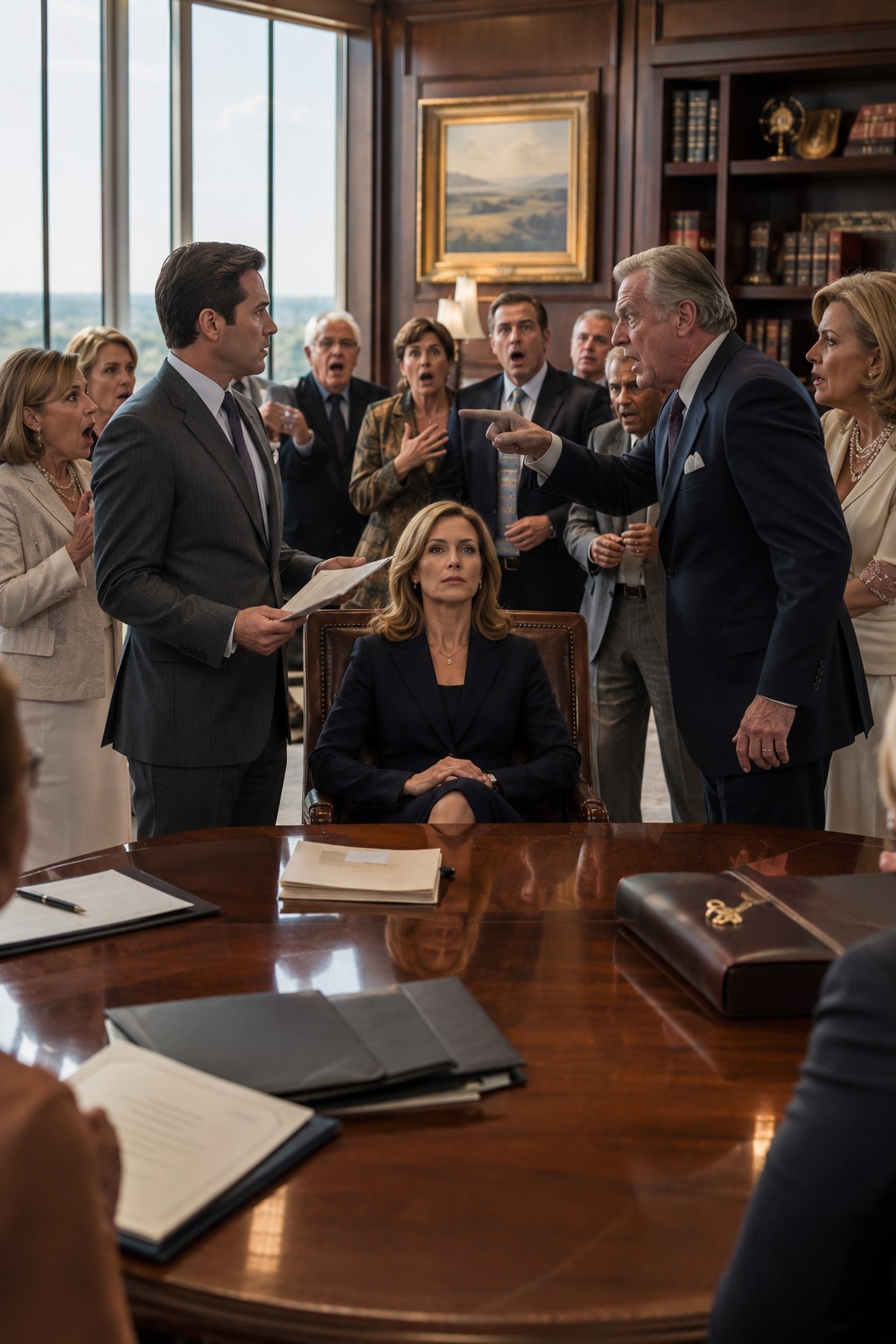
“She Hasn’t Been Part Of This Family For Years,” My Uncle Said At The Will Reading. His Wife Nodded. “It’s Just A Clerical Holdover. Nana Probably Forgot To Update The Paperwork.” I Stayed Silent. Then The Lawyer Looked At Him And Said, “Mr. Calloway, Before We Proceed – Do You Actually Know What Your Niece Does For A Living?” My Uncle’s Face Went Pale. My Uncle’s Hands Went Still.
(My Uncle Called Me “A Stranger With a Last Name” at Grandma’s Will Reading — Until the Lawyer Asked One Question)
Part 1
My uncle called me a stranger on a Tuesday morning in February, in a conference room that smelled like burnt coffee, old paper, and lemon furniture polish.
Hartley & Bowen Law sat on the seventh floor of a brick building in downtown Columbus, the kind of place with framed black-and-white photographs of the city from back when men wore hats to work and streetcars ran down High Street. Outside the window, slush clung to the curb in gray ridges. Inside, the room was warm enough that my wool coat felt too heavy across my shoulders, but I kept it on anyway.
Richard Callaway sat across from me with both hands flat on the table, like he was trying to claim the wood. His wife, Sandra, sat beside him in a cream-colored coat that had probably cost more than my first car. She kept tapping her phone with one glossy fingernail, her mouth pulled into that soft, satisfied line people wear when they think the hard part is already over.
Then Mr. Bowen read the clause.
The house. The investment accounts. The remaining cash after specific gifts. My grandmother’s estate, most of it, was left to me.
For three seconds nobody moved.
Then Richard laughed once. It was not a happy laugh. It was the sound a person makes when the elevator drops one floor too fast.
“No,” he said.
Mr. Bowen looked over his reading glasses. “No?”
“I want to contest it.”
My hands were folded in my lap. I could feel the seam inside my left glove pressing into my thumb. I stared at that seam because if I looked at Richard too long, I was afraid I would see something I had spent my whole life trying not to name.
Sandra finally looked up from her phone. “There must be some mistake.”
“There is no mistake,” Mr. Bowen said.
Richard’s face darkened. “She hasn’t been part of this family for years.”
I blinked once.
He pointed at me without turning his hand all the way over, like I was evidence on a tray. “She came around when Mom got sick. She made herself useful. And now this? Come on, Gerald. She’s essentially a stranger with a last name.”
Sandra nodded. “It’s really just a clerical holdover. Dorothy probably forgot to update the paperwork.”
The room became so quiet I could hear the heating vent ticking in the wall.
I did not defend myself. Not because I had nothing to say. I had rehearsed speeches in traffic, in showers, in the cereal aisle at Kroger while trying to decide between two brands of oatmeal. I had sentences sharp enough to draw blood. But when the moment came, the words stayed behind my teeth.
Mr. Bowen did not raise his voice. He only set the will down, squared the corners of the pages, and looked at my uncle.
“Mr. Callaway,” he said carefully, “before we proceed, I want to make sure everyone in this room understands who all the named parties are.”
Richard waved him off. “We know who everyone is.”
“No,” Mr. Bowen said. “I’m not sure that you do.”
Sandra’s finger stopped above her phone screen.
Mr. Bowen reached into his leather document case and removed a red folder I had not noticed before. It was thin, sealed with a white paper band, and labeled in my grandmother’s neat block handwriting.
He laid it on the table between us.
Then he looked directly at Richard and asked, “Before I allow you to call Maya a stranger again, do you recognize your sister Elise’s signature?”
### Part 2
My mother’s name was Elise Callaway, and for the first nine years of my life she was the whole weather of my world.
She smelled like coconut shampoo and coffee. She drove a blue Honda Civic with one missing hubcap and kept peppermints in the console. She worked billing at a dental office and wore soft cardigans with tiny pearl buttons. When she laughed, she covered her mouth with the back of her hand like laughter was something private that had accidentally escaped.
My father left when I was four. He did not storm out. He did not throw anything. He simply became a person who was supposed to come home and didn’t. At first my mother explained him in gentle phrases. He’s figuring things out. He needs space. He loves you in his way. After a while she stopped explaining. His name faded from our apartment the way smoke thins after a candle is blown out.
When my mother got sick, the explanations came back.
The doctors said ovarian cancer. My mother said bad cells. My grandmother, Dorothy Callaway, said nothing at all for almost a full minute, standing in our tiny kitchen in Dayton with her purse still on her arm and snow melting from her boots onto the linoleum.
Then she took off her gloves, washed her hands, and started making phone calls.
That was Nana. Dorothy Callaway did not collapse. She made lists.
She drove from Columbus every other day at first, then every day, then she stopped pretending and moved into our apartment with one suitcase and a metal recipe box. She learned the names of every nurse. She organized insurance statements in colored folders. She wrote down medication times on index cards and taped them to the refrigerator.
My mother died in October, when the leaves were turning red along the street outside our building. I remember that the hospital vending machine was out of peanut M&M’s, and I hated it for being empty. I hated the pale green walls. I hated the squeak of shoes in the hallway. I hated adults who lowered their voices when they saw me.
After the funeral, Nana packed my clothes while I sat on my bed holding a stuffed rabbit by one ear.
“You’re coming home with me,” she said.
I asked, “For how long?”
She folded my school sweatshirt, pressed the sleeves flat, and put it in a cardboard box.
“For as long as you need a home.”
Her house in Worthington was old and square, with white siding, black shutters, and a maple tree out front that dropped helicopter seeds all over the driveway in May. The basement smelled like laundry soap, dust, and the faint metallic tang of the filing cabinet she kept beside the water heater.
That cabinet was famous in our family.
Nana kept everything. Utility bills from 1989. Tax returns in green folders. Christmas card lists. Appliance manuals. Recipes cut from newspapers. She called it responsible living.
“The worst thing you can do,” she told me, “is leave a mess for the people who love you.”
Richard, my mother’s younger brother, came by two weeks after I moved in. He brought Sandra and their daughters, Brittany and Madison. Sandra hugged me too tightly and told me I was “so brave,” which made me want to hide in the pantry.
Richard patted my shoulder once and said, “You’ll adjust.”
Not we’ll help you. Not you belong here.
You’ll adjust.
I did, because children adjust to survive. I learned Nana’s house sounds: the furnace cough at midnight, the mail slot slap at eleven, the kitchen clock ticking like it was keeping score. I learned not to expect Richard except on holidays, and even then only if Sandra decided it would look bad not to come.
One winter night, when I was sixteen, I went downstairs looking for wrapping paper and found Nana kneeling at the filing cabinet with a folder open on her lap.
My mother’s name was written across the tab.
Below it, in smaller letters, was Richard’s.
Nana shut the drawer so fast the metal handle rattled, and for the first time in my life, I saw fear cross her face.
### Part 3
I spent most of high school trying to become the kind of girl nobody could feel sorry for.
Pity has a smell. It smells like casseroles dropped off in foil pans, like church perfume, like adults saying your name softly from across a room. I hated it. I hated the tilted heads and the sad smiles and the way teachers let me turn things in late during those first months after my mother died.
So I became reliable.
I did homework the day it was assigned. I kept extra pens in my backpack. I made the honor roll, then National Honor Society, then a list of scholarships taped above my desk. I worked Saturdays at a bakery where the air smelled like yeast and cinnamon, and I learned how to smile at customers who snapped their fingers at me.
Nana never told me she was proud in big, movie-scene ways. She did not cry at my graduation. She did not shout my name when I crossed the stage. She sat straight-backed in the bleachers wearing navy blue and sensible shoes, clapping with both hands exactly seven times.
But that night she made pot roast, mashed potatoes, green beans with almonds, and my mother’s lemon cake.
After dinner, she put an envelope beside my plate.
Inside was a check for textbooks.
“I thought we had to be careful,” I said.
“We are careful,” she replied. “That’s why I saved.”
I went to Ohio State and studied accounting because numbers made sense when people did not. A debit was a debit. A credit was a credit. Balance sheets did not smile at you while hiding a knife behind their back. I liked that.
Richard called once during my freshman year to ask how college was. I told him it was fine. He said, “Good, good,” then talked for twelve minutes about Brittany’s soccer scholarship prospects.
Sandra sent me Christmas cards with printed family photos where I was never included and signed them, Love, the Callaways. The first few times, I stared at that plural like it had teeth. Then I stopped caring. Or told myself I did.
Nana and I spoke every Sunday evening at seven. She liked routines because routines told the truth. If I was late, she would answer with, “I thought perhaps you had been abducted,” in a tone so dry it could sand wood.
After college, I moved to Chicago for work. The city hit me hard at first: wind snapping between buildings, sirens, train brakes screaming sparks into the dark. I rented a studio with a radiator that hissed all night and a view of a brick wall. I ate a lot of eggs. I passed the CPA exam on my first try and cried in the bathroom at work, quietly, so nobody would hear.
Nana heard. She always heard.
She mailed me a card with a blue jay on the front. Inside she wrote, Your mother would have said you worked like fire. I say you worked like a Callaway.
I kept that card in my desk drawer for years.
When Nana was seventy-eight, she was diagnosed with congestive heart failure. I flew home after the first hospital admission, my laptop bag banging against my hip as I ran through O’Hare in heels. I found her sitting upright in bed, annoyed by the hospital gown.
“You came all this way to stare?” she asked.
“I came all this way to make sure you weren’t bullying the nurses.”
“They require guidance.”
From then on, my life became calendars. Cardiologist visits. Pharmacy refills. Low-sodium meal plans. Home-care interviews. I built spreadsheets with medication schedules, symptom notes, blood pressure readings, insurance contacts, emergency numbers.
Nana watched me labeling pill bottles in large print one Sunday and said, “Your mother would have done that crooked.”
“She had other talents.”
“She did.”
There was warmth in her voice, but something else too. Something tucked underneath.
A month later, as I was leaving, I heard her on the phone in the kitchen.
“No, Gerald,” she said. “I want it clean enough that if Richard bangs his head against it, the only thing he breaks is his own pride.”
I stopped in the hallway, one hand on my suitcase, and wondered what my grandmother knew that I didn’t.
### Part 4
Richard became interested in Nana’s health the same month her house was appraised.
I do not believe in coincidences when paperwork is involved. Nana taught me that too.
It started with a phone call while I was in the produce section at Trader Joe’s, trying to decide whether a bag of spinach had one salad left in it or was already wet enough to be compost. Nana’s name lit up my screen.
“Richard came by,” she said.
I set the spinach down. “Is everything okay?”
“He brought brochures.”
“What kind of brochures?”
“Retirement communities.”
I could hear her television in the background, a local news anchor talking about lake-effect snow. Nana’s voice was calm, but there was a tightness in it. She was the kind of woman who could sound calm while holding a frying pan over a burglar’s head.
“What did he say?”
“That the house was too much for me.”
“It is a lot of house.”
“It is my house.”
“I know.”
“He used the phrase sensible next step three times.”
That was Richard. He wrapped pressure in reasonable language. He could make greed sound like concern if you weren’t listening carefully.
The next time I visited, Sandra came over with him. She wore perfume that filled the front hallway before she did, something powdery and expensive. She kissed the air near Nana’s cheek and said, “Dorothy, you know none of us want to see you isolated.”
“I am not isolated,” Nana said. “Maya is here.”
Sandra glanced at me. “Of course. When she can be.”
I was standing at the sink washing Nana’s favorite mug, the one with cardinals painted around the rim. The water was too hot, but I kept my hands under it.
Richard walked through the living room slowly, looking at the crown molding, the built-in shelves, the fireplace. His eyes did not look sad. They looked measuring.
At dinner, Sandra asked if Nana had “started thinking practically” about jewelry.
Nana sliced her chicken. “I think practically every day.”
“I just mean family pieces. It’s better to decide before things get emotional.”
“They’re emotional because they are family pieces.”
Sandra smiled. “Exactly.”
There are smiles that invite you in, and there are smiles that lock the door behind you. Sandra’s belonged to the second kind.
Later, when they left, I found Nana in the basement, standing in front of her filing cabinet. The bottom drawer was open. A stack of folders sat on top of the dryer.
“What are you doing?” I asked.
“Reviewing.”
“At ten at night?”
“Criminals don’t keep business hours.”
I laughed because I thought she was joking.
She did not laugh.
She handed me a folder labeled Home Repair and asked me to put it on the shelf. When I did, I saw another folder beneath it, older, the tab soft at the edges from being handled. My mother’s name again. Elise. Under that, in Nana’s block letters: Richard Loan / Guardianship.
My stomach gave a strange little drop.
“Nana,” I said.
She shut the drawer. “Not tonight.”
“Is he in trouble?”
She looked at the metal cabinet like it had spoken. “Richard has always believed consequences are what happen to other people.”
A week later, I found her at the kitchen table with a bank statement in front of her and a cup of tea gone cold beside her hand. The only light came from the stove hood, yellow and flat.
Across the statement, written in red pen, was one line circled three times.
R. Callaway Auto Group — $42,000.
When I asked what it was, Nana folded the paper exactly in half and said, “Old weather.”
But that night, after she went to bed, the answering machine blinked with one new message, and Richard’s voice filled the kitchen.
“Mom, don’t do anything until I talk to Gerald. I mean it. You don’t want Maya hearing the wrong version first.”
### Part 5
The last good day I had with my grandmother was in late October.
Good is a strange word for a day built around illness. Her ankles were swollen. She moved slowly from the living room to the kitchen, one hand sliding along the wall for balance. The house smelled like Vicks, chicken broth, and the cinnamon apples I had put in the oven because she said the place had started to smell like medicine.
But she was herself that day.
She sat at the kitchen table wearing a cardigan the color of oatmeal, reading the newspaper with a magnifying glass, muttering insults at politicians under her breath.
“You know they can’t hear you,” I said.
“Then I am being polite.”
I laughed so hard I had to grip the counter.
She looked up at me over the paper. Her eyes were pale blue and sharp, still sharp, no matter what her heart was doing. “Don’t let anyone make you feel grateful for what you earned.”
The sentence landed in the kitchen between us.
I turned from the sink. “What does that mean?”
“It means people who didn’t show up will sometimes arrive at the end carrying calculators.”
“Nana.”
She folded the newspaper slowly. “Your uncle is not evil.”
I said nothing.
“He is weak,” she continued. “Weakness does terrible impersonations of evil when money is in the room.”
That was the closest she ever came to warning me.
Two weeks later, I drove down from Chicago after our Sunday call. Her voice had sounded thinner, as if the words had to cross a longer distance than usual. I told myself I was overreacting. I packed anyway.
I got to Worthington at 11:30 at night. The porch light was on. The maple tree out front had dropped most of its leaves, and they lay wet against the walkway, shining under the light like old pennies.
Nana was in bed, propped on pillows, her breathing shallow but steady. The lamp beside her cast a soft gold circle over the quilt.
“You drove too fast,” she said without opening her eyes.
“Not that fast.”
“You lie poorly.”
I sat beside her and held her hand. Her fingers were cool, the skin paper-thin over bone. For a while we listened to the house: furnace, clock, wind pressing against the windows.
“I made a mess of some things,” she said.
“No, you didn’t.”
“I did. By protecting you from truths, I may have left you with questions.”
“I’m okay with questions.”
“No one is okay with questions forever.”
Her thumb moved once against mine.
I wanted to ask her everything. The folder. The loan. Richard’s message. My mother’s signature. Why she looked afraid that night in the basement when I was sixteen. But her breathing had become uneven, and suddenly I was nine again, understanding that adults could disappear even while you were holding their hand.
So I said the only thing that mattered.
“You were the most reliable person I ever had.”
Her eyes opened. She looked at me for a long time.
Then she squeezed my fingers once.
She died just before dawn.
The sky outside her bedroom window was the color of dishwater. I called hospice. I called the funeral home. I brushed her hair because she would have hated anyone seeing it flattened against the pillow. Then I stood in the driveway with my phone in my hand and called Richard.
He answered on the fourth ring, voice thick with sleep.
“Mom’s gone,” I said.
There was silence.
Then he asked, “Did she have a will?”
At the funeral, Richard cried loudly. Sandra dabbed under her eyes without disturbing her mascara. Brittany and Madison hugged me like cousins are supposed to hug, but Brittany whispered, “Dad is really upset,” as if grief were a competition and he was winning.
After the burial, Sandra cornered me beside the church coffee urn.
“You must be exhausted,” she said. “After all this responsibility.”
“I am.”
“It’ll be nice for you to go back to your own life.”
The coffee urn hissed. I watched a drop slide down the metal spout and fall onto the plastic tablecloth.
“My life included Nana,” I said.
Sandra’s smile held. “Of course.”
That night, alone in Nana’s house, I went to the basement. The filing cabinet was locked. The spare key was not in the freezer bag taped behind the laundry detergent where Nana always kept it.
On Monday morning, Mr. Bowen called.
His voice was gentle but firm.
“Maya, the estate meeting is Tuesday. Until then, do not discuss the will with Richard privately. Not on the phone. Not in person. Not by text.”
My hand tightened around the phone.
“Why?”
There was a pause.
“Because your grandmother was more prepared than he thinks.”
### Part 6
By the time I walked into Hartley & Bowen, I had slept maybe four hours in two nights.
I had dressed like armor was a real option. Black slacks. Gray sweater. Low heels. My grandmother’s pearl earrings, small and plain, the only jewelry of hers I had taken before the estate was settled because she had pressed them into my palm the previous Christmas and said, “These look better on you.”
The law office receptionist offered me coffee. I said yes even though my stomach was too tight for it. The coffee tasted burnt and metallic, but holding the paper cup gave my hands a job.
Richard and Sandra arrived twelve minutes late.
Richard wore a dark suit and a red tie. He had the pale, puffy look of a man who had not slept well but wanted credit for it. Sandra looked perfect. Her hair curved under at her jaw. Her lipstick was a careful rose. She gave me a quick scan from earrings to shoes.
“I didn’t realize you’d be here this early,” she said.
“I was told ten.”
“Yes, well.”
She placed her handbag on the conference table like she was setting down a flag.
Mr. Bowen came in with a stack of documents, his silver hair neatly combed, his expression professional enough to be unreadable. He had handled Nana’s affairs for more than twenty years. I remembered him from childhood as the man who brought a tin of shortbread every December and asked me what I was reading.
Now he sat at the head of the table and explained the process.
He began with formalities. Dorothy Callaway, deceased. Date of death. Most recent will, executed eighteen months earlier. Medical capacity confirmed by physician. Witnesses present. No later amendments.
Richard tapped one finger against the table.
Mr. Bowen read specific gifts first. Nana’s church received money for the food pantry. Her neighbor Mrs. Alvarez received Nana’s gardening books and the stained-glass bird feeder she had always admired. Brittany and Madison each received a cash bequest and a note encouraging them to spend some of it on travel before they had babies, mortgages, or opinions about back pain.
Sandra smiled at that. Richard relaxed slightly.
Then Mr. Bowen turned the page.
“To my granddaughter, Maya Elise Callaway, whom I raised as my own child in all ways that matter, I leave my residence at 614 Hawthorne Lane, Worthington, Ohio, including all contents not otherwise specifically distributed. I further leave the residue of my estate, including investment accounts, savings accounts, and proceeds from any remaining personal property, to Maya Elise Callaway.”
Mr. Bowen’s voice did not change.
The room did.
Sandra’s hand froze inside her purse. Richard’s finger stopped tapping. Somewhere in the hallway, a copier started humming, absurdly cheerful.
Richard said, “Read that again.”
Mr. Bowen did.
“No,” Richard said after the second reading.
“Richard,” Sandra murmured.
“No.” He leaned back, then forward again, like his body could not decide where anger belonged. “I want to contest this.”
Mr. Bowen nodded once. “That is your legal right.”
“She was manipulated.”
The word slid across the table like oil.
My face went hot, then cold.
Richard turned to me. “You inserted yourself into her life after we were established in ours. You made yourself indispensable. That’s not love, Maya. That’s strategy.”
Sandra added, “Dorothy was elderly. She probably didn’t understand the size of the estate.”
I looked at my hands. I noticed a tiny half-moon chip in the polish on my left index fingernail. I had painted them Sunday night because I needed to do something normal, and even that had gone wrong.
Then Richard said it.
“She’s essentially a stranger with a last name.”
Mr. Bowen set down his pen.
That small sound changed the air more than shouting would have.
“Mr. Callaway,” he said, “before we proceed, I want to make sure everyone in this room understands who all the named parties are.”
Richard waved a hand. “We know who everyone is, Gerald.”
Mr. Bowen reached into his case and took out the red folder.
The white band around it had my grandmother’s handwriting on it.
Elise / Maya / Richard — if necessary.
My heart began beating so hard I could feel it in my throat.
Mr. Bowen laid one finger on the folder and asked, “Before I allow you to call Maya a stranger again, do you recognize your sister Elise’s signature?”
### Part 7
Richard did not answer right away.
That was the first thing I noticed. Not guilt. Not fear. Just delay. A tiny, almost invisible gap between question and response, like a foot missing a stair in the dark.
Sandra looked from the folder to her husband. “Richard?”
He cleared his throat. “What is this?”
“A sealed memorandum your mother directed me to keep with the estate file,” Mr. Bowen said. “It includes copies of documents provided to me by Dorothy and, before that, by Elise Callaway.”
“My sister has been dead for twenty-four years.”
“Yes,” Mr. Bowen said. “Paper often outlives the people who sign it. That is why your mother valued it.”
The sentence hit me in the ribs.
Richard’s jaw worked. “This is unnecessary.”
“I disagree.”
Mr. Bowen did not open the red folder yet. Instead, he moved the will aside and folded his hands on top of it.
“You have made an allegation of undue influence,” he said. “That is serious. It suggests Dorothy lacked independent judgment, or that Maya used her position to overpower Dorothy’s free will.”
“That’s exactly what happened,” Richard said, though less strongly than before.
“Then I need to establish some facts.”
“I don’t need a lecture.”
“No. You need context.”
Sandra’s phone screen went dark. For the first time since she entered the room, she gave Mr. Bowen her full attention.
He turned to me briefly. “Maya, you do not need to answer unless I ask you directly.”
I nodded because I did not trust my voice.
Then he looked back at Richard.
“Were you aware that Maya holds a CPA designation?”
Richard blinked. “What does that have to do with—”
“Were you aware?”
“I knew she did something with numbers.”
“I see. Were you aware she has been a senior manager at Larkin Price in Chicago for the past three years?”
Sandra shifted.
“Were you aware,” Mr. Bowen continued, “that Dorothy requested Maya’s help restructuring her investment portfolio four years ago, while Dorothy was fully competent and before her cardiac diagnosis?”
Richard’s eyes flicked toward me.
I remembered that summer. Nana had called me on a Wednesday night to say her financial advisor had retired and the new man talked too fast. I flew in the next weekend. We sat at the kitchen table with coffee, legal pads, and every statement Nana had saved since the Clinton administration.
I did not take over. Nana would never have allowed that. I explained. She decided.
“The portfolio appreciated thirty-one percent after that restructuring,” Mr. Bowen said. “That was documented. Dorothy understood exactly what she owned.”
Sandra said quietly, “Thirty-one?”
Richard shot her a look.
Mr. Bowen went on. “Were you aware that Maya coordinated Dorothy’s cardiology appointments, home-care schedule, medication management, and insurance communications for the last two years?”
Richard’s face hardened again. “That’s what I mean. She made herself indispensable.”
“No,” Mr. Bowen said. “She became useful after others remained absent.”
The room went still.
I had never heard Gerald Bowen sound angry before. He did not raise his voice. He didn’t need to. His anger was colder than that, clean and controlled.
Richard’s cheeks reddened. “I called my mother.”
“Yes,” Mr. Bowen said. “Occasionally.”
Sandra inhaled sharply.
“I have Dorothy’s phone logs where she wished them preserved. I also have her home-care records, appointment attendance sheets, pharmacy authorizations, and correspondence. Maya’s involvement is extensively documented. So is yours.”
Richard stared at him.
I reached down beside my chair and lifted my tote bag. Inside was the binder I had built over two years. Medical calendars. Mileage logs. Lists of groceries. Medication changes. Copies of emails. I had made it because Nana taught me to keep records, not because I thought one day I would have to prove love in a conference room.
I set it on the table.
The sound was soft. It still made Sandra flinch.
“You can contest the will,” I said, and my voice surprised me by not shaking. “But if you do, think carefully about what you’re willing to say under oath about the last five years.”
Richard looked at the binder like it might open itself and bite him.
Mr. Bowen picked up the red folder.
“There is also,” he said, “the matter of why Dorothy used the word restitution in her letter of wishes.”
For the first time all morning, Richard looked afraid.
### Part 8
Restitution is not a word you expect to hear at a grandmother’s will reading.
It belongs in courtrooms, crime podcasts, old contracts with too many commas. It does not belong beside memories of lemon cake, pill organizers, and a woman who saved rubber bands in a coffee tin because “you never know.”
But Nana had used it. Of course she had. Dorothy Callaway used the right word even when the wrong one would have hurt less.
Mr. Bowen broke the paper band around the red folder.
The sound was small and final.
Inside were several documents clipped in neat groups. The top page was a letter in Nana’s handwriting, dated eight months before she died. Not shaky. Not confused. Her letters stood upright, practical and square, like they could survive weather.
“This memorandum is not part of the dispositive provisions of the will,” Mr. Bowen said. “But Dorothy asked that it be read in the event her judgment was challenged, particularly by you, Richard.”
Richard’s mouth tightened. “This is ridiculous.”
Mr. Bowen began to read.
I have made my decisions with clear mind and full memory. I know what I am doing. I know whom I am rewarding, whom I am correcting, and whom I am refusing to let rewrite history.
My throat closed.
Sandra looked down.
Mr. Bowen continued.
Maya did not appear in my life when I became ill. Maya has been in my life since the day she was born and in my home since the day her mother died. I raised her because Elise asked me to, because Maya needed me, and because no one else who shared her blood was willing to be inconvenienced by a grieving child.
Richard pushed back from the table. “Gerald.”
Mr. Bowen did not stop.
I have listened for years while my son described his absence as complicated. It was not complicated. It was convenient. He had a house. He had a wife. He had two healthy children. He told me, in writing, that taking Maya would disrupt his family and that she was “practically a stranger with a Callaway last name.”
The room tilted.
For a second, I could not see the table. I could see only my mother’s funeral shoes, black patent leather, too tight across my toes. I could see Richard patting my shoulder. You’ll adjust.
That phrase had not been born that morning. He had carried it for twenty-four years like loose change in his pocket.
Sandra whispered, “Oh, Richard.”
He did not look at her.
Mr. Bowen looked at me. “Maya, would you like me to pause?”
I shook my head.
If pain has a temperature, that one was cold. Not burning. Cold. A clean slice through old scar tissue I had thought was finished healing.
“Continue,” I said.
Mr. Bowen read the next page.
Elise had prepared for death better than most healthy people prepare for Tuesday. She had named me guardian. She had left instructions. She had set aside what little she could for Maya’s education and care. Richard was aware. Richard made promises to Elise in her final months that he later treated as sentimental conversation rather than obligation.
Richard slapped the table with his palm. “That is not fair.”
Mr. Bowen finally looked up. “Would you prefer that I read your own statement instead?”
Silence.
My pulse hammered in my ears.
Mr. Bowen removed another page from the folder. It was a photocopy of something older, the paper faintly gray around the edges. At the bottom was Richard’s signature, angled and impatient.
I had seen that signature on Christmas cards. Birthday checks. The back of funeral thank-you notes.
Above it, typed in black, was a sentence that made my stomach turn.
I am not in a position to assume responsibility for Maya Elise Callaway now or in the future.
Next to it, in handwriting, someone had added four words.
Not my responsibility either.
### Part 9
I had spent my life thinking Richard simply failed to show up.
Failure can be forgiven in certain lights. People are busy. People are scared. People do not know what to do with grief, especially a child’s grief. I had built a whole private theory around him, one that let me dislike him without hating him. He was selfish, yes. Thoughtless, yes. But maybe he had been overwhelmed. Maybe Sandra had pushed him. Maybe he had loved my mother and could not bear to look at her daughter.
Maybe, maybe, maybe.
The paper on the table killed every maybe at once.
He had not drifted away.
He had declined me.
There is a difference between not catching someone and taking a step back while they fall.
Mr. Bowen placed Richard’s statement beside Nana’s letter. “This was signed six weeks before Elise died.”
I stared at the date.
My mother had still been alive then. Thin, tired, wrapped in blankets on our couch, but alive. She had been making plans for me while her brother was putting refusal into writing.
Richard rubbed his forehead. “I had two small kids.”
“So did your sister,” I said.
His hand dropped.
The words had come out before I knew I was going to say them. They sat there between us, plain as a receipt.
Sandra said, “Maya, you don’t understand what it was like then.”
“No,” I said. “I understand exactly what it was like. I was nine.”
She looked away.
Mr. Bowen continued, voice careful now. “There is another matter. Dorothy instructed me to disclose it only if Richard alleged manipulation, lack of capacity, or improper influence.”
Richard’s head snapped up. “No.”
“Yes,” Mr. Bowen said.
Sandra’s eyes narrowed. “What another matter?”
Richard did not answer her.
I looked at the red folder and felt dread gathering in my stomach.
Mr. Bowen removed a packet of bank records and a promissory note. The note was signed twelve years earlier, but the attached ledger went back farther. Nana’s handwriting filled the margins in blue ink.
“When Elise died,” Mr. Bowen said, “there were expenses. Funeral costs. Medical bills. Moving Maya. Legal guardianship filings. Dorothy paid those expenses.”
“I offered to help,” Richard said quickly.
“You requested funds from Dorothy,” Mr. Bowen said, “stating that you would prepare your home for possible temporary care of Maya while guardianship was settled.”
Sandra turned toward him. “What?”
Richard’s face had lost color.
Mr. Bowen looked down at the records. “Forty-two thousand dollars.”
The number from Nana’s bank statement.
My hands went numb.
Richard said, “It was a family loan.”
“It was documented as such after Dorothy discovered the funds had not been used for Maya.”
Sandra stared at him like he had become a stranger beside her. “You told me that money was from the dealership buyout.”
Richard’s mouth opened, then shut.
Mr. Bowen’s voice remained steady. “Dorothy chose not to pursue litigation. She also chose not to tell Maya as a child. She considered the loss less important than shielding Maya from further harm. But she did not forget.”
Of course she didn’t.
Dorothy Callaway kept utility bills from 1989. She would not misplace betrayal.
Mr. Bowen slid a photocopy toward Richard. “Here is your signed acknowledgment of the debt. Here is the repayment schedule. Only three payments were made.”
Sandra whispered, “Three?”
Richard looked at me then. Not with apology. With resentment. As if I had dragged his secret into the light instead of finding it already sitting there, labeled and filed.
“I was under pressure,” he said.
“So was my mother,” I said. “She died anyway.”
His face twisted. “You don’t get to judge me.”
“I’m not judging you.” My voice was quiet. “The paperwork is.”
For one stunned second, I thought Sandra might cry.
Instead, she said, so softly I almost missed it, “That email was supposed to be deleted.”
Mr. Bowen’s eyes lifted.
Richard turned to her.
And just like that, the room found another trapdoor.
### Part 10
Sandra realized what she had said at the same moment everyone else did.
Her face changed first. The perfect grief-mask cracked, and something sharp and panicked showed underneath. She pressed her lips together, but the words were already out, hanging above the table like smoke.
“What email?” I asked.
Richard said, “Nothing.”
Mr. Bowen closed the folder halfway. “Mrs. Callaway, I advise you to be very careful.”
She gave a brittle laugh. “I don’t need advice from you.”
“No,” Mr. Bowen said. “But you may need your own counsel if this continues.”
That shut her up.
I looked from Sandra to Richard. My chest felt hollowed out, but my mind had gone strangely clear. That happens sometimes in emergencies. A person can be destroyed emotionally and still notice the pattern of scratches on a table leg.
“The email where he called me a stranger?” I asked.
Sandra stared at her phone.
Richard leaned forward. “Maya, this is old history.”
“It’s my history.”
“It was a difficult time.”
“It was my mother dying.”
His nostrils flared. “You think you’re the only one who lost someone?”
“No,” I said. “I think I’m the only one in this room who was nine.”
Mr. Bowen rested both hands on the documents. “Dorothy preserved printed copies of correspondence between Richard and Sandra from that period. Some were forwarded to her by Elise before her death. Some were later recovered from Dorothy’s own records. I do not believe we need to read them aloud unless litigation requires it.”
Richard swallowed.
That told me enough.
I imagined Sandra at thirty-something, annoyed by the possibility of a grieving child in her guest room. I imagined Richard agreeing. I imagined my mother, sick and scared, reading some careful email explaining why I was inconvenient.
I could not decide which part hurt worst.
Maybe that was mercy. Pain spread wide enough becomes weather.
Mr. Bowen turned a page in the will. “Dorothy did not disinherit you, Richard. She left you a substantial bequest.”
Richard’s laugh came out ugly. “Compared to the house and portfolio?”
“Compared to your involvement,” Mr. Bowen said, “it is generous.”
Richard stood so fast his chair scraped the carpet. “She poisoned Mom against me.”
I looked at him. “Nana?”
“You. You and your spreadsheets and your little perfect-granddaughter act.”
There it was. The story he needed. Not a child he abandoned. Not a mother he disappointed. A schemer. A climber. Someone who stole what should have been his because then he would not have to look at the truth.
“I would have taken care of her if she had asked,” he said.
Mr. Bowen’s eyebrows rose. “She did ask.”
Richard froze.
“Repeatedly,” Mr. Bowen continued. “I have notes from Dorothy’s calls. Requests for help after her first hospitalization. Requests for transportation to appointments. Requests that you spend a weekend in the house while Maya was out of state for work. Most were declined.”
Sandra muttered, “We had obligations.”
“So did Maya,” Mr. Bowen said.
I thought of red-eye flights. Laptop work at Nana’s kitchen table. Conference calls taken from my rental car in hospital parking lots. The smell of antiseptic in winter. The way Nana apologized every time I changed her bedsheets after a bad night, and how angry I was that anyone had made her feel like care was a burden.
Richard grabbed his coat.
“You’ll hear from my attorney,” he said.
“That is your right,” Mr. Bowen replied. “You should know the will includes a no-contest clause. If you challenge it without probable cause and lose, you risk forfeiting your bequest.”
Richard looked at the folder. Then at the binder I had brought. Then at Sandra, whose face was no longer composed.
He said nothing.
The meeting ended not with a bang, but with paper sounds. Sandra collecting her purse. Richard shoving his arms into his coat. Mr. Bowen stacking documents. My own breath moving in and out, too loud in my ears.
At the door, Richard turned back.
“You always wanted to replace us.”
I stood.
“No,” I said. “I wanted you to show up.”
He left without answering.
I signed what needed signing. Mr. Bowen walked me to the elevator and said, “Your grandmother knew exactly what she was doing.”
The elevator doors opened.
My phone buzzed.
A text from Brittany lit the screen.
Mom says you stole Grandma’s house. Did Dad really call you that when you were a kid?
### Part 11
I sat in my car in the parking garage for twenty minutes after the meeting.
Not crying. Not moving. Just sitting with both hands on the steering wheel while exhaust fumes drifted faintly through the concrete levels and somebody’s tires squealed below me.
Brittany’s text glowed on my phone.
Did Dad really call you that when you were a kid?
I typed three different answers and deleted all of them.
Finally I wrote: Not to my face. But yes, in writing. I found out today too.
The dots appeared. Vanished. Appeared again.
I’m sorry, she wrote.
Those two words undid me more than the whole meeting had.
I cried then, ugly and quiet, forehead against the steering wheel, my grandmother’s pearl earrings cold against my neck. I cried for my mother trying to secure my future while dying. I cried for Nana carrying the knowledge alone. I cried for the small, stubborn child I had been, trying to earn a place that one side of the family had already voted against giving her.
Then I wiped my face with a napkin from the glove compartment and drove to Worthington.
Nana’s house looked the same from the street. That felt offensive. The porch rail still needed painting. The maple tree still stood bare and black against the winter sky. Mrs. Alvarez’s wind chimes still made soft glassy sounds next door.
Inside, the air was stale.
I had left the thermostat low. The house held cold in its corners. My shoes clicked across the hardwood, and the sound felt too loud without Nana’s television murmuring from the living room.
I went room to room with no real purpose. Kitchen. Dining room. Hallway. Her bedroom, where the quilt had been folded by the hospice nurse. The bathroom still smelled faintly like lavender soap and medicated lotion.
In the basement, I stopped.
The filing cabinet drawer was open.
Not just unlocked. Open.
Folders leaned crookedly inside, shoved back in without Nana’s precision. A few papers lay on the concrete floor beside the dryer. The air smelled like dust, old metal, and something else I recognized after a second.
Sandra’s perfume.
Powdery. Expensive. Out of place.
My body reacted before my mind did. I backed up the stairs, locked the basement door behind me, then stood in the kitchen listening to my own heartbeat.
I called Mr. Bowen.
He answered on the second ring.
“The filing cabinet has been searched,” I said.
He did not ask if I was sure. “Leave the house now.”
“I’m inside.”
“Go to your car. Call the police non-emergency line from there. Do not touch the cabinet again.”
I looked toward the basement door.
On the kitchen counter, the answering machine blinked. One new message.
I had not noticed it when I came in.
“Maya,” Mr. Bowen said, sharper now. “Leave.”
But the red light blinked and blinked, patient as a pulse.
I crossed the kitchen and pressed play.
At first there was only breathing.
Then Richard’s voice, low and furious: “Mom, if you still have that gray box, you need to understand what it will do to this family.”
A click.
Silence.
The machine beeped.
I turned slowly toward the basement door.
A gray box.
I had never heard of it.
Then I noticed the corner of a yellow sticky note tucked beneath Nana’s ceramic sugar jar. It was in her handwriting.
If Richard comes looking, check behind the furnace.
### Part 12
I did not leave the house.
That was probably stupid. Mr. Bowen would later tell me it was definitely stupid, though he said it in the weary tone of a man who had known my grandmother and therefore understood hereditary stubbornness.
I stood in Nana’s kitchen with the sticky note in my hand and listened.
The house was quiet except for the refrigerator humming and the tick of the wall clock. No footsteps. No voices. No car door outside. Whoever had searched the basement was gone.
I grabbed the flashlight from the junk drawer, the one wrapped in duct tape because Nana believed replacement was for quitters, and went downstairs.
The basement light flickered twice before staying on. The concrete floor was cold through my shoes. Near the furnace, the air was warmer and smelled like dust burning off metal. I crouched beside it, sweeping the flashlight beam along the wall.
At first I saw nothing.
Then I noticed one panel of insulation board sitting too neatly against the foundation.
I moved it.
Behind it was a gray metal lockbox about the size of a shoebox.
My hands shook so badly I almost dropped it.
The key was taped to the bottom.
Of course it was. Nana believed in hiding things, not making them impossible.
I carried the box upstairs and set it on the kitchen table. For a minute I just looked at it. I had eaten cereal at that table. Done homework. Labeled pill bottles. Filled out financial aid forms. Watched Nana curse at the evening news. Now there was a locked box in the center of it, and I felt like the house itself had been waiting for me to catch up.
Inside were photographs, letters, a flash drive, and a sealed envelope with my name written across it.
Maya.
I opened the envelope first.
Dear girl, Nana had written, which was what she called me when she was pretending not to be sentimental.
If you are reading this, Richard has either forgotten what he did, or remembered and decided denial is cheaper. I am sorry for letting you learn this after my death. I told myself silence was protection. Perhaps it was also cowardice. Even responsible people make cowardly choices when love is involved.
I sat down hard.
The kitchen chair creaked under me.
She wrote about my mother. About Elise making lists from her hospital bed. About wanting me to stay close to my school, my friends, my remaining family. About asking Richard to consider taking me, at least temporarily, because Nana had been sixty-one then and terrified she would not live long enough to raise me.
Richard had refused.
Then he had asked Nana for money, claiming he needed to convert the den, buy furniture, make arrangements “in case circumstances changed.” Nana gave it to him because she wanted to believe her son was moving toward decency, even slowly.
He wasn’t.
He used the money for his business.
When Nana found out, he apologized just enough to avoid consequences and repaid just enough to call it complicated.
I found the photographs under the letter. My mother in the backyard, young and laughing, head turned toward someone outside the frame. Nana holding me as a baby, looking startled by tenderness. Richard at a family picnic, one arm around my mother, both of them sunburned and smiling. That picture hurt more than the ugly documents. It proved he had once loved her, or looked like he did.
At the bottom of the box was a more recent packet.
Realtor cards. A draft deed transfer. Notes in Nana’s handwriting.
Richard asked me again to sign over house before Medicaid spend-down conversation. False premise. Told him no. Sandra present. Maya not informed because I wanted facts first.
My mouth went dry.
He had not merely waited for Nana to die.
He had tried to get the house while she was still alive.
The flash drive sat in a plastic sleeve labeled Security camera — porch / Jan. 14.
I plugged it into Nana’s old desktop in the den. The computer groaned awake. The video opened grainy and bluish.
Richard stood on the porch six weeks before Nana died, leaning close to the doorbell camera.
His voice crackled through the speaker.
“Mom, you’re making a mistake. Maya is not your daughter. She never was.”
I stopped breathing.
Then, from inside the house, Nana’s voice answered, thin but clear.
“She was more my child than you were my son.”
Behind me, the kitchen floor creaked.
I turned.
Richard stood in the doorway.
### Part 13
For one wild second, neither of us spoke.
Richard looked older in Nana’s kitchen than he had in the law office. Smaller too, though he was a broad man. His coat hung open. His hair was windblown. His face had the gray, restless look of somebody who had driven too fast while rehearsing things that sounded better alone.
The back door behind him was shut.
I had forgotten to lock it.
“What are you doing here?” I asked.
He glanced at the computer screen, then at the gray box on the table.
His eyes changed.
“You found it.”
It was not a question.
I stepped away from the desk, putting the table between us. “You searched the filing cabinet.”
“I came to get what belonged to me.”
A laugh left me before I could stop it. It sounded nothing like amusement. “That sentence could be carved on the Callaway family crest.”
He flinched.
Good.
“You need to listen to me,” he said.
“No. I really don’t.”
“Maya, please.”
That word, please, landed strangely. He had not used it at the law office. Men like Richard saved please for when force stopped working.
He took one step into the kitchen. I took one step back.
“I made mistakes,” he said.
“You made choices.”
“I was young.”
“You were thirty-four.”
“I had a family.”
“So did my mother.”
He pressed his palms against his eyes. “God, you sound just like Mom.”
“Thank you.”
His hands dropped. “That wasn’t a compliment.”
“It is to me.”
For a moment, I thought he might explode. Instead, he sagged into the chair across from me. The same chair where Nana used to sit with her newspaper. Seeing him in it felt wrong, like mud on clean sheets.
“Sandra didn’t want another child in the house,” he said.
I stared at him.
The kitchen clock ticked.
“That’s your apology?”
“I’m explaining.”
“No. You’re relocating blame.”
He leaned forward. “You don’t know what our life was like. Brittany had asthma. Madison was little. The business was shaky. Elise was sick and everybody looked at me like I was supposed to fix it.”
“You weren’t supposed to fix cancer. You were supposed to not steal from a dying woman’s child.”
His face hardened. “I did not steal from you.”
I pointed at the gray box. “You took money Nana gave you to prepare for me, then used it for your dealership.”
“It was a loan.”
“You made three payments.”
“I was going to make more.”
“When? After the will reading?”
He looked away.
There it was again. Not sorrow. Not remorse. The humiliation of being seen.
Richard dragged a hand over his mouth. “If this gets out, it will ruin me with my daughters.”
“You did that. Not me.”
“They don’t need to know every ugly thing.”
“They asked because you lied about me.”
“I was angry.”
“You were exposed.”
His eyes flashed. “Do you want me on my knees? Is that it?”
“No.”
“What do you want?”
I thought about that.
For years, maybe I had wanted him to look at me and see family. I had wanted an uncle who called on birthdays without needing Nana to remind him. I had wanted cousins who did not treat me like a seasonal guest. I had wanted Sandra to stop smiling like kindness was a tax deduction.
But wanting is not the same as waiting.
“I want you to leave,” I said.
He stared.
“That’s it?”
“No. I want you to stop telling people I manipulated Nana. I want you to stop contacting me except through attorneys. I want you to explain to your daughters why they heard the truth from someone else. And I want you to understand something.”
My voice did not rise. It did not need to.
“You are not losing me today, Richard. You lost me when I was nine. I just found the paperwork.”
For the first time, his eyes filled.
Too late.
Late love is just weeds growing over a grave. Green does not mean alive.
He stood slowly. “Your grandmother would hate seeing this family broken.”
“No,” I said. “She hated seeing it pretend.”
He walked to the back door, then stopped with his hand on the knob.
“You’ll regret choosing a dead woman over the living.”
I looked at him, and finally understood that grief had not made him cruel. Money had not made him cruel. They had only removed the manners from cruelty that was already there.
“Richard,” I said.
He turned.
“Get out of my grandmother’s house.”
### Part 14
Richard did not contest the will.
His attorney sent one letter full of thunder, and Mr. Bowen answered with enough lightning to burn down the whole field. Phone logs. Medical records. Signed acknowledgments. The loan documents. The printed emails. The porch video. A reminder about the no-contest clause and the substantial bequest Richard would lose if he pushed a claim he could not support.
After that, silence.
Not peace. Silence.
There is a difference.
Sandra sent one text three weeks later, a long paragraph about stress, grief, misunderstandings, and how “families should heal.” I read it while standing in line at CVS behind a man buying cough drops and a balloon shaped like a dinosaur. I deleted it before I reached the register.
Brittany called me in March.
She cried. Not dramatically. Quietly, the way people cry when they are trying to stay polite. She said Richard had told them “some things,” but not everything. I told her I would not be the family historian unless she wanted the truth badly enough to hear all of it.
She said, “I do.”
So I told her.
Not with extra cruelty. Not with softened corners either.
Madison was not ready. That was fine. Truth is not a package everyone signs for on the same day.
I did not sell Nana’s house.
People assumed I would. A single woman with a career in Chicago did not need an old house in Worthington with a soft back deck, a fussy furnace, and wallpaper in the powder room that looked like it had been chosen during an argument in 1987.
But need is not the only measure.
I kept it.
I hired a contractor to rebuild the deck. I painted the kitchen a warm white because Nana had always claimed she liked the old yellow, but the old yellow made every vegetable look guilty. I replaced the cracked bathroom tile. I kept the built-in shelves, the maple tree, the dining room table with the scratch near the center where I had once pressed too hard doing algebra homework.
In April, I moved the filing cabinet from the basement to the small room off the kitchen and turned the space into an office. Not because I wanted to live inside the past, but because records deserve daylight too.
I found my mother’s photograph in the gray box and framed it.
She stands on the mantel now, laughing in Nana’s backyard at something I will never know. Beside her is a photo of Nana in her garden gloves, scowling at the camera because I took too long to press the button. Between them sits the blue jay card she sent after I passed the CPA exam.
Your mother would have said you worked like fire. I say you worked like a Callaway.
For a long time, I thought inheritance meant money or property. Then I thought it meant proof. Proof that Nana had seen me. Proof that I had belonged. Proof that Richard was wrong.
Now I think inheritance is simpler and heavier than that.
It is what someone teaches you to carry.
Nana taught me to show up. To keep records. To pay attention when people use gentle voices to hide sharp intentions. To never mistake being useful for being loved, but to understand that love, real love, often makes itself useful.
Richard taught me something too, though I doubt he would enjoy knowing it.
He taught me that some people return only when there is something left to take. He taught me that apologies without accountability are just another form of theft. He taught me that blood can explain a connection, but it cannot maintain one.
I did not forgive him.
That surprises people when I say it plainly. They expect time to sand down every edge. They expect family to be a magic word that turns locked doors into open ones. They expect the abandoned to become generous so the abandoning can sleep better.
But I am done making beds for people who left me standing outside.
I did not forgive him, and I did not become bitter.
Those two things can exist together.
In November, on the first anniversary of Nana’s death, I invited Mrs. Alvarez, Brittany, two friends from Chicago, and Mr. Bowen to dinner. I made pot roast, mashed potatoes, green beans with almonds, and my mother’s lemon cake. The house smelled like butter, rosemary, and the kind of warmth that arrives slowly, one honest person at a time.
Before dessert, Brittany stood in the kitchen doorway and looked at the mantel.
“You look like your mom,” she said.
“I know.”
“Grandma kept everything.”
I smiled. “She did.”
Outside, the maple tree scratched softly against the window. The filing cabinet stood in the office, organized and locked. The gray box rested on the top shelf of the closet, empty now except for the sticky note Nana had left me.
If Richard comes looking, check behind the furnace.
I kept it because it made me laugh.
I kept it because it was proof.
Not proof that I was family. I no longer needed that.
Proof that Dorothy Callaway knew exactly where to hide the truth, exactly when to reveal it, and exactly who deserved to inherit the house where love had done the work.
I was never a stranger with a last name.
I was the one who stayed.
THE END!