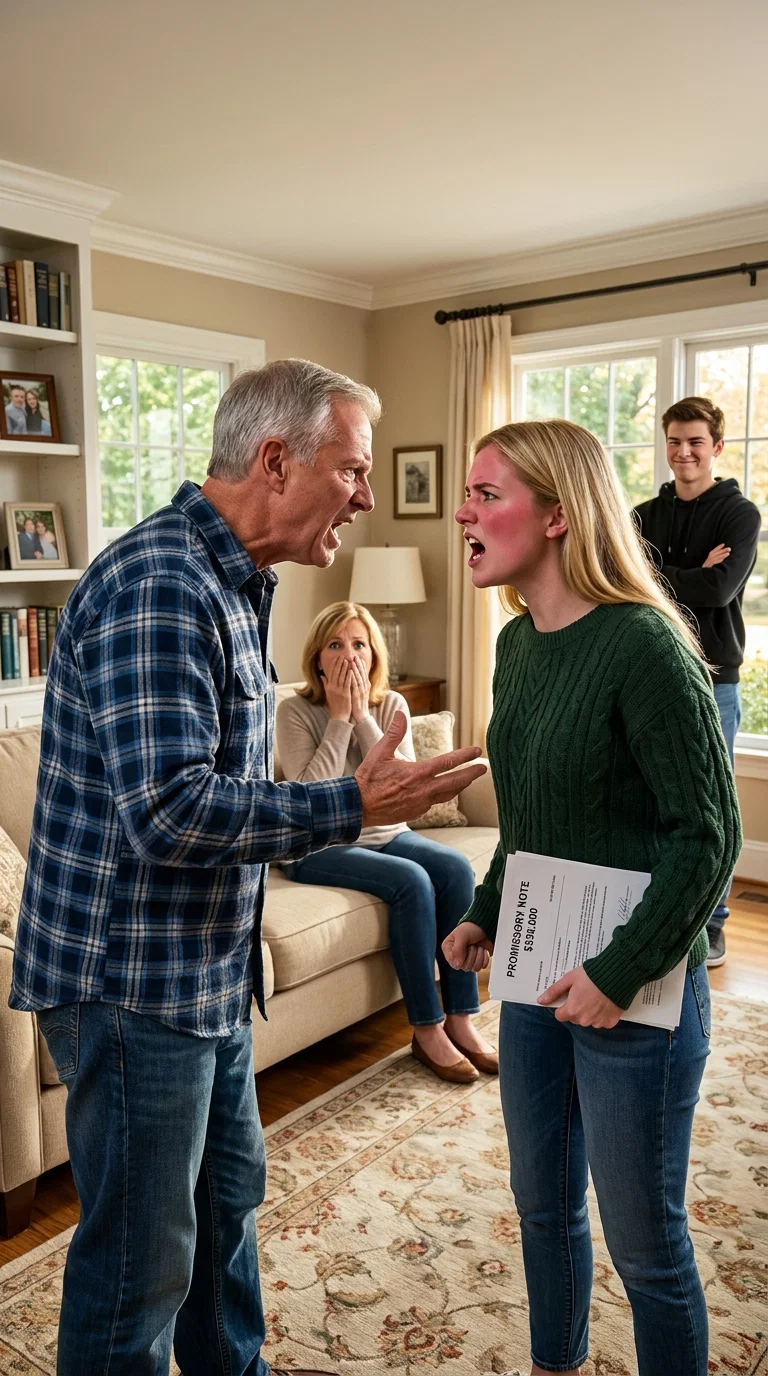
 “My brother
owes three hundred and thirty thousand dollars. You’re going to pay it,” Dad said.
He said it the same way someone might ask me to bring dessert to a family barbecue.
I sat across from him at my parents’ dining room table, the same table where I used to finish homework while my brother Caleb smashed windows and somehow ended up being called “misunderstood.” Caleb stood behind Dad with his arms folded, looking pale but strangely relaxed, like he already knew someone else had been selected to sink in his place.
I stared at the folder Dad slid toward me.
Loan documents. Overdue notices. A warning about a lien against Caleb’s construction company. A personal guarantee tied to my parents’ home as collateral.
My mother, Elaine, twisted a napkin nervously in her hands. “Your father and I could lose everything.”
I looked at the first page again. “Why is my name on this?”
Caleb looked away.
That answered enough.
I pulled out another paper. A business line of credit application. My signature appeared at the bottom.
Except I had never signed it.
My stomach dropped cold.
Dad didn’t even blink. “Caleb said you approved it years ago.”
“I didn’t.”
Caleb snapped, “Stop pretending you’re innocent. You always said family helps family.”
“I said I’d help Mom after surgery. I never said you could forge my signature for your collapsing business.”
Dad slammed his palm against the table. “Watch your mouth.”
For thirty-eight years, those words had controlled me. They made me apologize, shrink, fix problems, cover expenses, forgive everything.
Not anymore.
Dad leaned closer. “If you refuse, then you’re no longer family.”
The room fell silent.
Mom started crying, but even her tears felt practiced. Caleb watched me like he expected the old version of me to return—the dependable daughter with savings, a stable career, no husband, no children, and therefore, according to them, no real responsibilities of her own.
I looked at all of them.
“Then I’m not.”
Dad blinked in surprise.
Caleb laughed once. “You can’t be serious.”
I stood up and grabbed the forged paperwork.
“Yes, I can.”
That same day, I called my bank from the parking lot. Then I called an attorney. After that, I froze every account my family could access, removed my parents as emergency contacts, locked my credit, and filed a fraud complaint.
Five days later, the entire family appeared at my house.
Dad. Mom. Caleb. My aunt. Two cousins. Even my grandmother.
Dad knocked first.
I opened the door while my attorney listened on speakerphone.
“Too late,” I said.
Part 2
Dad’s face hardened. “Too late for what?”
“For pretending this was ever a family conversation.”
Caleb stepped forward. He looked exhausted. His eyes were bloodshot, his jaw covered in rough stubble. The smug look had disappeared.
“Rebecca,” he said, softening his voice, “I screwed up.”
I nearly laughed.
“A mistake is forgetting a payment. A mistake is ordering the wrong materials. Forging my signature on a six-figure loan is a felony.”
My aunt Carol gasped dramatically like I had attacked someone.
Dad pointed angrily at the phone in my hand. “Hang that up. We don’t need attorneys.”
A calm voice came through the speaker. “Mr. Harris, this is Daniel Price, Ms. Harris’s attorney. I strongly advise you not to threaten my client or discuss the alleged fraud without legal representation.”
The porch became completely quiet.
Mom covered her mouth. “Rebecca, please. We’re still your parents.”
I looked directly at her. That was the hardest part. Not Caleb. Not Dad. Her.
“You knew,” I said quietly.
Her eyes filled with tears.
“You knew he signed my name.”
She whispered, “Your father said it would only be temporary.”
There it was.
Not innocence. Permission.
Caleb rubbed his forehead. “The bank called everything due after your fraud report. They froze the business account.”
“No,” I corrected him. “They froze it because the application was fraudulent.”
Grandma stepped forward slowly with her cane. “Becky, your brother could end up in jail.”
“He should’ve thought about that before stealing my identity.”
Dad exploded. “Enough! You think you’re better than your family because you have money?”
“No. I think I have the right to keep what I earned.”
My cousin Mark muttered under his breath, “It’s just one signature.”
I looked at him. “Then let Caleb use yours.”
He immediately fell silent.
That silence said everything.
They wanted sacrifice, but only from me.
Daniel spoke again through the phone. “Rebecca, don’t let them inside. Written notice has already been sent directing all communication through my office.”
Dad narrowed his eyes. “You’d really let your mother lose her house?”
I opened the folder in my hands and pulled out copies of wire transfers. “You used Mom’s house as collateral for Caleb’s debt. You did that. Not me.”
Mom broke down crying then, real crying this time.
Caleb stared out toward the driveway.
For the first time, I saw fear in his face. Not guilt. Fear.
He wasn’t sorry for stealing from me.
He was sorry it stopped working.
I stepped backward into the doorway.
“I’m done being the family safety net.”
Then I shut the door.
And this time, I locked it.
Part 3
The next two months were ugly.
Dad told relatives I had “abandoned the family over money.” Caleb told people I had promised to invest in the business and backed out at the last second. Mom left voicemails that began with tears and ended with blame.
I saved every single message and forwarded them to Daniel.
The bank’s investigation moved fast because the signature on the loan didn’t match mine, the application IP address traced back to Caleb’s office, and the confirmation email came from an account he created using my maiden name and birth year.
That part made me feel sick.
This wasn’t desperation.
It was planned.
Eventually, the bank removed my name entirely from the debt and went after Caleb and my parents for repayment. Their house entered negotiations with the lender. Caleb’s equipment was repossessed. By Thanksgiving, his business was gone.
Everyone thought I would feel triumphant.
I didn’t.
I felt exhausted.
But exhausted was still better than trapped.
One afternoon, Mom came by alone carrying a shoebox filled with old family photographs.
“I brought these,” she said softly. “I thought maybe you’d want them.”
I opened the door halfway.
She looked smaller than I remembered.
“Your father won’t apologize,” she admitted. “Caleb says you destroyed his life.”
“What do you say?”
Her lips shook. “I say I should have protected you.”
That was the first honest thing she had said to me in years.
I took the shoebox from her hands.
“Thank you.”
She lingered there, probably hoping I would invite her inside. I didn’t.
“I love you,” she whispered.
“I love you too,” I replied. “But love doesn’t come with access anymore.”
She nodded slowly, crying quietly, and walked away.
The following spring, I bought a small cabin two hours north beside a lake surrounded by pine trees and cold morning air. Not because I was running away, but because I wanted one place on earth nobody had ever tried to take from me.
On my first weekend there, my cousin Mark sent me a text.
Caleb keeps saying you could’ve saved him.
I replied, Caleb could’ve saved himself by not committing fraud.
Then I blocked him.
At sunset, I sat on the porch drinking coffee while the trees shifted softly in the wind.
For years, my family called me selfish anytime I stopped being useful to them.
Now I finally understood something.
They didn’t disown me at that dining room table.
They accidentally gave me my freedom.