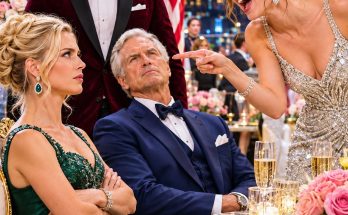
My Father Mocked Me in Front of an Entire Ballroom—Until Armed Military Officers Rushed In and Called Me “General Dawson”
My father laughed when someone suggested I might be a General.
The entire ballroom joined him.
“If Alyssa is a General, I’m a ballerina!” he announced, raising his whiskey glass.
People burst into laughter.
My aunt covered her mouth. My cousins exchanged amused looks. Even my father’s business partners seemed entertained.
I simply folded my napkin and placed it beside my plate.
I had learned a long time ago that arguing with my father was pointless.
He had spent most of my life believing I was the family disappointment.
My older brother, Michael, was the successful one. He had inherited my father’s confidence, his business connections, and his ability to make every conversation about himself.
I was simply Alyssa.
The quiet daughter who left home at eighteen.
The daughter who rarely attended family gatherings.
The daughter whose career my father never bothered to understand.
What he didn’t know was that I had spent the last twenty-two years building a military career that had taken me across the world.
And that night, I wasn’t even supposed to be at the gala.
I had attended because my mother had begged me.
“Just one evening, sweetheart,” she had whispered over the phone. “Your father is celebrating his company’s anniversary. It would mean so much if you came.”
So I came.
I wore a simple black evening dress, kept my hair neatly styled, and sat at a table near the back of the ballroom.
Nobody recognized me as anything important.
That was exactly how I preferred it.
During dinner, my father’s business partner, Mr. Harrison, noticed my military service pin.
“Are you still working in the military, Alyssa?” he asked politely.
“Yes,” I answered.
My father immediately interrupted.
“She has some administrative position. Nothing particularly exciting.”
I looked down at my water glass.
Mr. Harrison raised an eyebrow.
“Administrative? I thought you mentioned she was an officer.”
My father laughed.
“She probably has a fancy title. These days, everyone gets a title.”
Then my cousin Daniel leaned forward.
“Wait. Didn’t someone tell me you were a General?”
He was joking.
I knew that.
But before I could answer, my father practically shouted across the table.
“If Alyssa is a General, I’m a ballerina!”
The ballroom erupted.
I didn’t respond.
I just folded my napkin.
Then something happened that nobody in that room expected.
Less than a minute later, the ballroom doors slammed open.
Several uniformed military officers entered with urgent expressions.
The music stopped.
Conversations faded.
People turned toward the entrance as the officers moved quickly through the room, looking across the tables.
My father frowned.
“What’s going on? Who invited them?”
The lead officer scanned the ballroom.
Then his eyes found me.
He immediately stopped.
His expression changed.
He straightened his uniform, brought his hand to his forehead, and delivered a sharp salute.
“General Dawson.”
The entire ballroom went silent.
He continued.
“Washington requires your authorization immediately. We’ve been trying to reach you.”
For a moment, nobody moved.
My father’s whiskey glass trembled in his hand.
My mother stared at me.
Michael slowly lowered his phone.
Mr. Harrison looked from the officer to me.
I stood up calmly.
“Colonel, what’s the situation?”
The officer handed me a secure folder.
“Ma’am, the authorization is needed before the morning briefing. The delegation is waiting for your confirmation.”
I opened the folder and read the first page.
Then I looked at him.
“Tell Washington I’ll review the documents within the hour. Nobody proceeds without the required verification.”
“Understood, General.”
He saluted again.
I returned the salute.
And suddenly, the woman my father had been laughing at was no longer the center of a joke.
She was the person every military officer in that ballroom had come to find.
But my father still couldn’t accept what he was seeing.
“Alyssa?” he whispered.
I turned toward him.
“Yes, Dad?”
He swallowed.
“You’re… actually a General?”
I looked at the man who had spent twenty-two years dismissing everything I accomplished.
“Yes.”
He glanced at the officers.
Then at my uniform pin.
Then back at me.
“But why didn’t you tell us?”
I almost laughed.
Not because it was funny.
Because the answer was so simple.
“I tried.”
And for the first time that evening, my father had nothing to say.
Twenty-Two Years Earlier
When I was eighteen, I told my father I wanted to join the military.
He was sitting in his home office, reviewing business documents.
He didn’t even look up.
“Why?”
“Because I want to serve.”
He finally raised his eyes.
“Serve what? You could go to university. You could work in the company. You could have a comfortable life.”
“I don’t want to work in the company.”
His expression hardened.
“Your brother will take over one day. You should find something more suitable for yourself.”
I remember those words because they were the first time I realized my father had already decided what my life should look like.
My brother Michael was twenty-two then.
He was studying business management and already attending meetings with our father.
Everyone praised him.
He was ambitious.
He was confident.
He was the future of the family business.
I was the daughter who asked too many questions and wanted to do something different.
My father never understood that I wasn’t rejecting the family.
I was trying to build a life of my own.
My mother supported me quietly.
She helped me complete my application and drove me to the recruitment office.
My father didn’t attend my departure ceremony.
He said he had an important business meeting.
I waited until the last possible moment, hoping he might change his mind.
He never came.
That was the first family milestone I celebrated without him.
And it wouldn’t be the last.
The Years Nobody Saw
Military life was not glamorous.
There were long days, difficult decisions, demanding training, and responsibilities that followed me home.
I made mistakes.
I learned.
I worked with people whose experience taught me more than any classroom could.
I earned promotions gradually.
I began as a junior officer, then took on increasingly important leadership responsibilities.
I learned that leadership wasn’t about having the loudest voice.
It was about being accountable when decisions mattered.
I also learned something about my father.
He only respected achievements he could understand.
A business expansion impressed him.
A large house impressed him.
A luxury car impressed him.
But when I told him I had received a promotion, he would say things like:
“That’s nice, sweetheart. Anyway, Michael just closed a major deal.”
When I received an important assignment, he asked whether it came with better pay.
When I became responsible for a larger team, he changed the subject to my brother’s latest business success.
Eventually, I stopped sharing details.
Not because I was ashamed.
Because I was tired of explaining the importance of something to someone who had already decided it didn’t matter.
My mother remained the only person who asked questions.
She would call me after difficult assignments.
She remembered the names of my colleagues.
She kept copies of my official photographs in a small album.
Whenever I visited, she would show them to relatives.
My father usually walked away.
Years passed.
My responsibilities grew.
My career advanced.
And one day, after a lengthy selection process, I was promoted to General.
I didn’t announce it on social media.
I didn’t organize a celebration.
I called my mother.
She cried.
Then she said something I have never forgotten.
“Your father would be proud if he understood what this means.”
I looked out of my office window.
“Maybe one day, Mom.”
The Gala That Changed Everything
Back in the ballroom, the officers waited beside my table.
My father still hadn’t moved.
Michael finally found his voice.
“Excuse me, sir. There must be some mistake.”
The colonel turned toward him.
“Is there a problem?”
Michael pointed at me.
“That’s my sister.”
The colonel gave a brief nod.
“Yes, sir. General Dawson.”
Michael looked uncomfortable.
“But she’s never mentioned anything like this.”
I answered before the colonel could.
“I have mentioned it.”
My father finally spoke.
“You never told me you were a General.”
I held his gaze.
“I told you about my promotions. I told you about my assignments. I told you when I received my command responsibilities.”
He shook his head.
“Not like this.”
“How was I supposed to tell you? You never listened.”
My mother lowered her eyes.
She knew exactly what I meant.
Mr. Harrison slowly stood.
“Mr. Dawson, you told us your daughter worked in an office.”
My father adjusted his jacket.
“Well, I didn’t know all the details.”
I turned toward him.
“You never asked.”
That sentence landed harder than any argument could have.
The colonel checked his watch.
“General, we should proceed.”
I nodded.
“Give me five minutes.”
Then I turned to my father.
“I came tonight because Mom asked me to. I wanted one ordinary evening with my family.”
He looked at the officers.
Then at the folder.
“Can we talk later?”
“Of course.”
I picked up my handbag.
But before I could leave, my mother stood.
“Wait.”
She walked around the table and took my hand.
“I’m proud of you.”
Those four words nearly broke my composure.
For twenty-two years, I had waited to hear something like that from my father.
But it was my mother who said it.
I squeezed her hand.
“Thank you, Mom.”
Then I followed the officers out.
Behind me, the ballroom remained silent.
The Phone Call
The officers escorted me to a secure vehicle waiting outside.
As soon as I entered, I opened the folder.
The situation required a formal authorization connected to an upcoming international coordination meeting.
It was important, but it wasn’t something that could be rushed.
I reviewed the supporting documents, confirmed the required details with the appropriate officials, and gave my instructions.
My responsibilities did not disappear because my family had embarrassed me.
And I wasn’t going to allow a personal disagreement to interfere with professional judgment.
When the meeting concluded, I finally checked my phone.
There were seventeen missed calls.
Most were from my mother.
Three were from Michael.
Two were from my father.
Then a message appeared.
Dad:
Alyssa, call me. We need to talk.
I stared at it for a moment.
Then I put my phone down.
I wasn’t ready.
The Conversation My Father Had Avoided
The next morning, I visited my parents’ house.
My mother opened the door before I could knock twice.
She looked tired.
“I made coffee,” she said.
“Thank you.”
My father was sitting in the living room.
For once, there were no business associates, no guests, and no audience.
Just the two of us.
He stood when I entered.
“I owe you an apology.”
I didn’t sit down immediately.
He continued.
“What happened last night was inappropriate.”
“It was more than inappropriate.”
He nodded.
“I know.”
I finally took a seat.
He rubbed his hands together.
“I didn’t realize how far you had gone in your career.”
I looked at him.
“That isn’t the problem.”
“Then what is?”
“The problem is that you decided my career wasn’t important before you ever understood it.”
He looked away.
I continued.
“You never attended my ceremonies. You never asked about my responsibilities. You never wanted to know what I did. But you were always ready to explain my life to everyone else.”
He remained quiet.
“Last night, you laughed at me in front of hundreds of people. You made my career sound like a ridiculous fantasy.”
He lowered his head.
“I thought I was joking.”
“You were comfortable joking because you thought I had nothing worth respecting.”
My mother sat beside me.
She reached for my hand.
My father looked at her.
“Did you know she was promoted?”
My mother nodded.
“I knew.”
“And you didn’t tell me?”
She looked directly at him.
“I told you many times. You changed the subject.”
He had no answer.
Then he did something I had never seen him do before.
He sat down slowly and covered his face with both hands.
“I didn’t know how to talk to you after you left,” he admitted.
I waited.
He continued.
“Your brother followed the path I understood. You chose something I didn’t understand, and instead of learning about it, I dismissed it.”
His voice became quieter.
“I thought you were proving that you didn’t need us.”
I looked at him.
“I was never trying to prove that.”
He finally met my eyes.
“I know that now.”
The Envelope
My mother stood and walked toward the hallway.
“There’s something I want you to see.”
She returned with an old envelope.
My name was written across the front in my father’s handwriting.
I recognized it immediately.
It was dated twenty-two years earlier.
The day I left for military training.
I opened it carefully.
Inside was a short letter.
Alyssa,
I don’t understand why you have chosen this life, and I wish you had chosen differently.
But your mother tells me you are determined.
I hope one day you find what you’re looking for.
I may not know how to say it, but I hope you stay safe.
Dad.
I read it twice.
Then I looked at him.
“You wrote this?”
He nodded.
“I put it in your old room. I never mailed it.”
“Why?”
He stared at the floor.
“Because I was stubborn.”
I folded the letter carefully.
For years, I had believed he hadn’t cared enough to say goodbye.
Now I understood that he had cared, but his pride had prevented him from showing it.
That didn’t erase the hurt.
But it gave the hurt a different shape.
“I wish you had sent it,” I said.
“So do I.”
A Different Kind of Recognition
Three weeks later, my father called me.
He sounded nervous.
“I have a question.”
“Go ahead.”
“Would you be willing to attend a small dinner with some of my friends?”
I hesitated.
“Why?”
He cleared his throat.
“I want to introduce you properly.”
I said nothing.
He continued.
“Not because you’re a General. Not because of your title. Because you’re my daughter, and I’ve spent too many years pretending I knew your life without ever asking.”
I thought about it.
Then I agreed.
The dinner was much smaller than the gala.
There were only twelve people.
My father stood beside me when I arrived.
He didn’t make a grand announcement.
He simply introduced me.
“This is my daughter, Alyssa. She’s served in the military for many years. I’m proud of the person she’s become.”
He paused.
Then added something unexpected.
“Although I should probably mention that I was the last person in this room to understand just how remarkable she is.”
A few guests laughed gently.
This time, nobody was laughing at me.
I looked at my father.
He gave me a small, uncertain smile.
I returned it.
Not everything was fixed.
Twenty-two years of feeling dismissed could not disappear in one apology.
But something had changed.
He had finally started listening.
The Final Lesson
Several months later, I received another promotion-related assignment.
My mother called to congratulate me.
Then she said:
“Your father wants to know if he can attend the ceremony.”
I paused.
“Did he ask you to ask me?”
She laughed softly.
“He said he didn’t want to assume you’d want him there.”
I thought about the little girl who had once waited at a departure ceremony, hoping her father might appear.
Then I thought about the woman I had become.
“Tell him he can come.”
On the day of the ceremony, I stood among my colleagues while the official proceedings began.
When I looked toward the audience, I saw my mother in the front row.
Beside her sat my father.
He was wearing his best suit.
His hands were folded.
And when my name was announced, he stood before anyone else.
He applauded.
Not loudly to impress anyone.
Not to make a business connection.
He simply stood there, looking at his daughter.
After the ceremony, he approached me.
“I don’t know if I’ll ever fully understand your work,” he said.
“You don’t have to understand every part of it.”
He nodded.
“But I want to understand you.”
For the first time, I believed him.
He reached into his jacket and handed me a small photograph.
It was an old picture of me at eighteen, wearing my first military uniform.
On the back, he had written:
I should have been there from the beginning.
I looked at the photograph for a long moment.
Then I looked at him.
“You can still be here now, Dad.”
His eyes became watery.
He nodded.
And that was enough for that day.
Because the greatest achievement of my career wasn’t the title on my uniform.
It wasn’t the rank.
It wasn’t the officers who saluted me in front of hundreds of people.
It was finally understanding that I didn’t need my father’s approval to become someone I was proud of.
And when he finally learned to see me, I was already standing exactly where I had worked so hard to be.
The man who once laughed when someone called me General eventually became the man who stood up first whenever my name was announced.