The rain did not fall that morning so much as it attacked the earth, hurling itself from a sky the color of bruised fruit, beating against umbrellas, shoulders, coffin lids, and raw black soil with a violence that felt deliberate. I stood at the edge of the graves without moving, my black shoes sinking deeper and deeper into the cemetery mud, the wet ground slowly swallowing my heels as if it had mistaken me for someone already dead. The wool of my coat clung to my arms and back, heavy with water, cold enough to make my bones ache, but I could not bring myself to step beneath the canopy where everyone else huddled together in damp, whispering sorrow. That small white tent looked obscene to me, a polite little shelter raised over an impolite kind of ruin. It did not belong over this day. Nothing gentle belonged over this day. Not the pastor’s softened voice, not the bowed heads, not the folded programs printed with Daniel’s smiling face on one side and Lily’s bright little grin on the other. The world had split itself open in front of me, and the only honest thing the sky could do was bleed rain.
There were two holes in the ground. That was the part my mind kept returning to, as if it could not understand any larger truth beyond that one brutal fact. Two graves. Two caskets. Two endings where there should have been a lifetime of mornings. The first casket was dark mahogany, polished to a deep brown shine that had already begun to dull beneath the rain. Daniel lay inside it. My Daniel, who used to wake before me on Sundays and try to sneak into the kitchen quietly, even though the old floorboards always betrayed him. My Daniel, who measured pancake batter by instinct and always made too much because he said a house should smell like breakfast for as long as possible. My Daniel, who would swipe flour across the tip of my nose with his thumb and laugh when I scowled at him, a warm, ridiculous laugh that could roll through a room and make every sharp edge softer. He had been tall, patient, steady, the kind of man who listened with his whole face. He could turn grocery shopping into an adventure, bedtime into theater, and an ordinary life into something I had once believed was safe.
Beside his casket rested the second one. White. Small. Impossible. That was the word that kept flashing behind my eyes whenever I tried to look at it. Impossible. There was no universe in which a coffin should be that small. There was no universe in which my daughter’s body should fit inside a box that looked like it had been made for a doll. Lily was in there, my sweet, stubborn, bright-eyed little girl, who had only just learned to write her name in purple crayon. She could spell Lily, proudly, loudly, with the fierce satisfaction of a person who had conquered a mountain, even though the second L often faced the wrong way. She loved yellow because, she told me once while sitting cross-legged on the kitchen floor, yellow was what happiness would look like if happiness had a color. She loved puddles, blueberries, ladybugs, Daniel’s silly pirate voice, and the way I tucked her blanket under her chin at night. She had been five years old, with hair that never stayed neat and questions that arrived faster than anyone could answer them. Now she lay under a white lid while the rain tapped against it like impatient fingers.
People had expected me to collapse. I could feel that expectation moving through them, a nervous current beneath the grief. My aunt Nora stood beside me, holding an umbrella that had long since failed to protect either of us, her fingers wrapped around my elbow so tightly that I knew bruises would appear later. “Clara, honey,” she whispered, and her voice trembled in that helpless way people speak when they are trying to rescue someone from a place they cannot enter. “Please. Come sit down. Just for a minute. You’re freezing.” I heard her. I understood the words. But they seemed to reach me from the far end of a tunnel, distorted and useless. Sit down? As if grief were a dizzy spell. As if my legs were the problem. As if there existed a chair sturdy enough to hold the weight of standing in front of the two people who had been my entire life. I did not answer her. I did not blink away rain or tears, because there were no tears. That seemed to frighten everyone more than sobbing would have. I saw it in their glances, the way their eyes kept darting toward my face and then away again. They wanted some familiar language of mourning from me. A scream. A collapse. A hand clapped over my mouth. Something human. Instead, I stood there like a statue that had been carved in the exact moment before shattering.
The pastor spoke of eternal peace, of gardens beyond suffering, of divine plans that mortals could not yet understand. I looked at his mouth moving beneath the shelter of a black umbrella and felt nothing but a quiet, expanding hatred for language itself. Divine plan. Eternal garden. Better place. People had so many words prepared for death, and none of them were large enough to hold the sound Lily had made when she laughed so hard she hiccupped. None of them could explain why Daniel’s coffee mug still sat on our counter, why Lily’s yellow rain boots still waited by the door, why my phone still contained a video from three days before the crash of Daniel chasing Lily around the living room while she shrieked, “You can’t catch me, Daddy!” Nothing the pastor said could reach the place inside me where their absence had already begun to turn from pain into something colder and more permanent.
An hour before the service, while I sat alone in the back room of the funeral home staring at my own hands, my mother had sent me a photograph. I had opened it because grief had made me stupid, or perhaps because some old, abused part of me still expected a mother to become a mother in the face of catastrophe. The image loaded slowly. First came a strip of blue sky, then a flare of blinding sunlight, then white sand so bright it looked false. My parents stood barefoot on a Caribbean beach, sunburned and smiling with the casual entitlement of people who believed the world had been arranged for their comfort. Between them stood my older brother, Mason, tan and handsome and smug, holding up a frosted cocktail as if offering a toast to the camera. All three drinks had little paper umbrellas in them. Pink, green, blue. I remembered staring at those tiny umbrellas for a long time. Such cheerful little things, existing in the same world as my daughter’s coffin. Beneath the picture, my mother had written: We’re so sorry, sweetheart. But last-minute international flights are just exorbitantly expensive, and to be honest, funerals are terribly emotionally exhausting. This is simply too trivial a matter to completely ruin a non-refundable family vacation.
Too trivial. I had read the message once. Then again. Then again, because my mind refused to accept that the words were real. Too trivial. Not the death of a pet. Not a missed luncheon. Not a minor inconvenience. My husband and my child. Daniel and Lily. The two names that had given shape to every day of my adult life. My mother had looked at the burial of my family and weighed it against hotel deposits, flight prices, beach reservations, and her own distaste for emotional discomfort, and she had found my grief insufficiently important. The phrase did not wound me in the dramatic way people imagine cruelty wounds. It did not make me gasp or crumble. It entered me cleanly, like a blade so sharp the body does not feel the cut at first. Then it stayed there, lodged deep, pressing against every breath.
Now, as the lowering devices began to hum and Daniel’s casket descended toward the earth, my phone buzzed against my hip. The sound was small, almost swallowed by rain, but I felt it through my entire body. I moved slowly, as though my muscles belonged to someone else, and withdrew the phone from my coat pocket. The screen glowed white in the storm-dim afternoon. Another message from my mother. When you’re finished dealing with all that gloom, call me. We have something very important we need to discuss regarding the estate. For several seconds, I simply stared. The rain struck the screen and made the words shimmer. Finished dealing with all that gloom. As if I were attending a dull errand. As if I might return home, towel off, heat some soup, and become available for financial conversation. The estate. Daniel’s estate. Our home. Our savings. Insurance. Assets. Numbers. She was already circling them from a tropical beach like a gull over a carcass.
Elise Vale stepped beside me then, Daniel’s younger sister, carrying an umbrella that she tilted over my head though she was crying too hard to keep her own face dry. Elise had Daniel’s eyes, gray-green and expressive, though today they were swollen and red, her usually sharp mouth trembling with grief she did not try to hide. She glanced from my face to the phone, and something inside her seemed to harden instantly. “Is it them?” she whispered. Her voice carried so much disgust that the word them sounded like a disease. I gave one tiny nod. Elise’s jaw clenched. “Do not answer that, Clara,” she said. “Do not give them one second of you. Let them rot in the sun.” I looked back at the graves. Lily’s white casket was almost gone from sight now, lowered into the slick dark mouth of the earth. “I won’t,” I said. My voice startled me. It was rough, quiet, emptied of every familiar warmth. It sounded like a door closing in an abandoned house. “Not yet.”
In the days that followed, time became shapeless. People came and went. Casseroles appeared on my porch, covered in foil and labeled in careful handwriting. Someone from Daniel’s office sent flowers. Lily’s preschool teacher mailed a packet of drawings the children had made, bright crayon suns and crooked hearts and misspelled messages that I could not bring myself to read. The house filled and emptied and filled again, but I experienced all of it from a terrible distance, as though I were standing behind thick glass watching strangers move through rooms that looked like mine. At night, I walked from the kitchen to Lily’s bedroom to our bedroom and back again. I touched objects without purpose. The soft sleeve of Daniel’s blue sweater hanging over the back of a chair. A hair ribbon on Lily’s dresser. A library book about sea turtles lying open on the couch. Their lives had not disappeared cleanly. They had left behind evidence everywhere, small ordinary proofs that they had expected to return.
Three days after the funeral, the house became quiet enough to press against my eardrums. The last visiting neighbor had left. Aunt Nora had finally stopped insisting that I sleep at her place. Elise had gone home for a few hours only after making me promise I would call if I felt unsafe, though neither of us knew what that word meant anymore. I stood in the foyer at dusk, looking at Lily’s yellow rain boots beside the door. They were neatly lined up, toe to toe, because Daniel had taught her to “park them like little cars.” Dried mud still speckled the rubber from the last time she had jumped in puddles after a spring shower. I remembered her shrieking with delight when the muddy water splashed high enough to stain her leggings, Daniel laughing behind her, me pretending to scold them both while secretly taking pictures. In the kitchen, Daniel’s chipped ceramic coffee mug sat beside the sink. The chip was near the handle, shaped vaguely like the state of Texas if one squinted. He refused to throw it away because Lily had chosen it for him at a thrift store when she was three, solemnly declaring it “a daddy cup.” It waited there now for coffee that would never be poured, held by hands that would never warm around it.
The world, however, had not paused in respect. Bills arrived. Junk catalogs landed in the mailbox. A dental office left a voicemail reminding Daniel about an appointment scheduled for the following month. A children’s clothing store sent an email advertising back-to-school sales, complete with smiling models wearing backpacks. I discovered, with a kind of cold astonishment, that the universe could absorb the destruction of my entire life without altering its rhythm. Somewhere, people complained about traffic. Someone burned toast. Someone laughed at a television show. Somewhere, a mother braided her daughter’s hair while my daughter’s hair lay sealed beneath the ground. That was when I first understood that grief was not only sadness. Grief was insult. Grief was the unbearable offense of everything continuing.
At exactly seven that evening, someone pounded on my front door. Not knocked. Pounded. Heavy, impatient fists struck the wood with the entitlement of a person who believed entry was owed. I did not startle. My nervous system seemed to have burned through all available shock. I simply turned my head toward the sound, waited for the second round of pounding, then walked slowly across the foyer. Through the narrow glass beside the door, I saw the glow of headlights in the driveway and three familiar silhouettes beneath the porch light. My pulse did not quicken. It slowed. A strange, precise calm settled over me as I turned the deadbolt and opened the door.
My parents stood on my porch as if arriving late to a dinner reservation. My mother, Evelyn Thorne, wore cream linen pants, expensive sandals, and a loose coral blouse wrinkled from travel. Her skin had been burned an irritated pink across her cheekbones and nose, and her hair, though carefully blown out, had frizzed in the humidity. My father, Richard, stood behind her with a leather overnight bag in one hand and the tight, annoyed expression of a man inconvenienced by someone else’s tragedy. Behind them, in the driveway, Mason leaned against the hood of a rented luxury SUV, thumbs moving across his phone, his posture lazy, his face illuminated by blue light. He looked bored. That detail lodged itself in me with surgical clarity. My husband and daughter were dead. My brother was bored.
My mother did not wait to be invited in. She swept past me, bringing with her the cloying smell of coconut sunscreen, perfume, airport air, and stale entitlement. “Well, finally,” she said, glancing around my foyer as if assessing whether I had kept house properly during my widowhood. “God, Clara, you look absolutely dreadful. Have you even slept?” My father followed, wiping rain from his forehead, though there was barely a drizzle left outside. His eyes moved immediately over the living room, not with concern but calculation. Sofa. Console table. Antique cabinet Daniel had refinished by hand. Framed photographs. He looked at my home the way a man might look at items tagged for auction. “Let’s skip the theatrics,” he said. “Where is the insurance paperwork?”
For a moment, the words failed to arrange themselves into meaning. Insurance paperwork. That was the first question. Not How are you still breathing? Not I should have been there. Not I’m sorry I abandoned you beside two graves. Insurance paperwork. I looked from him to my mother, waiting for one of them to reveal that grief had distorted my hearing. My mother sighed dramatically, removing her oversized designer sunglasses and dropping them into her handbag. “Clara, please don’t make this harder than necessary. We know Daniel had a substantial life insurance policy. A man like that, responsible, careful, always planning ahead. And given the circumstances of the accident, with a commercial vehicle involved, the settlement will be significant. Possibly enormous.” Her eyes softened then, but not with love. With performance. “We’re your family. We need to discuss how best to handle it.”
Mason finally pushed himself away from the SUV and sauntered up the walkway, still glancing at his phone. He stepped into the house without closing the door behind him, letting damp air spill into the foyer. “Forty thousand is what we need liquid right now,” he said, as if entering a conversation already settled. “Temporary. A bridge. You’ll have plenty coming in, Clara. Don’t act like this is some huge sacrifice.” He looked at me then, really looked at me for the first time, and his mouth curled in something that might have been sympathy if he had ever learned how to imitate it convincingly. “Honestly, it might be good for you. Give you something practical to focus on.”
“All you need,” I repeated. The words tasted metallic.
My mother’s face tightened. She had never liked being echoed. It made her feel mocked, and Evelyn Thorne could endure almost anything except the suggestion that she was ridiculous. “Don’t take that tone with me,” she snapped. “After everything we’ve done for you. Raising you. Feeding you. Paying for school. Tolerating every strange little phase, every sulk, every endless complaint that Mason got more attention. You owe this family more than you’ve ever acknowledged.” She stepped closer, her voice lowering into the intimate cruelty she reserved for private wounds. “And Daniel would have wanted you to help us. He understood family duty.”
Daniel’s name in her mouth changed something in the air. Until then, I had been listening from inside the numb chamber grief had built around me. But when she said Daniel would have wanted, the chamber cracked. I saw him as clearly as if he had stepped into the foyer behind her—Daniel at the stove, Daniel reading Lily a book with all the voices, Daniel squeezing my hand after dinners with my parents and whispering, “You survived. I’m proud of you.” Daniel had never once asked me to sacrifice myself on the altar of my family’s appetite. He had spent years teaching me that love did not sound like a demand.
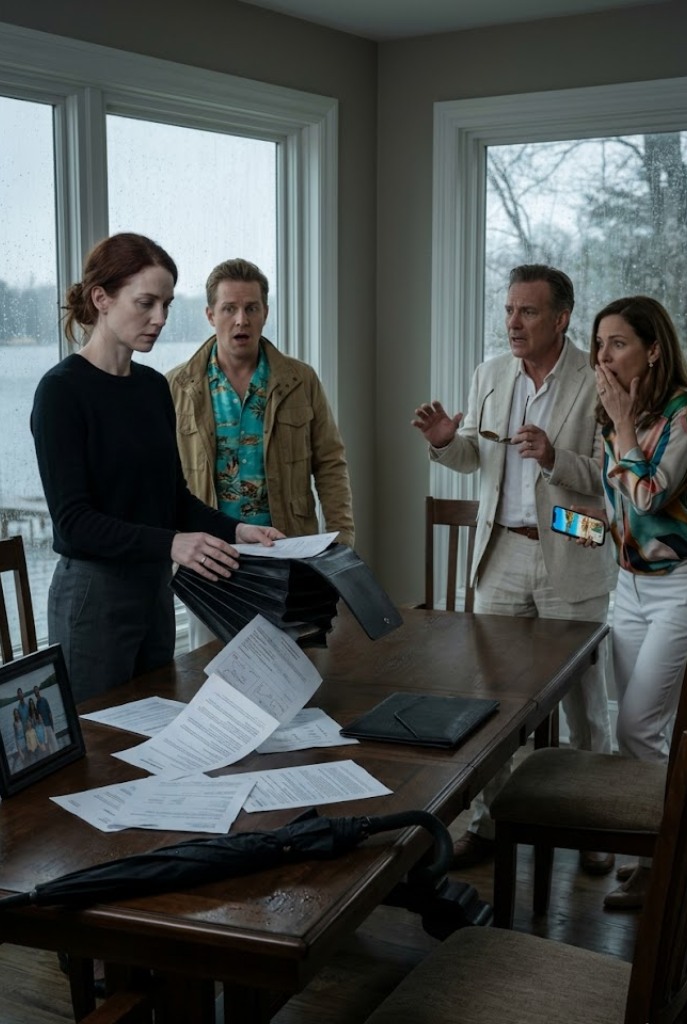
I looked down at the black leather folder in my hands. I had been holding it since I saw their headlights turn into the driveway. Its weight was not heavy in the ordinary sense. It was just paper, plastic sleeves, printed statements, transcripts, photographs, copies of bank records, legal summaries, and the kind of evidence that could make rich men sweat through tailored shirts. But in that moment, it felt like the only solid object in a house full of ghosts. My mother noticed it. Her eyes sharpened instantly. “There,” she said, pointing with one manicured finger. “You see? She’s already organizing the financials. I told you she would be. Clara has always been our little accountant.” She said accountant the way other mothers might say servant, with fondness flattened into ownership.
My father walked past me into the kitchen and sat down in Daniel’s chair. Not one of the other chairs. Daniel’s. At the head of the old oak table, beneath the pendant light he had installed himself on a Saturday while Lily handed him screws one at a time with great solemnity. My father leaned back, spreading his knees, assuming command of a room he had never earned. “Here’s the situation,” he said. “Mason has a commercial opportunity. Short term, high return, time sensitive. He needs capital to secure his position before the window closes. Forty thousand now could become three times that within months. This is how wealth is built, Clara. People who understand family understand leverage.”
“Family attends funerals,” I said.
The room went quiet. Mason scoffed first, because he had never learned to fear silence. “Oh, for God’s sake,” he said. “Don’t make this into some Greek tragedy. People die every day. It’s awful, sure. But we mourned in our own way. Mom cried at dinner the night she found out.” My mother shot him a warning look, not because his words were monstrous, but because he had said the ugly part too plainly. Mason shrugged, annoyed by the interruption. “What? We did. We toasted them. It was respectful.”
The calm inside me became colder. “You toasted my husband and child with cocktails on a beach.”
“Would you rather we had wasted thousands flying back just to stand in the rain?” Mason asked. “It wouldn’t have changed anything.”
“No,” I said. “It wouldn’t have changed what happened to them.” I walked into the kitchen and placed the black folder in the exact center of the table. I rested my palm on top of it, feeling the smooth leather beneath my fingers. My parents leaned forward almost involuntarily. Mason’s eyes flicked toward it, then away, then back again. Greed had always given them away faster than fear. “Daniel and Lily died because an eighteen-wheeler ran a red light at fifty miles per hour,” I continued. “That is what the police report says. That is the version the news repeated. A tragic accident. A tired driver. Failed reaction time. Rain-slick pavement.”
My father drummed his fingers once against the tabletop. “Yes. We read the article. Terrible. Now, if we could return to—”
“But that is not the whole story,” I said.
My mother’s expression shifted by a hair. A tiny tightening around the eyes. “What are you talking about?”
I did not answer immediately. In the silence, I could hear the house settling. I could hear the refrigerator hum, the faint tick of the clock above the pantry door, the sound of rainwater dripping from the gutters outside. The kitchen smelled faintly of old coffee and lemon dish soap. It looked ordinary enough to be cruel. “Before I married Daniel,” I said, “before Lily was born, before any of you decided my life was too small to interest you unless money was involved, I spent ten years as a senior forensic accountant for the state attorney’s office. You remember that, don’t you?”
My mother waved a dismissive hand. “Of course we remember. You made spreadsheets for prosecutors.”
“I followed money for prosecutors,” I corrected. “Fraud. embezzlement. shell companies. laundering networks. Bribes hidden as consulting fees. Kickbacks disguised as vendor payments. Numbers tell stories when people don’t want to. They record appetite. They record fear. They record carelessness. They record guilt.” I looked at Mason. “And unlike people, numbers don’t flatter themselves into believing they’re smarter than everyone else.”
His thumb stopped moving on his phone.
There it was. The first real crack. Not fear yet. Not guilt. Recognition. A small, involuntary pause from a man who had just realized the conversation had turned toward a room he thought he had locked. My parents missed it because they had never known how to read him critically. They saw Mason as an extension of their own ambition, polished and male and golden. I saw him as he was: charming when rewarded, cruel when challenged, lazy beneath the performance of brilliance, and endlessly confident that someone else would clean the consequences from his shoes.
“In the weeks after the crash,” I said, “I did not sleep much. Everyone told me that was normal. Trauma, shock, grief. But sleeplessness is useful when there are records to examine. Apex Freight, the company that owned the truck, has been financially unstable for nearly two years. Their public filings make that obvious if you know what to look for. Declining cash reserves. Delayed vendor payments. Unusual consulting expenses clustered around quarterly reporting periods. Maintenance budgets that look healthy on paper but don’t match actual repair orders. At first, I thought I was looking at ordinary corporate negligence. A struggling company cutting corners. Terrible, but not unusual.”
My father’s face had begun to harden, but not in anger. In concentration. Richard Thorne was not a stupid man, though he often mistook cruelty for intelligence. He understood enough about money to know when language had become dangerous. “Clara,” he said carefully, “you are grieving. It’s very common for people in your position to search for someone to blame.”
“I found someone to blame,” I said.
I opened the folder.
The first page was a bank record, enlarged and printed clearly, with Mason’s name highlighted in yellow. For one second, no one moved. Then Mason laughed. It was too loud, too quick, a laugh that broke apart before it became convincing. “What is this supposed to be?”
“A beginning,” I said. “Horizon Solutions LLC. Registered eighteen months ago in Delaware. Minimal web presence. No real staff. No physical office beyond a rented mail suite. Its listed purpose is logistics consulting, though I found no evidence of actual logistics work performed for any client. Apex Freight paid Horizon Solutions repeatedly for ‘operational efficiency analysis,’ ‘warehouse route optimization,’ and ‘strategic vendor alignment.’ Vague descriptions. Large invoices. Convenient timing.” I turned one page. “Two weeks before the crash, Apex wired Horizon Solutions sixty-two thousand dollars from an operational account used for fleet maintenance and depot repairs.”
My mother looked at Mason. “What is she talking about?”
Mason’s eyes stayed on the paper. He swallowed. “I have clients. That’s not illegal.”
“No,” I said. “Having clients is not illegal. Billing a company for services never rendered in order to siphon maintenance funds into personal accounts is illegal. So is routing the money through a secondary consulting entity called Vanguard Advisory Group, which lists my parents as indirect beneficiaries through a family trust they apparently forgot to disclose to the IRS.”
My mother’s mouth opened. Nothing came out.
My father stood so abruptly that Daniel’s chair scraped backward against the floorboards. The sound tore through me, but I did not let myself flinch. “You need to be very careful right now,” he said.
The laugh that left me did not sound like laughter. It sounded dry and broken, like a match struck in an empty room. “Careful,” I repeated. “You skipped your granddaughter’s funeral because the flights were too expensive, came into my home three days later smelling like sunscreen, sat in my dead husband’s chair, demanded his insurance money, and now you want me to be careful.”
Mason slapped his phone onto the counter. “This is insane. You’ve always done this. You get some little piece of information and build a whole persecution fantasy around it. Maybe Apex hired me. Maybe they paid me. You don’t know what work I did.”
I turned another page. “Three days before the crash, the senior mechanic at Apex’s north depot flagged truck 409 for critical brake failure risk. He submitted a repair order requiring immediate replacement of several components. The parts were ordered. The overtime invoice was generated. The repair log was marked completed and paid.” I looked up at him. “But the parts never arrived. The mechanic’s electronic signature was forged while he was off-site attending his son’s baseball game. The funds allocated for the repair moved from Apex’s maintenance account into a false vendor invoice, then into Horizon Solutions, then into an offshore holding account tied to you through a beneficial ownership chain so sloppy I would have been embarrassed to submit it as a training exercise.”
The color drained from Mason’s face.
I turned another page. “Truck 409 was the truck that entered the intersection at Hawthorne and Fifth at 8:17 that morning. The driver hit the brakes one hundred and forty-six feet before impact. The vehicle’s onboard data recorder shows pressure applied, delayed response, then partial failure. Daniel had the green light. Lily was in the back seat, singing along to a song from a children’s movie because Daniel had texted me seven minutes earlier complaining that she wanted to play it for the fifth time that morning.” My voice did not break. That frightened even me. “The truck did not stop because the brakes had been flagged as unsafe, the repair had been faked, and the money for that repair had been stolen.”
No one spoke.
The silence filled with Lily. With Daniel. With the sound I imagined but had never heard, metal crushing metal, glass bursting, a child’s song cut off mid-note. I had read the accident reconstruction report so many times that the diagrams lived behind my eyes. I knew the angle of impact. The speed. The weather. The approximate distance Daniel’s car was pushed across the intersection. I knew what had happened to my husband’s ribs, my daughter’s chest, the side window, the car seat latch. Grief had forced me to become fluent in the technical vocabulary of destruction. But the report had not used the word stolen. It had not used the word greed. That part had been waiting for me to discover.
My mother recovered first, because denial had always been her most athletic talent. “This is grief,” she said, voice trembling but still sharp. “This is exactly what grief does. It makes people paranoid. You’ve taken business records you don’t understand and turned them into a conspiracy because you cannot accept a tragic accident. Clara, listen to yourself. You’re accusing your own brother of killing your family.”
“I’m accusing him of stealing the money that should have repaired the brakes on the truck that killed my family,” I said. “If that distinction comforts you, hold on to it.”
Mason lunged for the folder. Not violently enough to knock me down, but quickly, desperately, with the reflexive panic of a man reaching for a snake near his foot. I stepped back before his hand touched the papers. My father grabbed his wrist. For a strange second, I saw the hierarchy among them reassert itself. Mason reckless. My father controlling. My mother calculating how to convert catastrophe into sympathy. “Enough,” Richard said. Then he looked at me, and I saw him choose negotiation over threat. His voice lowered. “Whatever you think you have, it doesn’t need to go further. Families handle things privately. You’re in pain. We understand that. Mason may have made mistakes in business. Mistakes can be corrected.”
“Mistakes,” I said.
“Errors in judgment,” my father continued. “Poor associations. Perhaps Apex misled him. Perhaps he signed documents without full knowledge. There are ways to manage this. But dragging your brother through a criminal investigation will not bring Daniel or Lily back.”
That was when my mother began to cry. Not real crying. I knew the difference. Real grief had lived in Elise’s shaking hands, in Aunt Nora’s red-rimmed eyes, in the way Daniel’s best friend could not finish his sentence at the graveside. My mother’s tears were summoned, shaped, placed where she believed they would be useful. “Clara,” she whispered, pressing one hand to her chest. “Please. He’s your brother. He is all we have.”
I stared at her. “He is all you chose.”
The words landed. For the first time all evening, my mother looked genuinely wounded. Not because she felt guilt, but because I had named the architecture of our family too plainly. Mason had always been the sun around which my parents orbited. When he failed, they reframed it as boldness. When I succeeded, they called it luck or diligence, which in their mouths meant dull obedience. Mason was brilliant. I was practical. Mason was ambitious. I was uptight. Mason needed support. I needed to learn resilience. When he wrecked his first car at seventeen, my father blamed the manufacturer. When I got a scholarship, my mother said it was good I had found a way to make up for not being charismatic. They had raised us under one roof but in different climates: Mason in warmth, me in shade.
My father leaned closer over the table. “How much?” he asked.
The nakedness of it stunned even Mason. My mother turned sharply. “Richard.”
He ignored her. His eyes stayed fixed on mine. “How much money would make this folder disappear?”
There it was. Not an apology. Not horror. Not even a denial. A price inquiry. The final confession of every person who believes morality is merely a negotiation conducted by people without enough leverage. I reached into my blazer pocket and removed my phone. I placed it gently on the table beside the open folder. Its screen was lit. A red timer counted upward. 00:15:42. 00:15:43. 00:15:44.
My mother saw it first. Her face went slack. “No,” she breathed.
“Yes,” I said.
My father lunged.
He moved faster than I expected, knocking over the chair and slamming one palm onto the table as his other hand reached for the phone. The folder flew open wider, pages sliding across the oak surface and spilling onto the floor in a scatter of highlighted records, wire transfer confirmations, email printouts, copies of text messages, maintenance logs, and photographs. My mother cried out. Mason cursed. My father’s fingers were inches from the phone when a voice cracked through the kitchen like a gunshot.
“Police! Nobody move!”
From the dark hallway leading to the guest rooms, Elise stepped into the light. Her face was pale but steady, her eyes fixed on Mason with a hatred so clean it almost shone. On either side of her came two detectives in plain clothes, badges visible, hands near their holstered weapons. Detective Harris entered first. I had known Harris years ago when I worked for the state attorney’s office. He had always looked older than his age, as though every lie he had ever heard had left a line in his face. Behind him was Detective Alvarez, younger, alert, already scanning the room with trained precision. My father froze halfway across the table, one hand still outstretched. My mother clamped both hands over her mouth. Mason stumbled backward so quickly that his hip struck the counter.
His elbow hit Daniel’s mug.
For a fraction of a second, the mug rocked at the edge of the counter, balanced between existence and loss. I saw the chip near the handle. I saw the faded blue glaze. I saw Lily at three years old holding it in both hands, proud of her thrift-store treasure. Then it fell. The ceramic struck the tile and shattered with a sharp, bright crash that seemed louder than thunder. Pieces skittered across the floor, some stopping near my shoes, some beneath the cabinet. Something inside me tore open.
Until that moment, I had been cold. Controlled. A blade held still. But the sound of that mug breaking released something monstrous. Rage rose in me so violently that the room whitened at the edges. I imagined crossing the kitchen in two strides. I imagined grabbing Mason by his expensive linen collar, slamming him against the cabinets, forcing him to look at the broken pieces and the folder and the empty chair and the yellow boots by the door. I wanted him to feel fear, not the strategic fear of getting caught, but animal fear. I wanted him breathless. I wanted him to understand one single second of what Lily must have felt when the world came apart around her.
My fingernails dug into my palms. Pain flashed. Blood, warm and real, beaded where nail met skin. I held on to that sensation. Pain was a rope. Pain pulled me back. Stick to the plan, I told myself. Daniel would have said it gently. Elise’s eyes found mine across the kitchen, and she seemed to understand. She took one small step, not toward Mason, but toward me.
Detective Harris picked up my phone with a gloved hand and stopped the recording. “Thank you for your cooperation, Mrs. Vale,” he said. “We have what we need.”
“This is illegal,” my mother said suddenly. Her voice came out shrill, stripped of elegance. “This is entrapment. This is trespassing. This is my daughter’s house.”
“It is,” Elise said. “Funny how you remembered she was your daughter after the police walked in.”
Mason pointed at me, his hand shaking. “She set us up. She lured us here and manipulated us. She’s unstable. Her kid just died. Her husband just died. You can’t trust anything she says.”
The words kid just died sent a visible flinch across Elise’s face. Detective Alvarez moved toward Mason, expression hardening. Harris remained calm. “Mason Thorne,” he said, “you are under arrest on charges including wire fraud, grand theft, conspiracy to commit fraud, and money laundering. Further charges related to criminal negligence and accessory liability are pending review with the district attorney’s office.”
As Harris spoke, Alvarez turned Mason around and pulled his hands behind his back. The metallic click of the cuffs sounded small and final. Mason stared at the wall as if expecting it to open and reveal another way out. For once, his beauty abandoned him. The golden boy face, so effective in boardrooms and dinner parties and family photographs, collapsed into something pale and slack, the face of a man discovering that charm is useless against handcuffs.
My mother surged toward the detectives. “No! Stop! You can’t do this. He is a good man. He made a mistake. Business is complicated. You people don’t understand business.” She turned to me, tears now spilling freely, though even then I could not tell whether they belonged to fear or love. “Clara, tell them. Tell them this is a misunderstanding. You’re angry, I understand, but this is Mason. Your brother. Your blood.”
“Lily was my blood,” I said.
The room seemed to absorb the sentence and offer nothing back.
My father straightened slowly, his face undergoing a transformation I knew well. Threat had failed. Control had failed. Money had failed. Now he reached for dignity, that old masculine costume he wore whenever consequences approached. He smoothed his wrinkled shirt and looked at Harris as though addressing a subordinate. “Detective, I insist on calling our attorney before anyone says another word.”
“That is your right,” Harris said. “And you’ll have the opportunity shortly.”
My father’s eyes narrowed. “What does that mean?”
Harris reached into his jacket and removed a folded document. “Richard and Evelyn Thorne, we have a warrant related to financial records connecting you to funds moved through Vanguard Advisory Group and other entities under investigation. Substantial undocumented transfers over the last eighteen months. We’ll be executing a search of your residence and financial devices.”
My mother gripped the counter. “Those were gifts,” she whispered. “Mason helps us. He takes care of us.”
“It was laundered money,” I said. I did not say it loudly. I did not need to. “You took money stolen from a company cutting corners on safety-critical repairs. Then you used it for renovations, cars, vacations, private clubs, and the Caribbean trip you refused to leave when your granddaughter was buried.”
My father looked at me then, really looked, and for the first time in my life, I saw something like fear behind his eyes. Not fear of prison. Not yet. Fear of me. Fear of the daughter he had underestimated for so long that he had mistaken her quietness for emptiness. He had thought I was brittle because I bent. He had thought I was weak because I avoided unnecessary fights. He had thought my devotion to Daniel and Lily had made me soft. He had not understood that love had given me something my family never could: a reason to stop wanting their approval.
Mason began to struggle as Alvarez guided him toward the front door. “This is not over,” he said. His voice cracked on the last word, making him sound suddenly younger, like the boy who used to break things and swear I had done it. “You think you won? You think this makes you powerful? They’re still dead, Clara. Daniel is dead. Lily is dead. You have nothing. You hear me? Nothing. You’re alone in this creepy little house with their pictures and their ghosts, and no amount of paperwork brings them back.”
The house went silent.
Elise made a sound, low and wounded, but I lifted one hand slightly to stop her. Mason wanted me to break. Even then, in handcuffs, with detectives at his back, he needed to find a soft place and press. That had always been his instinct. When he could not win admiration, he reached for cruelty. I walked slowly toward him, stepping over Daniel’s shattered mug. A piece cracked beneath my shoe. I stopped close enough that he could see my face clearly beneath the warm porch light spilling through the open door.
“No, Mason,” I said. “Putting you in a cage won’t bring them back. Nothing will. That is a truth I will carry every day for the rest of my life.” I held his gaze. “But you are wrong about one thing. I am not alone. Daniel loved me. Lily loved me. Elise loves me. Friends who stood in the rain when you stood on a beach love me. The people who brought food, who sat beside me, who remembered their names with tenderness—they are more family to me than you ever were.” His jaw tightened. I stepped closer. “And you just lost the only person in this family who spent her whole life absorbing the damage you caused. I am done protecting you from yourself.”
For the first time in thirty-four years, Mason had no reply.
They took him out through the foyer, past Lily’s yellow boots. My mother followed in a half-stumbling daze, begging the detectives, begging me, begging God with the sudden opportunism of a woman who had found religion only when law enforcement entered the room. My father walked behind her rigidly, already rebuilding his mind around strategy, lawyers, influence, favors. The cruiser doors shut outside with heavy finality. Red and blue lights flashed across the windows, washing the walls in brief, lurid color. Then the cars pulled away, taking my brother and the last illusion of my old family with them.
When the house was quiet again, I stood in the kitchen and looked at the mess. Papers everywhere. Chairs overturned. Coffee mug shattered. The black folder open like a wound. Elise knelt without speaking and began picking up the larger ceramic pieces. “Don’t,” I said, but my voice broke on the word. She looked up at me. Tears slid down her cheeks, but she did not look fragile. She looked fierce and exhausted and full of love. “Let me,” she said. “Please.” So I knelt with her, and together we gathered the pieces of Daniel’s mug from the floor. Some were too small to save. Some cut our fingers. We placed them in a shallow bowl, not because the mug could be repaired perfectly, but because throwing it away felt like a second death. When the last visible fragment had been collected, Elise sat beside me on the kitchen floor, our backs against the cabinet. For a while, neither of us spoke. The rain had started again, soft this time, tapping the windows the way Lily used to tap my arm when she wanted attention.
“I’m sorry,” Elise said eventually.
I shook my head. “You didn’t break it.”
“I mean for all of it.”
I stared at the bowl of ceramic pieces between us. “I know.”
She reached for my hand, saw the half-moon cuts in my palm, and made a small, pained sound. “Clara.”
“It kept me from doing something worse,” I said.
Elise wrapped my hand in a dish towel, careful and gentle. “Daniel would be proud of you.”
That was the sentence that undid me. Not at the funeral. Not when I saw the caskets. Not when my mother texted. Not when Mason was arrested. But there, on my kitchen floor, holding pieces of a broken mug while my sister-in-law pressed a towel against my bleeding hand, I finally cried. The sound that came out of me did not feel human. It was low and torn and ancient. Elise pulled me against her, and I folded as if every bone had been removed from my body. I cried for Daniel’s laugh, for Lily’s backward L, for pancakes, for bedtime stories, for all the ordinary mornings I had once wasted by believing there would be more of them. I cried until my throat burned and my eyes felt bruised. Outside, the rain kept falling, but now it sounded less like assault and more like the world washing blood from stone.
The arrests consumed the news for weeks. At first, I avoided television, social media, newspapers, anything that might flatten Daniel and Lily into a headline beneath Mason’s name. But the story grew too large to ignore. Apex Freight Fraud Probe Expands After Fatal Crash. Local Businessman Charged in Multi-State Money Laundering Scheme. Brake Repair Funds Diverted Before Collision That Killed Father and Daughter. Reporters camped outside the courthouse. Commentators debated corporate accountability. Strangers online argued about greed, regulation, punishment, grief. I watched none of it voluntarily, but fragments reached me anyway. Through Elise. Through Harris. Through attorneys. Through the grim machinery of justice that, once engaged, moved with a momentum both satisfying and horrifying.
The chief financial officer of Apex Freight, a man named Leonard Voss, tried to flee two days after Mason’s arrest. He arrived at a private airfield before dawn with a carry-on bag, two passports, and the doomed confidence of rich men who believe panic can be outsourced. Federal marshals intercepted him on the tarmac before he could board a charter jet bound first for Mexico, then for a country his attorneys had apparently assured him would be complicated for extradition. By noon, he was in custody. By evening, he was cooperating. Men like Voss did not understand loyalty except as a performance demanded from people beneath them. He gave up names, accounts, emails, deleted messages recovered from servers, and a chain of approvals that turned Apex Freight from a negligent corporation into a criminal enterprise with invoices and letterhead.
Mason did not handle betrayal well. Harris told me only what I needed to know, but court filings revealed enough. Mason had thought himself protected by distance and complexity, by shell companies named with bland confidence, by trusts nested inside entities nested inside accounts no one in my family understood well enough to manage without help. He had believed fraud was sophistication if committed in a suit. But fraud, like rot, leaves a smell. Horizon Solutions had billed for work it could not prove. Vanguard Advisory Group had accepted transfers inconsistent with its stated business purpose. My parents’ accounts showed patterns: deposits timed after Apex payments, credit card balances cleared, luxury expenses covered, cash withdrawals just beneath reporting thresholds. Every document led to another. Every number opened a door. It was a house made entirely of false walls, and once one panel shifted, the whole structure began to collapse.
My parents’ home was searched before they could finish deciding which attorney to call first. The house where I had grown up stood on a manicured cul-de-sac, all pale stone, tall windows, and ornamental landscaping. As a child, I had believed it was beautiful. As an adult, I knew it was staged. Every room had existed to impress visitors or intimidate family. The formal dining room where Mason’s trophies lined a glass-front cabinet. The living room where I was not allowed to sit with shoes on the rug. The upstairs hallway where my mother once told me to stop crying after Mason broke my science fair model because “no one likes a dramatic girl.” Federal agents left that house with laptops, tablets, records, jewelry appraisals, safe deposit keys, and the contents of my father’s office files. Within a month, liens had wrapped around the property like vines. Within three, it was seized under civil asset forfeiture proceedings tied to restitution claims.
I thought I would feel triumph when I heard. Instead, I felt a tired, distant recognition. That house had never been mine. Not even when I lived in it. My parents had promised it to Mason in a thousand casual ways long before any will could formalize the insult. “One day this will all be yours,” my father used to say while showing him the garage, the study, the wine cellar. When I was in the room, he would add, “Of course Clara will be taken care of too,” which meant I would be granted whatever portion did not inconvenience their image of Mason’s inheritance. I did not want the house. I did not want its chandeliers, its echoing rooms, its polished cruelty. But there was something quietly just in seeing it emptied of them. A palace built on favoritism and dirty money returned at last to the indifferent hands of law.
The wrongful death suit against Apex Freight began as paperwork, because everything after death becomes paperwork. Certificates. Claims. Motions. Authorizations. Releases. Statements. The attorney assigned to me by referral was a woman named Marianne Cole, silver-haired, direct, with the restrained fury of someone who had seen too many corporations call preventable deaths unfortunate incidents. She came to my house once, sat at my kitchen table, and reviewed the evidence while glancing occasionally at Lily’s drawings still taped to the refrigerator. “They will settle,” she said. “They’ll try to frame it as compassion. It won’t be compassion. It will be fear.” She was right. Apex Freight’s insurers wanted no jury. No photographs. No maintenance logs enlarged on courtroom screens. No grieving widow explaining in steady detail how funds meant for brakes traveled through shell companies while her child rode through a green light. The settlement offer arrived in numbers so large they seemed obscene.
Eight figures. Enough money to buy houses, cars, silence, reinvention. Enough money that my parents, had they been free to hear about it, would have considered it proof that tragedy could be profitable after all. I looked at the settlement documents for a long time. Daniel’s name was there. Lily’s name was there. Their lives had been converted into legal categories, damages, liability exposure, actuarial assessment. No amount of money could be enough because money belonged to the world of exchange, and there was no exchange for them. At first, the thought of the settlement entering my bank account made me physically ill. It felt like taking payment for surviving. It felt like blood in digital form.
Marianne did not rush me. “You don’t have to decide what it means right away,” she said.
But I did know one thing: I could not let that money sit in darkness. I could not let Mason’s greed, Apex’s corruption, my parents’ hunger, and Daniel and Lily’s deaths end in a balance sheet. Daniel had believed in usefulness. Not grim usefulness, not self-sacrifice disguised as virtue, but the kind that took pain and insisted it feed something kinder. He was the person who fixed a neighbor’s railing before being asked, who bought extra school supplies for Lily’s classroom because he noticed the teacher paying out of pocket, who said playgrounds mattered because children learned courage one climbing wall at a time. Lily had believed joy was a public good. If she found a sticker, she wanted to share it. If she had a cookie, she broke it in half even when the halves were wildly unequal and she tried to keep the larger one. She loved any place where children could run without being told to lower their voices.
Behind the elementary school Lily was supposed to attend, there was a neglected two-acre lot owned by the city. It had once been intended for expansion, then forgotten through budget delays and administrative drift. Weeds grew waist-high in summer. A chain-link fence sagged along one side. Children passed it every day on their way to classrooms, ignoring it because adults had made it into nothing. The first time I stood there with Marianne and a city representative, the wind moved through the dry grass and made it ripple like water. I imagined Lily in her yellow rain boots standing beside me, hands on hips, declaring it boring. Then I imagined what it could become.
The project began quietly, then gathered force. I bought the land through a charitable foundation established in Daniel and Lily’s names. I hired landscape architects, playground designers, accessibility consultants, safety engineers, arborists, and artists. I wanted the place to be beautiful, but not ornamental. I wanted it used hard. I wanted knees grass-stained, palms dusty, laughter loud enough to disturb bureaucrats. The designers showed me renderings full of tasteful earth tones, and I rejected them politely until one young architect asked, “What color did Lily love?” I said yellow. The next rendering came back with three enormous twisting enclosed slides painted brilliant canary yellow, rising from a climbing tower shaped like a sunburst. I cried in the conference room, silently, without covering my face, while the architects pretended very professionally to study their notes.
The playground became a living argument against despair. There were ramps wide enough for wheelchairs, sensory-friendly play panels, swings with supportive seats, low climbing structures for toddlers, taller rope bridges for brave older kids, musical elements that made soft chiming sounds when struck, shaded picnic tables, water fountains, and a splash pad shaped in subtle arcs like puddles after rain. The ground surface was soft and springy, safe without feeling sterile. Near the far edge, away from the loudest play areas, I asked for a mature Japanese maple tree to be planted, even though it was expensive and difficult. Beneath it, I placed a cedar and wrought-iron reading bench with curved arms and enough room for an adult and two children. Daniel had always said every child deserved a quiet place to fall into a story. “Books are doorways,” he told Lily once, and she spent a week trying to open every book like it had a knob.
The dedication stone took me the longest. I rejected drafts that sounded too formal, too sentimental, too public. In the end, the words were simple: In Loving Memory of Lily and Daniel Vale. The Light Remains. Elise stood with me when the stone was installed. The granite was cool beneath my fingertips. “Do you think it’s enough?” I asked her. She looked at the unfinished playground, at the yellow slides covered temporarily in protective wrapping, at the young trees staked upright against the wind. “Nothing is enough,” she said. “But this is something beautiful. That matters.”
During those months, the criminal cases moved forward. Mason’s attorney tried several strategies, each more desperate than the last. Mason had been misled by Apex. Mason had performed legitimate consulting work that others misused. Mason had no knowledge of the specific truck repair. Mason had addiction issues, anxiety issues, business pressure, family pressure, anything that might soften the outline of him. The problem was evidence. Evidence has a way of ruining theater. Emails showed Mason joking with Voss about “maintenance money becoming beach money.” Texts showed him complaining that mechanics were “whining for parts again.” One message, sent after the crash but before the funeral, read: Keep all 409 docs clean. Nobody wants a tragedy audit. I read that line only once. Then I gave the printed page back to Marianne and told her never to show it to me again unless legally necessary.
My parents avoided the worst charges connected to the crash itself, but the financial case swallowed them anyway. Tax evasion. Receiving stolen property. False statements. Laundering-related counts reduced through pleas their attorneys presented as victories. My father fought longer than my mother. He believed, even then, that a judge might recognize his superiority if given enough time. The judge did not. My mother cried at sentencing and spoke about family, humiliation, poor judgment, and the pain of losing her granddaughter, whom she described as “the light of our lives.” I was present in court that day, sitting between Elise and Marianne. When my mother said those words, Elise’s hand found mine and held it so hard our knuckles turned white. I did not stand. I did not shout. I did not correct the record by reading the text about trivial matters aloud, though I had brought a printed copy in my bag like a weapon. I let my mother perform. The judge had read the filings. Performance did not save her.
Mason received the longest sentence. When he turned before being led away, his eyes swept the gallery and found me. For one fleeting second, I saw hatred there so pure it might once have frightened me. Beneath it was something smaller. Bewilderment. He still did not understand how the story had escaped his control. He had been raised to believe consequences were weather that happened to other people. Now he stood in a room where every excuse had been translated into years. I did not smile at him. I did not look away. Hatred would have kept us tied together, and I wanted no more knots.
After the sentencing, I went home alone. For the first time since the crash, the house did not feel like a trap when I opened the door. It still hurt. Of course it hurt. Lily’s boots were still by the entrance, though I had finally cleaned the mud from them. Daniel’s mug, repaired imperfectly with clear adhesive by an artist Elise found, sat on a shelf in the kitchen. The cracks remained visible. I wanted them visible. Some things could be held together, but pretending they had never broken felt dishonest. I made tea I did not drink and walked through the rooms slowly. In Lily’s bedroom, dust floated in afternoon light. I sat on the edge of her bed and pressed my hand to her pillow. It no longer smelled like her. That discovery hurt more than I expected. Scent leaves first. The body betrays memory in small ways. I closed my eyes and tried to summon the exact weight of her climbing into my lap, the warmth of her forehead against my neck, the impatient rhythm of her voice when she had something urgent to tell me about worms or clouds or why bath time was unfair. Some details were sharp. Others had already begun to blur at the edges. I apologized to her out loud for that, though I knew she would not have understood why.
Grief changed shape as months passed. At first it had been total weather, a storm system with no horizon. Then it became a room I carried inside me, windowless and always waiting. Later, it became something more complicated: a chronic ache, a second pulse, a shadow that lengthened or shortened depending on the hour. Some mornings I woke and forgot for half a second. In that half second, the world was whole. Then memory returned with the force of a body hitting water. Other mornings, I woke already aware, my mind careful and quiet, as if approaching a sleeping animal. Rainy Sundays were the worst. Pancake smells could undo me. So could children’s laughter if it came from behind me unexpectedly, or the sight of a father lifting a little girl onto his shoulders in a grocery store aisle. But there were survivable days too. Days when I answered emails, met with playground contractors, ate dinner with Elise, laughed once at a story Daniel’s best friend told about him accidentally attending the wrong office meeting and contributing for twenty minutes before realizing. The laugh startled me. Then it comforted me. Grief had not killed laughter. It had made laughter rarer, but also more sacred.
The playground opened on a crisp Tuesday morning in October. The sky was clear, washed clean by overnight rain, and the air carried that bright autumn chill that makes every breath feel newly made. I arrived before sunrise because I wanted to see the place empty once before it belonged to children. The gates were wrought iron, painted deep green, with small yellow metal lilies worked subtly into the design. Beyond them, the slides curved against the paling sky like ribbons of captured sunlight. Dew sparkled on the grass. The Japanese maple had turned a deep red, its leaves glowing softly above Daniel’s bench. For a while, I stood alone at the entrance, one hand on the gate, unable to step through. Not because I was afraid. Because the beauty of it hurt.
Elise arrived carrying two paper cups of coffee. She wore a gray coat and a knitted scarf, her hair pinned messily at the back of her neck. She handed me one cup without asking how I took it. Black, like Daniel. We had both adopted small habits from him without discussing it, as if continuing his preferences might keep him near. “You’re early,” she said.
“So are you.”
“I figured you might need someone to stand here and say nothing.”
I looked at her, and something warm moved through the ache in my chest. “You’re very good at that.”
“I’ve had practice.” She looked through the gates at the playground. “Clara, it’s beautiful.”
Children began arriving before the official ceremony, because children do not care about ribbon-cutting schedules. A little boy in a dinosaur jacket pressed his face against the fence and gasped at the yellow slides. A girl with pigtails jumped up and down, shouting, “Can we go in now? Can we go in now?” Parents gathered with coffee and strollers, teachers shepherded students into loose lines, city officials arranged themselves near a podium. Marianne came. Detective Harris came, standing at the back with his hands in his coat pockets, looking uncomfortable in daylight but quietly pleased. Aunt Nora arrived with tissues already in hand. Daniel’s friends came. Lily’s preschool teacher came carrying a small bouquet of yellow flowers.
I had agreed to speak, then regretted it every day afterward. When the mayor finished his remarks and introduced me, polite applause rose from the crowd. I walked to the podium with my hands cold around the folded paper I had prepared. For a moment, all I could see were faces. Adults expect speeches to make sense. Children expect speeches to end quickly. That helped. I looked at the children, restless and bright, vibrating with the urgent need to play, and I put the paper aside.
“My daughter Lily loved yellow,” I said. My voice carried through the microphone, thinner than I wanted but steady enough. “She said yellow was the color of happiness. She was five, so she considered herself an authority on many subjects, including puddles, bedtime negotiations, and the proper amount of syrup for pancakes.” A soft ripple of laughter moved through the crowd. It did not wound me. It lifted something. “My husband Daniel believed children deserved places where they could be loud, brave, curious, and safe. He believed stories mattered. He believed kindness was something you did, not something you claimed to feel.” I looked toward the maple tree, its red leaves trembling slightly. “This playground exists because they existed. It does not replace them. Nothing could. But it carries forward something they gave freely: light, joy, welcome. I hope every child who plays here feels, even for a moment, that the world can be generous.”
I stopped there because anything more would have broken me. The ribbon was cut. The gates opened. Children surged forward in a wave of color and noise, their sneakers pounding the soft ground, their laughter rising into the cold blue morning. The little boy in the dinosaur jacket ran straight to the climbing tower. The girl with pigtails threw both arms into the air when she reached the top of the slide, then vanished into the yellow tunnel with a shriek of delight that rang out like a bell. Parents called reminders. Teachers laughed. A toddler discovered the musical chimes and struck them repeatedly with intense seriousness. The playground filled with motion, and for the first time in nearly a year, I stood in the center of my grief and felt something grow there that was not pain.
Elise came to stand beside me. “How are you doing?”
I watched the yellow slides. For a second, in the blur of movement, I imagined Lily among them. Not as a ghost. Not exactly. More as a possibility the world had once held. I imagined her climbing too fast, Daniel calling, “Careful, bug,” while pretending not to hover. I imagined her hair coming loose, her cheeks pink from cold, her voice shouting for me to watch. Watch me, Mommy. Watch. I had watched. I would keep watching, in the only ways left to me.
“I don’t know,” I said honestly. “But I’m standing.”
“That counts.”
“It does.”
A week after the playground opened, a letter arrived from my mother. The envelope was thin, cheap, and addressed in her familiar looping cursive. For a long time, I left it on the entryway table unopened. I knew what it would contain before reading it. Not an apology. Not truth. Need. People like my mother did not write letters when they had something to give. They wrote when another angle had failed. Eventually, I opened it with a kitchen knife and unfolded the single sheet inside. Two sentences. We are family, Clara. Please, find it in your heart to help us.
I read it once. There was no mention of Daniel. No mention of Lily except by omission, which was somehow worse. No admission. No grief that did not point back toward herself. Just family, the old word polished up and offered as currency. I felt no rage this time. Rage would have meant she still had a claim on some active part of me. What I felt was distance. Not forgiveness, not exactly. Distance can look like peace from the outside, but inside it is simply the recognition that a door no longer leads anywhere.
I did not burn the letter. I did not tear it up. I folded it carefully along its original creases, walked into my home office, and opened the black leather folder. It had grown thicker over the months, holding copies of indictments, plea agreements, settlement records, court transcripts, and the printed text message about the funeral being too trivial. I slipped my mother’s letter into the very back, behind everything else, then closed the folder and placed it on the highest shelf of the bookcase. Not hidden. Not displayed. Archived. That was the word. A record of a life I no longer had to argue with.
Winter came. The playground stayed busy on clear days, quieter in rain, magical under the first dusting of snow. I went there often, sometimes with Elise, sometimes alone. I learned the rhythms of it. Toddlers in the mornings. Schoolchildren in the afternoons. Grandparents on weekends. Teenagers occasionally sitting on the reading bench after dusk, pretending they were too old for playgrounds but still drawn to a place built for softness. Once, I found a little girl sitting beneath the Japanese maple with a book upside down in her lap, solemnly telling her stuffed rabbit a story from memory. I sat on the far end of the bench and listened without interrupting. When she finished, she looked at me and said, “This is my favorite place.” I managed to say, “Mine too,” before tears closed my throat.
I still lived in the house. People gently suggested moving, and for a while I considered it. There were too many ghosts, they said. Too many memories. They meant well. But ghosts were not only hauntings. Sometimes they were witnesses. Daniel was in the kitchen light, in the repaired mug, in the pantry shelf he had built slightly crooked and refused to fix because he said imperfection gave furniture personality. Lily was in the purple crayon mark beneath the dining table, in the tiny fingerprints I could not bring myself to scrub completely from the lower windowpanes, in the yellow boots that remained beside the door long after they stopped looking like something waiting to be worn. The house hurt, but it also held proof. I was not ready to surrender proof.
On the first anniversary of the crash, I woke before dawn. I had feared the date for weeks, watching it approach on the calendar like a storm front. Elise offered to stay over. Aunt Nora invited me to spend the day with her. Marianne sent a message saying I did not need to answer but she was thinking of me. I appreciated all of it and chose to be alone for the morning. I made pancakes. The act felt impossible and necessary. I used Daniel’s old mixing bowl, the one with the blue stripe around the rim. My hands shook when I measured flour. Batter dripped onto the counter, and for one wild second I expected Daniel’s thumb to swipe it onto my nose. The absence of that gesture nearly dropped me to the floor. Instead, I gripped the counter, breathed through it, and kept going. The first pancake burned. The second tore when I flipped it. The third came out golden. I placed it on a plate with blueberries and too much syrup, the way Lily liked. Then I sat at the table and cried until the pancakes went cold.
Later, I went to the cemetery. The sky was clear, almost offensively beautiful. Grass had grown thick over the graves. The headstone bore both their names, Daniel James Vale and Lily Grace Vale, beloved husband, father, daughter, light of our lives. I sat on the grass between them and told them about the playground. I told Daniel the reading bench was being used. I told Lily the slides were yellow enough to be seen from the school windows. I told them Mason was in prison, my parents too, Apex dismantled and sold in pieces. I told them justice had happened in the only limited, earthly way justice can happen, and that it had not fixed anything fundamental. “I miss you,” I said, which was too small a sentence for what it needed to hold. Then I said it again because there was no larger one.
When I left the cemetery, I drove to the playground. Children were there despite the cold, bundled in coats and hats, their breath visible as they ran. I stood near the gate and watched a father crouch to zip his daughter’s jacket. She complained, impatient to play. He laughed and kissed her forehead. The sight pierced me, but the wound did not bleed the way it once had. Pain came, and beside it, tenderness. That was new. For months I had feared that healing meant betrayal, that any moment of peace would suggest my love had weakened. But love was not measured by constant agony. Daniel would have hated the idea that devotion required my permanent destruction. Lily, with her bossy little heart, would have demanded I look at the slides.
So I did. I looked at the slides, blazing yellow in the winter sun. I looked at the children climbing, falling, trying again. I looked at the bench beneath the red-bare branches of the maple, waiting for spring leaves. I looked at the dedication stone, its engraved words catching light. The Light Remains. When I chose those words, I had not fully believed them. I had wanted to. That was different. But standing there one year later, with grief still lodged in my chest and breath still moving through me, I began to understand. Light did not remain unchanged. It did not cancel darkness. It did not explain loss or excuse cruelty or make the dead return. It remained because love, once given, continues to illuminate whatever it touched. Daniel and Lily had lit my life. Their deaths had not retroactively darkened every day we shared. The pancakes had been real. The bedtime stories had been real. The puddles, the laughter, the backward Ls, the flour on my nose, the daddy cup, the yellow boots—all of it remained. Not enough. Never enough. But real.
Spring returned slowly. The maple leafed out in soft red. Flowers bloomed near the entrance gates. The foundation began funding books for the elementary school library, then safety grants for local daycare transport programs, then an annual scholarship for students interested in public service, engineering, or early childhood education. I did not become magically whole through charitable work. That is a lie people tell because they prefer grief with a moral arc. Some days I still could not get out of bed until noon. Some nights I dreamed of the crash and woke with my throat raw from sounds I did not remember making. But purpose gave structure to the ruins. It gave my hands something to do besides hold absence.
Elise became my family in the ordinary, daily sense of the word. We had dinner every Thursday unless one of us was ill or traveling. Sometimes we talked about Daniel for hours. Sometimes we watched terrible television and said nothing meaningful at all. She told me stories from his childhood I had never heard: Daniel trying to build a treehouse with stolen curtain rods, Daniel hiding peas in his socks, Daniel once punching a boy who made fun of Elise’s glasses and then crying because he hated violence. I gave her stories of him as a husband and father: Daniel wearing a princess tiara while fixing the dishwasher because Lily insisted all repairmen needed crowns, Daniel practicing braids on yarn before attempting Lily’s hair, Daniel leaving notes in my laptop bag that said things like You are terrifyingly competent and I love you. Sharing him did not divide him. It multiplied what remained.
I visited Mason once, eighteen months after the arrest. I do not know exactly why I went. Curiosity, perhaps. Closure, though I distrust that word. Marianne advised against it unless I was certain. Elise offered to come and looked relieved when I said no. The prison visitation room smelled of disinfectant, old coffee, and human disappointment. Mason entered wearing institutional clothes, his hair shorter, his face leaner. For a moment, I saw our childhood in the shape of his eyebrows, the slope of his shoulders. Then he sat across from me and smiled, and whatever softness memory had threatened vanished.
“You look good,” he said.
I said nothing.
He leaned back. “I wondered when you’d come.”
“I almost didn’t.”
“But you did.” His smile widened slightly. “Family is funny that way.”
I studied him through the scratched partition. “I didn’t come because you’re family.”
“Then why?”
I had asked myself the same question during the drive. In the room, looking at him, I finally knew. “To see whether you were sorry.”
His face changed too quickly. A flicker of annoyance before he arranged remorse over it. “Of course I’m sorry. Clara, what happened was terrible. I never wanted Daniel or Lily hurt. You know that, right? Things got complicated. Voss pushed. Apex was already corrupt. I made bad choices, yes, but—”
“No,” I said, standing.
Panic flashed. “Wait. You just got here.”
“That was enough.”
“Clara.”
I picked up the visitation phone again only because I wanted him to hear me clearly. “You are sorry you were caught. You are sorry your life became smaller. You are sorry people know what you are. But you are not sorry Daniel died. You are not sorry Lily died. Not in any way that reaches beyond yourself.” I looked at him for another second, long enough to be certain. “I needed to know. Now I do.”
His face twisted. “You always thought you were better than us.”
“No,” I said. “I spent most of my life believing I was less. That was the whole trick.”
I hung up the phone and left while he was still talking.
After that, the last cords loosened. My mother continued to send letters every few months. I stopped opening them. My father sent none. Whether pride or strategy kept him silent, I did not care. Their absence became less like a wound and more like a cleared room. I filled it slowly. With foundation work. With dinners. With walks. With music Daniel had loved and, eventually, music he had never heard. With books read on the bench beneath the maple. With coffee held in both hands on cold mornings. With the strange guilt of surviving, and then, gradually, with the stranger courage of living.
On a bright October morning two years after the playground opened, I stood again at the entrance gates while children raced past me toward the yellow slides. The air smelled of fallen leaves and wood chips and someone’s cinnamon coffee. Elise was late, which meant she would arrive apologizing with pastries. I held my own coffee and watched a little girl near the swings try to write her name in chalk on the pavement. She made one of the letters backward, frowned at it, then shrugged and decorated it with a heart. I laughed before I could stop myself.
The sound surprised me. It was not the broken laugh from the night my parents came to demand money. It was not the brittle laugh of courtrooms and disbelief. It was small, genuine, and mine. The little girl looked up, saw me smiling, and smiled back before running toward her mother.
Elise arrived a moment later, breathless, holding a paper bag. “I’m sorry. The bakery line was ridiculous.” She followed my gaze to the children. “You okay?”
I thought about the question. Not because I wanted to lie, but because okay had become a more complicated country than I once understood. I would never be okay in the way I was before Daniel and Lily died. That version of me had been buried too, though no one had lowered a casket for her. But there was another kind of okay, scarred and weathered, built not from innocence but endurance. I could stand in sunlight without resenting it. I could hear children laugh without only hearing what had been stolen. I could say their names and feel love rise before devastation. I could remember Daniel’s flour-covered thumb and Lily’s backward L and feel, beneath the ache, gratitude that I had belonged to them and they to me.
“Yeah,” I said at last. My smile was small, but it was real. “I think I’m going to be okay.”
Elise slipped her arm through mine. Together, we stood at the gates while the playground filled with morning. The yellow slides gleamed. The maple leaves burned red overhead. Children shouted, parents called, swings creaked, sneakers thudded, and somewhere near the reading bench, a boy opened a book and disappeared into a story. The world had not become fair. It had not returned what it took. But the light remained, stubborn and golden, spilling over everything it could reach. I turned my face toward the sun, breathed in the cold bright air, and walked forward.