Part 1
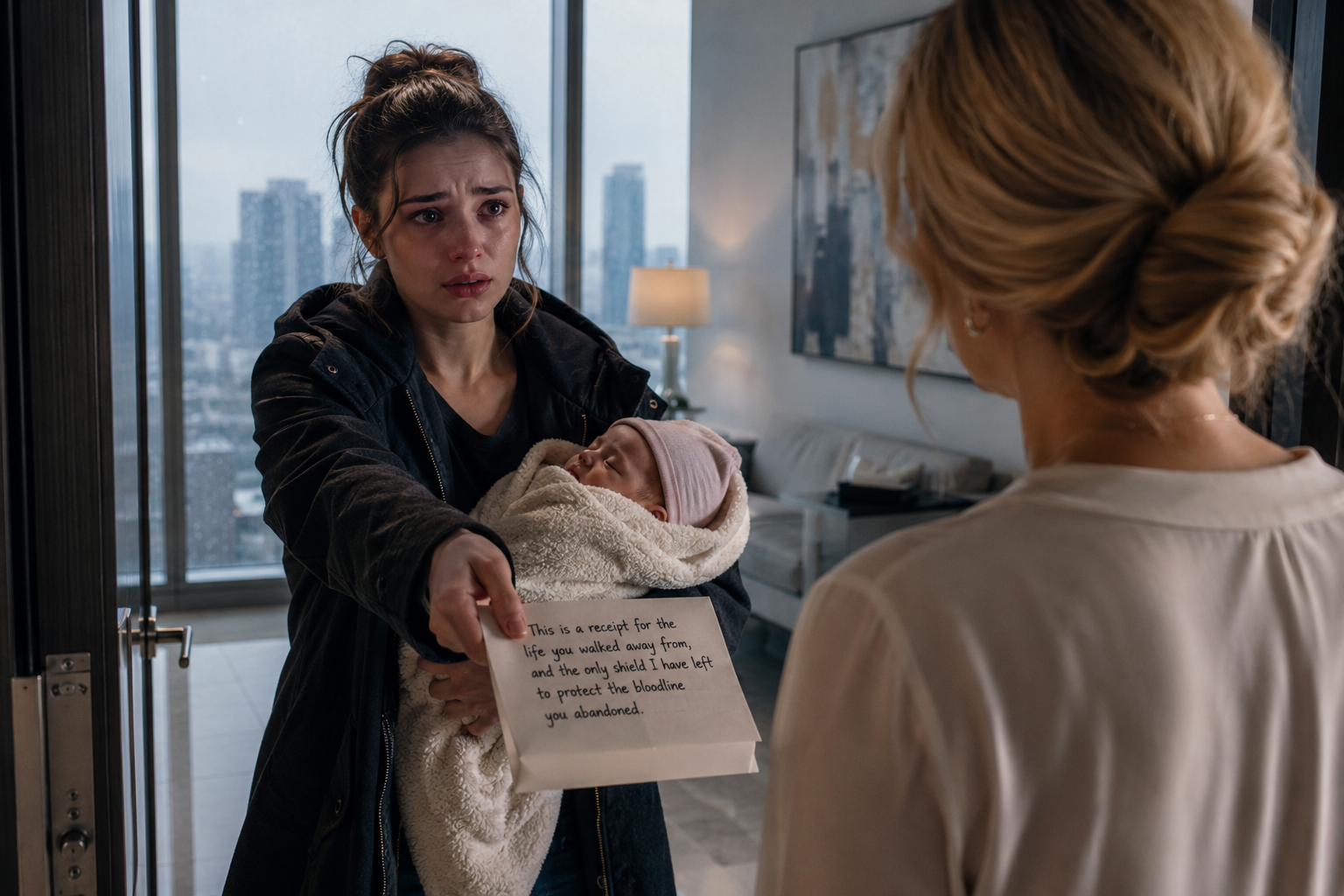
The baby was warm.
That was the first thing I noticed after the shock wore off enough for my hands to stop shaking.
Warm, impossibly small, and sleeping against my chest like she belonged there.
The young woman who had placed her into my arms stood just inside the doorway, rainwater dripping from the sleeves of her dark coat onto my marble floor. She looked exhausted. Not messy-exhausted. Hollow-exhausted. Like someone who had been carrying too much weight for too many years and finally realized their knees were about to give out.
And she had my eyes.
That realization hit harder than the baby.
Not similar eyes.
Not vaguely familiar.
Mine.
Twenty years disappeared in a single violent second.
“Save it,” she said sharply as my mouth opened. “I’m not here for an apology.”
Her voice was flat, almost rehearsed. Like she’d practiced saying those words enough times to sand all the emotion out of them.
The baby stirred softly between us.
I looked down automatically.
Tiny fingers.
Pink knit hat.
One sock missing.
My chest tightened strangely.
“I don’t understand,” I whispered.
“Yes, you do.”
She reached into her coat pocket and handed me a folded note.
The paper was damp from rain.
“This is a receipt for the life you walked away from,” it read. “And the only shield I have left to protect the bloodline you abandoned.”
My stomach dropped.
“What does that mean?”
The woman laughed once.
Not cruelly.
Not warmly.
Just tired.
“It means congratulations,” she said. “You’re a grandmother.”
The word hit me like broken glass.
Grandmother.
No.
Impossible.
Because in my head, nineteen-year-old me still existed untouched somewhere — selfish, beautiful, reckless, sprinting away from responsibility in expensive heels and borrowed confidence.
I had spent twenty years refusing to think about what came after I signed those adoption papers.
I told myself it was kindness.
That she deserved better.
That I was too young.
But the truth?
I liked my freedom more than I liked the idea of motherhood.
So I walked away.
And I never looked back.
Not once.
No letters.
No searches.
No birthday calculations in grocery store aisles.
No wondering if she looked like me.
Nothing.
The young woman studied my face carefully.
“You really never tried to find me,” she said quietly.
It wasn’t a question.
The shame burned hotter because she sounded unsurprised.
I swallowed hard.
“No.”
She nodded slowly like she had expected exactly that answer.
“Honestly?” she said. “That actually makes this easier.”
The baby whimpered softly.
Instinctively, I adjusted my hold.
The motion surprised both of us.
Her eyes flicked downward briefly.
“You’ve never held one before, have you?”
“No.”
“That tracks.”
The silence stretched.
Behind me, the penthouse glowed with expensive emptiness — designer furniture nobody sat on, abstract art I bought because critics told me to, kitchen counters untouched by anything except catered food and wine glasses.
Everything in my life suddenly looked staged.
Carefully curated.
Meaningless.
“What’s her name?” I asked finally.
The young woman hesitated.
“Lily.”
I looked down at the sleeping baby.
Lily.
“She’s beautiful.”
“I know.”
Something sharp flickered across her face then disappeared.
Not pride.
Fear.
Real fear.
The kind that lives in your bloodstream.
That was when I noticed the bruise near her wrist.
Yellowing fingerprints.
My eyes snapped upward.
She saw me notice.
“Don’t,” she said immediately.
“Who hurt you?”
“That’s not why I’m here.”
The rain battered harder against the windows now.
Somewhere far below, Manhattan traffic screamed through wet streets.
I looked again at the note in my trembling hand.
Shield.
Bloodline.
Abandoned.
“What’s happening?” I asked quietly.
For the first time since arriving, her composure cracked.
Her chin trembled once.
Then she reached into her bag and pulled out a thick manila folder.
Hospital records.
Birth certificate.
Photos.
Documents.
And one newspaper clipping.
She placed it gently on the marble table between us.
My breath caught instantly.
Because the man smiling in the photograph beside her was someone I recognized.
Not personally.
Professionally.
Dangerously.
Ethan Cross.
Billionaire investor.
Political donor.
Public philanthropist.
And according to the article headline:
LOCAL BUSINESSMAN CLEARED IN DOMESTIC DISPUTE INVESTIGATION
My daughter watched my face carefully.
“You know who he is,” she said softly.
It wasn’t a question either.
I nodded slowly.
Ice spread through my chest.
“What did he do?”
Her eyes filled immediately, though she fought the tears like she hated herself for them.
Then she looked at the baby sleeping in my arms.
And whispered:
“What your mother did to me.”
Part 2
For a moment, I couldn’t breathe.
The baby shifted softly against my chest, making tiny sleepy noises, completely unaware that the room had just split open.
My daughter — my daughter — stood across from me with bruises hidden beneath her sleeves and terror buried so deep inside her voice it sounded normal.
And all I could think was:
This is my fault.
Not because I chose Ethan Cross.
Not because I hurt her directly.
Because I taught her, before she was even old enough to remember me, that abandonment was survivable.
That love leaves.
That people who are supposed to protect you disappear.
I set the folder down carefully before my hands dropped it.
“How long?” I asked quietly.
She crossed her arms tightly, like she was holding herself together by force.
“Three years.”
Three years.
The number made me sick.
“He didn’t start out violent,” she said automatically.
The words came out too fast.
Too practiced.
Like she had defended him a thousand times before.
“He was charming. Patient. Generous. Everybody loved him.” Her mouth twisted bitterly. “You know… exactly the kind of man people never believe against.”
I looked again at the newspaper clipping.
Cleared.
Of course he was.
Men like Ethan Cross built entire lives around being believed.
“What happened?” I asked softly.
My daughter stared at the rain sliding down the windows.
“At first?” she whispered. “Nothing obvious.”
She gave a hollow laugh.
“That’s the scary part.”
The baby stirred again, and instinctively she stepped closer, adjusting the blanket around Lily’s tiny legs with gentle fingers.
The contrast nearly destroyed me.
Hands capable of so much tenderness carrying so much damage.
“He started with little things,” she continued. “Correcting me constantly. Telling me I was emotional. Forgetful. Dramatic.”
My stomach tightened.
Familiar words.
Painfully familiar words.
Then she said something that made my blood run cold.
“He used to tell me nobody stays unless they’re forced to.”
I closed my eyes.
Because somewhere deep down, whether she remembered me or not, I had taught her that first.
She watched my face carefully.
“You don’t get to cry,” she said suddenly.
The words sliced clean through me.
I nodded once.
“You’re right.”
“I’m not trying to punish you,” she added quickly, almost angrily. “I just… I spent my whole life wondering why my own mother didn’t want me enough to even check if I survived.”
There it was.
The wound.
Raw.
Living.
Twenty years old.
I had imagined many versions of this moment over the years — usually late at night after too much wine, when regret became brave enough to speak.
In every version, I defended myself.
I was young.
I was scared.
I did what I thought was best.
But standing here now, holding her baby while she tried not to fall apart in front of me, every excuse sounded pathetic.
“I was selfish,” I said quietly.
She blinked.
“I chose freedom over you.”
The honesty seemed to shock her more than denial would have.
“I kept telling myself giving you up was noble,” I continued. “But the truth is… I didn’t want my life to change.”
The room stayed silent except for Lily’s tiny breathing.
Finally, my daughter sat down slowly on the edge of the white sofa like her legs had given out.
“I thought meeting you would feel bigger,” she admitted.
“Bigger?”
“Angrier. More dramatic.” She rubbed her eyes roughly. “Instead I’m just tired.”
I understood that feeling immediately.
She looked older than twenty.
Not physically.
Spiritually.
Like life had already demanded too much from her.
“Why now?” I asked carefully.
Her eyes moved to Lily.
“Because he found out about her.”
Ice flooded my veins.
“What do you mean?”
“He was careful with me,” she whispered. “But after Lily was born…” Her voice cracked. “He started talking about discipline. Obedience. Bloodlines.”
I tightened my hold on the baby automatically.
“He said daughters become what their mothers are allowed to be.”
The room suddenly felt freezing.
“He’ll come looking for her,” she said softly. “Maybe not today. Maybe not tomorrow. But eventually.”
Fear moved through me for the first time.
Real fear.
Not for myself.
For this tiny sleeping child tucked against my chest.
“What are you asking me to do?”
My daughter looked at me then.
Really looked at me.
Not as a stranger.
Not as a villain.
Not even as a mother.
As a final option.
“Protect her,” she whispered.
My throat tightened painfully.
“And you?”
She smiled then.
Small.
Broken.
Resigned.
“That’s the problem,” she said softly. “I don’t think he’s going to stop until I disappear.”
Part 3 — The Ending
“No,” I said immediately.
The word came out so fast it startled both of us.
My daughter stared at me.
“You don’t understand—”
“No,” I repeated, stronger this time. “He does not get to take another generation from this family.”
Something flickered across her face.
Hope.
Tiny.
Terrified.
Unfamiliar.
Like she hadn’t allowed herself to feel it in years.
I walked to the massive windows overlooking Manhattan, Lily still sleeping against my shoulder, and pulled my phone from my pocket.
“What are you doing?” she asked quietly.
“For the first time in twenty years?” I said. “Trying.”
I called Daniel Mercer first.
Attorney.
Former federal prosecutor.
One of the few people powerful enough to make men like Ethan Cross nervous.
He answered immediately.
“Vivian?”
“I need emergency protection orders, private security, and every quiet favor you owe me.”
A pause.
“That serious?”
I looked back at my daughter.
“Yes.”
Daniel’s voice sharpened instantly. “Send me everything.”
Within an hour, the penthouse transformed.
Security at every entrance.
A former detective reviewing the documents.
Lawyers calling judges.
Phones buzzing constantly.
My daughter sat curled at the far end of the sofa watching it happen with stunned disbelief, Lily sleeping beside her in a borrowed bassinet my assistant had somehow produced within thirty minutes.
“You can do all this?” she whispered.
I almost laughed.
All the money.
All the influence.
All the connections.
And none of it had mattered until now.
“Yes,” I said quietly. “I can.”
Tears filled her eyes instantly, though she blinked them away hard.
“I didn’t come here because I wanted your help,” she admitted. “I came because I ran out of places to go.”
I sat beside her slowly.
“I know.”
“No,” she said shakily. “You don’t.”
She turned toward me fully for the first time.
“He isolated me from everyone. Friends first. Then coworkers. Then neighbors.” Her voice trembled. “By the end, I spent two years trying to become smaller because every time I had opinions or needs or emotions…” She swallowed hard. “He punished me for existing.”
The sentence hollowed me out.
Because suddenly I understood something unbearable:
Trauma repeats itself in accents.
My mother used shame.
Ethan used fear.
Different weapons.
Same wound.
Teach someone they are difficult to love, and eventually they’ll tolerate people who prove it.
My daughter looked down at her hands.
“I kept wondering what was wrong with me,” she whispered.
Without thinking, I reached for her.
She flinched.
The movement lasted less than a second.
But it nearly broke me.
I pulled my hand back immediately.
“I’m sorry,” she said automatically.
“No.” My voice cracked. “Don’t apologize for protecting yourself.”
The room went silent.
And then, very quietly, she started crying.
Not loudly.
Not dramatically.
The exhausted crying of someone who had held everything in for too long.
I sat there helplessly for one horrible moment before finally asking:
“What’s your name?”
She looked up.
I realized then how monstrous it was that I didn’t know.
Not because I forgot.
Because I never asked.
“Elena,” she whispered.
Elena.
I repeated it softly in my mind like something sacred.
My daughter had a name.
And I had missed twenty years of it.
Three days later, Ethan Cross arrived.
Not personally.
Men like him rarely dirtied their own hands.
Two lawyers entered my office building carrying threats disguised as legal paperwork: custody challenges, defamation warnings, accusations of instability.
Daniel barely glanced at them before laughing.
“Tell your client,” he said calmly, “that if he comes within five hundred feet of Elena or the child, the recordings go public.”
The lawyers froze.
Elena looked at me sharply after they left.
“Recordings?”
I opened the folder Daniel had assembled.
Private investigator reports.
Medical records.
Witness statements.
Photographs.
And audio files.
Ethan screaming.
Threatening.
Breaking things.
Elena stared at the evidence like she was seeing her own life translated into another language.
“You believed me,” she whispered.
The words shattered something inside me.
Because she sounded surprised.
I sat beside her carefully.
“When I was nineteen,” I said quietly, “I abandoned my daughter because I thought freedom mattered more than responsibility.”
Elena stayed still.
“I will spend the rest of my life regretting that.” My throat tightened painfully. “But I need you to understand something.”
She looked at me slowly.
“I will never abandon you again.”
For a long time, she said nothing.
Then Lily began crying softly from the bassinet.
Instinctively, both of us stood at the same time.
We froze.
Looked at each other.
And for the first time since she arrived, Elena laughed.
Small.
Wet with tears.
But real.
“You pick her up wrong,” she said softly.
“I’ve had four days of experience,” I replied.
“That’s terrible odds.”
“I’m learning.”
She hesitated only a second before stepping beside me.
“Support her head,” she murmured gently.
Our hands brushed together as we lifted Lily.
Tiny.
Warm.
Alive.
Three generations standing together in the middle of a penthouse that no longer felt empty.
Months later, after the restraining orders held, after Ethan Cross disappeared from headlines into investigations and sealed courtrooms, after therapy and sleepless nights and long conversations neither of us knew how to have—
Elena asked me something while we sat watching Lily sleep.
“Why didn’t you look for me?”
The old shame rose immediately.
But this time I answered honestly.
“Because I thought if I never saw what I lost,” I whispered, “I could pretend I hadn’t destroyed it.”
Elena was quiet for a long time.
Then she leaned her head softly against my shoulder.
“You did destroy something,” she said.
I closed my eyes.
“But,” she continued quietly, “you’re finally helping rebuild it.”
And for the first time in twenty years, the silence in my home no longer sounded empty.