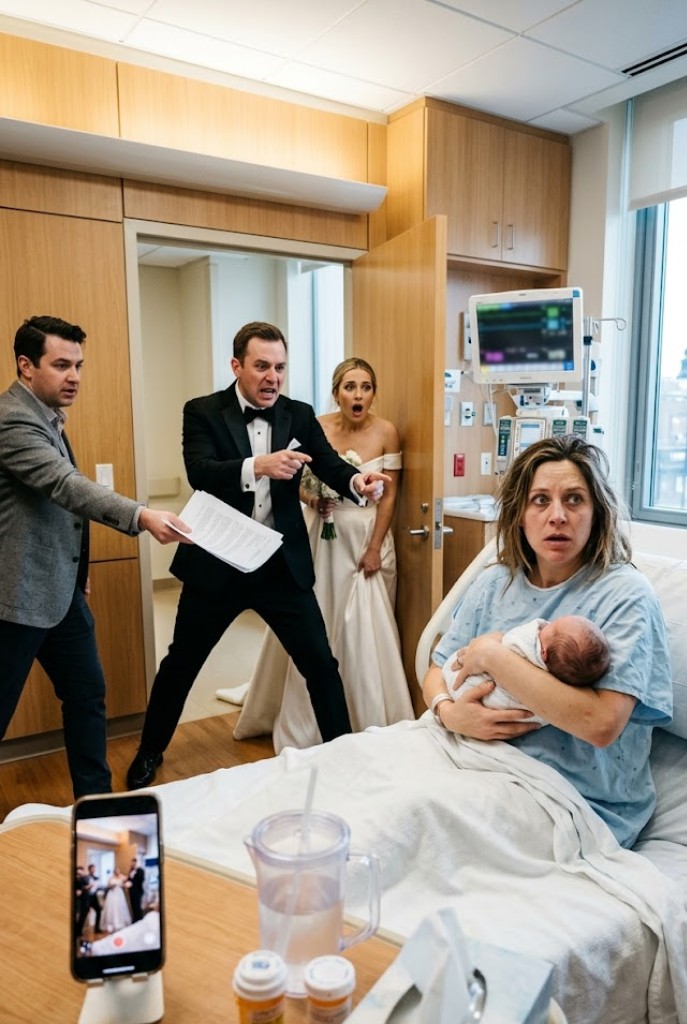
The rain had been falling over Brooklyn since dawn, tapping against the hospital windows with a steady patience that made the whole city seem quieter than it really was. Outside, traffic hissed along the wet streets, headlights smearing across the glass in pale yellow streaks, but inside Emma Bennett’s private room, the world had narrowed to the warm weight of her newborn daughter sleeping against her chest. The baby had been alive for only a few hours, yet she already looked as if she had arrived with a will of her own, her small fists tucked beneath her chin, her cheeks flushed pink, her dark lashes trembling in sleep. Emma watched her breathe, counted the tiny rises and falls of her blanket, and felt something in herself settle into place that no judge, no husband, no gossip column, and no family name could ever take from her again. She was exhausted down to the bone, her body sore, her hair loose around her face, her lips dry from hours of labor, but beneath all of that was a calm so deep it almost frightened her. She had survived. More than that, she had brought someone into the world who belonged to no one’s empire, no one’s lies, no one’s carefully arranged narrative. Her daughter belonged first to herself, and Emma intended to make sure the world learned that early.
The room smelled of disinfectant, rain-damp wool from her mother’s coat, and the faint sweetness of the carnations wilting in a glass vase near the window. Her mother, Eleanor Bennett, had left them there before stepping out to make a call and find coffee strong enough to keep herself from crying again. Eleanor had cried through the birth, through the first cry, through the nurse placing the baby on Emma’s chest, through the moment Emma whispered the name she had chosen months ago but told almost no one. Lily. Small, simple, soft, but resilient. A flower that returned after winter. Emma had not chosen it by accident. She had spent the last year being called cold, barren, bitter, unstable, difficult, vindictive, ungrateful, and broken. She had watched people who once smiled at her across charity tables lower their eyes when she entered rooms. She had watched acquaintances accept Adrian Carter’s version of her without ever asking for hers. She had signed divorce papers with trembling hands while her ex-husband looked across a polished conference table at her as if he were granting mercy by leaving her with anything at all. And all the while, quietly, invisibly, fiercely, Lily had been growing beneath Emma’s heart.
Her phone vibrated on the bedside table, cutting through the soft rhythm of the rain.
At first, she ignored it. She had ignored almost every call that day except her mother’s and her attorney’s. The people who mattered knew where she was. The people who did not matter could wait forever. But the phone kept buzzing, sliding slightly against the glass surface each time, insistent and ugly in the peaceful room. Emma turned her head just enough to see the name on the screen, and the air inside her chest changed.
Adrian Carter.
For one strange second, she thought fatigue had made her misread it. Adrian had not called her in weeks. Their communication had been filtered through lawyers, financial notices, carefully phrased threats, and the occasional message he sent at midnight when he was drunk enough to be sentimental but sober enough to be cruel. Yet there was his name, bright on the screen, alive as if he still had the right to interrupt her life whenever he pleased. Emma stared at it until the buzzing stopped. Silence returned. Lily shifted against her, making a faint sound that was almost a sigh. Emma lowered her cheek to her daughter’s hair.
Then the phone rang again.
A nurse near the IV stand glanced over. “Do you want me to silence that for you?”
Emma should have said yes. She should have let Adrian go to voicemail, should have let him stand wherever he was and perform whatever petty triumph he had planned for an empty line. She had just given birth. Her body needed rest, her daughter needed peace, and Adrian Carter had long ago forfeited the privilege of access. But something in Emma, something honed sharp through months of humiliation, refused to look away from an oncoming storm. She knew Adrian. She knew his timing was never accidental. If he was calling now, he wanted her to feel something. He wanted to reopen a wound he believed he had made permanent.
Emma picked up the phone with one hand while the other remained protectively curved around Lily’s back.
“Hello.”
The sound that came through the speaker was not Adrian’s voice at first. It was music. Violins, bright and polished, played somewhere behind him. A rush of laughter followed, then the clink of glass, then a woman’s delighted voice saying something Emma could not quite catch. The noise was unmistakably expensive. Champagne expensive. Cathedral expensive. Manhattan in the rain expensive. Then Adrian laughed, low and pleased, as if he had arranged the entire scene for her benefit.
“Emma,” he said. “I figured you should hear it from me first.”
She closed her eyes.
The nurse, sensing the change in the room, quietly adjusted the drip and pretended not to listen.
Adrian continued before Emma could answer. “Today I’m marrying Vanessa.”
The name entered the room like perfume poured over rot. Vanessa Reed. Former executive assistant. Soft-spoken, efficient, always early, always immaculate, always carrying Emma’s coffee in one hand and a tablet in the other. Vanessa, who had once told Emma that navy blue made her look powerful. Vanessa, who remembered Emma’s lunch preferences, rearranged meetings when Emma’s migraines came, and laughed with just the right amount of admiration whenever Adrian made a remark in the office. Vanessa, who had smiled at Emma in boardrooms while forwarding her confidential emails to Adrian. Vanessa, who had booked hotel suites in Miami, Dallas, and Los Angeles under corporate accounts while Emma was still trying to convince herself that her marriage was only strained, not dead. Vanessa, who was now apparently standing somewhere near a cathedral aisle in white lace, waiting to collect the husband she had already taken.
Emma opened her eyes and looked at her daughter. Lily’s fingers had caught in the rough fabric of the hospital gown, gripping it with impossible seriousness.
“Congratulations,” Emma said quietly.
There was a pause, just short enough to prove Adrian had expected tears and long enough to prove he was irritated not to hear them.
“Still so cold,” he said, the brightness in his voice sharpening. “That’s exactly why our marriage died.”
Emma did not flinch. Six months earlier, those words might have found something soft in her and twisted. She might have defended herself, might have said, Adrian, please don’t do this, might have tried to remind him of the years she had spent loving him when he was still a man capable of shame. But pain, when repeated often enough, eventually lost its element of surprise. Adrian had used her supposed coldness to justify every betrayal. He had called her cold when she asked why he came home smelling of someone else’s perfume. Cold when she questioned unexplained transfers. Cold when she refused to smile at Vanessa during charity events. Cold when she cried in the bathroom after another fertility specialist spoke to her with clinical pity while Adrian checked his phone. Cold, cold, cold, until the word became less an accusation than a curtain he hid behind.
“Why are you calling me?” Emma asked.
“To invite you.”
The absurdity of it was so grand that for a moment she almost laughed.
Adrian must have heard something in her silence because he rushed on, sounding pleased with himself again. “Vanessa thinks closure would be healthy for everyone. We don’t want bitterness lingering around. You know how these things are.”
Closure. Emma looked around the hospital room, at the rain, the flowers, the monitors, the clean folded towels, the little plastic bassinet where her daughter would later sleep. She thought of Vanessa standing in silk and diamonds, discussing closure as if she had not helped tear open every private seam of Emma’s life. She thought of Adrian calling from the threshold of his second marriage, not because he wanted peace, but because he wanted a witness to his victory.
“I just had a baby,” Emma said. “I’m not going anywhere.”
Everything on Adrian’s end changed.
The music continued. The distant laughter continued. A door opened somewhere near him, and someone said his name in a cheerful, impatient tone. But Adrian himself went completely silent.
“What did you say?”
Emma adjusted the pale pink blanket around Lily’s shoulders. She had imagined this moment many times during the pregnancy, though never exactly like this. In some versions, Adrian found out through a legal notice. In others, through his father. In the cruelest version, he found out on a day when he felt safe. That last detail, at least, had come true.
“I said I just gave birth.”
Another silence. Then Adrian’s voice returned, stripped of polish.
“Whose baby is it?”
Once, that question would have destroyed her. It would have ripped her open because it carried everything he had taught her to fear: accusation, disbelief, contempt, the suggestion that even motherhood could be used as a courtroom weapon. Once, she would have heard that question and remembered the divorce hearing, the way Adrian’s attorney had described her as emotionally volatile, medically fragile, and dependent on fantasy when reality disappointed her. She would have remembered Adrian’s friends whispering that she had become obsessed with having a child, that she blamed him for things no husband could control, that she had made their beautiful marriage impossible. She would have remembered the judge’s expression, not unkind but tired, as if Emma were one more wealthy woman trying to turn heartbreak into litigation.
But that woman had not survived unchanged. Something in her had died with the divorce decree, yes. Something trusting, something hopeful, something that believed love would eventually make a liar confess. But something else had risen in its place, quieter and harder to frighten.
Emma turned toward the rain-streaked skyline. Even through the gray blur, New York looked strangely beautiful, all glass and stone and water, a city that had seen every kind of ruin and still insisted on shining at night.
“You should get back to your fiancée, Adrian.”
“Emma.” His voice dropped, and for the first time she heard fear trying to disguise itself as command. “Tell me that child isn’t mine.”
Emma smiled faintly, though there was no humor in it.
“You signed everything without reading it, Adrian. You always hated details.”
She ended the call before he could answer.
For several seconds, the room held its breath. The nurse looked at Emma, then quickly looked away, her professional mask slipping just enough to reveal curiosity and concern. Lily slept on, undisturbed by the first tremor of the earthquake she had caused simply by existing.
“Do you need security notified?” the nurse asked softly.
Emma looked at the closed door. She knew Adrian well enough to know he would come. Not eventually. Not after reflection. He would come immediately, driven by panic, ego, and the unbearable suspicion that something had happened beyond his control. His entire life had been built around entering rooms as if he owned them. Hospitals, courtrooms, boardrooms, bedrooms, churches. He believed doors existed to open for men like him.
“Yes,” Emma said after a moment. “But don’t stop him at the entrance. Just make sure there are witnesses.”
The nurse’s eyes flickered. She was young, maybe twenty-eight, with tired eyes and a wedding ring that caught the fluorescent light when she moved. She seemed to understand more than Emma had said.
“I’ll let the desk know,” she replied.
Emma thanked her and set the phone back down. Her hand trembled once, then steadied. She looked at Lily and whispered, “You picked quite a day to arrive.”
Lily yawned, opened her mouth in a silent protest at the world, and went still again.
Thirty minutes later, the hallway outside Emma’s room filled with the sound of hurried footsteps.
By then, Eleanor had returned with coffee in a cardboard cup and fury in her face. Emma had told her only enough to prepare her. Adrian knew. Adrian was coming. Vanessa might be with him. Eleanor had listened without interrupting, then placed the coffee untouched on the table and removed her earrings with the calm of a woman preparing for a fight in a drawing room rather than a hospital.
“I never liked him,” Eleanor said.
“You toasted him at the wedding.”
“I lied beautifully.”
Emma would have laughed if her body had not hurt so much.
The first knock never came. The door burst inward with such force that it struck the rubber stopper and bounced back.
Adrian Carter stood in the doorway in a black tuxedo that had clearly been put on by a calmer man hours earlier. Now the bow tie hung loose around his collar, his white shirt was creased, his hair damp from rain and sweat, and his face had gone a shade of gray Emma had never seen on him before. Adrian had always been handsome in a way that seemed designed for magazine profiles: sharp jaw, dark hair, expensive posture, eyes trained to appear sincere at fundraisers. But panic made him less elegant. It pulled the symmetry apart. It exposed the boy beneath the heir, the frightened son of a powerful father, the man who had never learned to lose privately.
Behind him came Vanessa.
She entered as if she could still salvage grandeur from catastrophe. Her wedding gown swept across the hospital floor in a froth of satin and lace, absurdly bright under the harsh fluorescent lights. Her veil trailed behind her like spilled fog. Diamonds trembled at her throat and ears, each movement sending small flashes across the room. Her makeup had been done by someone talented and expensive, but anxiety had already begun to work against it. Her smile was fixed too tightly. Her eyes moved too quickly. She looked at Emma, then at the baby, then at Adrian, calculating.
For one suspended second, no one spoke.
Adrian stared at Lily.
Not tenderly. Not with wonder. Not with the helpless awe Emma had seen on her mother’s face. He stared as if the baby were a document found in a locked drawer. Evidence. Liability. Proof of something he had failed to erase.
Then he looked at Emma.
“You planned this,” he whispered.
Emma leaned back against the pillows. Her body ached from the birth, and fatigue moved through her limbs like deep water, but her voice remained calm.
“No,” she said. “You did.”
Vanessa recovered first. Of course she did. Vanessa had survived in executive suites by learning when to flatter, when to retreat, and when to attack. She lifted the front of her gown slightly to avoid the damp mark on the floor where Adrian had tracked rain inside and stepped fully into the room. Her perfume, floral and expensive, rolled over the sharper hospital smells. The nurse near the door stiffened. Eleanor sat in the corner with her hands folded, eyes cold.
“This is pathetic,” Vanessa snapped. “You really had a baby to ruin my wedding? Are you that desperate, Emma?”
The nurse froze beside the IV pole.
Emma looked at Vanessa’s tiara. It sat perfectly among glossy waves of hair, a little crown for a woman who thought possession was the same as victory. Emma noticed, with a strange detached amusement, that Vanessa wore pearl-stitched shoes beneath the hem of the gown. She must have imagined herself walking down marble steps, not pacing across a maternity ward.
“Congratulations, Vanessa,” Emma said softly. “You finally got to keep the man you stole.”
Vanessa’s expression hardened, but her eyes flicked toward Adrian first, checking whether he approved of her cruelty. “No one steals trash someone already threw away.”
Eleanor inhaled sharply, but Emma did not look away.
“You’re right,” Emma replied. “I was only returning defective merchandise.”
The nurse’s mouth twitched before she caught herself.
Adrian slammed the door shut, though not before Emma glimpsed two hospital security officers stopping at a discreet distance down the hallway. Good. Witnesses.
“That’s enough,” he said. “Is the baby mine or not?”
Lily stirred at the sudden noise. Her little face scrunched, and she made a soft sound, barely a cry, more offended than afraid. Adrian flinched as if the sound had touched a nerve. Emma watched him do it. That, more than anything, told her the truth about the kind of father he would have been if she had told him earlier. Not cruel to an infant, perhaps. Adrian’s cruelty was usually too vain to be direct against the helpless. But he would have treated Lily first as leverage, second as inheritance, third as image, and perhaps only distantly, inconveniently, as a child.
Emma reached carefully toward the bedside table. Her fingers closed around the blue folder she had placed there before the call. Mr. Reynolds had delivered it two days earlier, though the legal originals were already secured elsewhere. She held it out.
“Prenatal DNA test,” she said. “Verified lab. Legal chain of custody. Your name is on every page.”
Adrian did not move.
For months, he had moved through the world with the confidence of a man who believed paperwork existed to serve him. He signed contracts without reading the footnotes because someone else had always made sure the footnotes protected him. He skimmed financial statements because numbers bored him unless they were large enough to impress strangers. He dismissed details as the obsession of smaller minds. Details were what assistants handled, analysts handled, lawyers handled, wives handled. But now a folder sat between him and the life he had been celebrating thirty minutes earlier, and the details inside it terrified him.
Vanessa took it before he did.
“Give me that,” she said, snatching the folder with a confidence that lasted exactly four seconds.
Emma watched her open it. Watched her eyes move. Watched the first flicker of disbelief pass over the perfect bridal face. Vanessa turned one page, then another. She leaned closer, as if proximity might change the printed words. Her lips parted.
“That’s impossible,” she whispered.
Adrian grabbed the folder from her. He scanned the first page, then the second. Emma could almost see the arithmetic happening behind his eyes. Dates. Weeks. Estimated conception. The final days of the marriage. The night he had returned to the townhouse on the Upper East Side drunk enough to cry and desperate enough to confuse regret with love.
Emma remembered that night with a clarity that still made her skin feel cold. Rain had fallen then too, though not as heavily. Adrian had come home after midnight, his coat soaked, his face pale, his breath sharp with whiskey. She had been awake in the library, surrounded by financial documents she was not yet ready to admit looked wrong. He had stood in the doorway, swaying slightly, and for once he did not accuse her of spying or overreacting. Instead, he wept. Not beautifully. Not dramatically. He wept like a boy who had been told he would inherit a kingdom and had suddenly realized kingdoms could burn. Investor pressure, he said. His father’s expectations. Vanessa’s demands. The board watching. His fear of losing Carter Holdings. His fear of becoming ordinary. He said he was confused. Broken. Sorry. He said Emma was the only person who had ever known him before the suits and the cameras and the polished interviews. He said he missed her. He said he had made mistakes. He climbed into her bed as if sorrow were apology, and Emma, exhausted by months of loneliness, allowed herself one night of believing the man she loved might still be buried beneath the man who had betrayed her.
Before dawn, he was gone.
By noon, Vanessa had emailed Emma a revised meeting schedule with three heart emojis beside a charity luncheon appointment.
Now Adrian stood in a hospital room counting backward from his daughter’s birth, and the memory arrived in his face like a physical blow.
“You knew,” he said quietly.
“I found out after the divorce.”
“Then why didn’t you tell me?”
Emma looked at him for a long time. She could have answered a dozen ways. Because you would have used her. Because you would have called me a liar. Because you had just stood in court and let your attorney imply that my desire for a child had made me unstable. Because you had already taken enough. Because I needed one thing in my life to grow without your shadow over it.
What she said was simpler.
“Because you were too busy telling everyone I couldn’t have children.”
The words landed harder than she expected. Not on Adrian. On Vanessa.
Vanessa looked up sharply, and for the first time since entering the room, she seemed genuinely startled. Not frightened for Adrian, not angry at Emma, but surprised. As if some part of the story she had been sold had not been a performance for public sympathy but a private lie told to her as well. Emma saw the crack appear. Small. Thin. But real.
Adrian had built his second act carefully. Poor Adrian, trapped in a loveless marriage with a cold woman who could not give him children. Poor Adrian, heir to a great family business, longing for warmth and loyalty. Noble Adrian, trying for years to make it work before finally admitting defeat. Generous Adrian, leaving his ex-wife with more than enough while finding real love with the younger woman who understood him. Vanessa had not merely accepted that story. She had worn it like a gown. It made her betrayal romantic. It turned her from mistress into rescuer. It let her believe Emma had been an obstacle, not a person.
Emma had allowed Adrian to keep talking. She had let him post pictures, give interviews, restructure accounts, attend benefits with Vanessa on his arm, and turn Emma Bennett into a cautionary tale whispered over champagne. She had let him believe silence was surrender because he had never understood the uses of silence.
“What do you want from me?” Adrian asked.
The question revealed more than he intended. He did not ask what she needed. He did not ask about the baby. He asked what she wanted from him, because in his mind every truth was a negotiation and every relationship was a transaction with a hidden invoice.
“Nothing,” Emma said.
His eyes narrowed. “Then why do all this?”
“You called me.”
Vanessa clutched his arm. Her nails, pale pink and polished, pressed into his sleeve. “Adrian, we need to go. Everyone’s waiting.”
Emma smiled faintly. “Yes, they probably are. I’m sure your guests are wondering why the groom disappeared after learning his ex-wife just gave birth to his daughter.”
Adrian’s phone buzzed.
Then Vanessa’s.
Then, from the hallway, came hurried footsteps. Hospital security shifted. Eleanor rose from her chair.
A man in a dark tailored suit appeared in the doorway carrying a leather document case and the expression of someone who had spent years delivering bad news to people richer than he was. He looked first at Emma, who gave the smallest nod. Then he turned toward Adrian.
“Adrian Carter?”
Adrian froze. “Who are you?”
The man stepped inside just far enough to be unmistakably present without invading the medical space around Emma’s bed. “Daniel Park. Process server. You are hereby served.”
He extended a sealed envelope.
Adrian stared at it as if it might detonate.
Vanessa took half a step back, the train of her dress catching under one heel. Daniel Park calmly reached into his case again.
“And one for you as well, Vanessa Reed.”
The room went still in a different way then. Not shocked. Final.
Vanessa’s face drained of color beneath the makeup. “I don’t understand.”
“You will,” Emma said.
Adrian finally looked away from the envelope and back at Emma. “What did you do?”
Emma lowered her head and kissed Lily’s forehead. The baby smelled of milk, cotton, and the strange sweetness of new life. For months, Emma had imagined revenge as fire. She had imagined herself wanting to scream, to break, to make Adrian feel every moment of humiliation he had fed her in public while smiling in private. But holding Lily, she understood that revenge was not the point. Revenge was too small. What she had built was protection. Restoration. Proof. A wall between her daughter and the people who thought love, money, and bloodlines were things to be manipulated on letterhead.
“I protected what belonged to me,” she said.
Adrian’s eyes changed. For the first time since Emma had met him, real fear looked out through them, naked and unpolished.
He had absolutely no idea what was coming next.
The story did not begin in the hospital, though that was where Adrian finally learned he had lost control of it. It had begun years earlier, in a conference room high above Midtown, when Emma Bennett first noticed that Adrian Carter smiled differently at numbers depending on who was explaining them. He liked numbers when they appeared in headlines, when they proved growth, acquisition, expansion, dominance. He liked them when they made investors lean forward and journalists ask flattering questions about vision. He did not like numbers in ledgers, footnotes, deferred liabilities, collateral documents, tax schedules, or trust restrictions. Those numbers made him impatient. They required discipline rather than charisma. They could not be charmed by a smile.
Emma had been a forensic financial analyst before she became Mrs. Carter. She had built her reputation tracing what people tried to hide: misdirected funds, shell companies, suspicious valuations, concealed assets tucked into structures so dense their creators hoped no one would bother untangling them. She had not come from Carter money, though the Bennetts were not poor. Her father, Thomas Bennett, had been wealthy in a quieter way, less interested in society pages than in instruments of preservation. He believed money should have memory. He believed wealth without rules became appetite. Before he died, he established the Bennett Trust with provisions so precise that most lawyers found them exhausting and Emma found them comforting. It held assets intended for Emma and any future children she might have. It protected certain family investments from marital claims. It restricted collateralization without explicit authorization. It required multiple signatures for major movements and independent review under circumstances Thomas had described, in his old-fashioned language, as “attempted coercion by charm.”
At twenty-eight, Emma had laughed when she first read that clause.
At thirty-six, pregnant and divorced, she wept over it in her kitchen at three in the morning.
Adrian had loved her competence in the beginning, or claimed he did. He told friends she was brilliant. He called her his secret weapon. He brought her into discussions at Carter Holdings because she could see patterns in financial structures that his executives missed. Their courtship had been full of late nights, takeout containers, market reports, and laughter that came easily before either of them understood how much ambition could corrode intimacy. Adrian had been charming then, yes, but not yet hollow. He listened when she spoke. He asked questions. He seemed genuinely dazzled by the speed of her mind. When he proposed on the terrace of a hotel overlooking Central Park, he said he wanted a partner, not an ornament.
For a while, she believed him.
They married at the same Manhattan cathedral where he later tried to marry Vanessa. That detail would never stop feeling obscene to Emma. At her wedding, the stone arches had been filled with white roses and winter light. Adrian had cried when she walked down the aisle, or seemed to. Richard Carter had clasped Thomas Bennett’s hand and spoken solemnly of families joining. Margaret Carter had kissed Emma’s cheek and said she was exactly what Adrian needed: intelligence, steadiness, grace. Vanessa had not been there. Not yet. In those days, Emma still thought betrayal arrived like lightning, sudden and unmistakable. She had not learned that betrayal more often came like mold behind a wall, spreading silently while the house still looked beautiful.
The first years were not unhappy. They worked too much, traveled too often, and became the sort of couple featured in glossy charity write-ups beneath captions about rising leadership and modern philanthropy. Emma wore structured gowns and gave careful speeches. Adrian accepted awards and spoke about legacy. At home, they were sometimes tender and sometimes tired. They fought about schedules, about his father’s interference, about Emma’s refusal to attend every social function as if smiling beside him were part of her employment contract. But they also danced barefoot in the kitchen. They watched bad thrillers on rainy Sundays. They whispered about children while brushing their teeth at midnight, laughing over names they would never actually use.
Then the doctors began speaking in probabilities.
Month by month, the private ache of infertility became a public shadow Adrian pretended not to cast. At first, he was gentle. He held her hand in clinics and told her they had time. He said family was not only biology. He said he loved her more than any imagined child. But disappointment has a way of revealing the material from which love is made. Emma’s disappointment turned inward. Adrian’s turned outward. He began treating each failed attempt as a personal embarrassment, a delay in an inheritance narrative he had not realized he carried so deeply. His father wanted grandchildren. His mother wanted christening portraits. The board liked stability. Investors liked dynasties. Adrian told Emma none of this mattered until it was clear it mattered to him very much.
Vanessa appeared during that fragile season.
She was twenty-nine, quick, polished, and almost unnervingly attentive. She became Adrian’s executive assistant after two predecessors quit within a year, both citing his impossible hours and temper when stressed. Vanessa did not quit. She learned. She anticipated. She made his life frictionless. If Adrian needed a file, she had it. If he forgot a birthday, she sent flowers under his name. If he wanted a dinner reservation, she secured a table no one else could get. She wore neutral colors, laughed softly, and kept her voice low in offices where men mistook quietness for loyalty. Emma initially admired her. Then she pitied her. Then, slowly, she began to fear the way Adrian relaxed when Vanessa entered a room.
It was not one moment. It was many. A look that lasted too long over a conference table. A text that made Adrian smile and turn his phone facedown. Vanessa knowing about a fight Emma had never mentioned to her. Adrian defending Vanessa’s “professionalism” with too much heat when Emma asked why she was traveling to every investor meeting. The Miami conference where Adrian’s hotel room was upgraded and Vanessa’s room, supposedly booked on another floor, was never used. The Dallas dinner where a managing director’s wife asked Emma whether she and Adrian had an “arrangement,” then went pale when Emma stared at her. The Los Angeles charity gala where Vanessa wore a silver dress Emma had once admired in a boutique and said, with perfect innocence, “Adrian thought this color would photograph well.”
When Emma confronted him, Adrian accused her of paranoia. When she showed him inconsistencies, he accused her of humiliating him. When she cried, he called her unstable. When she stopped crying, he called her cold.
By the time the affair became undeniable, Adrian had already laid the groundwork to make Emma’s pain look like pathology. He told friends she had become difficult. He told his mother Emma refused to discuss adoption because she was obsessed with control. He told Richard that Emma’s involvement in certain financial matters had become erratic, that she was overstepping, that stress had affected her judgment. He told Vanessa enough to make her feel chosen and enough lies to make her feel righteous. Emma found the hotel receipts, the messages, the duplicated calendar entries. She found email forwarding rules she had not created. She found evidence that Vanessa had accessed confidential documents under the pretense of reorganizing shared executive files.
Then Emma found the first transfer.
It was small enough to be missed, large enough to be arrogant. Money moved through a subsidiary account connected to a financing arrangement she did not remember approving. The language in the supporting documents felt almost familiar, as if someone had copied old Bennett Trust correspondence and rearranged it. Emma stayed up all night tracing it. By morning, she understood only that something was wrong. Not everything. Not yet. Enough.
When she brought it to Adrian, his face closed in a way she would never forget.
“You went through company records without authorization?” he asked.
“I had authorization.”
“Not anymore.”
It was the first time he said aloud what he had been quietly making true. Emma was no longer partner. No longer trusted counsel. No longer the woman whose mind he once admired. She was a liability to be managed.
The divorce followed with brutal efficiency. Adrian’s attorneys painted him as patient and wounded. Emma’s concerns about finances became evidence of obsession. Her grief over fertility treatments became instability. Her anger over Vanessa became jealousy. Documents appeared late, incomplete, or buried in volumes of irrelevant disclosures. Accounts shifted. Valuations changed. The townhouse, the penthouse, the shares, the marital assets, the interlocking agreements between Bennett structures and Carter entities—all of it became a maze constructed by men who assumed exhaustion would accomplish what deception began.
Emma signed because she was tired. Because she had been made to feel alone. Because Adrian looked across the table with cold pity and said, “You’ll be taken care of, Emma. Don’t turn this into something uglier than it has to be.”
Three weeks later, she fainted in her bathroom.
At first she thought it was stress. She had lost weight during the divorce. She barely slept. She lived in a temporary apartment near the river, surrounded by boxes she refused to unpack because doing so felt like admitting defeat. Her mother insisted she see a doctor. Emma went only to end the argument.
The nurse practitioner returned with a smile Emma did not understand.
The pregnancy test was positive.
Emma stared at the woman for so long the smile faltered.
“That isn’t possible,” Emma said.
But it was.
Not only possible. True. Confirmed again and again through bloodwork, scans, the trembling grainy image of a heartbeat flickering on a screen while Emma gripped the edge of the exam table and tried not to break open from the force of it. Life had appeared after the marriage ended, after the courtroom humiliation, after Adrian’s final cruelty. Life had taken root in the last place anyone expected, including Emma.
For one week, she told no one except her mother.
For two weeks, she did not call Adrian.
By the third week, she knew she would not call him at all.
That choice was not made out of spite, though later Adrian would insist it was. It was made in a lawyer’s office, with medical records on the table and the Bennett Trust agreement open beside them. Mr. Samuel Reynolds, her father’s old attorney, had read the documents in silence, his glasses low on his nose, his face growing more severe with each page. He was seventy-two, silver-haired, precise, and unfooled by charm. He had known Emma since she was in college. He had handled Thomas Bennett’s estate. He had never liked Adrian but had once admitted the young man was “at least interesting.” After the divorce, he changed that assessment to “catastrophically vain.”
“Do you want him notified?” Reynolds asked.
Emma sat across from him with one hand pressed lightly against her still-flat stomach. “Legally?”
“Not immediately, given the circumstances. Eventually, yes, in controlled form. But there is another matter.”
He slid a set of documents across the table.
The Bennett Trust had not merely been referenced in Carter financing. It had been pledged. Not fully, not cleanly, and not in a way that would withstand scrutiny, but enough to expose intent. Signatures attributed to Emma appeared on authorizations she had never seen. Certain approvals had been routed through Vanessa’s administrative channels. Timing aligned with pressure at Carter Holdings: a liquidity squeeze, an acquisition Adrian refused to abandon, investor demands he had hidden beneath upbeat internal memos. The structure was clever in the shallow way of people who expect no one competent to look closely. It relied on confusion, speed, and Emma’s presumed emotional defeat.
Reynolds watched her read.
“They believed,” he said quietly, “that by the time anyone examined this properly, you would either be too exhausted to fight or too discredited to be believed.”
Emma’s vision blurred. Not from tears alone, but from the fury of seeing her life reduced to a risk calculation. They had not only betrayed her marriage. They had studied her pain and used it as cover.
“What can we prove?” she asked.
Reynolds’s expression changed then. Not softened. Sharpened.
“With time? A great deal.”
Time became Emma’s discipline.
Pregnancy was not gentle to her at first. Morning sickness was constant. Fatigue wrapped around her like wet cloth. Some days she lay on the bathroom floor and wondered how her body could feel so weak while her anger remained so alive. But between doctor appointments and sleepless nights, she worked. She returned to the skill Adrian had once praised and later dismissed. She traced transfers through holding companies. She compared signature pressure and digital timestamps. She reconstructed email chains from backups Vanessa had not known existed. She reviewed metadata, board packets, loan documents, collateral schedules, and revised drafts that revealed more in their deletions than their final language. Reynolds assembled a team quietly: a trust litigator, a forensic document examiner, a former federal prosecutor, and a private investigator with the soft voice of a librarian and the patience of a wolf.
Emma learned to move slowly.
That was the hardest part. Not the nausea. Not the loneliness. Not seeing photographs of Adrian and Vanessa at restaurants where Emma had once sat. Not the captions about second chances and true partnership. The hardest part was waiting while they lied. Waiting while Adrian told the world she had been impossible to love. Waiting while Vanessa wore jewelry Emma recognized from the Carter family vault, pieces Margaret had once said would stay with Emma because “some things belong to the first daughter-in-law.” Waiting while society pages speculated about a wedding date. Waiting while Carter Holdings announced restructuring that, to anyone reading closely, smelled like desperation wrapped in confidence.
When Emma’s pregnancy began to show, she withdrew further. She told doctors and legal counsel. She told no friends likely to leak. She wore oversized coats. She stopped attending anything. The world interpreted her absence as defeat. Adrian interpreted it as irrelevance. Vanessa interpreted it as victory.
Let them, Reynolds said.
So Emma did.
She read every interview. She saved every post. She archived every photograph. Adrian standing beside Vanessa at a museum gala, his hand at her waist. Adrian telling a business magazine that “family is chosen by courage, not obligation.” Vanessa posting a close-up of an engagement ring so large it seemed almost vulgar, captioned with a line about being loved loudly after years of waiting silently. Emma did not respond. She saved it. The caption mattered less than the timing; it coincided with a transfer that would later help establish intent.
Her daughter grew. The case grew with her.
By the time Lily kicked for the first time, Emma had proof that Vanessa had accessed restricted documents through Emma’s former credentials after the separation. By the time Lily’s heartbeat filled an exam room with rapid, miraculous sound, Reynolds had obtained records showing Adrian personally approved the use of Bennett-linked instruments as collateral while representing that proper authorization existed. By the time Emma began buying tiny clothes in secret, the document examiner had identified forged signatures with enough confidence to support litigation. By the time she stood in the nursery of the penthouse she had quietly fought to reclaim under emergency trust provisions, Emma understood the full shape of what Adrian had done.
He had not merely hidden marital assets. He had gambled with assets that were never his, including protections intended for any child Emma might someday have.
He had told the world she could not give him children while stealing from the legal structure designed to protect one.
That irony was so cruel it became almost clean.
The day before Lily’s birth, Reynolds called.
“The wedding is tomorrow,” he said.
Emma stood in the nursery, one hand on the crib rail. Outside, clouds gathered over New York.
“I know.”
“We can serve him before.”
“No.”
A pause. Reynolds knew her well enough not to mistake restraint for uncertainty. “During?”
“After he calls me.”
“You believe he will?”
“Yes.”
Adrian could not resist an audience. If he thought the wedding would wound her, he would make sure she felt the blade. Reynolds sighed, not in disapproval but in recognition.
“Then we prepare for both possibilities.”
They did.
The hospital had her security instructions. The process server had the address. The court filings were ready. The board notification package was scheduled. The emergency motion regarding the Bennett Trust was prepared for immediate filing. The prenatal DNA test, conducted legally and carefully, had already established paternity. Emma had not done it because she owed Adrian certainty. She had done it because her daughter’s rights would not depend on his willingness to believe a woman he had spent months discrediting.
Then Lily arrived during a thunderstorm, with a cry stronger than anyone expected from such a small body.
And Adrian called.
After Daniel Park placed the envelopes in Adrian’s and Vanessa’s unwilling hands, the hospital room became too small for all the ruin inside it. Vanessa looked from the envelope to Adrian, waiting for him to transform the situation through sheer authority. He had done it before. In restaurants, offices, even family gatherings, Adrian could make people doubt what they had seen by speaking with enough confidence. But legal papers did not blush. They did not retreat. They did not care about his tuxedo.
Adrian tore open the envelope with shaking hands.
Vanessa did not open hers. She held it away from her body as if the paper itself had contaminated her gown.
“This is insane,” Adrian said, scanning. “Fraud? Breach of fiduciary responsibility? Forgery? Concealment of marital assets?” He looked up. “Emma, you have no idea what you’re accusing me of.”
For the first time, Eleanor laughed. It was a small, elegant sound, as sharp as the edge of crystal.
Adrian turned on her. “This is between me and my ex-wife.”
“No,” Eleanor said, standing fully now. “It became between all of us when you stole from my dead husband’s trust.”
Vanessa’s eyes widened. “Adrian?”
He ignored her. “I didn’t steal anything. This is a misunderstanding created by lawyers who want billable hours.”
“Then you’ll enjoy explaining it to them,” Emma said.
His gaze snapped back to her. “You think this makes you look strong? Sitting here with my child and ambushing me on my wedding day?”
“My child,” Emma corrected. “Your biological connection does not make her a prop in your defense.”
“She’s my daughter.”
The word sounded strange in his mouth. Not because it was false, but because it cost him something. A daughter meant inheritance. A daughter meant legal standing. A daughter meant that the story he had told—that Emma was barren, that their marriage died of her failure, that Vanessa represented renewal—had not merely been cruel but visibly untrue.
Lily stirred again, and Emma adjusted her blanket. “You didn’t ask her name.”
Adrian blinked.
For a moment, shame nearly reached him. Emma saw it approach, saw the shadow of what he might have been if his soul had not learned to step aside whenever accountability entered a room. Then his face hardened.
“What did you name her?”
“Lily.”
The name hung between them.
Adrian swallowed. “That was my grandmother’s name.”
“It was also a flower long before your family claimed it.”
Vanessa made a wounded sound, whether from jealousy or panic Emma could not tell. “We need to leave. Now. Adrian, your father is going to lose his mind.”
“He already should have,” Eleanor said.
Vanessa’s head turned sharply. “You don’t get to talk to me like that.”
Eleanor looked at the wedding dress, the diamonds, the trembling mouth. “I am speaking to you with remarkable restraint.”
Daniel Park cleared his throat. “Service is complete. Ms. Bennett, Mr. Reynolds asked me to confirm the documents were received.”
“They were,” Emma said.
Adrian crumpled the corner of the envelope in his fist. “Tell Reynolds if he thinks he can freeze Carter accounts based on this melodrama, he’s lost his mind.”
Daniel’s expression did not change. “I’ll pass along your comments.”
He stepped out.
Vanessa immediately moved closer to Adrian, lowering her voice but not enough. “What accounts? Adrian, what did you do?”
He spun toward her. “Not here.”
“Not here?” Her laugh came out breathless and high. “You dragged me out of our wedding to a hospital room where your ex-wife is holding your newborn baby and serving me legal papers, and you think I’m waiting for a better location?”
“You followed me.”
“You ran out after one phone call.”
“Because she manipulated this.”
Emma watched them with a strange sense of distance. Once, watching Adrian defend himself to another woman would have hurt. Now it revealed only structure. This was how he survived: blame the nearest woman, revise the nearest truth, turn panic into accusation, and hope movement itself looked like control.
Vanessa pointed at the folder. “You told me she couldn’t have children.”
Adrian’s jaw tightened. “That’s not the issue.”
“It seems like a pretty significant issue,” Eleanor said.
“Stay out of it,” Adrian snapped.
The nurse stepped forward then, small but firm. “Mr. Carter, this is a postpartum recovery room. You need to lower your voice or leave.”
Adrian stared at her, incredulous that anyone in scrubs would speak to him that way. Then he looked past her and saw the security officers through the narrow glass panel beside the door. His expression shifted. He remembered witnesses.
He lowered his voice with visible effort. “Emma, listen to me. Whatever Reynolds has convinced you of, you don’t understand the broader context. Carter Holdings has complicated financing arrangements. Your father’s trust has historical ties to—”
“To nothing that allowed you to use it as collateral without authorization.”
He stopped.
Emma continued, calm and precise. “You routed documents through subsidiary counsel, misrepresented authorization status to lenders, relied on signatures I did not provide, and allowed Vanessa to access restricted files under credentials she had no legal right to use. You concealed marital assets during the divorce and made statements in court that you knew would discourage scrutiny. You also repeatedly and publicly represented that I was medically incapable of having children, while privately knowing the final week of our marriage made that assertion at least uncertain.”
Adrian’s face had gone still.
For years, he had underestimated the danger of Emma’s quiet voice. He preferred anger. Anger could be dismissed as emotional. Calm facts were harder to discredit.
Vanessa whispered, “You said she didn’t understand the accounts.”
Emma looked at her. “No, Vanessa. He said you didn’t need to.”
Vanessa flinched.
Adrian turned toward the door. “We’re leaving.”
“You should,” Emma said. “Your guests are waiting.”
He took one step, then paused. His eyes dropped to Lily again. This time, something more complicated moved through them. Not love. Not yet, perhaps not ever in the way a child deserved. But recognition. He saw the slope of her tiny nose, the dark hair, the stubborn little frown that might one day resemble his own. He saw not just liability, but blood. Men like Adrian often confused those things.
“I want a paternity test after birth,” he said.
“You can request one through counsel.”
“I want to hold her.”
“No.”
The word was quiet, immediate, and absolute.
Adrian stared at Emma as if she had slapped him. “She’s my daughter.”
“She is hours old. You are angry. You came here from a wedding with the woman who helped you harm her mother and possibly compromise assets intended for her future. You will not hold her today.”
Vanessa made a strangled sound, part outrage, part humiliation. “This is insane.”
Emma did not look at her. “No. This is boundaries. I understand why they feel unfamiliar.”
For a moment, Adrian looked as if he might argue. Then Lily opened her eyes.
It lasted only a second. Newborn eyes, unfocused and dark, blinked up into the room. Adrian saw them. The argument died in his throat. Emma saw a dozen emotions pass over his face, none of them stable enough to trust. Wonder, fear, resentment, calculation, grief. He had left a cathedral as a groom and walked into a hospital as a defendant, an ex-husband, and a father. The order of those identities was still rearranging itself inside him.
Vanessa grabbed his sleeve. “Adrian.”
That broke whatever fragile moment had formed. He looked away from the baby and toward the woman in the wedding dress whose future had just begun to collapse.
“Let’s go,” he said.
As they moved toward the door, Emma spoke once more.
“Adrian.”
He stopped but did not turn.
“You should ask Vanessa about the March email chain before your lawyers do.”
Vanessa went rigid.
Adrian slowly turned his head. “What March email chain?”
Emma looked at Vanessa. Vanessa looked at the floor.
There it was. Another crack.
“Enjoy your reception,” Emma said.
They left without another word, though the silence between them sounded louder than shouting.
After the door closed, Emma exhaled for what felt like the first time in half an hour. Her body immediately reminded her that she had just given birth. Pain pulsed through her lower back. Exhaustion rushed in behind the adrenaline. Eleanor crossed the room quickly and touched Emma’s shoulder.
“You were magnificent,” she whispered.
Emma shook her head. “I was tired.”
“Sometimes that’s better. Tired women waste less energy pretending.”
The nurse checked the IV, then Lily, then Emma’s blood pressure. She said nothing about what she had witnessed, but her touch was gentle. When she finished, she leaned closer and said softly, “For what it’s worth, I’ve seen a lot of fathers come into this ward. That man came in like a lawsuit.”
Emma laughed then. Not loudly. Not happily, exactly. But enough to loosen something inside the room.
Lily slept through it.
Across the East River, in Manhattan, the cathedral had not slept at all.
Adrian and Vanessa’s wedding had been designed to be seen. That was the first mistake. Every flower arrangement, every custom program, every candlelit aisle, every polished brass fixture, every planned photograph had been built around the assumption that spectacle favored them. Vanessa had wanted elegance with a hint of triumph. Adrian had wanted respectability restored. Margaret Carter had wanted the ceremony small enough to avoid vulgarity and large enough to make clear the family still approved. Richard Carter had wanted board members present, not because he cared about romance, but because optics mattered when a company was under pressure. The result was a guest list of two hundred people who represented money, influence, gossip, and institutional memory.
There were relatives from Chicago and California unable to attend, so the ceremony was being livestreamed through a discreet professional setup. Vanessa had insisted. She had cousins in Los Angeles, old college friends in San Diego, an aunt in Illinois who had helped raise her. Adrian had agreed because it made him look generous. No one had imagined the cameras would become witnesses to the most expensive unraveling of his life.
When Adrian first left the cathedral, he did not explain. He stepped away after Emma’s call, face white, phone tight in his hand. Vanessa, waiting in a side room with attendants fussing over her veil, saw him pass the doorway and knew instantly something was wrong. Bridesmaids called after him. He did not answer. She followed, lifting her gown, ignoring the photographer who whispered that they needed to stay on schedule. By the time anyone thought to ask where the groom had gone, Adrian was already in a town car, Vanessa climbing in after him with a fury that overcame decorum.
Inside the cathedral, guests waited.
At first, the delay was charming. Weddings ran late. Rich weddings especially. People whispered, smiled, checked phones. The string quartet looped through a gentle arrangement. Margaret Carter sat upright in the front pew, expression serene by force. Richard Carter glanced at his watch more often than a father of the groom should. Board members murmured among themselves. A cousin from Chicago texted the family livestream chat: Did something happen? Someone else responded with a laughing emoji.
Twenty minutes passed.
Then thirty.
Then forty.
The priest conferred quietly with an event coordinator. The musicians stopped playing and restarted. Guests who had been whispering began speculating. Had Vanessa fainted? Had Adrian gotten cold feet? Had there been a security issue? Was Emma involved? Her name traveled through the pews before anyone had reason to speak it, because society rarely needed evidence to summon a woman already cast as tragic.
When Adrian finally returned nearly an hour later, he looked like a man walking back from his own execution pretending he had merely stepped outside for air. His tuxedo was wrinkled. His collar was damp. His bow tie had been retied badly by hands that shook. Vanessa followed him through a side entrance, her veil crooked, mascara beginning to darken beneath one eye, her bouquet missing entirely. Every guest saw them. Every camera caught them. The livestream chat exploded in distant living rooms across the country.
The priest approached quietly. “Should we continue?”
Adrian opened his mouth.
Before he could answer, Margaret Carter rose slowly from the front pew.
She had not moved during the entire delay. Margaret was a woman who could make stillness more intimidating than anger. She was silver-haired, elegant, and raised in a world where public composure was both armor and weapon. Emma had once admired her. Later, she had learned that Margaret’s kindness extended only as far as the family reputation remained intact.
“Where were you?” Margaret asked.
The cathedral changed around the question. Guests leaned in without meaning to. Vanessa looked at Adrian. Adrian looked at his father. Richard Carter stood half a second after his wife, not to support her but because he sensed power shifting somewhere he could not yet see.
“Mother,” Adrian said, “not now.”
Margaret’s face did not change. “You disappeared from your own wedding.”
Vanessa stepped forward, brittle smile in place. “There was a private matter. Everything is fine.”
At that exact moment, Adrian’s phone rang.
Later, people would argue about how it happened. Whether he had accidentally connected to the cathedral’s sound system earlier while coordinating music with the event team. Whether his phone had been placed near a wireless microphone receiver. Whether someone had tried to help by syncing audio for the livestream and failed to disconnect. The technical explanation mattered less than the result.
Mr. Reynolds’s voice filled the cathedral.
“Mr. Carter, this serves as official notification of litigation involving fraud, document forgery, breach of fiduciary responsibility, and concealment of marital assets. We are also requesting an immediate freeze on all accounts tied to the Bennett Trust.”
For one heartbeat, no one moved.
Then the church erupted.
Whispers shot through the pews like sparks through dry grass. Someone gasped. Someone said, “Oh my God.” A board member turned sharply to another. Richard Carter’s face changed color so quickly it seemed dangerous. Margaret sat back down, then stood again, as if her body could not decide which version of dignity remained available.
Vanessa lunged toward Adrian’s phone. “Turn it off!”
Adrian fumbled, but panic made him clumsy. The phone slipped, hit the edge of a pew, and remained very much alive.
Too late.
The call ended or disconnected, but an attached file opened automatically from a notification preview. Later, Adrian would insist someone hacked him. Reynolds would calmly produce logs proving the file had been lawfully sent as part of counsel notification and that Adrian’s own device settings caused the preview. Again, explanation mattered less than result.
Emma’s voice, quiet and exhausted from the hospital, echoed through the cathedral.
“And please inform the board that Adrian Carter’s newborn daughter is officially recognized as a legal heir under the original trust agreement.”
The word daughter seemed to strike the room harder than fraud.
Vanessa stopped moving.
Margaret turned her head toward Adrian with such precision that several guests later described it as terrifying.
Richard spoke first. “Newborn daughter?”
Adrian reached for the phone. His best man, Daniel Price, got to it first by reflex, perhaps intending to help. Instead, with one panicked swipe, he projected the attachment onto the screen that had been installed near the front for remote family greetings and livestream visuals.
Documents appeared behind the altar.
Wire transfers.
Signature comparisons.
Extracted emails.
The first page was dense enough that many guests did not understand it. The second, simpler. The third, devastating.
A private message between Adrian and Vanessa lit up the cathedral in clean black text.
Emma’s broken. She’ll never fight back.
Another.
Once we’re married, she won’t be able to touch anything.
Another.
She can scream all she wants. Nobody’s going to believe her.
The entire congregation read the words.
Including the Carter Holdings board members seated near the front.
Including Margaret.
Including Richard.
Including Vanessa’s aunt in Illinois watching on a tablet in her kitchen.
Including Adrian’s cousins in Chicago, who stopped typing jokes into the livestream chat.
Including a junior associate from Carter Holdings’ legal team who had been invited because Vanessa liked him and who now stared at the screen with the expression of someone realizing his career might depend on remembering exactly where he was standing.
Vanessa covered her mouth.
Adrian lunged toward the screen equipment. “Turn it off!”
But the damage had already become public. People had phones out. Not all recording, perhaps, but enough. Screenshots had been taken. The livestream, though cut moments later by a frantic technician, had already transmitted the impossible.
Richard Carter stood fully.
He was tall, broad-shouldered despite age, and had spent decades making powerful men feel like boys who had failed an exam. Adrian had inherited his ambition from Richard but not his discipline. Richard did not shout at first. He did not need to.
“You used Emma’s trust?”
Adrian faced him, and for the first time in many years, he looked young. “Dad, I can explain.”
“You forged Bennett family documents?”
“No. It’s not—there were authorizations. It was complicated. Emma is twisting—”
Richard took one step forward. “Did you use the Bennett Trust as collateral?”
The question was narrow, deadly, and asked by a man who knew finance well enough to understand every implication.
Adrian hesitated.
That hesitation convicted him in the eyes of half the room.
Vanessa burst into tears. It might have been strategic at first. Tears had helped her before. Men softened. Women looked cruel if they did not. But these tears quickly became real because she sensed the protection around her dissolving. “We just wanted to be together!”
Margaret looked at her as if seeing her clearly for the first time and finding the view beneath contempt.
“Take off that necklace,” Margaret said.
Vanessa blinked. “What?”
“The necklace,” Margaret repeated. Her voice had gone quiet enough to make people strain to hear it. “It belonged to Emma.”
Vanessa’s hand flew to her throat. The diamonds there were old Carter stones, a family heirloom redesigned for Margaret decades earlier and later gifted to Emma on her first wedding anniversary. Emma had left it behind during the divorce because she no longer wanted any object that came with Carter fingerprints. Vanessa had worn it as victory. Margaret now saw it as evidence of vulgarity.
Two security guards moved closer, uncertain whether they were handling a family dispute, a financial scandal, or a bride about to faint.
Vanessa shook her head. “Adrian gave it to me.”
Margaret’s eyes did not leave hers. “And now I am telling you to remove it.”
“Mother,” Adrian warned.
Richard turned on him. “Do not speak.”
Vanessa’s composure finally shattered. She grabbed the necklace as though Margaret might rip it off her. “He told me Emma was finished!” she screamed. The sound shot through the cathedral, raw and ugly. “He said she’d never understand the accounts, that she’d never return to the company, that she didn’t matter anymore!”
Adrian spun toward her. “Shut up!”
But there are moments when a single command loses all power because everyone has heard too much already.
Vanessa backed away from him, veil sliding off one shoulder. “No, you shut up! You told me it was handled. You told me the signatures were fine. You told me Reynolds was old and Emma was too humiliated to fight. You said once we were married, your father would protect us because he’d have to.”
Richard’s face went from red to something closer to stone.
Adrian looked as if Vanessa had stabbed him in front of the altar. In a way, she had. Not because she lied. Because she told the truth without permission.
A board member stood. Then another. They did not approach the family; they moved toward the side aisle, phones already in hand. The optics had become governance. The romance had become exposure. Carter Holdings was no longer watching a wedding. It was witnessing a liability event.
The priest, pale and forgotten, closed the ceremony book.
No vows were spoken that day.
No rings exchanged.
No first kiss.
The flowers remained in place, extravagant and useless, while guests were quietly asked to leave through side doors. Some obeyed with solemn expressions and bright eyes full of gossip. Others lingered until security encouraged them. Vanessa’s bridesmaids gathered around her, though two looked more frightened than loyal. Adrian’s best man kept apologizing to no one in particular. Margaret disappeared into a private room with Richard, and when they emerged ten minutes later, they did not look at Vanessa at all.
Adrian tried to follow his father.
Richard stopped him with one raised hand.
“Do not come to the house tonight.”
“Dad—”
“Do not call me Dad in this building.”
The sentence struck Adrian harder than any accusation.
Vanessa, still wearing the necklace because no one had yet successfully taken it, stood near the front pew with her bouquet finally recovered from somewhere and crushed in her hand. She looked at Adrian as if waiting for him to choose her against the world. He looked at her as if she had become part of the evidence.
That was the true end of the wedding.
Not the legal papers. Not the livestream. Not even the revelation of the baby.
The wedding ended when Adrian and Vanessa looked at each other and both understood that love built on a shared lie becomes a courtroom strategy once the lie fails.
By Monday morning, the story had escaped every room where anyone tried to contain it.
Carter Holdings issued a brief statement before markets opened, announcing that Adrian Carter had been placed on administrative leave pending internal review. The language was smooth, bloodless, and devastating to those who knew how to read it. By noon, business reporters were asking questions. By afternoon, gossip sites had blurred screenshots from the aborted wedding livestream. By evening, someone had leaked that Emma Bennett had given birth to Adrian’s child the same day he attempted to marry his former assistant. The internet, never subtle, devoured the symmetry.
Emma saw none of it until Reynolds called.
She was still in the hospital, sitting upright with Lily in her arms while Eleanor tried to convince her to eat soup. Her phone had been placed facedown for hours. She had not wanted to see the world react to something that, for her, was not entertainment but the exposed bone of her life.
Reynolds’s voice was controlled, but she heard satisfaction beneath it. “You should know the wedding did not proceed.”
Emma closed her eyes. “What happened?”
“A series of events best described as self-inflicted.”
“Samuel.”
“The livestream captured part of the notification. Some documents were displayed publicly due to what appears to be an error with Mr. Carter’s phone. There are now multiple witnesses to statements made by Ms. Reed regarding the documents and your trust.”
Emma looked down at Lily, who was nursing with fierce concentration, one tiny hand pressed against Emma’s skin.
“Was anyone hurt?”
“Only reputations.”
“Then tell me what matters legally.”
Reynolds did. The board had convened an emergency session. Richard Carter had retained separate counsel. Vanessa had already contacted an attorney, then apparently contacted Adrian’s attorney, then been told that joint representation was not advisable. The emergency motion to freeze accounts tied to the Bennett Trust had been filed. Prosecutors had not yet entered formally, but Reynolds expected referrals once the evidence package was complete. The public nature of the wedding disaster complicated things, but not necessarily in Adrian’s favor. Witnesses were plentiful. Statements were preserved. Attempts to destroy evidence now would look exactly like attempts to destroy evidence.
“And Adrian?” Emma asked.
“He has called my office nine times.”
“What does he want?”
“First, to threaten sanctions. Then to demand a meeting. Then to ask whether you would consider private mediation before further filings. His tone is evolving rapidly.”
Emma almost smiled. “No direct calls.”
“Already instructed.”
After she hung up, Eleanor placed the soup in front of her again.
“Eat,” her mother said.
“I’m not hungry.”
“You just began a corporate war after giving birth. Eat anyway.”
Emma ate.
The days that followed were a blur of milk, legal updates, flowers from people who had ignored her for months, and messages she did not answer. Some were apologetic. Some curious. Some insultingly vague, as if the sender wished to reposition themselves near the correct side of history without admitting they had once believed Adrian. Emma read very few. Her world was Lily’s mouth searching for food, Lily’s small body curled against her, Lily’s cries at two in the morning, Lily’s astonishing ability to make every legal crisis feel both urgent and secondary. Motherhood did not make Emma softer in the way people liked to say. It made her more exact. She had less patience for performance. Less tolerance for people who mistook politeness for access. Less willingness to carry emotional burdens that belonged to others.
Adrian tried every path.
First came money.
Through counsel, he suggested a generous settlement that would “avoid unnecessary harm to both families.” The offer was large enough to insult her, because it assumed her principles had a price and that Adrian still had the liquidity to pay it cleanly. Reynolds rejected it within twenty minutes.
Then came pleading.
Adrian wrote a letter. Not an email, a letter, perhaps because he imagined paper carried sincerity. Reynolds forwarded a scanned copy after redacting nothing because Emma had asked to see everything. The letter began with Lily. He said the thought of having a daughter had shaken him. He said he had made mistakes under pressure. He said Vanessa had influenced decisions during a period when he was emotionally vulnerable. He said he had never meant to hurt Emma, not truly, not in the way things now appeared. He asked to see the baby. He asked to speak father to mother, without lawyers.
Emma read it at the kitchen table of the penthouse three weeks after coming home from the hospital. Lily slept in a bassinet nearby. The apartment, once part of the divorce dispute, had been restored to Emma under legal pressure tied to separate property claims. Adrian had once stood in its living room and said she would never keep it because she did not understand how these things worked. Now sunlight moved across the same floor while his apology lay beneath Emma’s hand.
She read the letter twice.
Then she wrote one sentence to Reynolds.
No unsupervised contact. All communication through counsel.
After pleading came blame.
Adrian’s next legal filing suggested Emma had concealed the pregnancy maliciously to create financial leverage. It implied parental alienation before Lily was old enough to focus her eyes. It argued that Emma’s decision not to notify him earlier showed vindictiveness. Reynolds’s response was surgical. He attached public statements made by Adrian regarding Emma’s alleged infertility, records of his conduct during the divorce, evidence of financial concealment, and a timeline showing that Emma had acted under legal advice while securing prenatal care and paternity confirmation. The judge, who had not presided over the divorce, reportedly read the filing in silence for several minutes before asking Adrian’s counsel whether they truly wished to proceed along that theory.
They did not.
Then came threats.
Adrian threatened a custody battle. Not directly, because direct threats would look bad. Through attorneys, he sought immediate recognition of paternal rights, expanded access, decision-making authority, and restrictions on Emma’s ability to travel with the child. He positioned himself as a father unjustly excluded from his newborn daughter’s life. The request might have been persuasive if made by a different man in different circumstances. But the judge reviewed the fraud allegations, the concealment of assets, the public lies, the pending financial investigation, and the fact that Adrian had learned of Lily’s birth only after calling Emma from his wedding to another woman and demanding to know whose child she was.
Supervised visitation only.
The first visit occurred in a family services room that smelled faintly of crayons and institutional carpet. Emma did not attend; she refused to make Lily’s relationship with Adrian another arena for performance. Eleanor went with the nanny and remained in the waiting area. A supervisor documented everything.
Adrian arrived in a suit too formal for the setting. He brought a stuffed bear from a luxury children’s boutique, still wrapped in tissue. According to the report, he asked several questions about Lily’s feeding schedule, held her stiffly for seven minutes, became emotional when she cried, and returned her to the supervisor sooner than expected. He asked whether Emma had mentioned him. The supervisor reminded him Lily was six weeks old.
Emma read the report without expression. Then she sat in the nursery and cried, not because she wanted Adrian back, not because she pitied him, but because her daughter’s father had arrived to meet her as if attending a deposition.
The legal machinery moved slowly, but it moved.
By Friday of the first week after the wedding, prosecutors had the forged authorizations, hidden transfers, altered document trails, and stolen records in their possession. Carter Holdings attempted to separate the company from Adrian’s conduct. Richard Carter resigned from two committees to avoid the appearance of interference. Margaret stopped appearing in public entirely. Vanessa disappeared from social media, then reappeared briefly through a lawyer’s statement claiming she had relied on representations made by Adrian and had not understood the legal significance of certain documents she processed. That statement lasted online for ninety minutes before being replaced by a shorter one.
Emma did not celebrate any of it. Celebration felt too light for the gravity of what had happened. Instead, she documented. She met with attorneys. She cared for Lily. She walked the penthouse at night when the baby would not sleep, passing windows that looked out over Manhattan’s glittering indifference. Sometimes she remembered herself younger, standing beside Adrian at those same windows, believing they were building a life. The memory no longer cut, but it ached like weather in an old fracture.
One evening, about two months after Lily’s birth, Margaret Carter requested a meeting.
Emma almost refused. Her first instinct was no. Margaret had stood by Adrian through the divorce. She had sent Emma one message afterward, tasteful and useless, expressing hope that time would bring healing. She had attended the wedding to Vanessa. She had watched Emma be erased and chosen not to object until the erasure embarrassed the family.
But Reynolds said Margaret’s attorney framed the request as personal, not legal.
Emma agreed to meet in a neutral place: a private room at a hotel restaurant in Midtown, late afternoon, no press, no Adrian.
Margaret arrived exactly on time wearing charcoal wool and pearls. She looked older than she had at the wedding, though perhaps only because humiliation had stripped away the lighting by which society women preserved themselves. Emma arrived with Reynolds in the next room and Lily at home with Eleanor. She did not rise when Margaret entered.
For a moment, they simply looked at each other.
Then Margaret said, “I owe you an apology.”
Emma did not make it easier for her. “Yes.”
Margaret sat. Her hands folded on the table. “I believed parts of what Adrian told me because it was convenient. I did not believe all of it, but I believed enough to avoid doing anything that would cost me peace in my own family. That was cowardice.”
Emma watched her carefully. Margaret Carter did not debase herself. Even apologies from her came dressed in structure.
“Why are you here?” Emma asked.
Margaret swallowed. “To ask about my granddaughter.”
“No.”
The refusal came before Margaret finished inhaling.
Pain crossed the older woman’s face, but she nodded. “I expected that.”
“Did you?”
“I hoped otherwise.”
“Hope is not a plan, Margaret.”
A faint, sad smile moved across Margaret’s mouth. “Your father used to say that.”
“Yes.”
Silence settled.
Margaret reached into her handbag and removed a small velvet box. Emma’s body stiffened.
“I am not asking you to take this,” Margaret said quickly. “Only to know I recovered it.”
She opened the box. Inside lay the diamond necklace Vanessa had worn at the wedding. Cleaned, reset in its velvet bed, glittering as if it had not spent a day against the throat of a woman screaming in a cathedral.
Emma stared at it. “I don’t want it.”
“I know.”
“Then why bring it?”
“Because I wanted you to know she no longer has it.”
That mattered more than Emma wanted it to. Not the necklace itself. The correction. The acknowledgment that some thefts were symbolic and still required restoration.
“Sell it,” Emma said.
Margaret looked surprised.
“Use the proceeds for women fighting financial abuse cases. Quietly. No Carter name on the donation.”
For the first time, Margaret’s composure trembled.
“That is more generous than we deserve.”
“It isn’t for you.”
“No,” Margaret said softly. “I suppose it isn’t.”
The necklace was later auctioned privately. The funds went, through an anonymous channel Emma approved, to legal aid organizations supporting women whose partners used money as a weapon. The amount was substantial. It did not undo anything. It helped someone anyway.
That became Emma’s standard for the months ahead.
Nothing undid anything. Some things still helped.
Carter Holdings changed leadership by necessity before anyone could pretend it was voluntary. Adrian was formally removed as CEO pending investigation, then permanently separated from executive authority after internal review revealed failures too extensive to bury. The company’s public statements spoke of governance, accountability, and renewed stewardship. Emma read them with the dry amusement of someone fluent in corporate remorse. Behind those statements, the board negotiated with regulators, lenders, and trust counsel. The stolen money was restored. Assets tied to the Bennett Trust were unwound from improper collateral arrangements. Independent oversight was imposed. Men who had once ignored Emma’s concerns now spoke of her expertise with reverence that made her want to laugh.
Richard Carter requested no personal meeting.
Instead, he sent a letter through counsel acknowledging that the trust had been improperly used and confirming cooperation in restoration. It was not warm. It was not apologetic in the way ordinary people understood apology. But Richard did not waste words, and in his world, the letter was equivalent to kneeling. Emma filed it.
Vanessa’s fall was quieter but uglier.
Without Adrian’s protection, she became what she had always feared becoming: useful to no one powerful enough to save her. Her attorney attempted to cast her as manipulated, a subordinate drawn into complex financial misconduct by a charismatic executive. There was some truth in that, perhaps. Adrian had more power. Adrian had more knowledge. Adrian had more to gain. But Vanessa had not been a child. She had accessed emails. She had forwarded confidential information. She had written messages mocking Emma’s supposed weakness. She had worn Emma’s necklace, planned a wedding on the bones of a lie, and tried to insult a postpartum woman holding a newborn. Victimhood did not fit cleanly over cruelty simply because consequences arrived.
Still, Emma found she did not hate Vanessa the way she had expected to.
Hate required intimacy of focus. Emma no longer had the energy. Lily took it, transformed it, demanded it in better forms. Anger became legal strategy. Grief became late-night rocking. Betrayal became boundaries. Vanessa became one more name in filings, one more person who mistook access for ownership and learned too late that borrowed power can be recalled.
Adrian, however, remained harder to put away.
Not because Emma loved him. That thread had burned through. But because he was Lily’s father, and parenthood has a cruel way of keeping certain doors visible even when they remain locked. He continued supervised visits. Some went poorly. Some went better. He learned how to hold Lily without looking terrified. He learned she liked being bounced gently, hated one particular brand of bottle, and made a furious little snorting sound before she cried. He sent updates through the supervisor requesting more time. The judge denied expanded access pending resolution of the financial proceedings and psychological evaluation. Adrian complied because he had no choice, though compliance sat poorly on him.
At four months, Lily laughed for the first time while Eleanor made faces at her in the kitchen. Emma caught it on video and watched it twenty times. She did not send it to Adrian. Then, after a long night of staring at the ceiling, she sent it to the visitation coordinator for inclusion in Lily’s general developmental updates. She told herself this was not generosity. It was documentation. Perhaps that was true. Perhaps not entirely.
At five months, Adrian appeared at a supervised visit without a tie and with dark circles under his eyes. His apartment in Jersey City had become a subject of gossip, though Emma took no pleasure in the details. He had sold assets to cover legal fees. Friends had retreated. Invitations stopped. Men who once laughed too loudly at his jokes now found reasons to be unavailable. His last name still opened some doors, but not the ones he cared about. The Carter name no longer meant inevitability. It meant investigation.
During that visit, according to the report, Adrian held Lily for nearly forty minutes. She slept against him. He cried silently for part of it. When the supervisor asked if he needed a break, he said no.
Emma read the report twice.
Then she placed it in Lily’s file.
She was not moved enough to forgive him. She was not cruel enough to deny the sadness of it.
Six months after Lily’s birth, the city had turned cold again. Not winter yet, but close. The kind of November air that sharpened every breath and made the skyline look cut from steel. Emma stood on the balcony of the penthouse Adrian had once sworn she would never keep, wrapped in a long cream cardigan, Lily warm and heavy in her arms beneath a knitted blanket. The balcony doors were open behind her just enough to let heat spill out from the living room. Inside, the apartment glowed with lamplight. Toys had invaded the clean lines of the expensive furniture. A folded stroller stood where a bar cart used to be. Burp cloths occupied surfaces once reserved for art books. The penthouse no longer looked like a magazine feature. It looked alive.
Lily slept against Emma’s shoulder, her breath soft against her neck.
Below, New York moved as if nothing extraordinary had ever happened. Taxis slid through avenues. Steam rose from vents. A siren wailed somewhere far away. Office lights burned in towers where people hid mistakes inside spreadsheets and called it strategy. Emma looked across the city and thought of every version of herself that had stood at windows like this: the ambitious analyst, the dazzled fiancée, the hopeful wife, the frightened patient, the betrayed woman, the defendant in the court of public opinion, the pregnant divorcée, the mother in a hospital bed holding a blue folder like a shield.
All of them had brought her here.
Her phone vibrated in her pocket.
She shifted Lily carefully and took it out.
A message from Adrian.
Was ruining me worth it?
Emma stared at the words.
Six months earlier, they might have made her furious. Three months earlier, they might have tempted her into a response sharpened enough to draw blood. Now she felt something quieter. Not pity exactly. Not forgiveness. Simply the calm recognition that Adrian still could not see the difference between being ruined and being revealed.
Behind her, Eleanor laughed at something in the kitchen. She had moved in temporarily after Lily’s birth and then gradually stopped pretending there was a departure date. Emma did not mind. The apartment felt steadier with her there. Family, Emma had learned, was not the performance Adrian had described over champagne. It was who stayed when there over champagne. It was who stayed when there was no audience. It was who brought soup, held the baby, read legal documents at midnight, and told the truth without needing it to flatter anyone.
Emma looked down at Lily. Her daughter’s face was peaceful, one cheek pressed against Emma’s sweater, mouth slightly open, lashes resting like fine brushstrokes. She had no idea yet about trusts, scandals, weddings, lawsuits, or the strange war adults could make out of pride. She knew warmth. Milk. Voices. The rhythm of her mother’s heart. That was enough for now.
Emma typed slowly with one hand.
You ruined yourself. I just saved the receipts.
She sent it.
Then she blocked his direct number again, because even perfect replies did not require open doors.
Inside, the kettle began to whistle. Eleanor called, “Tea?”
“In a minute,” Emma answered.
She stayed on the balcony a little longer, letting the cold air touch her face. She did not feel triumphant in the way people might expect. Triumph sounded loud, and Emma’s victory was quieter than that. It was the restoration of stolen things. It was her name cleared without her having to beg anyone to believe her. It was the trust secured. It was the company forced to look at what it had enabled. It was Vanessa’s diamonds turned into legal aid for women who might one day need evidence more than sympathy. It was Adrian in a smaller life, finally meeting consequences no family name could soften.
But above all, it was Lily sleeping safely in her arms.
That was the part Adrian would never understand. He still believed the story was about him: his wedding, his reputation, his company, his money, his fall. He thought Emma had acted because she wanted to destroy him, because in his world destruction was the only language power spoke. He could not imagine that the most powerful thing Emma had done was not revenge at all. It was refusing to let his version of reality become her daughter’s inheritance.
The wind lifted a strand of Emma’s hair across her face. She tucked it away and held Lily closer.
Years from now, Lily might ask about her father. Emma would not lie. She would not poison the child with details too heavy for small shoulders, but neither would she build a false shrine to a man who mistook apology for inconvenience. She would tell Lily, in time and with care, that people are not defined by the worst thing done to them. She would tell her that love without respect is only hunger. That money without integrity is danger. That family is proven in protection, not announced in speeches. That truth may move slowly, but it has a memory longer than any lie. And perhaps one day, when Lily was old enough to understand, Emma would tell her about the rainy day she was born, the cathedral across the river, the man in the tuxedo, the woman in the wedding gown, the blue folder, and the first moment Emma saw fear in Adrian Carter’s eyes.
But not yet.
For now, Lily needed sleep, warmth, and the steady beat of a mother who had walked through humiliation and come out carrying proof of life.
Emma turned away from the skyline and stepped back inside. The penthouse doors closed behind her with a soft click, shutting out the cold. Eleanor poured tea in the kitchen. The flowers on the table were fresh lilies now, white and pink, opening slowly in a ceramic vase near the window. Emma paused when she saw them, struck by the simple beauty of something blooming where it had been placed.
Lily stirred, then settled.
Emma smiled.
Outside, New York kept shining in the dark, indifferent and magnificent. Inside, the home Adrian had tried to take from her filled with the small sounds of a new life beginning: the kettle quieting, Eleanor humming, Lily breathing, Emma crossing the room not as someone discarded, not as someone defeated, not as the cold woman from Adrian’s story, but as the woman who had learned the exact weight of betrayal and chosen to build something stronger than bitterness from what remained.
The nightmare had begun for Adrian the moment he realized he had not read the details.
For Emma, the nightmare had ended the moment she understood she still could.