Part 1
The first time my daughter refused to get into her father’s car, she stood in the driveway gripping her backpack straps so tightly her knuckles turned white. “She hates me,” she whispered. I thought she meant me. For one terrifying second, my heart stopped. Then she shook her head. “No,” she said quietly. “Her.” Her. The new wife. The twenty-three-year-old woman my husband had hidden from the world while I was still sleeping beside him, still cooking his dinners, still sitting beside him at our son’s grave every March pretending grief had made us stronger instead of hollow. The wind moved through the trees above us, cold and sharp. My ex-husband sat behind the wheel of his black SUV staring straight ahead like none of this was happening. Like our daughter trembling in the driveway was an inconvenience instead of a cry for help. “Honey,” I said carefully, “you don’t have to panic. Just tell me what’s wrong.” My daughter swallowed hard. “She keeps trying to act like my mother.” There it was. Not screaming. Not drama. Just a fifteen-year-old girl quietly breaking. I looked toward the car again. Through the passenger window I could see her — the new Mrs. Jones — checking her reflection in the mirror. Blonde hair. Perfect makeup. Young enough that people probably mistook her for my daughter’s older sister instead of her father’s new wife. Or former secretary. Depending on how honest you wanted to be. Five years. That’s how long my husband hid her. Five years of “working late.” Five years of “business trips.” Five years of me believing trauma had changed him after we lost our son in that hit-and-run accident on March 19, 2017. Grief makes women ignore things they normally wouldn’t. I know that now. After our son died, my husband became distant, colder somehow. I thought he was drowning. Turns out he was just elsewhere. With her. “She told me I should call her Mom eventually,” my daughter whispered. Something hot and immediate exploded in my chest. “What?” “She said it would help everyone heal.” Heal. That word nearly made me laugh. As if healing was a rebrand. As if betrayal became wholesome when wrapped in Pinterest quotes and wedding photos. I crouched in front of my daughter carefully. “Did your father hear her say that?” A tiny nod. “And?” “He said she was trying.” Trying. I closed my eyes for one dangerous second. Because I suddenly saw everything clearly: the rushed January wedding, the social media photos, the matching Christmas pajamas, the captions about “new beginnings.” Meanwhile my daughter still cried in her room on her brother’s birthday. Still slept with his hoodie folded under her pillow. Still froze anytime someone mentioned family. But apparently the new wife had decided we were all supposed to move on according to her schedule. The SUV horn beeped lightly. Impatient. My ex rolled down the window. “We’re already late,” he called. Not: Is she okay? What’s wrong? Can we talk? Just late. My daughter flinched at his voice. That scared me more than anything. I stood slowly and walked toward the driver’s side window. My ex finally looked at me directly. At fifty, I suddenly felt ancient standing beside him. Not because of wrinkles or age — because betrayal ages women differently. It settles into the spine. “She doesn’t want to come today,” I said calmly. His jaw tightened immediately. “You can’t encourage this.” “I’m not encouraging anything. I’m listening to our daughter.” From the passenger seat, the new wife sighed dramatically. “She’s manipulating you,” she muttered loudly enough for me to hear. I turned slowly toward her. Five years. Five years this woman existed in the shadows of my marriage, and she still couldn’t face me directly. Not once. No apology. No conversation. No eye contact long enough to hold accountability. Just little comments from safe distances. My ex stiffened. “Don’t start.” I almost laughed at the irony. Don’t start. As though I had started any of this. “You moved your mistress into a stepmother role and expected everyone to adjust overnight,” I said quietly. “My daughter is grieving her brother, her family, and the collapse of her home. She’s allowed to struggle.” The new wife crossed her arms instantly. “I’m not a mistress anymore.” The sentence hung in the air like poison. Not anymore. Not denial. Not shame. Just correction. My daughter heard it too. I saw the tears hit her eyes immediately. And suddenly I understood something horrifying: This child had been carrying the emotional consequences of adult choices none of us had properly acknowledged. My ex opened the door sharply. “Enough,” he snapped. “You are not turning her against us.” Us. That word hit hard too. They were an us now. And somehow I was the outsider in the life I built. He lowered his voice. “You need to move on.” Move on. From twenty-four years of marriage. From burying our son. From discovering my husband had another life with a woman barely older than our babysitters used to be. I stared at him for a long moment. Then I said the one thing I had been swallowing for years. “She wouldn’t hate your wife so much,” I whispered, “if you hadn’t taught her betrayal comes dressed as family.” Silence. Complete silence. Even the new wife stopped talking. Behind me, my daughter quietly began crying.
Part 2
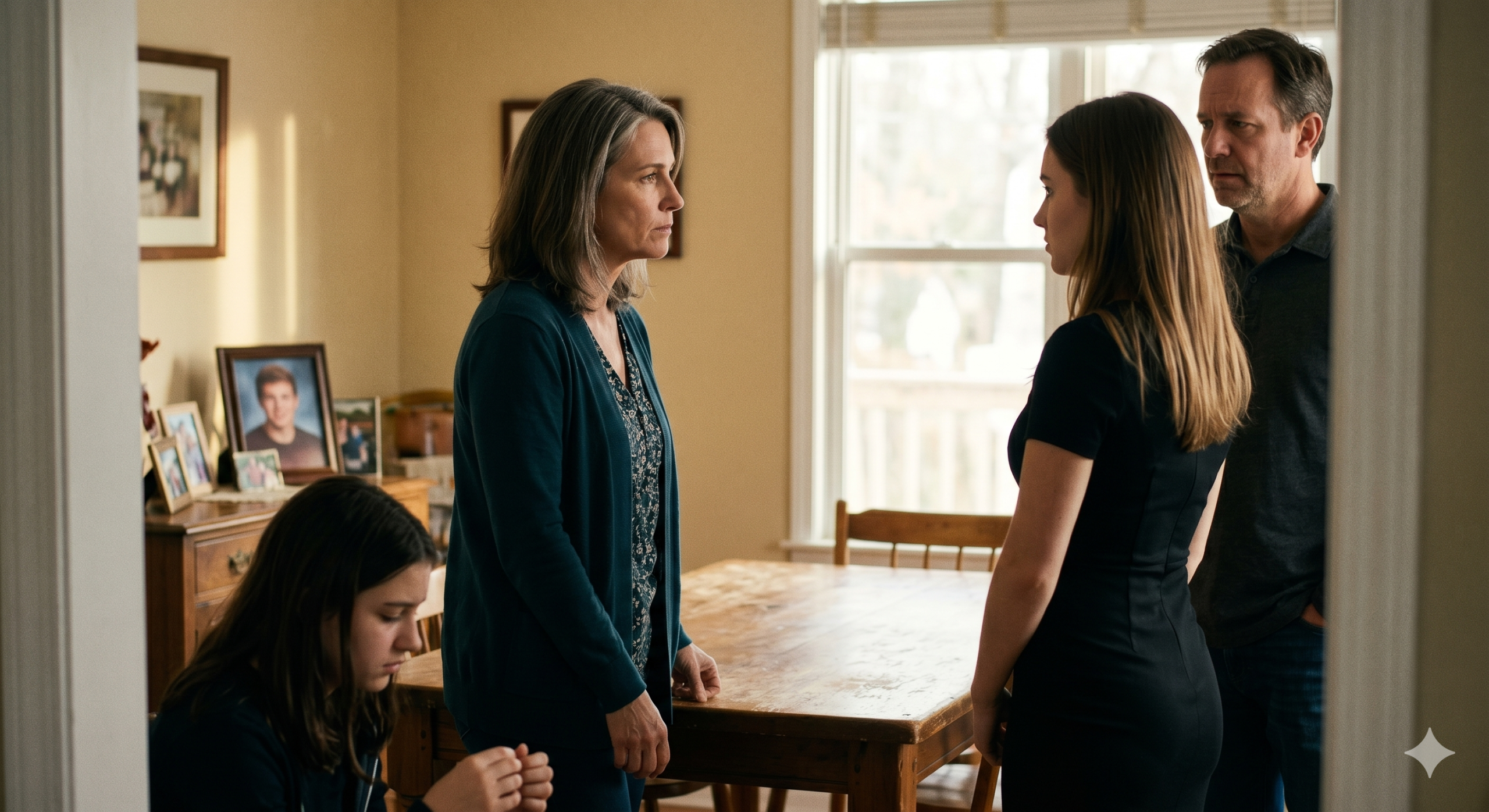
That night, my daughter locked herself in her room. I heard her crying through the wall around midnight. Not loud. Not dramatic. The quiet kind of crying teenagers do when they’ve already decided nobody can fix what hurts. I stood outside her bedroom door for almost ten minutes before knocking softly. “Can I come in?” Silence. Then: “Okay.” Her room still looked like two different lives trapped together. One side belonged to the little girl she used to be — fairy lights, stuffed animals, old dance trophies. The other belonged to grief. Her brother’s framed photograph sat beside the bed. His baseball cap hung from the desk chair untouched for years. One of his hoodies was folded carefully beneath her pillow like something sacred. My chest tightened immediately. She sat cross-legged on the bed hugging her knees. “She says I need therapy because I’m angry all the time,” she whispered without looking at me. I sat beside her carefully. “How did that come up?” “She found me crying after dinner last weekend.” “About your brother?” A nod. “And what exactly did she say?” My daughter wiped her face angrily. “She said grief becomes toxic when people hold onto it for attention.” For one full second, I genuinely saw red. Not metaphorically. My vision blurred with rage so intense it frightened me. Attention? My son was dead. Dead at eighteen because someone hit him with a car and drove away while my husband and I identified his body in a hospital hallway that smelled like bleach and winter air. And this girl — this twenty-three-year-old stranger — had the audacity to reduce my daughter’s grief to attention-seeking? “Did your father hear that?” I asked carefully. My daughter gave a bitter little laugh. “He told her maybe she should’ve worded it differently.” That answer hurt worse somehow. Because it meant he knew it was wrong. And still chose her comfort over his daughter’s pain. Again. I looked around the room slowly. “I’m going to ask you something important,” I said quietly. “And I need you to tell me the truth.” She finally looked at me. “Okay.” “Do you feel emotionally safe in that house?” The hesitation told me everything before she even answered. “I don’t know.” Those four words shattered me more than screaming ever could have. Because children who feel safe don’t answer like that. My daughter twisted the sleeve of her sweatshirt around her fingers. “She acts different when Dad’s not around.” My stomach dropped. “What do you mean?” “She goes through my things. She reads my journal sometimes.” Tears filled her eyes again. “And she keeps taking down pictures of Mason.” Mason. Even hearing my son’s name out loud still hurt. “She says it’s unhealthy to live in the past.” I stood up immediately before my anger became visible. Because if my daughter saw how furious I really was, she would stop talking to protect me. And I needed her talking. “When did this start?” “After the wedding.” Of course. The wedding. The magical transformation from mistress to wife apparently came with authority over my child’s grief. I walked toward the window, trying to steady myself. Outside, rain streaked across the glass in silver lines. The neighborhood lights blurred softly through the storm. Behind me, my daughter’s voice cracked. “I think Dad wants me to love her because then he won’t feel guilty.” The honesty of it nearly took my breath away. Fifteen years old. And already understanding emotional avoidance better than most adults. I turned back slowly. “Honey…” “But I can’t,” she whispered. “Every time I look at her, all I can think is that while we were crying over Mason… he was probably with her.” The room went silent. Because neither of us could honestly deny it. That was the ugliest part of betrayal after loss: you start rewriting old memories against your will. Funerals. Anniversaries. Hospital visits. Wondering which moments were real and which moments were interruptions to someone else’s affair. “I feel bad for hating her,” my daughter admitted softly. “You are allowed to feel hurt.” “But everyone keeps telling me she’s my family now.” I sat beside her again and took her hand gently. “No,” I said firmly. “Family is not a title someone earns by marrying your father.” Fresh tears rolled down her cheeks. “She keeps calling herself my bonus mom.” I closed my eyes briefly. Of course she did. “She bought matching necklaces for us at Christmas,” my daughter whispered. “One said ‘mother’ and one said ‘daughter.’” I stared at her in disbelief. “What did you do?” “I threw mine away.” A tiny guilty pause. “She cried.” For the first time that night, I almost smiled. Not because pain is funny. But because somewhere inside all this confusion, my daughter still understood truth. Then her expression changed suddenly. Fear. “Mom…” “What?” “She told me if I keep rejecting her, Dad might stop wanting me around because I make everything stressful.” Every muscle in my body went cold. “What exactly did she say?” My daughter swallowed hard. “She said men deserve peace after tragedy… and eventually they choose the people who give it to them.” I stood up so fast the bedside lamp shook. No. Absolutely not. This was no longer about discomfort or awkward stepfamily tension. This woman was emotionally manipulating a grieving child. And my ex-husband either didn’t see it — or didn’t want to. My phone buzzed suddenly on the nightstand. A text message from him. Why is she refusing to come back? Stop poisoning her against my wife. I stared at the screen for a long moment. Then slowly typed back: Your daughter is afraid of losing another parent. And your wife is using that fear against her. Three dots appeared instantly. Then disappeared. Then appeared again. Finally, one message came through: You’re being dramatic. I looked at my daughter sitting silently on the bed clutching her dead brother’s hoodie. And for the very first time since my marriage collapsed, something inside me hardened completely. Because grief had kept me weak. But motherhood? Motherhood was waking up.
Part 2 The ending
The custody hearing was scheduled three weeks later. Three weeks of tense exchanges. Three weeks of ignored messages from my ex. Three weeks of my daughter sleeping through the night for the first time in months because she finally knew someone believed her. And during those three weeks, something changed in me too. For years after Mason died, I had survived instead of lived. I let grief silence me. Shrink me. Convince me keeping the peace mattered more than speaking the truth. But watching another woman try to rewrite my daughter’s pain into “drama” snapped something awake. The courtroom smelled like old paper and coffee when we arrived. My ex sat at the opposite table beside his wife, both dressed like they were attending a country club fundraiser instead of discussing a grieving teenager’s emotional safety. She still wouldn’t look at me directly. Cowardice, I realized, often hides behind confidence. My daughter sat beside me twisting a tissue in her lap. “You don’t have to talk if you don’t want to,” I whispered. She looked up at me quietly. “Yes, I do.” When the judge asked why she no longer wanted overnight visits, the room became painfully still. My daughter’s voice shook at first. Then steadied. “She keeps trying to replace my mom,” she said softly. “And she acts like my brother dying is something inconvenient that everyone should be over by now.” The new wife’s face flushed immediately. “That’s not true—” The judge held up a hand sharply. My daughter continued. “She reads my journal. She removes pictures of my brother. She told me Dad might stop wanting me around if I keep making things stressful.” The silence afterward was enormous. I looked at my ex. For the first time since our marriage ended, he looked genuinely shaken. Not angry. Not defensive. Ashamed. Because hearing the truth in court sounded different than dismissing it over text. The judge turned toward him slowly. “Did you know your daughter felt emotionally unsafe in your home?” He opened his mouth. Closed it. Then looked at our daughter. And finally realized she was crying. Real crying. Not teenage attitude. Not manipulation. Pain. “I…” His voice cracked slightly. “I didn’t know it was this bad.” My daughter laughed bitterly through tears. “I tried to tell you.” That sentence hit harder than anything else said that day. I saw it land on him too. The judge ordered temporary modifications: no forced overnight visits, mandatory family counseling, and clear boundaries regarding the stepmother’s role. The new wife looked horrified. “What boundaries?” she asked sharply. The judge answered without emotion. “You are not this child’s mother. Stop trying to replace one.” For the first time in five years, I watched someone say out loud what everyone else had been too afraid to acknowledge. Outside the courthouse, rain poured across the city sidewalks. My ex approached us slowly while his wife waited near the car, furious and humiliated. Our daughter stiffened beside me instantly. He noticed. That hurt him. I could see it. “Honey,” he said quietly to her, “I never wanted you to feel replaced.” She stared at him for a long moment. “But you replaced Mom.” The honesty of teenagers is brutal because it contains no strategy. Only truth. He looked like someone had punched the air from his lungs. Then she whispered the sentence that finally broke him. “And after Mason died… I needed my dad more than ever.” He covered his face briefly. I had not seen my ex cry since the funeral. When he looked up again, his eyes were red. “I failed you,” he admitted. Our daughter started crying again immediately. Not because the pain disappeared. But because acknowledgment matters. Sometimes people don’t need perfection first. They need truth first. The new wife stormed toward us then, heels splashing through puddles. “This is unbelievable,” she snapped. “You’re letting a teenager destroy our marriage.” Our marriage. The audacity almost stunned me. But before I could respond, my daughter stepped forward. “No,” she said shakily. “You destroyed my family. I’m just finally allowed to say it.” Silence. The new wife looked at my ex, expecting rescue. Instead, he looked away. That was the moment she understood. Not everything can be rebranded into a happy ending. Especially not pain built on betrayal. Months later, things were quieter. Not perfect. Never perfect. But healthier. My daughter started therapy. The nightmares became less frequent. She began talking about her brother without immediately crying afterward. And my ex? He started showing up differently too. Not flawlessly. Not magically transformed. But trying. Really trying. One evening after dinner, my daughter sat beside me on the porch watching the sunset bleed orange across the sky. “Do you think Dad regrets it?” she asked quietly. I knew she didn’t just mean the affair. She meant all of it. The lies. The absence. The choices. I thought carefully before answering. “Yes,” I said softly. “But regret doesn’t erase damage.” She nodded slowly. Then leaned her head against my shoulder. “I’m glad you finally stopped pretending everything was okay.” I wrapped an arm around her gently. “So am I.” Inside the house, Mason’s photograph sat on the mantel where it had always belonged. Nobody moved it anymore. And for the first time since losing my son, I realized something important: Healing was never about forgetting the people we loved. It was about refusing to abandon the ones still here.