Part 1: The Click of the Pen
The sound of a plastic pen clicking is small, but in a busy grocery lane, it can sound like a ticking bomb.
Click. Click. Click.
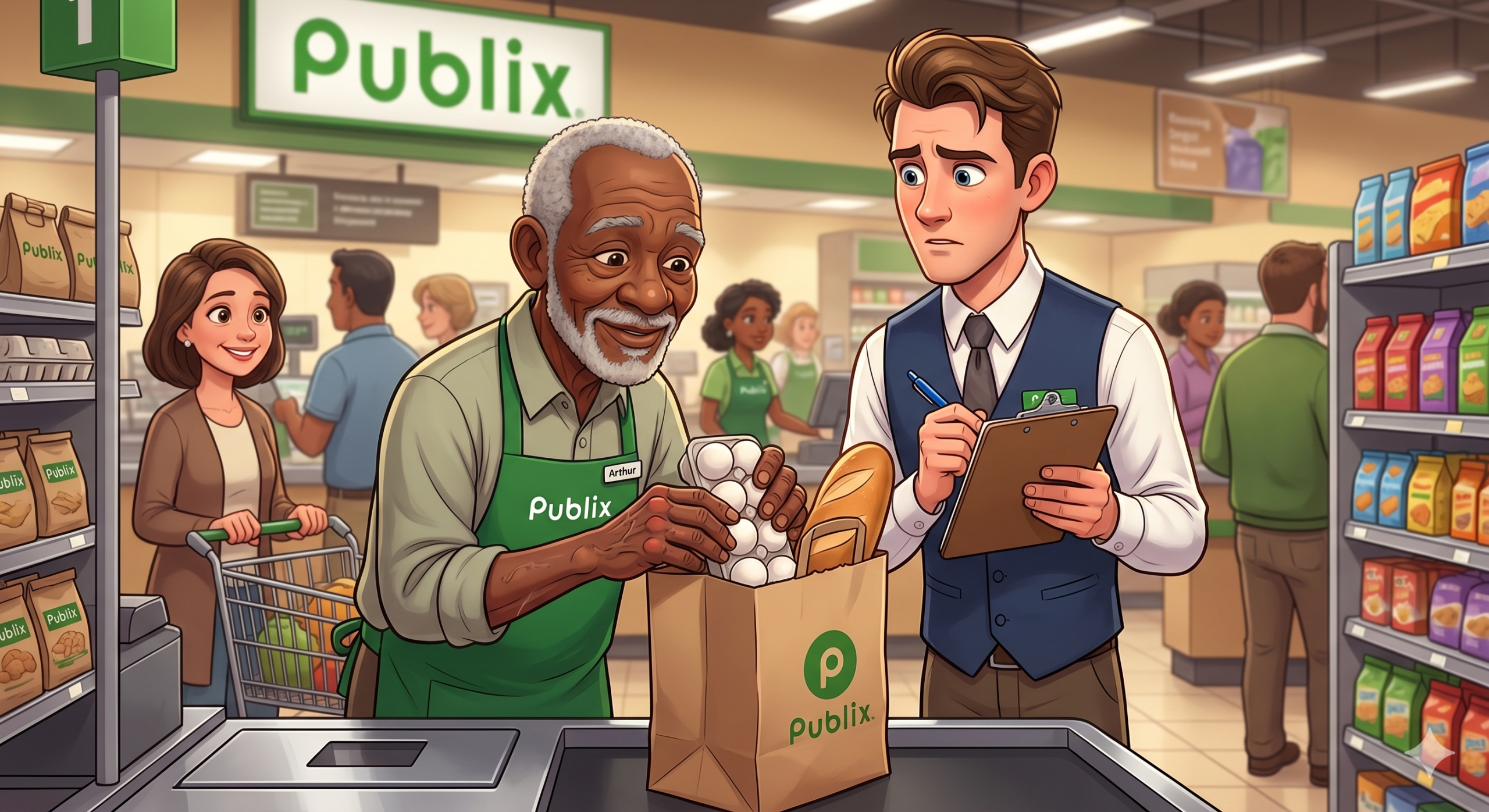
Arthur didn’t need to look up to know who it was. It was twenty-six-year-old Tyler, standing exactly three feet behind him with a shiny silver clipboard. Tyler had been made front-end manager two months ago, and he treated the checkout lanes like an Olympic track event.
Arthur was seventy-two. Every morning, his alarm went off at 5:00 AM, and by 10:00 AM, a dull, throbbing ache would bloom across his lower back. His hands, knotted and stiff with arthritis, didn’t move with the fluid grace they used to.
But Arthur didn’t complain. He couldn’t afford to.
His monthly Social Security check was exactly $987. His rent on a modest, one-bedroom apartment was $1,100. Do the math. Without this job bagging groceries at Publix, Arthur would be on the street. So, he stood on the anti-fatigue mat for eight hours a day, swallowed his pride, and forced a warm, genuine smile for every single person who walked through his lane.
“You’re tracking at forty seconds per basket, Artie,” Tyler muttered, tapping the clipboard with his pen. “You’re too slow. Corporate wants us under thirty. You’re dragging down our shift average.”
Arthur carefully placed a glass jar of pasta sauce at the bottom of a reusable bag, wrapping it safely in paper. “I like to ensure the eggs don’t crack and the glass doesn’t break, Tyler. Our customers appreciate the care.”
“Customers appreciate a fast exit,” Tyler snapped, clicking the pen one more time. “The college kids on Lane 3 are double-bagging and moving twice as fast. Just… pick up the pace. I’m writing up a performance log.”
Arthur swallowed the lump in his throat. He had started working his first paper route in 1966—years before Tyler was born. He had served in the military, raised a family, and worked thirty years in manufacturing before the company closed down. Now, his entire livelihood was being timed by a boy who didn’t even know how to balance a checkbook.
Part 2: The Encounter
It was a rainy Thursday afternoon when the breaking point arrived. Lane 4 was packed. Arthur’s back was screaming, but he kept his smile fixed, carefully greeting Mrs. Gable, a regular customer whose husband had passed away last winter.
“Hello, Mrs. Gable. Good to see you today. I made sure to put your frozen items together so they don’t sweat on your bread,” Arthur said kindly, reaching for her items.
Behind him, the relentless click-click-click began again.
Tyler stepped closer, practically hovering over Arthur’s shoulder. He looked at his smartphone timer. “Artie, look at the line. You’re hovering at forty-two seconds. Move the bread, grab the milk, let’s go. You’re just too slow. If you can’t keep up with the modern pace of this store, we need to look at reallocating your hours.”
He said it loudly. He said it right to Arthur’s face, right in front of Mrs. Gable, and right in front of the tall, burly man standing next in line.
Arthur’s hands froze over a carton of eggs. A deep, burning humiliation washed over him. He opened his mouth to apologize, but before he could say a word, a booming voice cut through the grocery store noise.
“Hey! Penalty box, junior!”
The voice belonged to the man next in line—a large, broad-shouldered man named Big Mike, who ran a local construction business and was well-known in the neighborhood. He stepped forward, pushing his shopping cart aside, and pointed a thick finger directly at Tyler’s chest.
“Excuse me?” Tyler stammered, stepping back, his clipboard shielding his chest. “Sir, I am managing my staff—”
“No, you’re harassing a gentleman,” Mike countered, his voice echoing across the front of the store. The entire lobby went dead silent. The cashiers stopped scanning. Customers turned around.
“I’ve been coming to this Publix for five years,” Mike said, stepping closer to Tyler. “Artie here knows my name. He knows my kids’ names. When it pours down raining, this man puts a jacket on his aching back and carries my elderly mother’s groceries out to her car so she doesn’t slip. He treats people like human beings.”
Tyler’s face flushed a deep, bright red. “Sir, corporate policy dictates our speed metrics—”
“I don’t give a damn about your corporate metrics,” Mike interrupted. He looked around the crowded lobby and raised his voice even louder. “Hey, folks! Who here thinks Artie is ‘too slow’ to work here?”
An immediate chorus of voices erupted from the lines.
“Artie is the best part of this store!” an elderly woman shouted from Lane 2. “Leave him alone!” a young mom called out.
Mike turned back to Tyler, who was now trembling slightly under the collective gaze of fifty angry customers. “This man was building this country before your parents were even a thought, kid. You want to time someone? Time yourself walking to the back room to find some manners. Because if I see you disrespecting him again, my crew and I are taking our four-thousand-dollar monthly commercial account across the street to Kroger. And I’ll make sure every business owner on my block does the same.”
Part 3: The New Metric
By Friday morning, the story had spread. A local customer had recorded a snippet of the encounter and posted it to a neighborhood Facebook group. By midnight, it had thousands of shares, with hundreds of locals commenting that Arthur was the heart of the community.
Arthur walked into work on Friday expecting the worst. He assumed he would be fired for causing a scene.
Instead, when he entered the back breakroom, the Store Manager, a veteran named Sarah, was waiting for him. Tyler was sitting in the corner, looking incredibly small, staring down at his shoes without his clipboard.
“Arthur, please sit down,” Sarah said gently.
Arthur sat, clutching his lunchbox. “Sarah, I’m sorry about the disruption. My hands… they do get stiff, but I swear I try my best—”
“Arthur, stop,” Sarah interrupted with a warm smile. “You have nothing to apologize for. Yesterday, corporate received over forty phone calls and a hundred emails from local residents. The regional vice president saw the video. Do you know what he told me?”
Arthur shook his head.
“He said that you cannot buy the kind of customer loyalty you generate with a million-dollar advertising campaign,” Sarah explained. She looked over at Tyler. “Tyler here has some re-training to do on leadership and empathy. As of today, the front-end ‘speed metric’ is being discarded for senior employees. We are implementing a new hospitality standard—and Arthur, we want you to help train the new hires on how to actually talk to our community.”
Sarah reached out and placed a hand over Arthur’s knobby, arthritic knuckles. “And to make sure you aren’t pushing yourself too hard, we are adjusting your schedule to shorter, preferred shifts with a permanent merit raise.”
That afternoon, Arthur stood at the end of Lane 4. The rain was drumming heavily against the glass doors of the storefront.
He loaded a paper bag with perfect precision, placing the heavy items at the bottom and the fragile items safely on top. He looked up and saw Big Mike walking through the line.
“How’s it going today, Artie?” Mike asked with a wide grin.
Arthur looked down at his hands, then up at the front-end desk where Tyler was quietly organizing plastic bags—without his clipboard, and without his pen.
Arthur smiled, a deep, genuine feeling of relief washing over him.
“It’s a beautiful day, Mike,” Arthur said softly. “Perfectly steady.”