The first thing Chloe Sinclair noticed when Jonathan Abernathy slid the tarnished silver dollar across the mahogany table was not the cruelty of it, though that came a second later and landed like a slap. It was the sound. A small metallic scrape, almost delicate, almost shy, moving over polished wood in a room where billions had just been handed out in steady, emotionless sentences. The coin spun once, caught the light from the chandelier, and came to rest in front of her right hand. It was heavy-looking, dull with age, and absurdly small compared to everything else that had been spoken into existence that afternoon: penthouses, villas, oil rights, corporate shares, yachts, offshore accounts, art collections, trusts large enough to feed entire cities if any of the people receiving them had ever thought of money that way. Yet there it sat, her father’s final gift to her, a single 1922 Peace Dollar placed before the only child in the room who had ever learned the value of a dollar by working for it.
Rain battered the windows of Whitman, Pierce & Abernathy, streaking the Manhattan skyline into gray ribbons. The boardroom sat high above the Financial District, twenty-seven floors over streets where taxis hissed through puddles and people hurried beneath black umbrellas, unaware that in this room, one of the largest private fortunes in America was being carved apart like meat before a hungry family. The air smelled of leather, old books, expensive cologne, and greed dressed in black. Chloe sat at the far end of the table, far enough from the others that the distance felt intentional, wearing navy hospital scrubs beneath a worn blazer she had pulled from the back of her locker at Bellevue after a fourteen-hour emergency shift. She had washed blood from under one fingernail in the staff bathroom before coming here. She still smelled faintly of antiseptic and coffee gone cold in a paper cup. She had not had time to go home, not that home in Queens held anything that could have made her look like she belonged among them.
Across the table, her stepmother, Veronica Belmont, sat beneath a black mourning veil that softened nothing about her face. Veronica was twenty years younger than Theodore Belmont had been and had spent the last decade making youth look like a weapon. Diamonds circled her wrists. Her black silk dress fit like a threat. She had not cried once since the funeral. Chloe had watched her dab carefully at dry eyes for photographers outside St. Bartholomew’s, then slip into the waiting car with the barest flicker of triumph at the corner of her mouth.
Beside Veronica sat Preston, Theodore’s son from his second marriage, though calling Preston a son made him sound like something more substantial than he had ever proved himself to be. At thirty-two, he had wrecked two Aston Martins, been quietly removed from three corporate internships, and once tried to launch a tequila brand because a woman in Ibiza told him he had “investor energy.” He stared at his phone through most of the reading until the word aviation fleet made him look up. On Veronica’s other side was Beatrice, Theodore’s youngest, glossy, bored, and dressed in couture grief. Beatrice had once married a minor European royal whose title was longer than his attention span, then divorced him eleven months later and called the settlement “an educational experience.”
And then there was Chloe.
The eldest daughter. The first child. The mistake Veronica had failed to erase completely because Theodore had never rewritten the bloodline, only the photographs. Chloe’s mother, Eleanor Sinclair, had been Theodore’s first wife, a pianist with quiet hands and a laugh that had made rooms warmer. When Eleanor died of ovarian cancer ten years earlier, Chloe had watched her father’s face close like a vault. At first, she thought grief had swallowed him. Later, she realized Veronica had used the grief like a hallway and walked straight into the center of his life. Within a year, photographs of Eleanor disappeared from the Upper East Side penthouse. Within two, Chloe stopped receiving invitations to family events unless a photographer might notice her absence. Within five, she and Theodore had fought so bitterly over her refusal to join the family foundation as a decorative nurse consultant that he had called her “stubborn beyond usefulness,” and she had told him he had mistaken obedience for love.
They had not spoken after that.
Five years of silence. Five years in which Chloe finished nursing school with loans, worked nights, took double shifts, rented a walk-up apartment with radiators that clanged like angry ghosts, and learned that sometimes the only way to survive a powerful family was to live as if they had already died.
Then Theodore actually died.
And now she sat in his lawyer’s boardroom, exhausted, grieving in a way she did not want to admit, hoping for one final sentence from him that might explain why he had let her become a ghost while he was still alive.
Jonathan Abernathy, Theodore’s longtime attorney, had read the will with all the warmth of a carved statue. He was in his late sixties, tall, narrow, and precise, with wire-rimmed glasses and a voice trained by four decades of legal combat not to reveal whether he admired, despised, or pitied the people in front of him. He began with Veronica: the penthouse, the Lake Como villa, the Park Avenue townhouse, a controlling stake in Belmont Global Logistics, private security arrangements, access to the family aircraft for life. Veronica lowered her eyes in false modesty, but the diamonds at her wrist trembled with barely contained satisfaction.
To Preston went the aviation assets, a fifty-million-dollar trust, the London commercial real estate portfolio, and enough liquid cash to allow him to confuse spending with purpose for the rest of his life. Beatrice received the family art collection, two European properties, a private cash trust, and full title to a yacht she had once claimed made her seasick. Each sentence from Abernathy fell into the room like gold coins dropped into velvet. No one gasped. No one thanked the dead. They accepted billions the way other people accept assigned seats.
Then Abernathy turned a page, and something in the room shifted.
“And finally,” he said, his eyes flicking once toward Chloe before returning to the paper, “to my eldest daughter, Chloe Elise Sinclair.”
Preston finally looked up from his phone. Beatrice’s red mouth curled. Veronica leaned back slightly, as if making space for the humiliation she had waited years to witness.
Chloe held her breath.
“For her unwavering independence,” Abernathy read, “her refusal to bow to expectation, and her insistence on making her own way in the world, I leave the sum of exactly one dollar. May it serve as a reminder of the value of hard work.”
For a second, the room was silent.
Then Preston snorted.
The sound broke something. Beatrice covered her mouth, shoulders shaking with giggles she made no real effort to hide. Veronica did not laugh; she was better than that. She simply leaned forward and smiled, a slow, venomous curve of satisfaction that told Chloe this moment would be retold at every dinner table Veronica controlled for the next ten years.
Theodore Belmont, a man who had tipped doormen in hundreds, had reduced his firstborn daughter to a single dollar in front of the people who hated her most.
Abernathy reached into his suit pocket and withdrew the coin. Not a check. Not even a crisp bill in an envelope. A coin, old and tarnished, heavy and theatrical. He slid it across the table.
“That concludes the reading,” he said softly.
Chloe stared at the coin. She told herself not to cry. She had held dying children while their parents collapsed against hospital walls. She had compressed bleeding wounds with her own hands. She had told families to wait in rooms that smelled like bad coffee because doctors were still trying. She had learned to swallow panic, grief, hunger, exhaustion. But this, somehow, was what made tears sting her eyes.
It was not the money. She had never expected money. It was the care of the insult. The performance of it. Her father had not merely disinherited her. He had written a line sharp enough to cut, ordered a coin to be placed before her like a prop, and arranged the room so Veronica could watch.
“Well,” Veronica purred, adjusting the diamond bracelet Theodore had probably bought her with money earned before she knew his name, “I suppose you can use it to take the subway back to Queens, dear. Oh, wait.” Her smile widened. “The fare went up, didn’t it? Such a shame.”
Chloe’s fingers closed around the coin.
The metal was cold. Heavier than it looked.
She stood. Her chair scraped loudly against the floor, and everyone looked at her. For one wild second, she considered throwing the coin at Veronica’s face. She pictured it striking that perfect cheekbone, pictured blood blooming through expensive foundation, pictured Preston filming it with delighted horror. The image almost steadied her because it felt honest.
Instead, she put the coin into her palm, closed her fist around it, and walked out.
She did not look back. Not at Veronica. Not at Preston or Beatrice. Not at Abernathy. She crossed the boardroom in her wet shoes and hospital scrubs and walked through the door with her chin high enough that no one in that room saw the first tear fall.
The corridor outside was thickly carpeted, silent, and too warm. Chloe made it halfway to the elevators before the breath left her body. She pressed one hand against the marble wall and bent forward, trying to force air into lungs that suddenly felt too small. The coin dug into her palm. Her father’s last words spun in her head. One dollar. Value of hard work. One dollar. One dollar. One dollar.
A sob escaped before she could trap it.
She hated him then. Truly hated him. Not with the childish anger she had carried after their last fight, not with the dull ache of abandonment, but with something clean and bright and scorching. He had waited until death to win. He had turned her into the punchline and left her no chance to answer.
“Ms. Sinclair. Chloe. Please wait.”
She spun around, wiping at her face with the back of her wrist.

Jonathan Abernathy was coming down the hall toward her, no longer moving with the measured dignity of the boardroom. His tie was slightly loosened, and he looked over his shoulder twice before reaching her. The unreadable mask had slipped; underneath it was urgency.
“Leave me alone,” Chloe said. Her voice cracked. She hated that too. “You did your job. The show is over.”
“You didn’t stay for the final codicil.”
She laughed once, broken and bitter. “There is no codicil. You said it concluded.”
“I said the reading concluded.” He stepped closer and lowered his voice. “Because the rest was not for their ears.”
Chloe stared at him.
“Theodore knew the boardroom was compromised,” Abernathy whispered. “He knew Veronica had people in my office. He knew if he left you anything of obvious value, she would bury you in probate litigation for decades.”
The elevator doors opened with a soft chime. An empty car waited.
Chloe did not move. “What are you talking about?”
Abernathy guided her inside with a firm hand that still somehow asked permission. He pressed the button for the underground garage. As the doors closed, he opened his briefcase and pulled out a black envelope sealed with wax.
“Your father was a complicated man,” he said, and for the first time his voice carried something like sorrow. “Cruel when frightened. Brilliant when cornered. Proud to the point of moral stupidity. But he was not a fool.”
Chloe looked at the envelope. Her name was written across it in Theodore’s sharp hand.
Abernathy continued, “Three years ago, he discovered Veronica and Preston were stealing from Belmont Global Logistics. More than stealing. They were altering his medications, manipulating cognitive evaluations, and using his decline to trigger internal succession procedures. He suspected they were slowly poisoning him, though by the time he had proof, he lacked the physical strength and corporate freedom to strike openly.”
The elevator seemed to drop too fast.
“That’s insane,” Chloe whispered.
“Yes,” Abernathy said. “It is.”
“Why didn’t he go to the police?”
“Because he did not know which doctors were compromised, which board members had already been purchased, and whether the scandal would destroy the pensions of thousands of employees before evidence could be secured. He wanted them exposed, but not at the expense of everyone dependent on the company.”
Chloe looked down at the coin in her fist. “So he humiliated me?”
“He protected you in the only way he believed would work. Badly, perhaps. But deliberately. He told me, ‘Give my daughter the dollar. If she throws it, she is not ready. If she keeps it, even in grief, she has the temperament to handle what comes next.’”
The elevator reached the garage. The doors slid open.
Chloe stared at Abernathy. “Handle what?”
“Open the envelope.”
Her fingers trembled as she broke the wax seal. Inside was a sheet of thick stationery covered in Theodore’s handwriting.
Chloe, if you are reading this, I am dead, and I have just insulted you in front of the people who killed me. Forgive me. I had to make them believe they had won. I had to make them believe you were nothing to me, so they would never look your way. They have the public company. Let them have it. It is rotting from the inside with debt they do not understand. They do not have my legacy. Look at the coin, my brilliant girl. Look closely.
Chloe’s knees weakened.
She lifted the Peace Dollar under the garage’s fluorescent light. Lady Liberty’s profile. The eagle. The worn ridged edge. She ran her thumb along the rim and felt it: a seam so fine she would have missed it if her father had not told her to search.
“Press the eagle’s eye,” Abernathy said.
Using her thumbnail, Chloe pressed the tiny indentation. There was a faint click. The coin’s top half slid sideways.
It was hollow.
Inside lay a microSD card and a tiny magnetic key fob shaped like a sliver of black steel.
Chloe forgot to breathe.
“What is this?”
“The true inheritance,” Abernathy said.
A black armored Lexus waited nearby with its engine running. Abernathy opened the passenger door. “We need to leave before Veronica realizes you did not simply go home to cry.”
Chloe got in.
They drove out of Manhattan in silence, north through rain that gradually softened into mist. The city fell away, then suburbs, then highways lined with bare trees. Chloe held the hollowed coin in her lap, opening and closing it again and again, as if the mechanism might vanish if she looked away. Her father’s handwriting sat folded beside it. She had wanted closure. Instead she had inherited a conspiracy.
“Where are we going?” she finally asked.
“To a property that does not exist on any county map under the Belmont name.”
“What does that mean?”
“It means your father learned from his enemies.”
Abernathy drove for hours, leaving New York behind and entering the rugged, dark terrain of western Massachusetts. Cell service vanished. The car’s GPS blinked out as they left paved roads and turned onto an old logging track that twisted through dense forest. Fog clung low between pines and bare oaks. The road was so narrow that branches scraped the side of the Lexus, and Chloe wondered whether the man driving her into the woods might be mad after all.
Then the headlights hit iron.
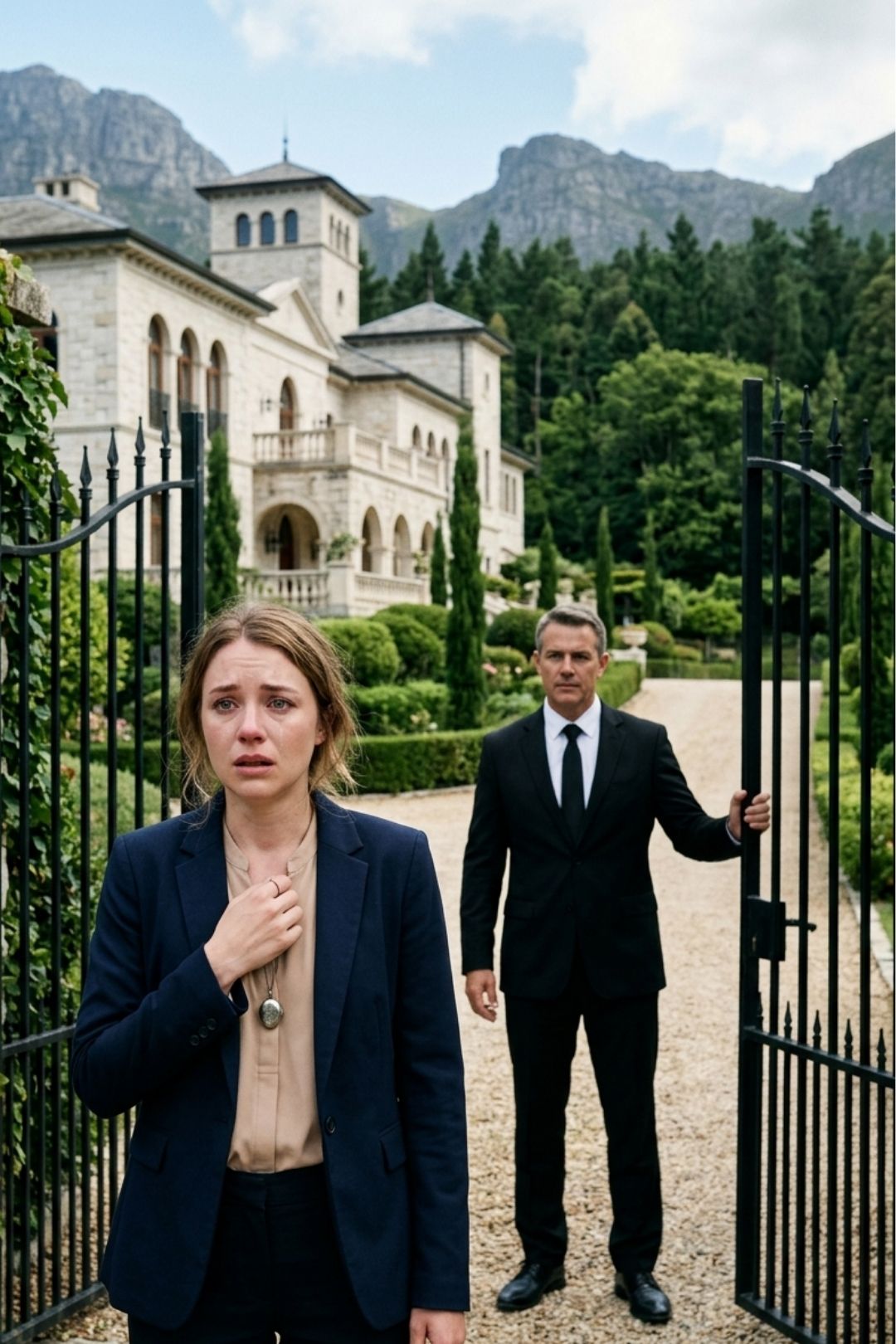
Two massive wrought-iron gates rose between stone pillars, twenty feet high and wrapped in decades of dead ivy. No mailbox. No address. No camera visible, though Chloe had a sudden certainty that something was watching them. A bronze nameplate, dark with age, was welded to one pillar.
THE HAVEN.
Abernathy stopped the car. “Your father bought it twenty years ago through five layers of holding companies. No one in the family knew. Not Veronica. Not Preston. Not even your mother.”
A metal box sat mounted to the stone pillar beside the gate. No keypad. No keyhole. Just a thin horizontal slot.
“The key,” Abernathy said.
Chloe stepped into the cold mountain air. The fog curled around her ankles. She slid the black magnetic fob into the slot.
For one second, nothing happened.
Then deep inside the stone, gears began to grind. A heavy industrial clank echoed through the woods. The gates slowly swung inward, dragging ivy apart like curtains opening on something that should have stayed hidden.
Abernathy drove through.
The driveway wound between ancient weeping willows. When the trees broke, Chloe gasped.
The house was enormous.
It rose from the center of a fifty-acre clearing like something stolen from Newport and buried in the mountains: limestone walls, copper turrets turned pale green with age, stained-glass windows, steep slate roofs, and broad marble steps leading to oak doors tall enough for giants. It was not lit inside, yet the grounds were manicured. The shrubs were trimmed. The gravel was clean. Someone had maintained it perfectly, silently, without anyone knowing.
“This,” Abernathy said, cutting the engine, “was Theodore Belmont’s real headquarters.”
Inside, The Haven was not abandoned. It was waiting.
The foyer held imported marble, a dual staircase, tapestries, statues, and dustless furniture covered not by sheets but by perfectly fitted preservation cloth. Modern cameras blinked from corners. Hidden sensors clicked softly as they passed. Abernathy led Chloe through a library of rare books, pressed a switch behind a false shelf, and revealed a steel spiral staircase descending into the ground.
Chloe followed him down.
Below the mansion lay a bunker.
Concrete walls. LED lights. Reinforced doors. Air filtration. Server racks. Medical storage. A laboratory room with sealed cabinets. Archive rooms. A communications center. At the end of a corridor stood a vault door thick enough to belong in a federal reserve.
Abernathy stopped beside a terminal. “The SD card.”
Chloe inserted the card into the reader.
The screen flickered. Lines of code moved too fast to read. A loading bar crawled across the screen, then vanished. The monitor went black.
Theodore Belmont appeared.
Chloe’s hand flew to her mouth.
He looked frail, seated in a high-backed chair, wrapped in a thick cardigan. His shoulders had narrowed. His skin looked gray beneath the lights. But his eyes—icy blue, sharp, unforgiving—were exactly as she remembered.
“Hello, Chloe,” the recording rasped. “If you are watching this, my final gamble paid off. You kept the dollar.”
Tears spilled before she could stop them.
“I am sorry,” he continued. “For the theater of the will. For the years of silence. For pushing you away after your mother died. I told myself distance would keep you safe from Veronica. That was true. It was also cowardice. I let you believe you were unloved because I could not bear giving our enemies a reason to use you.”
Chloe sank into a chair.
Theodore leaned closer on the screen. “Veronica and Preston think they have inherited the empire. They have inherited the corpse of one. Over the last thirty-six months, I leveraged Belmont Global Logistics through shell debt controlled by Aegis Capital. I used the borrowed capital to purchase physical assets, mineral rights, patents, private holdings, and liquid reserves beyond their reach. Aegis is mine. As of this morning, Aegis is yours.”
Behind the terminal, the vault door clicked. Bolts disengaged in a thunderous sequence.
Abernathy pushed the door open.
Chloe stood.
The vault inside was the size of a small gymnasium. On industrial pallets sat rows of Swiss gold bars. Climate-controlled cases held diamonds, bearer bonds, sealed deeds, antique coins, hard drives, patents, and documents labeled by jurisdiction. Screens showed asset ledgers. A wall map marked islands, commercial towers, data centers, mineral rights, shipping routes, and medical patents.
“The vault contains approximately two-point-eight billion dollars in liquid and physical assets,” Theodore’s recording said. “All legally transferred. All outside probate. All insulated from Veronica’s reach.”
Chloe stared, numb.
“But the wealth is not the point,” Theodore said. “The debt is. Aegis Capital holds the loans crushing Belmont Global. Veronica and Preston personally guaranteed enough of them to feel invincible when they thought the creditor was anonymous. When they default next month, you may foreclose on their shares, seize their assets, and remove them from every chair they poisoned to reach.”
His breathing grew rougher.
“I am giving you power, Chloe. I know you never wanted mine. That is why you can be trusted with it. You are a nurse. You heal strangers because it is right. Use this wealth to heal what I broke. Protect the employees. Preserve what is worth preserving. But first, excise the cancer from our family.”
He paused, eyes glistening.
“I love you. I should have said it when it could still hold you.”
The screen went black.
For a long time, Chloe could not speak. The vault gleamed around her. Gold, diamonds, deeds, bonds, billions. None of it felt as heavy as the words she had waited years to hear from a dead man’s mouth.
Abernathy stood quietly beside her.
Finally, Chloe wiped her face and picked up the hollowed coin.
“Call a board meeting,” she said.
Abernathy looked at her.
Her voice did not tremble. “It’s time to collect some debts.”
The next six weeks remade Chloe Sinclair.
Not visibly at first. She still worked three shifts at Bellevue before Abernathy and two security consultants convinced her that her presence in the ER posed both personal and strategic risks. She still returned to her Queens apartment and sat on the fire escape at dawn because The Haven felt too large to inhabit all at once. She still cried in private, not only for Theodore, but for the years he had wasted trying to protect her by wounding her first. Grief and rage moved through her in alternating currents. Some nights she wanted to forgive him. Others, she wanted to shout at his recording until her throat gave out.
But by day, she learned.
Abernathy introduced her to the machinery Theodore had built in secret: trust structures, holding companies, creditor rights, debt acceleration, asset seizures, board voting mechanisms, forensic accounting. Chloe learned faster than anyone expected except perhaps Theodore, who had anticipated her discipline. Nursing had taught her triage, pattern recognition, calm under pressure, and the ability to absorb horrifying information without freezing. Finance was not blood loss, but it had its own hemorrhages. Corruption had vital signs if you knew where to look.
She reviewed toxicology reports from Johns Hopkins showing digitalis exposure consistent with induced cardiac symptoms. She read private investigator summaries documenting prescription substitutions. She watched security footage from Theodore’s bedroom wing showing Veronica’s assistant entering medical cabinets at night. She read emails Preston sent through encrypted channels and believed deleted. She reviewed embezzlement ledgers, shell company transfers, luxury purchases disguised as consulting fees, Cayman accounts, forged board authorizations, and quiet betrayals dressed as corporate governance.
The more she learned, the colder she became.
Not cruel. Not like Veronica. Cold in the way surgeons are cold before cutting out infection.
Belmont Global was in worse shape than the public knew. Theodore had intentionally leveraged its assets to move wealth into Aegis, but Veronica and Preston had compounded the damage with theft, reckless spending, and falsified reports. The company was rotting, yes, but not dead. Thousands of employees still depended on it. Warehouses, drivers, dispatchers, logistics analysts, port workers, pensioners. Chloe thought of them often. People who would never sit in a mahogany boardroom but whose lives could be destroyed by those who did.
“We cannot simply burn it down,” she told Abernathy one night in The Haven’s operations room.
“No,” he said. “Your father did not want destruction. He wanted control shifted to someone who would save what could be saved.”
“And punish who needed punishing.”
“That too.”
The board meeting was scheduled six weeks after the will reading.
By then, Veronica was panicking.
The grace period on Aegis-held loans had expired at midnight. Corporate accounts were frozen. Margin calls had triggered. Morgan Stanley demanded answers. The board demanded cash. Preston demanded someone tell him why his cards stopped working. Beatrice cried because a villa account had been locked and she could not access staff payroll for the house she had never visited except in summer.
The executive boardroom of Belmont Tower smelled different that morning. Less cologne. More stale coffee and sweat. Veronica paced at the head of the table in a wrinkled Chanel suit, mascara faintly smudged beneath one eye. Preston sat slumped in a chair, staring at a spreadsheet he did not understand. Beatrice bit an acrylic nail to the quick. Bankers and senior executives avoided eye contact.
“What do you mean they are calling the debt?” Veronica snapped at a pale banker.
“The holding company, Aegis Capital, accelerated the loans after default,” he said. “The corporate accounts are overdrawn by four hundred million. Assets are frozen pending creditor action.”
“This is illegal,” Preston shouted. “Who owns Aegis? I want a name.”
The boardroom doors opened.
Jonathan Abernathy entered first.
Chloe walked ahead of him.
No one spoke.
She was not wearing scrubs. She wore a tailored black suit, simple, sharp, and severe. Her hair was pulled back. No diamonds. No mourning veil. In her pocket was the hollow Peace Dollar.
Veronica stared as if seeing a ghost.
“Chloe?” Beatrice whispered. “What are you doing here?”
Chloe walked to the head of the table. “Security works for the building owner, Beatrice. As of 9:30 this morning, Aegis Capital took possession of Belmont Tower due to failure to meet immediate debt obligations.”
Veronica laughed, breathless and brittle. “You? You are Aegis Capital? Don’t be ridiculous. You clean bedpans in Queens.”
“I save lives in Manhattan,” Chloe said. “You should learn the difference.”
Abernathy opened his folio and slid documents across the table. “Ms. Sinclair is the sole beneficiary and controlling authority of Aegis Capital. She holds the primary debt instruments now in default. Additionally, forensic evidence has been submitted to the FBI, the SEC, and the New York District Attorney regarding embezzlement, securities fraud, elder abuse, medical tampering, and suspected homicide by poisoning.”
Preston jumped up so violently his chair fell backward. “You have no proof.”
Chloe looked at Veronica. “Digitalis. Altered prescriptions. The Johns Hopkins toxicology reports. The nurse you paid through a shell company. The forged cognitive evaluations. The Cayman transfers. The invoices Preston signed for companies that never existed.”
Veronica’s face drained.
“The FBI is at your penthouse now,” Chloe continued. “Interpol has frozen the Caymans. Your cars, art, villas, and accounts are subject to seizure. You do not own Belmont Global anymore. You do not own this tower. You do not own the room you are standing in.”
Preston lunged toward the door, but two private security officers stepped into the frame.
Beatrice began sobbing.
Veronica sank into the leather executive chair, mouth opening and closing without sound. Chloe watched the realization cross her face. Theodore had not simply disinherited her. He had baited her. He had given her the public empire as a collapsing shell, let her sign guarantees, let her believe victory was inheritance, then placed the creditor’s knife in Chloe’s hand.
“You’re bankrupt,” Chloe said. She placed the hollowed coin gently on the table in front of Veronica. The metallic clink echoed through the room. “You’ll need a criminal defense attorney. I hear they require retainers. This should get you started.”
Then she turned and walked out.
She expected satisfaction. Some came. But not enough.
Power did not heal the years. Revenge did not resurrect Theodore. Veronica’s collapse did not give Chloe back the father who had chosen silence. It only cleared the room.
The real work began after.
Chloe spent the next year dismantling the corrupt layers of Belmont Global and rebuilding what could survive. She removed board members who had enabled Veronica. She protected pensions first. She sold vanity assets. She converted one private jet fund into an employee hardship trust. She shut down shell vendors, renegotiated debt, appointed outside auditors, and created a whistleblower office with real independence. Workers who expected layoffs received letters guaranteeing wages through restructuring. Warehouse supervisors received calls from the new owner herself, asking what was broken before consultants could translate their problems into expensive jargon.
She did not become Theodore. That was the point.
The Haven became more than a fortress. Chloe turned part of it into the headquarters of the Eleanor Sinclair Foundation, named after her mother, dedicated to medical debt relief, patient advocacy, and protection for healthcare workers who exposed elder abuse. The first grant paid the outstanding bills of two hundred oncology patients in New York. The second funded independent toxicology review programs for families who suspected medical coercion. Chloe kept working one shift a month at Bellevue for as long as she could, not because she needed the money, but because she needed to remember that wealth was a tool, not a world.
Veronica and Preston were indicted. Beatrice avoided prison by cooperating and surrendering assets she had barely understood she owned. Veronica’s trial revealed everything: the digitalis, the forged prescriptions, the embezzlement, the manipulation of Theodore’s doctors, the board pressure, the cold hunger that had sat beneath her diamonds all along. She was convicted on federal charges and later state charges tied to Theodore’s death. Preston took a plea and testified badly enough that the prosecutor had to remind him twice to answer without performing innocence.
Chloe attended only the first day of the trial.
She left before Veronica saw her.
On the anniversary of the will reading, Chloe returned to the boardroom at Whitman, Pierce & Abernathy. It had been repaneled after Aegis acquired the firm’s building in a side transaction Abernathy insisted was unnecessary and Chloe found amusing. Rain streaked the windows again. The mahogany table was the same. Chloe stood at the far end where she had once sat in scrubs, exhausted and humiliated, and placed the tarnished Peace Dollar on the polished wood.
Abernathy stood beside her.
“Do you hate him?” he asked quietly.
Chloe looked at the coin.
“Yes,” she said. Then, after a moment, “No. Sometimes. Less than before.”
“He loved you badly.”
“That may be the most honest thing anyone has said about him.”
Abernathy smiled faintly.
Chloe picked up the coin, pressed the eagle’s eye, and watched it open. The tiny compartment was empty now. The key and SD card were stored in The Haven’s vault. Still, the coin felt heavy enough.
“He should have trusted me sooner,” she said.
“Yes.”
“I would have fought beside him.”
“I know.”
“So did he,” Abernathy said. “That is why he was ashamed.”
Chloe closed the coin.
In the reflection of the dark window, she saw herself not as the nurse from Queens or the humiliated daughter or even the billionaire mastermind newspapers had started calling her. She saw a woman who had survived the cruelty of being underestimated and chosen not to become cruel in return unless justice required sharp edges.
She slipped the Peace Dollar into her pocket.
Outside, the rain kept falling over Manhattan, washing the city without asking permission from anyone.
At The Haven, lights now glowed in the library. Foundation staff worked in offices that once served as secret war rooms. The vault remained sealed below, but its wealth moved steadily outward now: debt relief, scholarships, elder-abuse investigations, employee pensions, rural clinics, nurse training, shelters, quiet interventions that never made headlines because Chloe had learned from Theodore’s worst mistake and best strategy at once.
What mattered most was often hidden until it was needed.
The world remembered the moment she was handed one dollar.
Chloe remembered the moment she chose not to throw it.
THE END.