After years of sacrifice, one family secret changed everything.

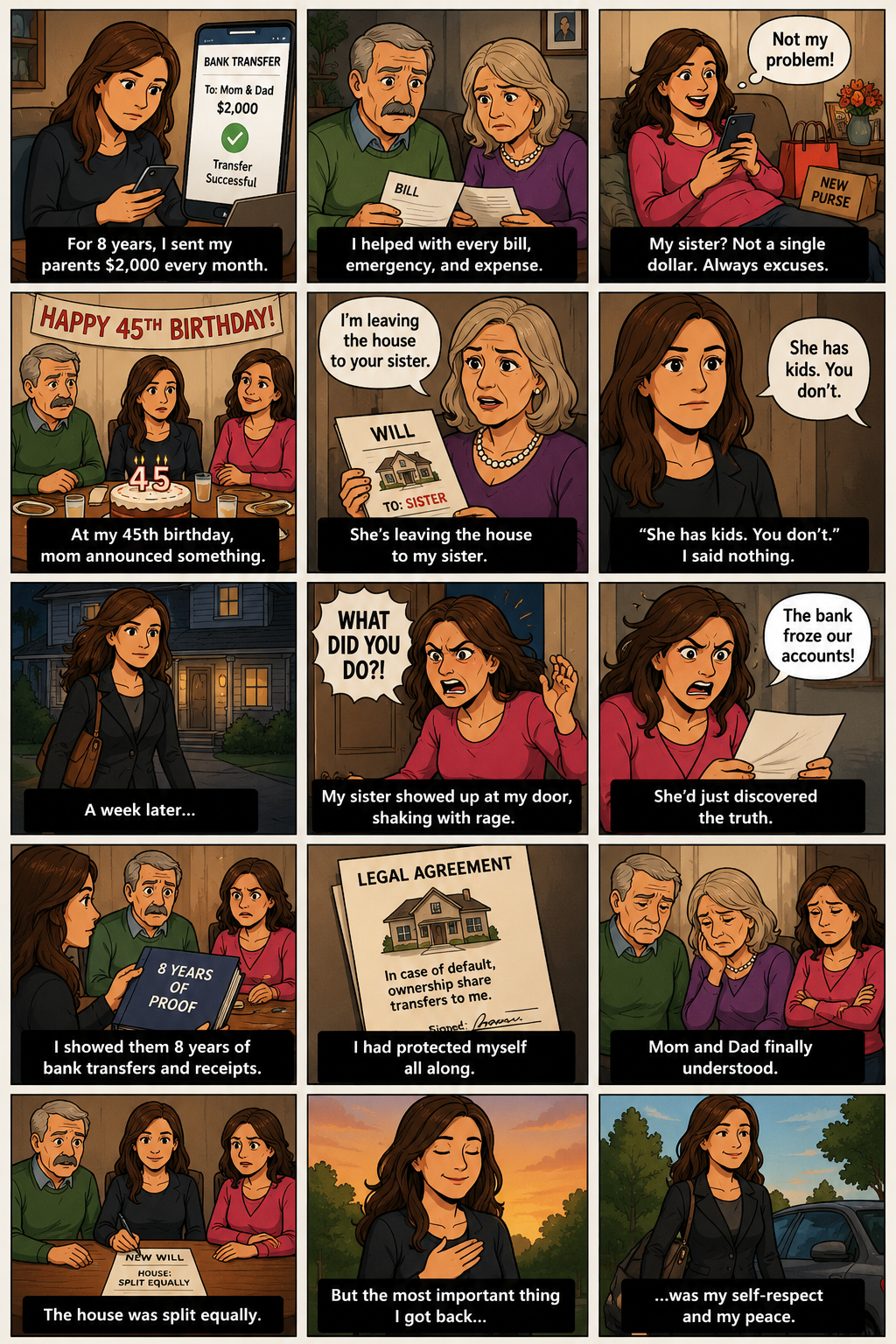
For eight years, I sent my parents $2,000 every single month.

I never told anyone about it.

Not my friends.
Not my coworkers.
Not even the woman I dated for three years.

To everyone else, I just looked like a middle-aged guy living a quiet, ordinary life. But behind the scenes, almost every financial decision I made revolved around helping my parents survive.

Dad’s retirement savings disappeared after his heart surgery.
Mom’s medications kept getting more expensive.
And the old family house was falling apart piece by piece.

So I stepped in.

Every month, on the first day, I wired the money without fail.

Meanwhile, my younger sister Rachel contributed absolutely nothing.

Whenever Mom defended her, it was always the same excuse.

“She has children.”
“She’s overwhelmed.”
“You know how hard things are for young families.”

I tried not to resent it.

But resentment has a way of growing quietly.

Especially when you’re sacrificing your own future while someone else gets praised just for showing up to Sunday dinner.

By the time I turned 45, I had given my parents nearly two hundred thousand dollars.

Two hundred thousand.

I could’ve bought a house.
Started a business.
Built an actual retirement fund.

Instead, I chose family.

So when Mom invited everyone over for my birthday dinner, I honestly thought maybe—just maybe—they finally appreciated everything I’d done.

I couldn’t have been more wrong.

Dinner started pleasantly enough.

Mom cooked my favorite roast chicken.
Dad even opened the expensive wine he’d been “saving for a special occasion.”

Rachel arrived late, of course.

Designer handbag on her shoulder.
New SUV parked outside.
Talking loudly about her upcoming family vacation to Cancun.

I sat quietly and tried not to think about the fact that I hadn’t taken a vacation in over ten years.

Then dessert came out.

And Mom stood up holding a small envelope.

“At my age,” she said softly, “it’s important to make plans for the future.”

Dad nodded beside her.

Rachel smiled immediately, like she already knew what was coming.

Mom pulled out a folded document.

“The house,” she announced, “will go to Rachel when we’re gone.”

The room went silent.

I honestly thought I misheard her.

Mom looked directly at me.

“She has children,” she said gently. “You don’t. It only makes sense.”

Eight years.

Ninety-six monthly payments.

Countless sacrifices.

And somehow, none of it mattered.

Rachel didn’t even try to hide her smile.

I felt something crack inside me—but I stayed calm.

I nodded once.
Took a sip of wine.
And said quietly, “I understand.”

Nobody noticed Dad refusing to meet my eyes.

Nobody noticed my hands trembling under the table.

And nobody noticed that after dinner, I walked outside alone and sat in my car for nearly an hour staring at my phone… at the bank transfers… at years of proof that I had quietly carried this family on my back.

I didn’t cry.

I didn’t yell.

But a decision formed in my mind that night.

A decision that would change everything for all of us.

And one week later…

Rachel came pounding on my front door in absolute fury.

Rachel stormed into my house without even knocking.

“What did you DO?!” she screamed, waving papers in the air.

Behind her, Mom stood pale and shaken.
Dad looked exhausted.

I slowly closed my laptop and looked at them calmly.

Rachel slammed the documents onto my kitchen table.

“The bank froze Mom and Dad’s account! The mortgage company is calling! What is THIS?”

I glanced down at the papers.

Then back at her.

“It’s debt,” I said quietly.

Mom’s face tightened.
“Why would you do this to us?”

I almost laughed at the question.

“For eight years,” I said carefully, “I sent you two thousand dollars every month.”

Dad lowered his eyes immediately.

Rachel crossed her arms.
“So? You wanted to help.”

“No,” I corrected softly. “I wanted my parents to survive.”

The room went silent.

I walked to a drawer and pulled out a thick folder.

Bank transfers.
Receipts.
Medical bills.
Property tax payments.
Utility shutoff notices I had secretly paid.

Every single thing.

I laid them across the table one by one.

“You told everyone Rachel was the one taking care of you,” I said. “But she never paid for anything.”

Rachel’s face turned bright red.

Mom looked horrified as she flipped through the records.

Month after month.
Year after year.

Dad finally whispered,
“She never knew how bad things were.”

I looked directly at him.

“Because every time you were drowning, I covered it.”

Then I pulled out one final document.

A legal agreement.

Eight years earlier, when Dad almost lost the house, I had paid off the remaining mortgage balance quietly—but their lawyer had insisted on protecting me.

The agreement stated clearly:
If my parents died before repaying the money, ownership of the house would partially transfer to me through a secured lien.

Rachel grabbed the papers with shaking hands.

“That’s impossible.”

“No,” I said calmly. “What’s impossible is expecting me to fund everyone forever while being treated like I don’t matter.”

Mom suddenly sat down and began crying.

Not dramatic tears.

Real tears.

The kind that come when someone finally realizes the truth too late.

Dad looked older than I had ever seen him.

“I was ashamed,” he admitted quietly. “You were the only one helping us.”

Rachel exploded.

“So this whole thing was a trick?!”

I stared at her.

“No. The trick was letting me play the role of the responsible daughter while you played the favorite.”

Silence filled the room.

Finally, Mom whispered,
“What happens now?”

I took a long breath.

Then I said the words I should have said years earlier.

“I’m done paying for everyone.”

Rachel looked terrified.

Because for the first time in her life, nobody was coming to rescue her.

A month later, my parents changed the will.

The house would now be split equally.

But honestly?

By then, it didn’t matter anymore.

Because the real thing I got back wasn’t the house.

It was my self-respect.

Leave a Reply

Your email address will not be published. Required fields are marked *