The phone started vibrating in the middle of a budget meeting, and for one stupid second, I considered letting it go.
I was sitting at the long conference table on the twelfth floor of a gray office building downtown, half-listening to my manager talk about department cuts and vendor contracts, staring at a spreadsheet that had begun to blur into blocks of green and white.
My phone was face down beside my notebook.
It buzzed once, stopped, then started again almost immediately.
I turned it over.
Noah.
My son was four years old.
He knew two rules better than most adults I worked with: don’t touch the stove, and don’t call Dad at work unless it was important.
I had drilled that into him because he loved hearing my voice and would talk forever if you let him.
Usually, if he wanted me, he waited until lunch, or he had his mom text me a photo of whatever toy dinosaur he had lined up across the couch.
He never called twice in a row.
I answered before the second vibration stopped.
“Hey, buddy,” I said, already half out of my chair.
“What’s wrong?”
At first there was nothing.
Just a thin rush of air.
Then I heard him breathe in the shaky little way he did when he was trying not to cry.
“Dad,” he whispered.
“Please come get me.”
My body went cold.
“Noah, where’s Mommy?”
“She went out.”
He was crying harder now, trying to talk through it.
Every word sounded wet and broken.
“Travis hit me with a baseball bat.
My arm hurts.
He said if I tell, he’ll do it again.”
For half a second, nothing in the room made sense.
The glass wall of the conference room.
The projector screen.
My boss holding a marker.
Someone opening a can of sparkling water at the far end of the table.
It all turned distant, like I was underwater.
Then I heard a man yelling in the background.
“Who are you talking to? Give me that phone.”
The line went dead.
I shoved my chair back so hard it toppled into the wall.
People were staring at me, asking questions, but I was already moving.
I grabbed my keys, dropped them, picked them up again with hands that barely worked, and ran for the elevator.
Noah was at Lena’s house.
Lena was my ex-wife.
We had been divorced for a little over two years, and most days we managed the kind of shaky peace divorced parents brag about when they’re trying to convince themselves it’s healthy.
We had split custody.
We texted about preschool pickups, cough medicine, and birthday plans.
We did not text about feelings.
We did not talk about the marriage except to apologize for it in indirect ways.
When she started seeing Travis, I didn’t like him.
That wasn’t unusual.
Ex-husbands rarely like the new guy.
But it wasn’t just jealousy.
It was the way he looked at people too long without smiling.
The way he called Noah “champ” without really paying attention to him.
The way he always seemed slightly annoyed by ordinary things, like children asking questions or dogs barking in the distance.
I had raised concerns.
Lena had called me bitter.
“You don’t get to interrogate every man I date,” she
said once over the phone.
“I get to care who’s around my son,” I answered.
“He’s never done anything to Noah.”
That had been the end of it.
Until my son whispered baseball bat into a phone.
By the time the elevator reached the garage level, I was dialing the only person who might get there before I did.
My brother Derek answered on the first ring.
“What’s going on?”
“Noah just called me,” I said, running across the concrete toward my car.
“He’s crying.
He says Lena’s boyfriend hit him with a baseball bat.
I’m downtown.
Where are you?”
Silence.
Then Derek said, “Ten, maybe fifteen minutes from her neighborhood.”
Derek had fought MMA in his twenties before a shoulder injury ended it.
He was calmer than me in every emergency, funnier than me at every funeral, and more dangerous than most men ever realized until it was too late.
He almost never raised his voice.
He didn’t raise it now.
“Do you want me to go in?” he asked.
“Yes.
Go now.
I’m calling 911.”
I started the car with one hand and nearly backed into a pillar.
My heart was hitting so hard it hurt.
When dispatch answered, I heard how frantic I sounded and hated that I couldn’t make myself calmer.
I gave them the address, Travis’s name, Lena’s name, Noah’s age.
I repeated what Noah had said word for word.
I told them the mother wasn’t home.
I told them the child said he’d been threatened.
The operator kept her voice measured and low, asking me to stay on the line, telling me officers were being sent.
Traffic was a red wall in front of me.
Every stopped car looked like an insult.
Every pedestrian seemed to move in slow motion.
I gripped the wheel hard enough to ache and pushed through yellow lights, apologizing under my breath to God, to cops, to whoever might be listening.
Then Derek called.
I switched over immediately.
“Tell me.”
His engine went quiet.
“Lena’s car is gone,” he said.
“Travis’s truck is here.
Front door’s cracked open.”
I couldn’t breathe.
Then he said, more softly, “I can hear a kid crying.”
The next sounds came in fragments.
A door pushed wider.
Footsteps across hardwood.
Noah sobbing.
Derek’s voice, sharp and controlled.
“Get away from him.
Now.”
A man answered, too far from the phone for me to make out every word, but I caught enough.
“Mind your business…
kid fell…”
Then Noah cried out, higher and harder.
“Derek!” I shouted into the phone.
No response.
Just movement.
A crash.
Something heavy hit the floor.
A man cursed.
Another thud.
Then Derek came back, breathing hard but steady.
“He’s down,” he said.
“Noah’s conscious.
His left arm looks broken.
Face is bruised.
I’m staying here until police arrive.”
I felt dizzy with relief and terror at the same time.
“Is Travis armed?”
“Not now.
But there’s a bat on the floor.
And he keeps looking toward the hall closet like there’s something in there he doesn’t want seen.
Get here fast.”
When I pulled onto Lena’s street, there were already two squad cars out front and an ambulance behind them.
My car was barely in park before I was out and running.
An officer tried to stop me at
the walkway.
I told him my son was inside and didn’t slow down until he realized who I was.
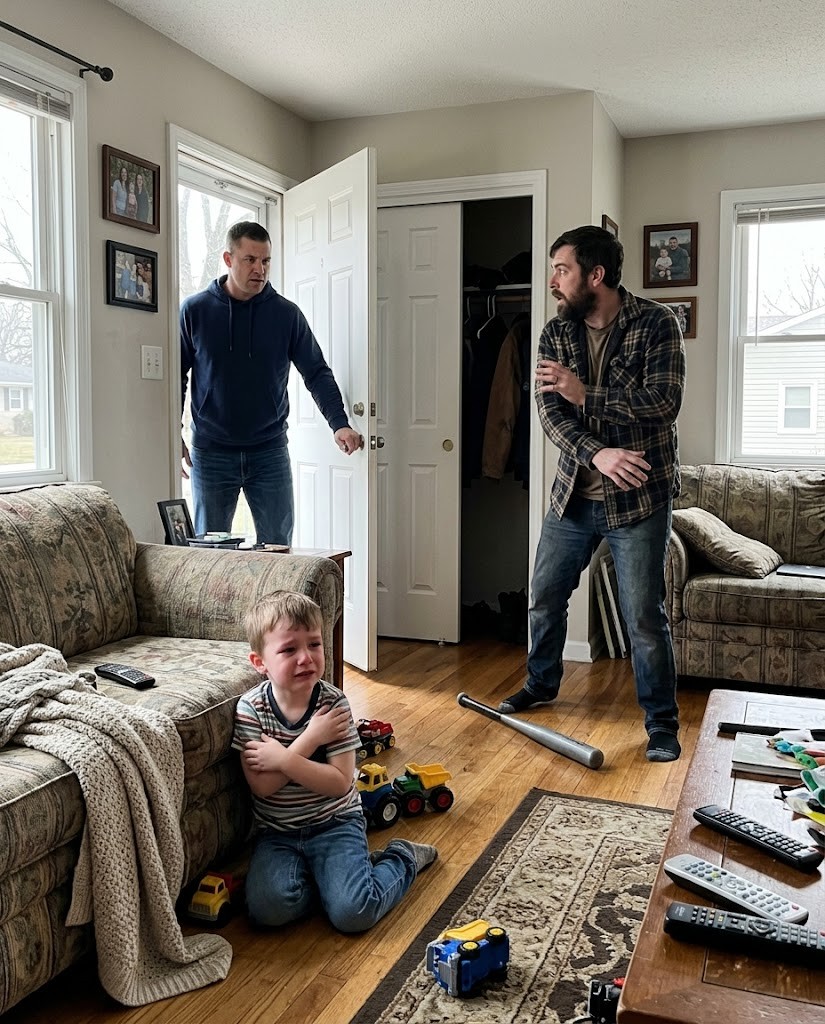
Noah was on the living room floor wrapped in a gray blanket from the couch, his little face blotchy and wet, his left arm bent at an angle that made the room tilt under me.
I dropped to my knees so fast they slammed the hardwood.
“Hey, hey, buddy, I’m here,” I said, touching his hair, his cheek, the uninjured shoulder, afraid to touch too much and somehow hurting him more.
He looked up at me with glassy eyes and reached for me with his good arm.
“Daddy.”
That one word nearly broke me.
I gathered him as carefully as I could while the paramedic crouched beside us.
Noah buried his face against my chest, shaking.
I could feel how small he was.
How hot his skin was.
How violently he had been crying.
Across the room, Derek stood near the doorway with one hand flexing open and closed, the old shoulder taped under his shirt.
At his feet, Travis was on his side in handcuffs, lip split, staring at nothing.
I had imagined, on the drive over, that I might launch myself at him.
That I’d need to be restrained.
That there would be blood and screaming.
Instead I looked at him and felt something worse than rage.
I felt disgust.
He had hit a four-year-old with a bat.
There was no amount of violence I could do to him that would make him feel as small as he deserved to feel.
The paramedics loaded Noah into the ambulance.
I rode with him while an officer followed in his cruiser.
At the hospital, X-rays confirmed a fractured ulna and severe bruising along his upper arm and shoulder.
There was swelling near his cheekbone and a fingerprint-shaped mark under one ear.
The doctor said the break was consistent with blunt force trauma.
Those clinical words hit me harder than I expected.
Blunt force trauma.
For my son.
A social worker interviewed me in a quiet room with toy blocks in one corner.
Another officer took my statement again.
Then they interviewed Noah using simple questions and soft voices.
I could hear pieces of it through the cracked door.
“What happened next?”
“He was mad.”
“Who was mad?”
“Travis.”
“Why was he mad?”
“I spilled juice.”
I leaned forward and put my face in my hands.
Spilled juice.
Not a fight.
Not a threat.
Not some wild misunderstanding that adults would later parse apart.
My four-year-old had spilled juice, and a grown man had decided a baseball bat was an acceptable answer.
Lena arrived forty minutes later looking like someone had driven all the color out of her body.
Her hair was half-fallen from a clip.
Her purse hung open from one shoulder.
She spotted me through the waiting room glass and ran over.
“Where is he?” she asked.
“In pediatrics.
Cast soon.
Police already have Travis.”
Her mouth trembled.
“Mark, I didn’t know.
I swear to God, I didn’t know.”
For months I had rehearsed angry speeches for this woman in my head.
About boundaries, warning signs, instinct.
In that moment, all I could say was, “You left him alone with our son.”
She covered her mouth and started crying.
wanted to feel satisfied.
I didn’t.
I was too tired and too afraid.
Later that night, after Noah finally slept with his tiny arm in a bright blue cast, the detective came back with more questions.
Officers had searched the house with a warrant after Derek mentioned the closet.
Inside they found not just the bat, but an unlocked gun case on a shelf low enough for a child to reach if he climbed.
The gun itself was missing from the foam insert.
My stomach turned.
“Where was it?” I asked.
The detective looked at me for a beat before answering.
“Under the couch cushion.
Loaded.”
I sat there without moving.
She continued, gentler now.
Travis had a previous arrest from another county involving a bar fight and an unreported domestic disturbance with a former girlfriend.
No felony convictions, which was how he’d stayed invisible to ordinary background checks.
But his temper wasn’t new.
It had just never cost him enough.
When Derek entered the house, Travis had apparently been trying to shove the gun deeper beneath the couch while Noah cried on the floor.
Whether he meant to threaten my brother, the police, or simply hide it, no one could prove yet.
It barely mattered to me.
My son had been alone in a house with a violent man, a baseball bat, and a loaded gun.
For the next few days, life narrowed to hospital discharge papers, pain medication charts, child services interviews, and Noah waking up from sleep crying that Travis was in his room.
I moved a mattress onto my bedroom floor so I could hear him breathe.
He clung to me whenever I stood up to pour coffee.
If I stepped outside to get the mail, he cried until he saw me again.
Derek came by every evening.
He never made a big deal about what he’d done.
He brought coloring books, fixed a loose cabinet hinge, and kept his voice light around Noah.
On the third night, after Noah fell asleep against my side watching cartoons, Derek stood at the kitchen sink and said quietly, “I got there later than I should have.”
I stared at him.
“You got there in time.”
He nodded once, but his jaw tightened.
He had seen things in that living room he didn’t fully describe, and I didn’t force him to.
The details we already had were enough to haunt both of us.
Lena asked to come see Noah after the first forty-eight hours.
I didn’t answer right away.
I spent an hour wanting to punish her and another hour remembering that she had also just discovered the man she trusted was capable of monstrous things.
She came over on Sunday afternoon carrying a stuffed fox and looking ten years older than she had the week before.
Noah didn’t run to her.
That was the hardest part to watch.
He stayed tucked beside me on the couch, staring at the toy in her hands.
“Hi, baby,” she said, voice shaking.
He didn’t answer.
She sat in the armchair and cried quietly while he watched cartoons and refused to look at her.
After twenty minutes, she said she had ended the lease application they had been discussing, changed the locks, and given police every message Travis had ever sent her.
“I should have listened to you,” she told me after Noah went to the bathroom with his cast held awkwardly against his chest.
“You kept saying something felt off, and I made you sound controlling because it was easier than admitting I might be wrong.”
I didn’t know what to do with the apology.
Accepting it felt too simple.
Rejecting it felt pointless.
“Wrong is dating someone rude,” I said.
“This was our son.”
She nodded like she had been expecting that.
Travis was charged with felony child abuse, assault, child endangerment, witness intimidation for threatening Noah, and unlawful firearm storage because of the loaded gun.
The prosecutor told us the recorded call, the medical report, Derek’s eyewitness statement, the 911 log, and the body-cam footage made the case unusually strong.
Still, months passed.
Cases move slower than trauma.
Noah started play therapy twice a week.
He learned to talk through puppets before he could explain anything directly to adults.
One puppet was a dinosaur.
One was a firefighter.
One was always the bad man.
The therapist said not to press, not to force healing to happen on our schedule just because we were desperate for signs of progress.
By Christmas, he stopped checking closets before bedtime.
By February, he could say Travis’s name without shaking.
By spring, his cast was long gone and he had full movement back in his arm, though he hated baseball on television and asked me to change the channel whenever a bat came into view.
When the plea hearing finally came, I thought I was ready.
I wasn’t.
Travis stood in county jail orange, hands clasped in front of him, and said he had been stressed, had been drinking, had never meant to hurt the child that badly.
The judge’s face did not change.
Neither did mine.
There are sentences people say in court that reveal exactly how broken they are.
I never meant to hurt the child that badly was one of them.
He took a plea that included prison time, mandatory no-contact orders, and supervised release conditions so strict his attorney looked sick reciting them.
It wasn’t enough for what he had done.
Nothing would have been enough.
But when the judge said the words remanded into custody, some knot inside my chest loosened for the first time in months.
Outside the courthouse, Lena sat on a bench and cried into both hands while reporters from no one important drifted near the steps hoping for comment.
I sat beside her because I didn’t know what else to do.
“Do you hate me?” she asked without looking up.
I thought about the nights Noah woke screaming.
I thought about her dismissing my instincts.
I thought about the way she had collapsed in the hospital hallway when she saw his cast.
“Sometimes,” I said honestly.
Then I added, “And sometimes I think you’re going to hate yourself enough for both of us.”
She nodded, because it was true.
Co-parenting after that became something quieter and more careful.
She went to counseling on her own.
She stopped defending choices just because someone challenged them.
She learned to ask more questions.
I learned that staying furious forever would keep Noah trapped in the same day we were trying to leave behind.
We were never going to
be friends.
But we became allies in the one way that mattered.
Noah turned five that summer.
He asked for dinosaurs, cupcakes, and a water table in the backyard.
Derek came early to help set up.
At one point I looked through the kitchen window and saw my brother crouched in the grass while Noah, soaked from the hose, explained with complete seriousness why a T.
rex could definitely beat a shark if the shark came on land.
Noah laughed then.
Not the careful little laugh he had after the incident, as if joy itself might break something.
A real one.
Big.
Sudden.
Unprotected.
I stood there holding a stack of paper plates and had to look away for a second.
Some damage doesn’t disappear.
It just stops being the loudest thing in the room.
At bedtime that night, after the guests left and the wrapping paper was bagged and the house finally went still, Noah climbed into my lap with his fox under one arm.
“Dad?”
“Yeah?”
“Uncle Derek is brave.”
I smiled.
“He is.”
Noah leaned his head against my chest.
“You are too.”
I closed my eyes.
I wasn’t sure bravery had much to do with it.
Terror had done most of the driving that day.
Terror and love and the ugly helplessness of being too far from your child when the world turns dangerous.
But maybe that was what bravery looked like from the outside.
You move anyway.
You call anyway.
You run anyway.
You kick the door open in whatever form you can.
After I tucked him in, I stood in the dark hallway a long time listening to the soft sounds of him sleeping.
I thought about a phone buzzing across a conference table.
About one answered call dividing my life into before and after.
About how close we had come to something even worse than what happened.
And I thought about Lena, about warnings dismissed and instincts explained away, about how ordinary danger can look right up until the moment it doesn’t.
Even now, the part that stays with me most isn’t the courtroom or the cast or the handcuffs.
It’s that my son knew exactly who to call when everything went wrong.
And I still wonder which hurts more: that a four-year-old had to be that brave, or that the adults around him nearly weren’t.