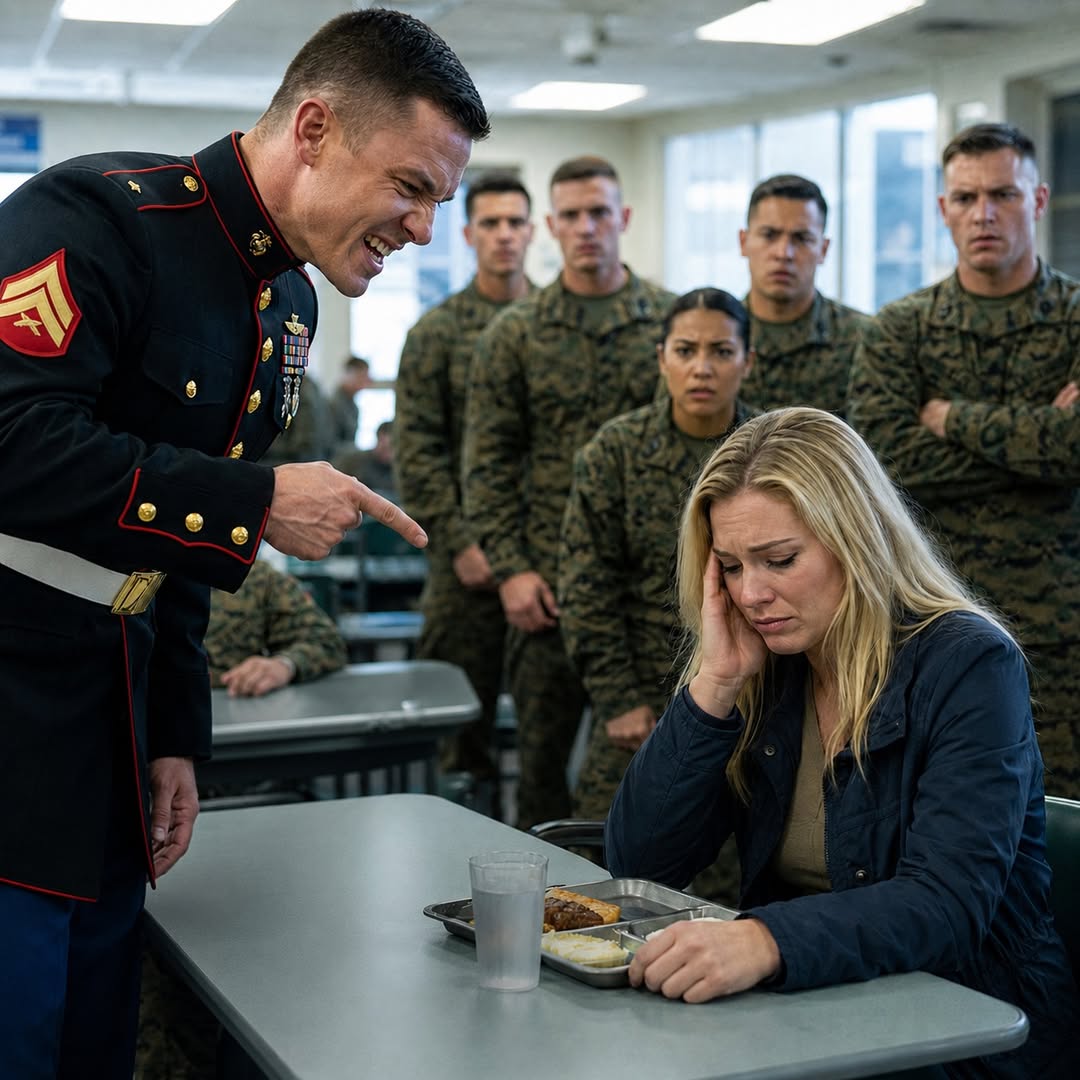
“Know Your Place, Missy” The Man Hit a Woman and Laughed—Until Every Marine Choked on Their Food in the Mess Hall
Part 1
“Hey, sweetheart, you lost?”
The voice cut across the mess hall like a thrown tray.
I had just sat down with a plastic fork, a square of overcooked chicken, and coffee that smelled like someone had burned a tire and poured hot water over it. The dining facility at Camp Lejeune was packed shoulder to shoulder—Marines in cammies, boots scraping tile, chairs dragging, steam rising off gravy, the sharp clean bite of floor wax under the heavier smell of fryer oil.
I kept my eyes on my tray.
Not because I was scared.
Because I had already counted the exits.
Two doors. One service entrance behind the milk cooler. A narrow lane between the drink machines and the wall where a person could move fast if everyone else froze. I had chosen the far steel table with my back to the bulkhead and a clean line of sight across the room. Old habit. Old habits had kept me alive long after bravery stopped being useful.
“The civilian petting zoo’s by the front gate,” the man said. “This here is a working mess. Marines only.”
A few young Marines laughed because he expected them to.
I lifted my fork, cut the chicken, and took one bite. Dry. Salted too late. The kind of food that made men complain and then come back for seconds because it was hot and free and familiar.
The man came closer.
He was big in the way some men build themselves when they are afraid of being ordinary. Thick neck, gym shoulders, sleeves tight around his arms. Sergeant stripes. A jaw set for performance. His name tape read Maddox.
He leaned over my table and flicked the edge of my visitor lanyard.
“Tourist,” he said, turning his head slightly so the table behind him could hear. “We get one every week. Wanders in off a base tour and thinks the chow hall’s a museum.”
More laughter.
One young Marine did not laugh. He was sitting two tables away, skinny in the shoulders, still too new to hide how new he was. His eyes moved from Maddox to me and then down to his food as if looking at either of us too long might cost him something.
Maddox planted one hand on the table.
“You allowed in here? You got a sponsor, or did you follow the smell?”
“I have a badge,” I said.
My voice was quiet enough that he had to listen.
That bothered him.
“A badge,” he repeated, grinning at the room. “She has a badge.”
I set my fork down, straightened it with the edge of my napkin, and looked up at him.
His eyes were bright with the simple expectation of a man waiting for fear. Fear, anger, embarrassment—any of those would have fed him. I gave him none.
For one second, his smile thinned.
Then he slapped the table hard enough to make my milk carton jump.
“Enjoy your visit.”
He walked away laughing.
I picked up the milk carton, set it square in its place, and kept eating.
Across the room, near the coffee urn, an older Marine had stopped with a cup in his hand. Master Gunnery Sergeant. Weathered face. The kind of man who had seen enough real danger to dislike fake danger on principle.
He was watching me, not Maddox.
For a moment, his expression changed, as if he had heard a song from another room and could not remember the words.
Then someone called for him at the door. He looked away.
I finished my lunch slowly. I bussed my tray. I wiped my place clean.
As I passed Maddox’s table, I felt his eyes on me like heat from an open oven, waiting for me to flinch.
I did not.
Outside, the afternoon sun hit the pavement white and hard. I walked to my rented sedan, opened the door, and sat without starting the engine.
Then I took out my small notebook and wrote the first line.
Day one. Mess hall. Sergeant Maddox. Public humiliation as entertainment.
I closed the notebook, and my hand stayed on the cover longer than it should have.
Because I had come to observe a battalion quietly.
By the end of lunch, I already knew one man wanted to be seen—and one old Marine had almost recognized me.
### Part 2
I returned the next day at noon.
That was not stubbornness. Stubbornness gets people killed. It was procedure. One scene tells you what a person performs. Repetition tells you what a place permits.
The mess hall was louder than before. Hot trays slid along rails. Someone near the drink station laughed with his whole chest. The smell of pepper, wet wool, coffee, and old grease hung under the fluorescent lights. Maddox sat at his usual table like a man holding court, elbows out, shoulders wide, making himself part of the furniture.
He saw me come in.
A slow grin lifted one side of his mouth.
I kept walking.
My goal was simple: eat, watch, learn.
Halfway through the serving line, a sound disappeared.
That is hard to explain unless you have lived long enough around groups of men under stress. A room can be loud and still have rhythm. Forks, jokes, coughs, chairs, boots. Then something breaks the rhythm. Not a crash. Not a scream.
A missing sound.
I turned before anyone called for help.
The young Marine from the day before was two tables over, both hands locked at his throat. His face had gone pale, then gray around the lips. His eyes were wide and animal-bright. The Marines around him half rose, useless with panic.
One slapped him on the back too high.
Another said, “Salas?” like the name itself might fix him.
Maddox was two seats away with his tray in his hands. He froze.
I moved.
Not fast enough to look dramatic. Fast enough to arrive.
I came behind the boy, hooked my arms under his, found the line above his navel, and pulled in and up. Once. Twice. His boots scraped against the tile. Three. His body fought for air that would not come. Four.
A piece of chicken hit the table and bounced onto the floor.
I turned him, checked his mouth, then put two fingers under his jaw.
Pulse strong. Air moving. Panic still climbing.
“Look at me,” I said. “Small breaths. In for four. Out for four. You’re all right.”
His eyes found mine.
There are few things more naked than fear in a nineteen-year-old trying not to look afraid. His hands shook when I guided him back onto the bench. Someone pushed a cup of water toward him.
“Not yet,” I said. “Breathe first.”
The room had gone still.
Three hundred Marines watched me count the boy through his first good breath, then his second. Color returned to his face in a rush. He coughed once and grabbed the edge of the table.
“You’ll feel it in your throat for a day,” I told him. “That’s normal. Small sips now.”
A staff sergeant came up late, notepad already in hand.
“Ma’am, I need your name for the pass-down.”
“There’s nothing to pass down,” I said.
“You saved him.”
“He swallowed wrong. He’s breathing. Watch him drink.”
He opened his mouth.
I looked at him.
He closed it.
I picked up my tray and returned to my seat.
Within a minute, the room tried to become normal again. Chairs moved. Forks resumed. Someone forced a laugh that died halfway out.
Maddox did not like silence unless he owned it.
“Relax,” he said loudly. “Anybody can smack food out of a boot. She got lucky.”
No one answered.
That bothered him more than disagreement would have.
Private First Class Salas kept both hands around his water cup, breathing exactly as I had told him. Four counts in. Four counts out.
When his eyes lifted to me, there was gratitude there, yes—but also confusion.
He could not decide what I was.
Neither could Maddox.
And that uncertainty put a crack in the floor under his throne.
### Part 3
By the third day, Maddox had turned me into a joke.
That was predictable. Men like him do not recover from being exposed by becoming kinder. They recover by making the witnesses ashamed for noticing.
When I walked in, his table started a slow clap.
One clap. Then another. Lazy, mocking, spreading only as far as the boys too scared not to follow his lead.
“The medic’s here,” someone called in a high voice.
I took a tray.
Eggs. Toast. Coffee. The coffee was still terrible.
My goal that day was to see whether anyone would stop him.
No one did.
That mattered.
Not because every Marine in that room was cruel. Most were not. I had watched a corporal pay for a younger Marine’s meal when his card declined. I had watched a cook set aside a fresh piece of chicken for a limping staff sergeant without making a show of it. I had watched small decencies pass hand to hand like contraband.
But decency done quietly and cowardice done quietly can look the same from a distance.
Maddox narrated my lunch for the room.
“Tourist went with eggs today. Bold choice. Maybe she’s writing a review.”
Some laughed.
Less than before.
That mattered too.
The young Marine, Salas, stood in the chow line ahead of me. His shoulders stiffened when Maddox came up behind him.
“Careful, Salas,” Maddox said, loud enough for the room. “Adopt enough strays, people start wondering what kind of Marine needs a civilian woman to save him from lunch.”
Salas stared down at his tray. His ears went red.
That was the conflict in its purest form. Maddox did not only want to humiliate me. He wanted to punish the boy for making him look helpless.
I stepped out of line, carried my coffee to an empty seat across from Salas, and sat down.
He looked at me like I had just stepped between him and traffic.
“Bad coffee every day?” I asked.
He blinked.
“Yes, ma’am.”
“That’s unfortunate. Consistency is usually a virtue.”
A corner of his mouth moved before he could stop it.
Maddox hovered nearby, waiting for something he could turn into sport. I gave him nothing. Salas gave him nothing. After two minutes, Maddox drifted away toward louder prey.
I finished my coffee and stood.
At the next table, a visiting officer was muttering over a travel form. His uniform was not American. Jordanian major, if I read the insignia correctly. He tapped one box with his pen, frustrated.
I answered him in Arabic without looking up.
“The block you want is the per diem code. Top right. They hide it badly.”
The pen stopped.
He looked at me sharply, then replied in the same language. His accent placed him near Amman. Educated, tired, polite.
I nodded and returned to my eggs.
Two Marines at the end of the table exchanged a look.
Maddox did not notice. He was busy telling another table that I had probably wandered off from a veteran museum tour.
I opened my notebook under the table.
Day three. Public mockery escalated. Target expanded to PFC Salas. No intervention. One lance corporal—Ortiz—visibly uncomfortable, looked away.
The pen moved in small, neat lines.
My anger did not feel hot anymore. That had burned out years before in places where heat meant fire and fire meant someone was not coming home.
This was colder.
Cleaner.
Records mattered. Patterns mattered. Names mattered.
I closed the notebook and slid it inside my jacket.
When I looked up, Master Gunnery Sergeant Brandt stood near the coffee urn again, staring at me with that same almost-memory caught in his face.
This time, when our eyes met, he went pale.
### Part 4
On the fifth day, Maddox stopped joking and started filing paperwork.
That told me two things.
First, he had realized volume alone was not giving him back the room.
Second, he was more dangerous than he looked.
A bully with a loud mouth can wound people. A bully who learns the system can ruin them.
I found that out at the hatch of the mess hall, where a young corporal stepped into my path with an expression that said he would rather be anywhere else.
“Ma’am, I’m sorry. Your visitor access has been flagged. You’ll need an escort until review clears.”
I looked at the badge hanging from my neck.
Under review.
The words were printed in red.
“What’s the basis?”
He swallowed. “Security concern.”
“Specific concern?”
“I don’t have that information, ma’am.”
His voice had the careful stiffness of someone repeating what he had been told and hoping not to be asked why.
Behind him, Maddox sat at his table, pretending not to watch.
I could have ended it then. One phone call. One name. One sentence spoken to the right person in the right office.
But my goal had never been to protect my pride.
My goal was to learn the battalion before the battalion knew me.
So I nodded.
“Understood.”
The corporal blinked. He had expected protest. People usually mistake calm for surrender because they have never seen calm used as a weapon.
He handed me a form. I signed it, asked for a copy, folded it once, and placed it in my notebook.
As I turned toward the exit, a young fire watch shifted near the door. His rifle hung wrong, muzzle drifting across the walkway, chamber flag missing. Nobody else seemed to notice. He was tired, bored, and new enough to think looking casual made him look confident.
I stepped closer.
“Marine,” I said quietly, “your weapon’s in an unsafe condition. Sling muzzle down. Chamber flag in before your sergeant finds it.”
His eyes snapped to the rifle.
“Yes, ma’am.”
He fixed it fast.
A clerk walking by with folders slowed just enough to hear. Lance corporal. Pierce, according to his blouse. His eyes moved from my lanyard to the rifle to my face.
Something lodged there.
Good.
Outside, the air smelled like pine sap and hot asphalt. I walked to my rented sedan and stood beside it with the review form in my hand.
The system had done what systems do. It accepted a shape that looked official and did not ask whether it was true.
I made one short call.
No rank. No explanation.
Just, “I need the visitor access trail preserved. Full chain. No action yet.”
Then I hung up.
That evening, in my motel room off Route 24, I laid the documents on the small desk beside the lamp. The shade buzzed faintly. The air conditioner rattled like loose teeth. I took out my black notebook and wrote everything while memory was still fresh.
False security concern. Access restricted. Likely initiated by Maddox. Need chain of signatures. Identify approving officer.
Then I opened the flat black case I had kept closed since arriving.
Inside rested a medal, a folded note, and a photograph of five people on a rooftop under a hard white sun.
One face in that photo still had the power to make the room go silent around me.
Diego Morera stood at my left shoulder, grinning like he knew a secret from God and had decided not to share it.
I touched the edge of the picture.
The mess hall thought I was a tourist with a bad badge.
But by then, one clerk had started wondering why a tourist spoke like command.
And one old Marine was about to remember where he had heard my voice before.
### Part 5
I did not know that Brandt spent that night in the operations shop.
I learned it later.
At the time, all I knew was that the air changed around him the next morning.
I had been allowed back into the mess hall with an escort, a gunnery sergeant from the serving line who clearly thought the whole thing was nonsense but had the discipline not to say so too loudly. He walked beside me with a tray in his hands and irritation tucked behind his jaw.
“Sorry about this, ma’am,” he muttered.
“Don’t be,” I said. “Processes reveal people.”
He looked at me as if he wanted to ask what that meant, then decided he liked his day better without the answer.
Maddox saw the escort and smiled.
To him, the red mark on my badge was proof that I had lost. He did not understand that paperwork can be a trip wire. He only saw a woman forced to enter under supervision, and his whole body loosened with pleasure.
“Look at that,” he called. “Tourist got herself a babysitter.”
A few men laughed.
Fewer than before.
Salas did not. Ortiz did not. Pierce, the admin clerk, was sitting near the wall with a sandwich untouched in front of him. He watched Maddox, then me, then his own hands.
I chose a table near the center of the room.
The gunnery sergeant sat two seats away, stiff with embarrassment.
“You don’t have to guard me like I’m going to steal the silverware,” I said.
That pulled a reluctant laugh out of him.
The laugh ended when Maddox came over.
He carried no tray. That was deliberate. A man without food in a mess hall has come to perform.
“You know,” he said, “most people would take the hint after access got pulled.”
I opened my milk carton.
“Most people miss important hints.”
He leaned closer. “You think you’re clever?”
“No.”
That stopped him.
I took a sip of milk. It was colder than expected, almost painfully so.
Across the room, Brandt appeared at the hatch. He was not moving like a man coming to lunch. He was moving like a man carrying something fragile and dangerous inside his chest.
His eyes found me.
This time, recognition was there.
Not certainty. Not yet. Recognition fighting disbelief.
Maddox did not see him.
“You keep showing up,” Maddox said. “Why?”
That was the first useful question he had asked me.
I looked at him then.
“Because people are clearest when they think no one important is watching.”
His smile hardened.
The gunnery sergeant beside me went very still.
For one breath, Maddox’s mask slipped, and I saw the small, sour thing underneath. Not strength. Not confidence. Hunger. He needed the room beneath him because he had no idea who he was without someone lower.
Then he laughed too loudly.
“Lady, nobody important is watching you.”
Behind him, Brandt turned and left the mess hall without eating.
That night, as I sat at the motel desk with my notebook open, my phone lit once with a message from a number I did not know.
No words.
Only a photograph.
A grainy still from security footage. Maddox in the passageway, shoulder driving into me hard enough to make it look like an accident to anyone who had never seen violence disguised as clumsiness.
Then a second message came.
Need confirmation. Were you Blackthorn Six?
I stared at the screen until the motel room seemed to shrink around me.
For seven years, that name had stayed buried under classification, grief, and the kind of silence that grows teeth.
I did not answer.
But my hands remembered the radio.
My hands remembered the rooftop.
My hands remembered Diego going back through the breach.
And when the phone lit a third time, there were only three words.
Master Guns remembers.
### Part 6
Northern Syria smelled like dust, cordite, hot metal, and old stone breaking open.
That is not the kind of memory that arrives politely. It comes through the body first. The grit in my teeth. The sweat under my armor. The radio pressed so hard against my ear that the cartilage hurt for days afterward.
We were on a rooftop across from a dead courtyard when everything went wrong.
A coalition aircrew was down inside a compound that had already taken too much fire. A Marine fire team was pinned behind a low wall with rounds chewing the stone above their helmets. The street between them and us was four hundred meters of bad ground, broken vehicles, blind corners, and dust thick enough to turn men into shadows.
I was thirty-six then.
Old enough to know fear by its first name.
Young enough to still believe I could outwork it.
My call sign was Blackthorn Six.
I became the calm voice because somebody had to.
That is the part civilians misunderstand. Calm is not a gift. It is not a personality trait. It is a decision you make again and again while every living thing inside you begs to run faster, shout louder, feel more.
“Move to the low wall,” I said into the net. “One at a time. Do not look left. Do not look for the shooter. Look where I tell you.”
A young Marine on the radio was breathing too fast.
“I can’t see—”
“You don’t need to see. You need to listen.”
His breath hitched.
“On my count. Three. Two. Move.”
He moved.
They all moved.
That was how we got them out. One task at a time. Never two. Two choices make scared men freeze. One command gives them a rope.
Diego Morera was beside me on that rooftop, dust gray on his beard, grin bright even in the dark.
“You always sound like you’re ordering coffee,” he said between bursts of fire.
“Coffee doesn’t argue as much.”
He laughed.
That laugh stayed with me longer than some people’s faces.
We brought out five.
There should have been six.
A wounded aircrewman was still inside, unable to walk. Diego heard it on the net. I saw him decide before he moved. Some men hesitate and call it judgment. Diego judged and went.
“Morera, hold,” I said.
He looked back once.
Not scared. Not reckless. Just certain.
“There’s a man inside,” he said.
Then he went through the breach.
He got the aircrewman to the wall. I saw the body come through. I saw hands grab him.
Then the wall took the hit.
The blast came through my teeth before the sound reached me.
When the dust lifted, Diego’s voice was gone from the net.
I keyed the radio and said his call sign once.
No answer.
A second call would have told every man listening that something in me had broken. So I did not make it.
I gave the next order.
Then the next.
Then the next.
I carried what was left of Diego out after dawn.
People later gave me a medal for that night. They used words like valor, composure, extraordinary heroism. They put a cross in a box and expected me to know what to do with it.
I kept Diego’s photograph beside it because the medal had never felt like mine.
Back in the motel room, I closed the black case with both hands.
The message from Brandt waited unanswered on my phone.
Were you Blackthorn Six?
I turned the phone face down.
I had come to Camp Lejeune to take command quietly, not to become a ghost story in my own battalion before I had earned their trust.
But ghosts do not stay buried just because you ask them to.
And the next day, Maddox gave mine a reason to stand up.
### Part 7
The ninth day began with rain.
Not heavy rain. The irritating kind that slicks sidewalks, darkens shoulders, and makes every building smell faintly of wet canvas. My escort walked me to the mess hall under a low gray sky, his cover pulled down, jaw still tight with silent disapproval over the badge situation.
Inside, the dining facility steamed.
Rainwater dripped from boots. Wet cammies gave off that wool-and-earth smell that takes over every military building in bad weather. The fluorescent lights buzzed overhead. Trays clattered. Voices bounced off painted cinder block.
Maddox was already there.
The red under-review mark on my lanyard might as well have been blood in water.
He rose when I reached the serving line.
My goal that day was to eat, document, and wait. I could feel the whole situation narrowing toward an end, but timing mattered. End something too early, and people call it misunderstanding. Let it reveal itself fully, and no one gets to pretend.
Maddox stepped into my path.
“Civilians who don’t listen,” he said, projecting to the room, “need to be shown where the line is.”
The serving line went quieter.
The cook behind the eggs stopped moving his spoon.
I held my tray with both hands.
“Step aside, Sergeant.”
His eyes flashed. He liked that I had used his rank. It gave him something to twist.
“Oh, now she knows rank.”
He slapped the tray out of my hands.
The sound cracked through the hall.
Plastic hit tile. Eggs slid across the floor. Gravy spattered my jeans. The tray spun on its edge, circling once, twice, then settling with a hollow wobble that seemed to go on too long.
The room froze.
Even Maddox’s table stopped smiling.
For one held breath, he had what he had always wanted: every eye in the hall.
I looked at the food on the floor.
Then I looked at him.
I said nothing.
That was when the Jordanian major stood from the next table, anger sharp in his face. He spoke in Arabic, one quick sentence, offering intervention.
I answered without turning.
“Stand down.”
Two words. Quiet. Absolute.
He sat.
Maddox heard the foreign language, saw a man obey me, and something ugly flared behind his eyes.
He stepped closer.
“You think you’re better than this room?” he said. “Smile for me, tourist.”
The gunnery sergeant escort shifted.
I lifted one hand slightly at my side.
Not to Maddox.
To the escort.
Hold.
Maddox smiled because he thought the gesture was fear.
“Go on,” he said. “Smile.”
Then he hit me.
Open hand. Hard. Across the face.
The slap snapped through the mess hall with a sound so clean and loud it seemed separate from the hand that made it.
My head turned with the force. My cheek burned. The skin beneath my eye tightened.
I let the strike land.
I did not lift a hand.
That was the hardest thing I did all week.
Not because Maddox was dangerous. He was not. I could have put him on the tile before his second breath. My body wanted to. Years of training rose in me like a door being kicked open.
But my purpose was larger than his body.
Three hundred witnesses. Camera coverage. Prior pattern. False paperwork. Public assault.
The record was complete.
I crouched, picked up the tray, and set it on the rail.
Then I straightened and smiled.
It was not a kind smile, though people often mistake certainty for kindness.
“Okay, Sergeant Maddox,” I said.
His laugh stumbled.
For the first time all week, fear touched his face.
He did not yet know why.
But somewhere behind him, Master Gunnery Sergeant Brandt had entered the room, and he looked like a man who had just watched history raise its hand.
### Part 8
The next morning, I put on my uniform.
Not the field jacket. Not jeans. Not the plain shoes that had let me pass through rooms like furniture.
Uniform.
There are mornings when cloth feels heavier than armor. That was one of them.
I stood in the motel mirror while the pale light through the curtains cut my reflection into strips. The mark on my cheek had faded but not disappeared. I left it uncovered.
Some truths should arrive with evidence.
The black case sat open on the bed. I looked at the Navy Cross longer than necessary, then closed the lid and left it there. Medals have their place. That day was not about metal. It was about command.
Before I left, I touched Diego’s photograph once.
“I’ve got them,” I whispered.
Not because I was sure.
Because sometimes you say the promise first and grow into it afterward.
At 1200, the mess hall was full.
It was change-of-command week, which meant the building had been scrubbed harder than usual and still smelled like old grease under the cleaning solution. Marines were eating fast, talking louder than they needed to, pretending inspections and ceremonies did not make everyone nervous.
I entered through the side hatch with Colonel Adrian Foss, the regimental commander, and Sergeant Major Hale. Brandt stood just inside, waiting.
He had asked for one thing.
The right to say it.
Colonel Foss had granted it.
I remained a step back, out of the main line of sight, while Foss entered first in conversation. The hall reacted the way military rooms react to colonels. Voices dropped. Backs straightened. A few men half rose before deciding whether they were supposed to.
Then Brandt’s voice filled the room.
“Attention on deck!”
Three hundred Marines came to their feet.
Benches scraped. Forks stopped halfway to mouths. A milk carton tipped at the end of one table and rolled against a tray, but nobody reached for it.
Brandt turned toward me.
His face had changed since the first day. The old almost-memory was gone. In its place was something rawer.
He came to attention.
“Ma’am,” he said, voice cracking on the word. “Blackthorn Six. Northern Syria. The courtyard. It was you on the radio.”
The room went still in a way silence alone cannot explain.
Colonel Foss crossed the floor, stopped in front of me, and saluted.
I returned it.
Then he turned to the hall.
“Marines, your incoming commanding officer, Lieutenant Colonel Naomi Dixon, Marine Raider Regiment. Navy Cross recipient. She has been eating in your mess for nine days.”
The words did not echo.
They dropped.
Heavy.
Final.
Faces changed all at once.
Salas stood so straight his throat worked with the effort not to cry. Ortiz stared at the deck as if he could burn a hole through it with shame. Pierce, the clerk, looked both terrified and relieved. The serving line gunnery sergeant’s jaw flexed once, hard.
At Maddox’s table, nobody moved.
Maddox himself stared at me with a smile still trying to survive on his face, like a match in rain.
First came disbelief.
Then calculation.
Then memory.
The lanyard. The notebook. The Arabic. The weapon correction. The tray. The slap.
His face emptied.
Two military police entered through the hatch.
Brandt had made that call the night before.
They crossed the silent mess hall and took Sergeant Mark Maddox by the arms.
He did not fight.
People imagine men like him roaring when the end comes. Most do not. They go quiet when the room they controlled finally sees them clearly.
As they led him past me, his eyes lifted once.
There was a question in them.
Not apology. Not yet.
Only a small, stunned question: How did I not know?
I did not answer.
The hatch sighed shut behind him.
And in a room full of Marines standing at attention, not one person had touched their food.
### Part 9
Truth moves slowly until it doesn’t.
By close of business, the assault report had names attached to it. Hundreds of them. Camera footage. Witness statements. The false access complaint. The shoulder check in the passageway. The public harassment. The comments toward Salas.
Once fear left the room, memory returned with impressive speed.
That is one of the bitter things about command. You learn how many people knew. You learn how many had filed the truth under not my problem because the lie was easier to live beside.
I spent the afternoon in a conference room that smelled of old coffee and printer toner, listening.
Salas sat first.
His hands were folded so tightly his knuckles had gone pale.
I did not sit behind the desk. I took the chair across from him.
“Tell me what happened,” I said.
He looked at the rank on my collar and then at the faint mark still on my cheek.
“Ma’am, I should’ve said something.”
“You’re not here to confess other people’s choices. Tell me what happened to you.”
So he did.
Not smoothly. Not dramatically. Young men rarely narrate their own humiliation well. They skip the worst parts, then circle back to them by accident. Maddox had mocked his weight, his family, his shooting scores, his accent, the way he held a fork, the way he breathed after choking.
“He said if I reported it, I’d be known as weak before I even started,” Salas said.
“And did you believe him?”
His mouth tightened.
“Yes, ma’am.”
That answer hurt more than any speech would have.
After Salas came Ortiz, ashamed and honest enough not to decorate it.
“I laughed twice,” he said. “Not because it was funny. Because he looked at me.”
“Why are you telling me that?”
“Because you wrote things down, ma’am. I figured I should too.”
He handed me a page. Messy handwriting. Dates. Comments. Names.
Courage sometimes arrives late and badly dressed. It is still courage if it tells the truth.
Pierce came in near evening with the access trail printed and clipped.
He stood at attention like a man expecting punishment.
“I keyed the flag, ma’am. I knew it was thin. I didn’t stop it.”
“Who brought it?”
“Sergeant Maddox.”
“Who approved it?”
He swallowed. “Lieutenant Crane.”
“Did anyone pressure you?”
A pause.
“Not directly.”
That meant yes in the language of young Marines trying not to accuse senior ones.
I let the silence work.
Pierce finally said, “Staff Sergeant Voss told me not to overthink things above my pay grade.”
There it was.
The drawer opened.
By the end of the week, Voss was relieved. Lieutenant Crane kept his career, barely, because incompetence corrected early is sometimes worth salvaging. Maddox went before a board with no room left to perform. The combatives belt did not save him. Neither did charm, volume, or old favors.
A battalion run by fear remembers everything once fear loses its teeth.
Through it all, Brandt said little.
He handed over his footage. His statement. His memory of Syria, though I had not asked him for that part.
When the room emptied, he remained standing by the window.
“You saved us,” he said.
“No,” I said. “Diego did.”
His eyes lowered.
“I never knew his name.”
“Now you do.”
He nodded once, and in that nod was seven years of debt changing shape.
That was when I assigned Salas to the operations shop under Brandt.
Brandt looked at the paper, then at me.
For a moment, neither of us spoke.
He understood exactly what I had given him.
Not repayment.
Responsibility.
And sometimes that is the only clean way to carry a debt.
### Part 10
The change of command took place under a hard blue sky.
Ceremonies always look clean from a distance. Colors passing hand to hand. Boots aligned. Orders spoken with polished certainty. Families sitting in folding chairs. Officers pretending the sun is not drilling into the backs of their necks.
But command is never clean.
It is people. Their courage and rot. Their silence. Their small kindnesses. Their paperwork. Their shame. Their second chances.
When the colors passed to me, the fabric was heavier than it looked.
I felt every eye on my face. They knew now. Not everything, but enough. The mess hall story had already traveled through the battalion in a dozen versions. Some made me colder than I was. Some made me braver than I felt. A few probably had me catching Maddox’s hand midair and sparing him for dramatic effect.
People prefer legends because legends ask less of them than facts.
The fact was simpler.
A man hit me.
I let the room see him.
Then I took command of the room.
After the ceremony, I walked the battalion spaces in uniform. No lanyard. No escort. No field jacket. Marines stiffened when they saw me, but not with fear exactly. More like they were waiting to find out what kind of commander would come after humiliation.
I did not yell.
That disappointed some of them.
Yelling would have been easy. It would also have made Maddox the center of the story again.
Instead, I changed systems.
Reports no longer died in drawers. Visitor access complaints required specific evidence. Junior Marines got alternate reporting channels posted where they could actually see them. Combatives instructors were reviewed. Leaders were told, plainly, that cruelty dressed as toughness would be treated as weakness with rank on it.
Some men liked that.
Some men hated it quietly.
That was fine. I trusted quiet hate more than loud agreement. Loud agreement often turns cowardly the moment it costs something.
Three days later, I found Salas in the operations shop with a radio log in front of him and Brandt standing over his shoulder.
“No, not like that,” Brandt growled. “If the time is wrong, the whole record is wrong.”
“Yes, Master Guns.”
“And breathe. You write like the paper owes you money.”
Salas noticed me and started to stand.
“As you were,” I said.
He froze halfway, then sat back down.
Brandt looked innocent, which on his face meant guilty of something.
“He’s learning,” he said.
“I can see that.”
Salas looked down, but not before I caught the smallest smile.
Good.
That afternoon, Ortiz requested mast to give a fuller statement. Pierce volunteered to review access procedures. The serving line gunnery sergeant started correcting Marines who laughed at the wrong things before the laugh had time to spread.
Not everything changed.
No commander fixes a culture in a week. Anyone who says otherwise is selling something.
But rooms remember.
The mess hall remembered the tray.
It remembered the slap.
It remembered the reveal.
And now, when someone got loud for the wrong reason, other people noticed faster.
That was a beginning.
That evening, I walked alone to the memorial wall near the edge of the battalion area. The sun had dropped low, turning the engraved names gold, then gray.
I found Diego without searching.
Master Sergeant Diego Morera.
I rested two fingers below his name.
“I’ve got them,” I said softly. “I’ve got them now.”
My phone vibrated.
Secure line.
Unknown string.
Then a message appeared.
Blackthorn. When you’re ready, Ironwood is alive.
For a moment, the whole world narrowed to those five words.
Because Ironwood had died three years ago.
At least, that was what I had been told.
### Part 11
I did not answer the message at the wall.
That may sound strange. Maybe you imagine a person receiving a note from the dead and calling back with shaking hands. But age and war teach you suspicion before hope. Hope can be a door. It can also be bait.
I stood with my fingers below Diego’s name until the phone went dark.
Ironwood.
Aidan Keller.
He had been a liaison officer attached to one of the ugliest assignments of my life. Smart, patient, funny in a dry way that sneaked up on you. He had a habit of tapping a pen twice before saying something he knew people would dislike. He spoke four languages badly and one language beautifully, depending on how much sleep he had.
He had also been reported killed in an ambush overseas.
Closed file. Memorial service. Folded flag.
Three years ago.
I had stood in the back of that service and left before anyone could ask me what he had meant to me.
Now his call sign sat on my screen like a match struck in a dark room.
I walked back to my office instead of my quarters.
The battalion building was mostly empty. Night duty murmured somewhere down the passage. A printer clicked in admin. The air smelled like dust, carpet glue, and old coffee—every operations building in every place I had ever served.
Brandt was in my outer office, because of course he was.
He looked up from a binder.
“You going to tell me why you look like you saw another ghost, ma’am?”
I closed the door behind me.
“Not yet.”
“That bad?”
“That uncertain.”
He absorbed that with the care of a man who knew the difference.
I placed the phone on my desk.
“Pull nothing. Search nothing. Ask nothing. If anyone contacts you using the word Ironwood, you bring it directly to me.”
His face changed.
He knew the name. Maybe not the story, but enough to understand weight.
“Aye, ma’am.”
After he left, I sat alone with the screen lit between my hands.
The smart move was to forward the message to the proper channels, lock it behind procedure, let people with better tools and fewer ghosts handle it.
I almost did.
Then another message arrived.
Same secure path.
A photograph.
Blurry. Cropped. Recent.
A man in profile near a port at night, thinner than I remembered, hair longer, face half turned from the camera. Aidan Keller’s face. Older. Alive.
Below it, one line.
Not all reports were mistakes. Some were choices.
I read that sentence until the words stopped behaving like words.
Outside my office, I heard Salas laugh at something Brandt said, then catch himself because laughter still felt risky around authority. Brandt barked at him to finish the log. The sound grounded me.
I had a battalion now.
Living Marines. Young Marines. Real responsibilities standing under fluorescent lights, needing clear orders and clean systems.
Ghosts could wait.
But not forever.
I typed one reply.
Proof of life. Location. Terms.
Three dots appeared.
Disappeared.
Appeared again.
Then the answer came.
Tomorrow. Wilmington docks. Come alone if you want the truth about who buried him.
I leaned back in my chair, the old coldness settling into place.
Maddox had been a problem of cruelty.
This was something else.
This smelled like a hidden hand, an old file, and a grave that had never held the right body.
### Part 12
I did not go alone.
I went without visible company, which is not the same thing.
Brandt hated the plan with his whole face, but he followed the order because he was a professional and because I let him put two trusted Marines far enough back to be useful and close enough not to insult me. Salas was not one of them. He was angry about that when he found out. Good. Anger meant he was starting to believe he belonged enough to object.
The Wilmington docks smelled of diesel, salt water, wet rope, and fish left too long in the sun.
Night made everything look guilty.
Cranes stood against the sky like frozen insects. Sodium lights turned puddles orange. Somewhere, a chain knocked softly against a mast. I walked in plain clothes again, but not the same way as before. The field jacket was gone. My hands were free. My eyes took in glass, shadow, reflection, movement.
At 2200, my phone buzzed.
Warehouse 6. Side door.
Of course.
No one ever chose a pleasant bakery for old secrets.
The side door was unlocked. Inside, the air was cooler and smelled of cardboard, rust, and standing water. One light burned near the far wall.
A man stepped into it.
For half a second, my body knew him before my mind allowed it.
Aidan Keller was alive.
Thinner, yes. Scar down one side of his jaw. Hair threaded with gray. But his eyes were the same—tired, watchful, carrying humor like contraband.
“Naomi,” he said.
The name in his voice nearly broke something I had spent years reinforcing.
I did not move closer.
“Proof first.”
He gave a small nod, as if he had expected nothing else. Then he said a sentence no file contained, no enemy could have guessed. Something Diego had said on the rooftop before the breach, too stupid and too sacred to repeat to anyone who had not been there.
My throat tightened.
“Who buried you?” I asked.
He looked toward the warehouse windows.
“People who needed Ironwood dead. People inside the reporting chain. I found a transfer route. Names. Payments. Falsified casualty reports. I tried to move it up clean.”
“And?”
He smiled without humor. “Clean got me killed.”
The old anger stirred, but I kept it behind my ribs.
“Why come to me now?”
“Because you just took a battalion, and because the man who helped erase me is attached to a command review that touches your new house.”
There it was.
The new information. The reason the ghost had waited until now.
He handed me a small drive.
I did not take it immediately.
“What’s on it?”
“Enough to end careers. Maybe enough to put people away. Also enough to make them desperate.”
A sound came from outside.
Not loud. A tire over gravel. Then another.
Aidan’s eyes shifted.
Mine did too.
“Did you bring anyone?” he asked.
“Yes.”
“Good,” he said. “So did they.”
The first shot hit the light above us.
Glass rained down in the dark.
I moved before fear could form a sentence, dragging Aidan behind a stack of crates as the warehouse erupted with footsteps, shouting, and the old familiar music of men making terrible choices.
### Part 13
The fight lasted less than four minutes.
People later made more of it than it was. They always do. Darkness, gunfire, a resurrected officer, a lieutenant colonel in plain clothes, Marines moving through rain-slick dockyards—it sounded like a movie once other mouths got hold of it.
Inside it, there was no music.
Only breath. Angles. Commands. The slap of wet concrete under boots. Brandt’s voice outside, low and furious. Aidan’s shoulder against mine behind the crates. My own pulse, steady not because I was fearless, but because fear had long ago learned to work while present.
“Two left,” Aidan whispered.
“I know.”
“You always say that.”
“Stop talking.”
He almost smiled.
Brandt’s Marines cut off the exit. Whoever had come expected one woman alone and found a net instead. That is the problem with underestimating people. You plan for the version of them that makes you feel safest.
Within minutes, three men were down, zip-tied, breathing, and very unhappy. One carried credentials that turned the night from criminal to catastrophic. The drive Aidan gave me went into a Faraday pouch. The calls that followed climbed fast and high.
By dawn, the docks were crawling with people who outranked almost everyone and trusted almost no one.
That was fine.
I trusted records.
Over the next several weeks, the hidden chain came apart. Not cleanly. Not publicly at first. Investigations never satisfy the appetite for drama because real accountability is mostly paper, interviews, locked rooms, and men who once looked untouchable discovering that signatures last longer than favors.
Aidan had been erased to protect a smuggling route buried under operational logistics. Diego’s death had been real. Aidan’s had been manufactured. The same network that buried him had brushed near my new command through a review channel, close enough that his warning mattered.
Maddox, in the end, was not part of that larger darkness.
That almost made him more pathetic.
He had not been a mastermind. He had not been a soldier in some grand conspiracy. He was only a cruel man who found a room that let him practice.
He was removed, charged, and gone from the battalion’s life. I did not visit him. I did not accept the apology he tried to send through counsel. Some people mistake consequences for closure. I do not.
The lieutenant who signed the false access flag learned to read before signing. Pierce earned a reputation for being annoyingly precise, which is one of the better reputations a clerk can have. Ortiz became the man who spoke first when something felt wrong, perhaps because he remembered too clearly how it felt to speak late.
Salas stayed under Brandt.
He grew slowly. That is the only honest way people grow.
Months later, I saw him in the mess hall correcting a new Marine who had laughed at another’s mistake.
Not cruelly. Not loudly.
He just leaned over and said, “We don’t do that here.”
The new Marine stopped laughing.
No speech. No ceremony. Just a room remembering a new rule.
Aidan left again after giving his statements. Not dead this time. Just gone into the machinery that men like him seem built to survive. Before he left, he asked if I ever thought about what might have happened if he had come back sooner.
“All the time,” I said.
“And?”
“And late truth is still truth. But it does not get to ask for the life that grief already rebuilt.”
He accepted that like a man who deserved it.
On a gray evening nearly a year after I first walked into that mess hall, I stood again at the memorial wall. Diego’s name was cool beneath my fingers.
The battalion behind me was not perfect. No battalion is. But it was cleaner than I found it. Braver in the small places. Quicker to interrupt cruelty. Slower to worship volume.
“I’ve got them,” I told Diego again.
This time, I believed it.
Then I turned back toward the lights of the mess hall, where trays clattered, coffee burned, boots scraped tile, and three hundred Marines ate under a silence that no longer protected the wrong man.
THE END!