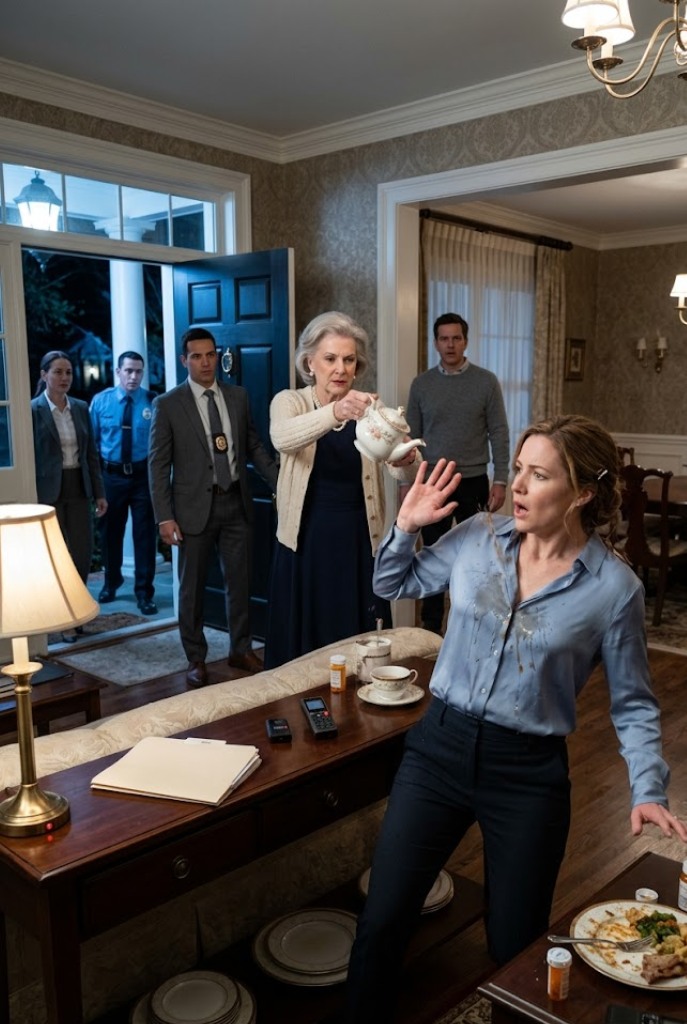
The tea hit my chest before the fear did.
For one strange, suspended second, my mind refused to understand what my body already knew. Heat exploded across my collarbone, sharp and white and blinding, and the porcelain cup in Margaret’s hand hovered above me like a small, elegant weapon. Earl Grey, bergamot, steam, expensive china. Those were the details my brain chose to preserve while my throat closed around itself and my lungs fought for a breath that would not come. I was on the floor of my own living room, one cheek pressed against polished mahogany boards, fingers clawed uselessly against the wood, my body locked in the brutal paralysis of anaphylactic shock. My tongue felt enormous. My pulse moved through me in thick, panicked beats. The room was dimming at the edges, narrowing into a tunnel where only Margaret Miller’s face remained clear.
She looked peaceful.
That was the part I would remember most later. Not the pain, though the burns across my chest would mark me for months. Not even Daniel standing in the hallway with his hands trembling uselessly at his sides. What I would remember was the expression on my mother-in-law’s face as she looked down at me. Calm. Satisfied. Almost domestic. Like a woman admiring a spotless kitchen after finishing the dishes. Like she had finally fixed an irritation that had been troubling her for years.
“Die quietly, trash,” she whispered.
The last drops of tea slid from the gold-rimmed cup and splashed against my skin. The pain flared again, savage enough to send a scream through my skull, but my swollen throat allowed nothing out except a wet, broken rasp. Somewhere above me, the chandelier blurred into a floating moon. The velvet curtains, the Venetian chandelier, the silk rug, the antique clock on the bookshelf, the framed wedding photograph on the mantel — all the pieces of the beautiful home I had built, arranged, polished, and tried desperately to make feel safe — seemed to watch in silence as the woman who had hated me from the first day of my marriage leaned closer to make sure I understood she was enjoying this.
The execution had begun with dinner.
It had been a Tuesday evening, ordinary in the way truly terrible days often are before they turn. Rain moved softly against the tall windows. Daniel had come home late, as usual, but with flowers this time, pale pink tulips wrapped in brown paper, the kind he bought when he needed to appear tender. Margaret had arrived an hour earlier in cream wool, pearls, and that faint, powdery perfume she wore like an accusation. She had insisted on cooking, which should have been my first warning. Margaret never cooked unless there was an audience. She hosted, directed, criticized, corrected the placement of serving spoons, and told stories about the women in her family who “understood proper household dignity,” but she did not cook. Not for warmth. Not for nourishment. Not without purpose.
“I thought Claire deserved a night off,” she had said, smiling at me with her lips and nowhere else. “She looks exhausted lately.”
Daniel had looked at me then, too quickly, as if checking whether I understood the performance. I had smiled back because I was very good at smiling by then. Marriage to Daniel Miller had trained my face into obedience long after my mind had begun quietly gathering evidence.
The dish was braised chicken in a glossy, fragrant sauce. Margaret served it in shallow white bowls with roasted carrots and tiny potatoes, the kind of meal that looked harmless because cruelty rarely arrives with warning labels. I took one spoonful. One. The sauce touched the back of my tongue, rich and savory at first, then wrong. A sharp, bitter bloom spread through my mouth. Almond. Not the vague sweetness of imitation flavoring, not some accidental trace, but that unmistakable blade of nut oil buried beneath cream and herbs.
My fork slipped from my fingers and struck the rim of the plate.
Daniel looked up.
Margaret did not.
She was already watching me.
I reached for my water glass, but my hand hit it too hard and sent it skidding across the table. My throat tightened with horrifying speed. Heat crawled up my neck. My lips began to swell. I tried to breathe and heard the sound first: a thin, whistling pull that seemed far away and too small to belong to my body. Tree nut allergy, severe. Not a preference. Not a mild sensitivity. A medical fact so well documented that Daniel had once carried my prescribed epinephrine injector in the inner pocket of every suit jacket, tapping it gently before leaving the house like a superstition. I had trained everyone close to me. I had emergency medication in three rooms, my purse, my car, my office. Daniel knew. Margaret knew. Their entire family knew because Margaret had mocked it for years.
“Must be exhausting,” she had once said at a holiday brunch, watching me decline a dessert with crushed pistachio. “Living as if the world has to rearrange itself around your fragility.”
That night, as my airway narrowed and my hands flew to my throat, I reached for Daniel.
I clawed at his jacket.
His breast pocket was flat.
Empty.
His eyes flickered down to my hand, then away.
That was the moment I knew.
Not suspected. Not feared. Knew.
My chair toppled backward when I tried to stand. The room lurched. Daniel shouted my name, but his voice had the thinness of theater, too loud and too late. Margaret rose with controlled grace, pushing back her chair as if she were merely clearing space for a fallen napkin. I stumbled toward the hall where I kept one emergency injector in the small drawer beneath the console table. My fingers brushed the edge of the table before my knees buckled. My body hit the floor hard. Air vanished. The world became wood grain, rain, chandelier light, and the terrible sound of my own lungs failing.
Daniel stood in the arched entryway now, pale, shaking, hugging his own ribs.
“Mom,” he stammered. “Mom, what are you doing?”
But he did not move toward me.
Margaret stepped around the overturned chair and lifted her teacup from the table. “I am doing exactly what you should have done two years ago, Daniel.”
That was how she said it. Calmly. Not in panic, not in rage. As if my death had been a delayed household task, like replacing a cracked tile or finally donating old coats. Daniel swallowed hard. His hands dragged through his hair, ruining the careful style he maintained even when coming downstairs for coffee. He looked horrified, but horror is a slippery emotion. It can mean conscience. It can also mean fear of consequences.
The tea came next.
She poured it slowly, deliberately, across my chest and collarbone while I lay unable to roll away. The scalding liquid soaked through the neckline of my blouse. My skin blistered almost instantly. I tried to move. My fingers spasmed, but no meaningful motion followed. My vocal cords produced nothing but a strangled hiss. Pain flashed behind my eyes so bright it briefly cut through the suffocating fog.
“Please,” Daniel whispered, but not to me. To her.
Margaret crouched beside me, the pearls at her throat swinging slightly. “She was never family,” she said. “She was an interruption.”
My vision pulsed.
The darkness tugged at me, soft and heavy. It promised relief. No burning throat, no blistered skin, no betrayal, no Daniel, no Margaret, no years of carefully arranged cruelty hidden behind manners and money. Just quiet. Just surrender.
But surrender had never been my talent.
They had forgotten that.
Everyone in Daniel’s world had forgotten who I was before I became Mrs. Claire Miller, the polished wife in the beautiful house, the woman who hosted donor dinners, remembered birthdays, donated to school auctions, and apologized when her mother-in-law insulted her in her own kitchen. They had forgotten the woman I was before I softened my edges to survive their dynasty. Or maybe they had never bothered to learn her at all.
Before corporate compliance, before wealth management dinners and charity boards and Daniel’s old-money friends who believed cruelty sounded better in French, I had spent six years as a felony prosecutor for the district attorney’s office. I had stood in courtrooms where murderers looked more sincere than Daniel did that night. I had cross-examined surgeons who falsified patient records, executives who stole retirement funds, husbands who cried over wives they had beaten, mothers who smiled while lying about children they had harmed. I had learned that guilt has rhythms. Fear has tells. Greed leaves paperwork. Lies repeat themselves because liars are rarely as creative as they think. And when I left prosecution for the quieter, better-paid world of corporate compliance, I did not stop being that woman. I simply became harder to recognize.
Daniel had mistaken softness for blindness.
Margaret had mistaken manners for weakness.
Both of them had mistaken my silence for ignorance.
The first crack in my marriage appeared so quietly I almost respected it. A bank password changed without telling me. Daniel said it was a security update. Then a joint savings transfer I did not authorize. He said it was to cover investment taxes. Then a missing envelope from my home office containing copies of estate documents. He said I had probably moved it because I was “under stress.” Margaret began visiting more often, wandering rooms as if inventorying them. She opened drawers when she thought I was upstairs. She asked strange questions about my life insurance. Daniel became affectionate in bursts, warmest whenever he needed my signature. When I asked why our financial planner sent forms for a policy I did not remember approving, Daniel kissed my forehead and told me I worried too much.
Then came the new life insurance proposal.
Two million dollars.
“Just responsible planning,” Daniel said, sliding the paperwork across the breakfast table. His tone was gentle. Too gentle. “We’re not getting younger. After what happened with your reaction last spring, I’d feel better knowing everything was organized.”
That reaction last spring had happened after a catered dinner at Margaret’s house where a dessert had been “accidentally” cross-contaminated. I had used my injector in time and spent the night under observation. Margaret cried at the hospital, beautifully. Daniel held my hand while staring at his phone. At the time, I told myself fear made people strange. Looking back, fear had not made him strange. It had made him impatient.
I refused to sign the policy.
Daniel’s warmth cooled by degrees.
Margaret called me cheap. “You live in a house like this and act like a woman counting pennies over laundry detergent.”
I sold the diamond tennis bracelet Daniel had given me for our anniversary and told him I misplaced it. The money went to a forensic accountant named Lenora Price, a woman with silver hair, quiet eyes, and the kind of patience that made criminals nervous. I hired her under a private retainer using funds Daniel could not access. I asked her to look at everything: accounts, transfers, policies, beneficiary changes, Daniel’s business interests, his debts, his mother’s finances, any movement that touched my name.
“Are you worried about divorce?” Lenora asked during our first meeting.
I looked at the papers in front of me.
“I’m worried about motive,” I said.
She did not ask another foolish question.
Then I called Tomas Harris.
Detective Tomas Harris had once been my partner in the loosest sense prosecutors and detectives can be partners. He was older than me by fifteen years, patient where I was sharp, suspicious where I was idealistic, and the first person who taught me that the truth does not need you to decorate it. “Build the room,” he used to say. “Let the liar walk into it.” He had seen me win hard cases and lose one I still thought about when rain hit courthouse windows. We had not spoken regularly after I left the district attorney’s office, but some professional bonds live in the bones.
He answered on the third ring.
“Claire Bennett,” he said, using my maiden name because he never liked Daniel. “Either someone is dead or about to be.”
“Not yet,” I said.
The silence on his end changed.
I told him enough. Not all. Enough. The allergy incident. The policy paperwork. The missing documents. The feeling of being watched inside my own home. The flat pocket where Daniel had once kept my injector. The way Margaret’s grief always looked rehearsed before anything happened.
“You need to leave,” Harris said.
“I need proof.”
“You need oxygen more than proof if they’re escalating.”
“I know.”
“Claire.”
“I know,” I repeated. “Help me build the room.”
He cursed softly.
Then he helped.
The obvious cameras were installed first. Bulky dome cameras in the foyer and near the rear entrance. Daniel approved those because they made me look paranoid in a way he could use later. Margaret laughed when she saw them. “Security theater,” she called it. “Very dramatic.”
I let them think the domes were the system.
They were not.
The real cameras were smaller, harder, and smarter. A smoke detector in the hall. A vintage bookshelf clock Daniel never wound because he did not care for anything that required maintenance unless it admired him back. The heavy brass reading lamp on the side table, which Margaret complimented the morning she tried to kill me. A digital photo frame on the mantel showing our wedding portrait, a picture of Daniel smiling at me with a tenderness I now believed had always been a performance. Each device had audio. Each fed to an encrypted server outside the house. Each was tied to motion triggers, sound thresholds, and an emergency protocol Harris insisted on adding after I told him Daniel had started asking whether I kept spare medication in predictable places.
“You collapse unnaturally, I get an alert,” Harris said. “You scream, I get an alert. Motion registers after a medical trigger, I get an alert. You understand this is not a substitute for leaving.”
“I understand.”
“No, you don’t. You’re still in that house.”
He was right. But by then, leaving was not simple. Not emotionally. Not legally. Not strategically. Daniel had already begun moving money. Lenora had found gambling debts hidden beneath business language, loans described as consulting advances, cash withdrawals that traveled through accounts like rats through walls. My name had appeared on documents I had not signed. An old canceled policy had been reopened through forged electronic authorization. If I left too early, Daniel would claim abandonment, panic, instability. Margaret would help him rewrite everything. I knew women who had been discredited by less. I had prosecuted cases where the dead had more credibility than the living because someone powerful wrote the first version loudly enough.
So I stayed.
And I documented.
I moved emergency medication, then replaced decoys. I kept one injector taped beneath the drawer rail in the hall console, another inside a hollowed book in the downstairs library, another in the garden shed, and one in my purse. Then I noticed the hall console drawer had been opened, its contents rearranged by a hand that thought precision meant putting things back neatly. I removed that injector and did not replace it. Daniel searched for it twice on camera. Margaret searched once, wearing gloves. I watched the footage alone at midnight and felt something inside me freeze into final certainty.
That was two weeks before the dinner.
By then, Lenora had found enough financial misconduct to ruin Daniel. Harris had enough suspicious behavior to justify immediate intervention if something happened. My attorney, Elias Vance, had rewritten my will, revoked questionable authorizations, placed assets behind protections, and prepared sealed packets in case of my sudden death. I canceled the policy Daniel thought he had revived. I changed beneficiaries. I left Daniel one dollar in the updated will, not out of pettiness, though there was that, but because Elias said it made the exclusion unmistakably intentional. Margaret received nothing but the public record she would eventually create for herself.
I could have confronted Daniel then.
Sometimes, in the hospital later, people asked why I had not. Why not leave? Why not tell him I knew? Why not serve divorce papers while surrounded by police? It is a question people ask when they believe evil stops because it is named. But I had spent too long around people like Daniel and Margaret. Confrontation would not have produced confession. It would have produced adaptation. They would have hidden money faster, destroyed evidence, painted me unstable, claimed my allergy made me fearful and irrational. They would have moved the crime to a place without cameras, without triggers, without Harris watching. I was not waiting to be harmed. I was waiting to survive what they were already planning.
Still, when the sauce touched my tongue, fear came like an animal.
Because strategy is one thing when written in legal notes. It is another when your throat is closing.
Daniel dropped to his knees beside me after the sirens began, but not to save me. His hands moved frantically around my body, searching my cardigan pockets, the floor near my hip, under the edge of the sofa. His panic was real now, but it was not panic for my life. It was panic over the scene. The staged tragedy had slipped out of his control.
“Where is it?” he muttered. “She always has one. Where is the injector?”
Margaret slapped his wrist sharply. “Stop being an idiot. It is too late.”
“We need it to look natural,” Daniel hissed. “If they arrive and we haven’t even tried—”
“It will look natural,” Margaret snapped. She stood and smoothed her cream skirt, reassembling herself into the grieving mother-in-law she planned to become. “Poor fragile Claire accidentally ingested an allergen. A tragic oversight. You called emergency services the second she collapsed. They arrived too late. These things happen.”
I wanted to laugh. A wet, broken sound pressed against my teeth and died there.
Fragile Claire.
Cheap Claire.
Paranoid Claire.
Furniture.
That was the word Margaret used next. Daniel leaned over me, his eyes wet, his mouth trembling. “I’m sorry, Claire,” he whispered.
Margaret scoffed. “Oh, for God’s sake, Daniel. Don’t apologize to the furniture.”
The word cut through the suffocation with impossible clarity.
Furniture.
Not wife. Not woman. Not human. A thing. An object in her son’s house. Something useful, decorative, replaceable, owned. She had reduced me to what I had allowed myself to become inside their family: a silent piece of the room, expected to absorb damage and remain polished.
Something ancient and furious woke inside me.
I forced everything I had left into my eyes. I locked my gaze onto Daniel’s face. The fog parted for one hard, bright second, and I stared at him with every ounce of prosecutor, wife, survivor, and witness still alive in me.
Daniel recoiled.
He saw it. I know he did. He saw that I was not pleading. I was not forgiving. I was not dying as the woman he thought he had cornered. I was watching him. Recording him with the one instrument still under my control. Memory.
Then the sirens grew louder.
Margaret froze.
Daniel turned toward the rain-streaked windows. “Did you call them? Mom, did you call 911?”
“Of course I didn’t,” Margaret spat. “She couldn’t have. She can’t even blink properly.”
Wet tires hissed violently against the driveway. Car doors slammed. Margaret’s composure cracked.
“Daniel,” she said. “Do something.”
He stumbled to the window, pulled the drape back an inch, and went white. “Police. Three cruisers.”
“No.” Margaret shook her head. “No, that’s impossible.”
Then the brass reading lamp blinked red.
Just once.
A sharp crimson pulse near the base.
Daniel saw it. His head snapped toward the side table. “What the hell is that?”
Margaret followed his gaze. For the first time all evening, true fear crossed her face.
The front door shook beneath a thunderous pounding.
“Police!” a voice roared over the storm. “Open the door immediately!”
Margaret lunged toward the side table. She grabbed the brass lamp and hurled it to the floor. The bulb shattered. The shade rolled away. The base cracked open, exposing the tiny black eye of the hidden camera, still angled toward them, still recording.
The smoke detector blinked red.
The bookshelf clock blinked.
The digital wedding frame on the mantel glowed solid crimson.
Daniel turned slowly back toward me. His face collapsed around the realization.
“You,” he choked out. “You recorded us?”
I could not speak.
I did not need to.
Margaret made a sound I can only describe as feral. She grabbed the heavy ceramic teapot from the serving tray, ignoring the heat against her palms, and raised it above her head.
“You poisonous, treacherous little bitch—”
The front door exploded inward.
Oak struck the wall hard enough to rattle the framed prints in the foyer. Two uniformed officers came in first, weapons drawn, voices sharp and overlapping. Behind them, paramedics rushed forward with trauma bags. Rain blew in behind them, cold and wild, carrying the smell of wet pavement and rescue. Last came Detective Tomas Harris, gray-haired, broad-shouldered, and calm in the way only dangerous men can be calm when the evidence has already told them where to stand.
“Step away from Claire Bennett immediately,” Harris ordered. “Drop it. Hands where I can see them.”
Margaret’s fingers opened. The teapot crashed to the floor inches from my head, exploding into jagged steaming pieces. Daniel threw both hands up and fell backward, scrambling away from me.
“Wait!” he cried. “This isn’t what it looks like. She had an allergic reaction. We were trying to help.”
Harris stepped over the broken ceramic and looked at the room. The sauce on the dining table. The blistered skin on my chest and neck. The missing medication. The broken lamp. Margaret’s burned palms. Daniel’s hands empty of any attempt to save me.
“Funny,” Harris said coldly. “The live video feed made it look exactly like attempted murder.”
A paramedic dropped beside me. “Severe airway compromise,” she said. “Pulse thready. We need epi now.”
The injector went into my thigh through the fabric of my slacks. The medication hit like lightning. My heart slammed. My body jerked. My throat did not open all at once; it fought, resisted, then tore air back into me in one ragged, agonizing pull.
Breathing hurt.
It hurt like inhaling glass.
It was the most beautiful pain I had ever felt.
I do not remember the ambulance clearly. I remember lights. Rain on a windshield. A paramedic telling me to stay with her. Harris’s voice somewhere near my ear saying, “We got them.” I remember trying to ask about the footage, but my throat produced only a scraped whisper. Harris understood anyway.
“Server’s secure,” he said. “Don’t talk.”
I obeyed because, for once, silence belonged to me.
The next seventy-two hours blurred into hospital ceilings, oxygen masks, IV lines, burn dressings, throat swelling, doctors speaking in careful tones, and Harris appearing at strange hours with coffee he did not drink. My body felt like a country after invasion. Every swallow hurt. My chest and collarbone were wrapped in white gauze. My voice, when it returned, sounded like gravel dragged across concrete. Nurses came and went. A burn specialist checked the tea scalds. An allergist documented the reaction. A forensic nurse photographed every injury with clinical gentleness. Elias Vance arrived in a charcoal suit, carrying folders and fury under a polished surface.
“You look terrible,” he said.
“I almost died,” I rasped.
“That would do it.”
I smiled because if I did not, I might have cried.
The financial investigation accelerated while I was in the ICU. Attempted murder has a way of making warrants easier. Lenora’s preliminary findings became the spine of something much larger. Daniel’s hidden gambling debts were worse than I had known. Sports betting, private card rooms, online accounts, loans disguised as business opportunities, interest payments made through cash advances. He had been drowning quietly for years while presenting himself as a man of refined competence. Margaret knew. Of course she knew. Mothers like Margaret do not miss weakness in their sons; they weaponize it against everyone else.
Daniel had forged my electronic signature to reinstate a canceled life insurance policy and tried to alter beneficiary structures through a broker who specialized in “complex family risk planning,” which turned out to mean fraud wearing a tie. He had moved money from our joint account in increments small enough to seem ordinary unless viewed as a pattern. He had accessed my home office files repeatedly. Margaret’s browser history showed searches about fatal allergic reactions, emergency response windows, and whether a spouse could collect insurance if a death was ruled accidental. She had purchased a concentrated nut-based culinary product through a burner account and had it shipped to a neighbor’s vacant rental property. Deleted texts were recovered. Some were logistical. Some were cruel enough that even Elias, who billed by the hour and rarely wasted emotion, went silent after reading them.
One from Margaret to Daniel read: Weak sentimental women make incredibly easy widowers if you stop hesitating.
Daniel had replied: I just need it clean. No mess. No questions.
There are betrayals you feel in the heart, and betrayals you feel in the body. This one was both. He had kissed my forehead in the mornings while calculating how my airway might close. He had slept beside me while debt and greed reshaped me into an exit strategy. He had watched his mother mock my infertility, my allergy, my softness, my caution, and instead of defending me, he had used those vulnerabilities as engineering notes.
On the third day, Harris asked if I wanted to face them before arraignment.
“You don’t have to,” he said. “No one would advise it medically.”
“Are you advising it?”
“I’m advising you to heal.”
“That wasn’t the question.”
He looked at me for a long moment. “As a detective, I want them to see you breathing.”
Elias objected first, then arranged it twenty minutes later because good attorneys understand that some meetings are not for legal strategy. They are for reclaiming the last stolen room inside your own mind.
They brought Daniel and Margaret into a secure conference room off the hospital wing, cuffed, guarded, stripped of everything they had used to perform superiority. Margaret wore an orange county jumpsuit that made her look smaller and angrier. Without pearls, without cream wool, without polished hair, her aristocracy seemed like a costume left on a bedroom floor. Daniel sat beside her in gray holding clothes, unshaven, eyes swollen, wedding band gone. He looked not like a monster in the cinematic sense, but like something far more ordinary and therefore more frightening: a selfish man exposed without lighting.
I sat in a wheelchair because standing for long periods still made me dizzy. Gauze covered my chest and neck. My throat burned. Every breath was work. But I was alive, and they had to look at me.
Harris stood behind me. Elias stood to my left with a tablet in hand.
Margaret lifted her chin. “You set us up.”
I nearly laughed, but my throat hurt too much.
“This is entrapment,” she said. “You staged a medical emergency to frame us.”
I leaned back slightly, letting the silence stretch. Courtrooms had taught me the usefulness of waiting. People like Margaret rush to fill silence because silence threatens their control.
“I didn’t cook the chicken,” I said. My voice came out rough, but steady. “I didn’t hide my medication. I didn’t pour boiling tea on my own chest.”
Her mouth tightened.
Daniel leaned forward against his cuffs. “Claire, please. You have to listen to me. I panicked. That’s all. I froze. I never wanted you dead.”
Elias tapped the tablet.
Daniel’s own voice filled the room, crisp and clean from the bookshelf clock recording three weeks earlier.
“She has to die before the open enrollment period ends and she can alter the beneficiaries again.”
Daniel closed his eyes.
The audio shifted.
Margaret’s voice followed, cold and clinical: “Then make sure she consumes enough to trigger the reaction. Do not let her reach the hallway drawer.”
My hands tightened around the blanket on my lap. I knew the recordings existed. I had heard transcripts read to me. Hearing their voices again was different. The body remembers danger before the mind organizes it.
Daniel whispered, “Claire—”
“No.”
He flinched.
“No more,” I said. “You don’t get to say my name as if it still opens something.”
Margaret turned on him then, because cruelty always seeks a weaker surface when it cannot break the intended one. “Stop sniveling. She has always been dramatic.”
Elias tapped the tablet again. This time the screen turned toward Margaret.
The video played.
There she was, kneeling over my paralyzed body. There was the teacup. The steam. Her manicured hand pressing against my burned skin. Her face calm with satisfaction. Her voice filled the room.
“Die quietly, trash.”
When the clip ended, Margaret had gone still.
It was the first honest silence I had ever heard from her.
Harris slid a folder onto the table. “Charges include attempted murder in the first degree, conspiracy, insurance fraud, forgery, evidence tampering, and related financial crimes. Additional charges may follow.”
Margaret’s lips trembled, but she fought to recover the only weapon she had left. “A jury will see what she is. Fragile. Emotional. Vengeful.”
“Juries like video,” Harris said.
Daniel began to cry. Loudly. Openly. His shoulders shook. His face collapsed into his cuffed hands. “I loved you,” he sobbed. “Claire, I loved you. I got lost. I owed money. Mom kept pushing. I didn’t know how to get out. I loved you.”
Two years earlier, his tears would have undone me. I would have moved toward him before remembering not to. I would have explained his pain to myself until mine became secondary. But that woman had nearly died on a mahogany floor. The woman in the wheelchair watched him clinically, with the exhausted clarity of someone who had finally seen the machinery behind the magic trick.
“You didn’t love me,” I said. “You loved access. To my house. My credit. My salary. My reputation. My silence. You loved the version of me that made your life easier and then tried to kill the version that started asking questions.”
He sobbed harder.
Margaret stared at me with hatred so pure it almost looked like devotion. “You ruined my son.”
“No, Margaret,” I said. “I recorded him. You raised him.”
The trial did not begin for months, but the public story began almost immediately. The Millers had always lived inside a carefully curated social world: donor dinners, museum boards, hospital benefits, private school networks, old-family acquaintances who mistook inherited polish for moral substance. News of the attempted murder spread through that world like ink through water. At first, there were murmurs. Surely not Daniel. Surely not Margaret. There must be another side. Claire had always seemed anxious. Allergies could be complicated. Families had tensions. Then the preliminary hearing introduced enough evidence to turn whispers into silence.
People love ambiguity when it protects their comfort. Video destroys that luxury.
Margaret refused every plea offer. She believed, until the end, that her performance could defeat reality. She hired an attorney known for defending wealthy women accused of financial crimes and tried to frame herself as a distraught mother wrongly accused by a vindictive daughter-in-law. That strategy lasted until the prosecution played excerpts from the recordings in open court. Even heavily limited, the evidence was devastating. Her attorney objected often. The judge overruled often. Jurors watched Margaret pour boiling tea onto my body while telling me to die quietly. After that, cream wool and pearls could not be reassembled around her.
Daniel folded earlier. He took a plea rather than face the full weight of trial. Cowardice had always been the most honest thing about him. His allocution was a masterpiece of self-pity. He spoke of debts, pressure, shame, fear, his mother’s influence, his “complicated emotional state,” and his regret. He cried when describing the moment he saw me on the floor, as if the tragedy were that he had witnessed my suffering rather than helped create it. The judge listened with the expression of a man who had heard better lies from worse actors.
Daniel received fourteen years, financial restitution, and the permanent destruction of the image he had valued more than his wife’s life. Margaret went to trial, lost, and received twenty-two years. The sentencing hearing was the last time I saw her in person. She wore a navy suit that did not fit properly and looked toward the gallery as if searching for loyal subjects. There were few. Daniel’s friends had vanished. Margaret’s charitable circles had issued statements about being shocked and saddened. Her own relatives sat stiffly near the back, faces arranged into public neutrality. When given the chance to speak, Margaret blamed me, Daniel, modern marriage, medication culture, greedy prosecutors, and “the theatrical power of edited video.” She did not apologize. That was almost a relief. An apology from Margaret would have felt like another crime.
When the judge sentenced her, she finally looked at me.
There was no remorse in her face.
But there was defeat.
I accepted that.
The house sold six months later.
I had expected it to hurt. For years, I had poured myself into that place. The chandelier from Venice. The mahogany floors. The antique clock. The reading lamp. The garden I planted along the south wall. The kitchen tiles I selected after visiting four showrooms because Daniel said he trusted my taste. But after the crime scene cleaners, after investigators, after photographs and evidence tags, after standing in the living room and seeing the exact place my body had lain, the house no longer felt like mine. Maybe it never had. Maybe I had only been decorating a stage where Daniel and Margaret planned the final act.
It sold above asking price to a family who loved the light.
I did not tell them everything. Disclosure laws required what they required. The realtor, bless her practical soul, called the incident “a resolved domestic criminal matter.” The buyers cared more about school districts and the renovated kitchen. I wished them well. Truly. Houses can survive horror. Sometimes they deserve new voices.
I moved to the coast.
The cottage was small, sun-drenched, and perched on a rocky cliff above a slate-gray stretch of ocean that changed moods more honestly than people did. White linen curtains lifted in the wind. The floors were pale wood instead of dark mahogany. The kitchen was narrow but bright. The bedroom faced east, and sunrise entered without asking permission. I filled the rooms with plants, books, plain ceramics, soft blankets, and furniture chosen for comfort rather than performance. No portraits of old families. No rooms designed to impress people I did not like. No dining table large enough for conspiracies.
For weeks, I could not drink tea.
The kettle’s whistle sent my heart into my throat. Steam made my shoulders tense. The first time a mug tipped too quickly in the sink and hot water splashed my wrist, I dropped to the floor before I knew I had moved. Healing is not graceful. It is not a montage of walks on beaches and sunlight on scars. It is ugly little moments where the body insists the danger is still happening because the body does not read court verdicts. My chest healed slowly. The burns faded from angry red to tender pink, then silver. My throat recovered, though my voice remained lower than before, rougher when I was tired. The internal scars took longer. Some mornings, I woke with my hands clenched. Some nights, I checked the locks three times despite living alone on a cliff road where the nearest neighbor was an eighty-year-old painter named Ruth who brought me lemons and never asked questions she had not earned the right to ask.
Harris visited once in spring. He stood on my balcony with a mug of coffee, looking at the ocean like it had personally offended him.
“You always did like dramatic scenery,” he said.
“I earned it.”
“You did.”
We stood in companionable silence for a while.
“Do you miss prosecution?” he asked.
I thought about courtrooms, witnesses, the old rhythm of cross-examination, the satisfaction of catching a lie by its sleeve. “Sometimes.”
“You’d still be good.”
“I know.”
He smiled faintly. “There she is.”
I did not return to prosecution. Not fully. But I began consulting on financial abuse cases, domestic coercion cases, insurance fraud tied to intimate partner violence. Quietly at first. Then less quietly. I spoke to investigators about patterns that look like marital stress until someone dies. I helped train advocates to recognize financial grooming, forged signatures, sudden policy changes, isolation disguised as concern. I never used my story as spectacle. I used it as context. There is a difference.
E used my story as spectacle. I used it as context. There is a difference.
Elias once asked if I wanted my name removed from certain public articles, buried where possible by privacy requests.
“No,” I said.
“You don’t owe the public your pain.”
“No,” I agreed. “But I owe the next woman proof that surviving loudly is allowed.”
The first time I made tea again, it was almost accidental. A storm rolled in on a Tuesday afternoon, turning the ocean dark and restless. Ruth had left chamomile at my door with a note: Good for nerves, terrible for villains. I laughed when I read it, a real laugh, and for some reason that made the kettle less frightening. I filled it. Set it on the stove. Waited through the rising hum, the first whisper of steam, the whistle. My hands shook, but I did not turn away.
I poured the water over chamomile flowers in a plain ceramic mug.
No porcelain rim. No gold. No bergamot.
The steam rose soft and herbal. I carried the mug to the balcony, wrapped both hands around it, and waited for fear to arrive.
It did.
Then it passed.
The mug warmed my palms. Nothing burned.
Below me, waves struck the rocks and broke apart into white foam. The sky opened just enough for a blade of sunlight to fall across the water. I breathed in the salt air, deeply, freely, without fighting for it. My lungs expanded. My throat held. My body, that betrayed and loyal vessel, did the miraculous ordinary work of keeping me alive.
I thought of Margaret then, in a prison cell where no one cared about her pearls. I thought of Daniel, counting years instead of debts. I thought of the woman I had been on the floor, staring up through darkness, refusing to let the last thing she saw be their victory. I wished I could reach back to her. Not to warn her. She already knew. Not to save her. She had saved herself as much as anyone could. I wished I could tell her that one day there would be a balcony, an ocean, a mug of tea, and silence that did not belong to fear.
For years, Daniel and Margaret believed silence was something they could force on me. A wife’s silence. A victim’s silence. A dead woman’s silence. They thought if they controlled the room, they controlled the story. But they had forgotten one simple truth from every courtroom I had ever entered.
Silence is not always surrender.
Sometimes silence is evidence gathering breath.
Sometimes silence is a camera blinking red in the corner.
Sometimes silence is a woman waiting, watching, surviving long enough for the truth to speak in her place.
And sometimes, after the verdicts are read and the house is sold and the scars fade to silver, silence becomes something else entirely.
Peace.