The Outlaw Smith: Part 1
The year was 1867, a time when the Western frontier was expanding rapidly, but the choices for a young girl remained tightly bound. In a dusty border town, a fourteen-year-old girl sat in the corner of a dimly lit room, listening to the heavy drone of her father’s voice bargaining with an older man. Without her consent, her life was traded away; she was sold into marriage by her father, given no say in the decision, and left feeling utterly trapped.
As the sun dipped below the horizon on her wedding night, the reality of her cage set in. But instead of resigning herself to her fate, a quiet determination took hold. Slipping out into the dark, she took a mule, a small knife, and ran away in secret into the vast, unforgiving wilderness.
The frontier was harsh and dangerous for a young girl entirely alone. The elements were brutal, and danger lurked around every bend, but the wilderness quickly became her teacher. To stay alive, she learned essential survival skills like hunting for food, shooting with precision, and taking on various odd jobs in passing settlements.
She was a ghost moving through the territory, often living under false names to avoid being found by her father or the husband she had left behind. With every freezing winter and scorching summer that passed, the frightened girl vanished. Over time, she became stronger, sharper, and deeply independent.
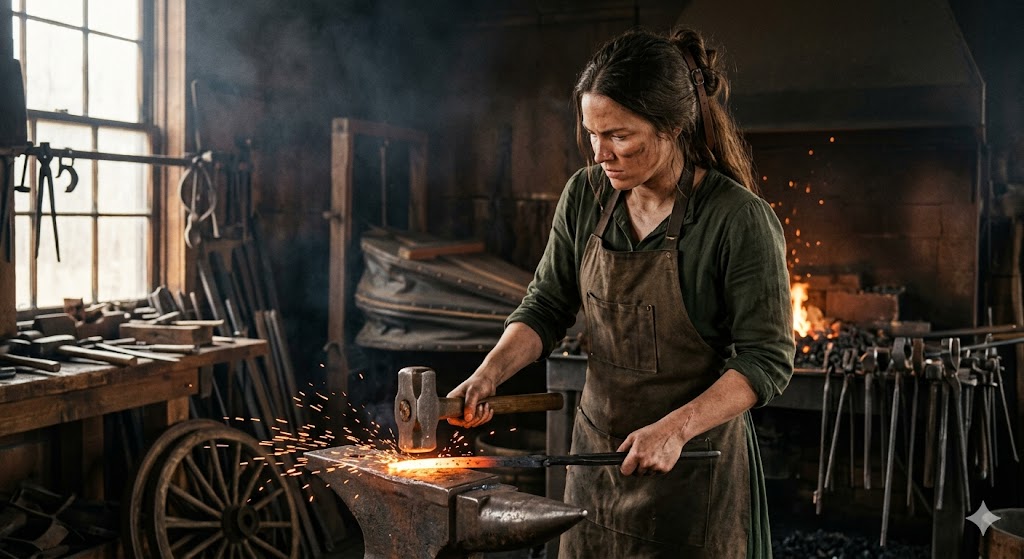
Her turning point arrived on a dusty road when a weathered blacksmith took pity on her traveler’s weariness. Recognizing a rare grit in her eyes, he gave her shelter and began to teach her his trade. Over the next few years, she learned the intense art of metalwork, becoming highly skilled with tools, heavy hammers, and the roaring heat of the fire.
When the old blacksmith eventually passed away, he left her his forge and all his tools—a life-changing inheritance. At around nineteen years old, she officially opened her own blacksmith shop.
At first, the townspeople doubted her, unable to believe a young woman could handle the grueling demands of the anvil. But her work quickly proved her skill. Iron didn’t care who swung the hammer, and her welds were flawless.
As her reputation grew, she became deeply respected in her town, known as the finest smith in the territory. She never returned to her old life or the man she was sold to. Her story became a legend of the frontier—a testament to escape, survival, and building an entirely new life through sheer strength.
Would you like to continue expanding this story into Part 2, exploring her first major challenge in the town, or would you like to generate a visual asset for this narrative?
The Outlaw Smith: Part 2
The heat radiating from the forge was the only constant in a world that had changed so rapidly. Now nineteen, she stood over the anvil, the steady clank-clank-clank of her hammer echoing out into the dusty street of her new home. Word of the town’s skilled new blacksmith had spread far beyond the county lines, bringing in plenty of work, but it also brought unwanted attention.
One afternoon, a shadow fell across the threshold of the shop. A tall, rough-looking man pushed his way inside, his eyes scanning the iron tools before landing on her with a sneer.
“I’m looking for the blacksmith,” the man barked, wiping trail dust from his jacket. “Not his apprentice.”
She didn’t stop swinging. She delivered one final, precise blow to the glowing orange horseshoe, quenched it in a barrel of water with a loud, aggressive hiss, and finally looked up. “You’re looking at her. What do you need fixed?”
The man laughed, a harsh, grating sound. “A girl fixing a wagon axle? I don’t think so. I’ll take my business down the road.”
“The next forge is thirty miles through bandit territory,” she replied calmly, setting her hammer down. “And your left axle is hairline-fractured. You won’t make it five.”
He hesitated, looking from her steady gaze down to the massive iron anvil. Reluctantly, he unhitched his wagon and left it in her yard, muttering curses under his breath about the changing times on the frontier.
She worked through the night. The fire cast long, dancing shadows against the wooden walls of the forge as she heated the heavy iron, poured her strength into the welds, and reinforced the steel until it was stronger than the day it was manufactured. This wasn’t just a job; every strike of the hammer was a declaration of the independence she had fought so hard to achieve since the night she escaped on a lone mule.
The next morning, the man returned, flanked by a few curious townspeople who expected to see a botched job. He inspected the axle thoroughly, looking for a flaw, a weak seam, or anything to justify his doubt.
Instead, he found perfection. The iron was flawlessly bound, smooth, and built to withstand the harshest mountain trails.
The man stared at the wagon, then looked at her hands—calloused, soot-stained, and steady. Without a word, he tossed a handful of silver coins onto her workbench, hitched his team, and drove away. The watching townspeople nodded in quiet approval. From that day forward, the whispers of doubt in the town completely vanished, replaced by a deep, unshakeable respect. She had forged her own place in the world, and she was never going back.
The Outlaw Smith: Part 3
The autumn winds of 1872 brought a bitter chill to the valley, but inside the forge, the heat remained as intense as ever. At twenty-four, she had spent five years building her business, and her shop was now the beating heart of the growing frontier town. Everyone knew her alias, respected her craft, and left her to her privacy.
But privacy on the frontier was a fragile thing.
Late one evening, as she was sweeping up iron filings by the dim light of a lantern, the bell above the door chimed. A man stepped inside, pulling off a heavy wool coat. He was a wealthy land speculator from three counties over, visiting the town to buy up local cattle ranches.
He approached the counter, tossing a broken silver pocket watch chain down to be soldered. “They told me you were the handiest person with a torch in these parts.”
She didn’t answer immediately. She froze, her breath catching in her throat.
Though five years had passed, and the man’s hair had gone gray at the temples, she would know that voice anywhere. It was her father. He was older, wealthier from years of shady land deals, and completely oblivious to the fact that the tall, strong woman standing behind the counter was the frightened fourteen-year-old girl he had sold away for a handful of cash.
She kept her face in the shadows, her heart hammering against her ribs like a runaway train. For a split second, the old terror threatened to paralyze her. She was transported back to that dimly lit room, feeling trapped and helpless.
Then, her hand brushed against the handle of her heavy blacksmith’s hammer resting on the bench. She felt the thick calluses on her palms, smelled the familiar scent of coal smoke, and remembered the miles she had traveled, the deer she had hunted, and the iron she had bent with her own two hands. The fear vanished, replaced by an icy, unshakeable calm.
“I can fix it,” she said, keeping her voice low and raspy, pitching it differently than the childhood voice he might remember. “Leave it. Come back tomorrow morning.”
The old man nodded carelessly, not even bothering to look her in the eye. To him, she was just another nameless laborer on the frontier. “Make sure it’s done right,” he muttered, turning on his heel and walking out into the cold night.
That night, she didn’t sleep. She sat by the dying embers of the forge, holding the small knife she had carried with her on the back of a mule all those years ago. Part of her wanted to pack up and run again, to change her name and disappear into the territories.
But as the first light of dawn began to peek through the cracks in the wooden walls, she looked around her shop. She looked at the heavy iron anvil left to her by the blacksmith, the glowing hearth she had built up herself, and the respect she had earned from every soul in the town.
No, she thought, her jaw tightening. I am not running anymore. I forged this life.
When her father returned the next morning, the sun was fully up. She stood tall in the center of the shop, the repaired silver chain resting on the counter directly between them.
He picked it up, inspecting the flawless weld with a satisfied grunt. He tossed a silver dollar onto the wood. “Good work, girl. You’ve got a steady hand.”
She looked him dead in the eye, letting the full weight of her gaze land on him. There was no fear in her expression—only the cold, hard strength of iron. “My work is always solid,” she replied evenly. “And I don’t belong to anyone.”
The old man frowned slightly, a brief flicker of confusion passing over his face as if a ghost had just crossed his mind. But the moment passed, and he pocketed his watch, turned around, and walked out of her shop for good.
She watched him go through the window until his carriage vanished down the dusty trail. The past had finally come looking for her, and it had found absolutely nothing it could hold onto. She was completely free.
The Outlaw Smith: Part 4
A week passed after her father’s departure, and the autumn chill gave way to the first heavy snow of the season. The valley was buried under a thick, quiet blanket of white, turning the town into a silent fortress. The bitter cold kept most folks indoors, but the forge remained a beacon of warmth, its chimney constantly sending thick plumes of grey smoke into the crisp winter sky.
With fewer travelers on the road, she finally had time to focus on her own projects. She spent her days crafting intricate, durable iron latches, heavy-duty hinges, and decorative double-bordered iron frames for the townspeople’s homes. Working with the fire was therapeutic; every strike of her hammer on the anvil seemed to solidify her victory over the past. She had faced her oldest ghost and hadn’t flinched.
Late one evening, during a raging blizzard, a frantic knocking battered her front door.
She caught her breath, instinctively reaching for the pistol she kept hidden beneath the workbench. On the frontier, a late-night visitor in a storm usually meant trouble. She cracked the door open, keeping her shoulder pressed against the heavy wood.
Standing on the porch was the town sheriff, his face pale and his coat covered in a thick layer of frost.
“I need your help,” the sheriff gasped, his breath misting heavily in the freezing air. “The stagecoach carrying the valley’s winter medical supplies and mail crashed into the ravine three miles out. The main iron coupling on the rescue sled just snapped clean in two. If we can’t weld it back together tonight, those supplies will freeze, and the folks up at the mountain outpost won’t survive the week.”
She didn’t hesitate. She pulled the door wide open. “Bring it inside.”
The sheriff and two deputies dragged the massive, broken iron coupling into the heat of the forge. The break was clean, but the iron was thick and old, requiring an immense amount of heat and precise handling to mend properly.
“Can you fix it?” the sheriff asked anxiously, rubbing his frozen hands together by the hearth. “Most men wouldn’t even try in this weather.”
“I’m not most men,” she said plainly, tying her leather apron tight. “And the iron doesn’t care about the weather.”
She threw fresh coal onto the hearth, pumping the bellows until the fire roared with a fierce, brilliant intensity. She plunged the broken pieces into the heart of the flames, waiting for the metal to reach the perfect glowing shade of yellow-orange.
For the next two hours, the sheriff and his deputies watched in absolute awe. She worked with the strength and precision of a master artisan. Her swings were rhythmic and powerful, bending the stubborn metal to her absolute will. Sparks flew like fireworks into the dark corners of the shop, reflecting in her determined eyes. She fused the seams, reinforced the core with a fresh steel plate, and quenched the finished piece in the water barrel with a triumphant, echoing roar of steam.
The sheriff stepped forward, inspecting the repaired coupling. It was twice as thick as before, flawlessly smooth, and entirely unbreakable.
“Darn if you aren’t the finest smith this territory has ever seen,” the sheriff said, shaking his head in disbelief. “You just saved a lot of lives tonight, ma’am.”
“Just doing my job, Sheriff,” she replied, wiping the sweat and soot from her forehead with the back of her sleeve.
They loaded the heavy piece back onto their sled and disappeared into the blinding snowstorm. As the door closed, she stood alone in the quiet warmth of her shop. She looked at her calloused hands, then out the window at the town that now relied on her for its very survival.
She had started her journey as a runaway child with nothing but a mule and a small knife, fleeing a life where she was treated as property. But tonight, she wasn’t an outlaw, a runaway, or a victim. She was the anchor of the community, an independent woman who had forged her own destiny out of fire and steel. And as she finally put out the hearth for the night, she knew that no matter what the future held, she was exactly where she belonged.
The Outlaw Smith: Part 5
The winter eventually broke, giving way to a brilliant, muddy frontier spring. The mountain passes cleared, and the town celebrated its survival with a renewed sense of energy. The story of the blacksmith who worked through a raging blizzard to save the town’s medical supplies had traveled far down the territory lines. Now, travelers didn’t just stop at her shop out of necessity—they stopped just to see the legendary woman smith of the valley.
With her business thriving, she decided it was time to expand. She took on a young apprentice, a quiet fourteen-year-old orphan boy from the edge of town who reminded her entirely too much of herself at that age.
On his first day, the boy stood nervously by the roaring hearth, staring at the heavy tools with a mixture of awe and fear. “Ma’am,” he whispered, looking down at his scrawny arms. “I don’t know if I’m strong enough to bend the iron.”
She walked over, picking up a medium-sized rounding hammer and placing it gently into his hands. She adjusted his grip, ensuring his fingers were firm but relaxed.
“Iron doesn’t care about your size, kid,” she said, her voice warm but steady. “It doesn’t care where you came from, who your family was, or what your name used to be. It only cares about the heat of the fire and the focus of your strike. You don’t need brute force to shape your world. You just need grit.”
The boy looked up at her, the fear in his eyes completely vanishing, replaced by a sudden spark of determination. He nodded, picked up a piece of scrap metal, and placed it into the coals.
Ten years later, the dusty border town had grown into a bustling frontier city, complete with a railroad station, brick buildings, and a sprawling marketplace. But sitting proudly on the main thoroughfare was the original wooden forge, now expanded with a large sign over the door that read: The Valley Foundry.
At twenty-nine, she had officially handed the daily hammer and heavy lifting over to her apprentice, who had grown into a brilliant, deeply respected master smith in his own right. She now spent her days managing the business, designing complex architectural ironwork for the city’s new buildings, and mentoring other young women who arrived in the territory looking for a fresh start.
One quiet evening, after the fires had been put out and the shop was still, she sat at her wooden desk by the window. She pulled open a small, locked drawer and reached into the back, pulling out a worn leather pouch.
Inside was the small, rusted knife she had used to cut her ties to her old life, and the heavy brass key to the forge that the old blacksmith had left her so many years ago.
She held them in her hands, feeling the cold metal against her calloused palms. She looked out the window at the city lights, listening to the distant, peaceful murmur of a community she had helped build, protect, and sustain.
She had started her journey running away on a lone mule in the dead of night, a child sold into a life of captivity. But she had run toward the fire, learned to master the flame, and forged a life of absolute freedom, strength, and purpose. She closed the drawer, locked it tight, and walked out into the warm spring night, completely victorious, completely independent, and finally home.
The Outlaw Smith: Part 6
By the summer of 1887, the frontier was completely transformed. The territory had officially been granted statehood, and the once-wild valley was now connected to the rest of the country by twin ribbons of steel. Locomotives roared through the pass daily, their whistles echoing against the mountains.
Now thirty-four, she stood on the platform of the bustling train station, watching passengers disembark. She wore a tailored linen travel suit, her long hair pinned up neatly, though a faint, permanent silver scar from an old forge spark still marked the back of her left hand—a badge of honor she wore proudly.
She wasn’t there to catch a train. She was there to inspect the grand iron archway she had designed for the station’s entrance. It was a massive, elegant structure featuring high-contrast geometric lines and double-border iron frames that perfectly captured the strength and modernity of the new era.
“It’s a masterpiece,” a voice said from behind her.
She turned to see her former apprentice, now a broad-shouldered man of twenty-nine, standing with his own young daughter. He looked up at the archway with deep respect. “The city council is calling it the gateway to the valley.”
“Iron always tells the truth,” she smiled softly, patting his shoulder. “If you put honest work into it, it stands the test of time.”
Later that evening, a special banquet was held at the town’s new grand hotel to honor the pioneers who had built the community from the ground up. The dining room was spectacular, filled with soft warm cream table linens, polished brass chandeliers, and the town’s most prominent citizens.
When she walked into the room, the entire assembly stood up, filling the hall with a resounding ovation. The governor himself stepped forward to hand her a beautifully engraved silver medal of civic merit.
As she accepted the award, she looked across the crowded room. In the reflection of the large glass windows, she didn’t see a victim of the past. She saw a woman who had completely rewritten her own narrative. The frightened fourteen-year-old girl who had fled into the dark night on a lone mule was now an indelible part of history.
She raised her glass to the crowd, her voice carrying a deep, unshakeable confidence. “To the frontier,” she said evenly. “And to everyone who has the courage to shape their own destiny.”
Late that night, long after the music had faded and the guests had gone home, she walked back to the old wooden forge by herself. The city had built up around it, but she had refused to let them tear it down. It remained exactly as it was—the anvil resting firmly in the center, the hearth quiet but ready.
She walked inside, the familiar scent of coal smoke and cured leather greeting her like an old friend. She didn’t turn on the modern electric lamps that had recently been installed down the street; instead, she lit a single, simple candle.
She walked over to the anvil, running her fingers across its scarred, hardened surface. This piece of iron had sustained her, protected her, and given her a voice when she had none.
She pulled her old leather journal from her bag and opened it to the very last page. Using a fountain pen, she wrote a final, permanent entry in bold, clear lettering to close the chapter on her journey:
They can sell your time, they can trade your youth, and they can try to build a cage around your life. But as long as you have a spark of fire in your spirit and the grit to hold the hammer, you can break any chain they forge against you. I am no one’s property. I am completely my own.
She closed the book, blew out the candle, and stepped out into the cool, star-lit night. The wilderness had tried to break her, the past had tried to reclaim her, but she had conquered them both. She locked the heavy timber door of the foundry behind her, turned toward the bright lights of the city she had helped build, and walked into her future—completely free, completely independent, and forever unbroken.
The Outlaw Smith: The Grand Finale
Thirty years after the fateful night she fled into the dark on a lone mule, the valley had fully transformed from a wild frontier into a booming, modern state. Yet, nestled quietly among the new brick buildings and bustling streets sat the original wooden forge—now a historic landmark known across the territory as The Valley Foundry.
On a warm summer evening, the community gathered outside the foundry to honor its founder. A beautiful bronze plaque was unveiled near the entrance, mounted onto a stone wall. The design was elegant, framed with the double-borders she had popularized in her architectural ironwork, honoring the woman who had helped build the very foundations of the town.
She stood before the crowd, now in her mid-forties, looking out at the faces of the people who respected her not just as a master artisan, but as a pillar of strength. Beside her stood her former apprentice, now a master smith himself, holding his young daughter’s hand.
“You gave this town its strength,” the mayor announced to the crowd, presenting her with a commemorative golden anvil charm. “When the frontier was harsh, your fire kept us moving forward.”
The crowd erupted into applause, but she simply smiled, her eyes drifting to the glowing hearth inside the open doors of the shop.
When the celebration ended and the streets grew quiet under the starlight, she stepped inside the forge alone. She didn’t light the modern lamps; instead, she let the soft, natural moonlight illuminate the room.
She walked over to her old wooden desk, opened the bottom drawer, and took out the worn leather pouch containing her small survival knife and the original key to the shop. She placed them on the anvil one last time, looking at how far a fourteen-year-old girl with no say in her life had truly come.
She had survived the wilderness, conquered doubt, faced her past without flenching, and built a legacy that would outlast the frontier itself.
Taking a piece of chalk, she wrote one final message on the dark slate board above her workbench, a permanent reminder for every traveler, runaway, or dreamer who might ever walk through her doors:
The fire will test you, the hammer will tire you, but the iron you shape with your own two hands will free you.
She picked up her coat, stepped out onto the porch, and locked the heavy timber doors behind her. Looking up at the vast, open night sky, she breathed in the fresh mountain air. The chains of her past were entirely broken, melted away by decades of hard work and unyielding grit. She walked down the quiet street into the bright future she had proudly forged for herself—completely independent, deeply respected, and forever free.