
IF YOU CAME FROM FACEBOOK, HERE’S THE NEXT PART OF THE STORY, ENJOY !!
The bruise was hidden under layers of Nathan’s expensive makeup. My lip had been carefully painted. I wore the ivory silk dress Margaret had once said made me look “almost appropriate for the family.” My hair was pinned smoothly. Diamond studs. No necklace. Margaret disliked women who drew attention to their throats.
At noon exactly, Margaret Ellington entered my house without ringing the bell.
She used the spare key Nathan had given her after I specifically refused. The lock turned, the grand front door opened, and there she was, wrapped in pale cashmere, South Sea pearls glowing at her throat, silver hair swept into a faultless chignon. She looked less like a guest than a victor arriving to inspect conquered territory.
Nathan met her in the foyer and kissed both cheeks.
“Mother.”
“My darling.”
Then Margaret turned her cold blue eyes to me.
Her gaze traveled down my dress, paused on my waist, my hands, my face. She lingered on my left cheek, where the makeup concealed what her son had done.
“Well,” she said, her voice like silk wrapped around a blade. “You look remarkably tired, Amelia. Are you sleeping enough?”
Nathan’s mouth twitched with the smallest flash of anxiety before he smoothed it away.
I smiled. “I’m perfectly fine, Margaret. Please, lunch is ready.”
She did not take the guest chair.
She glided into the formal dining room and seated herself in the carved armchair at the head of the table.
My chair.
I said nothing.
I poured her wine exactly to the line she preferred.
“Nathan tells me you have come to your senses regarding the living arrangements,” Margaret said, lifting the glass. “I told him you simply needed a night to reflect.”
I placed the serving platter before her. “Did he say that?”
“He said you became terribly emotional after dinner last night.” She offered me a pitying smile. “Young wives often do. Hormones and insecurity make such a volatile mix. But a successful marriage requires discipline, Amelia. It requires understanding your place in the hierarchy.”
Nathan leaned back to my right, smug and relaxed. He believed the bruise was hidden. He believed the floors beneath his feet belonged to him. He believed the quiet woman serving his mother chicken had been broken by a single strike.
“You’ll clear out the east guest wing by tomorrow afternoon,” Margaret continued, cutting into her chicken with surgical precision. “My movers will bring my essentials this weekend. We will also discuss replacing the domestic staff. Maria is far too familiar with you, and familiarity breeds disobedience.”
I picked up my fork.
“Of course, Margaret. Whatever you think is best.”
Nathan looked pleased. He reached over and patted my hand, making my skin crawl.
“See, Mother? Was that so hard? Amelia just needed time to process the transition.”
“No,” I said softly, looking directly into his eyes. “Not hard at all.”
For half a second, my calm unsettled him. His brow furrowed. He searched my face for sarcasm, defiance, something he could punish.
Then Margaret laughed, dry and triumphant, and his doubt vanished.
That was always Nathan’s fatal weakness.
He needed applause.
As long as his mother validated him, the rest of the world disappeared.
For the next forty-five minutes, they ate my food and planned the rest of my life in front of me.
Margaret announced she would handle the household accounts because “young wives are notoriously sentimental with money.” Nathan would review my personal spending each month, just until I learned “responsible rhythm.” I would resign from what Margaret called my “little consulting hobby,” because a wife in an established family should not “chase clients like a shopkeeper.” My charity work would be folded under the Ellington Family Legacy Trust, where Margaret could “lend sophistication.” Once I finally produced children, Margaret would step in to raise them properly and spare them from my “chaotic modern influence.”
I smiled.
I nodded.
I ate my potatoes.
Every word was being captured by the high-fidelity voice-activated microphone hidden beneath the antique sideboard behind Nathan’s chair. Every threat. Every insult. Every plan to isolate me, restrict me, control my movement, limit my money, invade my foundation, remove my staff, and reduce my life to an ornament on Margaret Ellington’s mantel.
Then, as the plates were being cleared, Margaret grew careless.
“I told you she would fold immediately,” she said to Nathan, leaning back as if I were invisible. “Women from her background always do. Pretty little nobodies with no real family power. They crave the stability we provide.”
Nathan chuckled and wiped his mouth with a linen napkin.
“She had some savings when we married, sure, but nothing meaningful. Certainly nothing that could sustain this lifestyle.”
My hand paused on the wine bottle.
I looked at him and let the mask slip just a fraction.
“Is that what you truly believe, Nathan?”
He waved his fork dismissively, face flushing with irritation.
“Don’t start, Amelia. We’re having a pleasant afternoon. Don’t ruin it with financial paranoia.”
Margaret’s eyes narrowed. She sensed the shift in the room before Nathan did.
“What exactly does that mean?”
I dabbed my mouth with my napkin and folded it neatly beside my plate.
“Nothing at all,” I said. “Just curiosity.”
But Nathan saw something then.
A flicker of amusement behind my compliant smile.
Something dark.
Something waiting.
He shifted in his chair.
Good.
Let him wonder.
Let fear take root.
Because the truth was so large, so heavy, so completely beyond the narrow architecture of their imagination, that when it finally fell, it would crush the entire Ellington myth beneath it.
The truth was simple.
I had never needed Nathan’s money.
I had never needed his name.
I had never needed his mother’s approval, his family’s connections, his country club invitations, or his ridiculous belief that I had married upward.
Before our engagement, before I played the role of the quiet supportive fiancée at Ellington events, before Margaret decided I was a socially useful but ultimately manageable woman, I had spent ten years building a specialized cybersecurity firm under my mother’s maiden name.
IronGate Systems.
I did not put my face on magazine covers. I did not attend tech conferences where men in sneakers spoke about disruption while their assistants handled payroll. I did not announce myself on social media as a founder, visionary, or public genius. I built quietly, hired brilliantly, protected fiercely, and solved problems no one wanted to admit existed. IronGate protected data for multinational banks, defense contractors, sovereign wealth funds, and government-adjacent agencies that paid very well for silence.
Three years earlier, I sold IronGate through a sequence of private transactions so discreet that even the business press never fully understood what had happened. The assets moved through blind trusts, holding companies, and private foundations. I sold it for enough money to buy the Ellington Estate, Nathan’s venture division, his mother’s townhouse, and the social circle Margaret worshiped three times over in cash.
The deed to this house?
Mine.
Held by a trust that named me as sole beneficiary.
The investment accounts Nathan liked to discuss as if they were his domain?
Mine.
The charitable foundation that gave him philanthropic standing at galas?
Mine.
And the most elegant secret of all: the largest silent investor in Nathan’s venture capital firm, the fund he mocked at cocktail parties as “some faceless institutional outfit run by cautious idiots,” was also mine.
I was the architecture beneath his reality.
And six weeks earlier, when Margaret began pressing Nathan to force me out of the financial loop, when her insults sharpened into strategy and Nathan’s condescension became control, I had not cried.
I had done what I did best.
I started tracking.
Documenting.
Archiving.
I had copies of forged checks used to siphon money from joint convenience accounts. I had Nathan’s hidden gambling debts disguised as private investment losses. I had gigabytes of encrypted messages between mother and son discussing how to “discipline” me, isolate me from Maria, reduce my access to transportation, replace my advisors, and eventually present me as mentally unstable so they could seize control of my assets.
They thought they had married into weakness.
They thought I was a fragile bird they could cage.
They had no idea they had walked into a vault and started kicking the walls.
After lunch, the dining room became suffocating. I gathered dessert plates and retreated to the kitchen. Running water gave me a cover of sound, but the hairs on the back of my neck rose before I heard her footsteps.
Margaret followed me in.
The swinging door clicked shut behind her.
She stood by the marble island while I scraped plates, her perfume heavy and powdery in the air. The polite mother-in-law mask was gone. All that remained was ambition sharpened by age and entitlement.
“Listen carefully, you insignificant little girl,” she said in a low voice. “My son is generous, but he is not patient. You pushed him too far last night. You will learn obedience in this house, or you will lose everything. Do you understand?”
I picked up a sponge and ran it slowly under warm water.
“Everything?” I asked, keeping my back to her.
“The house. The accounts. The lifestyle.” Margaret stepped closer. “And your reputation. I have friends on every charity board in this city. A woman with no real family backing can be ruined with the right story. A whisper about instability. A rumor about infidelity. A concern about medication or emotional volatility. By Christmas, you would be a pariah.”
I turned off the faucet.
The silence after running water always feels larger than silence that was already there.
I dried my hands carefully on a linen towel. Then, for the first time all day, I turned and looked directly into Margaret’s cold eyes. I let the frightened-wife mask fall. I let her see what had been standing in front of her the whole time.
“Margaret,” I said softly, my voice cold as deep water, “so can a family.”
Her smile vanished.
“What did you say to me?”
Before she could gather her outrage, the front doorbell rang.
From the dining room, Nathan called out, irritated. “Amelia! Who the hell is that? We aren’t expecting anyone.”
I tossed the towel onto the counter.
Margaret stared at me as confusion slowly curdled into instinctive dread.
“That,” I said, walking past her toward the foyer, “should be my lawyer. And she hates being kept waiting.”
Nathan opened the front door with an annoyed huff, expecting a delivery driver, a landscaper, or some minor inconvenience staff should have handled before it reached him.
Instead, four people stood on the stone porch.
At the front was Vivian Walker, my lead attorney, sharp and composed in a charcoal suit, her silver hair cut to her chin and her expression calm in a way that made powerful men nervous. Beside her stood Daniel Cho, forensic financial investigator, carrying a thick leather briefcase. Behind them waited two uniformed police officers, faces unreadable.
Nathan’s color drained.
“What is this?” he snapped, trying to sound authoritative and landing somewhere near panic. “Can I help you?”
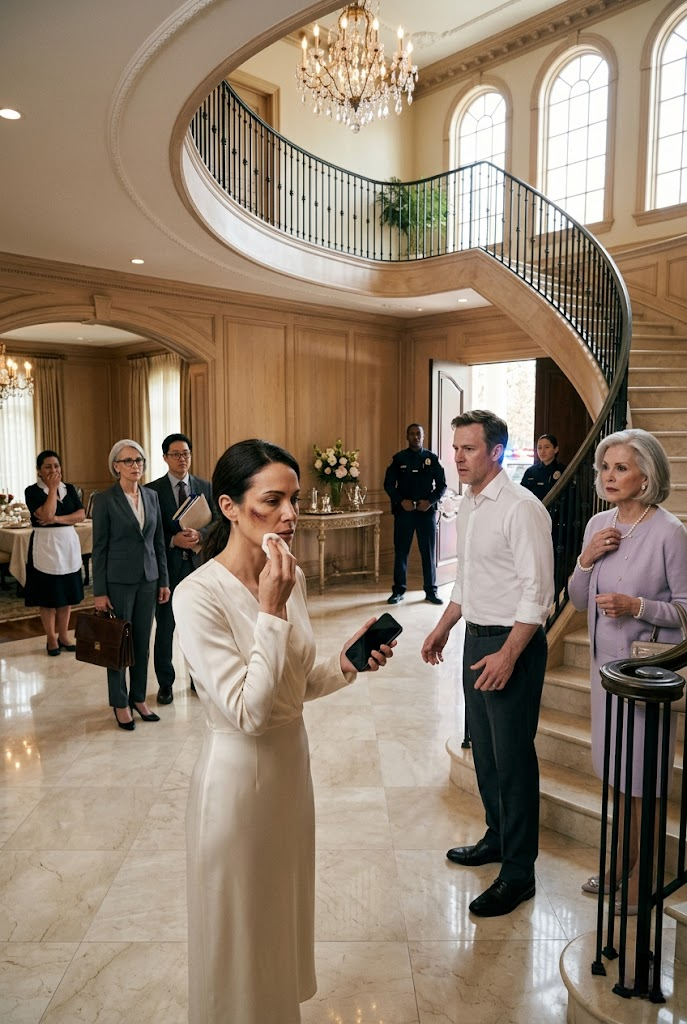
I stepped into the grand foyer, my heels clicking against Italian marble like a ticking clock.
“They are my lunch guests, Nathan,” I said smoothly.
Margaret appeared behind him, pearls clacking softly as she hurried forward.
“Nathan, do not let these people in without a warrant.”
Ms. Walker stepped over the threshold without waiting.
“Mrs. Amelia Hope is the sole legal owner of this property,” she said, lifting a folder. “She has invited us inside. Good afternoon, Mr. Ellington.”
Nathan turned to me, eyes wide. “Amelia, what the hell did you do? Who are these people?”
I did not answer with words.
I reached into the pocket of my ivory dress and pulled out the black phone.
I tapped the screen once.
The kitchen recording began to play.
Margaret’s voice filled the foyer, sharp and venomous.
“You will learn obedience in this house, or you will lose everything. Do you understand?”
Margaret went rigid.
I tapped another file.
The bedroom recording echoed under the high ceiling.
The sound of a slap.
My gasp.
Then Nathan’s voice, low and cruel.
“My mother asked for one simple thing… This is my home, Amelia. My name. My wealth.”
Nathan lunged toward me.
The taller officer stepped between us instantly, one hand resting on his belt.
“Sir,” he said. “Step back. Now.”
Nathan froze, breathing hard.
Ms. Walker opened her folder.
“Nathan Ellington, you are being formally served with immediate divorce papers, an emergency protective order petition, a binding notice of full asset separation, and a civil complaint regarding financial coercion, wire fraud, and attempted misappropriation of trust funds.”
Margaret’s face turned the color of bone beneath powder.
“This is absurd,” Nathan stammered, forcing out a laugh that convinced no one. “She’s my wife. She’s hysterical. This is some performance. Look at her. She’s fine.”
I held his gaze.
Then I reached into my other pocket and removed a clean white makeup wipe.
Slowly, deliberately, under the chandelier and in front of everyone, I pressed it to my cheek and dragged it downward.
The layers of concealer and foundation came away.
The bruise emerged beneath them: deep purple, black, and yellow, stretching from my cheekbone toward my eye.
Nathan stopped laughing.
The sound died in his throat.
The officer’s expression hardened.
“I went to a private clinic at six-thirty this morning,” I said. “High-resolution photographs. Full medical report. Time-stamped. Notarized. The doctor has already filed the required domestic violence documentation.”
Margaret grabbed Nathan’s arm.
“Say nothing,” she snapped. “Not another word without counsel.”
But Nathan was panicking now. Drowning. Thrashing.
“She provoked me!” he shouted, pointing at me. “She manipulated this. She set me up.”
The officer sighed.
“Sir, turn around and place your hands behind your back. You need to come with us for processing regarding the domestic assault complaint.”
“No.” Nathan stumbled back over the edge of the rug. “No, you can’t do this. This is my house.”
I stepped closer, forcing him to look at the bruise he had given me.
“This house was purchased through my blind trust two years before our marriage,” I said slowly. “You never signed a deed, Nathan. You signed a temporary occupancy agreement. You signed it blindly because you called reading legal paperwork ‘women’s paranoia.’ You are trespassing.”
His eyes darted to his mother.
The man who had struck me disappeared.
In his place stood a terrified boy waiting for rescue.
Margaret whispered, trembling with rage, “Fix this, Nathan. Fix it now.”
I almost pitied him.
Almost.
Then Daniel Cho dropped his leather folder onto the console table with a heavy thud.
“We are not finished,” Ms. Walker said, turning toward Margaret. She removed another envelope from her briefcase and held it out. “Margaret Ellington, you are named as a co-conspirator in the civil complaint. We have subpoenaed and preserved copies of encrypted communications in which you advised Mr. Ellington to isolate, manipulate, and financially cripple my client.”
Margaret jerked her hand back as if the envelope burned.
“Those were private communications,” she snapped. “This is illegal.”
“So was the pain your son inflicted on me,” I said. “You did not respect the privacy of my marriage, Margaret. You broke the lock. I simply walked through the open door.”
Daniel Cho tapped the folder.
“Additionally, during our audit this morning, we traced multiple unauthorized wire transfers from the Amelia Grace Foundation’s operating accounts. The funds were routed through shell companies connected to offshore accounts controlled by Mrs. Margaret Ellington.”
The foyer fell silent.
Not quiet.
Silent.
Nathan slowly turned his head toward Daniel Cho, then toward his mother.
For the first time in his protected life, Nathan Ellington looked genuinely betrayed.
“Mother?” he whispered. “The charity funds? You stole from the charity? You told me you were securing investments for the family portfolio.”
Margaret’s face hardened into pure self-preservation.
She did not look at her son.
She looked at me.
“I did what was necessary for this family’s survival. Someone had to protect our legacy from this outsider.”
“No,” I said. “You did what common thieves do. You reached for something valuable that never belonged to you, and you burned your own house down trying to steal it.”
The unraveling was swift.
The police escorted Nathan out while he shouted my name, first in rage, then in pleading, then in something that almost sounded like love if one had never heard the real thing.
I had.
I knew the difference.
Margaret remained in the foyer as red and blue lights painted the walls of the estate she had wanted so badly. She was shaking now, not from fear, but from poisonous rage.
“You will regret this,” she hissed. “You will regret humiliating us. We have friends. We have influence. We will destroy you in court.”
I opened the front door wider and gestured toward the driveway.
“No, Margaret,” I said. “I regretted marrying him. I regretted letting you sit at my table. This is simply the correction.”
For a long fractured moment, she stared at me and realized the truth.
I held every card.
I owned the board.
She had nothing but pearls, rage, and the remains of a story no one would believe once the recordings reached the right ears.
She walked out carrying only her handbag.
After she was gone, the house became impossibly quiet.
Ms. Walker stood beside me while Daniel Cho organized documents on the console table. One officer remained to take my statement. Maria had appeared silently near the back hallway, one hand pressed to her mouth, tears in her eyes. I looked at the dining room, at the half-empty wine bottle, the folded napkins, the chair Margaret had claimed as mine.
Then my knees nearly gave.
Ms. Walker caught my elbow.
“Breathe,” she said softly.
“I am.”
“No, Amelia. Actually breathe.”
So I did.
The first breath hurt. The second shook. The third brought tears so sudden I almost hated them.
Maria crossed the foyer and wrapped me in her arms with the kind of tenderness I had forgotten adults could offer without wanting anything in return. She did not say, “I told you.” She did not say, “I knew.” She simply held me while the house around us changed ownership in a way paperwork had already known but my heart had not yet felt.
That night, I did not sleep in the master bedroom.
I slept in the sunroom beneath a cashmere throw while Maria stayed in the guest room and Ms. Walker’s security team stationed someone outside the estate gate. I woke twice from dreams of Nathan stepping over me. Each time, I touched my cheek, felt the bruise, and then touched the black phone on the side table.
Proof.
The word steadied me.
Not because proof erased pain.
Because proof returned reality to its rightful owner.
The legal storm began before sunrise.
Nathan’s attorneys called Ms. Walker at 6:12 a.m. By 6:30, they had pivoted from outrage to negotiation. By 7:05, they requested a private settlement conference. By 8:00, a friend of Margaret’s on a philanthropic board called me directly and suggested “discretion for the sake of all involved.”
I let it go to voicemail.
By noon, Nathan’s arrest had become a rumor in three country clubs, two venture funds, and one private school admissions committee where Margaret had been cultivating influence for a grandchild who did not exist. By evening, the rumor had acquired details, some false, some worse than the truth, all of them proof that Margaret’s beloved society cared less about morality than proximity to scandal.
I did not release the recordings publicly.
Not then.
I did not need revenge.
I needed control.
Ms. Walker moved with surgical precision. Temporary protective order. Asset freezes. Emergency injunction preventing Nathan or Margaret from accessing any trust-controlled accounts. Formal notification to the Amelia Grace Foundation board. A forensic audit of every vendor and outgoing transfer from the previous eighteen months. Notices to Nathan’s venture firm, including documentation that my holding company was their largest silent investor and that continued association with Nathan represented a material risk.
The firm acted faster than affection ever had.
Money has a way of clarifying moral courage.
By Friday, Nathan had been removed from the board pending investigation. By Monday, he was terminated. The official statement cited “conduct inconsistent with fiduciary and ethical obligations.” Cold language. Clean language. Language written by people who wanted no fingerprints on the fall.
Margaret tried to fight.
Of course she did.
She claimed she had been framed. She claimed I was unstable. She claimed Nathan had acted in self-defense. She claimed the foundation transfers were investment reallocations. She claimed I had seduced her son for his name, entrapped him financially, and turned against him when he refused to abandon his mother.
Then Ms. Walker produced the messages.
Margaret to Nathan: She needs to learn consequences before she begins thinking of herself as equal.
Nathan to Margaret: She’s stubborn but soft. I can break the stubborn part.
Margaret: Do not apologize afterward. Women interpret apology as power.
Nathan: She has no one.
Margaret: Exactly. That is why she was chosen.
That was the message that ended him.
Not legally. Not even financially.
Spiritually.
When Nathan saw it during deposition, his face changed. Not because he realized what he had done to me. Because he realized what his mother had done to him.
She had not loved him as a son.
She had sharpened him as a tool.
His attorney requested a break.
Ms. Walker refused.
Nathan stared down at the paper, his hands trembling.
“She said that?” he whispered.
I watched him from across the conference table and felt something dangerously close to pity rise in me. Then I remembered the floor. The blood. The way he slept.
“Yes,” I said. “She did.”
His eyes lifted to mine.
“I didn’t know she wrote that.”
“But you knew what you did after reading everything else she wrote.”
He looked away.
That was the closest he came to shame.
Criminal proceedings moved slower, but they moved. The assault charge remained. The financial fraud investigation widened. The forged foundation authorization linked to Margaret’s shell accounts gave prosecutors more interest than anyone expected. The Amelia Grace Foundation supported children’s trauma recovery programs, family shelters, and legal aid for women escaping abuse. Stealing from it was not only criminal. It was narratively disastrous.
Margaret had stolen from wounded children to preserve the illusion of legacy.
There was no elegant way to defend that.
Three months after Nathan’s arrest, I walked into the foundation’s downtown office for the first time since the assault. The staff already knew. Not all details, but enough. They did not stare at my healed cheek. They did not ask for a speech. They had placed flowers on my desk, white lilies and red roses from our shelter partners, with a card that said only:
We are here.
I sat in my office and cried for ten minutes.
Then I got to work.
Work saved me, but not in the way people like Margaret understood work. It did not distract me from pain. It gave pain a place to become useful. I expanded the foundation’s emergency legal fund. We funded secure transportation grants for women leaving violent homes. We added financial abuse screening to our partner shelters. We created a program that taught women how to identify coercive control through money, documents, passwords, and property access.
The first training session was held in a community center basement that smelled faintly of coffee and floor wax. Twenty-seven women attended. Some took notes. Some cried. Some sat with arms crossed, not ready to believe their lives fit the words on the projector.
I stood at the front with no makeup on my cheek.
The bruise had faded by then, but I knew where it had been.
“My name is Amelia Hope,” I began. “And I want to talk about the kind of abuse that arrives with paperwork.”
No one moved.
Good.
Stillness meant the room was listening.
I told them about control disguised as concern. About shared accounts that are not truly shared. About passwords requested in the name of transparency. About family members who call isolation tradition and surveillance love. About the difference between generosity and surrender. About how someone can live in your house and still have no right to own your life.
Afterward, a woman named Tanya waited until everyone else left.
She wore a green cardigan with a missing button and held a folder against her chest.
“My husband says I don’t understand money,” she whispered.
I nodded.
“He has me sign things.”
My throat tightened.
“Do you read them first?”
She looked embarrassed.
“No.”
I did not shame her. Shame is what abusers use when they want their victims too humiliated to ask for help.
I gave her Ms. Walker’s card.
“Start now,” I said.
Six months later, Tanya sent me a photograph of a new apartment key in her hand.
I printed it and kept it in the foundation office.
Not all victories make headlines. Some fit in the palm of a woman’s hand.
Nathan pleaded guilty nine months after the day he handed me the velvet makeup pouch.
Aggravated domestic assault. Wire fraud connected to trust documentation. Cooperation on portions of the financial case involving Margaret. His attorneys negotiated hard. The Ellington name, damaged but not worthless, still bought some polished arguments. He received three years in a minimum-security facility, restitution obligations, mandatory counseling, and a permanent protective order prohibiting contact with me.
At sentencing, he read a statement.
It was well-written. His lawyers probably helped.
He spoke of regret, pressure, family expectations, untreated rage, the toxic influence of legacy, his mother’s control. He said he had failed as a husband. He said he accepted responsibility.
Then he looked at me.
“I loved you,” he said.
That was when I finally spoke.
I had not planned to. Ms. Walker had prepared a victim impact statement for me to read if I wanted. It sat folded in my lap, three pages of careful language. Harm. Trust. Safety. Consequences.
I stood and left it folded.
“Nathan,” I said, “love does not strike and sleep. Love does not hide bruises under foundation. Love does not call control protection or obedience peace. Whatever you felt for me, it was not love. It was ownership. And I will spend the rest of my life making sure women learn the difference before men like you teach it to them through pain.”
The courtroom was silent.
Nathan lowered his head.
I did not care whether it was shame or strategy.
Margaret fought longer.
She always would.
Her lawyers tried to separate her from Nathan’s actions, then from the foundation transfers, then from the shell companies, then from the messages. But greed leaves trails, and Margaret had been too arrogant to believe anyone would follow hers.
She sold the townhouse first to cover legal fees. Then the pearls. Then the cars. Then a vacation property in Maine she had once described as “too modest for hosting.” The country club suspended her membership quietly, then publicly pretended they had not. Her friends stopped inviting her to luncheons because scandal is contagious only when the person infected is no longer powerful enough to protect.
She eventually accepted a plea agreement in the financial case. Restitution. Probation. Community service. Public disgrace. Prison might have been cleaner, but the terms were strict enough to make her furious, and that brought me a small, ungenerous satisfaction I decided not to apologize for.
As for the estate, I kept it.
People expected me to sell.
Some advised it gently. Too many memories, they said. Too much pain. Too much history in the walls.
But the house had never belonged to Nathan. It had never belonged to Margaret. It had belonged to me from the beginning, and leaving it because they had tried to claim it felt like giving them one final room.
So I reclaimed it.
First, I changed every lock.
Then the security system.
Then the staff contracts.
Then the bedroom.
I had the heavy bed removed and donated the frame after stripping it of any sentimental meaning it had pretended to hold. I repainted the walls a warm sunrise color that made the room glow in the morning. I replaced the silk curtains with linen. I moved the bed to face the garden instead of the fireplace.
The bathroom mirror, the one that had reflected my bleeding mouth back at me, stayed.
But I added a small brass plaque beneath it.
You saw clearly.
Maria cried when she read it.
The east guest wing, the suite Margaret had planned to occupy like a queen claiming territory, became my foundation office. We knocked down walls and opened the rooms to sunlight. I turned her imagined bedroom into a legal resource library. The sitting room became a counseling space. The dressing area became storage for emergency phones, prepaid cards, lockboxes, and document kits for women who needed to leave quickly and safely.
On the first warm morning of spring, I sat barefoot in that new office wearing an oversized sweater and holding a mug of black coffee. Through the floor-to-ceiling windows, I watched wild red roses climb along the old stone fence.
My face had healed.
There was no shadow under my eye.
No ache in my jaw.
My name had changed back before the ink dried on the decree.
Amelia Hope.
Not Ellington.
Hope.
The name had always been mine, but after everything, it felt less like inheritance and more like instruction.
My phone buzzed on the glass desk.
Unknown number from a correctional facility.
Another scheduled call from Nathan.
Another attempt to apologize, explain, persuade, search for a crack in the life he no longer entered.
I did not answer.
I let it go to voicemail.
Then I deleted the voicemail without listening.
Healing did not happen because he was punished.
That was something I had to learn slowly.
Justice can create distance. It can create safety. It can create accountability, sometimes. But healing is quieter. Less dramatic. More stubborn. Healing was waking up without reaching instinctively for concealer. Healing was laughing in the kitchen with Maria while flour dusted the counters. Healing was walking through the dining room and sitting at the head of the table without feeling Margaret’s shadow in the chair. Healing was the first night I slept through without dreaming of the floor.
It was also anger.
Clean anger.
The kind that stops apologizing for existing.
For months, I carried anger like a lamp. It lit old rooms. Memories rearranged themselves beneath it. Nathan mocking my “little foundation.” Margaret commenting on my body at brunch. Nathan asking for access to accounts “for simplicity.” Margaret suggesting I see “a discreet doctor” about my mood when I objected to her controlling staff schedules. The way Nathan would touch the back of my neck at parties, lightly enough to look affectionate, firmly enough to steer.
The slap had not been the beginning.
It had been the moment the story stopped being subtle.
One year after the arrest, the Amelia Grace Foundation opened the Ellington Resource Center.
I had resisted the name at first.
Ms. Walker suggested it.
“Why give them the honor?” I asked.
She smiled thinly. “Not honor. Reclamation.”
The center’s full name was printed above the entrance in clean black letters:
The Ellington Resource Center for Financial Abuse Recovery
Funded by Amelia Hope and the Amelia Grace Foundation
Beneath it, in smaller letters:
No one owns the life you survive.
We opened without a gala.
No champagne. No society photographers. No string quartet. No speeches about legacy from men who used the word as camouflage.
Instead, the opening was attended by shelter partners, attorneys, counselors, survivors, social workers, and women who had once been told they were too weak, too emotional, too dependent, too unstable, too ungrateful, too difficult, too much.
Tanya cut the ribbon.
The woman with the green cardigan and the apartment key.
She wore a yellow dress that day and cried so hard someone had to help her with the scissors.
I stood beside her and cried too.
That evening, after everyone left, I walked alone through the center. The rooms smelled of new paint, paper, and coffee. In one office, volunteers had already stacked folders labeled Emergency Banking Checklist. In another, donated laptops waited for women who needed to rebuild digital access. A children’s corner held picture books, crayons, soft chairs, and a mural of a sunrise over open water.
I stopped in front of the wall near the entrance.
We had hung no portraits of donors.
No elegant photographs of wealthy people pretending generosity had made them beautiful.
Instead, there was a simple framed statement:
Abuse often begins as a story someone tells you about your place.
Recovery begins when you stop believing it.
I read it three times.
Then I went home to the estate, made tea, and slept deeply beneath linen curtains while rain moved softly against the windows.
Two years after the assault, Margaret sent a letter.
It arrived on cream stationery, naturally.
Her handwriting was still beautiful. Slanted. Elegant. Cruel even before the words began. I recognized it immediately and set the envelope on the dining table without opening it. For three days it sat there beside a bowl of lemons, gathering the kind of attention poisonous things demand.
Finally, I opened it.
Amelia,
I have been advised not to write, but there are things a woman of my generation understands that yours does not. I did what I believed necessary to preserve a family my son was too weak to protect. You may believe you won, but you destroyed something sacred. Nathan is diminished. I am humiliated. The Ellington name is dust. I hope, in your quieter moments, you understand the scale of what your pride has done.
There was no apology.
Of course there wasn’t.
I read it once.
Then I turned it over and wrote on the back:
Margaret,
The sacred thing you destroyed was your son’s soul. I only turned on the lights.
I did not mail it.
Some replies are for your own hand, not the other person’s eyes.
I burned the letter in the fireplace that night and watched the cream paper curl into black.
Five years later, I saw Nathan again.
Not because I wanted to.
Because he was released early and petitioned through counsel to modify the protective order so he could send what his attorney called “a letter of restorative accountability.”
Ms. Walker called me personally.
“No,” I said.
“I assumed.”
“Then why call?”
“Because you get to say it out loud.”
I stood in the east office, looking out at the roses.
“No.”
“Good,” she said.
A week later, I saw him from a distance outside the courthouse after the petition was denied. He looked thinner. Older. His hair had gone gray at the temples. He wore a plain suit that did not fit him as perfectly as his old ones had. For one strange second, I saw not the monster from the bedroom, but the boy Margaret had made—a boy raised to believe control was love and apology was weakness.
Then he turned, and our eyes met across the courthouse steps.
Something passed over his face.
Regret, maybe.
Need.
Fear.
It did not matter.
I got into Ms. Walker’s car and closed the door.
Some doors do not need to be reopened to prove you have healed.
Margaret died seven years after the incident, in a private assisted-living facility outside the city. I heard through a mutual acquaintance, not family. Nathan did not call. No one asked me to attend the funeral, perhaps because everyone finally understood the answer.
I did send flowers.
White roses.
No card.
Not forgiveness.
Not cruelty.
An ending.
By then, the foundation had become larger than anything I had imagined when I first created it. We had centers in five cities, legal partnerships in twelve states, and a digital security program that helped women protect their accounts, files, devices, and identities when leaving dangerous relationships. IronGate’s old engineers volunteered to build secure tools. Former prosecutors taught documentation workshops. Survivors became advocates. Advocates became directors.
The work was not glamorous.
Good.
Glamour had nearly killed me.
At one annual training, a young attorney asked why I still lived in the estate.
“Isn’t it hard,” she said carefully, “to stay where it happened?”
I thought about that.
Then I answered honestly.
“At first, yes. Then I realized the house had witnessed the truth before anyone else did. I stopped thinking of it as the place where he hurt me and started thinking of it as the place that kept the record.”
She wrote that down.
I hoped she would remember it.
On the tenth anniversary of the day Nathan handed me the makeup pouch, I hosted lunch in the same dining room.
Not a gala.
Not a performance.
Lunch.
Maria sat at the table as a guest, not staff. Ms. Walker came and complained that the chicken was too good for a weekday. Tanya came with her teenage daughter. Dr. Halpern came late from clinic, still in flats and a tired smile. We filled the table with roasted lemon chicken, potatoes, salads, bread, wine, laughter, and stories.
I sat at the head of the table.
No one took my chair.
At some point, Maria raised her glass.
“To the woman who smiled at monsters and invited the lawyers to lunch.”
Everyone laughed.
I did too.
Then I looked around the room at the women who had helped me reclaim my life, and I thought about the younger version of myself sitting on the bathroom floor, blood in her mouth, phone in her hand, realizing that proof had finally arrived in the shape of pain.
I wished I could tell her something.
Not that everything would be easy.
It would not.
Not that justice would fix everything.
It would not.
Not that she would never be afraid again.
She would.
I would tell her this:
You are not the bruise.
You are the evidence.
You are not the silence.
You are the witness.
You are not the house they tried to claim.
You are the key.
That evening, after everyone left, I walked through the estate alone. Sunlight slid across the marble foyer. The dining room smelled faintly of wine and rosemary. In the kitchen, the sink was full of dishes because Maria had refused to work and I had refused to let her. The house was messy, warm, alive.
I climbed the stairs to the master bedroom.
For a long time after the assault, I avoided standing in the exact place where Nathan had struck me. Later, I stood there deliberately. Now I crossed it without thinking, then paused only because I realized I no longer measured the room by violence.
The rug had been replaced.
The bed had been replaced.
The woman had not.
She had been revealed.
In the bathroom, the mirror reflected my face back to me. Older now. Stronger in ways that did not show. No bruise. No split lip. No foundation hiding what someone else had done. Just my face, bare and lit by evening.
Beneath the mirror, the small brass plaque still read:
You saw clearly.
I touched the words once.
Then I went downstairs, opened the front door, and stepped outside.
The roses along the stone fence had climbed higher than ever. Red, wild, impossible to discipline. The air smelled of rain, green leaves, and summer beginning again.
My phone buzzed.
A message from the foundation director.
Another woman had used our emergency documentation guide to secure a protective order that afternoon. Another account frozen before funds could be stolen. Another child safely relocated with his mother. Another life interrupted before it could be erased.
I read the message once and pressed the phone against my chest.
Some women are taught to cover bruises with expensive makeup.
Some women are taught to cover crimes with lies, signatures, silence, and obedience.
For a while, I had covered both.
But only long enough to survive.
Only long enough to gather proof.
Only long enough to turn the lock from the inside.
Nathan had believed one slap would teach me my place.
Margaret had believed one lunch would make me surrender my home.
They were both wrong.
The slap did not teach me obedience.
It taught me timing.
The lunch did not mark the beginning of their rule.
It marked the end of their access.
And the velvet makeup pouch Nathan dropped into my lap—the one he thought would hide his violence—still sits in a glass box in the resource center’s training room, not as a relic of shame, but as a lesson.
Beside it is a small plaque.
It says:
This is what they hand you when they think you will hide the truth.
Do not hide it.
Use it.
THE END