Part 1
I was 31, pregnant with our first son, Rowan, when I first realized I was alone in the only way that mattered.
That morning started like any other late pregnancy morning—heavy, slow, my body already negotiating with every movement. I remember standing in the kitchen, one hand braced on the counter, the other resting on my stomach, waiting for something I couldn’t quite name.
Then it hit.
Not the practice kind. Not the “maybe this is it” kind.
The real ones.
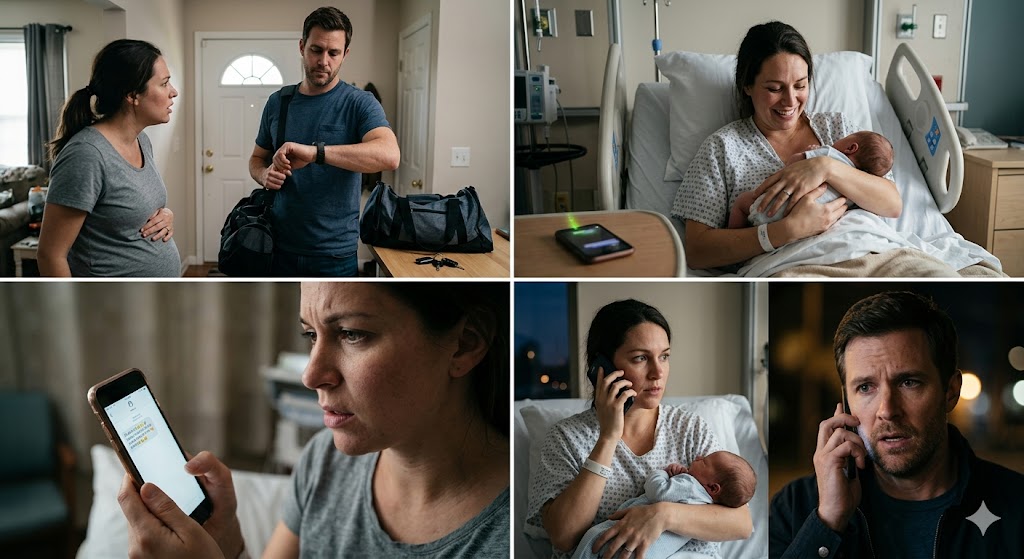
I exhaled sharply, trying to stay calm. “I think this is it,” I told my husband, Beckett.
He didn’t look up from his phone at first. When he finally did, he squinted like I was reporting weather.
“Are you sure it’s not Braxton Hicks?” he asked.
Another wave rolled through me, stronger this time. I had to grip the counter harder.
“I’m sure.”
That should have been enough.
Instead, he checked his watch.
And said he had a guys’ trip.
At first, I thought I misunderstood him. My brain refused to connect the words to the situation happening in my body.
“I have to leave,” he said, already moving. “The deposit’s non-refundable. My mom can take you if it gets worse.”
I remember laughing once—not because it was funny, but because my body didn’t know what else to do with the shock of it.
“I’m in labor,” I said, slower this time, like maybe he just hadn’t heard me correctly.
He paused at the doorway with a duffel bag in his hand.
“I know,” he said. “But this trip has been planned for months.”
Then he left.
The door clicked shut like it was nothing.
Like everything was still normal.
I stood there for a full moment, waiting for the sound of him coming back. Waiting for something to correct itself. Something to say this was a misunderstanding.
Another contraction hit, and this one didn’t care about denial.
I grabbed my phone and called my best friend.
My voice broke halfway through her name.
“Come now,” I managed.
She didn’t ask questions. Just said, “I’m on my way.”
By the time she arrived, I was bent over the kitchen counter, counting breaths between waves of pain and disbelief.
And that was the beginning of everything changing—not just the labor, but the life I thought I had been living.
Because some moments don’t just hurt in the moment.
They rearrange the truth behind everything that comes after.
Part 2
The hospital lights were too bright for the kind of pain I was in.
Everything moved quickly once we arrived—too quickly for my mind to keep up. Nurses asking questions, attaching monitors, telling me to breathe like breathing was something I had forgotten how to do. My best friend never left my side, answering what I couldn’t, holding my hand when my grip turned desperate.
“Where’s the father?” someone asked gently at one point.
There was a pause I couldn’t fill.
My friend answered for me. “He’s… not here.”
No one pressed further. But I felt the shape of the question stay in the room anyway.
Labor stripped everything down to essentials—pain, breath, time. There was no space left for excuses, or for the story I had been trying to hold together in my head all morning.
Just truth. Raw and unavoidable.
Hours collapsed into one another. I remember fragments: the rhythm of monitors, the sting of exhaustion, my friend whispering encouragement even when I stopped responding. I remember thinking, somewhere between contractions, that I had never felt more physically alone in my life—and yet I was not unattended.
That distinction mattered more than I could explain.
Then suddenly, everything shifted.
Voices sharpened. Hands moved faster. A calm urgency filled the room that made my chest tighten before anyone even said a word.
“Baby’s heart rate is dropping,” someone said.
My name was spoken more times in five minutes than I think I had heard all week. I couldn’t process all of it, only the tone—focused, controlled, serious in a way that erased everything else.
And then, just like that, Rowan arrived.
A cry filled the room—sharp, real, alive.
For a second, I didn’t understand what I was hearing. Then they placed him on my chest.
Warm. Small. Real.
Everything inside me went still in a way that had nothing to do with exhaustion.
“I’ve got you,” I whispered without thinking, even though I wasn’t sure if I meant him or myself.
My best friend was crying before I even realized I was.
For a moment, there was nothing outside that room. No duffel bag. No unanswered calls. No door closing behind someone who should have stayed.
Just him. My son. Breathing against me like he had always belonged there.
But peace, I was learning, doesn’t erase reality.
It only pauses it.
Because later—after the stitches, after the exhaustion settled into my bones, after the hospital room grew quiet enough to hear my own thoughts—my phone lit up.
Once.
Then again.
Then again.
Beckett.
And the tone of those calls wasn’t casual anymore.
It was panic.
Part 3
By the time I finally looked at my phone, the screen was almost burned with his name.
Beckett. Beckett. Beckett.
Voicemails stacked one after another. Messages that started sharp and annoyed, then turned confused, then spiraled into something heavier.
Where are you answering?
Call me back right now.
Why is your friend telling me you had the baby already?
And then, finally:
What did you mean I can’t come in?
I didn’t respond right away.
Rowan was asleep against my chest, his tiny breaths steady in a way that felt impossible after everything. My arm was sore. My eyes burned. But there was a strange clarity sitting under the exhaustion—like something in me had finished breaking and had started settling into a new shape.
My best friend glanced at the phone. “You don’t have to deal with him tonight.”
“I know,” I said quietly.
But it wasn’t about tonight.
It was about everything that came before it.
I finally listened to one voicemail.
His voice came through fast, stripped of its usual confidence.
“Why isn’t anyone letting me in? I’m at the hospital. They’re saying I’m not on the list. This is ridiculous—just tell them I’m the father.”
A pause. Noise in the background. A door opening somewhere.
Then his voice again, lower now.
“Did you actually… already have him?”
That one landed differently.
Not because of the question—but because of how long it took him to ask it.
Like it hadn’t occurred to him that life could keep happening without his permission.
I looked down at Rowan.
Perfect. Real. Here.
And I thought about the morning. The duffel bag. The door closing. The way he had measured my labor against a deposit and decided I could wait.
Something in me went very still.
I typed a reply, then deleted it.
Typed another. Deleted that too.
Finally, I just said the only thing that felt accurate.
He’s here.
That was it.
No explanation. No anger. No invitation into this moment.
Just truth.
Less than a minute later, my phone rang again.
This time, I didn’t answer.
Because for the first time since the contractions started, I understood something clearly:
Beckett wasn’t reacting to the birth of his son.
He was reacting to the fact that life had already made a decision without him.
Part 4
The next morning came without mercy.
Hospital mornings don’t feel like mornings at all—just a shift in lighting, a change in staff, and the quiet realization that nothing pauses for what you’ve just survived.
Rowan was still asleep when Beckett arrived.
I didn’t see him walk in. I felt it first—the shift in air, the way my friend straightened slightly in her chair, the way the hallway noise seemed to hesitate outside the door.
Then he was there.
Standing just inside the room like he wasn’t sure he was allowed to take up space in it.
His hair was messy, like he hadn’t slept. His shirt wrinkled. His eyes locked immediately onto the hospital bassinet before they even found me.
And when they did, something in his expression cracked open.
“You had him,” he said, like he still couldn’t fully accept the sentence.
I didn’t respond right away. I adjusted the blanket around Rowan instead, careful not to wake him.
“Yes,” I said finally.
That single word seemed to do more damage than anything else I could have said.
Beckett took a step closer, then stopped, like there was an invisible line he suddenly didn’t know how to cross.
“I didn’t know it was happening that fast,” he said quickly. “If I’d known— I thought it was just early labor. You said—”
“I said I was in labor,” I interrupted quietly.
Silence.
My best friend stood up without a word and moved closer to the window, giving us space—but not distance.
Beckett ran a hand through his hair. “I tried to come back. I called. They wouldn’t let me in. I was stuck on the highway and—”
“And you still didn’t turn around,” I said.
He stopped.
That was the part neither of us needed to say out loud, but it hung between us anyway.
He looked at Rowan again, softer now, almost careful. “Can I…?”
I studied him for a long moment.
Not as the person I had built a life with in my head.
But as the person who had walked out while I was in labor and chosen not to come back until everything was already over.
“Not yet,” I said.
His face tightened, like he hadn’t expected that answer to be real.
“I’m his father,” he said, quieter this time.
I nodded once.
“I know.”
Another silence settled—heavier now, full of everything that couldn’t be undone with explanations.
Beckett exhaled slowly, like he was trying to steady himself. “What happens now?”
That was the first honest question he had asked since the door closed that morning.
I looked down at Rowan again.
Then back at him.
“I don’t know,” I said. “But it won’t be what it used to be.”
And for the first time, he didn’t argue.
Part 5
Beckett didn’t leave right away.
He stood there longer than anyone should have to stand in a room where they no longer know their place.
At some point, a nurse came in quietly to check on me and adjust Rowan’s blanket. She didn’t ask questions. She didn’t need to. She simply did her work, nodded politely at Beckett, and left again—like she had seen enough versions of this story to recognize the shape of it already.
When the door closed, the silence returned sharper than before.
Beckett finally sat down in the chair beside the bed. Not close enough to assume comfort. Not far enough to pretend he wasn’t part of it.
“I didn’t think you’d actually shut me out,” he said.
I let out a slow breath.
“That’s the problem,” I said. “You didn’t think about it at all.”
His jaw tightened, but he didn’t interrupt.
For a moment, I almost felt sorry for him—not because he was suffering, but because he looked like someone realizing too late that consequences aren’t loud. They don’t announce themselves. They just arrive fully formed.
“I thought I was doing the responsible thing,” he said finally. “The trip was planned. The money—”
“The money,” I repeated softly.
He stopped.
I shook my head once, not angry anymore. Just tired of the logic.
“You left me in labor,” I said. “There isn’t a version of responsibility where that makes sense.”
He looked down at his hands.
For a long time, neither of us spoke.
Rowan shifted slightly in his sleep, making a small sound that immediately pulled my attention away from everything else. Instinct took over. My hand moved to him without thinking, smoothing the edge of his blanket.
Beckett noticed that. I could feel it.
Something changed in his expression—not dramatic, not sudden. Just a quiet recalculation.
“I want to fix this,” he said.
I didn’t look up right away.
Because that word—fix—didn’t fit what had happened.
Finally, I said, “This isn’t something you fix.”
That landed harder than anything else I had said.
He opened his mouth, then closed it again.
“What do I do then?” he asked, more honestly this time.
I looked at him for a long moment.
Not as a husband.
Not even as an enemy.
Just as someone who had arrived after the moment everything changed.
“You start by understanding you don’t get to decide the pace of this anymore,” I said quietly. “Not for me. Not for him.”
His eyes flicked to Rowan again.
And for the first time, he didn’t look like he was trying to take control of the situation.
He just looked like someone trying to learn how to exist inside it.
“I’m still his father,” he said, almost like he needed to remind himself.
“Yes,” I said.
A pause.
“But you don’t get to skip the parts where you show up,” I added.
The room went still again.
Outside, the world kept moving—announcements over hospital speakers, footsteps in the hallway, distant laughter that didn’t belong to us anymore.
Beckett stood slowly.
Not leaving yet. Not staying comfortably either.
Just hovering at the edge of what his life had become.
“I’ll come back,” he said.
It wasn’t a promise I answered.
Because for the first time, I understood something clearly:
Coming back was no longer the same as being welcomed.
Part 6
Beckett did come back.
Not in the dramatic way people imagine—no big apology that fixes everything at once, no sudden clarity that rewrites the past—but in small, uneven steps that didn’t quite know what direction they were going yet.
The next day, he showed up again.
Same chair. Same careful distance. Same uncertainty about where he belonged.
He brought a small bag this time. Not the duffel from that morning. Something quieter. Things he thought might be useful but didn’t fully know how to choose—snacks, a blanket, a tiny stuffed toy that looked like it had been picked up in a rush of guilt more than intention.
He set it down awkwardly on the side table.
“I wasn’t sure what he’d like,” he said.
Rowan was asleep again, swaddled tightly, his face soft in a way that made every argument in the room feel far away.
“You can’t really know yet,” I said.
That was the truth of it. He was still brand new to the world. So was everything else.
Beckett nodded, absorbing that without pushing back.
For a while, it was just quiet. Not the tense kind from before, but something emptier. Less charged. Like the room was slowly learning how to hold more than one reality at once.
At one point, Rowan stirred and made a small sound—barely anything.
Beckett leaned forward slightly without thinking. Then stopped himself, glancing at me first, like he was still asking permission for instincts he used to assume were automatic.
“You can,” I said quietly.
That was enough.
He moved closer and looked down at his son.
Really looked.
Something in his face softened in a way that didn’t need words. Not perfect understanding. Not redemption. Just recognition.
“He looks… real,” Beckett said softly, almost like he was surprised by the simplicity of it.
I almost laughed, but didn’t.
“He is,” I said.
A long pause followed.
Then Beckett spoke again, quieter this time.
“I keep thinking about that morning,” he admitted. “I don’t know why I didn’t— I don’t know why I didn’t just stay.”
There it was. Not an excuse. Not a defense. Just the question he had finally caught up to.
I didn’t answer right away.
Because there wasn’t a clean answer that would make it easier for either of us.
Instead, I said, “People show you who they are in moments like that.”
He flinched slightly, but didn’t deny it.
“I didn’t think I was that person,” he said.
“I don’t think most people do,” I replied.
That stayed between us for a while.
Rowan’s small breaths filled the silence in a steady rhythm—proof that something had gone right in a day where so much hadn’t.
Finally, Beckett leaned back in the chair.
“I want to do better,” he said.
Not a promise this time. More like a direction he was trying to find.
I studied him for a moment.
“I’m not asking you to be perfect,” I said. “I’m asking you to be consistent.”
He nodded slowly, like that was harder than it sounded—but understandable.
Outside the window, daylight shifted again, marking time in a place where time didn’t feel like it belonged.
And for the first time since that morning, the story didn’t feel like it was collapsing or exploding.
It felt like something else.
Something harder.
Something still being built—carefully, and without shortcuts.