Two Dirty Cops Pulled My Daughter Over And Beat Her Until She Was Permanently Blind. They Planted Drugs In Her Car And Threatened To Kill My Sister If I Spoke Up. “Nobody Touches A Cop In This Town,” They Laughed In My Face. They Expected A Lawsuit. They Got A War. I Activated My Old Squad And Turned Their Precinct Into A Kill Box. When Ryder Saw Me Standing In The Dark With My Tactical Gear, He Finally Realized His Mistake. “Please! I Have A Family!” He Begged. “They Took Her Eye. I Took Their Souls.”
Part 1
The phone did not ring.
It buzzed against the nightstand at 3:14 in the morning, a hard, angry vibration that dragged me out of sleep before my eyes opened. Old habits do not die just because the uniform is folded away in a cedar chest. Ten years after leaving the Navy, I still woke like a switch had been thrown inside my skull.
On or off.
Alive or dead.
I grabbed the phone.
“Hunter speaking.”
There was a woman on the other end. Calm, trained, but holding something back.
“Is this Mr. Thomas Hunter? Father of Violet Hunter?”
My bedroom was dark except for the thin gray slice of moonlight across the floorboards.
“Yes.”
“This is St. Jude’s Medical Center. Your daughter has been admitted to the trauma unit. You need to come now.”
Not “she’s okay.”
Not “minor accident.”
Now.
“I’m on my way.”
I dressed in the dark. Jeans. T-shirt. Boots. Keys from the dish by the door. Outside, the June air smelled like wet pavement and cut grass. My truck engine turned over too loud in the quiet neighborhood, and as I backed out of the driveway, I realized my hands were locked around the wheel so hard my knuckles had gone pale.
Violet was twenty-two. Small, sharp-eyed, careful with everything. She was the kind of girl who carried granola bars in her purse for homeless people and apologized to dogs when they bumped into her. She did not get into trouble. She painted murals at elementary schools. She called me every Sunday even if all she had to say was that her basil plant looked “dramatic.”
The hospital parking lot was almost empty. Fluorescent lights buzzed over the entrance. The lobby smelled like antiseptic, coffee, and tired fear.
“My daughter,” I told the woman at the desk. “Violet Hunter.”
Her fingers moved over the keyboard. Then they stopped.
That pause told me more than any words could.
“Room four,” she said softly. “The doctor is with her.”
The hallway felt longer than it should have. Monitors beeped behind curtains. A nurse pushed a cart past me, wheels squeaking against polished tile. When I reached room four, I stopped in the doorway.
For one second, my mind refused to accept what my eyes were giving it.
That is not my daughter.
The girl in the bed looked too small. Too still. Her face was swollen and bruised, her lips split, one cheek dark with dried blood that someone had tried and failed to clean away. A thick white bandage covered her right eye. Fresh red had bloomed through the gauze like a horrible flower.
A doctor turned toward me.
“Mr. Hunter?”
“What happened?”
“She was brought in by paramedics. Severe facial trauma, concussion, broken ribs, and an ocular injury.”
“The eye.”
His shoulders dropped.
“We couldn’t save it. I’m sorry.”
The room went quiet except for the slow hiss of oxygen.
My daughter painted skies. She painted water. She painted portraits of strangers on the subway because, she once told me, “Everybody has at least one interesting angle.”
Now one of her eyes was gone.
“The police report says she was intoxicated,” the doctor said carefully. “They said she resisted arrest and fell during the struggle.”
I looked at Violet’s hands. Her knuckles were smooth. No scrapes. No torn nails.
Then I saw her wrists.
Finger-shaped bruises circled them.
I pulled the sheet down two inches and saw the print across her chest. Not a smear. Not a bruise from falling. A clear, muddy boot mark pressed into her skin.
“That isn’t a fall,” I said.
The doctor swallowed.
“Her blood alcohol level was zero.”
The air changed.
Violet stirred. Her remaining eye opened, cloudy with pain and medicine. It searched the room until it found me.
“Dad?”
“I’m here, sweetheart.”
Her fingers clamped around mine.
“They laughed,” she whispered.
“Who?”
“The cops.”
The machines beeped faster.
“One of them said his badge meant he could do whatever he wanted.”
I leaned close, keeping my face steady while something cold and ancient woke up inside me.
“Did you hear their names?”
Her lips trembled.
“Ryder. Blake.”
Outside the window, near the emergency entrance, two police cruisers sat beneath yellow lights. Two officers leaned against one hood, drinking coffee and laughing.
One was big.
I watched him throw his head back like he had just heard the funniest joke in the world.
And for the first time that night, I wondered if the men who hurt my daughter were still close enough to hear her crying.
### Part 2
By sunrise, the pain medication had thinned out and reality came for Violet in pieces.
First she touched the bandage.
Then she froze.
Her one good eye stared at the ceiling, unblinking, while morning light cut through the blinds and striped her blanket in gold.
“It’s real,” she said.
It was not a question.
I sat beside her, my elbows on my knees, coffee untouched in a paper cup near my boot. I had spent the last three hours watching her breathe and memorizing every mark on her body because details mattered. Details were the difference between grief and proof.
“Yes,” I said. “It’s real.”
Her throat moved.
“I did everything right.”
“I know.”
“I was driving Emma home because everyone else had been drinking at the art show. I dropped her off. I was two miles from my apartment when the lights came on behind me.”
Her voice shook, but she forced the words out like each one cost her.
“I pulled over right away. Hands on the wheel. Window down. Like you taught me.”
I nodded.
“The big one came up fast. He didn’t ask for my license. He just yanked my door open and yelled that I was reaching. I wasn’t. I was trying to unbuckle my seat belt.”
Ryder.
The name sat in my mind like a round chambered.
“They dragged me out. My cheek hit the road. There was gravel in my mouth. I kept saying, ‘I’m not resisting.’ I asked for their badge numbers.”
She closed her eye.
“That made him mad.”
I did not interrupt her. I only held her hand.
“Blake laughed. Ryder told me I wanted a good look at his badge, so he’d give me something to remember him by.”
Her breath hitched.
“Dad, I couldn’t move.”
The world narrowed until all I could hear was the faint hum of the lights overhead and the blood moving behind my ears.
“You’re safe now,” I said.
She looked at me, and I saw she wanted to believe that.
But she was smart.
“No, I’m not. They’re cops.”
“I’m going to handle it.”
“Don’t do something that gets you killed.”
I smiled a little, though nothing in me felt soft.
“I’m retired, not stupid.”
She did not smile back.
“You get quiet when you’re dangerous.”
That hurt because it was true.
I kissed her forehead.
“I’ll be back.”
My first stop was the police department.
The building sat downtown between the courthouse and city hall, red brick, black glass, flag snapping in the wind. I had walked into compounds overseas that felt warmer.
The officer at the front desk looked up when I gave my name. Something flickered in his eyes.
Recognition.
Not sympathy.
“I need to speak to whoever took the report on Violet Hunter.”
He leaned back.
“You want to file a complaint?”
“I want to speak to your commander.”
A sergeant came out five minutes later. Miller, according to the nameplate on his chest. He had a round face, a coffee stain on his sleeve, and the bored patience of a man who had already decided I was a problem.
“Mr. Hunter,” he said. “I read the report. Your daughter was intoxicated and combative. Officers used necessary force.”
“She was sober.”
His eyes hardened.
“Careful.”
“She has a boot print on her chest.”
“Accidents look ugly sometimes.”
“That was not an accident.”
Miller stepped closer.
“If you push this, your daughter’s charges get worse. Assaulting an officer. Resisting arrest. Maybe reckless endangerment. You understand me?”
Behind the glass wall, I saw two cops by the coffee machine.
One large.
One lean.
Ryder lifted his knee and made a little motion in the air. Blake laughed so hard he nearly spilled his coffee.
They were reenacting it.
My daughter’s worst moment was their morning entertainment.
Something inside me moved toward violence with terrifying ease. I measured the distance to the locked door. The glass. The cameras. The pistol on Miller’s hip.
Then I saw the red recording light in the corner.
They wanted me angry. They wanted me stupid. They wanted a headline that said unstable veteran attacks police.
So I exhaled.
“You’re right,” I said.
Miller blinked.
“I’m emotional. I’ll talk to my daughter.”
His smile returned.
“Smart man.”
I walked out slowly, every step controlled. In my truck, I opened the glove box and pulled out a small black notebook. On the first page, I wrote three names.
Ryder.
Blake.
Miller.
Then I stared at the police station until my anger cooled into something cleaner.
The front door was closed.
Fine.
I had never been much for front doors.
There was one man left who might tell me whether this rot stopped at the patrol level or went all the way up.
Chief Julian Walker.
An old brother-in-arms.
And if Julian protected them, then my daughter had not been beaten by two dirty cops.
She had been beaten by an entire kingdom.
### Part 3
Julian lived in a house that made my jaw tighten before I reached the porch.
Fresh white siding. Stone walkway. Two-car garage. A fishing boat parked beside the house with a cover clean enough to eat off. The lawn had those perfect diagonal mower stripes men pay other men to make.
Police chiefs did not usually live like that unless they married money, inherited money, or took money.
Julian had done none of the first two.
I rang the bell.
He opened the door wearing a navy polo shirt and holding a glass of something amber. It was not even noon.
“Tom,” he said.
No surprise. No warmth either.
“Julian.”
His eyes moved over me the way they had once moved over ridgelines and alleys overseas. Calculating. Measuring threat.
“I heard you made a scene at the station.”
“My daughter is missing an eye.”
He looked down the street before stepping aside.
“Come in.”
His study smelled like leather, cigar smoke, and lemon oil. Framed commendations covered one wall. A photo from our deployment sat on a shelf behind his desk. We were both younger in it, sunburned, filthy, and smiling like fools who had survived one more day.
I remembered dragging him behind a burned-out truck after shrapnel opened his thigh.
I wondered if he remembered too.
“Ryder and Blake did this,” I said.
Julian poured a second drink and offered it.
I ignored it.
“They lost control,” I continued. “They lied on the report. Miller threatened me this morning.”
Julian sat behind his desk.
“You’ve been out a long time, Tom. Things are different here.”
“Don’t give me that.”
His face tightened.
“This city has problems. My officers deal with bad people every day. Sometimes force looks ugly to civilians.”
“She is not bad people. She is my daughter.”
He opened a drawer and slid a file across the desk.
“Then read what your daughter did.”
The report was clean, typed, official, and rotten from the first sentence.
Violet had been driving erratically. Violet had slurred her words. Violet had reached for a metallic object. Violet had attacked Officer Ryder. Violet had fallen during the struggle.
There was even a witness statement.
Marcus Dean claimed he had seen everything from across the street.
I read it twice.
“Who is Marcus Dean?”
“A citizen.”
“Convenient citizen.”
“Reliable enough.”
“Where’s the dashcam?”
Julian sighed.
“Malfunctioned.”
“Body cameras?”
“Battery issue.”
I looked at him.
“You expect me to believe both officers lost video at the exact moment they hurt my daughter.”
“I expect you to understand reality.”
The room felt smaller.
Julian leaned forward.
“The district attorney is ready to charge her. I can slow that down. Maybe even make it go away.”
“What do you want?”
“A waiver. You and Violet release the department from liability. No lawsuit. No media. No public accusations.”
There it was.
Not justice.
A trade.
My silence for my daughter’s future.
“You know she didn’t do this,” I said.
He did not deny it.
He took a drink instead.
“That’s not the point.”
“It is to me.”
“Then you’re still thinking like a soldier. I’m thinking like a chief. I have a department to protect.”
“You mean men.”
“I mean order.”
“No,” I said. “You mean power.”
His eyes went flat.
“Walk away, Tom. Be a father. Help her heal. Do not come after my city.”
My city.
Not the city.
His.
I closed the file gently.
“I’ll think about it.”
Julian relaxed just enough for me to see the mask slip. He thought the threat had worked. He thought I was tired, grieving, manageable.
I left without shaking his hand.
Outside, the sky had gone cloudy. Wind pushed dry leaves across the expensive driveway. I sat in my truck and looked at the boat, the new roof, the polished brass numbers on his mailbox.
Then I called Natalie Ross.
She answered on the third ring.
“I haven’t heard from you in six years, Hunter.”
“I need a lawyer.”
“You finally kill somebody?”
“Not yet.”
The line went quiet.
“What happened?”
“My daughter was beaten by police. They’re framing her.”
Natalie’s voice changed.
“Names.”
“Ryder. Blake. Sergeant Miller. Chief Julian Walker. And a witness named Marcus Dean.”
“I’ll start digging.”
“One more thing,” I said, watching Julian’s curtains move behind the front window. “Find out who owns the property near Route 9 by the old mill.”
“That where it happened?”
“Close enough.”
“Hunter, what are you planning?”
I started the truck.
“I’m planning to find out whether Marcus Dean is real.”
“And if he isn’t?”
I looked at Julian’s house one last time.
“Then I find out who invented him.”
As I pulled away, a thought settled into me with the weight of a locked door.
Julian had not sounded like a man covering up a mistake.
He had sounded like a man protecting an operation.
### Part 4
I did not go home.
Home was where grief waited in the kitchen chair Violet used when she came over for dinner. Home was the mug she had painted for Father’s Day, the one with the lopsided blue whale and the words Best Dad, Even When Annoying. Home was too full of her before.
I needed the after.
I drove three towns over and rented a gray sedan with cash. Nothing shiny. Nothing memorable. Then I bought gas station coffee, a ball cap, and a pair of cheap sunglasses that made me look like every tired divorced man in America.
For three days, I watched.
Ryder and Blake worked nights. They moved through the poor edges of the city like coyotes along a fence line. Trailer parks. Laundromats. Motels with broken signs. Apartment blocks where the hallway lights flickered and nobody called a lawyer because lawyers cost money.
They did not patrol.
They hunted.
I saw Ryder pull over an old man in a rusted Honda and make him empty his trunk onto the shoulder. I saw Blake laugh while the man gathered loose tools from the gravel. I saw them park outside a diner and take free food without paying. I saw people lower their eyes when the cruiser rolled past.
Fear has a smell if you sit in it long enough.
It smells like stale coffee, hot vinyl, and your own sweat drying under your collar.
On the third night, Natalie sent me a name.
Evan Miller.
No relation to Sergeant Miller, according to the message. Arrested six months earlier by Ryder and Blake for assaulting an officer. Charges dropped before trial.
Dropped charges interested me more than convictions.
People who actually assault cops usually get buried.
People with dropped charges usually have leverage.
Evan lived in a low apartment complex near the industrial district. The stairwell smelled like bleach and old smoke. When he cracked the door, the chain stayed on.
He was maybe twenty-five, but his eyes looked older. A scar split one eyebrow. His jaw had a nervous jump.
“I’m not buying anything,” he said.
“My name is Hunter. My daughter is Violet.”
His expression changed.
“Ryder and Blake hurt her three nights ago.”
The chain slid free.
Inside, his apartment was half-packed. Cardboard boxes, cheap couch, mattress on the floor. A fan rattled in the window, pushing warm air around instead of cooling it.
“I’m leaving tomorrow,” he said. “Ohio. Cousin has a garage there.”
“What happened to you?”
He laughed once, no humor in it.
“They said I fit a description. I asked what description. Ryder smiled like I told a joke.”
He lifted his shirt enough for me to see pale scars across his ribs.
“They didn’t take me straight to the station.”
“Where?”
He looked at the door.
“The old quarry.”
The word landed exactly where I expected it to.
“Tell me.”
He sat on a box and rubbed both hands over his face.
“They called it a compliance check. They’d cuff you, make you stand, knock you down, then order you back up. If you couldn’t, they said you were resisting.”
His voice thinned.
“They told me if I talked, they knew where my little sister went to school.”
That was their real weapon.
Not fists.
Family.
“Why were the charges dropped?”
“My uncle works records at the courthouse. He saw things that didn’t match. He threatened noise. So they made a deal. Charges gone if I left town and kept my mouth shut.”
“Did you ever hear the name Marcus Dean?”
Evan frowned.
“No. But they had names for people they used when they needed stories. Ghosts, they called them.”
Ghosts.
Fake witnesses with paper lives.
I pulled out my notebook.
“Show me where in the quarry.”
He hesitated.
“I can’t testify.”
“I’m not asking you to.”
“You can’t beat them. They own judges. They own prosecutors. They own the chief.”
“I know.”
“Then why are you doing this?”
I looked at the boxes stacked by his door. A young man leaving his whole life because two cowards with badges told him to run.
“Because my daughter asked me if she was safe, and I couldn’t say yes.”
Evan stared at me for a long moment. Then he went to the kitchen, grabbed a napkin, and drew a rough map with a shaking pen.
“South rim,” he said. “Old maintenance shed. They park behind it where the road dips.”
I folded the napkin and put it in my pocket.
When I stood, he grabbed my sleeve.
“Mr. Hunter. If you go there, understand something. That place isn’t just where they hurt people.”
His face had gone pale.
“It’s where they make people disappear from the record.”
I walked back to the gray sedan under a sky with no stars, Evan’s words crawling under my skin.
The quarry was not a crime scene.
It was a habit.
And habits leave trails.
### Part 5
The quarry sat twelve miles outside town, past the last gas station and a church with a sun-faded sign that said Mercy Is A Choice.
The irony was not lost on me.
I parked half a mile away and walked in through scrub brush and broken weeds. Afternoon heat shimmered off the pale rock. Rusted machinery stood in the pits like dead animals. Water collected in deep holes, green and still, with mosquitoes hovering over the surface.
I found the maintenance shed exactly where Evan said it would be.
Its metal siding was peeled back at one corner. Graffiti covered the door. The dirt around it was marked with tire tracks, some old and washed soft, some fresh enough to show tread.
They still came here.
I did not step into the clearing. I stayed where the brush held my outline and studied the place. The slope of the road. The blind curve. The places headlights would sweep. The places a camera could see without being seen.
My mind built a map because that was what it had been trained to do.
But this was not overseas. I was not setting up an ambush. I was setting up a record.
Truth needed angles too.
On my way back to town, blue lights appeared in my rearview mirror.
I was not speeding.
I had signaled every turn.
The gray sedan rolled to a stop on the shoulder, gravel crunching beneath the tires. I placed both hands on the wheel where they could see them.
Ryder approached first.
Big body. Thick neck. Shaved head. He walked with the lazy confidence of a man who had never been held responsible for anything.
Blake stayed near the cruiser, one hand on his belt, smiling.
Ryder leaned into my open window.
“Mr. Hunter.”
“Officer.”
“Funny seeing you out here.”
“Beautiful day.”
He grinned.
“You always visit abandoned quarries in rental cars?”
“Only when golf courses are full.”
His smile twitched.
“You think you’re funny?”
“No.”
He smelled like mint gum and sweat.
“You’ve been asking questions. Talking to Evan. Talking to a lawyer. That’s unhealthy behavior for a man with family.”
I kept my breathing slow.
“My family is already hurt.”
“Could get worse.”
Blake called from behind him, “Sister lives on Rosewood, right?”
My eyes did not move.
Kendra.
My younger sister. School librarian. Two kids. Toyota with a cracked bumper.
Ryder tapped the roof of my car twice.
“Roads are dangerous. Brakes fail. People look down at phones. Accidents happen.”
There was the turn.
The mistake.
He thought fear would make me fold.
Instead, fear sharpened me.
“I understand,” I said, lowering my eyes.
Ryder enjoyed that.
“Good. Go home. Tell your daughter to remember she fell. Tell your lawyer to find a new hobby.”
“I don’t want trouble.”
“No,” he said. “You don’t.”
He walked back to the cruiser. Blake laughed as they pulled around me, gravel spraying against the sedan’s hood.
I sat still until they disappeared.
Then I reached into my shirt pocket and stopped the recorder.
Every word was there.
The threat to Kendra.
The quarry.
The admission that they knew who I had spoken to.
It was good.
It was not enough.
I drove straight to Natalie’s office.
Her place was above a bakery that made the stairwell smell like cinnamon and burnt sugar. Inside, her office was paper chaos: case files, coffee cups, sticky notes, and one dying plant she had named Clarence.
I played the recording.
By the time Ryder said accidents happen, Natalie’s face had gone white.
“We take this to the FBI tonight.”
“No.”
“Hunter—”
“If we hand them one recording, Julian buries it. Says it’s context. Says Ryder was warning me about road safety. We need more.”
“You mean you need bait.”
“I mean we file the lawsuit.”
She stared at me.
“You told me the system was trapped.”
“It is. That’s why we don’t use it to win yet. We use it to make them angry.”
“They’ll come after you.”
“Good.”
“No, not good. Dangerous.”
“Natalie, they already came after Violet.”
The bakery ovens below us kicked on. Warm air rose through the old floorboards.
She looked down at the recorder, then back at me.
“What do you want in the complaint?”
“Everything. Brutality. Corruption. Witness fabrication. Cover-up. Name Ryder, Blake, Miller, Julian, and the department.”
“That will light the city on fire.”
I stood.
“Then let it burn bright enough for everyone to see.”
The next morning, every reporter in town would know my daughter’s name.
And if Ryder and Blake hated light as much as I thought they did, they would crawl out of the dark to shut it off.
### Part 6
The lawsuit hit at 9:02 a.m.
By 9:17, Natalie had three reporters leaving messages.
By noon, my daughter’s case was on every local news site, though they blurred her face and used words like alleged because lawyers had trained journalists to fear the truth before they printed it.
I sat in the gray sedan across from a diner where Ryder liked lunch. Through the window, I watched him pace near the booths, phone pressed to his ear, face red enough to see from the street.
Good.
Pressure changed people.
Pride made them stupid.
My burner phone buzzed.
Natalie.
“Marcus Dean is smoke,” she said.
I sat up.
“No real address. No tax history. The number on the statement belongs to a disconnected line. But listen to this. The supposed witness address is tied to a closed P.O. box. That box was rented years ago by a retired officer named Colin Reed.”
“Friend of Ryder?”
“Former partner.”
I looked through the diner window. Ryder threw his napkin down and stormed toward the restroom.
Natalie continued, “Colin owns Dean’s Liquors on Route 9.”
Route 9.
My hand tightened around the phone.
“Line of sight?”
“Perfect. Exterior cameras facing the street.”
For the first time in three days, I felt something like air enter my lungs.
“Can we subpoena?”
“We can. But if Colin is involved, he’ll claim the footage is gone before the paper touches his door.”
“Then I’ll ask nicely first.”
“Hunter.”
“I said nicely.”
Dean’s Liquors was a low building with barred windows and a flickering neon sign. Inside, the air smelled like cardboard, floor cleaner, and old beer. A bell over the door jingled when I entered.
Colin Reed stood behind the counter. Gray mustache. Thick forearms. A faded police tattoo visible beneath his sleeve.
He looked me over.
“You lost?”
“I’m looking for footage from your exterior camera. Night of June seventh. Around eleven forty.”
His eyes cooled.
“System overwrites every twenty-four hours.”
“That’s unfortunate.”
“Very.”
“Marcus Dean ever shop here?”
“Lots of people shop here.”
“That wasn’t my question.”
He leaned both hands on the counter.
“You should leave.”
Behind him, a teenage clerk stacking boxes stopped moving. Thin kid. Brown hair. Name tag said Eli.
I let my eyes meet his for half a second.
Fear.
But also recognition.
I left without pushing. Men like Colin enjoyed resistance. Better to deny him the pleasure.
Two blocks away, I found a folded receipt under my windshield wiper.
My first instinct was trap.
Then I opened it.
Written in blue pen on the back were six words.
Backups don’t overwrite. Ask about Miguel.
Below that was a phone number.
I called from the burner.
A young voice answered.
“You Hunter?”
“Who is Miguel?”
“My brother.”
Eli’s voice cracked.
“They arrested him last year. Ryder said he assaulted him. Miguel never touched anybody. He came home with bruises and stopped talking for weeks.”
“Why help me?”
“Because I saw her car that night.”
My jaw tightened.
“Violet?”
“I was closing. Colin told me to go to the stockroom when the lights flashed outside. I peeked through the door. I saw enough.”
“Do you have the footage?”
“Not me. The system sends a backup to a cloud account Colin forgot about. Miguel set it up when he worked here. He still has the login.”
“Can he pull it?”
There was a pause.
“He already did.”
We met behind a closed car wash at dusk. Eli arrived on a bicycle, hoodie pulled low despite the heat. He handed me a thumb drive like it was a live grenade.
“Please don’t say my name.”
“I won’t.”
“My brother said there’s something weird near the end.”
“What kind of weird?”
Eli shook his head.
“He wouldn’t tell me on the phone. Just said the cops weren’t the only ones there.”
The sun was sinking behind the laundromat, turning puddles orange in the cracked pavement.
I held the thumb drive in my palm and felt the whole case shift.
Until that moment, I thought I was hunting two men.
But someone else had watched my daughter bleed on the side of the road.
And whoever it was had stayed hidden.
### Part 7
Natalie’s office was dark except for the laptop screen.
Rain tapped against the windows. Downstairs, the bakery was closed, but the smell of sugar still lived in the walls. Natalie sat beside me with one hand over her mouth as the video loaded.
The file was grainy, black and white, angled from above the liquor store awning.
The timestamp read 11:41 p.m.
Violet’s small blue car rolled into frame and pulled neatly to the curb.
The police cruiser stopped behind her.
No swerving.
No erratic driving.
No chaos.
Just my daughter doing exactly what she had been taught to do.
Ryder approached fast. He did not pause at her window. He yanked the door open so hard the car rocked. Violet’s hands flew up, palms visible. Blake came around from the passenger side, laughing even before anything happened.
Natalie whispered, “God.”
I did not move.
If I moved, I might break something.
They dragged Violet from the car. Her knees hit the pavement. She tried to cover her head. Ryder leaned over her, shouting words the camera could not hear. Blake stood back, arms folded, watching like it was a show.
Then came the strike that took her eye.
The video had no sound.
I heard it anyway.
Not with my ears. With the part of a father that knows when his child is calling.
Natalie paused the video and looked away.
“I’m sorry,” she said.
“Play it.”
“Hunter—”
“Play it.”
She did.
They cuffed Violet after she stopped moving. That detail mattered. They did not cuff her because she was dangerous. They hurt her first and restrained her after.
Then they dragged her toward the cruiser.
“Wait,” Natalie said.
She rewound ten seconds.
“What?”
“Look at the far curb.”
Across the street, half-hidden beneath an oak tree, sat a dark sedan. No headlights. Engine off. It had been there before the stop began.
Watching.
“Could be a neighbor,” Natalie said.
“No houses there.”
“Colin?”
“He drives a truck.”
We watched again.
The sedan never moved. Not when Ryder pulled Violet from the car. Not when Blake laughed. Not when my daughter went limp.
It waited.
Then, as the cruiser left with Violet in the back, a delivery truck passed through the frame. Its headlights swept across the sedan for less than a second.
A flash of windshield.
A pale shape behind the wheel.
Natalie froze the image.
The face was a blur.
But the posture was familiar.
Straight-backed. Still. Hands low on the wheel.
Military stillness.
I leaned closer until the pixels lost meaning.
“Can you enhance it?”
Natalie gave me a look.
“This isn’t television.”
“Can anyone?”
“Maybe. A forensic video tech. But if we hand this to the wrong person, Julian hears before we’re ready.”
“Then find the right person.”
She rubbed her temples.
“First, we preserve it. Multiple copies. Off-site. Cloud. Physical drives. One to my safe. One to a reporter with instructions not to open unless something happens to us.”
I nodded.
That was why I had called her.
I knew pressure, movement, danger.
Natalie knew paper trails and insurance policies.
We watched the video twice more, not because we wanted to, but because we needed every second. The lies in the report became almost laughable in their boldness. Violet never reached. Never fought. Never threatened.
The only question left was how high the lie went.
The answer sat in that shadowed sedan.
At midnight, I went to see Violet.
She was at Kendra’s house, away from the hospital, curled under a quilt on the couch. Her face was still bruised yellow and purple. The bandage had been replaced by a medical patch.
She woke when I entered.
“You found something,” she said.
I sat on the edge of the coffee table.
“Yes.”
“Is it bad?”
“It proves you told the truth.”
Her one eye filled with tears, but she blinked them back.
“Will they go to jail?”
“Not yet.”
“Why not?”
“Because the video also shows someone watching.”
She stared at me.
“Who?”
“I don’t know.”
But even as I said it, my stomach had already chosen a name my mind did not want to accept.
Julian had told me to leave his city alone.
Now I had to find out if he had been sitting in the dark while his city tried to kill my daughter.
### Part 8
The deposition room smelled like lemon polish and expensive leather.
Police union lawyers liked rooms like that. Long tables. Heavy chairs. Framed abstract art nobody understood. Places designed to make ordinary people feel small before anyone asked a question.
I wore my black suit.
Natalie called it my funeral suit. She was not wrong.
Ryder arrived first, dress uniform pressed, shoes shining, medals pinned like proof of goodness. Blake followed, chewing gum with his mouth open. Their lawyer, Adrian Bell, smiled the kind of smile men learn in courtrooms and divorce proceedings.
“Mr. Hunter,” he said. “This should not take long.”
“No,” I said. “It shouldn’t.”
Ryder smirked at me.
I looked down at the table like a tired father who had run out of options.
Masks matter.
In my old life, camouflage was fabric and mud. In this room, it was posture.
Natalie turned on the camera.
The little red light blinked.
She began softly.
Names. Badge numbers. Years of service. Training history. Use-of-force policies.
Ryder answered like he was bored.
Blake tapped a pen against the table.
Then Natalie reached the night of the stop.
“Officer Ryder, why did you pull over Violet Hunter?”
“She was driving erratically. Crossed the center line. Nearly struck a mailbox.”
Lie.
“Did she comply with your instructions?”
“No. She was belligerent from the start. Slurring. Hostile.”
Lie.
“Did you smell alcohol?”
“Yes.”
Lie.
“Did Ms. Hunter reach for a weapon?”
Ryder leaned back.
“She reached toward the glove compartment. I believed she was going for a weapon.”
The video showed her hands raised.
Lie.
Blake added, “We had seconds to react.”
Lie.
Natalie wrote something down.
“Describe how she sustained the injury to her eye.”
Ryder’s expression became solemn in a way that made my skin crawl.
“She resisted arrest and fell forward during the takedown. It was unfortunate.”
I felt my hands curl under the table.
Violet had asked me not to do something stupid.
So I stayed still.
Natalie flipped a page.
“Were any other officers present?”
“No.”
“Was Sergeant Miller there?”
“No.”
“Was Chief Julian Walker present?”
Something small happened then.
Ryder’s eyes moved to Adrian before returning to Natalie.
“No.”
Blake stopped tapping the pen.
Natalie’s voice stayed mild.
“To be clear, Chief Walker was not at or near the scene?”
“No.”
“Did he observe the stop from any location?”
Ryder laughed.
“The chief doesn’t sit around watching traffic stops.”
“Under oath, Officer Ryder.”
He leaned toward the camera.
“Under oath. Chief Walker was not there.”
Natalie turned to Blake.
“Same answer?”
“Same answer.”
“And the witness Marcus Dean?”
“Saw the whole thing,” Ryder said.
“Have you met Mr. Dean?”
“Briefly.”
“When?”
“After the incident.”
Another lie. Maybe.
Natalie wrote again.
“Do you know Colin Reed?”
Ryder’s jaw tightened.
“Retired officer. Lots of people know Colin.”
“Did Colin Reed provide the name Marcus Dean?”
Adrian sat up.
“Objection. Foundation.”
“You can answer,” Natalie said.
Ryder stared at her.
“No.”
The room felt colder.
Natalie asked three more questions, each one setting another nail. Then she turned off the camera.
Adrian smiled.
“Well, that was dramatic and useless. Your case is emotion, Ms. Ross. Not evidence.”
Ryder stood and walked behind my chair.
He leaned down so close I smelled his gum.
“Your girl should’ve kept her head down,” he whispered. “You too.”
I lifted my eyes.
For one second, I let him see me.
Not the grieving father.
Not the tired veteran.
The man behind the mask.
Ryder’s smile faded.
“I was keeping my head down,” I said quietly. “That’s how I saw your feet.”
He frowned, not understanding.
Then he left with Blake.
When the door closed, Natalie exhaled for the first time in a full minute.
“They lied about everything.”
“Yes.”
“They denied Julian.”
“Yes.”
“If we prove he was there, they’re finished.”
“Not just finished,” I said. “Locked in.”
Natalie opened her laptop and brought up the frozen frame of the dark sedan.
“There’s one problem.”
I looked at the blurred face behind the windshield.
“We still can’t prove it’s him.”
Outside, thunder rolled over the city.
The trap was built.
But before we could spring it, we needed to put a name on the ghost in the car.
### Part 9
Julian’s mistake was vanity.
Men like him can hide money, rewrite reports, pressure witnesses, and make cameras disappear, but they cannot resist owning things that make them feel important.
His unmarked sedan was one of those things.
Black. Polished. Government plates. Dark tint. Custom antenna mounted too far back on the roof because Julian liked upgraded radio systems even when the department budget said no.
I remembered the antenna from his driveway.
A small silver cap at the tip.
The kind of detail nobody notices unless details once kept them alive.
Natalie found a forensic video analyst through a civil rights attorney she trusted. We met him in the back room of a print shop after closing, between stacks of campaign flyers and wedding invitations.
His name was Samir. He wore a cardigan, thick glasses, and the exhausted expression of a man who had seen too much ugly footage for one lifetime.
“I can’t create what isn’t there,” he warned.
“We only need what is,” Natalie said.
He worked for two hours.
Frame by frame.
Headlight flare. Windshield reflection. Contrast adjustment. Stabilization. No magic. Just patience.
I stood behind him and watched the dark sedan sharpen by fractions.
Not the face.
The car.
A dent low on the driver’s door.
A county parking decal.
A silver-capped antenna mounted too far back on the roof.
Samir froze the clearest frame and sat back.
“That’s an official vehicle.”
Natalie looked at me.
“You know the car?”
“Yes.”
But knowing was not proving.
So I drove to city hall the next morning and parked across from the municipal garage. I waited with a newspaper open in front of my face like every bad spy movie ever made, except bad tricks work when people are arrogant enough not to look.
At 8:12, Julian’s sedan rolled through the gate.
Black. Dented driver’s door. County decal. Silver-capped antenna.
My chest went hollow.
Part of me had still wanted to be wrong.
That was the cruelty of betrayal. Evidence could pile up like bricks, and some dumb human corner of your heart would still look for a door.
I took photographs.
At 9:30, Natalie filed an emergency motion to preserve all department vehicle logs and GPS data.
At 10:15, city IT informed her that Julian’s GPS unit had “malfunctioned” the night of Violet’s assault.
Of course it had.
At 11:00, Natalie received an anonymous email from someone inside dispatch. No message. Just an audio file.
We played it in her office.
Static first.
Then a dispatcher’s voice.
“Unit C-One, confirm location?”
C-One was the chief.
Julian’s voice answered.
“Route 9. Observing.”
“Do you need marked units?”
A pause.
“No. Ryder and Blake have it handled.”
Handled.
My daughter screaming on pavement.
Handled.
Natalie stopped the audio and covered her mouth.
I walked to the window.
Traffic moved below. People bought coffee. A man argued with a parking meter. The ordinary world had the nerve to continue.
Julian had been there.
He had watched.
And when dispatch asked if his men needed help, he chose silence.
I thought of the desert. A night full of smoke. Julian bleeding into sand. My hands dragging him to cover while rounds cracked overhead. I had carried him because we did not leave our own behind.
He had left my daughter on the road.
My phone buzzed.
Unknown number.
I answered without speaking.
For three seconds, there was only breathing.
Then Julian said, “You’re making a mistake.”
I looked at Natalie. She stiffened.
“You were there,” I said.
Silence.
“You watched.”
“You don’t understand what you’re walking into.”
“I understand enough.”
His voice dropped.
“Tom, there are things bigger than Ryder and Blake.”
“There always are.”
“You think a video saves you? It doesn’t. It makes you a target.”
I watched rain gather on the window glass.
“You should have thought about targets before your men chose my daughter.”
“She should have complied.”
There it was.
The last thread snapped.
Any memory of brotherhood burned away, clean and final.
“Do not call me again,” I said.
“Tom—”
“You lost the right to use my name.”
I hung up.
Natalie looked pale.
“What now?”
I picked up the thumb drive with the footage, the deposition transcript, the dispatch audio, and the enhanced stills.
“Tomorrow night is Julian’s State of the City address.”
Her eyes widened.
“Every reporter in the county will be there.”
“Yes.”
“Hunter, public exposure is risky.”
“So is silence.”
I looked at the frozen image of Julian’s sedan.
The ghost had a name now.
And the whole city was about to meet him.
### Part 10
The town hall glittered like a wedding cake.
White columns. Polished floors. Gold trim around the stage. Rows of chairs filled with council members, donors, business owners, reporters, and citizens who still believed applause could measure character.
Violet stayed home with Kendra.
That was my one condition.
She had already survived the truth once. She did not need to watch strangers gasp over it like entertainment.
I stood near the back wall beside Natalie. She held a folder against her chest. Inside were printed exhibits and a court-stamped preservation order. In her purse was one copy of the thumb drive. In my jacket was another.
A third had already gone to a federal civil rights investigator whose name Natalie refused to tell me.
Insurance.
Chief Julian walked onto the stage to a standing ovation.
Ryder and Blake sat in the front row in dress blues, stiff and proud, their badges catching the stage lights. Miller sat two rows behind them, arms crossed, face sour.
Julian smiled like a man standing at the center of his own church.
“This has been a difficult week,” he began. “Our department has faced accusations. Painful accusations. False accusations.”
Murmurs rolled through the room.
I felt Natalie go still beside me.
Julian continued, voice swelling.
“But we will not allow anger to destroy trust. We will not allow one tragic accident to become a weapon against the brave men and women who protect this city.”
One tragic accident.
My vision tightened.
Natalie touched my sleeve.
“Steady.”
Julian gestured toward Ryder and Blake.
“Officers like these represent the best of us.”
Applause erupted.
Ryder stood and gave a humble little nod.
Blake looked at the cameras.
That was the moment Natalie moved.
She walked down the center aisle toward the public comment microphone. The moderator tried to wave her off.
“Ms. Ross, public comments are scheduled after—”
“This concerns evidence in a federal civil rights matter,” Natalie said, voice clear.
The room shifted.
Reporters smelled blood before anyone else did.
She held up the folder.
“Chief Walker has just made public statements contradicted by sworn testimony, video evidence, dispatch audio, and official vehicle records.”
Julian’s smile froze.
Adrian Bell, the union lawyer, stood from the side aisle.
“This is improper.”
Natalie did not look at him.
“I agree. What happened to Violet Hunter was improper.”
Whispers turned sharp.
The AV volunteer, a college kid with nervous hands, plugged in the drive Natalie had given him before the event as part of her “presentation.” The screen behind Julian flickered from the city seal to black.
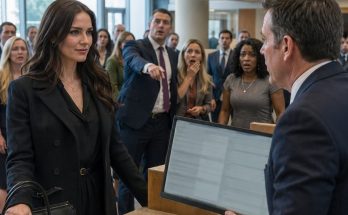
Julian turned slowly.
Then Violet’s car appeared.
A gasp moved through the room.
The video played without sound.
It did not need sound.
Everyone saw the clean stop. The open door. Ryder’s hands. Violet’s raised palms. Blake laughing. The moment violence crossed the line from force into cruelty.
A woman screamed.
Someone said, “Oh my God.”
Ryder lunged to his feet.
“That’s fake!”
But his voice cracked.
Reporters swung cameras toward him.
Blake backed into his chair like he could disappear into it.
The video continued. Violet limp. Cuffs after. Cruiser door open.
Then Natalie raised her hand.
“Pause.”
The screen froze on the dark sedan beneath the oak tree.
She turned to the room.
“Chief Walker testified through counsel that he was nowhere near the scene.”
She clicked to the enhanced image.
The sedan sharpened enough for the decal, dent, and antenna to show.
Then she clicked again.
A photo of Julian’s official vehicle taken that morning.
Same dent.
Same decal.
Same antenna.
The hall went dead silent.
Natalie’s voice cut through it.
“Dispatch audio confirms Chief Walker was on Route 9, observing, while his officers assaulted Violet Hunter.”
The audio played.
Unit C-One, confirm location?
Route 9. Observing.
Do you need marked units?
No. Ryder and Blake have it handled.
Handled.
The word hung over the room like smoke.
Julian’s face had gone the color of ash.
Ryder shoved past a chair toward the side exit, but people lifted phones. Cameras closed in. Not touching him. Not attacking him.
Recording him.
For the first time, he looked afraid of witnesses.
Outside, sirens began.
One.
Then three.
Then many.
Miller stood and looked toward the doors, realizing too late that the sound was not backup coming to protect them.
It was accountability arriving with lights on.
### Part 11
I did not stay to watch the handcuffs.
That surprises people when they hear the story.
They expect me to say I stood there smiling while Ryder and Blake were marched out in front of the same cameras they had posed for. They expect satisfaction to look loud.
It did not.
Satisfaction, if that is even the word, felt like walking out into cold night air and finally being able to take a full breath.
Natalie stayed behind with the federal investigator. I slipped through a side door and crossed the parking lot while town hall erupted behind me. Reporters shouted. People cried. A councilman vomited near a hedge. The whole city was waking up at once, and waking up hurts.
At Kendra’s house, Violet sat on the couch with a blanket around her shoulders. The TV was off. Kendra hovered near the kitchen pretending not to hover.
Violet looked at my face.
“It happened?”
“It happened.”
“Did they see?”
“Everyone saw.”
Her hand rose to her patch.
“Good.”
There was no joy in her voice.
Only relief with bruises on it.
The next morning, the headlines were everywhere.
Video Exposes Police Assault.
Chief Walker Present During Brutality.
Federal Agents Raid Precinct.
Ryder and Blake were arrested before sunrise. Miller too. The department’s internal server was seized. Lockers searched. Patrol cars towed. Officers who had laughed too loudly two days earlier suddenly had nothing to say.
Natalie called at 8:06.
“They found more.”
I was at Kendra’s kitchen table drinking coffee that tasted like burnt wood.
“What kind of more?”
“Deleted complaints. Altered reports. A list of names tied to witness statements that don’t exist. Evan wasn’t the only one.”
I closed my eyes.
“How many?”
“At least nineteen cases with the same pattern.”
Across the room, Violet watched birds pick at the feeder outside the window. Her profile was still swollen. The morning light caught the edge of her patch.
“Natalie,” I said quietly. “Tell me every one of those people gets called.”
“They will.”
“And Julian?”
“Arrested at his house. Federal obstruction, conspiracy, civil rights violations. They’re looking at financial corruption too.”
“The boat?”
“The boat is the least of his problems.”
I almost smiled.
Almost.
By noon, Special Agent Harris came to see us. He was tall, tidy, and careful with his words. Federal agents always sound like they are walking across thin ice, even indoors.
He sat across from Violet in Kendra’s living room and explained what came next. Trial. Statements. Medical records. Testimony if she was strong enough.
Violet listened without interrupting.
When he finished, she asked, “Will I have to look at them?”
Harris paused.
“Possibly.”
She nodded once.
“Then I’ll look.”
I wanted to tell her she did not have to. I wanted to put myself between her and every ugly thing left in the world.
But that was not protection anymore.
That was stealing her choice.
So I said nothing.
After Harris left, I found an envelope tucked into the mailbox.
No return address.
Inside was one sheet of paper.
Tom,
You know what war does to men. You know decisions get made in seconds. I made mistakes, but I served beside you. Do not let them bury me with animals like Ryder. Speak for me. Tell them who I was before this.
Julian.
I read it twice.
Then I handed it to Violet.
Her face did not change.
“He wants you to save him?”
“Yes.”
“Will you?”
The kitchen smelled like coffee, toast, and the lavender soap Kendra used on dishes. Ordinary smells. Safe smells.
I took the letter back and tore it once down the middle.
“No.”
Then again.
“No late apology matters after the damage is done.”
Violet watched the pieces fall into the trash.
For the first time since the hospital, she smiled.
Small.
Tired.
Real.
That afternoon, Natalie called again.
“Julian’s lawyer wants a meeting.”
I looked at the shredded letter in the trash.
“Of course he does.”
“He’s offering testimony against Ryder and Blake if you publicly ask for leniency.”
I stared out the window at the quiet street.
The king had lost his throne.
Now he wanted the man he betrayed to build him a smaller one.
### Part 12
The meeting took place in a federal conference room with no windows.
Julian sat across from me in a gray suit that did not fit as well as it used to. Without the badge, without the office, without men outside waiting for his orders, he looked smaller. Not weak exactly. Just reduced to human size.
His lawyer did most of the talking.
Chief Walker was prepared to cooperate. Chief Walker had valuable information. Chief Walker had served his country and community. Chief Walker hoped Mr. Hunter would consider the full picture.
I let the man speak until the room ran out of his perfume and excuses.
Then Julian leaned forward.
“Tom.”
I looked at him until he corrected himself.
“Hunter.”
“That’s better.”
His jaw tightened.
“I made compromises.”
“You watched my daughter get hurt.”
“I didn’t order that.”
“You didn’t stop it.”
He swallowed.
“You know what command is like. Sometimes men under you make mistakes.”
“Don’t use command with me.”
His eyes flashed.
“There are people worse than me involved.”
“Then name them.”
“I will. But I need—”
“No.”
“You haven’t heard the offer.”
“I heard enough.”
His lawyer sighed.
“Mr. Hunter, a public statement from you could influence sentencing. It would show restraint. Mercy.”
I stood.
“Mercy is for people who come before the damage and choose not to do it.”
Julian’s face hardened.
“So that’s it? After everything we survived?”
I leaned over the table.
“I carried you once because you were my brother. You watched my child bleed because protecting your kingdom mattered more than being a man. Whatever we survived died that night.”
For a moment, the old Julian flickered through. Angry. Proud. Cornered.
Then it vanished, replaced by fear.
I left him there.
The trial began six weeks later.
By then, Violet had traded the medical patch for a black eye patch that made strangers look twice and then quickly pretend they had not. She did not hide from it. That was her decision. She said if people were going to stare, she might as well give them something honest to stare at.
The courtroom was packed.
Evan testified first. His voice shook at the beginning, but steadied when he described the quarry. Then Miguel. Then a mother whose son had been framed. Then an old man from the Honda stop who had kept a photograph of his trunk contents scattered on the roadside because, he said, “I wanted proof that I wasn’t crazy.”
One by one, ghosts became people.
Ryder stared at the table.
Blake cried twice.
Miller blamed paperwork.
Julian blamed culture, pressure, politics, everyone but himself.
Then Violet took the stand.
The courtroom seemed to hold its breath.
She wore a dark green dress and her black patch. Her hair was pulled back from the scar on her cheek. She looked pale, but when she raised her right hand to swear the oath, it did not tremble.
Natalie questioned her gently.
Violet told the truth plainly.
The drive home. The lights. Her hands on the wheel. The door opening. The pavement. The laughing. The words about the badge. The moment she understood one eye would never open again.
No drama.
No performance.
Just facts.
That made it worse.
When Adrian Bell cross-examined her, he tried to imply confusion. Trauma. Memory gaps.
Violet looked at him with her one clear eye.
“I remember the sound of Officer Blake laughing,” she said. “I remember the smell of hot asphalt. I remember wondering if my dad would know I didn’t fight them.”
The jury watched her, and I saw the case end in their faces before the lawyers finished talking.
After closing arguments, we waited in a side room with bad coffee and a humming vending machine.
Violet sat beside me, twisting a paper napkin.
“What if they don’t believe me?”
“They do.”
“You don’t know that.”
“No,” I admitted. “But I know what I saw.”
She rested her head against my shoulder.
Hours passed.
Then the bailiff opened the door.
The jury had a verdict.
Violet stood slowly, and I felt her hand find mine.
Whatever came next, she would hear it on her feet.
### Part 13
Guilty.
The word sounded different each time the clerk read it.
Guilty on conspiracy.
Guilty on deprivation of civil rights.
Guilty on aggravated assault.
Guilty on perjury.
Guilty on obstruction.
Ryder stared straight ahead, jaw clenched, like he could still bully the room into changing its mind.
Blake folded in on himself.
Miller closed his eyes.
Julian did not look at me.
That was fine.
I had looked at him enough for one lifetime.
Sentencing came three weeks later under a sky the color of wet concrete.
Ryder got twenty-five years.
Blake got twenty-two.
Miller got fifteen.
Julian, after finally turning on half the county to save himself from worse, got eighteen years in federal prison and lost his pension, his house, his boat, and every photograph in city hall where he had once smiled like a hero.
The judge spoke calmly.
“You used the law as a weapon. You used fear as policy. You mistook silence for consent. This court will not.”
There was no cheering.
No applause.
Just the heavy sound of consequences settling over men who had avoided them for too long.
Outside, reporters waited on the courthouse steps.
Violet and I walked through them without stopping.
“Violet, do you forgive them?”
A microphone nearly touched her face.
She paused.
For one second, I thought she would keep walking.
Instead, she turned.
“No,” she said. “Forgiveness is not a requirement for healing.”
Then she got into my truck.
I drove away before anyone could turn her pain into another headline.
We did not go home.
I took the long road out to Lake Mercer, where I used to bring her when she was seven and too impatient to fish but too stubborn to admit it. The dock was old, boards silvered by weather, nails rusted at the edges. Wind moved across the water in dark ripples.
Violet walked to the end and stood with her hands in her coat pockets.
“I got an email,” she said.
“What email?”
“The Art Institute. Chicago.”
My throat tightened.
“They accepted you?”
She nodded.
“My new portfolio.”
The one she had painted during recovery. Faces half in shadow. Windows. Roads. A self-portrait with one eye covered and the other looking straight at the viewer like a challenge.
“They said the work had urgency,” she said.
“It does.”
“I’m going.”
“Good.”
“I can’t stay here and be the girl people whisper about near the cereal aisle.”
“You were never just that.”
“I know.” She looked at the water. “But now I want to know who I am somewhere else.”
I pulled the black notebook from my jacket. The first page still had the names.
Ryder.
Blake.
Miller.
Julian.
For months, those names had been a mission. A map. A reason to wake up when anger was easier than breathing.
Now they were just ink.
I tore out the page.
Violet watched.
“Ready?” I asked.
She nodded.
I crumpled it and threw it into the lake. It struck the surface with a tiny sound and vanished into gray water.
The wind smelled like rain and pine.
“Does it feel over?” she asked.
I thought about the hospital room. The boot print. The laughter. The video. The courtroom. The way Julian said my name like history could excuse betrayal.
“No,” I said honestly. “Not all at once.”
She leaned against my arm.
“But it feels like ours again.”
That was exactly it.
Our lives had been taken over by men who believed their badges made them untouchable. They had turned Violet’s pain into paperwork, her truth into a threat, her future into something they thought they could bargain with.
They were wrong.
She still had a future.
Not the one she planned. Not the easy one. But hers.
A month later, I drove her to Chicago in a truck packed with canvases, books, winter coats, and one basil plant strapped into the passenger-side footwell because she insisted it had “emotional needs.”
Her apartment was small. Third floor. Brick walls. Steam heat that clanked like an old ship. From the window, you could see an alley, a slice of train track, and enough sky to paint.
When I hugged her goodbye, she held on longer than usual.
“You’ll call?” I asked.
“Every Sunday.”
“Even if the basil gets dramatic?”
“Especially then.”
I stepped back.
She stood in her doorway, black patch, scar visible, chin lifted.
My daughter had lost an eye.
She had not lost herself.
On the drive home, I did not check the rearview mirror much. There was nothing behind us worth chasing anymore.
The road ahead was wide, bright, and finally ours.
THE END!
Disclaimer: Our stories are inspired by real-life events but are carefully rewritten for entertainment. Any resemblance to actual people or situations is purely coincidental.