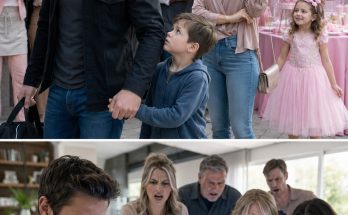
I Reserved A $2,800 Venue For My Son’s Birthday. When We Arrived, The Banner Read: “Happy 8th, Lily!” My Girlfriend’s Daughter. She Shrugged: “He Can Have It Next Year—She Really Wanted This One.” My Son Whispered: “It’s Okay, Dad.” I Walked Out Without A Word And Cancelled Every Future Payment. By Midnight, The Entire Group Chat Exploded…
Part 1
I knew something was wrong before I even saw the banner.
The parking lot outside Galaxy Lab Events had been glowing in late-afternoon sun, the kind of bright white light that makes windshields flash and asphalt smell warm. Noah sat in the back seat with both hands wrapped around the straps of his little backpack, wearing the navy button-up shirt he had picked out himself because, in his words, “inventors should look serious.”
He was turning eight. My son had waited months for this day.
I had paid $2,800 for the private science-themed birthday package. Not because I was rich. I was not. I was a graphic designer, which meant some months were good and some months were a pile of invoices, client revisions, and reheated coffee. But I had saved for it because Noah had been through enough.
A divorce. Two homes. Quiet car rides after custody exchanges. Adults speaking in careful voices around him.
I wanted him to have one day that did not feel careful.
One perfect day.
When we stepped through the glass doors, cold air rolled over us, carrying the smell of vanilla frosting, balloon rubber, and something floral. That last part made me slow down.
Floral was wrong.
The science package was supposed to have silver streamers, neon green table runners, little plastic goggles, dry-ice fog effects, and a dessert table shaped like a messy laboratory bench. I knew because I had designed the invitations myself: rockets, beakers, warning stripes, little cartoon explosions. I had sent the files to the venue twice.
Instead, the room looked like someone had dropped a princess boutique into a party hall.
Pink balloons floated from the ceiling in glossy clusters. Gold streamers shimmered against the walls. The dessert table was covered in blush fabric, sugar flowers, and a unicorn cake with a sparkling number eight on top.
Then I saw the banner.
Happy 8th Lily.
My body stopped so sharply that Noah bumped into my side.
For a second, the room kept moving without me. Children laughed near the craft table. A party host in pastel fairy wings clapped her hands and called for everyone to gather around. Someone’s phone flashed. A little girl shrieked with delight over a tiara.
But my son stood silent beside me.
Noah looked up at the banner. Then at the cake. Then at the pink goody bags lined up in perfect rows.
Then he looked at me.
I turned toward Vanessa.
She was standing near the dessert table, one hand holding her phone, the other resting lightly on her daughter Lily’s shoulder. Vanessa had arrived earlier, supposedly to “help check the setup.” She wore a cream blouse and that soft, practiced smile I had once mistaken for kindness.
“What is this?” I asked.
She blinked like I had asked something inconvenient.
“Oh,” she said, giving one tiny shrug. “Lily really wanted this theme.”
The words did not land at first. They floated there, ridiculous and impossible.
“What?” I said.
Vanessa sighed. “Don’t start. She’s been talking about having a party like this for weeks, and honestly, she was so excited. Noah can have this place next year.”
I looked down at Noah.
His face had gone carefully blank.
That was worse than crying.
Vanessa lowered her voice, like I was embarrassing her. “He’s still young, Alan. He won’t care as much.”
My chest went cold.
Not hot. Not explosive. Cold.
Because when cruelty comes dressed as reason, you realize the other person has already practiced the explanation.
Noah tugged gently at my sleeve. I looked down, and he gave me a little smile that looked too small for his face.
“It’s okay, Dad,” he whispered.
Something inside me cracked, but I did not yell. I did not rip the banner down. I did not ask the room to stop.
I crouched to Noah’s level.
“Come on, buddy,” I said.
His eyebrows pulled together. “We’re leaving?”
“Yes.”
Vanessa let out a sharp laugh behind me. “Oh my God, Alan. Seriously? Don’t be dramatic.”
I stood, took my son’s hand, and walked toward the exit.
Behind us, Vanessa called my name.
I did not turn around.
The glass doors slid open, and sunlight hit my face like a slap. Noah’s hand was warm and stiff inside mine. I kept walking until we reached the car, but every step felt like I was leaving one life and entering another.
Then Noah asked the question that nearly made me fall apart.
“Did I do something wrong?”
And in that moment, I realized this was not just about a birthday party anymore.
### Part 2
I knelt beside the car door with one hand on the roof and the other holding Noah’s shoulder.
“No,” I said, too fast. “No, buddy. Absolutely not. You did nothing wrong.”
His eyes dropped to his sneakers. He had chosen those too, black high-tops with glow-in-the-dark stars along the soles. He had told me they looked like “space scientist shoes.”
“Then why wasn’t my name there?” he asked.
There are questions children ask that are so simple they leave no place for adults to hide.
I swallowed hard.
“Because an adult made a selfish choice,” I said carefully. “And that choice hurt you. But it was not because of anything you did.”
He nodded once, but I could tell the words had not reached the bruised place yet. He climbed into the back seat without arguing. That scared me more than a tantrum would have.
A child who screams still believes someone might listen.
A child who goes quiet has already started protecting other people from his pain.
I shut the door, got into the driver’s seat, and gripped the steering wheel until my fingers hurt. Through the windshield, I could see the venue windows glowing pink and gold. Inside, Lily was probably standing under that banner, surrounded by children, cake, balloons, and my money.
Vanessa’s money? No.
Mine.
Noah’s day.
Noah’s name.
Noah’s trust.
“Can we still do something?” he asked from the back seat.
I looked at him in the mirror. His face was turned toward the window, but his voice was trying so hard to sound normal.
“Anything you want,” I said.
He thought about it. “Pizza?”
“Pizza sounds perfect.”
“And maybe the arcade?”
“Absolutely.”
He hesitated. “Can it just be us?”
That one hurt deeper than the banner.
“Yeah,” I said quietly. “Just us.”
So we drove across town to a little pizza place with red plastic cups, sticky tables, and a neon sign in the window that buzzed like an old refrigerator. The air smelled like garlic, melted cheese, and fryer oil. A baseball game played silently on the TV above the counter.
Noah picked a booth in the corner.
We ordered too much food. Pepperoni pizza, cheese sticks, curly fries, and a chocolate milkshake so thick the straw stood straight up in the glass. I let him have soda too, because some days rules are less important than repair.
At the arcade next door, he beat me twice at a racing game and once at air hockey. He laughed for real the third time I accidentally scored on myself. That laugh nearly dropped me to my knees.
I kept watching him between the flashing lights and electronic music, looking for signs of damage I could not name. He smiled. He played. He chose cheap prizes from the ticket counter: a glow ring, a squishy alien, and a tiny notebook with planets on the cover.
But every now and then, when another kid shouted “birthday boy!” at someone across the room, Noah’s shoulders tightened.
He noticed everything.
Kids always do.
Later, we sat in my car in the parking lot, eating soft-serve from paper cups while the sun slid behind the strip mall. Noah told me about the invention lab he wanted to build someday. It would have “explosion-proof walls,” a snack drawer, and a robot assistant named Carl.
“Maybe next year I don’t want a big party,” he said suddenly.
I kept my voice steady. “That’s okay.”
“Unless it’s actually mine.”
I stared out at the cracked yellow parking lines.
Actually mine.
Two small words. A whole indictment.
By the time I dropped Noah off at his mom’s house that evening, he seemed calmer. His mother, Rachel, opened the door and immediately knew something had happened. We had been divorced for almost three years, and while we were not always perfect, we had learned how to read each other when it mattered.
Noah hugged her waist.
I asked if I could talk to her outside.
On her porch, under a flickering light full of moths, I told her everything.
Rachel’s face changed slowly. First confusion. Then anger. Then something sadder.
“She did that to him?” she asked.
“Yes.”
“And you left?”
“Yes.”
“Good,” she said.
One word. No drama. No lecture.
Just good.
That helped more than I expected.
When I got home, my apartment was dark except for the blue glow of my laptop on the desk. The custom science invitations were still open on the screen from the night before. Little rockets. Little warning labels. Noah’s name in bold silver letters.
My phone had been buzzing for hours.
Thirty-seven unread messages.
Twelve missed calls.
One group chat on fire.
I opened it.
The first message I saw was from Vanessa.
Unbelievable. You ruined Lily’s birthday.
I stared at the screen.
Lily’s birthday.
Not Noah’s party.
Not a mistake.
Not confusion.
Lily’s birthday.
And that was when I realized Vanessa had not improvised this.
She had planned it.
### Part 3
I sat at my kitchen table while the refrigerator hummed and the city outside my window settled into midnight traffic. My apartment smelled faintly of cold pizza because I had brought home the leftovers Noah did not want. The box sat unopened on the counter, grease darkening one corner.
My phone kept lighting up.
Vanessa’s sister: Alan, how could you embarrass Lily like that?
Vanessa’s mom: You abandoned a room full of children.
Vanessa’s brother: Real men don’t punish kids because they’re mad at their girlfriend.
A cousin I had met once at a barbecue: Hope you’re proud of yourself.
I scrolled slowly, reading the rewritten version of my own life as it appeared in real time.
According to them, I had “stormed out.” I had “humiliated” Lily. I had “weaponized money.” I had “ruined a child’s special day.”
No one mentioned Noah.
Not once.
That absence told me more than any insult.
Then Vanessa called again.
I let it ring until it stopped.
She called a second time.
Then a third.
Finally, I answered.
“What?” I said.
No greeting. No softness. I had used up every polite version of myself in that party room.
“You need to send the rest of the payment tonight,” Vanessa snapped.
I leaned back in the chair. “Excuse me?”
“The venue balance. The entertainer fee. The custom cake charge. Some of the add-ons weren’t covered by the first payment, and because of your little stunt, I had to deal with everything.”
For a moment, I thought anger would come.
Instead, I felt a strange calm.
“My stunt,” I said.
“Yes, Alan. Your stunt. Do you have any idea how embarrassed I was?”
I looked at the old mug beside my laptop. It had a chip on the rim and said World’s Okayest Dad. Noah had picked it out for Father’s Day because he thought it was hilarious.
“I’m not paying another cent,” I said.
Silence.
Then Vanessa laughed. “You signed the contract.”
“I signed a contract for my son’s birthday.”
“You’re being childish.”
“No,” I said. “You changed the entire event behind my back.”
She scoffed. “I adjusted it.”
“You replaced his name.”
“He can read, Alan. It wasn’t going to kill him.”
That sentence sat between us like something rotten.
I closed my eyes.
“You looked at my son standing under another child’s birthday banner and decided that was acceptable.”
“You’re making this sound so dramatic.”
“It was dramatic. He whispered that it was okay because he didn’t want me to be upset.”
“So what was I supposed to do?” she asked, voice rising. “Tell Lily no? Break her heart?”
“So you broke his instead.”
She made an irritated sound. “Oh my God. He’s not made of glass.”
“No,” I said. “But he is a child.”
“So is Lily.”
“And yet only one of them had a party stolen.”
Another silence.
Then her tone shifted. Softer. Wounded. Familiar.
“You know how hard things have been for us,” she said. “You know Lily has been feeling left out. I thought you understood what it meant to build a family.”
There it was.
The word she always used when she wanted me to surrender.
Family.
A year earlier, that word had worked on me. It had made me cover dinners, buy school supplies, rearrange weekends, pay for outings, swallow discomfort. It had made me confuse generosity with obligation.
But not tonight.
“Family does not mean my son disappears,” I said.
Vanessa inhaled sharply.
“You always do this,” she said. “Everything has to revolve around Noah.”
“He’s my son.”
“And Lily is supposed to be nothing?”
I rubbed a hand over my face. “That’s the trick, isn’t it? If Noah gets anything, you act like Lily has been robbed.”
“You’re twisting this.”
“No. I’m finally saying it clearly.”
Her voice went cold. “This is why your marriage failed.”
I froze.
There are insults that bounce off you because they are desperate.
Then there are insults people have been saving.
This one had weight.
I opened my eyes and stared at the custom invitation still glowing on my laptop screen.
Authorized Inventors Only.
I had spent hours on it after work. I had adjusted every color. I had asked Noah whether the rocket should be red or blue. He had said blue because red was “too obvious.”
“I’m ending this,” I said.
Vanessa laughed once. “Ending what?”
“Us.”
“You don’t mean that.”
“I do.”
“Over a party?”
“No,” I said. “Over what the party proved.”
She started talking fast then, words tumbling over each other. I was overreacting. I was tired. We should discuss this in person. I owed her a conversation. Lily was crying. Her family was furious. I had made everything harder.
But the longer she talked, the clearer I felt.
When she stopped for breath, I said, “I canceled all future payments.”
The silence that followed was different.
“What did you say?”
“I called the venue. And my bank.”
“You can’t do that.”
“I did.”
“Alan.”
For the first time all night, I heard panic.
And it told me there was something about those charges I still did not know.
### Part 4
The first call I had made was from outside the arcade while Noah was inside feeding tokens into a claw machine.
I could see him through the glass, standing under purple lights, concentrating hard as the metal claw dropped uselessly beside a stuffed dinosaur. He did not know I was shaking.
The venue manager, Marcy, answered on the fourth ring.
“Galaxy Lab Events, this is Marcy.”
“My name is Alan Whitaker,” I said. “I booked a private birthday event today under my name.”
“Oh, yes,” she said warmly. “For Lily’s party?”
My hand tightened around the phone.
“No,” I said. “For Noah’s party.”
A pause.
The traffic behind me hissed over wet pavement from an earlier sprinkler runoff. Somewhere nearby, a car alarm chirped twice.
“I’m sorry?” Marcy said.
“I booked a science-themed birthday party for my son, Noah. When we arrived, the room had been changed to a pink unicorn party for Vanessa’s daughter, Lily. I did not authorize that.”
The silence stretched.
Then I heard keyboard clicking.
“Mr. Whitaker, one moment please.”
I stood beside the arcade window, watching Noah finally win the stuffed dinosaur. He turned around, searching for me, and I lifted my hand. He smiled. I smiled back like my heart was not beating in my throat.
Marcy came back quieter.
“It looks like theme updates were submitted three days ago.”
“By whom?”
Another pause.
“Vanessa Coleman.”
“Was there written authorization from me?”
“She indicated she was your partner and that the changes were approved.”
“That is not what I asked.”
“No,” Marcy said finally. “I don’t see written authorization from you.”
“What changes did she submit?”
More clicking.
“Banner name changed to Lily. Dessert table changed to unicorn princess. Cake design updated. Activity package adjusted. Goody bags changed. Host costume changed.”
Each item felt like a small door closing.
“And charges?” I asked.
“There were additional upgrade fees.”
“How much?”
She hesitated.
“Mr. Whitaker, I think it would be best if we—”
“How much?”
“Approximately nine hundred and forty dollars remaining, after the deposit and initial payment.”
I almost laughed.
Vanessa had not only stolen Noah’s party.
She had upgraded it and expected me to pay the balance.
“I am withdrawing authorization for any future charges,” I said. “I’m also disputing any changes made without my written consent. Please send me the full email trail tonight.”
Marcy sounded uncomfortable, but not defensive. “I understand. I’m very sorry, Mr. Whitaker. We should have verified directly.”
“Yes,” I said. “You should have.”
Then I called my bank.
By the time Noah came out holding the dinosaur under one arm, I had blocked future venue charges and documented everything in an email with timestamps.
That was why Vanessa’s panic on the phone did not surprise me.
What surprised me was how fast she recovered.
“You had no right,” she said.
“I had every right. It was my card.”
“You’re humiliating me.”
“You used my card for an event I did not approve.”
“It was still for the kids.”
“No,” I said. “It was for control.”
She made a sharp sound. “You sound insane.”
That word landed, but not the way she wanted it to.
Because suddenly I remembered all the little times she had made me question myself.
The robot kit.
That had been the first moment Noah’s face changed in a way I should have noticed.
He had saved allowance and chore money for months to buy a limited-edition robot-building set. I matched the last twenty dollars because he had done extra reading without being asked. When he opened the box at my apartment, his hands trembled with excitement.
Lily saw it ten minutes later.
“I want to build it,” she said.
Noah hugged the box to his chest. “It’s mine.”
Vanessa smiled too brightly. “Maybe you can share.”
“I saved for it,” Noah said.
“Come on,” Vanessa replied. “Don’t be selfish.”
I had stepped in gently, saying Noah did not have to share something special right away.
Vanessa went quiet for the rest of the evening.
Later, after the kids were asleep, she told me I had embarrassed her.
“She’s just a little girl,” she said. “You made her feel like an outsider.”
“I made Noah keep the gift he saved for.”
“You don’t understand girls,” she snapped.
I apologized.
I actually apologized.
Sitting in my kitchen months later, phone pressed to my ear, I felt shame rise up hot in my throat. Not because Vanessa had manipulated me. Because Noah had watched me fold.
How many times had he watched?
How many times had he learned that peace came at his expense?
“I’m done,” I said again.
Vanessa’s voice hardened. “You’ll regret treating us like this.”
“Maybe,” I said. “But I would regret staying more.”
After I hung up, I opened the group chat again.
The messages had multiplied.
I typed one response with steady hands.
I booked and paid for my son’s birthday. Vanessa changed the theme, cake, decorations, banner, and charges without my permission to make it Lily’s party. My son walked into a room where his own name had been replaced. I removed him from that situation and canceled unauthorized future charges. There will be no further discussion.
Then I left the chat.
For the first time all night, my phone went still.
But at 7:12 the next morning, a voicemail appeared from a man I barely knew.
Lily’s father.
And his message made Vanessa’s lie much bigger than I thought.
### Part 5
The voicemail was short.
“Alan, this is Mark. Lily’s dad. I heard something about yesterday, and I think Vanessa’s version is missing a few walls and a roof. Call me.”
I played it twice while standing barefoot in my kitchen, waiting for coffee to brew. Morning light came through the blinds in pale stripes. My eyes burned from lack of sleep. My phone battery was at sixteen percent because I had forgotten to plug it in.
I had met Mark exactly twice.
The first time was at Lily’s school play. Vanessa had described him as unreliable, selfish, always late, “the kind of father who does just enough to look decent.” But at the play, I remembered him kneeling to fix Lily’s shoe strap in the crowded hallway while Vanessa stood ten feet away scrolling her phone.
The second time was at a soccer game. He had brought orange slices. Vanessa said he only did that because other parents were watching.
I had believed her.
Or maybe I had accepted her version because it was easier than asking questions.
I called him back.
He answered on the second ring.
“Alan?”
“Yeah.”
He exhaled. “Thanks for calling.”
I leaned against the counter. “What did Vanessa tell you?”
“That you promised Lily a birthday party at some expensive venue, then got mad at Vanessa and walked out, canceled the payment, and made Lily cry in front of everyone.”
I closed my eyes.
“Of course.”
“So that’s not what happened?”
“I booked that venue for Noah.”
He was quiet.
I continued. “Science theme. My son’s name on everything. Vanessa arrived early and changed it to Lily’s party without telling me. I found out when Noah and I walked in.”
Mark muttered something under his breath.
“What?” I asked.
“I said, that sounds more familiar.”
The coffee maker sputtered behind me, filling the kitchen with a burnt, bitter smell.
Mark sighed. “She told Lily I couldn’t afford to throw her a proper birthday this year, but you stepped in because you cared about her like your own.”
I opened my eyes.
“She told Lily that?”
“Yeah. So now my daughter thinks you gave her a party and then took it away.”
I gripped the edge of the counter.
There it was. Another child used as a shield. Another child handed a story that would hurt her because it helped Vanessa.
“I never promised Lily anything,” I said. “I don’t blame her. She’s eight.”
“I know,” Mark said. “That’s why I called. Lily’s upset, and I’m trying to figure out what’s real before I say anything to her.”
That sentence told me something important about him.
He wanted truth before reaction.
Vanessa had never done that.
We talked for twenty minutes. Then thirty. Mark was not polished, not charming. He spoke in short, tired sentences and sounded like a man used to being accused before he entered the room.
He admitted he had missed some things. A school pickup two years ago when his truck broke down. A support payment that had been late after he changed jobs. A parent-teacher conference he joined by phone instead of in person.
“But she turned every mistake into a character witness,” he said. “By the time I corrected anything, people had already heard her version.”
I looked toward the living room, where Noah’s science invitation print sample still sat on the coffee table.
“Yeah,” I said. “I’m starting to understand that.”
Mark told me Vanessa had a habit of presenting expenses as emergencies. School supplies. Dance fees. Therapy costs. Birthday deposits. Always urgent. Always wrapped in guilt. Sometimes he paid half. Sometimes he paid all. Sometimes later he found out the numbers were inflated.
“She’s good at making you feel like asking for proof means you don’t care about your kid,” he said.
That hit so directly I had to sit down.
Because she had done the same thing to me.
Not with Lily at first. With “the kids.” With “family.” With the idea that love meant handing over your wallet and your boundaries at the same time.
“Did she mention a remaining balance?” I asked.
Mark gave a dry laugh. “Funny you ask. She texted me last night saying you abandoned her with almost a thousand dollars in charges and asked if I could help cover it for Lily’s sake.”
My stomach turned.
“She asked you too?”
“Yep.”
We sat in silence for a second, two men on opposite ends of the same trap.
Then Mark said, “Listen. I don’t want drama. I just want Lily not to be lied to. I’m going to tell her the party was not promised by you.”
“Thank you.”
“And Alan?”
“Yeah?”
“I’m sorry for Noah.”
I stared at the floor.
Those five words did something Vanessa’s entire family chat had not done.
They acknowledged him.
After we hung up, I poured coffee and forgot to drink it. My mind kept turning over everything Mark had said. The pattern was bigger than me. Bigger than the party. Vanessa had been building separate versions of reality and letting everyone else live inside the one that benefited her most.
At 2:34 that afternoon, my doorbell rang.
Through the peephole, I saw Vanessa standing in the hallway with red eyes, folded arms, and a face arranged into injury.
But behind her, half-hidden near the stairwell, stood her mother.
And suddenly I knew this was not an apology.
It was a performance.
### Part 6
I opened the door only as far as the chain allowed.
Vanessa’s eyes flicked to the chain, and her mouth tightened.
“Really?” she said.
“Yes,” I replied.
Her mother, Diane, stepped closer from the stairwell. She wore a lavender cardigan, pearl earrings, and the kind of disapproving expression people use when they have already decided they are morally superior.
“We need to talk,” Diane said.
“No,” I said. “Vanessa and I are done.”
Diane blinked like no one had ever refused the opening line before.
Vanessa’s eyes were wet, but there were no tears falling. “Alan, please. Can you not do this in the hallway?”
“We can do it here.”
“This is humiliating,” she whispered.
I looked at her carefully. “You changed my son’s birthday banner to your daughter’s name in a room full of guests.”
Her face hardened for half a second.
Then she looked down.
“I made a mistake,” she said softly.
That was the first almost-apology I had heard. But almost-apologies are like fake doors painted on walls. They look useful until you reach for the handle.
Diane stepped in. “She was trying to make both children happy.”
“No,” I said. “She was trying to make Lily the center of Noah’s event.”
“Lily has had a difficult year,” Diane said.
“So has Noah.”
Diane’s lips pressed together.
I watched that land nowhere.
Vanessa rubbed her forehead. “I didn’t think he would take it like that.”
“He is eight.”
“Exactly,” she said quickly. “He’s resilient.”
That word snapped something loose in me.
People love calling children resilient when what they really mean is convenient.
“He should not have to be resilient about his own birthday,” I said.
Vanessa stared at me.
Diane made a small, offended sound. “You’re being very unforgiving.”
“I am being accurate.”
Vanessa’s voice trembled. “After everything I gave to this relationship, you’re just throwing me away?”
I almost laughed.
Instead, I opened the door wider, not to invite them in, but because I wanted her to see my face clearly.
“What did you give, Vanessa?”
She recoiled. “Excuse me?”
“What did you give? Because I can list what I gave. I paid for dinners. I paid for outings. I bought Lily school clothes when you said you were short. I covered camp registration. I rearranged weekends. I let my son be asked to share things he should not have had to share. I listened when you said I needed to think like a family. So tell me. What did you give?”
Her eyes flashed.
Diane stepped forward. “How dare you keep a ledger?”
“I didn’t,” I said. “That was the problem.”
Vanessa’s injured expression collapsed into anger.
“You offered,” she snapped.
“Yes. And then you expected.”
“That’s what partners do.”
“No. Partners ask. They don’t manipulate.”
She crossed her arms. “You’re making yourself the victim.”
I felt tired suddenly. Not weak. Just tired of watching her change masks.
“Where was Noah in your version of yesterday?” I asked.
Her brow furrowed. “What?”
“When you told your family what happened, where was Noah?”
She looked away.
“Did you tell them he walked in and saw Lily’s name over his dessert table? Did you tell them he whispered that it was okay? Did you tell them he asked me if he did something wrong?”
Diane’s expression shifted. Just slightly.
Vanessa saw it too.
“Alan is exaggerating,” she said quickly.
There it was.
Not remorse. Damage control.
I nodded once.
“We’re done.”
Vanessa stepped closer. “You don’t get to just decide that.”
“I do.”
“I have things at your place.”
“I’ll box them up.”
“That’s cold.”
“So was what you did to my son.”
For a second, she looked like she might slap the door or scream. Then she leaned closer, voice low enough that Diane could barely hear.
“You think Rachel is any better?” she hissed. “At least I wanted to build a family with you. She left you.”
I stared at her.
And finally, finally, I felt nothing.
Not hurt. Not confusion. Not the old urge to explain myself until she understood.
Just nothing.
“Leave,” I said.
Diane touched Vanessa’s arm. “Come on.”
Vanessa backed away, but her face had changed. The crying girlfriend was gone. The woman in the hallway now looked cornered.
At the elevator, she turned.
“You’re going to look very cruel when people hear the whole story,” she said.
I almost answered.
Then I remembered the group chat, the party room, Noah’s tiny smile.
I closed the door.
An hour later, Rachel called.
Her voice was tight.
“Alan,” she said, “why is Vanessa messaging me?”
And that was when I learned Vanessa had decided to drag Noah’s mother into it.
### Part 7
Rachel was not easy to frighten.
She managed a dental office, raised Noah half the week, handled insurance companies like a professional hostage negotiator, and once changed a tire in work heels during a thunderstorm because she refused to wait two hours for roadside assistance.
So when I heard tension in her voice, I stood up immediately.
“What did Vanessa say?”
Rachel exhaled through her nose. “She sent me a long message about how your behavior yesterday was emotionally unstable and how she’s concerned about Noah being caught in the middle.”
I shut my eyes.
“She used those words?”
“Caught in the middle? Yes. Also controlling, vindictive, and financially abusive.”
I looked toward the hallway where Vanessa’s things still sat in a small basket near the closet: a scarf, two paperback novels, a phone charger, a half-empty bottle of perfume. The perfume had leaked once, and the faint vanilla scent still clung to the shelf.
Even her things had spread.
“What else?” I asked.
Rachel paused.
“She implied you might be using Noah to punish her.”
A laugh came out of me, but it sounded wrong.
“Of course she did.”
“Alan,” Rachel said, softer now, “I don’t believe her.”
I sat back down.
That hit harder than I expected.
Our divorce had not been some clean, noble separation. We had both been tired. We had both said things we should not have said. For a while after, every conversation felt like stepping around broken glass.
But we had worked hard to become decent co-parents.
And now Vanessa was trying to turn even that into a battlefield.
“I’m sorry she pulled you into this,” I said.
“I’m not worried about me. I’m worried about Noah.” Rachel’s voice changed. “He asked me this morning if birthdays can be transferred.”
I stared at the wall.
“What?”
“He asked if someone can just take another person’s birthday if they want it more.”
I pressed my fist against my mouth.
There are moments when anger becomes too big for noise.
Rachel waited.
Finally, I said, “What did you tell him?”
“I told him no. I told him adults can make bad choices, but his birthday belongs to him.”
I breathed out slowly.
“Thank you.”
“I also told him you did the right thing by leaving.”
My throat tightened.
Rachel continued. “He needed to see that.”
After we hung up, I opened Vanessa’s message thread for the first time since the night before. There were dozens of texts.
Alan, please don’t do this.
You’re hurting Lily.
My mom thinks you’re being cruel.
You need to grow up.
We can talk like adults.
I can’t believe you involved the venue.
You’re making me look like a liar.
That last one stopped me.
Not: You’re calling me a liar.
Making me look like a liar.
There are accidental confessions people type when they are too angry to edit themselves.
I screenshotted it.
Then I started a folder on my laptop.
Not because I wanted revenge. Because I had learned something during my divorce: when emotions run high, documentation is not pettiness. It is oxygen.
I saved the venue email. The bank confirmation. The group chat screenshot. Vanessa’s texts. Rachel’s message.
Then I sat there looking at the folder name.
Vanessa Incident.
It sounded too small.
So I renamed it.
Noah Birthday.
Because that was the point. Not Vanessa. Not Lily. Not her family.
Noah.
That evening, Noah came over for dinner. I made spaghetti, which I slightly overcooked because I was distracted, and garlic bread, which I burned on one edge. Noah ate around the blackened parts without comment.
After dinner, we sat on the floor building a small robot kit from his shelf. Not the limited-edition one. A simpler one, with blue plastic wheels and tiny screws that kept rolling under the couch.
He worked quietly for a while.
Then he asked, “Is Vanessa mad at me?”
The screwdriver slipped in my hand.
“No,” I said. “And even if she were, that would not be your responsibility.”
He focused on fitting a wheel into place. “Lily looked happy.”
I did not know what to say.
He continued, “I didn’t want her to be sad.”
That was my son. Still trying to protect the child who had been placed in his spot. Still kind. Still dangerous to himself because of it.
“You can care about Lily and still be hurt,” I said. “Both things can be true.”
He nodded slowly.
“Did you break up with Vanessa?”
“Yes.”
This time he looked up.
His expression was not happy exactly.
It was relieved.
Small. Careful. Immediate.
Then he looked back down and whispered, “Okay.”
That quiet okay told me more than a hundred complaints would have.
And it made me wonder what else he had been swallowing all year without telling me.
### Part 8
The next few weeks were ugly in the way slow storms are ugly.
Not one dramatic explosion. Just constant pressure. Gray skies. Wet shoes. Messages appearing when I was trying to work, when I was brushing my teeth, when I was helping Noah with multiplication homework.
Vanessa posted vague things online.
Some people only show love when money is involved.
Real mothers know children come first.
A man can smile in public and still be cruel behind closed doors.
She never used my name. She did not have to. Mutual friends sent me screenshots with question marks, flame emojis, or awkward little messages like, “Hope you’re okay, man.”
I did not respond to most of them.
One of Vanessa’s friends sent me a six-paragraph message about emotional maturity. I blocked her after the second sentence.
Another person asked if I really canceled “a little girl’s birthday party.”
I replied once.
No. I canceled unauthorized charges after my son’s birthday party was changed without my consent.
They did not answer.
People who want gossip rarely enjoy receipts.
But the hardest part was not the adults.
It was watching Noah rebuild himself in tiny, almost invisible ways.
The first Saturday after the party, I asked if he wanted to go mini golfing.
He looked up from his cereal and asked, “Is Lily coming?”
“No.”
“Is anybody else?”
“No. Just us.”
He stirred his cereal until the flakes went soggy. “Okay.”
At the mini golf place, he waited before choosing his ball color. In the past, he would grab blue immediately. That day, he looked at me first, like he needed permission to want something.
“Blue’s open,” I said casually.
His hand moved fast.
The next week, I took him to a bookstore. He found a science experiment book with a volcano on the cover, held it for almost five minutes, then put it back.
“You don’t want it?” I asked.
He shrugged. “It costs money.”
“So?”
“So maybe we should get something everyone likes.”
I crouched in the aisle between children’s nonfiction and graphic novels. The store smelled like paper, coffee, and rain from people’s jackets.
“Buddy,” I said, “you are allowed to want things just because you like them.”
He looked embarrassed. “I know.”
But he didn’t. Not fully.
That was what Vanessa had done. Not in one day. In layers.
A comment here. A redirected plan there. A treat split unevenly. A moment where Lily’s disappointment became everyone’s emergency and Noah’s disappointment became maturity.
After the bookstore, I called Rachel.
“We need to watch for this,” I said.
“I know,” she replied. “He did it here too. I asked what cake he might want next year, and he said maybe plain vanilla because nobody gets mad at vanilla.”
I closed my eyes.
Nobody gets mad at vanilla.
That became the sentence that lived in my chest for days.
Around that time, Mark called again.
“I talked to Lily,” he said.
“How did it go?”
“Rough. She cried. Not because she lost a party. Because she realized her mom lied.”
I sat on the edge of my bed.
“I’m sorry.”
“Not your fault.” He sounded exhausted. “She asked if Noah hates her.”
“He doesn’t.”
“I told her that. I also told her she should apologize if she sees him. Not because she caused it, but because he got hurt.”
That surprised me.
It was the kind of parenting Vanessa always claimed Mark could not do.
“Thank you,” I said.
He sighed. “I’m trying.”
After we hung up, I sat in the quiet apartment and thought about how easily Vanessa had sold me a villain. Mark the deadbeat. Rachel the woman who left. Noah the child who needed to learn sharing. Me the hero-provider who should prove love by paying.
Every story had been arranged to keep Vanessa in the center.
A week later, I received an email from Marcy at Galaxy Lab Events.
Subject: Follow-up Regarding Private Event Authorization.
I opened it expecting a standard apology.
Instead, attached to the email was a forwarded chain between Vanessa and the venue.
I read it once.
Then again.
Then a third time.
Because three days before the party, when the venue asked Vanessa to confirm I had approved the changes, she had written:
Alan is fine with it. He wants Lily to feel like the birthday girl too.
I stared at that sentence until the words blurred.
Because that was not just a lie.
It was proof.
### Part 9
I printed the email chain at the office the next morning.
The printer coughed out warm pages while one of my coworkers, Ben, leaned against the counter eating a granola bar and pretending not to notice my face.
“Client from hell?” he asked.
“Something like that.”
He glanced at the top page. “Birthday party from hell?”
I gave him a look.
“Sorry,” he said quickly. “Bad joke.”
I almost smiled. Almost.
My workplace was a converted warehouse with exposed brick, too many plants, and a coffee machine that made noises like it was fighting for its life. Usually, I liked it there. Design problems made sense. Move this logo two pixels left. Change the color temperature. Adjust the spacing. People could be unreasonable, but the work itself had rules.
Life with Vanessa had not.
At my desk, I laid out the printed pages beside my sketchbook.
Vanessa’s email was worse in black ink.
Alan is fine with it.
He wants Lily to feel like the birthday girl too.
I remembered her standing in my kitchen two weeks before the party, rinsing a glass while suggesting we make things “more inclusive.” I remembered saying no. Clearly. Firmly. For once.
And while I thought the matter was settled, she had simply gone around me.
My phone buzzed.
Unknown number.
I ignored it.
It buzzed again.
Then a text appeared.
This is Diane. You need to stop spreading private information. Vanessa is devastated.
I stared at it.
Then I typed:
Please do not contact me again.
She replied immediately.
You are punishing a mother for loving her child.
I blocked the number.
Ten minutes later, Vanessa emailed me.
Subject: Can We Please Be Adults?
I should not have opened it.
But I did.
Alan,
I know you’re angry. I know you feel like I handled things badly. But what you’re doing now is not okay. Sending screenshots, involving Mark, turning people against me—this is cruel. Lily keeps asking why you hate her. I hope you understand the damage you’re causing.
I stopped there.
There it was again.
Lily as shield. Lily as weapon. Lily as emotional hostage.
I did not respond.
Instead, I created a new email to Vanessa.
Vanessa,
Do not contact Rachel, Noah, my workplace, or me except to arrange pickup of your belongings. Do not represent me as responsible for any event charges or promises made to Lily. Further harassment will be documented.
Alan
I read it three times to make sure there was no anger in it. Anger gives people handles. Facts do not.
Then I sent it.
For the rest of the day, I worked badly. I adjusted a restaurant logo until it looked worse than when I started. I missed a typo in a draft menu. I drank coffee until my hands felt electric.
At 5:40, as I was packing up, Ben stopped by my desk.
“Hey,” he said. “You good?”
I almost gave the automatic answer.
Fine.
But I was tired of that word.
“My son got hurt,” I said. “By someone I trusted.”
Ben’s face changed. “That sucks.”
“Yeah.”
“No advice,” he said, lifting both hands. “Just… that sucks.”
It was the perfect response.
On the drive home, rain started. Not heavy. Just enough to make the road shine and blur the taillights ahead of me. My wipers dragged across the windshield with a tired rubber squeak.
When I got to my apartment building, there was a cardboard box outside my door.
Vanessa’s things.
But I had not packed them yet.
I crouched slowly.
On top of the box was the scarf from my closet, her books, the charger, the perfume bottle wrapped in a plastic grocery bag.
And an envelope.
My name was written across it in Vanessa’s handwriting.
For a moment, I considered throwing it away unopened.
Then I saw the corner of a photograph sticking out.
A picture of Noah.
My stomach tightened.
I carried the box inside, closed the door, and opened the envelope.
What fell out was not an apology.
It was a copy of a photo Vanessa had taken months earlier: Noah and Lily sitting at my kitchen table, both eating pancakes.
On the back, she had written:
This is the family you’re throwing away.
I stood there in my entryway, rain ticking against the window, holding that photo.
And for the first time, I wondered whether Vanessa had ever loved us at all—or only the life she thought we could provide.
### Part 10
I kept the photo, but not for sentimental reasons.
I slid it into the Noah Birthday folder with the emails and screenshots. Evidence did not have to be legal to matter. Sometimes evidence was for your own mind, for the days when guilt tried to rewrite history in a softer font.
The photo bothered me for three reasons.
First, Noah looked happy in it. Syrup on his chin, one hand half-raised because he was explaining something. Probably dinosaurs or robots or why pancakes were better when stacked unevenly.
Second, Lily looked happy too. That was the part people like Vanessa always exploited. The fact that the children had real moments. Real laughter. Real sweetness. It made the manipulation harder to untangle because not everything had been fake.
Third, Vanessa had not written, I miss you.
She had written, This is the family you’re throwing away.
Not losing.
Throwing away.
Blame disguised as grief.
That weekend, I took Noah to a small children’s museum two towns over. It had a water table, a pretend grocery store, a climbing structure, and a maker room with cardboard tubes, tape, bottle caps, and glue sticks. The place smelled like crayons, disinfectant, and wet socks.
Noah spent forty minutes building a “moon elevator” out of paper cups and string.
A little boy beside him asked if he could help.
Noah hesitated.
I watched from a bench, pretending to check my email.
Then Noah said, “You can help with this part, but the top is mine.”
I looked up.
The other boy shrugged. “Okay.”
And that was it.
No tears. No guilt. No adult swooping in to force generosity.
Just a boundary.
Small, clear, healthy.
I had to turn away for a second.
After the museum, we got burgers. Noah dipped fries into ketchup with intense focus.
“Dad?” he said.
“Yeah?”
“Was Vanessa bad?”
I put my burger down.
That was not a question you answer carelessly.
“She made bad choices,” I said.
He frowned. “But was she bad?”
I thought about Vanessa’s laugh when I saw the banner. Her shrug. Her telling me Noah could have it next year. Her message to Rachel. Her note on the photo.
Then I thought about the fact that Noah was eight, and children should not have to carry adult labels before they can carry their own lunch trays without spilling milk.
“I don’t know if she’s bad,” I said. “But she was not safe for our family.”
He considered that.
“Like a broken outlet?”
I blinked.
“Yeah,” I said slowly. “Kind of like that.”
“You don’t hate the outlet. You just don’t touch it.”
I stared at him.
“That’s actually pretty wise.”
He shrugged and ate another fry.
That night, after I dropped Noah at Rachel’s, I sat in the car outside her house for a moment. Through the front window, I could see Noah kick off his shoes, Rachel remind him to put them by the door, and him immediately forget.
Normal life.
Beautiful, boring, ordinary life.
My phone buzzed.
For one second, my stomach tightened the old way.
But it was Marcy from the venue.
Hi Alan, I wanted to follow up personally. Our team reviewed what happened, and we’ve changed our authorization policy for private events. I know that does not undo what your son experienced. However, if you and Noah ever want to try again, we would like to offer a discounted rebooking package, valid for one year. No pressure.
I stared at the message.
Then I laughed once, softly.
Not because it was funny.
Because the universe has a strange way of placing a clean brick beside a pile of rubble and asking whether you want to build.
I did not answer right away.
The next day, I showed Noah.
He read slowly, lips moving a little.
“Does that mean we can do the science one?” he asked.
“If you want.”
He looked down at the phone. “Would it actually say my name?”
“Yes.”
“And nobody can change it?”
“I’ll make sure nobody changes it.”
He was quiet for a long moment.
Then he handed the phone back.
“Maybe,” he said.
Not yes.
Maybe.
And somehow maybe hurt more.
Because it meant the desire was still there, but trust had become a locked door.
A few days later, Mark called again.
This time, his voice sounded different.
“Lily wants to write Noah a note,” he said.
I sat up straighter.
“What kind of note?”
“An apology. In her words. I told her she doesn’t have to fix what adults broke, but she said she wants him to know she didn’t mean to take his party.”
I looked toward Noah’s closed bedroom door. He was inside building with Legos, humming to himself.
“I’ll ask him,” I said.
Before I could, another message came through.
From Vanessa.
Tell Mark to stop turning my daughter against me.
And right beneath it, a second message:
You’ll all be sorry when I tell everyone what really happened.
### Part 11
I did not answer Vanessa.
That was becoming easier.
Silence, I had learned, was not weakness when the other person wanted a stage.
Instead, I called Rachel.
“I need to ask you something,” I said.
“If it involves Vanessa, I already hate it.”
Despite everything, I smiled.
“Mark says Lily wants to write Noah an apology note.”
Rachel was quiet for a second. “How do you feel about that?”
“I think Lily is a kid. I don’t want to punish her for what Vanessa did.”
“Agreed.”
“But I also don’t want Noah feeling responsible for making Lily feel better.”
“Also agreed.”
We decided to ask him simply, without pressure.
That evening, Noah sat cross-legged on the living room rug, sorting Legos by color into plastic bowls because he said it made him “more efficient.” Rain tapped lightly against the windows. The apartment smelled like popcorn.
“Buddy,” I said, sitting on the couch. “Lily asked if she could write you a note.”
His hands paused over the blue bowl.
“Why?”
“I think she wants to say she’s sorry.”
He stared at the pieces.
“She didn’t change the banner,” he said.
“No.”
“Her mom did.”
“Yes.”
He picked up a yellow brick, then put it in the wrong bowl.
“Can I read it but not answer?”
“Absolutely.”
That answer came faster than I expected, and I was glad. It meant he knew what he needed.
Two days later, Mark dropped the note in my mailbox.
The envelope had Noah’s name written in big uneven purple letters. There was a sticker of a cat wearing sunglasses on the corner.
Noah opened it at the kitchen table.
I stayed nearby washing dishes, giving him privacy without leaving him alone. The warm water ran over my hands. A plate clinked against the sink.
He read it once.
Then again.
His mouth moved slightly.
Finally, he said, “She says she thought her mom asked you.”
I turned off the faucet.
“She says she didn’t know it was mine until I came in.” His voice got smaller. “She says she liked the unicorn cake but then she felt bad.”
I dried my hands slowly.
“How do you feel reading that?”
He shrugged, but his eyes were wet.
“Better. And sad.”
“Both makes sense.”
He folded the note carefully and slid it back into the envelope.
“I don’t want to be mad at Lily.”
“You don’t have to be.”
“I’m still mad at Vanessa.”
“You’re allowed.”
He looked relieved to hear that.
A child’s anger can frighten them when adults keep telling them to be nice. Sometimes they need permission to know anger is not cruelty. Sometimes anger is the part of them that understands they deserved better.
That night, after Noah fell asleep, I received an email from Vanessa.
No subject.
Just a long block of text.
She said Mark was poisoning Lily. Rachel was poisoning Noah. I was poisoning everyone. She said she had “only tried to create one beautiful memory.” She said I had turned the kids against each other. She said one day Noah would resent me for destroying a family that loved him.
I read the whole thing once.
Then I saved it.
No reply.
The next morning, I woke up to three missed calls from a number I did not recognize. Then a message.
Hi Alan. This is Marcy from Galaxy Lab. I’m sorry to bother you, but Vanessa Coleman called this morning asking to access the original event files and invitation designs. She said you gave permission. We did not release anything. I thought you should know.
I sat up in bed.
The room was still dark. My alarm had not gone off yet.
Original event files.
Invitation designs.
My designs.
My son’s name.
I stared at the message, and for the first time since the party, I felt real fear mixed with anger.
Because Vanessa was not trying to apologize.
She was trying to take the pieces that were left.
### Part 12
I called Marcy before I even made coffee.
“What exactly did she ask for?” I said.
Marcy sounded embarrassed and tired. “She asked whether we still had the digital invitation artwork you provided during booking. She said she wanted to make memory prints for the children.”
Memory prints.
I looked at the ceiling and let out a slow breath.
“She does not have permission to access or use any of my design files.”
“I understand,” Marcy said. “We did not send anything. After what happened, your account has a note requiring direct written authorization from you only.”
“Good.”
“There’s something else,” she added.
My stomach tightened. “What?”
“She asked whether the discounted rebooking could be transferred.”
“To whom?”
A pause.
“To Lily.”
For a moment, I could hear only the static-soft silence of the phone line.
Of course.
Of course the repair offered to Noah had become, in Vanessa’s mind, another resource to claim.
“No,” I said. “It cannot.”
“I told her that.”
“Thank you.”
After we hung up, I sat on the edge of my bed in the gray morning light and laughed once. Not because anything was funny. Because some people will stand in the ashes holding a match and ask who is going to pay for their new curtains.
That day, I made decisions.
Not emotional ones. Practical ones.
I changed passwords for accounts Vanessa might have known. Streaming, grocery delivery, cloud storage, the shared photo album I had stupidly added her to months earlier. I removed her from emergency pickup permissions at Noah’s after-school program. I emailed Noah’s teacher and the front office with a simple update: Vanessa Coleman was no longer authorized for pickup or communication regarding Noah.
Rachel did the same on her end.
Then I packed Vanessa’s remaining belongings in a clean box and arranged for Diane to pick them up from the building lobby. I did not meet her. I did not open the door. I did not create a scene for anyone to twist.
The box left.
The apartment felt different afterward.
Not empty.
Cleared.
That weekend, Noah asked if we could go to the park with the big climbing net. It was cold but sunny, the kind of early spring day where everyone pretends jackets are optional. The grass was damp. Dogs barked near the walking trail. Somewhere, someone was grilling even though it was barely warm enough.
Noah climbed to the top of the net and waved down at me.
“Dad! Look!”
“I’m looking!”
He grinned.
No checking first. No shrinking. No asking whether someone else wanted the top.
Just joy.
When he climbed down, cheeks red from wind, I said, “I was thinking about the science party.”
His face went cautious.
“We don’t have to do it,” I added quickly. “Not if it feels weird.”
He kicked at the mulch. “Would it be at the same place?”
“It could be. Or somewhere else.”
“Could it be smaller?”
“Yes.”
“Could there be no unicorns?”
I smiled. “I can guarantee no unicorns.”
That got a tiny laugh.
“And can Mom come?”
“Of course.”
“And maybe Ben from your work? He made that funny robot drawing.”
“If he wants to.”
“And not Vanessa?”
“Never Vanessa.”
He looked up at me, searching my face.
“You promise?”
“I promise.”
Something unclenched in him.
“Then maybe I want it.”
A month later, we booked a smaller place. Not Galaxy Lab’s big package, but a hands-on maker studio with paint-splattered tables, pegboards full of tools, and a back room where kids could build little battery-powered cars. The owner, a woman named Carla, wore denim overalls and spoke to Noah like his ideas were serious.
When she asked what name should go on the banner, Noah looked at me.
I nodded.
He said, “Noah.”
Carla wrote it down.
“Theme?”
Noah stood a little taller.
“Inventor lab,” he said.
Then he added, “Mine.”
Carla smiled like she understood more than he had said.
“Yours,” she said.
On the drive home, Noah watched the city slide by through the window.
Then he asked, “Can we invite Lily?”
I kept my hands steady on the wheel.
“You can,” I said. “But you don’t have to.”
He thought for a long time.
“I don’t want to,” he said finally. “Not because I hate her.”
“I know.”
“I just don’t want to think about that day.”
“That’s okay.”
He nodded, relieved.
And I realized another lesson had landed.
Forgiveness, if it ever came, did not have to include access.
### Part 13
The new party took place on a Saturday with clean blue skies and a wind that kept flipping the corner of the welcome mat outside the maker studio.
I arrived early.
Not Vanessa early. Not control disguised as help. Real early.
I checked every detail myself.
The banner hung over the main table in blue and silver letters:
Welcome, Inventor Noah.
The cake was chocolate with white frosting and tiny edible gears around the edge. The activity stations had goggles, magnets, craft motors, cardboard tubes, tape, markers, and little cards that said Mission One, Mission Two, Mission Three. Carla had even set up a “failed experiments” bin so kids could toss in broken attempts and try again.
The room smelled like sawdust, markers, frosting, and fresh coffee from the parent table.
Rachel arrived with Noah at noon.
He walked in wearing the same navy shirt from the first party.
I had not known he would choose it.
For one terrifying second, I worried it would bring everything back.
Then he saw the banner.
He stopped.
His mouth opened slightly.
The room was not fancy. No glitter ceiling. No expensive balloon arch. No fairy host clapping in pastel wings. Just sunlight through big windows, folding tables, bright tools, and his name exactly where it belonged.
He turned to me.
“This one is actually mine,” he said.
My throat closed.
“Yeah,” I managed. “It is.”
He ran to me and wrapped both arms around my waist. I put one hand on the back of his head and closed my eyes.
I had spent weeks wondering how to fix what Vanessa had broken. But standing there with my son pressed against me, I understood something.
You do not always fix the wound by pretending it never happened.
Sometimes you fix it by proving the ending changed.
The party was loud, messy, and perfect.
Noah’s friends built cars that veered sideways, robots that collapsed, and one cardboard tower that looked structurally illegal. Rachel laughed with Carla near the snack table. Ben came and drew cartoon lab badges for the kids. Mark did not come, of course, but he texted me that morning: Hope Noah has the day he deserves.
He did.
When the cake came out, everyone sang his name.
His name.
Noah’s eyes shone in the candlelight.
He made a wish and blew out all eight candles in one breath.
Later, while the kids were testing their battery cars on a wooden ramp, my phone buzzed.
Vanessa.
I had not blocked her email yet because part of me wanted a record if she escalated.
The message was short.
I hope you’re happy. You got what you wanted.
I looked across the room.
Noah was laughing so hard he had to lean against the table. His car had lost a wheel and somehow crossed the finish line anyway.
I typed one reply.
Yes. I am.
Then I blocked her.
For good.
Not because I hated her. Hate still keeps a chair open at the table.
I blocked her because my life no longer had a place for someone who saw my kindness as permission, my money as access, and my son as an obstacle.
A few months later, Noah stopped asking if plans were “really for him.” He started choosing blue without checking. He asked for the science book at the bookstore, and we bought it. He built a baking-soda volcano on Rachel’s patio that made a spectacular mess and stained one flowerpot permanently orange.
He was not magically untouched by what happened.
Neither was I.
But he was healing in the ordinary ways children heal when the adults around them stop asking them to shrink.
As for Vanessa, I heard pieces through mutual friends for a while. She told one version, then another. Some people believed her. Some did not. I stopped caring. The truth did not need applause to remain true.
I never took her back.
I never met her for coffee.
I never gave her closure wrapped in politeness so she could feel less guilty about what she had done.
Some doors do not need to slam.
They just need to stay shut.
My name is Alan. I am a graphic designer. I build things from blank pages, rough sketches, broken ideas, and late-night revisions.
For a while, I thought love meant making room.
Now I know better.
Love means knowing who should never be pushed out of the room in the first place.
And my son will never again have to stand under someone else’s banner and whisper, “It’s okay,” when it clearly is not.
THE END!
Disclaimer: Our stories are inspired by real-life events but are carefully rewritten for entertainment. Any resemblance to actual people or situations is purely coincidental.