Part 1: The Cold Corridor
The day my daughter was born was supposed to be the happiest day of my life. Instead, it was the day my entire world turned to ash.
I stood in the sterile, brightly lit hospital corridor, the sound of my own frantic breathing echoing off the walls. Just moments before, the doctor had walked out of the operating room with a somber face, delivering the news that shattered my soul into a million pieces: my beautiful wife was gone. The complications during childbirth had been too severe.
When the nurse finally brought me to the nursery window, my chest was tight with a crushing, suffocating grief. I looked through the glass at the tiny newborn wrapped in a pink blanket.
“She survived,” the nurse said softly, her voice thick with sympathy. “But due to the lack of oxygen during the delivery, she has been left severely disabled. She will face an incredibly difficult road ahead.”
The Unforgivable Choice
I didn’t even touch her. I couldn’t bring myself to step into the room.
Looking at that tiny bassinet, I didn’t see a miracle; all I could see was the heavy, painful price of my wife’s life. Blinded by a selfish, terrified anger and overwhelmed by a cowardice I couldn’t control, I looked at the social worker standing beside me.
“I wanted a happy family, not a crippled burden,” I said, my voice cold, hard, and entirely detached from reality.
The social worker gasped, but I didn’t care. I demanded the relinquishment papers, signed my name on every single line, and walked out of the hospital into the pouring rain. I left my own flesh and blood behind, running away as fast as I could to bury my guilt in a new city, a new job, and a quiet, empty existence.
17 Years Later
Seventeen years passed in a blur of lonely schedules and deep, unspoken regret. Every single year, the arrival of my wedding anniversary brought a heavy, suffocating cloud over my heart. I had spent nearly two decades trying to outrun my own shadow, but the guilt of what I had done never truly left me.
On our seventeenth anniversary, I finally found the courage to return to our hometown. I bought a single bouquet of my late wife’s favorite flowers and walked into the quiet community cemetery.
I found her plot, the familiar marble headstone standing peaceful and still in the afternoon sun. But as I stepped closer to place the flowers at the base, my breath suddenly caught in my throat.
My heart completely stopped.
Resting right against the center of her gravestone was a laminated, colorful drawing—and it changed absolutely everything I thought I knew about the past seventeen years.
Part 2: The Gift on the Marble
I dropped the bouquet of flowers. They tumbled onto the grass, completely forgotten, as I fell to my knees in front of my wife’s gravestone.
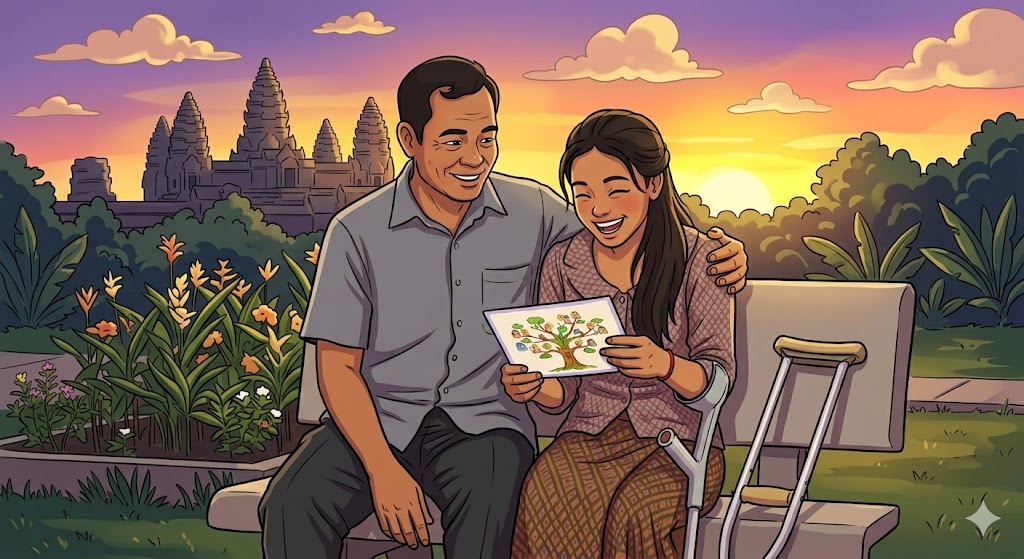
With trembling hands, I reached out and picked up the laminated piece of paper. It was a brightly colored, hand-drawn illustration of a massive, beautiful family tree. The branches were filled with names, vibrant leaves, and small sketches of smiling faces. But it was the writing at the very bottom that made the air completely rush out of my lungs.
Written in shaky but deeply determined handwriting, the note read:
“Happy Anniversary, Mom. I brought Dad’s smile with me today. I’m doing great, and I know you’re watching over me.”
The Weight of a Name
A choked sob escaped my throat, the sound tearing through the quiet cemetery. I stared at the signature beneath the note. It was a beautiful name, one that filled me with an instant, piercing recognition.
Seventeen years ago, I had signed away my rights to a child I called a “burden.” I had left her with nothing but the clothes on her back and the hospital medical records. But someone had taken her in. Someone had given her a name, loved her, and raised her to know exactly who her mother was.
Worse yet, she knew about me. The note said she brought “Dad’s smile” with her. Did she look like me? Did she possess pieces of my expressions despite my total abandonment of her?
As I sat there in the dirt, clutching the drawing against my chest, a sudden sound shattered the silence. The distinct, rhythmic crunch of gravel echoed from the path behind me.
A Patient Approach
I froze, my heart pounding violently against my ribs as I slowly turned my head.
Walking down the narrow pathway toward our plot was a young woman. She was leaning heavily on a pair of forearm crutches, her legs moving with a slow, irregular, and distinctly uneven stride. Every step required immense, visible effort, but she carried herself with an undeniable, breathtaking grace.
Beside her walked a man at a patient, measured pace. He didn’t try to hurry her or carry her; he simply walked by her side, his calm, steady presence acting as a silent anchor of support.
As they drew closer, the young woman’s eyes locked onto mine. She stopped walking, resting her weight on her crutches.
I looked up into her face, and my breath caught entirely. She had my jawline, but her eyes—wide, deep, and beautifully expressive—belonged entirely to my late wife.
Part 3: Standing Face-to-Face
I stood up slowly from the dirt, my legs shaking so violently I could barely keep my balance. The laminated family tree was still clutched tightly in my right hand. I wanted to run, to hide, to shield myself from the absolute shame of looking into the eyes of the child I had abandoned seventeen years ago.
But I couldn’t move. Her gaze held me in place.
She took one more careful, rhythmic step forward on her crutches, stabilizing herself before looking down at the dropped bouquet of flowers on the grass, and then back up to my face.
“You’re him, aren’t you?” she asked softly. Her voice wasn’t filled with bitter anger or spite. It was calm, clear, and carried a gentle maturity that cut straight through my soul.
I tried to speak, but all that came out was a broken, choked sob. I simply nodded, the tears cascading freely down my cheeks.
A Father’s Shame
“I’m sorry,” I managed to whisper, my voice cracking under the weight of seventeen years of buried guilt. “I am so, so sorry. I was a coward. I looked at you through that glass window, and I let my fear ruin me. I thought… I thought I couldn’t handle the burden. I didn’t even hold you.”
The man standing beside her gently stepped back a pace, keeping his steady, reassuring eyes on her, letting her handle this moment on her own terms.
My daughter looked at me for a long, quiet moment. Then, she let out a soft breath and shifted her weight on her crutches.
“I know,” she said quietly. “The foster care agency gave me to an incredible family who eventually adopted me. They never hid the truth from me. They told me about my mother’s passing, and they told me that my biological father left because he was broken by grief. For a long time, I wondered what you looked like. But I never hated you.”
Stronger Than Fear
Hearing her words felt like a knife directly to my heart—not because they were harsh, but because I didn’t deserve her grace.
“You don’t hate me?” I asked, my voice barely audible.
“No,” she said, a small, beautiful smile breaking through the solemnity of her face. “Hate is a heavy burden to carry, and my body already carries enough weight. My adoptive parents taught me that a person’s worth is never measured by their physical limitations. I have a happy family, a beautiful life, and I am thriving. I came here today to tell Mom that she doesn’t need to worry about me.”
She looked at the drawing in my hand. “I drew that family tree because, despite everything, you are still a part of my story. You gave me life, and Mom gave her life for me to be here. I am strong enough to forgive the man who wasn’t strong enough to stay.”
Part 4: The Path to Healing
The silence in the cemetery was heavy, but it was no longer cold. I looked at my daughter, her hands firmly gripping her forearm crutches, standing tall with a dignity that completely eclipsed my years of cowardice.
“I don’t deserve your forgiveness,” I choked out, the tears burning my eyes as I stepped closer, careful to respect her space. “I threw away the greatest gift your mother gave me because I was afraid of the dark days. I called you a burden… and yet here you are, carrying the light for both of us.”
She looked down at the gravestone, her expression soft and reflective. “My adoptive parents always told me that people do terrible things when they are paralyzed by fear and grief. If I kept holding onto anger, I would be letting your past fear control my present happiness. I chose a long time ago to live a beautiful life, not a bitter one.”
A Bridge Over the Past
The man standing a few paces behind her stepped forward gently. He offered a warm, polite nod—his calm, steady presence acting as a silent guardian for her during this intense emotional reunion.
“She has spent her whole life defying expectations,” he said softly, his voice full of absolute pride. “She doesn’t just survive; she inspires everyone around her to be better. Your wife would be incredibly proud of the woman she became.”
My daughter reached out a hand, her fingers steady. “You don’t have to carry the guilt anymore,” she said gently. “I am whole. I am loved. And if you are ready to stop running, you can know the daughter you walked away from.”
I fell to my knees again, pressing my forehead against her hand, weeping tears of absolute gratitude and relief. The bridge I had burned seventeen years ago hadn’t been completely destroyed; it had been rebuilt by the pure, unshakeable strength of a child’s grace.
The Power of Moving Forward
We spent the rest of the afternoon sitting on a stone bench near my wife’s resting place, talking for hours. I listened as she shared stories of her childhood, her achievements in school, and her dreams for the future. For the first time in nearly two decades, the suffocating cloud over my heart completely vanished, replaced by a radiant sense of hope.
The road ahead wouldn’t erase the years we lost, and the physical challenges she faced would still be there, but the isolation was over. We were no longer strangers separated by a glass window. We were standing together, moving forward into the light.
Part 5: The Gift of Togetherness
A year passed, and the quiet bench by my wife’s resting place became the foundation for a beautiful, unexpected new chapter in my life. The heavy, suffocating shadow of my past cowardice had completely dissolved, replaced by a deep sense of purpose. I was finally given the chance to do what I should have done seventeen years ago—to stand by my daughter, not as a source of fear, but as a source of unwavering support.
With the blessing of her wonderful adoptive parents, I became a regular, joyful presence in her life. I attended her milestones, cheered the loudest at her events, and learned to celebrate the incredible, resilient rhythm of her world.
One warm Saturday afternoon, we returned together to the quiet community cemetery to celebrate her eighteenth birthday. As we walked down the stone pathway, the rhythmic, steady click of her crutches sounded like music to my ears.
She stopped in front of the marble headstone, which was now beautifully surrounded by blooming flowers we had planted together. She turned to look at me, her face illuminated by a radiant, peaceful smile.
“For seventeen years, I came here alone to talk to Mom,” she whispered, a tear of pure happiness glistening in her soulful eyes. “I used to tell her about my dreams and my struggles. But today, I get to show her that I’m not walking this path by myself anymore. You didn’t just find me, Dad. You found your way back to her legacy.”
The Eternal Circle
I wrapped my arms gently around her, looking up at the clear blue sky with a profound sense of peace. The tiny baby I had once abandoned behind a glass window out of sheer terror had grown into a brilliant beacon of light, guiding me out of my own darkness.
That evening, as the sun began to dip below the horizon, casting a soft, warm cream glow across the grass, we sat together on our favorite stone bench. She pulled a new drawing from her bag and laid it gently against the gravestone.
It was a beautifully detailed continuation of the family tree she had brought the year before, but this time, the branches were wider, connecting her adoptive family, her late mother, and me into one grand, unified circle of love.
At the very bottom, her steady script read:
“Love doesn’t demand perfection. It just asks that you show up, hold tight, and refuse to let go.”
We sat hand-in-hand in the quiet twilight, knowing that while the past could never be rewritten, our future was completely secure, wrapped in an unbreakable bond of grace, forgiveness, and family.
Part 6: The Unbroken Circle
A year after her eighteenth birthday, we stood together in the small garden behind my new home. The late afternoon sun cast a soft, warm cream glow across the lawn, reflecting beautifully off the vibrant flowers we had planted. Against all odds, and with the immense resilience she had shown her entire life, my daughter was stepping into a brand-new chapter.
She stood beside her adoptive father, leaning lightly on her forearm crutches, looking absolutely radiant in a simple, elegant dress. Today was her graduation day, a milestone many doctors had told us she might never reach.
As she walked across the grass to accept her diploma from her adoptive parents, she stopped and looked over at me. She gave me that familiar, soulful smile that belonged entirely to my late wife.
In that moment, the man who had once been a silent anchor by her side walked over and placed a reassuring hand on my shoulder.
“You did good, dad,” he said softly, his voice full of steady pride. “You stopped running, and you showed up when she needed you most.”
The Ultimate Victory
I smiled, a profound, overwhelming sense of peace finally settling deep into my soul.
After the celebration, my daughter and I walked up to the small study in my house. Resting there on the table, in a place of total honor, was the very first family tree drawing she had left at the gravestone. Beside it lay a new frame, ready for her graduation photograph.
I looked at her, remembering the sterile hospital corridor, the bitter terror, and the cruel words I had spoken seventeen long years ago. I had running away from a “burden,” only to realize that the only true burden I ever carried was the weight of my own cowardice.
She hadn’t needed a perfect father; she just needed a man brave enough to stop running and love her exactly as she was. My wife had given her life to bring this miracle into the world, and though I had stumbled in the dark for nearly two decades, my daughter’s grace had safely guided me back to the light.
Epilogue: The Unbroken Circle
A year after her eighteenth birthday, we stood together in the small garden behind my new home. The late afternoon sun cast a soft, warm cream glow across the lawn, reflecting beautifully off the vibrant flowers we had planted. Against all odds, and with the immense resilience she had shown her entire life, my daughter was stepping into a brand-new chapter.
She stood beside her adoptive father, leaning lightly on her forearm crutches, looking absolutely radiant in a simple, elegant dress. Today was her graduation day, a milestone many doctors had told us she might never reach.
As she walked across the grass to accept her diploma from her adoptive parents, she stopped and looked over at me. She gave me that familiar, soulful smile that belonged entirely to my late wife.
In that moment, the man who had once been a silent anchor by her side walked over and placed a reassuring hand on my shoulder.
“You did good, dad,” he said softly, his voice full of steady pride. “You stopped running, and you showed up when she needed you most.”
The Ultimate Victory
I smiled, a profound, overwhelming sense of peace finally settling deep into my soul.
After the celebration, my daughter and I walked up to the small study in my house. Resting there on the table, in a place of total honor, was the very first family tree drawing she had left at the gravestone. Beside it lay a new frame, ready for her graduation photograph.
I looked at her, remembering the sterile hospital corridor, the bitter terror, and the cruel words I had spoken seventeen long years ago. I had spent two decades running away from a “burden,” only to realize that the only true burden I ever carried was the weight of my own cowardice.
She hadn’t needed a perfect father; she just needed a man brave enough to stop running and love her exactly as she was. My wife had given her life to bring this miracle into the world, and though I had stumbled in the dark for nearly two decades, my daughter’s grace had safely guided me back to the light.
THE END.