“Your son hasn’t eaten his lunch since November, Mrs. Anderson,” Linda said over the phone. Her voice dropped to a quiet whisper, and I could hear the clanging of metal trays in the background. “I wouldn’t normally call, but I watched him again today. He handed his entire blue lunchbox to the same little girl. She ate like she hadn’t seen food in days.”
My hand tightened around the kitchen phone. The dryer was humming in the utility room, a normal, boring sound that suddenly felt completely out of place. I looked down at the grocery list on my counter.
Every Sunday, I spent 45 dollars on deli turkey, honeycrisp apples, and organic juice boxes. I packed them neatly into Toby’s faded blue canvas lunchbox. I thought my seven-year-old was just going through a massive growth spurt. He always came home from school starving, asking for seconds before dinner was even ready.
Now, it all made sense. He was coming home hungry because he was giving his entire lunch away. Every single day. For five months.
“The girl’s name is Lily,” Linda continued. “She wears the same stained yellow sweatshirt every single week. And Mrs. Anderson, I noticed a dark purple bruise on her wrist when she reached for the sandwich today.”
Something cold settled deep in my stomach. I didn’t even hang up the phone properly. I just grabbed my keys off the counter, ran out to my Chevy, and drove straight to Oak Creek Elementary. The winter wind was howling through the bare Wisconsin trees, throwing dry leaves against my windshield. I couldn’t get the image of a bruised wrist out of my head.
I think it was a Thursday. No, it was a Wednesday, because Wednesday was my grocery shopping day. I remember that detail because my trunk was still full of food when I pulled into the school parking lot.
I walked past the main office, barely nodding at the receptionist, and went straight out to the playground. It was recess. The children were running around, their loud laughter filling the cold air. But I didn’t look at them. I scanned the edges of the yard.
I found them sitting on the bottom step of the rusty fire escape at the back of the building.
Toby was sitting there with his knees pulled up to his chest. Beside him was Lily. She was tiny, far too small for a seven-year-old. She was clutching Toby’s blue lunchbox like it was a treasure chest.
As I walked closer, I noticed her yellow sweatshirt. It was worn thin at the elbows, the cuffs gray with dirt. Her sleeves were pulled all the way down, covering her hands.
“Toby,” I called out softly.
My son looked up, his face turning pale. He immediately stood up, stepping slightly in front of Lily as if to shield her. He looked like he thought he was in deep trouble.
“Mom, please don’t be mad,” Toby whispered, his eyes swimming with tears. “I’m sorry I lied about eating the apples.”
I knelt down on the cold asphalt, my knees cracking. I looked at Lily. She had wide, hollow brown eyes that looked far too old for her face. When she saw me, she pulled the blue lunchbox closer to her chest and shrank back against the brick wall.
“I’m not mad, sweetheart,” I said, looking at my son. “But I need to know why you’re giving your lunch away.”
Toby looked at Lily, then back at me. He leaned in, his warm breath smelling faintly of the cinnamon crackers I had packed him the day before.
“She told me her dad locks the fridge at night,” Toby whispered. “And she said if she asks for food, he makes her sleep in the cold room.”
I stopped breathing for a few seconds. I didn’t notice I was holding my breath until my chest started to hurt. I looked at Lily’s wrists. One of her sleeves had ridden up slightly, revealing a dark, yellowish-purple ring around her small bone. It looked exactly like the shape of an adult’s hand.
I got up, walked back to my car, and sat in the driver’s seat with the engine running. My hands were shaking so badly I could barely press the numbers on my phone screen. I called Child Protective Services.
“I need someone at 142 Elm Street immediately,” I told the operator, my voice cracking. “There is a little girl starving, and her father is locking up the food.”
The caseworker, Sandra, met me at the school parking lot 40 minutes later. She looked like she had been doing this job for thirty years. Her face was lined with exhaustion, and her eyes were heavy, but her jaw was set. She told me to follow her in my car.
We drove to a small, neglected green ranch house on the edge of town. The siding was covered in green mold, and the front porch steps were visibly rotting. It was the kind of house people drove past quickly.
Sandra walked up the steps and knocked firmly on the door. I stood a few paces behind her, my heart hammering against my ribs.
An adult man opened the door. He was wearing a clean polo shirt, khaki pants, and holding a mug of steaming coffee. He looked completely normal. He actually smiled at us, his eyes crinkling at the corners.
“Can I help you ladies?” he asked, his voice polite and warm.
“Mr. Vance?” Sandra asked, holding up her badge. “I’m Sandra Miller with Child Protective Services. We received a report regarding your daughter, Lily.”
Richard Vance didn’t flinch. He didn’t look angry. He just let out a soft, tired sigh, like a parent who was used to dealing with difficult school rumors.
“Oh, I see,” Richard said, leaning against the doorframe. “Let me guess. The school called? Lily has a very active imagination, Ms. Miller. She has been making up stories lately because we had to cut back on sugar. Kids make things up when they don’t get their way.”
“I understand,” Sandra said, her voice remaining perfectly flat and professional. “But as part of our protocol, I need to do a quick walk-through of the home. Especially the kitchen and Lily’s sleeping area.”
Richard’s smile didn’t fade, but I noticed his grip on the coffee mug tightened. His knuckles turned slightly white.
“Of course,” he said, stepping aside. “We have nothing to hide. Come on in.”
The inside of the house smelled like pine cleaner, but it was incredibly sparse. There were no toys on the floor, no family photos on the walls. It felt cold, like an empty motel room.
We walked into the kitchen. My eyes went immediately to the refrigerator.
My stomach dropped.
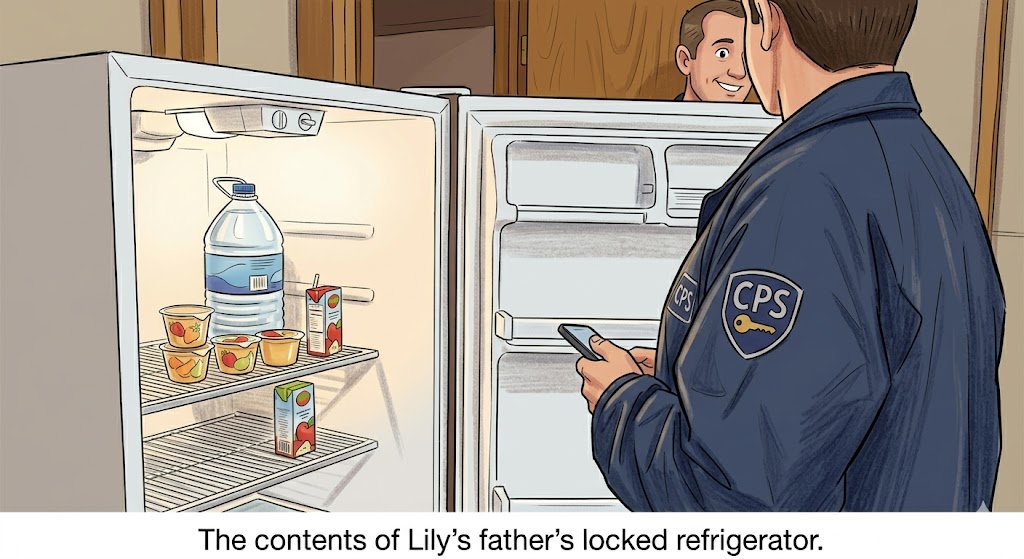
Bolted directly into the stainless steel door of the fridge was a heavy, black iron padlock. The keys were nowhere to be seen. The kitchen cabinets also had small silver latches on them, all secured with padlocks.
Sandra stopped in front of the fridge. She pointed to the padlock.
“Can you explain this, Mr. Vance?” she asked.
Richard laughed, a casual, dry sound. “Lily has a sleepwalking issue. She cleared out the pantry in her sleep a few weeks ago, almost choked on some dry rice. It’s for her own safety. I unlock it when I’m awake.”